



Abstract
Two studies (n = 1,522) examined the impact of role models in sport and science, technology, engineering, and mathematics (STEM) domains where gender discrimination has resulted in a lack of high-profile women. We examined the role of gender matching of personally known and famous exemplars on women's and men's motivation. Participants nominated a woman or man in sport (Study 1) or STEM (Study 2) who was either famous or known to them personally; they then indicated the extent to which they perceived this individual to be a motivating role model. Women and men were more motivated by personally known (vs. famous) role models. For famous exemplars, both women and men were most motivated by same-gender models (Studies 1 and 2). For personally known exemplars, men were similarly motivated by same- and other-gender models (Studies 1 and 2), but women were more motivated by same-gender models in sport (Study 1). Mediation analyses indicated that personally known (vs. famous) exemplars and, for women, same- (vs. other-) gender exemplars, were perceived as more attainable future selves and consequently were more motivating (Study 2). Given that there are fewer famous women in domains dominated by men, it is important to know if women can be inspired by personally known rather than famous individuals. These studies provide insight into the kinds of exemplars that are most motivating for women and may serve as a guide for educators and other practitioners seeking to provide the best role models for girls and women in domains dominated by men. Additional online materials for this article are available on PWQ's website at http://journals.sagepub.com/doi/suppl/10.1177/03616843231156165.
In 2018, Donna Strickland became the first woman to win the Nobel Prize for Physics in over 60 years; media stories highlighted the significance of her success, noting that she would serve as a valuable role model for future generations of women in science (Casey, 2018; Nusca, 2018). The fact that this achievement was so unusual, however, points to a challenge for women seeking role models in fields dominated by men. Given that women's successes are often undervalued or underreported (Biscomb & Matheson, 2019; Coche, 2015; Cooky et al., 2015; Sherry et al., 2016), it may be difficult for aspiring women to find inspirational same-gender examples in such domains. When famous same-gender exemplars are unavailable, women may instead seek inspiration from exemplars of success whom they know personally—a chemistry teacher rather than a Nobel prize winner; a local baseball coach rather than a major league baseball superstar. It is unclear, however, whether such personally known exemplars will be as motivating as celebrities. In the present research, we examined this directly, assessing the importance of gender matching in determining the motivating impact of both personally known and famous exemplars.
Importance of Same-Gender Role Models
In their motivational theory of role modeling, Morgenroth et al. (2015) define role models as “individuals who influence role aspirants’ achievements, motivation, and goals by acting as behavioral models, representations of the possible, and/or inspirations” (p. 4); they argue that role aspirants will be inspired by role models to the extent that they perceive those models to represent goal embodiment, attainable achievements, and desirable outcomes. For women in fields dominated by men, who see few examples of same-gender others in high-level positions, it may be especially important to have women role models who embody their goals and serve as inspirational representations of possible future success. These models provide valuable evidence that such achievements are attainable for women in domains traditionally dominated by men (Midgley et al., 2021) and may provide a useful template guiding women's behavior as they seek similar success (Lockwood, 2006). Further, women who have achieved a high level of success may illustrate that such achievements are not only possible, but also desirable; women may be more likely to admire same-gender exemplars of success, and consequently be more motivated to adopt behaviors aimed at pursuing similar accomplishments (Morgenroth et al., 2015). Thus, same-gender role models may be particularly motivating for women in fields dominated by men, by representing attainable success, providing guides to behavior, and activating inspiration.
Indeed, a growing body of research suggests that women benefit from exposure to successful same-gender role models in fields traditionally dominated by men. For example, in one set of studies examining athletic role models, men were similarly motivated by women and men, but women were more motivated by women than men (Midgley et al., 2021). Role models who are women boost other women's motivation and performance (Herrmann et al., 2016; Marx et al., 2013; Midgley et al., 2021) and enhance their interest in pursuing science, technology, engineering, and mathematics (STEM) fields, in particular (Olsson & Martiny, 2018; Pietri et al., 2020; Shin et al., 2016; Stout et al., 2011). Matching role models on gender may be particularly effective because women are more likely to identify with successful women than men (Lockwood, 2006; Midgley et al., 2021) and because successful women provide compelling evidence refuting traditional stereotypes that men are superior in STEM fields (Midgley et al., 2021; Van Camp et al., 2019; Young et al., 2013). Thus, same-gender role models may serve as embodiments of women's goals and provide valuable representations of what is possible, which in turn may encourage women to acquire similar skills, reinforce their goals, and motivate them (Morgenroth et al., 2015).
Famous Versus Personally Known Role Models
Despite clear evidence that same-gender role models are more motivating than different-gender role models, it is less clear whether such same-gender exemplars are most motivating when they are famous or whether they may also be motivating when they are personally known. In fields that are heavily dominated by men, this distinction is important because women may find it difficult to identify relevant high-profile examples of other women's success stories. Given that there are no women's professional teams at the highest levels of many sports, for example, it may not be possible for aspiring women athletes to identify same-gender celebrity role models who are comparable to role models who are men; there are no examples of famous women who have played on winning teams in the World Series, Stanley Cup, or Superbowl. Even when professional women's teams exist, as with the WNBA, they are not afforded the same media prominence as men's leagues (Spruill, 2017; Yip, 2018), and players are consequently less likely to be household names. Indeed, when asked to nominate a role model in sports, both men and women participants were most likely to generate names of athletes who are men (Giuliano et al., 2007; Midgley et al., 2021), even though women found same-gender examples to be most motivating (Midgley et al., 2021).
Similarly, whereas individuals may find it easy to generate examples of well-known men in STEM fields (e.g., Albert Einstein, Stephen Hawking), they likely have access to fewer such prominent examples of women (e.g., Marie Curie, Katherine Johnson). Although women's share of prestigious international awards in science and engineering has increased in the past 20 years, women received only 19% of these awards from 2016 to 2020 (Meho, 2021). As of 2019, out of the 210 Nobel Prizes in science and economic fields since 1901, only 22 had gone to women (Guterman, 2019), and in 2021, all seven of the Nobel science prize (Physics, Chemistry, and Medicine) winners were men (Nobel Prizes 2021, n.d.). Thus, although women may benefit from same-gender role models, a lack of support for women's achievements may make it difficult for them to identify well-known examples of women who have achieved success in domains traditionally dominated by men.
Given the dearth of publicly lauded women in domains dominated by men, it is important to consider whether personally known role models would be as motivating as famous role models. It is possible that, if their achievements are less spectacular than those of celebrity examples, nonfamous role models may be less inspirational; a college professor's modest success may be less motivating than that of a Nobel laureate. To the extent that a famous exemplar's achievements are more publicly praised, they may seem more admirable and desirable; a desirable role model may in turn be more inspiring (Morgenroth et al., 2015). Alternatively, it may be that the success of a personally known role model appears to be more attainable, and thus may actually be more motivating than a celebrity's success; past research suggests that role models are most inspiring when their success appears within reach (Diel et al., 2021; Lockwood & Kunda, 1997). In one study, for example, participants were more successful in a math task after they were exposed to a nonfamous than a famous scientist (Hu et al., 2020, Study 2). Moreover, when asked to nominate a role model, participants were more likely to generate the name of someone they knew personally than someone famous (Lockwood, 2006; Midgley et al., 2021). Accordingly, although personally known role models may receive less public adulation for their success, we expected that they would nevertheless be more inspirational than would famous role models, for both women and men.
To date, research has not directly compared the impact of famous and personally known role models. A number of studies have examined the impact of role models unknown to participants, including successful exemplars who are famous (Giuliano et al., 2007; Hoyt, 2013; Hoyt & Simon, 2011; Hu et al., 2020, Study 1; Latu et al., 2019, Study 1; Midgley et al., 2021), nonfamous and created for the purpose of the study (Betz & Sekaquaptewa, 2012; Herrmann et al., 2016; Hu et al., 2020, Studies 2 and 3; Lockwood & Kunda, 1997, 1999; Marx et al., 2013; Marx & Ko, 2012; Shin et al., 2016), nonfamous confederates (Cheryan et al., 2011, 2013; Stout et al., 2011, Studies 1 and 2), or real but not famous (Pietri et al., 2020). These studies suggest that same-gender role models who are not personally known can have a positive impact on women. For example, women who read about a (fictional) highly successful woman in their own field rated themselves more positively than those who read about a man (Lockwood, 2006). Additionally, exposure to a positive famous (Latu et al., 2019; Stout et al., 2011, Study 2) or nonfamous (Marx & Ko, 2012) same-gender (vs. other-gender) role model has been associated with better performance on subsequent tasks.
Other studies focusing on the impact of personally known models also suggest that gender is important (Stout et al., 2011, Study 3; Young et al., 2013). For example, women in science and engineering courses who viewed their science professor, who was a woman, as a role model showed a decrease in their implicit endorsement of gendered science stereotypes, and were more likely to show increased implicit science identities (Young et al., 2013). Similarly, women students identified more with math and expected to receive higher grades when their professor was a woman than a man (Stout et al., 2011, Study 3). These studies did not, however, compare the impact of personally known relative to famous role models, nor did they measure motivation. In one study that did include both famous and personally known examples (Wohlford et al., 2004), participants reported that their personally known role models had a greater influence on them than their famous role models; however, this study did not examine whether gender matching of these personally known role models was more important for women than men. Indeed, because participants were not randomly assigned to consider role models who were women or men, the value of matching personally known and famous role models on gender remains unclear. In addition, because participants were undergraduate students from a range of disciplines, this study did not examine how the impact of personally known or famous role models, either same- or other-gender, might differ for women and men in fields traditionally dominated by men.
Gender Matching and Whether Role Models Are Famous Versus Personally Known
In domains dominated by men, whether a role model is personally known or famous might interact with whether that model is same- or other-gender in determining the model's motivational impact. Past research suggests that, in domains traditionally dominated by men, such as athletics, women are more motivated by same-gender role models than men (Midgley et al. 2021). However, the bulk of this research (Midgley et al., 2021; Studies 1, 2, and 4) did not distinguish between role models who were personally known and those who were famous; rather, participants were simply asked to nominate an athlete and rate the extent to which they were motivated by that exemplar. In one study that did distinguish between personally known and famous exemplars (Midgley et al., 2021; Study 3), varsity and recreational athletes were asked to describe an athletic role model who motivated them and indicate whether or not they knew the role model personally; women (vs. men) and varsity (vs. recreational) athletes were more likely to describe a role model whom they knew personally. Because this study did not directly compare participants’ motivation by personally known and famous role models, however, it is unclear what the relative impact of these role models might be on women and men.
In the case of famous role models, both women and men may be most likely to be motivated by same-gender examples. Indeed, when individuals believe that gender is related to performance, they are most likely to compare themselves to and be influenced by same-gender others (Zanna et al., 1975). Gender matching may also be associated with greater motivation for women even in domains where famous role models who are women are scarce. Indeed, because women in such domains are minority group members, gender may be especially salient to them (Abrams et al., 1990; Hogg & Turner, 1987; McGuire et al., 1978), such that matching on gender may be an important determinant of the impact of a role model. Further, in contexts dominated by men, such as STEM, women will be particularly likely to identify with their gender (van Veelen et al., 2019), and so may be most inspired by a role model who is the same gender. Consistent with this possibility, past research on social comparison suggests that women are especially likely to compare themselves to and be influenced by same-gender others (Crocker & Blanton, 1999; Martinot et al., 2002). In sum, for famous role models, gender matching may be important for both men and women.
In the case of personally known role models, gender matching may be less important for men; to the extent that they share a personal connection with the model, they may be able to draw other parallels between themselves and the role model, and so be motivated regardless of the model's gender. Indeed, past research on social comparison indicates that individuals may be influenced by others with whom they share similarities on a variety of attributes related to performance (Goethals & Darley, 1987) or even similarities unrelated to performance, such as a shared birthday (Brown et al., 1992). When one knows a potential role model personally, one may be more aware of such similarities than would be the case for a famous role model. For women, however, gender matching may remain important even for personally known role models, over and above other possible similarities. Given women's minority group status, gender will continue to be salient, such that women will be more influenced by exemplars who are women than men. In addition, people assume greater similarity between individuals who share distinctive rather than nondistinctive attributes (Nelson & Miller, 1995); women may see greater parallels between themselves and other women in fields dominated by men, again due to their distinct minority status. Thus, for personally known role models in such domains, matching on gender may be more important for women than for men.
In sum, it is important to understand whether women in fields dominated by men, who have access to relatively few famous examples who are women, might benefit from personally known role models. However, no research to date has examined how the impact of personally known and famous role models on women's and men's motivation might differ, depending on whether those role models are gender-matched. We examined this directly.
The Present Research
In two studies, we compared the motivating impact of famous and personally known exemplars, same- and other-gender, on women and men. Participants in two domains dominated by men, athletics (Study 1) and STEM careers (Study 2), were randomly assigned to nominate a successful woman or man who was either famous or personally known. We examined three hypotheses. We predicted that, for both women and men, personally known exemplars would be more motivating than famous exemplars (H1). We also predicted that the importance of gender matching and whether an exemplar was famous or personally known would interact with individuals’ own gender in predicting how motivating they would find an exemplar to be. Specifically, we expected that both women and men may find famous same-gender exemplars most motivating (H2). For personally known exemplars, on the other hand, we expected that gender matching would be important primarily for women (H3); men may be able to find connections with a personally known exemplar other than gender, and so find them to be motivating. Because gender may be more salient to women than men in fields dominated by men (Abrams et al., 1990), women may continue to benefit most from gender-matched exemplars, even those whom they know personally. After first examining gender matching of personally known and famous exemplars in the domain of athletics in Study 1, we conducted a follow-up Study 2 in the STEM domain, for which we preregistered our plans for analyses before finishing data collection.
On an exploratory basis, we also examined the perceived future attainability of exemplars as a potential mechanism underlying the effects of whether an exemplar is famous or personally known (H4, exploratory) and the interaction of the exemplar type (famous or personally known) with participant gender and exemplar gender (H5, exploratory) on motivation (Study 2). We expected that personally known exemplars’ achievements would be perceived as more attainable and more representative of future selves, which in turn would be associated with greater motivation (H4). Past research (Lockwood, 2006; Midgley et al., 2021) found that women were more likely to be motivated by successful exemplars to the extent that they viewed the exemplars as possible selves, and saw their achievements as attainable; however, it is unclear whether this effect holds true for both famous and personally known role models, or whether the attainability of personally known role models (which women may rely on more) is differently influenced by gender matching. We thus examined whether women would perceive same-gender exemplars to be more attainable future selves, particularly when they are personally known, and whether this in turn would be associated with greater motivation (H5).
Study 1
In Study 1, women and men were asked to generate the name of either a woman or man who was successful in the athletic domain, and who was either famous or known to them personally. We then examined the degree to which they perceived the athlete to be a motivating role model. We predicted that both women and men would find personally known athletes most motivating (H1), and that they would also be most motivated by same-gender famous athletes (H2). In addition, we predicted that, for personally known athletes, women would be especially likely, relative to men, to be motivated by same-gender examples (H3).
Method
Ethics approval for the study was obtained from the University of Toronto Social Sciences, Humanities, and Education Research Ethics Board before data collection. Data were collected between September 19, 2018 and October 3, 2018, and data and syntax are available upon request from the corresponding author.
Participants
We recruited 856 Amazon's Mechanical Turk workers who had previously indicated that they participated in sports/physical activity (e.g., running) at least once per week; the latter was assessed using a scale ranging from 1 (less than 1 h/week) to 6 (5+ hours per week) with a median response of 4 (3–4 h/week). All participants who completed the survey were compensated with $2 USD. Data were cleaned as it was coming in to reach our target sample size of approximately 800 participants (i.e., 200 per condition) who had completed 70% or more of the survey.
In total, we excluded data from 58 participants who completed less than 70% of the survey, 11 participants who indicated, in an attention check, that the individual they listed was not involved in sport or physical activity, six participants who were asked to name an athlete who was a woman but later indicated the person they named was a man, two participants who were asked to name an athlete who was a man but later indicated the person they named was a woman, 16 participants in the personally known condition who indicated that they did not in fact know the athlete or who named someone identified by a research assistant as a famous public figure, and 22 participants in the famous athlete condition who listed an individual whom they later indicated was not famous or whom our research assistants could not find any online reference to as a public figure. Finally, we excluded data from seven participants who did not identify as a woman or man or did not disclose a gender identity. In the current research, we did not have sufficient power to examine gender as a continuous or multinomial variable and thus were unable to include data from these participants. We look forward to future studies that examine how gender and fame of exemplars impact athletes across the gender spectrum.
The final sample consisted of 734 participants: 391 (53.27%) women, 343 (46.73%) men; Mage = 38.49, SD = 11.78 years. When asked to indicate their ethnicity/race, 552 (75.20%) participants identified as White/European, 66 (8.99%) as African/Black, 44 (5.99%) as Hispanic/Latinx, 33 (4.50%) as Asian, six (0.82%) as East Asian, five (0.68%) as Native American/American Indian, two (0.27%) as Southeast Asian, two (0.27%) as South Asian, and 18 (2.45%) as biracial or having multiple ethnic/racial identities; six (0.82%) of participants did not provide an ethnicity/race. IP addresses indicated most participants resided in the United States (708; 96.46%); of the remaining participants, four (0.54%) resided in Canada, four (0.54%) in India, four (0.54%) in Venezuela, three (0.41%) in Mexico, and 11 (1.50%) in other countries. Post hoc sensitivity analyses indicated that our sample size provided 99.99% power to detect medium effects and 77.21% power to detect small effects in a three-way ANOVA.
Procedure
After providing informed consent, participants were randomly assigned to fame condition (famous or personally known) and gender of athlete (woman or man). Specifically, participants were either asked to think of an athlete they knew personally with the prompt: “Think of a female [male] athlete or athletic woman [man] whom you know or have interacted with in person. Ideally, this is someone you know well, but can also be an acquaintance” or were asked to think of a famous athlete who is well-known to the general public with the prompt: “Think of a famous female [male] athlete or athletic woman [man]. Ideally, this would be someone known to the general public.”
After entering an athlete's name, participants were asked a series of questions about the athlete that served as both attention and manipulation checks. First, participants provided an open-ended description of the athlete they nominated and their primary sport. These responses were later reviewed by a research assistant unaware of the study hypotheses to verify that participants had nominated a specific athlete who fit the criteria of the condition to which the participant was assigned. Additionally, participants indicated the extent to which they perceived the athlete they nominated as famous on a 7-point Likert scale ranging from 1 (strongly disagree) to 7 (strongly agree) and whether they knew the athlete personally or not.
Next participants responded to five items about the athlete as a role model (Midgley et al., 2021): “[athlete's name, as entered by the participant] is a role model for me,” “[athlete's name] is someone I strive to be more like,” “[athlete's name] is a representation of what I would like to be in the future,” “[athlete's name] sets an example that I would like to follow,” and “I would like to be more like [athlete's name].” Participants then completed six items assessing motivation: “[athlete's name] motivates me,” [athlete's name] makes me feel determined,” “[athlete's name] encourages me,” “[athlete's name] makes me want to work harder,” “[athlete's name] makes me want to put more effort into achieving my goals,” and “[athlete's name] inspires me.” Ratings were made on a 7-point Likert scale with endpoints ranging from 1 (strongly disagree) to 7 (strongly agree). Answers to all 11 statements were averaged to create a single index of the degree the participant saw the named athlete as a motivating role model (α = .97). Finally, participants answered demographic questions about themselves, which included items in which they reported their own gender and the primary sport or physical activity in which they participate.
Results
Manipulation Check
As expected, a one-sample t-test indicated that participants in the famous condition viewed the athletes they named as more famous (M = 6.68, SD = 0.76) than did participants in the personally known condition (M = 2.58, SD = 1.83), t(732) = 39.63, p < .001, d = 2.93, 95% CI [2.71, 3.13].
Sports of Athletes and Participants
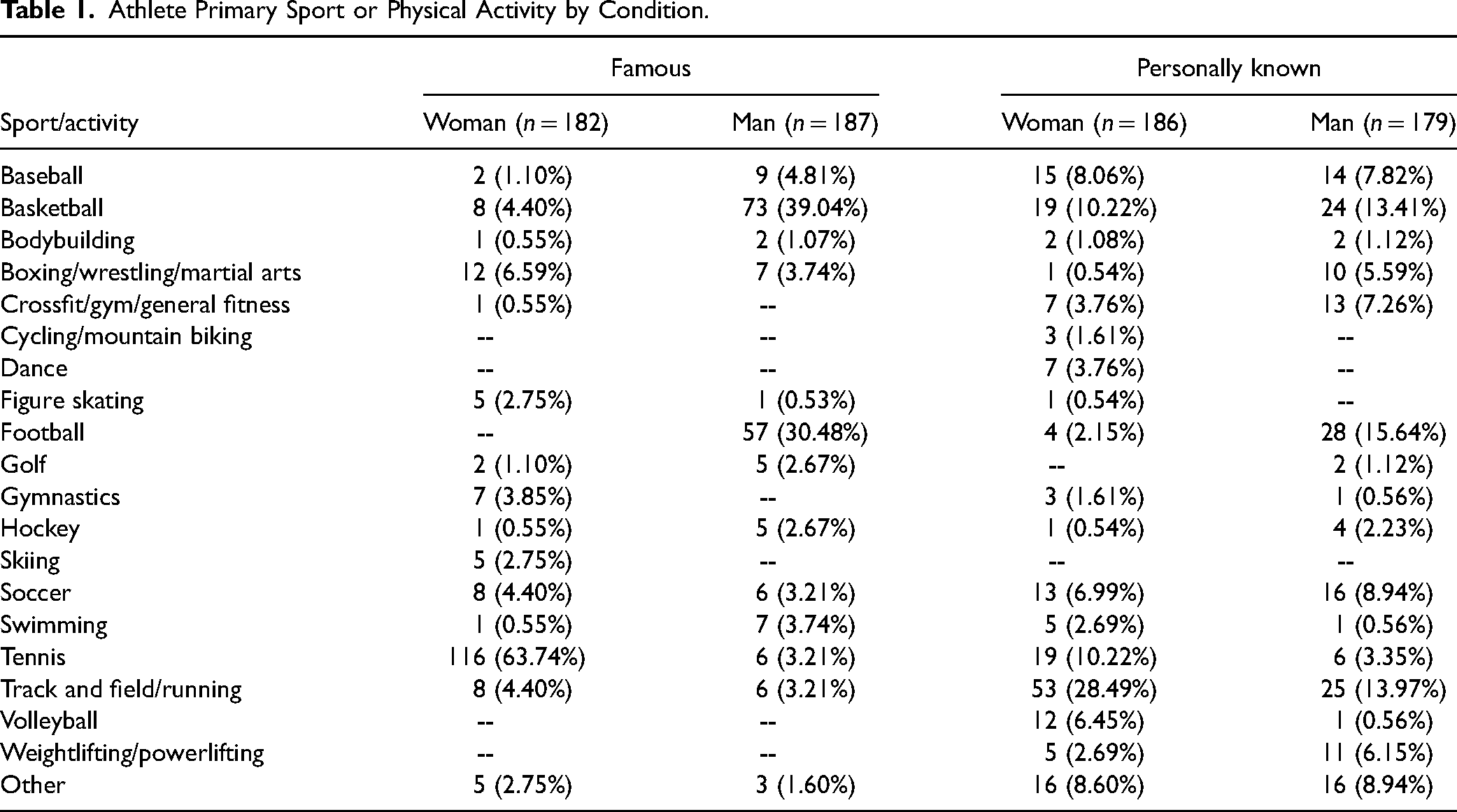
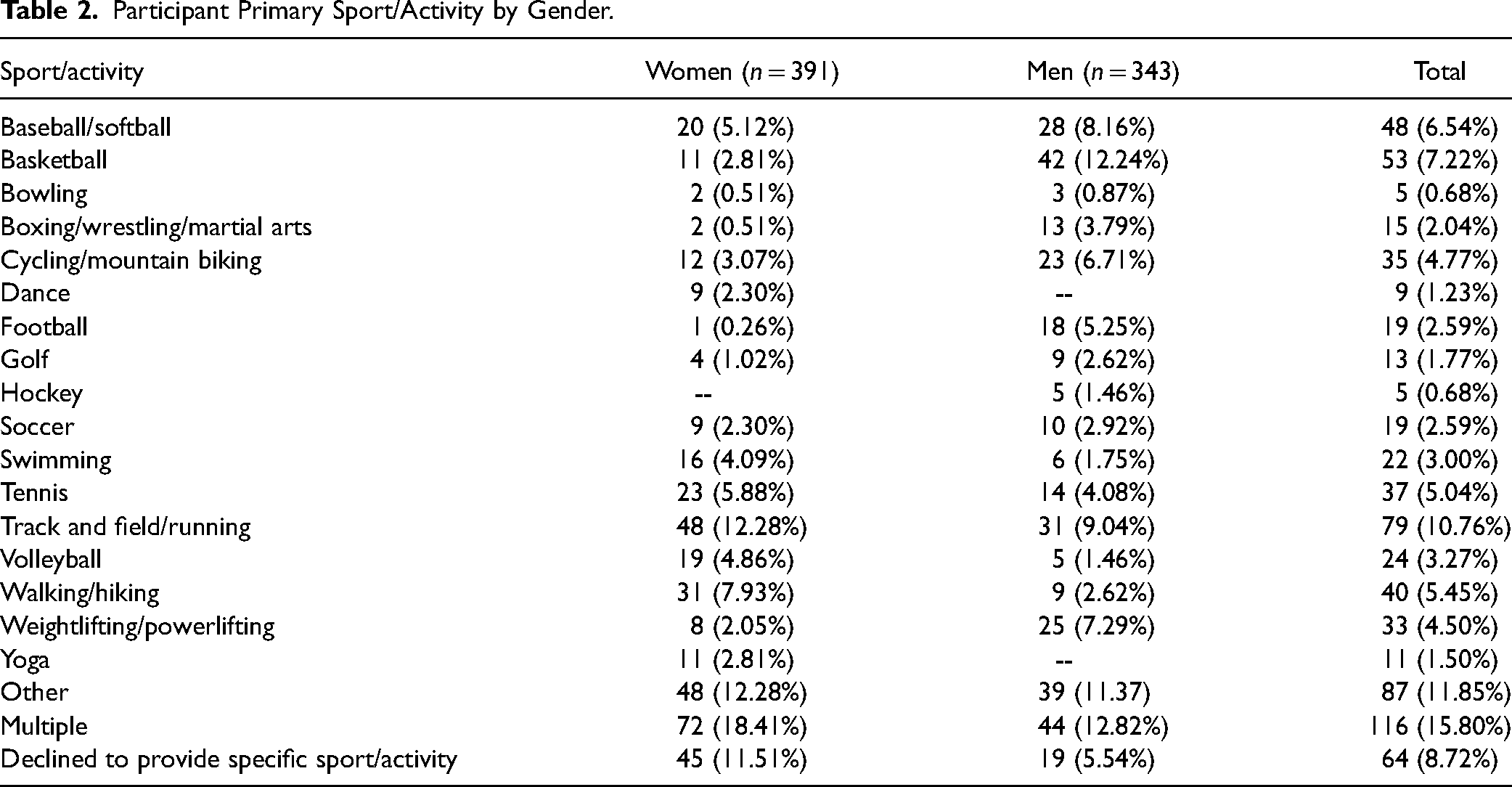
We first examined the athletes nominated by participants across conditions and their primary sport or physical activity as listed by participants (Table 1), ensuring that participants nominated a single individual and that the individual met the criteria for the condition to which participants were assigned (i.e., was the correct gender and, if participants were in the famous condition, was indeed an athlete known to the public). Participants in the famous condition were most likely to nominate exemplars who were women in the domain of tennis, and exemplars who were men in the domain of basketball or football. For participants in the personally known condition, on the other hand, the most common domain for both men and women was track and field/running. A summary of participants’ own primary sport or physical activity is included in Table 2. Women were most likely to report their sport or physical activity as running/jogging/track and field, whereas men were most likely to report their sport or physical activity as basketball.
Athlete Primary Sport or Physical Activity by Condition.
Participant Primary Sport/Activity by Gender.
Athletic Role Model Motivation
Next, we conducted a three-way ANOVA to examine the effects of participant gender, athlete gender, and athlete fame (i.e., whether the athlete was famous vs. personally known) on the extent to which participants viewed the athlete as a motivating role model. Complete results of this model are shown in Table 3.
Fixed-Effects ANOVA Using “Athlete as a Motivating Role Model” as the Criterion.
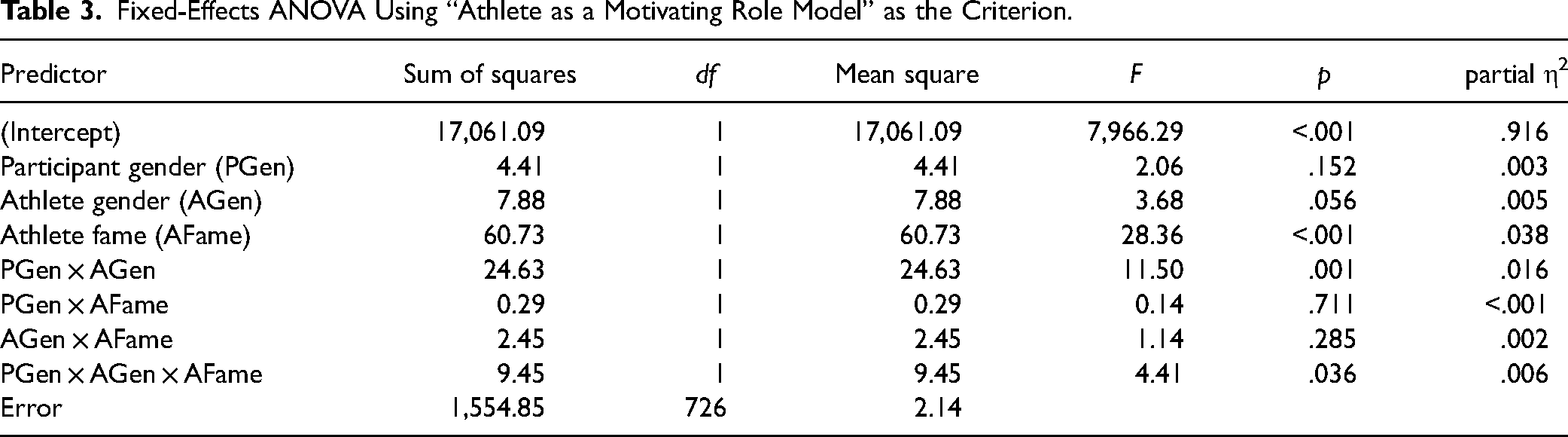
As predicted, the main effect of athlete fame was significant: Personally known athletes (M = 5.14, SD = 1.38) were seen as more motivating exemplars than famous athletes (M = 4.54, SD = 1.57). There was also a significant two-way participant gender-by-athlete gender interaction; women were more motivated by athletes who were women (M = 5.22, SD = 1.44) than athletes who were men (M = 4.60, SD = 1.56), F(1,726) = 11.67, p < .001, partial η2 = .016, but men were not more motivated by athletes who were men (M = 4.85, SD = 1.46) than athletes who were women (M = 4.67, SD = 1.51), F(1,726) = 1.91, p = .17, partial η2 = .003. This interaction, however, was qualified by a significant three-way interaction (H3). For famous athletes (Figure 1a), women were more motivated by women (M = 4.95, SD = 1.52) than men (M = 4.27, SD = 1.54), F(1,726) = 10.97, p < .001, partial η2 = .015, and men were more motivated by men (M = 4.75, SD = 1.61) than women (M = 4.24, SD = 1.53), F(1,726) = 5.03, p = .03, partial η2 = .007. For personally known athletes (Figure 1b), on the other hand, men were not more motivated by men (M = 4.94, SD = 1.32) than women (M = 5.12, SD = 1.36), F(1,726) = 0.68, p = .41, partial η2 = .001, whereas women were more motivated by women (M = 5.46, SD = 1.32) than men (M = 5.00, SD = 1.50), F(1,726) = 4.78, p = .03, partial η2 = .007. As we made no specific predictions about the other simple effects in the three-way interaction, they are not discussed here and instead are outlined in our supplementary analyses.
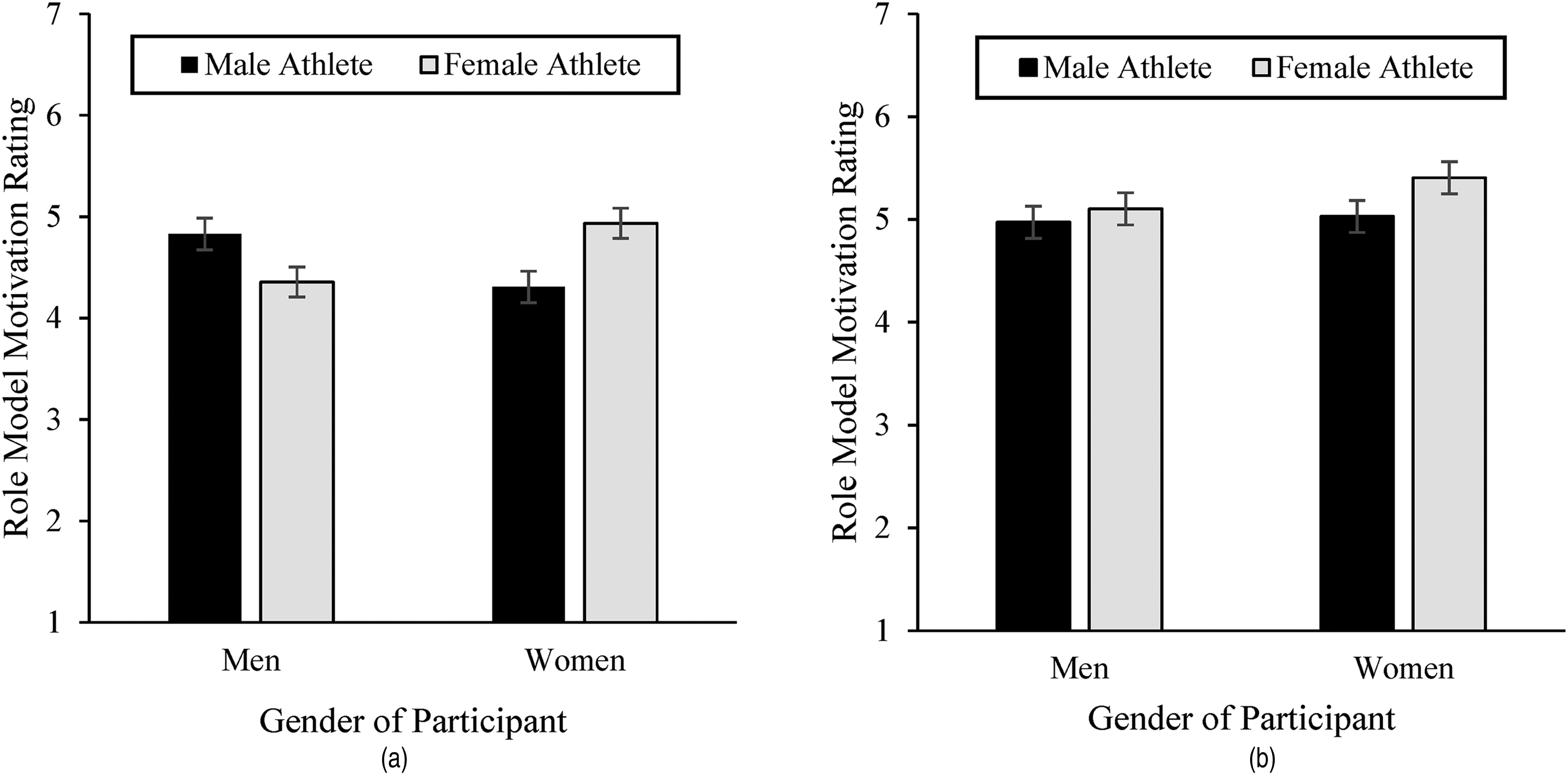
Role Model Motivation Ratings for Famous and Personally Known Athletes. (a) Famous Athletes. (b) Personally Known Athletes.
Discussion
In sum, for famous athletic exemplars, all participants were motivated more by same- than other-gender athletes. For personally known athletic exemplars, in contrast, men were equally motivated by both men and women, but women again derived more motivational benefits from the same-gender athletes. In other words, although men rated same- (vs. other-) gender athletes as more motivating role models, this was true only for famous athletic exemplars. Women, on the other hand, rated same- (vs. other-) gender athletes as more motivating role models, regardless of whether they were famous or personally known. In addition, both men and women were more motivated by personally known than famous exemplars. Although famous examples may illustrate a high level of success, their very stardom may make their success less attainable and consequently less inspirational. Moreover, although personally known same-gender athletes may be most motivating for women, it is noteworthy that the personally known man was at least as motivating as a famous woman. In domains dominated by men, there may be relatively few famous or personally known exemplars of success who are women. It may be that women have learned to find personally known exemplars who are men to be relevant through sharing of other attributes.
Past studies have shown that individuals tend to be most motivated by athletic exemplars in their own sports of interest, and that women may therefore be at a disadvantage because they are less likely to nominate same-gender exemplars in their own sports (Midgley et al., 2021). In the present study, many participants nominated athletes from outside their own sports (Tables 1 and 2). For example, although numerous participants chose Serena Williams, a tennis player, as the example of a famous woman athlete, relatively few indicated that they themselves were tennis players. In addition, it is unclear the degree to which these participants, many of whom may have been only casually interested in sports, would have had strong goals to become like these exemplars. This distinction is important because more serious athletes are more likely to select role models in their own sport than are more recreational athletes (Midgley et al., 2021; Study 3). It is noteworthy, therefore, that despite this potential limitation, participants nevertheless reported relatively strong motivation to become more like the successful exemplar; mean motivation scores were 4.84 (SD = 1.51) on a 7-point Likert scale. Moreover, although women may have been less likely than men to identify exemplars in their own sport (Midgley et al., 2021), they were nevertheless at least somewhat motivated by these exemplars, particularly when matched on gender. Thus, this study suggests that gender matching of role models may be relevant even when individuals have more casual goals in a domain, and when the exemplars are only superficially matched to their own domains of interest. Nevertheless, we cannot rule out the possibility that participants were simply remembering being motivated by such role models when they were younger and had more specific aspirations in the sport in which their chosen exemplar excelled.
In the second study, we selected participants who identified themselves as professionals in a domain dominated by men: STEM. Because all our participants were themselves in STEM careers, we were able to compare the relative impact of famous and personally known exemplars for individuals more likely to have well-defined goals, in domains more aligned with these exemplars. Moreover, because these participants were actively engaged in STEM careers, their exemplars would have implications for their current professional motivation in the workplace.
Study 2
As with athletics, STEM fields tend to be dominated by men (Fry et al., 2021; Global Gender Gap Report, 2021). Accordingly, we attempted to replicate the findings of Study 1 in the STEM domain. Specifically, in Study 2, we examined whether the motivating impact of STEM exemplars on men and women participants would be determined by both the gender of the exemplar and whether the exemplar was famous or known personally to participants. We predicted that, as in Study 1, both women and men would find personally known exemplars most motivating (H1), and that they would also be most motivated by same-gender famous exemplars (H2). In addition, we predicted that women would be especially likely, relative to men, to find same-gender, personally known exemplars to be motivating (H3).
We also used Study 2 to examine, on an exploratory basis, whether the degree to which exemplars represent attainable future selves would determine how motivating those exemplars are perceived to be. We have argued that personally known exemplars may be more inspiring than famous ones because they represent future achievements that are more attainable; indeed, studies have found that individuals are more motivated by a successful other when that other's accomplishments are attainable (Lockwood & Kunda, 1997). Given that the achievements of famous figures such as Albert Einstein or Marie Curie may not be seen as attainable by most individuals in STEM careers, they may be less motivating than exemplars with less spectacular but more reachable achievements. Accordingly, we conducted a mediation analysis to assess whether personally known exemplars do indeed represent more attainable future selves, and so are more motivating than famous exemplars (H4, exploratory).
In addition, past research suggests that women are most motivated by same-gender exemplars in the domain of athletics because they perceive their achievements are more attainable, and because they are more representative of a possible future self (Midgley et al., 2021). In Study 2, we examined whether future attainability would play a similar role in determining women's motivation by same-gender STEM exemplars. Because men are less likely to face gender-related barriers to success in STEM, their motivation may be less driven by the perceived future attainability of the same-gender exemplar's success; they are unlikely to see a successful man's achievements as any more attainable than a successful woman's achievements. Accordingly, we conducted moderated mediation analyses to assess whether future attainability of same-gender exemplar is a mechanism underlying motivation by personally known (vs. famous) exemplars (H4, exploratory) and women's (but not men's) motivation by exemplars (H5, exploratory).
Method
As in Study 1, ethics approval for the study was obtained from the University of Toronto Social Sciences, Humanities, and Education Research Ethics Board before data collection. Data were collected between December 18, 2020 and March 31, 2021, and data and syntax are available upon request from the corresponding author.
Participants
We recruited 1,020 workers from Prolific who had previously indicated, on a prior pre-screening survey conducted through Prolific, that their primary sector of employment was “Science, Technology, Engineering, and Mathematics.” All participants who completed the survey were compensated at Prolific's suggested rate of £7.80 GBP per hour, for an average payment of £0.81 GBP (or $1.12 USD) per participant. Data were cleaned as it was being collected to reach our target sample size of 787 participants, which, based on an a priori calculation with G*Power, would provide 80% power to detect a small effect size (i.e., Cohen's f = 0.10 or partial η2 = 0.01; Miles & Shevlin, 2001) when testing for a three-way interaction at an alpha level of.05. In total, we excluded data from 59 participants who indicated in an eligibility check that they were not currently studying or working in a STEM field, 43 participants who answered fewer than 70% of the survey questions, and 14 participants who indicated in an attention check that they did not nominate an individual in STEM. Additionally, we excluded 53 participants who did not follow instructions related to the nominated individual's gender (e.g., naming a woman when asked for a man) and 57 participants who did not follow instructions pertaining to naming an individual that was either known to the public or personally known to the participant. Finally, as in Study 1, we excluded data from six participants who did not clearly identify as either a man or woman, a key variable in the current analyses. Four of these participants reported a gender identification different from their response on a prior Prolific prescreening survey, and two participants reported identifying as neither a man nor a woman. As in Study 1, we did not have significant power to examine gender as a continuous or multinomial variable.
The final sample consisted of 788 participants: 397 (50.38%) women and 390 (49.49%) men (Mage = 28.74, SDage = 8.02). When asked to report their ethnicity/race, 571 (72.46%) participants identified as White/European/White, 62 (7.87%) as Hispanic/Latinx, 58 (7.36%) as Asian, 22 (2.79%) as South Asian, 15 (1.90%) as African/Black, nine (1.14%) as East Asian, six (0.76%) as Southeast Asian, five (0.63%) as Middle Eastern, and 18 (2.28%) as biracial or having multiple ethnic/racial identities; 22 (2.79%) participants listed other ethnic/racial identities or chose not to answer this question. IP addresses indicated 180 (22.84%) participants resided in the United Kingdom, 160 (20.30%) in the United States, 102 (12.94%) in Portugal, 60 (7.61%) in Poland, 50 (6.35%) in Canada, 35 (4.44%) in Mexico, 29 (3.68%) in Italy, 25 (3.17%) in Germany, 24 (3.05%) in Greece, 19 (2.41%) in Spain, 15 (1.90%) in Australia, 10 (1.27%) in France, 10 (1.27%) in the Netherlands, nine (1.14%) in Belgium, nine (1.14%) in Chile, eight (1.02%) in Ireland, eight (1.02%) in Israel, six (0.76%) in Czechia, five (0.63%) in Hungary, four (0.51%) in South Africa, three (0.38%) in Austria, three (0.38%) in Sweden, and 14 (1.78%) in other countries. Finally, employment status data provided by Prolific indicated that most participants (525; 66.62%) were employed full-time, 135 (17.13%) were employed part-time, six (0.76%) were currently unemployed, and 122 (15.48%) did not indicate their employment status.
Procedure
After providing informed consent, participants were randomly assigned to condition (famous or personally known) and gender (woman or man) of an individual in a STEM career. That is, participants were either asked to think of someone they know personally in STEM with the prompt: “Think of a woman [man] in a Science, Technology, Engineering, or Math career whom you know or have interacted with in person. Ideally, this is someone you know well, but can also be an acquaintance” or were asked to think of a famous person in STEM who is well-known to the public with the prompt: “Think of a famous woman [man] in a Science, Technology, Engineering, or Math career. Ideally, this would be someone known to the general public.”
After entering the name of an individual in STEM, participants were asked to describe the named individual in open-ended form and to indicate that individual's primary occupation. These responses were later reviewed by a research assistant unaware of the hypotheses of the study to verify that participants had nominated a specific individual who works in a STEM field and who fit the criteria of the condition to which the participant was assigned. Next, participants rated the extent to which they found this individual to be a motivating role model by indicating their agreement with two items: “[STEM individual's name] is a role model for me” and “[STEM individual's name] motivates me.” Because the 11 items tapping into role model motivation in Study 1 were highly inter-correlated, we selected the two most face-valid items for use in Study 2. Ratings were made on a 7-point Likert scale with endpoints ranging from 1 (strongly disagree) to 7 (strongly agree), and, as in Study 1, answers to these two items were averaged to create a single index of the degree the participant saw the named individual as a motivating role model, r(786) = .76.
Participants then indicated their agreement, on a 7-point Likert scale that ranged from 1 (strongly disagree) to 7 (strongly agree), with 7 possible reasons why participants found the STEM individual they nominated motivating (Midgley et al., 2021). First, participants indicated the extent to which they perceived the person they nominated as demonstrating that similar success is attainable for themselves on three items: “[Nominated individual's name, as entered by the participant] shows me that I can achieve something similar in the future”, “[Nominated individual's name] shows that I can achieve success in STEM careers”, and “[Nominated individual's name ] shows that I can overcome barriers to success in STEM (i.e., Science, Technology, Engineering, and Math) careers.” Next, participants indicated the extent they perceived their nominated individual as a possible future self on four items: “[Nominated individual's name] represents the self that I would like to become”, “[Nominated individual's name] is a possible “future self” for me,” “[Nominated individual's name] gives me something specific to aim for,” and “[Nominated individual's name] personifies a goal I want to achieve.” We combined all seven attainability and possible future self-ratings to form a single measure of future attainability (Cronbach's α = .91).
Participants also indicated the extent to which they saw the exemplar they nominated as an example of countering gender stereotypes on three items: “[Nominated individual's name] demonstrates that it is possible to break down gender-related barriers to success,” “[Nominated individual's name] challenges traditional gender stereotypes in STEM careers,” and “[Nominated individual's name] defies/challenges traditional beliefs about what women and men are capable of in the STEM (i.e., Science, Technology, Engineering, and Math) domain” (Cronbach's α = .90). Because we did not, however, expect this variable to predict role model motivation above and beyond future attainability (Midgley et al., 2021), this variable is not discussed further here and instead is outlined in our supplementary analyses.
Next, participants completed a set of manipulation and attention checks, similar to those used in Study 1. To verify adherence to condition instructions, participants indicated the gender of the individual they nominated, whether they knew them personally, and the extent to which the individual nominated is famous on a 7-point Likert scale that ranged from 1 (strongly disagree) to 7 (strongly agree). Finally, participants answered demographic questions about themselves, including items on which they reported their own gender and occupation.
Results
Manipulation Check
An independent samples t-test confirmed that participants viewed the individuals they nominated in the famous condition as more famous (M = 6.63, SD = 0.69) than those nominated in the personally known condition (M = 2.03, SD = 1.53), t(786) = 53.95, p < .001, d = 3.85, 95% CI [3.61, 4.08].
STEM Fields of Nominated Individuals and Participants
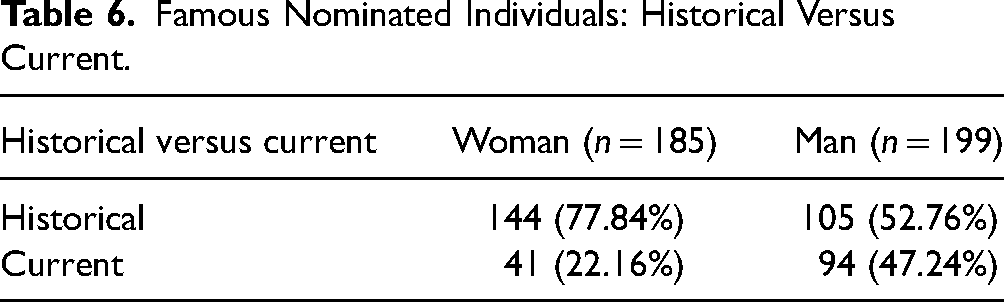
As in Study 1, we first examined the individuals nominated by participants across conditions, ensuring that participants nominated a single person, and that the individual met the criteria for the condition to which participants were assigned. Next, a research assistant unaware of the study hypotheses reviewed the occupations participants had listed for their nominated individual in STEM and participants’ own self-reported occupations and classified them into one of the four primary STEM fields (i.e., Science, Technology, Engineering, or Math; see Tables 4 and 5). Additionally, this assistant classified famous exemplars as either current or historical individuals (Table 6). Both women and men were especially likely to nominate exemplars in science fields. In the case of famous 0exemplars, participants were more likely to nominate historical than current exemplars who were women. Women were most likely to report being in science fields, whereas men were more likely to report being in technology or engineering fields.
Nominated Individuals’ Science, Technology, Engineering, and Mathematics (STEM) Field by Condition.
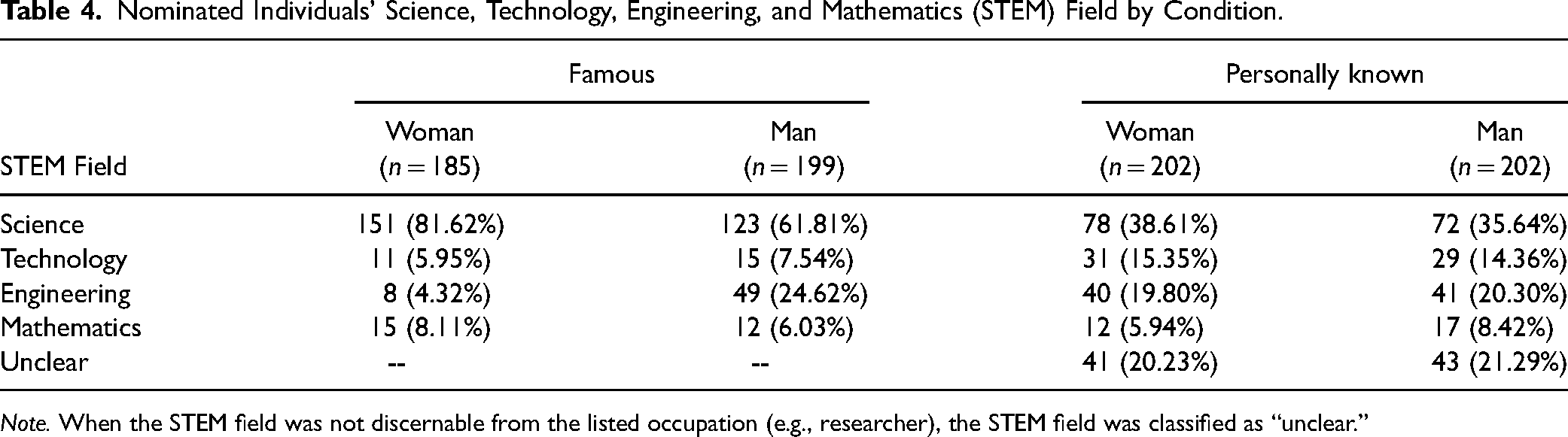
Note. When the STEM field was not discernable from the listed occupation (e.g., researcher), the STEM field was classified as “unclear.”
Participant Science, Technology, Engineering, and Mathematics (STEM) Field by Gender.
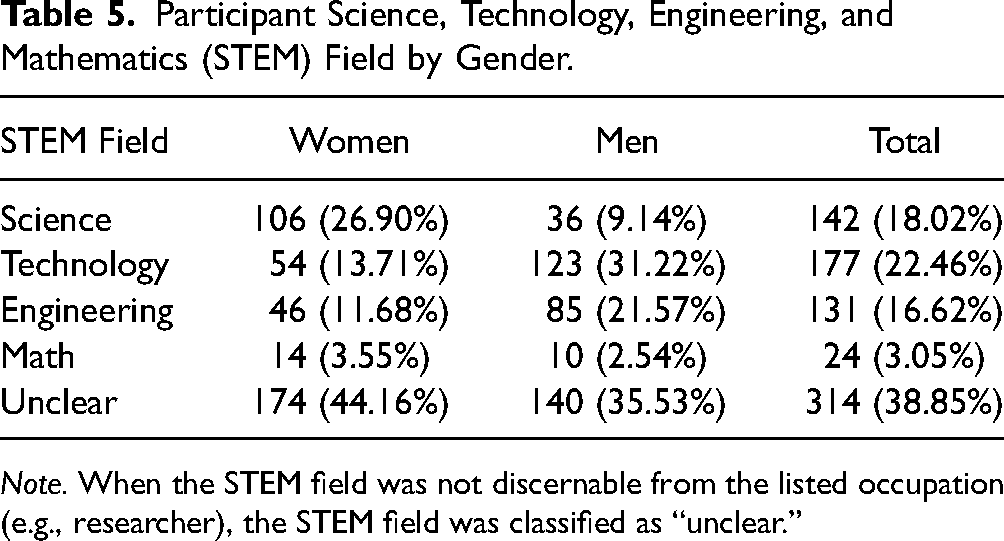
Note. When the STEM field was not discernable from the listed occupation (e.g., researcher), the STEM field was classified as “unclear.”
Famous Nominated Individuals: Historical Versus Current.
Role Model Motivation
Next, we conducted a 2 × 2 × 2 ANOVA to examine the effects of participant gender, the STEM individual's gender, and fame (i.e., whether the individual was famous or personally known) on the extent to which participants viewed the nominated STEM individual as a motivating role model. Complete results of this model are shown in Table 7.
Fixed-Effects ANOVA Using “STEM Individual as a Motivating Role Model” as the Criterion.
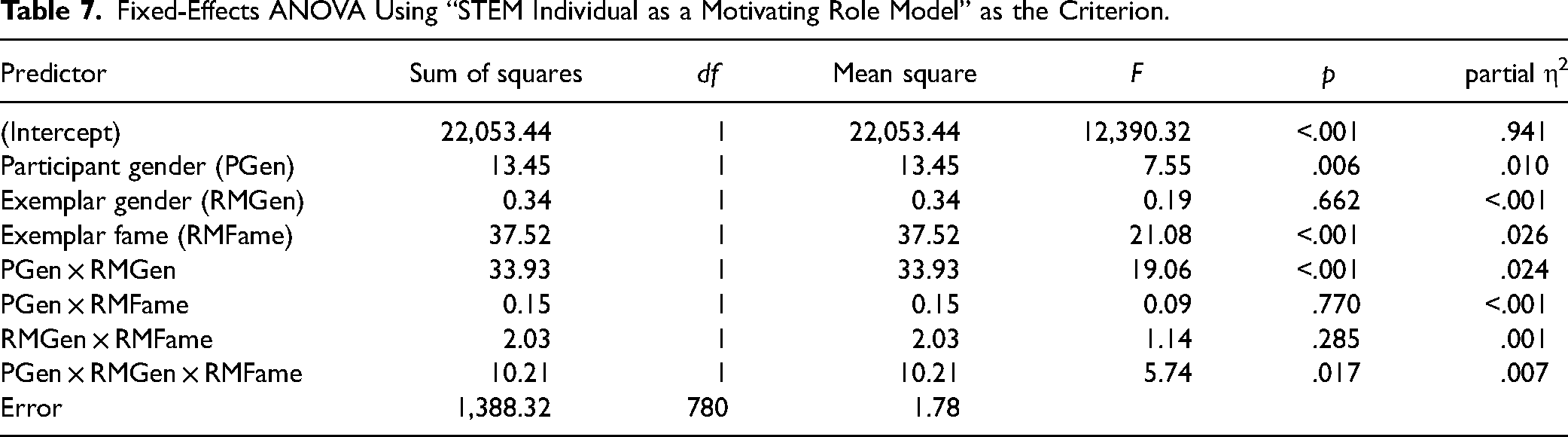
As in Study 1, there was a significant main effect of fame: Personally known individuals in STEM (M = 5.53, SD = 1.28) were rated as more motivating role models than famous individuals (M = 5.08, SD = 1.43). In addition, the two-way participant gender by exemplar gender interaction was significant; men were more motivated by men (M = 5.35, SD = 1.18) than women (M = 4.98, SE = 1.53), F(1,780) = 7.74, p = .006, partial η2 = .010, and women were more motivated by women (M = 5.67, SD = 1.30) than men (M = 5.23, SE = 1.39), F(1,780) = 11.51, p < .001, partial η2 = .015. This interaction, however, was qualified by a significant three-way interaction (H3). For famous individuals in STEM (Figure 2a), women were more motivated by women (M = 5.62, SD = 1.32) than men (M = 4.84, SD = 1.50), F(1,780) = 15.69, p < .001, partial η2 = .020, and men were more motivated by men (M = 5.19, SD = 1.19) than women (M = 4.69, SD = 1.54) exemplars F(1,780) = 7.17, p = .008, partial η2 = .009. For personally known individuals in STEM (Figure 2b), on the other hand, men were not more motivated by personally known men (M = 5.53, SD = 1.15) or women (M = 5.28, SD = 1.47), F(1,780) = 1.64, p = .20, partial η2 = .002; however, contrary to our findings in Study 1, women were not more motivated by women (M = 5.70, SD = 1.30) than men (M = 5.58, SD = 1.19), F(1,780) = 0.49, p = .49, partial η2 = .001. As in Study 1, because we made no specific predictions about the other simple effects in the three-way interaction, they are not discussed here and instead are outlined in our supplementary analyses. In sum, in Study 2, both men and women rated same- (vs. other-) gender individuals in STEM as more motivating role models but only when this individual was famous (rather than personally known).
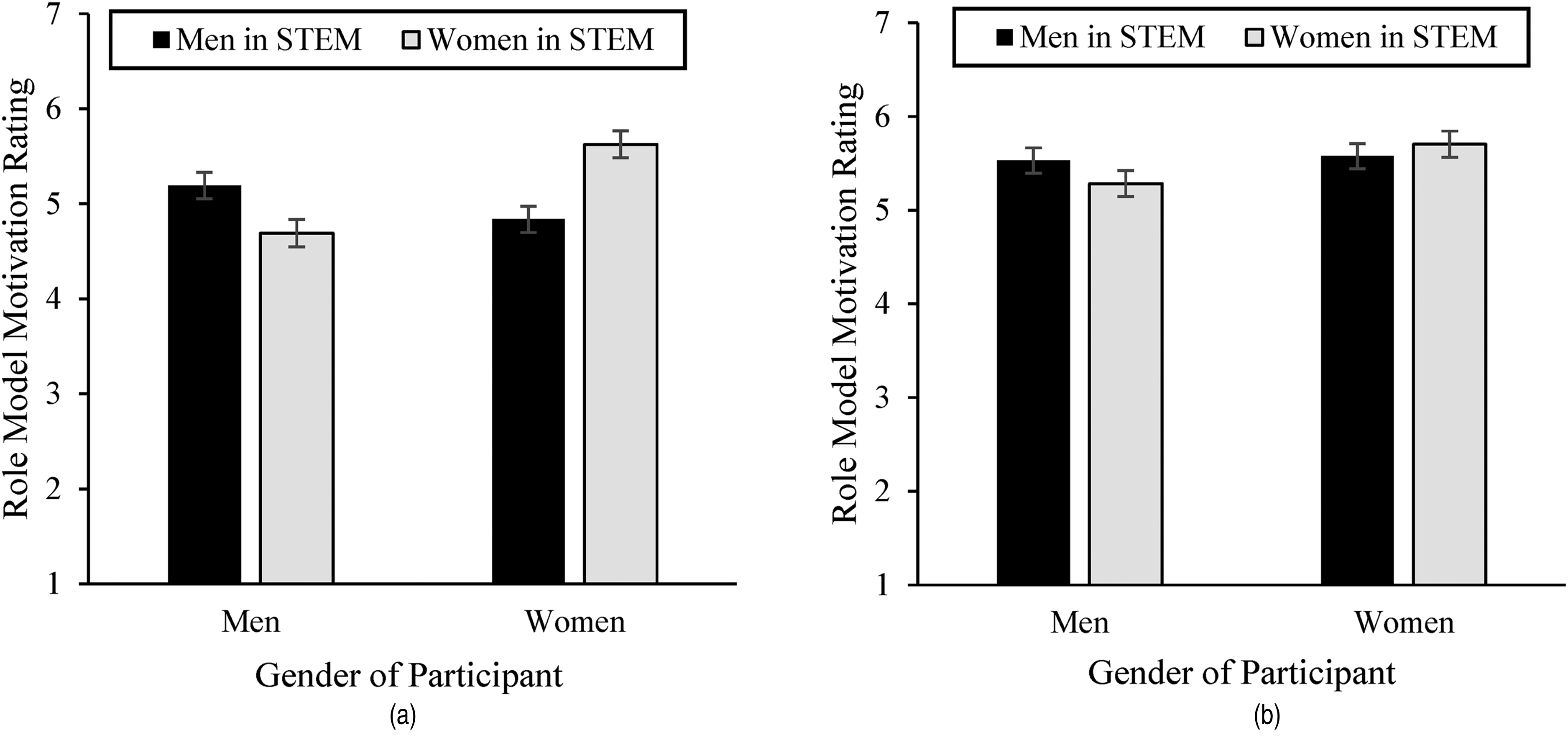
Role Model Motivation Ratings for Famous and Personally Known Individuals in Science, Technology, Engineering, and Mathematics (STEM). (a) Famous Individual in STEM. (b) Personally Known Individual in STEM.
Future Attainability of Exemplar’s Success as a Mediator
Next, we examined a possible mechanism for participants’ ratings of role model motivation. Specifically, we examined whether, for all participants, personally known (vs. famous) exemplars in STEM predicted higher role model motivation ratings at least in part due to higher future attainability (H4, exploratory) and whether same-gender STEM exemplars were especially motivating for women relative to men because they better represented an attainable future self (H5, exploratory). To test these hypotheses, we conducted a three-way moderated mediation model (Figure 3) using the PROCESS macro for SPSS and bootstrapping procedure (Model 12; Hayes, 2018) with 5,000 resamples, generating 95% confidence intervals for the indirect effects.
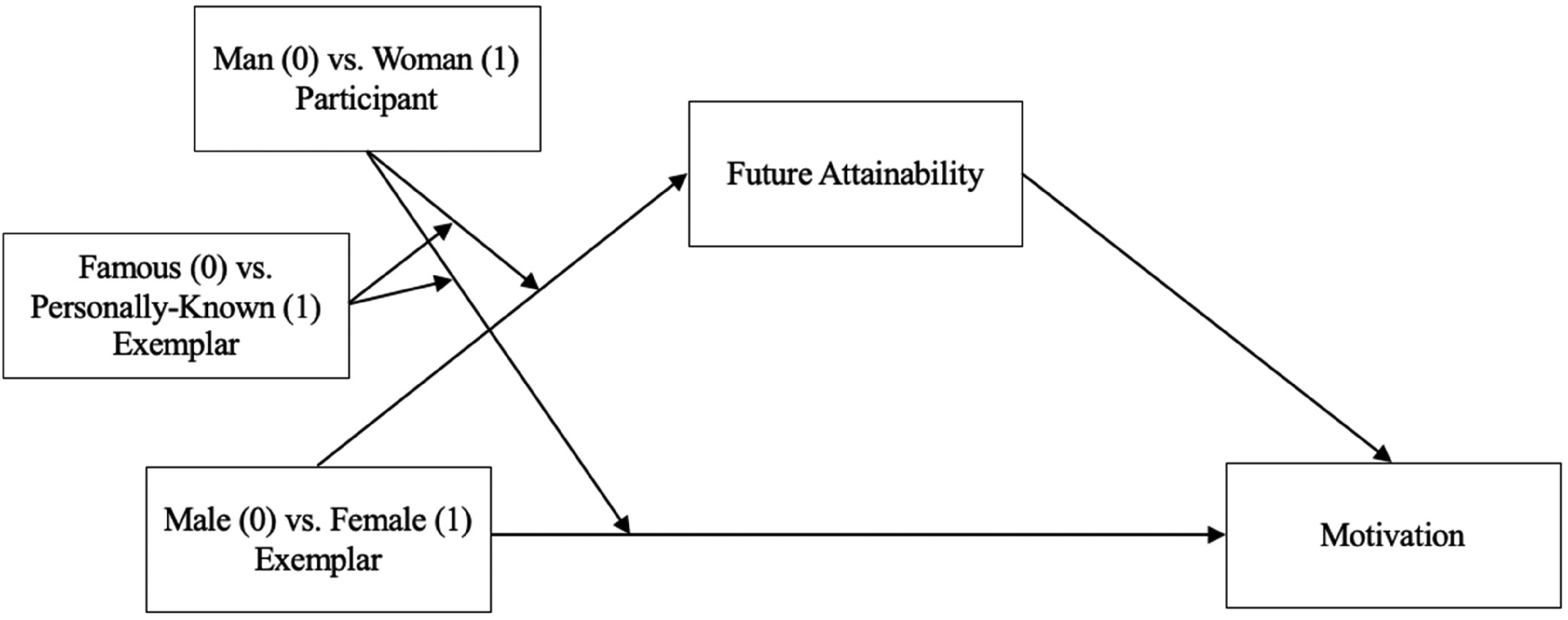
Explaining Higher Motivation Ratings: Future Attainability.
Predicting Attainability
There was a main effect of participant gender on future attainability, b = −0.50, 95% CI [−0.86, −0.14], SE = 0.18, p = .007; compared to men, women rated the exemplars they nominated as less attainable future selves. Additionally, whether the exemplar was famous or personally known predicted ratings of future attainability, b = 0.64, 95% CI [0.28, 0.99], SE = 0.18, p < .001; participants reported that personally known (vs. famous) exemplars represented a more attainable future self. Finally, there was a significant two-way interaction between participant gender and exemplar gender in predicting ratings of future attainability, b = 1.14, 95% CI [0.63, 1.66], SE = 0.26, p < .001. Specifically, there was a significant effect of exemplar gender on ratings of future attainability for women (Figures 4a, 4b), b = 1.11, 95% CI [0.85, 1.36], SE = 0.13, p < .001, but not for men (Figures 4a, 4b), b = −0.03, 95% CI [−0.29, 0.22], SE = 0.13, p = .79. No other main effects or interactions were significant, p’s > 0.16.
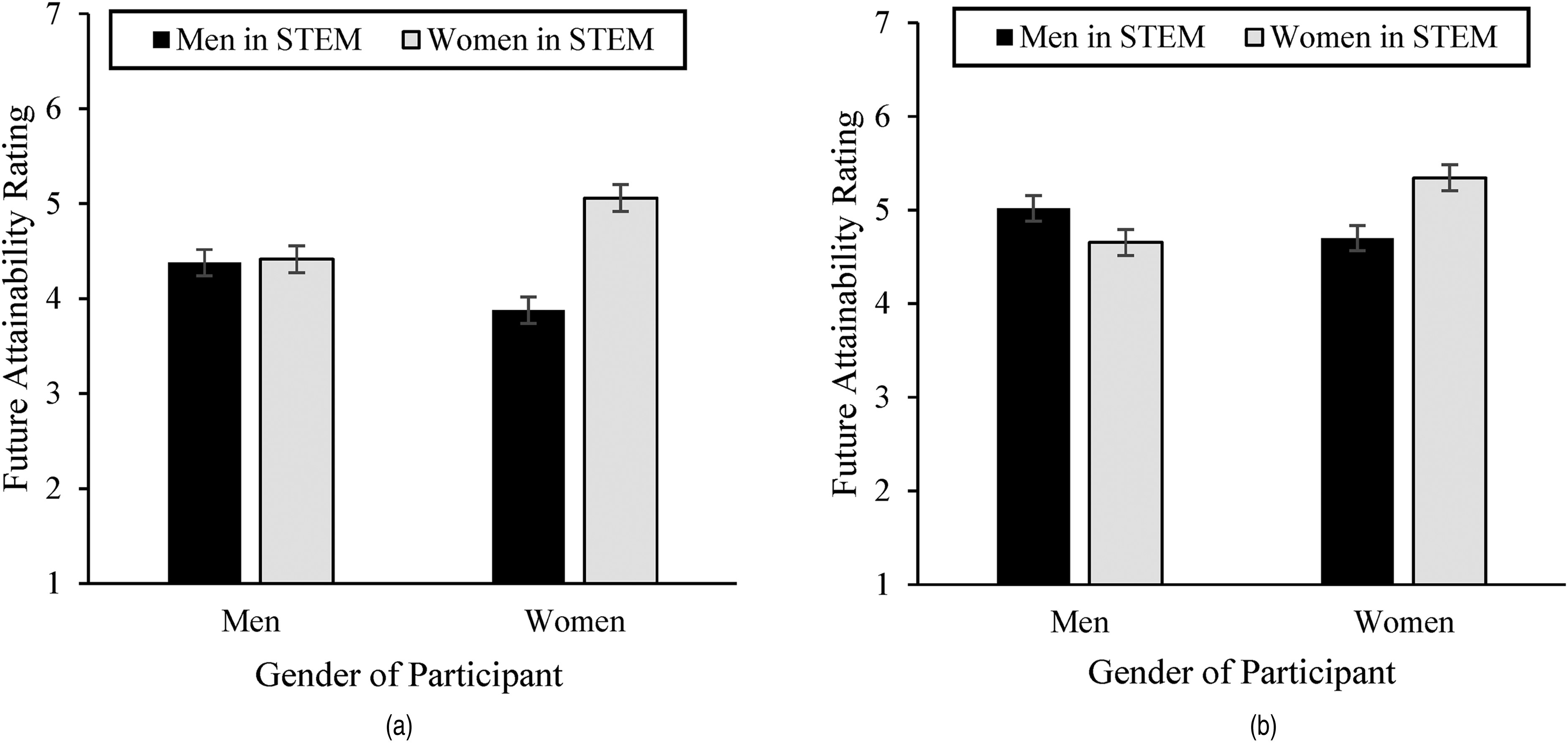
Future Attainability Ratings for Famous and Personally Known Individuals in Science, Technology, Engineering, and Mathematics (STEM). (a) Famous Individual in STEM. (b) Personally Known Individual in STEM.
Predicting Motivation via Attainability
In our model, higher motivation ratings were predicted by higher future attainability ratings, b = 0.75, 95% CI [0.70, 0.80], SE = 0.03, p < .001. For women, the indirect effect of exemplar gender on motivation through attainability was significant in both the famous condition, index of mediation = 0.88, 95% CI [0.60, 1.18], SE = 0.15, and the personally known condition, index of mediation = 0.48, 95% CI [0.23, 0.75], SE = 0.13. For men, on the other hand, there were no indirect effects in either the famous condition, index of mediation = 0.03, 95% CI [−0.24, 0.29], SE = 0.13, or the personally known condition, index of mediation = −0.27, 95% CI [−0.55, 0.01], SE = 0.14. Future attainability explained higher motivation for same-gender exemplars for women, but not for men, in both the famous condition, index of conditional moderated mediation = 0.86, 95% CI [0.45, 1.27], SE = 0.20, and the personally known condition, index of conditional moderated mediation = 0.76, 95% CI [0.38, 1.14], SE = 0.19.
After accounting for attainability, whether the exemplar was famous or personally known no longer predicted motivation, b = −0.14, 95% CI [-0.39, 0.12], SE = 0.13, p = .28. Additionally, the remaining (direct) effect of exemplar gender on motivation was not significant for men in the personally known condition, b = 0.02, 95% CI [−0.23, 0.29], SE = 0.13, p = .85, nor for women in the famous condition, b = −0.10, 95% CI [−0.37, 0.18], SE = 0.14, p = .50. There was however, a significant direct effect of exemplar gender for men in the famous condition, b = −0.53, 95% CI [−0.78, −0.27], SE = 0.13, p < .001, and for women in the personally known condition, b = −0.35, 95% CI [−0.60, −0.11], SE = 0.13, p = .005; after taking into account the significant indirect effects through attainability, both these groups of participants rated women (vs. men) as less motivating.
In sum, personally known (vs. famous) exemplars were seen as better demonstrating future attainability, regardless of gender of the participant or exemplar, and this in turn predicted higher role model motivation. In addition, women (but not men) gave higher ratings of future attainability to same-gender exemplars, which in turn contributed to the high motivation ratings of these particular individuals.
Discussion
As in Study 1, participants were more motivated by personally known than famous exemplars. In addition, participants were most motivated by famous exemplars of the same gender as themselves. Thus, as with sports, gender matching is important in determining whether celebrity exemplars are motivating in STEM. Also consistent with Study 1, men were similarly motivated by personally known men and women. Contrary to our hypothesis (H3), however, women were no more motivated by personally known women than men. It may be that women experienced a ceiling effect; because they were already very motivated by personally known men (M = 5.58 on a 7-point Likert scale), it may have been difficult to detect an even higher level of motivation for personally known women. Alternatively, because STEM fields are less subject to segregation by sex than sports, women may have been exposed to more personally known men who were relevant to them on dimensions other than gender. In athletics, women and men typically compete separately, on different teams in sex-segregated leagues or competitions. Women may consequently have had very little personal contact with successful men in their sports. In contrast, women working in STEM fields are more likely to have encountered many men in the same field on a regular basis in their studies and later in their workplaces. Accordingly, they may simply have had more opportunities to identify men known to them personally, even if they might have benefitted even more from personally known women. Thus, for women, personally known exemplars may be especially important, even when not of the same gender as themselves.
In addition, exploratory mediation analyses revealed a possible mechanism to explain why some exemplars are especially motivating. Specifically, compared to famous exemplars, those who are personally known are more motivating because they are perceived to be more attainable future selves. Furthermore, gender-matched exemplars are perceived as more attainable future selves by women but not men, which in turn contributes to women's motivation by both famous and personally known same-gender exemplars.
In Study 1, we examined the impact of successful exemplars in sports, a domain in which participants were likely casually rather than professionally engaged; we did not explicitly recruit professional athletes. In Study 2, in contrast, participants were selected if they were actively employed in a STEM field. Thus, Study 2 provides evidence that whether or not a role model is matched on gender, and personally known rather than famous, are important variables determining the impact of role models in individuals’ own career areas. Motivation scores for Study 2 were generally higher, with a mean of 5.31 (SD = 1.37) compared to 4.84 in Study 1, which is not surprising given that these individuals were describing motivation in their professional careers. Although the degree to which participants were casually or more formally involved in the domain of interest across the two studies, the results were generally consistent, with the exception that women in Study 2 were not more motivated by a gender-matched than mismatched personally known exemplar.
General Discussion
Past research has highlighted the value of role models for women, particularly in fields dominated by men, but has not differentiated between celebrity role models who inspire from a distance and close-contact role models, who inspire through their personal connection to others. In the present research, we found that gender matching of famous exemplars was crucial: Both women and men were most motivated by famous exemplars of the same gender as themselves. Different effects emerged for personally known exemplars. Specifically, gender matching was not important for men's personally known exemplars in either Studies 1 or 2; men were motivated similarly by men and women who were personally known in both athletic and STEM career domains. In contrast, whereas women were more motivated by gender-matched personally known athletic exemplars, they were similarly motivated by personally known women and men in STEM. Overall, with the exception of women in sports domains, individuals may be able to derive similar inspiration from men and women who are personally known to them.
In addition, the present studies suggest that personally known exemplars may be more inspiring than famous ones because they personify goals and achievements that resemble participants’ future selves. Thus, Serena Williams or Rafael Nadal may be less inspiring than a local coach; Donna Strickland or Richard Dawkins may have less influence than a high school science teacher. That is not to say that celebrity role models have no impact; indeed, participants reported finding famous exemplars to be at least somewhat motivating. Rather, although all success stories may have the potential to inspire, those that demonstrate a level of success that is perceived as attainable may have the greatest influence. Indeed, our mediation analyses (Study 2) suggest that personally known (vs. famous) exemplars were more motivating for both women and men because they were seen as more attainable representations of future selves. However, our analyses also suggest that different processes may be driving women's motivation by same- and other-gender exemplars when those individuals are known to them personally; whereas women were motivated by same-gender exemplars in part due to their greater future attainability, this was not the case for exemplars who were men. In future research, it will be important to further examine the mechanisms through which women in fields dominated by men may benefit from personally known role models of either gender.
The distinction between famous and personally known role models is especially significant for women, moreover, because in many domains, they may have few same-gender celebrity exemplars available to them. Men, who have access to many more examples of famous same-gender success stories in domains like sports and science, have an advantage; it is easier for them to find motivating role models who are household names. Women, in contrast, may more frequently benefit from personally known role models; even when they are unable to find an inspirational example of a celebrity who is a woman, they can nonetheless turn to examples of successful individuals whom they encounter in their daily lives.
Although these studies provide new evidence regarding the role of fame and gender in determining whether individuals find role models to be motivating, we note that we did not measure individuals’ actual behavior or performance in STEM or sport. We would expect that when individuals are inspired by role models, they work harder to achieve success. Indeed, past studies suggest successful role models can boost individuals’ performance (Hoyt, 2013; Latu et al., 2019; Marx & Ko, 2012). Nevertheless, it will be important to establish that personally known role models are not only more inspiring than famous ones, but also have a more beneficial effect on performance.
The present study provides evidence that gender matching and the degree to which exemplars are personally known will impact the degree to which those exemplars are motivating. In their motivational theory of role modeling, Morgenroth et al. (2015) note that motivation by role models will be determined by both the characteristics of role aspirants (e.g., their goals and beliefs about whether their abilities are fixed or malleable) and the characteristics of the role models (e.g., their degree of success, and their similarity to role aspirants); role aspirants’ perceptions of the degree to which a role model represents goal embodiment, attainability, and desirability, will be key to determining whether that model is motivating. In our examination of hypothesis 5, we focused primarily on whether the exemplars represented possible future selves (which should map on to goal embodiment), and attainability. We did not explicitly assess whether the role model represented a desirable outcome. Indeed, given that participants in Study 2 were selected based on a casual rather than professional interest in sport, it is not clear that a successful athlete would necessarily represent a particularly desirable outcome for these individuals. It is noteworthy, therefore, that even these participants were at least somewhat motivated by the successful athletic exemplars. In future research, it will be important to consider how individuals’ specific goals, and the degree to which they view an exemplar as representing a desirable outcome, may influence motivation by role models.
In addition, we note that the generalizability of our findings is limited, given that the majority of participants in both studies were White and resided in the United States (Study 1) or Western Europe (Study 2). It may be that matching on race is more important than gender for some underrepresented groups. Moreover, although we pre-screened individuals to identify those with athletic (Study 1) or STEM (Study 2) interests, we note that the specific sport and career domains of women and men participants differed. For example, women in Study 1 were more likely to report athletic interests related to running, track and field, and tennis, whereas men were more likely than women to report athletic interests in domains such as basketball, baseball, and weightlifting. In Study 2, women were more likely to report that they were in science careers, whereas men were more likely to report that they were in technology or engineering careers. To the extent that women in technology or engineering occupations are especially underrepresented, they may be more likely to benefit from same-gender personally known role models than would women in science careers more generally. In future research, it will be important to examine the impact of gender matching in specific career areas. Further, because we did not collect data on sexual orientation or socioeconomic status, it will be important in future research to assess whether these variables may also moderate the impact of famous and personally known role models on individuals.
In the present research, we have discussed the effect of successful exemplars in the context of the literature on role models. We note that, although this use of the term role model is in keeping with past studies (Lockwood, 2006; Lockwood et al., 2002; Lockwood & Kunda, 1997, 1999), the exemplars nominated by participants might better be considered to be potential role models, in that, not all participants necessarily aspired to become like these exemplars or were motivated by them. Indeed, our dependent measures were designed to assess the extent to which these exemplars were perceived to be motivating role models. It is also possible, however, that role models may exert at least some of their impacts through implicit rather than explicit processes. Indeed, past studies suggest that social comparisons to other people occur relatively automatically (Gilbert et al., 1995) and can occur outside of conscious awareness (Mussweiler et al., 2004); thus, individuals may experience changes in their goals or motivation after exposure to a successful other even if they do not explicitly identify the other as a role model. In the future, it may be useful to consider whether, according to existing definitions of role models (Lockwood, 2006; Morgenroth et al., 2015), individuals must consciously recognize that they are being motivated by or are modelling their behavior on that of another person, for that person to be considered a role model.
In addition, we note that the present studies focused on role models rather than mentors. Whereas a role model is someone who can inspire others through their own example, a mentor is someone who typically also contributes directly to the success of their protégé by offering support, advice, or encouragement. We have argued that personally known role models are more inspirational because their achievements are more attainable, and the mediation analysis in Study 2 supports this argument. It is possible, however, that personally known role models are, at least in some cases, also mentors; they may not only inspire by their example, but also motivate individuals by offering more direct support. An examination of mentorship was beyond the scope of the present research, but past research has confirmed the importance of gender-matched mentors; for example, women engineering students benefitted more when assigned a mentor who is a woman (vs. a man; Dennehy & Dasgupta, 2017). In future studies, it will be important to consider how personally known role models may also serve as mentors and how gender matching may also be implicated in such processes.
In our studies, participants were adults, who had presumably already identified their sports-related areas of interest (Study 1) and selected a career area (Study 2). For these individuals, the role models they nominated were not so much helping them to identify a possible future direction as to move forward in an already-chosen direction. Role models, however, play an important role in determining children's choices and goals (Bryant & Zimmerman, 2003; Zirkel, 2002) and may also be valuable in highlighting potential future pathways for children and young adults (Keller & Whiston, 2008; Valero et al., 2019). For girls, it may be especially valuable to see a same-gender celebrity athlete or scientist, who may encourage them to consider future pathways that, due to negative gender stereotypes, might otherwise have seemed irrelevant or unattainable (Olsson & Martiny, 2018; Zirkel, 2002). Indeed, to the extent that children are less likely than adults to assume an upper limit on future accomplishments, they may find celebrity role models to be more motivating than personally known ones. If one believes one can be a future Wimbledon winner, one may be more inspired by Serena Williams than by a local tennis star. Thus, the optimal degree of success exemplified by a role model may vary across individuals’ lifespans, with younger individuals viewing the accomplishments of even famous exemplars as attainable. As a result, it may be especially important for girls to be exposed to examples of same-gender famous role models in domains dominated by men. Younger girls may benefit from knowing that there are pathways to publicly lauded success, beyond those that they see in their immediate surroundings. Such questions have important practical implications: The dearth of high-profile women in domains dominated by men may create a self-fulfilling prophecy. To the extent that girls cannot “see themselves” in future careers, they may be loath to pursue studies in these areas. Indeed, women are less likely to pursue an education in STEM even when they have higher mathematics grades than their counterparts who are men (Hango, 2013).
Practice Implications
The present studies have important practice implications. First, it is important for coaches, educators, and other mentors to understand the potential value of introducing positive role models that counter gender stereotypes. When starting out in a domain long dominated by men (e.g., athletics, STEM), women may find it difficult to identify high-profile, same-gender role models who have achieved success despite obstacles associated with gender discrimination. Experts in these domains, on the other hand, would have more knowledge of successful individuals of all genders, and thus be able to help women (or members of other minority groups within the field) find a role model with whom they can identify. Crucially, this research indicates that these role models must not necessarily be famous or well-known to the public; indeed, the present research suggests that because their achievements appear more attainable, personally known role models may be especially valuable. For women, these personally known role models provide important evidence that success is possible in fields where more famous same-gender exemplars are few and far between, and helping women identify and connect with such role models could be an important step toward correcting gender inequities in various domains. In future research, it will be important to learn more about the optimal role models for women who are at various stages in their careers, to ensure that women have relevant sources of inspiration in fields once open only to men.
Supplemental Material
sj-docx-1-pwq-10.1177_03616843231156165 - Supplemental material for Maximizing Women's Motivation in Domains Dominated by Men: Personally Known Versus Famous Role Models
Supplemental material, sj-docx-1-pwq-10.1177_03616843231156165 for Maximizing Women's Motivation in Domains Dominated by Men: Personally Known Versus Famous Role Models by Claire Midgley, Penelope Lockwood and Lisa Y. Hu in Psychology of Women Quarterly
Footnotes
Availability of Data Materials

Declaration of Conflicting Interests
The author(s) declared no potential conflicts of interest with respect to the research, authorship, and/or publication of this article.
Funding
The authors received no financial support for the research, authorship, and/or publication of this article.
Supplemental Material
Supplemental material for this article is available online.
References
Supplementary Material
Please find the following supplemental material available below.
For Open Access articles published under a Creative Commons License, all supplemental material carries the same license as the article it is associated with.
For non-Open Access articles published, all supplemental material carries a non-exclusive license, and permission requests for re-use of supplemental material or any part of supplemental material shall be sent directly to the copyright owner as specified in the copyright notice associated with the article.
