




Abstract
Women perceive specific strategies developed to support their performance in compensation negotiations as ineffective and are unlikely to use them—suggesting an implementation gap. We examined whether providing theoretical rationales—explaining how specific strategies are meant to work—attenuates this gap. Furthermore, we explored a novel cause of it: women's expectations regarding the perpetuation of gender roles upon using a strategy. In two studies (N = 1,254), we observed that regardless of the provision of the rationales, women expected all examined specific strategies to be less economically effective and most of them to perpetuate gender roles more than regular assertiveness. Moreover, especially women's expectations regarding economic outcomes decreased their intentions to use most specific strategies. Women also expected most specific strategies to lead to less favorable social evaluations than yielding, which again led to their lower intentions to use them. Altogether, negotiation trainers and educators should consider that explaining how specific strategies are meant to work is not enough to close the implementation gap and to reduce gender inequality in negotiations. To attenuate the implementation gap, they may need to enable women to more fully experience how using specific strategies can improve their negotiation performance. Online slides for instructors who want to use this article for teaching are available on PWQ's website at http://journals.sagepub.com/doi/suppl/10.1177/03616843221128484.
Gender differences in negotiations can lead women to earn less and become leaders less often than men (e.g., England et al., 2020; Lyness & Grotto, 2018). In light of this, researchers designed specific strategies to support women's negotiation performance (e.g., Bowles & Babcock, 2013; Kray et al., 2012), but Mazei et al. (2020) observed for several specific strategies an implementation gap, which denotes an insufficient application of the strategies in people's professional life. As the implementation gap is a hurdle to the achievement of gender equality, we examined the provision of theoretical rationales for the specific strategies as a first key means to reduce it. Furthermore, we examined a novel cause of the implementation gap—expectations regarding the perpetuation of gender roles—and whether it generalizes to the hitherto neglected but crucial strategies of being advocated for (Amanatullah & Morris, 2010) and imagining being an advocate (Bear & Babcock, 2017).
Women's Dilemma in Negotiations and the Implementation Gap
Women have to weigh the benefit of negotiating a higher salary against the risk of being evaluated negatively (Al Dabbagh et al., 2016; Amanatullah & Morris, 2010). This dilemma (Bowles et al., 2022; Kulik & Olekalns, 2012) is due to their gender role (Eagly, 1987; Eagly & Karau, 2002). Gender roles describe how women and men typically behave, prescribe how they ought to behave, and proscribe how they ought not to behave (Eagly & Karau, 2002; Rudman et al., 2012). Men are expected to behave agentically (e.g., assertively), but women are expected to behave communally (e.g., as caring for others; Eagly et al., 2020; Haines et al., 2016). Deviations from gender roles can lead to negative reactions, known as backlash (Dannals et al., 2021; Rudman, 1998; Williams & Tiedens, 2016), which people anticipate to incur (Amanatullah & Morris, 2010; Toosi et al., 2019). Hence, people tend to behave in line with their gender role (Eagly & Wood, 2012; Rudman & Fairchild, 2004). In compensation negotiations, however, agentic behaviors help to achieve economic outcomes (Hüffmeier et al., 2014; Stuhlmacher & Linnabery, 2013). Thus, women often fare worse than men in compensation negotiations (Bowles et al., 2022; Mazei et al., 2015; Shan et al., 2019), which is why researchers developed specific strategies to support women in negotiations.
Bowles and Babcock (2013) examined relational accounts, a strategy to express concern for relationships as a legitimation for women's negotiation behavior. Women using this strategy appear more relational and more gender role–congruent, which increases a counterpart's willingness to work with them as well as to grant their requests (Bowles & Babcock, 2013; see also Bowles et al., 2019). Kray et al. (2012) examined feminine charm, a combination of friendliness and flirtatiousness. Whereas friendliness signals a concern for others (congruent with women's gender role), flirtatiousness signals self-concern (in line with agentic negotiation behavior). When women are perceived as more flirtatious than friendly, they can achieve better economic outcomes (Kray et al., 2012), but they may also incur backlash (Infanger et al., 2016). Mazei and Hüffmeier (2014) examined confrontation. Confronting counterparts with the notion that gender roles influenced them may induce guilt or discomfort. Thus, counterparts may try not to be influenced by gender roles (see Czopp & Monteith, 2003; Czopp et al., 2006) and grant requests without evaluating women negatively.
Another particularly prominent approach is advocacy (e.g., Bear & Babcock, 2017; Kouchaki & Kray, 2018). Other-advocating women can appear as communal (e.g., Amanatullah & Morris, 2010; Eagly et al., 2020), so that they can negotiate more assertively (and more successfully; Bowles et al., 2005) without incurring backlash (Amanatullah & Tinsley, 2013), but they also deceive more―even if this contradicts their personal ethics―as they feel pressure to not let their principals down (Kouchaki & Kray, 2018; as the latter puts women in a state of discomfort, it might discourage them from assuming an advocacy role).
However, note that when a negotiation concerns women's own compensation, they have to decide whether they would like to be advocated for. Hence, advocacy can only take place if one person is willing to be advocated for. Yet, women may not want to be advocated for as it could reinforce the view that they are ineffective negotiators (Kray et al., 2014; Kray & Thompson, 2005) and as they would give up treasured control (Burger, 1985; Burger & Cooper, 1979). Thus, the practical usefulness of the advocacy–approach is unclear.
A notable alternative specific strategy is to mentally reframe a negotiation, such that women imagine themselves to advocate for someone else, which was examined by Bear and Babcock (2017). Using this strategy was found to improve women's economic negotiation outcomes. Yet, note that imagining being an advocate reflects an “internal” process that a counterpart may not be aware of, which leaves the risk of the counterpart reacting with backlash (see Bear & Babcock, 2017).
Although such specific strategies can be potentially useful (e.g., Bowles & Babcock, 2013), a recent study (Mazei et al., 2020) suggested an implementation gap for relational accounts, feminine charm, and confrontation: Women expected these specific strategies to be less effective than assertiveness in terms of economic outcomes and to be less beneficial than yielding in terms of social evaluations (e.g., building a positive relationship with the counterpart). Due to these expectations, women were found to be rather unlikely to intend to use the specific strategies, especially in comparison to assertiveness (Mazei et al., 2020).
Causes and Extent of the Implementation Gap
In the current research, we compared the specific strategies to assertiveness and yielding (cf. Mazei et al., 2020; Stuhlmacher & Linnabery, 2013). Assertiveness and yielding are standard strategies that can be located at the ends of a “gendered” spectrum of behaviors in negotiations, ranging from fully incongruent to fully congruent with women's gender role. Assertiveness involves, for example, making only few and small concessions (Hüffmeier et al., 2014) or phrasing requests as demands (Amanatullah & Tinsley, 2013; Small et al., 2007). Assertiveness helps to achieve high economic outcomes (Hüffmeier et al., 2014; Kulik & Olekalns, 2012), but is fully incongruent with the female gender role (Eagly & Karau, 2002; Eagly et al., 2020). Thus, assertiveness is an informative comparison standard for women's expectations regarding the achievement of economic outcomes (Mazei et al., 2020) and the perpetuation of gender roles. By contrast, yielding involves making many or large concessions without “fighting” for one's own profits (as such, it differs from relational accounts, which aim to improve them), and it conveys a concern for the counterpart (see the Dual Concern Model; Pruitt & Rubin, 1986; Stuhlmacher & Linnabery, 2013). Thus, yielding typically leads to favorable social evaluations (Hüffmeier et al., 2014; Kulik & Olekalns, 2012) and is fully congruent with the female role (e.g., Eagly et al., 2020). Hence, yielding is an informative comparison standard for women's expectations regarding social evaluations (Mazei et al., 2020) and again for the perpetuation of gender roles.
Relational accounts, feminine charm, and being advocated for work by incorporating feminine attributes, as women highlight a concern for others or an organization (e.g., Bowles & Babcock, 2013; Kray et al., 2012). Yet, feminine attributes are seen to characterize an ineffective negotiator (Kray et al., 2014; Kray & Thompson, 2005). In contrast, confrontation is not meant to work by incorporating feminine attributes, but it could be seen as offensive (Mazei et al., 2020) or as being “off-topic,” so that a counterpart could be expected not to concede. Thus, altogether, women may expect relational accounts, feminine charm, being advocated for, and confrontation to lead to lower economic outcomes than assertiveness. With regard to imagining being an advocate, this strategy represents an internal process (i.e., mental reframing). Thus, women using this strategy still have to decide how to behave, making it unclear how they expect it to impact their outcomes. Hence, we raised an exploratory research question regarding the effects of imagining being an advocate (see the end of this section).
Further, as relational accounts, feminine charm, and being advocated for work by incorporating feminine attributes, women using them give the impression of adhering to their gender role. By doing so, however, women could perpetuate gender role expectations (Bowles & Babcock, 2013), which they may recognize (see also Rudman & Fairchild, 2004). Thus, women may expect that using relational accounts, feminine charm, and being advocated for would result in greater perpetuation of gender roles than assertiveness (confrontation is not included here, as this strategy does not follow women's gender role). In turn, if a strategy is expected to be economically ineffective or to perpetuate gender roles, women should be unlikely to intend to use it. Hence, altogether, we hypothesized (for an overview, see Figure 1):
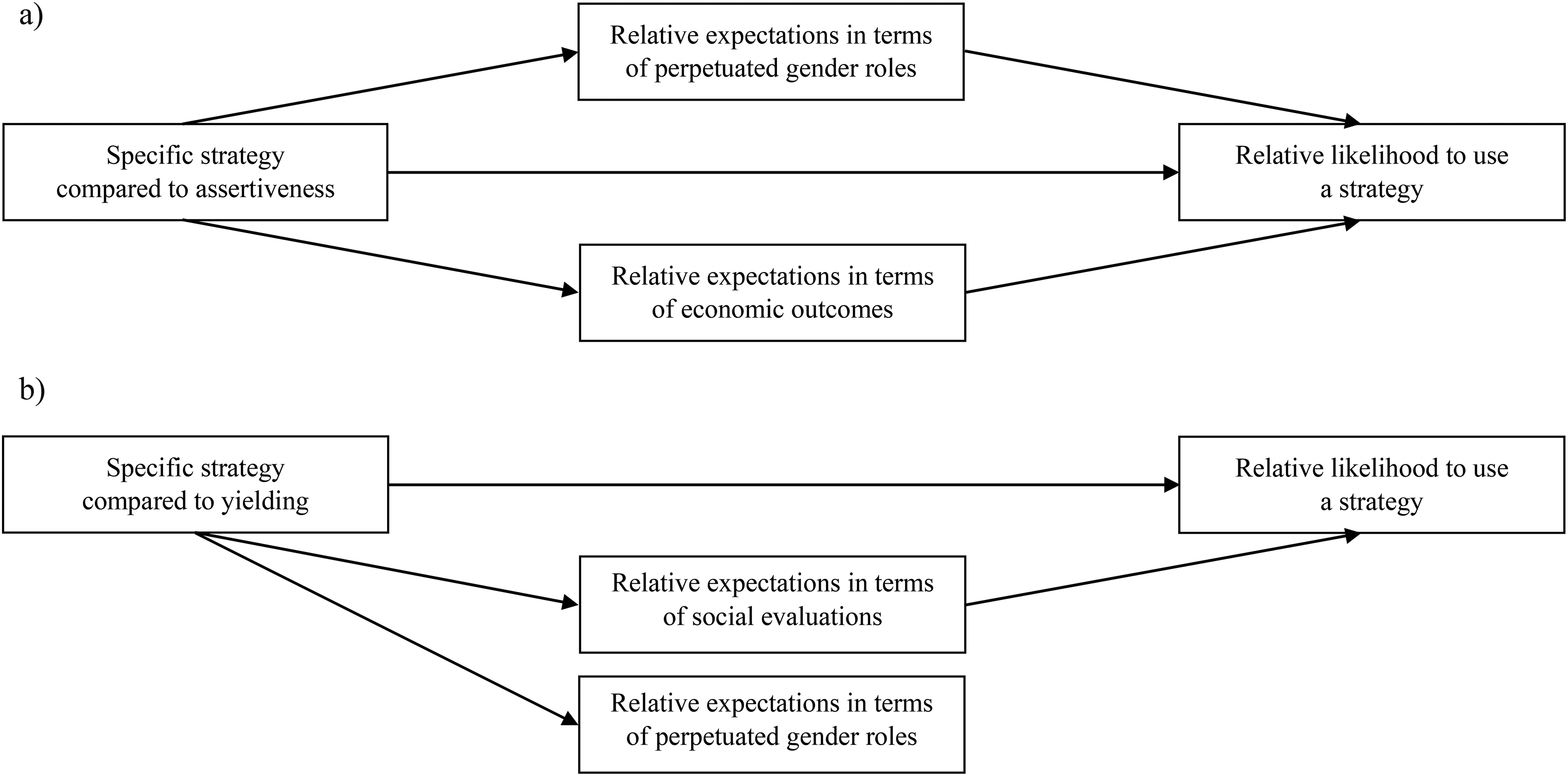
Conceptual Model of How the Constructs Are Hypothesized to be Related to Each Other.
Women would expect relational accounts, feminine charm, confrontation, and being advocated for to lead to lower economic outcomes than assertiveness.
Women would expect relational accounts, feminine charm, and being advocated for to result in a higher degree of perpetuation of gender roles than assertiveness.
Women would be less likely to intend to use relational accounts, feminine charm, confrontation, and being advocated for than assertiveness.
Women's lower likelihoods of intending to use relational accounts, feminine charm, confrontation, and being advocated for than assertiveness would be mediated via their expectations regarding economic outcomes and the perpetuation of gender roles.
Although relational accounts and feminine charm work by highlighting feminine attributes, they remain strategies to further one's own interests (Mazei et al., 2020), which contradicts women's gender role (Eagly et al., 2020; Haines et al., 2016). Further, women using feminine charm could be perceived as seeking power via self-sexualization, which could invite backlash (Infanger et al., 2016; Rudman et al., 2012). Moreover, as confrontation could be seen as offensive, women might expect to be evaluated negatively in return. Finally, when being advocated for, women might expect to be seen as shirking responsibility or as weak (a “negative” feminine attribute; Prentice & Carranza, 2002). As people recognize the risk of incurring backlash (Amanatullah & Morris, 2010; Rudman & Fairchild, 2004), women should expect all specific strategies to lead to less favorable social evaluations than yielding.
Yet, whereas yielding is fully in line with women's gender role, relational accounts, feminine charm, confrontation, and being advocated for are meant to improve one's own outcomes—an act of self-concern that is not in line with their gender role (e.g., Bowles et al., 2022; Eagly & Karau, 2002; Kray et al., 2012). Hence, women should expect these specific strategies to lead to a lower degree of the perpetuation of gender roles than yielding.
In turn, when women expect negative evaluations for using a specific strategy, they should be unlikely to intend to use it. Thus, women should be less likely to intend to use relational accounts, feminine charm, confrontation, and being advocated for than yielding, which should be mediated via their lower expectations regarding social evaluations. As women likely expect yielding to perpetuate gender roles more than any specific strategy—a “negative” expectation—it is not sensible to predict that the perpetuation of gender roles would mediate women's greater intentions to use yielding (see Figure 1). Altogether:
Women would expect relational accounts, feminine charm, confrontation, and being advocated for to lead to less favorable social evaluations than yielding.
Women would expect relational accounts, feminine charm, confrontation, and being advocated for to lead to a lower degree of perpetuation of gender roles than yielding.
Women would be less likely to intend to use relational accounts, feminine charm, confrontation, and being advocated for than yielding.
Women's lower likelihoods of intending to use relational accounts, feminine charm, confrontation, and being advocated for than yielding would be mediated via their expectations regarding social evaluations.
In addition, as it is unclear how women expect imagining being an advocate—an unobservable, internal process (see Bear & Babcock, 2017)—to influence any outcomes, we raised the following exploratory research question (RQ) in our preregistration:
How would women evaluate imagining being an advocate as compared to assertiveness and yielding regarding economic outcomes, social evaluations, and the perpetuation of gender roles? And would women be more or less inclined to use this strategy as compared to both conventional strategies?
Finally, although cultural differences are not the focus of our research, we included women from Germany and the United States (U.S.). According to Shan et al. (2019), Germany and the United States are both individualistic and assertive cultures, resulting in a negotiation advantage for men. Yet, Germany fares better on the Gender Inequality Index with a score of .084 (GII; Human Development Reports, 2020) than the United States with a score of .204 (scores range from 0 to 1, with lower scores indicating less inequality)—thus, German women might expect less backlash for role-violations. Hence, German women may be relatively likely to just negotiate assertively, rather than using specific strategies. Therefore, we explored the implementation gap among women from Germany and from the United States and asked:
Does the cultural background (Germany vs. the United States) influence women's evaluations and intentions to use certain strategies?
How to Attenuate the Implementation Gap?
We examined whether providing women with theoretical rationales for the specific strategies attenuates the implementation gap. Specific strategies are typically grounded in theory (e.g., Eagly & Karau, 2002; Stuhlmacher & Linnabery, 2013), which is clearly a strength. Yet, without information about the underlying rationales, people may be unable to understand how and why the specific strategies could be effective. In turn, people's understanding of the consequences of using specific strategies—their expectations regarding economic outcomes, social evaluations, and the gender role perpetuation—fuels the implementation gap (Amanatullah & Morris, 2010; Mazei et al., 2020). Explaining to negotiators how the specific strategies are meant to impact different outcomes in a compensation negotiation could facilitate a deeper understanding of them and, thus, help to close the implementation gap. This general reasoning is in line with expectancy-value theories, the heuristic model of persuasion, as well as insights into people's decision-making.
Vroom’s (1964) VIE theory has three main constructs: valence, instrumentality, and expectancy (for a helpful illustration, see Karau & Williams, 1993). 1 The theory can explain people's intentions and has already been used in research on negotiation and gender (e.g., Reif et al., 2020; Reif et al., 2019). In VIE theory (Vroom, 1964), the technical term expectancy denotes the perceived likelihood with which an effort, or “e,” would lead to a performance, or “p”—thus, expectancy captures the perceived relationship of “e → p” (Van Eerde & Thierry, 1996). In our context, expectancy thus refers to women's perceptions that they would be able to apply a strategy (“If I tried to assert myself, would I be able to do so?”). In turn, instrumentality denotes the perceived relation between a performance (“p”; here, the enactment of a strategy) and a subsequent outcome (“o”; e.g., social evaluations), or “p → o” (Van Eerde & Thierry, 1996). Thus, the instrumentality-component captures the kinds of expectations that underlie the implementation gap (Mazei et al., 2020; e.g., “If I used a strategy, how would it influence my economic outcomes, social evaluations, or the perpetuation of gender roles?” see our measures below, and please note that women's dilemma is rooted in the risk of incurring backlash when being agentic—a question regarding the “instrumentality” of agency—but not an inability to be agentic; e.g., Amanatullah & Morris, 2010). Finally, valence means “all possible affective orientations toward outcomes, and it is interpreted as the importance, attractiveness, desirability, or anticipated satisfaction with outcomes” (Van Eerde & Thierry, 1996, p. 576). Thus, in our context, valence refers to how subjectively attractive or valuable the key outcomes of a negotiation (e.g., economic profits or social evaluations) are to women.
Providing theoretical rationales leverages the instrumentality-component. As hypothesized above and as suggested by first evidence (Mazei et al., 2020), women typically expect that the usage of specific strategies (“p”) would lead to worse economic outcomes (“o”) in comparison to assertiveness. Likewise, women typically expect that the usage of specific strategies (“p”) would lead to less favorable social evaluations (“o”) in comparison to yielding (Mazei et al., 2020). In turn, these unfavorable expectations drive the implementation gap. Altogether, under normal circumstances—when women are not provided with rationales—women do not perceive the specific strategies to be instrumental in achieving valued outcomes in a negotiation. In other words, without any explanations, it remains unclear how exactly using a strategy could possibly work, such that positive outcomes result.
Yet, when theoretical rationales are provided, women do receive explanations as to how the usage of specific strategies (“p”) could, in fact, result in desired outcomes (“o”; e.g., improved social evaluations). For instance, a theoretical rationale for a relational account might explain that women using this specific strategy may appear more appropriate by highlighting their relationships (Bowles & Babcock, 2013; Table 1). Thus, women are guided in their expectations of how using a strategy (“p”) could lead to valuable outcomes (e.g., if a counterpart perceives a demand as appropriate, it follows that they likely grant it, resulting in better economic outcomes, or “o”). Thus, the provision of theoretical rationales makes clearer the potential benefits that follow from using a specific strategy—their instrumentality. In turn, if women have more favorable expectations regarding their instrumentality, they should become more likely to intend to use them. Altogether, the implementation gap should be attenuated when women are provided with theoretical rationales (vs. when not).
Descriptions of the Seven Negotiation Strategies and Their Underlying Theoretical Rationales.
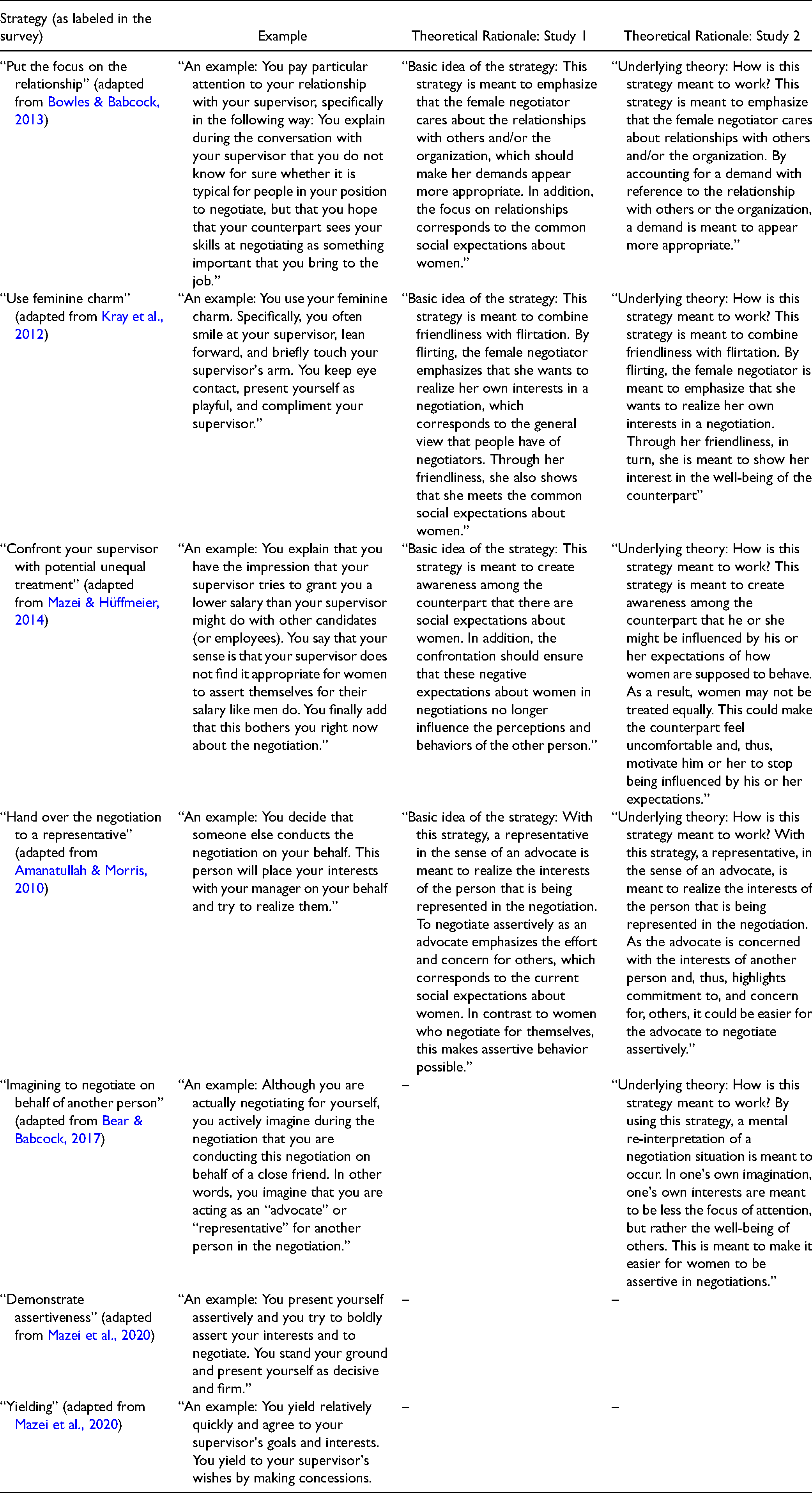
Moreover, the heuristic model of persuasion (Chaiken, 1987) posits that people process information on a continuum ranging from heuristic to systematic. When people process information systematically, which is likely in our context given the relevance of compensation negotiations, they attend “to the strength and quality of the arguments” (Smith & Mackie, 2007, p. 246). In the absence of any theoretical rationales, there are simply no arguments provided suggesting the potential effectiveness of specific strategies, which can leave people unconvinced to use them. Yet, explicit theoretical rationales (or “underlying theory”; see Table 1) do deliver arguments as to why using a strategy could be helpful (e.g., a counterpart could deem a demand as appropriate; Bowles & Babcock, 2013). Research on advice-giving also suggests that people collect additional information to delineate the relative attractiveness of multiple options (Harvey & Bolger, 2001). Moreover, even if people processed information heuristically, the general presence of theoretical rationales could serve as a heuristic, or cue, suggesting the effectiveness of strategies and why it can make sense to use them (similar to cues implying expertise), whereas there is not even a heuristic provided that would suggest their effectiveness in the absence of theoretical rationales. In fact, people often rely on heuristics to evaluate recommendations (e.g., “more is better”) and agree more with statements that contain more information and arguments. Thus, in certain cultures (e.g., Germany), people may be more persuaded when they are also explained why a recommendation is helpful (Meyer, 2014). Taken all together, we hypothesized:
The expected effects described in Hypotheses 1a, 1c, 2a, and 2c would be attenuated when a theoretical rationale for the strategies is presented.
Regarding the perpetuation of gender roles, however, it is unclear how the provision of theoretical rationales may influence women's expectations. Doing so may increase the expected perpetuation of gender roles when using specific strategies as the rationales often imply the enactment of communal behaviors. Yet, doing so may also reduce the expected perpetuation as the rationales imply the economic benefits of using a strategy, which would help to reduce inequalities. Thus, we asked:
How would the provision of theoretical rationales influence the expected perpetuation of gender roles?
Overview of Our Research
Our research included two studies. In Study 1, we surveyed German women to examine all hypotheses and also RQ 3. Study 2 represents a replication and extension of Study 1 that we conducted primarily to address the limitations of Study 1. Preregistrations can be retrieved as per the following links: https://osf.io/zxaqf/?view_only=3bb11a5f286c4fbda8ac43b4c3be0cce (Study 1) and https://osf.io/swtg3/?view_only=fb7769b0e63a45ff8a44b4792bc1106c (Study 2). We share all materials in the Online Supplement. Our data and code are available as per the following links: https://osf.io/f5mdr/?view_only=bf17f099dc9b49138df5ca81cdff70aa (Study 1) and https://osf.io/zqm9f/?view_only=05cb21e8a4a7443a8d8e8d8a566ba79e (Study 2). We disclose our manipulations, our sample sizes, exclusions, all measures, and the general procedure (Simmons et al., 2012).
Study 1
Method
Design
We used a 2 (theoretical rationales: absent vs. present; between-subjects) × 6 (strategy: relational accounts vs. feminine charm vs. confrontation vs. being advocated for vs. assertiveness vs. yielding; within-subjects) mixed-factorial design. 2 Participants were randomly assigned to one of the between-subjects conditions and evaluated all six strategies.
Power Analysis
We conducted an a priori power analysis for repeated measures ANOVA for two groups and six measurements using G*Power (Faul et al., 2007). Based on prior data (Mazei et al., 2020), we set the correlation among measures to .05 and corrected for non-sphericity with a value of .20. The analysis revealed a sample size of 102 women in order to detect a medium-sized main effect (f = 0.25; α = .05; 1 − β = .80), which we multiplied by four (N = 408) due to our predicted ordinal interaction effect in Hypothesis 3 (Simonsohn, 2014).
Sample
In Study 1, we recruited German women via the WiSo-Panel (www.wisopanel.net), a German non-profit panel with demographically heterogeneous panelists. This panel invites at least 550 participants to studies. A total of 573 participants completed our survey. We excluded four participants who wished to withdraw their data at the end of the survey, seven participants who indicated they were not women, and 58 participants who failed an attention check.
We also included a treatment check, asking whether theoretical rationales were presented, but its wording might have been unclear: Most participants (n = 216) in the rationales absent condition erroneously indicated that they had seen them. They may have interpreted the given examples, which were presented in both conditions, as being the rationales. Yet, please note that our manipulation was unlikely to be simply unsuccessful: If that were true, one would expect that most participants who were presented with the rationales would also fail the check by stating that they were not provided with them, which was not the case (n = 29). Moreover, regardless of the condition (Φ = .02, 95% CI [−.06, .11], SE = .04, p = .585), most participants passed the attention check, suggesting that they had carefully completed the survey. Finally, note that excluding participants who failed the treatment check (83.40% in the rationales absent condition, 5.76% in the rationales present condition) would have led to a significant imbalance in group sizes (Φ = .78, 95% CI [.73, .83], SE = .03, p < .001) as well as a substantial loss of statistical power. Thus, we deviated from our preregistration in this aspect and did not use a failed treatment check as an exclusion criterion (unlike as in Study 2).
This approach led to a final sample of N = 504 women who ranged in age from 19 to 87 years old (M = 50.42; SD = 12.58). Most participants (n = 341) were regularly employed, one woman was in retraining, 14 women were students at a university, and 148 women had a different occupational status (mainly unemployed, n = 74, or retired, n = 71). Employed women had a variety of job types as indicated by Holland’s (1996) taxonomy: 28 categorized their occupation as realistic, 35 as investigative, 17 as artistic, 98 as social, 75 as enterprising, and 88 as conventional. In sum, our sample was heterogeneous. Moreover, whether they were young or old, employed or unemployed (including retired), women's relative likelihoods of intending to use the specific strategies were comparable. 3 Thus our data allow for some generalizability (Mazei et al., 2020).
Measures
Given that participants had to evaluate all six strategies separately, we used one or two items to measure each construct (cf. Mazei et al., 2020).
Expectations Regarding Economic Outcomes
On a scale from 1 (not at all) to 7 (very much), participants answered the question: “What do you think: How much does this behavior lead your counterpart to grant your requests (for example, regarding salary)?” A similar item was used in prior research (Bowles & Babcock, 2013; Mazei et al., 2020).
Expectations Regarding Social Evaluations
On a scale from 1 (not at all) to 7 (very much), participants answered two questions: “What do you think: How much does this behavior lead your counterpart to want to work together with you?” and “What do you think: How much does this behavior lead to building a positive relationship with your counterpart?” (see also Bowles et al., 2007; Mazei et al., 2020). The items were averaged to build a scale. Cronbach's alphas varied between α = .80 (rationales absent condition, yielding) and α = .95 (rationales absent condition, being advocated for). 4
Expectations Regarding the Perpetuation of Gender Roles
On a scale from 1 (not at all) to 7 (very much), participants answered one question: “What do you think: How much does this behavior lead you to contribute to the perpetuation of the current social expectations of women and their behavior?” Answers to this item were reverse-coded, such that a higher score indicated a more favorable rating (as was the case for the other expectations).
Likelihood of Intending to Use Strategies
On a scale from 1 (not at all) to 7 (very well), participants answered one question: “How well can you imagine yourself to show this behavior in this negotiation situation?” This item was adapted from Mazei et al. (2020).
Forced-Choice Item
For exploratory purposes, we asked participants which of the provided strategies they would choose if they had to pick only one (cf. Mazei et al., 2020).
Treatment and Attention Check
Participants were asked whether in most cases the basic idea of the strategies (this expression was used to simplify the language) was presented, along with an example for the behavior, when they had read about the various strategies. An attention check was placed between the questions on negotiation experience, asking participants to simply select the second response option as counted from the left-hand side.
Further Information and Demographics
Participants were asked to indicate on a scale from 1 (not at all) to 7 (very well) how well they were able to picture themselves in the described negotiation situation. A bootstrapped one sample t-test revealed that the mean value (M = 5.31, SD = 1.52) was significantly higher than the midpoint of the scale, t(503) = 19.32, p < .001, 95% CI [1.17, 1.45], suggesting that participants were able to picture themselves in the situation (cf. Mazei et al., 2020). Participants also indicated the gender of the counterpart they imagined to have in the negotiation (n = 383, or 75.99%, indicated a man). As male counterparts can lead women to initiate fewer negotiations and to incur more backlash (Bowles et al., 2007; Eriksson & Sandberg, 2012), women might appraise the strategies differently based on the imagined counterpart's gender. Bootstrapped t-tests for independent samples showed that women imagining a male counterpart expected feminine charm to fare less unfavorably in comparison to yielding regarding the social evaluations, MDiD = −0.52, 95% CI [–0.87, −0.18], t(502) = −2.82, p = .005. Yet, all remaining comparisons did not reveal significant differences, suggesting that the imagined counterpart's gender did not have much of an influence in the current study.
Furthermore, participants indicated whether they had ever negotiated aspects of their work (n = 317, or 62.90%, had negotiated at least once) and if so, how often they had done so (range from 1 to 500; Mdn = 3.00). Moreover, participants indicated on a scale from 1 (not at all) to 7 (very well) how well it was generally possible to negotiate aspects of their work in their current job (n = 396, M = 3.27, SD = 2.01) and their past job (n = 458, M = 3.37, SD = 2.02). Sample sizes for these items differed because participants could indicate that these questions did not apply to them. Exploratory analyses on the role of negotiation experience can be found in the Online Supplement. Finally, participants indicated demographics.
Procedure and Materials
The study was described as asking about people's opinion concerning negotiation strategies that could be used in work situations. After giving consent, participants read about a hypothetical salary negotiation (adapted from Mazei et al., 2020) and were asked to picture themselves in it. To ensure participants would not skip reading the scenario, the button to continue appeared after ten seconds. Salary negotiations are seen as “masculine” negotiations (Bear, 2011) that typically result in gender differences (e.g., Bowles et al., 2022; Reif et al., 2019). In the scenario, participants were involved in a negotiation and implicitly described as having already made requests, which reflects a certain level of assertiveness (e.g., Bowles & Babcock, 2013; Kugler et al., 2018). Finally, the supervisor in the scenario was described to be hesitant to meet their requests, implying the risk of backlash (cf. Mazei et al., 2020).
Afterwards, participants evaluated all six strategies one after another in a randomized order. For each strategy, an example was given (see Table 1; the original versions in German can be found in Online Supplemental Table 1s). The example for relational accounts was adapted from the skill-contribution script from Bowles and Babcock (2013), the example for feminine charm from Kray et al. (2012), and the example for confrontation from Mazei and Hüffmeier (2014). The example for being advocated for was based on Amanatullah and Morris’s (2010) advocacy approach, whereby the perspective of the person who was advocated for was taken. Finally, the examples for assertiveness and yielding were adapted from Mazei et al. (2020).
In the rationales absent condition, participants were only shown the examples for each strategy. In the rationales present condition, participants were additionally provided with theoretical rationales (Table 1). The rationales were adapted from and closely followed the corresponding explanations presented in the original research (i.e., relational accounts from Bowles & Babcock, 2013; feminine charm from Kray et al., 2012; confrontation from Mazei & Hüffmeier, 2014; being advocated for from Amanatullah & Morris, 2010). The rationales were given in everyday language to make them comprehensible to non-researchers. Notably, theoretical rationales were presented only for the specific strategies, not for assertiveness and yielding, as they served as comparison standards in both conditions. Their depiction was held constant across conditions to prevent introducing a confound: If we had not done so, effects for the between-subject factor could have been due to the rationales provided for the specific strategies or due to the presence (vs. absence) of rationales for the conventional strategies.
Participants then indicated which of the six strategies they would choose if they had to pick just one. Afterwards, they answered the checks, provided further information, indicated demographics, and were allowed to give comments. At the end of the study, we asked them whether we were allowed to use their data for research purposes and debriefed them.
Results
Due to the numerous single comparisons, we organized all statistics relevant to our hypotheses and RQs in Tables 2 to 5. Test statistics for less central and supplementary analyses can be found in Online Supplemental Material. Further, in order to double-check all results, two of the authors independently conducted all of the analyses.
Study 1: Descriptive Statistics for Both Conditions and Each Negotiation Strategy (N = 504).
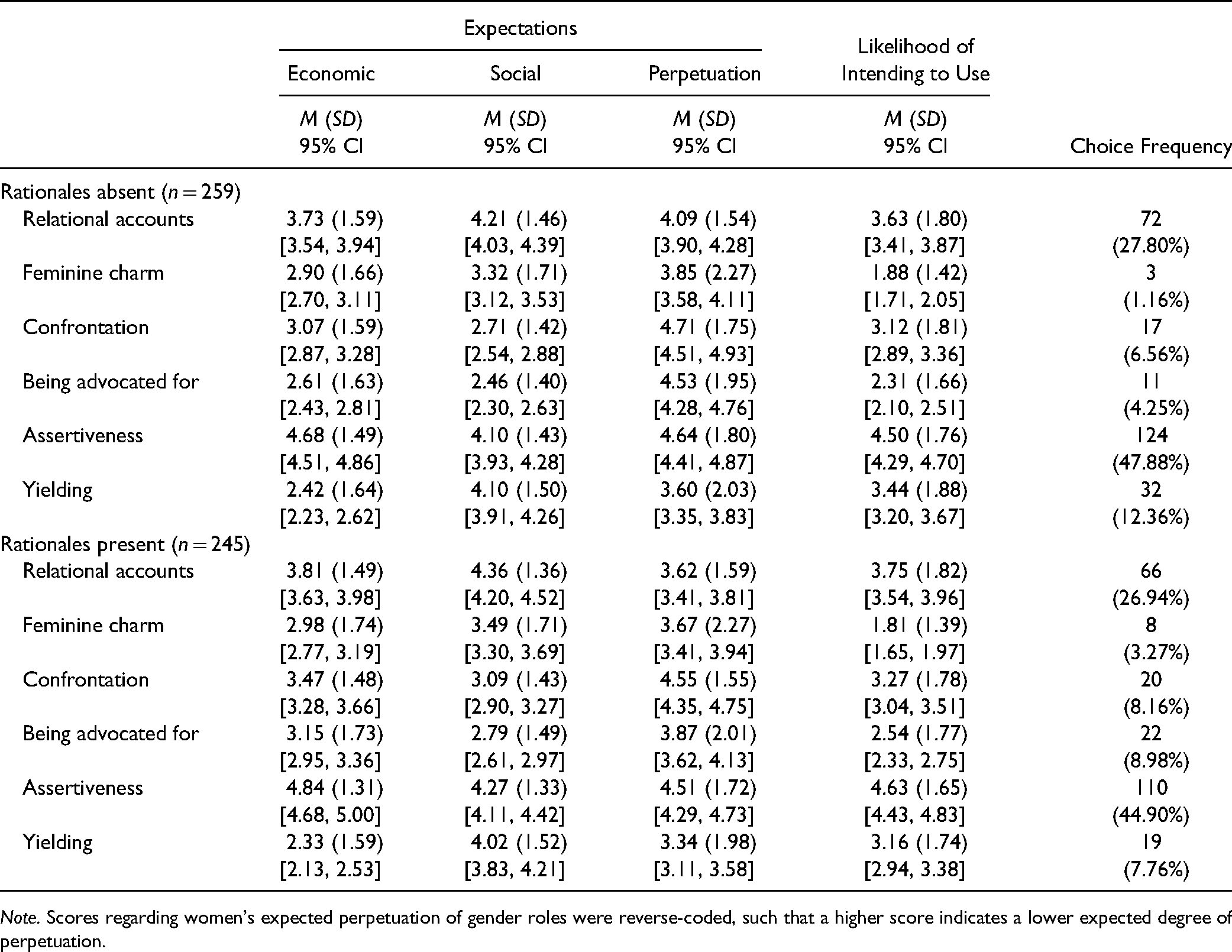
Note. Scores regarding women's expected perpetuation of gender roles were reverse-coded, such that a higher score indicates a lower expected degree of perpetuation.
Study 1: Test Statistics for One-Sample t-Tests for the Whole Sample (N = 504).
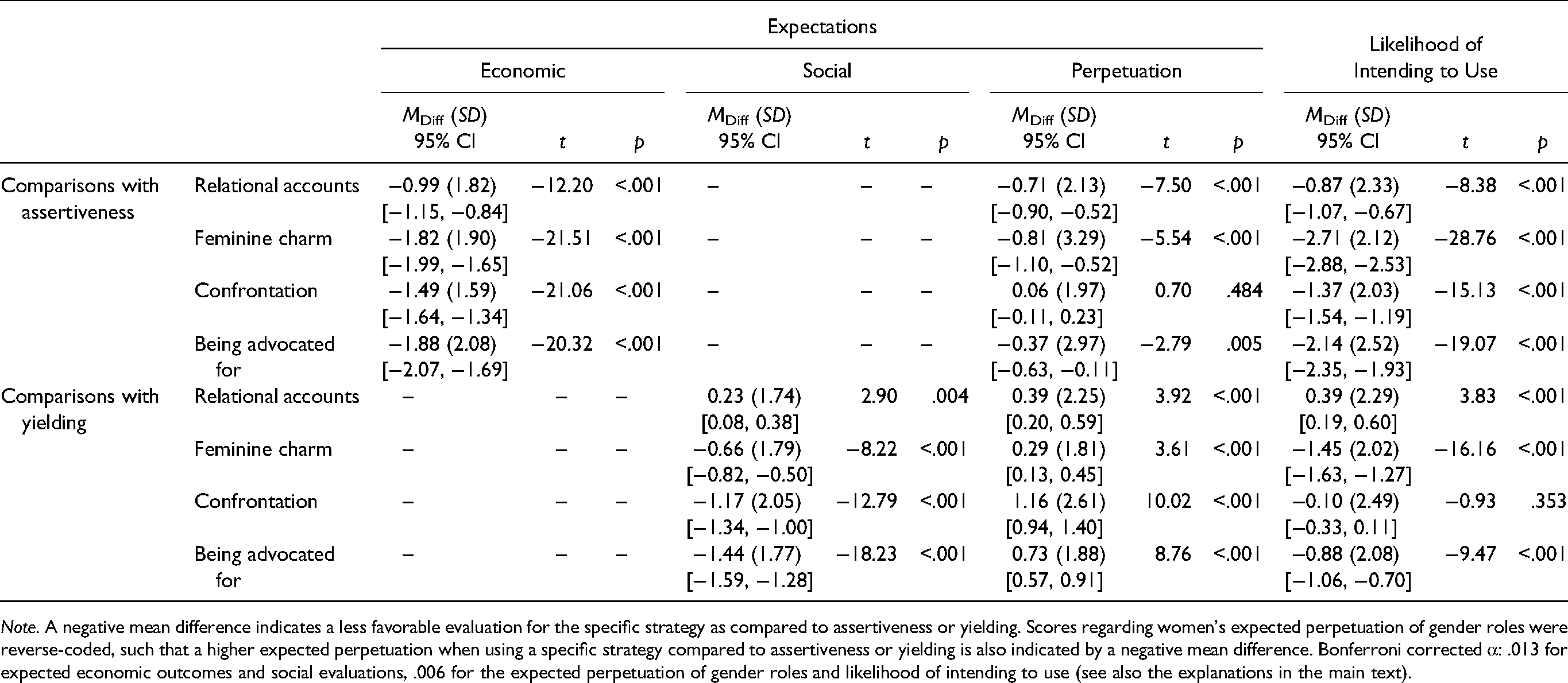
Note. A negative mean difference indicates a less favorable evaluation for the specific strategy as compared to assertiveness or yielding. Scores regarding women's expected perpetuation of gender roles were reverse-coded, such that a higher expected perpetuation when using a specific strategy compared to assertiveness or yielding is also indicated by a negative mean difference. Bonferroni corrected α: .013 for expected economic outcomes and social evaluations, .006 for the expected perpetuation of gender roles and likelihood of intending to use (see also the explanations in the main text).
Study 1: Test Statistics for Mediation Analyses.
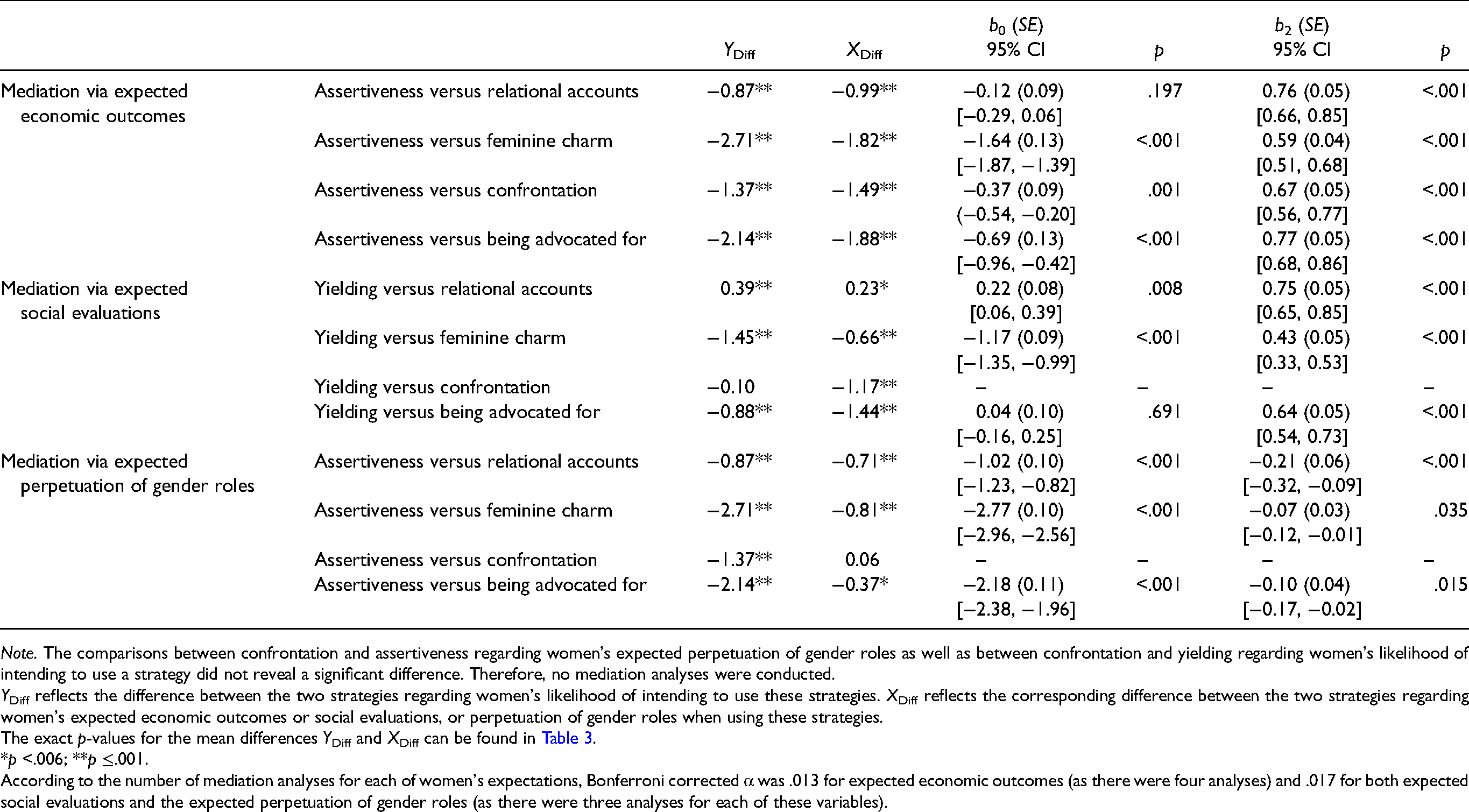
Note. The comparisons between confrontation and assertiveness regarding women's expected perpetuation of gender roles as well as between confrontation and yielding regarding women's likelihood of intending to use a strategy did not reveal a significant difference. Therefore, no mediation analyses were conducted.
YDiff reflects the difference between the two strategies regarding women's likelihood of intending to use these strategies. XDiff reflects the corresponding difference between the two strategies regarding women's expected economic outcomes or social evaluations, or perpetuation of gender roles when using these strategies.
The exact p-values for the mean differences YDiff and XDiff can be found in Table 3.
*p <.006; **p ≤.001.
According to the number of mediation analyses for each of women's expectations, Bonferroni corrected α was .013 for expected economic outcomes (as there were four analyses) and .017 for both expected social evaluations and the expected perpetuation of gender roles (as there were three analyses for each of these variables).
Study 1: Test Statistics for Independent Samples t-Tests Comparing the Conditions “Rationales Absent” and “Rationales Present.”
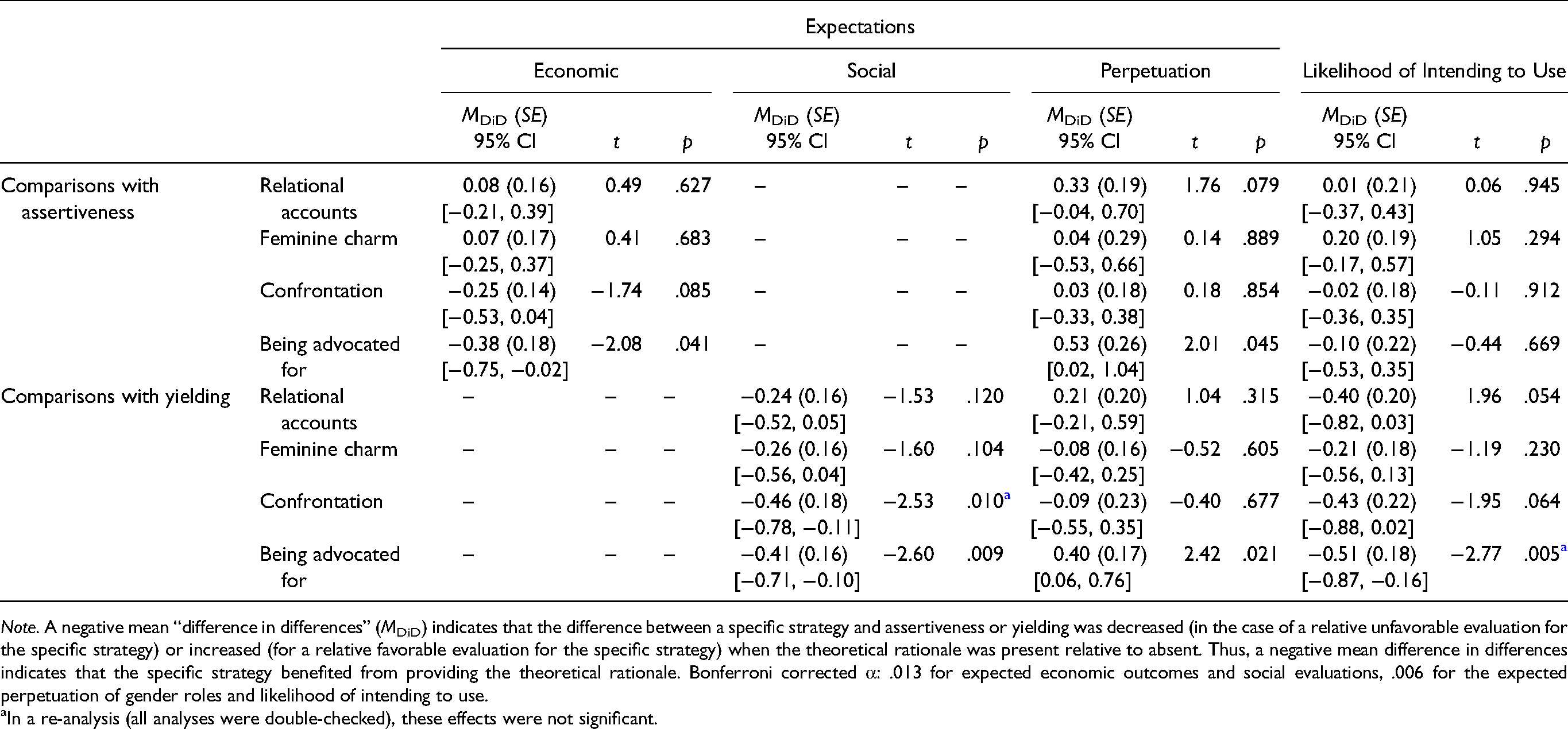
Note. A negative mean “difference in differences” (MDiD) indicates that the difference between a specific strategy and assertiveness or yielding was decreased (in the case of a relative unfavorable evaluation for the specific strategy) or increased (for a relative favorable evaluation for the specific strategy) when the theoretical rationale was present relative to absent. Thus, a negative mean difference in differences indicates that the specific strategy benefited from providing the theoretical rationale. Bonferroni corrected α: .013 for expected economic outcomes and social evaluations, .006 for the expected perpetuation of gender roles and likelihood of intending to use.
In a re-analysis (all analyses were double-checked), these effects were not significant.
Women's Evaluation of the Strategies
Shapiro-Wilk tests suggested that the assumption of normality was violated for all four main study variables in both conditions. Hence, we conducted non-parametric Friedman's ANOVAs, separately for both conditions, to examine whether there was a main effect for the within-subjects factor of strategy, which could suggest an implementation gap. In both conditions, the strategies significantly differed from each other regarding women's expected economic outcomes, social evaluations, perpetuation of gender roles, and the likelihood with which they intended to use them (see Online Supplemental Table 2s).
We next conducted bootstrapped one-sample t-tests (2,000 samples; bias corrected and accelerated 95% CIs) to test our specific Hypotheses 1a–c and 2a–c. 5 These tests examine whether the mean difference between one of the specific strategies and either assertiveness or yielding differs significantly from zero. These mean differences are needed for the mediation analyses and the examination of the influence of the theoretical rationales, both of which are provided below. For example, subtracting women's likelihood of intending to use assertiveness from their likelihood of intending to use confrontation indicates women's relative likelihood of intending to use confrontation over assertiveness. As the examination of each main study variable involves multiple single comparisons, namely comparing each specific strategy with either assertiveness, yielding, or both, we used Bonferroni corrections. Here and for all subsequent t-tests for Study 1, we adjusted α to .013 for women's expected economic outcomes as well as social evaluations (as the four specific strategies were compared either to assertiveness or to yielding) and to .006 for women's expected perpetuation of gender roles as well as their relative likelihood of intending to use a specific strategy (as the four specific strategies were compared to both assertiveness and yielding). Descriptive statistics are presented in Table 2 and all test statistics are presented in Table 3.
As a robustness check, we additionally conducted multilevel analyses for our main study variables, in which responses regarding the strategies were nested in each individual. For each variable, the results revealed a virtually unchanged pattern of results.
Expected Economic Outcomes
Hypothesis 1a stated that women would expect relational accounts, feminine charm, confrontation, and being advocated for to lead to lower economic outcomes than assertiveness. In fact, women expected all specific strategies to lead to lower economic outcomes than assertiveness, which fully supports Hypothesis 1a.
Expected Social Evaluations
Hypothesis 2a stated that women would expect relational accounts, feminine charm, confrontation, and being advocated for to lead to less favorable social evaluations than yielding. Analyses revealed that women expected feminine charm, confrontation, and being advocated for to lead to less favorable social evaluations than yielding. Unexpectedly, however, women expected relational accounts to lead to more favorable social evaluations than yielding. These findings mostly support Hypothesis 2a.
Expected Perpetuation of Gender Roles
Hypothesis 1b stated that women would expect relational accounts, feminine charm, and being advocated for to lead to a higher degree of perpetuation of gender roles than assertiveness. In fact, women expected each of these three specific strategies to perpetuate gender roles more than assertiveness would, which fully supports Hypothesis 1b. As anticipated, confrontation did not significantly differ from assertiveness. Hypothesis 2b stated that women would expect relational accounts, feminine charm, confrontation, and being advocated for to lead to a lower degree of perpetuation of gender roles than yielding. In fact, women expected all four specific strategies to perpetuate gender roles less than yielding would, which fully supports Hypothesis 2b.
Likelihood of Intending to Use Strategies
Hypothesis 1c stated that women would be less likely to intend to use relational accounts, feminine charm, confrontation, and being advocated for than assertiveness. In fact, women were less likely to intend to use any of the specific strategies compared to assertiveness, which fully supports Hypothesis 1c. Hypothesis 2c stated that women would be less likely to intend to use relational accounts, feminine charm, confrontation, and being advocated for than yielding. We found that women were less likely to intend to use feminine charm and being advocated for than yielding, but they were more likely to intend to use relational accounts than yielding, and they had no preference regarding confrontation in comparison to yielding. These findings partly support Hypothesis 2c.
Women's Expectations as Mediators
We used the procedure by Judd et al. (2001) to examine mediation in within-subjects designs (cf. Mazei et al., 2020). The procedure uses the centered sum of, as well as the difference between, two “Xs” (here, women's expectations) as predictors of the difference between two “Ys” (here, the likelihood of intending to use a strategy). Mediation occurs when the difference in the Xs is significant and in the same direction as an observed significant difference in the Ys and, also, the difference in the Xs predicts the difference in the Ys. This prediction is reflected in a significant coefficient b2. The differences in the Xs and Ys were already examined above (see Table 3). We again used a robust estimation and a Bonferroni correction based on the number of mediation analyses for each expectation (see Table 4). Again, we provide the test statistics in Table 4 to best organize the numerous results.
Expected Economic Outcomes and Expected Perpetuation of Gender Roles
Hypothesis 1d stated that women's lower likelihoods of intending to use relational accounts, feminine charm, confrontation, and being advocated for compared to assertiveness would be mediated via their lower expectations regarding economic outcomes. In fact, women's lower likelihoods of intending to use any of the specific strategies compared to assertiveness were mediated via their lower expectations regarding economic outcomes. These results fully support Hypothesis 1d.
Hypothesis 1d also stated that women's lower likelihoods of intending to use relational accounts, feminine charm, and being advocated for compared to assertiveness would be mediated via their less favorable expectations regarding perpetuated gender roles. Women's lower likelihoods of intending to use relational accounts and being advocated for relative to assertiveness were, in fact, mediated via their expectations that using them would lead to a greater perpetuation of gender roles. Yet, women's lower likelihood of intending to use feminine charm compared to assertiveness was not mediated via the expected perpetuation of gender roles. These results mainly support Hypothesis 1d.
Altogether, note that Hypothesis 1d postulated mediation via two expectations—regarding economic outcomes and the perpetuation of gender roles. In fact, the separate mediation analyses that we reported above revealed that women's relative likelihoods of intending to use relational accounts and being advocated for were mediated via both expectations. Thus, we additionally used Montoya and Hayes' (2017) procedure, which builds on Judd et al. (2001) and allows for a competitive test of multiple mediators in within-subjects designs.
Results revealed that both expectations mediated women's lower likelihood of intending to use relational accounts compared to assertiveness, b0 = −0.23, 95% CI [−0.42, −0.03], SE = .10, p = .022, beco = 0.74, 95% CI [0.65, 0.83], SE = .05, p < .001, bperp = −0.13, 95% CI [−0.21, −0.05], SE = .04, p = .001. Yet, women's lower likelihood of intending to use being advocated for compared to assertiveness was only mediated via their expected economic outcomes, but not their expected perpetuation of gender roles, when both expectations were included in the model, b0 = −0.69, 95% CI [−0.93, −0.46], SE = .12, p < .001, beco = 0.77, 95% CI [0.68, 0.85], SE = .04, p < .001, bperp = 0.00, 95% CI [−0.06, 0.06], SE = .03, p = .969.
Expected Social Evaluations
Hypothesis 2d stated that women's lower likelihoods of intending to use relational accounts, feminine charm, confrontation, and being advocated for than yielding would be mediated via their less favorable expectations regarding social evaluations. Women's lower likelihoods of intending to use feminine charm and being advocated for compared to yielding were, in fact, mediated via their less favorable expectations regarding the social evaluations for these strategies. Women's higher reported likelihood of intending to use relational accounts over yielding, which we did not predict, was mediated via their expectation that relational accounts would lead to more favorable social evaluations. As women did not differ in their likelihood of intending to use confrontation and yielding, we did not conduct a mediation analysis. These results partly support Hypothesis 2d.
Influence of Providing the Theoretical Rationales
To test Hypothesis 3, we conducted robust t-tests for independent samples (as a robustness check, multilevel analyses again revealed virtually unchanged results). These tests compared two differences with each other—each one capturing the difference between one of the specific strategies and either assertiveness or yielding. One difference stemmed from the condition in which the theoretical rationales were absent and the other difference stemmed from the condition in which the theoretical rationales were present (mean differences and test statistics for one-sample t-tests split for both conditions are in Online Supplemental Tables 3s and 4s). For example, we examined whether women's relative likelihood of intending to use confrontation compared to assertiveness changes depending on whether the theoretical rationale for confrontation was provided or not. In the following, we describe these mean differences in differences (MDiD). We present all test statistics in Table 5. Please note that we did not have a hypothesis but only an exploratory research question regarding the expected perpetuation of gender roles.
Expected Economic Outcomes
Hypothesis 3 stated that the differences between all four specific strategies and assertiveness regarding women's expected economic outcomes would be attenuated when the theoretical rationales for the specific strategies were presented. Yet, providing a rationale did not attenuate the difference between any of the specific strategies and assertiveness regarding women's expected economic outcomes.
Expected Social Evaluations
Hypothesis 3 further stated that the differences between all four specific strategies and yielding regarding women's expected social evaluations would be attenuated when the theoretical rationales for the specific strategies were presented. Providing the rationale for relational accounts did not change its difference from yielding regarding the expected social evaluations (we observed that women expected relational accounts to lead to more favorable social evaluations than yielding). Presenting the rationale for feminine charm also did not attenuate its difference from yielding. Regarding confrontation as compared to yielding, presenting its rationale was initially found to attenuate the difference (p = .010), but in a re-analysis, this effect was not significant (p = .014; please recall that all analyses were conducted twice to double-check the results and that we used a Bonferroni-corrected α of .013 for women's expectations regarding social evaluations; the variation in p-values likely occurred due to the randomly drawn samples as used in bootstrapped analyses). We interpret this result conservatively, such that providing the theoretical rationale likely did not attenuate the difference. Finally, however, providing the rationale for being advocated for was found to significantly attenuate its difference from yielding.
Likelihood of Intending to Use Strategies
Hypothesis 3 further stated that the differences between all four specific strategies and assertiveness or yielding regarding women's likelihood of intending to use the strategies would be attenuated when the theoretical rationales for the specific strategies were presented. Yet, providing the rationales did not attenuate the differences between any of the specific strategies and assertiveness. Moreover, providing the rationales for relational accounts, feminine charm, and confrontation did not affect their differences from yielding (we observed that women were more likely to intend to use relational accounts than yielding and equally likely to intend to use confrontation and yielding). Providing the rationale for being advocated for initially attenuated its difference from yielding (p = .005), but not in a re-analysis (p = .009; once again, two of the authors conducted the same analyses using bootstrapping, which likely explains the variation in p-values). A conservative interpretation is again that providing the theoretical rationale did not attenuate the implementation gap. For additional exploratory Bayesian analyses, see the Online Supplemental Material.
Exploratory Analyses
Influence of the Rationales on the Expected Perpetuation of Gender Roles
To explore RQ 3, we conducted bootstrapped independent samples t-tests, comparing women's relative expected perpetuation of gender roles when the rationales were absent versus present. The rationales did not influence the differences between the specific strategies and either assertiveness or yielding. All test statistics can be found in Table 5.
Forced-Choice Item
A χ2-goodness-of-fit test showed that, when women had to pick one strategy, their choices were not equally distributed (see Table 2), irrespective of whether the theoretical rationales were absent, χ2(5) = 250.72, p < .001, or present, χ2(5) = 190.06, p < .001. Furthermore, the two distributions did not differ, χ2(5) = 10.21, p = .069, suggesting that providing the rationales had no influence on the choice of strategy. Women mostly chose assertiveness and relational accounts when they had to pick just one strategy.
Discussion
Hypotheses 1a–d were mostly supported. In comparison to assertiveness, women expected all specific strategies to lead to lower economic outcomes and most of them to a greater perpetuation of gender roles. These expectations (especially, but not only, those regarding economic outcomes) led to their lower likelihood of intending to use specific strategies. The results also largely supported Hypotheses 2a–d. Along with women's expectation that yielding would perpetuate gender roles the most, they expected nearly all specific strategies to lead to less favorable social evaluations, reducing their likelihood of intending to use feminine charm and being advocated for in comparison to yielding. Yet, with regard to Hypothesis 3, providing the theoretical rationales hardly had any influence.
Still, Study 1 was also limited. Most notably, the theoretical rationales used in Study 1 referred to “common social expectations about women” (see Table 1), yet our measure for the perpetuation of gender roles also referred to “expectations of women and their behavior.” These design features might have introduced demand effects. Thus, the main purpose of Study 2 was to address the limitations of Study 1 and to examine whether its results would be replicable. Furthermore, in Study 2, we broadened the set of specific strategies to include imagining being an advocate. Although culture is not the main focus of our research, we included German women and U.S. women in Study 2 to examine the generalizability of our findings from Study 1 more broadly. Altogether, we revised study materials for Study 2 (see below) and again tested Hypotheses 1a–d, 2a–d, and 3, as well as explored RQs 1–3.
Study 2
Method
Design
We used a 2 (theoretical rationales: absent vs. present; between-subjects) × 7 (strategy: relational accounts vs. feminine charm vs. confrontation vs. being advocated for vs. imagining being an advocate vs. assertiveness vs. yielding; within-subjects) mixed-factorial design. In Study 2, we again primarily focus on the influence of the theoretical rationales and the processes underlying the implementation gap (see our hypotheses). Thus, consistent with Study 1, we provide primary analyses based on our full sample and utilizing the 2 × 7 design described above. Afterward, we split our sample by culture and provide exploratory analyses for RQ 2.
Power Analysis and Sample
An a priori power analysis with the same settings as for Study 1, but for a design with seven measurements, revealed that a sample size of N = 368 per culture is required to detect a medium-sized effect and the predicted interaction. To account for potential exclusions, we recruited 450 German women and 450 U.S. women via the platform Prolific (www.prolific.co). Prolific invites more participants when others do not complete the study or wish to withdraw their data. Thus, we received data from 943 participants in total. Adhering to our preregistration, we excluded 43 participants because their data were incomplete or because they did not consent to the usage of their data, seven who indicated they were not women, 22 because they failed the attention check, and 121 because they failed the treatment check (unlike as in Study 1, in which we had to deviate from our preregistration by not excluding participants who failed the treatment check; see above). 6 This led to a final sample of N = 750 women (396 German, 354 U.S.) who ranged in age from 18 to 89 years old (M = 31.65; SD = 12.78). The majority were regularly employed (n = 340) or a student at a university (n = 267), 10 women were students at a high school, and 133 women had another occupational status (mainly unemployed, n = 84, retired, n = 21, or self-employed, n = 20). Employed women again had a variety of job types: 18 categorized their occupation as realistic, 51 as investigative, 37 as artistic, 78 as social, 81 as enterprising, and 75 as conventional (see Holland, 1996). Once again, women's relative likelihoods of intending to use the specific strategies were similar for younger women and older women and also comparable across their different occupational statuses. 7
Measures
To improve measurement quality, we used two items for each construct in Study 2. All items were rated on a scale from 1 (not all all) to 7 (very much/very well). Regarding the expected economic outcomes, we added the question: “What do you think: How much does this behavior lead you to achieve a good economic outcome (e.g., a higher salary)?” Regarding the expected perpetuation of gender roles, we substituted the original question with two new questions (some participants noted that the previously used question was not easy to understand): “What do you think: How much does this behavior lead to a perpetuation of the common societal role of women?” and “What do you think: How much does this behavior lead to stereotypes about women and their behavior to be preserved?” Again, answers to these items were reverse-coded. Finally, regarding the likelihood of intending to use a strategy, we added the question: “How likely would it be for you to use this behavior in this negotiation situation?” Cronbach's alphas across all strategies and main constructs in both conditions varied between α = .75 (expected social evaluations, rationales present condition, yielding) and α = .96 (expected economic outcomes, rationales absent condition, being advocated for). 8
The forced-choice item and the attention check were the same as in Study 1. Given that our treatment check in Study 1 might have been unclear, we simplified the stimulus materials and the treatment check in Study 2: We presented the rationales for the specific strategies in bluish boxes (comparable to info boxes from textbooks), and, for the treatment check, we asked participants whether they were presented with a bluish box for most of the strategies that explained how the strategy is meant to work. In Study 2, fewer participants failed the treatment check (12.83% compared to 42.76% in Study 1). Further, we added a manipulation check asking participants to rate on a scale from 1 (not at all) to 7 (very clear) how clear it was to them how each strategy is meant to work. A bootstrapped t-test for independent samples revealed that women's understanding of the strategies in the rationales absent condition (M = 6.02, SD = 1.07) and the rationales present condition (M = 6.15, SD = 0.96) did not differ, t(748) = −1.78, p = .075. This result might be due to a ceiling effect because women in both conditions indicated that it was fairly clear to them how the strategies are meant to work—an interesting result that we elaborate on in the general discussion.
The measures used for further information and demographics were the same as in Study 1. Again, participants were able to picture themselves well in the described negotiation situation (M = 5.80, SD = 1.15), as the mean value was significantly higher than the midpoint of the scale, t(549) = 42.70, p < .001, 95% CI [1.71, 1.88]. Further, 611 participants (81.47%) indicated they imagined a male counterpart. Bootstrapped independent samples t-tests showed that the imagined counterpart's gender neither influenced women's expectations nor their relative likelihood of intending to use the strategies. Moreover, 312 participants (41.60%) indicated that they had negotiated aspects of their work at least once, whereby the number of negotiations ranged from 1 to 20 (M = 2.77, SD = 2.83). Finally, participants indicated that it was generally rather less possible to negotiate aspects of their work in their current job (n = 569, M = 3.34, SD = 2.07) and their past job (n = 694, M = 3.22, SD = 1.97).
Procedure and Materials
The procedure was largely similar to Study 1. We used the same scenario and basic instructions, yet stated additionally that preliminary results from laboratory studies suggest that each of the strategies to be evaluated can potentially be helpful (to make clearer the general potential usefulness of the specific strategies). Further, we used the same behavioral examples for the strategies as in Study 1. For the newly added strategy of imagining being an advocate, we used an example adapted from the feminine-complement prime from Bear and Babcock (2017). One important difference from Study 1 was that we removed from the theoretical rationales any statements about a strategy being congruent with the female gender role (see above; see also Table 1). We did so to address the possibility that women's expectations regarding perpetuated gender roles were guided by the particular wording of the rationales. The rationale for imagining being an advocate was adapted from the corresponding explanation given by Bear and Babcock (2017).
Results
To test our hypotheses, we begin by presenting the results for the complete sample (Tables 6 to 9) and then explore the results for Germany and the U.S. separately (Tables 10 to 12). Again, all results were double-checked by two of the authors.
Study 2: Descriptive Statistics for Both Conditions and Each Negotiation Strategy (N = 750).
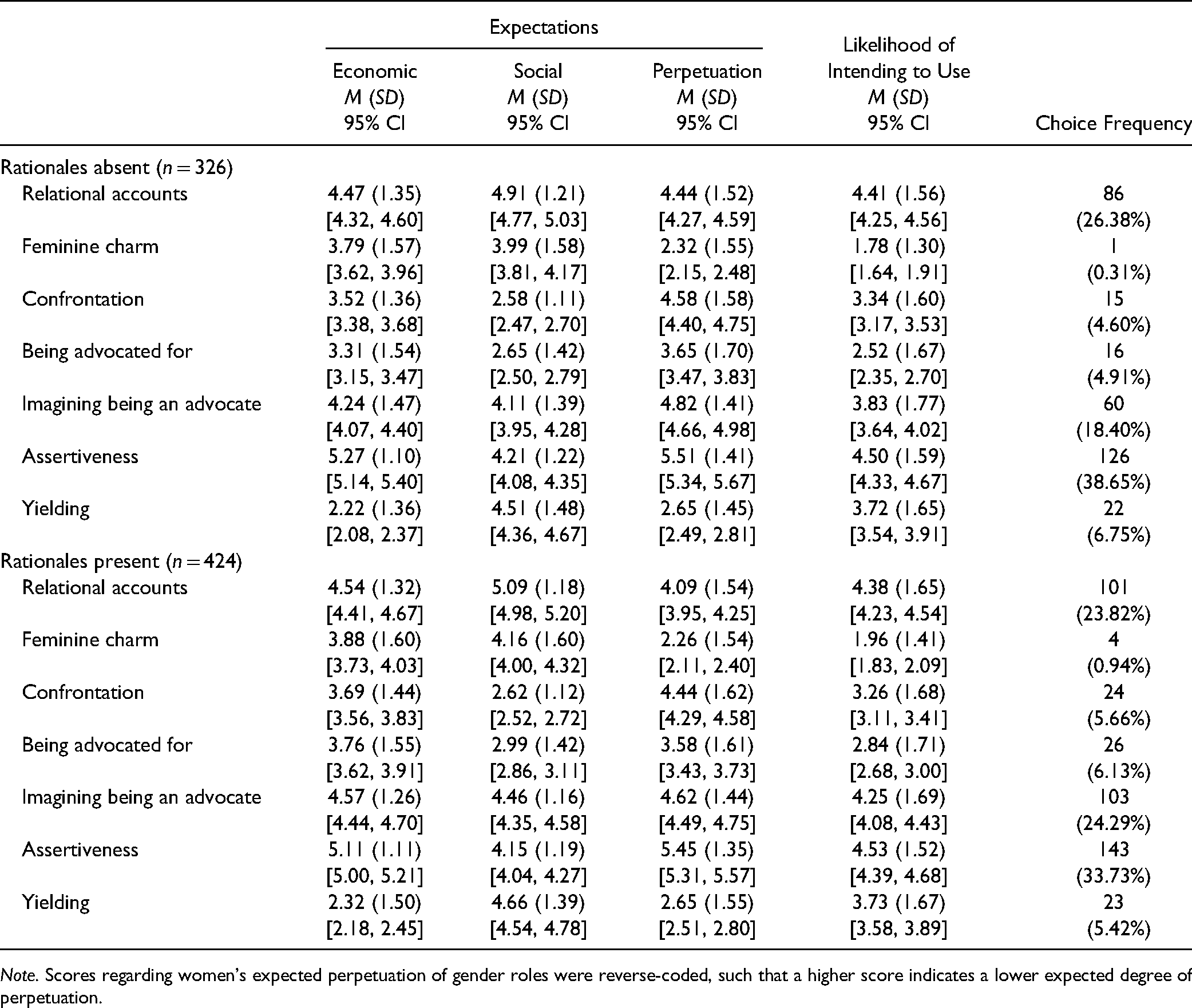
Note. Scores regarding women's expected perpetuation of gender roles were reverse-coded, such that a higher score indicates a lower expected degree of perpetuation.
Study 2: Test Statistics for One-Sample t-Tests for the Whole Sample (N = 750).
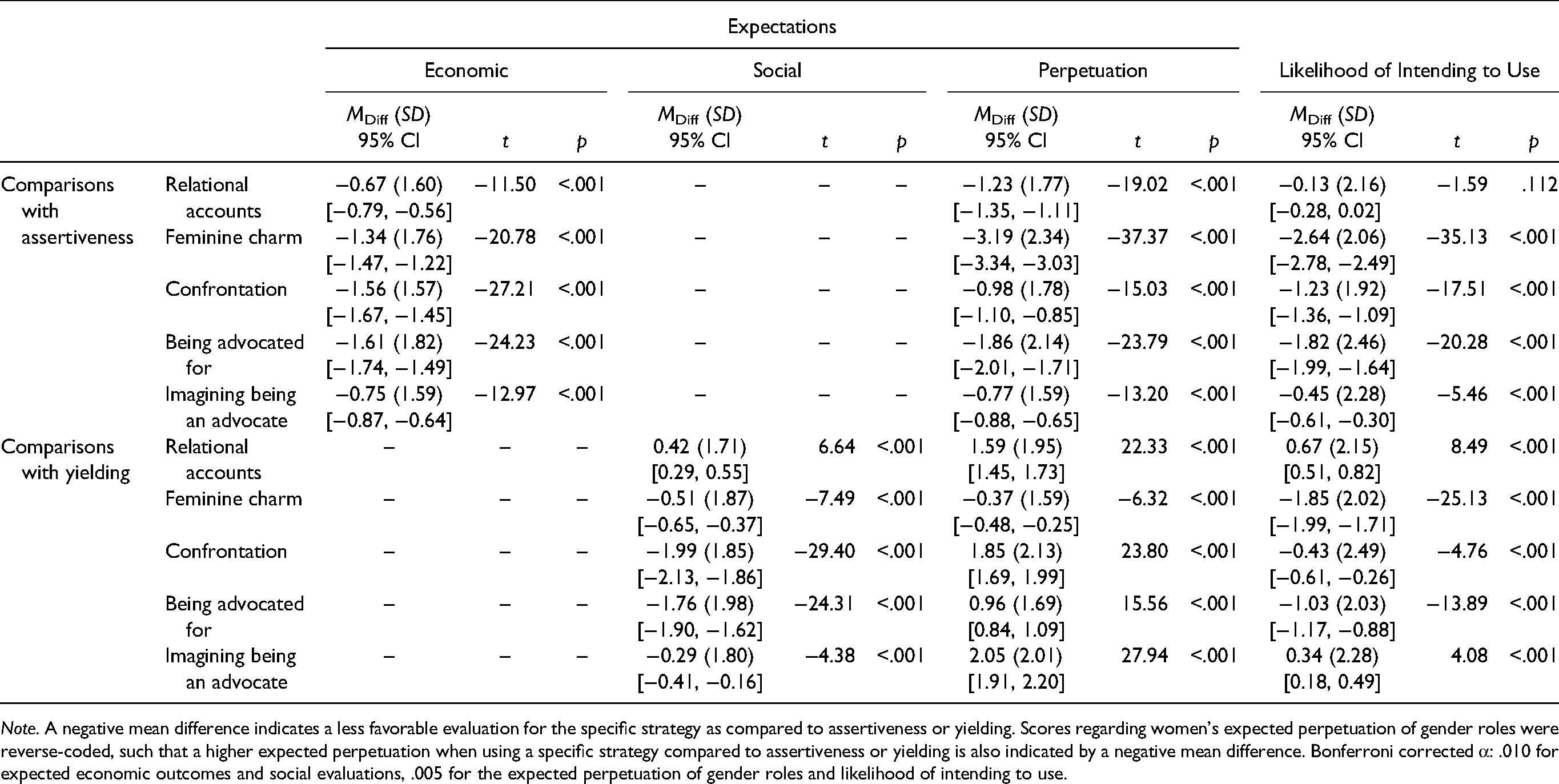
Note. A negative mean difference indicates a less favorable evaluation for the specific strategy as compared to assertiveness or yielding. Scores regarding women's expected perpetuation of gender roles were reverse-coded, such that a higher expected perpetuation when using a specific strategy compared to assertiveness or yielding is also indicated by a negative mean difference. Bonferroni corrected α: .010 for expected economic outcomes and social evaluations, .005 for the expected perpetuation of gender roles and likelihood of intending to use.
Study 2: Test Statistics for Mediation Analyses.
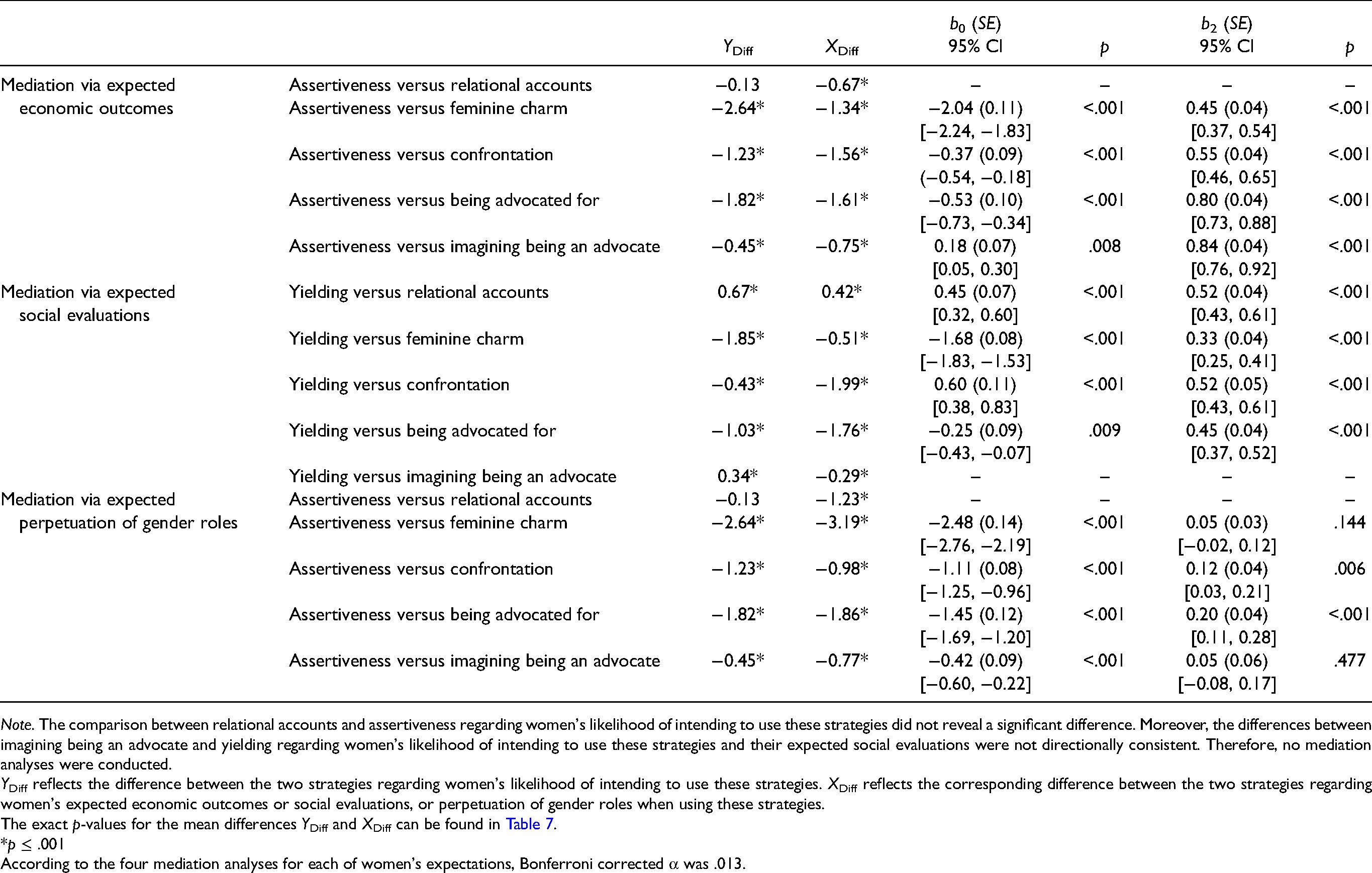
Note. The comparison between relational accounts and assertiveness regarding women's likelihood of intending to use these strategies did not reveal a significant difference. Moreover, the differences between imagining being an advocate and yielding regarding women's likelihood of intending to use these strategies and their expected social evaluations were not directionally consistent. Therefore, no mediation analyses were conducted.
YDiff reflects the difference between the two strategies regarding women's likelihood of intending to use these strategies. XDiff reflects the corresponding difference between the two strategies regarding women's expected economic outcomes or social evaluations, or perpetuation of gender roles when using these strategies.
The exact p-values for the mean differences YDiff and XDiff can be found in Table 7.
*p ≤ .001
According to the four mediation analyses for each of women's expectations, Bonferroni corrected α was .013.
Study 2: Test Statistics for Independent Samples t-Tests Comparing the Conditions “Rationales Absent” and “Rationales Present.”
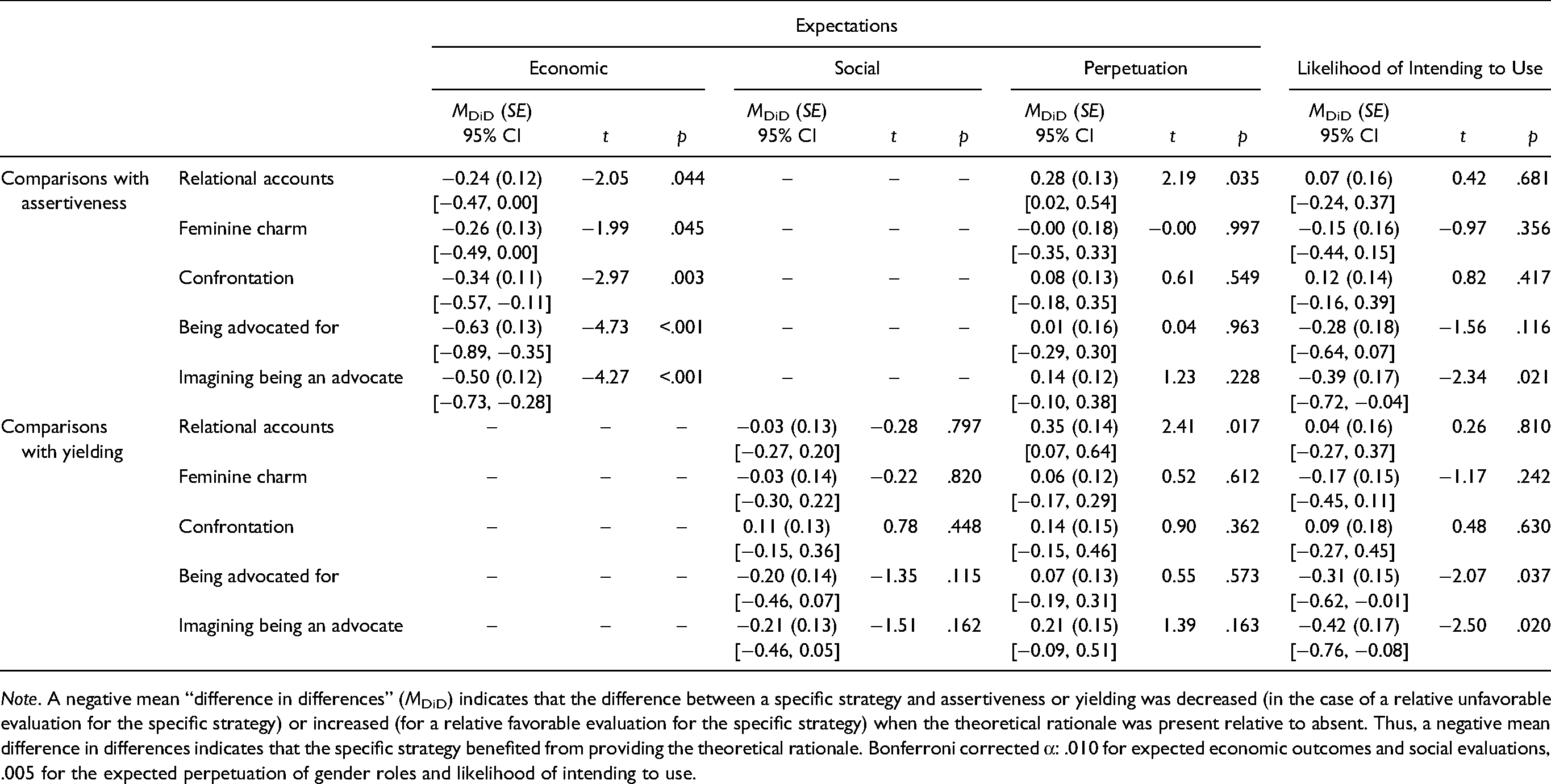
Note. A negative mean “difference in differences” (MDiD) indicates that the difference between a specific strategy and assertiveness or yielding was decreased (in the case of a relative unfavorable evaluation for the specific strategy) or increased (for a relative favorable evaluation for the specific strategy) when the theoretical rationale was present relative to absent. Thus, a negative mean difference in differences indicates that the specific strategy benefited from providing the theoretical rationale. Bonferroni corrected α: .010 for expected economic outcomes and social evaluations, .005 for the expected perpetuation of gender roles and likelihood of intending to use.
Descriptive Statistics Separately for Both Countries and Each Strategy (N = 750).
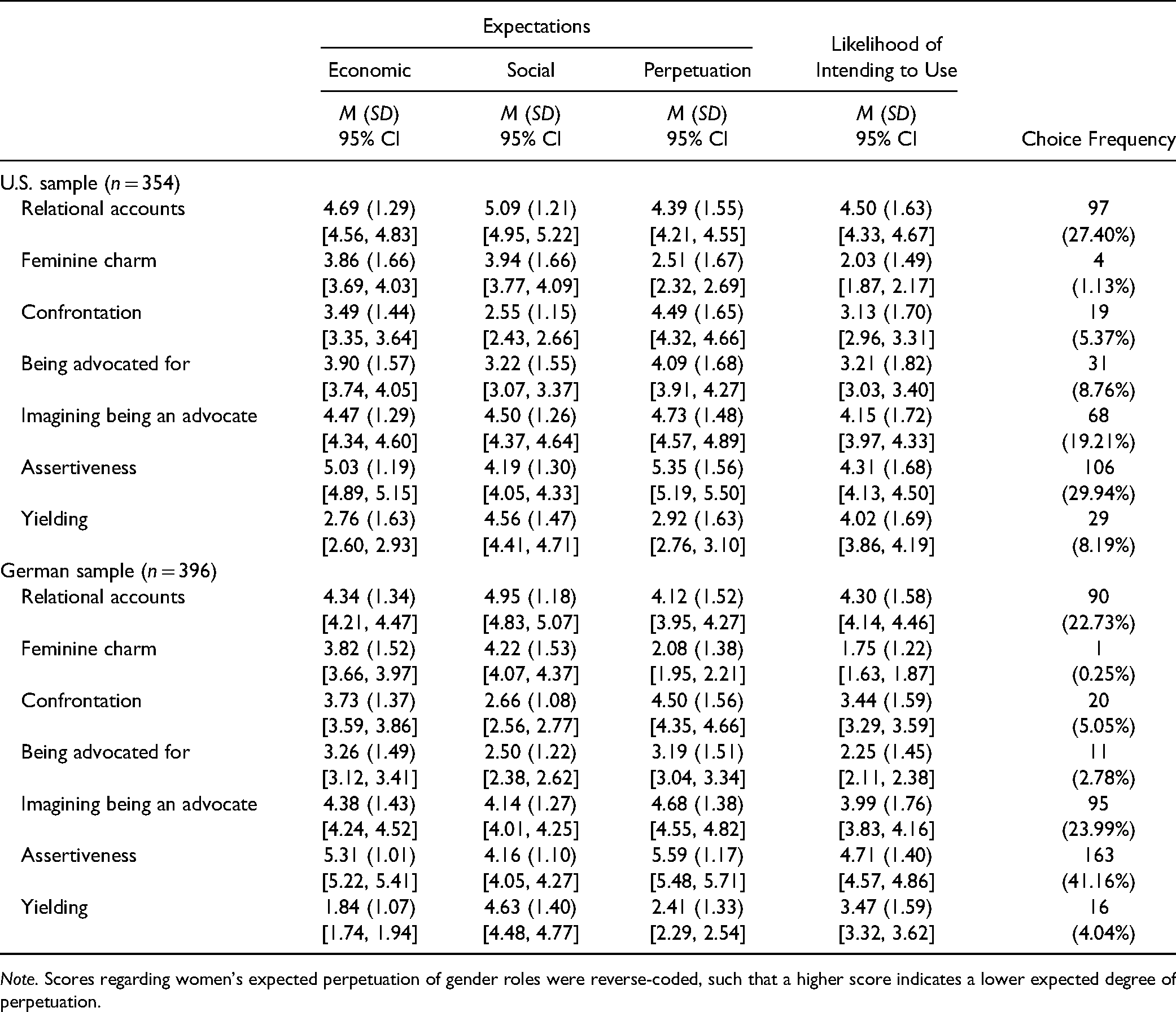
Note. Scores regarding women's expected perpetuation of gender roles were reverse-coded, such that a higher score indicates a lower expected degree of perpetuation.
Study 2: Test Statistics for One-Sample t-Tests for the U.S. Sample (N = 354).
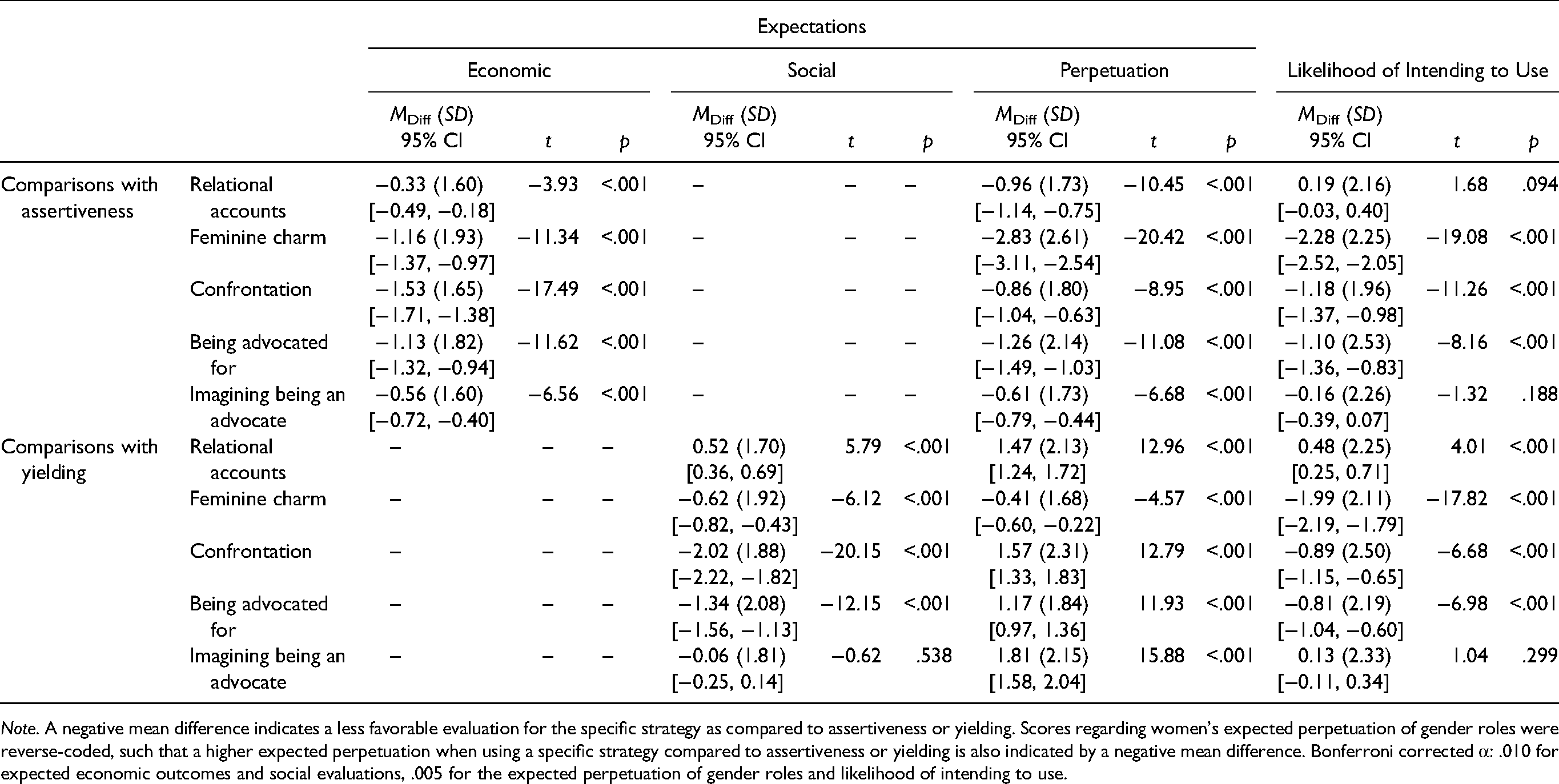
Note. A negative mean difference indicates a less favorable evaluation for the specific strategy as compared to assertiveness or yielding. Scores regarding women's expected perpetuation of gender roles were reverse-coded, such that a higher expected perpetuation when using a specific strategy compared to assertiveness or yielding is also indicated by a negative mean difference. Bonferroni corrected α: .010 for expected economic outcomes and social evaluations, .005 for the expected perpetuation of gender roles and likelihood of intending to use.
Study 2: Test Statistics for One-Sample t-Tests for the German Sample (N = 396).
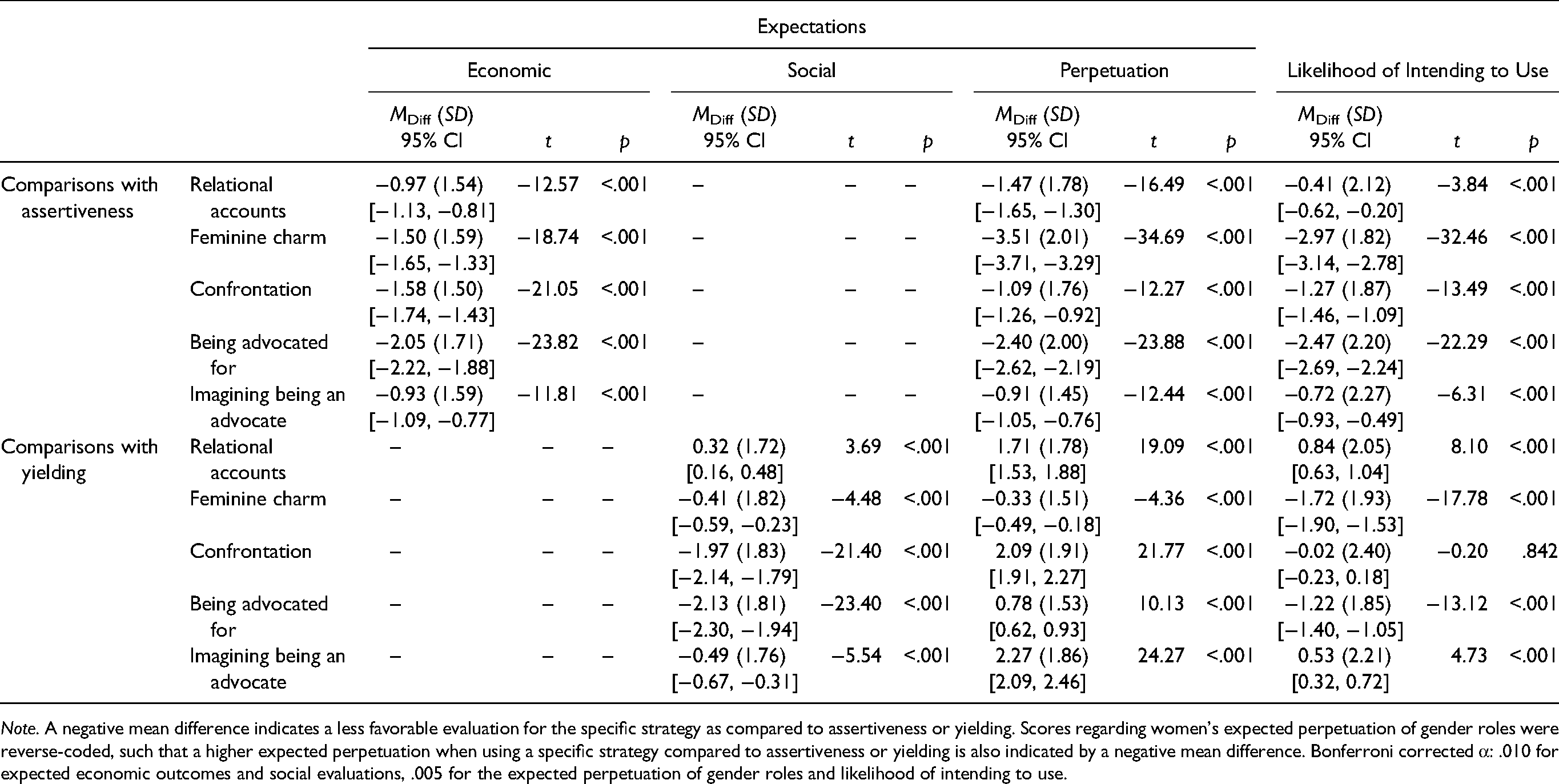
Note. A negative mean difference indicates a less favorable evaluation for the specific strategy as compared to assertiveness or yielding. Scores regarding women's expected perpetuation of gender roles were reverse-coded, such that a higher expected perpetuation when using a specific strategy compared to assertiveness or yielding is also indicated by a negative mean difference. Bonferroni corrected α: .010 for expected economic outcomes and social evaluations, .005 for the expected perpetuation of gender roles and likelihood of intending to use.
Women's Evaluation of the Strategies
Shapiro-Wilk tests suggested that the assumption of normality was again violated for all main study variables in both conditions. Thus, as was done for Study 1, we conducted robust non-parametric tests. Once again, we found that the seven strategies significantly differed from each other in both conditions regarding women's expected economic outcomes, social evaluations, perpetuation of gender roles, and their intended likelihood to use one of the strategies (see Online Supplemental Table 2s).
Thus, we again conducted robust one-sample t-tests to test our specific Hypotheses 1a–c and 2a–c. We also again used a Bonferroni correction: Here and for all subsequent t-tests of Study 2, we adjusted α to .010 for women's expected economic outcomes as well as social evaluations (as the five specific strategies were compared either to assertiveness or to yielding) and to .005 for women's expected perpetuation of gender roles as well as their relative likelihood of intending to use a specific strategy (as the five specific strategies were compared to both assertiveness and yielding). Regarding imagining being an advocate, we only raised a research question. Descriptive and tests statistics are in Tables 6 and 7. As for Study 1, we also conducted multilevel analyses, which revealed virtually unchanged results.
Expected Economic Outcomes
Women expected all specific strategies to lead to lower outcomes than assertiveness, which fully supports Hypothesis 1a and informs RQ 1.
Expected Social Evaluations
Women expected feminine charm, confrontation, being advocated for, and imagining being an advocate to lead to less favorable social evaluations than yielding. Yet, women again expected relational accounts to lead to more favorable social evaluations than yielding. These findings mostly support Hypothesis 2a and inform RQ 1.
Expected Perpetuation of Gender Roles
Women expected all specific strategies to lead to a greater perpetuation of gender roles than assertiveness, which mostly supports Hypothesis 1b (we did not expect such a difference between confrontation and assertiveness). Moreover, women expected relational accounts, confrontation, being advocated for, and imagining being an advocate to lead to a lower perpetuation of gender roles than yielding, which again mostly supports Hypothesis 2b (and informs RQ 1), as women expected feminine charm to lead to a higher perpetuation than yielding (contrary to our hypothesis).
Likelihood of Intending to Use Strategies
Women were less likely to intend to use most of the specific strategies compared to assertiveness, except for relational accounts (i.e., there was no difference from assertiveness), which mostly supports Hypothesis 1c and informs RQ 1. Women were also less likely to intend to use feminine charm, confrontation, and being advocated for than yielding. Yet, not in line with our hypothesis, they were more likely to intend to use relational accounts and imagining being an advocate in comparison to yielding. These findings provide partial support for Hypothesis 2c (and again inform RQ 1).
Women's Expectations as Mediators
We again begin by using the procedure by Judd et al. (2001) and a robust estimation with a Bonferroni correction (according to the number of conducted analyses for each expectation, see Table 8). We include imagining being an advocate in the report of our results, and display the test statistics in Table 8.
Expected Economic Outcomes and Expected Perpetuation of Gender Roles
Women's lower likelihoods of intending to use feminine charm, confrontation, being advocated for, and imagining being an advocate compared to assertiveness were mediated via their lower expectations regarding economic outcomes, which supports Hypothesis 1d (as women did not differ in their likelihood of intending to use relational accounts vs. assertiveness, we did not run an analysis).
Women's lower likelihood of intending to use being advocated for compared to assertiveness was also mediated via their expectation that using this strategy would perpetuate gender roles more, which supports Hypothesis 1d. As we reported above, unexpectedly, women also expected confrontation to lead to a greater perpetuation of gender roles than assertiveness, which also mediated their lower likelihood of intending to use confrontation compared to assertiveness. However, women's lower likelihoods of intending to use feminine charm and imagining being an advocate than assertiveness were not mediated via their expected greater perpetuation of gender roles, not in line with Hypothesis 1d. Again, as women did not differ in their likelihood of intending to use relational accounts and assertiveness, we did not conduct a related mediation analysis.
We again conducted competitive tests for Hypothesis 1d using the procedure by Montoya and Hayes (2017), as the separate analyses above revealed mediation via both expectations for confrontation and being advocated for. Women's expected economic outcomes and their expected perpetuation of gender roles both mediated their lower likelihood of intending to use confrontation than assertiveness, b0 = −0.30, 95% CI [−0.49, −0.12], SE = .09, p = .001, beco = 0.54, 95% CI [0.46, 0.62], SE = .04, p < .001, bperp = 0.08, 95% CI [0.01, 0.15], SE = .04, p = .019. Women's lower likelihood of intending to use being advocated for compared to assertiveness was only mediated via their expected economic outcomes, but not via their expected perpetuation of gender roles, when both were included in the analysis, b0 = −0.43, 95% CI [−0.65, −0.21], SE = .11, p < .001, beco = 0.78, 95% CI [0.70, 0.86], SE = .04, p < .001, bperp = 0.07, 95% CI [0.00, 0.14], SE = .03, p = .043 (we again used a Bonferroni correction based on the number of analyses; thus, α was halved to .025).
Expected Social Evaluations
Women's lower likelihoods of intending to use feminine charm, confrontation, and being advocated for compared to yielding were mediated via their less favorable expectations regarding social evaluations, which supports Hypothesis 2d. Women's higher likelihood of intending to use relational accounts over yielding, which we did not predict, was mediated via their expectation that relational accounts would lead to more favorable social evaluations. Women also reported a higher likelihood of intending to use imagining being an advocate than yielding, but simultaneously expected it to lead to less favorable social evaluations. Thus, we did not run an analysis.
Influence of Providing the Theoretical Rationales
We again conducted robust t-tests for independent samples comparing two differences with each other (see above; again, multilevel analyses revealed virtually unchanged results). Mean differences and test statistics for one-sample t-tests split by condition can be found in Online Supplemental Tables 5s and 6s. We only had an exploratory research question for the expected perpetuation of gender roles. Again, we include imagining being an advocate in the report of our results (test statistics are in Table 9).
Expected Economic Outcomes
Providing the rationale for relational accounts did not attenuate its difference from assertiveness regarding women's expected economic outcomes. The same was observed for feminine charm. However, providing the rationales for confrontation, being advocated for, and imagining being an advocate was found to attenuate their differences from assertiveness, although substantial differences remained even with rationales present.
Expected Social Evaluations
Providing the rationale for relational accounts did not increase its difference from yielding (we observed that women expected relational accounts to lead to more favorable social evaluations than yielding). Also, providing the rationales for feminine charm, confrontation, being advocated for, and imagining being an advocate did not attenuate their differences from yielding.
Likelihood of Intending to Use Strategies
Providing the rationales did not influence the difference between relational accounts and assertiveness (we observed that women were equally likely to intend to use both strategies) and was not found to attenuate the differences between the remaining specific strategies and assertiveness. Providing the rationales for relational accounts and imagining being an advocate also did not change their differences from yielding (please recall that women were more likely to intend to use these two specific strategies than yielding). Finally, providing the rationales for feminine charm, confrontation, and being advocated for did not attenuate their differences from yielding. Thus, Hypothesis 3 was mostly not supported (for Bayesian analyses, see the Online Supplemental Material).
Exploratory Analyses
Influence of the Rationales on the Expected Perpetuation of Gender Roles
Providing the rationales neither influenced the differences between the specific strategies and assertiveness nor the differences between the specific strategies and yielding (see Table 9).
Forced-Choice Item
A χ2-goodness-of-fit test showed that women's strategy choice was not equally distributed (see Table 6), irrespective of whether the theoretical rationales were provided, χ2(6) = 271.75, p < .001, or not, χ2(6) = 286.30, p < .001. Further, the two distributions did not differ, χ2(6) = 7.22, p = .301, suggesting that providing the rationales had no influence on the choice of strategy. Women preferred assertiveness, relational accounts, and imagining being an advocate when they had to pick just one strategy.
Influence of the Cultural Background
We conducted Bonferroni corrected one-sample t-tests (see section Women's Evaluation of the Strategies for a detailed description) separately for both countries to explore RQ 2, namely whether women's cultural background influenced their evaluations and intentions to use certain strategies. Descriptive statistics can be found in Table 10 and test statistics are organized in Table 11 (the United States) and Table 12 (Germany).
The pattern of results for both countries appeared largely similar. U.S. women and German women both expected all specific strategies to lead to lower economic outcomes as well as to a higher perpetuation of gender roles than assertiveness. Moreover, women from both countries expected feminine charm to perpetuate gender roles more than yielding, and the remaining strategies to perpetuate gender roles less than yielding. U.S. women and German women also both expected relational accounts to lead to more, but feminine charm, confrontation, and being advocated for to lead to less favorable social evaluations compared to yielding. Regarding imagining being an advocate, German women expected it to lead to less favorable social evaluations than yielding, whereas U.S. women did not expect the two strategies to differ. Regarding women's likelihood of intending to use a strategy, German women were less likely to intend to use any specific strategy compared to assertiveness. However, U.S. women were less likely to intend to use only feminine charm, confrontation, and being advocated for than assertiveness, but equally likely to intend to use relational accounts and imagining being an advocate compared to assertiveness. Women's likelihood of intending to use relational accounts over yielding was similar in both countries, as was women's lower likelihood of intending to use feminine charm and being advocated for than yielding. Whereas U.S. women were less likely to intend to use confrontation than yielding, German women were equally likely to intend to use these two strategies. Finally, U.S. women were equally likely to intend to use imagining being an advocate and yielding, whereas German women were more likely to intend to use imagining being an advocate.
In summary, we found that the implementation gap occurred in both countries for most of the specific strategies. Still, U.S. women intended to use relational accounts and imagining being an advocate just as much as assertiveness, whereas German women only preferred to use these two strategies over yielding.
Finally, a χ2-goodness-of-fit test showed that women's strategy choices were neither equally distributed among U.S. women, χ2(6) = 188.76, p < .001, nor among German women, χ2(6) = 390.12, p < .001 (see Table 10). In both countries, women mostly chose relational accounts, imagining being an advocate, and assertiveness. Yet, the distributions differed, χ2(6) = 29.66, p < .001, such that U.S. women compared to German women more often chose being advocated for and yielding, whereas German women more often chose assertiveness.
Discussion
The results of Study 2 mainly substantiated the results of Study 1, suggesting that demand effects did not play a major role in Study 1. Again, Hypotheses 1a–d were mostly supported: Women expected all specific strategies to lead to lower economic outcomes and to perpetuate gender roles more than assertiveness, which explained the implementation gap that emerged for almost all specific strategies (except for relational accounts; especially, but not only, expectations regarding economic outcomes were a mediator). Largely in line with Hypotheses 2a–d, women expected yielding to perpetuate gender roles more than most of the specific strategies, and for nearly all specific strategies (except for relational accounts), women also had less favorable expectations regarding social evaluations in comparison to yielding, which led them to be less likely to intend to use many of the strategies. Although women were more likely to intend to use relational accounts and imagining being an advocate than yielding and equally likely to intend to use relational accounts and assertiveness, they were not more willing to use any specifically designed strategy than simply showing assertiveness. Notably, with regard to Hypothesis 3, providing the theoretical rationales, again, mostly did not attenuate the implementation gap.
General Discussion
We extended the extant knowledge on the implementation gap in the following ways. First, our studies revealed that women's expected perpetuation of gender roles when using certain strategies can be an additional root of the implementation gap (besides expectations regarding economic outcomes and social evaluations; Mazei et al., 2020). Moreover, our studies showed that the implementation gap, which can impede progress towards gender parity, emerges for more crucial strategies than previously known (i.e., being advocated for and imagining being an advocate) and in at least two cultures (although relational accounts and imagining being an advocate represent exceptions among U.S. women). Finally, despite our repeated and stringent tests, we found that providing theoretical rationales for the specific strategies hardly had any influence on the implementation gap and its underlying processes. Altogether, our research revealed that the implementation gap is a robust phenomenon. A summary of all hypotheses and respective results can be found in Table 13.
Overview of the Hypotheses and Results.
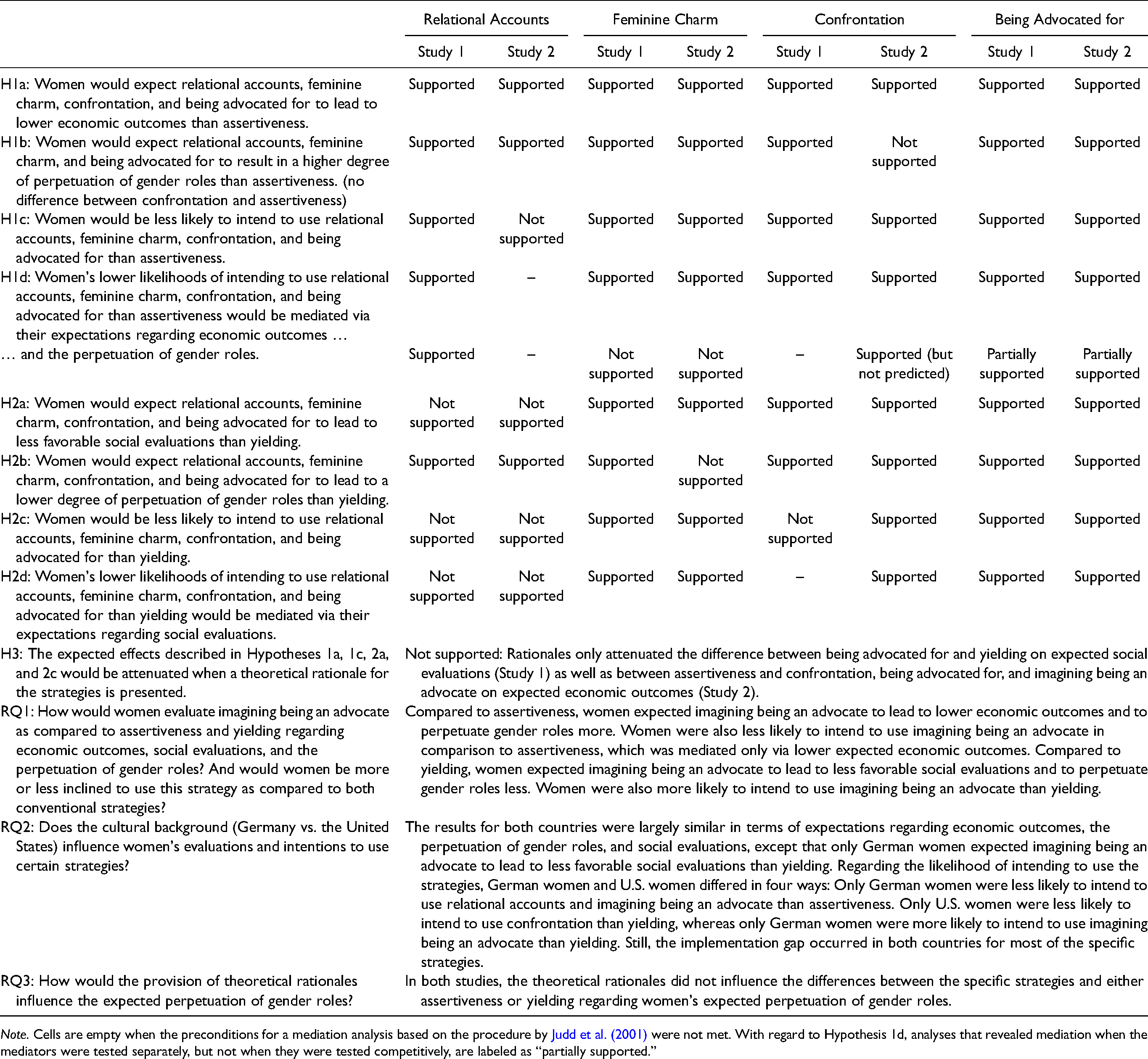
Note. Cells are empty when the preconditions for a mediation analysis based on the procedure by Judd et al. (2001) were not met. With regard to Hypothesis 1d, analyses that revealed mediation when the mediators were tested separately, but not when they were tested competitively, are labeled as “partially supported.”
Theoretical Implications
In our studies, we found that an implementation gap can emerge even when women were provided with underlying theoretical rationales. This discovery suggests that the initial results by Mazei et al. (2020) were not simply obtained because the underlying rationales for the specific strategies were not given. This finding is noteworthy: If researchers and practitioners examined the available literature on the implementation gap, they may assume that it could be closed in a straightforward fashion by explaining to women how the strategies are meant to work, as the implementation gap was previously observed only once and under the narrow condition of completely absent explanations for the strategies (Mazei et al., 2020).
Yet, also with regard to Vroom's VIE theory (1964), we found that providing the theoretical rationales did not strongly influence women's expectations regarding the achievement of different negotiation outcomes when using specific strategies. We reasoned that providing the rationales would leverage the instrumentality component, or “p → o” (Van Eerde & Thierry, 1996), by making clearer the potential benefits (“o”) that can follow from using a specific strategy (“p”). Thereby, the rationales may potentially guide women who contemplate using a specific strategy in their expectations regarding their instrumentality. Accordingly, we hypothesized that providing theoretical rationales would lead women to become more likely to intend to use specific strategies. However, in most cases, providing the rationales did not convince women to use specific strategies. Regardless of the presence of the rationales, women also indicated that it was fairly clear to them how the specific strategies are meant to work. Thus, our results suggest that more detailed explanations as to how the strategies are meant to work will not help to attenuate the implementation gap. The implementation gap, it appears, represents a noteworthy and stubborn hurdle in the pursuit of gender parity.
We also explored a novel cause of the implementation gap: women's expectations regarding the perpetuation of gender roles upon using a certain strategy. Women mostly expected the specific strategies to perpetuate gender roles more than assertiveness, which partly also mediated their lower likelihood of intending to use specific strategies. Thus, our findings suggest that women were aware of the risk of perpetuated gender roles and considered this risk when making strategic choices (see Rudman & Fairchild, 2004). Interestingly, this risk might be particularly relevant for women who believe that they themselves do not need to use a specific strategy, as they would not expect to obtain any personal benefits from using a specific strategy that could outweigh the negative consequence of perpetuating the female gender role. Altogether, our research illuminated a novel cause of the implementation gap, which is a relevant insight because an incomplete understanding of the implementation gap would hinder progress toward closing it. Therefore, an important avenue for future research is to examine how the expected perpetuation of gender roles can be addressed, for instance, by providing explanations that highlight the benefits of using a specific strategy (e.g., improved economic outcomes), which may ultimately help to reduce inequalities and underlying gender roles (as gender gaps in pay would be mitigated).
Our research extended the knowledge about the implementation gap in yet another way: We found that the implementation gap is not limited to the strategies of relational accounts, feminine charm, and confrontation, but also exists for the hitherto neglected but relevant strategies of being advocated for and, in part, imagining being an advocate (among German women). That is, women could hardly imagine handing over the negotiation to someone else. Although being advocated for was evaluated more favorably when its theoretical rationale was provided, such that (a) women's expected social evaluations, relative to yielding, increased (Study 1) and that (b) women's expected economic outcomes, relative to assertiveness, increased (Study 2), women were still not inclined to use being advocated for. Moreover, they still expected it to lead to relatively unfavorable social evaluations, and only yielding was expected to result in even worse economic outcomes. Women's unfavorable social expectations might stem from the possibility of them being perceived as weak or as shirking responsibility when handing over the negotiation. In addition, simply asserting oneself is, at least, consistent with people's expectations of how a negotiation typically proceeds. In conclusion, our findings highlight that the practical usefulness of advocacy could be limited—although related insights are certainly relevant for theory (Amanatullah & Morris, 2010; Bowles et al., 2005). Regarding imagining being an advocate (Bear & Babcock, 2017), women were more likely to intend to use it than yielding and, for U.S. women, equally likely to intend to use it in comparison to assertiveness. Hence, this strategy appears to be relatively promising. Yet, it has to be kept in mind that a negotiation counterpart likely is unaware of a woman's mental reframing of a negotiation situation, so the risk of incurring backlash can remain upon using this strategy (Bear & Babcock, 2017).
Practical Implications
In compensation negotiations, women can be disadvantaged by gender roles (e.g., Bowles et al., 2022; Kulik & Olekalns, 2012), leading to inequalities in terms of pay and career advancement (e.g., England et al., 2020; Lyness & Grotto, 2018). Unfortunately, our findings revealed that strategies, which can in principle be helpful for women to address their disadvantages (e.g., Bowles & Babcock, 2013), have characteristics that can fuel unfavorable expectations. That is, women may expect that these strategies cannot help them achieve economic success without inviting negative evaluations (Mazei et al., 2020) or perpetuating gender roles. These insights are relevant for different stakeholders. Negotiation trainers or diversity officers (Leslie, 2019) need to consider that these specific strategies may not be actually used—even when their underlying theoretical rationales are explained. Hence, negotiation trainers may need to enable women to more fully experience the application of those specific strategies, for instance, by observing other women (cf. social learning theory; Bandura, 1977; Bandura, 2001) or by using them themselves and observing their actual effects (cf. behavior modeling training; Decker & Nathan, 1985; Taylor et al., 2005). Similarly, as negotiation contexts are as diverse as women are, negotiation trainers could consider the particular contexts in which specific strategies can be of greatest help for women. For example, relational accounts might be particularly effective in negotiations in which relationships with the organization or other people are strongly valued by a counterpart, whereas confrontation might be particularly effective in negotiation situations in which an injustice has demonstrably occurred. Negotiation trainers should also keep in mind that women may be persuaded differently depending on their culture. Women from “principles-first” cultures (e.g., Germany) often aim to understand why specific strategies are necessary and meant to help before practicing how to apply them. Women from “application-first” cultures (e.g., the United States) often are more thrilled by the “how” and focus less on the “why” (Meyer, 2014). Finally, as aforementioned, women were relatively unlikely to intend to hand over a salary negotiation to an advocate. Hence, organizations need to consider whether employees would actually be inclined to be advocated for.
Limitations and Future Research Directions
Although we addressed some of the limitations that characterize the extant research on the implementation gap, future research should address the limitations of our work. First, similar to Mazei et al. (2020), we used written descriptions for the negotiation scenario and the strategies. Although participants were able to picture themselves in the situation, future research could utilize videos in which actors apply the strategies (cf. social learning theory; Bandura, 1977; Bandura, 2001). It might also be promising to examine women's expectations and likelihoods to use specific strategies when their usage is strongly encouraged, for instance, by a confident advisor with high expertise (Sniezek & Van Swol, 2001).
Moreover, future research could measure women's actual behaviors (Baumeister et al., 2007) with real ensuing consequences (Morales et al., 2017). Further, our scenario included a rather implicit hint toward the risk of backlash. This design feature may help to explain women's relatively high reported likelihood of using assertiveness (see also Amanatullah & Tinsley, 2013) and also why German women in Study 1 expected assertiveness to lead to comparable social evaluations as yielding.
Future research is also needed to examine further potential influences on women's expectations as well as the implementation gap. For example, our negotiation scenario did not specify the counterpart's gender. Although the imagined counterpart's gender was not found to have a strong impact in our studies, examining the characteristics of women's counterparts (including but not limited to their gender; see, e.g., Bowles et al., 2007) certainly is an important question for future research. Similarly, more light could be shed on the influence of women's own characteristics, such as their age, occupational activities, or type of activity. Gender differences in agency and communion also are greater among heterosexual samples (Hsu et al., 2021), a tendency that might influence the processes examined here. For example, people who self-identify as women but did not internalize traditional feminine traits may evaluate feminine charm relatively unfavorably in comparison to women who conceive of themselves differently. Related to that, women's individual belief about them (not) “needing” a specific strategy might be another cause of the implementation gap that could be worth examining. Lastly, we explored two countries, Germany and the United States, which are both rather individualistic and high in cultural assertiveness. Thus, future research could examine the implementation in countries with less cultural assertiveness.
Further research on advocacy (e.g., Amanatullah & Tinsley, 2013; Kouchaki & Kray, 2018) would also be relevant. For instance, an interesting avenue is to (further) examine when (and why) women would be more inclined to be advocated for, as well as how other people perceive women who use this strategy. Similarly, regarding imagining being an advocate, Bear and Babcock (2017) found that it helps to increase women's economic outcomes in negotiations, but it remains unclear whether using this strategy would lead to a backlash.
Finally, one of the most important routes for future research is to examine further ways to attenuate the implementation gap. Besides avenues based on social learning theory (Bandura, 1977) and behavior modeling trainings (Decker & Nathan, 1985), women could be provided with empirical evidence suggesting that the specific strategies do “work.” Another particularly important route for future research is to develop further strategies that are more attractive to women from the outset and, thus, more likely to be actually used.
Conclusion
The implementation gap represents an important hurdle to the achievement of gender equality in the workplace. Our studies have taken research on this gap several steps forward. We found the implementation gap to be a robust phenomenon that exists even when women are explained how the specific strategies are meant to work. Moreover, the implementation gap has multiple roots—an insight that can aid in designing new strategies. Furthermore, the implementation gap emerges for previously neglected strategies (i.e., being advocated for and, partly, imagining being an advocate). Altogether, we provided novel insights into the implementation gap that help to guide future research and practice.
Supplemental Material
sj-docx-1-pwq-10.1177_03616843221128484 - Supplemental material for Are Strategies for Women in Compensation Negotiations More Appealing When It Is Explained How They Are Meant to Impact Negotiation Outcomes?
Supplemental material, sj-docx-1-pwq-10.1177_03616843221128484 for Are Strategies for Women in Compensation Negotiations More Appealing When It Is Explained How They Are Meant to Impact Negotiation Outcomes? by Melanie Lietz, Jens Mazei, Marc Mertes, and Joachim H?er in Psychology of Women Quarterly
Supplemental Material
sj-pptx-2-pwq-10.1177_03616843221128484 - Supplemental material for Are Strategies for Women in Compensation Negotiations More Appealing When It Is Explained How They Are Meant to Impact Negotiation Outcomes?
Supplemental material, sj-pptx-2-pwq-10.1177_03616843221128484 for Are Strategies for Women in Compensation Negotiations More Appealing When It Is Explained How They Are Meant to Impact Negotiation Outcomes? by Melanie Lietz, Jens Mazei, Marc Mertes, and Joachim H?er in Psychology of Women Quarterly
Footnotes
Author Contributions
Melanie Lietz and Jens Mazei contributed equally to the current research and the authorship order was determined by a coin toss.
Our preregistrations can be retrieved via the following link: https://osf.io/zxaqf/?view_only=3bb11a5f286c4fbda8ac43b4c3be0cce and 
Declaration of Conflicting Interests
The authors declared no potential conflicts of interest with respect to the research, authorship, and/or publication of this article.
Funding
The authors received no financial support for the research, authorship, and/or publication of this article.
Supplemental Material
Supplemental material for this article is available online.
Notes
References
Supplementary Material
Please find the following supplemental material available below.
For Open Access articles published under a Creative Commons License, all supplemental material carries the same license as the article it is associated with.
For non-Open Access articles published, all supplemental material carries a non-exclusive license, and permission requests for re-use of supplemental material or any part of supplemental material shall be sent directly to the copyright owner as specified in the copyright notice associated with the article.
