




Abstract
Abuse against women’s rights activists is a serious concern, but there is a lack of research into strategies on how to reduce this. Past research has identified self-affirmation (i.e., thinking about one’s valued traits) and perspective-taking as promising strategies to reduce minority target backlash. Through one pilot study (n = 98), and one two-part experimental study (n = 202), we tested the effect of perspective-taking and self-affirmation on empathy toward feminism among men. Fictional Facebook profiles were manipulated to encourage perspective-taking, perspective-taking with self-affirmation, or were neutral in content. Participants then rated feelings toward individual feminists as well as feelings (in the context of perspective-taking emotions) toward abuse faced by feminists more generally. Results indicated that perspective-taking combined with self-affirmation promoted empathetic feelings (as represented by perspective-taking emotions) toward feminists experiencing abuse. The impact on empathy was particularly strong among men with high initial prejudice toward feminists. These results suggest that self-affirmation could potentially reduce online abuse of feminists through an increase in empathetic feelings. This research has broader implications for male engagement within feminism, and we recommend that educators and male allies of feminism promote positive, affirming roles for men (e.g., as fathers), as this may encourage empathy toward feminist issues. Policy makers could consider this strategy in the context of promoting policies such as shared parental leave. Online slides for instructors who want to use this article for teaching are available on PWQ's website at http://journals.sagepub.com/doi/suppl/10.1177/03616843211017472
Gender inequality is well-documented, with the United Nations (2020) stating that women and girls suffer discrimination and gender-specific violence in every part of the world. A snapshot of gender-based violence in the United Kingdom (UK) reveals that one in five women have been the victims of sexual assault (Rape Crisis UK, 2019; United Nations, 2020); one in four women have been the victims of domestic abuse—with two women a week murdered by a current or former partner (Refuge, 2020); and 70% of adult women have been the victims of sexual harassment (Duncan & Topping, 2018). On a societal level, UK women earn nearly 18% less than men (Office for National Statistics, 2019), do 60% more of the unpaid domestic work (Office for National Statistics, 2016), and face considerable barriers in equal access to health care and public spaces (Perez, 2019). In light of the above, the feminist movement in the UK and beyond appears to have legitimate cause for concern; however, backlash against feminism and policies intended to advance gender equality is more prevalent than ever, aided in part the digitalization of political discourse (Ging, 2019; Jane, 2014).
Backlash Against Feminism
As noted by Ging (2019), contemporary anti-feminism stems in part from the split in the men’s rights movement of the 1970s into anti-feminist men’s rights activism and pro-feminist activism. The latter morphed into male engagement in feminist discourse, as well as scholarly research in critical men’s studies; this discipline acknowledges men’s overall structural power in society as well as individual male suffering under an oppressive masculine role (Connell & Messerschmidt, 2005; Messner, 2016). Conversely, the anti-feminist men’s rights movement has since campaigned for repealing domestic violence legislation and rape laws and generally regards society as being biased against men (Messner, 2016). The increase in anti-feminist support has been referred to as part of a broader “feminist backlash” in society, and Messner (2016) notes that a number of factors have made this backlash possible. These include the professionalization of feminism—where diminished versions of the feminist message have been broadly accepted into legislation—leading to the belief that feminism has “won” and further feminist action is no longer needed; and the neo-liberalization of society, where cuts to welfare and deindustrialization have left large groups of men disillusioned and financially disadvantaged. Although anti-feminist groups encompass a relatively small proportion of the population, it is evident that watered-down versions of these messages are pervasive among the wider population, where women calling themselves feminists are viewed in a negative light. Specifically, women who call themselves feminists are viewed as less warm (Meijs et al., 2019) and as possessing negative personal traits and disliking men (Houvouras & Scott Carter, 2008), when compared to non-feminist women.
Consequences for Society
Prejudice against feminism has serious consequences for those on the receiving end as well as for society. Antipathy toward feminists is in part evidenced by the considerable amount of online abuse faced by feminist activists (Lewis & Marine, 2015; Westmarland, 2015). A vast majority (88%) of feminist activists have experienced online abuse ranging from hostility to death and rape threats, which has severely impacted feelings of safety (Jane, 2014; Westmarland, 2015). As such, online platforms present a paradox for feminist activists. In some ways, the internet has provided a valuable platform for advancing feminist theory on gendered communications and behaviors and has through that also presented the opportunity for increasing the popular appeal and recognition of some of these concepts. Two relevant examples here are the popularization of words such as “manspreading” and “mansplaining.” Ging and Siapera (2018) note that these tactics are in line with a recent “performative turn” in feminist activism, where shock and humor are employed within the feminist message. At the same time, the online nature of these messages means that many become, over time, watered-down versions of the original sentiments (Gavey, 2012; Windels et al., 2020). Similarly, although Twitter has catapulted several prominent social campaigns (e.g., #MeToo), it is also routinely used to objectify women, perpetuate anti-feminist messages, and has played a key role in the targeted abuse against feminists (Li et al., 2020; Lutzky & Lawson, 2019; Rodriguez & Hernandez, 2018; Stabile et al., 2019). A similar case can be made for the online forum Reddit. Reddit has become a platform that facilitates traditional feminist methodologies of storytelling and awareness raising (e.g., in the case of sexual assault and violence against women), but it is also one of the most prolific sites for extreme misogyny and the coordinated mobilization of harassment of feminists (O’Neill, 2018; Van Valkenburgh, 2018).
Although the individual suffering of this abuse should not be overlooked, it can also be argued that prejudice against, and abuse of, feminists have wider consequences for society, as they normalize extreme and violent language against women (Hlavka, 2014; Jane, 2014; Meijs et al., 2019; Ramsey et al., 2007). The European Union (2018) recognizes online abuse as part of wider gender-based violence against women and notes the numerous negative consequences for the individual, but also for society, in hindering gender equality. The fear of online abuse also contributes to a reluctance by women to engage in feminist activism, which has negative consequences for political discourse and democratic engagement (Burn et al., 2000; European Union, 2018; Jane, 2014). It therefore makes sense to draw parallels between the abuse of feminist activists and the considerable abuse of female politicians, as they both exist in the context of the “wallpaper of sexism” against which women live (Hlavka, 2014). As such, this issue has wide-reaching implications for participatory democracy (Perraudin & Murphy, 2019). The seriousness of this issue has resulted in national and international calls for change (European Union, 2018; Matharu, 2016), suggesting that society needs new ways of tackling online abuse of feminists and women. We propose that self-affirmation may be one of them.
Finally, several researchers have noted that online environments facilitate a reduction in empathy (e.g., Terry & Cain, 2016), which increases the risk of abuse and cyberbullying (Brewer & Kerslake, 2015; Zych et al., 2019). Specifically, online environments reduce, or completely remove, many of the conditions necessary for producing empathy, such as eye-to-eye contact, facial feedback, and being aware of behavioral consequences (Terry & Cain, 2016). Therefore, although women’s rights activists may be particularly susceptible to any type of abuse, the lack of empathy present in online communications may make this risk even more pertinent online. Men are also more likely to support anti-sexism policies if they empathize and feel solidarity with women’s experiences of sexism, rather than just being aware of them, which highlights the overall importance of empathy in a feminist context (Wiley et al., 2012). Two techniques that have been linked to increases in empathy are perspective-taking and self-affirmation.
Perspective-Taking and Self-Affirmation
The process of perspective-taking involves asking prejudiced individuals to imagine what it would feel like to be a stigmatized target to trigger feelings of empathy, decrease stereotyping, identify with the target group, and reduce in-group favoritism (e.g., Galinsky & Moskowitz, 2000). Strategies based on encouraging empathy with feminists have previously been found to be successful at reducing prejudice (Becker & Swim, 2011). However, perspective-taking may also produce feelings of threat and defensiveness which can lead to further stigmatization or reduce the effectiveness of the strategy, particularly in cases where the target themselves initiates the perspective-taking request and/or there are high levels of initial prejudice (Stone et al., 2011). To complement perspective-taking, self-affirmation can protect a prejudiced individual against feeling threatened (as resulting from the perspective-taking) by reaffirming their self-integrity in one domain (e.g., pride at career achievements), meaning they do not need to react defensively when their self-integrity is threatened in another (e.g., highlighting their own misogynistic biases or lack of awareness) by the perspective-taking process. Self-affirmation is a process whereby a person actively attempts to maintain a good self-image, focusing specifically on positive qualities they may possess (Steele et al., 1993). Self-affirmation can be activated by asking a person to think about their most valued personal attributes (Stone et al., 2011) and doing so can reaffirm a persons’ adequacy to themselves, fulfilling their need for self-integrity (Cohen & Sherman, 2014). Thus, self-affirmation can help facilitate sympathetic feelings toward members of the stigmatized group triggered by perspective-taking (Schmeichel & Martens, 2005; Stone et al., 2011).
An important aspect of self-affirmation is that it seems to reduce negative evaluations of threatening marginalized groups as well as their message, and it also makes members of dominant groups more likely to acknowledge minority discrimination (Sherman & Cohen, 2006; Stone et al., 2011). This strategy would apply well to the feminist message, which often evokes strong negative reactions (possibly due to the perception that these messages are threatening to the status quo), and as feminists themselves often seem to be more negatively perceived than the message itself (Meijs et al., 2019). Stone et al. (2011) posit that when a target confronts prejudice and negative attitudes, the receiver may become even more resentful toward the target, thus leading to further exclusion of someone who is already marginalized. This effect may be particularly relevant for feminists, who are already stereotypically viewed as aggressive (Houvouras & Scott Carter, 2008), a stereotype that is likely exacerbated when employing active confrontational strategies. Self-affirmation also links with previous research into feminist activism, which has found that men are more likely to feel solidarity with feminists after being exposed to positive descriptions of feminist men (Wiley et al., 2012); this observation suggests that creating conditions for positive identities and self-affirmation could play an important role in increasing feminist appeal to men. Ging and Siapera (2018) further note that investigations into online misogyny must consider continuities between the online and offline world (i.e., how identities span the physical and digital world, rather than being separate entities); this idea is applicable to the lack of positive identities for men, both online and offline. Jane (2014) further stresses that, although they have popular appeal, feminist strategies to target online misogyny must move away from individualized, Do It Yourself (DIY) approaches, and toward coherent and collective approaches. We posit that these collective approaches would be further enhanced by a consideration of psychological theory. By suggesting self-affirmation as one of these potential approaches, the current paper therefore builds on and extends previous research into feminist activism.
The Current Study
Drawing on the evident need for interventions that target prejudice and abuse against feminists as well as the feminist message, the current study is a conceptual replication of Stone et al. (2011), which examined self-affirmation as a strategy to reduce prejudice against Arab-Americans. Specifically, their study measured prejudice against the target (Arab-Americans) in the initial stages of their study and then asked participants to view several social media profiles, which included one member of the target group. Within these profiles, one condition asked participants to self-affirm (and the remaining conditions did not), after which they were asked to make various judgments about the target, which included likeability, perceived confrontation, and perceived stereotypical traits. Participants were also asked questions aimed at measuring a broader perspective-taking of the target’s plight (i.e., facing online harassment), which Stone et al. (2011) conceptualized as indicating more empathetic feelings toward a broader issue facing Arab-Americans. For our study, although materials have been adapted to reflect the context in which the study is implemented, the overall procedure and methods are similar to those of Stone et al. (2011). The sample is male-only, as globally men are less likely to identify as feminist (Scharff, 2019), more likely to be anti-feminists (Ging, 2019), and to hold beliefs incompatible with feminism, such as sexist or rape-myth supporting attitudes, to a greater degree than do women (Glick & Fiske, 2001; Persson & Dhingra, 2021; Suarez & Gadalla, 2010). They are also the most likely group to perpetuate any kind of gender-based abuse against women (García-Moreno, 2005; World Health Organization, 2012). Drawing on the procedure from the second study in Stone et al. (2011), men were initially screened on prejudice against feminists and then, 4 weeks later, asked to evaluate feminists and their message, following self-affirmation or no self-affirmation. As in Stone et al. (2011), we measured both perceptions of the feminist target herself (in terms of likeability and desire to meet), as well as the broader effects of perspective-taking toward the feminist message, operationalized as participants’ ratings of injustice and empathy following exposure to a feminist highlighting the issue of online abuse. Participants viewed feminists and feminist messages through fictional Facebook profiles rather than MySpace profiles, as the former is now more common among people of all ages (Press, 2018).
In line with Stone et al. (2011), we hypothesized that self-affirming questions coming before perspective-taking would reduce backlash against the stigmatized target (feminist woman), as measured by a desire to meet them, as compared to all other conditions. We hypothesized that the effect would be particularly strong when applied to men with high prejudice against feminists, because these men should experience the highest levels of backlash when faced with a feminist woman (Vorauer & Sasaki, 2009). This means that self-affirming questions should have stronger influence on mitigating backlash from this group, as the backlash itself will be the strongest. We further hypothesized that the mechanisms behind the benefits of perspective-taking conditions would be due to the target being perceived as less stereotypical. With the above, this conceptual replication applied Stone et al.’s (2011) important framework to investigate whether self-affirmation can be useful in reducing prejudice against feminists. We built on Stone et al.’s (2011) original methodology by developing new materials relevant to the study of anti-feminism and implementing these experimentally on a well-powered community sample (as opposed to student samples). To ensure research rigor, the newly developed materials were validated on a separate sample. We also aligned our research with central tenets of reproducible research practices, thus hoping to contribute to transparency within this field more generally.
Method
Transparency Statement
All materials that were developed specifically for this article can be found in repositories on the Open Science Framework (OSF; https://osf.io/gbxyp/). These materials include the Facebook profile manipulations (n = 4) and the questionnaire measures. In addition, we include links to repositories with the full data sets (https://osf.io/gbxyp/) and the code that we used for the analysis.
Design
The study had a two-part design (T1 and T2) and was between-subjects. The independent variable was type of prejudice reduction strategy, which had three levels: control, perspective-taking only (PT), and perspective-taking + self-affirmation (PT + SA). Outcome variables were perceived positive traits, confrontation, desire to meet target, perspective-taking responses, and emotional responses. At T1, participants responded to a feeling thermometer (Gervais & Hoffman, 2013) to assess their prejudice against feminists. After 4 weeks, participants were asked to view three Facebook profiles and complete measures relating to the outcome variables. This delay was used to prevent participants’ original responses from biasing their views on the profiles. Prejudice at T1 was used as a moderating variable. Our approach here differed from Stone et al. (2011), who dichotomized this variable; however, we believed that including it as a continuous moderator presented a more effective use of the variability of our data.
Materials
Material development
Most measures included in this study were adapted from Stone et al. (2011) and had thus been validated in a similar context. Items were operationalized in line with procedures by Stone et al. (2011). To extend the self-affirmation framework to an anti-feminist context, we also developed and validated our own material. Materials that were developed specifically for this study (Facebook profiles for prejudice strategy manipulation and Feminist Stereotypes Scale) were independently pilot tested before being included in the study. For the pilot study, male undergraduate students (n = 98) completed the Feminist Stereotypes Scale and were asked to identify which of the fictional Facebook profiles could be classified as a feminist.
The results indicated that the Feminist Stereotype Scale had good reliability (α = 0.89). In addition, the feminist profile was correctly identified as such by a majority of the participants (87%).
Feeling thermometer
Participants were asked to rate how they felt about different social groups on a feeling thermometer (Gervais & Hoffman, 2013), from 0 (very cold or unfavorable feeling) to 100 (very warm or favorable feeling) with the mid-point of 50 representing no feeling at all. To obscure the fact that we were interested specifically in views on feminists, participants rated their feelings toward ten different social groups, including vegans, hipsters, environmental activists, and academics.
Prejudice reduction strategy manipulation
To deliver the different prejudice reduction strategies, participants were asked to view fictional Facebook profiles. Manipulation of these profiles included whether or not the profile was feminist, which was indicated by the Facebook “cover photo” which was displayed as a banner on the profile; the cover photo of the feminist profile consisted of an illustration that read “I love feminism.” The second manipulation was whether material on the personal Facebook timeline asked participants to self-affirm and/or take the perspective of the person in the profile. Self-affirmation was induced by the fictional profile posting a status asking about the last time participants were proud (“When was the last time you were proud of something you did? What happened?”), with control conditions asking a non-affirming question about boredom (“When was the last time you were bored? What happened?”).
Perspective-taking was induced by the person positing a screenshot of an anti-feminist abusive message she received, stating “this is important” and asking the viewer to imagine what it would feel like to receive messages like that “on a daily basis.” In the non-perspective-taking condition, the woman instead highlighted the issue of poor food on university campuses. Therefore, participants could view one of the three feminist profiles: control (campus food + bored), perspective-taking only (abusive message + bored), or perspective-taking and self-affirmation (abusive message + proud). All other details stayed the same. The feminist profile displayed was placed within the context of viewing and rating multiple profiles; decoy profiles showed a man and a woman with no political affiliations, asking neutral questions (e.g., “When were you really confused? What happened?”) and highlighting non-feminist issues such as poor student accommodation and over-crowded public transport.
Dependent variables
Positive traits and confrontation
Two items measured the extent to which participants rated the feminist target as friendly and sincere, for a combined score of positive traits. One item measured the degree to which the target was perceived as confrontational. All these items were measured on a 7-point Likert-type scale from not at all to very much. A higher score indicated that the target was higher in positive traits and/or more confrontational, respectively.
Stereotypes
Six items asked participants to rate the target on negative stereotypes associated with feminists (overbearing, angry, opinionated, demanding, aggressive, and stubborn) taken from a review of relevant research by Roy et al. (2007). Items were rated on a 7-point Likert-type scale from not at all to very much. Together, these items were averaged and formed a negative stereotype score (α = 0.90). A higher score indicated that the participants associated the target more strongly with negative stereotypes about feminism.
Desire to meet
One item asked participants about their desire to meet the target, which was scored on a 7-point Likert-type scale from definitely do not want to meet to definitely want to meet. A higher score indicated a greater desire to meet.
Perspective-taking responses
Participants were asked to rate the extent to which they felt empathy, sympathy, and compassion for the target, which formed a total perspective-taking score (α = 0.93). These items were all measured on a 7-point Likert-type scale from not at all to very much. A higher score indicated higher levels of empathetic feelings toward the target, indicating that the participant had taken their perspective. Participants were also asked five items asking how irritated, angered, alarmed, outraged, and bothered they felt, which formed a total perceptions of injustice score (α = 0.89). A higher score indicated stronger feelings of injustice.
Emotional responses
As per Stone et al. (2011), participants were asked about the extent to which they experienced six emotions (happiness, anxiety, guilt, disgust, anger, and excitement) more generally when viewing the profile. Following the analysis plan of Stone et al. (2011), of particular interest were guilt (as related to perspective-taking) and two items as averaged to form positive affect (happy and excited). All emotions were rated on a 7-point Likert-type scale, and a higher score indicated that they felt that emotion to a great degree.
Attention and manipulation checks
Participants were asked one material manipulation check, one instructional manipulation check, and two attention check items. Instructional manipulation and attention checks (Oppenheimer et al., 2009) intend to assess whether participants are reading the questions and are following the instructions in the study. When participants fail a pre-set threshold of these checks, they are excluded from the final analysis. Oppenheimer et al. (2009) suggest that attention checks can increase the quality of research findings, particularly when manipulating experimental variables, and can contribute to better reproducibility across the social sciences (Ioannidis, 2005). They can also boost statistical power without biasing the remaining sample (Thomas & Clifford, 2017). The material manipulation check was the same as in the pilot study and checked whether participants correctly identified the key profile as a feminist. The instructional manipulation check asked participants whether any of the profiles had raised the issue of global warming; this question aimed to assess whether participants had followed the general instructions to study the profiles carefully. The attention checks simply instructed participants to select various responses across the items (e.g., “Please select ‘very much’ here”).
Procedure
Data collection took place on Qualtrics Version XM (2020). Mirroring the procedure from Stone et al (2011), data collection took part in two stages. In the first stage, participants were asked to rate their feelings toward various social groups (to obscure that the focus of the study was prejudice against feminists), with feminists being the target group. They were also asked their age. After 4 weeks, participants were contacted again to complete the second part of the study. In line with procedures by Stone et al (2011), participants were told the study was about how people form impressions based on “thin slices” of information. In this part, participants viewed three fictional Facebook profiles that varied according to whether the person was a feminist, what personal issue of importance they raised in their profile, and whether participants were asked to self-affirm. The target profile was that of a feminist woman raising the issue of abuse against feminists. Participants were randomized to conditions according to the randomization function in Qualtrics. Following this, participants were presented with the three profiles (one target and two decoys) in a random order and asked about their feelings toward the person in the profile, and how they felt about the issue raised by the person. Participants were also asked to rate what emotions they felt about the person and their message. The survey was set on a timer to require participants to spend a minimum of 40 seconds on each profile to ensure that participants were sufficiently exposed to the manipulations. The first part of the study took about 3 minutes, and the second part took about 15 minutes.
Participants
Sample size was based on a power calculation conducted in R (R Core Team, 2020), using the pwr package (Champely, 2020). The power level was set at 95% with two predictor variables and the target effect size (as based on Stone et al., 2011) was small-medium (f2 = 0.08), well accounting for obtained effects in Stone et al. (2011). The significance value was set at p < .05. Based on this analysis, the target sample size was 183 participants (n = 61 per condition). A sample size plot can be found on our OSF page (https://osf.io/gbxyp/).
Self-selecting UK community samples were recruited through Prolific (Prolific.co) and paid £6.40 per hour for taking part. Prolific is a recruitment platform that sources samples based on filters set by the researchers, making it the ideal setting to recruit an all-male sample. As compared to face-to-face recruitment, Prolific reduces sample bias and allows for the recruitment of a fully powered sample (Palan & Schitter, 2018). In contrast to alternative online recruitment platforms (e.g., Amazon’s mTurk [www.mturk.com]), Prolific (2021) hosts a varied demographic and also pays each participant a minimum wage, which is a key consideration in the ethical implementation of research (Hauser et al., 2019).
A total of 202 participants were included in the analyses; these were all male UK residents with a mean age of 37.11 years (SD= 13.12, Mdn = 34, range =18–83). In total, participants were paid £1.42 for taking part. Originally, 213 participants had been recruited; out of these, five did not complete the second part of the study and a further six were excluded as they did not correctly identify the feminist profile. Therefore, the follow-up rate was 95% between T1 and T2. The flow of participants through the different study stages is illustrated in Figure 1.
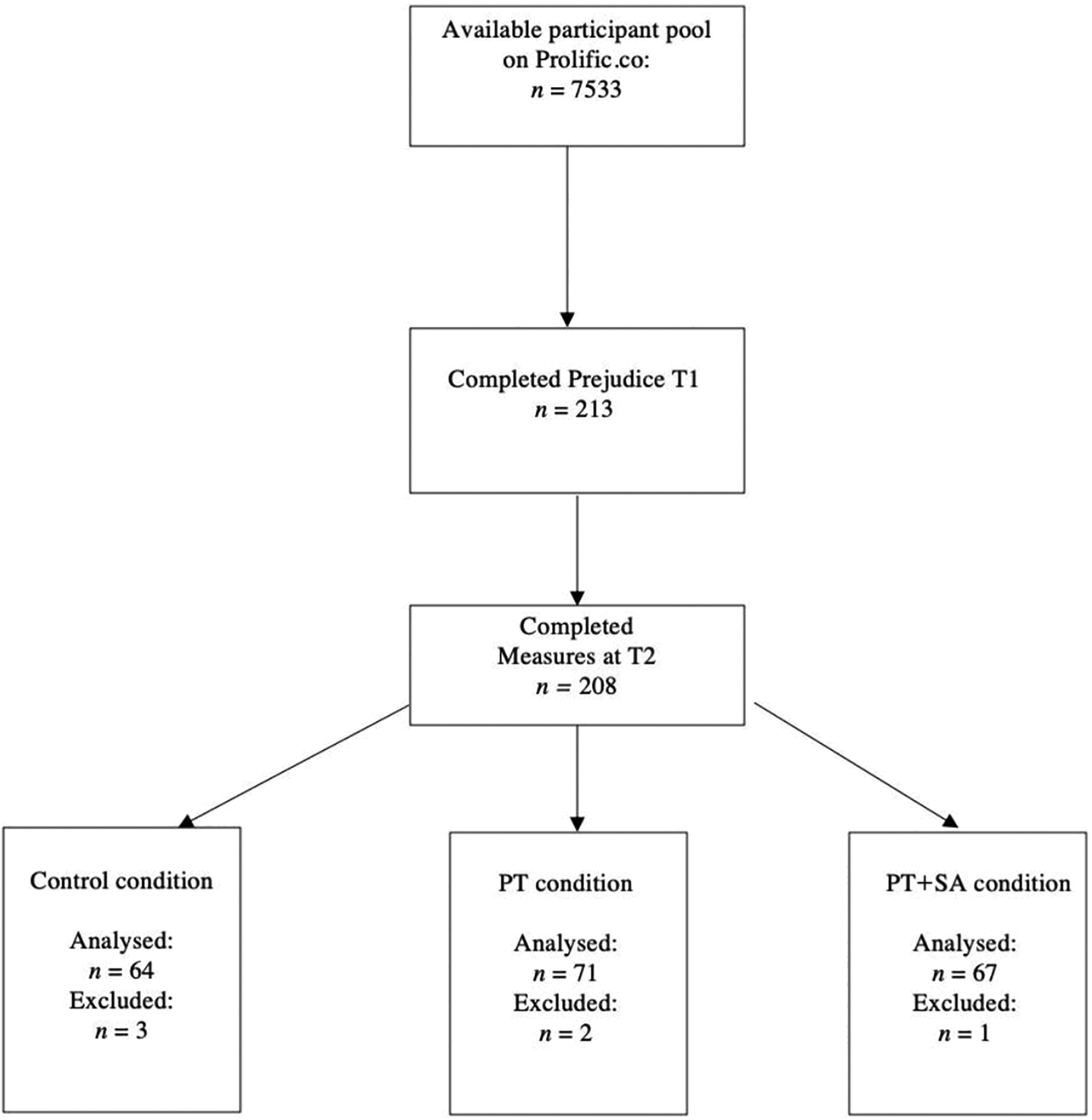
Participant Flow-Chart.
Ethical Considerations
The study received ethical approval from the local ethics coordinator at Leeds Beckett University and from the ethics committee at Manchester Metropolitan University. It was conducted according to the British Psychological Society’s (2018) Code of Ethics. Participants gave informed consent, were aware of their right to withdraw, and were fully debriefed after the study. Participants were paid an hourly wage which is considered fair compensation in line with the UK minimum wage (UK Government, 2020); however, this payment was not substantial enough to induce participants to partake in activities with a greater risk beyond their everyday life (British Psychological Society, 2018).
Results
Colorized versions of all the figures can be found on our OSF repository (https://osf.io/gbxyp/).
Analysis Strategy
Analyses were carried out in the statistical software R Version 2.6.2 (R Core Team, 2020), using base R functions as well as various R packages.
Data Preparation
Participants who failed the manipulation check were excluded (n = 6), resulting in a final sample of 202 participants. Then, new variables for perceived positive traits, feminist stereotypes, perspective-taking responses, and emotional responses were created using the R package PROscorerTools (Baser, 2017). No items were reverse-scored. There were no missing data, and there were no outliers using the ±3 median absolute deviation (Leys et al., 2013) method for detection.
Equivalence Between Groups
Equivalence between groups (target feminist profiles) on T1 prejudice against feminists was assessed through a one-way ANOVA, comparing all three prejudice reduction conditions. This was non-significant (p = .55), meaning that participants in the different conditions had equal levels of initial prejudice against feminists. Groups were also equivalent on age (p = .94).
Descriptive Statistics
Descriptive statistics for key variables across the three conditions are displayed in Table 1. Mean level of prejudice against feminists was just below the mid-point of the scale (M = 46.53, SD = 24.56, range = 0–100).
Descriptive Statistics for Key Study Variables Across the Three Conditions.
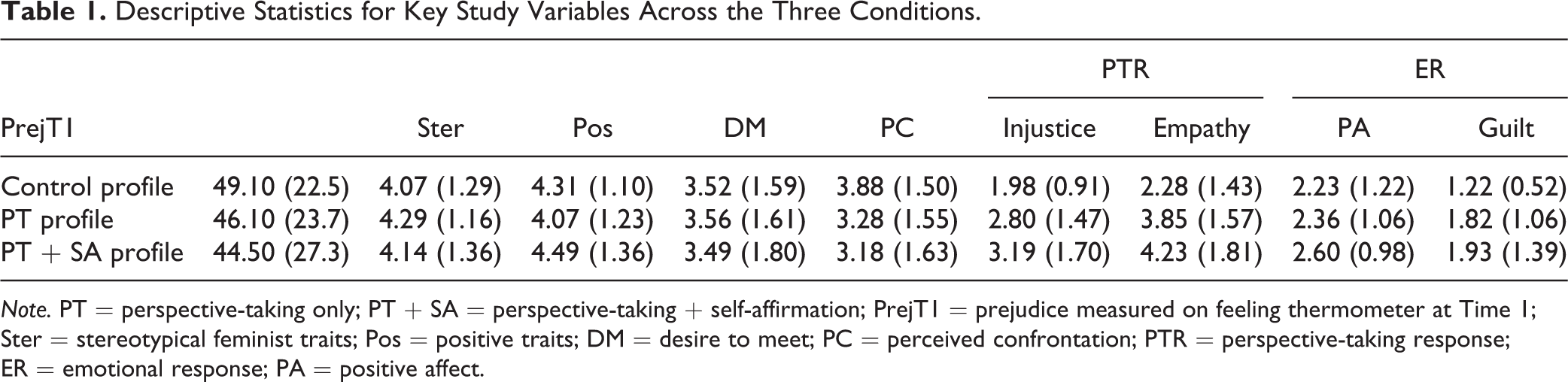
Note. PT = perspective-taking only; PT + SA = perspective-taking + self-affirmation; PrejT1 = prejudice measured on feeling thermometer at Time 1; Ster = stereotypical feminist traits; Pos = positive traits; DM = desire to meet; PC = perceived confrontation; PTR = perspective-taking response; ER = emotional response; PA = positive affect.
Main Analyses
Perceptions of target
To investigate whether the type of prejudice reduction strategy impacted any of the outcome variables, four one-way ANOVAs (followed by pairwise comparisons if significant) were conducted comparing the three prejudice reduction strategies (control, PT, and PT + SA) on each of the outcome variables: desire to meet, negative feminist stereotypes, perceived confrontation, and positive feelings toward the feminist target. Because of the multiple comparisons, the target significance level was adjusted to p < .01. The ANOVA for desire to meet the feminist target was non-significant, indicating that type of prejudice reduction strategy did not impact how much participants wanted to meet the feminist woman, F(2, 199) = 0.03, p = .97. Another one-way ANOVA demonstrated that type of prejudice reduction strategy also did not reduce the negative feminist stereotypes associated with the woman, F(2, 199) = 0.54, p = .59, reduce feelings of perceived confrontation, F(2, 199) = 3.78, p = .03, or increase positive feelings toward the feminist target, F(2, 199) = 1.96, p = .14. These findings therefore suggest that neither PT + SA nor perspective-taking alone increase positive feelings toward feminist women.
Perspective-taking responses
While perceptions of the feminist herself were not altered through PT + SA, further analyses did reveal that the prejudice reduction strategy manipulation impacted perspective-taking responses, as measured by perceptions of injustice, feelings of guilt, feelings of empathy, and positive affect. This is operationalized as the participants’ feelings toward the broader ideological context of the feminist’s plight (i.e., the degree to which participants felt feelings of injustice and empathy more generally when confronted with the issue of online anti-feminist abuse). This pattern is illustrated in Figure 2. All the below analyses were one-way ANOVAs, followed by pairwise comparisons if main effects were significant. Because of the multiple comparisons, the target significance level was again adjusted to p < .01.
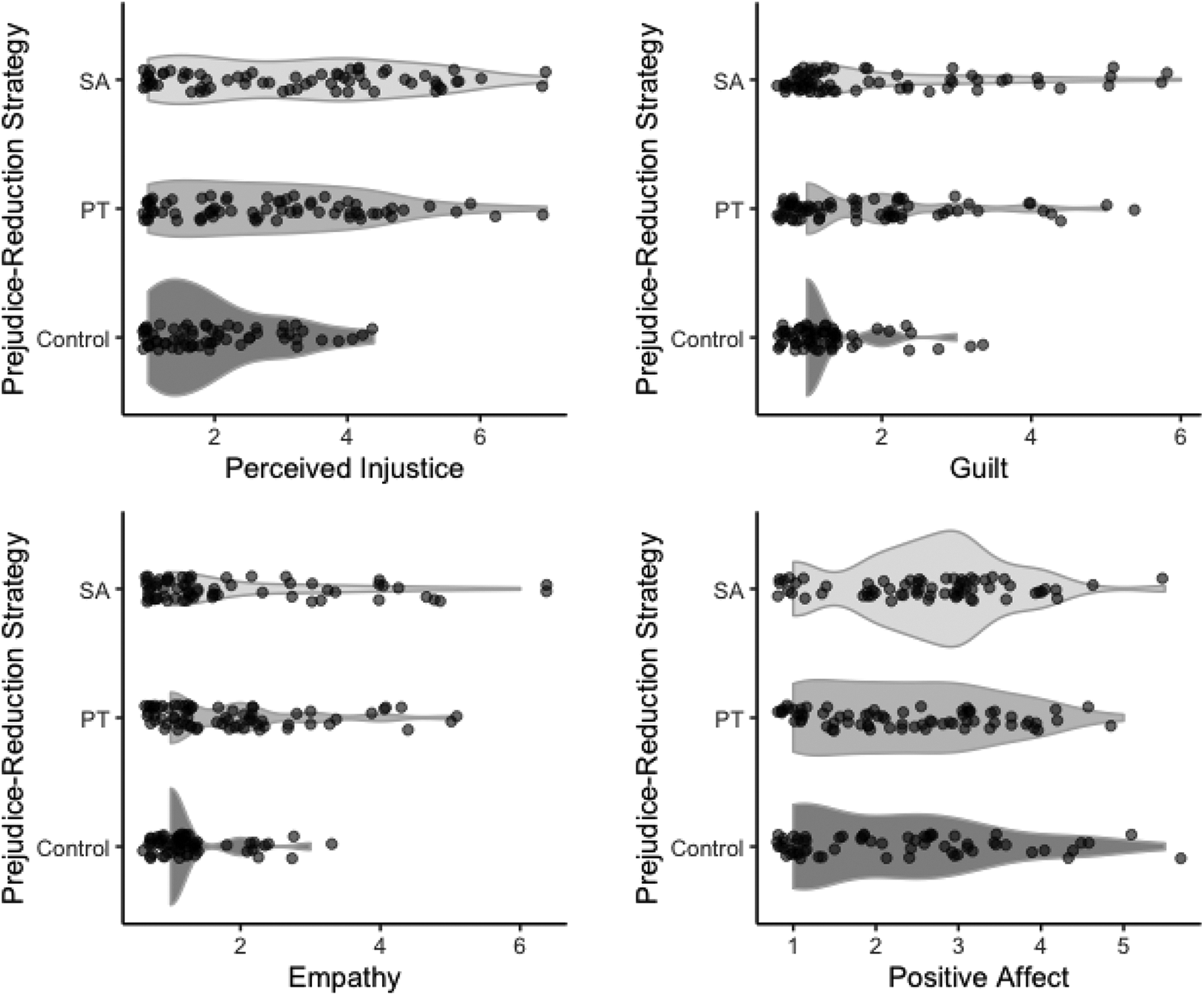
Violin Plots Illustrating the Spread of Scores in Perspective-Taking and Emotional Response Variables for Each Condition.
Results indicated that type of strategy employed by the target (control, PT, and PT + SA) impacted perceptions of injustice, F(2, 199) = 12.56, p < .001. Pairwise comparisons showed that this effect was found in both PT + SA (d = 1.21, p < .001) and PT conditions (d = 0.82, p < .001), as compared to the control condition. The comparison between PT and PT + SA was not significant (p = .39). The prejudice reduction manipulation (control, PT, and PT + SA) also impacted participants feelings of guilt, F(2, 199) = 8.47, p < .001, with both PT + SA (d = 0.71, p = .001) and PT (d = 0.60, p < .01) showing greater feelings of guilt as compared to the control group. The comparison between PT and PT + SA was not significant (p = 1). Further, the prejudice reduction strategy (control, PT, and PT + SA) impacted feelings of empathy, F(2, 199) = 5.76 p < .01. Specifically, PT + SA participants showed greater feelings of empathy toward the feminist target, as compared to the control condition (d = 0.95, p <.01). The comparison between PT and PT + SA was not significant (p = .48), and neither was the comparison between PT and the control condition (p = .13). Finally, prejudice reduction manipulation strategy did not impact participants’ feelings of positive affect, F(2, 199) = 1.97 p = .14. The above suggests that both perspective-taking and perspective-taking with self-affirmation have the potential to increase perspective-taking responses and encourage empathy with feminist issues such as online harassment. Although there was no significant difference between the PT and PT + SA conditions, the effect sizes of feelings of injustice, guilt, and empathy relative to the control condition were all higher for the self-affirmation condition compared to the perspective-taking only condition.
Moderation Analyses
To examine whether any of the above effects varied according to level of T1 prejudice reported by participants, three moderation analyses were carried out on feelings of injustice, guilt, and empathy. The moderation analysis fitted a linear model using the R package gvlma (Pena & Slate, 2019) and regressed each of the outcome variables onto condition and T1 prejudice level (separately as well as with interaction terms). Only the model for empathy presented significant interactions, F(5, 196) = 10.68, p < .001, R2 = .19. The models for injustice, F(5, 196) = 5.80, p = .05, R2 = .10, and guilt, F(5, 196) = 4.06, p = .002, R2 = .07, presented no significant interactions (p’s > .05). Initial prejudice significantly moderated the empathy scores across conditions, such that higher empathy scores were found in individuals with higher initial prejudice in the PT + SA condition only, b = 0.03, SE = 0.10, p < .01, and not in the PT or control conditions (p’s > .05). In other words, individuals with higher initial prejudice showed greater differences in empathy across the conditions compared to those low in initial prejudice. In this context, PT + SA was uniquely effective in increasing empathy among high-prejudice individuals. This effect is illustrated in Figure 3.
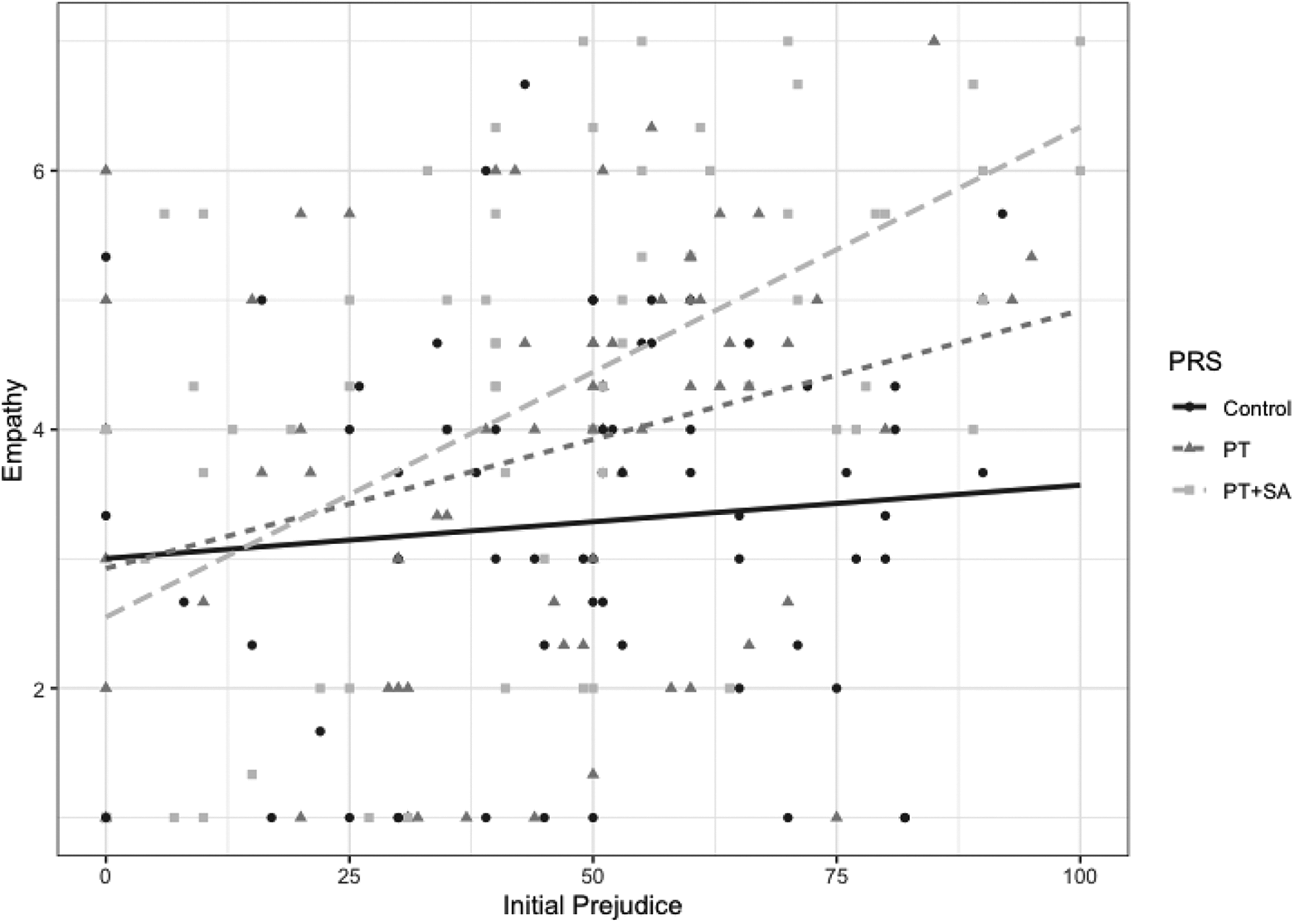
Illustration of the Moderation for the Effect of Initial Prejudice on Empathy by Condition.
Discussion
Although past research has documented that abuse against feminists is prevalent (Houvouras & Scott Carter, 2008; Lewis et al., 2016), this is (to our knowledge) the first study to empirically test strategies to reduce prejudice against feminism as informed by psychological theory. On a sample of over 200 men, findings from this study indicated that perspective-taking and self-affirmation can be useful strategies to induce feelings of empathy, guilt, and injustice in people who are confronted by a potentially threatening message (feminism). As such, this conceptual replication provides a timely update to Stone et al.’s (2011) important findings and builds on their original methodology by developing new materials (including fictional Facebook profiles and a scale intended to measure feminist stereotypes) and implementing these on a well-powered community sample (as opposed to student samples). In doing this, we seek to contribute more generally to central tenets of paradigm-driven research (Nosek et al., 2012) and reproducible research practices.
Our findings support previous research showing that being asked to take the perspective of a stigmatized target can increase empathy and reduce prejudice (Becker & Swim, 2011). In addition, our findings extend the literature by showing that such approaches can be effective even when the perspective-taking request comes from the stigmatized target herself. However, the prejudice reduction manipulation did not seem to impact feelings toward feminists themselves, such as desire to meet or stereotypical traits. These findings, therefore, present some important similarities as well as differences to those of Stone et al. (2011).
Contrary to our hypotheses, there were no significant differences observed between the self-affirmation condition and perspective-taking alone. One potential reason is that we were unable to check to see whether participants had self-affirmed correctly. In much self-affirmation research, participants must write down their affirmation, which can be checked by the researcher to see whether they have completed the task correctly (McQueen & Klein, 2006). In this case, we sought to replicate Stone et al. (2011) to determine whether a subtle self-affirmation request coming from the prejudiced target could produce the same effect to emulate the situations in which such a strategy may be employed in the real world (e.g., on social media). As such, it was not feasible to assess whether the self-affirmations were successful. Another potential reason the self-affirmation was not effective is that participants were asked to self-affirm on a value of subjective success (i.e., they were asked to reflect on something they did that made them feel proud). We chose this affirmation as it was broad enough to allow any participant to use, regardless of their personal history or values, and previous research had successfully employed it (e.g., Hall et al., 2014). However, it is possible that the self-affirmation of pride was not sufficiently strong to reduce defensiveness enough for the participant to want to meet the target, which was the primary dependent variable (J. Stone, personal communication, August 28, 2020). Despite the lack of significant differences, participants in the self-affirmation condition consistently reported higher mean feelings of empathy, guilt, and injustice than those in the perspective-taking only condition and larger relative effect sizes were observed, suggesting that the manipulation did have some effect. It is plausible that we would have observed a difference if, for example, we excluded participants that did not self-affirm correctly.
Further analyses of the data revealed that men who scored highly on prejudice at T1 were significantly more likely to feel empathetic toward the feminist target when they had self-affirmed as opposed to when they had not. This observation therefore suggests that self-affirmation is particularly effective with those with strong feelings of antipathy toward feminists, who may, theoretically, feel little empathy toward feminists in everyday life. As Stone et al. (2011) did not produce separate analyses for participants with high and low prejudice, it is not clear whether these effects would mirror theirs. Second, while self-affirmation led to participants sharing a sense of injustice and guilt when faced with feminist issues, an important difference between our results and those of Stone et al. (2011) is that perspective-taking combined with self-affirmation did not reduce backlash against the feminist target as measured by desire to meet, perceived positive traits, and perceived confrontation. A possible reason for this finding is that the process of confronting any discrimination comes at personal cost (Kaiser & Miller, 2001), meaning that generally, any intervention to reduce stereotypes will struggle to avoid, to a certain degree, reflecting poorly on the stereotyped target. In the context of our study, it is likely that the intervention did not improve perceptions of feminists themselves, because feminists are stereotyped as unlikable (perhaps even more so than other stereotyped targets), even in the context of relatively broad agreement with central tenets of feminist ideology (Lewis et al., 2016; Meijs et al., 2019). As such, it provides a possible explanation for these results. This finding further affirms previous research that has found that even when people are sympathetic toward feminist ideas, they generally have negative perceptions of feminists themselves (Carr, 2018; Meijs et al., 2019).
Empathy and Self-Affirmation
In the current study, self-affirmation combined with perspective-taking induced feelings of empathy, particularly among men with strong feelings of antipathy toward feminists. This is an important finding, as it has the potential to reduce abuse against feminists, which has been highlighted as an important concern in society (Ging, 2019; Meijs et al., 2019). It has been suggested that online abuse stems from an online disinhibition effect (Lapidot-Lefler & Barak, 2012; Suler, 2004) that makes people behave differently online, as compared to in the physical word. As argued by Chambers (2014), this phenomenon is facilitated through a lack of face-to-face contact in online interactions, which reduces feelings of empathy toward the abused target. In fact, most factors present in digital environments promote a reduction in natural empathetic processes (Terry & Cain, 2016).
Furthermore, reduced empathy has been associated with increased online abuse and cyberbullying (Brewer & Kerslake, 2015; Zych et al., 2019). Therefore, while our manipulations did not reduce backlash as measured by reductions in negative stereotypes, feelings of empathy could still be useful in dampening abuse and harassment. If perspective-taking combined with self-affirmation can increase feelings of empathy toward a feminist target among those who are theoretically the most likely to abuse feminists (i.e., high in negative feelings toward feminists), it would have a promising potential to reduce online abuse against those who campaign for women’s rights more generally. This explanation would therefore suggest that while the strategies proposed above would not necessarily improve perceptions of feminists, the empathy resulting from self-affirmation could serve as a psychological buffer against perpetrating online harassment (Suler, 2004).
Practical Implications
When considered in the broader context of future directions for feminism and public policy, the findings of our research suggest that self-affirmation and perspective-taking could revive the core values of male engagement with the feminist cause, many of which work along similar premises as self-affirmation. According to Messner (2016), original male engagement with the feminist cause centered on the notion of positive roles for men (as expressed in critical men’s studies), which provided men with a positive, self-affirming road within feminism (Connell & Messerschmidt, 2005; Ging, 2019). This approach acknowledges men’s overall structural power over women within society alongside the suffering of individual men (e.g., men’s higher risk of suicide and ill health), which may be partially attributed to the impoverished male sex role, for example, restrictive emotionality and stoicism (Messner, 2016; World Health Organization, 2014). The creation of positive roles for men within the struggle for gender equality would therefore ensure that gender equality is not perceived as a zero-sum game (i.e., that improved conditions for women necessarily mean worsened conditions for men). As such, the media would benefit from presenting gender equality as beneficial to men and women alike, rather than highlighting women’s rights as antagonistic to men or promoting a false symmetry between men and women’s gender oppression (Messner, 2016). Further, this suggestion would mean that, rather than directly confronting anti-feminism, the way forward may be for feminism to realign with the core values of male engagement with feminism, and produce positive, affirming roles for men within the struggle for gender equality; this aligns with the original men’s liberation movement, which packaged feminism in terms of potential gains for men (Messner, 2016). Ideally, feminist collective action would in this context become a source of men’s self-affirmation (Wiley et al., 2012).
In a contemporary context, this approach could involve an increased focus on men’s positive interpersonal roles as fathers, friends, and loving partners. Practically, this could involve shared-parental leave policies as seen in some Nordic countries, which promote positive roles for men as active fathers; this policy allows women’s re-entry into the workforce after motherhood (a key feminist objective), while promoting increased welfare for both fathers and children (Baily, 2015; Gillard, 2018). Policies like these would therefore account for some of the concerns voiced by mainstream men’s rights movements, particularly in terms of positive roles for fathers. Long-term, it may be particularly important to re-define scripts for male sexuality; doing so will be key for preventing sexual violence against women, but it will also provide a route for more fulfilling relationships for men. Practically, this could involve a continued feminist activism within sex education for younger people as well as a critical examination of pornography as being central to normalizing sexual violence and coercion in sexual scripts (Vera-Gray et al., 2021). As other men’s behaviors serve as powerful motivators for men, it is likely that male feminist activism in this area could yield considerable, long-term rewards (Gidycz et al., 2011; Wiley et al., 2012), particularly in the context of criticizing mainstream pornography. As women’s roles in society are changing more rapidly than men’s (Ging, 2019), it is otherwise likely that men will feel “left behind,” something that will only strengthen the backlash against feminism. This has been further elaborated on by Van Valkenburgh (2019) who recommends that future theorizing on online aggression against feminists consider the wider societal conditions—in particular neoliberalism—that create the foundations for the feminist backlash.
Importantly, only men who are high in male gender role stress (i.e., who are stressed by situations that challenge traditional masculine identities) respond aggressively to women when threatened with a loss of power (Harrington et al., 2021). As this group also reports higher endorsement of online harassment (Rubin et al., 2020), this finding suggests that a positive redefinition of the male sex role could lessen this backlash, through reducing men’s gender role stress. These positive roles could also promote empathy for feminists more broadly, which could make online harassment less likely (Chambers, 2014; Suler, 2004). Acknowledging concerns about over-burdening already taxed women activists with further demands on men’s role within feminism, the creation of positive and affirming identities for men will be particularly important for male allies of the feminist cause (Baily, 2015).
Limitations and Future Directions
Although this study provides a unique insight into processes that have the potential to increase sympathetic feelings toward feminists, there are several limitations to bear in mind when interpreting the results. One limitation is that although the prejudice reduction manipulations produced feelings of injustice and empathy in the participants, we did not measure directly whether these were related to behavioral measures or attitudes toward specific feminist causes. While the manipulations had no effect on negative stereotypes of feminists or a desire to meet them, we did not specifically measure behavior relating to online abuse or harassment (e.g., cyberbullying; Brewer & Kerslake, 2015). Future research should test the theoretically supported prediction that increased empathy may be useful for reducing abusive behaviors, even if it does not increase positive perceptions of targets. Another limitation is related to the measurement of injustice, which asked participants how they felt in response to the Facebook status about the online abuse suffered by the feminist (e.g., “bothered,” “irritated”). The items were chosen to replicate those used by Stone et al. (2011). It is possible that the wording of the question meant that some participants interpreted these with respect to how they felt about the feminist raising the issue of abuse (rather than the issue itself). Without qualitative insight into the participant’s interpretations of the questions, this possibility cannot be ruled out. However, it is mitigated by the fact that the items had high consistency (α = 0.89), and the other items (e.g., “alarmed,” “outraged”) are conceptually related to emotions about issues (e.g., online abuse) rather than people. Nevertheless, future research should consider clarifying this question when attempting replications of this study. A further limitation is that several other variables were assessed with only a single item (e.g., guilt, confrontation). This decision was intended to keep the length of the study reasonable (and to follow procedures by Stone et al., 2011) but may impact the reliability of the findings.
Another limitation is that, as previously mentioned, we were unable to perform a manipulation check to see whether participants had self-affirmed appropriately or whether they had taken the perspective of the target. This was due to the fact that these requests were presented as coming from the target rather than the experimenter (Stone et al., 2011), and thus attempting to measure directly whether participants had self-affirmed or taken the target’s perspective was likely to reveal that the profiles contained a manipulation. However, it may be possible to assess self-affirmation indirectly, for example, by measuring self-appraisal more generally (McQueen & Klein, 2006) and future research should examine this. Finally, our study is contextually limited, as it was conducted on a UK sample. As antipathy toward feminists, and online abuse of women more generally, is a world-wide issue (European Union, 2018; Meijs et al., 2019), further research would benefit from implementing these procedures in other countries. Importantly, the feminist profile presented in this study (Alice) was White, and conventionally attractive, thus representing the most acceptable form of feminism in society (D’Ignazio & Klein, 2020; Lorde, 1984). As prejudice based on gender intersects with that of ethnicity (for a detailed discussion of intersectionality, see Crenshaw, 1989), it is very likely that a Facebook profile of a Black or Asian feminist woman would have faced harsher backlash from participants, as she is confronting sexism as well as implicit racism (Carastathis, 2014; Lorde, 1984). Future research, would, therefore, benefit from including ethnicity as a manipulated variable, to further understand how intersectionality interacts with feminism(s). Within the current manipulation strategy, this could be conveniently done by altering the Facebook profiles—we would welcome the reuse of our materials for this purpose. This development will be particularly relevant given the sustained criticism of mainstream feminism as failing to fully consider and incorporate Black and Asian women’s experiences of oppression (Collins, 2009). Finally, there were several relevant demographic variables (e.g., sexual orientation, level of education, socio-economic status) we did not measure—our findings should be considered with this limitation in mind, and we recommend that future researchers in this area consider including them.
Conclusion
In conclusion, this study is a novel contribution to the literature on self-affirmation, as well as on prejudice against feminists, and it is the first of its kind to empirically test prejudice-reduction strategies in a feminist context. Although self-affirmation combined with perspective-taking did not make feminists themselves seem more likable, it increased perspective-taking feelings (of empathy, guilt, and injustice) toward feminists facing online abuse. Self-affirmation combined with perspective-taking was also uniquely effective in affecting empathy in individuals with high levels of initial prejudice; these approaches could therefore work as protective factors against the perpetration of online abuse. Moreover, as self-affirmation links with traditional aspects of men’s engagement with feminism, it has the potential to facilitate the promotion of positive, affirming roles for men on the course to gender equality. While the lack of diversity limits the extent to which conclusions can be applied to all types of feminist activism, results do nonetheless contribute to knowledge on how to increase empathy toward feminists. We therefore recommend that feminist activists and policy makers consider strategies that promote positive roles for men within the struggle for gender equality, such as consent-based sexual education and shared parental leave policies.
Supplemental Material
Supplemental Material, sj-pptx-1-pwq-10.1177_03616843211017472 - When Men Who Dislike Feminists Feel Proud: Can Self-Affirmation and Perspective-Taking Increase Men’s Empathy Toward Feminists?
Supplemental Material, sj-pptx-1-pwq-10.1177_03616843211017472 for When Men Who Dislike Feminists Feel Proud: Can Self-Affirmation and Perspective-Taking Increase Men’s Empathy Toward Feminists? by Sofia Persson and Thomas J. Hostler in Psychology of Women Quarterly
Footnotes
Acknowledgment
We would like to thank Dr. Jenny Cole for her help with the pilot study in the initial stages of this project.
Declaration of Conflicting Interests
The author(s) declared no potential conflicts of interest with respect to the research, authorship, and/or publication of this article.
Funding
The author(s) disclosed receipt of the following financial support for the research, authorship, and/or publication of this article: Participant recruitment for this research was funded by a research grant from the Centre for Psychological Research (PsyCen) at Leeds Beckett University.

References
Supplementary Material
Please find the following supplemental material available below.
For Open Access articles published under a Creative Commons License, all supplemental material carries the same license as the article it is associated with.
For non-Open Access articles published, all supplemental material carries a non-exclusive license, and permission requests for re-use of supplemental material or any part of supplemental material shall be sent directly to the copyright owner as specified in the copyright notice associated with the article.
