



Abstract
The Enhanced Assess, Acknowledge, Act (EAAA) program has been shown to reduce sexual assaults experienced by university students who identify as women. Prevention researchers emphasize testing theory-based mechanisms once positive outcomes related to effectiveness are established. We assessed the process by which EAAA’s positive outcomes are achieved in a sample of 857 first year university students. EAAA’s goals are to increase risk detection in social interactions, decrease obstacles to risk detection or resistance with known men, and increase women’s use of effective self-defense. We used chained multiple mediator modeling to assess the combined effects of the primary mediators (risk detection, direct resistance, and self-defense self-efficacy) while simultaneously assessing the interrelationships among the secondary mediators (perception of personal risk, belief in the myth of female precipitation, and general rape myth acceptance). The hypothesized multiple mediation model with three primary mediators met the criterion for full mediation of the intervention effects. Together, the mediators accounted for 95% and 76% of the reductions in completed and attempted rape, respectively, demonstrating full mediation. The hypothesized secondary mediators were important in achieving improvements in personal and situational risk detection. The findings strongly support the benefit of cognitive ecological theory and the Assess, Acknowledge, Act conceptualization underlying EAAA. This evidence can be used by administrators and staff responsible for prevention policy and practice on campuses to defend the implementation of theoretically grounded, evidence-based prevention programs. Online slides for instructors who want to use this article for teaching are available on PWQ's website at http://journals.sagepub.com/doi/suppl/10.1177/0361684320962561
For at least 40 years, people and communities affiliated with feminist, health, and educational organizations and institutions have been working to prevent sexual assault (e.g., Morrison et al., 2004; Women Against Rape, 1980), and since the early 2000s, there has been increased interest in evidence-based program development and evaluation to rigorously assess interventions’ successes and failures. Much of this work has been accomplished on university campuses. A number of qualitative and quantitative review articles and meta-analyses have summarized the state of the field and made recommendations for promising directions for academics and practitioners (Basile et al., 2016; DeGue et al., 2012; DeGue et al., 2014; Ellsberg et al., 2015; Gidycz et al., 2002; Lonsway et al., 2009; Schewe, 2002). As well, prominent researchers have called for resources to be focused on evidence-based, theory-driven, effective programs within a comprehensive approach to sexual violence prevention (e.g., Banyard, 2013; Banyard & Potter, 2017; Orchowski et al., 2010; Orchowski et al., 2018). This approach includes, and extends beyond, student programming to changing entire campuses and communities. Included in current recommendations by a consortium of independent sexual violence prevention researchers and the Centers for Disease Control are bystander-based interventions for students of all genders, resistance education for female students, and continued development of programming for male students related to a bystander and social norms education (Basile et al., 2016; Orchowski et al., 2018).
These opinions are strongly supported by the prevention science literature (e.g., Nation et al., 2003), where it has long been recommended that all prevention work be comprehensive in having multiple interventions targeted for different audiences within a system and use prevention best practices (e.g., include opportunities for active interaction and application of skills). Researchers in academia and public health have also recommended improvements to evaluation research in order to answer more precise questions about what works and why (Banyard et al., 2014; DeGue et al., 2014; Orchowski et al., 2018). Published standards for reporting randomized and nonrandomized evaluation trials (Des Jarlais et al., 2004; Schulz et al., 2010) and calls for better reporting of interventions so that they can be understood and implemented with findings replicated and improved upon by others (e.g., Hoffmann et al., 2014; Pinnock et al., 2017) have also emerged. Specifically, within the sexual violence prevention field, researchers have argued for more rigorous studies that would allow the testing of theory-based mechanisms once positive outcomes related to their effectiveness are established (e.g., Norris et al., 2018).
Salazar et al.’s (2019) recent analysis of the mechanisms for change in the RealConsent program for university men is a good example of such an analysis. While high attrition in the follow-up period and the short duration of the positive outcomes make the authors’ conclusions tentative, it is an important first attempt to understand how a theory-based sexual assault program works. To our knowledge, no studies of sexual assault resistance education programs for university women have assessed the process by which positive outcomes are achieved (Senn et al., 2018), despite increasing calls for such analyses (Hollander, 2018; Norris et al., 2018). This is our goal.
The current article focuses on the first author’s Enhanced Assess, Acknowledge, Act (EAAA) sexual assault resistance education program, which is also known as the Flip the ScriptTM program. EAAA is the only program that in a randomized controlled trial (RCT) has been shown to substantially reduce the sexual assaults that women university students experienced over the subsequent year (i.e., 50% reduction in attempted and completed rape as well as reductions in other forms of sexual assault; Senn et al., 2015). In fact, positive outcomes occur for at least 2 years (Senn et al., 2017). A few empowerment self-defense or risk reduction programs for women have also demonstrated positive sexual assault outcomes. Specifically, assessment of a 30-hour empowerment self-defense program using a quasi-experimental design indicated significant reductions in sexual victimization for college women for at least 1 year after participating in the program (Hollander, 2014). A shorter, 7.5-hour risk reduction program, evaluated using an experimental design, also led to significant reductions in sexual victimization for subsets of college women who participated in the program for a few months (e.g., Gidycz et al., 2006; for a review of theory and evidence for the type of program more generally, see Orchowski & Gidycz, 2018). Thus, the benefits of understanding how these types of programs work extend beyond a single program.
We were ideally situated to provide answers to this question for many reasons. EAAA was evaluated in a multi-site RCT with a large sample of 893 women students. There were prospective data for women who did and did not take the program, which included information about their backgrounds and baseline scores on key variables. Further, we followed them with assessments across more than a year with high retention. Data collection included measurement of potential mediators (mechanisms) 1-week post-intervention and sexual assaults in the 12 months following that assessment, which allowed for prospective temporal conclusions regarding the mediators’ influence on post-program sexual assault outcomes. As such, we were able to go beyond the goal of finding out whether a program works to decrease sexual victimization to how and why the program works. This article describes a chained multiple mediation analysis, which allowed us to assess the joint processes that produced treatment outcomes. Through this analysis, we tested the model of theoretically postulated mechanisms that drove the development of the sexual assault resistance education program. This is important for scientific and practical reasons and has not previously been reported.
Theoretical and Empirical Foundation of EAAA
The EAAA program’s name acknowledges that it is based in large part on the recommendations of Rozee and Koss (2001), who synthesized decades of theory and rape research to suggest a theoretically driven, evidence-based approach for sexual violence prevention programming for young women. 1 They named this conceptualization “Assess, Acknowledge, Act (AAA).” AAA was conceived on a bedrock of theory and feminist research, particularly the cognitive ecological theory proposed by Norris and Nurius (e.g., Norris et al., 1996; Nurius & Norris, 1996) and the evidence of effective sexual assault resistance strategies provided by Ullman (1997, 1998) as well as a long tradition of feminist grassroots activism, advocacy, theory, and self-defense practice (e.g., Bateman, 1978; Rozee et al., 1991; Wen-Do Women’s Self Defence, n.d.; Women Against Rape, 1980). These underpinnings are described in more detail elsewhere (Rozee et al., 1991; Rozee & Koss, 2001; Senn et al., 2015; Senn et al., 2017). Rozee and Koss’s proposed approach challenged past practices that were not theory- or evidence-based, tended to focus primarily on stranger sexual assault, and were largely ineffective (see Morrison et al., 2004, for review of research evaluations of programs conducted prior to this period). They argued that, given the continuing alarming rates of sexual violence experienced by young women, the complete lack of success in reducing perpetration, and the substantial evidence base available, providing women with knowledge and skills to prepare them to detect risk, overcome emotional obstacles to acknowledging the danger, and to resist sexual coercion or sexual assault by men they know was imperative.
In response to this call, the first author designed a resistance program curriculum to bring the conceptualized program into reality. The term “resistance” is used in its broadest sense to represent any attitudes women hold or actions they take to refuse to accept or comply with social norms or expectations that (a) support woman-blaming explanations for sexual violence, (b) undergird societal tolerance of rape culture, and/or (c) undermine women’s sexual autonomy. Resistance includes defensive actions women take to protect their boundaries, their body, and sexual integrity in interactions with others. For survivors, resistance also includes the refusal to accept sexual violence perpetrators’ views of them and what occurred. EAAA reduces the sexual victimization women experience while holding perpetrators entirely responsible for their actions (Senn et al., 2015; Senn et al., 2017) and interrupts messages often perpetuated in a rape culture (Radtke et al., 2020). The program has a gendered framing, focusing on sexual assaults perpetrated by men who are known to young women (i.e., it uses a broad definition of acquaintances that includes family members, intimate partners, classmates, neighbors, and other men they know). EAAA is designed and implemented to recognize the diversity of experiences of participants who self-identify as women in terms of prior sexual victimization history (i.e., that there will always be survivors in the room), demographics (e.g., race, class, religion), abilities (e.g., physical ability, ability to be loud), sexual identity (i.e., explicitly acknowledges heterosexual, bisexual, lesbian, and asexual identities), and relationship and sexual experience.
The goals of the program are to (a) increase the likelihood that empirically supported risk cues in social contexts (e.g., isolation, alcohol) and revealed in men’s behavior (e.g., persistence, sexual entitlement) will be detected by women as early as possible in social interactions, (b) decrease women’s emotional or cognitive obstacles to risk detection or resistance in situations involving known men, and (c) increase the likelihood that women will use defensive actions (e.g., leaving when possible, forceful verbal and physical self defense) that are most likely to lead to better outcomes (i.e., reduced severity of the sexual assault, interruption of rape; Tark & Kleck, 2014; Ullman, 1997) when threats are detected.
To accomplish these goals, the curriculum has four 3-hour units. Unit 1, Assess, is designed to help women identify situations and behaviors that signal a higher risk for sexual violence. Unit 2, Acknowledge, was created to assist women to overcome emotional barriers to acknowledging the threat from men they know and provides practice in identifying and resisting verbal coercion. Unit 3, Act, provides empowerment verbal and physical self-defense training (based on Wen-Do Women’s Self Defence) focused on effective strategies for resisting common acquaintance tactics. Unit 4, Relationships and Sexuality, adapted from the Our Whole Lives curriculum (Goldfarb & Casparian, 2000; Kimball & Frediani, 2000), offers high quality sexual information and a context for exploring and talking about their own sexual desires and relationship values. In other words, EAAA gives women evidence-based information, skills, and practice within a positive sexuality framework to empower them to more quickly identify a sexually coercive situation involving a male acquaintance as dangerous and get out or use forceful resistance if necessary. More detail on the program content is provided elsewhere (Radtke et al., 2020; Senn et al., 2013).
The key findings for the registered, multisite (three universities), RCT (SARE Trial) evaluating EAAA have been published elsewhere (Senn et al., 2015; Senn et al., 2017) but are briefly summarized here. The reductions in sexual violence for young women who were assigned to the EAAA program (Senn et al., 2015) were accompanied by positive program effects on a number of other important outcomes (Senn et al., 2017) measured 1 week after participation and, for most, at 6 and 12 months (and up to 24 months). We measured these additional outcomes because they were hypothesized mediators; that is, they encompassed most of the theoretical mechanisms targeted by the AAA approach to increase women’s safety without limiting their freedom. In this study, we go beyond our previous analysis of the program’s positive effects on these outcomes to test whether, together, they are mediators of the reductions in the sexual assault across time. In other words, do improved scores on these outcomes at post-test (1-week after participation) combine to account for the reductions in sexual assault experienced from that point until the 12-month follow-up?
In the following section, we explain the hypothesized multiple mediation model (Figure 1) and, specifically, the theory behind our expectations that the possible mediators would combine to lead to reductions in sexual assault. Given that the model was built based on the best evidence available, there are no competing theoretical models to be tested; rather, we are assessing whether the model works as a whole and whether the relationships for any hypothesized elements are not supported. Any variable that is hypothesized to explain a portion of the EAAA program’s effect on sexual assault victimization through a direct link to the outcome, we refer to as a “primary mediator.” These are the primary elements of the AAA model. Any variable that is hypothesized to have an indirect link to the outcome through its influence on a primary mediator, we refer to as a “secondary mediator.”
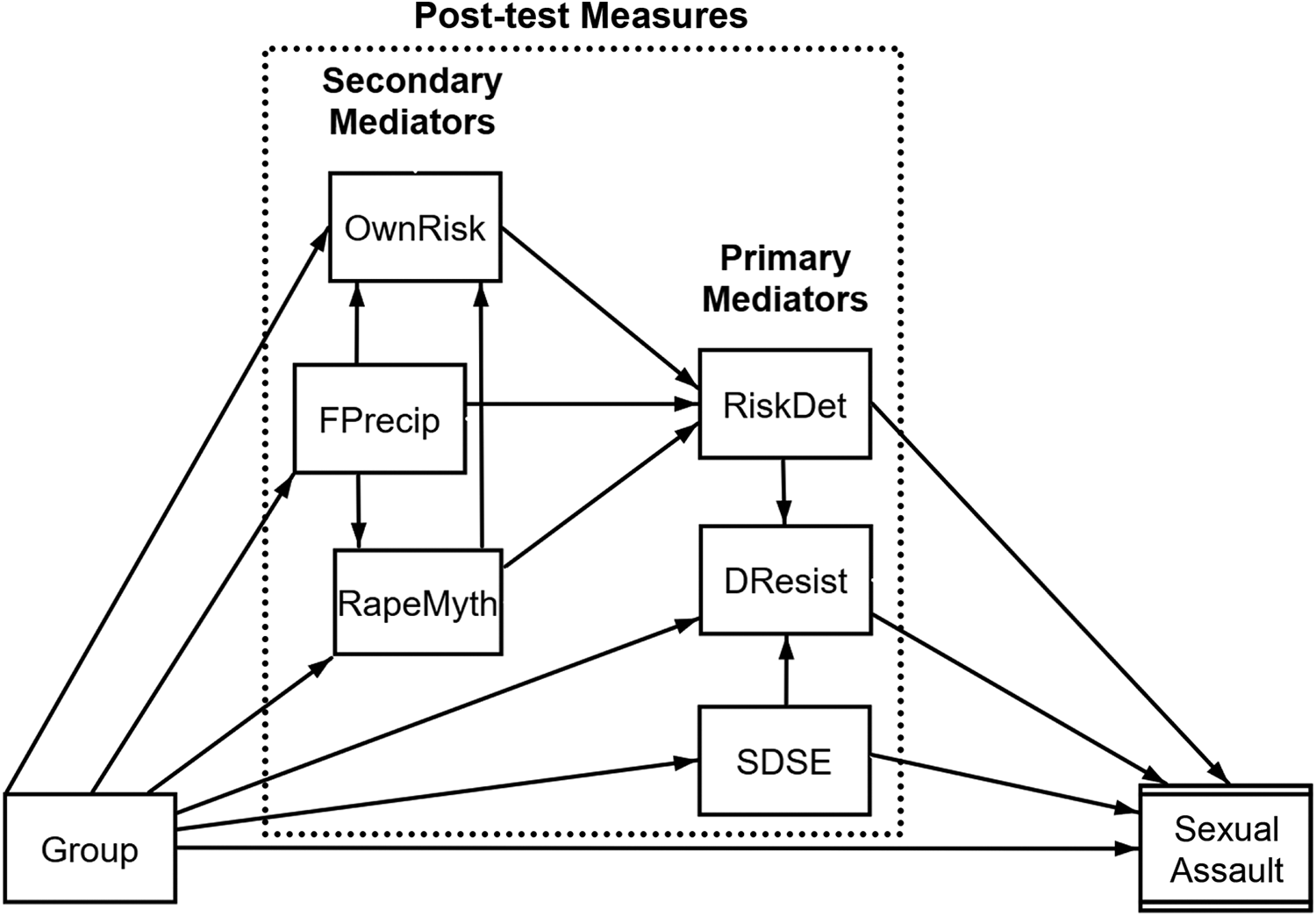
Hypothesized Multiple Mediation Model.
Note. Primary mediators are variables that are hypothesized to explain a portion of the Enhanced Assess, Acknowledge, Act program’s (Group) effect on sexual assault victimization and have a direct link to the outcome (Sexual Assault). Secondary mediators are variables that are hypothesized not to have a direct link to the outcome themselves but rather are expected to influence the primary mediators. OwnRisk = perceived risk of acquaintance rape; FPrecip = belief in female precipitation of rape; RapeMyth = rape myth acceptance; RiskDet = risk detection; DResist = direct resistance; SDSE = self-defense self-efficacy.
Mediators of Reductions in Sexual Assault
Risk detection is a key element of the primary appraisal process outlined in Nurius and Norris’s (1996) cognitive ecological model and hence also the theoretical underpinning of the first unit (Assess). The program is designed to undermine socialization processes about “stranger risk” that direct women to use a wide range of precautionary strategies involving restrictions on their freedom without protecting them from sexual violence (e.g., not walking alone at night; Gordon & Riger, 1989; Stanko, 1990). The curriculum provides information and practice in identifying empirically supported risk factors for acquaintance sexual assault and encourages women to trust their own instincts and judgments when they identify risk cues in social situations. Based on past research (e.g., Marx et al., 2001) and theory, better risk detection (i.e., more accurate, earlier) at post-test, which was a positive outcome of participation in EAAA (Senn et al., 2017), should be directly linked to reductions in sexual victimization in the subsequent 12 months and hence a primary mediator.
The EAAA program also addresses obstacles women encounter at secondary appraisal stages (i.e., after risk has been detected and when they are making “determinations of coping resources, options, and outcomes”; Nurius & Norris, 1996, p. 130) in interactions with coercive men. Content and activities in the second unit of the EAAA program focus on strengthening women’s belief in their own sexual and relationship rights and undermine the belief that relationships must be preserved at all costs. Young women are provided with a context in which they can practice asserting their needs and confronting common verbal and physical acquaintance perpetrator tactics. In the third unit, facilitators present evidence that direct forceful verbal and physical resistance strategies and leaving lead to better outcomes in sexual assault situations. In any given situation, participants are then able to select their own toolbox of effective strategies from among the many techniques taught. Nurius and Norris (1996) summarize the goal of intervention to improve the situation for women as follows: Thus, the extent to which a woman is prepared to see assertive behavior as a reasonable resistance stance and is assisted to gain assertiveness skills and habits may have an indirect effect mediated through a woman’s cognitive structures operating at the time of the coercion. (p. 122, emphasis added)
Thus, both increases in self-defense self-efficacy, that is, confidence that she could assert and defend herself across a range of situations, and the ability and willingness to use more direct resistance strategies in a hypothetical situation should be related to one another and be primary mediators of the EAAA program’s effects on sexual assault. Notably, in our previously published analysis, we found both variables to be positively impacted by program participation (Senn et al., 2017).
Based on the research evidence (e.g., Vitek et al., 2018), risk detection was a primary mediator expected to be influenced by secondary mediators (i.e., other specific attitudes and beliefs directly affected by the EAAA program). Three hypothesized secondary mediators that were included in the RCT were (a) women’s perceptions of their own general risk of sexual assault, (b) acceptance of rape myths, and (c) the belief that women play a causal role in sexual assault. All were affected in the desired direction by program participation at the post-test, and these effects were maintained for at least 2 years (Senn et al., 2017). These attitudes and behaviors were not expected to have direct effects on sexual victimization (i.e., changes in attitudes and beliefs alone have never been sufficient to reduce the incidence of sexual assault; Morrison et al., 2004). Instead, they were included in the trial precisely because any improvements in these attitudes and beliefs were hypothesized to facilitate risk detection. Thus, we hypothesized that in combination these three factors would be related to each other and would lead to better outcomes in sexual assault through their relationships with risk detection. Each is described in more detail below.
An optimism bias, which is the belief that while others are at risk of experiencing a particular negative outcome, we are not ourselves at risk, can in some circumstances be protective (e.g., against depression; Conversano et al., 2010). However, “unrealistic optimism” (Nurius & Norris, 1996) is an obstacle to detecting acquaintance sexual assault risk (Norris et al., 1996). Unsurprisingly, an optimism bias is present in women’s estimates of their sexual assault risk (Gidycz et al., 2006). The problematic piece of this perception is not the judgment of risk for other women who are similar to us—this tends to be relatively accurate (i.e., there is a possibility the bad event could occur)—but rather judgment for one’s self (i.e., it is unlikely to occur to me). The RCT analyses showed that the EAAA program increased women’s perceptions of their own general risk of sexual assault (Senn et al., 2017). 2 We hypothesized that this should be related to women’s risk detection in specific situations by making “danger cues” relevant and worthy of attention as they arose in those situations.
Similarly and relatedly, commonly held myths about the characteristics of rape, rape perpetrators, and rape victims (e.g., that rape is most likely to be perpetrated by strangers) may be psychologically self-protective (e.g., “only women who do X, wear Y, or go to Z are raped and I would never do those things”) but may also have negative consequences, such as impairing perceptions of one’s own risk of sexual assault (e.g., Bohner et al., 2009; Yeater et al., 2010). Victim-blaming beliefs are thought to be particularly pernicious in this regard. We therefore hypothesized that the program’s positive effects in reducing rape myths in general and the specific incorrect belief that women cause rape by their own actions (Senn et al., 2017) would be related to improved risk perception. Further, we expected that reducing the belief that women cause rape by their own actions, a belief that when applied to the self can give one false sense of security (e.g., If I don’t go there or do that, then it can’t happen to me), would be related to increases in women’s perceptions of their own personal risk because reducing these beliefs makes salient that any woman is potentially at risk.
The theory and evidence upon which EAAA was built emerges from many different, primarily correlational studies often focused on a single domain (e.g., risk perception or self-defense strategies) that were related to positive outcomes (Norris et al., 2018; Tark & Kleck, 2014; Vitek et al., 2018). Although changes in individual domains can occur and can be important in their own right (e.g., more high-quality information about a phenomenon or more skill is usually better than less), our focus is on how the combined domains of the whole model are implicated in achieving the reductions in attempted and completed rape 3 affected through participation in the EAAA program.
We focused on the 1-year data from the SARE Trial RCT, because a drop in effect sizes after 1 year and a decrease in the sample size across 2 years reduced our ability to test these relationships beyond this period. 4 We assessed mediation prospectively using participants’ scores on the hypothesized primary and secondary mediators that were measured 1-week post-program and their experience of sexual assault in the subsequent 12 months after the post-test. Given our large sample size, we were able to test the mediation effects for completed and attempted rape separately. It should be noted that rape is broadly and behaviorally defined to include oral, vaginal, and anal penetration by a man without the woman’s consent through a range of perpetrator tactics including threats, force, and taking advantage of or inducing women’s incapacitation from drugs or alcohol (Koss et al., 2007).
Method
Participants
Eight hundred and ninety-three first-year undergraduate students who identified as women were recruited at three universities and enrolled in the SARE RCT. The full trial protocol has been published (Senn et al., 2013), as have the 1- and 2-year primary and secondary outcomes (Senn et al., 2015; Senn et al., 2017). The prospective analysis in the present study required valid responses on potential mediators measured post-intervention at a 1-week post-test and sexual assault outcomes measured beyond that point. A total of 871 (97.5%) women completed the 1-week post-program survey. Among these, 857 (98.4%) completed one or both of the 6- and 12-month follow-up surveys (i.e., not lost to follow-up) and were included in this study. The 36 participants who were excluded were not characteristically different from the 857 who were retained in the present study (all ps ns). The average age of the included women was approximately 19 years, almost all were heterosexual or bisexual, one-quarter were women of color, one-half lived in a university residence, one-third had previous self-defense training, and approximately one-quarter had experienced the previous victimization (see Table 1).
Between-Group Comparisons of Participant Characteristics at the Time of Randomization.
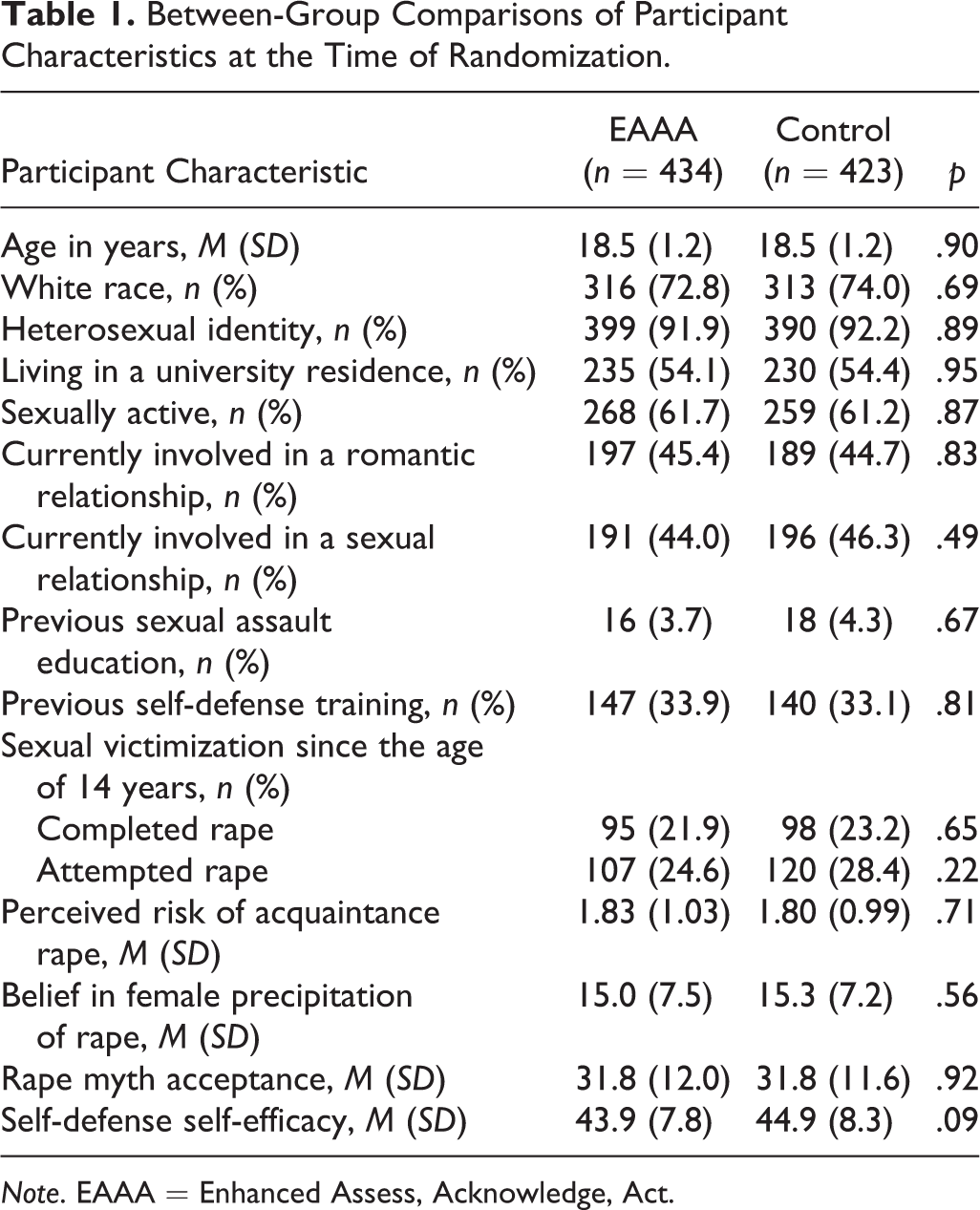
Note. EAAA = Enhanced Assess, Acknowledge, Act.
Intervention
EAAA
This small group (≤20 participants) intervention was led by pairs of highly trained, slightly older peer (<30 years) women facilitators. Women attended an average of 3.62 (SD = 0.82) of four sessions, with most (91%) attending three or four sessions. Curriculum fidelity was high (average 94%) as measured by the assessment of randomly selected audio recordings.
Control
To match the standard of care common to all university campuses at the time, brochures on sexual assault were available for participants to take and read, with a friendly and knowledgeable person available to answer any questions that arose about sexual assault or available resources from the group of participants. Brochures chosen were specific to the campuses but had common elements, including the provision of general sexual assault information, date rape drug facts, legal and medical information for survivors, and local resources.
Procedure
The detailed RCT protocol and procedures are published elsewhere (Senn et al., 2013), but we provide a brief overview here. Participants were recruited through a variety of means, including posters, emails, tabling, and advertising in research participant pools. Interested students made contact by phone or email, were screened by a research assistant and given a detailed explanation of the purpose of the study, the longitudinal survey process and timing, and the randomization procedure. They then chose the timing of the baseline and EAAA intervention sessions that matched their schedule without yet knowing to which condition they would be randomly assigned. All participants attended a baseline session to complete surveys in a computer lab, were randomized (using Randomize.net), and then directed to their intervention room. A meal was provided, the randomization outcome was revealed, and the session facilitated. Depending on their chosen schedule, those students randomized to the EAAA program completed the other units during the same weekend as the baseline session, with two program units delivered each day, or across the next 3 weeks, with one program unit delivered immediately and the other three in subsequent weeks. Control participants attended their brief group brochure session and then did not return until the post-test survey session. Both control and program participants completed in-person, post-test surveys. For the program participants, these occurred 1 week after the final program session. Control participants completed these surveys at the same time as the program participants with whom they attended the baseline and randomization session. Thereafter, all participants completed follow-up online surveys at 6 months, 12 months, 18 months, and for those enrolled in the first year of the trial 24 months, after the baseline session. The CONSORT flowchart is published elsewhere (Senn et al., 2015; Senn et al., 2017).
In the original published article on the efficacy of the program in improving sexual assault outcomes (Senn et al., 2015), an intention-to-treat analysis was used. This required that any sexual assaults occurring between the baseline and the post-test be included in the assessment of efficacy even though participants in the program condition had not yet received the full dose of the intervention. This affected program participants who chose the weekday format more since there was more time between their baseline and post-test survey sessions (average of 28 days) compared to those choosing the weekend format (average of 8 days). For the current prospective analysis, sexual assaults needed to have occurred after completion of the post-test sessions where potential mediators were measured. Therefore, while other aspects of intention-to-treat were still used, we scored sexual assaults occurring after the post-test as the first occurrence of this outcome. As randomization was effective in ensuring equality between groups on all potential mediators measured at baseline (Senn et al., 2015) and two mediators were assessed using single-use measures only at post-test, the current analysis used only mediator data obtained at the post-test survey.
Measures
Sexual assault was measured using the Sexual Experiences Survey–Short Form Victimization (SES-SFV; Koss et al., 2007). The SES-SFV provides participants with seven items consisting of a stem that describes a sexually coercive or assaultive act or attempted act (e.g., “A man put his penis into my vagina or [someone] inserted fingers or objects without my consent by…”), followed by five descriptions of perpetrator tactics or strategies (e.g., “using force, for example, holding me down with their body weight, pinning my arms, or having a weapon”). The tactics range from verbal pressure to physical force. Given the gender-specific focus of the program, we removed the gender-neutral reference to “someone” to ensure reports were victimization by men only. Participants responded to each stem and tactic based on the frequency of occurrence (a) since the age of 14, (b) since the baseline (1-week post-program), and (c) since the last survey for 6- to 24-month follow-ups. When participants reported an attempted or completed rape, they were prompted to use a pop-up calendar to pick the (approximate if necessary) month and the day the incident happened. As such, the outcome/dependent variable in the mediation model is analyzed as time-to-event. Victimization by attempted or completed rape between the 1-week post-program survey and 12-months of follow-up is the focus of the current analysis and randomization to the EAAA program or control group is the causal variable.
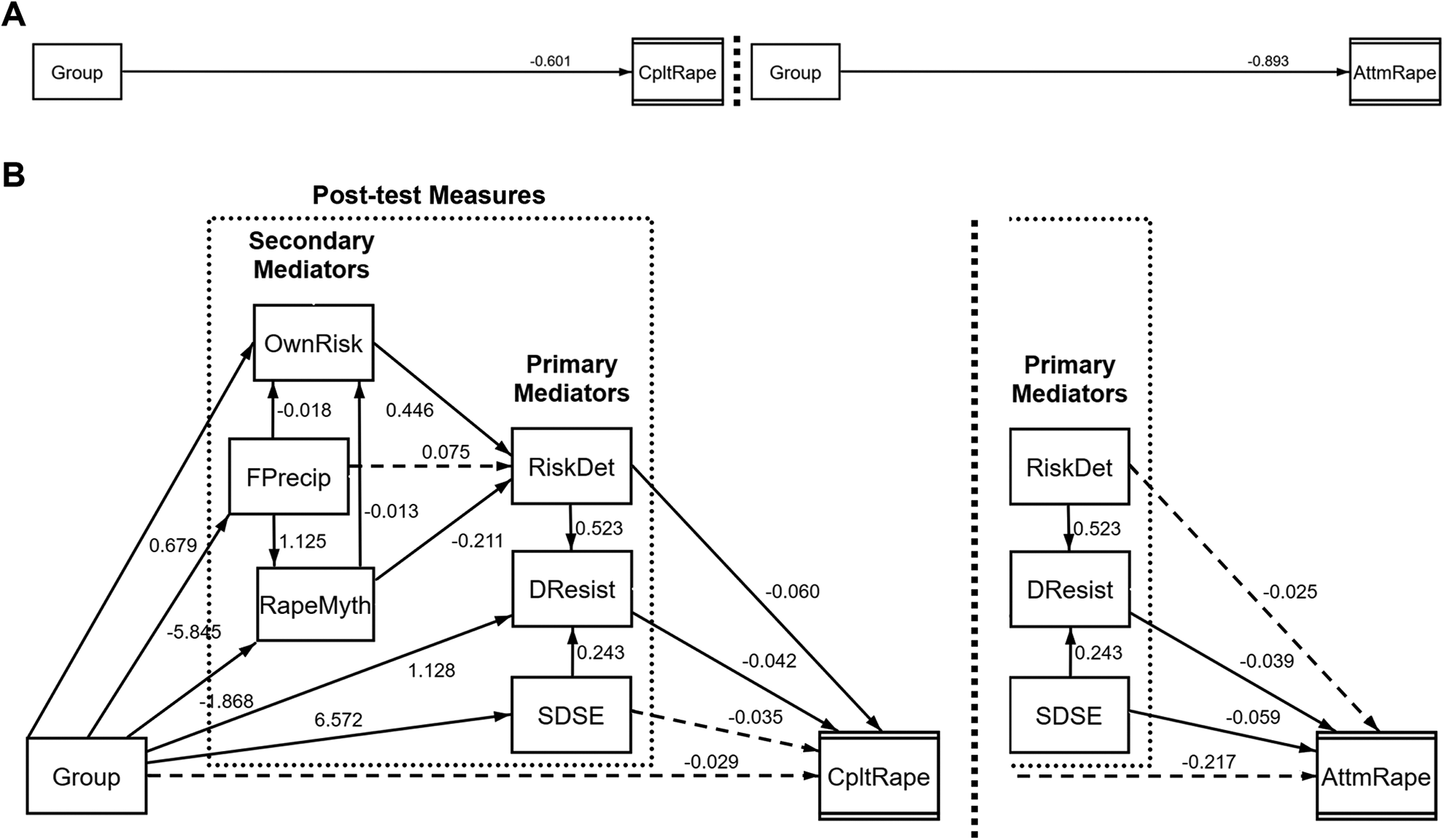
Total Effect Models and Final Chained Multiple Mediator Models for Completed Rape and Attempted Rape.
Note. (Panel A) The total effect, relating intervention group to completed rape without mediators, in terms of a hazard ratio was .55 (b = −.601, relative risk reduction = 45%, p = .037). After accounting for clustering the p value was .055. The total effect, relating intervention group to attempted rape without mediators, in terms of a hazard ratio was .41 (b = −.893, relative risk reduction = 59%, p = .011). (Panel B) The direct effect, relating intervention group to completed rape with mediators, in terms of a hazard ratio was .97 (b = −.029, relative risk reduction = 3%, p = .933); the percentage of the mediated intervention effect was 95.2% (p < .001). The direct effect, relating intervention group to attempted rape with mediators, in terms of a hazard ratio was .80 (b = −.217, relative risk reduction = 20%, p = .595); the percentage of the mediated intervention effect was 75.7% (p < .001). Solid lines represent significant paths and dashed lines represent nonsignificant but hypothesized paths. CpltRape = completed rape; AttmRape = attempted rape; OwnRisk = perceived risk of acquaintance rape; FPrecip = belief in female precipitation of rape; RapeMyth = rape myth acceptance; RiskDet = risk detection; DResist = direct resistance; SDSE = self-defense self-efficacy.
Mediators
Figure 1 illustrates the hypothesized chained multiple mediation model. Primary mediators are those variables hypothesized to have a direct link to the outcome. Secondary mediators are hypothesized to influence primary mediators without direct relationships to the outcome. Responses to these measures at a 1-week post-test are the focus of the current analysis. All measures demonstrated good internal consistency in the current sample (Senn et al., 2017).
Primary Mediators
These included situational risk detection, direct resistance, and self-defense self-efficacy. Situational risk detection was assessed using Testa et al.’s (2006) measure that provides a hypothetical acquaintance dating scenario with escalating coercion revealed at two time points (collapsed data used here) and asks the question, “How likely is it that the situation just described will result in…” followed by 10 positive (e.g., “an evening that ends pleasantly”) and negative (e.g., “You being upset by Michael’s behavior”) outcomes. Participants rated the likelihood of each on a 7-point scale. The 6 item Direct Resistance subscale (Testa et al., 2006, built on items from Norris et al., 1999, and Davis et al., 2004) was used to measure willingness to use effective self-defense strategies (e.g., “Forcefully push him away”) in a hypothetical situation. It was administered following the coercive dating scenario described above on the same 7-point likelihood Response Scale with the data collapsed across the two time points. Self-defense self-efficacy was measured by responses on a 7-point Confidence Scale to 11 items adapted by (Senn et al., 2017) of Marx et al.’s (2001) adaptation of Ozer and Bandura’s (1990) scale (e.g., “If a situation develops in which you feel you could be in danger of sexual assault, how confident are you that you could successfully think up ways to get out of that situation and then execute your plan?”).
Secondary Mediators
These include (a) a single-item measure of perception of one’s own general risk of acquaintance rape, Perceived Risk of Acquaintance Rape (“What are your chances of being raped by someone you know?”), rated on a 5-point scale from “very likely” to “very unlikely” (adapted from Gray et al., 1990); (b) a specific measure of victim blaming, the 6-item Female Precipitation subscale of the Perceived Causes of Rape Scale (Cowan & Campbell, 1995; e.g., “Rape is caused by women allowing the situation to get out of control”); and (c) a general measure of rape myth beliefs, the Illinois Rape Myth Acceptance Scale–Short Form (Payne et al., 1999; e.g., “Men from nice middle-class homes almost never rape”).
Statistical Analyses
Path analyses were used to fit the chained multiple mediator models. Weibull proportional hazards regression models were used because the outcomes were time-to-first completed rape and time-to-first attempted rape and as such yielded hazard ratios which can be interpreted as relative risks (i.e., risk ratios). The proportional hazards assumption was assessed by plotting log(−log[survival]) versus the log of survival time and by testing the time dependent covariate in the regression models.
The total effect of the EAAA program was estimated by calculating unadjusted hazard ratios (HR) from Weibull proportional hazards regression models that included the intervention variable as the only predictor in the models. The direct effect was estimated by calculating adjusted hazard ratios from regression models that consisted of the intervention variable and the mediators. The percentage of the mediated intervention effect was calculated from the respective intervention regression coefficients in the total effect and direct effect models as follows:
We tested the primary mediators jointly using a likelihood ratio test to establish whether they are the process through which the effects of the program are realized. Full mediation, defined as a non-significant direct effect, would suggest that the mediators explain the impact of EAAA, whereas partial mediation (a significant direct effect) would suggest that the mediators are important to the EAAA outcomes but not sufficient to explain the outcome. Given that both the EAAA program and control were conducted in group sessions, all regression models accounted for clustering of outcomes within group sessions by using the generalized Huber/White/sandwich estimator of the variances. The extent of clustering was characterized by design effects. All analyses were conducted using Stata Version 16 (StataCorp LLC, College Station, TX, USA) and SAS Version 9.4 (SAS Institute Inc., Cary, NC, USA), and results with p values less than .05 were considered statistically significant.
Results
As shown in Table 1, the randomization of a relatively large number of women into the trial yielded two similar groups with regard to demographics, sexual experience, and potential mediators (those assessed pre-randomization), and therefore no adjustment for baseline covariates was necessary in the analyses. Among the 857 women included in the present study, 52 (6.1%) experienced a completed rape and 43 (5.0%) experienced an attempted rape between the time of completing the post-test survey and 12 months of follow-up, and only 2.1% (9 of 434) in the EAAA program and 2.6% (11 of 423) in control were lost to follow-up. As both the outcome event rates and lost to follow-up rates observed in the present study were low, it is permissible to calculate the percentage of the mediated intervention effect from the respective intervention regression coefficients without concern of bias (Burgos Ochoa et al., 2020). With regard to model proportionality assumptions, the plots of log(−log[survival]) versus the log of survival time yielded relatively parallel lines and the test of the time dependent covariate in the regression models yielded non-significant p values (.36 and .14 for completed and attempted rape, respectively). As the EAAA program and control sessions were conducted in 93 groups (clusters), with an average of 9.2 participants in each group, the within-group clustering resulted in design effects of 1.19 for completed rape and 1.11 for attempted rape.
For this sample of 857 women, the total effect of the EAAA program was a 45.0% reduction in the risk of completed rape (HR = 0.55, p = .037: ignoring clustering, p = .055: accounting for clustering; Figure 2, Panel A). For attempted rape, the total effect of the EAAA program was a 59.0% reduction (p = .011). Results from the final chained multiple mediation analyses are displayed in the path diagram (Figure 2, Panel B) and numerically summarized in Table 2. The three primary mediators in the hypothesized model, when tested jointly, were responsible for a significant reduction in the sexual assault outcomes (likelihood ratio test, p < .001). Some of the relationships (hazard ratios) between the primary mediators and the outcomes were nonsignificant because of the interrelationships among the mediators. All are critical to the overall mediation model as evidenced by the significant likelihood ratio test. The hypothesized secondary mediators related to each other as predicted, rape myth acceptance and belief in female precipitation partially mediated the intervention’s effect on the perceptions of one’s own general risk, and perception of personal risk and rape myth acceptance mediated the intervention’s effect on risk detection. One hypothesized path was not supported; belief in female precipitation did not have a significant path directly to risk detection.
Regression Coefficients for the Primary and Secondary Mediators in the Final Path Diagram With Respective Hazard Ratios and Correlation Coefficients for Completed and Attempted Rape.
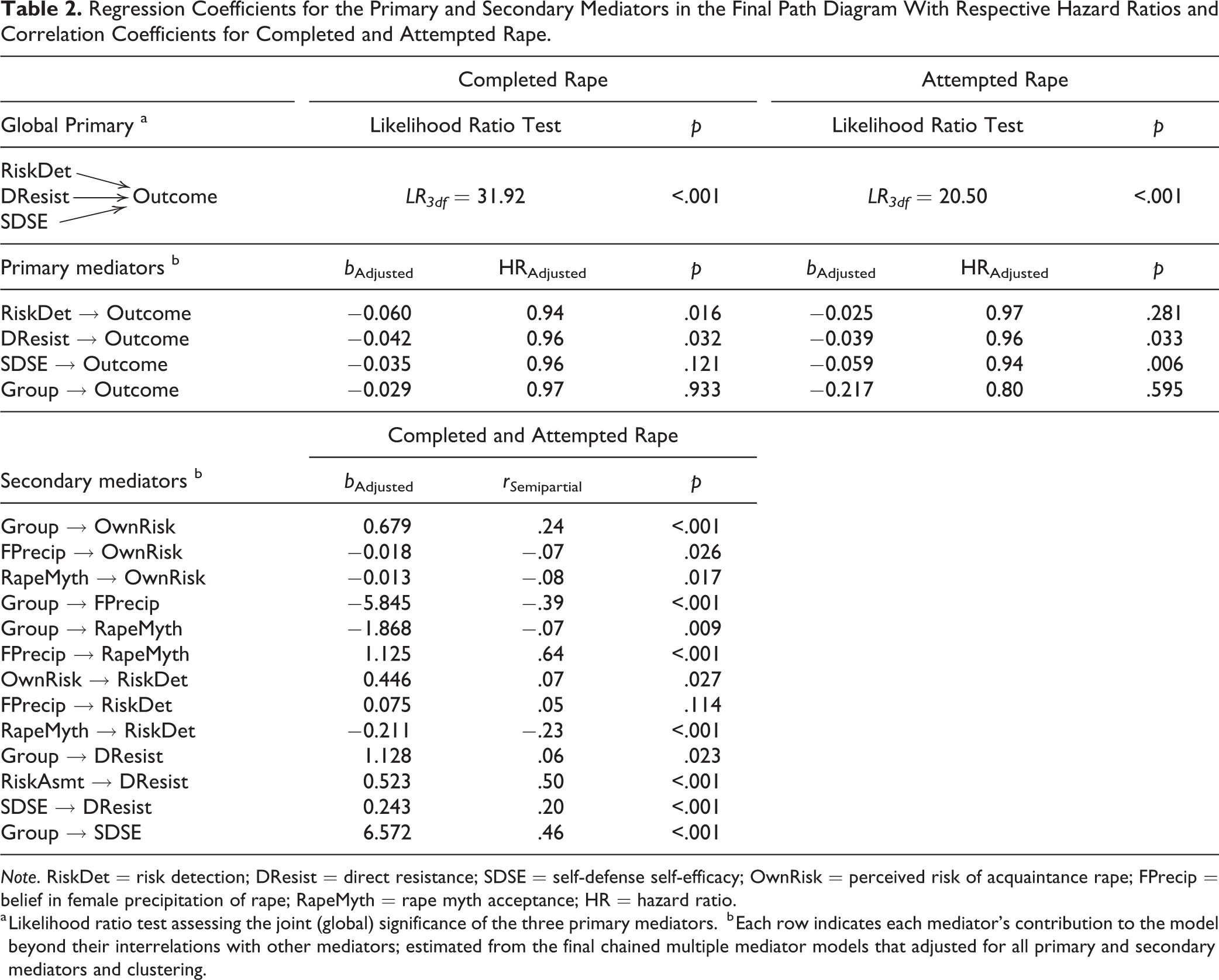
Note. RiskDet = risk detection; DResist = direct resistance; SDSE = self-defense self-efficacy; OwnRisk = perceived risk of acquaintance rape; FPrecip = belief in female precipitation of rape; RapeMyth = rape myth acceptance; HR = hazard ratio.
a Likelihood ratio test assessing the joint (global) significance of the three primary mediators.
b Each row indicates each mediator’s contribution to the model beyond their interrelations with other mediators; estimated from the final chained multiple mediator models that adjusted for all primary and secondary mediators and clustering.
The model fully mediated the intervention effects for both completed rape and attempted rape by yielding direct effects of 3% (p = .93) and 20% (p = .59) reductions in risk, respectively. Specifically, the model mediated 95.2% (p < .001) of the intervention effect for completed rape and mediated 75.7% (p < .001) for attempted rape.
In our theoretical model, we assumed that secondary mediators work solely through a primary mediator, so we also examined a model with paths from these secondary mediators to the outcome to test this presumption. The percentage of mediation did not increase. In addition, we evaluated whether an all-paths model would improve mediation of the outcome over our theoretical model. Again, the percentage of mediation did not increase.
Discussion
In sexual violence prevention practice, we generally have presumed that effective programs work to achieve their outcomes in the ways that we theorized; however, we cannot move our theory and practice forward unless we test these models or mechanisms directly. Until recently, sexual violence prevention programs have not been sufficiently effective to warrant this type of exploration nor have the evaluation studies been sophisticated enough in design, sample sizes, quality of measured outcomes, and so on, to allow it. The current findings contribute to the sexual violence prevention field by advancing our understanding of how a sexual assault resistance program for university women works to reduce the sexual victimization that women experience.
Although mediation analyses often focus on one mediator at a time (Baron & Kenny, 1986; Preacher & Hayes, 2004), we used a chained multiple mediation analysis, which accounts for the relationships among the mediators. This analysis confirmed that the theoretical model we tested fully mediates the program’s effects on sexual assault. In other words, the direct program effect is no longer statistically significant when the mediators are included in the model. More important, and surprising perhaps, the theoretical model tested accounts for 95% of the reduction in completed rape and 76% of the reduction in attempted rape. This is an unusually large mediation effect and provides strong support for EAAA’s theoretical and evidentiary underpinnings (Nurius & Norris, 1996; Rozee & Koss, 2001). The theory works extremely well to explain the positive outcomes of sexual assault resistance education for women students in the early stages of their university studies.
Primary Mediators of Program Reductions in Sexual Assault
Based on theory and prior evidence, we hypothesized that the EAAA program would reduce completed and attempted rapes through changes in three key mechanisms—risk detection, self-defense self-efficacy, and direct resistance. As expected, the three primary mediators worked together in producing the program’s effects on sexual assault.
We explicitly included two of the hypothesized primary mediators, risk detection and self-defense efficacy, because they were key aspects of Nurius and Norris’s cognitive ecological model, the theory upon which the AAA approach and the EAAA program are built. Risk detection is involved in the primary appraisal of a social situation involving an acquaintance as dangerous and, therefore, in need of a response. Self-defense self-efficacy is involved in the secondary appraisal of a coercive sexual situation as something that can be overcome by, or coped with, using women’s own resources. Improving risk detection is generally viewed as a necessary goal of an intervention but not sufficient to lead to better outcomes (Vitek et al., 2018). After all, one could see danger and not know what to do, say, or the options available to take actions, leading to passivity or non-response (Macy et al., 2006; Nurius et al., 2004). Self-efficacy is critical to people being able to implement changes in their lives (Bandura, 1977), and past research has shown that confidence is related to an increased likelihood of women responding assertively in sexual assault situations (Vitek et al., 2018).
However, knowing more about one’s options and effective responses and being willing to use them are also important to action. Because expanding these available resources (i.e., women’s knowledge and capabilities) is theorized to reduce barriers to resistance (Rozee & Koss, 2001), we also included women’s selection of, and willingness to use, the resistance strategies known to be the most effective in an acquaintance sexual assault situation, namely, direct, forceful verbal and physical strategies (e.g., Tark & Kleck, 2014).
This model supports the necessity of designing resistance programming to influence all three primary mediator components of the AAA model (Rozee & Koss, 2001). The multiple mediation analysis shows how risk detection, self-defense self-efficacy, and direct resistance strategies operate when they are considered together. Risk detection and direct resistance are correlated. After all, if danger is not detected, assertive or forceful actions will not be taken, and vice versa. Self-defense self-efficacy and direct resistance are also correlated. This makes sense for exactly the reason that we, and other researchers (Hollander, 2016, 2018; Rozee & Koss, 2001), argue for their inclusion in the model. Specifically, they are both necessary for resistance to be undertaken. A woman who lacks the general confidence in her ability to take action to stand up for or defend herself is unlikely to report that she would use defensive actions in a specific situation. Similarly, high confidence that she could problem-solve and defend herself in an acquaintance situation could be misplaced, if she is unable to detect risk in the early stages of the situation, when more defensive options are available compared to later stages, or if she lacks knowledge of likely effective strategies.
Altogether, these findings support Rozee and Koss’s (2001) AAA conceptualization and claims that women would benefit substantially from increased ability to assess danger in acquaintance situations, overcome emotional obstacles to acknowledge risk and feel prepared and confident knowing that resistance is possible, and then to take action using their own judgment and the best strategies available to them. Even though we measured risk detection and direct resistance in response to hypothetical situations, these factors together with self-defense self-efficacy explained the lower levels of completed and attempted rape reported by the women across the year following program participation. Therefore, the content and activities within EAAA, which increased knowledge of sexual assault risk cues in men’s behavior and in social situations, increased theoretical and practical knowledge of effective resistance strategies in acquaintance situations, and enhanced women’s confidence in their own judgment and abilities (Senn et al., 2017) all play important roles in reducing sexual victimization.
Secondary Mediators of Program Reductions in Sexual Assault
Detection of danger is extremely difficult in acquaintance social situations where building friendships or intimate relationships, studying, partying, or otherwise having fun are the focus of the interactions, and coercive and controlling strategies usually start slowly and escalate (Norris et al., 1996; Norris et al., 1999; Nurius, 2000; Nurius & Norris, 1996). Based on the research literature, we added three potential secondary mediators affected by the EAAA program to the theoretical model: women’s perceptions of their own general risk of sexual assault, belief in rape myths, and the pernicious myths that hold rape victims responsible. The analysis strongly supported the indirect role of all three in achieving program improvements in sexual victimization through enhancing women’s ability to detect risk, one of the primary mediators. However, unlike our test of mediation for the sexual assault outcomes, which is based on prospective data, our test of the mediation of the primary mediators was cross-sectional, disallowing conclusions of causality. Nevertheless, these findings provide evidence of how improvements in one of the primary mediators, risk detection, might be accomplished by the program’s content and process.
We used only a single item measure of perception of own general risk of sexual assault, which made underestimation of effects more likely (e.g., Beal & Dawson, 2007). Despite this, increasing women’s perceptions of their own general risk of acquaintance sexual assault was an important link in the chain to better risk detection in a specific situation. Vitek et al. (2018) have suggested that the optimism bias may be related to all three stages of the AAA model, not just risk detection. In our test of the full (all paths) model, which failed to improve mediation, paths from perception of general risk to the other primary mediators, self-defense self-efficacy and direct resistance (representing the final two stages of the AAA conceptualization and secondary appraisal and coping in the cognitive ecological model), were not supported. Although a test of Vitek et al.’s hypothesis with a more nuanced and robust measure should be attempted in the future, our analysis suggests that the model works extremely well when the benefits of increasing perception of one’s own general risk modestly are presumed to act through increasing risk detection.
As expected, the secondary mediators were inter-related. Reducing women’s already low general rape myths, which include but extend beyond victim-blaming attitudes, may allow them to appreciate the gendered social reality and see themselves as potentially vulnerable to acquaintance sexual assault. In the analysis, lowered general rape myth acceptance was directly related to higher perception of one’s own general risk, and then through that perception of personal risk contributed to improvements in risk detection. We suspect that undermining the general rape myths that focus on excluding known men from being considered as perpetrators could be responsible for this contribution to risk detection. EAAA’s ability to reduce woman-blaming beliefs specifically was also important. It was indirectly related to increased risk detection through women’s higher acknowledgment of their personal risk of acquaintance sexual assault. Both the content and philosophy of EAAA as well as the rigorous training process for facilitators aim to ensure that woman-blaming is interrupted and undermined as it arises during the group intervention. This program feature proves to be very important in improving participants’ risk detection through lower general and specific rape myths.
To be clear, we are not calling for a return to the problematic past practice of entirely, or primarily, focusing sexual assault prevention on undermining rape myths (Morrison et al., 2004). Unsurprisingly, given the complicated nature of the cultural discourses about sexual assault and women’s varied experiences, as well as the tenuous link between attitudes and behavior (Fishbein & Ajzen, 2011), reducing negative attitudes about rape alone does not reliably increase bystander behaviors or reduce victimization or perpetration (DeGue et al., 2014; Fenton et al., 2016). This was confirmed in our analysis as direct pathways from attitudes to the sexual assault outcomes were not supported. Nevertheless, we have shown that even though women hold relatively low levels of belief in rape myths and victim-blaming and there is no direct link to reduced sexual assault, reducing belief in rape myths appears to have specific benefits for women’s resistance to sexual assault. It is related to improved risk detection in acquaintance situations. Faster and more accurate detection of danger is necessary for the benefits of any resistance, risk reduction, or self-defense program to be fully realized.
Attempted Versus Completed Rape
Our analyses were focused on two categories of sexual assault. First, we applied the model to the completed (oral, anal, and vaginal) rape outcome, which is central to most studies of sexual assault prevention. The mediation model explains the EAAA program’s effects across the diverse perpetrator tactics assessed by the SES. Similar to other studies of university students’ experiences, a large proportion of these rape experiences involved alcohol (Abbey, 2011; Klein et al., 2018; Krebs et al., 2009). Nonetheless, because past research has demonstrated that alcohol consumption impairs risk detection (e.g., Parks et al., 2016) and response/resistance (e.g., Davis et al., 2004; Stoner et al., 2007) to sexual coercion, future research could explore the specific ways in which EAAA resistance education contributes to, and might be limited in, reducing alcohol-involved sexual assaults specifically.
Second, we tested the same theoretical model for attempted rape. However, the model tested was based on theory and evidence primarily derived from research on completed rape. Despite this, the same mediation model predicted a large proportion of the program-produced reduction in attempted rape. This suggests there is substantial overlap in the mechanisms that explain EAAA’s positive effects in reducing both completed and attempted rapes. A somewhat lower percentage of mediated effect was found for attempted rape (76% vs. 95%), which suggests that there may be room for other mediators to be added to the model when considering attempted rape. We provide some possible explanations for the results involving attempted rape based on the current study and past research to guide future research.
Women cannot control whether men in their social environments will be coercive, so reductions in attempted rape victimization mean that some men who were coercive were not able to execute their plans or increase their level of intrusion. Reductions in attempted rape may have been accomplished by women detecting early warning signs from verbal indications of men’s attitudes (e.g., sexual entitlement) or behavior (e.g., attempts to socially isolate them) and leaving the situation before the men became coercive. This requires trusting their instincts or perceptions at earlier stages, something that we did not directly measure. Further, they may have used forceful verbal or physical strategies that interrupted the trajectory of coercion (e.g., “you are crowding me, MOVE AWAY” or a wrist-release to make him let go as he grabbed her wrist to try to move her to a more isolated location). Women tend to match their force to the force being used against them (Tark & Kleck, 2014), so detailed study of the forms of direct resistance corresponding with particular instances of attempted rape may offer some clues to what works some or most of the time. Alternatively, or in addition, women may have engaged in other strategies to undermine risk factors that enhance perpetrators’ advantages (e.g., isolation) that are not included in the direct resistance measure (e.g., called a friend to join them at the party when a guy who was in attendance made them feel uncomfortable; Anderson et al., 2016). Thus, our findings for attempted rape can be explained (at least in part) by components of the AAA model.
However, because some (24%) of the program effect for attempted rape was not explained by the model, we likely need to look beyond the AAA model to explain the program’s success in reducing attempted rape. A combination of quantitative and qualitative research with women who have taken resistance programs may be needed for further theory development.
Directly measuring the benefits of the fourth unit’s positive sexuality enhancement of the AAA model could also improve our understanding of how EAAA works to reduce attempted rape. This unit contributes to resistance education by challenging societal messages that women’s sexual desires are of lesser importance than are those of men. It addresses the absence of high-quality sexual education and discussion of women’s sexual desires in society at large (Fine, 1988; Fine & McClelland, 2006) and how normative (hetero)sexual practices put men’s (presumed) sexual needs ahead of women’s (Hollway, 1984). This latter discourse, in particular, has been implicated in acquaintance sexual assault (Gavey, 2005). Due to participant burden, we did not measure women’s awareness of their own desires and values or their confidence in asserting these in various situations, although earlier work has shown benefits (Senn et al., 2011). For heterosexual and bisexual women, who constituted the majority of the sample, increases in sexual knowledge and confidence would be expected to contribute to faster risk detection, particularly identification of sexual pressure and other coercive tactics.
In general, it may be wise for future researchers to do what we did not, that is, to think through the theoretical model for attempted rape specifically from the start. In this way, additional constructs could be identified and measured. We encourage researchers to include analysis of attempted rape experiences and avoid treating them as “non-events” (Cermele, 2010) or as less important (Hollander & Rodgers, 2014) when evaluating prevention programs and testing theoretical models so that we hone our broader sexual assault prevention knowledge and skills.
Strengths and Limitations
Our study’s prospective design provided many benefits and allowed us to test the influence of mediators at one point in time (post-test) on subsequent sexual victimization. As a result, we could infer causality for that outcome. However, we could only do a cross-sectional analysis of the relationship of the secondary mediators with the primary mediator, risk assessment. Although risk detection was related to the attitudes and beliefs serving as secondary mediators and these attitudes and beliefs improved after participation in the program, we cannot conclude that the improvements in risk detection were produced by the changes in attitudes and beliefs. Further research is needed.
Our sample size was large, our retention was high (>97%), and our conclusions are based on the responses of women with and without rape experiences prior to their participation in the research. Despite these strengths, our sample was not large enough to reliably evaluate the model separately for women with and without prior sexual victimization experience (i.e., to test whether victimization moderates the mediation model). We explore similarities and differences in EAAA’s program effects for individual outcomes by prior victimization elsewhere (Senn et al., in press), but await future research with larger samples for this more complex analysis.
Our test of the theoretical model was applied to a large and diverse sample of university students who identify as women. We are working now to expand the populations who may benefit from resistance programming of this type and would then be able to test whether the same or similar mediation model applies. We are currently adapting EAAA for younger girls and will be evaluating the adapted version in an RCT. We are also working with other scholars to lay the groundwork for an adaptation of the EAAA model specifically for trans-identified students, if it is appropriate.
The field has many good measures but needs more in the domains key to women’s resistance to sexual violence and several measures, which we used as the best available, have limitations. Perception of personal risk is clearly important to women’s ability to detect risk as we were able to conclude this even with an imperfect single-item measure. Still, there is a need for a multi-item measure of perception of sexual assault risk (and the related optimism bias) with good psychometric properties. We join other researchers (e.g., Vitek et al., 2018) in also calling for improved measurement of risk detection. Testa et al. (2006), building on the work of others (Davis et al., 2004; Norris et al., 1999), developed the strong measures of risk detection and direct resistance used in our research. However, participants are responding to a specific two-part scenario of a dating interaction with a coercive man. Scenarios for acquaintance situations that are relevant for women who do not date men, due to their sexual identity or cultural/religious/political background, are needed. Moreover, an ability to measure and then collapse across responses to multiple situations and contexts would strengthen the measurement of the constructs. Other available risk perception measures (Messman-Moore & Brown, 2006) could also be improved with more scenario options. Currently, once these measures have been used in a longitudinal study, they cannot be presented again because the “end of the story” is now known. This is a limitation for understanding how program effects are mediated for the longer term.
Our analysis was also limited by our failure to include measures of implied mediators. For example, we presumed that if women improved their risk detection and used more direct, forceful resistance strategies, they had overcome at least some of the known obstacles to assessing, acknowledging, and acting to resist acquaintance sexual assault. Our analyses would have been improved by measuring changes in women’s endorsement of known obstacles and assessing whether this process variable acts as a primary or secondary mediator. We also did not measure what is variously described as relationship investment or motivation to maintain relationships with men, yet this is the hypothesized origin of one specific psychological barrier to acknowledging danger and/or resisting men they know, particularly for heterosexual women (Macy et al., 2007; Norris et al., 2018; Nurius et al., 2004). EAAA explicitly acknowledges this motivation (and its positive roots) and uses various approaches to undermine its application in circumstances where risk cues have been detected. Explicit measurement of this barrier for acquaintance rape resistance may have improved the model.
Some researchers have suggested that the experience of learning physical and verbal self-defense changes how women experience their bodies, including their sense of inhabiting and having ownership of them (i.e., embodiment; see Piran, 2016) and that this can lead to increased demands that boundaries be respected and resistance when boundaries are violated (Hollander, 2004; Hollander, 2014). Inclusion of measures of embodiment and of experiences setting and protecting boundaries might both be fruitful additions for future research. Qualitative research with young women who have experienced the program could also potentially expand our knowledge of other ways in which this type of education affects them.
Practice Implications
The current study builds on our previously published research in offering important insights for practitioners of empowerment self-defense. Previous analysis showed that a relatively small number of hours (3 of 12) of instruction focused on verbal and physical self-defense in acquaintance situations is sufficient to increase confidence and willingness to use the strategies that research has shown are most likely to be effective. Current findings show that these two benefits also contribute to reductions in attempted and completed rape. Detecting risk in social situations and men’s behavior is neither obvious nor easy because of the emotional obstacles to seeing danger when it is present in acquaintance situations. Our findings show, however, that significant attention must be paid to this kind of risk detection to achieve these dramatic benefits. Finally, our findings demonstrate the importance of creating a self-defense learning environment that directly contradicts woman-blaming and rape myths.
In recent years, sexual violence prevention researchers have come together in calling for universities to develop comprehensive sexual violence prevention plans, including both targeted and universal (bystander) prevention programming to achieve meaningful change (e.g., Bonar et al., 2020; Orchowski et al., 2018). By contrast, in the current political climate with burgeoning roles and responsibilities and limited resources, university administrators who are responsible for developing prevention policies and staff in prevention roles may feel pressured to offer a single, one-size fits all, online or in person prevention program for students. The current study provides compelling evidence to defend the implementation of theoretically grounded, evidence-based prevention practices. The findings show the specific mechanisms by which resistance education on campus works to empower women and reduce the likelihood that they will experience sexual violence. Specifically, offering sexual assault knowledge and challenges to rape myths and perceptions that sexual violence can only occur to others and not oneself lays the foundation for effective education. However, this is not enough. Achieving large reductions in attempted and completed rape requires that program content and practices build on this foundation by improving risk detection in social interactions with acquaintances, providing a context within which women can safely identify and reduce emotional obstacles to risk detection and resistance, and increasing women’s repertoire of effective strategies and confidence to interrupt and resist sexual coercion and sexual assault attempts. Providing even more benefit than we demonstrated may be possible through enhanced programming; providing less is not defensible.
Conclusion
The chained multiple mediation analysis showed that the hypothetical model underlying the EAAA program explains the dramatic reductions in sexual violence experienced by program participants. Sexual assault is not inevitable (Bevacqua, 2000; Radtke et al., 2020). Empowering students who identify as women with knowledge and skills and providing a place and time for application and practice can make a profound difference in their lives. Although we await cultural change and interventions that can prevent sexual violence perpetration reliably and substantially, resistance education for women should be one critical piece of all comprehensive sexual assault prevention plans.
Supplemental Material
Supplemental Material, Senn_et_al - Testing a Model of How a Sexual Assault Resistance Education Program for Women Reduces Sexual Assaults
Supplemental Material, Senn_et_al for Testing a Model of How a Sexual Assault Resistance Education Program for Women Reduces Sexual Assaults by Charlene Y. Senn, Misha Eliasziw, Karen L. Hobden, Paula C. Barata, H. Lorraine Radtke, Wilfreda E. Thurston and Ian R. Newby-Clark in Psychology of Women Quarterly
Footnotes
Authors’ Note
This study was registered with ClinicalTrials.gov (Identifier NCT01338428). This article is based on data published in Senn et al. (2015) and Senn et al. (2017). The trial protocol was published in  .
.
Declaration of Conflicting Interests
The author(s) declared no potential conflicts of interest with respect to the research, authorship, and/or publication of this article.
Funding
The author(s) disclosed receipt of the following financial support for the research, authorship, and/or publication of this article: The study was supported by an Operating Grant from the Canadian Institutes of Health Research (FRN 110976) and by the University of Windsor.
Notes
References
Supplementary Material
Please find the following supplemental material available below.
For Open Access articles published under a Creative Commons License, all supplemental material carries the same license as the article it is associated with.
For non-Open Access articles published, all supplemental material carries a non-exclusive license, and permission requests for re-use of supplemental material or any part of supplemental material shall be sent directly to the copyright owner as specified in the copyright notice associated with the article.
