



Abstract
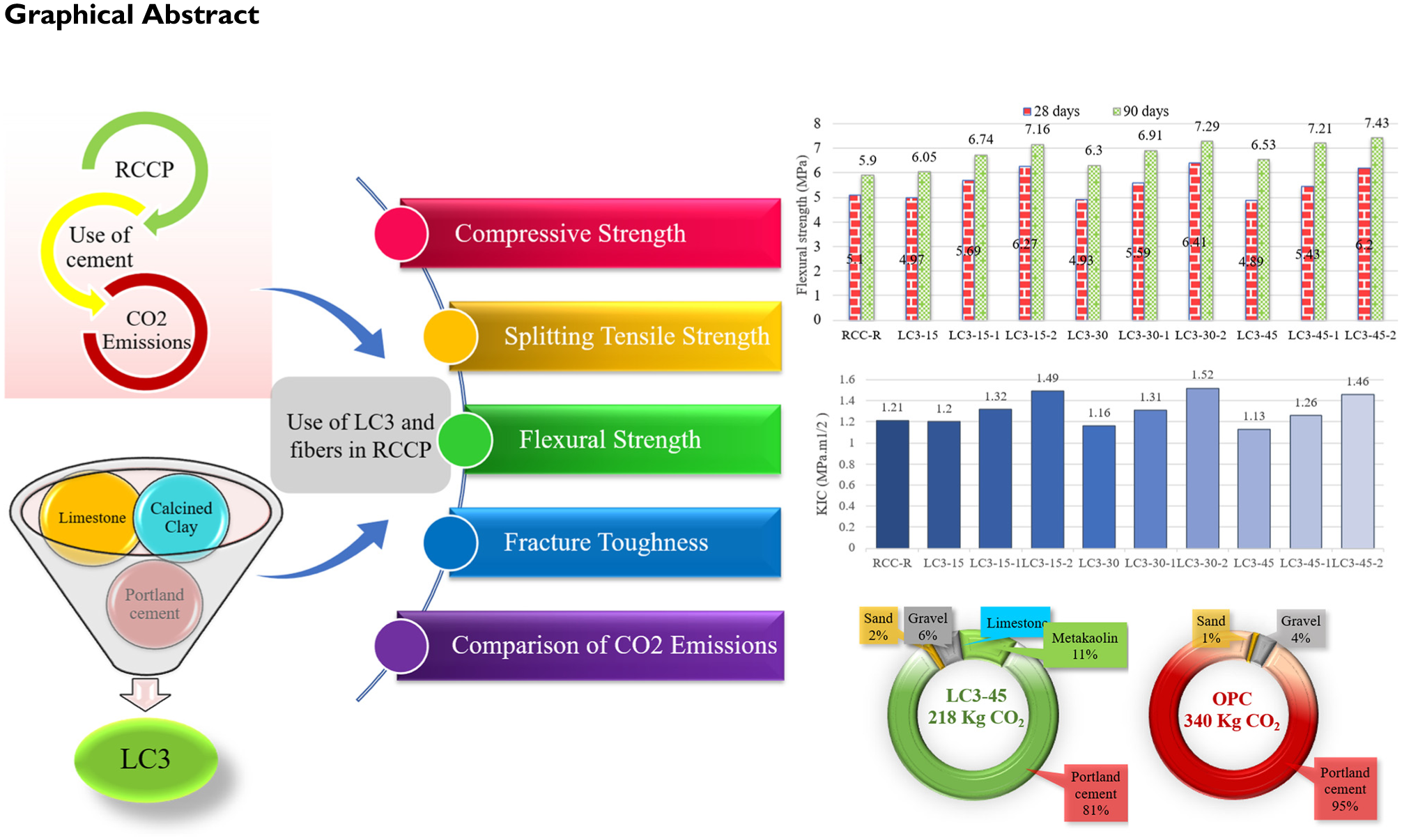
The use of traditional cement in various fields, including concrete pavements, has become an environmental threat because of the widespread emission of greenhouse gases and other pollutants. The use of limestone calcined clay cement (LC3) in various fields has emerged in recent years as a sustainable and environmentally friendly alternative. In this study, to reduce the consumption of ordinary portland cement (OPC) in roller-compacted concrete pavements (RCCPs), LC3 has been used as a partial replacement for OPC. Also, because of the presence of various cracks in concrete pavements, macro-synthetic fibers have been used to improve the mechanical properties and crack resistance behavior of RCCP. LC3 has been substituted for OPC in three ratios of 15%, 30%, and 45% and macro-synthetic fibers were also added to the mixtures at 0.25% and 0.5% by volume, and the mechanical properties and fracture behavior of the specimens were evaluated at different ages. In addition, SimaPro software has been used to compare the carbon dioxide (CO2) emissions in different roller-compacted concrete designs. The research results indicate that the use of LC3 at early ages may lead to a slight reduction in its mechanical properties, but as the samples age and with the completion of LC3’s pozzolanic activities, this reduction is compensated, resulting in better outcomes than the control sample. These findings indicate that the simultaneous use of LC3 and macro-synthetic fibers can be recognized as a suitable solution for RCCP with good mechanical properties and environmental compatibility.
Keywords
Get full access to this article
View all access options for this article.