




Abstract
A construction schedule review is an essential aspect of schedule management for U.S. state departments of transportation (DOTs) to deliver transportation construction projects on time. Despite their importance, current literature pays limited attention to addressing schedule quality problems for highway construction projects. This research aims to assess schedule quality problems from DOTs’ perspective and suggests recommendations to improve DOTs’ schedule review practices. To achieve this, two questions were formulated: 1) What schedule problems do DOT schedule reviewers perceive as vital to schedule quality? and 2) What schedule problems do DOT schedule reviewers find repeatedly? This research first reviewed relevant literature and identified 44 schedule quality problems noted about highway construction. Based on these 44 problems, a survey was developed to assess the level of impact and the likelihood of occurrence of each problem. The survey was deployed to Texas Department of Transportation practitioners with schedule review experience. The analysis prioritized the problems by the relative impact and frequency, and DOTs can utilize this analysis to improve their schedule review process and practices. This paper contributes to the academic body of knowledge by investigating the schedule quality problems in highway construction and DOT practitioners’ perceptions of the schedule quality problems. Its industry contribution includes providing the methodology for DOTs to assess their schedule quality problems.
Project schedules are essential for U.S. departments of transportation (DOTs) to record, monitor, track, and communicate construction progress and deliver the projects on time ( 1 ). DOTs must manage construction schedules properly to ensure public safety, decrease traffic inconvenience, and prevent the escalation of public expenditure ( 2 ). Despite their importance, construction schedules submitted by contractors can be deficient or deliver incorrect information ( 3 – 4 ). Poorly planned schedules are the dominant cause of project delay, and if an owner approves poorly planned schedules, it can allow opportunities for claims after construction ( 2 , 4 ). As the government sector tends to be more vulnerable to such substandard schedules than the commercial sector, it is fundamental for DOTs to conduct an appropriate schedule review to ensure construction projects are managed by quality schedules ( 5 – 8 ).
A schedule review is a central process to maintain reliable and quality project schedules. It ensures that a schedule submitted by a contractor is complete and includes all the necessary information to understand the contractor’s interpretation of the work and its work plan ( 6 ). It also verifies whether the contractor’s work plan complies with contractual requirements ( 7 ). Schedule review activities involve detecting errors and omissions, suggesting appropriate corrections, and evaluating if the schedule captures the project status accurately ( 9 ). Failure to detect critical schedule deficiencies can impede timely action to correct or adjust the schedule ( 4 , 8 ). In short, the project owner’s schedule review/approval is an essential process to minimize schedule quality problems and to ensure the schedule quality required to achieve the target schedule performance for a project.
Notwithstanding the importance of schedule reviews, few studies have been conducted on highway construction. There has been a lack of research identifying schedule quality problems and evaluating their importance to decision-making from the perspective of DOTs’ schedule reviewers. To close the research gap, this research aims to assess schedule quality problems in highway construction and suggest recommendations to improve DOTs’ schedule review practices. Three objectives were defined to achieve the purpose: 1) to identify schedule quality problems in highway construction, 2) to assess the level of impact and frequency of the problems, and 3) to provide recommendations for improvement based on the findings.
The scope of this study was limited to highway construction schedules submitted by contractors to DOTs during construction. This study did not include other non-construction schedules, such as project development schedules or maintenance project schedules. A “schedule” in this paper refers to a construction schedule submitted by contractors.
Literature Review
A schedule is a roadmap showing how a contractor plans to deliver a project successfully ( 10 ). It is a communication tool between project stakeholders conveying necessary information for project controls to deliver a project on time ( 11 ). A valid and quality schedule satisfies both planning and scheduling needs complying with the contractual requirements, and it needs to be accurate, complete, and consistent with other project planning documents ( 12 – 14 ).
Both academic researchers and professional practitioners have delved into determining key measures to assess schedule quality. De La Garza and Ibbs’ study is one of the early studies on contractor schedule reviews ( 15 ). It introduced a computer-based schedule analysis system providing 34 conceptual scheduling provisions to evaluate baseline and progress schedules for medium-height commercial buildings. They collected the provisions from observations of actual schedule review activities of practitioners in addition to practitioner interviews. As the system was developed in the 1990s, the provisions lack details related to scheduling software.
More recent studies have attempted to establish a structured way to evaluate construction schedules. Bragadin and Kähkönen identified 75 schedule requirements categorized under five schedule health indicators: general requirements, construction process, schedule mechanics, cost and resources, and control process ( 16 ). It, however, aimed to guide schedule development rather than the schedule review process. Han et al.’s research is another study that explored the schedule quality assessment ( 17 ). The authors collected 49 metrics to assess the quality of baseline schedules. The 49 metrics were organized under nine categories: general, milestone, duration, calendar, logic, constraint, float, lag, and lead. The threshold for each metric (pass/fail) was defined based on the relevant guidelines of various governmental and professional organizations. The significant challenge for applying such metrics to highway construction projects is determining the common threshold, as highway construction projects vary in scope, size, and complexity.
Dzeng et al.’s study is one of a few studies focusing on schedule reviews from highway construction agencies ( 9 ). They developed a tool called “Network Review Assistant” to help public agency schedule reviewers improve their schedule review quality. They collected schedule review items from Taiwan highway practitioners and grouped them into 12 categories under three levels (schedule, activity, and meta-activity levels). Although this study was one of the rare studies in the highway construction area, their focus was evaluating the technical aspects of a computerized critical path method (CPM) schedule, excluding schedule quality issues concerning contract plan compliance such as work phasing and sequence.
The previous studies provide insight into the criteria for evaluating schedule quality. However, most studies have focused on commercial construction and/or the schedule development (contractor) angle, which calls for more research for DOTs in highway construction. As a state transportation agency, a DOT manages various types and sizes of highway construction projects, and DOT practitioners are responsible for reviewing schedule submittals from multiple construction projects within tight review times. Rhode Island DOT (RIDOT), for example, requires contractors to submit schedule updates every 2 weeks, and the RIDOT’s review period is five working days ( 18 ). In addition, a schedule review requires a certain level of industry domain knowledge and experience, scheduling expertise, and scheduling software skills, among others. Between workload and resource constraints, it is always challenging for DOTs to review each schedule submittal thoroughly and comprehensively. If a schedule is accepted with its problems unnoted, it can adversely affect schedule quality and, consequently, project schedule performance ( 19 ). Thus, DOTs need to improve the effectiveness and efficiency of their schedule review process and practices to ensure the required schedule quality under time and resource constraints.
The effectiveness of a schedule review can be improved by prioritizing schedule evaluation criteria to help decision-making on schedule acceptance ( 20 ). A schedule reviewer decides whether to accept or reject the schedule based on the impact of detected schedule problems ( 4 , 19 ). If the relative importance of a schedule quality problem affecting the accept/reject decision is pre-defined, the schedule review process to make such a decision will be more effective and reliable.
A way to increase schedule review efficiency is to reduce recurring schedule errors. DOT schedule reviewers inspect construction schedules submitted by multiple contractors with different levels of sophistication. For various reasons, for instance, a contractor’s lack of scheduling resources or lack of clarifications in the standard specifications, some schedule errors or deficiencies can occur repeatedly across different projects and contractors. If those errors are identified and corrective measures are implemented, it will expedite the schedule review process.
Research Approach
The review of extant literature highlighted a need for more studies on schedule reviews for highway construction. It also exposed a research void in probing the prevalent schedule quality problems that deteriorate the effectiveness and efficiency of the schedule review process. Past studies focused on the schedule quality assessment criteria, paying less attention to actual schedule quality problems. A better understanding of schedule quality problems and the reviewer’s perceptions of them can unfold the areas for improvement and practical recommendations. It will also reveal the gap between the previous literature and the practitioner’s perceptions about schedule quality problems. This research, therefore, formulated two research questions:
1) What schedule problems do DOT schedule reviewers perceive as vital to schedule quality?
2) What schedule problems do DOT schedule reviewers find frequently?
The research approach consisted of five steps: literature review, development of schedule problems list, survey development, data collection and analysis, and conclusions and recommendations. This research first defined the research need and purpose from the literature review. The second step was developing a list of schedule quality problems relevant to DOTs’ schedule review practices. A survey was designed to assess DOT practitioners’ perceptions of the identified schedule quality problems. The level of impact and likelihood of occurrence of each problem was determined by analyzing the survey data. Finally, the research findings were summarized and translated into conclusions and recommendations.
Development of Schedule Quality Problem List
The initial set of schedule quality problems was collected from academic journal articles, professional papers, and industry-recommended practices. The initial list covered schedule quality problems in the construction industry in general. The initial list was then examined against the scheduling requirements specified in various DOTs’ standard specifications, which refined the list pertinent to DOTs’ schedule review process and practices. The final list included 44 schedule quality problems organized under three categories and seven criteria, as shown in Table 1.
Schedule Quality Problem List for Highway Construction
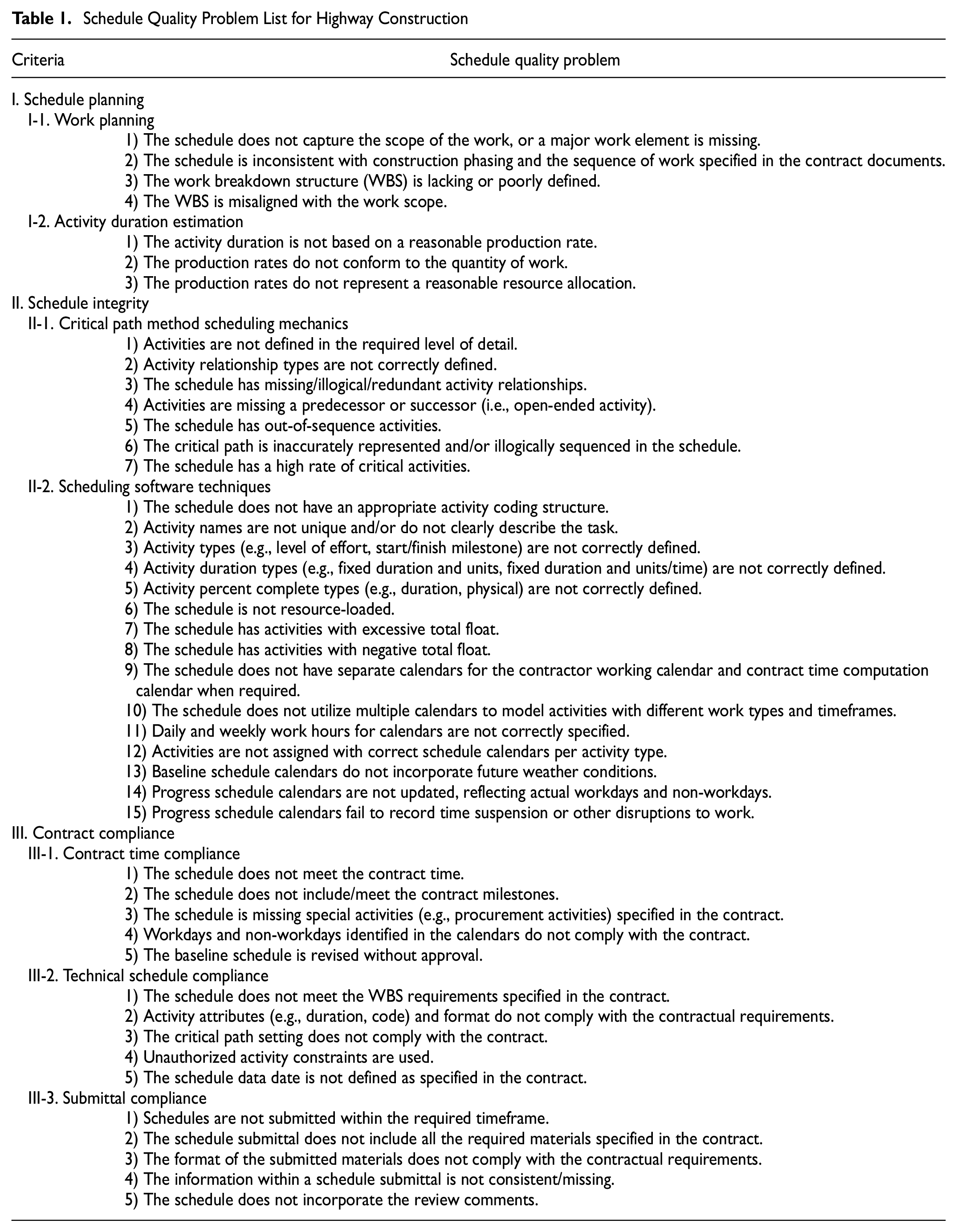
The three categories—Schedule Planning, Schedule Integrity, and Contract Compliance—are characterized by different knowledge areas of the schedule review process. The Schedule Planning category is related to project-specific knowledge about the work to be performed, including work scope, work type, plans, and work phasing and sequence. The Schedule Integrity category refers to the technical soundness of a schedule and, accordingly, detecting the problems in this category requires specialized knowledge and skills in CPM scheduling and scheduling software. The last category, Contract Compliance, involves the schedule requirements in the standard specifications and contract documents.
Schedule Planning
Work Planning and Activity Duration Estimation
A schedule is a contractor’s work plan per the contractor’s interpretation of the work to be performed. A schedule, thus, is expected to display proper planning of the work with reasonable duration estimation. A valid schedule needs to conform to the work phasing and sequence specified in the contract documents ( 8 , 20 ). A quality schedule addresses the work scope with no missing major work elements ( 4 , 8 , 20 ). If a schedule lacks work breakdown structure (WBS) or is misaligned with the work scope, a schedule reviewer should not accept the schedule ( 20 ). The duration estimation is another criterion to validate the contractor’s work plan. The activity duration estimation needs to be based on reasonable production rates factoring in work quantity and resource allocation ( 9 , 16 , 20 , 21 ). DOTs may also specify in their standard specifications that schedules incorporate work quantities and production rates ( 22 , 23 ).
Schedule Integrity
CPM Scheduling Mechanics
Since the CPM technique is currently the prevalent scheduling method, most DOTs require their contractors to use it for their projects ( 24 ). A schedule, therefore, needs to be reviewed for any deficiencies or failures to the CPM scheduling rules and basics. Illogical sequences or relationships between activities can lead to miscalculation of project duration. Any open-ended or out-of-sequence activities need to be identified, and DOTs should advise contractors to correct them (4, 9, 16, 17, 20, 25). As the critical path determines the project duration for a CPM schedule, the logic and density of the critical path also need to be examined so that the critical path is accurately represented with a reasonable rate of critical activities (4, 8, 9, 16, 17, 25).
Scheduling Software Techniques
As a CPM schedule is better represented in a computerized environment than by manual calculations, DOTs tend to designate a specific scheduling software application for schedule preparation in the specifications ( 21 , 24 ). Converting a CPM network schedule into a computerized format using a scheduling software tool requires proper utilization of software techniques. When a schedule is prepared using a sophisticated tool such as Microsoft Project or P6 Primavera, it is essential to check if the schedule elements are correctly incarnated in that environment.
Among numerous scheduling software features, activity attribute definition and calendar settings are essential. Activities are fundamental components of a schedule, and their key attributes need to be carefully defined. Such attributes include activity code and name, activity type, duration type, and percent complete type, among others. For instance, a project start activity should be assigned with the start milestone activity type, not the task-dependent activity type. If a DOT requires a resource-loaded schedule, it is also necessary to examine if activities are assigned with quantity, labor, and cost depending on the contract ( 4 , 8 , 9 , 16 , 20 ). In addition, a schedule reviewer needs to pay attention to any activities with excessive or negative total float as they may indicate illogical activity sequences or relationships ( 16 , 17 , 20 ).
The utilization of calendars is another critical feature of scheduling software tools. Using multiple calendars enables the modeling of different activities with different timeframes in one schedule to calculate the project duration correctly ( 26 ). It is critical to review various schedule calendars carefully to ensure that the schedule accurately models activity, resource, and project timeframes. One of the most critical calendar features that demands the reviewer’s attention is creating separate calendars for contractor work timetables and contract time computation ( 9 , 26 ). Many DOTs administer multiple timeframes to determine contract time, which requires the creation of separate calendars in a schedule to model contractors’ actual workdays and contract time independently ( 24 ). For example, Colorado DOT determines the contract time based on either working days or calendar days. If a project contract time is computed using calendar days per the contract, a schedule needs a contract time calendar, where every day counts as a working day, and a contract working calendar that incorporates weekdays, weekends, holidays, and weather conditions reflecting actual work in the field ( 27 ). Therefore, it is crucial that the schedule calendars accurately model project time computation and record actual workdays and non-workdays as the project progresses.
Contract Compliance
Contract Time Compliance
A contractor must comply with the contract requirements, including schedule requirements. Contract time is one of the most important criteria, if not the most important, to evaluate the schedule’s contract compliance. If a schedule does not meet the contract time and contract milestones, the schedule must be rejected ( 9 , 16 ). When the contract or standard specifications require the inclusion of special activities (e.g., procurement activities) in a schedule, schedule reviewers need to ensure that those activities are included ( 9 , 19 , 20 ). Many DOTs stipulate the utilization of multiple calendars to incorporate different activity types and weather conditions ( 22 ). Verifying schedule calendars against the relevant contract requirements assures accurate schedule calculation ( 26 ). DOTs also require contractors to submit different types of schedule at various project phases. A baseline schedule is of importance among other schedule types. U.S. DOT’s standard specifications define a baseline schedule as “the current approved initial construction schedule on which subsequent construction schedule updates are based” ( 28 ). As the baseline schedule is the contractor’s original work plan agreed on by DOTs, a schedule review should identify any unapproved revisions to the approved baseline.
Technical Schedule Compliance
DOTs’ standard specifications stipulate technical schedule requirements concerning CPM scheduling and scheduling software techniques ( 24 ). Those requirements can be precise—like RIDOT’s—regulating the WBS basic structure and activity ID and coding structures ( 18 ). More common requirements on technical schedule elements include activity duration limit (e.g., no more than 20 working days), critical path definition (e.g., longest path), and the cut-off date for updating periodic progress schedules ( 22 , 23 , 27 ). DOT schedule reviewers need to check if a schedule complies with the technical schedule requirements in contract documents and the standard specifications of their DOTs.
Submittal Compliance
Contractors are obligated to submit different schedule types to DOTs at different project phases as per the contract. For highway construction projects, preliminary schedules, baseline schedules, periodic progress schedules, and as-built schedules are common schedules required for submission ( 24 ). Each schedule submittal must be submitted within the stated timeframe in the contract ( 4 , 9 , 19 , 21 ). Failure to do so hinders the schedule reviews and timely feedback for any schedule corrections. As schedules are also used for delay/claim analysis during or after construction, it is essential to review if each schedule submittal contains all the required materials and the information is consistent across the materials (7, 12, 29–31). In addition, schedule reviewers should verify if resubmitted schedules incorporate previous review feedback.
Survey Development
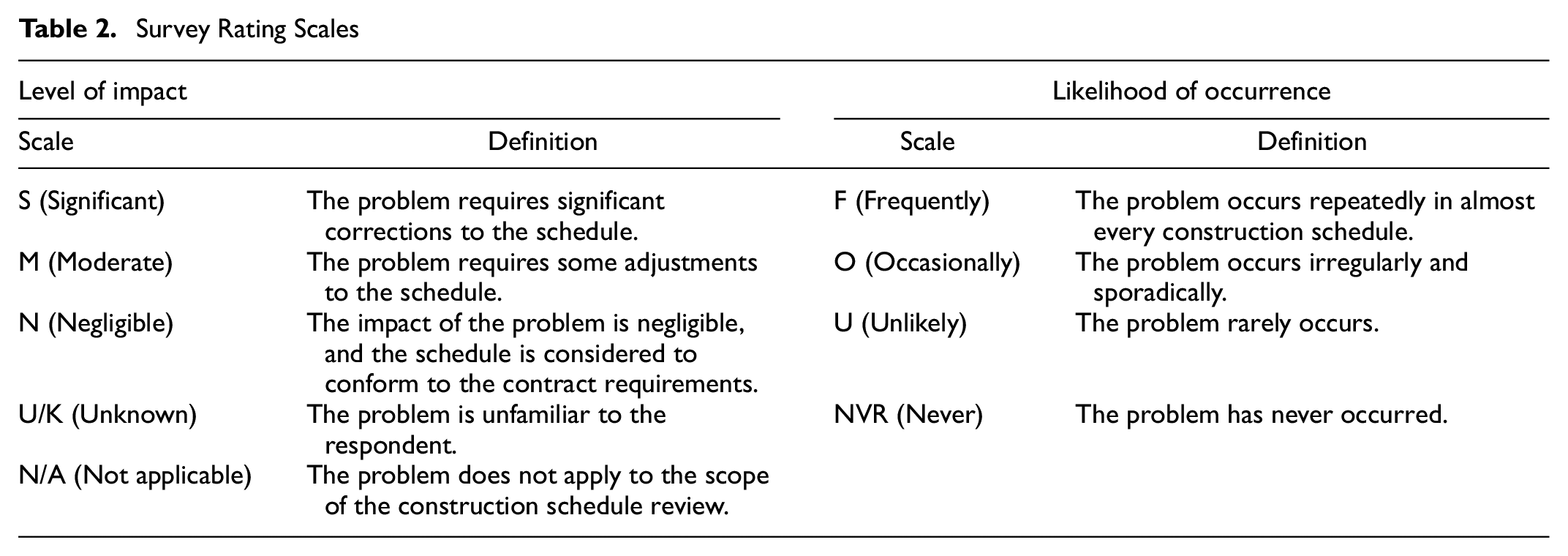
The primary data collection method for this research was a survey to gain the DOT practitioners’ perceptions of the level of impact and the likelihood of occurrence of the identified schedule quality problems. The survey questionnaire consisted of three parts. The first part included an introduction to the research and survey instructions. The second part asked for general information about the respondents and their schedule review practices. The last part asked the respondents to rate the level of impact and the likelihood of occurrence of 34 schedule quality problems. These 34 problems were adapted from the 44 schedule quality problems discussed in the previous section to accommodate the survey target respondents, Texas Department of Transportation (TxDOT) practitioners. The 34 problem questions were organized into four sections for the survey purposes: 1) Schedule Integrity, 2) Schedule Calendars, 3) Plan and Contract Compliance, and 4) Submission Completeness. The rating scales were defined and provided in the survey as shown in Table 2 to increase the objectiveness of the responses. To ensure the clarity and relevancy of the survey, three pilot survey interviews were conducted with three separate TxDOT practitioners with experience in contractor-submitted schedule reviews for TxDOT. The feedback from the three interviewees was incorporated to finalize the survey questionnaire.
Survey Rating Scales
Data Collection
This research selected TxDOT as the target survey audience. TxDOT, consisting of 25 districts with 90 area offices, is one of the largest state DOTs in relation to capital expenditure for highways ( 32 ). Its 25 districts administer the construction and maintenance of highway projects, and each district is divided into several area offices that oversee the projects in their respective counties ( 33 , 34 ). Area offices are led by area engineers who supervise the entire construction and maintenance operations in their area offices, and individual project managers are responsible for monitoring the progress of individual projects ( 35 ). TxDOT districts range from a highly populated district with over 5 million inhabitants, such as Dallas district, to a small one with a population of 40,000. Having a wide spectrum of project management in relation to project size and scope, area offices receive construction schedules with different levels of sophistication. For this reason, TxDOT was considered a desirable case for this research.
The survey was deployed using a snowball sampling approach. Snowball sampling is a chain referral method that allows access to additional participants through referrals provided by existing participants’ social networks ( 36 ). It is an effective sampling technique where researchers can approach a “hidden population” ( 36 , 37 ). This research required survey participants with schedule review experience in TxDOT to obtain reliable data. As the researchers had limited knowledge and access to that population, the snowball sampling technique was considered suitable.
The contact information of TxDOT area offices was obtained from the TxDOT web page, and each area office was contacted by phone and asked to participate in the survey. Once area engineers agreed to participate, their email information was collected for survey distribution. They were further asked to share the survey with relevant practitioners to their knowledge (snowball sampling). The survey was deployed through an online survey platform (Qualtrics XM) and a Microsoft Word document by email. The survey was initially distributed to 54 TxDOT practitioners. Of the 37 total responses received, 30 responses were usable for analysis. The 30 responses were received from 25 different area offices and 15 different TxDOT districts.
Data Analysis
Information of Respondents and Area Offices
Two-thirds of the 30 respondents were either area engineers or assistant area engineers. The remaining 10 respondents included five construction inspectors, two project managers, one record auditor/recordkeeper, one transportation engineer, and one former area engineer. The survey respondents were diverse in their experience with TxDOT and schedule reviews, as shown in Figures 1 and 2. The average years of experience in TxDOT was nearly 16 years, with a minimum experience of 8 months and a maximum experience of 32.7 years. Respondents’ experience in schedule reviews varied from 1 year to 25 years, with an average of 7.5 years.
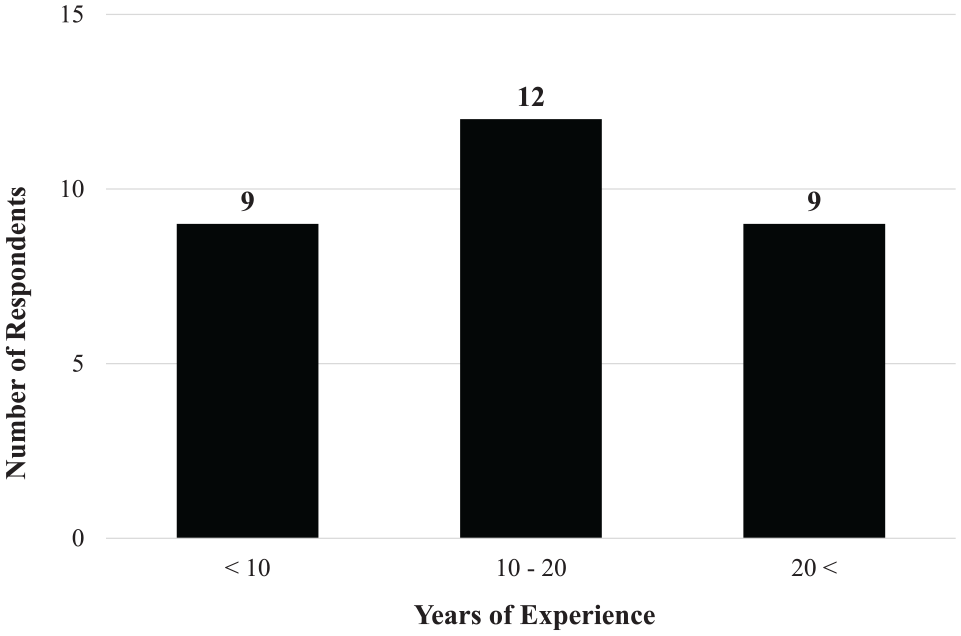
Respondents’ experience with Texas Department of Transportation (N = 30).
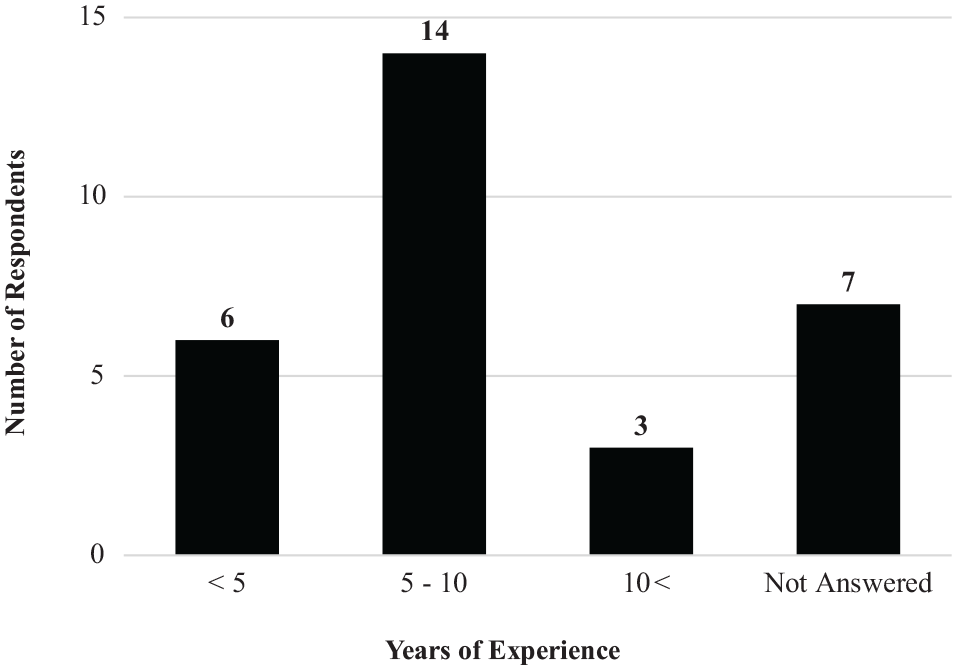
Respondents’ experience with schedule reviews (N = 30).
The respondents answered that their area offices received monthly 3 to 25 schedules from contractors (an average of 12 per month). Area offices outsourced the review of some portion of incoming schedules, 37% on average, to professional engineering consultants. The standard specifications and project provisions for TxDOT highway construction projects require that contractors prepare and submit schedules using the CPM in Primavera P6 format ( 32 ). Half of the survey respondents answered that their area offices used a printed version (either in paper or portable document format) of a schedule for reviews, and 14 respondents answered that they used both the printed version and the Primavera P6 electronic file version for reviews. Only one respondent indicated that the area office reviewed schedules solely in the Primavera P6 platform.
Assessment of Level of Impact and Likelihood of Occurrence
The survey respondents were asked to rate the level of impact and the likelihood of occurrence for each of the 34 schedule quality problems, to their knowledge, per the provided rating scale (Table 2). For the analysis purpose, scores were assigned to the rating scales. The scores assigned as per the level of impact rating scale were 3 for “Significant,” 2 for “Moderate,” and 1 for “Negligible.” The scores for the likelihood of occurrence ratings were 3 for “Frequently,” 2 for “Occasionally,” and 1 for “Unlikely.” The “Never” response was assigned zero.
The average scores for the level of impact and the likelihood of occurrence of the 34 problems from the entire responses are plotted in Figure 3. Problems 1 to 11 (P1–P11) are grouped in the Schedule Integrity section, and the Schedule Calendars section includes P12–P19. The Plan and Contract Compliance section has nine problems (P20–P28), and the remaining six problems (P29–P34) are categorized in the Submission Completeness section. The schedule quality problems in the Plan and Contract Compliance section tend to have higher average impact scores than others, as four of its nine problems have an average impact score of 2.4 or above. The Submission Completeness section problems (P29–P34) tend to have higher occurrences than the other section problems and are also perceived as having a relatively higher impact.The top 10 schedule quality problems in relation to the level of impact are shown in Table 3. The respondents perceived that a schedule needs significant corrections or adjustments when a schedule does not meet the key contract requirements, such as contract time and sequence of work. This result indicates that, if a schedule presents these problems, it should not be accepted. It is noteworthy that P26 (critical path setting) ranked the third highest impact score. Like other DOTs, TxDOT’s standard specifications stipulate that the critical path is defined as the longest path of the schedule ( 18 , 22 , 23 , 27 ). Primavera P6 offers two options for the critical path calculation—total float and longest path ( 38 ). Reviewing a printed version of a schedule is less likely to detect this deficiency. As the critical path determines the project duration of a CPM schedule, it is crucial to verify if it is correctly defined by reviewing the electronic file version.
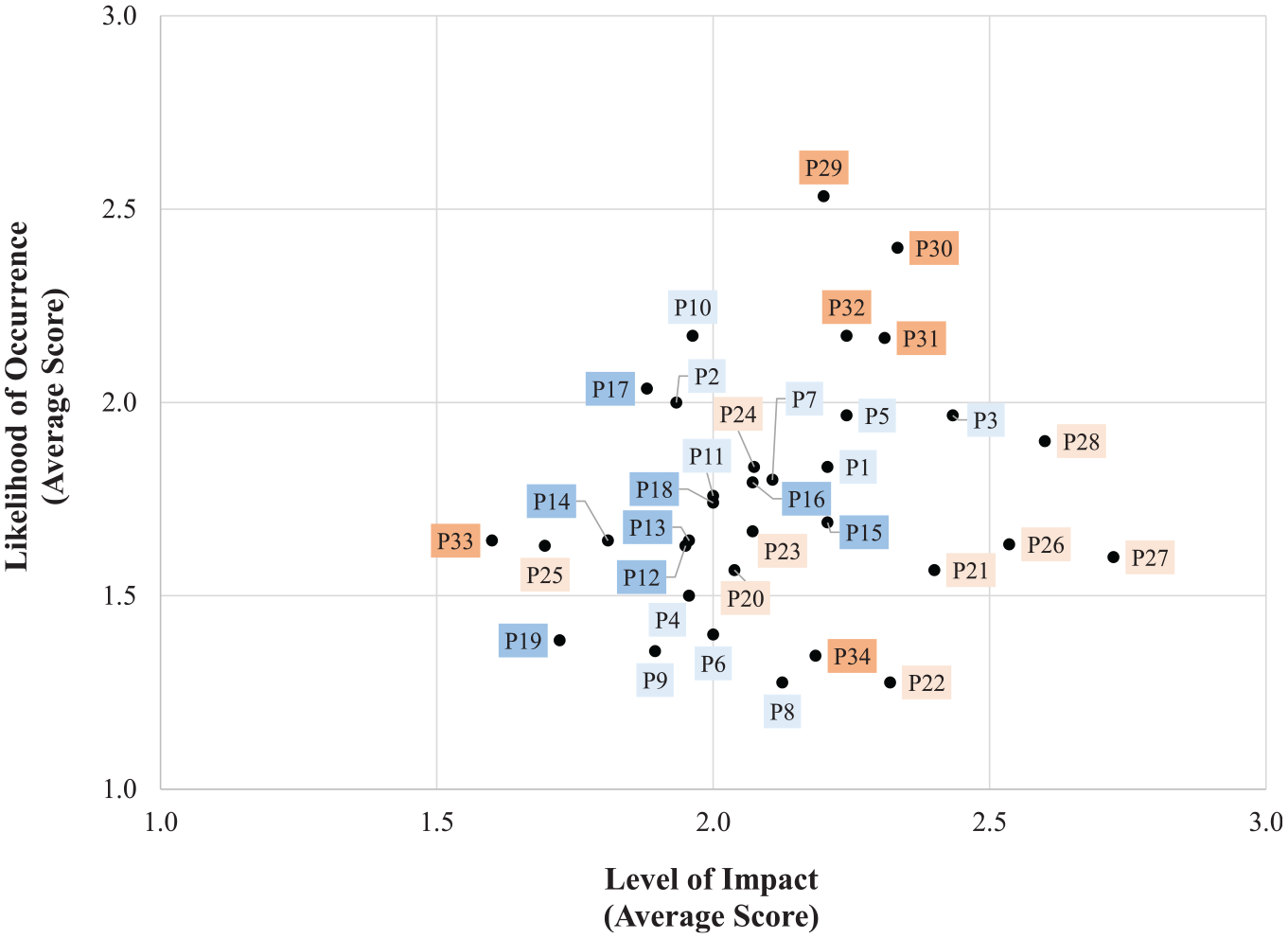
Average scores of the level of impact and likelihood of occurrence (34 problems).
Top 10 Schedule Quality Problems—Level of Impact
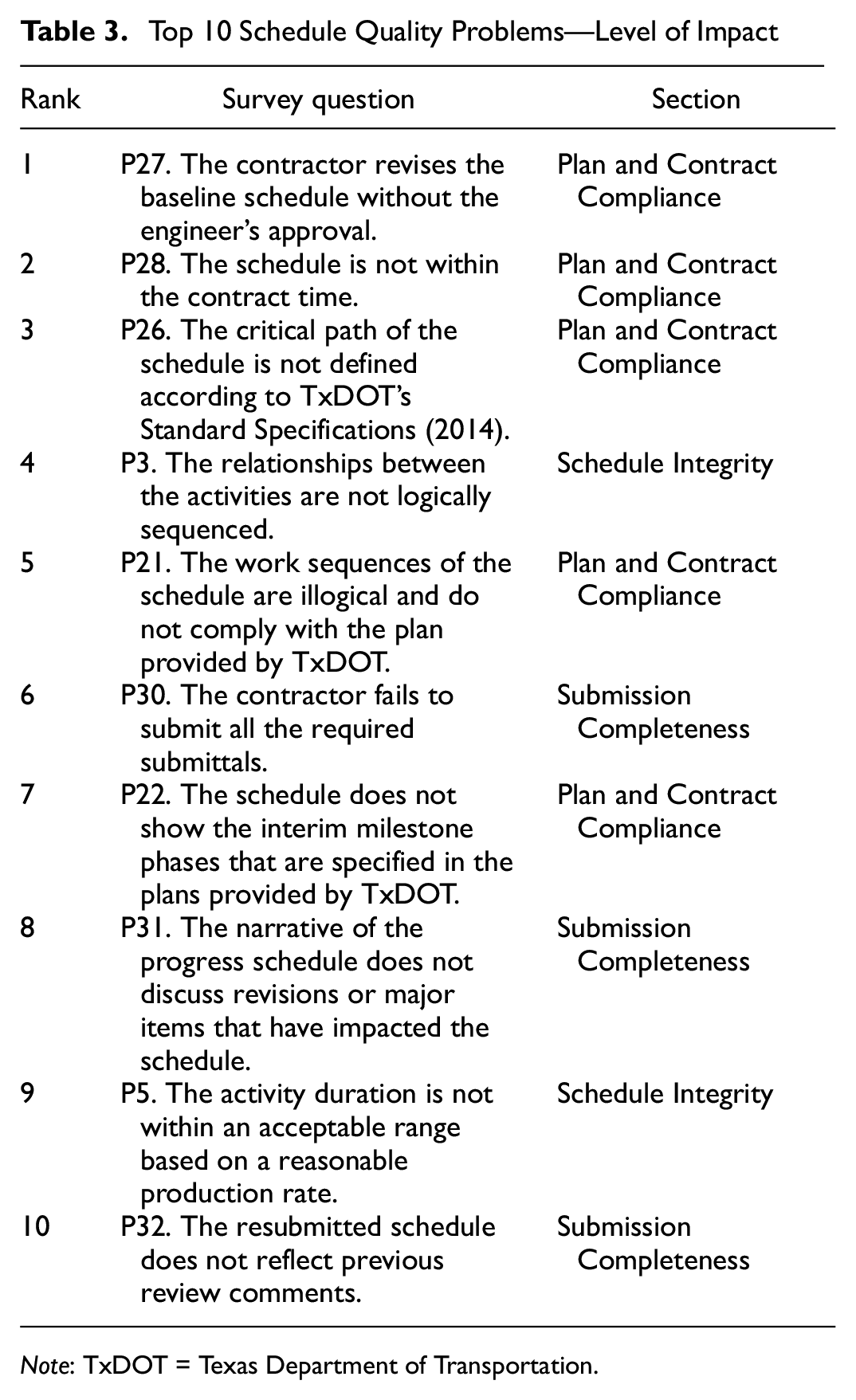
Note: TxDOT = Texas Department of Transportation.
The top 10 schedule quality problems ranked high likelihood of occurrence are shown in Table 4. Four of the five most frequently occurring problems are associated with submission completeness. DOTs’ standard specifications state that the timing of schedule submissions and the list of data and documents must be included in each schedule submittal. For schedule reviewers to evaluate schedules accurately and to provide contractors with timely schedule corrections, contractors need to submit schedule submittals with the complete and correct information within the required timeframe ( 39 ). Furthermore, if contractors submit overdue schedules simultaneously, schedule reviewers are overloaded, which can delay the review process. In addition, the survey respondents occasionally found that the resubmitted schedule did not fully incorporate the previous review comments. These problems deteriorate the efficiency of the review process, affecting the schedule quality. Nonetheless, the survey results indicate that contractors often fail to meet the schedule submission requirements. This suggests that contractors struggle to prepare and submit schedule submittals complying with submission requirements. A possible explanation is the level of sophistication of contractors participating in DOT construction projects. A significant portion of DOT projects are small- to medium-sized and awarded to local contractors who may not necessarily have the scheduling expertise to meet DOTs’ requirements and expectations.
Top 10 Schedule Quality Problems—Likelihood of Occurrence
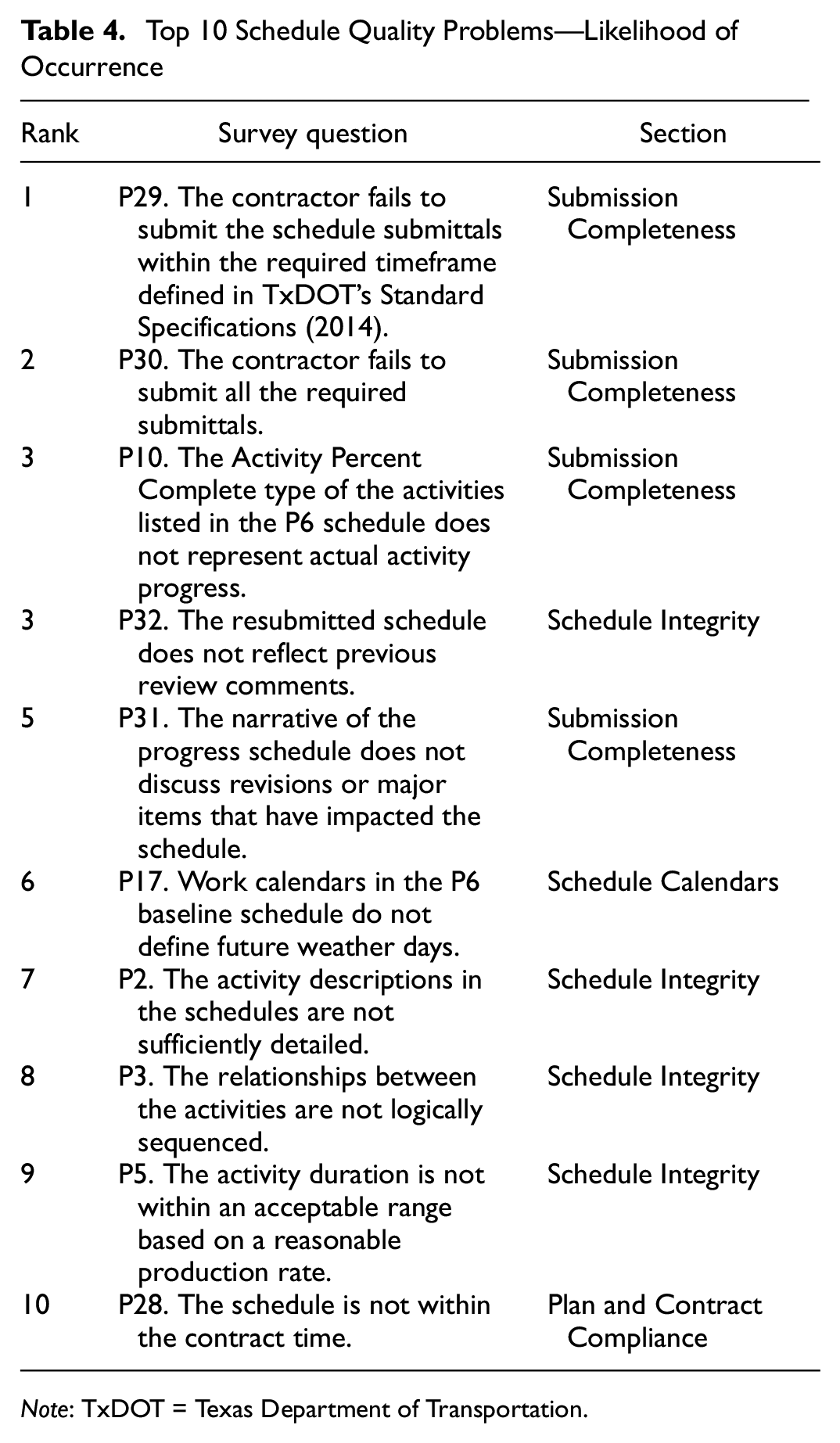
Note: TxDOT = Texas Department of Transportation.
A noteworthy finding is the relationship between the “Unknown” and “Not Applicable” responses and the schedule review format responses (printed and P6 electronic file versions). Twenty-five problems of the 34 problems had at least one response rating “Unknown” or “Not Applicable.” Notably, the problems with the high “Unknown” and “Not Applicable” responses were scheduling-software-specific problems. Also, two-thirds of the 100 “Unknown” ratings came from respondents who relied solely on a printed version for schedule reviews. When limited to the Schedule Calendar section (P12–P19), for example, the respondents who reviewed a printed version only had nearly three times more “Unknown” responses than those who reviewed schedules both in the printed and electronic files. The extant literature emphasizes the utilization of schedule calendars (8–10, 26). DOTs’ standard specifications also have specific schedule calendar requirements including workday and non-workday definitions ( 18 , 22 , 23 , 27 ). Incorrect use of the schedule calendar results in incorrect schedule calculations, including its critical path. The schedule calendar setting cannot be inspected effectively from a printed version of a schedule, which was corroborated by the significantly higher rates of “Unknown” of the respondents who reviewed a printed version schedule only. Past studies emphasized the technical aspects of conducting schedule reviews underscoring the importance of reviewing electronic schedules ( 6 , 15 , 20 , 21 ). Nevertheless, the survey respondents do not fully utilize the scheduling software in their reviews. This could be because of a lack of resources, including human, time, and training.
Recommendations for Improvement
A schedule reviewer decides to accept or reject a schedule considering the importance of the detected problems. This step, however, may solely depend on individual schedule reviewers not providing objective and adequate support for such decision-making ( 20 ). Furthermore, as a schedule review heavily relies on the schedule reviewer’s expertise, it is challenging for less-experienced reviewers to detect schedule quality problems and make appropriate decisions at the same level as experienced reviewers ( 40 – 42 ). If a DOT provides its schedule reviewers with clear criteria and a guide for schedule review decision-making, it will improve the schedule review process where reviewers can make an objective decision on schedule acceptance and rejection.
DOTs can utilize the approach of this research in developing their schedule review criteria and guide. This study identified the schedule quality problem relevant to DOT practices that DOTs can adopt in developing a guide to detect those problems. Further, it is recommended that DOTs assess the impact and frequency of those schedule quality problems that their schedule reviewers experience. Depending on the level of impact and frequency of each problem, DOTs can establish the decision-making criteria—accept, accept with corrections, or reject—and categorize the problems into the decision-making criteria to support schedule reviewers’ decision-making.
A checklist is a useful way to detect schedule quality problems. It is particularly effective to train and develop entry-level schedule reviewers. It is also an efficient communication method. The DOT schedule reviewers could use a checklist to evaluate the quality of schedules and send it to contractors as part of feedback so that contractors better and quickly understand the required schedule quality.
At an organization level, DOTs can have regular schedule review workshops where schedule reviewers share lessons learned from ongoing and completed projects and highlight best practices. These workshops can promote sharing schedule review knowledge between entry-level schedule reviewers and more-experienced reviewers. It can also allow knowledge transfer across different districts/areas as well as project sizes and types within a DOT.
DOTs may need to expand their efforts to contractors to improve schedules. The analysis reveals that contractors fail to meet the schedule submission requirements, such as submission time, more than occasionally. Reducing such repetitive problems is key to a more efficient schedule review process. It is recommended that DOTs provide training sessions to contractors as well as DOT schedule reviewers to reduce such problems. Another approach to lower incomplete submission problems is to enforce a penalty for failing schedule submissions. According to Han et al., 13 of the 18 DOTs they studied impose monetary penalties if a contractor fails to submit schedules within the required timeframe ( 24 ). If a DOT does not have such a penalty scheme, the inclusion of such requirements may mitigate the no/late schedule submission issue.
Conclusions
In highway construction, a quality schedule is key to schedule performance which will ultimately decrease traffic inconvenience and assure public safety. DOTs’ schedule review is an effort to maintain quality schedules. This research purports to identify areas to improve DOTs’ schedule review process by assessing the impact and frequency of schedule problems that deteriorate their effectiveness and efficiency. The research started with a literature review collecting construction schedule quality problems, resulting in the identification of 44 problems, organized by three high-level categories and seven criteria. A survey of DOT practitioners was developed to assess the degree of the impact and frequency of the schedule quality problems. The survey was distributed to TxDOT practitioners with schedule review experience using snowball sampling. Through the analysis of 30 usable responses, the level of impact and the likelihood of occurrence of each problem were assessed.
The analysis demonstrates that TxDOT schedule reviewers perceived the schedule problems associated with contract compliance as more significant. In contrast, the impact of the problems requiring scheduling software techniques was less apprehended. The analysis also uncovered that TxDOT schedule reviewers frequently experience late schedule submissions or incomplete submittals. These observations establish a need for guidance for both DOT reviewers and contractors, accompanied by clear and detailed schedule requirements in standard specifications. Particularly, it is important to provide DOT schedule reviewers with scheduling software training to ensure that they have sufficient skills to scrutinize technical schedule elements.
The findings of this research are expected to help DOTs diagnose and improve their schedule review process. DOTs can utilize the schedule problems identified in this research in developing schedule review guides or training materials for their schedule reviewers. In addition, DOTs can develop a schedule checklist to assist with the schedule review process. By doing so, DOTs can improve their schedule review practices and process and maintain quality schedules.
This research also contributes to the academic body of knowledge by presenting an insight into DOT schedule review practices as well as DOT practitioners’ perceptions of schedule review problems. This research identified the schedule quality problems that DOT practitioners experience and assessed the impact and frequency of the problems, which previous studies had paid less attention to. A limitation of this research is that data were collected from TxDOT only. Future studies can investigate other DOTs’ practices based on this research. The skill level of schedule reviewers was not included in the research scope. Future research may explore how schedule reviewers with different skill levels perceive schedule quality problems differently. Another research avenue could be examining schedule quality problems by project characteristics, such as project size or contracting type.
Footnotes
Acknowledgements
The authors would like to thank the employees of the Texas Department of Transportation who participated in the survey and provided support.
Author Contributions
The authors confirm their contribution to the paper as follows: study conception and design: J. Son, B. Han, N. Khwaja, W. O’Brien; data collection: B. Han; analysis and interpretation of results: J. Son, B. Han, N. Khwaja, W. O’Brien; draft manuscript preparation: J. Son, B. Han, N. Khwaja, W. O’Brien. All authors reviewed the results and approved the final version of the manuscript.
Declaration of Conflicting Interests
The author(s) declared no potential conflicts of interest with respect to the research, authorship, and/or publication of this article.
Funding
The author(s) disclosed receipt of the following financial support for the research, authorship, and/or publication of this article: The authors would like to acknowledge the Texas Department of Transportation for sponsoring this work through the project Innovative Construction Project Delivery Technical Support (Contract #601CT0000027418).
