



Abstract
Regional transit governance has become a topic of growing interest in some transit policy circles in the United States. There is hope that the quality of transit service can be improved by creating governance structures that transcend municipal and county borders to oversee and coordinate transit provision over entire regions. Although several studies have recorded the benefits of such governance systems and several others have explored different models, few have investigated the methods by which these structures were created. This is crucial information, as establishing such governance structures is a delicate political process with no guarantee of success. Through interviews with planners in Germany, this study investigated six German regional transit governance bodies and searched for strategic components that were instrumental to the creation of at least one regional governance structure. Five were ultimately found, which can be mixed and matched for use in strategies in regions seeking to establish regional transit governance of their own. The five strategic components found were bilateral negotiations, state intervention, large infrastructure packages, political moments, and strong leadership. Further case study research is needed to reinforce and expand this set of strategic components.
Keywords
Regionally integrated transit, a transit network across which passengers may move freely as if it was a single network even if it is composed of multiple operators, is a feature desired by many planners and transit riders but achieved in few American major cities. In regions with multiple agencies, such as New York City, Los Angeles, and especially San Francisco, coordination and integration is the exception rather than the rule. In an effort to improve American transit systems by improving the customer experience, planners and advocates have taken an interest in regional transit governance structures that coordinate transit agencies within the region while allowing agencies to maintain significant local autonomy to serve local needs. Several studies have examined the many benefits of integration, which include enhanced ease of use for passengers, increased ridership, and more willingness among the public to support transit systems ( 1 – 7 ). However, little academic literature has been written in English about how such regional structures (henceforth referred to as network managers) came to be. What are the political histories of these network managers? What can policymakers learn from these histories to inform the potential creation of new ones? It is time to begin researching methods for creating network managers, as this information will yield valuable practical knowledge for planners and advocates wishing to make progress on reforms.
This paper is an attempt to begin cataloguing the political processes by which network managers are created, by examining the origins of six such bodies in Germany. German urban regions have a penchant for establishing a specific type of network manager known as a Verkehrsverbund (Verkehrsverbünde in plural). The authors selected Germany as the country of interest because its decentralized federal system of government and affinity for local control closely align with similar forces in the United States that are currently cited as barriers to regionalized transit governance reforms. Furthermore, the sheer number of network managers (every major metropolitan area has one) and their early adoption of the concept (since the 1960s) makes Germany an interesting place to study many such structures within a single regulatory framework.
Methods
The authors conducted this study through literature review of works both in English and German and a series of interviews with German planners. The literature review included any study, document, or book that could be found that might have information on the history of regional transit governance in Germany. This included a German-language book on the history of the Hamburger Verkehrsverbund (HVV) authored by former chairperson of the HVV board Reinhard Krause, German and English language publications by the German Transport Ministry (VDV) and the Verkehrsverbund Rhein-Ruhr (VRR), as well as academic works by Vukan Vuchic, Ralph Buehler, and Wolfgang Homburger. The authors conducted interviews with planners at the Verkehrsverbund Berlin-Brandenburg (VBB), üstra Hannoversche Verkehrsbetriebe (ÜSTRA), the city-state of Hamburg, and VRR. Interviewees were identified through the personal networks of one of the authors. Each was interviewed between one and three times, for an hour per time. Questions were provided beforehand, but the interviewee was given significant leeway to steer the conversation to topics more familiar to them, as the goal was to find out as much as possible about Verkehrsverbünde histories generally, rather than limit the topic to specific areas. The authors initially set out looking for information on just the VRR, but this approach allowed for a much greater breadth of information to be discovered. Subject material discussed included the political history of the respective governance bodies with an emphasis on their origin stories, as well as discussions about the structure of the German transit ecosystem and the inner workings of transit delivery within the European Union framework. Because the events described took place 30 to 60 years ago, most people who were intimately involved in their creation have since passed away. The planners interviewed for this report knew only the high-level details of the history of each Verkehrsverbund. Hopefully, future researchers will have more success in finding primary sources. Research challenges aside, it was determined that even the available information, limited though it was, would still be helpful to those wishing to study regional transit integration.
Through these interviews and publications, it was possible to gather information about six Verkehrsverbünde within the timeframe of the project. These were the HVV in Hamburg, Grossraum Verkehr Hannover (GVH) in Hannover, Münchner Verkehrsverbund (MVV) in Munich, and Rhein-Main Verkehrsverbund in Frankfurt in addition to the aforementioned VRR in the Rhein-Ruhr and VBB in Berlin. These six Verkehrsverbünde are shown on the map in Figure 1. Because the above-mentioned book about the foundation of the HVV was written by a former chairperson of the board, Reinhard Krause, the HVV has the most detailed account found of any Verkehrsverbund studied. It is fortunate to have a detailed account of the Hamburg case because, as discussed later in this paper, the HVV’s status as the first Verkehrsverbund meant it had special hurdles to overcome that none of the others had. The VRR, which receives a chapter in a commemorative book published by the VDV, was the second-most in-depth account encountered. However, it is a distant second, as it lacks the detailed description of the groundwork necessary to establish the VRR that Krause’s book provided on the HVV. Information on the remaining four Verkehrsverbünde was gathered from interviews with German planners, supplemented by accounts from academic papers that contained brief summaries. Because these sources could not provide more than the broad outlines of the events leading to the foundations of these Verkehrsverbünde, these accounts are shorter and sparser in detail than the accounts of the HVV and VRR. These accounts were analyzed, and five components that were determined to be important to the establishment of a Verkehrsverbund were extracted.
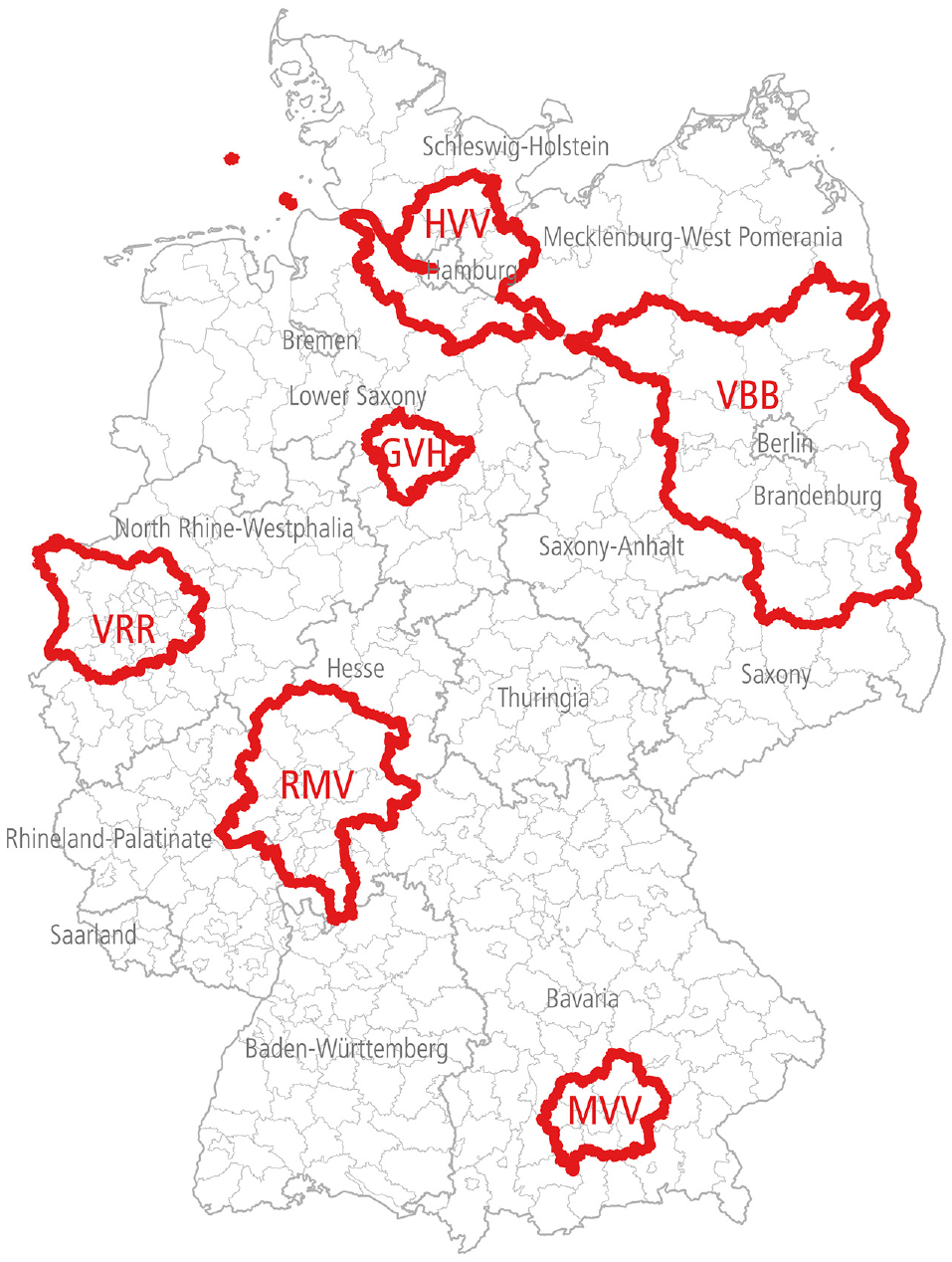
A map of the Verkehrsverbünde studied along with the German states and counties.
These developments will be analyzed through the Multiple Streams Framework to understand what caused regions to create Verkehrsverbünde when they did ( 8 ). The Multiple Streams Framework was determined to be an appropriate approach because of the focus of this research being on the moment of change and the events leading up to it, and owing to the broadness of the accounts. Under this framework, the policymaking process consists of three parallel and mostly independent processes known as streams: a problem stream, a policy stream, and a politics stream. A policy is made when several actors agree on a problem definition, open a political dialogue to discuss terms, and come to an agreement on a policy solution. Throughout the paper, reasoning through the Multiple Streams Framework is also used to fill in contextual details, most notably how developments in Hamburg shifted the policy environment of other cities in favor of the Verkehrsverbund. The important points that will be discussed can be understood as actions that precipitated or catalyzed a convergence of the three streams to create a Verkehrsverbund.
The Verkehrsverbund: German Regional Transit Governance
Regional transit governance exists in several forms in different cities around the world. The easiest to understand are regions that have merged all their transit provision into a single consolidated agency. This tends to be the American approach to regional transit governance, as exemplified by Salt Lake City’s Utah Transit Authority (UTA), Boston’s Massachusetts Bay Transportation Authority (MBTA), Denver’s Regional Transportation District (RTD), and Phoenix’s Valley Metro. Bogotá’s Sistema de Transporte Urbano (SITP) also exemplifies this approach. Next are regions that have a regional transit service provider that also provides regional transit governance functions (or a network manager that also happens to be a transit agency). This tends to be the preferred approach in Australia and Canada, as exemplified by Toronto’s Metrolinx, Vancouver’s TransLink, Brisbane’s Translink, and Sydney’s Transport for New South Wales (TfNSW). Transport for London (TfL) and Paris’s Régie Autonome des Transports Parisiens (RATP) also exemplify this approach. Next are regions that have a network manager that does not itself provide any transit services but does coordinate the services in its jurisdiction to ensure they function as a coherent whole. Skåne’s Skånetrafiken in southern Sweden and every Verkehrsverbund in Germany, Switzerland, and Austria are prime examples of this. Finally, there are a great many regions where transit is not formally coordinated on a regional level to behave as one integrated system, or where such coordination is done on an ad hoc basis. This tends to be the case in Chinese cities, which tend to treat rail and bus networks as separate, and Japanese cities, where private operators still have a large presence. Tokyo, with its two subway companies, eight major commuter rail companies, and dozens of smaller rail companies (all with separate fare structures) exemplifies this perfectly with its heavy rail operators alone, to say nothing of the constellation of bus companies that also serve the region. The San Francisco Bay Area, with its 27 agencies, also subscribes to this approach.
Every major urban area in Germany has a Verkehrsverbund to govern its transit at regional level. The Verkehrsverbund coordinates public transport planning, services, fare structures, ticketing, marketing, and customer information throughout entire metropolitan areas, and in some cases, entire states ( 2 , 3 ). Verkehrsverbünde vary widely in their governance structures, funding models, revenue redistribution formulas, and government participation, as these properties are determined at the discretion of regional actors. The only common property between all Verkehrsverbünde is that all are regional agencies that coordinate transport planning and aggregate some aspects of transit operations. From a governance point of view (most relevant for this study of the political history of these bodies), there are three major types, as discussed below.
History of the Types of Verkehrsverbund
The first Verkehrsverbünde created in Germany were all alliances controlled by their constituent transit companies, known as Unternehmensverbünde. This structure was the most natural in the 1960s, when many transit agencies were still private companies. However, as transit became less profitable owing to the rise of the automobile, many transit companies began to struggle and were acquired by local governments, which took over control of them (this aspect of transit provision is a similarity that Germany has with the United States, the difference being that American cities tended to wait until their transit companies were defunct before commencing municipalization). Once state and municipal governments began to become more involved in transit provision through subsidies and ownership of transit agencies, they also began taking increasing degrees of control over regional transit governance. This ultimately led to the creation of institutions controlled by combinations of state and local governments known as Aufgabenträgerverbünde to oversee regional transit cooperation. These are the two main types of Verkehrsverbünde. Organizations of a third type also exist, known as Mischverbünde. These organizations combine elements of Unternehmensverbünde and Aufgabenträgerverbünde. However, Mischverbünde are rare, and since none of the organizations studied happened to be Mischverbünde, this report does not discuss them further.
Liberalization was the trend in governance in the decade after the Reagan–Thatcher years, and Germany was no exception. From its inception in 1993, the European Union pushed liberalization schemes to all of its member states. As part of this liberalization, in the mid-1990s, Germany devolved much responsibility for regional transit planning and provision from federal to state and local governments. Henceforth, the federal government would only handle transit planning for national transit services, leaving states to handle local and regional transit planning.
Now possessing the mandate to control regional and local transit in a way they never had before, many state and local governments seized control of various Unternehmensverbünde and converted them into Aufgabenträgerverbünde ( 3 ). This allowed state and local governments to more closely control their transit companies, an important goal given the increased level of subsidy these governments were providing their transport companies. According to staff at VBB (personal communication, March 25, 2021), this transition was also seen as resolving a conflict of interest, as now the government, rather than the transport companies themselves, would oversee the tendering of route concessions and the setting of fares. The case studies explored in this study are all either Unternehmensverbünde or Aufgabenträgerverbünde, with the important distinction being that the former are governed by the transit agencies themselves whereas the latter are controlled by a combination of state and local governments.
Regional Transit Integration: A Literature Review
Creating a Verkehrsverbund can have measurable short- and long-term benefits for a region’s transit system. Homburger and Vuchic conducted a study 7 years after the creation of the world’s first Verkehrsverbund in Hamburg, finding that travel times had been reduced by 25% to 50%, and people were more willing to make transfers ( 1 ). Except for a few instances, fares also decreased. The rationalization of the bus network resulted in operational savings of up to 20%, savings that—because of economies of scale—persist indefinitely. The ability of the Verkehrsverbund to spend public money more effectively is a great asset from a public finance perspective. Some rail stations saw passenger counts increase by 25% to 110% after the formation of the HVV, and the percentage of passengers carrying monthly passes increased from 42% to 54%, which reduced boarding delays ( 1 ). As a result, perceptions of public transit improved dramatically at this time ( 1 ). Therefore, Homburger and Vuchic concluded the Verkehrsverbund was a success and recommended it as a model for other metropolitan areas to follow.
Further studies corroborated these early findings. Dunn conducted a study in 1980, also on Hamburg, and came to the same conclusion ( 9 ). In 1989, Topp updated these two studies, concluding that Verkehrsverbünde were successful in boosting transit ridership ( 10 ). In 1995, Pucher and Kurth provided another update, examining five of the 14 Verkehrsverbünde that existed among German, Austrian, and Swiss metropolitan regions by 1993. They found that all had succeeded in attracting more public transport riders, and had, in most cases, increased or at least stabilized transit’s mode share ( 11 ). Finally, a 2015 study of five Verkehrsverbünde found that all had successfully attracted more riders and increased revenues—both in total and per capita ( 3 ). The Verkehrsverbund systems reduced some costs, especially those related to redundant services, administration, marketing, and maintenance because of the elimination of redundancies and the increased ability to leverage economies of scale ( 4 – 6 ).
Adopting a contrasting viewpoint, Chisholm argued in 1992 that formal transit coordination is not always necessary and may indeed even be detrimental. His primary example argues that, contrary to popular belief, the San Francisco Bay Area’s many transit agencies do actually coordinate with each other. According to Chisholm, because this coordination is based on informal interpersonal relationships between the various transit agencies, local governments, and the Metropolitan Transportation Commission (MTC), it is often unfairly discounted and not recognized for the level of resilience this multiagency structure affords the Bay Area’s transit network ( 12 ). Although it may be correct that several of the transit agencies in the Bay Area have bilateral ties, the lack of formal regional coordination on transit schedules, fares, wayfinding, and the design of multimodal hubs all seem to be detrimental to the passenger experience and create barriers that make transit less competitive vis-à-vis the automobile. In fact, it is for this reason that work has begun to establish regional wayfinding standards and to rationalize fares ( 13 ). The Verkehrsverbund structure strikes a balance between complete independence and complete consolidation, allowing transit agencies to retain much of their independence and local control while making the network appear unified to the customer.
Taking a broader view, DeRobertis et al. conducted case studies of 10 cities around the world that are meeting the criteria of transit excellence and found that all had an organization that coordinated transit at the regional level (i.e., a network manager). Verkehrsverbünde are a type of network manager, specifically one that provides coordination only and does not operate any transit services of its own. The other two types of network manager are regional transit agencies, which also provide regional coordination, and completely consolidated regional transit operators. DeRobertis et al. found that the flexible nature of the Verkehrsverbund and its coordination-only properties made it well-suited for use in metropolitan regions with quickly growing suburbs, and that the ability of the Verkehrsverbund to coordinate fare policy, planning, schedules, and marketing enabled it to ensure high standards of quality for transit in regions that had one ( 14 ).
Numerous papers over the last 50 years have established, reestablished, and confirmed the benefits of creating a Verkehrsverbund. Other scholarship points to the importance of network management in guaranteeing good transit provision from the customer perspective, and a well-tailored Verkehrsverbund can avoid the consolidation pitfalls others have raised. In summary, there is ample evidence to explain why a city might wish to create a Verkehrsverbund. However, notably absent from the literature are any recommendations for how to create one. This study seeks to start answering this question through an examination of the histories of several Verkehrsverbünde, starting with the first Verkehrsverbund ever established.
Hamburg
The first Verkehrsverbund in Germany was created in Hamburg in 1965 in an effort to make transit more competitive against the rising tide of the automobile and to extend one company’s power over an entire metropolis. Ultimately, the reform was brought about by bilateral negotiations between Hamburg’s biggest local operator and the national railway company.
Geographic Context
Most municipalities in Germany are part of a county and share responsibilities with the county in which they are situated. Though the details vary by state, larger municipalities are often consolidated city-counties, giving them equal status to counties. This is analogous to the city and county of San Francisco in California or the independent city of Baltimore in Maryland. Counties, meanwhile, are subservient to the state in which they are located. Hamburg is a city-state, which means it has the special distinction of having equal status to a state. The situation is similar to Washington, D.C., if the District of Columbia were granted statehood. Hamburg is in the northern part of Germany along the Elbe River. Although the city was historically contained entirely within the borders of the city-state of Hamburg, the modern metropolis of Hamburg had by the 1960s expanded beyond the city-state’s borders and spilled over into the neighboring states of Schleswig-Holstein and Lower Saxony. The tristate nature of the Hamburg metropolis complicates governance in the region.
Historical Context
By the 1950s, Hamburg’s public transit network consisted of several overlapping networks of subway, suburban railway, streetcars, regional trains, ferry lines, and bus lines ( 15 ) operated by private transport companies. These companies operated independently to maximize their market share and openly impeded interagency transfers, operating parallel lines, independent fare systems, and not colocating stations ( 15 ). At this time, it could require seven tickets to traverse the city ( 16 ). This situation was not unique to Hamburg and was common in all larger urban areas where public transport was structured around multiple local transport companies ( 15 ).
Although inconvenient for passengers, the transit companies did not view this fragmentation as a problem, as it allowed them to act independently of one another. This was easier for them as it required less coordination. Therefore, whereas transit fragmentation had been a feature of the system for some time, it was not widely recognized as a problem by the actors with the power to change it. However, this would soon change.
The 1950s saw the rise of the automobile and the beginning of a precipitous market share decline for all transit companies, for various economic, social, and political reasons ( 17 ). As transit companies began slipping into unprofitability, leadership across the region began to call for reforms to stem the bleeding. Many wanted the transit agencies to form a unified fare system. Some wanted more sweeping changes. All, however, agreed that the transit within greater Hamburg could not continue as it had, and something needed to change. In Multiple Streams Framework terms, consensus was building in the problem stream that transit would need to undergo reform. Policy entrepreneurs proposed various solutions. However, one policy entrepreneur in particular would come to dominate the policy stream and implement reforms.
Max Mross was the CEO of the Hamburger Hochbahn (HHA), the dominant transit company in Hamburg. Once a collection of private companies that merged, the HHA had been taken over by the city-state of Hamburg by the late 1950s. This made it technically the city’s municipal transit agency, though the commerce-minded Hanseatic city-state of Hamburg still gave it a long leash to operate more like a private company than any transit agency in the United States would be able to. The HHA’s large market share and its ability to operate like a private company meant that Mross had great influence over Hamburg’s transit ecosystem. That it was municipally owned meant that the public, through their elected leaders, could put pressure on the HHA (and by extension, Mross) to enact reforms ( 16 ).
In the late 1950s, Max Mross looked across the Hamburg transit landscape and saw an industry in crisis. The HHA was one of the few profitable transit agencies, but Mross knew this would not last. The immediate problem before Mross was a matter of his company’s profitability, a problem caused by a loss of customers to the automobile. Simultaneously, Mross was under pressure from city politicians to make the transit network more user-friendly by unifying the disparate fare structures of the different agencies. Mross reasoned that transit’s loss in mode share was a result of its comparative inconvenience. An inconvenience, in turn, that was exacerbated by the barriers and lack of coordination between the transit companies. If he could somehow unite the transit companies, he could satisfy his shareholders (i.e., the elected leaders of the city-state of Hamburg) who were calling for greater seamlessness, while simultaneously potentially saving Hamburg’s transit from its freefall. There was no guarantee this plan would succeed, but it was better than guaranteed unprofitability, which was the trajectory of the HHA at the time. It was at this moment that Mross became the policy entrepreneur for a new kind of transit coordination. He began going about achieving the policy consensus he would need to realize the creation of the organization that would later become known as the Hamburger Verkehrsverbund.
The Verkehrsverbund As HHA’s Power Play
Most proponents of transit integration at the time wanted Hamburg’s transit agencies to form a fare union to deliver a unified fare structure ( 16 ). Mross, however, wished to go further. He wanted an organization that would set not only fares, but also schedules, routes, and branding. This would, from the customer’s perspective, make several of the differences between the transit agencies disappear. Together with his staff, Mross set out to create this organization with the stated purpose of making transit more seamless in a bid to better compete with the automobile. However, there was a secondary motive. Mross hoped that the HHA, as the largest agency in the Hamburg transit system, would come to dominate the HVV and thus extend its influence over other transport companies ( 15 ). There was no guarantee the gambit to reverse the decline of transit would work, but if it did, it would be a boon for HHA, and by extension, the city-state of Hamburg which owned HHA. By being the dominant member of the newly created HVV (the HHA carried over 70% of the passengers in Hamburg), HHA could effectively fold all the other companies’ networks into their own without having to raise the money to buy the other agencies outright. The city could take over the region’s transit without paying a great cost.
The HVV was also not without benefit to the other operators—by agreeing to form an alliance with HHA, their passengers would gain access to the largest transit network in the city, and HHA’s network could funnel passengers into theirs. Furthermore, once in an alliance with HHA, the smaller operators could redirect resources from competing with other operators to increasing the levels of service within their own areas or expanding service. It was for these reasons that Mross convinced the second-largest operator in Hamburg, Deutsche Bundesbahn (DB; German Federal Railways) to enter negotiations, opening a political window to discuss a policy package.
DB Drives a Hard Bargain
HHA controlled all the agencies necessary to make the alliance a reality, with the sole exception of DB. Since DB operated the suburban rail network and controlled Hamburg’s access to the national passenger and freight rail network ( 16 ), HHA needed DB’s participation if the HVV was to succeed. This, combined with how HHA and the city-state of Hamburg were under political pressure to come to an agreement with DB, meant that DB had a strong hand when HHA opened negotiations to create the HVV ( 16 ).
The Grand Bargain
Mross had achieved problem consensus and had created a political opening by initiating negotiations. However, achieving policy consensus turned out to be more difficult than anticipated. Mross and his team, initially expecting easy victory, spent 5 years in difficult negotiations with DB. In the end, the city-state of Hamburg through HHA paid a hefty price to get DB on its side ( 15 ). DB only agreed to join HVV after the city-state of Hamburg agreed to ( 2 , 16 )
Subsidize DB’s Hamburg suburban rail network,
Build and pay most of the cost of a substantial infrastructure package for DB, including a new grade-separated trunk line through the city center, and
Give DB veto power in the HVV governance structure, making it coequal with HHA even though it carried less than a third of the passengers ( 15 ).
This policy package satisfied DB’s interests, achieving policy consensus and paving the way to the establishment of the HVV.
Expansions and Reforms
In 1965, the negotiations finally came to an end and HHA, DB, and a suburban bus company founded the HVV ( 16 ) as an alliance of companies (Unternehmensverbund). All the municipally owned transport companies in the region joined, and eventually, private companies joined too. As in other regions at the time, the HVV was restructured in the 1990s to be a government-run responsible authority alliance (Aufgabenträgerverbund). It then expanded twice subsequently to include substantial portions of the neighboring states.
Impact
Over the next few years, transit policymakers both inside and outside West Germany watched Hamburg carefully to see the results of their experiment. They were rewarded with definitive proof. As mentioned earlier, a study conducted 7 years later found reduced travel times, greater willingness to make transfers, an overall decrease in fares, significant operational savings, and an increase in monthly passholders ( 1 ). Although not enough to return transit to profitability, these reforms succeeded in blunting much of the impact of automobilization and helping transit to remain relevant.
However, the HVV’s biggest impact occurred outside the Hamburg region. Hamburg was not the only city grappling with falling transit ridership and was far from the only city with a fragmented transit environment. The HVV may not have fully accomplished Max Mross’s goal of profitability for HHA, but for many politicians and activists, the improved ridership and improved transit provision was justification enough for the establishment of Verkehrsverbünde in other regions. As actors watched the HVV’s success and practitioners from Hamburg brought their skills to other regions, the Verkehrsverbund emerged as a strong candidate in the policy stream of every major city in the German-speaking world, and the conditions for opening policy windows for creating a Verkehrsverbund became more attainable. Thus precipitated the policy diffusion of the Verkehrsverbund from Hamburg to the rest of Germany, Switzerland, and Austria.
The HVV, by virtue of existing, is thus partially responsible for the creation of all the other Verkehrsverbünde in Germany, five of which are explored in the next sections.
Rhein-Ruhr
The Rhein-Ruhr region created its Verkehrsverbund after a lengthy process that began with intervention from the state government of North Rhine-Westphalia. The continued success of the VRR is a demonstration of the concept’s viability in polycentric metropolises.
Geographic Context
The Rhein-Ruhr region is an agglomeration near the border with the Netherlands, contained entirely within the state of North Rhine-Westphalia. It contains the cities of Cologne, Dortmund, Düsseldorf, and Essen. Historically the industrial heartland of Germany, today it is home to over 10 million inhabitants. Unlike Hamburg, the Rhein-Ruhr is polycentric, so there is no dominant city to act as the clear leader for forming a Verkehrsverbund.
Historical Context
Before 1980, public transport within the agglomeration of cities in the Rhein-Ruhr region operated without specific coordination. Like in Hamburg, passengers had to buy two or three different tickets when they transferred from one company’s services to another. This was frequently necessary even on short-distance trips, as the transit lines usually ended at the city limits. Furthermore, timetables were not coordinated and waiting times for transfer passengers were long ( 18 ). Just as in Hamburg, transit was losing mode share to the car, the transit companies were falling into unprofitability, and, as in Hamburg, there was growing consensus in the problem stream that transit needed to be reformed. However, unlike in Hamburg, there was no single person powerful enough to dominate the policy stream and push a reform like the Verkehrsverbund through.
The establishment of VRR, therefore, required much more of a team effort than the HVV. Rather than rely on the individual transit agencies to come to reach consensus in the problem stream, advocates focused on affecting policy change in the state government. However, achieving problem consensus among enough key actors to hold discussions that would become the political window for a bill mandating the creation of a Verkehrsverbund was no easy task. Even after the foundation of the HVV provided a functional example of the solution that would come to dominate the solution stream, it took years for this coalition to convince the state government to intervene to create a Verkehrsverbund for the Rhein-Ruhr region. The coalition, however, was ultimately successful, and the government of North Rhine-Westphalia intervened to reform transit throughout the state, kicking off a decade-long process that would end with the creation of the VRR.
State Intervention and Careful Planning
At the bidding of a coalition of politicians and leaders up and down the state, the government of the state of North Rhine-Westphalia, in cooperation with the Federal Ministry of Transport, divided the state into nine regions and urged all cities and counties in the state, which by this point owned most of the transport companies, to form Verkehrsverbünde. The primary aim was to organize and operate an improved public transport service within each region. The state government created commissions to establish these Verkehrsverbünde, including the one founded in 1970 that created the VRR ( 18 ).
From the beginning, the commission focused on promoting mobility with more customer-friendly tariffs for trips that crossed city boundaries. Fare integration was a challenge owing to the polycentric nature of the Rhein-Ruhr region, one that the commission solved by arranging the fare zones in a honeycomb pattern, rather than the more typical radial pattern ( 19 ).
In interviews, some German transit practitioners presented the establishment of Verkehrsverbünde as a methodical, deliberate exercise in which all stakeholders saw the eminent rationality of the reform and began cooperating immediately to implement it. This is what the authors term the “unified front” narrative and is the narrative that appears to be often told to foreign audiences. The truth, as revealed in German-language documents intended for domestic consumption, is that the cities, counties, and companies of the Rhein-Ruhr region did not at first put aside their own interests in pursuit of the greater good ( 19 ). Parochial thinking was a problem from the start—companies were initially skeptical of the unified tariff system, and it took time for them to realize that by working together they could achieve a system that was more than the sum of its parts ( 19 ). It may have taken several years, but the stakeholders did eventually build enough mutual trust that they began reaching agreements that laid the groundwork for further cooperation. After nearly a decade of working together, the cities, counties, and companies agreed to a structure and the VRR was born.
In 1979, 9 years after the state government began the process, the commission completed its activities and established the VRR in the northern part of the Rhein-Ruhr region as an alliance of the transport companies in the region (Unternehmensverbund). One year later, the VRR began operations ( 18 ). The aim of this organization was to unify the fare structures, optimize transport services, and coordinate traffic at the city limits. The VRR has been an integral part of transport in the Rhein-Ruhr region ever since, a demonstration of a Verkehrsverbund at work in a polycentric metropolis.
Rhein-Main
The Rhein-Main region established its Verkehrsverbund through bilateral negotiations, in a manner similar to Hamburg.
Geographic Context
The Rhein-Main region is a polycentric region of which Frankfurt is the biggest city. The region is mostly within the state of Hesse but spills over into neighboring Rhineland-Palatinate as well. Though it is only a city of 600,000, it is Europe’s financial capital and is home to one of the world’s busiest airports. This means that in addition to trips within the region, there is much long-distance commuting and travel generally into the city.
Creation Through Bilateral Negotiation, Reform by the State
The story of the Verkehrsverbund in the Rhein-Main area begins with the foundation of Frankfurt’s Frankfurter Verkehrsverbund (FVV) in 1974. The story of its establishment is similar to Hamburg’s but occurs later.
Like in Hamburg, automobilization and the decline of transit were in full swing in Frankfurt, which slowly led to consensus in the problem stream. This was complemented by the rise to prominence of the Verkehrsverbund concept in the solution stream after the establishment of the HVV in 1965. Like in Hamburg, Frankfurt’s largest transit operator and DB opened a political window in the form of a series of bilateral negotiations to establish the FVV as an Unternehmensverbund.
According to a planner interviewed about the subject, from the beginning, it was clear that the alliance had several shortcomings. The governance structure of the organization was ill-suited to its operation, as evidenced by the constant competition between the shareholders’ representatives in the company (VBB staff, personal communication, March 25, 2021). Furthermore, as the Rhein-Main region is more polycentric than Hamburg, the FVV’s original area in and around only the city of Frankfurt was deemed to be too small to sufficiently serve the growing region with its strong commuter transport demand (VBB staff, personal communication, March 25, 2021).
For this reason, policy entrepreneurs within the state government of Hesse used the national transit policy reforms of the 1990s (in which the German Federal Government devolved much authority over transit systems to the states) as a policy window to introduce some much-needed reforms to the FVV. In 1995, the state government of Hesse folded the FVV into a newly formed entity called the Rhein-Main Verkehrsverbund (RMV), an alliance of governments (Aufgabenträgerverbund) that covered most of southern Hesse including the former territory of the FVV, plus the city of Mainz. At this point, the RMV basically contained the entire Rhein-Main region. In addition to expanding the area covered by a Verkehrsverbund, the state of Hesse also assigned RMV the power to coordinate all transit within its area ( 14 ).
Hannover
One of the more dramatic origin stories, the second Verkehrsverbund in Germany was born by surprise in response to protests.
Geographic Context
The particulars of municipal governments in Germany vary by state, but large cities in Germany tend to have a consolidated city-county (known as a Kreisfreie Stadt) similar to the city and county of San Francisco in California, surrounded on all sides by a larger rural county (known as a Landkreis) bearing the same name. This separates the governance of a region’s urban and rural areas. Before 2001, Hannover was one of these city-counties surrounded by a rural county. Starting in 1963 though, Hannover took several steps to create a regional authority to ensure integrated planning and financing for the whole metropolitan area, which was spilling out of the city-county and into the rural county of Hannover. This regional authority covered both counties and began consolidating the planning for the two counties, setting in motion a slow process for a merger that was finally completed in 2001. This is unique in Germany. Hannover is contained entirely within the state of Lower Saxony, a largely rural state in Northern Germany.
Protests Motivate Reforms
The history of the Verkehrsverbund in Hannover is notable because it was enabled by a sudden shift in the problem stream. The problem and solution streams in Hannover were initially similar to Rhein-Main, Rhein-Ruhr, and Hamburg. Falling transit ridership led to falling revenues for the transit companies, both problems defined by their respective problem entrepreneurs in the problem stream. The establishment of the HVV in 1965 provided credibility to the Verkehrsverbund as a potential solution, elevating it to prominence in the solution stream.
Whereas problem consensus was reached gradually through declining revenues in Hamburg and a large advocacy effort in Rhein-Ruhr, in Hannover, riots brought problem consensus swiftly. In 1969, several cities in Germany, Hannover included, erupted into protest in reaction to fare hikes and service cuts in what became known as the Rote-Punkt (red dot) Riot. At that time, ÜSTRA, Hannover’s largest transport company, was privately owned. Protesters blockaded tram lines and gave out red dots for motorists to display on their windows in solidarity (also to show their willingness to transport passengers who would otherwise be stranded by the transit shutdown). The protesters demanded cheap, integrated public transportation as a condition for ending the blockades. According to the planner interviewed for this story, politicians initially opposed relenting to rioters. However, once they realized the population was backing the protests they got on board and began to make reforms. By essentially holding the city hostage, the protesters brought the problems of transit fragmentation and unaffordability into sharp focus and made sure the relevant decision makers could no longer ignore them. Pro-Verkehrsverbund policy entrepreneurs lost no time. In a matter of days, ownership of ÜSTRA transferred from its private owners to the regional authority, which had just been established in 1963 (ÜSTRA staff, personal communication, June 9, 2021). The establishment of the Verkehrsverbund, which in other cities was a long and drawn-out process of negotiations, happened next. In Hamburg, these took 5 years, and in Rhein-Ruhr, nine. In Hannover, the Verkehrsverbund was established in only one. In 1970, Hannover established the GVH, with ÜSTRA, DB, and several other operators as partners. Achieving policy consensus among the policymakers and stakeholders was almost certainly a more contentious process than described by the planner interviewed, but the fast turnaround is nonetheless notable.
Munich
The German planning saying “Organization before electronics before concrete” indicates a philosophy of reforming institutions before spending heavily on new infrastructure. However, the difficulty of reform means that even the Germans often pursue them simultaneously, a strategy of “organization through concrete.” Hamburg did this when it promised DB infrastructure projects in exchange for its cooperation in forming the HVV. However, perhaps nowhere exemplifies this organization-through-concrete model better than Munich.
Geographic Context
Munich is a monocentric region located entirely within the state of Bavaria in Southern Germany. The central city of Munich is a consolidated city-county, surrounded on three sides by a rural county bearing the same name.
Infrastructure for Reform
Munich achieved policy consensus for the creation of its Verkehrsverbund through the raft of preparations the city made for the 1972 Summer Olympic Games (former City of Hamburg transportation planner, personal communication, August 13, 2021). When Munich won its bid to host the 1972 Olympic Games, it kicked off a frenzy of infrastructure construction within the city. As of 1960, Munich had neither the S-Bahn (commuter rail) nor the U-Bahn (subway) systems that are the defining features of city transport today. The U-Bahn was under construction, and the S-Bahn was still in the planning stages. After the city won its 1966 bid to host the 1972 games, however, the city accelerated construction of the U-Bahn system to open the Olympic Line in time for the opening ceremony. Meanwhile, the city, state, and national governments collaborated to construct the S-Bahn network, including the diametral tunnel at the core of the system. Resources poured into Munich to allow this to happen. The federal government through DB decided in 1965 to finance and build the S-Bahn tunnels ( 2 ). This is in sharp contrast to Hamburg, where DB forced Hamburg to pay for the S-Bahn tunnels. Unfortunately, a detailed account of the negotiations undertaken to enable this could not be found. According to a planner familiar with the arrangement, there was a tacit agreement between Munich and the other cities in Germany that Munich would get disproportionately more federal infrastructure money at that time to prepare for the Olympics, and would receive disproportionately less money for a time after the Olympics (former City of Hamburg transportation planner, personal communication, August 13, 2021).
The amount of infrastructure constructed in Munich leading up to the Olympic games was so vast that the establishment of the Verkehrsverbund almost seems to have been an afterthought. Whatever anti-Verkehrsverbund conflicting interests that may have existed appear to have been washed away by the torrent of infrastructure money, and the policy consensus among the relevant stakeholders was not shaken by the addition of the Verkehrsverbund to the policy package. As the U-Bahn and S-Bahn networks geared up for opening, Munich complemented the new systems with the inauguration of their Verkehrsverbund, the Münchner Verkehrs und Tarifverbund (MVV), with the City of Munich and DB as stakeholders. This move allowed passengers to move through the U-Bahn and S-Bahn networks as if they were one seamless network, greatly expanding the effectiveness of both. The S-Bahn was designed to move people into and out of the city center. The U-Bahn was designed to move people around the city center. Unifying the networks allowed passengers to travel from nearly anywhere in the city center to an S-Bahn line, then out of the center and vice versa on a single ticket, making the system more useful than it would otherwise have been. Together, Munich and DB formed the MVV in 1971 and operations began in 1972, in time for the Olympics ( 2 , 3 ).
Berlin
The youngest major Verkehrsverbund in Germany, the Berlin-Brandenburg region’s Verkehrsverbund Berlin-Brandenburg is a product of the jubilation surrounding the reunification of Germany in 1990.
Geographic Context
Berlin is a city-state surrounded entirely by the state of Brandenburg. Historically, the urbanized area was contained entirely within the city-state. However, urbanization has begun spilling over the border into Brandenburg. Thus, any jurisdiction that wishes to encompass the entire region must contend with two states.
Reunification Generates Problem Consensus
Berlin’s problem stream was unique among the cases studied because of the sudden shift caused by reunification. The reunification of Germany was met with celebration across the country and the (NATO-aligned) world. As the parties wound down, however, work began on a series of projects to stitch together the parts of the country that had been divided by the Iron Curtain.
Berlin had gone from being two isolated cities on opposite sides of the Iron Curtain to being a single united city contained within one country. It was immediately obvious to all relevant decision makers that the transport policies of preunification Berlin would be ill-suited to the new unified Berlin. Thus, consensus on a problem definition emerged immediately. Berlin needed transport policies to reflect its new status as a single city. On the infrastructure side, this meant reestablishing transport links that had been cut off by the Berlin Wall and ensuring coordination between the various agencies providing transport in Berlin. On the governance side, Verkehrsverbünde, by this time well established in West Germany, were seen as being so effective at coordinating transit that the reunification treaty recommended the establishment of one in Berlin ( 2 , 3 ).
The amount of infrastructure necessary to reconnect West Berlin was vast. The former territory of West Berlin needed to be reconnected not only to East Berlin, but also to the hinterlands to the north, west, and south of the city. Infrastructure reconstructions included subway and rail connections, which the federal government provided aid to rebuild ( 2 ).
According to a planner who lived through this moment, because discussions occurred within the watershed moment of reunification—a dramatic and emotional point in time—many of the political decisions surrounding the establishment of a Verkehrsverbund in Berlin-Brandenburg were easier there than they were elsewhere. Whereas the Verkehrsverbund awaited the buildup of a political coalition in Frankfurt, Rhein-Ruhr, and Hamburg, in Berlin all parties immediately expressed their desire to form such an alliance, as expressed by their writing a recommendation for its establishment into the reunification treaty ( 20 ) (VBB staff, personal communication, March 25, 2021). In other words, all actors were so aligned on the problem definition and a policy solution that the policy was passed almost immediately. This immediate agreement is a testament to how established and accepted the Verkehrsverbund concept was in the policy stream by 1990. This shared enthusiasm allowed decision makers to establish the VBB over a vast area compared with some earlier Verkehrsverbünde. Whereas the HVV only included the city-state of Hamburg plus some outlying suburbs, the VBB encompassed the city-state of Berlin and most of the large state of Brandenburg immediately on its foundation in 1996, with the remaining portion of Brandenburg closest to Saxony joining in 2004 (VBB staff, personal communication, March 25, 2021).
As demonstrated by the six histories presented, the routes to establishment can be quite different from one Verkehrsverbund to another, and it can be difficult to keep track of which events happened when. A graphic representation of the six histories is presented in Figure 2, to assist with understanding of the timing of the various events.
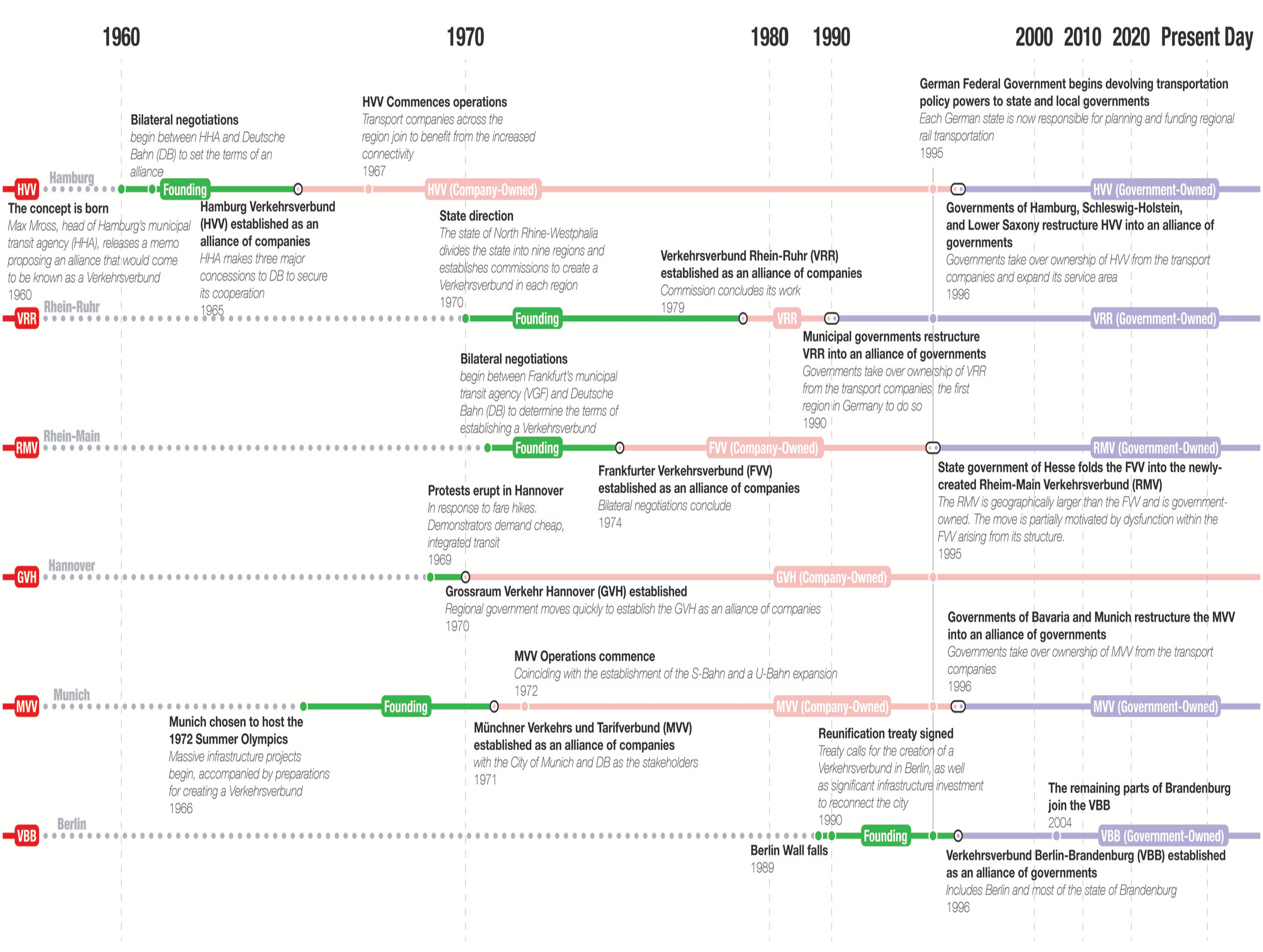
Timelines of the establishments of six Verkehrsverbünde.
Key Points in the Histories of the Verkehrsverbünde
Each Verkehrsverbund had a key element in its history, a time when the relevant actors focused on one pivotal Process, seized a crucial Opportunity, crafted a compelling Incentive, navigated an essential Negotiation, or utilized clever Tactics to overcome the barriers posed by the conflicting interests of the involved parties. These key Processes, Opportunities, Incentives, Negotiations, and Tactics (POINTs) are the defining elements of the history of a Verkehrsverbund, and fall into one of the three streams, making that stream the focal stream of the history of that Verkehrsverbund. Notably, though each of the three streams needed to align in each of the cities studied for their Verkehrsverbünde to be created, the cities differed in which stream their key POINTs fell into. The remainder of this paper explores these key POINTs in the context of the Multiple Streams Framework.
Key Points in the Problem Stream
In most of the cases studied, the problem stream moved slowly, and it took years for the relevant actors to accept the problem definition that would lead to the creation of a Verkehrsverbund. In these cities, consensus about the nature of the problem only emerged gradually as transit companies slipped into unprofitability (Hamburg) or Verkehrsverbünde in earlier adopters proved a success (Frankfurt, Rhein-Ruhr, and Munich). However, in two cities, the problem stream moved suddenly, bringing a problem into sharp focus, which led to rapid adoption. These two are the cities whose key POINTs fall into the problem stream.
Leveraging Disruption, the Hannover–Berlin Approach
Disruptive political events, such as protests, geopolitical shifts, and crises can motivate a rapid convergence of opinions on a problem definition, making them good catalysts for change. Therefore, it should come as no surprise that some Verkehrsverbünde were established at such times.
In Hannover, the protesters in the Rote-Punkt Riot demanded integrated transit, presenting the region’s decision makers with a problem (i.e., demands for a regionally integrated affordable transit system) that they could not ignore (because the protests were so large). Pro-Verkehrsverbund policy entrepreneurs pounced on this opportunity, using the pressure on the regional lawmakers to push through and implement the formation of the GVH among other reforms within a year.
In the case of Berlin, reunification triggered a rethinking of how the city operated at all levels of government and society, as the borders that had divided the city for decades disappeared. Suddenly, transit policies treating Berlin as two isolated cities in countries on the brink of war made no sense and had to be rethought. The problem, as agreed on by the relevant actors, was that Berlin needed new transit policies to reflect its status as a reunified city. A Verkehrsverbund, which by this point was standard in cities across Germany, was the obvious solution.
Disruptive political events that swiftly change the problem stream can lead to fast action but are unpredictable from a timing perspective. The major social event or disruption could be major protests, a financial crisis, or even a pandemic. Cities adopting this method as part of their strategy must have coalitions lined up in advance of this event so that they can quickly push in the same direction before the window of opportunity closes.
Key Points in the Politics Stream
In situations where the problem stream develops at its more typical slow pace, once the necessary decision makers have come to a consensus on a problem, the next step in the process is to convene a forum of some sort to discuss solutions. The two approaches to forming these forums were the key POINTs of three cities.
Bilateral Negotiations, the Hamburg–Frankfurt Approach
In Hamburg and Frankfurt, the leaders of the local transit agencies independently came to a consensus that a problem of transit fragmentation existed and needed to be resolved through bilateral negotiations. These bottom-up negotiations were the key POINTs in the history of the Verkehrsverbünde in Hamburg and Frankfurt. In opening these bilateral negotiations, the decision makers in Hamburg and Rhein-Main created an opening in the politics stream that gave them an opportunity to reach a consensus on a slate of policies that would lead to the creation of their Verkehrsverbünde.
Initiating bilateral negotiations involves convincing leaders in the largest transit agency in the region to form a network manager with the other agencies under the premise that joining such an alliance would be more beneficial than staying out. Achieving this problem consensus is challenging, as it involves convincing transit agencies to explore a change they could perceive as risky. If successfully formed, it is an indication that the relevant actors have aligned in the problem stream and opened a window in the politics stream. It is therefore imperative to make sure that the discussions move toward alignment in the policy stream as well, as the alignment of all three is necessary for the passage of the policy package. Whereas this is the most methodical ground-up method, it can be quite slow to pursue since it relies on agencies to build trust with each other over time. This method is likely to create an Unternehmensverbund governed by the transit operators. In both Hamburg and Frankfurt, this was determined after a time to be an inadequate solution and both Verkehrsverbünde were reformed by their respective state governments into Aufgabenträgersverbünde governed by local and state governments. Cities that adopt this method as part of their strategy should be prepared to do the same.
State Intervention, the Rhein-Ruhr Approach
Hamburg and Frankfurt benefited from their transit ecosystems already being dominated by one or two big agencies, so a bilateral agreement could unite the vast majority of the network. This meant that a ground-up approach to opening an opportunity in the politics stream was relatively simple, as only two actors needed to be involved. This was not so in the highly polycentric Rhein-Ruhr region. A ground-up approach there would have required problem consensus from many transit operators, a much taller order. To get the necessary critical mass of transit companies into their Verkehrsverbund, the Rhein-Ruhr region depended on legislation from the state government of North Rhein-Westphalia, which in turn required a massive coalition of supporters up and down the state at all levels of government to lobby the state for intervention. This reliance on state intervention is the key POINT of the VRR’s history. Unlike in Hamburg and Frankfurt, this method could be accomplished without the support of all the transit operators involved as long as the opposing operators had insufficient influence in the state government to scuttle the process. This essentially shifted the key policymaking process from the individual operators to the state house. In doing so, Verkehrsverbund proponents removed the direct influence of transit agency self-interest from the equation while introducing the more diverse politics of the state legislature. The political opening in this case would come in the form of a bill in the state legislature, and the main challenge of this method would have been keeping the supportive coalition strong enough to fend off attacks from opponents seeking to kill the bill. It was, from start to end, a slow and deliberate affair. Significant patience is required to pursue this method, as it can take years to build the required coalition, and nearly a decade to negotiate the Verkehrsverbund once the legislation is passed ( 19 ).
Strong, Visionary Leadership, for the First Movers
Having a strong advocate in the political stream is always helpful, but nowhere is it more critical than when bold action is required. Of all the cities studied, Hamburg faced the greatest difficulties in establishing its Verkehrsverbund for the simple reason that it was the first. During its formation, there was no precedent for such an organization in the German-speaking transit world. The idea of a Verkehrsverbund was so risky, bold, and fringe that it would probably never have been invented were it not for the efforts of Max Mross. As the CEO of the biggest transit agency in a monocentric city, Mross had the unique ability to spearhead such ideas, and he used his power to push through the formation of the HVV. In other words, Mross served as a firm rock in the political stream, shaping the policy flows around him and creating the conditions necessary for the creation of the HVV. Once the HVV had set the precedent, the Verkehrsverbund concept rose to prominence in the policy stream, meaning visionary leadership was less necessary to establish Verkehrsverbünde in subsequent cities.
Cities establishing the first network manager in their country will face the same extra hurdles that Hamburg did, as reform opponents can capitalize on broader unfamiliarity with the concept to brand it as culturally incompatible, risky, and foreign. In such cases, it can be immensely helpful, perhaps even necessary, to have an influential regional leader champion the concept and campaign for its implementation.
Key Points in the Policy Stream
Even if all necessary stakeholders agree on a problem and have entered discussions, they may be prevented by self-interest from agreeing on a policy change. Reform is often a bitter pill. To convince transit agency leadership to accept it, several cities in Germany administered a spoonful of incentives to help the medicine go down. An incentive of sufficient size can overcome the barriers of self-interest and convince key stakeholders to align in the policy stream, allowing a policy to move forward. As a bonus, such incentives may even complement the Verkehrsverbund policy, making it into a more comprehensive package of regional transit integration. There are two cities with a key POINT of this nature.
Infrastructure Incentives for Coordination, the Munich Approach
Munich’s key POINT was its use of large infrastructure projects to secure policy alignment behind the creation of a Verkehrsverbund, where the preparations for the Olympics served as the impetus for a large infrastructure program that, in turn, served as the vessel for the creation of the MVV. The buildout of subway and commuter rail infrastructure alone was so transformative in the Munich transit space that the establishment of the MVV almost seems minor in comparison. This was precisely the point, and the enormous influx of resources promised in the reform package appears to have been enough to convince all involved actors that it was in their self-interest to support the policy package. In doing so, it unlocked all the necessary doors to creating a Verkehrsverbund. As an added benefit, the resulting combination of infrastructure and governance reform made for a comprehensive transit integration package that gave Munich regionally integrated transit governance and the integrated transit system to go with it. This double benefit makes the Munich approach a compelling strategy for policy entrepreneurs seeking to establish network managers in their own regions.
Infrastructure as an incentive to secure alignment in the policy stream was a POINT in Hamburg as well. In Hamburg, infrastructure played a vital role as a bargaining chip, which the city-state of Hamburg gave to DB in exchange for DB’s support in establishing the HVV. Both the city-state and DB agreed on the problem, but disagreed on the terms of the policy package that would be the solution. DB, despite being the smaller player in the bilateral negotiations, had more leverage. This meant that the city-state had to add an infrastructure component to the policy package, in addition to power-sharing and subsidy concessions, to overcome DB’s limits of self-interest and secure their alignment on the policy package.
Though “organization before electronics before concrete” might be a German planning mantra, at least two of the six cities studied used concrete to buy (at least in part) the coalition needed to reform the organizations. Cities looking to establish a network manager of their own should consider using infrastructure to sweeten the deal, or even better, make large infrastructure investments conditional on establishing a network manager. The ideal situation is a package that bundles network management with a series of infrastructure projects designed to close gaps in the network, as this moves the transit system toward seamlessness on two fronts. Doing so builds a coalition in the policy stream for creating a network manager.
Applying the Lessons to a Fragmented U.S. Metropolitan Context: The San Francisco Bay Area
Regional transit governance in the United States, where it has happened, has often come in the form of a single consolidated regional transit agency (Salt Lake City’s UTA and Denver’s RTD are examples). Outside of this, most urban regions have a dominant large agency serving the core city that has the power to set the transit direction for the region. The San Francisco Bay Area is uniquely fragmented in that none of its 27 agencies is a clearly dominant agency that has the power to set the transit agenda for the region ( 21 ). The metropolis is itself so multipolar that its namesake city is no longer even the most populous in the region (that title is now held by San José).
The Bay Area’s transit mode share was relatively high for an American city, though it was declining even before the pandemic ( 21 ). The success of the Verkehrsverbund in Germany at increasing transit ridership, and improving the customer experience and public support for transit overall, suggests that the Verkehrsverbund or similar network manager might be a policy worth exploring in the Bay Area. To determine how such a policy change might take place, however, it is first necessary to examine the three streams.
Current Context, a Multiple Streams Approach
In the problem stream, universal agreement that fragmentation in the transit sphere is an important problem deserving of policymaker attention has only come about recently because of the pandemic. Apart from a vocal coalition of advocates and researchers who have underscored the cost of fragmentation, the leaders of the transit agencies themselves have historically been more preoccupied with short-term funding problems, a result of the near-perpetual state of crisis in which transit has existed since World War II. These transit leaders have historically defined the lack of resources for transit as the problem, rather than fragmentation. Additionally, a penchant for preserving local control has engendered resistance to attempts to regionalize governance on a range of policy issues, including transit ( 21 , 22 ). As a result, although the Bay Area public may be increasingly traveling at a regional level, transit governance continues, by and large, to be local in scope. However, in the last few years, the COVID pandemic has precipitated a shift in the problem stream. Ridership in the Bay Area has not recovered to prepandemic levels, leaving a large hole in transit agencies’ farebox recovery ratios. The transit agencies have been filling this hole with federal COVID relief dollars, but these will soon run out in 2024 or 2025 ( 23 ). To avert the transit “fiscal cliff” that will occur when this happens, transit agencies in 2023 are seeking state operations assistance funding to fill the gap ( 24 ). However, the legislature wishes to see proof that the operators are doing all they can to attract customers back to transit before agreeing to operating assistance. This pressure has led to a degree of problem consensus on the part of the operators.
In the political stream, the typical state of events in the Bay Area is that elected officials from various parts of the region tend to be naturally inclined to resist efforts toward regionalization, though this has recently changed with the establishment of the network management committee. A significant factor here is that transit tends to be funded at a local level in the United States to a greater degree than elsewhere, and there is a natural desire from local authorities to maintain local control over their locally generated funding. Furthermore, in the United States there tends to be broad public support for devolving authority to manage public programs to the lowest level of government. This is based on the assumption that the lower levels of government are closer to the citizens, and that they are therefore more understanding of the needs of citizens and also better able to respond to local concerns. However, with the recent achievement of problem consensus, key stakeholders in the Bay Area have agreed to create a network management committee at MTC, which will act as the forum for discussing network management policy going forward ( 25 ). This is the political opening that proponents can use to promote policy packages that will institute network management reforms.
In the policy stream, policy entrepreneurs in the form of the advocacy organization promoting network management have managed to organize a coalition around their solution ( 26 ), and continue to voice their support for network management as the region moves forward with deliberations. There are also significant numbers of staff at transit agencies and governments throughout the region who are interested in exploring policy reforms. However, although the leaders of several transit agencies may have expressed interest in exploring policy reforms, their historic view of resource scarcity as the problem has led to a conservative policy for their solution. Rather than pursuing a policy of comprehensive regional integration and service improvement to attract more customers, a “risky” policy, they pursue the comparatively “safe” policy of controlling their own costs by making each agency as individually financially efficient as possible. Unfortunately for customers, this means each operator decouples itself from its neighbors and focuses on maintaining tight control over every aspect of its operations. This makes interagency trips difficult to impossible, resulting in a dearth of interagency customers that the operators then use as further justification for eschewing regional integration. Whereas this conservative policy reduces risk for every agency individually in the short term, it causes the transit system as a whole to be less and less able to provide regional trips in the long term. In a region where travel is increasingly regional, this undermines public trust in the transit system, leading to decreasing mode share and political support, making it a losing strategy overall. However, now that there has been an opening in the political stream in the form of the network management committee, there is a chance for the relevant stakeholders to convene and discuss regional integration policies. Proponents of network management should ensure the discussion proceeds in productive ways and work to build a comprehensive package of regional integration policies that can gain consensus from all the relevant stakeholders.
Opportunities for Strategic Component Use in the Bay Area
Using a similar strategy to that employed in Hannover and Berlin, advocates used the disruptions caused by the COVID pandemic to put network management on the agenda. At the beginning of the pandemic in 2020, with transit ridership in freefall, MTC, the Bay Area’s metropolitan planning organization, convened a task force to identify a package of programs to help transit recover from the pandemic. That MTC was in charge of distributing the COVID relief funds to the transit operators may have contributed to their endorsement of the task force. Network management advocates had a seat at the table, and ensured network management was part of that package. This effort produced a document known as the Bay Area Transit Transformation Action Plan, which MTC is currently working to implement.
The Bay Area is too multipolar for a single visionary local leader or bilateral negotiations to be effective for creating a truly regional organization, which is why network management advocates are also lobbying for state intervention, just as in the Rhine-Ruhr region. Advocates have assembled a coalition of representatives at the state level, and there is even a budding partnership with stakeholders in the Los Angeles region. And though none of their sponsored bills have yet become law, AB 629, SB 917, and AB 761 have exerted political pressure on Bay Area transit operators to take steps toward greater regional integration.
Going forward, there will be more opportunities to utilize strategic components from Germany to establish a network manager in the Bay Area. MTC may have established a network management committee, but it remains to be seen whether this body will have the powers to be a true network manager. The aforementioned fiscal cliff will be disruptive for the transit operators, and advocates may offer reforms as a way of giving operators financial security in exchange for reforms empowering the network management committee. The region is also stepping up the planning for a second transbay tube, underground rail extension to downtown San Francisco, and a second Bay Area Rapid Transit (BART) corridor through San Francisco. Construction of the BART extension to San José is imminent, and planning for the Diridon Station reconstruction is well underway. With the correct political maneuvering, advocates could use regional funding for these megaprojects to secure operator participation in network management activities. Advocates could go even further, bundling these megaprojects together into a cohesive regional transit project to knit the various transit systems together, creating an integrated transit system to complement the integrated transit governance.
Conclusions
Planners in cities wishing to establish regional transit governance have a wealth of experiential knowledge to draw from in the establishment of the many Verkehrsverbünde of Germany. This study has catalogued the experiences of the six cities studied that planners may find useful in implementing their own reforms.
To establish a network manager,
Cities may choose to encourage two of the most powerful transit agencies in their region to establish regional governance through bilateral negotiation;
Regions may choose to seek intervention from a higher government such as the state to motivate the reforms;
Cities seeking to establish what will be the first network manager in their country have extra hurdles on their route. Strong, visionary leadership may be necessary to overcome these and spearhead reforms;
Regions may use large infrastructure packages to incentivize all involved actors to assent to the reforms; and
Planners may use disruptive political moments as opportunities to execute reforms.
The first three strategic components focus on influencing the political stream, the fourth focuses on achieving consensus in the policy stream, and the fifth capitalizes on shifts in the problem stream.
A successful strategy will likely involve mixing and matching these components to suit the needs of the region the strategy is for and will be flexible enough to adapt to changing conditions on the ground. It should also be noted that more strategic components beyond these four almost certainly exist. Further research is needed to examine the transit governance histories of more regions to discover further examples of strategies already mentioned and new strategies that could be added to this catalogue. Regions of interest may be found in Sweden, Australia, Canada, and the other cities in Germany.
It is hoped that planners and policymakers will be able to use the results of this and future studies to implement transit policy reforms going forward.
Footnotes
Acknowledgements
The authors would like to thank Ian Griffiths and Seamless Bay Area for sponsoring this research, Dr. Karen Trapenberg Frick for chairing the capstone committee, and Dr. Elisa Barbour for editorial help as the committee member. This paper is derived from a larger report done as a capstone project for the Department of City and Regional Planning at the University of California, Berkeley, CA.
Author Contributions
The authors confirm contribution to the paper as follows: study conception and design: K. Anzai; data collection: K. Anzai, E. Eidlin; analysis and interpretation of results: K. Anzai; draft manuscript preparation: K. Anzai, E. Eidlin. All authors reviewed the results and approved the final version of the manuscript.
Declaration of Conflicting Interests
The authors declared no potential conflicts of interest with respect to the research, authorship, and/or publication of this article.
Funding
The authors received no financial support for the research, authorship, and/or publication of this article.
