



Abstract
This paper investigates how and to what extent changes in user behavior may mitigate the benefits of teleworking on commuting distance and time, a phenomenon often referred to as a “rebound effect.” The direct effect of teleworking is to reduce the number of commuting trips (work travel effect). This may trigger behavioral changes among transport users: teleworkers may carry out additional trips for other purposes (non-work travel effect), and may change their residential/job location, leading to longer commuting distances (residential location effect). In addition, the improvement in travel conditions consequent to the work travel effect might result in greater mobility by non-teleworkers (induced demand). Considering the Paris region as a case study, this paper applies a four-step travel demand model to evaluate several teleworking scenarios and quantify the rebound effects. We complete the analysis with an economic evaluation of the scenarios, focusing on mobility effects. The overall rebound effect is found to be substantial, cancelling out 62%–68% of the gains in travel distance and 74%–85% of travel time savings. Nonetheless, the social benefits of teleworking remain significant, amounting to 1.4% of the social cost of road transport in the region. This suggests that teleworking may be able to contribute significantly to a policy mix aimed at reducing travel demand.
Keywords
The transport sector is one of the main sources of greenhouse gas (GHG) emissions, contributing an estimated quarter of European emissions ( 1 ), and a similar proportion in the United States ( 2 ). The Avoid-Shift-Improve (ASI) framework has been proposed as a potential strategy that can be applied within the transport sector to reduce demand. It is a strategy based on three principles: avoiding unnecessary travel, shifting from higher to lower GHG emissions modes, and improving the efficiency of the various transport modes ( 3 ). While research has suggested that policy mixes integrating the three aspects of the ASI framework are required ( 4 ), demand reduction remains more poorly understood than technological solutions ( 5 ).
Teleworking is probably the most well-known of the travel demand management measures, especially in light of the COVID-19 crisis and the subsequent lockdowns that were enforced in several countries. It can be defined as “a form of organizing and/or performing work, using information technology, in the context of an employment contract/relationship, where work, which could also be performed at the employer’s premises, is carried out away from those premises on a regular basis” ( 6 ).
From the moment that Alvin Toffler predicted that teleworking “could shift literally millions of jobs out of the factories and offices into…where they came from originally: the home” ( 7 ), it has been considered as a way to reduce the externalities of transport by reducing the number of home–work commute trips. Not only that, but it was thought that widespread teleworking would have wider social and economic benefits, an idea which led to the adoption of pro-teleworking legislation in states such as California ( 8 ). Over time, academic research caught up with the concept, and a more balanced view began to be discussed in the literature ( 9 – 13 ). The research coalesced around two fundamental questions: first, were the number of teleworkers and the regularity of teleworking large enough to lead to a significant system-wide effect ( 12 ); second, to what extent were the benefits of teleworking limited by counteracting changes in user behavior. Underlying these two was the question of how to best estimate the effects of teleworking given the available data and with a reasonable degree of accuracy. Notably, teleworkers might choose to move further away from their workplace ( 14 , 15 ), or carry out more non-work trips on teleworked days ( 10 ). Meanwhile, the other users of the transport system might take advantage of the resulting decongestion to travel more often and further, a phenomenon known as induced demand ( 16 ). These “rebound effects” have often been discussed in the literature, but largely separately, and without consideration of the separate contribution that each may have on the total effect of teleworking.
This paper investigates how and to what extent teleworker and non-teleworker behavior may amplify or mitigate the expected benefits of teleworking. More specifically, it seeks to assess the magnitude of each elementary rebound effect, to better understand the main drivers of the total effect that teleworking has on the transport system. The objective is the design of policies with a high degree of synergy that can help mitigate the various rebound effects. We also carry out an economic evaluation of teleworking focusing on mobility impacts, including travel conditions (travel cost and travel time savings), and related environmental impacts (climate change, noise, and air pollution).
The methodology relies on the four-step model MODUS to simulate scenarios with different levels of teleworking and quantitatively assess three effects of teleworking: the effect on work-related travel (hereafter work travel effect), the effect on non-work-related travel (non-work travel effect), and the effect on the home–work commute distance (residential location effect). In addition, a fourth, general, effect on the wider transport system that is not restricted to teleworking alone—induced demand—is calculated, and an economic evaluation carried out. The methodology for the economic evaluation is cost–benefit analysis (CBA), restricted to effects within the transport sector in accordance with French guidelines ( 17 ). The analysis is carried out on the Paris region (Île-de-France), France, which suffers from high congestion in its transport system, in addition to having (even before the COVID-19 crisis) a significantly higher rate of teleworking than the rest of the country ( 18 ).
This paper extends teleworking literature in two main ways. First, it provides an estimation of the magnitude of the various effects of teleworking, separately and in combination. As a result, it provides a deeper understanding of the upper-bound in the benefits that can be expected from teleworking (as given by the work travel effect) as well as the extent to which these benefits are reduced by changes in user behavior. It considers teleworking not merely within the context of the COVID-19 epidemic, but within the wider context into which it fits as a travel demand management measure. Second, through the economic evaluation, it provides an estimate of the effect of the social costs and benefits of teleworking.
The remainder of this paper is organized as follows. The next section summarizes literature on teleworking. Then we introduce the MODUS model and give a mathematical formulation of teleworking integration into the model and the method used for evaluating the effects. Then a section describing our case study is given, followed by the results and their discussion. Concluding remarks along with limitations of this study and possible future research are provided in the final section.
Literature Review
Teleworking can be studied through a variety of paradigms. First and foremost, the study of teleworking is part of the wider study of interactions between information and communication technology (ICT) and transport. Four potential interactions between ICT and transport have been suggested by Andreev, Salomon and Pliskin ( 19 ): substitution, complementarity, modification, and neutrality. More recent works suggest that this framework is better suited to the simpler technological environment of the 1980s and 1990s during which it was elaborated than to the present day, where mobile phones have become elaborate portable communications and computing devices ( 20 , 21 ). In this framework, ICT and transport form a “tapestry of relationships” with bidirectional effects and complex interactions. Considering the scope of this study, the traditional ICT–transport paradigm was considered adequate. As such, the review concerns itself primarily with substitution and complementarity.
While Table 1 provides an overview of the overall effect of teleworking through studies in the literature, Table 2 specifies the effects by distinguishing between work travel, non-work travel and residential location effects. The most direct effect of teleworking is the substitution of the otherwise necessary commute by working at home, which we refer to as the work travel effect. This reduces commuting trips, as confirmed by several empirical works such as those cited by the ADEME, the French Energy Transition Agency ( 22 ), with some variation in teleworking rates being observed over the course of the week ( 23 ). The work travel effect has also been investigated in the literature using travel demand models. Shabanpour et al. ( 24 ) estimated a model of teleworking choice and frequency, and used the results to simulate the effects of teleworking on mobility. Similarly, Alonso et al. ( 25 ) used the MARS land-use and transport interaction model to study the long-term effects of increasing teleworking.
Overview of the Quantitative Studies on the Effects of Teleworking on Transport
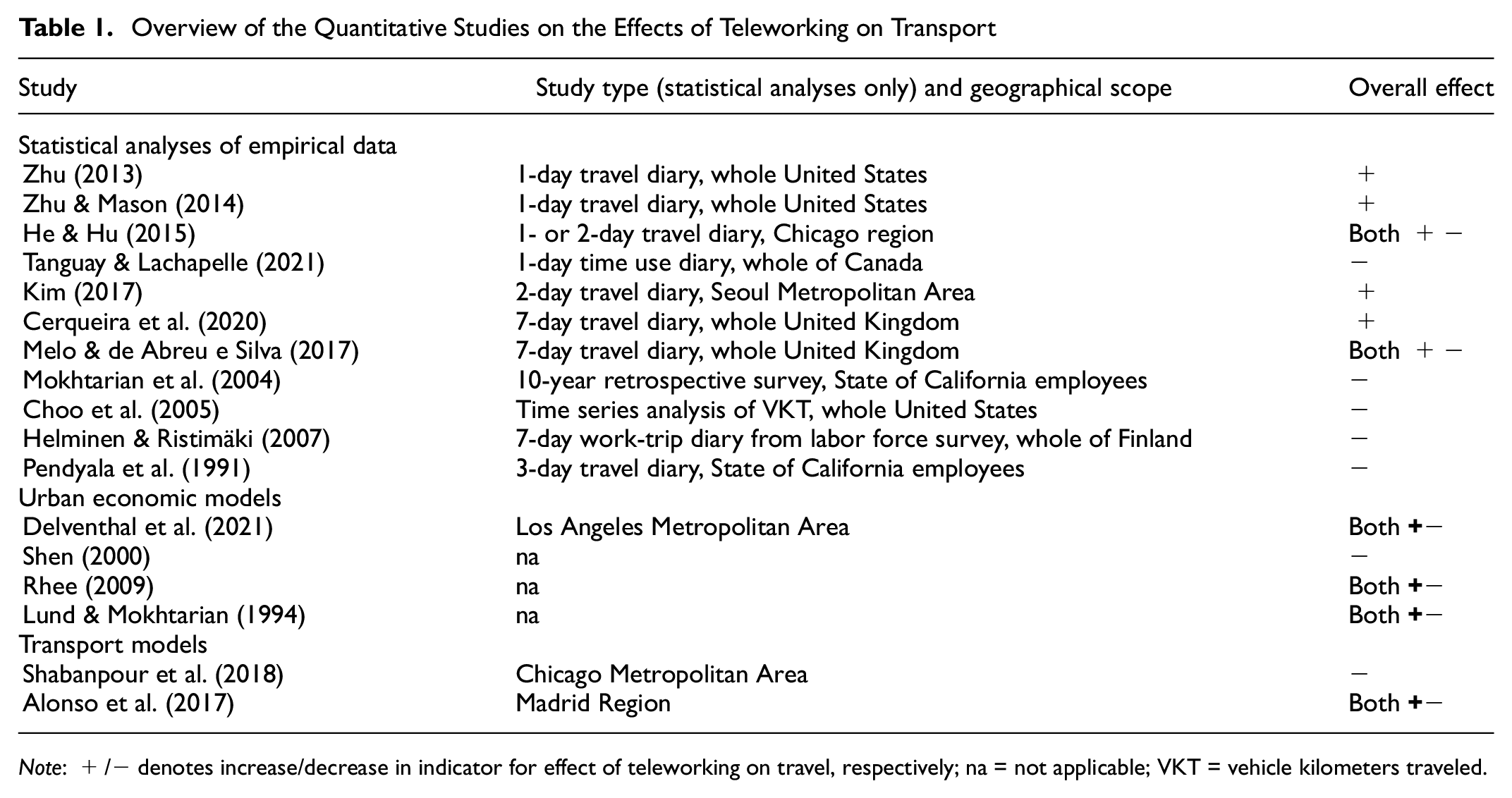
Note: +/− denotes increase/decrease in indicator for effect of teleworking on travel, respectively; na = not applicable; VKT = vehicle kilometers traveled.
Work Travel, Non-work Travel and Residential Location Effects as Seen in the Literature
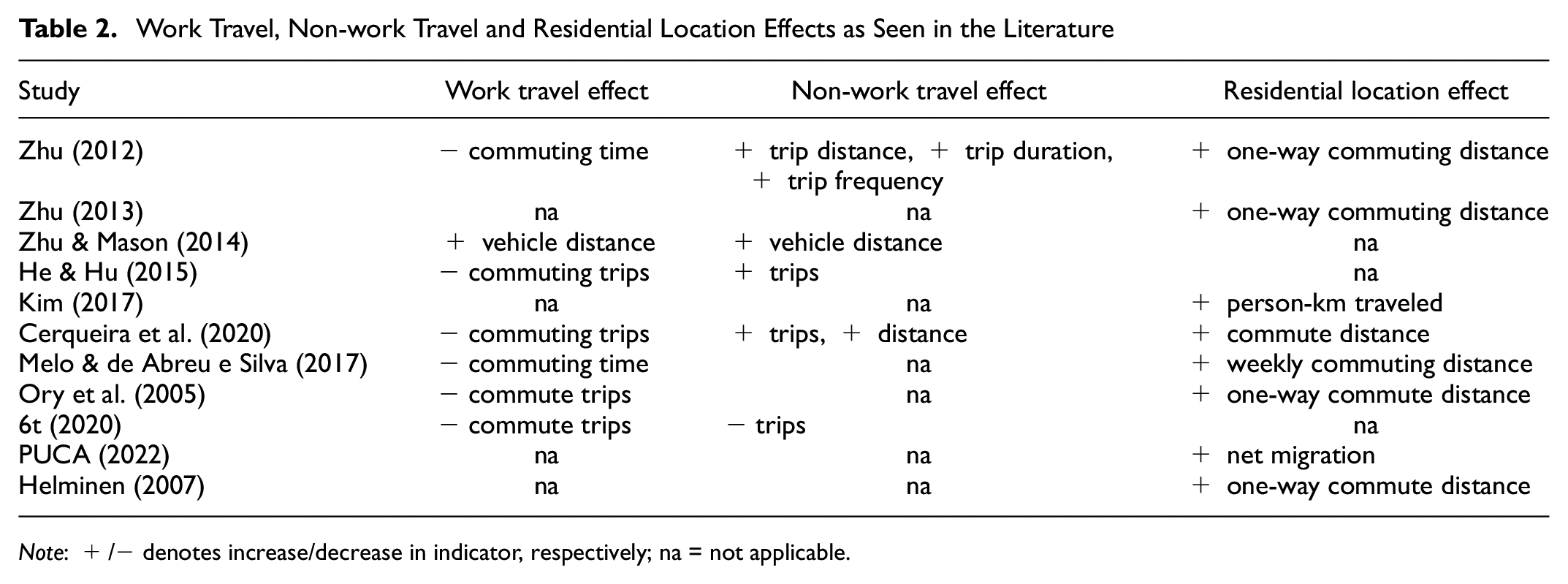
Note: +/− denotes increase/decrease in indicator, respectively; na = not applicable.
The indirect effects are the two groups of rebound effects that have previously been mentioned. First, there is the behavior change of teleworkers induced by them teleworking. Several authors have argued that the constant travel budget of households will lead to more time being spent on non-work travel as work travel is reduced because of telework ( 10 , 26 ). This is the non-work travel effect, which different studies have tried to identify through statistical analysis of empirical data, usually from a general travel survey, or from a survey specifically targeting teleworkers. In the first category we find studies such as Zhu ( 26 ), which was based on the 2001 and 2009 US National Household Travel Survey; Kim ( 10 ) using the South Korean Household Travel Survey, and Cerquiera et al. ( 9 ) using the UK National Travel Survey. Despite working with data from very different sources, these studies as well as several others have converged on the result that teleworking is associated with more non-work travel, whether measured in number of trips, total distance travelled, or total time spent traveling. Among the surveys specifically targeting teleworkers, the one carried out by the ADEME ( 22 ) showed a greater number of non-work trips by teleworkers but did not consider distance or time.
Whether the additional non-work travel is carried out on teleworked or non-teleworked days cannot always be determined from the empirical data; in the study by the ADEME it was found to be significant on non-teleworked days while on teleworked days a reduction in travel was observed instead, whereas in the work by Kim only the effect on teleworked days was significant. Cerquiera et al. reported only the effect for the overall workweek, making it impossible to distinguish daily variations.
The second indirect effect of the change in behavior of teleworkers is residential relocation, leading to longer one-way commute distances, dubbed “telesprawl” by some authors ( 11 ). This is the residential location effect. In neo-classical urban economics theory, households would be located to minimize the summed cost of housing and travel.
As they commute less to work by virtue of being teleworkers, they would be able to relocate to more outlying areas. This hypothesis has been tested severally through modeling studies: Lund and Mokhtarian ( 27 ) calibrated a simple monocentric model to study the effect of this relocation on vehicle distance traveled; Rhee ( 28 ) carried out a similar analysis, but considering endogenous teleworking decisions; Delventhal ( 29 ) calibrated a model of real estate, transport, and firm equilibria for the city of Los Angeles. The results from these studies were as expected: residential relocation toward the periphery, and the relocation of jobs toward the core of the city.
Beyond simulating residential relocation through urban economic models, attempts have also been made to study this phenomenon by looking at empirical data. First, there is some indirect evidence provided by comparing the commuting distances of teleworkers and non-teleworkers as some studies have done ( 9 , 10 , 26 , 30–32). More direct, perhaps, would be a study of actual relocation decisions and their relationship to the decision to telework. Ongoing research by the PUCA in France, in the context of the recent increased teleworking rates ( 15 ), indicated an acceleration of pre-existing migratory trends in which there was net migration of residents from large metropolitan areas into the suburbs, specifically from the center of Paris to its inner and more distant suburbs, while other research ( 23 ) indicated that companies were relocating to the Paris city-center. Ory and Mokhtarian ( 14 ) also tried to look at the question of the temporal relationship between the decision to relocate and the decision to telework, but their study is hindered by their relatively small sample size. Finally, Helminen and Ristimäki’s study ( 33 ) found that teleworking is associated not only with residential relocation, but with secondary residences as well.
There is also an indirect effect that is because of the response of the other users of the transport system. This is induced demand, a phenomenon that is more often than not associated with improvements in road capacity ( 34 ). Nonetheless, the mechanism that applies to capacity improvements applies to any decongestion effort, including teleworking.
While many studies investigate each of these different teleworking effects separately, relatively few have considered them together. This is especially the case when considering only the attempts to model the effects of higher levels of teleworking, through either travel demand or urban economics models.
One may question the reliability of the empirical findings that have been presented, especially given the likely endogeneity of teleworking when considering its effects on travel. Endogeneity may first arise from the omitted variable bias, which manifests as a self-selection effect when there are unobserved socioeconomic and attitudinal differences between the populations of teleworkers and non-teleworkers. Different methods have been applied to deal with it: a fixed effects model ( 35 , 36 ) and instrumental variables ( 37 ). A second source of endogeneity comes from teleworking and travel decisions not being made consecutively, but rather simultaneously. Two studies ( 38 , 30 ) identified the problem, but did not deal with it. Among the papers that were considered, only Zhu ( 26 ) attempted to deal with this form of endogeneity, again through the use of instrumental variables.
The difficulties involved in trying to deal with the endogeneity problem explain the small number of papers that have tackled it. If one applies an instrumental variable approach, there is the problem of finding a suitable instrument. A good instrumental variable for teleworking would be strongly correlated with it but weakly correlated with whatever unobserved individual characteristics it was introduced to deal with. Zhu ( 26 ) uses internet use at home and total number of phones available as instruments when trying to predict teleworking’s effect on travel; Giovannis ( 36 ) uses job position, social class and whether an individual has a computer at home as instruments in predicting teleworking’s effect on traffic and air pollution. The study by He and Hu ( 37 ) meanwhile uses a host of personal and household characteristics, such as education. The extent to which these instruments may be correlated with some unobserved characteristics is worth considering, but is something that this paper does not attempt to go into.
The use of longitudinal data would make it simpler to carry out causal inference of the effects of teleworking, since it is a reasonable assumption that the cause came before its effect. Ory and Mokhtarian ( 14 ) try to do this, and arrive at the conclusion that teleworking does not lead to residential relocation, but that it is often the other way around. But this study faces two significant issues: first, being a retrospective study, it is limited by what people can actually remember; second, it has a limited sample size, and being composed entirely of State of California employees is unlikely to be very representative. The Nilles panel survey ( 39 ) avoids the first problem but still faces the second. Hampered as it is by its small sample size, it finds no statistically significant differences between teleworkers and non-teleworkers in their residential relocation patterns over the course of the study. This problem of sample size and representativity has been raised by Mokhtarian et al. ( 40 ) in their review of the early teleworking pilot programs, casting a shadow over all their results and the conclusions that have been drawn from them.
For this reason, in estimating the teleworking effects, this article has mainly applied the findings of the larger, more representative cross-sectional surveys, notably those in which the attempt has been made to correct for the endogeneity problem.
Methodology
Travel Demand Model: MODUS
As discussed previously, teleworking may trigger a variety of changes in behavior on the part of the users of the system, at every level of the land-use transportation feedback cycle ( 41 ). By representing the principal travel decisions and the equilibrium on the transport system, travel demand models allow us to capture most of these effects.
MODUS is a multimodal travel demand model based on the standard four-step procedure ( 42 ). It is a static model, which captures a single average representation of the mobility behavior in an area during various time periods in an average working day. In addition, as a four-step model, it is aggregated, and therefore does not represent the individual-level travel demand. Travel demand is segmented according to 11 trip purposes (e.g., commuting, shopping, leisure) and two types of individuals, based on whether one has access to a private vehicle or not. Four transport modes are represented: cars (C), public transport (PT), cycling (CY) and a composite mode composed of walking, e-scooters and roller-skaters (W). The specifications are fairly standard for this kind of model and are detailed in the documentation by the regional transport authorities ( 43 ).
The weaknesses of the four-step model are well documented in the literature ( 44 , 45 ). Several of these are particularly acute in the context of teleworking. First, trips are modeled directly, rather than as the by-product of activities, which is what more advanced activity-based models do ( 46 ). Second, they do not make any consideration of trip chaining. This means that they do not consider how a breakdown in previously efficient trip chains because of working from home might lead to greater travel.
In spite of this, these shortcomings were far outweighed by the advantages of using an operational, well-calibrated travel demand model that has been used by the regional agency to carry out demand studies and analyses for several years. Since MODUS was robust and gave stable results, it was considered significantly better than the alternatives, which would all have been experimental prototypes. Furthermore, a more disaggregate model would have required far more detailed input data for teleworking and its effects. Nonetheless, the authors do intend to soon carry out a similar study with a multi-agent model that will be able to integrate a wider variety of effects.
The structure of the modeling chain is displayed in Figure 1. The generation step is a linear regression model for each of the modeled periods (morning and evening peak periods). Travel is segmented into 22 demand segments based on their trip motive for the generation stage, and each one is further divided again based on access to a private vehicle. Travelers that are dependent on public transport in MODUS are those who live in households in which there is no vehicle (if they are below the legal driving age), or who do not have a driving license (if they are above the legal driving age).
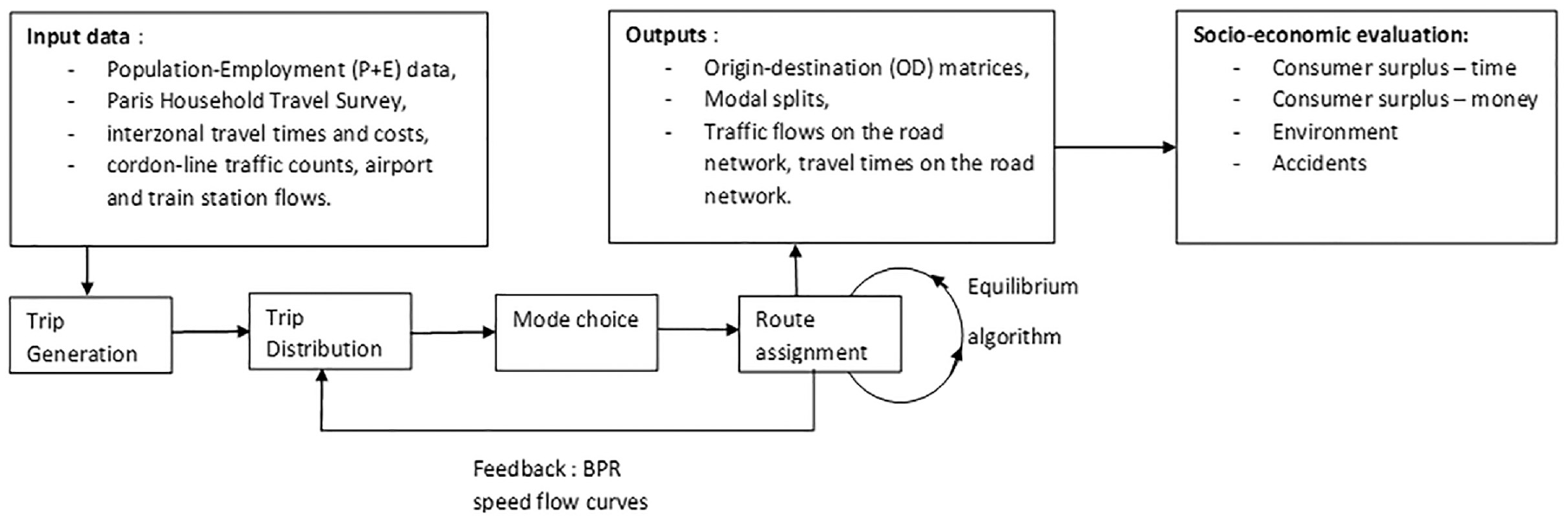
Conceptual Structure of the Modeling Chain.
In the gravity distribution model, the impedance variable used is the multimodal disutility of travel (calculated as the opposite of the multimodal utility), which is derived from the mode choice multinomial logit model. The use of a consistent definition of the disutility of travel between trip distribution and mode choice stages ensures microeconomic coherence. Modal utilities include a time cost component and a monetary cost component, with parameters—such as the value of travel time saved (VTTS)—that vary depending on the travel demand segment. A Box-Cox transformation is applied to the utility components to cater for the non-linearity in the perception of travel cost and time. Route choice is based on a standard multipath assignment procedure. MODUS was calibrated using the Paris region’s household travel survey—the Enquête Globale Transport, administered in 2010—in addition to road count data. It is run as a Python program for the generation, distribution, and mode choice steps, and uses the software PTV Visum for the route choice step. The run time for MODUS is approximately 2 h on a Dell Latitude 5520 with a 3.00GHz Intel i7 processor and 32Gb of RAM.
Representing Teleworking
The work travel effect was considered through the removal of trips at the generation stage. This was done per socio-professional category according to the following equation:

where
These parameters were calibrated from available data and based on previous studies. Thus,
The non-work travel effect was studied by adding trips at the trip generation stage, at a rate that varied according to the trip purpose (using an equation similar to the one given above).
The residential location effect was considered at the trip distribution stage. This was done by applying a modification factor to the friction parameter in the gravity formulation. The modification factor was of the following form:

where
This simplified integration of teleworking involves several assumptions. Most significantly, the choice of teleworking is exogenous. Teleworkers are imputed on the model, rather than being considered as a specific alternative. This is in contrast, for example, with the work of Shabanpour et al. ( 24 ) in which the decision to telework is endogenous and based on the sociodemographic characteristics of the individual.
Furthermore, the socioeconomic evaluation of teleworking carried out in this paper only includes costs and benefits related to mobility. The impacts of teleworking on work productivity and on the private utility of time (linked to working at home, being able to carry out other activities, etc.) are beyond the scope of this paper.
Key Performance Indicators
Several key performance indicators (KPI) are used to evaluate the teleworking scenarios:
Travel distances as given by vehicle-kilometers traveled (VKT) for private vehicles.
Travel times as given by vehicle-hours traveled (VHT).
The social cost of teleworking.
The VKT and VHT are two standard road traffic indicators. The former measures the level of traffic and is closely related to the performance of the system for externalities (pollution, noise, emissions), whereas the latter captures the experience of the user as captured through the travel time. Together, they provide a good idea of the effect of teleworking on road traffic.
The social cost was calculated through a CBA. This is a technique used by decision-makers to analyse the efficiency of a policy. It is generally applied in the ex ante analysis of transport projects ( 48 ); it is, however, increasingly also being used to evaluate “soft” policies such as travel demand management. Some of the advantages of CBA over rival methods are its grounding in the willingness to pay of the users, as shown by their revealed or stated preferences, and its strict criteria for inclusion of effects, which limits double-counting.
The methodology applied in this study was that given by the French authorities, with the parameters as shown in Supplemental Table S1. The effects included were the costs and benefits of market and monetizable non-market goods ( 49 ). The typical procedure was simplified by taking a “snapshot” of a future scenario with teleworking and its effects included, rather than trying to model the evolution of all the relevant indicators from the present day. This snapshot approach has already been applied in the case of automated driving ( 50 ).
Measuring the Rebound Effects
Consider a teleworking frequency of 30%. The direct effect of teleworking is given by the
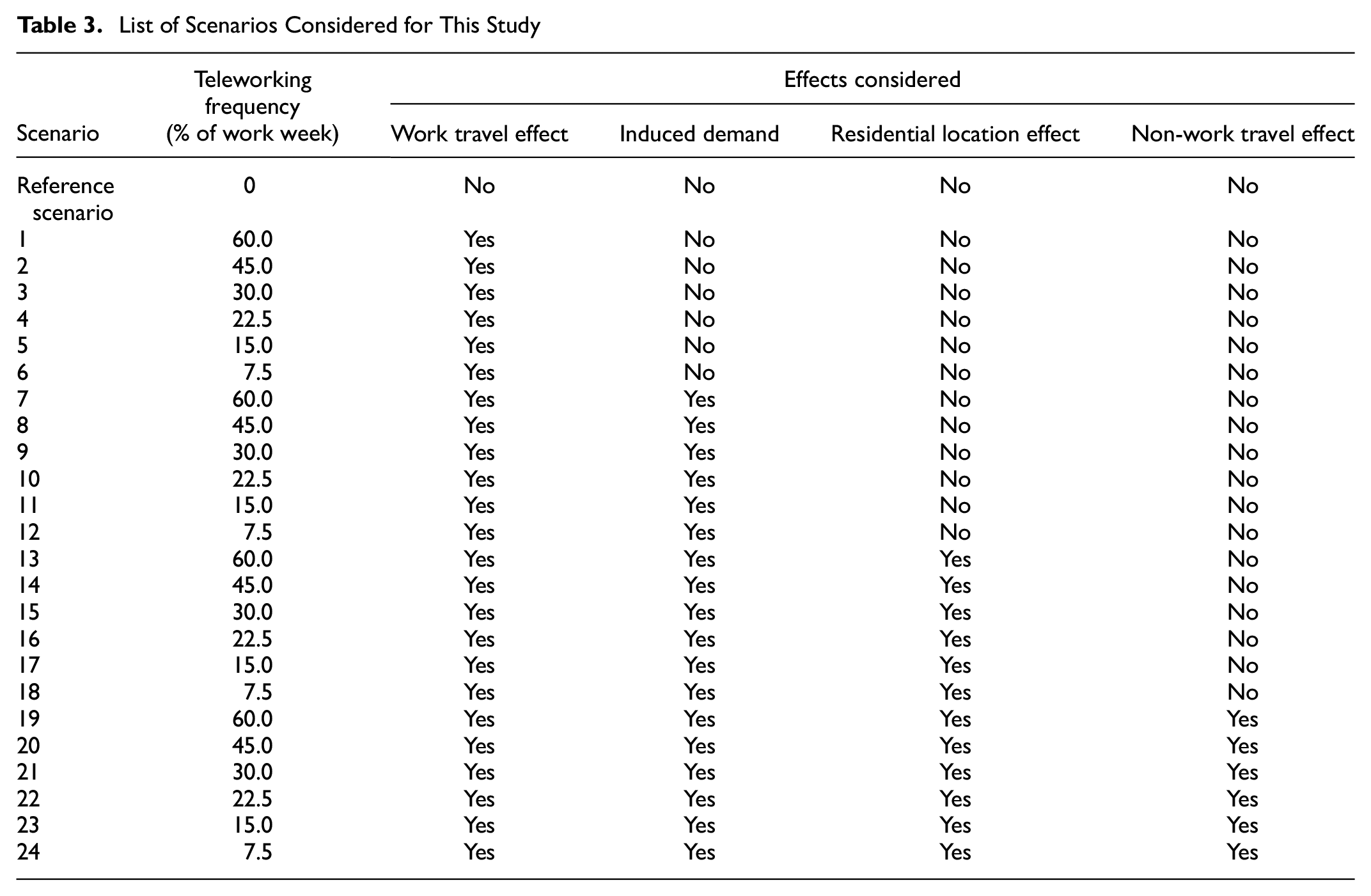
The same procedure is carried out for all the different combinations of direct and indirect effects of teleworking, to produce the list of scenarios given in Table 3:
List of Scenarios Considered for This Study
The order in which effects were introduced into the model was based on the degree of certainty of the magnitude and direction (positive or negative) of effects. In this way, the work travel and induced demand effects were introduced first into the model, since there seemed to be wider agreement about them in the literature, whereas the residential location and non-work travel effects were introduced afterward, since they present similar degrees of uncertainty. The authors nonetheless acknowledge that slight order effects may be present, and therefore that introducing the effects of teleworking in a different order may have led to a somewhat different outcome. Further work would be needed to determine the extent to which this is the case.
The effects for all the KPI’s at our teleworking frequency of 60% are then given as: Work travel effect = Scenario 1–Reference Scenario Induced femand = Scenario 7–Scenario 1 Residential location effect = Scenario 13–Scenario 7 Non-work travel effect = Scenario 19–Scenario 13
Some thought needs to be given to the construction of an appropriate reference scenario. The most natural choice would probably be some base-year level of teleworking. However, since the objective is to evaluate the full potential of teleworking as a travel demand management measure, we instead chose to have our baseline comparison be a situation with no teleworking. Therefore, the teleworking frequency in the reference scenario was set to 0. A difficulty in measurement of induced demand is that most travel demand models do not consider the generalized cost of travel when generating trips ( 16 , 42 ). But it is nonetheless possible to evaluate the induced demand effect of the additional VKT caused by longer trips and modal shifts when decongestion takes place.
Case Study
The Greater Paris Region—better known as Île-de-France —spans over 12,000 km2 with a population of 12.3 million in 2019 ( 51 ). It is the densest French region, with a population density of 1000 inhabitants per square kilometer on average, but which is 50 times greater in inner Paris than in the outer ring ( 52 ). Similarly, the level of teleworking strongly varies with the metropolitan area: before the COVID-19 crisis, the proportion of teleworkers was 18% in inner Paris, but only half that in the surrounding areas ( 18 ). This is largely because a higher proportion of inhabitants of the inner core work in managerial roles as compared with the rest of the region. Nonetheless, the surrounding areas also have higher rates of teleworking relative to the rest of France, in part because of the longer commuting times in the region ( 53 ). The Paris region is divided into 1289 traffic analysis zones (TAZ) in MODUS, thus forming a travel demand matrix of 1289 × 1289 origin–destination pairs.
Results and Discussion
The simulation was run in MODUS for the model morning peak (6–10 a.m.) and evening peak (4–8 p.m.) periods, and the results aggregated.
Travel Times
Increased teleworking does decrease the overall traffic level for the private vehicle mode, but significantly less than one might have expected. The work travel effect reduces VHT by 17.1%, but once rebound effects are integrated it falls to 2.5%. The rebound effects therefore reduce the gains in VHT by 74%–85%, depending on the teleworking frequency.
One can see that the direct effect of teleworking is that work trips are eliminated from the generation stage (Figure 2). This however causes the other users of the transport system to make longer trips and travel more by private car (induced demand). Furthermore, the teleworkers themselves carry out significant amounts of non-work travel, which adds additional trips to the transport system that would not otherwise have been there had they not teleworked (non-work travel effect). The average home–work distance of teleworkers also increases, leading to longer commutes and additional time spent in the transport network (residential location effect). Therefore, the overall effects that are observed indicate the significance of the rebound effects. Though the work travel effect by itself leads to a very significant reduction in total travel time, when the contribution of the rebound effects is considered, the overall reduction is much less significant.
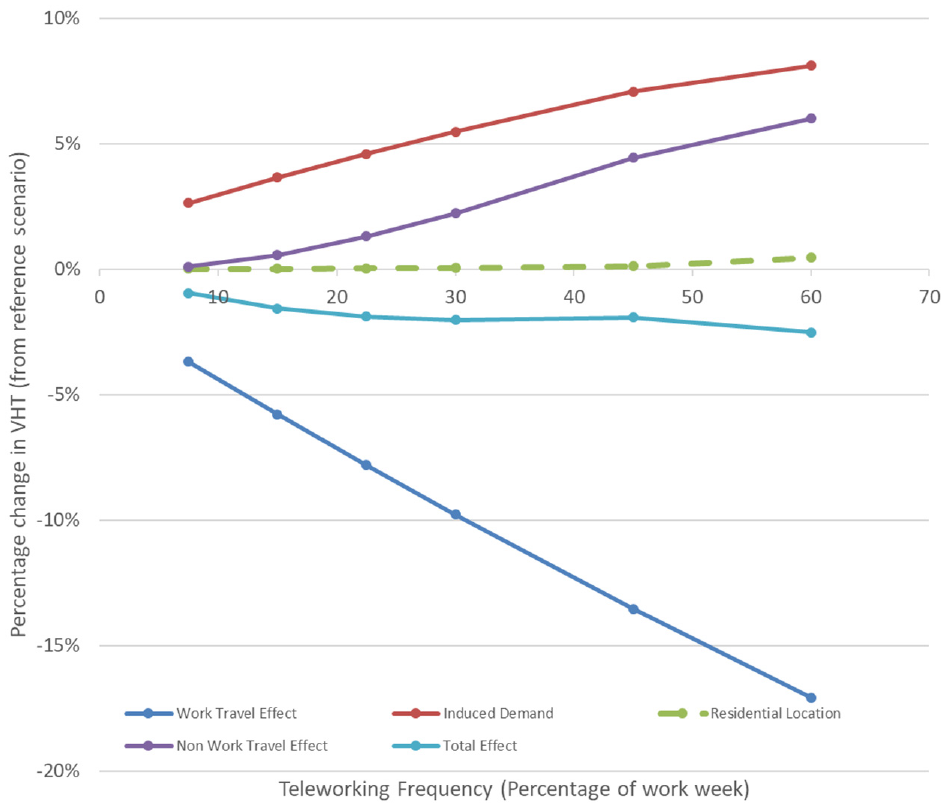
Effect of teleworking on travel times.
The rate of change of VHT with change in percentage of the work week spent teleworking seems to decrease with an increase in the rate of teleworking. The effect is mild, however. The principal reason for this is that congestion is concave, which means that one experiences decreasing gains with decongestion. Also, the non-work travel effect only becomes significant at high frequencies of teleworking.
Induced demand is the most significant rebound effect at all levels of teleworking: it contributes an 8.1% increase in VHT for the highest teleworking frequency. This shows that the response of other users contributes more to limiting teleworking’s effectiveness than the change in behavior by teleworkers themselves, which is to be expected since non-teleworkers vastly outnumber teleworkers.
The distance effect on VHT is so small as to be almost unnoticeable from the graph above. At the highest teleworking frequencies of 30%, it represents an increase of only 0.5% in the VHT. This result can be explained by the distance chosen to represent the relocation effect—3.1 km—being in reality quite small compared with the average commuting distance, which in Île-de-France varies between 9.6 km and 13.5 km, depending on the trip purpose. Only a small part of the population increased their home–work commute by less than a third, which meant that the residential location effect was ultimately insignificant compared with the other two effects. There was also potentially a speed effect in action: longer trips meant faster speeds, since travelers were more likely to use highways when making them.
This finding echoes that of Shen ( 13 ) who investigated the effects of substitution of ICT for travel. Their findings were that it required very high levels of substitution for the residential location flexibility to become significant. It is also similar to the finding of Coulombel et al. ( 54 ), who studied the various rebound effects caused by urban ridesharing using an Integrated Transportation–Land-Use Model. They similarly found that the residential relocation effect was virtually insignificant, even as the ridesharing reduced the VHT by more than 10%. Their finding was that even at high levels of decongestion people will not change their residential location; this paper’s finding, conversely, is that even if people do change their residential location, the decongestion effect is unlikely to be substantial.
This 2% reduction in total travel times for a teleworking population of approximately 41% of workers can be compared with values obtained from the literature. Shabanpour et al. ( 24 ) obtained a 2.1% decrease in total travel time when the proportion of teleworkers increases from 12% to 50% of the workforce.
Travel Distances
As for travel distances for the vehicle mode, teleworking leads to a significant reduction in VKT when only considering the work travel effect, but which is strongly mitigated by the various rebound effects (Figure 3). In this case, the work travel effect leads to a reduction of 9.6% in VKT, but once the rebound effects are integrated the overall reduction is only 3.2%. The gains lost are between 62% and 68% of the total work travel effect, depending on the teleworking frequency.
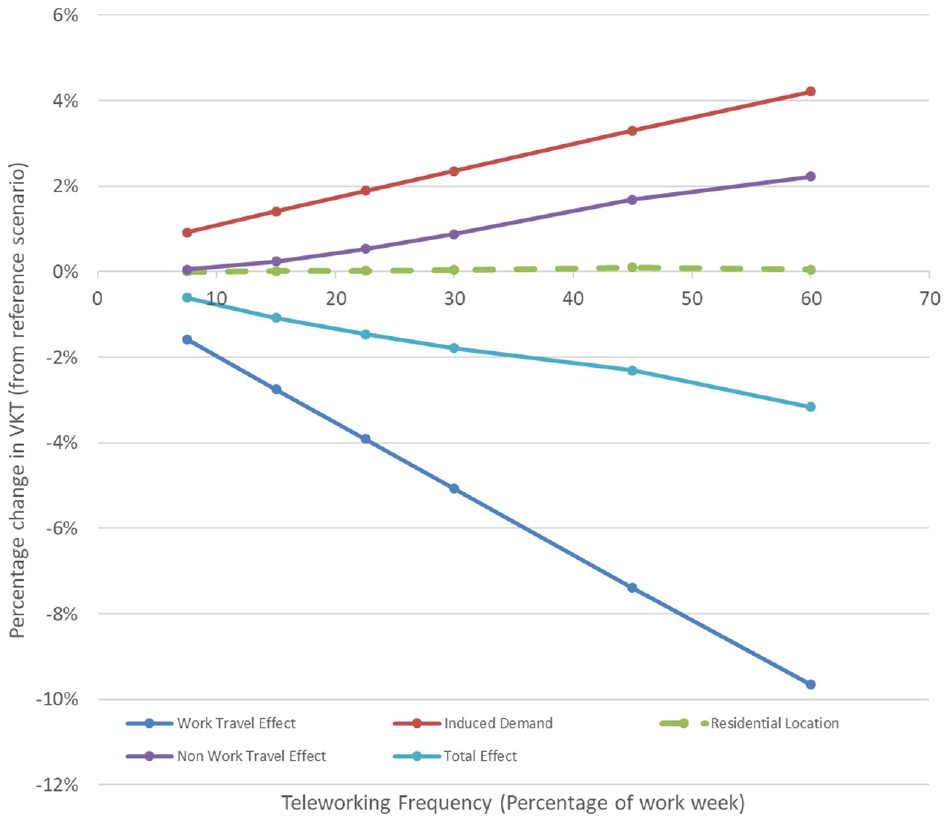
Effect of teleworking on travel distances.
Both the impacts on VKT and those on VHT are convex (Figure 4); however, the impact on VHT is more convex, since it includes both the effect of fewer trips and that of higher speeds, and speed improves less and less as there is less and less congestion. As a result of its higher convexity, the two curves cross each other, with gains in VHT being higher than those in VKT at low teleworking frequencies and lower at high teleworking frequencies.
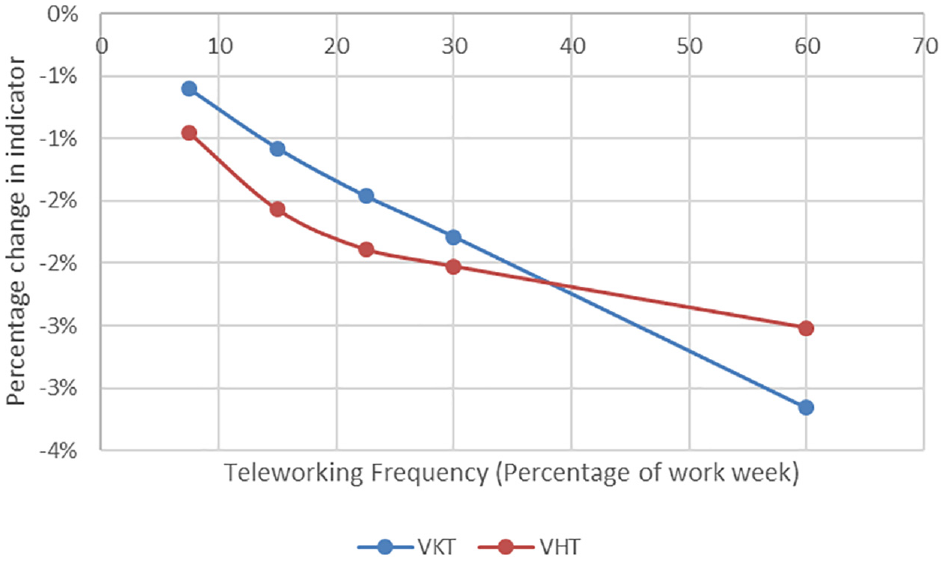
Comparison of vehicle-kilometers traveled (VKT) and vehicle-hours traveled (VHT) changes with teleworking.
The results of this study are fairly similar to those obtained from the literature (Figure 5), but they are lower. Notably, a significant number of studies show increases in the total travel distance as the level of teleworking increases. There are numerous potential reasons for this, one of the most likely being that there are rebound effects beyond the induced demand, non-work travel, and residential location effects that have a significant impact on teleworking. The inability to model effects whose nature is not well understood is, however, a fundamental limitation of all transport models.
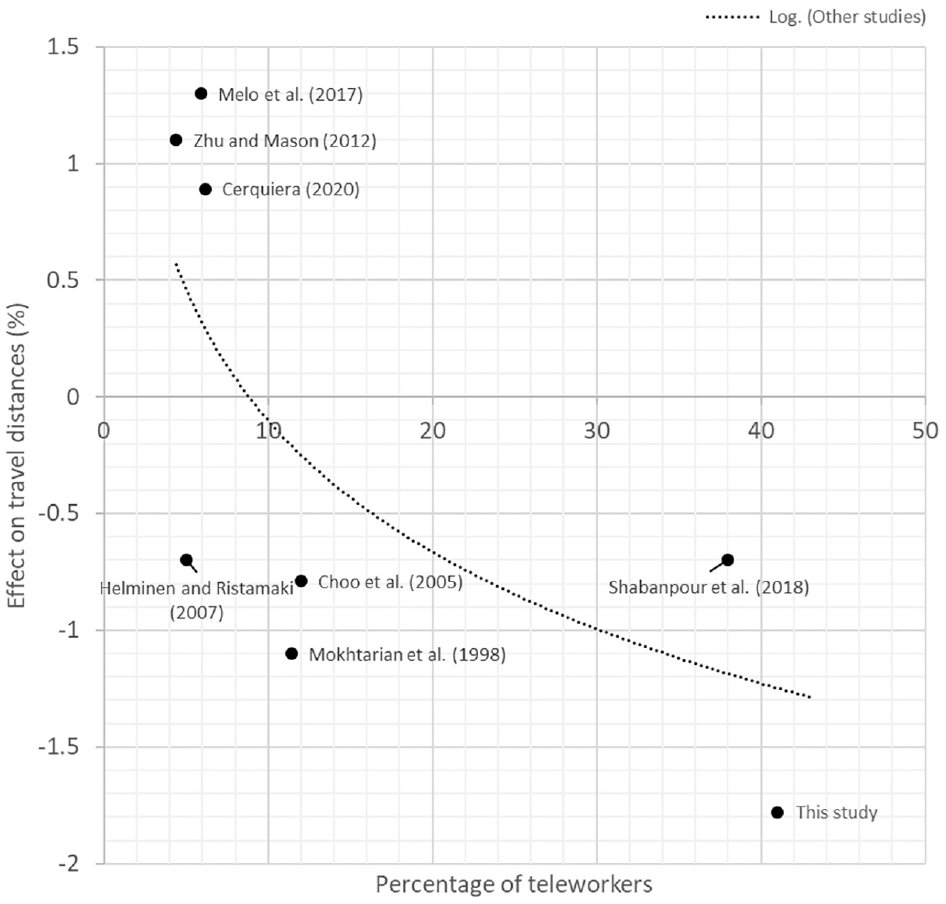
Comparison of vehicle-kilometers traveled (VKT) results with other studies.
Socioeconomic Evaluation
The results of the socioeconomic evaluation are presented in Figure 6. They show that applying current reference values, teleworking results in a social net value of 191,076€ for the sum of the two peak periods, when all effects are integrated. This translates to roughly 1.3 M€/day in surplus gains for the society, assuming the usual rates of conversion from peak hour to daily traffic for the Île-de-France region.
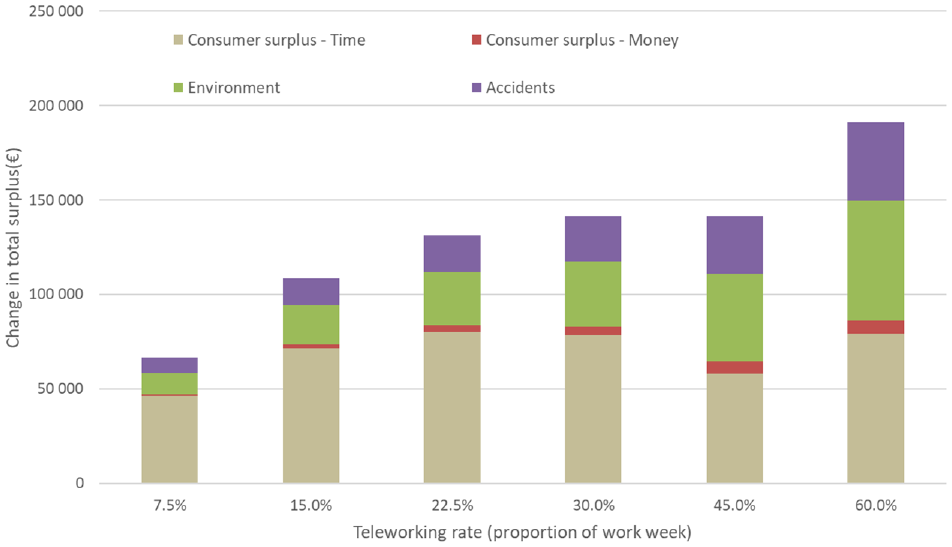
Cost–benefit analysis results (sum of morning and evening peak hours).
This figure is composed of 71% increases in consumer surplus, with the rest coming from decreases in externalities at the lowest teleworking frequency, while at the highest frequency the contribution of consumer surplus increases is only 45%. This is in keeping with the relative variation of the VKT and VHT reductions: the increases in consumer surplus are mostly tied to the decreases in VHT, while the decreases in externalities are mostly tied to the decreases in VKT.
Coulombel et al. ( 55 ) give a figure for the aggregate generalized costs of road transport of 90M€/day in the Paris region. If implemented at the rates assumed in this study, therefore, teleworking would be able to reduce the social cost of road transport by roughly 1.4%, a far from insignificant figure, yet at the same time slightly underwhelming considering that the rates of teleworking considered for this study far outweigh any observed for the French capital before the COVID-19 crisis. Furthermore, the majority of gains observed at lower teleworking frequencies (which are likely to be more attainable) are in the form of increased consumer surplus, which means that teleworking might in reality largely benefit road users, who are already heavily subsidized under the current tax systems in many countries ( 56 , 57 ).
The figures obtained from the socioeconomic evaluation do not include the costs and benefits tied directly to the choice of teleworking. In reality, those who telework do so because its total generalized cost is lower than the alternatives. Therefore, tied to the choice of teleworking are costs and benefits that should be considered in a CBA.
One can speculate on the effects that teleworking has on productivity, and therefore on the results of the CBA. Several empirical studies have shown that teleworking may lead to increased productivity ( 22 , 58 ), largely because of working more hours when working from home than when working from the office. On the other hand, economic theory suggests that reduced interaction between workers should also lead to reduced productivity ( 28 ), an idea supported by studies emphasizing the role of copresence on knowledge sharing and therefore on productivity ( 59 ). For this study, the two effects were assumed to cancel out, leading to no net effect on productivity.
Conclusion
This paper estimates the effects of teleworking on the urban transport system by indicators of travel demand (VHT and VKT) as well as the total social benefits arising from teleworking. The effects of teleworking are separated into the direct effect (the work travel effect) and several rebound effects (induced demand, non-work travel effect, and residential location effect). The value of each rebound effect is estimated, as is the total effect arising from their combination.
The direct effects of teleworking are found to be very significant, leading to reductions of 17.1% and 9.7% in VHT and VKT respectively at average teleworking frequencies of 60%, or three days per week, among those whose jobs were teleworkable. Once the various rebound effects are integrated, however, these gains are reduced to 2.5% and 3.2% respectively. In spite of these rebound effects, teleworking is nonetheless estimated to lead to social benefits of approximately 1.3 M€/day to the transport sector, primarily through relieving congestion and reducing transport externalities.
The principal limitation of this study is the consideration of teleworking as an exogenous parameter. Under normal circumstances, teleworking is a choice made by workers based on their evaluation of its benefits and costs; integrating this evaluation would enable a more realistic estimation of teleworking rates. It would also have an impact on the results of the CBA.
Another limitation is the decision to focus on private vehicles, since this is the mode that is most precisely simulated in MODUS. However, the highest proportion of teleworkable jobs were found in areas well served by public transport, meaning this was the more heavily impacted mode ( 23 ). It would be necessary to repeat this exercise with a model that more precisely simulates public transport.
Given the significance of the rebound effects, the key policy question is what complementary measures can be taken to maximize the benefits of teleworking and reduce its unintended consequences. Policies that reduce the attractiveness of the private car mode, such as road pricing and reduced road capacity, have been shown to have high synergy with teleworking ( 4 ) and be particularly effective against the rebound effects observed in this study ( 54 ). Future studies should seek to examine the effectiveness of policy mixes that combine teleworking with measures such as these.
In spite of its significant rebound effects, teleworking—and indeed travel demand management as a whole—undoubtedly plays a role in any policy mix that aims to reduce the externalities induced by the transport sector ( 4 ). However, a greater awareness is necessary on the part of policymakers of these effects and the appropriate ways to mitigate them. More and better-quality primary data would undoubtedly aid them in designing suitable policies, as would the operationalization of demand models that are more sensitive to the effects of teleworking. In addition, the users of the transport sector have their role to play; behavioral change is not easy, but in light of the challenges facing this sector and the world at large it is necessary.
Supplemental Material
sj-docx-1-trr-10.1177_03611981231182973 – Supplemental material for Evaluation of Direct and Indirect Effects of Teleworking on Mobility: The Case of Paris
Supplemental material, sj-docx-1-trr-10.1177_03611981231182973 for Evaluation of Direct and Indirect Effects of Teleworking on Mobility: The Case of Paris by Mwendwa Kiko, Nicolas Coulombel, Alexis Poulhès, Tatiana Seregina and Guillaume Tremblin in Transportation Research Record
Footnotes
Acknowledgements
The authors acknowledge the Île-de-France Regional Department for the Environment, Planning and Transport (DRIEAT IF) for providing data and technical support on the MODUS model.
Author Contributions
The authors confirm contribution to the paper as follows: study conception and design: M. Kiko, N. Coulombel, A. Poulhès, T. Seregina, G. Tremblin; data collection: M. Kiko, G. Tremblin; analysis and interpretation of results: M. Kiko, N. Coulombel, A. Poulhès, T. Seregina; draft manuscript preparation: M. Kiko. All authors reviewed the results and approved the final version of the manuscript.
Declaration of Conflicting Interests
The author(s) declared no potential conflicts of interest with respect to the research, authorship, and/or publication of this article.
Funding
The author(s) disclosed receipt of the following financial support for the research, authorship, and/or publication of this article: This work was funded by the Lab Recherché Environnement Vinci ParisTech.

Data Accessibility Statement
The data that supports the findings of this study are available from the Direction régionale et interdépartementale de l’environnement, de l’aménagement et des transports (DRIEAT) Île-de-France. Restrictions apply to the use of these data, which were used under license for this study. Data are available from the authors with the permission of the DRIEAT.
Supplemental Material
Supplemental material for this article is available online.
References
Supplementary Material
Please find the following supplemental material available below.
For Open Access articles published under a Creative Commons License, all supplemental material carries the same license as the article it is associated with.
For non-Open Access articles published, all supplemental material carries a non-exclusive license, and permission requests for re-use of supplemental material or any part of supplemental material shall be sent directly to the copyright owner as specified in the copyright notice associated with the article.
