



Abstract
Young ethnic minority women face unique challenges when riding public transport. The present study contributes by providing a narrative-based examination of young ethnic minority women’s formation of fear and adaptive behavior when using public transport. Twenty-nine ethnic minority women, under the age of 30, participated in a semi-structured interview in Auckland, New Zealand. Findings show that adaptive behavior commonly includes pre-planning nighttime trips, relying on their phones to act confident and engage in communication with family en-route, and appearing disinterested to reduce unwanted attention. These measures are expressions of women’s agency and their capacity to prevent victimization and manage fear, particularly in places where they feel unsafe, such as empty stations and dark or enclosed environments. Their lived experiences highlight the level of anxiety they experience on a regular basis. Participants discussed how they are acutely aware of their ethnicity (and appearance) when using public transport at all times of the day. They remain near exits and are constantly on high alert. They also discussed how, from an early age, women are educated in a culture of “stranger-danger” which in the long term erodes their confidence to travel independently and safely. These findings show that the current design of public transport systems does not adequately meet the travel needs of certain groups of women. Public transport authorities are encouraged to gain deeper insights into these issues and develop design strategies which promote inclusiveness.
Keywords
In many cities women are more frequent users of public transport. Several reasons contribute to their ridership, including low income, not holding a driver’s license, and having less access to a private vehicle ( 1 ). To date, the majority of the research studies on women and transport have focused on women as a homogeneous group and discussed how perceived safety influences women’s travel behavior. A sub-group of women that have received less attention is ethnic minority women, also termed as women of color, and the barriers they encounter when riding public transport ( 2 ). Studies have shown that ethnic minority women face unique challenges in comparison to women from a Caucasian ethnic background. Ethnic minority women are more likely to have limited access to a private vehicle and are less likely to hold a driver’s license in comparison. This can be a result of religious and/or cultural expectations ( 3 ). Ethnic minority women from low-income households are heavily reliant on existing public transport services even if the services are inefficient and unsafe. From the few studies ( 4 ) that have been undertaken, it is clear that women of color face different challenges and have a higher sense of unease when riding public transport.
The present study is a follow-up study to a previous study by Chowdhury and van Wee ( 5 ) in Auckland, New Zealand. The study compared women from ethnic minority backgrounds with women from Caucasian ethnicity and found that ethnic minority women are more anxious by comparison even during daytime trips. Similar findings were discussed by Garcia et al. ( 2 ) that women of color feel more targeted because of their ethnicity. Age is another socio-demographic factor which has an influence on the group of women more likely to experience harassment. Young women are more likely to be targets compared with older women ( 6 ). As such, the present study looks at a specific group of women—young women from ethnic minority backgrounds and those who are regular riders of public transport. Ethnic minority is defined as those who identify themselves with an ethnicity other than New Zealand European or any other Caucasian ethnicity. It explores the formation of fear in ethnic minority women when riding public transport and their adaptive behavior to self-protect and attempt to reduce chances of victimization. Adaptive behavior is a response to perceived risk of or actual experiences of crime and leads to modified behavior in travel ( 7 ). Pedersten ( 8 ) found that in the early 20th century, women would carry hatpins up to 12-in. long to defend themselves against aggressors. Over the last century, women have been reshaping their public lives through tactical adaptation and improving their independence in society. However, threats of sexual harassment and violence strongly remain in the public transport domain and still curb women’s freedom of mobility.
Data collection for the present study was undertaken in Auckland, New Zealand. Auckland is New Zealand’s most ethnically diverse and metropolitan city ( 9 ). A majority of people in Auckland cite New Zealand European as their ethnicity. The city center is an educational hub with two large universities and many small-size institutes which attracts many students. This makes the city an ideal case study to examine the adaptive behavior of young ethnic minority women when riding public transport. Specifically, the research questions asked for this study are: a) how do socio-cultural norms (such as opinions of friends, family and social media) shape young women’s perceived safety and formation of fear of using public transport? and b) to what extent do environmental and social factors (antisocial behavior) have an influence on their adaptive behavior? Through semi-structured interviews, based on a small sample of young ethnic minority female public transport riders, the study examines their past experiences, conversations with family/friends on safety, their travel decisions, and reactive risk management strategies (adaptive behavior). Narratives from these young women explain the barriers they encounter and their general perception of a woman’s agency when traveling independently. The following section provides a summary of relevant literature on factors which influence perceived fear and women’s experience using public transport. We then provide a summary of the data collection process, before explaining the results. This is followed by a discussion of the results before the conclusions and some recommendations for future direction.
Literature Review
Most ethnic minority women and those who are immigrants rely heavily on public transport ( 8 ). Amar and Teelucksingh ( 10 ) stated that 44.8% of non-Western immigrant women in Canada ride public transport, compared with only 28.2% of immigrant men. Uteng ( 11 ) examined how cultural norms in Norway contribute to immigrant women’s management of their daily trips. Factors such as low income, location of household, and being poorly educated contribute to their social exclusion. A limited number of studies have identified that ethnic minority women experience heightened fear on public transport ( 3 , 12 ). In addition, ethnic minority women living in areas of lower income are more fearful when riding public transport from their residential suburb ( 13 ). Garcia et al. ( 2 ) emphasized that there is not enough scholarly research on women of color and their experience of using public transport. It is understood that women of color are subject to attacks which are racially motivated, not only for their gender. This makes ethnic minority women more vulnerable, in comparison to women from Caucasian ethnicity, as a result of their appearance. Fear is a subjective experience and marks the ways in which women are able to carry out their daily travel needs, enjoying freedom and public spaces. Through this, fear limits women’s participation in society and their access to opportunities, accentuating inequity in cities ( 8 , 14 ).
One of the main causes of fear for female public transport riders is the fear of victimization, in particular of sexual harassment and violence. Many studies have discussed how women often encounter harassment, a mixture of confrontational and non-confrontational, when riding public transport. Sexual harassment encompasses a wide number of behaviors that can include verbal (sexual comment), physical (groping, unwanted touching), and exposure to indecent photos or behaviors ( 15 ). Some acts such as complimenting, which may seem harmless, are forms of harassment that make women feel uncomfortable ( 16 ). The fear of harassment and of becoming a victim can constrain how a woman travels and be the primary decision-making factor ( 17 – 19 ). Most women are afraid of traveling alone and at night, thereby limiting their access to public transport services ( 17 , 20 ). Real or perceived, evidence indicates that fear of harassment decreases their mobility ( 21 ). Any experience of harassment or assault can increase levels of fear and create a cycle of insecurity among women ( 17 , 22 ). Kash ( 23 ) outlines how women who have been assaulted in the past experience heightened situational awareness as well as being in a state of hyper vigilance. The impacts of sexual assault have a long-lasting effect on passengers’ daily journies that goes beyond a single journey. A major issue that authorities struggle with is that many public transport harassment cases are unreported. Very few cases are typically reported by victims. Ding et al. ( 4 ) stated that only 4% of cases are reported by victims and 9% by witnesses. This means that although authorities are aware of the issue, they may underestimate its significance. Ceccato and Loukaitou-Sideris ( 24 ) recommended a tool that local authorities can use to determine the dynamics of the concerned public transport environment. Using technological solutions such as CCTV, drones, and various mobile applications, authorities can collect data to understand the issues in detail.
A woman’s ability to move freely from origin to destination can be limited by the constant worry of making the “wrong” choice ( 3 ). Fear can be heightened by disorder in the environment. Certain environmental factors, such as isolated stations and dark alleys, can evoke fear of victimization for women. The time of day while waiting at public transport stations affects fear, namely early morning or late evening as a decrease in visibility increases risk ( 16 , 25 ). Areas with poor lighting, minimal exits and enclosed areas are factors in the formation of fear given the potential for unnoticed attacks and the lessened ability to escape ( 15 ). Bright lighting at stations can also have adverse effects if it draws unnecessary attention ( 3 ). Crowded areas often subject women to higher levels of fear as they create an opportunity for physical harassment ( 17 ), while desolate stations can also heighten fear because of the lack of witnesses in the event of an attack ( 26 ). Underground facilities also evoke more fear as they are closed and dark compared with ground level stations. Additionally, multistorey structures such as car parks evoke similar fear given their constrained nature ( 13 ).Visually unappealing areas, such as areas with graffiti, litter, and run-down buildings can create a feeling of unease as they suggest that crime occurs commonly in the neighborhood. Antisocial behavior such as the presence of drunk people, loud passengers, and passengers who minimize the amount of space for women to sit through elbowing and stretched legs can increase their feelings of fear ( 16 ). The presence of beggars and homeless people can also contribute to lessened feelings of security ( 17 ). A few studies ( 15 , 27 ) have investigated women’s precautionary and avoidance measures. Adaptive behaviors commonly adopted by women include getting off the vehicle at an earlier stop, moving to a safer space in the station or vehicle, standing with other women, and placing their bag to avoid unwanted touching ( 27 ). Many women avoid certain routes at particular times of day, traveling after a certain time of day, and rely on the support of friends and family for nighttime travel. Although it provides some level of empowerment for women to protect themselves, overall, it restricts their freedom of movement and participation in opportunities or activities.
Another main contributing factor to the formation of fear is warnings by family and friends and stories in the media. In the 19th century, it was only considered appropriate for women to enter public spaces during the daytime with a companion, in part as a result of concerns about safety ( 3 ). Remnants of this attitude exist today and perceptions about the vulnerability of women restrict their freedom to access public spaces. Wesely and Gaarder ( 1 ) discussed the perception that safety is deeply rooted in cultural norms and values. Loukaitou-Sideris ( 26 ) highlights how parents, media stories, and advice from police emphasize the threat of crime in public spaces. Young girls are often denied access to public spaces by parents because of the threat of sexual harassment and these attitudes can last into adulthood. Second-hand experiences with sexual assault can also influence perceptions of safety on public transport ( 23 ).
Data Collection
Auckland City
The data were collected in Auckland, New Zealand’s most urbanized city with a population of 1.6 million and the most ethnically diverse city in the country ( 28 ). The median age of those living in Auckland is 35 years. The median household income is $76,500 per annum, which is the highest for all regions in the country ( 28 ). Auckland is located on the north island of New Zealand. Auckland’s public transport system includes bus, train, and ferry services. Women’s average annual income is around $37,900. Around 63% of women of working age are employed, with 5.3% unemployed. The gender income gap has improved, but still exists at 9.4% for the median hourly wage. Overall, women are under-represented in higher-paid jobs and mostly work in lower-paid jobs in the health and social sector ( 29 ).
Recruitment of Participants and Interview Process
Participants were recruited, after approval from the university’s Human Ethics Committee, by an advertising poster on Facebook, Alumni groups, and word of mouth. Google forms were used to screen individuals who expressed interest in the survey. The screening questions included gender, ethnicity, and frequency of public transport use. They were asked to include their e-mail address. Only participants who used public transport at least once a week and were women from an ethnic minority background were selected for an interview. The potential participants were then invited via e-mail, and meetings were organized for the interviews. The duration of the interviews was around 1 h for each participant. The semi-structured interviews took place during lockdown and just after lockdown restrictions were lifted in Auckland, New Zealand between May and August 2020. The lockdowns made it difficult to reach potential respondents and affected the final number of participants. On June 8, 2020, all restriction related to Covid-19, except international border controls, were removed. By the time the participants were recruited, people were moving freely without a mask and public transport services had returned to normal. Some of the interviews were still carried out online for convenience. Most were conducted in person at the university campus. Although age was not explicitly asked in the interview, all participants were between 18 and 30 years old. Written consent was sought from the participants before each interview began and was recorded. The transcriptions were sent back to the participants for review before being used for analysis. The NVivo software was used to carry out the thematic analysis. The process of coding for NVivo began with a set of descriptive codes which were based on the semi-structured interview questionnaire. The suggested themes from NVivo were further sub-categorized into social and environmental factors for formation of fear and adaptive behavior employed by the participants.
A key benefit of the semi-structured interview is that it allows conversations to uncover details that are not explicitly covered by the questions. In addition, semi-structured interviews allow for an empathetic type of interview, in which the interviewer can change their stance from neutral to in favor of the interviewee ( 30 ). Given the topic of this study, this approach was favorable to make the participants feel at ease and allow them time to discuss their lived experiences. The questionnaire was used as a guide and had four sections: (a) socio-demographics (number of years living in New Zealand, wearing religious attire, and ethnicity); (b) trip characteristics (journey time, walking time to station, waiting time, and journey time); (c) socio-cultural norms; and (d) environmental and social factors. Questions in the semi-structured interviews were designed to prompt discussions. Table 1 provides the key questions and pictures shown to participants for Question 5, 6, and 7 to contextualize the environmental factors along with follow-up questions.
Semi-Structured Interview Questions
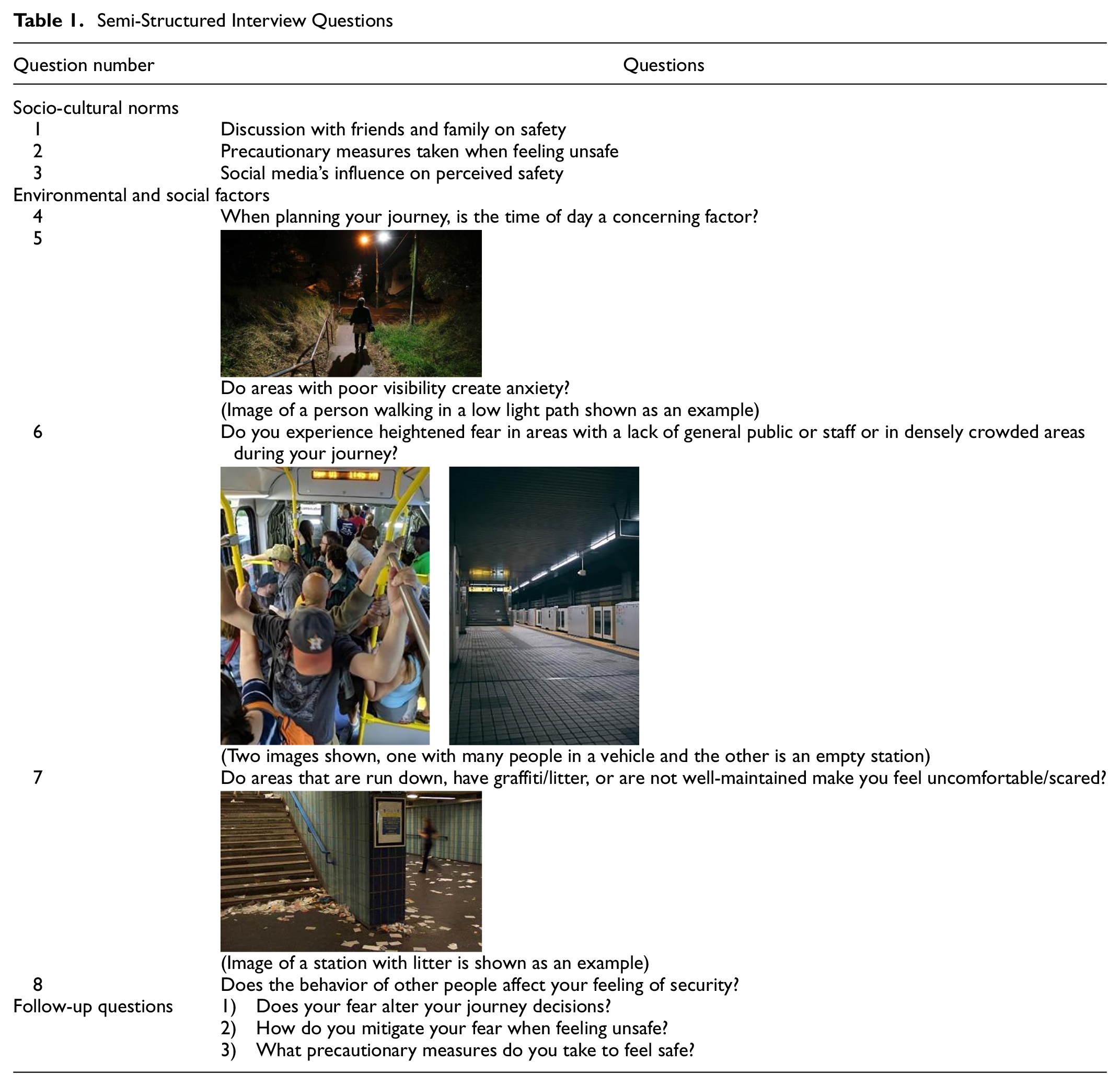
The focus of the questions was on participants’ past experiences and did not include their use of public transport during the Covid-19 pandemic. The reason for this exclusion is to keep the scope of the study focused on ethnic minority women’s general experience of using public transport.
Participants
A total of 29 women participated in the study. Guest et al. ( 31 ) identified that thematic saturation is reached between seven to 12 interviews. However, Hennik et al. ( 32 ) found that code saturation is reached at nine interviews, and 16 to 24 are required for saturation. Code saturation is when all themes are uncovered, and thematic saturation occurs when all themes are revealed. Most of the participants had lived in New Zealand for more than 20 years (20 participants) and nine participants had lived in New Zealand for at least three years. Only one participant had religious attire (hijab). The sample size also represents mostly Asian (10 participants) and Southeast Asian (14 participants) women. Two participants identified as Pacifica and two were from the Middle East. This is representative of Auckland’s population. Around 15% of the population identified themselves as being from an Asian ethnic group; the largest minority group ( 33 ). Of the 29 participants, five were recent graduates, with most participants stating they were university students. The majority of the participants’ destinations was the city center, in particular the university campus. Figure 1 shows the trip-origin of the 29 participants. These are well distributed geographically in the Auckland Region.
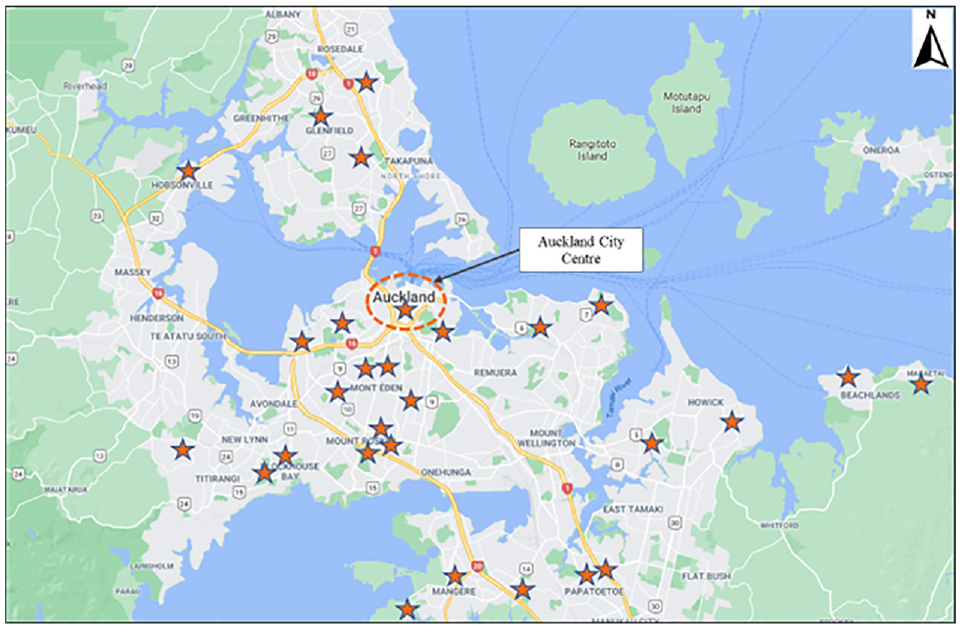
Origins of public transport journeys in Auckland City.
Bus was the most common mode of public transport used by the participants (62%). Only nine participants typically make a transfer, and their average transfer waiting time is 10 min. Fifteen participants wait for the first vehicle for 10 min or less. Most participants walk to their station/stop, which takes 5 to 10 min. One participant walks for 20 min, and five participants are dropped off by a family member. Most participants’ (19 out of 29) typical journey time is between 30 and 45 min, while only four participants’ journey time is more than 45 min and six ride less than 30 min.
Results
General Perception of Safety at the Intersection of Age and Ethnicity
When participants were asked about the perceived safety of their daily public transport journeys, most stated “somewhat safe.” Many of the participants compared Auckland’s public transport services to their home country and discussed their experiences. P18 stated “Before I came to New Zealand, I was taught how to protect myself. People will say, if you walk in the street with poor lighting in the area and no one is around you, you should look straight ahead and avoid looking around to show that you are not afraid. Put your hands in yours pockets to show that you have something to protect yourself with.” P06 said: “….I remember when I was 15 years old, a homeless guy started making racial comments at me. This experience has stayed with me.”
Participants were asked to select the reasons which prevent them from using public transport more often. Most participants discussed operational issues such as unreliable and infrequent services, slow journey time, and overcrowded vehicles. Participants discussed the common barriers they encountered on a typical journey. Along with environmental factors such as isolated and poorly lit stations, they also mentioned antisocial behaviour (e.g., drunken people) as a hinderance to their trip and perceived safety. Only a few participants (<5) mentioned verbal and physical harassment as a safety issue.
Influence of Socio-Cultural Norms on Formation of Fear and Adaptive Behavior
To determine the impact of socio-cultural norms on participants’ perceived safety, they were asked about discussions with friends and family, and the influence of social media on their perception of the safety of riding public transport. They were then asked to describe any adaptive measures they employ when feeling unsafe. Most (22 out of 29) participants have had discussions about travel and safety with their friends and family. In the interviews, they discussed how family members’ opinions and perceptions of safety have had a significant impact on their own formation of perceived safety. Parents often gave specific gender related warnings to the participants. As described by P05: “…being an Indian woman, you are told not to go out too late or not to come home too late. We are told we can’t protect ourselves. Although I am confident that I can protect myself, I would not want to put myself in a position where I have to.” Participants explained that many of the warnings and restrictions their parents placed on them would not apply nor would be heavily enforced on their male siblings. The main message of most warnings is to take precautions to avoid nighttime travel or traveling alone. “My parents always tell me not to take the bus at night. You are traveling alone, you can’t take the bus at night by yourself” (P03). One of the key themes from all the discussions is that most participants had an agreement with their family that if they are coming home at night, someone would pick them up from the station. “If I’m traveling at night, I wouldn’t walk home, my dad would pick me up at the bus stop. It is an ongoing discussion with my parents because they refuse to let me take public transport for night trips. They are worried about the people and poor lighting” (P10). Others showed concern about belongings and not attracting attention to themselves, as discussed by P08 “…don’t look at people, don’t like make eye contact. Make sure you have all your belongings in front of you.”
The impact of social media was found to be less uniform among the participants. For those who heard stories, it had a strong influence on their perceived safety. “I hear a lot of stories about women being harassed and it freaks me out. I’ve known quite a few people who had experiences involving random strangers coming up and talking to them for no reason” (P15). Another participant said that she felt anxious in areas with graffiti and litter and thinks this is an influence from media showing such areas to have high crime rates. For a few participants, some stories led to a clear change in their behavior. P23 read a story of a bus driver harassing a woman and since then, she sat away from the driver.
Participants were asked to discuss any adaptive behavior from the warnings received from parents and any influence from social media. The most common response was revealing their location to friends and family using their mobile phone. “I always text where I am; constantly monitoring my precise location. My sister and I track each other using our phones.” (P06). They stay vigilant about their surroundings, as described by P13: “I always stay alert. If I’m on the bus, I make sure that I’m aware of my surroundings and where I am.” Others discussed their adaptive behavior to include placing themselves around formal and natural surveillance. “If I’m going to ride the train late at night, then I will try to sit somewhere where there are more people around or near the train warden to be more visible. If I’m waiting for the train, I’ll sit where there is a security guard and find a place visible to the public” (P24). Around 12 participants stated that they limit their mobility at night and avoid using public transport.
Impact of Environmental and Social Factors on Formation of Fear and Adaptive Behavior
A summary of the key themes relating to environmental and social factors and the corresponding adaptive behavior are provided in Table 2. The numbers indicate the frequency with which the theme was discussed by the participants. Fear of harassment was a common theme across all the factors with particular emphasis during nighttime trips and when face with uncivilized behavior by other passengers. Other themes related to the formation of fear include feeling isolated and vulnerable, lack of surveillance, and lack of exit options. Participants discussed feeling uncomfortable, with some feeling trapped in crowded areas. Time of day was an important determinant in their travel decisions, with most discussing the difficulty of surveying their surroundings at night. Most of the participants maintained a state of high vigilance (“high alert/on guard”) and stayed in contact with a friend or family en-route.
Key Themes for Environmental and Social Factors in Formation of Fear, and Adaptive Behavior
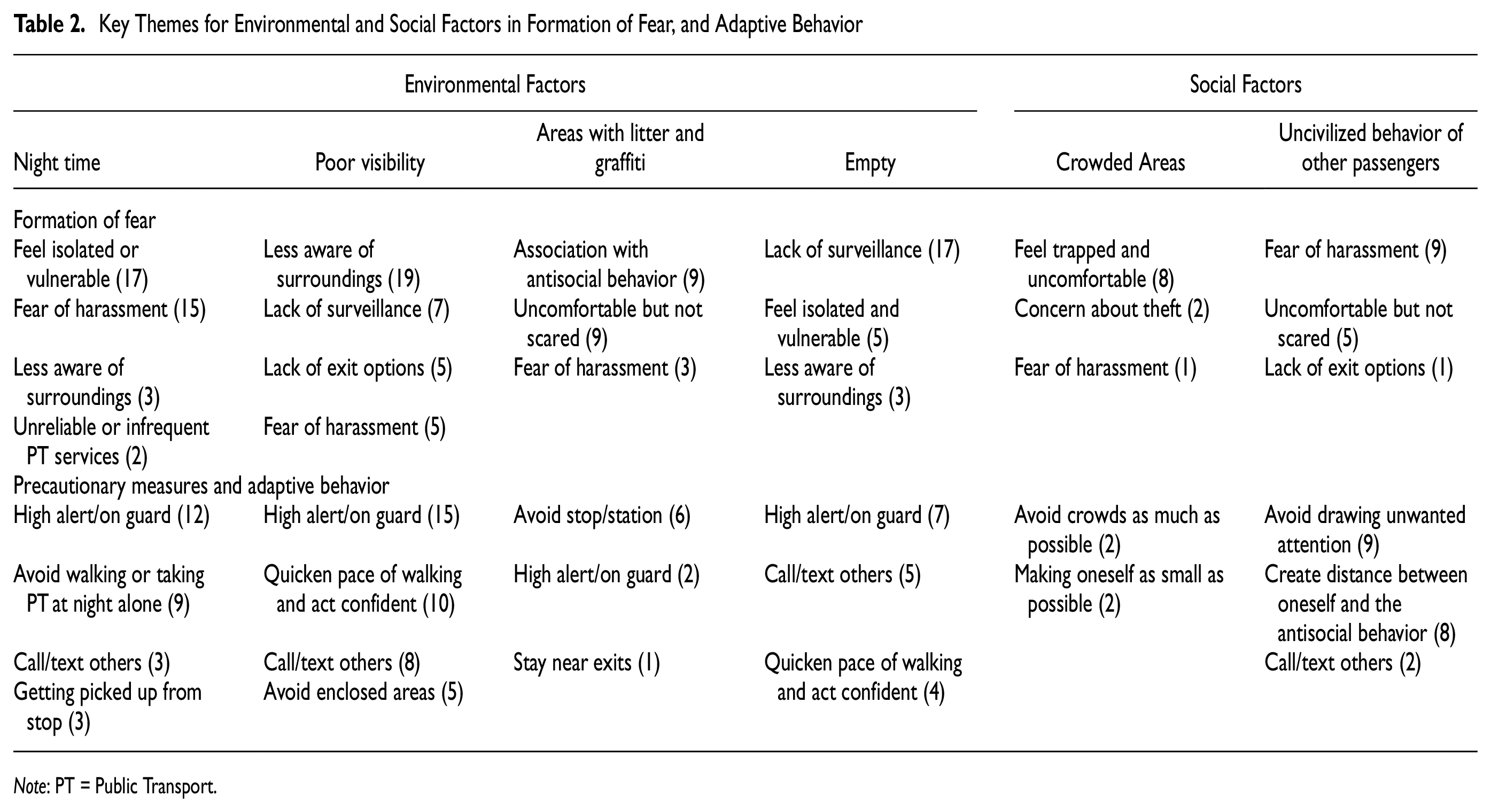
Note: PT = Public Transport.
Visibility and Lighting
Participants were asked about their experiences of using public transport at night when visibility was poor. A majority of the participants (19) said that it was difficult to survey their surroundings at night. Participants noted that the presence of other people creates a sense of security through natural surveillance. Participants said that when there are fewer people around at night, it gives them a sense of being isolated and vulnerable, causing them to be on high alert and feel fearful. One participant described it as follows, “…….as the lack of not knowing what’s there and not being seen. You can’t see people and they can’t see you. There is no surveillance” (P14). This heightens their fear of harassment during night time trips. They felt more vulnerable when they wait at bus stops or walk in confined spaces such as underpasses. Unreliable public transport services cause participants to wait longer and this further heightens their feeling of anxiousness at night. “I’m not afraid of using public transport at night but I’m not silly. Low frequency means you’re just loitering about after dark with nothing to do. So why would I put myself in that situation? There’s just not many people around. So, if anything does happen, no one is around to witness or help me” (P21). Participants make adjustments to their behavior by being more vigilant, frequently contacting family members, and walking at a fast pace to leave the station quickly. P6 was told by her parents to “just go straight to where you want to go, don’t behave like you’re afraid, don’t look around.”
Crowded and Empty Stations
Participants were asked about any experiences they had had in crowded and empty public transport stations and vehicles. For crowded stations and vehicles, most participants said that although they would feel uncomfortable at times, they did not feel unsafe and anxious. Nine participants said they felt uncomfortable and 10 participants did not feel scared or uncomfortable in crowded situations. “I feel comfortable in crowds. I feel safer when there are many people around” (P12). Most participants (17 out of 29) felt unsafe in empty stations and in vehicles with few people, with most describing similar reasons for fear as when they were in areas with poor lighting and visibility. Participants discussed concerns around a lack of witnesses and feeling vulnerable. “It’s eerie because nobody is there. There’s no one to ask for help. Or if there is somebody there at night you have to wonder what they could be doing” (P16). Participants explained that one of their resulting adaptive behaviors has been to stay in frequent communication with family members and friends about their location as they progressed through their public transport journey.
Litter and Graffiti
A majority of the participants (19 out of 29) reported that physically intimidating behavior at a stop or station make them feel anxious, but not fearful. Participants said that physical antisocial behavior mirrors the antisocial behavior of people in the area, as described by P10: “…it implies that the type of people that pass don’t care about their surroundings, they don’t care about presenting themselves in a certain way, and if they bother to uphold the law. So, then they’re probably more likely to do something.” Six participants discussed that they adapted their travel behavior by avoiding a stop or station known for its antisocial behavior, and when this is not possible, they stay vigilant during their time there and remain near exits.
Antisocial Behavior
All participants said that antisocial behavior increases their feelings of anxiousness. Antisocial behavior such as drunken or loud speaking male passengers make them feel afraid. Nine participants were concerned about unpredictable behavior of people who attempt to interact with them. P25 recalled her experience mentioning that “when people have come and talk to me, I generally try to be friendly and aim to end the conversation quickly. Because this is a lot easier than the alternative of rejecting the attempt.” Similarly, participants note that they would prefer to minimize interactions with others. P06 explained how she acts unavailable: “I put on my headphones to seem disinterested and less open to making eye contact. I think that if I’m not bothering them, they won’t bother me either.” Most participants also attempt to appear unapproachable by looking away, using their mobile phones, appearing busy, or sitting near the bus driver to reduce feeling fearful.
Discussion
The findings align with those from other studies ( 5 , 13 ) which showed that women approach public transport rides with a certain level of anxiety. This study contributes by providing narrative-based evidence that young women’s perception of safety is strongly influenced by discussions with family members, to the point that arrangements are made with family members to either stay in communication during the journey or to be picked up from a public transport stop/station. Participants said that warnings are gender specific, and that similar warnings are not given to their male siblings. Constant warnings reinforce in young women the perception that they cannot protect themselves and are at risk of being harassed when traveling alone, mostly at night. In ethnic minority families, culture and dependency are significant factors, meaning that parents have a strong influence over a young woman’s travel patterns (Syam, 2014). A common adaptive behavior found is that participants continued to follow warnings from their families even after becoming more independent and moving away from their family home. This is consistent with findings from previous literature (Loukaitou-Sideris, 2011) which found that remnants of attitudes around perceived vulnerability restrict access to public spaces. The results from this study highlight the manner in which young ethnic minority women are taught and warned by their families that they are at risk and must act to always take precautions when using public transport. This type of messaging enforces in women a sense of vulnerability in public spaces. Participants said that stories on socio-media on harassment at public transport services have some impact on their travel decisions. The stories caused them to re-evaluate their decisions and make adjustments to reduce the risk of harassment.
Common themes in discussion with participants on poor environmental and social factors showed that they contribute to young women feeling anxious out of fear of harassment, feeling isolated and vulnerable, and a lack of surveillance. Participants discussed in detail how they achieve a sense of security by observing their surroundings and relying on natural surveillance. Similar findings were found by D’Arbois De Jubainville and Vanier ( 27 ) that women avoid certain times and routes when there is minimal natural surveillance. As such, poor visibility during nighttime was seen to heighten anxiety for young women, particularly when walking home, alone, from a station. Participants said that, at night, there is less natural surveillance with fewer people to witness potential crimes or help if required, adding to their fear of harassment. But, at the same time, participants noted that crowded services were less attractive for their inconvenience rather than personal safety. These findings align with other studies which examined the impact of unkept station environments on perceived safety ( 13 , 19 ). Antisocial behavior such as loud male passengers or drunken men also made participants feel uneasy, and sometimes fearful to the point that they would avoid certain routes and stations at particular times of day.
The adaptive behaviors employed by young ethnic minority women overlap between the warnings they receive from family members and poor environmental and social factors. Participants discussed a series of adaptive behaviors in response to their perceived safety, including being vigilant and walking with a sense of purpose to reduce unwanted attention, relying on devices such as headphones and mobile phones to create an appearance of disinterest for any form of interaction and to appear confident. Behaviors which were unique to young ethnic minority women include a heavy reliance on family for nighttime public transport trips and staying in constant communication with friends or family throughout their journeys. An interesting finding was that, when approached, some participants acted in a friendly manner to avoid conflict. The participants explained that even though they would feel anxious and frightened at the time, they would “….smile through the experience…” to not cause any aggravation. Additionally, many participants discussed how they would plan for potential worst-case scenarios in stressful situations as a risk management strategy to help identify escape routes. As discussed by de Backer ( 34 ), these precautionary measures are a response to mild forms of harassment. Women exercise precautionary measures to protect themselves from these mild forms of harassment and this acts as a form of social control on women’s freedom of mobility.
A limitation of the study is that although the data was collected during the Covid-19 pandemic, the questions in the interview did not include any questions with regard to change in travel behavior. However, factors which influence fear are unlikely to change. Instead, new variables may arise as a result of the Covid-19 pandemic.
Conclusion
The present study examined the formation of fear and adaptive behavior in young women from an ethnic minority background who regularly ride public transport. Around 29 women participated in semi-structured interviews in Auckland, New Zealand. Formation of fear was examined using a narrative-based approach of lived experiences for socio-cultural norms (opinions of family and friends), poor environmental factors (low lighting, graffiti, litter, etc.) and social factors (drunken men, loud passengers, etc.). The majority of the participants were university students and heavily reliant on public transport at different times. These young women were asked to explain any adaptive behaviors they employ as a result of their experiences. It was clear from the interviews that the participants gave considerable thought to their trips. They make arrangements with family to be picked up if traveling at night. They use devices such as headphones to appear unavailable and mobile phones to stay connected with friends and family during their journeys, particularly at night. Participants emphasized that they remain vigilant and constantly survey their surroundings. They look out for antisocial behavior and keep away. If they feel unsafe, they stay near exit points. The findings from this study are similar to previous studies ( 15 ). The main contribution of this study is that it provides narrative-based evidence on the lived experiences of young ethnic minority women and how they, in fear, use public transport.
This study highlights the importance of examining women’s mobility from different socio-economic groups. The findings add to the body of knowledge that the process and design of public transport systems do not meet the travel needs of vulnerable population groups. Practitioners and policy makers are encouraged to conduct consultations with different groups of women before developing and implementing any guidelines or strategies to create an inclusive system. The findings are expected to assist practitioners in considering the needs of different groups of women when designing policies and interventions. A public transport system is truly inclusive and equitable when its riders can enjoy freedom of mobility and travel without fear.
Footnotes
Author Contributions
The authors confirm contribution to the paper as follows: study conception and design: S. Chowdhury and V. Ceccato; data collection: P. Patel and V. Giridharan; analysis and interpretation of results: S, Chowdhury, P. Patel, V. Giridharan; draft manuscript preparation: S. Chowdhury, P. Patel, V. Giridharan. Author. All authors reviewed the results and approved the final version of the manuscript.
Declaration of Conflicting Interests
The author(s) declared no potential conflicts of interest with respect to the research, authorship, and/or publication of this article.
Funding
The author(s) received no financial support for the research, authorship, and/or publication of this article.
