



Abstract
Training for advanced driver assistance systems (ADAS) generally aims to teach drivers various system limitations. However, limitation-focused training has disadvantages, such as drivers having difficulty remembering a long list of limitations over time. The current study compared limitation-focused training with responsibility-focused training, which aims to teach drivers how they should be using ADAS and the consequences if they do not use the systems appropriately. We asked 62 participants several open-ended questions after they watched either a limitation-focused (n = 32) or responsibility-focused (n = 30) training video to investigate the effects of each training approach on driver attitudes toward ADAS and how they intend to use ADAS. We also elicited feedback about the training itself. Thematic analysis of the interview transcripts showed that drivers in both training groups thought the videos were helpful and both training approaches were associated with reduced intention to engage in distractions while using ADAS. Results also showed that decreased interest in ADAS and reports of not wanting to use ADAS were more common after the limitation-focused training, with drivers in the limitation-focused group highlighting the number of limitations and unclear benefits as reasons why they would not use ADAS. Given the drawbacks associated with limitation-focused training, our results suggest that the responsibility-focused approach may be a reasonable alternative that should be investigated further with behavioral studies. Participant feedback about the training is also summarized in the paper, which can inform the design of future ADAS training.
Keywords
Advanced driver assistance systems (ADAS), such as adaptive cruise control (ACC) and lane keeping assist (LKA), are available on over 90% of new vehicles as of 2018 ( 1 ). However, many drivers have misperceptions about the capabilities and limitations of these technologies ( 2 – 4 ). While ACC and LKA can control vehicle speed and steering, drivers are still required to pay attention to the roadway and take over control when necessary. Misperceptions, such as overestimating the capabilities of these systems, may lead to overreliance on ADAS, which can have dangerous consequences. Thus, various publications have highlighted the importance of training to support drivers in using ADAS safely (e.g., 5 , 6 ).
While information about ADAS limitations is available in vehicle owner's manuals, survey results suggest that many drivers would like to learn about in-vehicle technologies through videos ( 7 ), which are also relatively low-cost and easy to distribute. Studies have investigated how training videos compare with an owner’s manual in relation to the effect on drivers’ understanding and use of ADAS. However, results suggest that varying the training delivery method does not significantly affect drivers’ knowledge of ADAS limitations or reliance on the systems. For example, one study found that multimedia training (videos based on an owner’s manual, presented on an in-car infotainment system) was not significantly different from an owner’s manual in relation to driver knowledge of system limitations and time spent looking away from the road when driving the vehicle ( 8 ). In another study, drivers were trained on ADAS using either an owner’s manual or an instructional video based on the owner’s manual ( 9 ). Overall, there was no clear benefit of one training method over the other in improving knowledge of ADAS limitations. In addition, when drivers then used ADAS in a real vehicle, results indicated no significant difference in reliance behaviors (e.g., time spent with their hands off the wheel) between the owner’s manual and video groups.
Limited research has investigated whether and how changing the training content affects driver understanding and use of ADAS. Previous studies have generally based training content on vehicle owner's manuals and focused on teaching drivers the limitations of ADAS (i.e., the various situations in which the systems may not work). However, research suggests that drivers may forget limitations over time ( 10 ), and knowledge of limitations from an owner’s manual does not have a significant impact on overall trust in ACC and LKA or self-reported reliance on ADAS as assessed through intention to engage in distractions while using these systems ( 4 ). As an alternative, Boelhouwer et al. provided drivers with structural system information through explanations about how the various sensors work and their ranges ( 11 ). Compared with no training, they did not find a benefit of providing structural system information in relation to participants’ ability to identify situations in which they may need to take over from ADAS.
Another alternative is highlighting the driver’s responsibilities when using ADAS. In a pilot study, Zheng et al. compared comprehensive ACC training (taught specific limitations and the driver’s role and responsibility) with basic training (taught specific limitations only) ( 12 ). The basic training was associated with a lower proportion of ACC use compared with comprehensive training, particularly among older adults (aged 65 and over). Among the older participants, everyone in the comprehensive training group used the ACC during a simulator drive, but three participants in the basic training group did not activate ACC at all during their drives. The authors suggest that older drivers might particularly benefit from the comprehensive training, as it may facilitate a higher willingness to use ACC. While these results suggest a potential benefit of training drivers on their responsibility while using ADAS, it is unclear whether providing this type of training alone would be sufficient, as the roles and responsibility training also included training on specific ADAS limitations. Research suggests that training on specific limitations may positively affect how drivers use ADAS in those situations. For example, drivers who were trained on ACC limitations (e.g., ACC may not work on curves) were more likely to take over control of vehicle speed when they encountered those situations ( 13 ). However, research also shows that drivers forget limitations over time unless they experience them ( 10 ), and, given the long list of potential limitations, it may be impractical for drivers to learn and remember them all.
In the current study, we compared responsibility-focused training (highlights the overall fallibility of ADAS and reinforces how drivers should use these systems; did not include training on specific limitations) with limitation-focused training (lists limitations from an owner’s manual). In a previous paper based on the current study, we reported a quantitative analysis comparing the responsibility-focused approach with the limitation-focused approach in relation to knowledge, trust, and reliance intention measured through a dashcam-clip-based assessment and questionnaires ( 14 ). We found no significant differences between approaches for knowledge of situations in which ADAS would not work, appropriate situational reliance intention, or trust in takeover scenarios. However, the limitation-focused video was associated with lower trust in no-takeover scenarios and a negative bias after training (i.e., bias toward reporting that ADAS would not work on a knowledge questionnaire and bias toward reporting that they would need to take manual control or not use ADAS in various scenarios).
As part of the current study, we also asked participants open-ended questions about the effects of the training and their opinions of the training. In this paper, we report the results of a thematic analysis conducted on responses to these open-ended questions. The objective was to gain additional insight into how the different training approaches may affect driver perceptions of ADAS (i.e., their interest in using the technologies and their attitudes toward them) and how drivers intend to use ADAS. We also wanted to obtain feedback about the training from target users (i.e., what they found helpful, what they liked, and suggestions to improve the training) to inform the design of future ADAS training.
Methods
The study has two between-subjects factors: training approach (limitation-focused, responsibility-focused) and ADAS experience (experienced, no experience). The factors were crossed, resulting in four experimental groups (see Table 1). Interested individuals were asked to complete a screening questionnaire to determine their eligibility for the study, which included questions to assess ADAS experience. We considered experienced participants to be those who had used both ACC and LKA at least five times, based on prior work suggesting minimal changes to trust and acceptance of ACC after using the system five times ( 10 ). For the no-experience group, participants were required to have never used ACC or LKA.
Participant Demographics by Experimental Condition
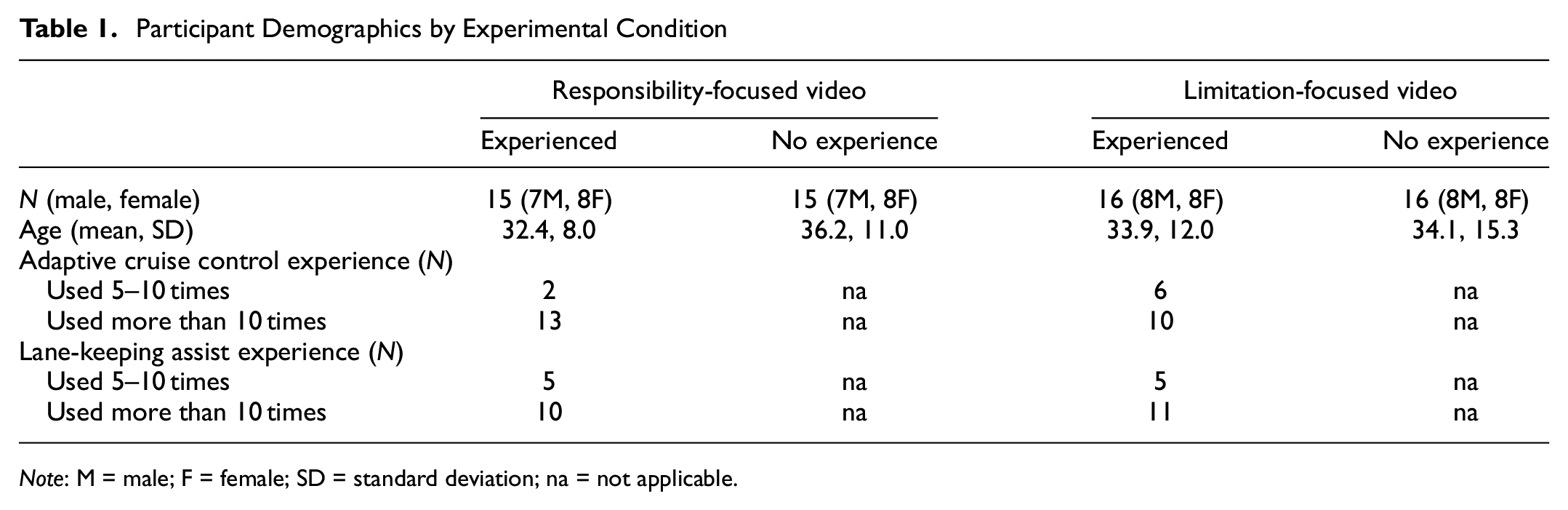
Note: M = male; F = female; SD = standard deviation; na = not applicable.
The study was conducted remotely over Zoom (see Figure 1 for an overview of the procedure) and had three stages (pre-training, post-training, and follow-up), split over two sessions. The approximate length of the first session was 90 min and the follow-up session was 20–30 min and took place a minimum of 4 weeks later. At each stage, participants viewed a series of dashcam clips and were asked what they would do in each situation if they had ADAS engaged, and completed several ADAS questionnaires. They also answered open-ended questions as part of a semi-structured interview at the end of stages 2 (post-training) and 3 (follow-up), which took approximately 15–20 min in the first session and 5 min in the follow-up session. The current paper focuses on the analysis of these open-ended questions.
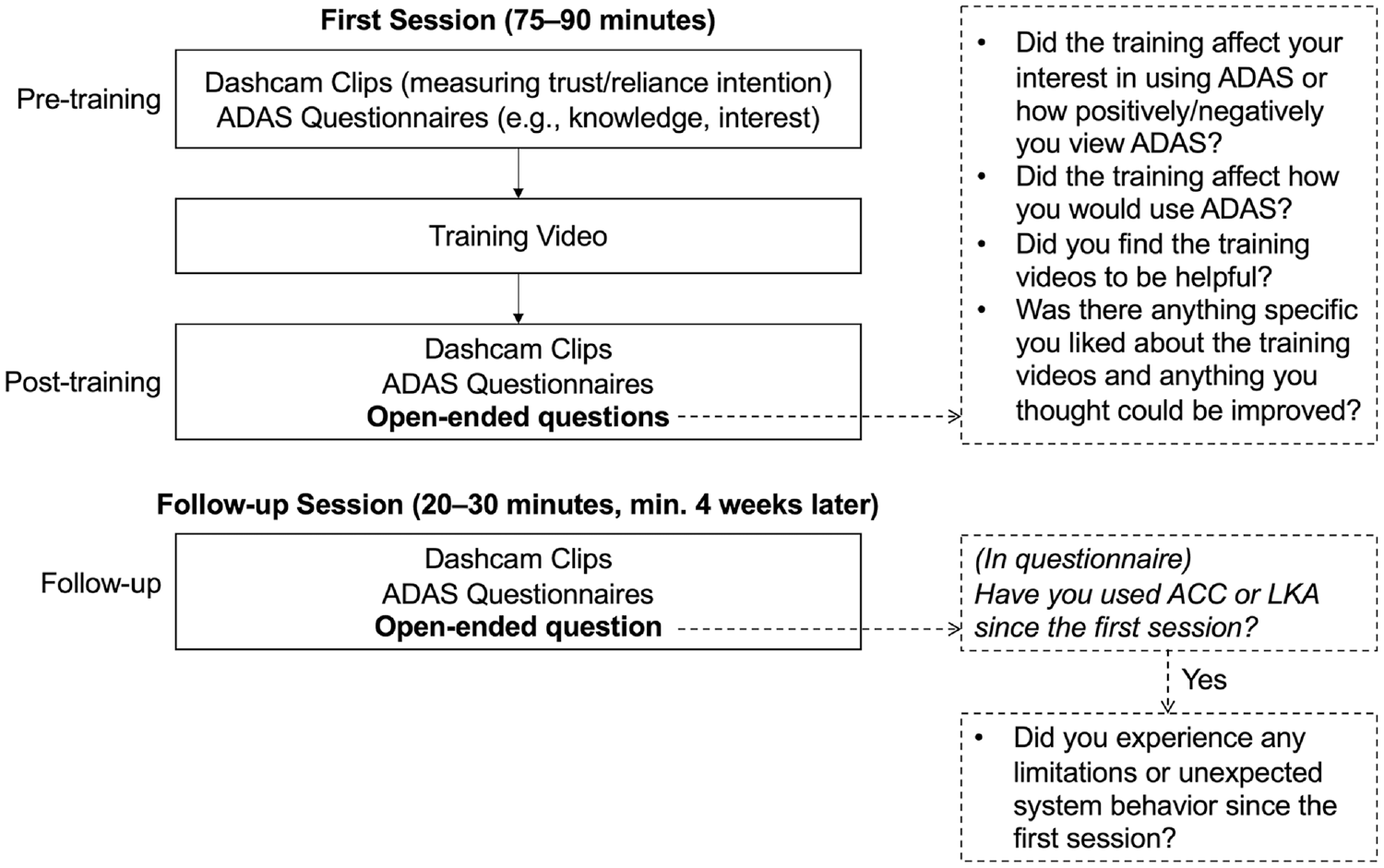
Experimental procedure. Boxes with dashed lines show the open-ended questions that participants were asked, results of which are reported in the current paper. The open-ended questions were asked verbally in a semi-structured interview format.
Participants
Participants were recruited through online postings (e.g., Facebook, online classified advertising websites) and emails to individuals who had signed up to be contacted by our research group about upcoming studies. Participants were required to live in Canada and have a valid driver’s license. Interested individuals were asked to fill out the screening questionnaire and eligible individuals were contacted to participate. Data was collected from 65 participants; however, three participants were excluded from the analysis (one participant was excluded because they reported having ADAS experience in the screening questionnaire but indicated during the study that they had never used ACC or LKA, and two participants were excluded because their responses indicated that they did not understand the questions being asked in the study). The demographic breakdown of the remaining 62 participants, by group, can be found in Table 1. Participants received C$25 (Canadian dollars) compensation for the first session and C$10 for the follow-up session. The study was approved by the University of Toronto’s Research Ethics Board (protocol #41029).
Training Videos
The training videos were based on ACC and LKA systems in the 2021 Toyota Corolla. However, participants were told that the training was for ACC and LKA systems in our test vehicle (a make or model was not specified), which were similar to systems that are currently available to drivers for purchase. We chose to use the Toyota Corolla as the basis for our training because, in a previous survey of North American drivers, we found that Toyota was the most commonly owned vehicle among drivers who had ADAS in their vehicle ( 4 ). The limitation-focused video covered a range of ACC and LKA limitations that are typically found in a vehicle owner’s manual. In contrast, the responsibility-focused video used two examples to highlight how collisions could occur if drivers did not remain engaged in the driving task. The responsibility-focused video was designed to include less information, but both videos were designed to be the same length (approx. 8 min) to avoid a potential confound because of training length. Both videos were split into two parts to reduce potential fatigue.
Part 1 of each training video explained what ACC and LKA did and how they worked (i.e., using a sensor and camera). Part 1 of the training also showed participants where the sensor and camera were located, and the range of the ACC sensor and where the LKA detected lane markings overlaid onto a screenshot of the roadway taken from a driving simulator (Figure 2, top). Part 2 of the limitation-focused training video listed 20 situations where ACC may not work, with an image accompanying each situation, and three or four images on screen at a time (Figure 2, bottom right). Part 2 of the responsibility-focused video went through two example scenarios where ADAS may not work. In the first scenario, a slower vehicle in the lane to the right of the driver cut into the lane ahead of them. In the second scenario, the vehicle drifted into another lane where there was a stopped car, because of missing lane markings. Both scenarios were played twice, the first time with the driver looking at their phone and a collision occurring because the ACC could not slow down in time (first scenario) or the vehicle swerved into the stopped car (second scenario). The second time going through each scenario showed the driver paying attention to the roadway and braking (first scenario) or steering (second scenario) to avoid the collision. The scenarios used a combination of simulator recordings and driver-facing video (Figure 2, bottom left). Before the start of the study, the training videos were reviewed and updated based on feedback from researchers within and outside our research group.
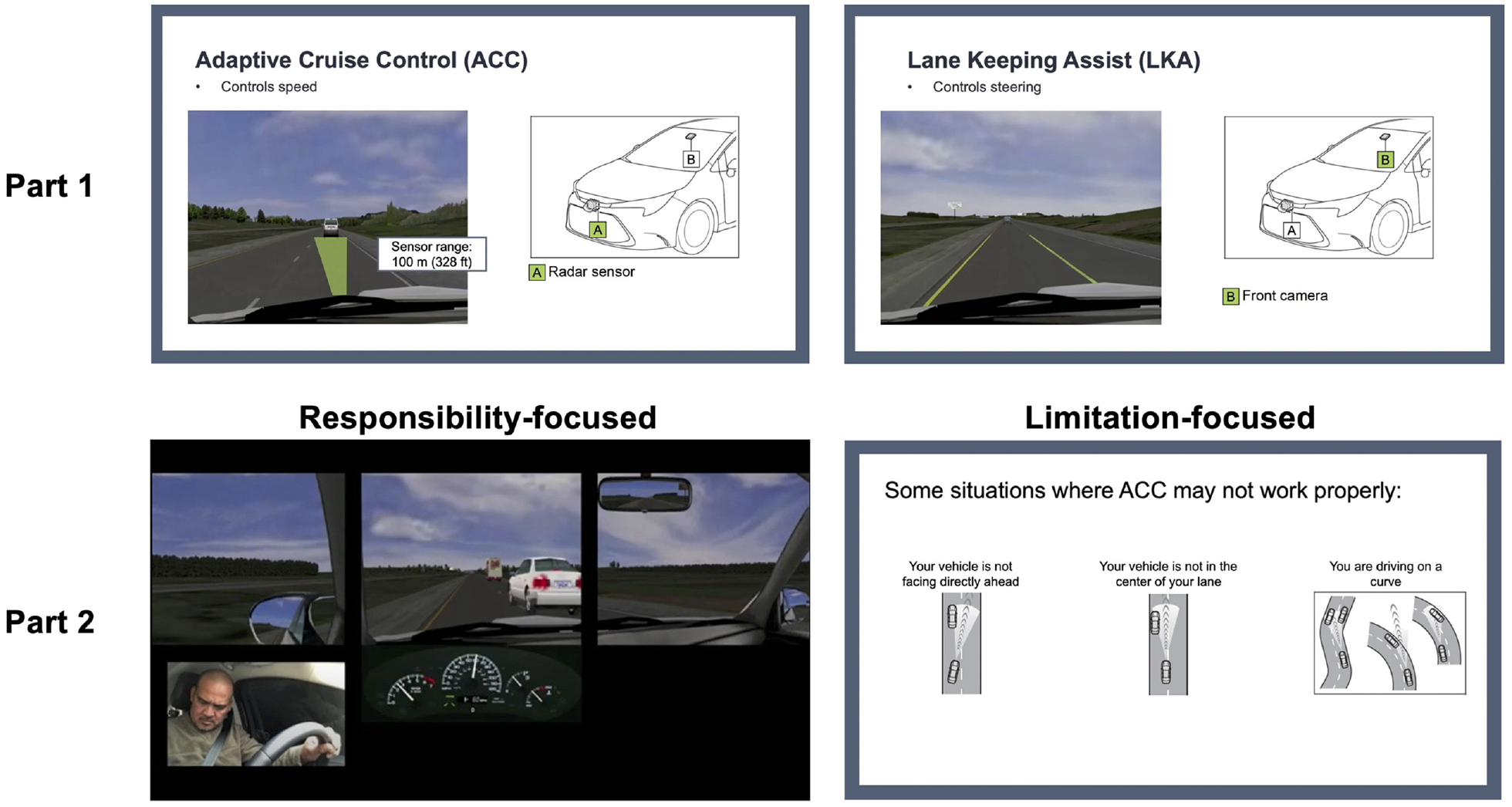
Screenshots from part 1 (top) and part 2 (bottom) of the training videos. Screenshots for part 1 are the same for the responsibility-focused and limitation-focused videos.
Procedure
At the end of the first session and after having watched the videos, participants were asked several open-ended questions to assess whether the training affected their interest in using ADAS or their attitudes toward the system, as well as if the training affected how they would use ADAS. Participants were also asked about their opinions of the training itself (i.e., if there was anything they found helpful, anything in particular they liked about the training, and any suggestions for improvement).
At the beginning of the follow-up session, participants were asked if they had used ADAS since the first session. At the end of the follow-up session, participants who reported having used ADAS were asked if they experienced any system limitations or unexpected behavior since the first session. For all open-ended questions, participants were first asked the general questions (found in Figure 1) without any additional prompts or context from the experimenter. After their initial response, the experimenter would provide clarification (e.g., if the participant did not understand the question) or prompt the participant for more detail (e.g., if the participant mentioned something that was unclear or would benefit from further explanation). In general, the experimenter avoided asking the participants leading questions so that participants’ self-generated opinions were obtained. Sessions were recorded and transcribed within 4 weeks. Recordings were deleted after transcription.
Analysis
To analyze the transcripts, we used thematic analysis, which is a commonly used method to identify patterns in qualitative data, and requires researchers to familiarize themselves with the data, code the data, develop themes from the data, and revise as necessary ( 15 ). As the first step, the researchers familiarized themselves with the interview transcripts. Then, they used a hybrid coding approach, whereby a predetermined set of codes (i.e., short phrases used to categorize responses, such as “more interested in using ADAS”) was created before coding; however, the researchers could also code any emerging topics ( 16 ). A team of five researchers participated in a 1.5 h training session that covered the predetermined coding scheme and coding on NVivo 12 software. First, the researchers independently coded the same four randomly chosen transcripts, and later discussed their coding process in detail in a 2 h calibration session. Afterwards, all 62 transcripts were randomly divided among four researchers, while one researcher (DeGuzman) coded all 62 transcripts to further ensure consistency. NVivo 12 was used for all coding. Once coding was complete, all five researchers discussed the emergent codes and agreed on a final coding hierarchy. They then coded the assigned transcripts again using the final coding scheme. Any coding disagreements were discussed between the first coder (DeGuzman) and the second coder to reach consensus. Before discussions, percent agreement between the first and second coders ranged from 85% to 92%. The final codes were organized into higher-level themes that corresponded to the different open-ended questions participants were asked (e.g., changes in ADAS interest, helpful aspects of the training).
Results
Effects of the Training
Attitudes and Interest in ADAS
In general, the effect of training on attitudes toward and interest in using ADAS depended mainly on the training type but also on ADAS experience, with most participants having no change in attitudes or interest (Figure 3). Among the participants who reported no change in interest, 14 participants in the responsibility-focused group mentioned that, while their interest did not change, they learned more about the sensor limitations, compared with only one participant in the limitation-focused group. The most common comment for participants in the limitation-focused group who had no change in interest was that their attitude and interest were based on existing experience (n = 6; all experienced participants).
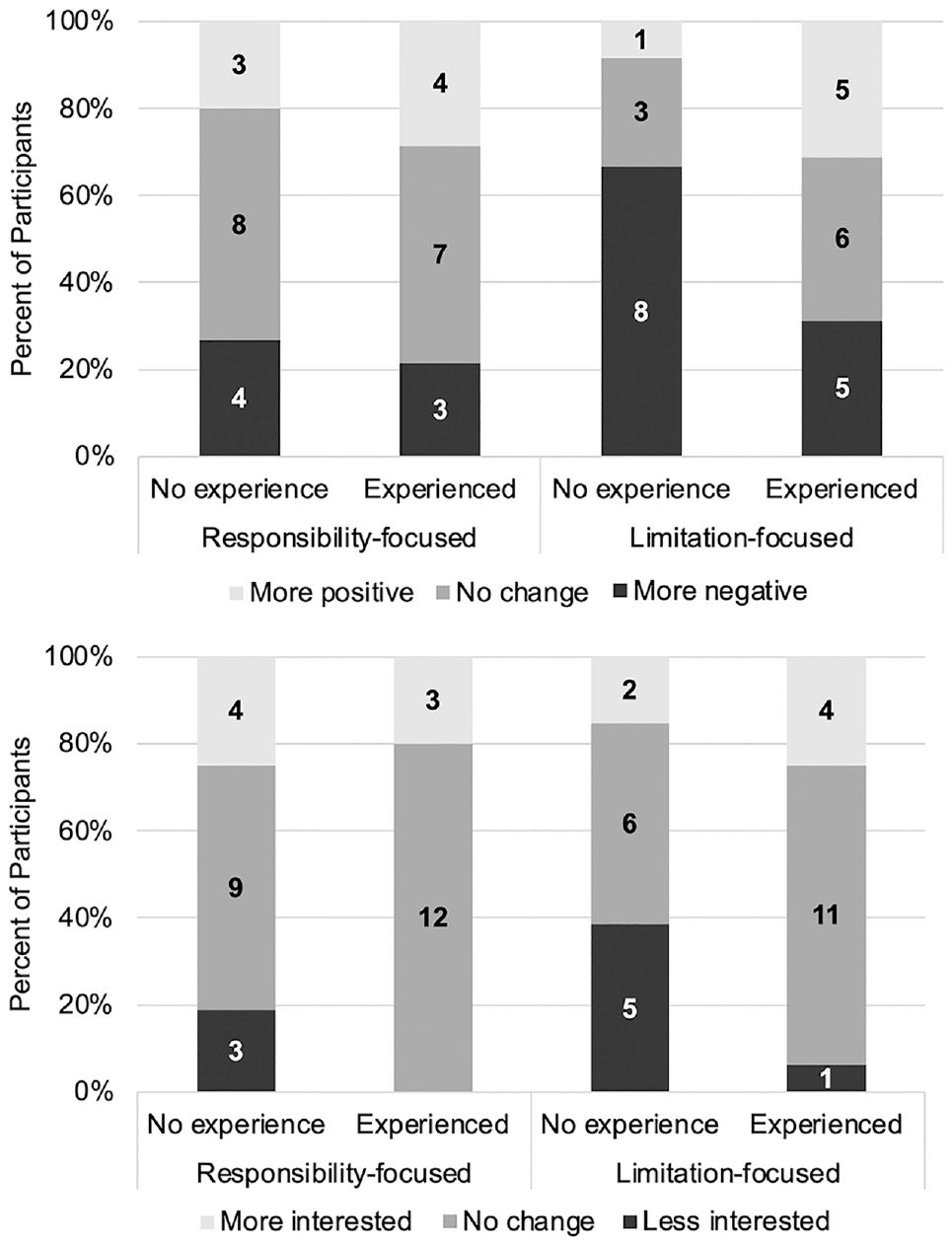
Self-reported change in attitude toward advanced driver assistance systems (ADAS) (top) and interest in using ADAS (bottom) after training.
The limitation-focused group with no ADAS experience had the highest proportion of respondents that reported a more negative attitude toward or less interest in ADAS after training. Similarly, this group also had the lowest proportion of respondents that reported a more positive attitude or increased interest. The most common negative comment from among the limitation-focused group (whether their interest changed or not) was that there were too many limitations (n = 15). For the responsibility-focused group, the most common negative comment was that they thought the systems were more capable (n = 8), which was also commonly reported for the limitation-focused group (n = 7). For both training conditions, the most common positive comment about ADAS was that they had a positive view of the system because they gained better knowledge of system capabilities and limitations from the training videos (responsibility-focused n = 6, limitation-focused n = 7).
Changes in Intended Distraction Engagement and ADAS Use at Post-Training
Responses to whether participants would change how they used ADAS fell into two themes: changes in distraction engagement (e.g., whether they would text, make a phone call, or eat while using ADAS) and changes to when or how frequently they would use ADAS. In relation to engaging in distractions, 31% of participants reported that they would reduce engagement in distracting tasks (Figure 4, top). The most common reasons given for reducing distraction engagement in the responsibility-focused group were limited sensor capabilities (e.g., the sensors only detect a limited range ahead; n = 7) and the driver’s role (e.g., they need to be paying attention, have their hands on the wheel, or both; n = 3). For the limitation-focused group, the most common reasons given for reducing distraction engagement were the driver’s role (n = 6) and there being too many limitations (n = 4).
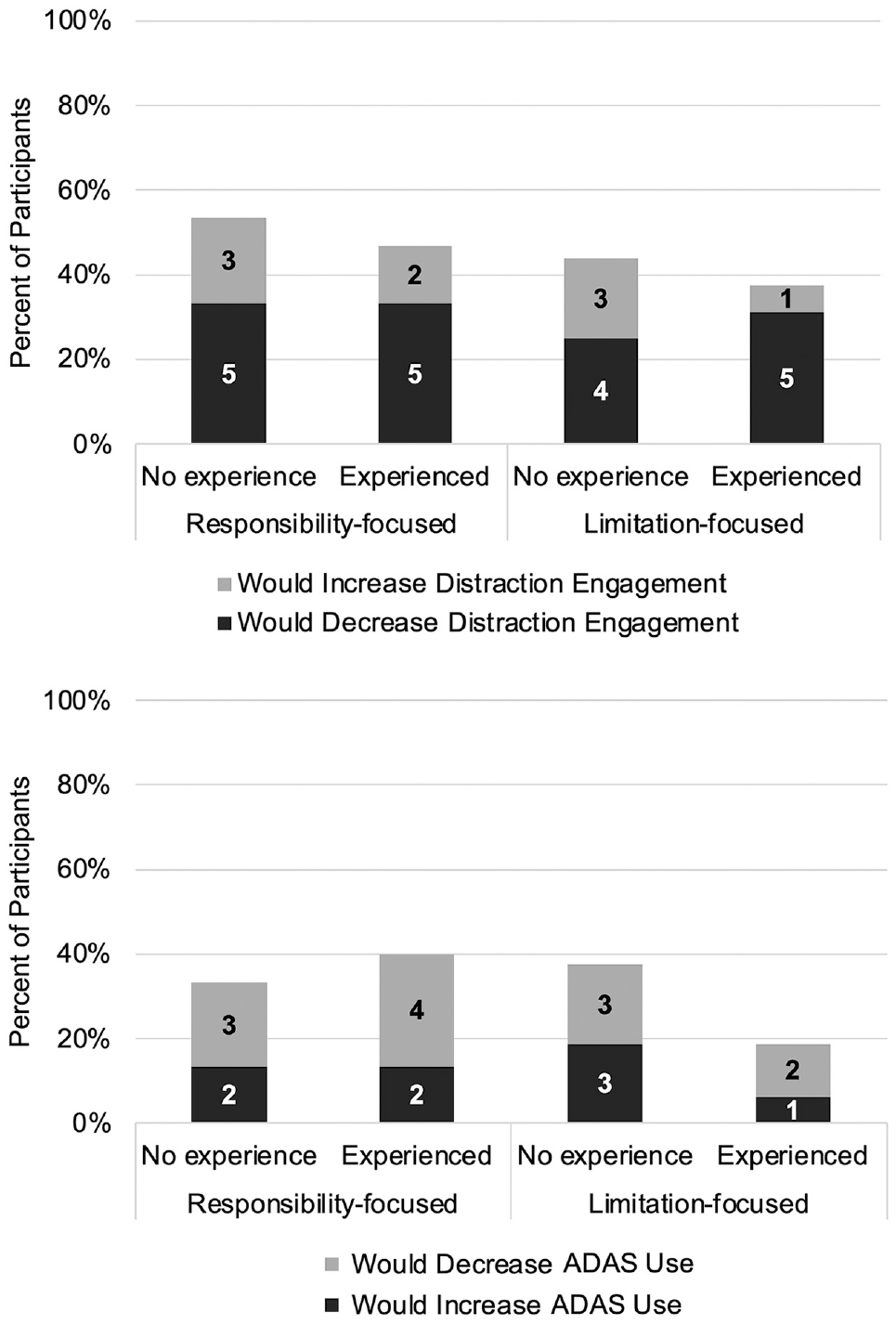
Percent of participants in each group who reported they would change their distraction engagement while using advanced driver assistance systems (ADAS) (top) and ADAS use (bottom) after training.
Nine participants (six with no ADAS experience) mentioned that they would increase their engagement in distractions (Figure 4, top). For participants with and without ADAS experience, one of the explanations was that the ADAS would enable them to engage in tasks that did not require visual attention (e.g., handsfree or handheld call, eating; n = 2 in responsibility-focused group and n = 2 limitation-focused group). Another explanation was that the systems do some of the work for the driver (n = 3 in responsibility-focused group and n = 1 in limitation-focused group). For example, two of the experienced participants specifically mentioned being able to send a text message because the LKA would help keep them in their lane if they looked away for a short period, for example, “I might be more willing to glance away from the road and make that text conversation. That doesn’t necessarily make it right, but it means that I know I’ve got a larger margin for error, than if I didn’t have that system.” In contrast, two limitation-focused group participants (with no ADAS experience) mentioned that they would feel more comfortable engaging in distractions in certain situations where the system should work because of learning where the systems would not work. For example, “You kind of rule out the situation in your head and you– you can look around and say, well, I’m– I’m in one of those situations where it’s kind of a green– well, green light, metaphorically, to be able to do one of those activities, and this car will be able to handle that or the system will kick in when I need help.”
In relation to how they would use ADAS, some participants indicated that they would use the ADAS less after training (n = 7 in responsibility-focused group and n = 5 in limitation-focused group). However, participants with and without ADAS experience in the responsibility-focused group explained that they would use ADAS less in specific situations where they thought it would not be appropriate to use (e.g., in poor weather or on busy roads when other drivers may act unpredictably). Some participants at both experience levels in the limitation-focused group also mentioned that they would not use ADAS in specific situations (e.g., in poor weather or when the road was not straight, n = 3), while two participants with no ADAS experience mentioned that they would not use the systems at all because of the number of limitations and because the benefits of ADAS were not clear. One participant stated, “There were many, many possibilities where both of them could fail whether it’s the weather, or the road markings, or construction, or the vehicle in front was too low or too high, or my vehicle was too low or too high. Things which you could never, ever foresee. There are just too many negative possibilities.” The other participant said, “I think basically it’s just a big list of, “don’t use it in A, B, C, D, E, F, G, H,” right? So it’s like, basically use it in– again only straight lines, like– not too sunny, but not rain either. Basically, if you run into the circumstance where everything is perfect, then feel free to use it, but you still have to pay full attention so it’s like, what’s the point? Maybe if it spelled out more of the benefits, because I don’t really understand what the benefits are at this point.”
Observations About ADAS Use at Follow-up
Twenty-five participants who had used ADAS since the first session (n = 13 in responsibility-focused group, one with no experience at the first session; n = 12 in limitation-focused group, one with no experience at the first session) were asked open-ended questions at follow-up. Three participants reported that they experienced a limitation of ADAS since the first session. The reported limitations were ACC not slowing when they were going around a curve (limitation-focused group), not being able to rely on LKA when lanes do not have clear markings (limitation-focused group), and vehicle swerving when in a construction zone (responsibility-focused group). One participant in the limitation-focused group also mentioned that they encountered animals on the road while using ADAS and they intervened by braking. Eleven participants mentioned that since the first session, they were more aware of ADAS functionality and limitations when using the systems (n = 6 in responsibility-focused group and n = 5 in limitation-focused group). Some experienced participants (n = 3 in responsibility-focused group and n = 1 in limitation-focused group) also mentioned that they were more cautious when using ADAS, while others (n = 1 in responsibility-focused group and n = 2 in limitation-focused group) stated that they did not use ADAS when they might encounter limitations (e.g., when it was raining).
Feedback About the Training
When asked if they found the training videos helpful, 61 out of the 62 participants thought that they were helpful. One participant (experienced, limitation-focused group) was neutral about the benefits of the training video as they were already on their second vehicle with ADAS and reported that they were aware of the system limitations. The most common aspect of the videos that participants reported as being helpful was that they learned information about the systems and how to use them (Table 2). Participants in the responsibility-focused group (with and without ADAS experience) mentioned that seeing the consequences of not paying attention (i.e., what would happen if the driver was/was not paying attention) was helpful (Table 2). Another interesting observation is that a small number of participants with no ADAS experience in each of the training groups were unaware that drivers had to keep their hands on the wheel while using ADAS (Table 2).
Different Aspects of the Training Videos Identified as Being Helpful by the Participants (First Column) and the Number of Participants Who Did So
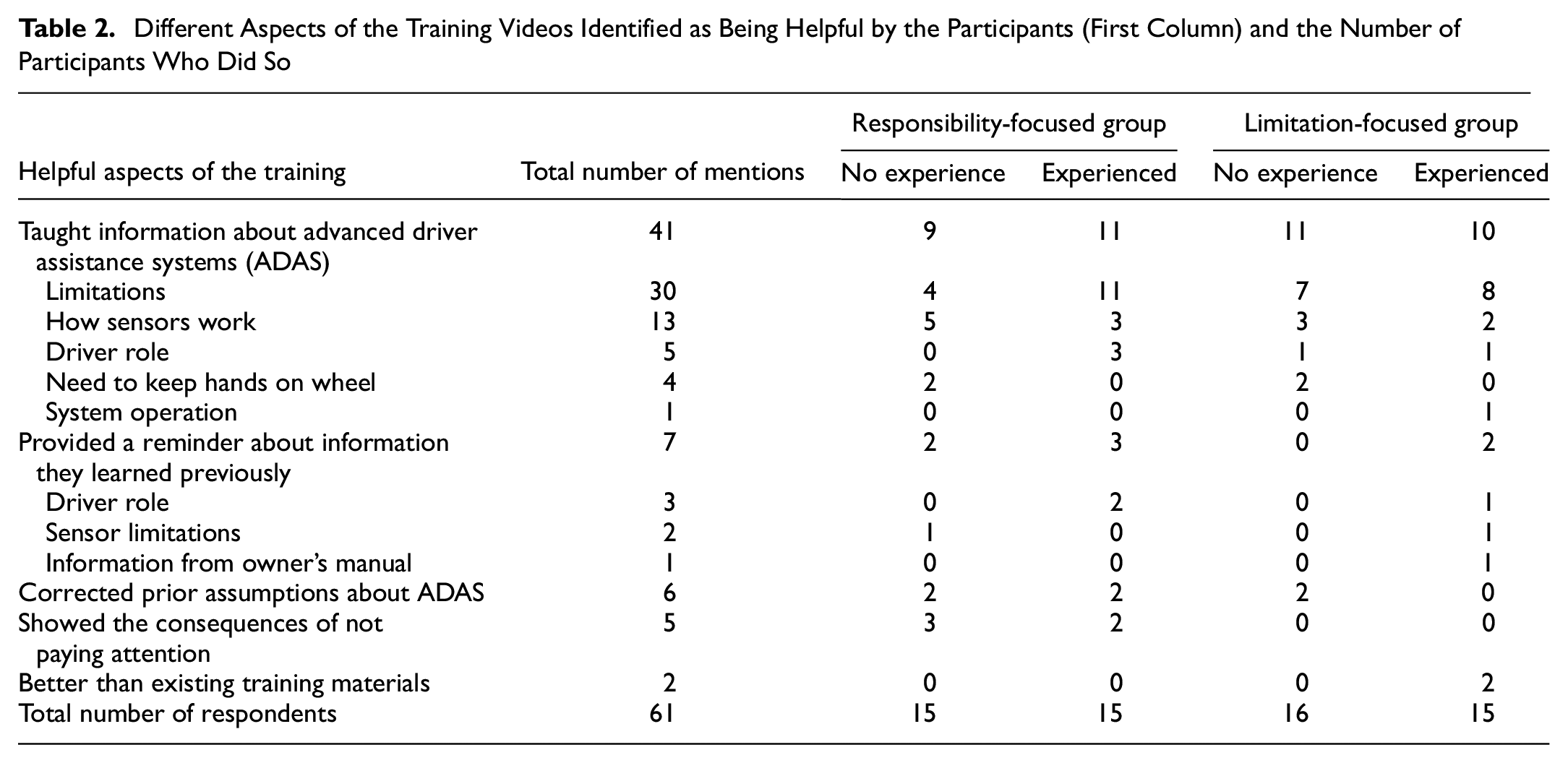
In addition to whether they found the training helpful, participants were also asked if there was anything specific they liked about the training. Twenty-one (out of 30) participants in the responsibility-focused group and 19 (out of 31) participants in the limitation-focused group expressed liking at least one aspect of the training. Participants in both groups liked that the videos were clear (n = 9 and n = 14, respectively). While the responsibility-focused group reported liking the content of the videos (n = 14) and seeing the driver view (n = 8), the limitation-focused group highlighted liking the visuals (n = 8). Content of the videos were mentioned less in the limitation-focused group (n = 3). Participants also liked that the training covered a good amount of detail (n = 4 in responsibility-focused group and n = 1 in limitation-focused group) and had good length (n = 3 in responsibility-focused group and n = 2 in limitation-focused group). Participants also suggested ways to improve the training videos, with the most common suggestion for both training videos being to add more information (n = 9). The full breakdown of suggestions can be found in the Appendix.
Discussion
We conducted a qualitative analysis of interview data collected from an online study to investigate the effect of two training approaches (responsibility-focused and limitation-focused) on driver attitudes toward ADAS and how they would use ADAS, as well as to obtain feedback from drivers about the training itself. Video-based training in our study was effective at reducing intended engagement in distractions for 31% of participants. However, 15% of participants reported being more likely to engage in distractions while using ADAS after the training, with just under half of these participants specifying that they would engage in distractions that did not require visual attention (e.g., handsfree phone call). A small number of experienced ADAS users felt that the technology would allow them to (briefly) engage in handheld cellphone distractions (i.e., texting). Research shows that current ADAS users frequently engage in distractions while using these systems (17, 18), and training alone is unlikely to prevent all drivers from engaging in distractions. Thus, other interventions may be needed in conjunction with training to support safe ADAS use. For example, utilizing driver state monitoring to alert drivers when they need to reorient their attention to the roadway (e.g., 19 ) or even limiting drivers’ access to distractions (e.g., forwarding incoming calls to voicemail; 20 ).
There were differences between training approaches in their effects on general ADAS use. Participants in the responsibility-focused group reported that they would use ADAS less in situations where they may not work. Some participants in the limitation-focused group made similar comments, but two participants with no ADAS experience mentioned that they would not use ADAS at all because there were too many limitations, and the benefits of the technology were not clear. These comments are consistent with the findings of Zheng et al. who found that training on limitations alone was associated with a higher proportion of ACC disuse than training that included limitations and information about the driver’s role and responsibility ( 12 ). For most participants in the current study, the training did not affect attitudes toward ADAS or interest in using the systems. However, a more negative attitude toward ADAS and decreased interest in using ADAS after training were more common among participants who received limitation-focused training. The most common reason given by the participants for the negative effects was that there were too many system limitations. Ideally, training would reduce misuse without increasing disuse. Overall, our results suggest that focusing training on a series of system limitations may have a negative impact on drivers’ interest and willingness to use ADAS, which may be more common for new or prospective users.
It is possible that the potential disuse associated with limitation-focused training may be related to locus of control (i.e., whether people think outcomes are a result of things within or outside their control) ( 21 ). Previous research shows that defensive driver training that focused on how to decrease the probability of getting into a collision was associated with an increased perception that driving outcomes were a result of internal factors (i.e., their own behavior) and a decreased perception that outcomes were caused by external factors (e.g., other drivers, malfunctions, luck) ( 22 ). The responsibility-focused video explains that ADAS are limited, but it also emphasizes how the driver can use the system safely, and thus may be associated with drivers believing they have more control on the outcomes of using ADAS. In contrast, the limitation-focused lists all the limitations, which may make drivers feel that they have less control over the outcomes while using ADAS, especially for drivers who have not yet tried the systems, potentially resulting in drivers without ADAS experience being less interested in using the systems.
In addition, research shows that drivers forget limitations over time if they do not experience them ( 10 ). At the follow-up session, several weeks after training, only three participants experienced any limitations they learned about during the training and one intervened in anticipation of a limitation. Since encountering limitations is relatively rare, the limitation-focused training may be less practical than the responsibility-focused training which provides less information and instead uses two example scenarios to emphasize how the driver should use ADAS. Further, from an implementation perspective, while manufacturers may still be required to list limitations in an owner’s manual for liability reasons, they may be more likely to develop and distribute additional training for their vehicles if the focus is less on the limitations of their technology and more on the driver’s responsibility in using the systems.
In relation to participant feedback about the training, all but one participant found the training to be helpful, with two-thirds of participants indicating that they learned something from the training. The prevalence of existing limitation-focused ADAS information may have affected how participants assessed the usefulness of the training. When considering whether they found the videos helpful, participants who received responsibility-focused training may have been comparing the different type of content with information they had previously encountered. In contrast, participants who received the limitation-focused training may be comparing the method of delivery with existing limitation-focused training (e.g., video versus owner’s manual). For example, two experienced participants mentioned that the limitation-focused video was better than existing training materials, specifically owner’s manuals. While our results suggest that training designers may not want to develop training that focuses primarily on system limitations, if limitation-focused training is needed, using a video format may be preferred by drivers. Although video-based training has not been found to be more effective than reading an owner’s manual (8, 9), more drivers may complete the training if delivered in video format, based on previous research showing that drivers would like to learn about in-vehicle technology through videos ( 7 ). Drivers also report learning about ADAS through trial-and-error in the vehicle and variations in ADAS across manufacturers may have also affected the aspects of the training that experienced participants found to be helpful ( 2 , 3 , 23 ). For example, most systems require drivers to have their hands on the steering wheel and alert drivers if they do not detect steering input, which may explain why none of the experienced participants reported learning that they need to keep their hands on the wheel (i.e., they may have learned this through using the system). In contrast, some experienced participants reported that the training taught them about the driver’s role, while others did not. Some vehicles have systems that monitor whether the driver is looking at the roadway, and drivers with these systems may already have learned through system use that they need to keep their eyes on the road. However, none of the participants in our study mentioned having an attention monitoring system, and we did not have information about which vehicles each participant drove. Thus, more research is needed to further explore how experience with ADAS and driver monitoring systems affects drivers’ perceptions of training and the information they find to be most helpful.
Thirty-two percent of participants provided suggestions to improve the training, suggesting that most of the participants felt the training was adequate. Most suggestions were from drivers without ADAS experience, and were related to specific details they wanted to know more about (e.g., how the system determines if the driver’s hands are on the steering wheel), which makes sense given they had never used the systems before. Researchers or other training designers may consider these suggestions when designing future ADAS training.
One limitation of the current study is that we only collected self-report data (e.g., drivers’ opinions about whether the training affected how they would use ADAS). Future research is needed to explore how responsibility-focused and limitation-focused training affect actual behavior (e.g., in a driving simulator or real vehicle). Further, there are drawbacks to qualitative analyses, such as the inability to draw statistical conclusions about associations in our data. However, the qualitative data we collected was able to provide richer information than questionnaires alone about drivers’ perceptions of the training and how it affects their attitudes toward the systems and how they might use them. We asked open-ended questions to gather drivers’ self-generated opinions, only prompting them for clarification or elaboration. In addition, we followed up with participants after several weeks, which allowed us to gather data on their experience with ADAS after the training. As an initial exploration of the responsibility-focused training approach and how it compares with limitation-focused training, we heard many useful comments that should be investigated further with a larger sample.
Conclusions
We conducted a thematic analysis of interview data to investigate the effects of limitation-focused and responsibility-focused ADAS training on driver attitudes toward ADAS and how drivers intend to use ADAS. We also elicited feedback about the training itself. Drivers found both training videos to be helpful and both training approaches were associated with reduced intention to engage in distractions while using ADAS. However, our results suggest that the limitation-focused approach may be associated with drawbacks like decreased interest in the technology and potential disuse, particularly among drivers without ADAS experience, with some participants highlighting the number of limitations and unclear benefits as reasons why they would not use ADAS after the limitation-focused training. Further, manufacturers may be more willing to distribute ADAS training materials for their vehicles if the content is focused on the driver’s responsibility while using these systems as opposed to highlighting the numerous limitations. Overall, our results suggest that the responsibility-focused approach may be a reasonable alternative to limitation-focused training that should be investigated further with behavioral studies.
Supplemental Material
sj-docx-1-trr-10.1177_03611981221151022 – Supplemental material for Limitation-Focused versus Responsibility-Focused Advanced Driver Assistance Systems Training: A Thematic Analysis of Driver Opinions
Supplemental material, sj-docx-1-trr-10.1177_03611981221151022 for Limitation-Focused versus Responsibility-Focused Advanced Driver Assistance Systems Training: A Thematic Analysis of Driver Opinions by Chelsea A. DeGuzman, Suzan Ayas and Birsen Donmez in Transportation Research Record
Footnotes
Acknowledgements
We would like to thank Emily Shaw for providing valuable feedback on the training videos and Mohamed Abdelwahab, Ashna Jain, Selena Lombardi, Cole Stotland, and Claire Zhang for help with data collection and coding.
Author Contributions
The authors confirm contribution to the paper as follows: study conception and design: C. DeGuzman, B. Donmez; data collection: C. DeGuzman; analysis and interpretation of results: C. DeGuzman, S. Ayas, B. Donmez; draft manuscript preparation: C. DeGuzman, S. Ayas, B. Donmez. All authors reviewed the results and approved the final version of the manuscript.
Declaration of Conflicting Interests
The author(s) declared no potential conflicts of interest with respect to the research, authorship, and/or publication of this article.
Funding
The author(s) disclosed receipt of the following financial support for the research, authorship, and/or publication of this article: This work was supported by the National Sciences and Engineering Research Council of Canada (NSERC) through the Discovery Grant Program (RGPIN-2016-05580) and Transport Canada through the Enhanced Road Safety Transfer Payment Program.

Supplemental Material
Supplemental material for this article is available online.
References
Supplementary Material
Please find the following supplemental material available below.
For Open Access articles published under a Creative Commons License, all supplemental material carries the same license as the article it is associated with.
For non-Open Access articles published, all supplemental material carries a non-exclusive license, and permission requests for re-use of supplemental material or any part of supplemental material shall be sent directly to the copyright owner as specified in the copyright notice associated with the article.
