



Abstract
Aging of bitumen can lead to fatigue and non-load-associated cracking of asphalt pavements. Performance grade specifications include threshold limits for rheological properties from specific ranges of binder behavior after laboratory aging. Some specifications include aging ratios (ARs) to limit the rate at which properties deteriorate. This study compares the evolution of interrelationships and ARs of performance parameters in specific areas in Black Space to understand the relative susceptibility of the binder behavioral spectra to aging. Unmodified and polymer modified binders are aged with the rolling thin film oven and pressure aging vessel, and tested with the dynamic shear and bending beam rheometers. It is seen in the study that there are both related and unrelated aging trends in the distinct stiffness-related ranges. Correlations in parameter development significantly improve when binders are grouped by similar features such as modification type or origin. Binder source and modification type and degree greatly dictate aging trends in the high-stiffness range. In the low-stiffness range, the initial hardness of the binder is indicative of aging potential. The evolution of properties may be influenced by either modification or binder source in the intermediate domain. When considering ARs for specifications, combining complementary ARs may provide reciprocal insights into binder aging.
Keywords
Aging of bitumen can lead to fatigue and load-associated cracking of asphalt pavements ( 1 ). To ensure sufficient in-field behavior and durability, performance grade (PG) specifications include threshold limits for rheological properties from specific ranges of binder behavior after laboratory aging. Some specifications include aging ratios (ARs) to limit the rate at which properties will deteriorate ( 2 ).
Black Space has been used to monitor bitumen aging and performance (
1
,
3
,
4
). The complex shear modulus, G*, is plotted versus the complex phase angle,
Molecular Structure and Aging of Bitumen
Bitumen is divided into two groups of primarily hydrocarbon molecules, that is, asphaltenes and maltenes, without a finite boundary between them. Asphaltenes are insoluble in n-heptane, highly polar solids of relatively high molecular weight. Maltenes have lower molecular weights and are divided into polar resins, and non-polar saturates and aromatics ( 5 ). Redelius and Soenen note the presence of trace amounts of metals such as vanadium, nickel, and iron ( 6 ).
Models exist that attempt to mimic the structure of bitumen molecules. These vary in complexity and reasoning. Some accept the generalization that bitumen is a colloidal suspension with higher molecular weight asphaltenes dispersed in lower molecular weight maltenes. The maltenes form the continuous phase. The polar resins will act as the dispersing agents, while the solvents will inhibit the solvating strength of the maltenes ( 5 ).
Two boundary types of bitumen composition, the sol-type and gel-type, are commonly accepted. In the sol model, asphaltenes are completely dispersed and mobile within the maltenes. In the gel model, the maltene fraction is not sufficient to accomplish asphaltene distribution. The asphaltenes are allowed to associate and form irregular, disconnected structures. The gel behavior of bitumen decreases as it is heated. Most bitumens behave somewhere between the two ( 5 ).
Redelius and Soenen stress that, although bitumen is often analyzed in its fractional components (saturate, aromatic, resin, and ashpaltene [SARA]), the behavior of bitumen is not the sum of the parts ( 6 ). They characterize bitumen as a continuum of unique and intricate molecules with complex interactions rather than a colloidal suspension. The size of the largest molecules is dependent on the crude source, while the size of the smallest molecules is dependent on the cut point of the specific refinery. The larger the molecules, the higher the molecule interactions, and the higher the viscosity of the bitumen.
Physical properties and performance of bitumen are influenced by three main molecular interactions ( 6 ):
London dispersion forces: This interaction is most important for larger, non-polar asphaltene molecules. Temporary dipoles are induced that can dominate bitumen behavior.
Polar and hydrogen bonds: Although these interactions are important for smaller molecules, they play a lesser role in the interactions of larger bitumen molecules. Polar interactions correlate with the elastic stiffness component of bitumen.
Pi-pi forces: These interactions are caused by the different shapes of the molecules, which are unlimited.
Redelius and Soenen describe the behavior of asphaltenes during aging and cooling as precipitation (versus association) ( 6 ). The degree of precipitation depends on the insolubility of the asphaltenes and the solving power of the maltenes.
This theory is supported by the findings of Bukka et al.: fourier transform infrared (FTIR) analysis of two binders with an inverse relationship of asphaltene content and viscosity revealed that, although a similar amount of oxygen was present, the distribution of the oxygen content in aromatic portions was a significant indicator of viscosity ( 7 ).
In some ways, there are similarities in the opposing views. Hunter et al. state that the degree of dispersion of asphaltenes, along with the viscosity of maltenes, will ultimately determine the viscosity of the bitumen ( 5 ). They agree that research (such as Christensen et al.) has shown that increased asphaltene content leads to increased viscosity at a constant temperature ( 8 ). Bukka et al., and Redelius and Soenen state that larger proportions of asphaltenes alone do not produce larger viscosities ( 6 , 7 ). Bukka et al. also apply the sol-gel concept; Redelius and Soenen do not ( 6 , 7 ). Redelius and Soenen do concede that it is possible that some molecules in the asphaltenes, such as the metal groups, may be completely insoluble and form associations ( 6 ).
Bitumen hardens with age because of an interaction with the oxygen in the air. Three hypotheses are proposed where the reaction with oxygen causes increased:
Molecular size,
Polarity, or
Aromaticity (which leads to additional pi-pi and dispersive interactions) ( 6 ).
Redelius and Soenen conclude that physical properties, such as viscosity and stiffness, are highly dependent on molecular interactions ( 6 ). These interactions change over time because of chemical reactions with oxygen. Properties such as viscosity relate well to molecular weight and aromaticity.
Performance Measurement of Asphalt Binders
Because of the chemical complexity of bitumen, engineers often use mechanical test properties to measure performance and durability for road applications. Performance specifications measure specific rheology indicators to determine the suitability of a binder for environmental and traffic conditions ( 2 , 9 ). These specifications are based on the principal that controlling fundamental properties can prevent or limit failure. King et al. note that, although aging can lead to increased risk of fatigue cracking, damage caused by thermal, non-load-associated cracking is also induced ( 1 ). Table 1 indicates common failure mechanisms of bituminous surfacing applications and the parameters that may be used to measure binder resistance or susceptibility.
Stiffness Ranges, Failure, and Performance Parameters
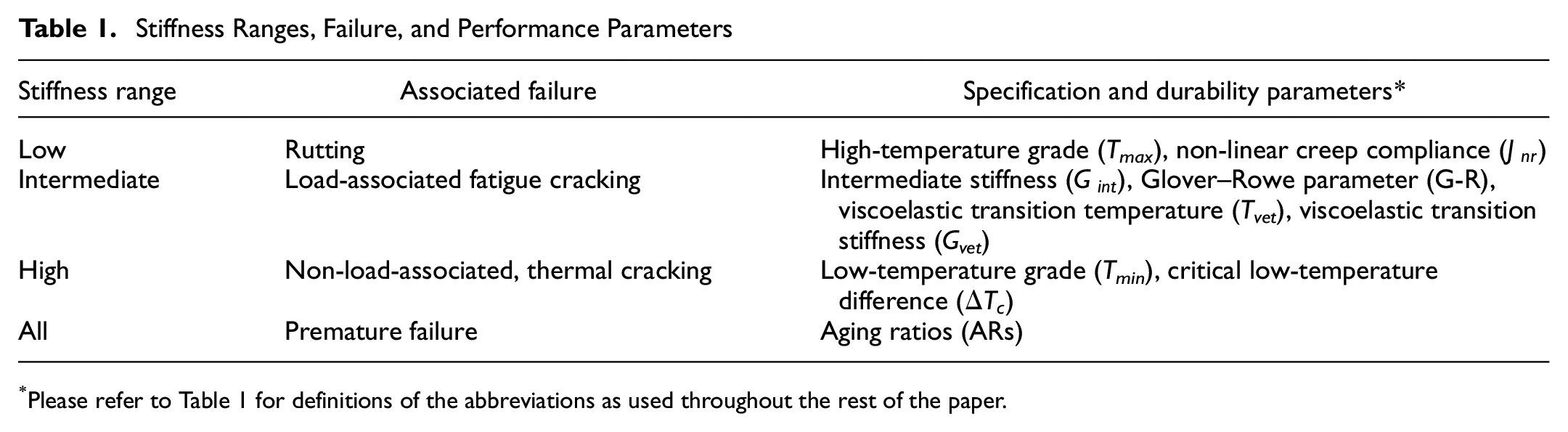
Please refer to Table 1 for definitions of the abbreviations as used throughout the rest of the paper.
Binder Performance Grade (PG)
PGs aim to ensure sufficient high-, intermediate-, and low-temperature performance during service life. Table 2 gives an example of the PG specifications currently used in South Africa. PG definitions are based on the minimum and maximum expected road temperatures,
Performance Grade (PG) Bitumen Specification Example ( 2 )
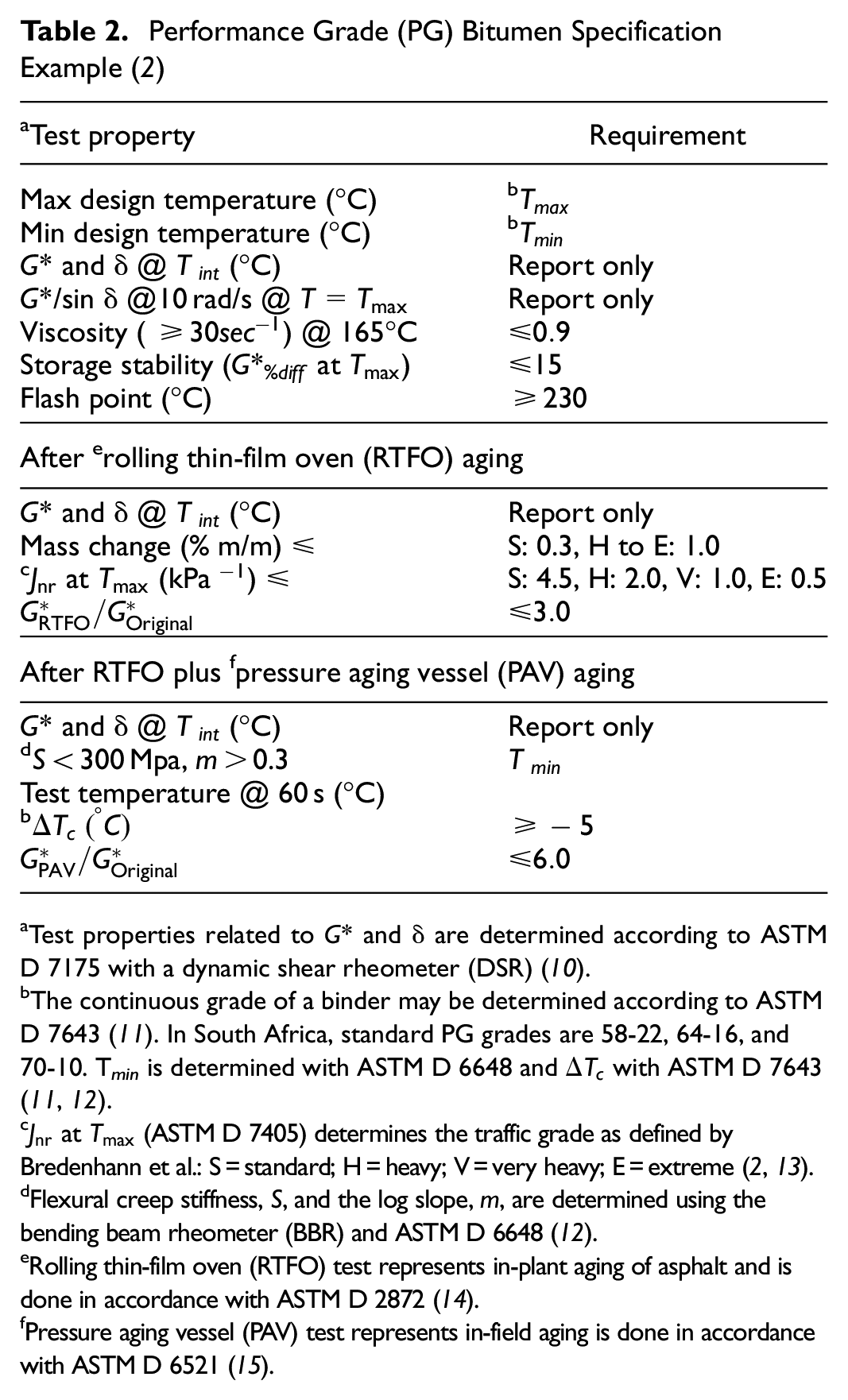
Test properties related to G* and
The continuous grade of a binder may be determined according to ASTM D 7643 (
11
). In South Africa, standard PG grades are 58-22, 64-16, and 70-10. T
min
is determined with ASTM D 6648 and
Flexural creep stiffness, S, and the log slope, m, are determined using the bending beam rheometer (BBR) and ASTM D 6648 ( 12 ).
Rolling thin-film oven (RTFO) test represents in-plant aging of asphalt and is done in accordance with ASTM D 2872 ( 14 ).
Pressure aging vessel (PAV) test represents in-field aging is done in accordance with ASTM D 6521 ( 15 ).
Rheological properties are tested to determine binder characteristics that are expected to control in-field performance. Dynamic shear rheometer (DSR) testing is used to determine the complex shear modulus,
It is important to distinguish between the specification grade, that is, environmental requirements, and the continuous grade of a binder ( 11 ). In this paper, Tmax,cont, Tmin,cont, and Tint,cont [(Tmax,cont+Tmin,cont) / 2 + 4] denote the continuous equivalent of Tmax, Tmin, and Tint. For example, a binder with Tmax,cont = 67.65°C and Tmin,cont = -25.17°C has Tint,cont = (67.65 - 25.17) / 2 + 4 = 25.24°C.
Critical Low-Temperature Difference

with S and m as defined in Table 2, and the critical temperatures where specification limits are reached, interpolated as ( 16 ):


where the current specification limits are defined in Table 2, and
Aging Ratios (ARs)
ARs indicate the rate at which binder properties will deteriorate from their original state. They are often expressed in relation to the stiffness measured with increasing binder ages (Figure 1):


The South African PG specification shown in Table 2 requires ARs as determined at the intermediate temperature (
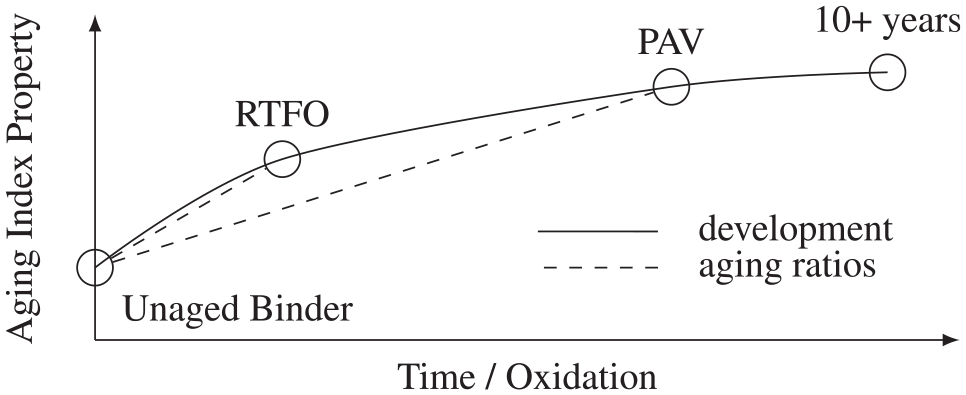
Age-hardening of binders.
Other Durability Parameters for Binders
Durability relates to the ability of a binder to maintain its performance and, therefore, its ability to resist the effect aging has on beneficial properties ( 18 ). Figure 1 shows the expected change in properties over time. Aging indicators include an increase in G* and viscosity or a decrease in ductility. Durability parameters thus aim to evaluate the evolution of rheological properties over time in in-service road conditions. Table 1 also include parameters not commonly included in PG specifications, but that have been proven by research to measure the performance of bitumen.
Ductility and the Glover–Rowe (G-R) Parameter
Ductility is measured according to ASTM D 113 and defined as the distance to which a binder sample elongates before it fractures when pulled apart at a specific temperature and speed (cm/min) combination ( 19 ). Although empirical, research has suggested that ductility represents a measure of the state of the colloidal system, or molecular interactions, in the binder and the shear susceptibility at a specific temperature ( 20 ).
Kandhal recovered binders from a range of asphalt surfacings and found a correlation between the ductility of the binder and the visual condition of the pavements ( 20 ). For binders with similar penetrations, those with lower ductility are more susceptible to cracking than those with higher ductility.
Generally, ductility is measured at low temperatures, not only to establish the resistance to thermal cracking but because of the consistency of binders at those temperatures. Because of the nature of binder deformation, ductility measurements at temperatures above 25°C have low reproducibility and little meaning ( 20 ).
Ductility is an efficient means to rank binder condition and performance. Because of its empirical nature and binder requirements (75 g), surrogates for this test method have been investigated and developed. Glover et al. investigated the use of a Maxwell mechanical model to describe the extensional flow a binder undergoes during a force-ductility test ( 21 ).
The model combines a spring and a dashpot element in series to represent elastic (G) and viscous (
Displacement described by the Maxwell model is dependent on stiffness, G, and the ratio between G and viscosity,

where
For modified binders, the relationship between ductility and the Glover parameter is less defined. The measure to which ductility improves is dependent on the type of modifier and the interaction with the binder. However, polymers degrade with age, decreasing the benefit to ductility. Glover et al. note that polymer degradation could even contribute to a loss of ductility of the binder, as unaged stress elongation, influenced by both the binder and polymers, changes when the polymers are no longer active ( 21 ). When comparing the Glover parameter with ductility, the general correlation improved when grouped according to a similar type. The differences between the unmodified binders, however, converge with age.
Rowe et al. noted that the Glover parameter could be reduced as follows ( 22 ):

thus

and

As the test is performed at a constant frequency, the G-R parameter is then defined as ( 22 ):

with limiting values equivalent to 5 and 3 cm ductility, of 180 and 600 kPa, respectively ( 20 ).
Similarities in G-R and
Viscoelastic Transition
The viscoelastic transition (VET) is associated with
Gvet is independent of temperature and frequency. It is simply the stiffness of the binder when G' = G". Widyatmoko et al. determined Tvet at a loading rate of 0.4 Hz (
24
). More recently, Porot and Eduard, and Garcia Cucalon et al. used 10 rad/s as this loading rate is commonly applied in specifications (
25
,
26
). The
As a binder ages, Gvet and
Black Space Diagram
A Black-Space diagram plots G* versus
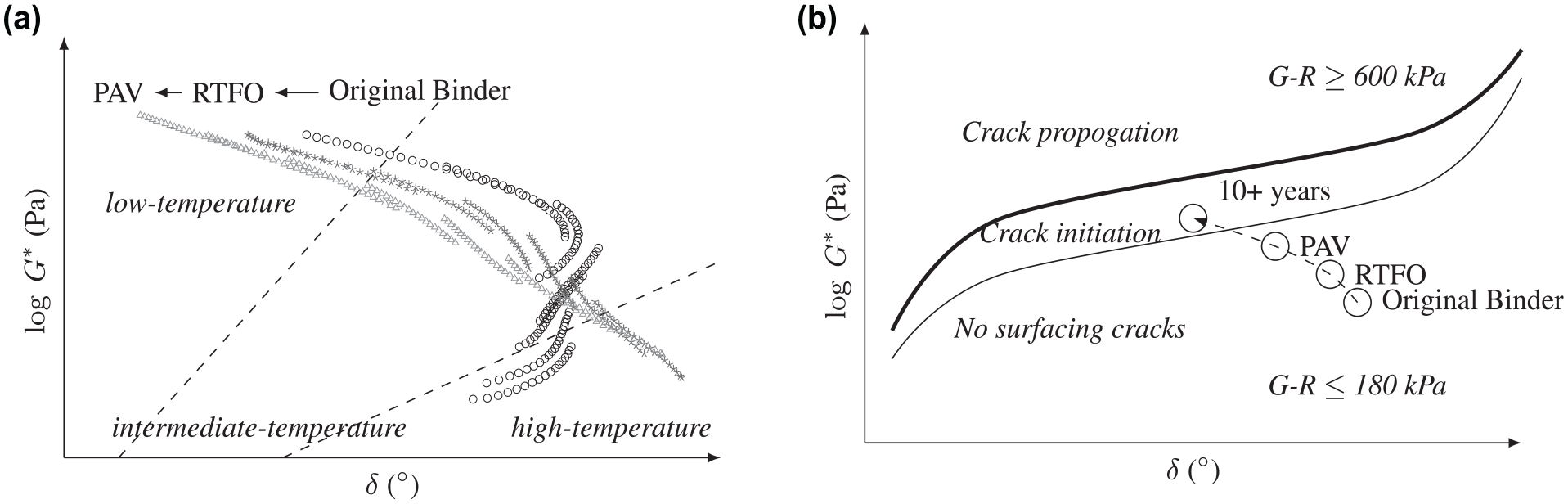
Age hardening of binders in Black-Space: (a) mechanical test data in Black Space and (b) evolution of Glover–Rowe parameter (G-R).
The G-R parameter is helpful to monitor the combined effect aging has on both the stiffness and relaxation properties of binders at in-service temperatures. King et al. associate the 180 and 600 kPa boundaries for G-R with areas (i.e., combinations of G* and
Research Approach
When considering (i) observations of ductility and the influences of modification and its deterioration by Glover et al., (ii) the distinct evolution of binder properties in each temperature range presented in Figure 2a, and (iii) the established development of G-R and associated performance boundaries shown in Figure 2b, the authors ask (a) how the changes in each region relate, (b) whether the development of parameters in each region follow similar trends observed for G-R, and (c) whether the observations of these parameters improve when specific groupings (such as modification type and source) are considered ( 21 ).
To investigate these questions, neat binders are artificially aged and tested with the DSR and BBR at various loading rate and frequency combinations ( 10 , 12 , 14 , 15 ).
Parameters from each temperature region are evaluated to determine interrelationships and the change in bitumen stress-strain response with increased aging:
High-temperature:
Low-temperature:
Intermediate-temperature: VET, G-R, and
ARs for all parameters
Material Selection and Procurement
Unaged, original binders originate from refineries and suppliers across South Africa and are subjected to artificial aging processes. Various ages are included to establish trends in parameter development.
Binders are considered based on:
Binder type: Binders are chosen to represent those commonly applied in industry. The study includes 70/100, S-E1, SC-E1, S-E2, and SC-E2. Three asphalt binders are available as a part of the larger research initiative. These are included in the analysis to indicate possible differences in aging of modification types: 50/70, A-E2, and A-P1. (S, A, C, E, and P represent spray grade, asphalt, emulsion, elastomer-modified, and plastomer-modified, respectively. 1 and 2 indicate the degree of modification) ( 34 ).
Origin: Binders are sourced either directly from suppliers or road-building projects. Those obtained from suppliers are selected to ensure diversity in base binders and modification. These binders originate primarily from the Western Cape (WC), Gauteng (GP), and Kwa-Zulu Natal (KZN) provinces. Where original binders are sourced from specific projects in specific provinces, the original binder is labeled from the province the road project is located in, that is, the Eastern Cape (EC), Limpopo (L), or Free-State (FS) provinces.
Ages: Binder ages are chosen with the intent to represent ages along the full spectrum of surfacing life. RTFO-aging is specified in the South African PG specification for all binders, that is, both asphalt and chip seal binders. For this reason, the majority of binders are subjected to RTFO testing before PAV aging. However, since chip seal binders do not undergo in-plant aging represented by RTFO aging, some specimens are only aged with the PAV to consider possible disparities in aging. Artificial ages comprise: Original (unaged), RTFO, RTFO & PAV1, PAV2, RTFO & PAV2, PAV4, and RTFO & PAV4. (PAV1 indicates 20 h aging, and PAV4 indicates 80 h aging.)
In total, 92 binder samples are considered: 18 penetration grade, 49 modified spray-grade, 15 emulsion, and 10 asphalt-modified binders; 19 unaged and 73 binders between RTFO to RTFO & PAV4 aged were tested. For anonymous analysis, binders are labeled by their type and alphabetic markers, that is, S-E1-D, when the binder specific evolution of parameters are analyzed. Other projects that reference these binders are Engelbrecht, Van Zyl et al., and Tredoux et al. ( 35 – 37 ).
Testing
Aging
The RTFO test simulates plant aging, and the PAV simulates short-term in-service aging. For RTFO, ASTM D 2872 (unmodified) and TG 1 (modified) are followed, and for PAV, ASTM D 6521 is followed ( 14 , 15 , 18 ). (PAV aging is applied in multiples of 20 h, that is, PAV4 is equivalent to 4 times 20 standard PAV hours.)
DSR
The DSR is used to conduct strain and frequency sweeps. ASTM D 7175 is followed with equipment and test set-up as follows ( 10 ):
Parallel 8 mm with 2 mm gap, and 25 mm with 1 mm gap
Sample preparation: Silicone moulds
The corresponding test variables, as well as variations of the specification, are as follows:
Applied strain: For unaged binders, strain percentages as per Bredenhann et al. are used ( 2 ). For aged binders, strain sweeps are conducted between 0.01 and 10% strain. When the stiffness reaches 95 % of its initial value, the linear viscoelastic (LVE) limit is reached. If the LVE limit is less than 1%, that percentage strain is applied during frequency sweeps. Otherwise, 1% is used.
Test temperatures: For most samples, the 8 mm geometry is used to test the specimen at 35°C, 25°C, 15°C, and 5°C, and the 25 mm geometry at 35°C, 45°C, 60°C, and 70°C. Strain sweeps are conducted at the lowest temperature for each geometry.
Test frequencies: Strain sweeps are conducted at 10 radians/s, and frequency sweeps between 0.251 and 25.1 radians/s at each temperature.
Sample preparation: Before testing, binders are heated at 165°C and poured into DSR moulds.
Bending Beam Rheometer (BBR)
The BBR is used to determine cold temperature stiffness and relaxation. ASTM D 6648 is followed with equipment and test set-up as follows ( 12 ):
Sample preparation with steel moulds.
Binders are tested at two to three temperatures, which are determined by the binder type.
The corresponding sample preparation and conditioning procedure is as follows:
Binders are heated at 165°C for 25 to 30 min while steel moulds are prepared.
After pouring, the binder is left to cool at room temperature for 60 min, and trimmed after 20 to 30 min. For harder binders buttering (refer to ASTM D 6648, note 10) is required ( 12 ).
Before demoulding, the binder is placed in a fridge for 5 min.
The demoulded beams are then left in the BBR bath for 60 min at the test temperature (± 0.1°C).
Following testing, the specimen width and height is measured with an electronic calliper to the nearest 0.01 mm.
For specific samples, BBR tests could not be completed. For these binders, only Tmax,cont is reported; other continuous and low-temperature parameters are not included in the data analysis.
Performance Parameters
For this study, DSR and BBR data are shifted to Tref = 15°C. The modified Kaelble shift and generalized logistic master curve functions are used to calculate specific parameters where needed ( 28 ). The evolution of binder properties with aging is subsequently evaluated by examining the progression of performance and durability parameters:
VET parameters: Tvet is the temperature at which
G-R parameter: G* and
ARs: ARs are calculated for each of the above performance parameters to evaluate relative aging for the load-response region of binder behavior it represents. Predominantly, ARs are calculated as:

where X represents the specific performance parameter. The exception is

The variation is required because of the nature of
The relative susceptibility of binders to age in various regions of behavior is evaluated by considering interrelationships. The correlations between performance parameters are indicated by the Pearson correlation coefficient,

where
X and Y = correlated variables,
n = the number of data points.
The summary of the experimental flow, including material selection, testing, and data analysis, is shown in Figure 3. It is noted that shift and master curve function optimization is not in the scope of this paper, but is reported by Goosen ( 28 ).
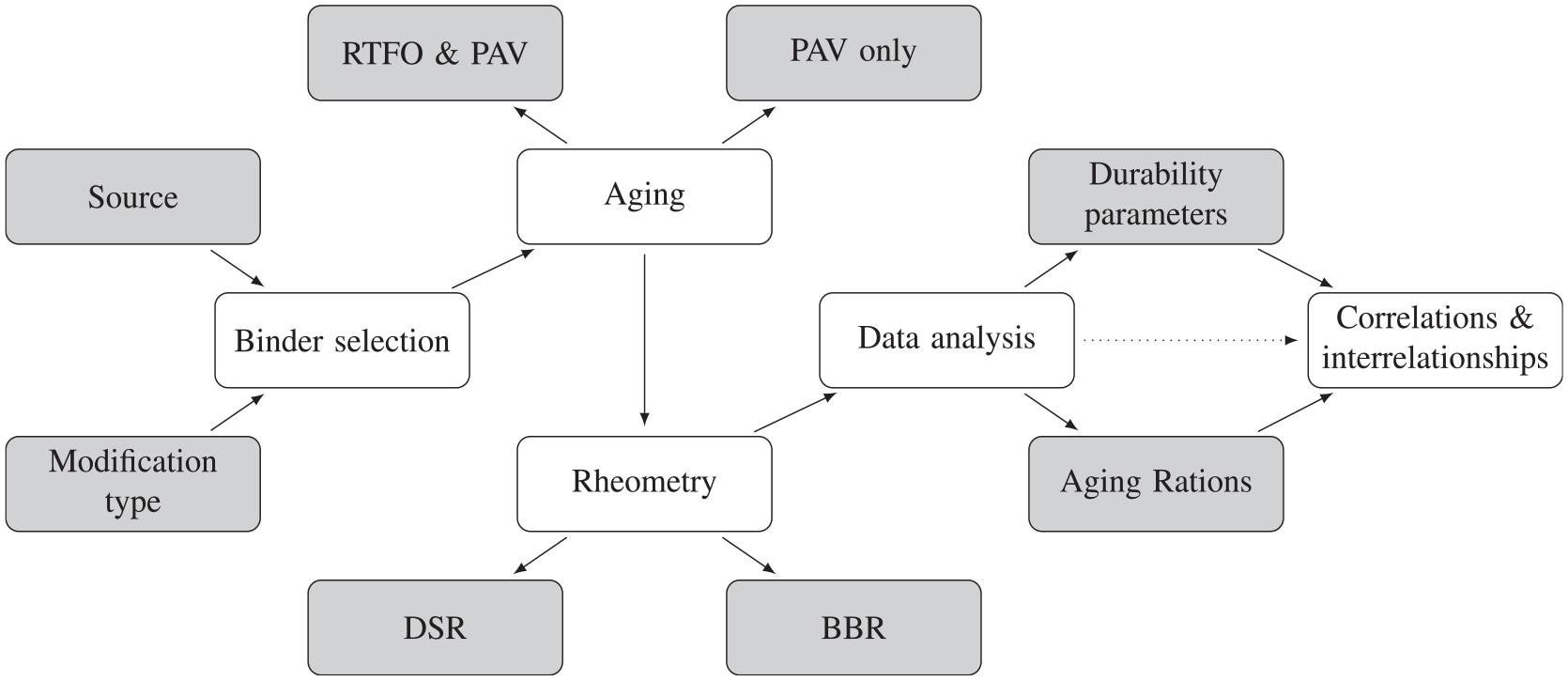
Experimental and data flow design.
Evolution of Durability Parameters
Black Space Diagram
Black Space represents the entire range and domain of possible mechanical responses, at the particular binder age, regardless of loading rate and temperature. Parameters were chosen to represent various stiffness and relaxation spectra indicated in Figure 2a. The typical progression of G* versus
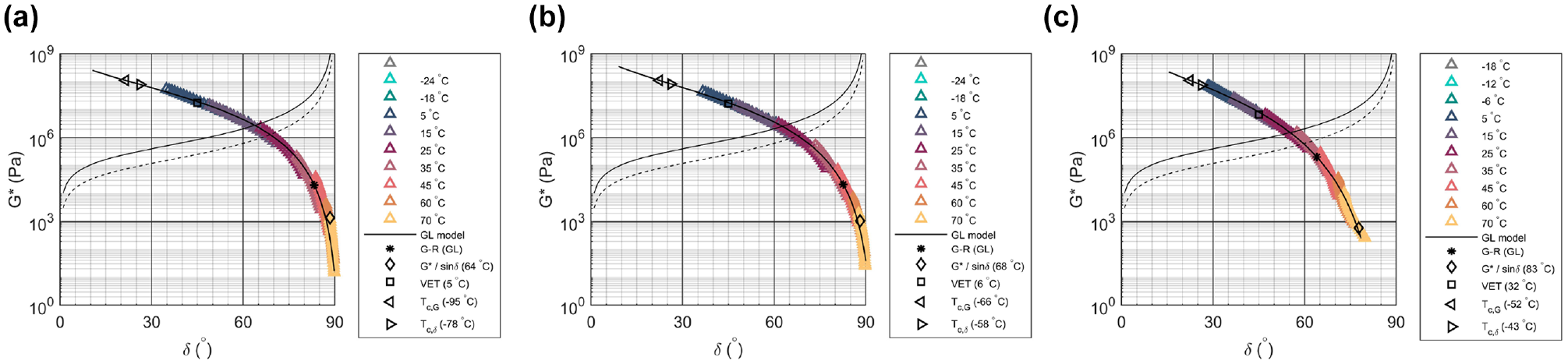
Typical progression of Black Space diagrams for unmodified binders: (a) unaged, (b) rolling thin-film oven (RTFO)-aged, and (c) pressure aging vessel (PAV)-aged.
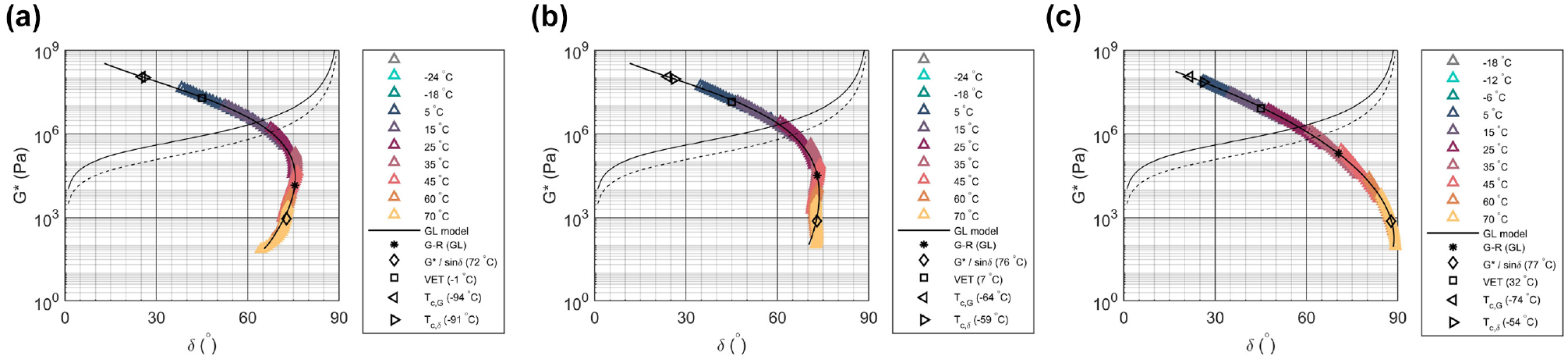
Typical progression of Black Space diagrams for modified binders: (a) unaged, (b) rolling thin-film oven (RTFO)-aged, and (c) pressure aging vessel (PAV)-aged.
As binders age in Black Space, the high-temperature tail of modified binders straightens out to the right—an indication of decaying modifiers. For similar test temperatures, the curve as a whole flattens and moves to the upper left. As a result, VET and G-R move closer together and G*/sin
Figure 6 shows the progression of G-R in Black Space. With an increase in age, G-R is expected to move from the lower right corner toward the upper left of Black Space. This movement is also known as the march of death as it is indicative of increased age and oxidation, and ultimately signals distress and possible failure. It is observed that the data converges significantly with age. Scattering for artificial ages in Figure 6a suggests that location after artificial aging depends on the initial position. Thus, when grouped by similar grade, that is,
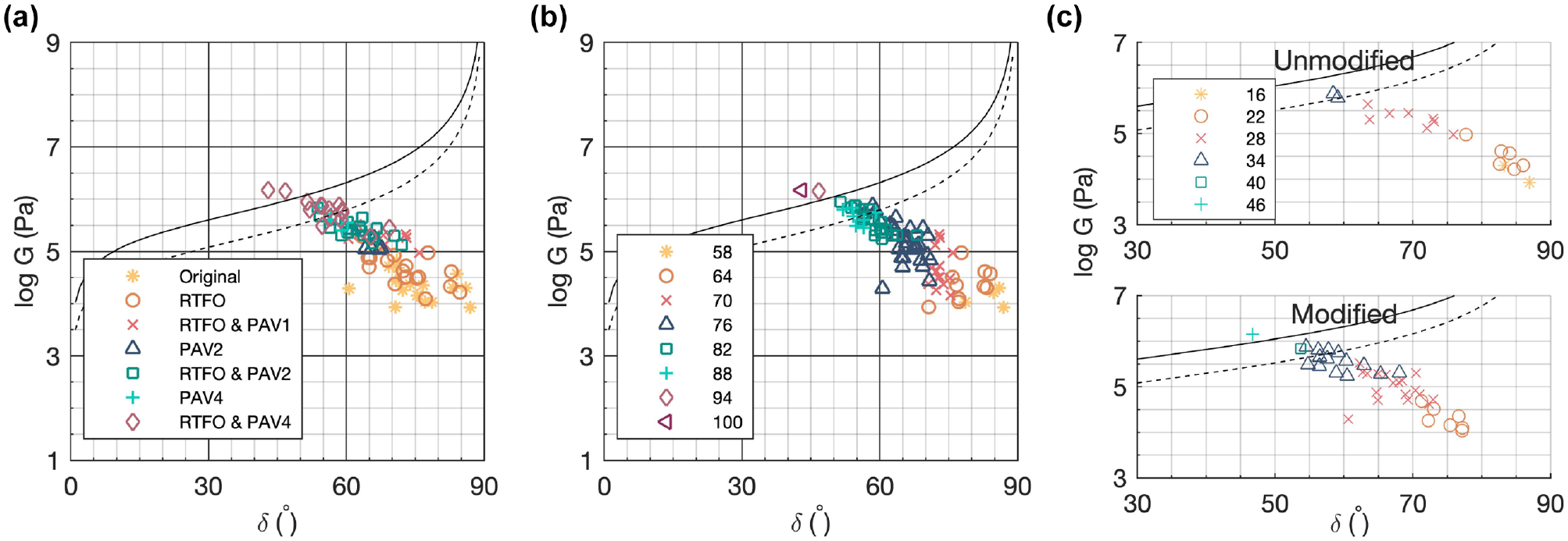
Glover–Rowe (G-R) in Black Space: (a) artificial ages, (b) grouped by
To investigate the scattering of data point with G* <
Continuous Temperature Grades
Figure 7 shows the relationship between Tmax,cont, the useful temperature interval, that is, Tmax,cont - Tmin,cont, and Tint,cont. In Figure 7a, the useful temperature interval is observed to be proportional to Tmax,cont. The correlation implies that (i) the 80°C difference enforced by specifications for
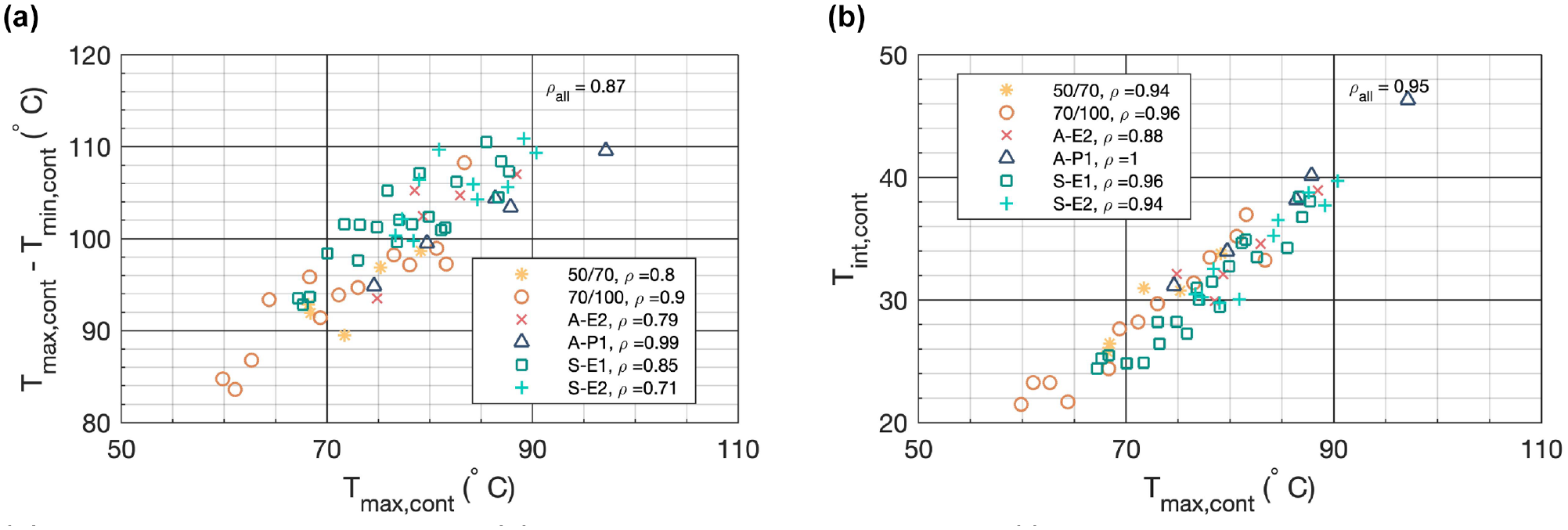
Development of continuous grades: (a) useful temperature interval and (b)
The relationship between
Pertinent interrelationships for continuous grade parameters are indicated in Figure 8. Figure 8a shows the temperature grades versus G-R. Performance boundaries associated with G-R are included. When considering the graph, it is useful to remember the movement of G-R away from high- and toward low-temperature behaviour in Black Space as aging increases. Subsequently, it is seen that the correlation of G-R and
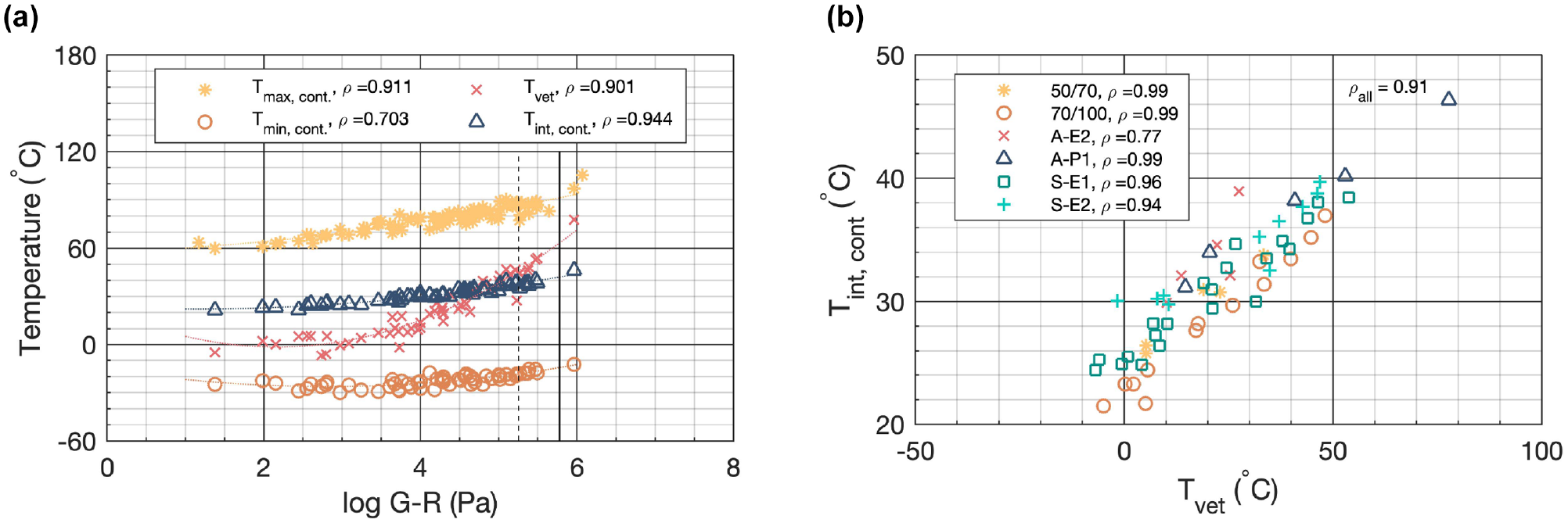
Pertinent interrelationships for continuous grades: (a) continuous temperature grades versus Glover–Rowe (G-R) and (b)
The interrelationship with
Further to the above, the study distinguishes between the continuous intermediate temperature of the binder and the intermediate temperature of the climate, or PG grade. Temperatures associated with intermediate stiffness behavior of the binder will increase with time. As defined by the PG specification, the intermediate temperature of the climate will remain constant at either 22°C, 28°C, or 34°C. It may be interesting to investigate whether there is a relationship between the difference in
Intermediate-Temperature Stiffness
Intermediate temperatures are defined per specification binder grade, specifically for 55-22, 64-16 and 70-10. Binder stiffness at intermediate temperatures of 22°C, 28°C, and 34°C, and a loading rate of 1 rad/s, is investigated as a measure of the expected in-service stiffness response. The specific intermediate temperature is dependent on the environment for which the binder has been chosen. In principle, it remains constant unless temperatures associated with specific regions are adjusted, for example, because of climate change. As binders age, it is expected that stiffness at intermediate temperature will increase, as will the associated risk of fatigue damage.
As expected, decreasing temperature causes increasing stiffness. For the binders considered,
General correlations between the intermediate temperature stiffness responses and G-R in Figure 9 are similar to those of
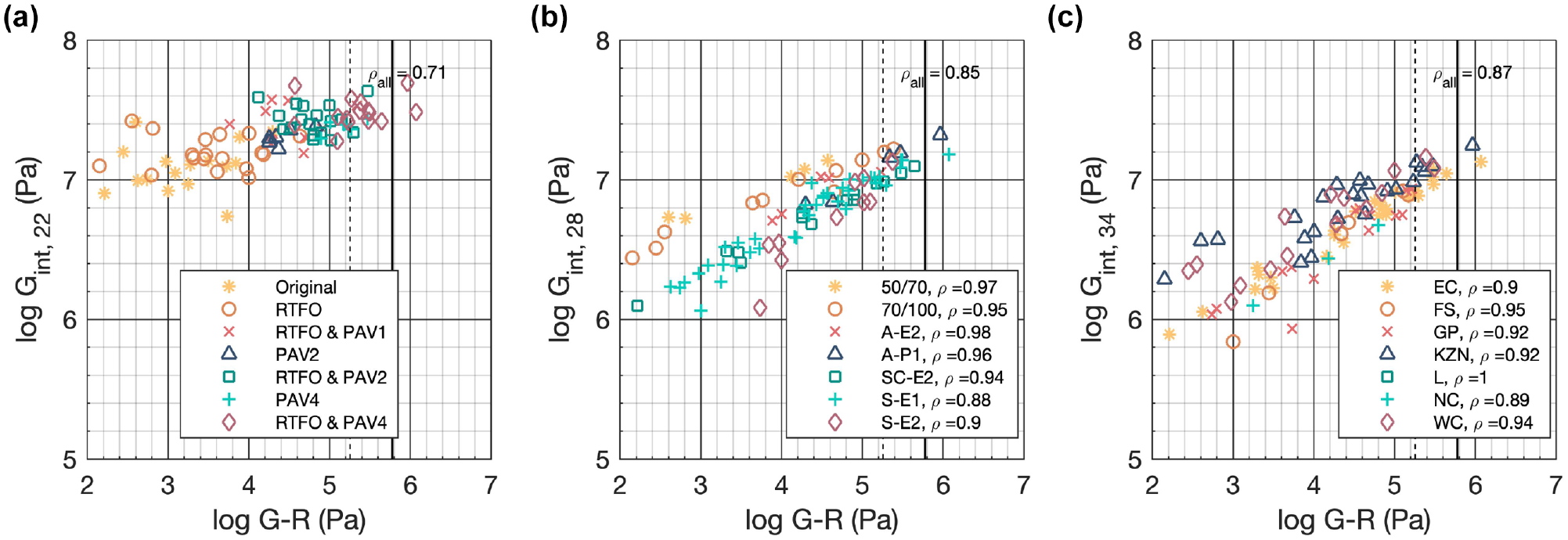
Intermediate stiffness versus Glover–Rowe (G-R): (a) Gint,22, (b) Gint,28, and (c) Gint,34.
Scattering observed for G-R <
When considering
Critical Low-Temperature Difference
General trends in development are considered in Figure 10.
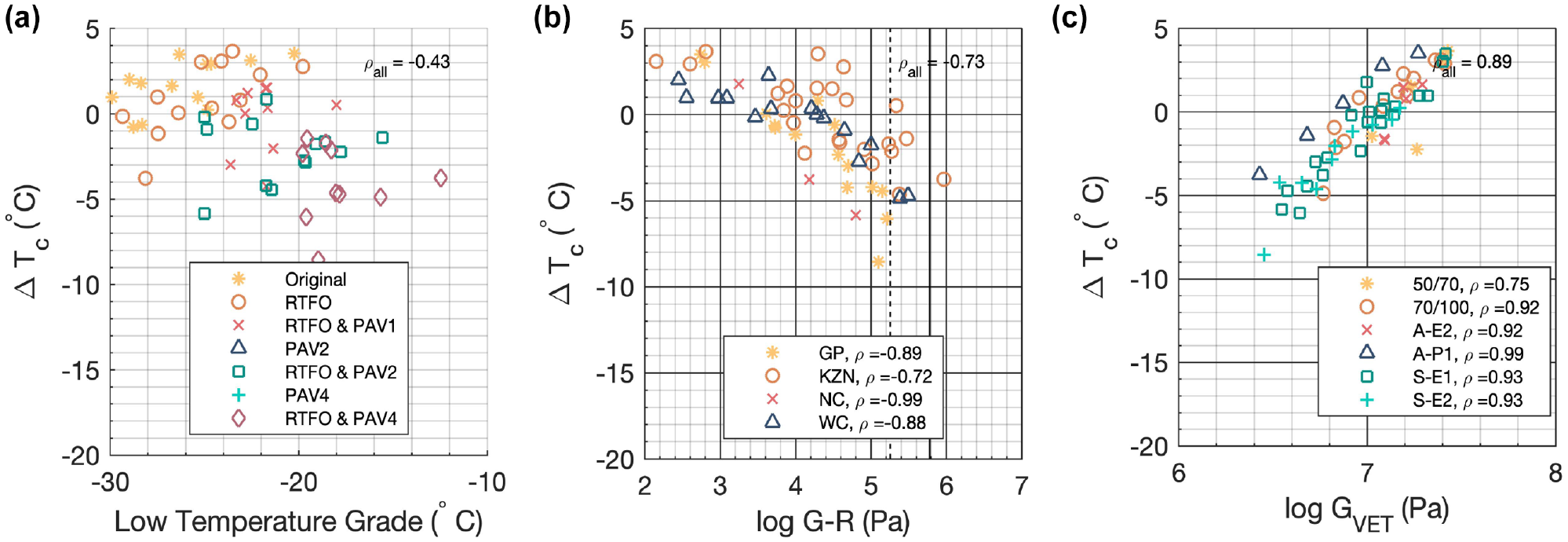
Figure 10b shows
Figure 10c indicates the correlation of
From the above analysis, it appears that
Viscoelastic Crossover
The development of VET is shown in Figure 11. VET has been linked to oxidative-age hardening, reduced temperature susceptibility and binder distress (
24
,
25
,
29
).
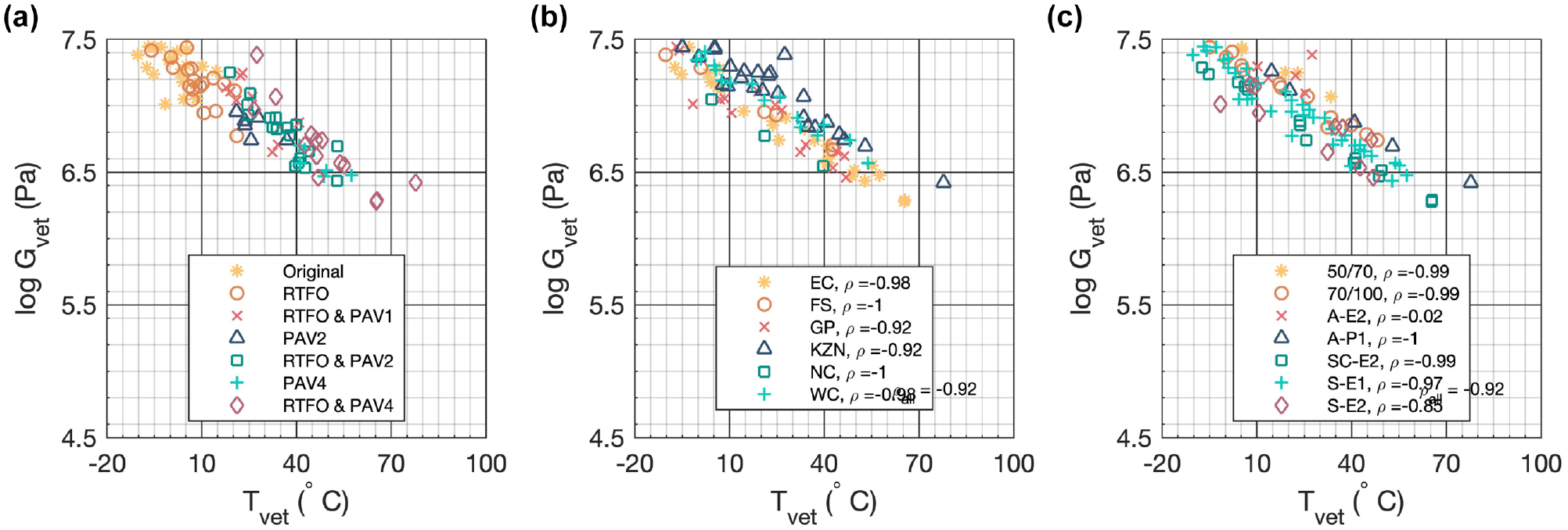
Influences on the development of viscoelastic transition (VET): (a) artificial age, (b) source, and (c) binder type.
Viscoelastic Transition (VET)
The VETs in relation to
As observed in Figure 11c, unmodified binders appear to tend toward the upper part of the data band. This occurrence suggests modified binders are slightly less stiff whilst transitioning from viscous to elastic-dominant behavior. The impact of this observation on construction should be considered and investigated further. The rate of change for all sources and binder types appears similar.
Crossover Frequency
The
The VET is compared with
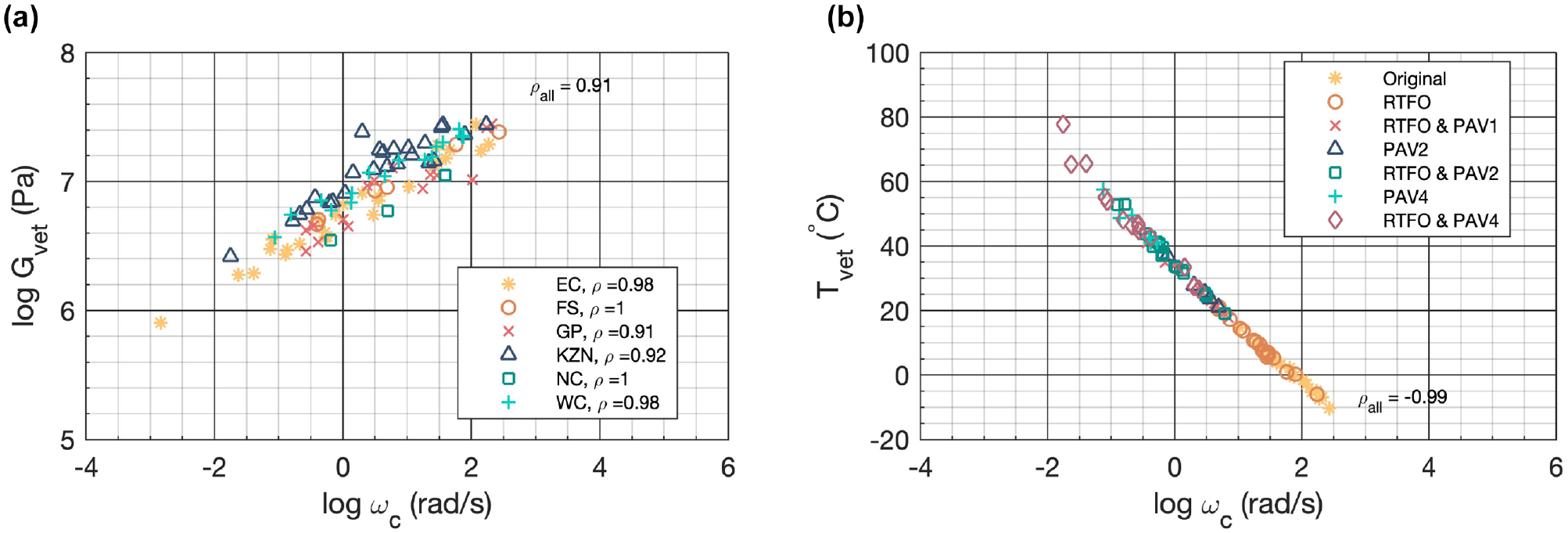
Viscoelastic transition (VET) versus
Figure 13 exhibits significant interrelationships for
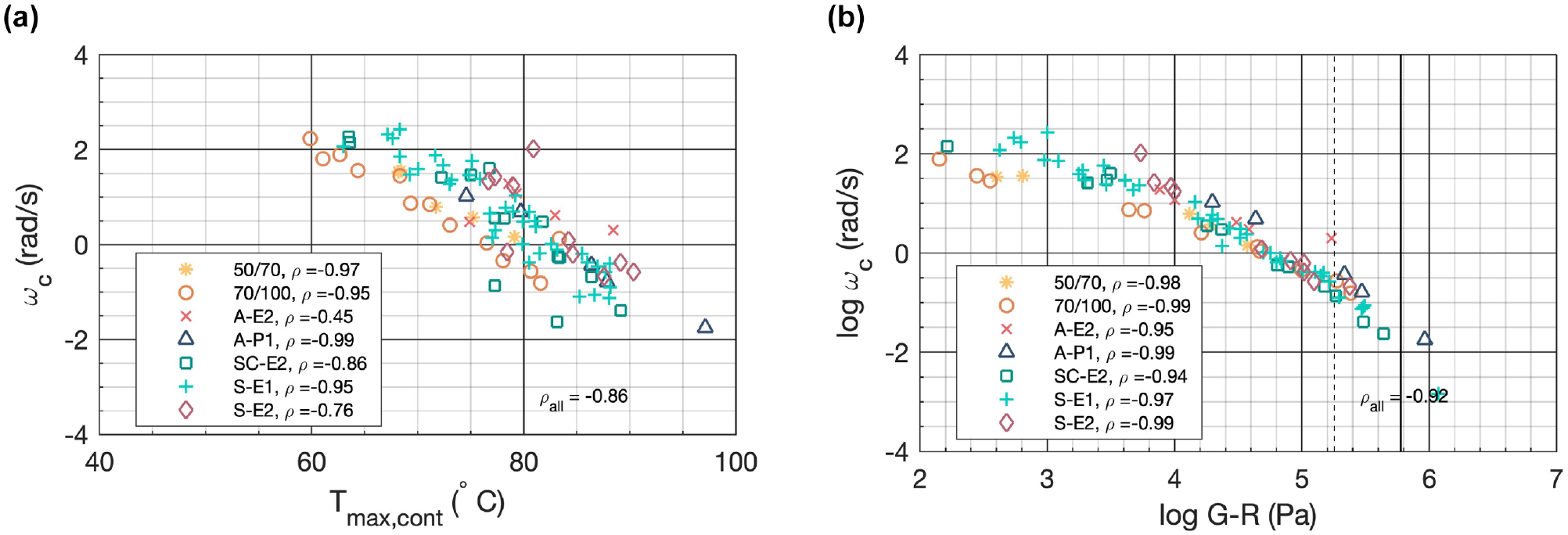
Pertinent interrelationships for
G-R and
Glover–Rowe Parameter (G-R)
The general development of G-R in Black Space is indicated in Figure 6. G-R has been shown throughout the paper to correlate well with a significant number of rheological indicators. G-R also indicates notable interrelationships with VET as indicated in Figure 14. The specific evolution of G-R for individual binders is shown in Figure 15.
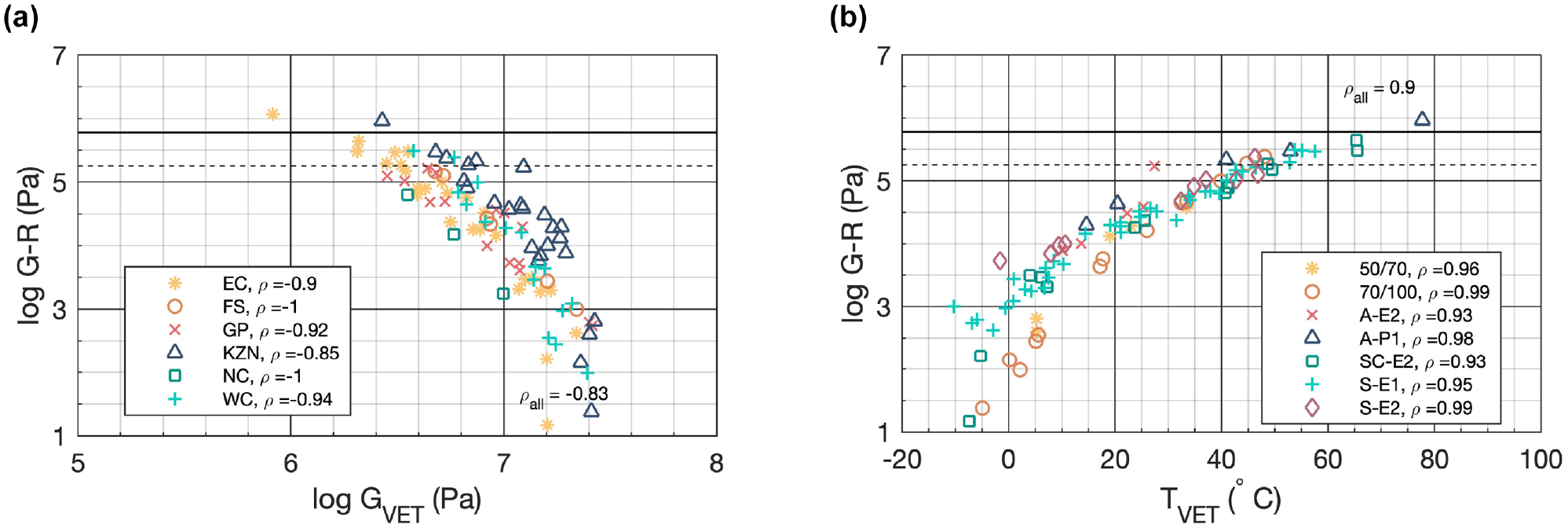
Glover–Rowe (G-R) versus viscoelastic transition (VET): (a)
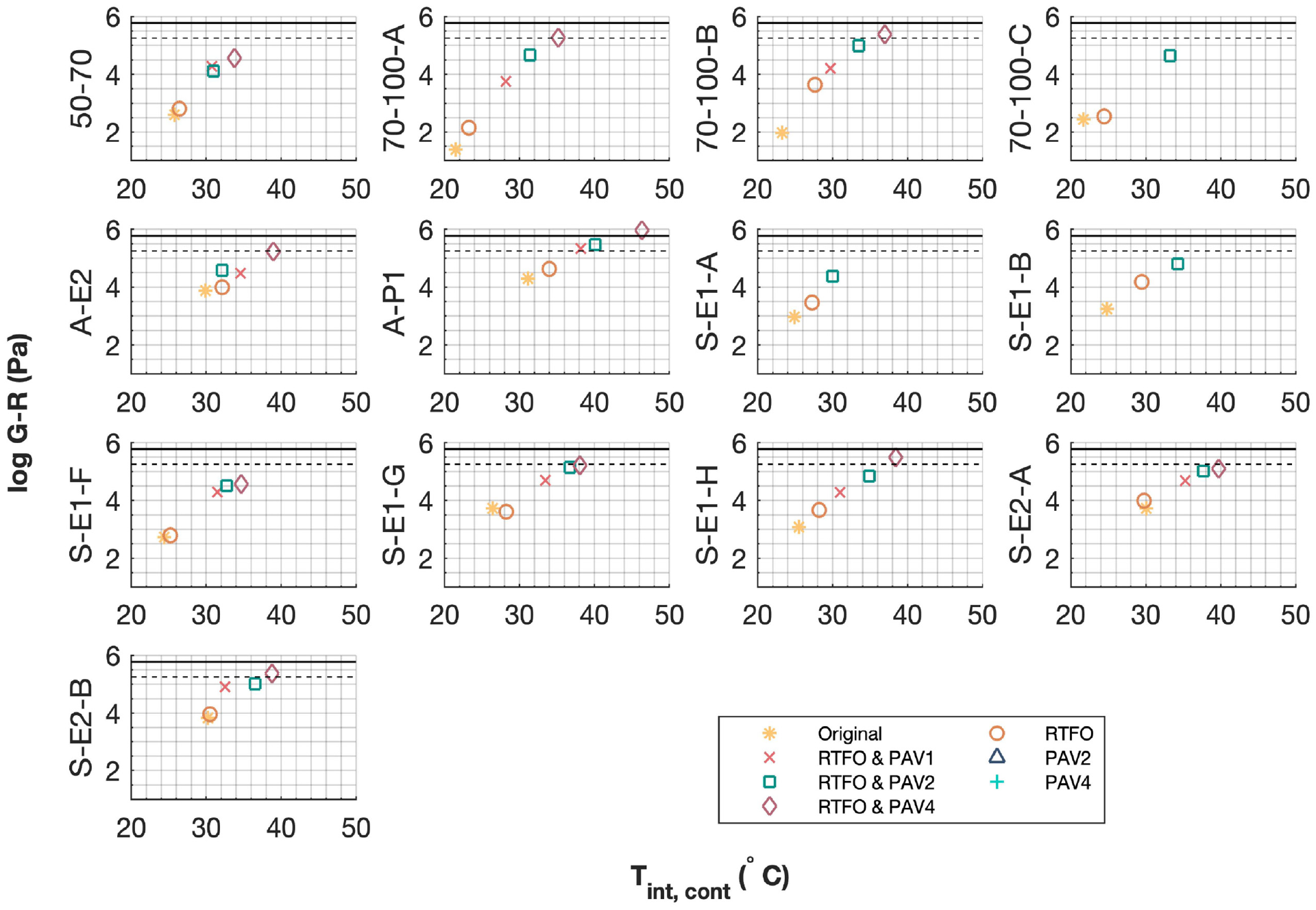
Development of Glover–Rowe (G-R) versus
The interrelationship with
In Figure 6c, grouping by
It is a further point of clarity that a single binder follows a particular trend. This distinction may be assumed to be caused by various aspects identified, including the base binder and not excluding modification products. Some distinction between binder types can be observed since their initial values tend to be in similar ranges. The slope also appears to converge with increased artificial age, in most cases possibly approaching an asymptote.
Aging Ratios (ARs)
Based on observations of general evolution and interrelationships, ARs are considered for parameters that indicate sensitivity to triggers of binder aging. Parameters are chosen to represent high-, intermediate-, and low-temperature or stiffness responses. Interrelationships are considered to assess relative susceptibility to aging at different regions of binder behavior.
It should be stressed that ARs normalize the parameters, and disregard the initial conditions. Thus, one binder may yield a greater AR than another, and still behave relatively less aged in absolute terms. Interrelationships between ARs point out where behavior is most susceptible to aging. The onus is then on the analyzer to determine whether the aging mechanisms will lead to premature failure.
Continuous Temperature Grade
The ratio of aged to initial
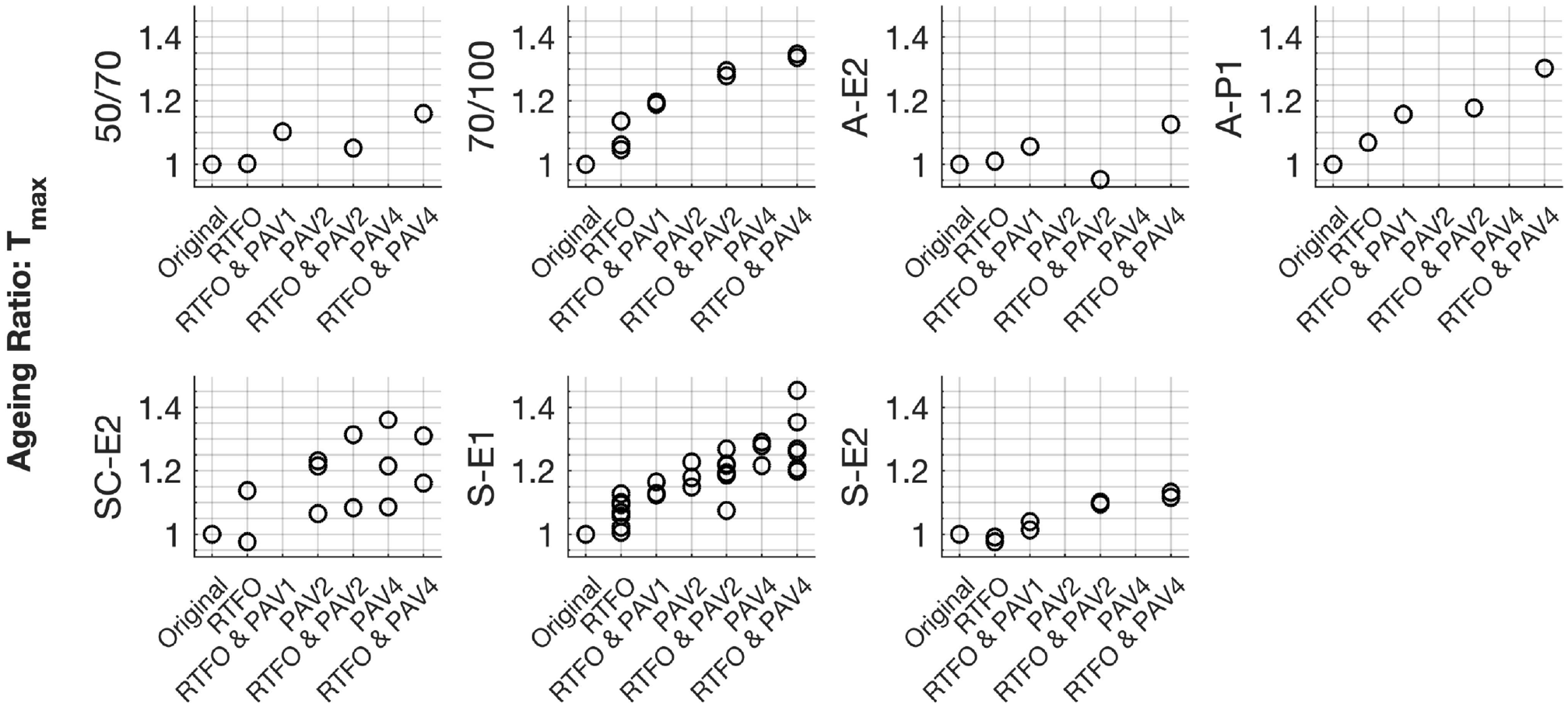
Interestingly, S-E2 binders yields a considerably lower aging rate than other modified binders—this is also observed for the 50/70 and A-E2 binders, respectively. From literature, it is understood that bitumen approached a stiffness asymptote with age. This trend may translate to the equivalent high-temperature grade. Subsequently, a binder that is initially stiffer or aged may have lower aging potential.
Further, it may also be mentioned that, in South Africa, it would be assumed that SC-E2 emulsion binder is produced from a S-E2 base binder. Given the parallel between aging of the S-E1 and SC-E2 binders, this may be called into question.
When interrelationships in Figure 17 are considered, significant insights are gained. The AR of
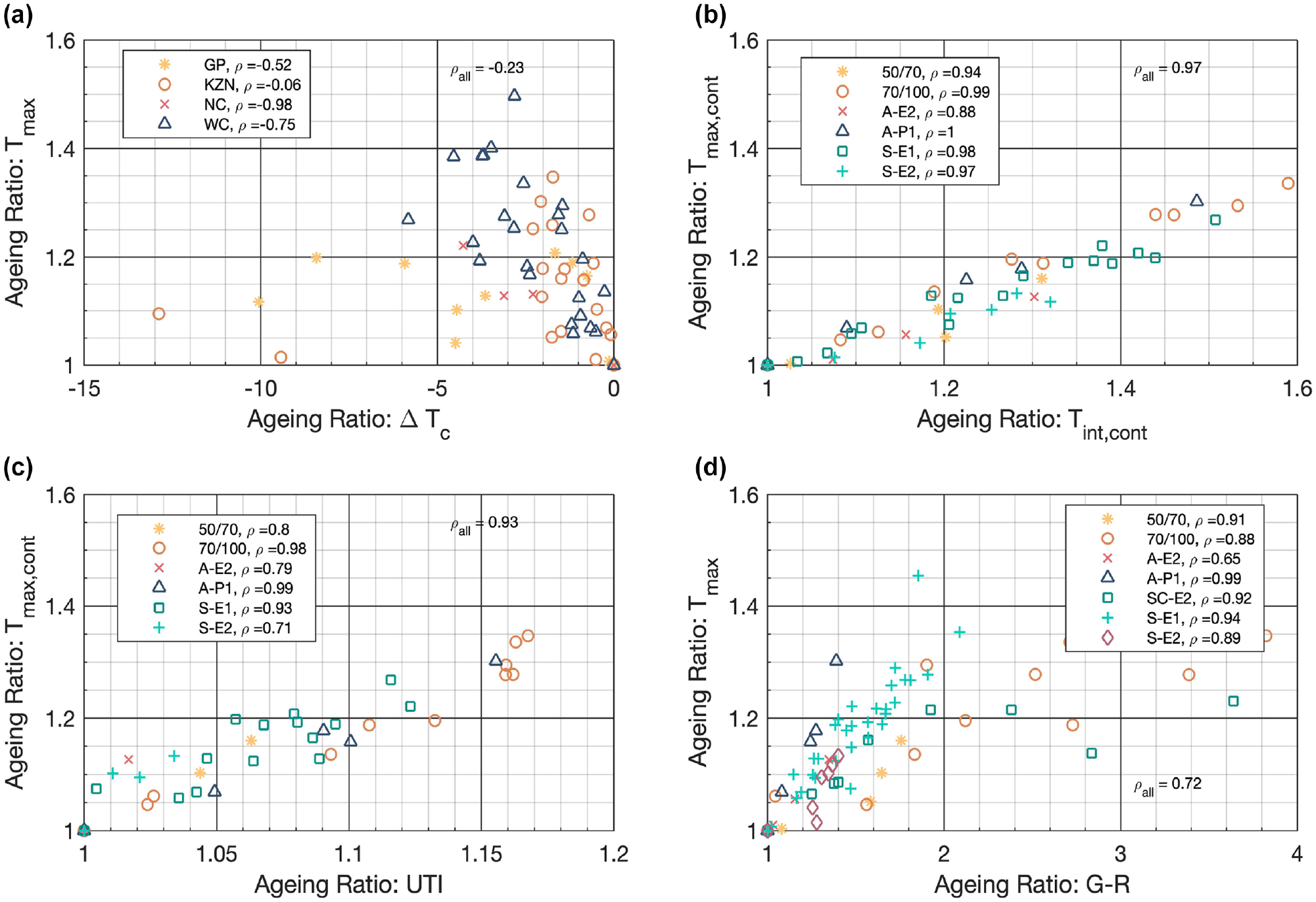
High-temperature AR interrelationships: (a)
The correlation in development between
Binder type is expected to influence the aging and aging rate in Black Space between
Intermediate-Temperature Stiffness
The interrelationship between G-R and
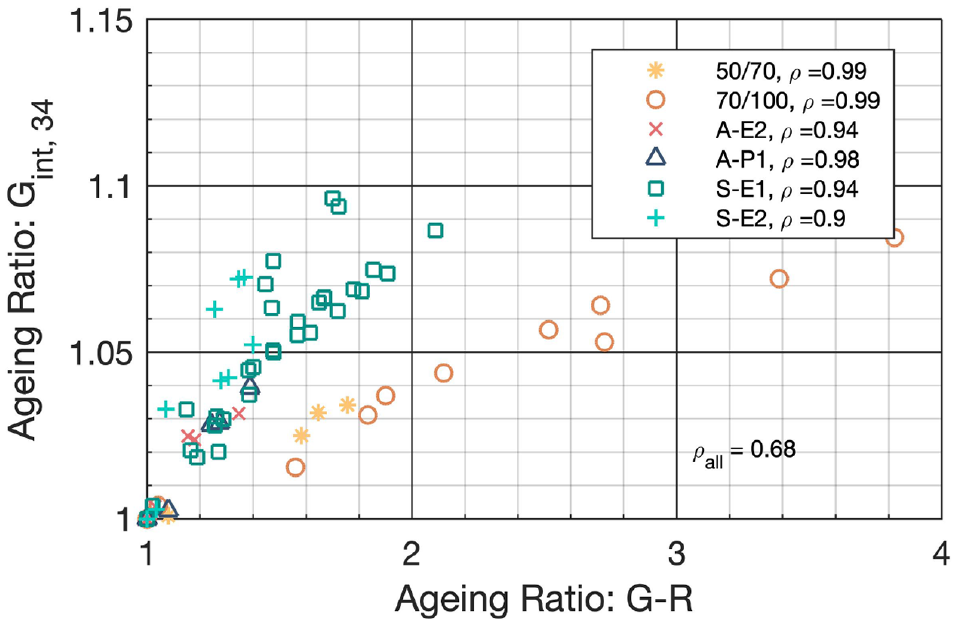
Intermediate stiffness versus Glover–Rowe (G-R).
Trends in ARs for in
In Figure 18, the separation of modified and unmodified binders observed in Figure 17d is further noticeable. It could be argued that this distinction is because of the difference in behavior observed in Figures 4 and 5. The 35°C isotherm and G-R parameter in Black Space coincide with the deviation in the modified binder data between
Critical Low-Temperature Difference
The aging rate of
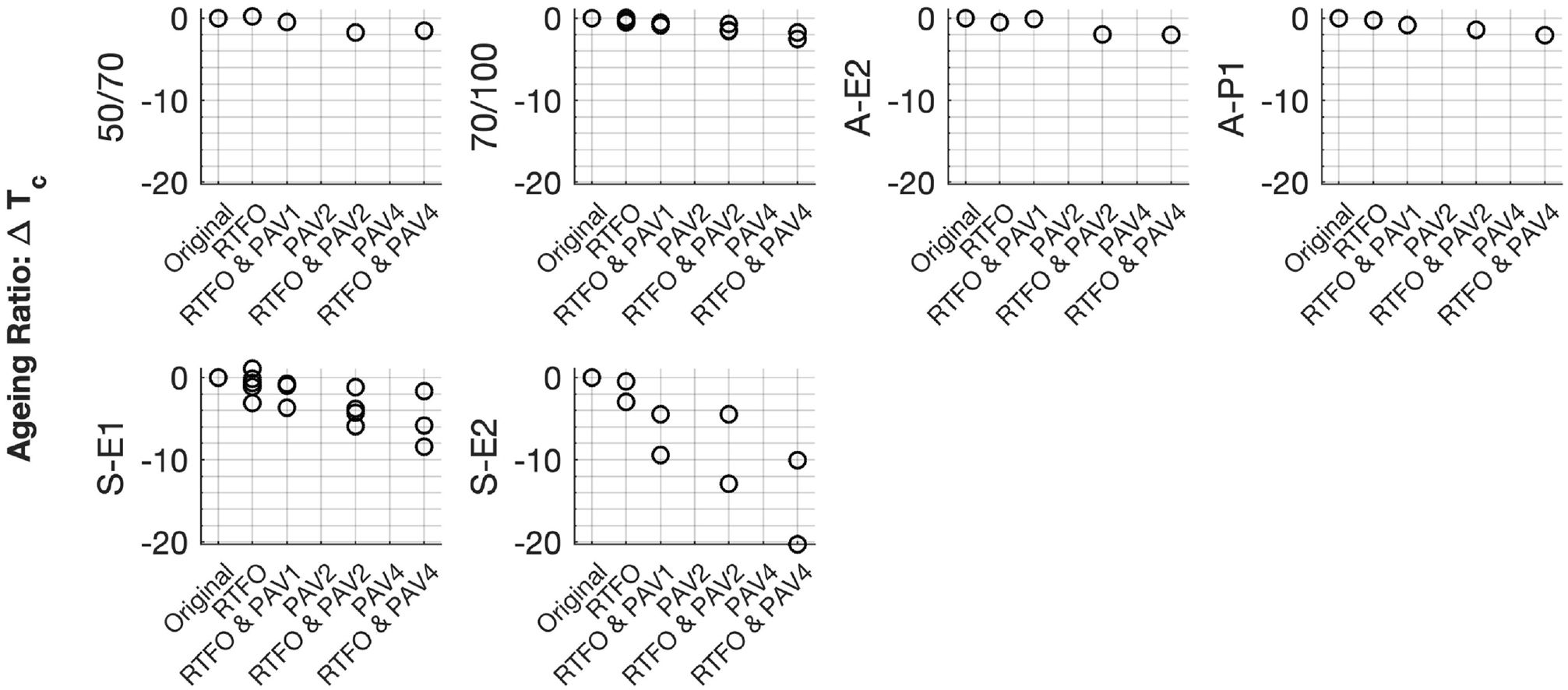
Interrelationships are considered in Figure 20. In general,
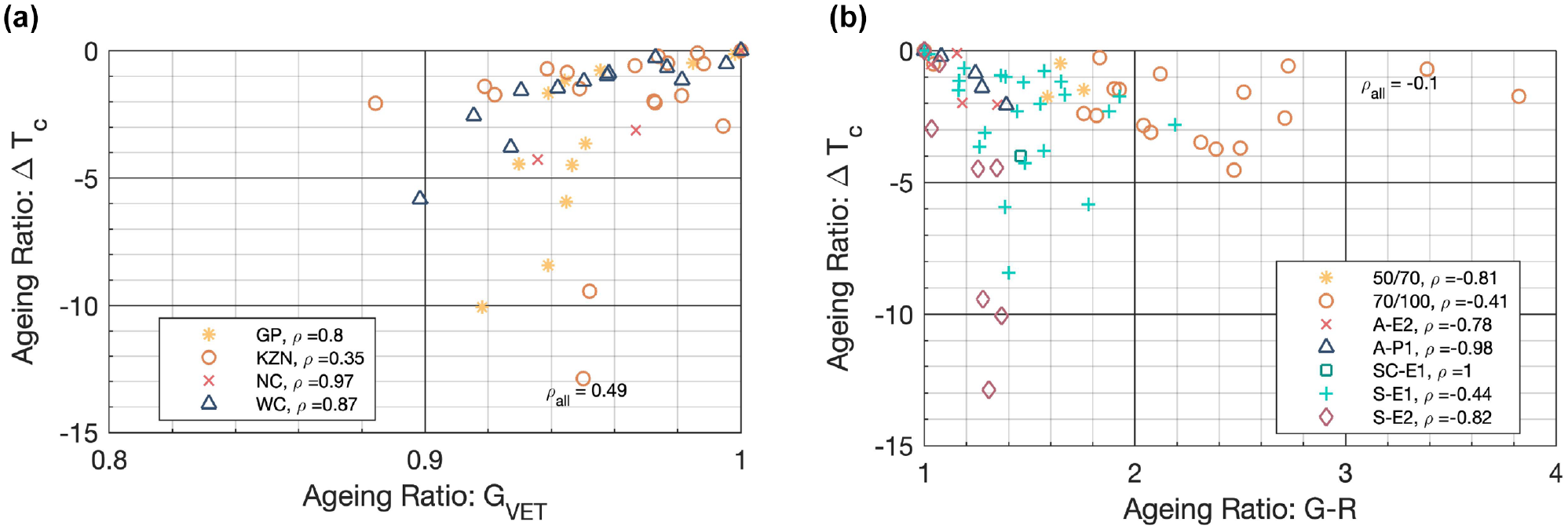
The influence of binder type on the correlation between aging rates of
If details about modifications were available for S-E1 binders, it would be interesting to assess whether considering the degree of modification, or possibly type of modification, would further improve correlations. From a chemical perspective, it may also be valuable to investigate the molecular composition and its influence on low- and intermediate-temperature-aging susceptibility.
Viscoelastic Crossover
Viscoelastic Transition
ARs for
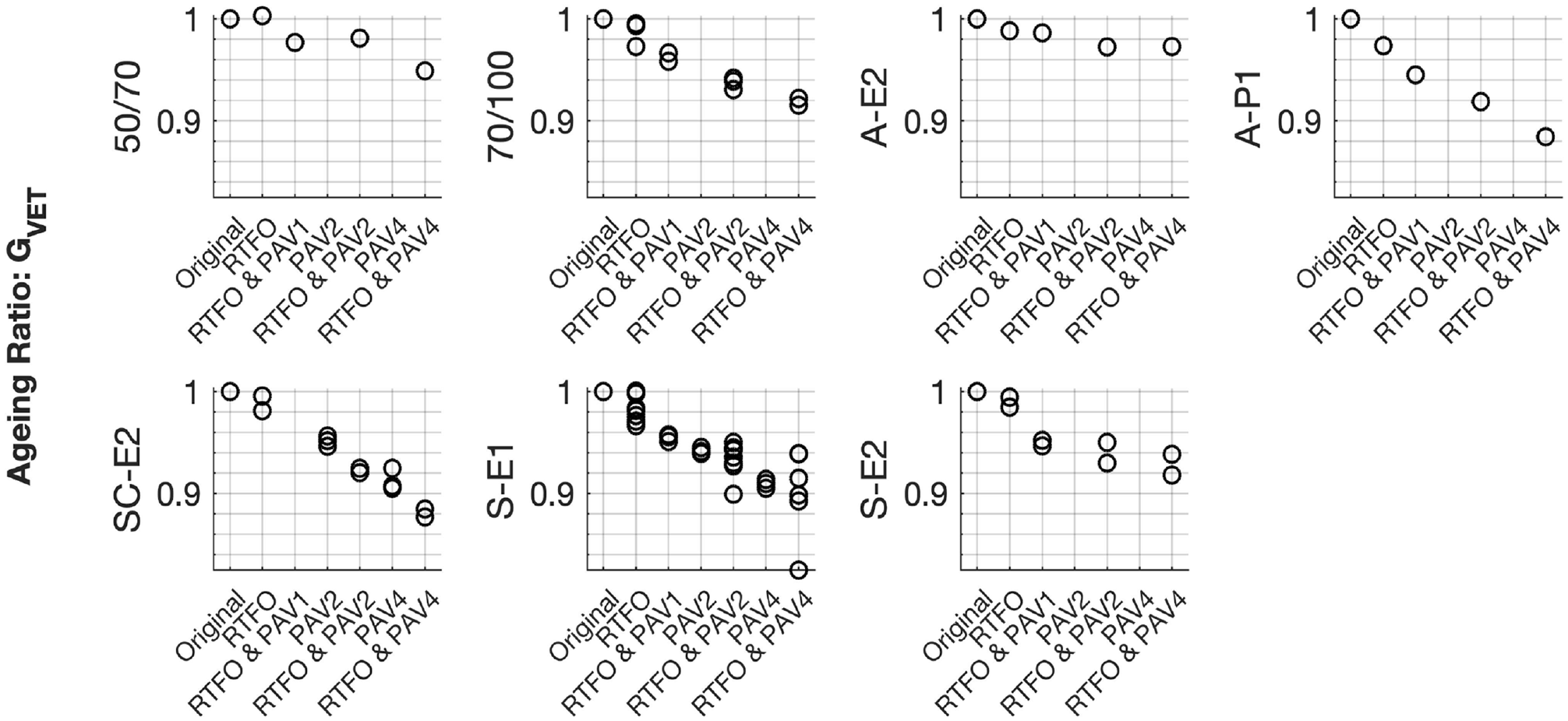
Interrelationships are considered in Figure 22. Correlations with
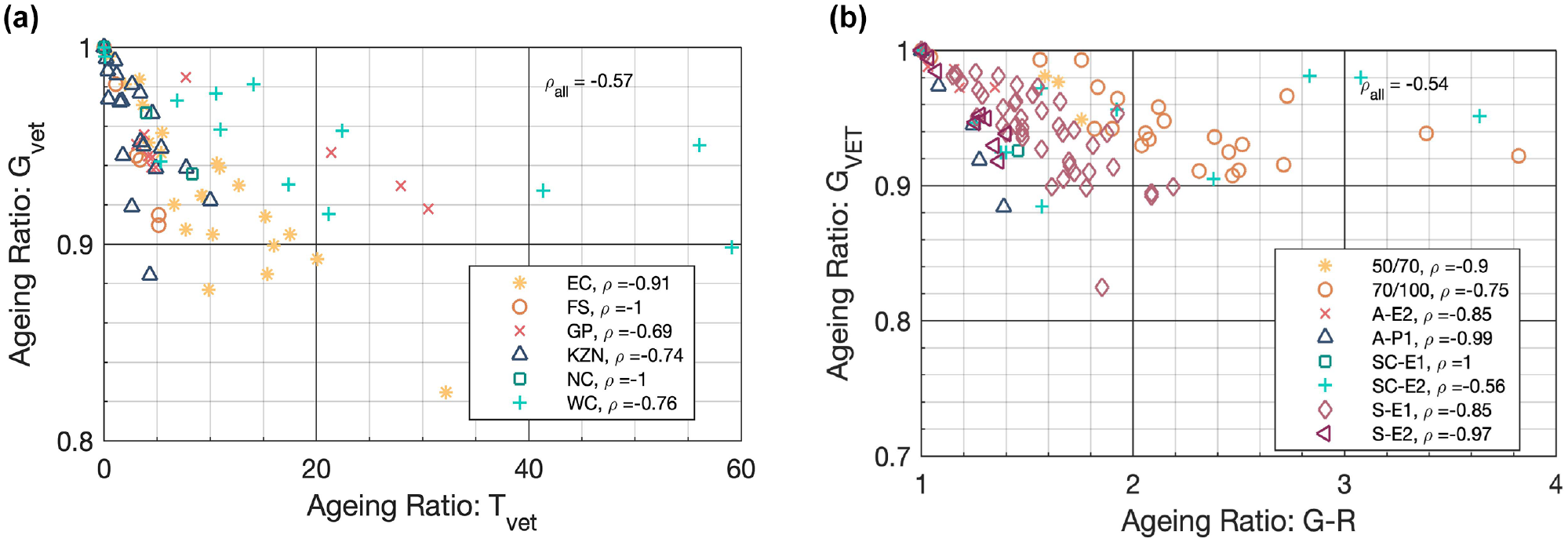
G vet aging ratio (AR) interrelationships: (a) Tvet and (b) Glover–Rowe (G-R).
The influence of binder type on the correlation between
Crossover Frequency
ARs for artificial binders in relation to log
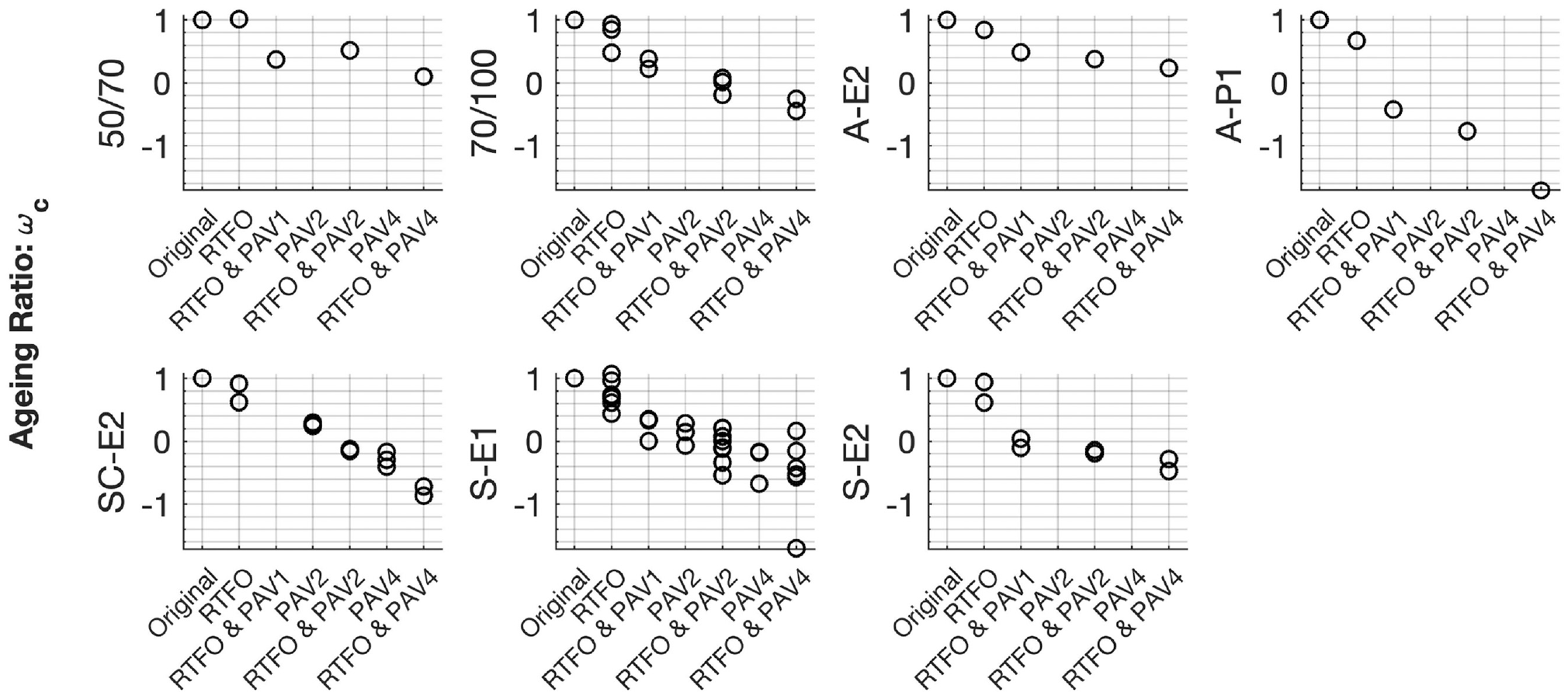
Crossover frequency aging ratio (AR) versus artificial age per binder type.
Notable interrelationships for
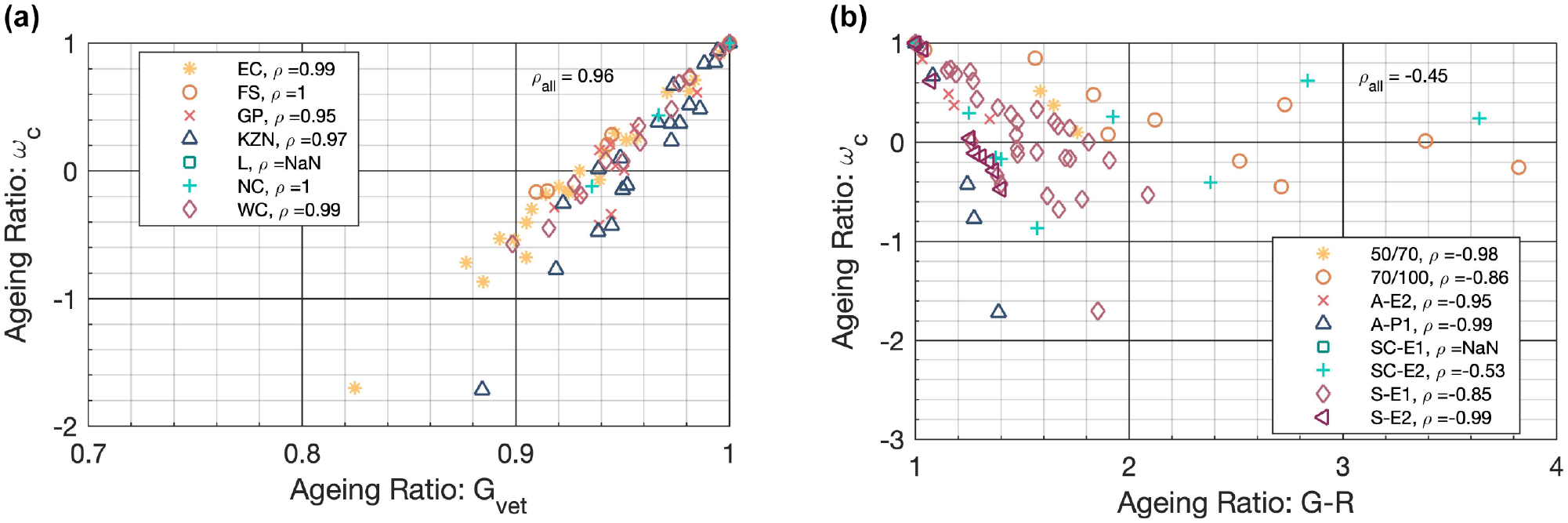
Crossover frequency aging ratio (AR) interrelationships: (a)
Similar to the observations with
G-R Parameter
Interrelationships that involve G-R are referred to throughout the discussion. ARs in relation to artificial ages are shown in Figure 25. Unlike previous parameters, which indicated a greater variability for modified binders, G-R is higher and more scattered for unmodified binders. Values range between 1 and 2 for modified and between 1 and 4 for unmodified binders. This observation supports previous findings that unmodified binders are more susceptible to age hardening on the lower intermediate portions of the behavioral line.
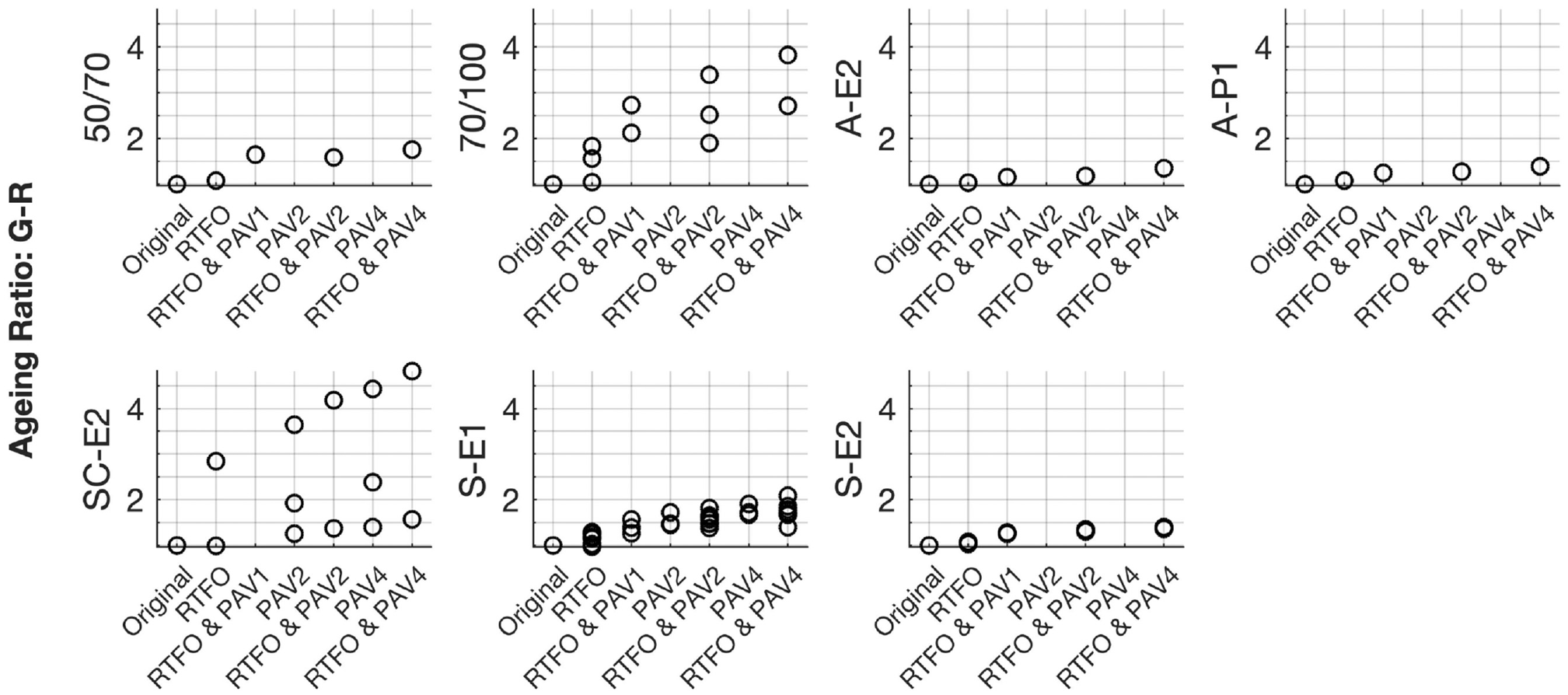
Glover–Rowe (G-R) aging ratio (AR) versus artificial age per binder type.
Summary of Pertinent Observations and Discussions
The literature presented indicated molecular size and interactions highly affect mechanical binder properties such as stiffness and viscosity ( 6 ). Molecular size is influenced by the crude source and processing by refineries, while oxidative aging will both increase molecule sizes and affect their interactions.
Further literature has shown the relationship between ductility and G-R is distinct for modified and unmodified binders, and more distinguishable when similar binders are grouped ( 21 , 22 ). Polymer degradation is thought to contribute to loss of ductility. Differences in behavoir converged with age.
The authors set out to understand binder aging by asking how changes in distinct behavioral ranges in Black Space relate to each other; how these changes relate to known aging trends for G-R; and to what extent the observations are influenced by binder origin and modification.
The investigation was done by considering interrelationships in performance-related parameters development and ARs for various laboratory-aged modified and unmodified binders.
The aging of binder in Black Space is notably different for modified and unmodified binders. The decay of modifiers is observed in high-temperature behavior, as the tail straightens, and becomes similar to that of unmodified binders. The movement of isotherms indicates increasing elastic dominant behavior for operational temperatures. In general, parameters adjacent in Black Space indicate notable correlations.
Low-Stiffness Behavior
Aging in the low-stiffness or high-temperature behavior range is considered by analysing the development of
Consequently, it is seen that softer binders, whether modified or unmodified, are most susceptible to a higher degree of aging in the high-temperature behavior spectrum, but that any aging in this region will coincide proportionally with aging throughout the useful temperature interval.
Intermediate-Stiffness Behavior
Intermediate-stiffness or temperature aging is analyzed through the progression of G-R at 15°C and 0.005 rad/s,
The evolution of G-R is sensitive to modification of non-aged binders because of location on the mechanical test data in Black Space. G-R grouped by
G-R indicates compelling interrelationships between a significant number of performance parameters. Converging interrelationships with G-R, VET, and
G-R ARs are more scattered for unmodified binders. Values range between 1 and 4 for these, and only between 1 and 2 for modified binders. Interrelationships indicate that unmodified binders are relatively more susceptible to aging in the lower-intermediate-stiffness domain measured by G-R than in low- and high-stiffness ranges.
A distinction is made between intermediate specification, or environmental, temperatures, that is,
Intermediate stiffness correlates most with parameters located in proximity on the behavioral curve, that is, G-R,
The ARs of
A decrease in
Interrelationships at the viscoelastic crossover begin to indicate transition in dominating influencers of binder behavior and aging. Correlations with
ARs for
Subsequently, it is seen that modified binders are more susceptible to aging in the higher stiffness domains, and unmodified binders relatively more in the lower-intermediate stiffness domains.
High-Stiffness Behavior
High-stiffness of low-temperature aging is analyzed through the evolution of
The comparison of ARs with G-R is substantial. G-R dominates aging for unmodified binders, while the
In the high-stiffness domain, aging is highly influenced by the modification and crude source of the binder. It may be beneficial to investigate the molecular compositions of binders and the influence on low-temperature aging susceptibility.
Influence of Modification and Source on Interrelationships
For the binders and aging considered in the study, it is deduced that specific binder types are more susceptible to aging in particular distinct stiffness domains in Black Space:
In the low-stiffness domain measured by
In the lower-intermediate stiffness domain measured by G-R, unmodified binders are more susceptible to aging than modified binders.
In the higher-intermediate stiffness domain measured by VET and
In the high-stiffness domain, susceptibility to aging is higher for modified binders and those from specific crude sources and refineries.
The development of
Implications of Aging Ratios (ARs)
ARs normalize parameters and disregard initial conditions. One binder may indicate a greater AR than another, and still be relatively less aged in absolute terms. Interrelationships between ARs point out where behavior is most susceptible to aging. The onus is then on the analyzer to determine whether the aging mechanisms will lead to premature failure.
The concept of an AR appears contradictory to uniform parameter limits per specification grade. Uniform limits imply greater absolute allowances for changes in properties. An initially softer bitumen, with a lower G-R, may age significantly more than a harder bitumen before reaching the performance limits, although they were chosen for significantly different environments. Given the correlation between G-R and
When considering ARs for specifications, primary failure mechanisms should be considered. Additionally, a combination of poorly correlating ARs may be considered. Complementary parameters will monitor distinct aging aspects and can provide reciprocal insights into binder aging. Thus, including ARs for G-R,
Conclusion and Recommendations
It is seen in this study that there are both related and unrelated aging trends in the distinct temperature- or stiffness-related behavioral ranges in Black Space. Correlations in parameter development significantly improve when binders are grouped by similar features such as modification type or origin. In the high-stiffness range, binder source and modification type and degree greatly dictate aging trends; in the low-stiffness range, the initial hardness of the binder is indicative of aging potential; and in the intermediate domain, the evolution of properties may be influenced either modification or binder source.
Based on observations in the analysis, further investigations into specific areas are recommended:
G-R and other parameter boundaries based on PG grade
Whether binder fatigue tests at intermediate temperatures may assist in distinguishing parameter performance thresholds for the various PG grades
The possible correlation of
The parallel between molecular composition and low-temperature aging
Describing aging as a combination of G-R and
The calculation of ARs for parameters where both positive and negative values are present, such as
Finally, it would be constructive to validate observations of interrelationships and ARs for binders that are from other crude and refinery sources, specifically in global regions where modification strategies differ from South Africa.
Footnotes
Acknowledgements
The authors acknowledge the assistance of Much Asphalt for allowing the use of their testing equipment, and Mr G. van Zyl and Mr S. Bredenhann for their guidance and mentorship.
Authors’ Note
The research forms part of a larger research initiative concerning the implementation of PG specifications in South Africa. The binders analyzed in the study are tested by multiple testers, and referenced in Van Zyl, Engelbrecht, Tredoux, and Goosen ( 28 , 35–37). Details and discussion of numerical modeling are given in the PhD disseration of Goosen ( 28 ).
Author Contributions
The authors confirm contribution to the paper as follows: study conception and design: E. S. Goosen, K. J. Jenkins; data collection: E. S. Goosen, K. J. Jenkins; analysis and interpretation of results: E. S. Goosen, K. J. Jenkins; draft manuscript preparation: E. S. Goosen, K. J. Jenkins. All authors reviewed the results and approved the final version of the manuscript.
Declaration of Conflicting Interests
The author(s) declared no potential conflicts of interest with respect to the research, authorship, and/or publication of this article.
Funding
The author(s) disclosed receipt of the following financial support for the research, authorship, and/or publication of this article: Student funding was provided by the Wilhelm Frank Foundation, the South African National Roads Authority, and the Southern African Bitumen Association.
