



Abstract
This paper introduces the concept of using an existing low-volume road design method to design the lower granular layers within a mechanistic-empirical design to ensure an adequate construction platform. The DCP-DN design method was chosen because it has advantages over other cover-based empirical methods in this context, including utilizing a full-depth measurement and requiring a balanced layer profile. To implement the DCP-DN method and use field Dynamic Cone Penetrometer (DCP) data in the mechanistic-empirical design, a relationship to convert between stiffness and DCP penetration index was required. A new set of internally consistent relationships between various soil strength and stiffness parameters was thus developed, using a meta-analysis of 126 models published since the 1960s. These were used to develop a new nomograph for estimating the properties of various soils.
Keywords
An oft-neglected part of pavement design, at least in California, is the subgrade and subbase layers. These are important not only for long-term performance but also for the constructability of the upper layers, particularly to provide a platform for paving. Without adequate support, the upper layers cannot be compacted to the required density, and construction traffic may damage the supporting layers before the pavement is completed, or worse, construction vehicles might become mired. An example is shown in Figure 1 from the initial weekend of construction of the long-life rehabilitation of I-710 in Long Beach, California, in 2003. The asphalt paving trucks became stuck in the loose sand subgrade, requiring a change order to include a 150 mm crushed concrete/granular base as a construction platform. While pavement design methods explicitly or implicitly include models to handle the long-term performance of the lower layers of the pavement, typically to limit rutting, an approach is needed to ensure an adequate construction platform for new construction and some reconstruction and full-depth recycling strategies.
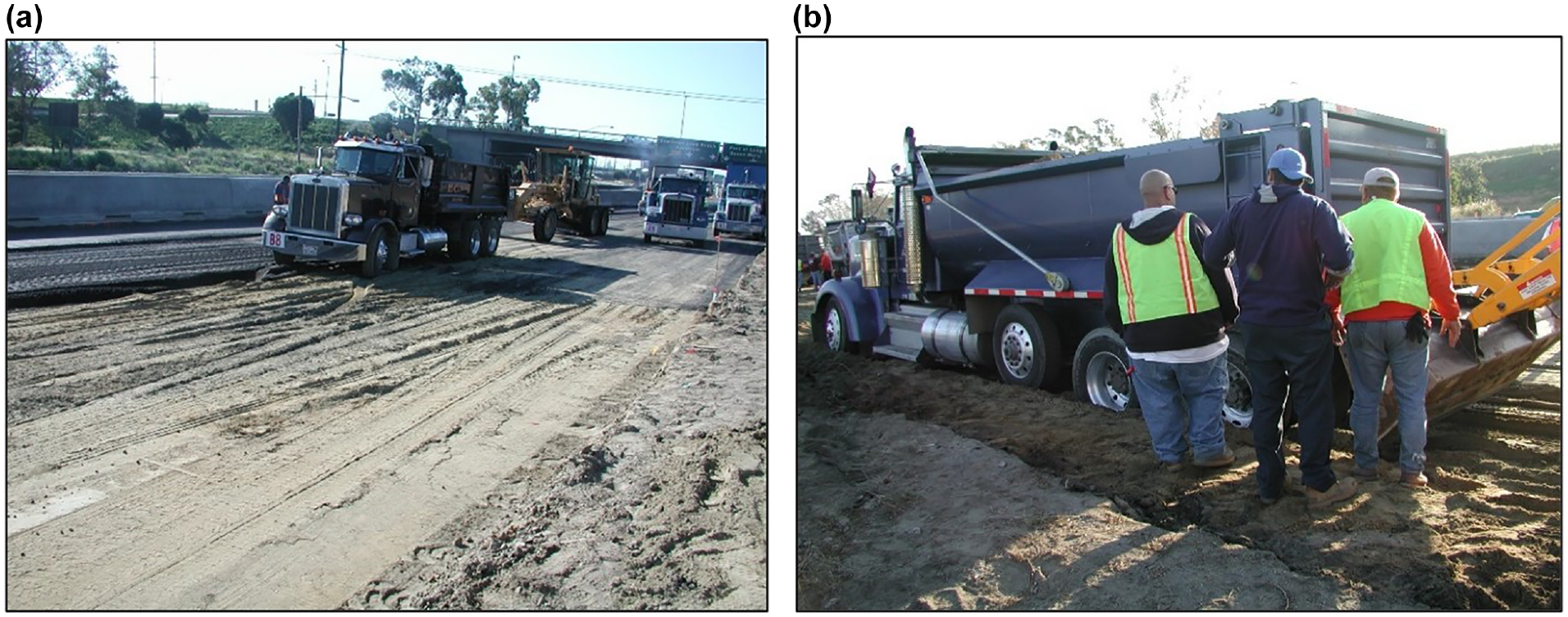
(a) Note asphalt paved directly on subgrade, (b) Note extensive damage to the subgrade.
The characterization of the subgrade and subbase layers can be complex and often has the least attention paid to it in design. It is common to spend tens of thousands of dollars characterizing the asphalt concrete for a design while using a visually rated soil classification to obtain default properties for the subgrade. Again, this is less of an issue for rehabilitation since the subgrade can be characterized by deflection testing and back-calculation, but it is not always possible to perform extensive laboratory or field testing of the subgrade for new pavements, as is suggested in NCHRP 1-37A ( 1 ). Frequently design methods assume an adequate construction platform.
This paper presents a proposed approach for construction platform design based on the DCP-DN design method ( 2 ). The Dynamic Cone Penetrometer (DCP) has been used worldwide since the 1960s to determine the strength of the top ∼800 mm of unbound granular layers in a pavement. The DCP is a straightforward tool that uses a hammer (with a known weight and drop height) to drive a cone through the soil while measuring the penetration depth after each blow. The penetration rate is measured as DN, the abbreviation of “DCP Number” used in the South African literature, therefore the DCP-DN method. It can be used to determine a strength profile with depth and is reasonably well correlated with the field California bearing ratio (CBR), resilient modulus (MR), unconfined compressive strength (UCS) and other properties of the material. In the U.S.A., the penetration rate is often referred to as DCP penetration index (DPI), but is still reported in millimeters per blow, a convention followed here. Other authors use the abbreviations PR (penetration rate) or PI (penetration index) and will occasionally use thousandths of an inch (mils) per blow.
To tie the DCP-DN and a mechanistic-empirical (ME) design together, a relationship to convert between DPI and MR is required. Many relationships have been published in the literature, with some discussion about which one is “right” when none are strictly correct. However, using meta-analysis techniques, combining these published relationships to determine an overall best fit is possible, allowing other properties to be used for the DCP-DN method and the DCP data for design. Thus, this paper also presents a meta-analysis of published relationships to obtain DPI and the other properties listed above (especially MR).
Background
Design methods can be broadly classified into empirical and ME, with the latter currently receiving most of the research focus. Most empirical methods build on the long tradition of “cover” based designs, including the California R-value method, the AASHTO structural number concept, and the USACE CBR cover curves. These methods codify empirical observations of pavement performance, and what they all have in common is that a particular subgrade requires a certain cover to handle the traffic adequately and that better quality materials (such as aggregate base compared with imported borrow) contribute more cover per unit thickness.
In ME design, the method analyzes critical responses in the pavement and uses these as latent variables in empirical (i.e., statistical) transfer functions to determine performance. One of the downsides to ME design is that it can analyze any pavement structure, so this concept of cover is implicit, and it is possible to design structures that perform adequately but are not ideal. For example, one can design a full-depth asphalt pavement on a very soft subgrade or design a thick Portland Cement Concrete (PCC) slab on the same soft subgrade. In both cases, most ME design methods will show reasonable results for low to medium traffic. However, these pavements will not perform well because of distress mechanisms not captured by the design method. In addition, they will be difficult or impossible to construct. In the case of the flexible pavement, it will be impossible to compact the bottom lift of the asphalt layer to the required density, and in both cases, it will be likely that construction traffic will get stuck and rut and deform the subgrade before the upper layers can be built.
It is thus essential to have some method to enforce the lesson of cover and ensure an adequate construction platform within an ME design method. Some methods specify the minimum index properties (e.g., grading and plastic index) of materials for the construction platform (especially in catalogs of designs based on ME analysis). However, if the in-situ materials are not within these minimum specifications but might still be adequate, this can result in additional cost. The insight of this work is that there exists an entire set of empirical design methods for low-volume roads of various kinds, such as unpaved roads, forest roads, mine haul roads, or roads in developing countries and rural areas. If the construction platform is viewed as a low-volume road designed to handle the construction traffic, then one of these methods can be used to design the lower layers.
An alternative approach would be to incorporate construction traffic loading on each layer directly into the ME design method. While this would be feasible, it might require several additional damage models, each requiring calibration, and other changes which might be difficult to implement. In addition, it would require estimation of the construction traffic on each layer.
The DCP-DN Design Method
The DCP is a well-documented test that is well known to most pavement engineers ( 3 ), so it will not be detailed here. However, less well known is that the DCP can be used directly for pavement design. The DCP-DN design method originated in South Africa ( 4 ), where the DCP is widely used. The method was validated with extensive field observations, combined with heavy vehicle simulator tests, to determine the structural capacity of the pavements, and is currently used widely within Africa for low-volume road design, as detailed in a recent review by Paige-Green and Van Zyl ( 2 ), which provides extensive background to the history and development of the method, along with comparisons with other design methods. Fundamentally, the DCP-DN method builds on the long tradition of cover-based designs by taking the field measured DCP profile and comparing it with an idealized profile, and then requiring the addition of one or more cover layers to ensure the resulting post-construction DCP profile would meet or exceed the required idealized profile.
The DCP-DN design method has two differences from other empirical design methods that are beneficial if we only consider the lower unbound granular layers in a pavement. The first is that it uses the overall strength of the top ∼800 mm of unbound material, characterized by the total number of blows to reach a depth of 800 mm (DSN800), rather than just a single subgrade surface measurement. The second is that the method explicitly relies on an additional concept of pavement “balance.” Balance has two components: a type of structure and how well the pavement fits that structure. A “deeply” balanced pavement has successively stronger/stiffer layers on top of weaker/softer ones so that the ratio between successive layers is not too high. One with a “shallow” balance has a high ratio between the respective layers, meaning that the bottom of each layer tends to be in tension, and an “inverted” structure has weaker layers on stiffer layers. One property that can be determined for each DCP result (as long as the penetration depth is at least 800 mm) is the balance number (B), which measures the non-uniformity of the penetration rate with depth and is obtained by fitting the standard pavement balance curve, shown in Equation 1, to the penetration data ( 5 , 6 ).

where
BSNd = number of blows to reach depth d,
DSN 800 = number of blows to reach a depth of 800 mm,
d = penetration depth (mm),
B = balance number.
Deeply balanced pavements are defined as having B values from 0 to 40, shallow structures have B values greater than 40, and inverted structures have B values less than zero ( 6 ). For each of these three types of structure, a “well-balanced” pavement follows the balance equation closely (so that the modular ratio remains relatively constant with depth), while “averagely” and “poorly” balanced pavements have progressively higher deviations from the standard balance curve.
Balance is vital for a construction platform because strength and stiffness are a function of density, and density is a function of compaction energy. Without a good construction platform to act as an “anvil,” one cannot impart this energy into the layer being compacted, and it will instead be absorbed by the layers below. This implies that the construction platform can only be built using a deeply balanced design from bottom to top (i.e., 0 ≤ B < 40). A balance number (B) of 30 to 40 would be ideal if one had access to good quality borrow or subbase material because it would allow the thinnest added layers, reducing cost. However, there is a trade-off: the higher the balance number, the harder it is to achieve compaction of the added layers. Unlike other empirical methods, the DCP-DN method allows the designer to explore this relationship in design and choose a B value that works both in the DCP-DN method and in the ME design, accommodates locally available materials, and the field measured DCP profile. Shallow and inverted designs can generally only be achieved using mechanical stabilization.
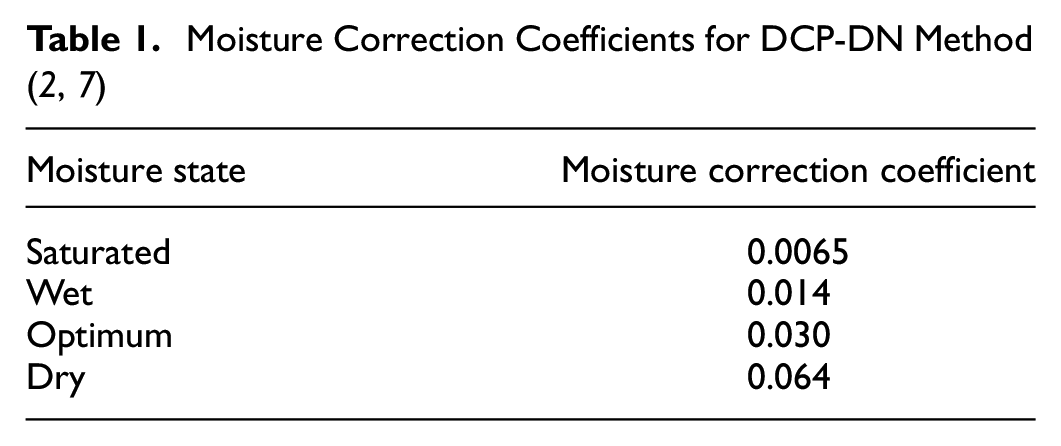
The DCP-DN design method correlates performance, measured as allowable single-axle load equivalents (ESALs) to DSN800 from the DCP test. A correction is applied for different moisture levels in the pavement (saturated, wet, optimum, or dry) see Table 1. Given design traffic and moisture conditions, a required DSN800 can be calculated as follows ( 2 , 4 ):

If DCP test data are available, B from the data can be used, or B can be chosen—either way, a profile of blow count to depth is determined with these two parameters. The derivative of this profile gives the required DPI profile with depth:

This profile can also be seen as a required in-situ CBR, R-value, or
One assumption of the DCP-DN method is that the road has a seal coat ( 2 ), which is unlikely to be true of a construction platform. However, a seal coat provides minimal structural capacity and mainly limits moisture ingress and surface wear. Most construction vehicles use specialized tires and low inflation pressures, so some of the concerns around the performance of the top ∼25 mm of the pavement are not relevant in this case. In addition, construction traffic on the lower layers is not channelized by lane markings.
To use this design method, one needs to know the DPI for each type of cover material that could be used, which prompts the development of a consistent correlation between DPI and various other soil properties that are typically available, because DPI is often only available for in-situ materials. At a minimum, this requires representative DPI values for different soil classifications, but if other laboratory-measured properties (such as CBR or R-value) are known, these can be used to estimate the penetration rate. In addition, the moduli for these materials would also need to be estimated for ME design, likely using similar methods. Conversely, if an ME design is being considered, the moduli can be converted to DPI to determine a pseudo penetration curve for the lower layers, which can be checked to ensure the construction platform is adequate. Nearly every ME design method has built-in default moduli values for various materials. In many cases, relationships to other properties are also provided, such as in the Guide for Mechanistic-Empirical Design of New and Rehabilitated Pavement Structures ( 1 ), because the determination of properties for unplaced materials in a design method has always been a problem. Many design methods include these relationships, which leads directly to the question of what relationships to use.
Meta-Analysis of Relationships Between Subgrade Strength and Stiffness Properties
Over the last 60 years, since the 1960s, many relationships between various strength and stiffness parameters for soils have been published, along with typical ranges for various soil types, and new studies are still being published. Typically, these papers or reports cite a few “authoritative” sources for the relationship in question, reproduce the same figures and descriptions of well-known test methods, and then have some new data to develop a new relationship, which is then compared with those already published. In nearly all cases, the authors find a similar relationship with slightly different parameters, and the reader is left to choose if they prefer the new relationship to the old, and since the old is published in a standard, it continues to be used. It is also common to see the various nomographs that allow one to graphically convert between two or more properties reproduced, and either a table or graph of typical ranges for AASHTO and Unified Soil Classification (USC) classes (which are typically not updated by the authors). Most of the fitted models are done independently, so one is cautious about using a new correlation to obtain CBR from DPI but then using an old nomograph to convert CBR to MR. As a result, even the newest design methods still use correlations developed in the 1960s and 1970s ( 1 ).
What is needed is a way to combine these studies and harmonize the conversions between all the properties. If the raw data and exact methodologies from all these studies were available, it would be possible to develop an extensive data set and perform a comprehensive statistical analysis, including joint estimation of all relationships simultaneously. However, data are not available for many studies (or would have to be digitized off plots). Faced with a similar problem, it has become quite common recently for researchers in other fields to turn to Bayesian meta-analysis ( 8 ), which allows each published model to be treated as a data set with sampling error. This requires a complete set of statistical parameters, however, these are not published in most cases.
As a last resort, a simple meta-analysis is possible by using only the published relationships. The type of data and problem domain here are not typical of meta-analyses found in other scientific literature, so a new methodology was developed. Firstly, working on the assumption that the published models are well formulated, each represents the best estimate of both the mean and the median (i.e., 50% percentile) of the data at any particular input value. However, because the models tend to be extrapolated past the test data, we are likely to encounter outliers at the edges of the range. For this reason, a least absolute deviation (LAD) solution is preferred over the more common ordinary least-squares approach because it is robust against outliers. This approach will fit the median value from the model predictions rather than the mean. In addition, the approach needs to consider the joint estimation of parameters across all the various combinations of properties so that the complete set of models is self-consistent with the underlying published models (and, therefore, hopefully, the original data).
For simplicity, we will only consider single input conversion models, not those requiring multiple inputs, making the results more general, but excluding those that require additional information like plasticity index or other numerical inputs. While some relationships might be specialized to a particular soil type (such as high or low plasticity clays), the other relationships are typically not specialized in this way, meaning that two-step (e.g., DPI to CBR to MR) relationships might be biased. Also, every additional constraint limits the usefulness when that condition is not known in advance.
If we have

Because all the properties are on different scales, the error formulation would naturally be complex to account for unit differences. However, we have one advantage: most published models of interest are log-log models. This means that their errors are ratios, making all the errors for different properties equivalent. The only property of interest that does not fall into this mold is the California R-value, which is often not transformed. R-value is constrained to a range of zero to 100, so the transform
The error can be formulated as:
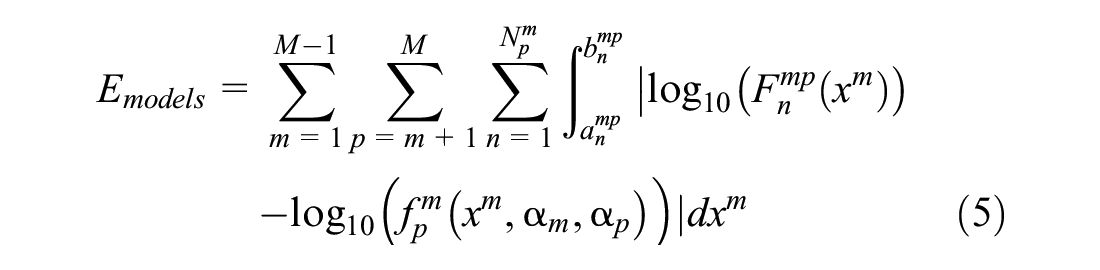
The integral in the error function can be replaced by a few sample points, and the error summed over these without significant loss of accuracy. An added aspect of error minimization also includes the errors from the published minimum/maximum ranges of properties for various soil types. If we have
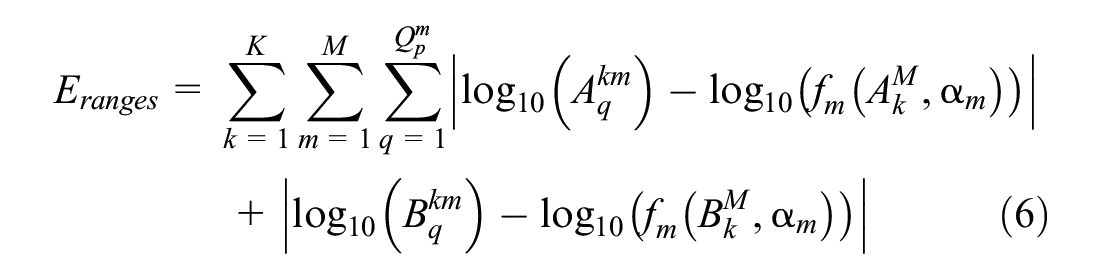
Statistically, the two models can be seen as specialized joint LAD estimators. The sum of these two functions can be jointly minimized with respect to the parameters and ranges to obtain the best fit. Using these results, it is also possible to construct an updated nomograph that can be used for quick visual estimation of properties.
There is no way to test goodness-of-fit because there are no observations to plot against or use in the determination of
Meta-Analysis Results
While direct measurement of properties is always desirable, there are cases where estimating one property from another is necessary. The goal of this meta-analysis is not to perpetuate the idea that one can visually assess the subgrade soil classification and determine all the required properties without testing but to act as a “test of reasonableness” to cross-check other testing or provide guidance when testing cannot be performed (for example, when the material does not yet exist). If additional information about the soil is available (such as alluvial versus residual soils), a locally developed correlation specific to that soil type might provide better estimates. However, if one were, for example, to use a local relationship to obtain DPI from CBR, then use the models presented here to convert to stiffness, there would be little benefit over converting directly from CBR to stiffness.
Since an elastic modulus is required for all ME design methods, this was chosen as the reference property in the meta-analysis (property
Every attempt has been made to remove duplicate models, especially those with the same parameters when expressed in SI units. In some cases, the published coefficients are rounded versions of those found in their citations. For example, the common relationship for
Figures 2 to 4 show the 126 published models (restricted to their valid ranges when possible). In each plot, the median for the published models is shown using large gray circles, and the final fitted model is shown using a thick black line. The other lines show the various published models. References are provided for each of the models on the figure. In some cases, the model needed to be inverted to be plotted or converted to SI units. A correction for the Australian standard 30° DCP cone to the more common 60° cone is used to correct the fitted model. While the DCP and CBR values have been split out, the modulus values have not been split by test type or other features, because in many cases, the test method was not given. Models with different constraints and limits (e.g., sand or clay specific) are also included without limiting the analysis to match these constraints. Some studies have multiple models fitted to the data, using different subsets. For these studies the most general published model is used, but if two or more models are published then all are included as separate models.
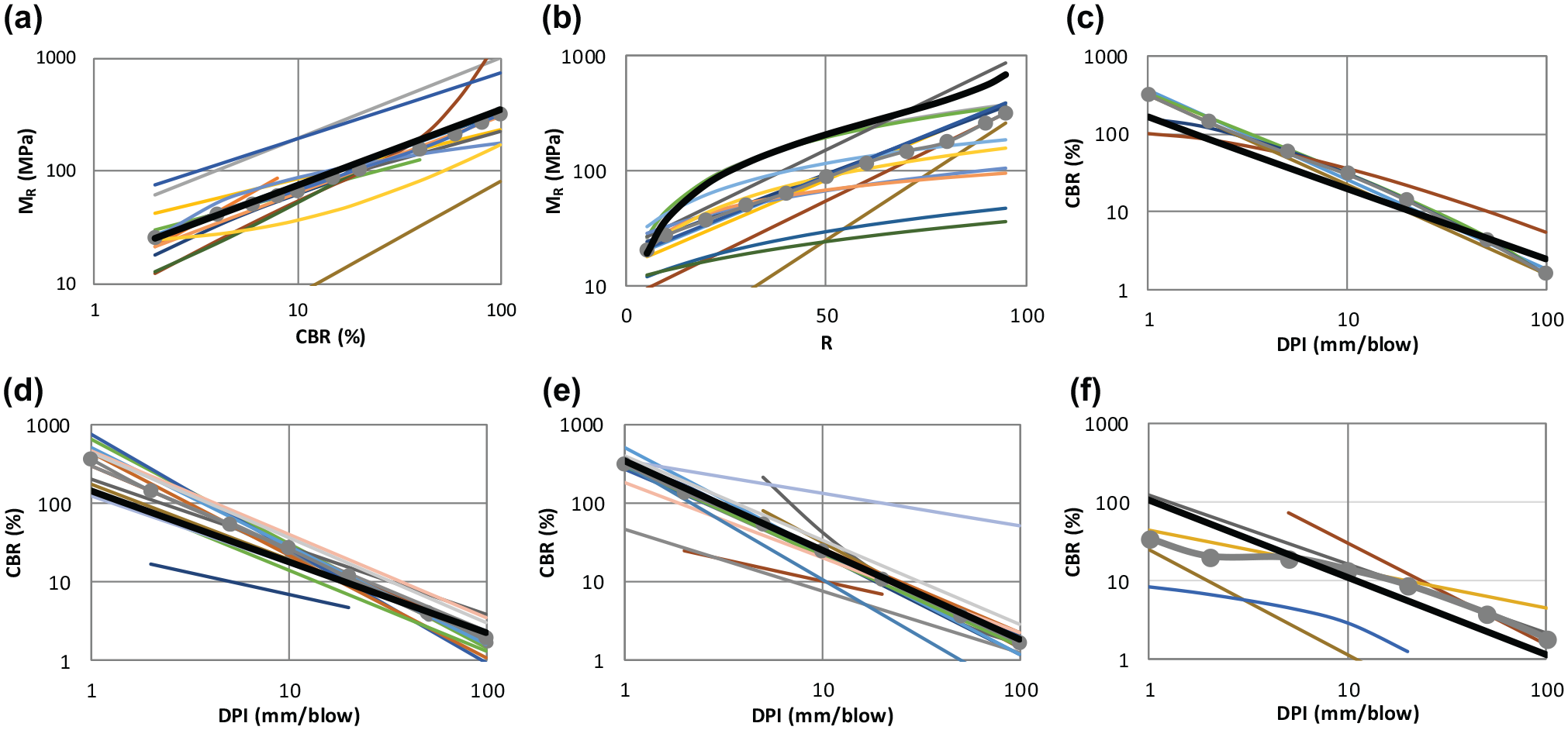
Plots of various published models along with the overall best fit model: (a) CBR versus
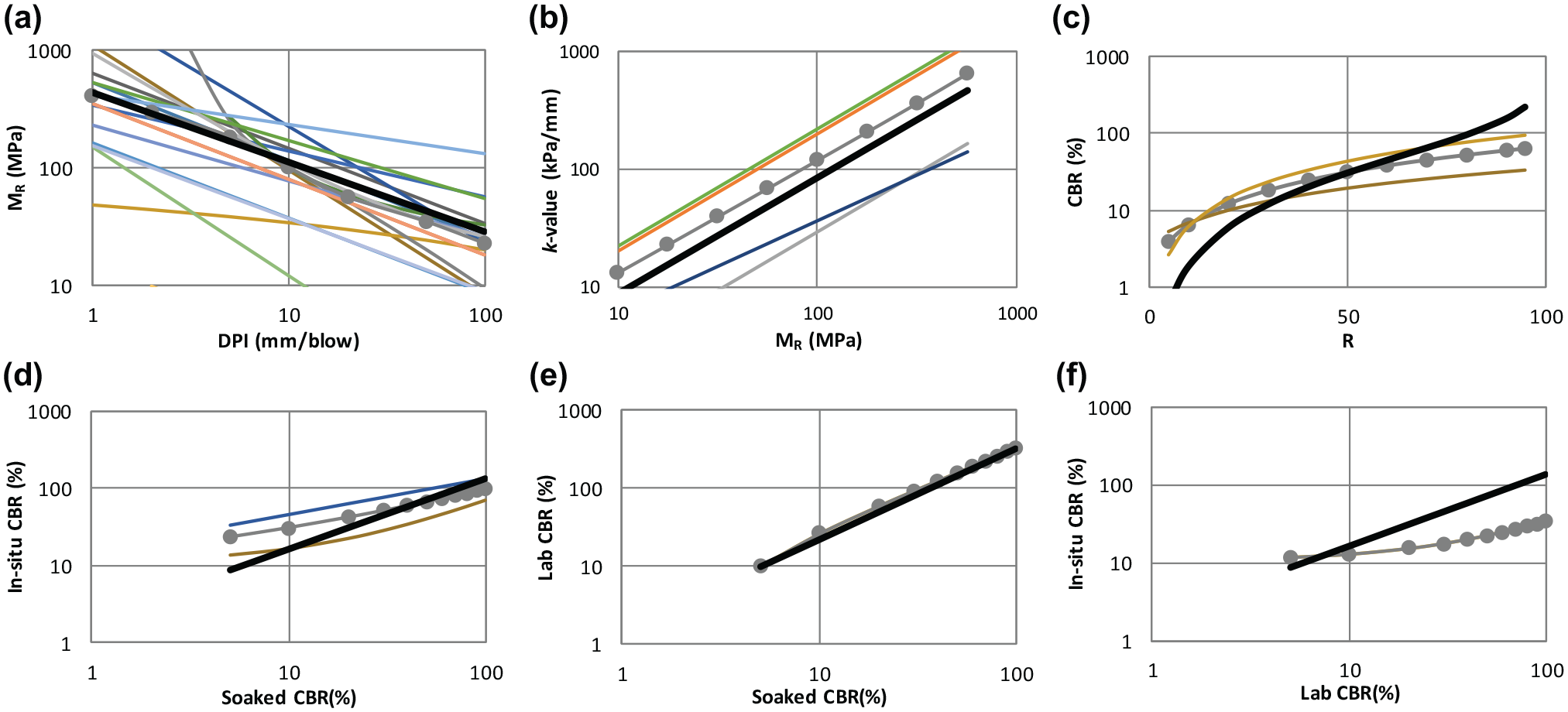
Plots of various published models along with the overall best fit model: (a) DPI versus
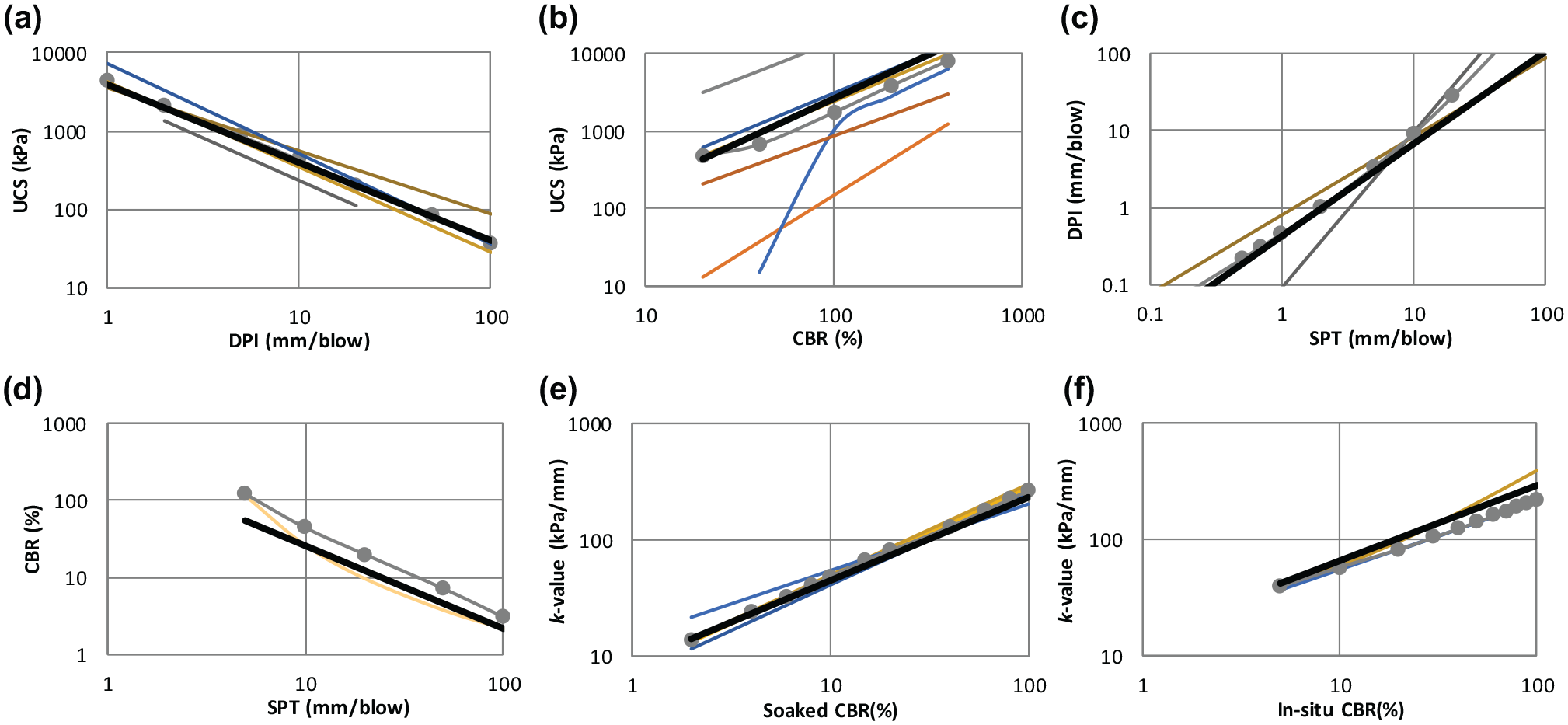
Plots of various published models along with the overall best fit model: (a) DPI versus UCS ( 5 , 50 , 57 , 71 ), (b) CBR versus UCS ( 19 , 72–75), (c) SPT versus DPI ( 76 , 77 ), (d) SPT versus CBR ( 35 , 78 ), (e) soaked CBR versus k-value ( 79 ), and (f) in-situ CBR versus k-value ( 69 , 80 , 81 ).
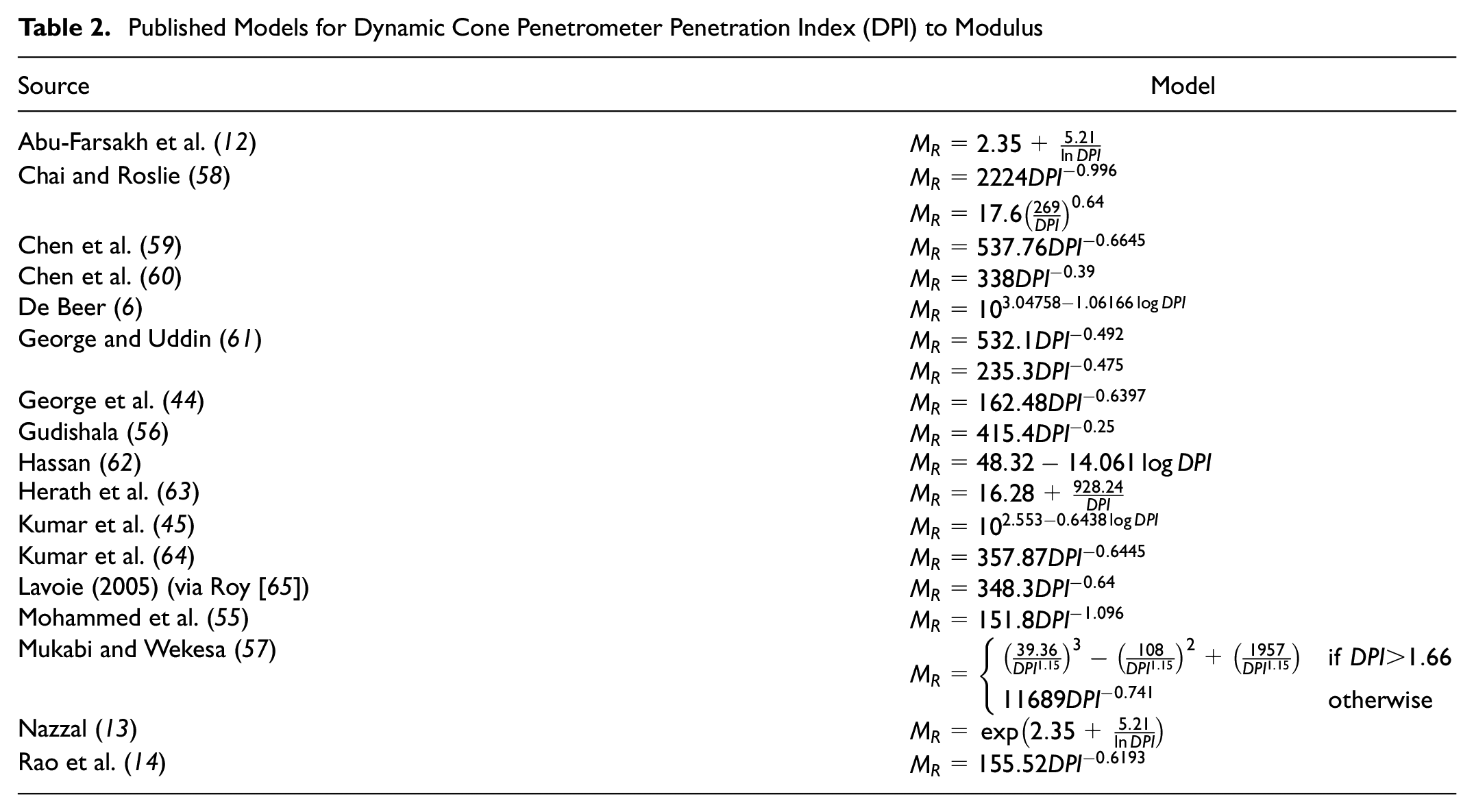
Table 2 shows the 19 published models for Figure 3a. As can be seen, most of the models are exponential, so log-log when linearized, with slopes around negative one half and a scale of between 100 and 1,000 MPa, implying an intercept of 2–3 in log10 space. The equation by Mohammed et al. ( 55 ), shown as a light green line on the bottom left in the figure, seems to be an outlier with a low intercept and high negative slope, as does that of Gudishala ( 56 ), shown as a light blue line in the top right, which has a reasonable intercept but low slope. In addition, the model by Mukabi and Wekesa ( 57 ), the almost vertical curving gray line, seems to have some interesting behavior and is probably not benefiting from the complex formulation. However, when we take the median value of the model predictions (the gray circles), we obtain a relatively straight line with a modulus of around 400 MPa at 1 mm/blow (which would be reasonable for a well-compacted granular base) and almost exactly 100 MPa at 10 mm/blow, which again would be reasonable for subgrade material. These median points are not used in the model, but this relationship has many underlying models, so, naturally, the overall best fit follows the median closely. As expected, the overall best fit (Equation 10) has coefficients that fall within those for the published models. The residual absolute difference is 0.347 orders of magnitude for this relationship, implying that the model predictions could be 2.2 times too high or low. Since this does not include the residual error from the underlying studies’ data, the actual residual standard deviation for predictions would be higher than this.
Published Models for Dynamic Cone Penetrometer Penetration Index (DPI) to Modulus
In most cases, the overall best fit is close to the median for the published models. However, there are some cases where it differs considerably. In Figure 2b, the R-value follows the upper edge of the published models for most of the MR range, which corresponds to the model in the AASHTO 1993 design method ( 66 ), ignoring the majority of the published models. It is unclear why this is the case, but it appears necessary for the other correlations (such as CBR) to fit. Overall, the fitted model makes sense, and the relationships are well within the expected ranges. The following equations give the final relationships:








The equations above are all based on the SI units shown on the nomograph (and other figures). Confidence intervals are not supplied because they would need to include the residual errors from the underlying models, which are not available in many cases. However, the overall residual absolute error is 0.264 orders of magnitude or ±1.8 times. In other words, the error of any particular prediction of MR from these equations is probably within a factor of two of the actual modulus. The DCP/CBR relationships tend to be more tightly clustered, hinting that these two tests are probably measuring similar properties (which is not surprising). The modulus relationships tend to have a larger range (of up to an order of magnitude on both sides in some cases), indicating that the relationship between the shear/strength properties and stiffness is more tenuous (which is also no surprise). The error in the minimum-maximum values for the classifications is 0.13 orders of magnitude or a factor of 1.3. The error here is probably lower because most of the published ranges of various properties are already highly curated and probably do not reflect the full range of values seen in the field.
Using these equations, and the ranges for the various soil classifications, the nomograph shown in Figure 5 can be created, by taking a range of values for each property, converting these into MR and plotting an axis. Additional axes are added for U.S. customary units for properties where these are used. The nomograph provides a quick visual method to cross-check various parameters and can be read by finding a given value on the scale of interest and projecting vertically up or down to the other scales to find the corresponding values. In addition, two sets of ranges are given for the AASHTO and USC systems, which can be used to obtain reasonable ranges for the various properties if only the classification is known.
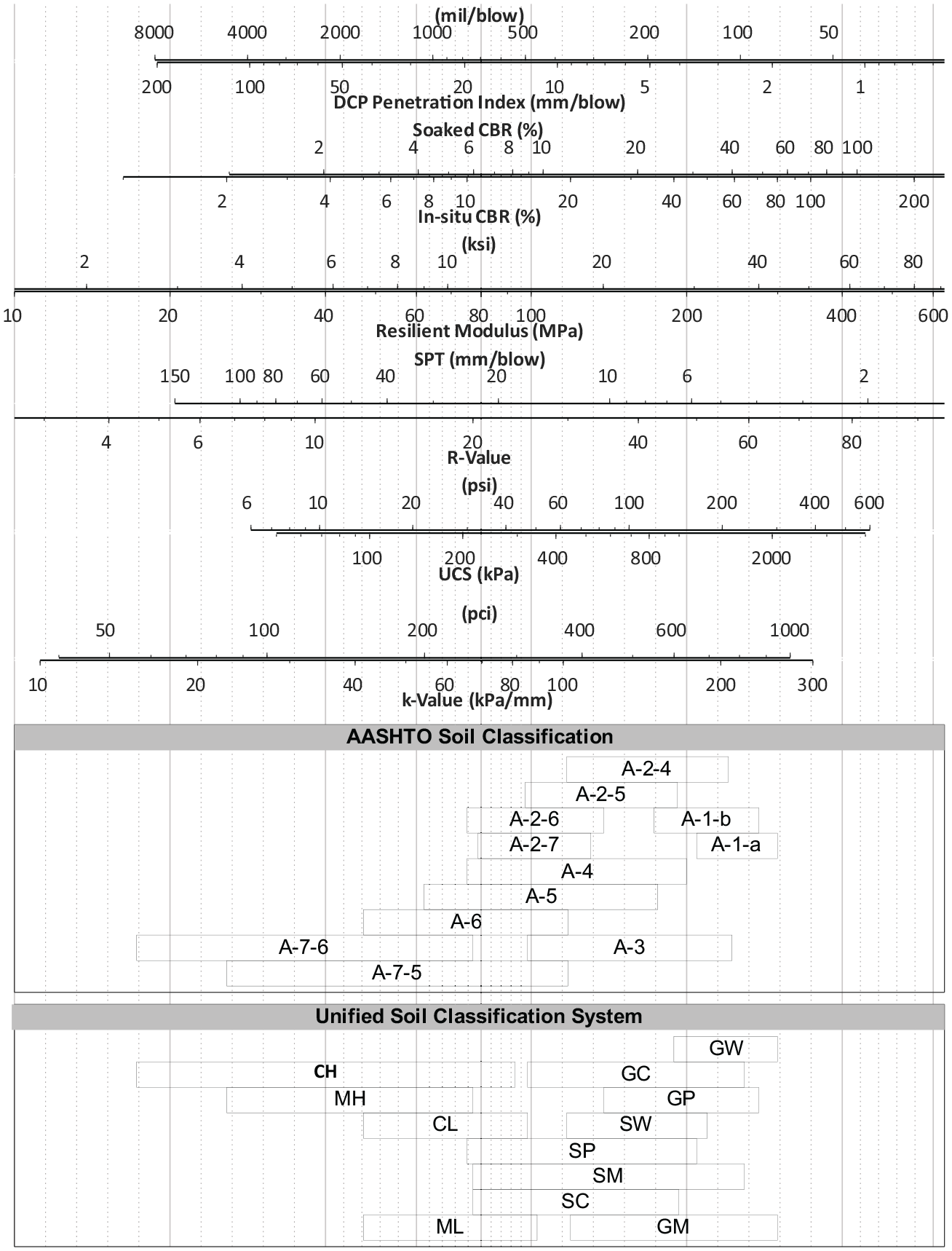
Nomograph based on overall best fit model.
Application of the DCP-DN Design Method
The actual application of any low-volume road design method to the design of the construction platform would typically depend on the agency responsible and the context and would need to accommodate existing practice. However, two examples of how the DCP-DN design method might be used in the ME design of new pavements are given below. Since the goal is not to replace the ME design of the lower layers but still to ensure an adequate platform by constraining the designer, we can be conservative in the assumptions—a well-specified ME design method will respond to the improved subgrade/subbase by allowing thinner base and surface layers, so the cost of the overall design should be comparable.
The first example might be for a greenfield design for a new large highway. We will assume the construction platform is soaked and a construction traffic load of 1,000 ESALs (this assumes that the platform will be exposed to considerable construction traffic—equivalent to hauling enough aggregate base for ∼20 lane-km of construction). A B value of 38, at the top end of the deeply balanced range, is appropriate for granular layer construction since it builds the layers as thin as possible while maintaining adequate cover. Based on these assumptions and Equation 2, the subgrade requires a DSN800 of 31 (31 blows to reach 800 mm, or about one blow per inch). Using B and Equation 3, we can obtain the required profile shown in Figure 6.
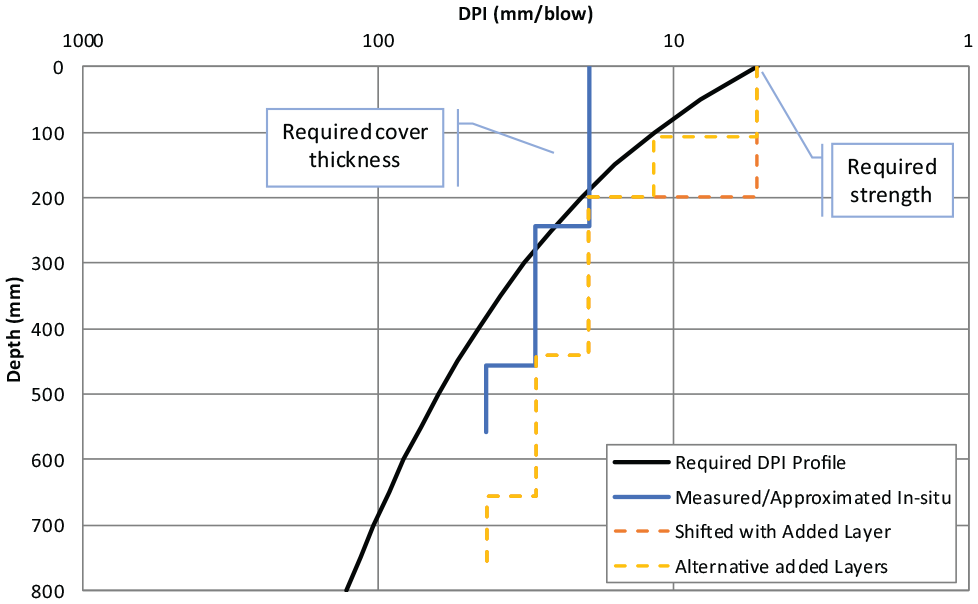
Required minimum dynamic cone penetrometer penetration index (DPI) profile with depth and cover.
Any measured stiffness profile that falls to the right of this curve will have a DSN800 of at least 31 but will likely have a different B. Unlike some cover-based design methods, the DCP-DN based design essentially specifies the minimum required stiffness at the surface, so it is insufficient to cover a weak subgrade with a thick layer of better, but still not strong, material (like an imported borrow). If DCP testing can be performed at the site, a layer strength diagram could be obtained from the DCP analysis. In this example, the profile has a 245 mm layer with a DPI of 20 mm/blow, followed by a 200 mm layer at 30 mm/blow and 45 mm/blow below that, shown in Figure 6 as the measured profile. From this, we can determine both the depth of cover and the required stiffness of the cover. These are also shown in Figure 6. In this example, the top layer of the measured profile is the limiting point and requires ∼200 mm of cover to meet the profile, with a material with a DPI of <5 mm/blow (which, based on the nomograph, would have CBR∼22 and MR∼170 MPa). However, we do not need to use this material through the entire cover layer. We could use two 100 mm layers, with the lower having a DPI of ∼11 mm/blow. The appropriate strategy would depend on the availability of material and other factors.
A second example might be a two-lane rural access road with a deep clay subgrade in a river delta. In this case, we might only obtain a single measurement, that the subgrade has a modulus of ∼25 MPa, based on triaxial testing, which would correspond to a material with a soaked CBR of less than one or a DPI of ∼125 mm/blow, which should raise some concern. A pure ME design on this material suggests that a 240 mm polymer-modified full-depth asphalt layer would be sufficient for a 20-year design. However, using construction traffic of just 20 ESALs (and the same B of 38), a DSN800 of 10 would be required, along with a surface DPI of ∼16 mm/blow (corresponding to a material with a CBR of ∼7 and stiffness of ∼85 MPa) which would be in line with an imported borrow in most standards. A cover depth of 300 mm would be needed. The same ME design method now shows that the full-depth asphalt layer could be reduced to 210 mm. Of course, a full-depth asphalt might not be the best strategy here, and the ME design shows that placing a 150 mm aggregate base on the imported borrow would allow the asphalt to be further reduced to 180 mm.
Applying the same 1,000 ESALs requirement from the first example to the second would require 800 mm of cover, with the same requirement of ∼170 MPa for the top layer of the cover, with at least 150 mm of this material over 650 mm of the imported borrow, which would probably be more in line with a typical state highway design for such a poor subgrade.
This procedure can be implemented in an ME design method by considering the layers in the design, checking if the lower layers are granular materials, and converting their reference modulus values to DPI, using Equation 10. The balance number (B) and ESALs can be hard-coded or inputs provided, but these are used to establish the required DPI profile. If the profile is not met, a warning can be shown to the user, requiring them to insert a borrow or subbase layer. These checks can be integrated with the other checks, such as minimum and maximum layer thicknesses, moduli, and others.
The best method for establishing an existing stiffness profile with depth at a site is through DCP testing because this provides a field measurement at various depths. Because it is relatively quick and easy, it also allows many tests to be run at different locations, allowing a much better spatial coverage than triaxial testing. The DCP data can also be used to segment the subgrade into uniform segments, and the cover thickness adjusted based on the measurements within each segment. In addition, the DPI can be used to estimate the subgrade stiffness.
However, if a full profile with depth is not possible, then using a single value to characterize the subgrade is acceptable if it can be established that the sample represents the weakest layer. A depth profile should be developed if the in-situ condition has a stiffer layer on a weak layer (for example, from an existing imported layer).
Conclusion and Recommendations
This paper shows that it is possible to use a low-volume road design method to specify the lower layers of a pavement designed using a modern ME method to ensure that it has an adequate foundation and a suitable construction platform. The DCP-DN design method was chosen because it is easy to apply and has the advantage over other methods that it utilizes the strength profile of the subgrade. In addition, the DCP results can be used to characterize the subgrade for ME design as an alternative/supplement to traditional geotechnical tests and laboratory testing. Because the DCP is a quick and simple test, more testing can better capture subgrade variability or anomalies.
In addition, this paper presents a meta-analysis of many published correlations between DPI,
The meta-analysis could be extended to other soil properties of interest. Some published relationships relating the existing properties to shear strength and the Cone Penetrometer Test were not included. In addition, there is a large body of work not explored here that relates the various properties on the nomograph to intelligent compaction parameters. A valuable extension to this work would be to correlate DSN800 with some parameters from intelligent compaction so that it would be possible to specify a minimum roller response to ensure an adequate construction platform.
Footnotes
Acknowledgements
The authors appreciate the technical review by staff of California Department of Transportation (Caltrans), especially Raghubar Shrestha, Office of Asphalt Pavements, and oversight by Joe Holland, of the Division of Research, Innovation and System Information. The assistance of Biana Giang in collecting the citations is also gratefully appreciated.
Author Contributions
The authors confirm contribution to the paper as follows: study conception and design: J. D. Lea, R. Wu, J. T. Harvey; data collection: J. D. Lea; analysis and interpretation of results: J. D. Lea; draft manuscript preparation: J. D. Lea. All authors reviewed the results and approved the final version of the manuscript.
Declaration of Conflicting Interests
The author(s) declared no potential conflicts of interest with respect to the research, authorship, and/or publication of this article.
Funding
The author(s) disclosed receipt of the following financial support for the research, authorship, and/or publication of this article: This paper describes research activities requested and sponsored by the California Department of Transportation (Caltrans) Grant #65A0788.

Data Accessibility Statement
The contents of this paper reflect the views of the authors and do not necessarily reflect the official views or policies of the State of California or the Federal Highway Administration. This paper does not represent any standard or specification.