



Abstract
Globally, cities face a range of transport-related environmental, social, and economic challenges, not least congestion, air pollution, and promotion of sustainable modes of public transport. Mobility hubs (MHs) have been identified as a mechanism to aid the move toward a sustainable transport network and are at various stages of implementation in cities throughout the world. The growing prevalence of MH schemes highlights the requirement for a holistic overview of MH networks to ascertain their characteristics and inform policy direction. Consequently, this study presents a review of current MH deployment and literature, with the aim of examining this global phenomenon and identifying a future research agenda. The study combines a comprehensive review of web searches with gray literature and a limited number of articles from academic journals. Twenty locations, at different stages of development and implementation, were identified as examples to be reviewed and analyzed, thereby providing a context for the review. Subsequently, four themes have emerged: objectives of MHs, format, location, and operational factors. Key findings include the importance of stakeholder engagement in design and location choices, the significance of branding, and connection with existing travel infrastructure including public transport and active travel. Additionally, the provision of amenities is common to MH schemes because it promotes usage and integration into the local landscape. From this detailed review of the state of MHs, a future research agenda has been identified, including further defining MHs, understanding the origin and applicability of MH objectives, considering day-to-day operations, policy transfer implications, and further evaluations of single and network MHs.
Climate change is currently a focus of international and national policy and, consequently, there has been a growing recognition of the need to address the impact of urban transport. National governments, regions, and cities are focusing more attention on this and other environmental and social issues relating to urban transport such as congestion and air pollution, and their impact on health ( 1 ). Therefore, the idea of mobility hubs (MHs) or mobihubs has evolved over the course of the last 20 years as one solution and has been integrated into the transport plans of many cities. Originally, MHs were envisaged as a means of addressing a shortage of parking space by promoting shared mobility. The first example of MHs being implemented was in the city of Bremen in Germany, where they are called mobil.punkts ( 2 ). This idea was developed further both in Germany and other parts of the world to include sustainability elements as well as allow seamless connectivity to transport that would take the internal combustion engine (ICE), namely, private cars, off the streets. The multifunctional idea of MHs as places where various modes of transport could be connected while acknowledging the relationship between location, space usage, and transport integration meant that various regions started to explore their own versions of MHs ( 3 ).
Although still in their infancy, several definitions of MHs have been proposed. The term ‘hub’ embodies multiple transport-related concepts that are often dependent on scale, from large multiuse areas such as cities to a more defined type of hub such as an airport, which is a point of connectivity either for passengers or cargo (
4
,
5
). The meaning of this term has been extended to MHs, and one definition of MHs proposed by CoMoUK is as follows: A mobility hub is a recognisable place with an offer of different and connected transport modes supplemented with enhanced facilities and information features to both attract and benefit the traveller (
6
).
This provides a useful definition of MHs. MHs are interventions focused on short-distance intraurban journeys in individual cities or towns and their surrounding areas. This excludes regional or international travel hubs; however, MHs can be located here. The growing prevalence of MH schemes worldwide can be seen in the significant investment globally in transport-related schemes with MHs as a key component, for example, in 2019, €8.86 million was invested by the European Regional Development Fund in the North-West Europe Interreg eHUBS scheme ( 7 ).
Although elements of MHs have been examined in detail, there is still a requirement to look holistically at how this important development will achieve environmental and social objectives. Thus, the aim of this paper is to examine the phenomenon of MHs with the intention of establishing a future research direction. The paper is structured as follows. The next section details the method, and this is followed by an examination of the objectives of MHs, their physical characteristics, and the operational challenges they face. Finally, the conclusion offers a future research direction.
Method
Given the paucity of research related to MHs, this paper adopted an overall exploratory approach to research design. To gain an understanding of the development and implementation of MHs, a qualitative method of inquiry was chosen to determine and characterize the purpose and features of MHs while identifying a future research direction. An initial keyword search strategy using terms such as “mobility hub,”“mobilityhub,”“mobil.punkt,”“e-hub,” and “mobihub” was adopted, and this was combined with organizational and geographic identifiers. Search terms were developed iteratively based on the review of examples identified and as new cases or relevant terms emerged.
Within these results, search hits were reviewed to extract information related to MH objectives, implementation, features, and evaluation. In cases in which multiple search hits or documents were related to MH examples, they were each reviewed to identify unique or corroborative information. As the search process evolved and discrete geographic examples of MHs were identified, location-specific search terms were used in conjunction with the others, for example, “Bremen” and “Nottingham.”
Twenty MH networks were identified, see Table 1. These present diverse geographic and physical characteristics, representing different stages of MHs, either existing or planned. The selection criteria for the inclusion of a MH in the study sample were based on the availability, fidelity, and consistency of data and information to enable rigorous analysis. In each case, requisite information included the following: MH objectives; physical characteristics of the MH; network (e.g., locations and amenities); and hub operation and management. Although they are a relatively new transport innovation in the UK, MHs have been increasingly in evidence in the U.S.A. and continental Europe over the last two decades, and provide the majority of available literature that forms the basis for this study sample. Iterations of MHs may be evident in other regions such as Asia and South America; however, the information and literature available is limited and so they are not included in the sample.
Summary of Mobility Hub Mode Provision
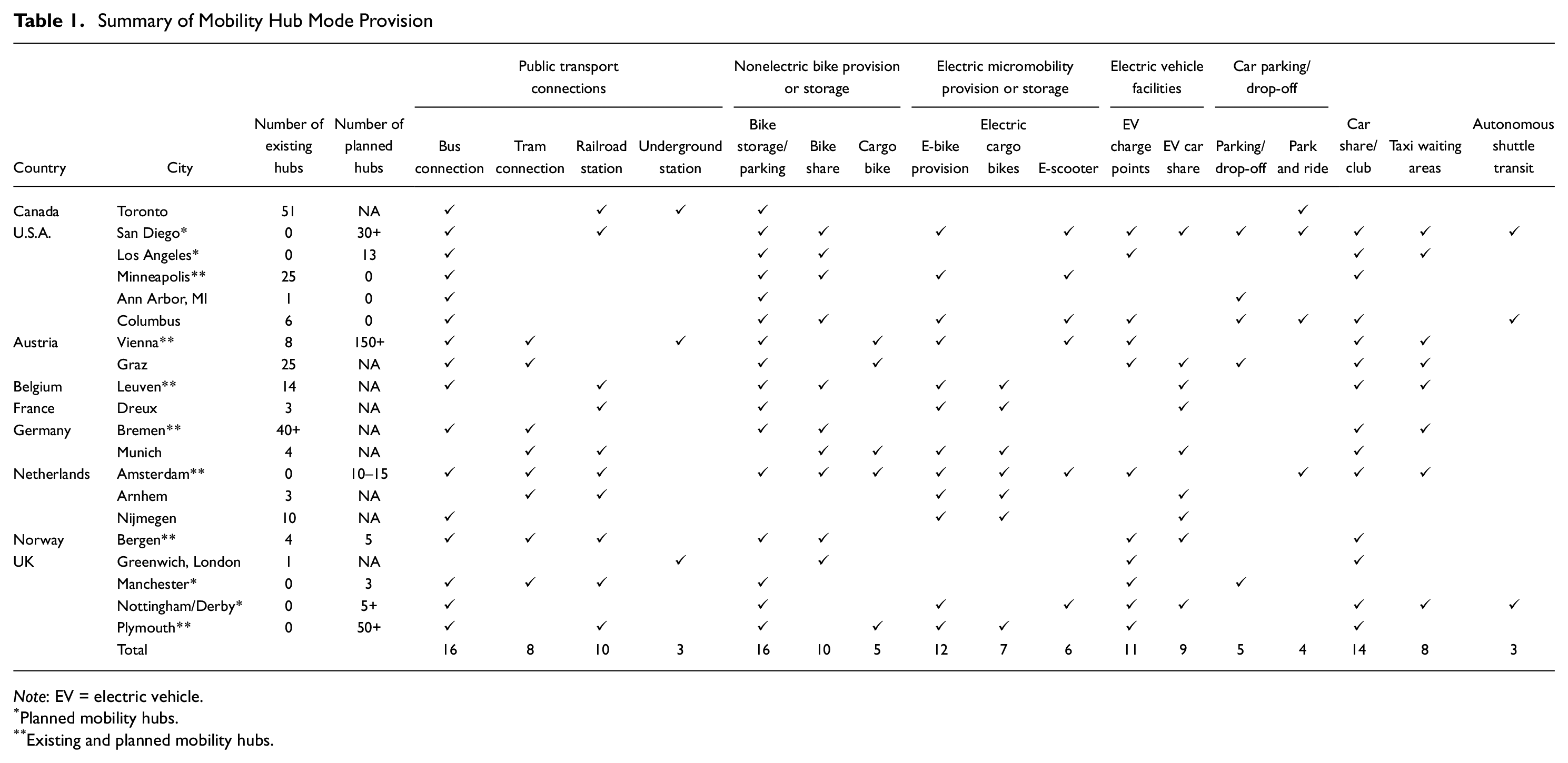
Note: EV = electric vehicle.
Planned mobility hubs.
Existing and planned mobility hubs.
Mobility Hub Objectives
MH objectives vary from city to city and country to country. The objectives and purpose of developing of MHs can be broadly characterized as addressing environmental issues, primarily a reduction in carbon emissions, or encouraging socioeconomic improvement.
Environmental
Environmental issues, most notably carbon neutrality, is a recurring theme in relation to transport in states, regions, and cities throughout Europe ( 8 , 9 ), and in North American projects too ( 10 , 11 ). Although addressing environmental concerns is an objective of MHs ( 12 ), this has only recently become a driving force in local and national policy ( 13 ) and, consequently, the push toward the idea of MHs as a policy for reducing carbon emissions has accelerated. From the original idea, which has its origins in the city of Bremen in the late 1990s, and the first physical hubs in the early 2000s, MHs have gained in popularity in a wide variety of cities throughout the world, in part because of their potential as a solution to the provision of sustainable transport, especially that which is powered by electricity. Goals with regard to network and facility improvement feed into the requirement for innovative sustainable solutions to climate change and, consequently, can be seen in the objectives set by regional public authorities such as Plymouth City Council ( 9 ). In addition to addressing climate change, improving air quality is the aim of several areas that are introducing MHs ( 7 , 14 – 16 ).
To achieve the overarching objectives, more specific goals have also been set in many cases. Day-to-day goals such as providing seamless connectivity and improving user experience to facilitate modal shift to sustainable forms of transport can be seen in cities such as Vienna ( 17 ). These specific goals are achieved by creating a sense of space, for example, through improving aesthetic design, transport choice, or efficiency for passengers within the hubs ( 10 , 15 , 18 , 19 ). These improvements will potentially link with the overall objective of enhancing user experience, thereby helping to cement modal shift with the aim of achieving environmental goals through a reduction in the number of ICE vehicles and, consequently, harmful emissions.
Socioeconomic Improvements
A common objective of MHs is the social and economic improvement of cities and regions. Sustainable economic growth objectives are becoming evident in public transport policy ( 20 ), together with improvements in social accessibility ( 15 ). In the U.S.A., the San Diego Association of Governments’ (SANDAG) regional plan 2021 emphasizes the need to “create equal access to jobs, education, healthcare, and other community resources” ( 21 ), and the introduction of MHs are a contributing factor to this aim. Equality of access will improve the economic situation of those who may have financial or practical constraints in using existing public transport. This objective recurs across many of the existing and planned MH networks throughout the UK and Europe as well as the U.S.A. ( 9 , 15 , 16 , 22 ).
As well contributing to environmental and health problems, congestion is also a major economic issue. This worldwide economic concern is being tackled first on a governmental level, cascading down to a regional and city level. For example, in the UK, improvement of productivity through the reduction of congestion is one of the aims of the £1.7 billion Transforming Cities Fund ( 23 ). As part of this, MHs are being planned and implemented to reduce the number of ICE cars across regions and promote more shared transport ( 9 ). A specific example of this can be found in Amsterdam, where the MH proposed for the De Pjip area (electric car sharing) has the aim of encouraging “200 people to sell their car.” It is intended that their parking spaces will be replaced by green areas or shared transport spaces ( 18 ).
Furthermore, the forms of transport and amenities available at MHs play an important part in helping to boost economic and social conditions. E-cargo bikes and local amenities such as cafes and restaurants are examples of how MHs aim to regenerate and support local business through the provision of multipurpose spatial elements including attractive pedestrian areas and business opportunities ( 6 , 10 ). Linked to this is the need for accessible, safe, and secure MHs, because having unsafe areas may have an impact on user experience and numbers; therefore, in several areas, one objective is ensuring these are secure sites ( 9 , 10 ).
Physical Characteristics
This section examines the physical characteristics of MHs and is in two parts: format, including available modes of transport and design; and location choices with regard to MHs, including single hubs and hub networks.
Format (Modes of Transport and Design)
Germany has the longest association with MHs. Bremen was one of the first cities to explore the possibility of using hubs to promote multimodal transport options with the aim of achieving local objectives of taking cars off the streets and improving the street space. From this experience of developing and implementing hubs, lessons learned have been shared with the Shared Use Mobility Center (SUMC) in the U.S.A., which looks at seven aspects of MHs: links to transit; the need to target areas with high parking pressure; the need to be close to the user; the importance of mobile technology; the need to promote multimodal living and not just trips; the need to make hubs visible; and the importance of marketing ( 24 ). In addition, guidelines have been released by regions and cities, each attempting to provide help to MH planners and operators ( 6 , 25 , 26 ), but often with a focus on their own plans and projects ( 10 , 19 , 21 ).
Three components have been identified as key considerations in the implementation of MHs when considering format: the modes of transport available, both existing and planned; design elements of MHs; and amenities provided by MHs.
Modes of Transport
There is a growing variety of transport options available to a MH designer, from the original shared options of cars, bikes, and public transport to more technologically innovative and sustainable solutions such as e-bikes, e-cargo bikes, and e-scooters ( 6 , 9 , 14 , 27 ) (see Table 1). The required modes of transport for each MH network can be based on one or all of the following: the requirements of the local population; the ability to provide these options; or what is considered best to meet local objectives ( 6 , 9 , 27 ). Shared mobility is becoming more common in cities around the world because of several factors. A study highlights the importance of shared mobility as having the “disruptive potential to create a shift towards social, environmental, and economic efficiency through the use of technology” ( 28 ). Car sharing is one of the primary forms of shared mobility and can be broken down into two operational models: business-to-consumer (B2C) and peer-to-peer sharing systems ( 29 ). MHs come under the B2C category of car sharing, and as can been seen from Table 1, car sharing is a common component of MHs. Currently, the availability of car sharing is low: numbers from a study looking at a B2C model state 17.8 shared cars per 100,000 inhabitants from a sample of European countries ( 29 ). However, the benefits of car clubs, with either one car operating a round trip car share model taking on average 10.5 cars off of the road, or flexible or one-way cars taking on average 13.8 cars off the road could, therefore, be significant ( 30 ). An interesting point to note is the high number of European cities using shared electric forms of transport, as can be seen from Table 1. Cities such as Arnhem, Nijmegen, and Nottingham have made specific provision for e-hubs. Although in North America a move toward “low emission” ( 21 ) or “low or no carbon transportation options” ( 31 ) can be seen, there is a focus on mode change and not the implementation of purely electric formats. This difference in method for achieving similar policy objectives is also shown in the provision of car parking. As can be seen in Table 1, provision for car parking or drop-off is much greater in North American MHs than in their European counterparts. Shared mobility was a founding principle of MHs in Germany, and it remains a key component of their operation. The success of car-sharing methods in relation to use of hubs and especially reduction in car numbers has been recorded and reported in Bremen ( 32 ). However, car sharing is not the only method of achieving city objectives; alternatively, it can be considered as a supplementary factor to other modal transport options such as public transport ( 32 , 33 ).
The provision of micromobility facilities for bikes and scooters, both electric and standard, is becoming more common. For instance, Nottingham City Council has recently introduced a potentially easy addition to MHs in the form of free-floating e-scooters. In Portland, Oregon, with regard to transport strategy, e-scooters were found to have a positive effect in helping to achieve the aims of reducing congestion, improving safety, increasing accessibility, and reducing the environmental impact of other modes of transport ( 34 ). One issue that was raised was the illegal parking of e-scooters. This could be addressed by the provision of visible MHs, which, in turn, would assist in safe micromobility use because there would be designated parking areas, thus reducing the risk to visually impaired pavement users ( 34 ). However, there are questions in relation to the ability of e-scooters to achieve sustainability objectives. One study that conducted a series of Monte Carlo simulations found that over the lifecycle of e-scooters, they were higher polluters than modes of transport they had displaced; this was in part because they had to be collected daily (by an ICE vehicle) and taken for charging ( 35 ).
Active Travel
A prominent element of MH guidelines produced by practitioners is the provision of safe active transport through pedestrianized and bike access ( 11 , 25 , 36 ). The SUMC describes pedestrianized access as one of the “essential transportation amenities” ( 25 ). Although these guidelines are focused on the U.S.A. and have few associated case studies, they have been issued by an organization with extensive experience of promoting shared mobility in the U.S.A. and provide a comprehensive overview of the requirements for MHs with the objective of increasing shared mobility. In addition to pedestrianized access, 18 of the 20 studies considered indicate an adoption of areas either for bike sharing or storage ( 9 , 17 , 20 , 27 , 37 ). The focus on electric modes only is an interesting development in the Arnhem and Nijmegen MH networks, and is an unusual case in the implementation of active travel elements. However, whatever the form, active travel is an integral part of recent and planned MHs because it assists in the achievement of environmental targets and increases societal benefits through improvements in health and air quality.
Public Transport
Public transport links are a key feature of MHs, and some exploratory case studies describe the first/last mile connectivity of MHs as an integral part of such a system ( 16 , 34 , 38 , 39 ). Guidelines developed by CoMoUK, SUMC, and Metrolinx stress the importance of MHs being located at points where there is access to public transport ( 6 , 10 , 11 ). According to the SUMC guidelines, public transit “is the core on which a diverse array of options depends” ( 25 ). An interesting point to note is that the requirement for links to public transport is not limited to certain regions or areas and, in fact, is spread across case studies, planned hubs, and guidelines. A natural addition to the need for public transport connections is the requirement for real-time public transport information, something that is highlighted in Plymouth City Council’s plans (UK) and in the information from SANDAG in California ( 9 , 11 ).
Design
Design of intermodal transfer is crucial in avoiding delays and other issues when traveling. Pitsiava-Latinopoulou and Iordanopoulosp ( 4 ) analyze the required design features of MH intermodal interchanges. According to their classification, MHs could be categorized as “interchanges” or “on-street facilities” ( 4 ). The proposed design features are useful in that they provide a broad description of intermodal interchange requirements and recommendations for their construction, although without the focus required to understand the specificities of MHs.
Through the Interreg program of work, guidelines on using psychological concepts to boost the use of e-mobility hubs were produced in 2020 ( 40 ). One of the core recommendations was that design features should optimize the take-up of e-hub services. The guidelines promoted the use of “floor communication, colour coding on the pavement and attractive surroundings” in MHs ( 40 ). In addition, the city of Los Angeles identified the need for MH spaces to be culturally and historically sensitive. It can be concluded that not only is design important for changing behavior, it is also important for residents, because good design is more likely to make them accept change to a neighborhood space ( 41 ).
Amenities
In an effort to improve the use and appeal of MHs there are examples of various amenities being made available, for example, information, and a sense of space in relation to both the waiting experience and certain economic elements ( 10 , 37 ). Soft factors such as these can be instrumental in determining transport usage and have an effect on quality of access, the waiting experience, ticketing, and safety ( 42 ).
Real-time travel is one of the key amenities provided. This is unsurprising, considering the emphasis on public transport connectivity. The importance of public transport information can be seen in the UK, where the documentation on the latest planned hubs in Plymouth and under the Future Transport Zones program includes sections on public transport ( 9 , 43 ). Several cities include information and wayfinding as a part of their MH network amenities, for example the Nottingham/Derby Future Transport Zone bid document ( 15 ) includes real-time information, and the city of Colombus encourages exploration of the area through provision of local information ( 43 ).
MHs have also been integrated into wider urban planning schemes to create spaces that are pleasant and promote sustainable travel ( 6 ). Part of this is ensuring that the waiting areas have facilities to improve the traveler’s experience ( 42 ), while also being a destination in themselves through the provision of food and beverage services. This sense of space and placemaking is at the heart of guidance for MHs such as that provided by Metrolinx, SUMC ( 10 , 25 ), and CoMoUK. Metrolinx aims to “(p)rovide a diverse mix of uses, including housing, employment, regional attractions and public spaces” ( 10 ), whereas SUMC emphasizes the multiuse functionality of MHs through the offering of “a pleasant garden space, art installations, cafes, community centres, or other gathering spots ( 25 ).” CoMoUK’s guidance suggests amenities including package delivery lockers, a mini fitness or play area, a cafe or co-working space, a water fountain, a waiting area, covered seating, and Wi-Fi ( 6 ). Not all MHs will have the land available to incorporate all these elements; therefore, public consultation becomes necessary to understand the requirements of the local community.
It is not only the offerings that create a sense of space, but consideration has also been given to accessibility, safety, and security. In their review of literature on transport interchanges, Hernandez and Monzon ( 44 ) identify safety and security, and comfort as “the most important psychological aspects” that should be taken into account when designing and operating a multimodal hub ( 44 ). SUMC emphasizes the need for good lighting and a well-trafficked area to ensure users feel safe when accessing and using facilities ( 25 ). Improved accessibility and seamless modes of transport are highlighted in the CoMoUK guidance and should be considered at every design step ( 6 ).
Offering amenities as a way of improving the sociospatial aspect of MHs helps to achieve several of their objectives, namely, an improved transport network to reduce congestion, the creation of sustainable economic growth, and the establishment of a safe space for active transport.
Location
MHs are relatively new to the UK, although they are more mainstream in other regions such as Western Europe and the U.S.A. However, this is changing, and as can be seen from Table 1, more and more MHs are being planned and implemented in the UK. Once cities and regions have decided to introduce MHs there are several questions with respect to location that need to be considered. First, there is the issue of the ideal position. Second, MH networks need to be taken into account. Finally, there are inevitably problems with attempting to choose a location or locations.
Individual Hub Location Choices
In examining the various guidance documents, there are several common themes with regard to ideal location, whether for a single hub or the individual hubs that comprise a network. The proposed size of a MH will affect location, specifically the requirement that it will have to fit the space available. This issue can be addressed by having a variety of hub sizes within a network, as shown by the plans for Nottingham and Derby. These contain a larger central hub in the space provided by developers and a smaller on-street hub in Derby situated in a congested residential area ( 15 ). Furthermore, the current UK best practice for MHs, which has been developed by CoMoUK, cites co-location of shared and public transport as a key characteristic. This leads to a requirement that any location chosen should aim to connect with robust public transport links and is one of what CoMoUK calls its mobility component matrix criteria for assessing location choices ( 6 ). The emphasis on public transport connectivity is highlighted by the Metrolinx guidance for MHs, which bases decisions about location choices on existing public transit elements ( 10 ). Lessons learned from the implementation of MHs in Bremen in 2003 highlight the need to locate hubs in areas that already have good transport links ( 24 ). This emphasizes that throughout the development of MHs, public transport connectivity has been a prominent element in the consideration of location.
Mobility Hub Networks
Inevitably linked with the need for making appropriate decisions about location is the decision as to whether there is going to be a MH network, and if so, whether all the hubs comprising this will have the same format and size. Perhaps there is only a need for a single hub. Single MHs have been developed, for example, the one in Greenwich in London, which is run by BP. However it is more common to see MH networks in cities or regions.
Single MHs are found infrequently, because many cities prefer a network arrangement. Another single hub like the one in Greenwich is the one in Ann Arbor, Michigan. This project was not originally planned as a MH, but developed organically through the addition of extra mobility options, in particular the connection to public transport, in a shared area originally designed as a car park ( 39 ). The natural development of this area from a car park to a MH demonstrates the effectiveness of having a multimodal connectivity point while also emphasizing that the targeted development of single MHs is infrequent.
There is already a network of six hubs in Colombus, Ohio and one consisting of eight in Bergen ( 43 , 45 ), demonstrating that cities and regions are more likely to build larger networks. Examples of the latter include the 50-hub network planned by Plymouth City Council as part of its Transforming Cities Fund proposals and the mobil.punkt in Bremen, which already has 42 hubs in the network and is planning to build 8 to 10 more annually because of the success of the project ( 6 , 9 ). A consideration that arises is how to determine the number of MHs that should be built and where they should be located, to ensure they attract the optimum number of users. In part, this can be driven by public consultation to understand the requirements of an area to maximize usage ( 8 ). Taking the example of the shared mobility organization Autodielen in Belgium, CoMoUK has outlined a strategy of one MH per 1,000 inhabitants in a rural context and one hub per 2,000 inhabitants in an urban context ( 6 ). However, this is specific to the Belgian model of MHs and may not be translatable to other regions, especially if urban density is considered; there may be a higher proportion of inhabitants in the immediate walkable area and, consequently, it may be preferable to have a larger hub with more options and amenities instead of separate closer neighboring hubs. Topography must also be a consideration when looking at users and user needs ( 46 ). If the available terrain is hilly, there may be less uptake of active transport or, conversely, if the immediate walking area is smaller, predominantly flat, or both, people may have a greater inclination to use active transport.
The question of how many MHs to develop also leads to consideration of size and type. If regional and public requirements are to be considered, then each hub will be designed differently. The city of Bremen has introduced mobil.punktchen, which are smaller versions of its mobil.punkt ( 2 ). This has led to the development of a two-tier MH system that has contributed to the expansion of the MH network, increased user options, and optimized the available space. Wang et al. ( 47 ) looked more closely at the planning strategy for multimodal hubs using the case study of Furstenfeldbruck, a city region in Germany with a high rate of car dependency. This comprehensive research covered several important aspects of multimodal mobility including the introduction of a three-tier system of MHs that was first pioneered in the state of North Rhine-Westphalia. The concept consists of center stations, sub-center stations, and ancillary stations, each type determined by size and modal requirements, and service offerings ( 47 ). Whereas much of the current guidance can be considered useful although superficial, this study delves deeper into the reasoning behind the thee-tier system and examines the environmental criteria for efficient MH networks ( 47 ). The authors propose a 250 m catchment radius to achieve higher rates of behavioral change, a figure that is lower than other guidance of 400 m to 500 m ( 25 ). Additionally, through an analysis of the Furstenfeldbruck population, they estimate as a worst-case scenario a 15% acceptance rate of e-bike and car share schemes ( 47 ).
Whether it is a two-tier approach like that in Bremen or a more tailored three-tier approach like that found in the Furstenfeldbruck study, the selection of network locations and network types depends on the individual requirements of cities and regions. Additionally, similar requirements may mean there is only a need for single-size MHs in a network that aims to attract an equal number of participants. The 20 studies selected have a variety of hub sizes within their networks depending on local requirements. For example, in the contrasting cases of Derby and Nottingham, space allocation in public areas allows a larger central network in Nottingham but potentially smaller hubs in Derby ( 15 ).
Difficulty in Choosing Locations
It is necessary to examine the difficulties faced in choosing locations either for single hubs or for networks.
Two major issues with regard to location choice are the lack of physical infrastructure and the availability of land. It will not matter how many ideal MH location criteria are met if the land is not available for use, a point highlighted by Aono ( 19 ). Nottingham and Derby have incorporated a MH into new development plans as one solution to this ( 15 ). Additionally, suitability of infrastructure is a considerable challenge. Even if the land is available there is no guarantee that the optimum conditions for MH creation exist; these can include charging infrastructure, bike lanes, or even safe pedestrianized access ( 1 ). Consideration should be given to the suitability of the land for electrification, and not only is this a factor in the SUMC guidance, it is one of the criteria in Plymouth City Council’s location strategy for MHs ( 9 , 25 ). Attention to safe pedestrianized access can be seen in a project being undertaken in Minneapolis, where work on improving intersections is being carried out as a means of reducing death and injuries caused by traffic accidents ( 48 ).
Another issue that has received attention is ensuring the community is involved in the decision-making process with regard to the location and details of MHs. This is a major factor in the planning for both the Leuven and Nijmegen ( 8 , 36 ) hub networks and would seem to indicate that these places (and potentially not just these places) see public consultation as a necessity when building a sustainable MH network. The Amsterdam Smart Mobility Lab has also engaged with the local population through surveys and a residents’ evening ( 49 ), with the aim of guaranteeing user numbers through providing options that have already been approved and requested by the local population. Therefore, societal acceptance and input are important elements to consider when deciding on a location for a MH ( 40 ).
Operation
The creation of a sustainable MH, whether a single one or one that is part of a network, depends on the consideration of its future viability, as well as its initial physical characteristics. Therefore, this section explores the underlying operational characteristics of existing and planned MHs in relation to their day-to-day operation post-implementation and the continuation of brand and marketing development.
A privatized MH is an option, and a good example is the one in Greenwich, UK. Martinez and Rakha ( 50 ) discuss a “destination-based model” in which private institutions would be crucial in effecting this type of network, which is an operational method relying on private enterprise stakeholder engagement and management to achieve the desired outcome of increased sustainable transport usage.
There is also the option of a MH operated wholly by the public sector in which city councils are responsible for all elements of the hub as well as site management. However, this is an option that has not been explored by any of the current studies detailed in this paper. The closest example to a MH wholly operated by the public sector is the CIVITAS EU-funded E-MOB project in Munich; however, this still relies on an element of private cooperation ( 14 ).
The most common form of day-to-day operational administration of MHs is a combination of both public and private effort. An example dependent on private operation can be found in Colombus, Ohio in which stakeholder engagement and involvement in operational issues has been extensive ( 43 ). The proposed MH for Amsterdam, to be located in Watergraafsmeer, has an innovative approach to day-to-day operations that involves the community, whereby the hub is organized and shared by the local inhabitants ( 18 ). Although community led, the local government has suggested that the group involved should be treated like any other shared mobility company, thus highlighting the combination of public and private management ( 18 ). These examples highlight the range of MH operational plans from more private to more public.
Marketing and branding are tools used by MHs to guarantee their sustainable and continued use. The Munich network has utilized marketing to promote hub services and to inform residents who may potentially use the hubs ( 14 ). As previously mentioned, the need for branding is a lesson learned from the Bremen operation, for which clear and memorable signage has been introduced to ensure MHs are recognized as such and that people are attracted to using them. The guidelines from SUMC and CoMoUK both identify the visibility of MHs as an important factor contributing to their success. SUMC goes further and advises that marketing should help the public understand the options on offer ( 6 , 25 ). The design of the MH area is an aspect that can contribute to behavioral change and influence continued usage ( 40 ). Additionally, marketing is a key ingredient that can register MHs in the public consciousness as well as providing an insight into the final design; for example, Amsterdam and Leuven are already actively engaging with the local population to ensure the correct selection of transport modes ( 8 , 18 ).
When considering the operational characteristics of MHs, it is also necessary to consider user experience. To address this, the aim has been to integrate MHs with existing travel infrastructure, for example, through Mobility as a Service (MaaS). Addressing integration is part of the requirement for future development ( 46 ). Wiener Linien ( 17 ) have introduced an app to run alongside the physical MHs. This allows access to up-to-date information and also streamlines the process by which the facility is used, including car sharing and private transport. In the UK, Plymouth City Council is also planning to introduce a MaaS app to complement the introduction of MHs ( 9 ). In particular, the importance of having access to up-to-date information is highlighted by a study ( 51 ) that states that information is a key aspect of the quality of intermodal interchange for users and operators. It is interesting to note that there is no mention of a digital counterpart to MHs in the SUMC guidance, indicating that this is not a vital component of a MH setup ( 25 ).
Conclusions and Future Research Agenda
This is an opportune time to analyze a fledgling transport initiative that aims to meet important global and local objectives of addressing climate change and sustainability issues. As such, this paper has offered a holistic review of MHs, and the aim has been to investigate the elements and characteristics prevalent in MH networks by examining 20 case studies. The paper has investigated the global implementation and deployment of MHs noting several key factors. The importance of the types of transport on offer is one of these. Notably, electric modes of transport are more commonly found in European hubs, whereas there is a focus on modal shift from the car to a more sustainable form of transport in North America. This is reflected not only in the modes on offer but in the wording of objectives, which although common in aiming for a reduction in carbon emissions, differ in their methods of how to achieve these goals. A common factor is the introduction of amenities to encourage the use of intermodal interchanges, especially the provision of real-time information, which is necessary if a link to the universally required element of public transport is to be created. Additionally, a key design aspect contributing to MH usage is its recognizability, and branding and marketing play a prominent role in defining the single and network MHs and ensuring sustainable usage. The choice of location for single hubs or those in a network is an important part of the decision-making process. Consideration needs to be given to the requirements of an area in relation to its existing facilities such as tourist attractions and businesses, and also to the size of the hubs, which can be small, medium, or large depending on local needs. The provision of electric infrastructure is a key factor in those areas with a sole focus on e-hubs such as Arnhem and Nijmegen. Generally, although MHs offer similar functionalities and features in their different locations, they are still dependent on local requirements either as proposed by the population or dictated by policy objectives.
This paper affords areas for further research. Intermodal interchanges and their component parts have many iterations, and people have different understandings of them. Although MHs can be considered as a type of interchange, consideration needs to be given to defining them in a clear and comprehensive manner to avoid confusion with other similar hubs such as the multimodal transport centers commonly found in the U.S.A. Currently, each organization or authority involved with MHs has its own understanding of what they are, and this can lead to difficulties in analysis because a ubiquitous definition would be preferable. The implementation of MHs worldwide and their growing influence on local transport policy has stemmed from transport objectives at all institutional levels; therefore, it is necessary to analyze the origins and applicability of these objectives further. In addition, an examination of the various stakeholders who are interested in investing in MH development and operation is required. It is this variety of MHs and associated organizations, both public and private, that lends itself to further investigation. Specifically, this would include organizational interaction in the context of urban transport.
Because MHs are a relatively recent innovation there is a need to focus on operational considerations, including an examination of the day-to-day administration and the differences between public and private ownership. This evaluation should include lessons already learned from implementation of a MH network. On a global level, the effectiveness of policy transfer from an individual city or regional perspective to elsewhere is an interesting research proposition. The development of MHs to date has been ad hoc and there is a need to understand the role of leadership in the instigation of hub development, the role of private entrepreneurs, and that of public, local, and national policy leaders. The MHs examined as part of this research highlight the diversity of their objectives, design, and features. The evaluation of MHs needs to be part of the research agenda, to identify successful design interventions and address issues such as the effectiveness of hub networks as opposed to discrete single hubs when meeting the objectives of MHs.
Footnotes
Author Contributions
The authors confirm contribution to the paper as follows: study conception and design: Thomas Arnold, Matthew Frost, Andrew Timmis, Simon Dale, Stephen Ison; data collection: Thomas Arnold; analysis and interpretation of results: Thomas Arnold; draft manuscript preparation: Thomas Arnold, Matthew Frost, Andrew Timmis, Simon Dale, Stephen Ison. All authors reviewed the results and approved the final version of the manuscript.
Declaration of Conflicting Interests
The author(s) declared no potential conflicts of interest with respect to the research, authorship, and/or publication of this article.
Funding
The author(s) disclosed receipt of the following financial support for the research, authorship, and/or publication of this article: This research was funded by Nottingham City Council and Loughborough University.
