



Abstract
Automated vehicle (AV) deployment can bring about transformational changes to transportation and society as a whole. The infrastructure owner-operators (IOOs), who own, maintain, and operate the infrastructure, have the opportunity to work jointly with the AV industry to provide safe and efficient operations. A key question for the IOOs is, “What transportation infrastructure improvements do AV manufacturers believe will facilitate and improve AV performance?” This study was designed to address this question through a comprehensive survey approach, including an online survey and follow-up interviews. A list of ten questions was discussed, covering the physical and digital infrastructure, infrastructure maintenance, standards and specifications, policy support, data sharing, and so forth. The researchers reached out to more than 60 entities who hold the AV testing permit in California. In total, 20 companies responded. They were from different sectors and well represented the AV industry. From the results of this study, it is concluded that the most important roadway characteristics that have the potential to benefit the automated driving system (ADS) are: (1) digital mapping and signage; (2) lane markings; (3) work zone and incident information; (4) vehicle-to-everything (V2X) communications; (5) actual traffic signals; (6) general signage; and (7) lighting. The digital features considered most critical to help accelerate ADS deployment include work zone and road closure information, traffic signal phase and timing, and traffic congestion. This study provides diverse voices and in-depth insights into topics that the AV industry and IOOs should engage in to advance AVs’ deployment.
Keywords
Automated vehicle (AV) deployment can bring about transformational changes to the transportation sector and society as a whole. In recent years, a limited number of publications about the potential impact of AVs on highway infrastructure have been released ( 1 – 4 ). There seems a consensus that AV deployment will require significant transformations in infrastructure planning and operations. However, there is no comprehensive reference to which transportation infrastructure improvements or modifications the AV industry believes will facilitate and improve their AVs’ performance. Nor is there a reference which provides diverse voices and nuances from different AV industry players. The current study was designed to fill these gaps. In this study, a survey was conducted with the AV industry which covered various aspects of infrastructure, including physical and digital infrastructure, infrastructure maintenance requirements, roadway specifications and standards, infrastructure policy support, timeline for AV deployment, data sharing for repair and maintenance, and venues for engagement with infrastructure owner-operators (IOOs). In addition, the study was supported by the California, U.S., transportation agencies and anchored in California, where it hosts AV testing for more than sixty entities. With this particular background, the current study served as the first step to engage the broadest range of members of the AV industry and state departments of transportation (DOTs) for their mutual interests in the AV deployment. In this paper, the terms automated vehicle (AV) and automated driving system (ADS) are used interchangeably.
Methods
Development of the Questionnaire
The survey questionnaire was developed based on a literature review and, in particular, the Federal Highway Administration (FHWA) Request for Information (RFI) issued in January 2018 ( 5 ). The contents were expanded with inputs from stakeholders within the California transportation agencies. The scope of the questionnaire was intended to seek comments on planning, development, maintenance, and operations of the roadway infrastructure necessary for supporting ADS. The questionnaire started with an opening statement, which communicated the purpose of the study, introduced the research team and the survey protocol to protect company privacy, and explained the steps following the survey. Following the opening, there was a list of ten questions covering various aspects of roadway infrastructure.
Implementation of the Online Survey
The study protocol was drafted and submitted for review by the Committee for Protection of Human Subjects (CPHS), University of California, Berkeley (Berkeley, California, USA). The Google Form platform was used for conducting the survey, in which all questions were set as optional. The research team received the list of AV testing companies and their contacts from the California Department of Motor Vehicles (DMV) and started sending survey invitations to each of the 66 companies on the list. To encourage participation, four rounds of email invitations were sent out to the companies from May to June, 2020. Based on the study protocol, responses from all companies were de-identified before sharing or reporting.
Survey Response Rate
In total, 20 companies responded to the survey. The 20 respondents were from different sectors within the AV industry. The composition is shown in Figure 1. Among the respondents, six (30%) were AV startup companies, including companies focusing on both passenger vehicles and low-speed shuttle buses; three (15%) were automated truck startup companies; four (20%) were AV technology provider startup companies, including companies working on both AV hardware and software; four (20%) were traditional automotive car manufacturers; and three (15%) were traditional automotive suppliers. The composition indicates that the survey respondents well represented the important players in the AV industry.
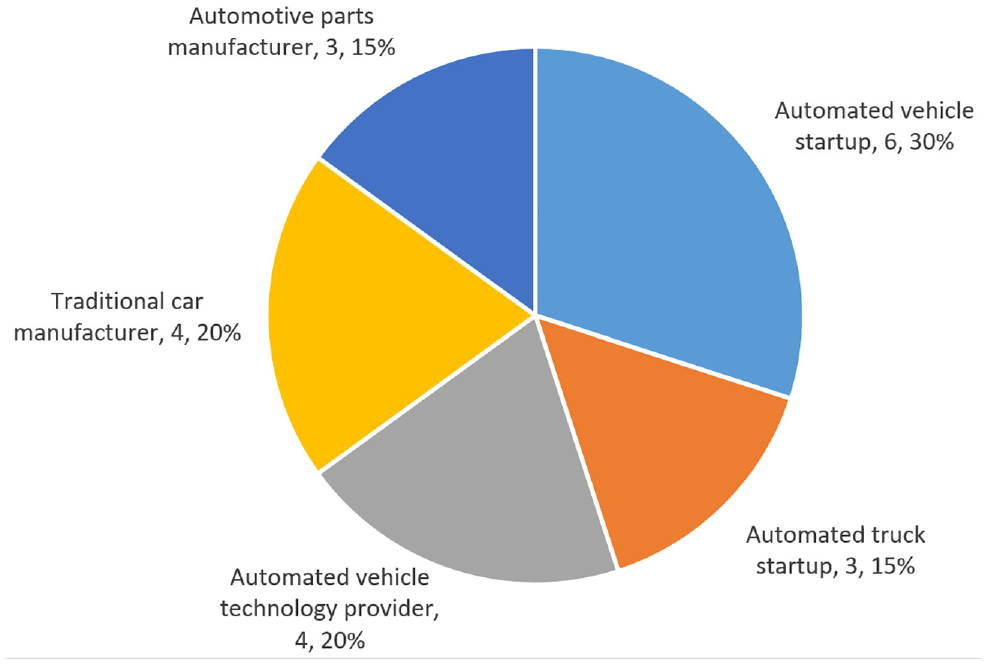
Composition of the survey respondents.
Implementation of the Interviews
The purpose of the follow-up interview was to ask respondents to elaborate further on their answers. After completing the survey, each survey response was analyzed and used to draft the interview guide, which was formulated to solicit further responses about previous feedback from specific respondents. Zoom meetings were used for the follow-up interviews. The duration of each interview was about one hour. The interview was voice-recorded for transcription and further analysis. The interviews were conducted in August and September, 2020.
Interview Responses Rate
In total, eight of the 20 survey respondents participated in the follow-up interviews. The composition of the interview respondents is shown in Figure 2, which is very similar to the composition of the survey respondents.
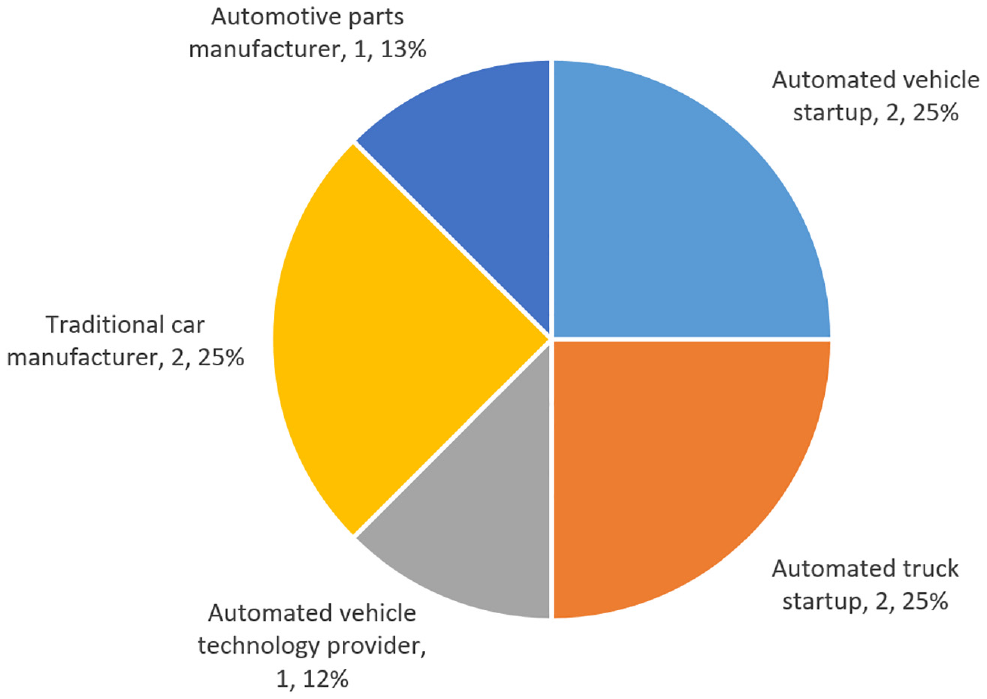
Composition of interview respondents.
Results and Findings
This section summarizes the results and findings of each question based on analysis of respondents’ feedback in both the online survey and the interviews.
Question 1
“What roadway characteristics or features do you believe will benefit your ADS systems? You can choose to prioritize them into high, medium, and low factors. Examples of roadway features include lane markings, signage, lighting, traffic signals, digital mapping and signage, work zone and incident information, V2X data, etc.”
Survey Results
For this question, 18 (90%) companies responded, with 15 of them prioritizing their selected items as high, medium, and low factors. Table 1 summarizes the top-chosen roadway characteristics, including digital mapping and signage, lane markings, vehicle-to-everything (V2X), work zone and incidents information, general signage, traffic signals, and lighting. All of the above items were chosen by at least seven respondents. Other roadway characteristics, such as good pavement quality and electronic signs with high refresh rates, were chosen by only one or two respondents.
Top-Chosen Roadway Characteristics
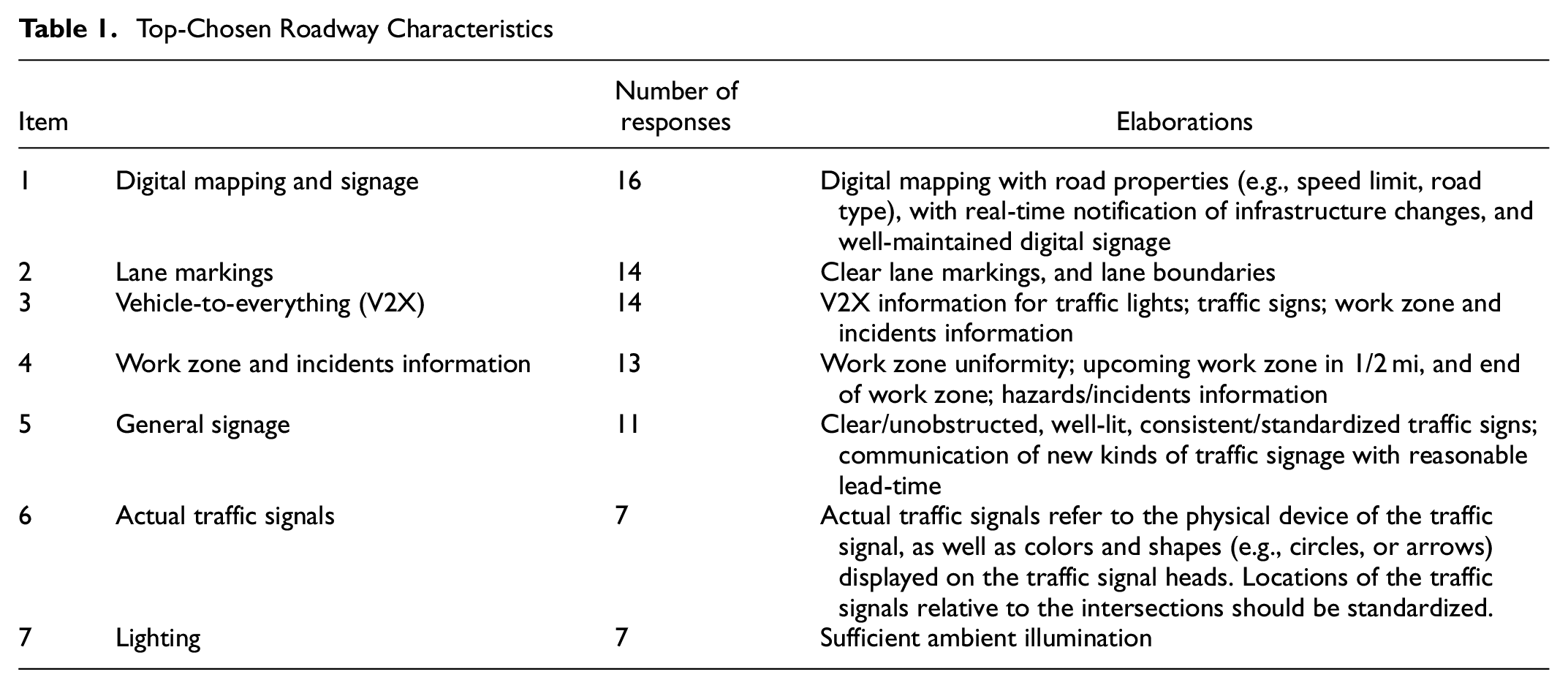
The specified needs for signage and lighting is likely correlated with the sensing technologies that each company uses for their ADS. Therefore, further analysis was carried out into this potential correlation. Each company’s AV system was categorized as either vison-based system or sensor-fusion-based system (e.g., Lidar, radar, cameras, and ultrasonic), based on the published information on each company’s website. Out of the 20 respondents, 15 (75%) companies use a sensor-fusion-based AV system, three (15%) use a vision-based AV system, and the other two (10%) are software and navigation service providers, and therefore not applicable. The result shows that signage was selected by 11 companies, of which nine use sensor-fusion-based systems and two use vision-based systems. Lighting was selected by seven companies, with six using sensor-fusion-based systems and one using a vision-based system. This result indicates that, for signage and lighting, both the companies using sensor-fusion-based systems and the companies using vision-based-systems chose them as important features that will benefit their ADSs.
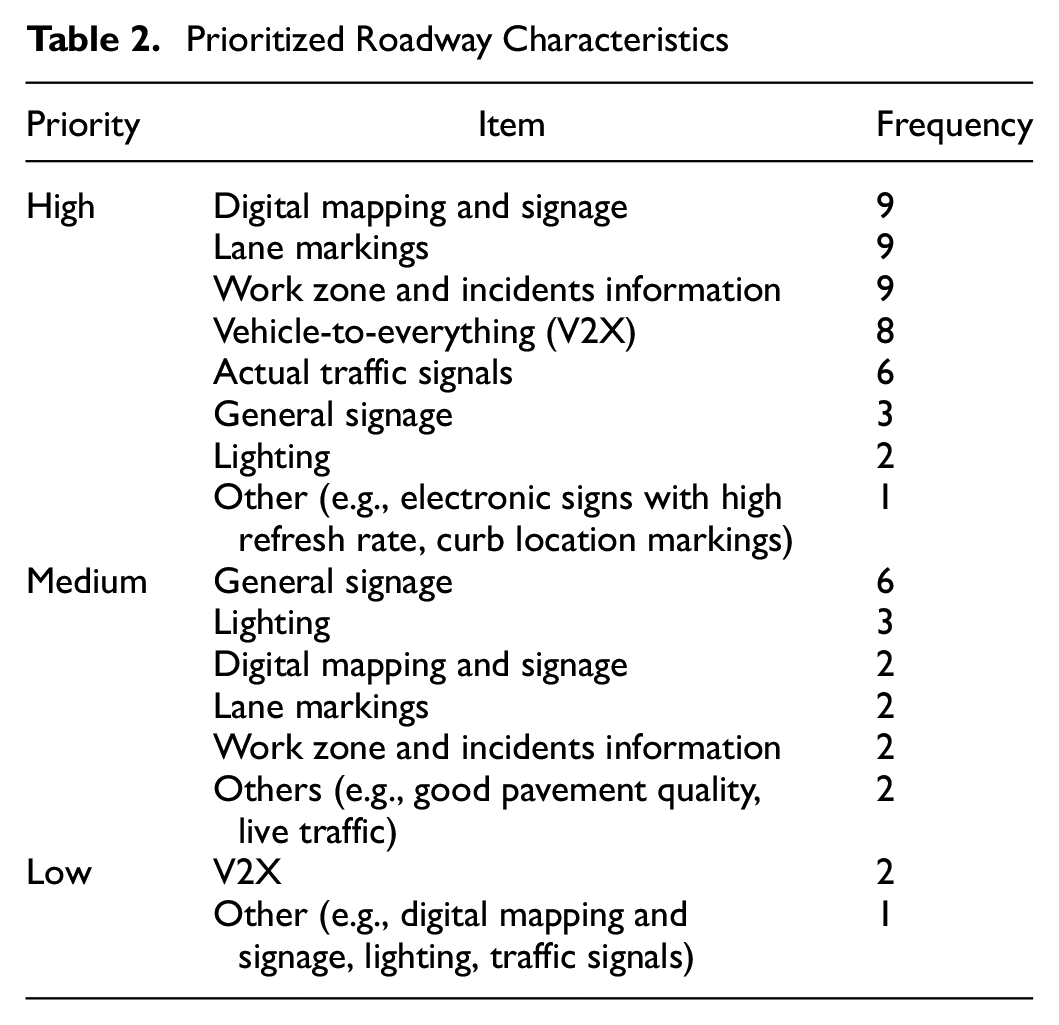
Among the 18 respondents, 15 prioritized their selected roadway characteristics, as shown in Table 2. Note that the respondents place different priorities on selected items. Therefore, the same item may appear multiple times at different levels. At the top of the table, the high-priority items are listed in the order of their selection frequency, and include digital mapping and signage, lane markings, work zone and incidents information, V2X, traffic signals, general signage, and lighting. The medium-priority items include general signage, lighting, digital mapping and signage, lane markings, and work zone and incidents information. The low-priority items include V2X and others. The high-priority items in Table 2 are the same items as shown in Table 1.
Prioritized Roadway Characteristics
Interview Results
During the interview, the interviewees were asked for further explanations of certain roadway characteristics, including lane markings, traffic signs, work zone information, electronic signs, and shared exit.
Cracks in parallel of lane markings: Respondents expect to have limited or no use of bitumen to fix cracks parallel to lane markings over long distances.
Traffic signs: It is expected that the IOOs will share information on new traffic signage with reasonable lead-time and provide a nationwide database with traffic signs and their positions.
Work zone information: Provision of work zone information, including how IOOs display the cones and how they mark the signage, is very helpful for ADS performance and safety.
Flashing rate for electronic signs: The LED lights on electronic signs flash at a high frequency that human eyes cannot see. The problem is that the camera system of ADS can see the flashing. Therefore, to be identified by the camera system, twice the camera’s frame rate is expected, which should be greater than 200 HZ.
Shared exit: A shared exit is the lane that can be used to either go straight or exit. For an ADS, it causes confusion. The system has indecision about whether it is supposed to stay straight or take the exit. Sometimes the ADS goes straight through the middle.
Question 2
“Are there any specifications or standards associated with the roadway characteristics that you believe would support a minimum performance level?”
Survey Results
In the survey, 13 (65%) companies responded to this question. However, most of the respondents commented on expectations for certain roadway characteristics rather than providing quantifiable specifications. These responses are summarized in Table 3. The most mentioned item is lane markings, by seven respondents. The expectations for lane markings are high contrast, non-deteriorated, using a brighter color for markings and a darker color for pavement, and well painted with good visibility at night-time. Inconsistent or worn-out lane markings with old lane markings or with cracks in parallel are pressing issues when considering the status of lane markings. In this study, respondents were not specifically asked about the width of the lane markings. Therefore, no preference was given about the width of the lane marking (e.g., 4 in. versus 6 in.).
Expectations of Roadway Characteristics
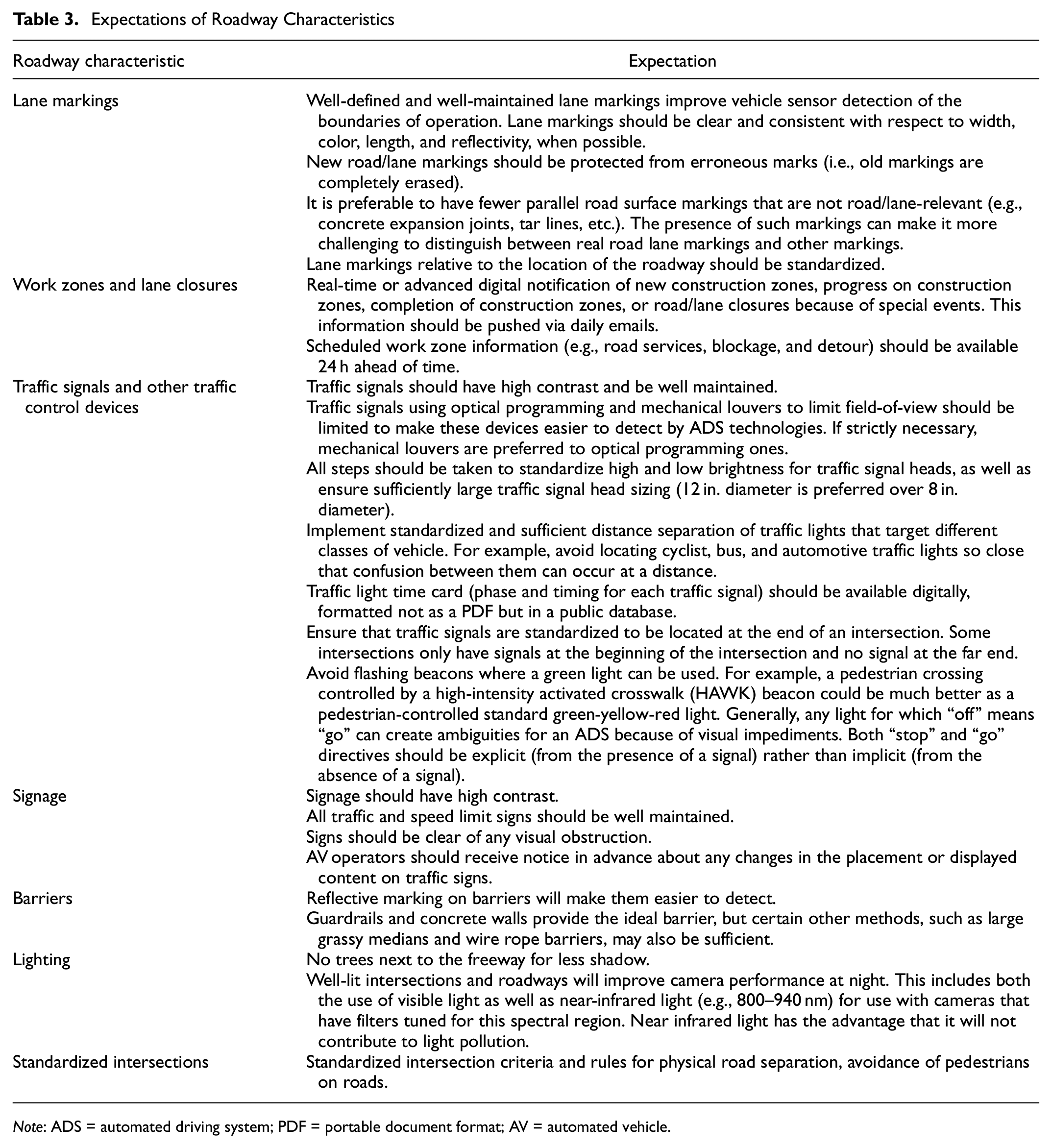
Note: ADS = automated driving system; PDF = portable document format; AV = automated vehicle.
Interview Results
Concerning the format of V2X messages, only one respondent mentioned that the V2X data frequency should be higher than 10 Hz.
For HD (High Definition) maps, one respondent mentioned that the accuracy of HD maps should be smaller than 10 cm. In the interview, this respondent was questioned further. It turns out that this suggested accuracy was based on their testing and practice (e.g., error within 10 cm). Concerning the format of the HD map, one respondent mentioned ADASIS (Advanced Driver Assistance Systems Interface Specification) standard for HD maps (https://adasis.org/). ADASIS has defined an interface to facilitate the distribution of information between the in-vehicle map database ADAS (Advanced Driver Assistance Systems), and automated driving applications. This enables vehicle environment data based on HD maps, improving automated driving performance. In 2020, ADASIS released the new specification v3.1.0. In the new release, detailed lane modeling and line geometry and additional data (e.g., landmarks) have a resolution of 0.01 m. In addition, ADASIS members were finalizing version v3.2 in early 2021, which includes, among other things, extended lists of traffic signs, localization objects like obstacles and traffic sign face, and a fully defined application API (Application Programming Interface). However, some other respondents also mentioned that many AV companies are developing their own maps. A truly open and widely accepted map format is currently missing.
It is worth mentioning that, during the interview, three respondents emphasized the importance of “uniformity” of those roadway characteristics. One example is consistency across cities on color and application regulations that apply to a section of the curb (e.g., in Oakland, white curbs are for 3 min passenger loading, while in San Francisco they are for 5 min passenger loading). An ADS is very good at picking up things that are consistent with what it has been trained. Therefore, there should be uniformity and not a patchwork of different standards across different states, counties, or even cities.
Question 3
“Deterioration is common in infrastructure, and maintenance is performed periodically. Do you see the need for different infrastructure maintenance requirements when considering the use of ADS rather than human-driven vehicles?”
Survey Results
In the survey, 18 (90%) of the respondents answered this question. Among them, 12 (66.7%) mentioned that a different infrastructure maintenance requirement would be needed for ADS compared with human-driven vehicles. In general, they believe that the need for different infrastructure maintenance requirements when considering the use of ADS rather than human-driven vehicles is obvious. These respondents shared the view that well-maintained infrastructure is important to provide consistently high automation availability and high performance. It should take into account that ADS has a limited perception capacity when compared with a human driver. Besides, certain roadway features, such as potholes, affect all ADSs regardless of the automation level. On the contrary, the other four (22.2%) respondents mentioned that they do not foresee any specific infrastructure maintenance requirements for AVs. As commented by one of the respondents “in order to achieve the right level of safety for the AVs, any infrastructure that is used in the safety process for human-driven vehicles should be safe for AVs as well.” This includes both monitoring and maintaining the infrastructure in working conditions. Another two (11.1%) respondents gave uncertain answers that more frequent maintenance is nice to have but not essential.
Interview Results
Most interviewees agreed that the infrastructure would need to be monitored and maintained more stringently if IOOs want to promote ADS on their roadways. They are interested in obtaining information about when road segments are non-compliant with the standards. Some other interviewees either have high confidence with their own ADSs or have high expectations with the ongoing AV research, which they believe will be sufficient to handle the degradation of roadway features. However, they also acknowledged that with well-maintained infrastructure the performance of their ADSs would be enhanced.
In the interview, two respondents also suggested how roadway maintenance could leverage AV testing and deployment. Through the widespread deployment of AVs that are constantly monitoring infrastructure conditions, there will exist an opportunity to optimize the repair and maintenance of the roadway. In this way, the observed needs for AV deployment can be addressed faster rather than by relying on a traditional maintenance schedule.
Since many survey respondents mentioned potholes, further questions were asked in the interview about the impacts of potholes. As explained, when any wheel of the vehicle hits a pothole, the force will be transmitted to the steering wheel, resulting in rotating steering. In this case, driving at low speed seems fine. However, at high speed, it could result in a lane departure. If it is a deep pothole, it will have a bigger impact on controlling of the vehicle. In the case of a pothole followed by a flat tire it can generate a very dangerous scenario.
Question 4
“What particular issues exist for ADS to interpret certain physical infrastructure elements, such as lane markings, traffic signals, HOV/bike lanes, and signs?”
Survey Results
In the survey, 15 (75%) companies responded to this question. All the physical infrastructure elements mentioned in each response were extracted and then summarized. As shown in Table 4, the most mentioned issues are associated with lane markings as mentioned by eight respondents, signage by six respondents, traffic signals by five respondents, and others by five respondents.
Most Mentioned Issues for Physical Infrastructure
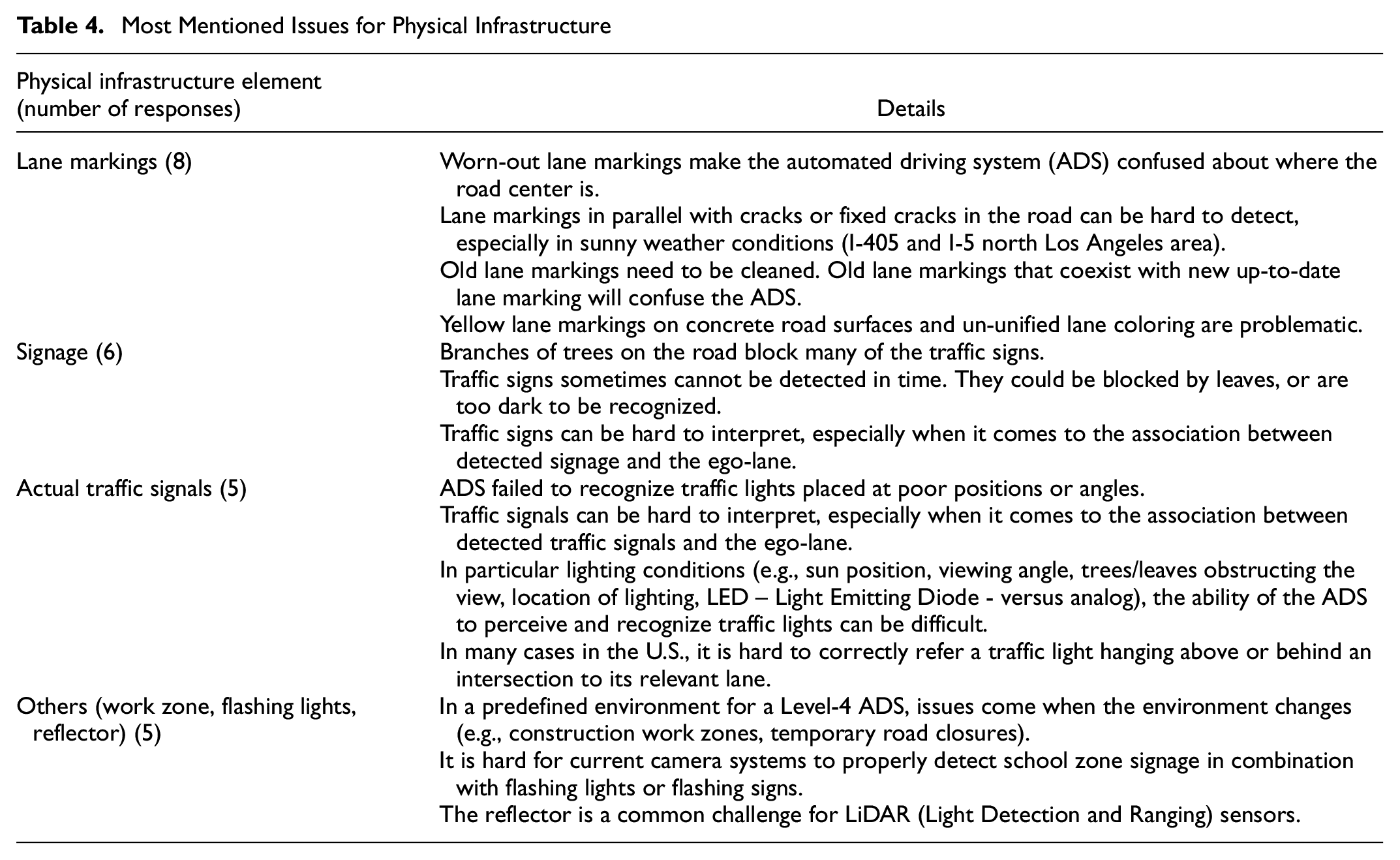
Issues for each physical element are listed in Table 4. For lane markings, the issues include: being worn-out, cracks in parallel with lane markings, co-existence with old markings, low contrast, and un-unified coloring. For signage, three issues were mentioned. One issue is that the signage can be visually obstructed by other objects, such as overgrown tree branches. Another issue is the low contrast. The third issue is difficulty in telling the relationship between certain signage and the AV’s ego-lane; this could be caused by the angle of the signage or the roadway structure.
Similarly, for traffic signals, two issues were mentioned. One is perception of traffic signals under certain lighting conditions (e.g., sun position, viewing angle). The other issue is the relationship between the detected traffic signals and the ego-lane. There are other physical infrastructure issues that were mentioned by a few respondents, such as work zone and temporary road closures, and reflectors. Respondents’ feedback to this question is well aligned with findings from other research ( 2 , 4 ).
In both Question 1 and Question 4, several respondents mentioned flashing lights and flashing signage, which cause perception challenges for cameras because ADS systems interpret individual camera images and may miss the whole message if the light or signage is time varying. For the flashing lights and signage to be identified by the camera system, twice the camera’s frame rate was recommended.
Interview Results
During the interview, one respondent further elaborated on issues of lane boundaries. One is rain marks, as shown in Figure 3a, caused by vehicles driving ahead of the ego-vehicle on the wet road surface or by water-filled ruts. Often these rain lines run along the direction of travel. Rain marks in the image can show a similar contrast to real lane markings in the rain and wet surface conditions, which causes problems. As shown in Figure 3b, stationary vehicles could also be identified as lane boundaries. Another challenge for the camera system is to identify poles when they are tall and thin, as shown in Figure 3c.
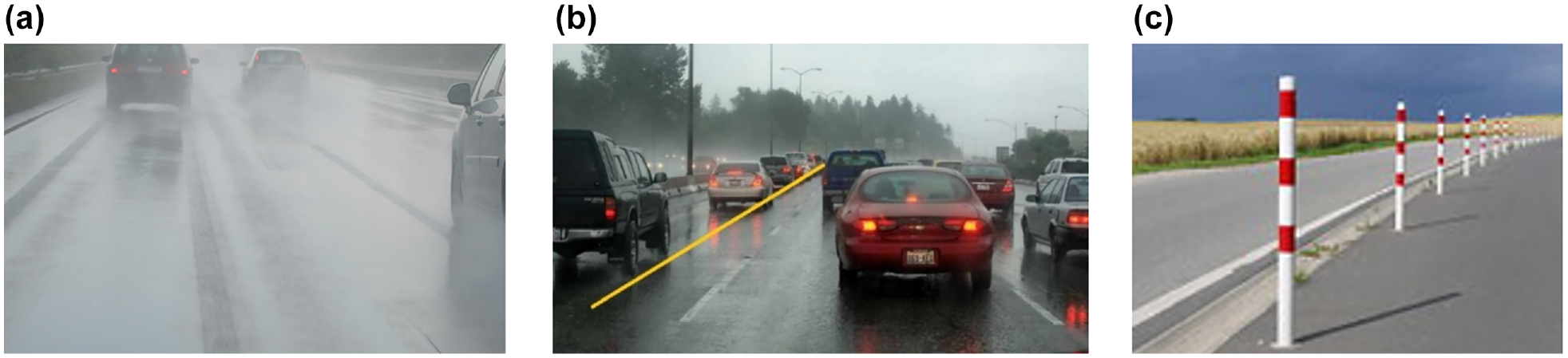
(a) Rain marks, (b) stationary vehicles, and (c) tall, thin poles.
Question 5
“What types of digital features of infrastructure and transportation operations do you believe would help accelerate safe and efficient deployment of the ADS?”
Survey Results
In the survey, 18 (90%) companies responded to this question. Frequency and further explanations for each digital feature are shown in Table 5.
Most Mentioned Digital Features
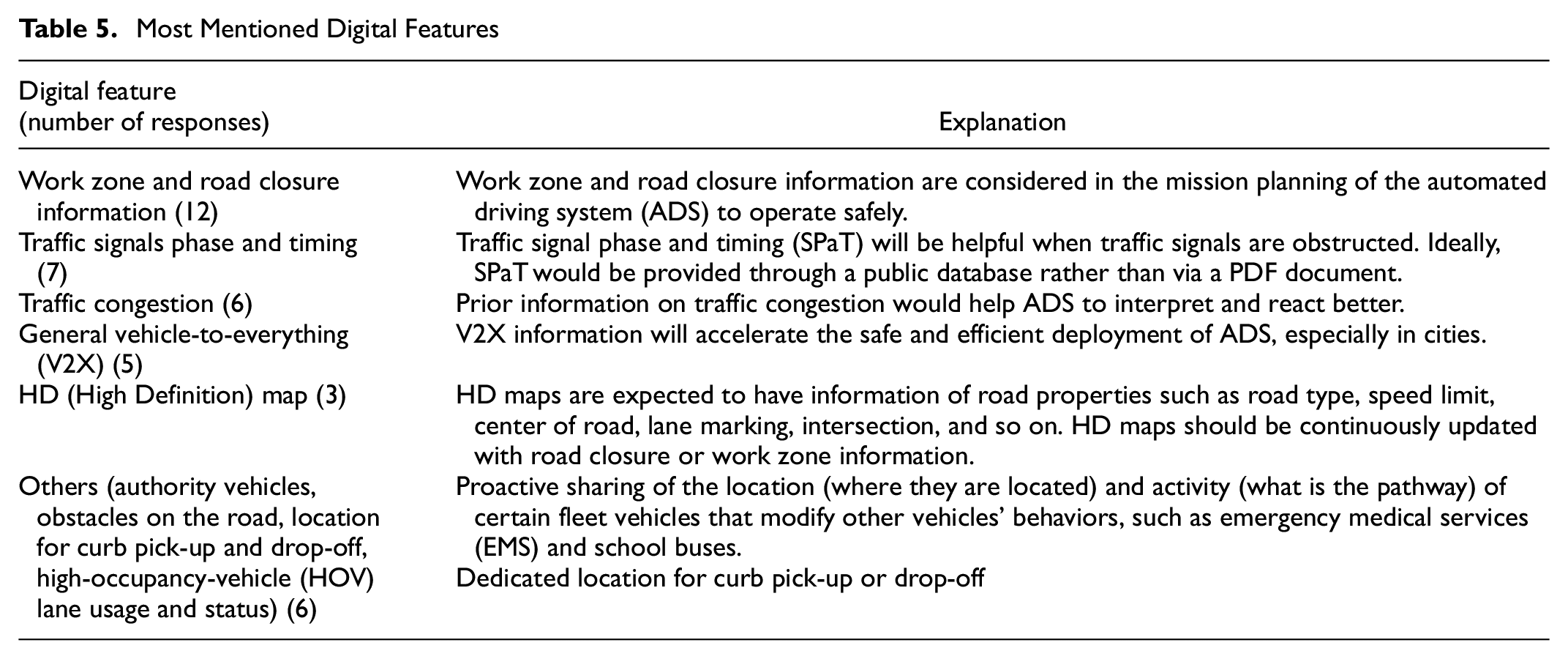
Work zone and road closure information were mentioned by 12 respondents.
Traffic signal phase and timing (SPaT) information is very helpful when the signals are hard to detect, as mentioned by seven respondents.
Traffic congestion information was mentioned by six respondents, as it would help ADS to interpret the environment and react better.
General V2X, including vehicle-to-vehicle (V2V) and vehicle-to-infrastructure (V2I), was mentioned by five respondents.
HD maps are a critical part of making ADS safe, which was mentioned by five respondents. HD maps are expected to have information about the center of the road, lane marking, and intersection information.
Features such as the location for curb pick-up and drop-off and high-occupancy vehicle (HOV) lane usage were mentioned, but less frequently than the other previously mentioned digital features.
Interview Results
Interviewees provided further feedback about the importance of digital features of infrastructure. ADS generally relies on accurate detection of lane markings, signage, and traffic signals to make decisions about its next action. Maintaining up-to-date digital assets that provide information on roadway structure and design is an important aspect of providing information on the existence of specific infrastructure features that ADS can verify with its sensing capabilities. If roadway infrastructure information is stored as the baseline, and dynamic digital information is transmitted either on a periodic or ad hoc basis, it will certainly enhance ADS reliability.
The digital infrastructure needs to be reliable enough to serve as a supplement to avoid having all the sensors and computation power on board the vehicles. Another aspect of digital information is that a little bit information for all situations is more important than much information for only a few situations. As commented by one respondent, as long as there is one traffic signal that does not follow any new initiatives, ADSs will have to cater to traffic signals without digital features.
The HD map was expected to be continuously updated with road closure and work zone information. The HD map is not necessarily shared through V2X. Dynamic elements such as road closure, work zone, or accident information were expected to be timely updated and shared through V2X. Concerning the format of the HD map, respondents commented that a truly open and widely accepted map format is missing.
Question 6
“How would you anticipate receiving such information? For example, through cellular connection onboard or dedicated communication units, such as dedicated short-range communications (DSRC) or dual cellular units (as proposed in Cellular-V2X concepts)?”
Survey Results
As shown in Table 6, 17 (85%) of the respondents answered this question. Most respondents (six, 35.3%) mentioned that all communication channels work, as long as they are available. Four (23.5%) respondents anticipated that cellular technology would be the delivery medium for the foreseeable future. One reason is that cellular connection is already on board many vehicles. Another reason is the lead time needed for rule making, technology development, and deployment for the dedicated communication channels. Another four (23.5%) respondents anticipated receiving such information through the dedicated communication channel, either DSRC or cellular vehicle-to-everything (C-V2X). The rest (three, 17.6%) of the respondents anticipated that C-V2X would win the race with DSRC and that the communication channel will transition to C-V2X in the timeframe of the mid-2020s.
Channel(s) for Receiving Digital Features
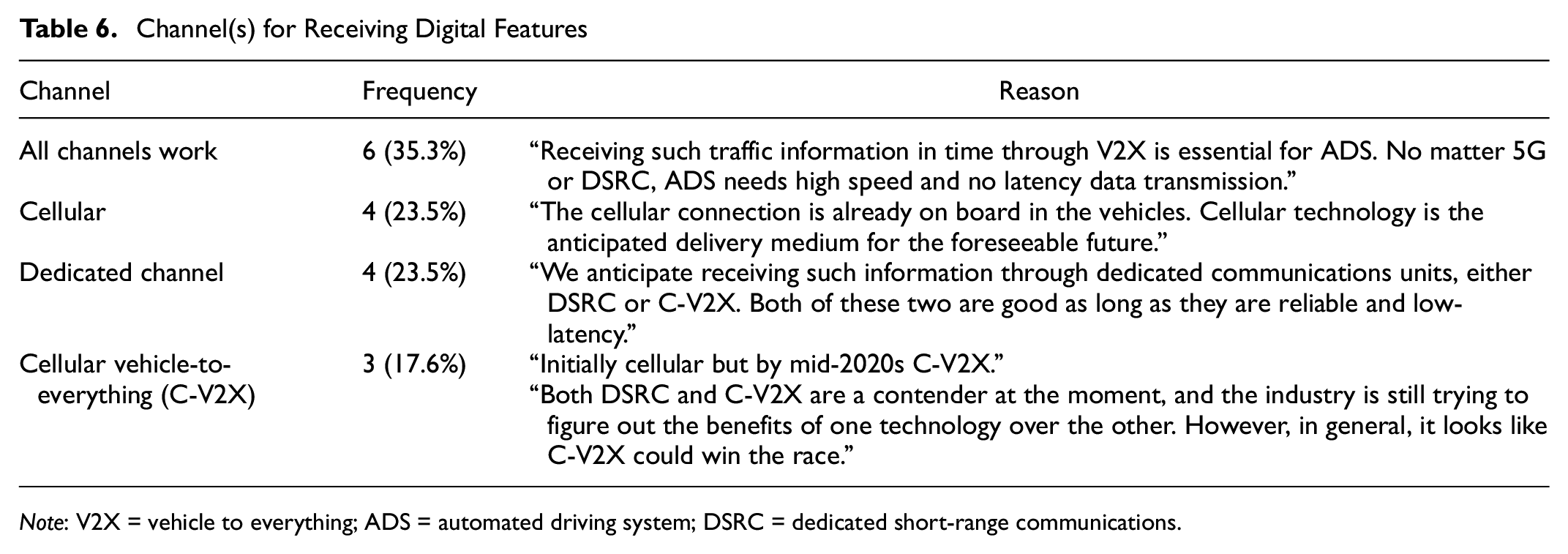
Note: V2X = vehicle to everything; ADS = automated driving system; DSRC = dedicated short-range communications.
Interview Results
During the interview, respondents emphasized that low latency is the critical criterion for V2X applications. When it comes to safety-critical input, it is essential to have more than one communication channel. A dedicated channel plus cellular connection would be a good solution for safety-critical inputs. Another consideration brought up by the respondents is the cost of either channel. The best solution is one that has multiple providers, so that the providers will compete to drive the price down and the quality up.
Question 7
“How do you envision AV deployment in 3, 5, and 10 years? At what levels of automation, per Society of Automotive Engineers (SAE) Level-3 to Level-5?”
Survey Results
In the survey, all 20 (100%) respondents answered this question. The SAE J3016 standard defines six levels of driving automation, from Level-0 (No Driving Automation) to Level-5 (Full Driving Automation) ( 6 ). The results in Table 7 include the timeframe for different levels of automation, frequency of the response, and deployment details.
Automated Vehicle (AV) Deployment in 3, 5, and 10 Years
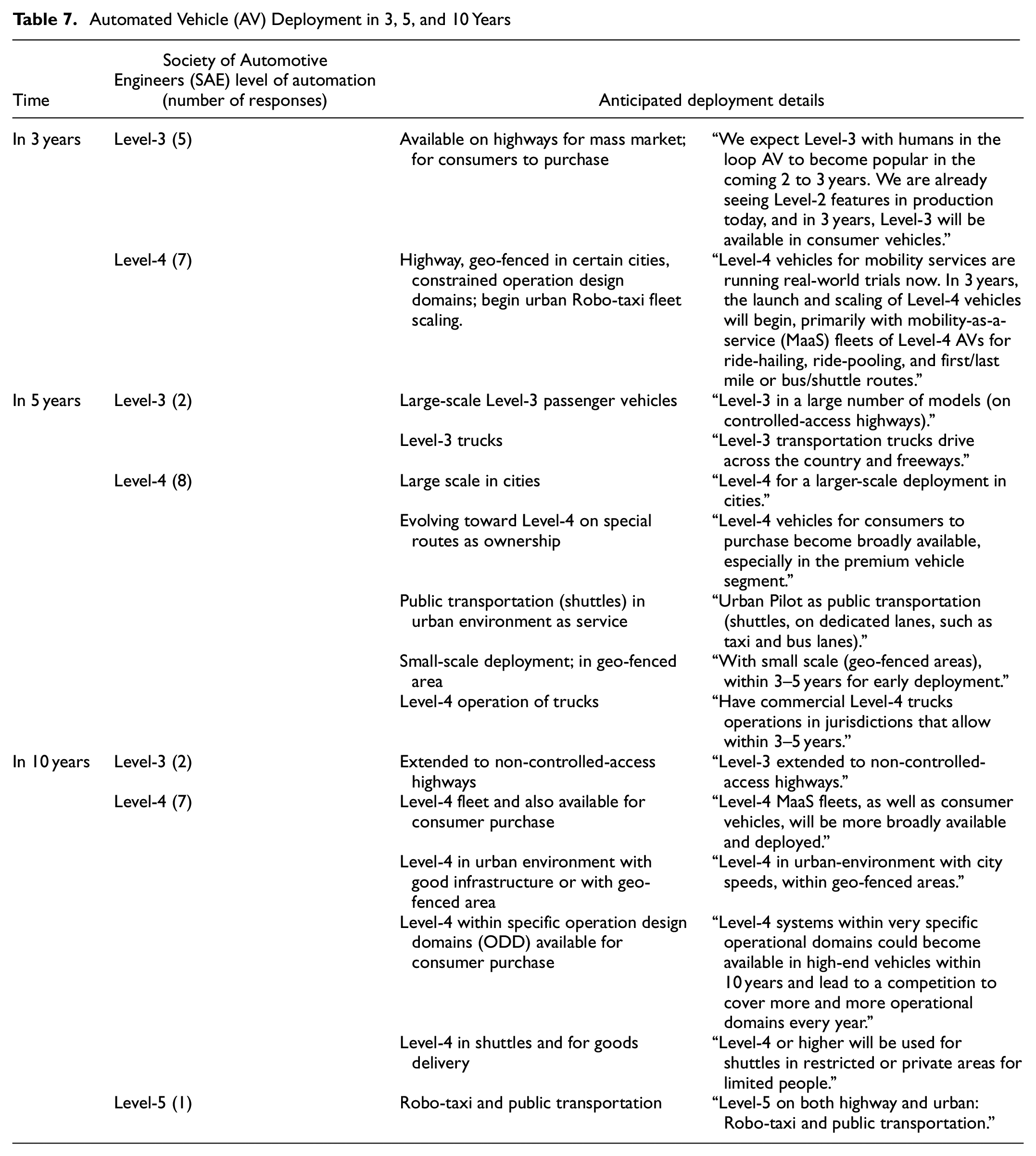
A 3-year timeframe is relatively near from the perspective of vehicle fleet deployment or production. Most respondents have clear pictures of the AV deployment, especially for Level-3 and Level-4 automation. As commented on by five (25%) respondents, Level-3 (Conditional Driving Automation) will be available for consumers to purchase but mainly works in the highway driving environment. According to seven (35%) respondents, Level-4 (High Driving Automation), primarily as mobility service fleets, will begin to scale. However, Level-4 will be limited to constrained operation design domains (ODDs).
Respondents’ predictions about AV deployment in 5 years are less consistent than their predictions for the 3-year timeframe. Two respondents commented on Level-3 in 5 years. For passenger vehicles, Level-3 running on controlled-access highways will be available on many vehicle models for the mass market. Level-3 trucks will be available across the country on controlled-access highways. Eight (40%) respondents commented on Level-4. However, their predicated deployment modes and scale are quite different. The boldest prediction is that Level-4 will have large-scale deployment in the urban driving environment, and will become broadly available for consumers to purchase, mainly in the premium vehicle segment. The rest of the predictions are less optimistic. For passenger vehicles, Level-4 automation is considered likely available either as public transportation or mobility service or in early deployment within ego-fenced areas. For trucks, it is considered that Level-4 automation will be commercially available in certain jurisdictions.
Respondents’ predictions for AV deployment in 10 years are similar to their predictions of AV deployment in 5 years. In total, ten (50%) respondents provided their feedback. Only one respondent commented on Level-5 in 10 years; that is, that Level-5 automation will be available on both highway and urban as Robo-taxi and public transportation.
Interview Results
During the interview, respondents shared more thoughts about what is considered deployment and the operational domains, which makes it possible to better interpret various predications. What is considered deployment? It could be higher-level automation only released in constrained ODDs in certain markets. On the other hand, it could be broadly available everywhere in every market. These two scenarios of deployment mean different levels of technology readiness.
Other than the technology, there is another challenging aspect confronted in different markets: legal liability. The legal liability of car manufacturers in the U.S. is much more challenging than in Europe and other countries. For Level-3 and above automation, when the vehicle is driving itself until the human driver takes over, the AV manufacturer is responsible for whatever happens while the vehicle is in automation mode. This will shift the responsibility for accidents, and therefore liability, from drivers to car manufacturers. This burden on the car manufacturers may be prohibitive of further development. The third challenge is the cost of ADS. Many car manufacturers are working on bringing down the cost and making the system as cost-effective as possible. These two aspects, as well as the technology itself, are going to influence the deployment of ADS.
Another important notion is the operational domain. The freeway-driving environment, although high speed, is an uncomplicated traffic pattern. However, it is rather more complicated with different road users in the urban driving situation than the freeway-driving environment. Nevertheless, some Level-4 automated shuttle is already deployed, for example, in Florida’s retirement community at a lower speed (e.g., less than 25 mph). Thus, the operational domain also matters when talking about AV deployment.
Question 8
“What types of infrastructure policies do you believe the state (California) and local agencies should consider related to the deployment cases identified in the previous question?”
Survey Results
Eighteen (90%) respondents answered this question. The most frequently mentioned policy is the V2X policy. Seven (38.9%) respondents shared the expectation that the state should consider V2X policies, such as equipping traffic signals and providing V2X information. With V2X, many onboard perception and localization tasks can be facilitated, improving the safety and reliability of the technology. Three respondents (16.7%) expected up-to-date digital maps from local agencies. They expected a standard map that defines the automation level availability for considered zones within a city. Here automation level availability means whether the roadway characteristics allow minimum performance for the considered level of automation. For instance, some portions of the city could be Level-3 ready, while some others could be Level-2 ready, or not ready for any automated driving because of no map coverage or lack of detectable lane features.
Physical infrastructure maintenance was the second most frequently mentioned policy, mentioned by four (22.2%) respondents. Firstly, they expected policy support for better maintenance of the physical infrastructure. Secondly, they expected policy support for the maintenance of specific operational routes. Three respondents (16.7%) expected both state and federal policies for dedicated AV lanes on interstate highways, which could foster platooning and increase functional operational domains.
For testing and licensing, two (11.1%) respondents expected the state to support Level-4 testing of commercial fleet trucks over 10,000 lb. Three (16.7%) respondents mentioned other policies such as dedicated pick-up and drop-off locations.
Interview Results
During the interview, respondents provided in-depth feedback on the infrastructure policies. V2X can provide data to inform vehicles better about roadway conditions and traffic conditions. Therefore, they strongly suggested that IOOs across the country focus on V2X policies. Two respondents expressed concerns over the lack of a clear set of rules over AV testing. It is important for the state to develop a consistent approach for effectively engaging entities for AV testing. It would also be important for IOOs to implement uniform policies and procedures that support AV operating across multiple jurisdictions. As a reference, in Europe there is a consistent set of rules that everybody knows. If there are exceptions to that, they can be dealt with on a case-by-case basis. Overall, respondents share the understanding that they expect the infrastructure policies for AV deployment to be rolled out in phases with improvement over time. Meanwhile, technology will work with what is available.
Question 9
“What are the venues for governmental agencies to interact with the industry? Are there commonly accepted industry standards and/or best-practice guidelines related to infrastructure?”
Survey Results
In the survey, 17 (85%) of the respondents answered this question. Concerning venues for governmental agencies to interact with the AV industry, the most mentioned venues are Automated Vehicle Symposium (AVS), Transportation Research Board (TRB) meetings, National Highway Traffic Safety Administration (NHTSA) and FHWA meetings on AVs, SAE AV committees meetings, and consortiums with industry representatives, as well as individual dialogs with authorities.
Concerning commonly accepted industry standards and best-practice guidelines, the Manual on Uniform Traffic Control Devices (MUTCD) was one of the standards for infrastructure. The Federal Communications Commission (FCC) and NHTSA were recommended for industrial standards. Standards organizations like SAE remain the best places to obtain feedback from a broad spectrum of industry players. Another mentioned source of best practice is guidelines issued after pilots in partnership with governmental agencies.
Interview Results
During the interview, respondents agreed that having a venue for engagement between the governmental agencies and the AV industry and having standards or best-practice guidelines related to infrastructure are very important for AV research and development. The use of consortiums to improve industry engagement is encouraged. Respondents explicitly mentioned that there should be more government and industry collaborations happening where safety is concerned.
Question 10
“What data might your company be willing to share that would be beneficial for public agencies?”
Survey Results
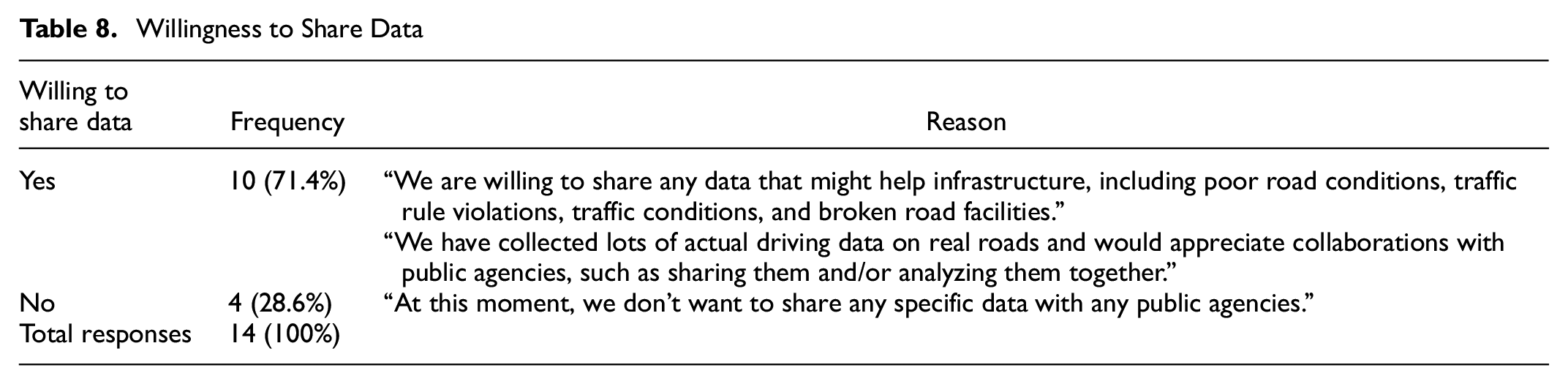
As shown in Table 8, 14 (70%) respondents answered this question. Ten (71.4%) respondents were willing to share data with public agencies. Some of these companies are completely open to data sharing. The other four (28.6%) respondents were not willing to share data because of concerns about revealing their proprietary information and limited resources (e.g., labor, budget), especially for startup AV companies.
Willingness to Share Data
Interview Results
Some respondents shared their further thoughts about the complication of data sharing. The testing data is focused on the performance of ADS but not on the roadway features or measurements. Firstly, there would need to be some agreement on what constitutes a poor roadway. Secondly, AV testing generates a huge amount of data, for example, one terabyte of information per hour of driving. In contrast, a very small fraction of that data would be related to the assessment of road conditions. It raises two challenges for data sharing: how to transfer the information, and how to aggregate it. Thirdly, the data AV companies collect are not stored in a representation that can be reduced to specific ADS roadway conditions. Therefore, there is a need for standardization of what format and what level of information is required. Finally, yet importantly, what human validation or verification would be needed? If humans are needed, which is likely the case, before or after sharing the information, it will definitely require dedicated resources. Some respondents who were willing to share data with public agencies further suggested approaches for engagement between the IOOs and AV companies. The IOOs can interact with the industry by sponsoring workshops or through third-party research organizations.
Discussion
Based on the survey and interview responses to each question, all results of this study are summarized into one diagram, as shown in Figure 4. This diagram includes eight headings, which correspond to most of the survey questions. Based on the responses, the results of Question 1 and Question 2 are combined under one heading, “Most Important Roadway Features.” The results of Question 8 and Question 9 are combined under one heading, “Needed Policy Supports.” This brief summary provides a concise picture of the AV industry’s expectations about roadway features that will benefit AV deployment.
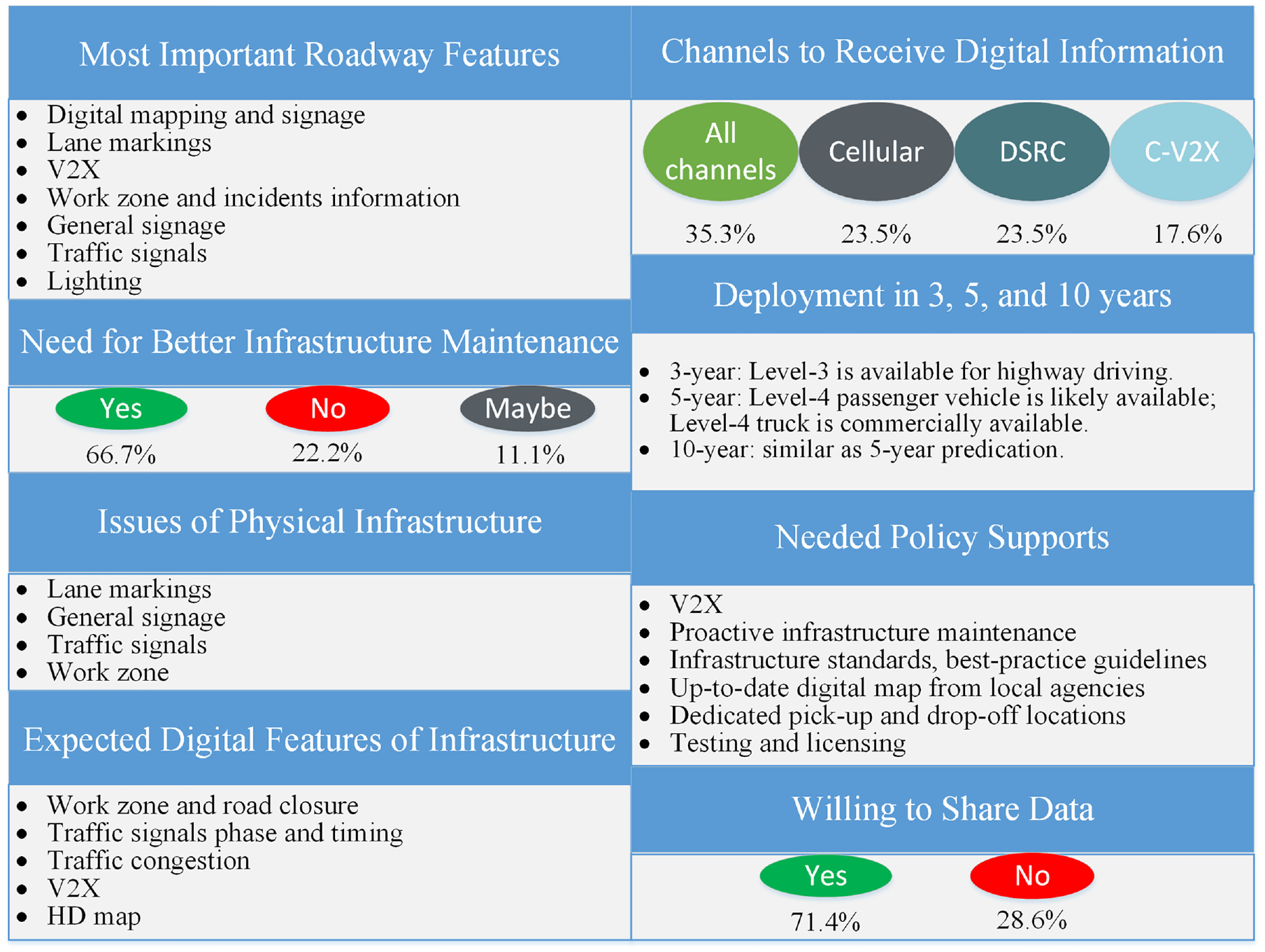
Summary of findings.
In addition to the above summary, the answers across all survey questions are combined, the findings are discussed, and recommendations are provided for the following topics: digital mapping and signage, lane markings, work zone and incidents information, V2X, and infrastructure maintenance, as well as policy support.
Digital Mapping and Signage
Digital mapping and signage were the most frequently mentioned roadway features that the companies believed would benefit the AV deployment. Digital mapping and signage were expected to provide road properties (speed limits, road types) and a well-maintained nationwide database with traffic signs and their positions. Some respondents also expected to have up-to-date digital maps from local agencies, so that the map will be able to define the automation-level availability within a city. Besides, the map was also expected to be continuously updated with infrastructure changes, such as road closure and work zone information, which could be timely updated and shared through V2X.
Concerning the map format, most respondents commented that a truly open and widely accepted map format is currently missing. Only one respondent mentioned ADASIS, an open forum with members from the global vehicle industry manufacturers and suppliers. ADASIS has been working on the HD map standard to improve the performance of automated driving. However, most other respondents were not aware of this forum or their map specifications. On the other hand, several respondents mentioned that many leading companies in the industry have been dedicated to developing their HD maps, which are treated as their core competencies to create an advantage over competitors.
It seems clear that it is not the IOOs’ responsibility to develop digital maps for deploying AVs. Instead, the development of digital maps is a commercial process that will be led by the industry leaders, and the maps will gradually become mature and widely available to other industrial players as the process unfolds. However, it will be very helpful if the IOOs provide certain categories of digital information, including SPaT, and the dynamic information of infrastructure changes (e.g., road closure and work zone information). This cooperation between the AV industry and the IOOs is essential for developing a truly useful digital map. This cooperation will require communication between the two parties about what information is needed, what formats (e.g., accuracy, frequency of update) are expected, and how to transfer the data from the IOOs or provide data access to the AV companies.
It is recommended that, as the first step, the IOOs and local agencies could provide digital information, including SPaT, work zone, and road closure information, and then gradually expand to provide other digital information such as signage. Further, it is recommended that IOOs start with defined zones, where it is manageable to have the digital information provided. As commented by one respondent, a little bit of information for all situations is more important than much information for only a few situations. If the state tries to do everything everywhere, it will not have nearly enough resources, and it is hardly likely to be done with any consistency.
Lane Markings
Lane marking is the most important physical infrastructure that would benefit the safe deployment of AVs. It is expected to be clear with high contrast, non-deteriorated, using a brighter color for markings and a darker color for pavement, and well painted with good visibility at night-time. Besides, lane markings should be standardized relative to the location of the roadway. On the other hand, inconsistent or worn-out lane markings with old lane markings are the most pressing issues in comparison with other physical infrastructure.
It seems that there is no clear guideline or standard about what constitutes good lane markings. The factors of color, width, and contrast all affect the luminance and retroreflectivity of lane markings. Other environmental factors, such as rain, sunlight, and night-time, would also affect the detectability of lane markings by the machine vision systems. Some states have tried to implement contrast markings (e.g., white 4 in. wide marking paralleled by 2 in. wide black striping on each side) for better detection. However, according to Pike et al., the benefit of contrast marking compared with the standardized lane marking is not obvious ( 7 ). Further research is needed to explore the impact of other unknown factors (e.g., sunlight) on detectability, and then standardize the design of lane markings. Then, different jurisdictions can follow the standard for either upgrade or maintenance of the lane markings on their roadways. Otherwise, there will not be any uniformity of lane markings across the state or the country.
Concerning maintenance of lane markings, it could leverage AV testing and deployment. Through the testing and deployment of AVs that are constantly monitoring roadway conditions, there is an opportunity to optimize the repair and maintenance of the lane markings and other roadway conditions. In this way, the observed needs for AV deployment can be addressed faster rather than relying on a traditional maintenance schedule. The leveraging of AV testing and deployment for roadway maintenance will be mutually beneficial to both AV companies and the IOOs. However, it will require good communication between the two parties about what constitutes worn-out lane markings, how to report them to the IOOs, and what actions are expected after the reporting. Beforehand, research is needed to explore the best practices of how to extract the roadway condition information from the AV testing report or AV testing data.
Work Zone and Incidents Information
The work zone and road closure are major inconvenience factors for AVs and the surrounding traffic. In a predefined environment, the work zone, temporary road closures, and incidents will create issues for a Level-4 ADS. AV companies expect the provision of work zone information, including how IOOs display the cones and how they mark the signage in the work zone or incident scenes. To provide timely work zone and incident information to the AVs, firstly, an agreement is needed on what signage will be used for work zones or accident zones, so that AVs have a distinctive symbol to respond to. Secondly, real-time or advanced digital notification of new construction zones, progress on construction zones, completion of construction zones, or road/lane closures are part of the work zone and incidents information, which are expected to be pushed either in real-time or daily emails. Additionally, standardizing access to the work zone and incidents data would greatly benefit ADS providers.
V2X
The AV industry believes that V2X could be used as a data source by ADS. V2X will accelerate ADS deployment in cities. Many AV companies think it will be great when it is well defined and implemented. As predicted, the V2X communications may be ready for application in the 2030s ( 4 ). But for now, it is too uncertain for the companies to count on it. The most expected digital information from V2X are work zone and road closure information, SPaT, and traffic congestion information. For optimal performance of ADS, a redundant path of SPaT from the traffic lights through V2X communications would be helpful. Concerning preferred channels for receiving V2X information, as long as the information is available, the AV companies can use it in various ways. Therefore, it was recommended that the industry and governmental agencies reach an agreement on what V2X technology to use and then start the mass deployment.
Infrastructure Maintenance
The combined feedback from all respondents indicates that the majority of companies expect higher requirements of infrastructure maintenance for ADS than for the current human-driven vehicles. It is different from the findings of an existing publication that the AV industry is optimistic about using sensors and algorithms to solve the challenges of existing physical infrastructure ( 2 ). The rationale is that humans are good at filling in the gaps when infrastructure deteriorates. Some automation systems have a limited perception capability compared with a human driver. The degradation of roadway features will have adverse impacts on ADS availability and performance. In addition, a more proactive approach to maintenance should be taken. In other words, it is necessary to shift from a repair-as-needed approach to a preventative-maintenance approach.
As mentioned earlier, through the testing and deployment of AVs that are constantly monitoring roadway conditions, there is an opportunity to optimize the repair and maintenance of the roadway conditions. In addition, the majority of respondents from this study were willing to share any data that would be useful to increase AV safety. It is valuable for the AV industry to report road damage or other obstructions to public agencies for timely rectification. For doing so, an agreement will be required to prioritize each observation’s severity to make the data more meaningful. There are also various concerns about proprietary information embedded in the data, potential liability issues, or the amount of labor work needed for annotating the data before and after sharing. It would be more helpful if there could be some funding behind these efforts to justify a joint effort. Regardless, it is highly recommended to initiate direct and in-depth conversations between the state agencies and critical industrial stakeholders. It is also recommended to begin the research effort for tools and algorithms that would facilitate data sharing and data processing for this purpose.
Policy Support
Concerning the timeframe for AV deployment, it is forecast that within 3 years, Level-3 automation will be commercially available and mainly work in the highway traffic environment. In the same timeframe, Level-4 automation will start as the MaaS. Although the forecast of deployment in 5 years and 10 years is less consistent, it could be seen that the uncertainties mainly lie in the deployment of Level-4 automation, which ranges between small-scale deployment in geo-fenced locations and large-scale deployment in cities. As to the Level-5 automation, most respondents preferred not to comment on it, which implies that the widespread use of full automation, with no driver attention needed, will reside many years in the future. These uncertainties associated with technological advancement and AV implementation will present a great challenge for policymakers to plan for AV infrastructure needs and support their deployment. However, based on the findings of this study, it is recommended that the following policy areas are considered by the IOOs and agencies for supporting the AV testing and deployment.
There are not yet specifications or standards for roadway characteristics that allow for a minimum performance level. Definitely, this area would need governmental lead and support. In the meantime, several ongoing projects (e.g., National Cooperative Highway Research Program, NCHRP 20-102 project) and initiatives (e.g., FHWA’s Work Zone Data Exchange project) are working toward filling in the gaps. These specifications and standards will be defined in accordance with the considered level of automation. For instance, some portions of an HD map could be Level-3 ready; other portions could be Level-2 ready or not ready at all for automated driving because of no map coverage or lack of detectable lane features on the road. Such standard information is expected to be available and be shared with the AV companies. To achieve this, clarifications must be made on the roadway features that will enable the minimum performance at each automation level.
Concerning policy for dedicated AV lanes, there are different voices. Instead of dedicated lanes, some other respondents suggested defined zones with certain areas, where Robo-taxi service is likely to be deployed first. Within the defined zones, it is manageable to make sure the lanes are properly marked, and roads are well maintained. Therefore, the authors agree that dedicated lanes are not necessarily the choice, but defined zones, or automated zones as mentioned in the literature, would be a better approach for the IOOs and agencies to try out and make changes before large scale deployment ( 2 , 8 ).
Another important area is V2X support. V2X information will surely accelerate the safe and efficient deployment of ADS, especially in cities. It is also clear that it is within the purview of the IOOs to deploy V2X and provide the needed digital features of infrastructure through V2X.
Conclusions
This study reached out to a broad range of members of the AV industry. Based on their feedback in the online survey and the follow-up interviews, it was found that the most important roadway characteristics that will benefit ADS are: (1) digital mapping and signage; (2) lane markings; (3) work zone and incident information; (4) V2X; (5) actual traffic signals; (6) general signage; and (7) lighting. Most companies agreed that the infrastructure would need to be monitored and maintained more stringently if state DOTs want to promote AV deployment on the roadways. The most frequently mentioned physical infrastructure issues are lane markings, signage, and traffic signals. The highly expected digital features to accelerate ADS deployment includes work zone and road closure, SPaT, and traffic congestion information. Concering preferred channels for V2X communications, as long as the information is available, the industry can use it in various ways. Most companies expected that the IOOs should consider equipping traffic signals and providing V2X information. They also expected policy support for better maintenance of the infrastructure’s physical elements and maintenance of specific operational routes. AV development is an incremental process. Concerning ownership of Level-4 or even higher automation, it will be driven by the acceptance of the Level-4 or Level-5 mobility service. Having a venue for engagement between the governmental agencies and the AV industry and having standards or best-practice guidelines related to infrastructure are very important for AV research and development. Concerning data sharing, most companies are willing to share data to improve roadway infrastructure and increase AV safety. The findings of this study provide valuable information for state DOTs’ planning, development, maintenance, and operations of the roadway infrastructure necessary for supporting ADS.
Footnotes
Acknowledgements
The authors want to thank all respondents who offered their valuable input.
Author Contributions
The authors confirm contribution to the paper as follows: study conception and design: P. Wang, B. McKeever, C.-Y. Chan; data collection: P. Wang, C.-Y. Chan; analysis and interpretation of results: P. Wang; draft manuscript preparation: P. Wang, B. McKeever, C.-Y. Chan. All authors reviewed the results and approved the final version of the manuscript.
Declaration of Conflicting Interests
The author(s) declared no potential conflicts of interest with respect to the research, authorship, and/or publication of this article.
Funding
The author(s) disclosed receipt of the following financial support for the research, authorship, and/or publication of this article: California Department of Transportation (Caltrans) sponsored this study.

The contents of this paper reflect the views of the authors, who are responsible for the facts and the accuracy of the data presented here