




Abstract
Policy makers in urban areas are subjected to increasing pressure to find sustainable solutions to congestion and transportation. A detailed understanding of the motivations of car owners is required to enable the development of policies that are both socially fair and take effective measures. The objective of this study is to provide a more granular differentiation of car owners using psychographic profiles in three basic dimensions (privacy, autonomy, and car excitement). These profiles are also examined in relation to general travel behavior in everyday and long-distance travel. Data was collected in Munich and Berlin (Germany) and a latent class analysis was applied to segment respondents into latent profile classes. On this basis, six different profile classes were identified. In addition to the Car Independents profile class which does not have strong orientations toward the car, several profile classes were also identified with high concerns about “privacy” in relation to social distances in public transit. The information and analysis presented enables a deeper understanding of the motivations of the different target profile classes and discusses the need for tailored, socially fair measures to reduce car ownership and use within these groups.
The challenges of traffic congestion and shifting toward more sustainable transport alternatives in urban cities are problems policy makers are struggling to solve. To find ways to better address these challenges, a clearer understanding of the motivations of car owners, as well as detailed analysis on what prevents them from using other modes of transport, is required. The car plays an important role in transport in Germany and is currently experiencing a renaissance because of recent concerns in relation to privacy and safety in public transport. Car ownership varies in urban areas in Germany, even when comparing similar cities ( 1 ). For example, a detailed examination shows these differences between Munich, that has approximately 460 cars per 1,000 inhabitants, and Berlin with approximately 380 cars per 1,000 inhabitants.
One method for explaining differences in relation to car use in cities is to use “segmentation approaches” to identify groups of people with specific characteristics. These approaches have been used by other researchers to identify travel-related segments, such as specific car users (2, 3). By focusing on car users, behavioral differences can be observed, for example, in relation to the frequency of use. Existing studies also reveal the significant role of psychological factors when considering the motivation to use a car. The dependence of people on their cars is not only a result of instrumental mobility needs, but also of underlying attitudes toward the car (4, 5). If people are emotionally attached to their car, for example, because they enjoy driving or the car gives them a feeling of freedom or status, then even people with a low intensity of car use can be attributed a certain dependence on cars. In addition to the emotional attachment, other unobservable aspects of car dependence also need to be considered. If people have an “autonomy” mindset, which means they consider the car to be relevant for their mobility, they are unlikely to switch from car to other transport modes. The recent global pandemic must be taken into account as well, since it has resulted in car use being more positively associated with safety and privacy during travel. If people feel uncomfortable in public transit because other passengers do not respect social distances, this can have a reinforcing effect on cars as the preferred mode of transport ( 6 ).
Since individuals derive benefits from the use of their cars that they do not derive from public transit, a greater understanding of these benefits is needed to identify more efficient strategies to influence car owners to change from private car use to more sustainable urban transport solutions. Individual attitudes and perceptions need to be carefully considered to broaden the general understanding of car use. The added value of this deeper and more complete analysis is particularly relevant for policy makers to develop targeted and more effective measures to influence behavior. Once specific groups are identified, it is possible to assess potential reactions to various policy restrictions, support measures or marketing strategies, and develop appropriate and expedient approaches.
To support this analysis and understanding, this study addresses the following key research questions: How can differentiations be made between car users based on their psychographic profiles? What prevents car users from considering other means of transport, such as public transit, as their mode of choice? These questions are approached methodically by applying latent class analysis (LCA), where dependencies between observable variables, for example, attitudes toward cars, are attempted to be explained by unobservable underlying classes ( 7 ).
The paper is structured as follows: First, the current research literature on car dependence and segmentation approaches is reviewed. Second, the data collection and the study sample approach are described. Third, the methodology is presented, with the selection of appropriate psychological variables as indicators in the LCA for predicting class membership. The resulting latent classes are then described, interpreted and compared. This is followed by a discussion of the results and a conclusion with references to further work.
Literature Review
The literature review is divided into two sections: an analysis of the existing research on psychological and behavioral aspects of car dependence, followed by a discussion of different methods used for segmentation in travel behavior research.
Car Dependence and Motives for Car Use
Characteristics such as flexibility, independence, availability, and comfort are commonly associated with cars. However, in dense urban areas, other alternatives, such as bicycles, also offer similar characteristics for everyday travel. Therefore, additional motives for car use must play a decisive role in the decision of mode choice in everyday travel.
When examining people’s car use, the concept of car dependence immediately comes into focus. In the literature, the term “car dependence” is used to describe a broad spectrum of dependencies and behavior in relation to car use from different perspectives (8, 9). Mattioli et al. distinguish car dependence on three levels (macro, meso, and micro) ( 10 ). They state that the “micro” perspective is most commonly used for travel behavior research. This level considers subjective aspects of “pro-car” attitudes, which motivate individuals to choose cars independently of the availability of other transport modes. Numerous studies investigating the psychology of individuals and its relation to car dependence exist (2, 3, 11). As this field of research has gained significance in recent years, assumptions around the instrumental, affective, and symbolic value of cars as motives for their use has become more widespread (4, 6, 12, 13).
In addition to these well-known motives, other investigations continue to expand the understanding of underlying motivations for car use. Von Behren et al. identify privacy and autonomy to be relevant aspects determining people’s choice of the car over other modes ( 6 ). Other studies confirm privacy as a relevant motivator for car use (5, 11, 14, 15). Beirao and Cabral provide further qualitative evidence of this through survey interviews ( 5 ). Ellaway et al. found that people both with and without car access agreed to the importance of privacy in car use (79% and 60%, respectively), and denied the existence of privacy in public transit ( 15 ). Hunecke et al. used a factor analysis to derive factors including car privacy and public transportation autonomy ( 11 ). In other studies, the meaning of autonomy was often linked to “car dependence,” which has been considered an important aspect for car use (2, 5). For some people, the car is essential because they do not consider any other modes of transport as suitable for their lifestyle and mobility needs. Hunecke et al. mention that all symbolic-affective evaluations of transport modes can finally be reduced to privacy, autonomy, and excitement, except for status ( 16 ). In contrast to existing literature, this study presents the simultaneous implementation of these three dimensions to define target groups among car owners.
Market Segmentation in Travel Behavior
Segmentation approaches are a widely recognized instrument in marketing and research to define meaningful sub-groups of individuals. In the existing literature, a multitude of segmentation studies in travel behavior research are available (2, 11, 14, 17). A detailed summary and review of segmentation methods is given by Wedel and Kamakura ( 7 ). Recently, exploratory procedures (post hoc) have been applied to identify the number of clusters and assign persons to them using multivariate statistical methods. The structuring of data into segments is driven by the data itself and therefore characterizes this method as “predictive.”
There is also evidence that systematic statistical segmentation techniques using theoretically derived attitudinal and psychographic variables are an appropriate way to understand natural behavior (2, 11, 18). Especially with respect to car use, the use of an attitude-based segmentation approach delivers higher predictive power ( 18 ).
In relation to the car dependence of car owners, it is worth highlighting a few existing approaches to segmentation. Based on an a priori approach, von Behren et al. evaluated car ownership in cities, considering both subjective and objective dependence, and determined five different types of car-dependent people ( 3 ). A limitation of this approach was the a priori number of segments defined by the authors. Anable considered an extensive set of psychological items for her cluster analysis and identified homogeneous attitudinal groups of car users and non-car users ( 2 ). Hunecke et al. and Götz et al. built cluster analyses solely using psychological factors; however, the latter identified two disadvantages with their methodology (11, 19). Firstly, the studies considered people without cars and included many clusters, so that the car clusters offered little differentiation among car owners, and, secondly, the deterministic approach of traditional cluster analyses neglects that people might also fit into multiple groups to a differing extent.
In contrast, LCA, which applies probability-based classification, is advantageous against deterministic clustering, as the choice of cluster assignment is based on statistical tests ( 20 ). By applying this LCA approach, misclassification bias can also be reduced. Another argument in favor of LCA is the possibility of using statistical criteria to determine the optimal number of clusters. Furthermore, the significance of different parameters in the model can be assessed ( 21 ). LCA can be used to identify latent groups in the population given a sample of responses to observed categorical variables ( 22 ). LCA is a widely accepted tool for travel behavior research and was used in an increasing number of studies in recent years (21, 23–26). For this study, it is a suitable method to examine car owners with respect to their underlying motivations for car use and to segment them into psychographic profiles. The strong focus on car owners with car use on a regular basis sets this study apart from existing studies and aims to increase the understanding of differences between types of car owners in dense urban areas.
Data Collection and Study Sample
In this study, the concept “travel skeleton” provided the framework for data collection in Berlin and Munich. This concept is a less time-consuming approach compared with longitudinal travel diaries, which are commonly used in national household travel surveys. These traditional trip diary surveys are expensive and increase the respondent burden of the participants, as individual trips and their characteristics (distance or duration) need to be recorded in great detail. This limits the potential inclusion of long-distance travel and attitudinal questions into such studies. However, precisely these aspects are relevant for understanding car use and ownership. To create a cost-effective survey alternative, the new approach of a “travel skeleton” focuses only on typical elements of everyday travel. This is achieved by questioning the respondents about their individual travel behavior with regard to relevant activities in a “typical” week (e.g., work, leisure, chauffeuring, errands, and shopping) and their mode choice. The approach reduces the respondent burden and allows the consideration of long-distance travel and attitudes through a standardized psychological item set (11). As a result, this novel concept provides an alternative to trip diaries for certain study applications, providing a reasonable level of detail for comparatively low effort. For a more comprehensive description of the approach, reference is made to existing studies (3, 6, 17).
As part of this study, the “travel skeleton” approach was applied, using face-to-face interviews (computer-assisted personal interview [CAPI]) in Berlin between October 2016 and January 2017 (17). A professional market research company conducted surveys using an access panel with telephone screening and on-street recruitment (e.g., shopping center). In Munich, a web-based survey (computer-assisted web interview [CAWI]) was applied using an online access panel in January and February 2020. After combining the data, controlling for missing values, and selecting persons who match the study criteria of “owning at least one car in their household” and “using a car at least several times per month,” a sample of 600 respondents remained, consisting of the subsamples Munich (n = 364) and Berlin (n = 236). Figure 1 gives an overview of the sociodemographics of the final sample and clearly shows that the two samples from Berlin and Munich are comparable. However, it becomes apparent that regular car users in Berlin tend to be of higher age. In both cities, at least 65% of people have unrestricted access to their cars. In addition, less than 28% of the participants live in areas with low population density (less than 7,000 people per km2).
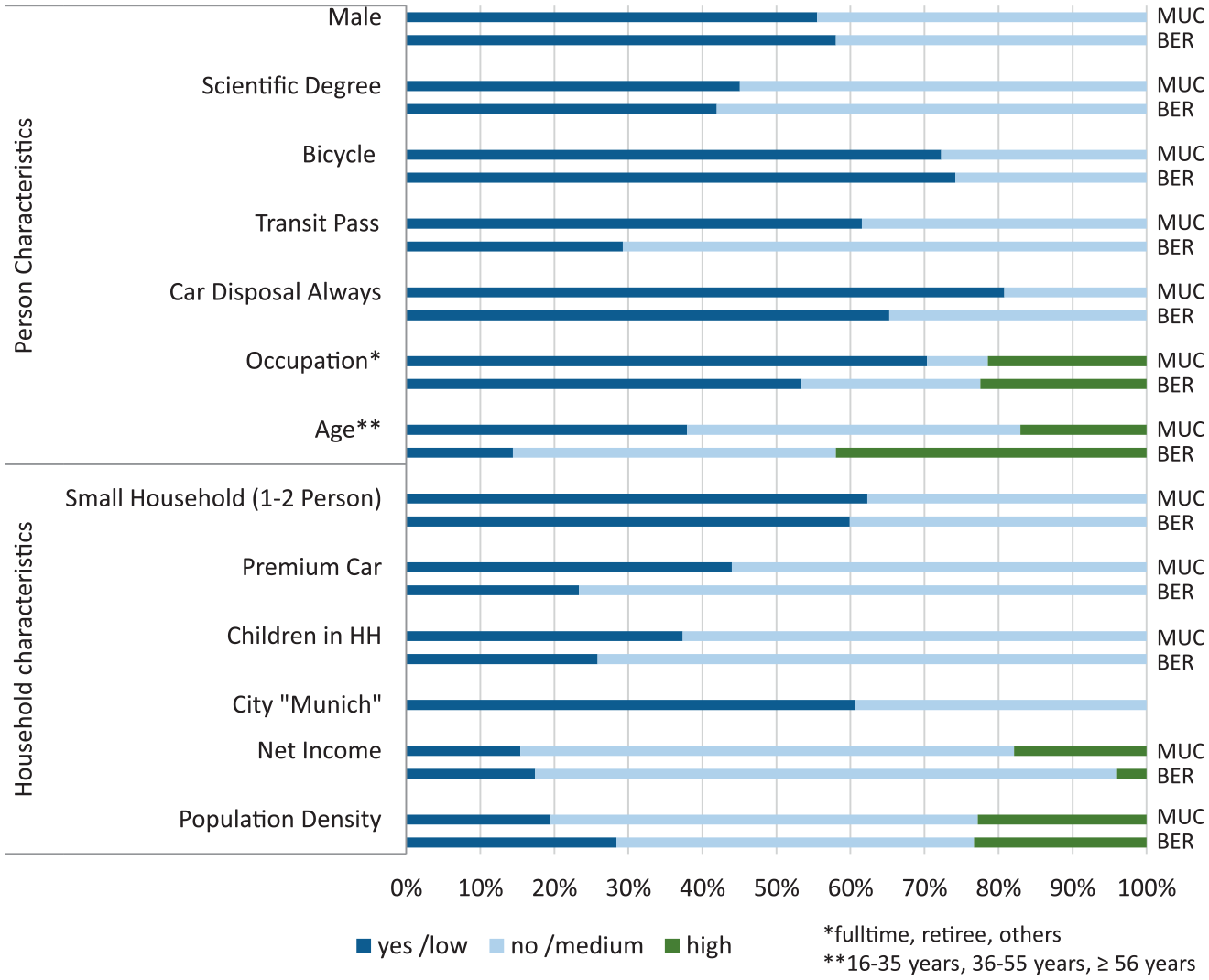
Characteristics of the used sample from Berlin (BER) and Munich (MUC).
Methodology
In this section, the study methodology is described by first explaining the attitudinal data selected to develop car owner profiles, and second, by introducing the segmentation approach to classify respondents into different profiles.
Defining Psychographic Profiles of Car Users
To define psychographic profiles for frequent car users in Berlin and Munich, integrated attitudinal items from Hunecke et al. were used (11, 16). The items on intrapersonal evaluation of travel mode use derived from the Theory of Planned Behavior and further mobility-related attitudinal dimensions (11, 27). Using this item set, three basic dimensions were selected as indicators in the model. First, profiles should represent “autonomy,” which may be indicated by car use as opposed to public transit. Second, they should reflect the “excitement” of using a car. Both dimensions are also used in the definition of subjective car dependence from von Behren et al. ( 3 ). Finally, they should take into account a preference for “privacy.” This aspect is intended to examine the impact of how people feel when other people get too close to them in public transit in an unpleasant manner.
The item set used in the survey also comprises environmental attitudes including the ecological norms and the intention to use public transit. These items were not used for class formation but for class description (see Figure 2). The questioning of attitudes toward environmental issues may be influenced by bias because of social desirability and time-related differences in attitudes between the surveys in 2017 and 2020.
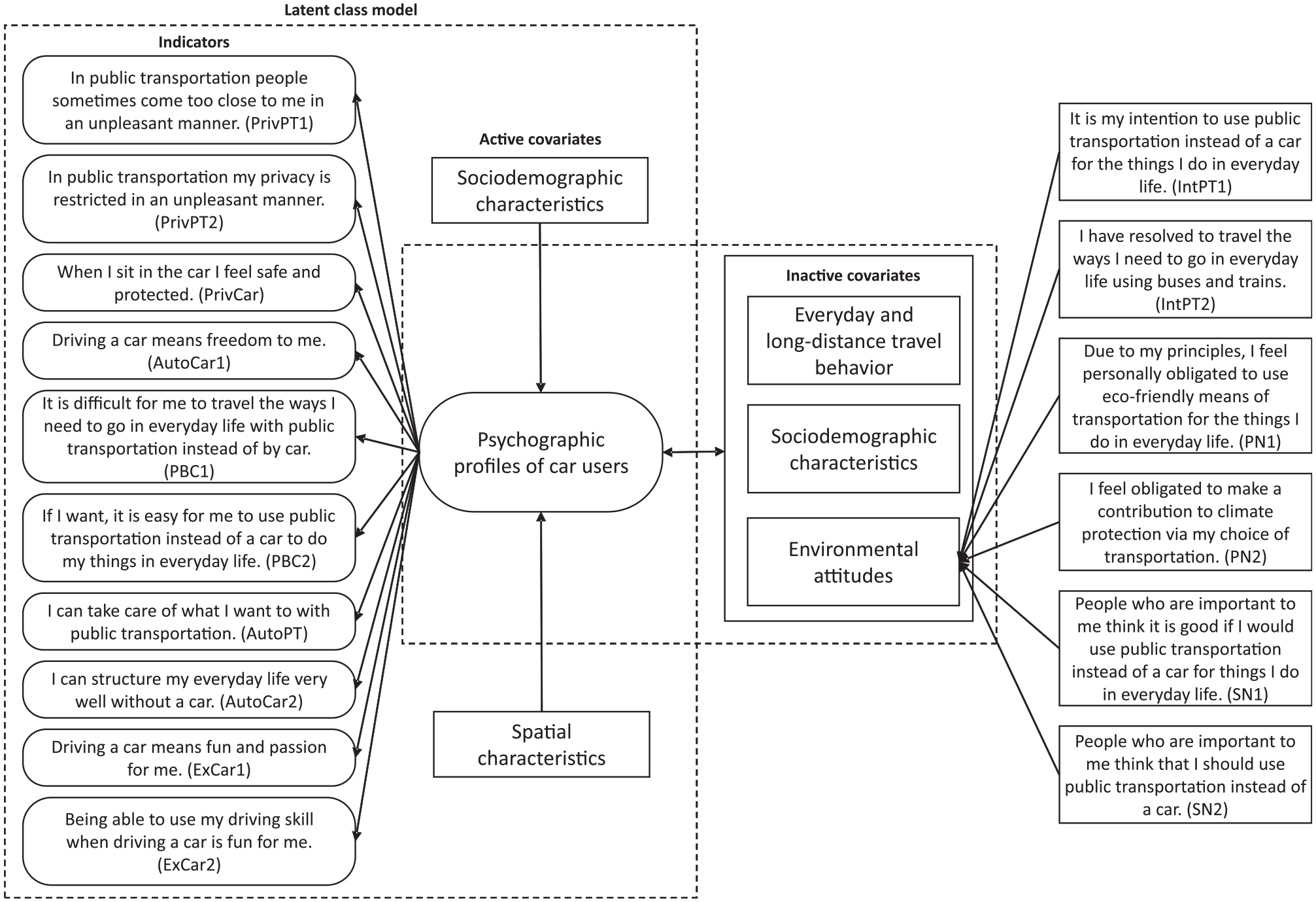
Research methodology for psychographic profiles of car owners.
Following this approach, 10 items were used to define the psychographic profiles of car users in Berlin and Munich: autonomy of car (AutoCar1, AutoCar2) and public transit (AutoPT); perceived behavioral control (PBC1, PBC2); privacy in car (PrivCar) and public transit (PrivPT1, PrivPT2); and car excitement (ExCar1, ExCar2) (see Figure 2). Dichotomous indicators of each item were created for the analysis: coded one if they “rather agree” or “agree” to the statement and null if they do not. This follows a similar approach as used by Rhead et al. in their study of environmental attitudes to identify latent classes ( 26 ).
Classifying Psychographic Profiles of Car Users
In this study, psychographic profiles of car users are analyzed by applying LCA. With this technique, it is possible to assign respondents to latent classes on a probabilistic basis. In the LCA model the class membership probabilities and the indicator-response probabilities are estimated ( 28 ). In this measurement model the latent classes explain the association between the indicators. In addition to the measurement model, each respondent possesses a probability to be in each latent class. This is based on the individual characteristics, such as age or gender. To reflect this, an extension of the model is required. The characteristics are considered by active covariates in the structural model of the LCA, which predict class membership. An important requirement of active covariates is that they are not endogenous to the indicators ( 21 ). In this approach, inactive covariates were also used in relation to travel behavior, sociodemographic characteristics, and environmental attitudes (see Figure 2). These were not included in the model for the estimation of membership probabilities but supply valuable information for understanding the resulting classes.
In general, there is no formal criterion for the minimum sample size for conducting LCA. However, a sample size of at least 500 respondents is determined to be sufficient in applied research, which the data set used in this study exceeds ( 29 ). A critical analysis step was the selection of the optimal number of classes based on statistical criteria which is explained in detail in the following section. After the determination of the optimal number of classes and the integration of active covariates, both parts of the model (measurement and structural model) were estimated simultaneously. For the estimation of LCA, the Software SAS with the procedure PROC LCA from Lanza et al. was used ( 28 ). The parameters were estimated by maximum likelihood estimation using an expectation-maximization type procedure ( 28 ). In the final model, the best combination of covariates was selected through the assessment of the log-likelihood improvement.
Results
In the following section, first, the class enumeration of the LCA is explained. Second, the results of received latent classes are described and discussed, including interpretation of the active covariates. Finally, the relationship between the latent psychographic profiles and the travel behavior of the respondents is analyzed.
Model Selection
The most challenging part of LCA is the identification of the optimal number of classes ( 20 ). Fit indices were used to allow a comparison of different LCA models and help identify an appropriate number of classes in the data.
The “measurement” part of the model was initially estimated based on the indicators. Starting with a 1-class LCA model, which served as a comparative baseline, the number of classes was increased to meet a 10-class LCA model. In addition, different fit indices (see Table 1) recommended by the literature were included as selection criteria. To compare models and determine the optimal cluster number, the following commonly used fit indices for LCA were applied: Akaike information criterion (AIC) and Bayesian information criterion (BIC) ( 22 ). With both indices, the most suitable model has the lowest AIC or BIC value (21, 22). The likelihood-ratio chi-square statistic, denoted G2, expresses the correspondence between the observed and predicted response patterns. Further, entropy can be used to evaluate the quality of the classification. Values above 0.8 indicate a good classification ( 22 ). In relation to minimum class size Ton et al. recommend a class size of at least 8% ( 21 ). In addition, classes with less than 5% are not appropriated for analysis ( 20 ).
Evaluation Criteria for Determining the Number of Classes of the Latent Class Analysis
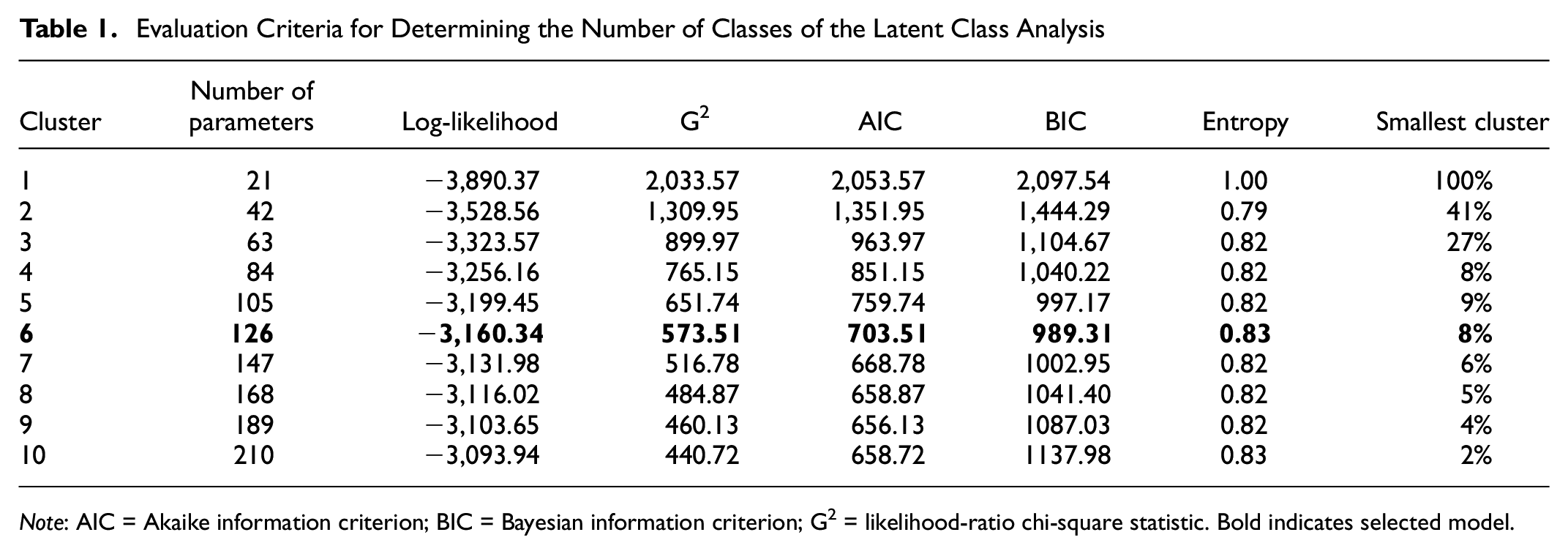
Note: AIC = Akaike information criterion; BIC = Bayesian information criterion; G2; = likelihood-ratio chi-square statistic. Bold indicates selected model.
Based on the fit indices and a content-related analysis of the obtained classes, a six-class model was selected. This six-class model has the lowest BIC value and a good classification with an entropy of 0.83. AIC keeps decreasing with the increase in the number of classes and G2 is higher than the degree of freedoms. These indices do not help to select the optimal number of classes. Models with more than six classes contain very small classes with less than 8% of the respondents.
Latent Psychographic Profiles of Car Owners
The six-class model was expanded by including a combination of seven suitable active covariates, which are exogenous to the indicators (see Table 2). These covariates include sociodemographic and spatial characteristics. This increased the log-likelihood value by 22%. After intensive analysis of profiling, each class was given a name to represent its unique set of characteristics.
Parameters of the Latent Class Analysis Model with Six Classes for Psychographic Profiles of Car Users
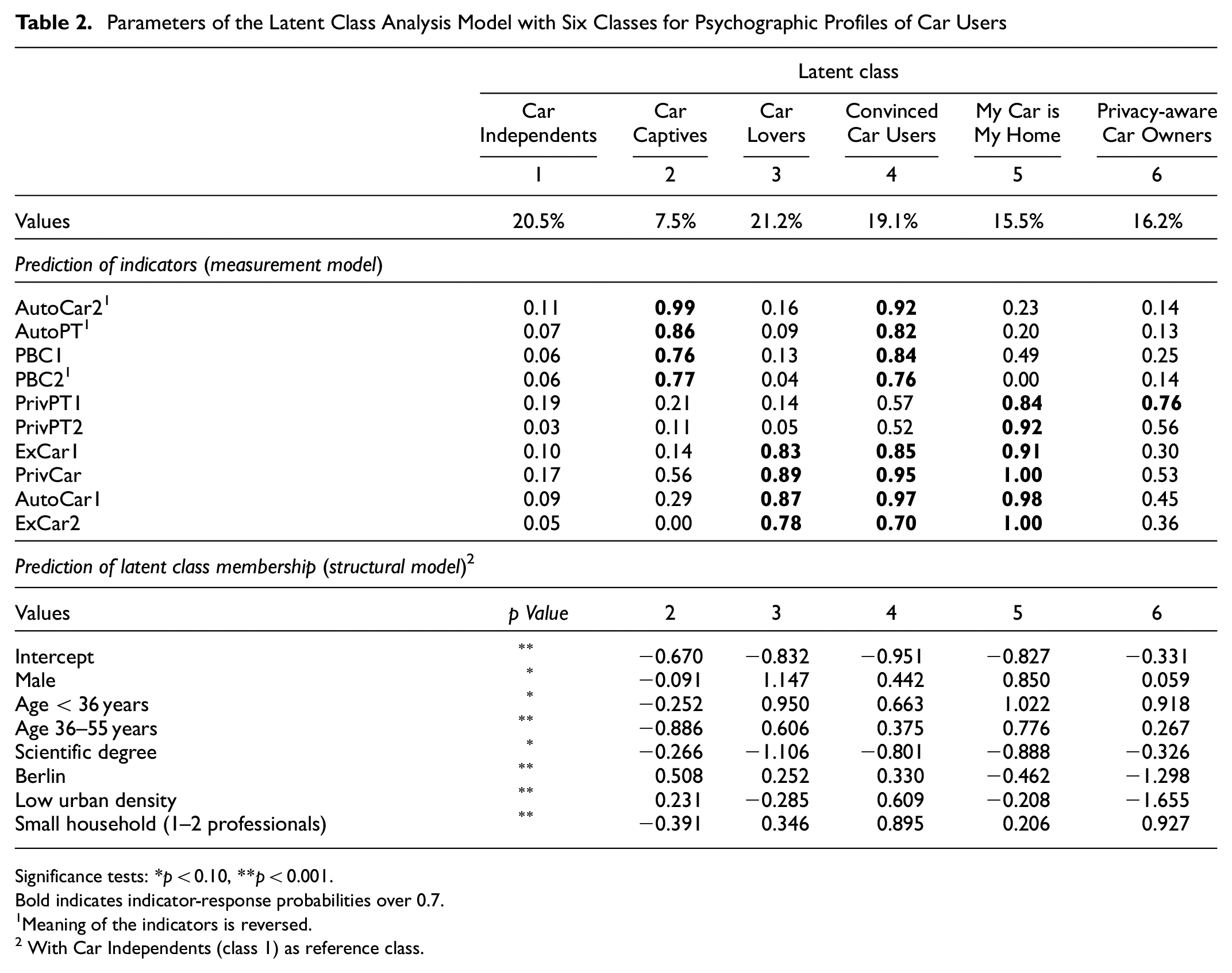
Significance tests: *p < 0.10, **p < 0.001.Bold indicates indicator-response probabilities over 0.7.
Meaning of the indicators is reversed.2 With Car Independents (class 1) as reference class.
Class 1—Car Independents are a large class with a share of 20.5% of all respondents. They do not agree to the statements of the indicators. Consequently, their frequent car use is independent of basic dimensions such as excitement, autonomy, or privacy.
Class 2—Car Captives are strongly dominated by “autonomy,” which can be identified through the high probability of agreement to PBC1, PBC2, AutoPT, and AutoCar2. People in this comparatively small class (7.5%) perceive the need for a car to manage their everyday life.
Class 3—Car Lovers love to drive a car. In their view, they do not need a car for everyday travel as the probabilities related to autonomy are low. For this group the affective motive (ExCar1, PrivCar, AutoCar1, ExCar2) is rather in the foreground as they are only interested in the driving pleasure. They clearly separate themselves from the first two classes and represent largest class with 21.2%.
Class 4—Convinced Car Users have a very strong combination between both autonomy and excitement. They regard the car as relevant for their everyday life and additionally like to drive.
Class 5—My Car is My Home class differs from the Convinced Car Users, as they do not see a need for the car for everyday travel. Instead, their orientation toward the car is strongly influenced by excitement and privacy (PrivPT1, PrivPT2). They like to drive and appreciate privacy.
Class 6—Privacy-aware Car Owners class are people with only privacy motivators.
The second part of the results is the presentation of the active covariates, which have an influence on the latent classes as exogenous factors (see Table 2). The active covariates in the structural model describe how well each class fits people with the defined characteristics. The intercept reflects the general fit of the population for a class.
Class 1 is the reference class for the interpretation of the covariates. The negative intercept shows that, in general, the probability of being in classes other than Class 1 (Car Independents) is lower. Men are much more likely to be in classes 3, 4, or 5, which are characterized by high probability of car excitement. A more unexpected result can be seen in relation to the age groups: people under 36 have a higher probability to be in classes 3–6. This shows that a generally positive attitude toward the car is found among young adults in both cities.
Besides individual characteristics, spatial structure was also considered which reflects the different motorization rates of the two cities. People from Berlin have a higher probability of being in classes 2, 3, or 4. This indicates that “privacy” in public transit use does not play such a decisive role for people from Berlin. Class 6 Privacy-aware Car Owners tend to come from Munich, as well as Class 5 My Car is My Home members. The latter show strong presence in Munich with a strong orientation toward cars which may partly explain the high motorization rate in Munich. However, it is interesting to note that Class 3 Car Lovers are more likely to be found in Berlin.
Population density also shows a significant influence on car use profiles. People from less dense areas are more likely to be Class 4 Convinced Car Users. Whereby Class 3 Car Lovers and Class 5 My Car is My Home members are more likely to occur in dense urban areas. This may be because of the “pro-car” attitude needed for people in these environments to overcome the difficulties of car ownership, for example, because of parking challenges.
Descriptive Analysis of the Latent Psychographic Profiles
In addition to active covariates, this study also considered inactive covariates. For this purpose, details of everyday and long-distance travel activities of the respondents were recorded. This section highlights the most important characteristics of the psychographic profiles (marked in bold in Table 3). Implications for policy makers are outlined in the discussion section.
Inactive Covariates of the Latent Classes
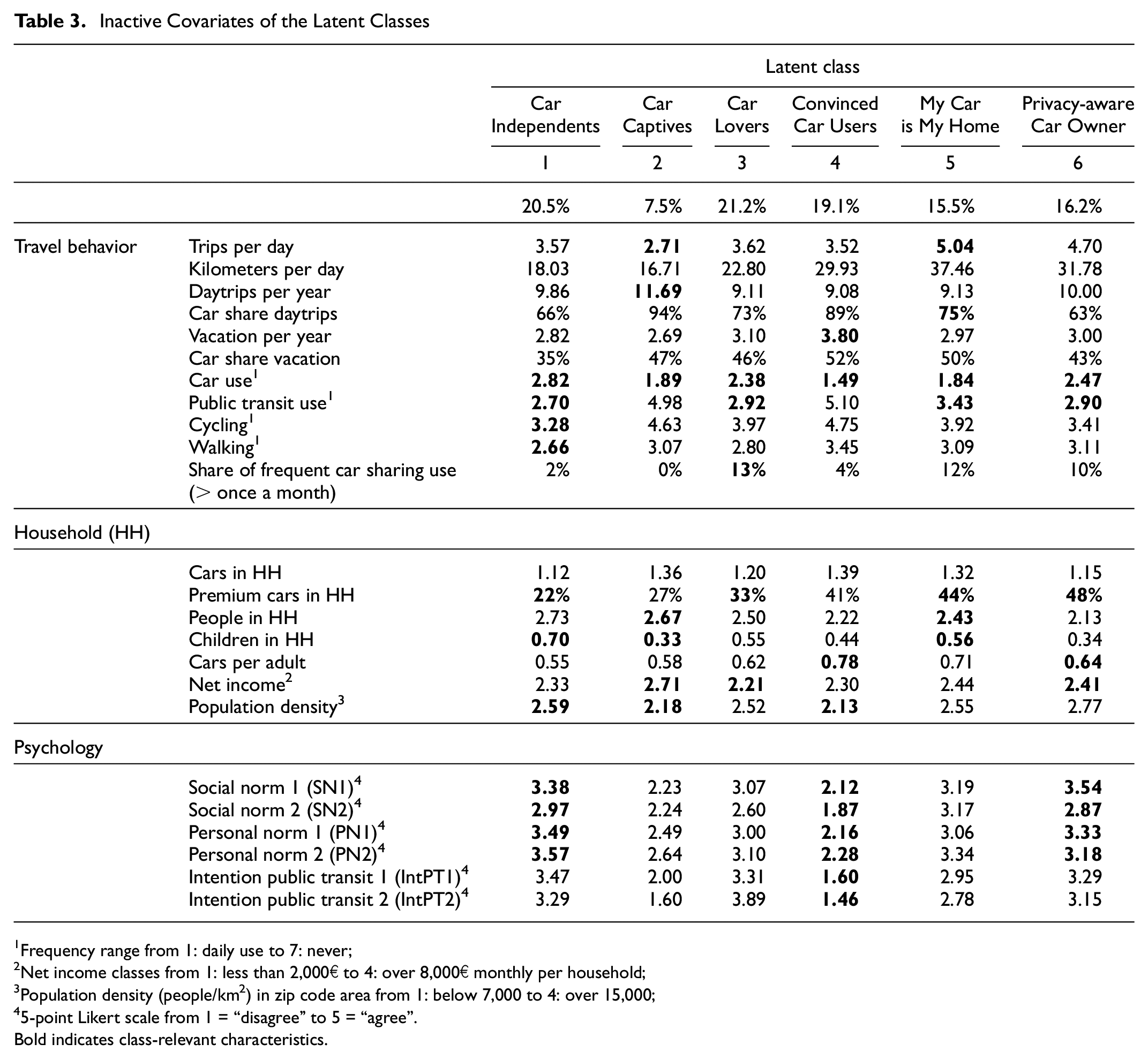
Frequency range from 1: daily use to 7: never;
Net income classes from 1: less than 2,000€ to 4: over 8,000€ monthly per household;
Population density (people/km2) in zip code area from 1: below 7,000 to 4: over 15,000;
5-point Likert scale from 1 = “disagree” to 5 = “agree”.Bold indicates class-relevant characteristics.
Class 1 Car Independents have children and mainly live in the city center and therefore do not need a car for general transport. Their share of transportation is balanced and they have a strong ecological norm. Class 2 Car Captives live on the outskirts of the city in large households with a high income and fewer children under 18 years. In general they make the least number of trips per day, but those are generally made by car, and they have the most daytrips with car use. Class 3 Car Lovers have a low average net income. This explains why they own few premium cars. In everyday life they use not only their private car but also public transit or car sharing. This is confirmed by the high intention of public transit use. Class 4 Convinced Car Users have the most cars per adult. They live on the outskirts of the city and conduct almost all trips by car. They make the most vacation trips per year, have a low ecological norm, and low intention to use public transit. Class 5 My Car is My Home people are highly mobile with regularly car use with a high share of premium cars. This class consists of young families who go on many daytrips with their car but few holiday trips. Class 6 Privacy-aware Car Owners combine car and public transit use in their everyday travel. The ownership of premium cars is prevalent in this class, also because of the high per capita income. This class shows a strong ecological norm despite high premium car ownership.
Discussion
In this section, the latent profiles are summarized and the implications for transport planners and policy makers are discussed.
Class 1 Car Independents show the lowest orientation to their cars. Living in the city center, where mobility alternatives to the car exist, the car is considered a fallback option to ensure mobility. Their high ecological norm explains why these car owners do not agree to the statements of the three basic dimensions and why they use their car less frequently. Also, their multimodal travel behavior demonstrates their independence from cars. Being highly educated, they might question their behavior and choose the most suitable mobility options in their everyday travel. Their desire to choose environmentally friendly transport modes in everyday life can be supported by marketing strategies which positively promote a car-free lifestyle. In this context pilot projects such as “Neue Mobilität Berlin” with their implemented “summer fleet” have already been launched and address the consumption of space as one of the main externalities of car use in cities ( 30 ).
On the contrary, Class 2 Car Captives are highly dependent on the car which is proved by both their psychographic profile and their travel behavior. In the existing literature, this group is also found in other cities ( 3 ). They might not be able to use other transport modes and are annoyed by their obligation to use the car in their everyday life because of congestion or poor parking situations. This is shown in their non-existent emotional motives of car use. For Class 2 Car Captives the first and last mile of public transit might often be an obstacle for its use. With improvements in the offered service of public transit for first and last mile issues in less dense areas, a shift of this group to other modes might be possible. However, such measures are associated with high cost of investment, which must be put in contrast to the size of this relatively small group.
The remaining classes (Classes 3, 4, and 5) generally have a strong orientation toward driving. Since there is a negative relation between the level of education and the attachment to cars, it is suggested that stronger awareness in relation to the negative consequences of car use in cities is generated. The three classes differ in their potential to be receptive to implications.
Class 3 Car Lovers are generally male and like to drive a car. In everyday life, they have limited possibilities to drive because of their urban lifestyle and also have a high intention to use public transit. They are inhibited car enthusiasts, who would drive more often if the conditions were more car-friendly (e.g., more parking spaces, less congestion). Therefore, restrictions on motorized individual traffic are adequate measures to prevent this group from becoming more frequent users of cars. Since they are still young, measures are essential to influence their behavior at an early stage. Moreover, they are currently not objectively dependent on a car.
In comparison, Class 4 Convinced Car Users are both captive users and car lovers. They are most likely captive because of their residential location on the outskirts of the city. Their underlying motivations explain their everyday and long-distance travel which is strongly dominated by the car. Being highly car-addicted, their acceptance for reducing their car use based on soft measures is low. This makes this group difficult to influence even in the long term. For this reason, primarily restrictive measures could be applied to this class. Relevant implications for Munich and Berlin are high parking costs in urban residential areas and road pricing. Long-term decisions around car ownership may be able to be influenced if parallel attractive alternatives such as premium car sharing are provided. This could help to reduce single car trips but is unlikely to discourage this group from broader car use because of their deeper affective motives. Falck and Fichtl found that the combined pricing of stationary and moving traffic in Munich (6 EUR/day) can lead to a significant reduction (23%) in traffic during peak hours in favor of alternative transport modes ( 31 ). Furthermore, a positive impulse for this group is increasing offers of electric vehicles, which provide emission-free solutions within these cities.
Class 5 My Car is My Home people are highly mobile. They are not dependent on the car for their trips but use it often because they are car lovers. Because of privacy issues, they rarely use public transit. Similar measures as for the Convinced Car Users are considered to be appropriate.
Class 6 Privacy-aware Car Owners are not dependent on the car in their everyday travel but hold on to ownership of their (premium) vehicles. Being young, high-income, and urban-living this lifestyle can explain their observable behavior. In addition, they have a high ecological norm and can be seen as educated pragmatics. They use the most suitable transport mode for their travel needs. Although they state privacy concerns in public transit, they use it frequently. At first glance, this seems contradictory, but there are indications in the literature that public transit users can be sensitive to privacy ( 11 , 14 ). Positive incentives could be provided through premium mobility services that offer a high degree of service and flexibility but also privacy (e.g., MOIA Shuttle in Hamburg). These also include attractive weekend offers, as the car is particularly relevant for weekend-activities. In addition, parking space management may also be a strong motivator to trigger questioning of car ownership.
Conclusion
LCA based on attitudinal data was used to examine the two study objectives: an investigation of underlying (latent) psychographic profiles among frequent car users, and a definition of a basis for designing more effective measures to change travel behavior.
The first objective was achieved by identifying six latent classes with a stable solution, where significant differences between car owners in the surveyed cities is seen. It becomes clear that the different motorization rates in Munich and Berlin are because of the composition of latent psychographic profiles. In particular, the occurrence of My Car is My Home people and Privacy-aware Car Owners can serve as an explanation of the higher rate of car ownership in Munich. These profiles also differ in relation to sociodemographic characteristics and travel behavior (inactive covariates). Concerning the second objective, the results help policy makers to create effective, targeted strategies based on the characteristics of the identified classes. This is discussed in detail based on conclusions from the analysis, and suggestions for policy making and transport planning are provided.
A limitation of this study approach is that only two German cities, with comparable cultures but with different rates of motorization, were considered. It would be helpful to use further spatial data for an enhanced comparison of the two cities. Data from foreign cities would also be useful to provide further detail and perspectives. In addition, the number and characteristics of relevant classes may also change over time in the future (e.g., social changes). This instability requires continuous investigation of the psychographic profiles. Class formation may be viewed as a further limitation, since not all classes have the same allocation probability for persons with a worst-case for Class 6 (84%) and best-case for Class 4 (91%). Furthermore, the use of two different methods of data collection (CAPI and CAWI) and different time periods (2017 and 2020) affects scientific comparability. In CAPI, interviewer effects may occur. Particularly for the psychological items needed for class formation, these effects were reduced since the respondents in CAPI filled out the items themselves. As mentioned before, time-related bias can be expected in relation to the ecological norm between 2017 and 2020. In the last 3 years, changes in society’s attitude toward the environment (e.g., Fridays For Future movement) can be observed in Germany. For this reason, these items were not used for class formation. In addition, infrastructure and travel behavior did not change significantly in either of the cities during this period.
As Class 1 Car Independents make up 20.5% of the sample population and do not agree with the statements used, further research around this is required. Especially, the integration of a fourth dimension, such as the ecological norm or the instrumental motive (e.g., because of objective reasons like chauffeuring people or making larger purchases), could provide further explanations for car use frequency in cities.
Footnotes
Author Contributions
The authors confirm contribution to the paper as follows: study conception and design: S. von Behren, L. Bönisch; data collection: S. von Behren, J. Vallée; analysis and interpretation of results: S. von Behren, J. Vallée, L. Bönisch, P. Vortisch; draft manuscript preparation: S. von Behren. All authors reviewed the results and approved the final version of the manuscript.
Declaration of Conflicting Interests
The author(s) declared no potential conflicts of interest with respect to the research, authorship, and/or publication of this article.
Funding
The author(s) disclosed receipt of the following financial support for the research, authorship, and/or publication of this article: This paper presents results of the project “Urban Travel Monitor (UTM)” funded by BMW.