




Abstract
Until recently, addressing the environmental externalities associated with the use of the private car and single occupancy vehicles has been the focus of the airport ground access policies worldwide. However, with the emerging unprecedented challenges of the COVID-19 pandemic, which have already changed the way we live, work, and travel, encouraging a change in commuter behavior has become even more important. This has necessitated that existing strategies be reconsidered in favor of adapting to a highly uncertain “COVID-19 world.” Historically, there has been a dearth of literature relating to airport employees’ ground access even though as a group employees represent an important segment of airport users with complex access requirements. This paper therefore focuses on airport employee related airport ground access strategies considering an emerging understanding of the future impacts of COVID-19 on global air travel. Pre-COVID strategies are investigated by conducting a documentary analysis of the most recent ground access strategies of 27 UK airports. The findings reveal that airport ground access strategies were mainly focused on setting targets and producing policy measures in favor of reducing car use and increasing the use of more sustainable transport modes including public transport, car sharing, and active travel (walking, cycling). However, measures encouraging public transport and car sharing will be more difficult to implement because of social distancing and fear of proximity to others. Instead, initiatives encouraging remote working, active travel, and improved staff awareness will be at the forefront of the future ground access strategy development.
Global demand for air travel has grown substantially over the last three decades and has doubled approximately every 15 years since the late 1970s ( 1 ). The sector has proved to be resilient to exogenous shocks in the past, namely 9/11, the 2008 financial crisis, and the SARS outbreak ( 2 ). The resultant increase in passenger, freight, and employment related airport ground access (termed “surface access” in the UK) has created a range of significant negative impacts including traffic congestion and local air pollution. At most international airports, private vehicle use is the dominant form of airport ground access. As such, airport managers and local transport authorities increasingly focus on maximizing the economic opportunity of airport activity while addressing the associated negative environmental impact. Primarily, this has been through encouraging a change in travel behavior, such as the increased use of public transport, active travel, and car sharing. Historically, the primary focus of airport ground access management has been on passenger travel—however, an often overlooked segment of airport access journeys is those undertaken by onsite employees of both the airport and third-party operators. Compared with passengers, airport employees have more regular travel patterns, a need to travel at unsocial hours, and a high dependency on private car use ( 3 , 4 ).
The COVID-19 pandemic has created unprecedented disruption to the operations of the global aviation sector. In the short term, this has resulted in the restriction and prohibition of non-essential travel and national “lockdowns” by governments globally. Latest estimates by the International Civil Aviation Organization have indicated that international travel demand will decline between 53% and 60% compared with forecasts made in 2019 ( 1 ). In addition to a reduction in air travel, there has been (at the time of writing) a widespread reduction in road traffic and public transport ridership—by as much as 90% compared with the pre-outbreak period ( 5 ). Government responses to reduce the transmission of the virus have included the promotion of home working, social distancing, and advice to avoid the use of public transport. As such, the aviation sector faces a deeply uncertain future which may challenge the viability of airlines and airport operators ( 6 ). While phased approaches to easing lockdowns and removing travel restrictions are in place worldwide to restart economies, the emergent studies suggest there is widespread uncertainty and the “new normal” will be entirely different from the pre-outbreak period ( 7 ). In the future we may have to “live with the virus” and control its transmission. From an airport ground access perspective, here lies a dichotomy: how can airports address ground access related issues by promoting more sustainable travel behaviors among airport employees and also passengers while also actively adapting to a highly uncertain “COVID-19 world,” which may include reduced aviation activity, reduced public transport viability (as a result of social distance and risk of viral transmission), and constrained financial resources?
The aim of this paper is to investigate airport employee related airport ground access strategies considering an emerging understanding of the future impacts of COVID-19 on global air travel. Accordingly, the paper is structured as follows. The second section critically reviews the literature on airport ground access. The third section interrogates the emerging findings related to the impact of COVID-19 on transport and highlights the potential opportunities and challenges in relation to airport ground access. The fourth section details the documentary analysis undertaken on current ground access strategies in the UK. The fifth section presents the findings of the documentary analysis. The sixth section discusses the findings of the documentary review and explores the impact of COVID-19 on employee related ground access strategies. The paper concludes by offering policy and practice-based recommendations for future employee ground access strategies in a post-COVID world.
Literature Review
While there is a comprehensive literature on passenger ground access, there is a dearth of studies that have dealt with employee ground access and it has been afforded much less attention. Studies considering employee ground access have mainly focused on the mode choice decisions and important factors affecting decision-making processes ( 8 ). An empirical study based on survey data suggests that airport employees should properly be included in the landside access planning processes otherwise airports are likely to mischaracterize the needs and varying requirements of an important market segment ( 9 ). Previous studies identified appropriate strategies for encouraging changes in travel behavior of airport employees, with a wide range of incentive-based measures including subsidized public transport, rewards for car sharing, and improved rail and bus services ( 3 ).
Ground Access Characteristics of Airport Employees
Airport ground access users can be split into four categories: passengers, employees, visitors, and suppliers ( 10 ). Airport employees can be defined as people working on the airport site and employed by companies including airport operators, airlines, ground handling firms, cargo and maintenance firms, government agencies and the other tenant companies. Each type of airport user has varying requirements and different characteristics with respect to airport ground access travel. In this regard, airport employees tend to vary from the other airport users in the different demands and needs they have of the ground access system. Around one third of airport ground access trips are undertaken by employees ( 10 ). This proportion is likely to be higher if the airport serves as the headquarters of an aviation company or provides large maintenance and engineering facilities ( 11 ). Unlike passengers, airport employees account for a relatively high number and frequency of ground access trips with a low number of people per vehicle. The most preferred mode of transport for these trips is the use of the private car. Although airport operators are seeking ways to reduce the reliance on private vehicle use and promote the use of more sustainable modes of transport ( 12 ), it would not be an easy proposition to design a common policy for all staff and achieve modal change since only a minority (approximately 7%) of airport workers are directly employed by airport operators while the rest are employed by other stakeholders ( 3 , 11 ).
Key Considerations for Addressing the Issue of Employee Ground Access
Recent transport statistics revealed that the use of private cars for travel to work journeys accounts for 68% across Great Britain ( 13 ). Compared with the overall mode share figures of commuters, employees working in the airport sector have similar commuting patterns and are more dependent than average on private means of transport while accessing their workplaces ( 10 ). A study conducted based on the data from a survey distributed to 34 airports on the commuting characteristics of airport employees revealed the key reasons for employee reliance on using private vehicles for ground access trips and the issues to be addressed for improving their public transport ridership ( 14 ):
The limited availability of public transport services at residential areas of employees;
The accessibility of employee’s worksite to public transport stations at the airports;
The availability and frequency of public transport services outside of peak period commuting hours;
The availability and cost of parking permits provided to employees.
In addition to the principal considerations, there may also be a strong preference among airport employees to travel by private car for entirely justifiable reasons. Perceived convenience, reliability, safety considerations, discomfort of public transport use, number of transfers required when using public transport alternatives, travel time, and travel cost were considered major factors which play an important role in making mode choices ( 12 ).
The literature on airport employee ground access reveals that the characteristic features of employee ground access trips and the challenges of addressing the employee specific issues are particularly complex and necessitate careful consideration by airport management. Employees represent an important group of airport users, and employee journeys might have a significant impact on the problems related to airport access given the complexity of their commuting characteristics.
Covid Pandemic and Transport—Challenges and Opportunities
The COVID-19 pandemic, and resultant government responses, have resulted in unprecedented disruption to both international and national travel. International travel restrictions, border closures, regional and local lockdowns, “social distancing,” and stay-at-home orders have been imposed to reduce the transmission of the virus ( 15 ). The aggregate effect of such events has been a collapse in international travel demand. In addition, ridership of public transport has fallen significantly, which has often resulted in a reduction of service capacity. As countries gradually move to a recovery phase and ease national travel restrictions there will need to be a continued and sustained effort to control the virus, including “social distancing” and the promotion of work from home policies which may result in reducing capacity and demand for public transport ( 16 ). Thus, the provision of alternatives to private car use for ground access may be limited. In addition, social distancing rules, public health requirements, and the fear of getting infected from the proximity risk of public transport, may also lead to an increase in private car use which will subsequently worsen the situation beyond current estimates.
Despite the undeniable economic and social challenges posed by COVID-19 outbreak, the emergent literature around the COVID-19 emphasizes that the pandemic can be considered as an opportunity for a long-term transformation of current policies toward more sustainable and green mobility ( 7 , 17 , 18 ). This is very much a consideration for policy makers working in the area of sustainable transport and travel planning. The unprecedented fall in the use of most transport services has dramatically reduced the carbon emissions and air pollution—excluding the transportation and distribution of goods bought via e-commerce and online shopping which have been put at the forefront of retail throughout the pandemic ( 19 ). However, the level of CO2 emissions is expected to increase in line with reopening businesses and easing restrictions, as occurred in the example of the 2008 financial crisis (a 1% drop in CO2 emissions during the financial crisis with a 5% rise in CO2 once it had passed) ( 20 ). As stated in the report published by the UK Committee on Climate Change, an expected 5%–10% fall in global emissions in 2020 is considered as a temporary reduction, however, the pandemic has created an opportunity which could accelerate the transition toward net zero greenhouse gas emissions ( 21 ). In this regard, it is important to note that one of the six strategic priorities for a transport decarbonization plan which aims to help achieve net zero greenhouse gas emissions by 2050 is to accelerate modal shift toward public and active transport.
Daily travel behavior does not change often since it depends on people’s habits ( 22 ). In travel behavior research, key events are of interest as they might drive behavioral change by weakening the habits of daily routine ( 23 ). These important life events are described as “windows of opportunity” ( 24 ). In this regard, COVID-19 has acted as a key event in changing people’s travel behavior since the stay-at-home orders, travel restrictions, and social distancing measures have already weakened habits people have in their daily routines. As airport employees have more regular commuting patterns in which habit tends to be an important factor, the pandemic is likely to affect the way they travel to work in the future. Using the literature on key events, so called “windows of opportunity,” a research framework has been developed to structure the discussion of the main findings from the individual airport surface access strategies (ASASs). The aim of the framework is to help assess how the COVID-19 pandemic may affect the future strategy development in the context of airport ground access.
As seen in Figure 1, the COVID-19 pandemic has resulted in two potential drivers of employee commuting behavior. The first is perceived impacts, such as fear of getting infected by the virus, which affect employee mode choice. The second is related to social distancing measures, which may result in reduced capacity and insufficient public transport services to meet the demand. Changes in employee mode share directly leads to a reconsideration of the mode share targets and policy measures, and thus finally influences the future strategy development.
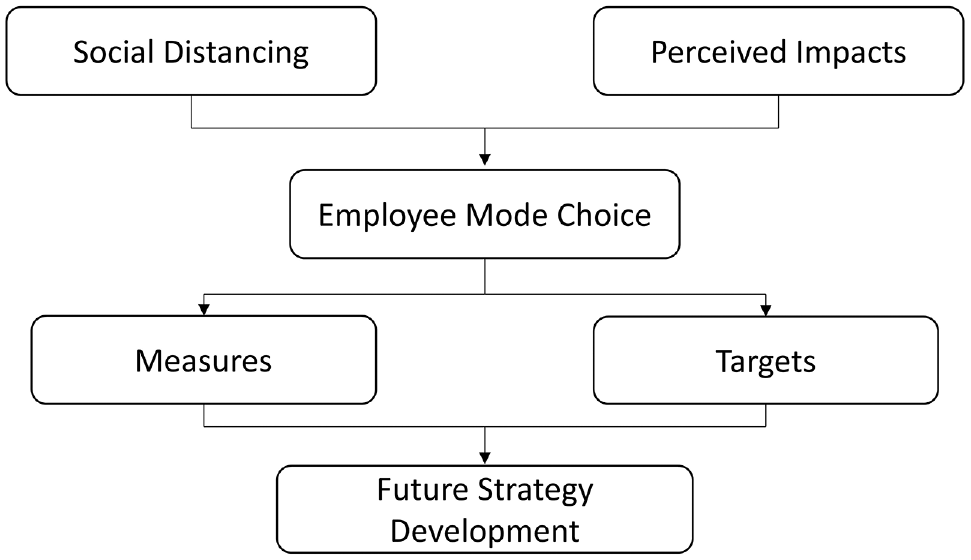
Schematic representation of the research framework.
Method
To investigate pre-COVID airport employee related ground access strategies, a documentary analysis was undertaken of the most recent ASAS of 27 UK airports (which accounted for 96.6% of UK passengers based, on 2019 Civil Aviation Authority [CAA] data). The research is focused on the UK as it offers an example of a developed aviation market. The UK government requires all airports handling more than 1,000 annual passenger air transport movements to produce an ASAS. The CAA’s Passenger Air Transport Movements data ( 25 ) was used to identify the airports that were required to develop an ASAS. The 27 airports vary in size, based on the classification made by Humphreys and Ison ( 3 ): small <2 million, medium = 2–10 million, and large >10 million passengers per annum. According to this classification, the airports included in this study constitute 12 small, eight medium and seven large airports, as seen in Table 1.
Characteristics of Airports and Strategy Documents
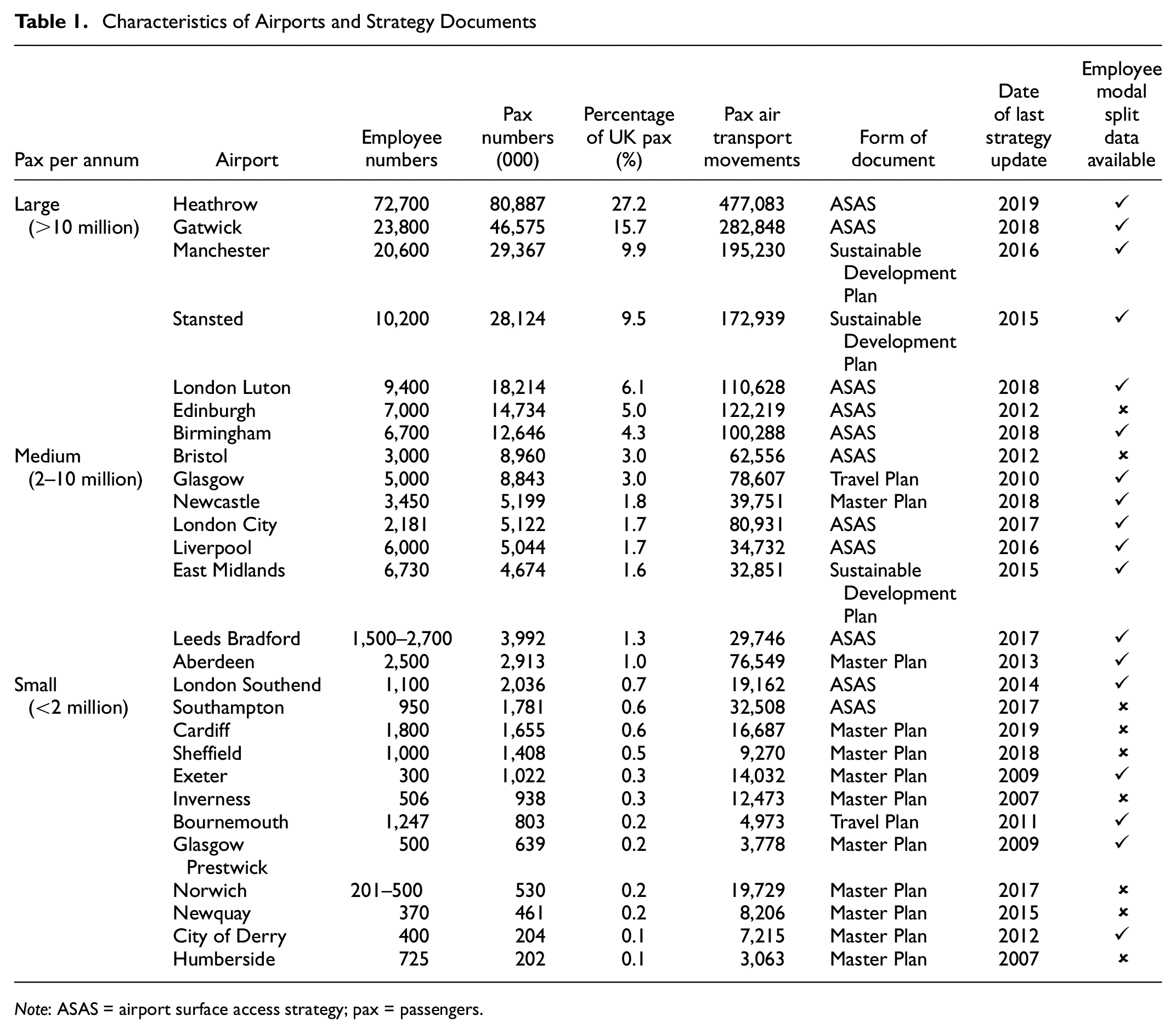
Note: ASAS = airport surface access strategy; pax = passengers.
The identification of airports was followed by a review of all available documentation related to airport ground access including master plans, sustainable development plans, travel plans, and ASASs. To ensure that the documents gathered for analysis are the most recent, 12 airports which had not published any document in the last five years were contacted by email. One third of airports responded and stated that the existing documents were the most up to date. If no response was received from an airport, all existing documents were included in the study and assumed to represent the airport’s current ground access strategies. However, it is possible that airports may be applying ground access strategies without publishing an up-to-date ASAS, thus this could be considered a limitation of this study.
Three elements included in ASASs were used to analyze the documents, namely: current mode split figures; modal shift targets to work toward; and policy measures proposed to deliver the targets.
It would be difficult to distinguish the targets and measures as there might be some overlap in these which needs clarification. For example, it could be thought that the modal shift is not a target but a measure to reduce congestion and associated emissions. However, in this study, the wide range of measures applied by airports to achieve a modal shift toward more sustainable transport, and modal shift remains as a target in itself. Thus, this could be considered a limitation of this study as underlying targets, for example, reduction in congestion, may not be readily identifiable.
Findings: Ground Access Strategies before Pandemic
Current Mode Split
The five categories of ground access transport which can be identified in available documentation are: private car, public transport, car share, active travel, and “other.” The definition of “other” modes of transport varies by airport, but mostly includes park and ride, taxi and company-operated transport under a demand responsive transport scheme.
As seen in Figure 2, the preferred mode of transport by employees for ground access journeys to and from airports is predominantly the use of the private car. For smaller airports, the percentage of employee car journeys is much higher, reaching over 95% at some airports, while employees using public transport account for between 0% and 10% of total ground access trips (with some staff perhaps not having access to a car, so having to use alternative modes of transport). The predominance of employee car use at small and medium airports can be partially explained by the limited public transport services which may not be financially viable. As to other modes, as an alternative to the private car and public transport, car sharing and active travel options (walking and cycling) are more popular among employees working at smaller and medium-sized airports compared with larger airports. This might also be a reflection of the lack of public transport alternatives leading employees to consider other options for commuting trips.
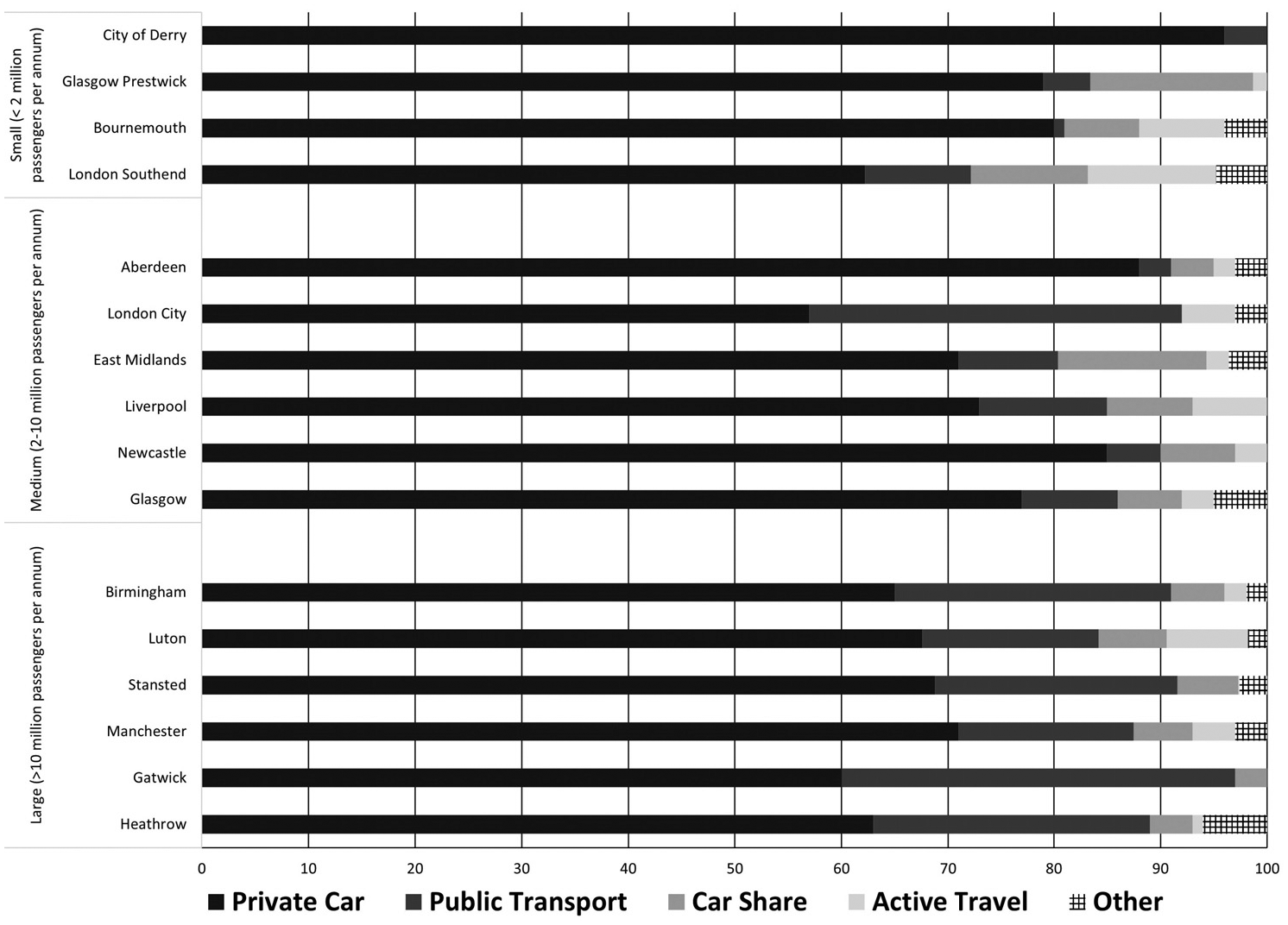
Employee mode split for airport ground access.
For larger airports, with passenger numbers of over 10 million per annum, it is seen that the public transport mode share of employee ground access journeys ranges from 17% to 37%. The key reason is that larger airports are well served with a wide range of public transport modes available to both passengers and employees. It is important to note that, although the percentage of public transport journeys to/from larger airports is higher compared with smaller/medium-sized airports, the private car still dominates the airport access mode used by employees at larger airports, with the figure ranging from 60% to 71%.
Mode Share Targets
Setting a challenging target is an important task for airports not only as a driving force to improve performance but also for making their priorities clear and providing a focus for working toward a more sustainable operation. With regard to airport ground access, the main targets relate to mode share change reducing private vehicle use and wider use of sustainable transport modes for ground access trips. The mode shift targets set by the 27 UK airports are shown in Table 2. For targets set by smaller airports, it is worth noting that eight out of 12 airports have no mode share targets specifically set for airport employees.
Mode Share Targets for Employees
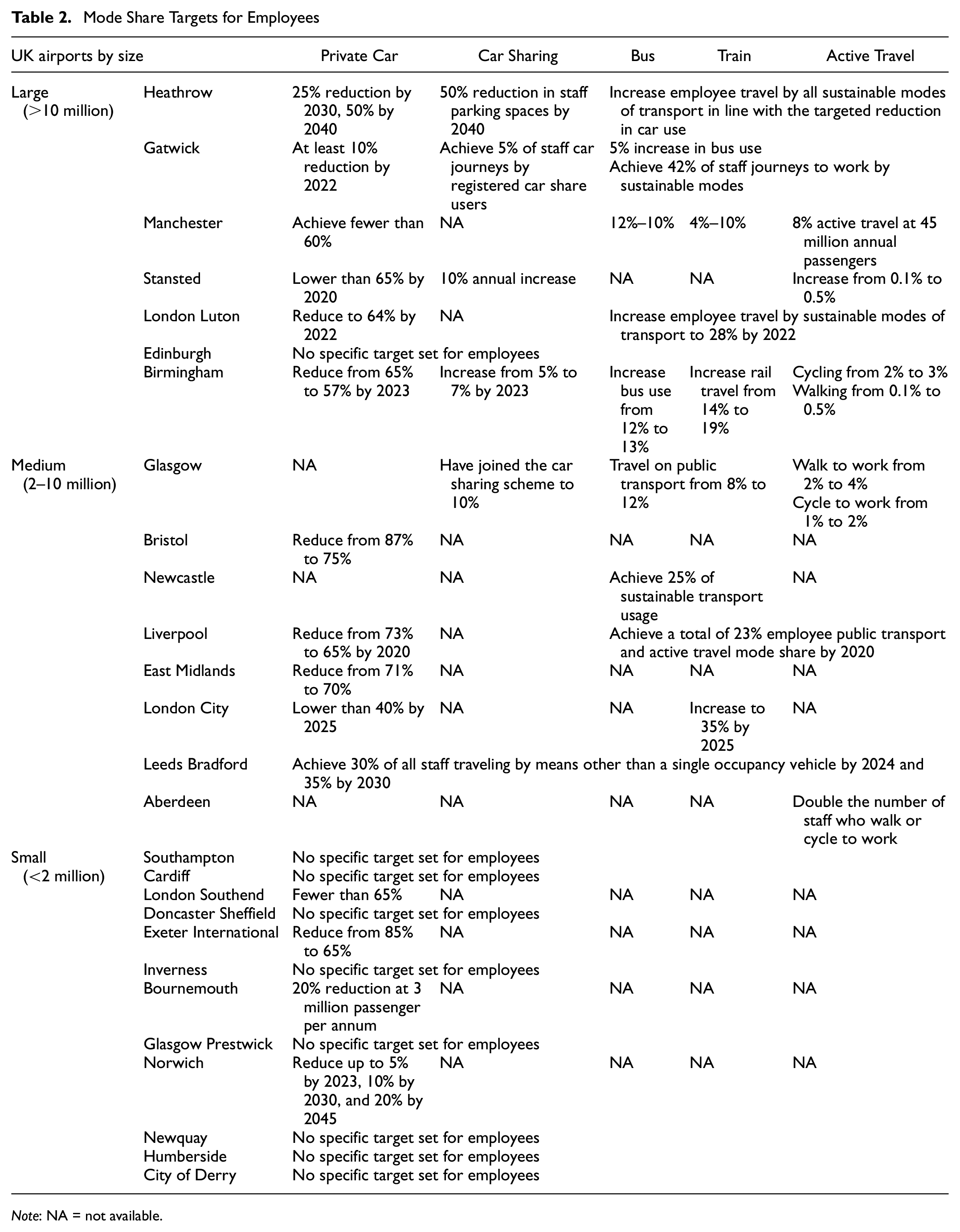
Note: NA = not available.
For medium and large airports, while the majority of airports have at least one overall mode share target which relates to reducing private car use, only a few have separate targets for each transport mode. For example, Birmingham Airport has specific targets for each mode of transport, including achieving an 8% reduction in single occupancy private car use and increasing the number of car sharers by 2%, bus use by 1%, rail by 5%, and active travel by 1.5%. Setting specific targets for each transport mode requires a detailed data collection process which can help operators and policy makers to analyze the current figures and make decisions when setting future targets. However, there appears to be some issue as to how employee figures are measured in setting more achievable and realistic targets. While passenger mode share figures are measured by CAA, mode share data of airport employees are collected by staff travel surveys conducted by individual airports with a variety of approaches, sample sizes, and participation levels. In this respect, some questions may arise as to what extent it is credible to rely on the data collected via employee travel surveys which are mostly subject to small sample size and low response rate (e.g., 12% at Luton, 20% at London City and East Midlands, 11% at Liverpool).
Policy Measures
Measures proposed to reduce the demand for car use in favor of more sustainable modes can be broadly divided into two categories: “push” (making car use less attractive) and “pull” (making other sustainable modes more attractive) measures. Based on this classification, individual ASASs show that UK airports have focused on less coercive means, that is, “pull” policy initiatives. These measures can be grouped into five categories, namely: improved public transport, active travel initiatives, car sharing measures, marketing and information provision, and reduced need to travel. In contrast, car parking management is considered as the only push measure which aims to make car use less attractive.
Improved Public Transport
An employee travel survey conducted by Heathrow Airport showed that employees would consider using public transport if improvements were made to provide more direct buses (stated by 33%), to offer discounted tickets (29%), and to provide more frequent services (26%). The results of the survey partially explain how important the availability, frequency, and incentives to use public transport services are for employees. Thus, measures to achieve improved public transport use are considered as a reflection of employees’ stated preferences. In this regard, the majority of airports work with bus and rail operators to increase the availability and frequency of services to accommodate employees’ shift patterns better. For example, Heathrow Airport highlighted the importance of extending operating hours of local bus services as 80% of airport employees work non-standard shift patterns, which means that employees must travel to work during times at which public transport services are limited or unavailable. For those airports with no direct rail connections (mostly the small- and medium-sized airports), local bus services are significant for increasing the availability of public transport services. Further, a variety of incentive-based initiatives is provided by most airports regardless of size. Such measures include offering discounted bus and rail tickets through travel cards at Gatwick, Stansted, Manchester, Luton, Birmingham, Liverpool, and Newcastle airports; interest-free loans for annual tickets at Norwich Airport; and prize draws for those using sustainable transport (Leeds Bradford and Newcastle).
Active Travel Initiatives
Non-motorized modes, also known as active travel modes, include cycling and walking. Given that at some airports a significant proportion of airport staff live in residential areas close to the airport, the importance of providing safe, convenient, and designated pedestrian routes and improved cycle paths between the airport and the residential areas for people who are able to cycle or walk was highlighted by some airports, namely: Heathrow, Stansted, Gatwick, Liverpool and Luton. Moreover, with regard to incentivizing the increased use of cycling, Stansted Airport, for instance stated in its ASAS that “Stansted joined the Government’s Ride2Work scheme in 2007 and many employees have been able to purchase new cycles at a discounted rate.” Such schemes offering tax-free or interest-free loans to purchase cycles are promoted at several UK airports regardless of size. The relative success of these subsidized cycle schemes specifically at airport sites is unknown.
Car Sharing Measures
Car sharing, also referred to as carpooling or ride sharing, is becoming a popular mode of transport among airport employees for travel to work. The proportion of car sharers reaches over 15% at some UK airports. The most common measures to improve car sharing focus on tracking car sharers and incentivizing car sharing. As stated by Gatwick Airport, it is difficult to track car sharing and measure the employee figures because of the informal arrangements between staff to car share for work trips. Therefore, the majority of UK airports support car sharing schemes which enable a precise, regular, and systematic monitoring of car sharing figures. Car sharing schemes work as follows. Employees first register for the scheme, then add the details of their journey and shifts, find a match on the database, then they can start sharing their rides, which enable them to generate less emissions and save money by splitting the cost. These schemes are also referred to as carpooling. Several incentives were also evident, including provision of priority parking spaces for car sharers by Leeds Bradford and Newcastle airports, parking charge discounts by Luton and Bournemouth, and shift swapping opportunities to facilitate arrangements for car sharing by Heathrow. It is also worth mentioning that Gatwick Airport introduced the UK’s first electric car sharing scheme in partnership with BlueCity, in which only electric car owners can participate. This is an important initiative both for increasing the number of staff who car share and encouraging airport employees to use low emission vehicles.
Marketing and Information Provision
Providing staff with information, raising their awareness of available sustainable transport options, offering discounted tickets, travel cards, cycle and car sharing schemes, and marketing of new developed and improved sustainable transport facilities were highlighted as among the most important priorities to ensure that employees can make an informed decision in favor of more sustainable mobility. In this respect, several policy initiatives are in place, including promoting colleague travel websites, provision of briefing packs to increase awareness of alternatives at staff inductions, and targeted travel planning approaches for new recruits.
Reduced Need to Travel
For reducing the need to travel, home working, flexible working, and video-teleconferencing, where applicable, are promoted as initiatives. However, as stated in the ASASs of East Midlands and Manchester airports, except for office-based staff there is little opportunity for home working because of the operational nature of airports. In this regard, Heathrow Airport has promoted some alternative practices with regard to reducing the need for commuting such as flexitime and compressed working hours.
Car Parking Management
For measures which aim to make car use a less attractive travel mode among employees, the airports’ ASASs showed that car parking management was the most promoted measure given the dearth of “push” approach-based policy initiatives. Several practices are evident, including a phased reduction in the number of parking spaces and relocating staff parking spaces to more remote locations with a shuttle bus link to workplaces. Further, Heathrow Airport intends to develop a detailed parking permit allocation system in which parking space requests are assessed on a case-by-case basis. The proposed approach considers three main elements, namely: distance-based exclusion (not issuing permits to employees who live near the airport), accessibility based (not issuing permits to those who live in areas where a wide range of public transport alternatives is available), and a day-based restriction (permit allowing employees to use car park no more than four days in a week).
Discussion
Before the COVID-19 crisis, the primary concerns of employee ground access were related to reducing the environmental externalities resulting from the increased use of private means of transport. The main findings of this study reveal that airport ground access strategies include several mode share targets and a wide range of policy actions to achieve targeted mode split in favor of more sustainable means of transport. The existing strategies have been developed based on the assumptions of business-as-usual without considering the unprecedented impacts of COVID-19. However, as the emergent literature around COVID-19 has stated the new normal will be entirely different, considering the experienced impacts of COVID-19 combined with major unknowns ( 7 ). For instance, the early assessments of the unprecedented impacts of COVID-19 on the air transport industry claim that the demand is expected to focus on larger-sized airports ( 6 ). It can be argued that this will intensify the ground access issues mainly at large hub airports since the larger the airport, the greater the ground access issues are likely to be.
Considering the current and potential future challenges of COVID-19, it would not be a coherent proposition to implement the ground access strategies developed before the pandemic in their entirety. There needs to be a reconfiguration focusing on the relative merits of active travel, home working, if possible, and the use of video-conferencing technologies such as Zoom and Microsoft Teams which have gained increased prominence. The rationale behind this is that the mode choice behavior of airport employees may tend to differ in the post-COVID period. The potential change in employee commuting behavior caused by the fear of getting infected or reduced public transport provision ( 22 ) may raise some important questions leading airport operators to reconsider their existing targets and policy measures.
It is necessary to consider how realistic it would be to set ambitious targets in favor of reducing employee car use and increasing more sustainable modes. It can be argued that employees may avoid using public transport and shared cars/vans, where keeping 2 m safe distance between others is difficult. Setting conservative targets or even trying to keep existing car use at the same level without intending to achieve more desired outcomes would seem more realistic within the current climate. However, as the pandemic has already weakened most habits in our daily routines, airport operators and policy makers may use this time to achieve more sustainable operations by using the potential of positive structural changes with respect to commuting behavior. As revealed in the analysis section of this paper, the majority of airports, with a few exceptions, do not include any specific targets set for increasing active travel. Considering the potential growth of the tendency toward active travel in the post-pandemic situation, it is worth arguing that airports need to consider having more specific targets for cycling and walking since the mode-based targets could provide an important goal to work toward. It must also be noted that reducing the need to travel with stimulated home working has been advised for people whose job position is suited to working remotely. However, setting targets for reducing the need to travel to work has not been greatly considered since the majority of employees working in the airport sector are not able to work from home because of the operational nature of airports. It could be claimed that airports may need to rely on the advice of their own Human Resources departments to identify the staff eligible to work from home and set achievable targets to improve remote working.
It could be argued that incentivizing public transport use in the post-COVID period would be much more important than the pre-pandemic period. Despite health and social distancing measures, reassuring employees of the safety of using transit services is not only in the hands of the airports but also requires better risk communication between airports, transport operators, and other stakeholders involved in policy planning. This will facilitate the sharing of travel advice and ensure there is a better information dissemination to increase the employee awareness. This is particularly important in scenarios where national, state, and regional travel restrictions are dynamic and respond to the changing conditions of the pandemic.
With the rising costs of running transit services because of the reduced capacity with changed seat layouts (because 2 m distance required) and extra health and safety measures, the provision of public transport to and from airports would require to be subsidized more for those who have no option other than using public transport. The difficulties with public transport could also apply to car sharing measures. While most airports have encouraged car sharing as an alternative to single occupancy car use, it would be more difficult to persuade employees to car share if the pandemic results in a more structural long-lasting impact on the travel behavior of employees. Besides difficulties with encouraging public transport use and car sharing, airports may also experience some difficulties with discouraging car use and imposing car parking management even in the post-COVID era. More parking space provision may be required in view of employees’ reluctance to abandon their cars in the current climate. Commonly, parking permits are sold to the third-party tenant companies by the airport authorities and these companies then distribute the permits among their employees. However, the cost of parking permits is not always passed on to employees ( 26 ). Therefore, the practice of giving free or subsidized parking permits to employees may remain a challenge with regard to changing employee mode choice behavior and encouraging public transport use post-COVID. Airports may also close the remote car parks for staff and stop shuttle services for the same reasons. However, it could be claimed that the best approach would be balanced parking management considering both the staff relations (retention and recruitment) and environmental sustainability goals of airports.
As opposed to the measures which seem more difficult to implement in a post-COVID situation, encouraging the use of active travel modes, reducing the need to travel, and improved information provision would have leading roles in future strategy development. The use of non-motorized modes allows employees to stay healthy and keep safe while making essential trips. Thus, it can be claimed that the measures will continue to be promoted as a means of stimulating the increasing level of acceptance of active travel. However, active travel may be impractical because of the physical layout of the airport site and is thus likely to remain an issue for some large and medium-sized airports which cover large areas, resulting in long and in some cases impractical walking and cycling distances. In this regard, electric bikes and scooters could be promoted for making commuting easier and effortless.
Further, the stay-at-home orders and lockdowns during the pandemic have shown the value and efficiency of remote working practices. This may lead airport operators to reconsider the potential of flexible home working at least for office staff (e.g., sales, marketing, and finance roles).
Providing existing staff with updated information of any changes in public transport provision and the availability of current incentives, offering personal travel advice to new recruits, and also raising staff awareness of the impacts of their mode choices on both the environment and the other people’s health are likely to appear of significance in the post-pandemic period.
Conclusions and Recommendations
This study has examined the most recent ground access strategies of 27 UK airports in an attempt to identify the extent to which pre-pandemic strategies would be relevant in tackling the issue of employee ground access in a post-COVID future. Much of the focus in airport ground access policy was on encouraging the use of more sustainable modes and reducing car use by setting mode share targets and proposing policy measures accordingly. As findings have revealed, UK airports have predominantly relied on the pull measures that make sustainable transport alternatives more attractive than private cars. However, the unprecedented challenge created by the COVID-19 pandemic has acted as a game changer with regard to travel behavior. The pandemic has already weakened individuals’ daily habits and changed the way they travel to work. This has necessitated airport operators and decision makers to reconsider employee ground access policies.
It is clear that airport operators will have much more difficulty with proposing such measures including encouraging public transport use, adoption of shared ride vans, and promoting car sharing unless they can reassure employees who fear being infected by the virus in the post-pandemic period. Further, car parking management is likely to be more problematic given the expected increase in the level of private car use. To turn these challenges into opportunities, it could be argued that the post-pandemic strategies must be reconfigured and tailored to the requirements of the emerging new normal. In this regard, several recommendations could be offered. For example, it is useful to avoid setting more ambitious targets in favor of increasing public transport and shared transport services. Despite the difficulties, several car parking measures must still be in place at least to disincentivize single occupancy ridership. Rather than traditional fixed working hours, rescheduling shifts could enable some employee groups to use public transport. More flexible remote working arrangements could be taken into consideration to reduce the need to commute. Active travel is likely to play a key role considering its health benefits and possibility of social distancing. Thus, cycling and walking facilities including designated pedestrian routes, cycle lanes, shelters, showers, and lockers could be increased at all airports regardless of size. Likewise, airports could put in place cycling schemes offering tax-/interest-free loans to encourage bike purchase. On top of these, airports could ensure that there are well-developed marketing and information provision initiatives to increase the staff awareness of all existing incentives and promotions available to them.
Several issues might be addressed in future research. First, research can enhance this study by conducting interviews with airport operators to provide a management perspective and identify possible post-pandemic challenges to airport ground access, specifically, how airport operators coordinate efforts with local transport providers, local authorities, and other stakeholders. Second, research should also investigate the factors affecting the mode choice behavior of airport employees in the post-COVID world as this may allow us to see the difference between the determinants of choice between pre-post pandemic. Future research with respect to the determinants of individual travel behavior would be much more useful if best practices related to sample size, response rate, and survey methodology are discussed and proposed so that airports may consider them while conducting their own employee travel surveys.
Footnotes
Author Contributions
The authors confirm contribution to the paper as follows: study conception and design: O. Yilmaz, M. Frost, A. Timmis, S. Ison; data collection: O. Yilmaz; analysis and interpretation of results: O. Yilmaz; draft manuscript preparation: O. Yilmaz, M. Frost, A. Timmis, S. Ison. All authors reviewed the results and approved the final version of the manuscript.
Declaration of Conflicting Interests
The author(s) declared no potential conflicts of interest with respect to the research, authorship, and/or publication of this article.
Funding
The author(s) disclosed receipt of the following financial support for the research, authorship, and/or publication of this article: This work is supported by the PhD Scholarship for Oguzhan Yilmaz provided by the Ministry of National Education of the Republic of Turkey.

Data Accessibility Statement
Data analyzed during this research is publicly available and can be accessed from the Civil Aviation Authority (CAA) and individual UK airports’ websites.