



Abstract
Through a choice experiment conducted among 995 Swiss respondents, we studied the linkages between prior investment decisions and the choice of travel mode. Our experimental design and empirical framework aimed to identify the impact of electric vehicles (EVs) and to test for two behavioral deviations from rationally optimal usage. Prior investment in a car or public transport pass could be used ex ante as a commitment device for overcoming self-control issues, or could affect mode choices ex post through the regret effect of sunk costs. We found no evidence to support the sunk cost hypothesis, but our findings provided partial evidence in favor of commitment mechanisms. A prior investment decision decreased the consumer’s responsiveness to variation of travel time. However, such commitments did not seem to influence responses to changes in marginal travel costs. Further, we found that EV adoption in the experiment did not result in a significant step-change in hypothetical usage patterns above rational marginal cost reactions. Our results thus reinforced the importance of financial incentives in policies aimed at a behavioral change in travel mode choices.
Travel mode choices are the outcomes of multiple decisions that occur in different time horizons. Although purchasing a vehicle or a travel pass is a relatively long-term decision, the mode choice at the time of travel occurs on a short-term basis. In a rational decision framework, these choices are assumed to be integral parts of a single decision about a “consumption bundle.” In particular, a rational consumer should anticipate their travel choices when making a relatively long-term investment in a public transport pass, a private car, or even in a dwelling. However, the behavioral economics literature points to potential deviations from rationality. Though these deviations are the subject of a large body of research, there is little empirical research testing such behavioral deviations in the travel choice context. We hypothesized that past long-term decisions (e.g., car choice) could influence time-of-use choices. This is particularly important in the current context of a greening transport sector with increasing electric vehicle (EV) options available. Adoption of emerging technology requires relatively important initial investments facing future uncertainties, a favorable context for decisions based on behavioral heuristics, and bounded rationality.
The rising proportion of global EV purchases will provide benefits in relation to air pollution emissions from the transport sector, however this could exacerbate other externalities through a rebound effect in car use (see, for example, Dimitropoulos et al. [ 1 ]). Given that the marginal cost of EV use is generally lower than for traditional internal combustion engine vehicles (ICEs), adoption of EVs could induce higher usage. There is, however, little empirical research on whether EV adopters are likely to change their car-use patterns beyond the direct effects of marginal costs.
We used the sequential decision structure to develop tests for potential deviations from rational decision-making in the context of personal travel. Our focus was on prior investments and their impact on the choice of travel mode at the time of use. We distinguished two competing hypotheses based on commitment mechanisms ( 2 ) and sunk cost effects ( 3 ). We also included the market for green vehicles and tested the impact of these on travel mode choices. Building on the preliminary work of Simma and Axhausen ( 4 , 5 ), we provided the first tests of these theories in the context of travel mode choices through a choice experiment. Our experimental design aimed to identify the possible impacts of EV adoption on usage patterns independently of marginal travel costs.
An experimental approach overcomes distinct issues inherent in revealed transport choice data (as in, for example, Simma and Axhausen [ 4 ], Ho et al. [ 6 ]). It allows us to investigate consumer behavior in relation to new vehicle types, when the market share of EVs is small. Specifically, in this new market context, not enough drivers currently own EVs for a large sample (0.66% of Swiss cars in 2018 [ 7 ]). Furthermore, with revealed preference (RP) data, the specific choice sets, including alternatives faced by respondents are difficult to observe and several attributes are strongly correlated (e.g., trip cost and duration). Stated preference (SP) choice experiments allow us to observe the whole choice set within which respondents make trade-offs. A well-designed experiment with repeated choice tasks for each individual additionally allows for variations in the choice attribute values, allowing for the identification of these effects. In this way one can predict how consumer behavior will change on aggregate as this market grows and develops. SP methods are hence widely used in behavioral economics and public policy ( 8 , 9 ).
We surveyed a sample of 995 respondents across German- and French-speaking regions of Switzerland. Exploiting the sequential structure of transport decisions, we analyzed trade-offs between each of three decision levels: long-term car purchase, medium-term public transport pass purchase, and time-of-travel transport mode choice. This setup allowed us to analyze how respondents reacted differently to marginal travel costs: if they used commitment devices, if there was evidence of a sunk cost fallacy, and if EV adopters traveled differently or used their cars more than marginal costs would dictate.
We provided the first experimental evidence that consumers do largely act rationally in their travel decisions. Specifically, we did not find any evidence of sunk cost effects. Moreover, our results did not point to any commitment mechanisms that could distort the rational effect of marginal travel costs. However, we did find evidence that prior investments distort the responsiveness to changes in trip duration, hence indicating a commitment effect to specific travel modes at this level. We finally found no travel mode choice differences for those having selected an EV compared with other car engine types. EV adopters did not inherently use their car more, and still reacted in the same way to marginal trip costs as those selecting ICEs. One exception was a slight dampening of reactions to marginal car trip costs, and a slightly larger reaction to car trip durations, among those selecting a plug-in hybrid vehicle (PHEV).
Our findings demonstrated the importance of marginal travel costs in personal mobility decisions. They also indicated that the advent of new green car technologies will not automatically lead to a step-change in car use and transport mode decisions above changing marginal travel costs. Our findings have repercussions for government policy-making around transport, especially over the transition to more sustainable transport consumption patterns. Our findings reinforced the belief that consumers could be incentivized to change mobility patterns through marginal cost adjustments such as fuel taxes, and fees for parking and road use.
The remainder of this paper is structured as follows. Background provides an overview of the relevant literature and details the behaviors we tested. Methodology outlines our approach, including the experimental design and econometric framework, and develops an empirical implementation of the specific hypotheses. The Data section then summarizes our data, which is followed by our estimation results, and our conclusions.
Background
SP studies, specifically choice experiments, have long been used to study consumer preferences and behavior, and the topic of transport and travel has been a key part of its use and development ( 10 , 11 ). Many governments and businesses rely on these methods to predict consumer choices and preferences for various potential future policies or new products ( 12 ). This is especially true for new technologies pre-introduction or before a large enough market has developed that could provide a sufficient amount of RP data ( 8 , 13 ). In the face of criticisms about hypothetical bias of SP responses and lack of external validity, several methodologies were developed to ensure incentive compatibility and the truthful elicitation of respondent preferences. Specifically, respondents must see their responses as having some chance of influencing public policy (or some agent’s actions) ( 12 , 14 ). In addition, a level of familiarity with or understanding of the hypothetical scenario is required ( 8 ). As further discussed in the Experimental Design section, our experiment fulfilled these criteria. We informed respondents that their answers would be used to build Swiss energy and transport policy, and reminded them of their household budget constraints. The context of car and travel mode choices was also very familiar, with respondents making these decisions regularly. The addition of new EV technologies primarily changes the relative fixed and marginal costs. EVs are commonly discussed in the media and in society, and their benefits and challenges seem to be widely known.
A range of behavioral literature in economics and psychology indicates that consumers may use commitment devices to lock themselves into particular future choices (e.g., Thaler and Shefrin [ 2 ], Gul and Pesendorfer [ 15 ], DellaVigna and Malmendier [ 16 ], Laran [ 17 ], Kivetz and Simonson [ 18 ]), or may take account of sunk costs (e.g., Garland and Newport [ 3 ], Friedman et al. [ 19 ], Just and Wansink [ 20 ], Arkes and Blumer [ 21 ], Thaler [ 22 ], Staw [ 23 ]). In the context of travel choices, the long- to medium-term ownership of a car or public transport pass may provide consumers with a commitment device to engage in specific mode choices at the time of travel. A car purchase could provide a precommitment (or an allowance) to car use at the time of travel, even if such use is nonoptimal from a marginal cost perspective, given the available alternatives ( 24 ). A public transport pass, conversely, could be purchased to commit oneself to using that mode in light of potential future temptation to indulge in driving a car ( 18 ). The sunk cost effect would indicate that a consumer would overuse their car (compared with what relative marginal costs would dictate) owing to regret about its purchase or self-justification ( 21 , 25 ). Importantly, this effect would rise the greater the “investment,” that is, the cost of the car ( 3 ).
Choice of travel mode, a seemingly simple decision at the time of travel, is in reality the result of a sequence of decisions at different time horizons. This sequence starts from relatively long-term investment decisions (occurring once every few years), such as purchasing a particular car. This is followed by intermediate-term decisions such as the purchase of a public transport pass/subscription (occurring once or a few times a year). The sequence ends with the choice of travel mode at the time of travel, occurring at a high frequency (e.g., on a daily basis).
Much research has been conducted on car purchase decisions ( 26 – 33 ), and on travel mode choice separately ( 34 – 40 ). We combined these into a joint framework of the interdependent mobility choice structure. To date, in the mobility domain, little attention has been devoted to the potential deviations from the standard assumptions of rational expected utility maximization. The intertemporal transport decision-making structure and the interdependencies between choices gives this sector prime opportunity for the appearance of such behavioral deviations.
The existence of commitment devices in other areas has long been demonstrated and fundamentally stems from the work on consumers’ self-control by Schelling ( 41 , 42 ) or Thaler and Shefrin ( 2 ). They showed that individuals restrict their future self’s choice set by precommitting to a certain course of action if they believe they will face a future lack of self-control or be tempted into short-run gratification.
Only a few authors ( 4 , 5 , 43 ) have discussed commitment devices within transport choices. Simma and Axhausen ( 4 , 5 ) look into the difference in car and public transport use between those who own a car or a transport pass. Loder and Axhausen ( 43 ) additionally include data on trips made by soft transport (cycling or walking). The authors concluded that they found evidence of commitments to transport modes, as the consumers who own or have access to a particular mobility device (i.e., a car or public transport using a discount pass), use that mode relatively more. However, this fails to account for the impact of marginal trip costs, which are reduced for a given mode by purchase of the relevant transport device. Therefore the increased usage of a mode by device holders could be justified through rational decision theory. The authors state that this is indeed the case ( 4 , 5 ).
Our focus in this paper is on a commitment effect beyond the rational response to lowered marginal costs. We argue that for evidence of a commitment effect, variations in marginal trip costs would engender a significantly smaller behavioral response among device owners than for non-device-owning individuals. To our knowledge there is no empirical study that robustly tests such an impact and therefore credibly identifies the existence of commitment devices in the transport sector.
We contribute to the broader commitment effect literature, which has shown evidence for its existence in a wide range of sectors. Laran experimentally demonstrates it with healthy versus indulgent food consumption and money saving versus spending ( 17 ). DellaVigna and Malmendier explore the implications of the effect for contract design in gym memberships, credit cards, and more ( 16 ). Kivetz and Simonson show that some consumers commit themselves to future indulgences if they are presently more prone toward saving ( 18 ).
The sunk cost effect, also known as the “sunk cost fallacy,” represents a behavioral tendency to consume more of a good, the larger the investments they have previously made in relation to the good, even though the investments are “sunk” and should have no bearing on the consumption decision. In rational theory consumers should base their consumption decisions on marginal benefits and costs, regardless of the sunk cost. Deviations from this have been explained in that people feel a level of regret about their past investment and now continue to consume the good as self-justification for the previous expenditure ( 25 ), or out of a desire to not appear wasteful ( 21 ). Some of the original studies of sunk costs include Arkes and Blumer ( 21 ), Thaler ( 22 ), and Staw ( 23 ). Arkes and Blumer ( 21 ), for example, demonstrates that sunk costs have an impact on theater attendance: the more paid for a season tickets, the higher the rate of attendance across the season. Further studies reinforce that the greater the sum invested, the greater the impact it has on later decisions ( 3 ) in a range of areas, including food consumption ( 20 ), and business investments ( 44 ). However, the evidence is not always positive. Friedman et al. show a mixture of findings across the broader literature, and their own computer-based lab experiment found a small and inconsistent sunk cost effect ( 19 ).
The transport sector is well-suited to the study of the impact of sunk costs given the large and variable investments in mobility devices and infrastructure, and the frequent, repeated transport decisions made. Ho et al. use data on car odometer readings across a number of years and changes in car registration costs in Singapore and Hong Kong, and show that the higher the amount invested in registering a car, the more it gets driven ( 6 ). However, this could be the result of selection bias, as the higher registration costs leave only those who will derive the greatest benefit from having a car (those who will use it more). This could also be the result of a nonpsychological path – higher registration costs could induce more car sharing, at a minimum among family and friends, generating a reduction in the average number of cars per household but increasing the use of existing ones. Our experimental approach avoided such selection issues. Existence of a sunk cost fallacy would mean that larger sunk costs lead consumers to react less to variations in marginal costs.
Methodology
Experimental Design
We designed a sequential choice experiment embedded within the annual Swiss Household Energy Demand Survey (SHEDS) 2018 (for more details see Weber et al. [ 45 ]). In total 5,514 individual households took part in the 2018 survey wave, and 995 of these were randomly assigned to take our experiment. This assignment targeted a representative sample along gender, age, region, and housing status.
The choice experiment was organized in a sequential structure to mimic the natural decision-making process. We first asked respondents to make a “long-term” decision regarding a car they would like to purchase. This was followed by the “medium-term” choice of a public transport pass, and finally, respondents were asked to make a series of time-of-travel mode decisions.
The choice tasks were designed with attribute levels of the car and transport mode tasks depending on the respondent’s previous choices. This setup allowed us to obtain accurate and reliable responses, and to accurately estimate the effect of past investments on consumers’ transport mode choices. The questionnaire is provided in the Supplemental Materials for reference.
In more detail, the experiment proceeded as follows. We initially primed the respondents by providing a script to encourage accurate and truthful responses, in line with the literature on preference elicitation in SP studies ( 12 , 14 ). We additionally included a reminder about the respondents’ household budget constraints, and indicated that the decisions here would require trade-offs to be made (as per, for example, Johnston et al. [ 46 ]). See Supplemental Materials: Choice experiment questionnaire for the script. Following this, we asked respondents to imagine that they had to make a choice about purchasing a primary household car “within the next year.” This is a relatively common task for Swiss households as our data showed an average car replacement period of about 5.5 years. This was also externally validated by a survey that finds Swiss households replace their car every 5 years ( 47 ).
The first choice task, then, was to choose the car size, between “micro,”“small,”“small–medium,”“mid-size,”“large,” and “SUV” (based on Touring Club Switzerland (TCS) standards [ 48 ]). We also gave respondents the option of choosing no car. Those who chose some car size proceeded to the second choice task, which asked respondents to choose a specific car. This task was a labeled choice table with six options and five attributes, as illustrated in Supplemental Materials: Choice experiment questionnaire. The labels were each car engine type, with two options as “electric” (i.e., BEV), two “plug-in hybrid” (PHEV), one “hybrid,” and one “internal combustion engine” (ICE). The attributes were “price,”“driving cost per 100 km,”“battery range,”“max. speed,” and “CO2 emissions (g/km).” Levels were set using data from the TCS on all cars currently available in Switzerland ( 48 ).
We did not explicitly include information related to EV charging in the experiment. In Switzerland, as in many countries, the topic of EVs is discussed widely and our experiment respondents therefore had at least some knowledge of the technicalities of using and charging an EV. We expected respondents to have a level of range anxiety, as seen in surveys domestically and globally, that would potentially discourage them from choosing an EV in the study relative to in the real-world market, where continued exposure to and experience with EVs and their charging may heighten adoption levels ( 49 , 50 ).
Next, all respondents answered the medium-term question of whether to buy a public transport pass. Such passes are ordinarily renewable on a monthly or yearly basis and give unlimited access to public transport across the entire country or a specific region. The following pass options were provided: “1st Class GA,”“2nd Class GA,” a local “regional pass,” or “none.” Both GA (General Abonnement) passes provide unlimited access to all public transport in the country, whereas regional passes offer the same within a defined region (usually a Swiss canton). The single attribute in this task was the pass price.
Finally, all respondents received a series of choice tasks relating to the transport mode for specific trips. We repeated the transport mode task three times for each of three trip types (commute, local leisure, and weekend trip), giving nine choice situations per respondent in total. Respondents who do not ordinarily commute (do not work or work from home) were only given leisure and weekend trip choice situations. Choice tasks were composed of two attributes, trip cost and trip duration, and were labeled with the transport mode (see Supplemental Materials: Choice experiment questionnaire). Trip cost was defined with the following popup for respondents: “Trip cost corresponds only to the car’s operating cost. It does not include other possible costs such as parking fees.” There was a maximum of five mode alternatives available: public transport (PT), respondent’s private car (CR), soft transport (“bike or foot”; ST), car sharing (CS), and car with a driver, for example, taxi (CD), with available alternatives and attribute levels depending on previous choices and responses. Irrelevant options were not displayed. In particular, respondents who chose no car in the first step did not receive the option to use one at this stage. For trip distances longer than 10 km ST was less realistic and therefore not offered. The levels of the cost attribute were further tailored to the device decisions previously made by the respondents. For example, respondents who chose a GA PT pass had a cost of 0 for using this mode. Those who chose a car received different trip cost values depending on the efficiency of the car they selected and the trip distance. To introduce some variability in the experimental design, the displayed attribute levels for each alternative additionally varied randomly between respondents and choice tasks, applying weights of 0.5, 1.0, or 1.5 to the calculated average values.
Econometric Framework
Our primary objective was to analyse the impact of the first-stage transport decisions on the travel mode choice at the time of travel, while controlling for respondents’ various sociodemographic and behavioral characteristics. To do this we proposed a comprehensive choice model that considered the various choice-level decisions and the final outcomes simultaneously.
Using a standard random utility model framework as the basis of our estimations ( 51 ), we estimated the choice of transport mode, between PT, CR, and ST. The two alternatives, CD and CS were selected in less than 3% of choice tasks. Owing to the low share, we excluded these two modes from the estimation. We tested this restriction and confirmed that it did not significantly alter the results.
Using the following utility function, respondent n’s utility for mode i in choice task t is estimated by

where mode i is an element of P (public transport), C (car), and S (soft transport).The vector of coefficients of the choice task–mode–respondent-specific attributes,
Respondents selected the transport mode, i, that maximized their level of utility, that is,

where E is the set of possible mode alternatives.
In our estimations we set PT as the base travel mode, that is,

The variables in
In
The biospheric values measured the importance respondents attributed to environmental protection and pollution prevention. Respondents rated four values (respecting the earth, unity with nature, protecting the environment, and preserving nature) as “guiding principles in their lives” on a 5-point scale ranging from 1 “not important” to 5 “extremely important” ( 52 ). Aggregating the four answers gave the respondent’s average biospheric value. We further created a binary variable with a value of 1 if respondents had an average biospheric value of 4 or more.
Empirical Behavioral Tests
To investigate the existence of mode commitment device usage and a reaction to sunk costs among respondents, we focused on a few key variable interactions. We summarize these tests in Table 1. We additionally tested the effect of EV adoption on mode choice, compared with ICEs, both in absolute terms, and in relation to the user’s reactivity to marginal trip costs. Overall, we naturally expected negative coefficients for
Summary of Behavioral Tests
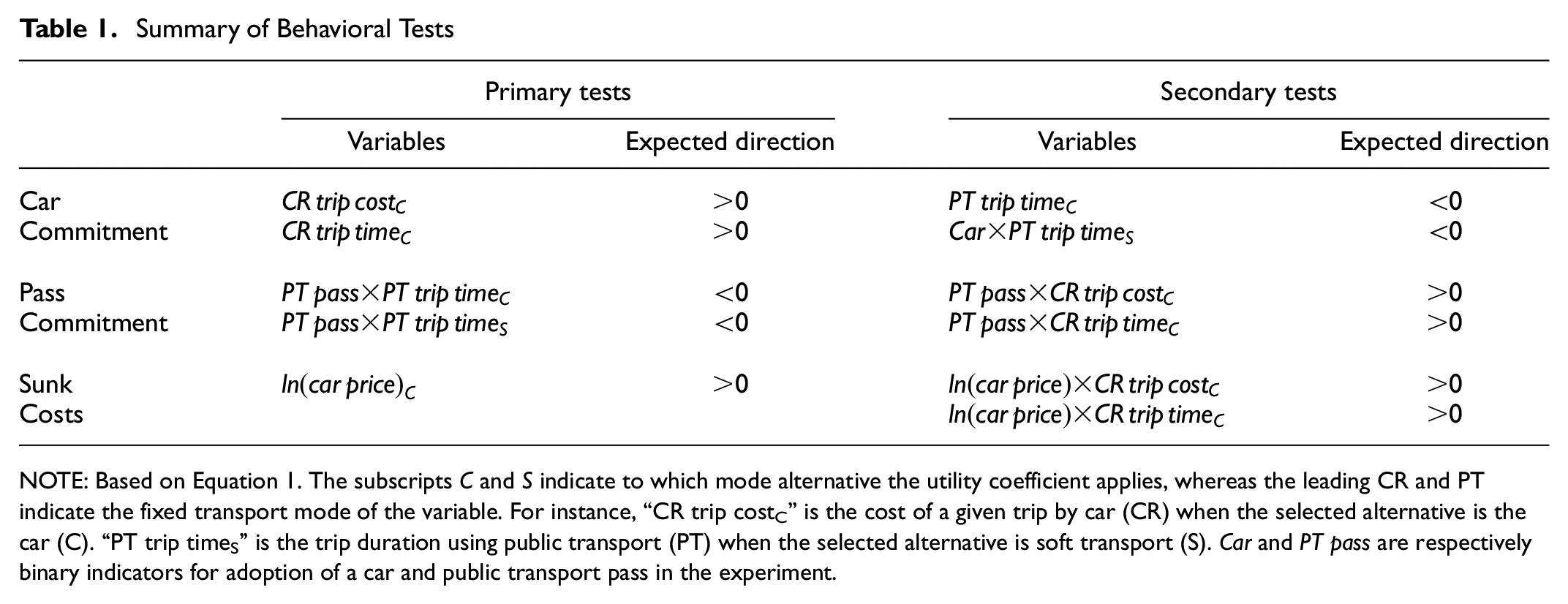
NOTE: Based on Equation 1. The subscripts C and S indicate to which mode alternative the utility coefficient applies, whereas the leading CR and PT indicate the fixed transport mode of the variable. For instance, “CR trip costC” is the cost of a given trip by car (CR) when the selected alternative is the car (C). “PT trip timeS” is the trip duration using public transport (PT) when the selected alternative is soft transport (S). Car and PT pass are respectively binary indicators for adoption of a car and public transport pass in the experiment.
If respondents were to display evidence of using a car as a commitment device, we would expect them to be less reactive to differences in the marginal travel costs than non-device-holding respondents. Specifically, those selecting a car should react less to variation in the costs of a trip by car as they are committed to using their car. Our primary car commitment tests were therefore whether the coefficients of
As for respondents opting for a PT pass, if it were to function as a commitment device their marginal disutility of the trip duration using PT should be lower than those without a pass. Thus the interaction term
The logic for evidence of consumer attention to sunk costs follows a similar pattern, however, car use depends on the amount invested, that is, the car price. If respondents were to display evidence of the sunk cost fallacy we would expect consumers to use their car more the greater the amount they paid for it. Therefore, the consumers’ utility gained from using the CR mode should rise the greater the price of the car. Thus our primary test was
Descriptive Respondent Statistics
The SHEDS sample is designed to be representative of the population at the national Swiss-level (excluding Ticino) ( 45 ). Our choice experiment respondents broadly matched this requirement, and we summarize here the data for the 994 respondents (the tables are provided in Supplemental Materials: Descriptive supplements). Specifically, the age group targets were 18 to 34: 30%; 35 to 54: 40%; and 55+: 30%. We slightly undersampled the youngest group and oversampled the older, at 24% and 35%, respectively. Further, we achieved sample proportions for renting versus owning that were close to the target of 63% tenants and 38% owners.
For our analysis, we also specifically targeted nine segments based on household size and region. We segmented by single, two-person, and multiperson households, and city, agglomeration, and rural locations. Here the level of “urban character” is defined by the Swiss Federal Statistical Office and agglomerations are urban to semi-urban municipalities with high economic and commuting links to a neighboring city center ( 53 ). Over half of respondents lived in the city, compared with 21% that were rural inhabitants and 28% in an agglomeration.
Respondents clearly varied in their real-life transport decisions, providing a good starting point for our experiment. About 26% of respondents did not own a car. This is slightly more than in the last Swiss Mobility and Transport Microcensus, which showed nearly 80% household car ownership in 2015 ( 54 ). Further, 45% of respondents owned a PT pass, slightly less than the 57% observed in the 2015 microcensus, however the latter also included some additional forms of passes ( 54 ). The majority of the PT passes in our sample were GA travelcards of either 2nd or 1st Class: 24% of all respondents.
Descriptive Choice Statistics
From the choice task responses, we gained an idea of the decision distribution and variation. The Supplemental Materials: Descriptive supplements summarizes the choices. Overall, 89% of respondents chose a car. This was slightly more than the historically stable Swiss car ownership rate of around 80% ( 54 ) and above the rate of 74% in our sample. Among the 882 respondents who selected a car, the majority chose a small or small- to medium-sized car. Over a third (34%) of respondents selected a BEV, and a similar proportion chose an ICE. In total 17% chose a PHEV and 15% a traditional hybrid.
Importantly for estimation of the impact of sunk costs, respondents who chose a car “spent” CHF 35,000 at the median. The prices ranged from CHF 24,000 to 53,000 at the 25th and 75th percentiles, respectively. The car prices selected naturally varied between fuel types, and on average respondents choosing a BEV or PHEV were willing to spend more. The median BEV price was CHF 40,000 and the PHEV price was CHF 51,000. By comparison, the median ICE price was CHF 24,000.
For the PT pass choice, 53% chose not to buy one, whereas 25% chose a regional pass, and 23% a GA of either class. About 45% of respondents who chose to buy a car also chose a PT pass, allowing for analysis of the two potential commitment device behaviors together.
Pearson’s chi-squared tests showed that the choices made in the experiment about car size and fuel type, and PT passes were significantly related to the real-life situations of respondents. That is, the stated car and PT pass preferences corresponded with their RPs. To some extent, this finding also illustrated consumer inertia. When faced with an important decision such as purchasing a car, consumers tend to favor a technology with which they are familiar. This has already been observed for example for heating system replacement ( 55 ), and broadly for repeated car ownership ( 56 ).
Following from the relatively high selection of transport devices (a car, a PT pass, or both these options), most respondents chose to use these two modes in the experiment. Overall, the CR was the most selected transport mode, at around 49%, followed closely by PT at 34%.
Results
We estimated four models based on Equation 1: (1) including respondent characteristics and the car choice; (2) adding car-choice interactions to test the behavioral impact of green cars; (3) adding our primary behavioral tests; and (4) adding our secondary behavioral tests. The estimation results are shown in Table 2, in which the upper panel shows the utility coefficients for the trip attributes, namely the cost and duration of the trip, and the lower panel shows the estimated coefficients for the alternative specific variables.
Estimation Results
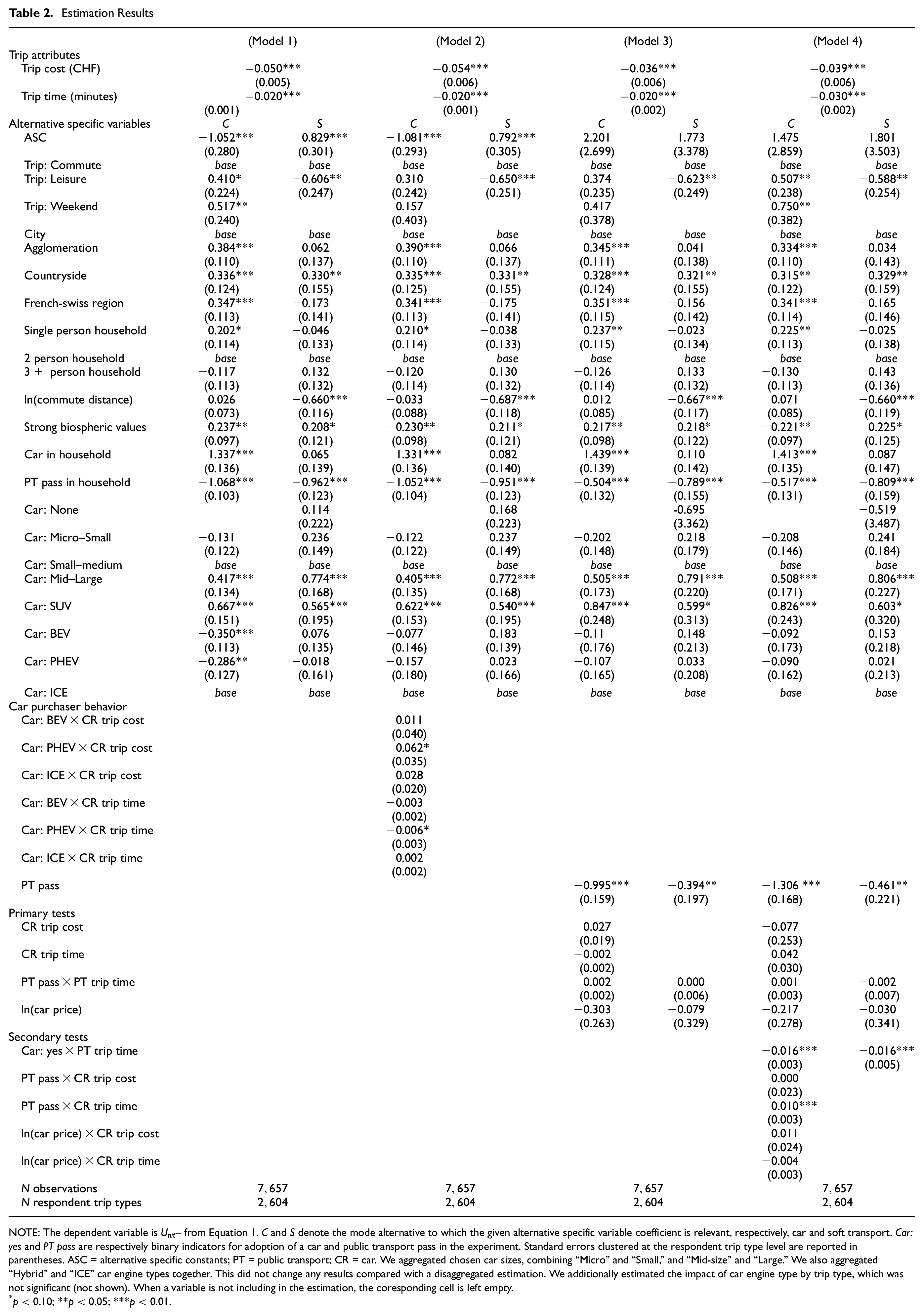
NOTE: The dependent variable is
p < 0.10; **p < 0.05; ***p < 0.01.
The trip attribute coefficients were both significant and of the correct sign in all models. Specifically, higher travel costs in money and time both led to decreases in utility. This means that increases in the costs of any particular transport mode alternative renders the selection of that mode less likely.
From the results of Model 1, we focused on the impact of respondent characteristics on mode choices. We found that compared with city dwellers, those living in an agglomeration or the countryside gained more utility from using a car. Furthermore, rural inhabitants were more likely to walk or cycle on average than those in other regions. Respondents from French-speaking Switzerland were shown to be more predisposed to using cars than those from the German-speaking region.
Commute distance naturally exerts a negative impact on the probability of taking ST, however it did not influence car usage when controlling for other factors. Respondents who placed a high importance on the environment obtained a disutility from car use and higher utility from ST. Finally, respondents who owned a car in real life were significantly more likely to choose the CR mode, and those with a PT pass in real life were also much more predisposed to using that mode.
We consistently found that compared with those who chose a small- to medium-sized car in the experiment, respondents who chose larger cars were significantly less likely to use PT. (We aggregated car sizes, combining “Micro” and “Small,” and “Mid-size” and “Large.” This did not alter the results significantly compared with a disaggregated estimation.). They gained greater utility from both car and ST use. In Model 1 we found those who chose an electric car reduced their car use, however, this disappeared once we further controlled for marginal car trip costs in Models 2 to 4. Note that we also aggregated “Hybrid” and “ICE” car engine types together. This did not significantly alter any results compared with a disaggregated estimation. We additionally estimated the impact of car engine choice by trip type, all of which were found to be insignificant.
In Model 2, we additionally interacted the chosen car engine type with the marginal trip cost and trip time for the given trip with the car alternative. These showed a slightly significant increase (decrease) in utility for using a PHEV the more costly (the longer) the trip. This indicated a slightly dampened reaction of PHEV adopters to trip cost, and a slightly heightened reaction to trip duration. These consumers thus displayed a higher valuation of travel time, which was supported by the observation that the PHEVs chosen had a relatively higher price and these respondents’ incomes were also higher. However, this was only at the 10% significance level.
We found no other evidence, however, of BEV-selecting respondents being more or less reactive to marginal trip costs compared with those having chosen a traditional ICE car. Overall, we observed no real step-change in car-use patterns in the experiment owing to green vehicle adoption beyond varied marginal trip costs.
Model 3 showed that respondents who selected a PT pass (GA or regional pass) were significantly more likely to use PT than a car or ST – seen through the significant negative alternative specific variable coefficients on the PT pass dummy of both these modes. This matched the findings of Simma and Axhausen ( 4 , 5 ). However, our primary behavioral tests (Table 1) did not support the hypothesis of commitment device use.
Specifically, the primary car commitment device test variables,
Summary of Test Results
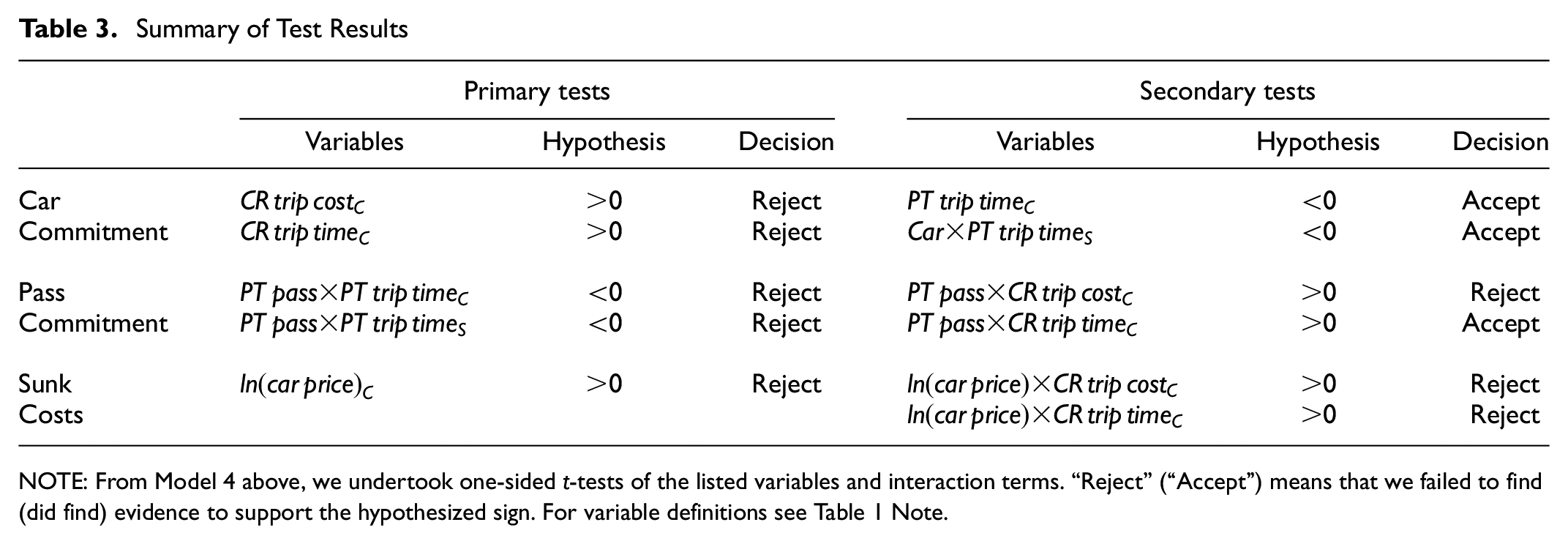
NOTE: From Model 4 above, we undertook one-sided t-tests of the listed variables and interaction terms. “Reject” (“Accept”) means that we failed to find (did find) evidence to support the hypothesized sign. For variable definitions see Table 1 Note.
As Table 3 further summarizes, the secondary tests in Model 4 nuance the behavioral test findings. We found that selecting a car (as opposed to no car) did decrease the respondents’ reactivity to variation in the trip duration for PT. We further found that, while respondents selecting a car and a PT pass did not react differently to the cost of the trip by car, they exhibited a diminished reaction to variations in the trip time by car, as hypothesized. Finally, the secondary tests for sunk costs were rejected. We found no evidence that sunk costs had any effect on mode choices.
We we do not believe our results were subject to a hypothetical situation bias and that the respondents were making realistic, informed choices. By restricting all estimates for choices and behavioral tests to those who also owned the particular transport device (car or PT pass) in real life, did not change the results of our hypothesis tests.
Conclusion
In this study we conducted a sequential choice experiment and analyzed transport consumers’ decision-making processes. We investigated the existence of travel mode commitment devices, the impact of sunk costs, and the differing choices of “green” car consumers. By reducing the selection biases inherent in revealed transport data, our experimental approach allowed a better estimation of future travel tendencies in a growing EV market. We found that what mostly drove consumer travel mode decisions was marginal trip costs and respondent characteristics, and demonstrated a nuanced response to our behavioral tests. Despite differences in car and PT use by the car size and PT pass chosen, we observed few changes to consumer responses to marginal costs.
We confirmed experimentally that the selection of a larger car or a PT pass did lead consumers to use relatively more of that mode, as similarly shown by Simma and Axhausen ( 4 , 5 ). However, we have provided the first tests of stronger commitment device usage based on response to marginal trip costs, and have shown that there is only partial evidence for this. Those who chose these long- and medium-term transport investments still responded largely rationally to variation in marginal costs. Respondents who opted for a car did not react any less strongly to variation in the cost and duration of trips by car. However, they did display a lower reactivity to changes in the trip duration of the key alternative, PT. Essentially we estimated no deviation in own-mode trip cost elasticity from the average, and a smaller cross-mode trip time elasticity. Similarly for PT passes, our primary tests revealed no commitment effect. However, we did again see an altered cross-mode trip time elasticity. PT pass selection was associated with a slight reduction in car-owner response to marginal car trip duration.
We additionally provided the first robust tests in the literature for the sunk cost fallacy in private transport, and contribute to the mixed results found across past studies of other sectors ( 19 ). We experimentally isolated the effect of car price on transport mode choices and found that the magnitude of the sunk cost did not influence travel mode decisions. We further found no change in consumer reactivity to marginal trip costs linked to sunk costs.
Although adoption of new technologies could lead to a different usage pattern associated with a rebound effect, our analysis provided little evidence of statistically significant differences in car usage behavior between EV adopters and nonadopters. Those who chose an EV were no more or less reactive to marginal trip costs. One exception to this, however, was a slightly smaller reaction to car trip costs, and a slightly larger one to car trip duration, among those who selected a PHEV. Overall, we found that increasing uptake of EVs in the market did not lead to any step-change in transport patterns, which will remain largely dependent on marginal costs and demographics.
As we found supportive evidence that prior investments could have a partial mode committing effect in relation to travel duration, the effects of reducing this (e.g., by more frequent PT) could be moderated by prior decisions (e.g., car ownership). This highlights the policy relevance of relatively long-term investment decisions and their effects on travel behavior. An indirect policy implication is that influencing a consumer’s investment decision (for instance not owning a car, or buying a PT travel pass) could be achieved through long-term changes in trip time and other comfort attributes. However, this paper’s main result hinges on the largely rational choices observed in our experiment, suggesting that behavioral deviations, if any, were not greatly important in the policy design of financial instruments. There was little evidence of any distortion of responses to marginal costs based on prior decisions.
Our findings of broadly rational decision-making could also indicate that respondents do not make strictly sequential decisions, but rather they anticipate their short-term travel choices and make their investments accordingly. Rational decision theory suggests that consumers make choices as a bundle, accounting for their personal characteristics such as residential location and commute distance, they know which travel mode they will mostly wish to take and purchase a car, a PT pass, or both to match their transport mode predictions.
Although the hypothetical nature of the experiment and its sequential design provided the benefits described, the results and inferences drawn could be subject to limitations. Specifically, they could fall short in predictive power when estimating future market shares. However, this limitation is much less relevant and problematic for the estimation of trade-offs that individuals make. Furthermore, the series of transport decisions made here over some minutes would normally be taken across many years, over which preferences and behaviors can change. We also did not explicitly include some car-use costs such as parking fees and registration. This would not, however, affect our behavioral tests and would, rather, increase the car trip cost and therefore substitution away from this mode, towards the alternatives.
In conclusion, our study has demonstrated the overwhelming importance of marginal costs in travel decisions. We found that transport consumers largely did not deviate from the traditional rational decision framework, as shown in other sectors. We did indicate, however, a partial commitment device effect via travel time. These findings are highly relevant for public policy makers. They highlight the importance of marginal travel costs in policy measures, such as fuel taxes, and road usage and parking fees.
Supplemental Material
sj-pdf-1-trr-10.1177_03611981211025279 – Supplemental material for Travel Mode Choices in a Greening Market: The Impact of Electric Vehicles and Prior Investments
Supplemental material, sj-pdf-1-trr-10.1177_03611981211025279 for Travel Mode Choices in a Greening Market: The Impact of Electric Vehicles and Prior Investments by Jeremy van Dijk, Mehdi Farsi and Sylvain Weber in Transportation Research Record
Supplemental Material
sj-pdf-2-trr-10.1177_03611981211025279 – Supplemental material for Travel Mode Choices in a Greening Market: The Impact of Electric Vehicles and Prior Investments
Supplemental material, sj-pdf-2-trr-10.1177_03611981211025279 for Travel Mode Choices in a Greening Market: The Impact of Electric Vehicles and Prior Investments by Jeremy van Dijk, Mehdi Farsi and Sylvain Weber in Transportation Research Record
Supplemental Material
sj-tex-3-trr-10.1177_03611981211025279 – Supplemental material for Travel Mode Choices in a Greening Market: The Impact of Electric Vehicles and Prior Investments
Supplemental material, sj-tex-3-trr-10.1177_03611981211025279 for Travel Mode Choices in a Greening Market: The Impact of Electric Vehicles and Prior Investments by Jeremy van Dijk, Mehdi Farsi and Sylvain Weber in Transportation Research Record
Supplemental Material
sj-tex-4-trr-10.1177_03611981211025279 – Supplemental material for Travel Mode Choices in a Greening Market: The Impact of Electric Vehicles and Prior Investments
Supplemental material, sj-tex-4-trr-10.1177_03611981211025279 for Travel Mode Choices in a Greening Market: The Impact of Electric Vehicles and Prior Investments by Jeremy van Dijk, Mehdi Farsi and Sylvain Weber in Transportation Research Record
Footnotes
Acknowledgements
The authors thank Paul Burger and Iljana Schubert, as well as seminar participants at EAERE 2020 for helpful discussions and feedback.
Author Contributions
The authors confirm contributions to the paper as follows: study conception and design: J. van Dijk, M. Farsi, S. Weber; data collection: J. van Dijk, M. Farsi, S. Weber; analysis and interpretation of results: J. van Dijk, M. Farsi, S. Weber; draft manuscript preparation: J. van Dijk, M. Farsi, S. Weber. All authors reviewed the results and approved the final version of the manuscript.
Declaration of Conflicting Interests
The authors declared no potential conflicts of interest with respect to the research, authorship, and/or publication of this article.
Funding
The authors disclosed receipt of the following financial support for the research, authorship, and/or publication of this article: This research is part of the activities of SCCER CREST (Swiss Competence Center for Energy Research), which is financially supported by Innosuisse.

Supplemental Material
Supplemental material for this article is available online.
References
Supplementary Material
Please find the following supplemental material available below.
For Open Access articles published under a Creative Commons License, all supplemental material carries the same license as the article it is associated with.
For non-Open Access articles published, all supplemental material carries a non-exclusive license, and permission requests for re-use of supplemental material or any part of supplemental material shall be sent directly to the copyright owner as specified in the copyright notice associated with the article.
