



Abstract
Large-scale changes are expected for urban mobility systems, triggered by digitalization and various other factors such as climate concerns or urbanization. For researchers and planners, it is therefore becoming increasingly important to understand the determinants of variability and stability of travel decisions. The motivation for the study is that, in transportation research and modeling frameworks, travel choices usually derive from individual traits and accessibility variables. What is underrepresented by such an approach is that decisions are also socially embedded. The authors postulate that mobility patterns are strongly interwoven with the way people configure their social networks. The paper introduces and discusses an empirical approach to investigate the social embeddedness of mobility decisions. The basic premise of the approach is that social network configurations provide an important setting for daily life in general and individual travel decisions in particular. Analysis is based on a three-phase interview study, conducted in Karlsruhe, Germany. The analytical approach reveals that a substantial part of travel is only loosely coupled to generalized costs of transport. Instead, the motivational degree linked to certain relationships largely influences willingness to travel and the relative stability of everyday life. Relationships that are internally satisfying or extremely familiar to people appear highly persistent. Furthermore, relationships that provide a certain degree of flexibility appear changeable, though not necessarily in all dimensions. Only a very small number of relationships appear both substitutable and changeable.
The much debated emergence of a variety of new or digitally improved mobility services, such as sharing services, intermodal information systems or autonomous vehicles, have raised questions about the extent to which such services can contribute to changing transport demand ( 1 – 3 ). Policy makers as well as industrial strategists need a good understanding about which conditions make future changes likely. Since the 1960s, transport demand models have played a decisive role in assessing how transport could look in the future. Typically, transport demand models aim to explain and forecast potential changes by incorporating well-known causal relations between demand and the parameters affecting it. Price, quality and land-use patterns, as well as age, household structure and income of potential end users, are in particular considered as principal drivers of transport demand. Sometimes, lifestyle habits are taken into account, largely framed as attitudes toward certain transport modes ( 4 ). Probabilities of choice are assumed to be largely driven by these factors, holding true across times and situations ( 5 ). Technological innovations, such as new transport offers, are usually implemented within this framework to assess impacts. Resulting changes in the abovementioned parameter values form the foundation for estimating future demand. However, the described conceptualization in modeling frameworks implicitly assumes that activities can be flexibly organized and performed at varying destinations and times, with substitutable modes, and without having any consequences for social life. Or, to put it differently, that many areas of daily life can be easily performed and organized in a different way, if parameter values (such as costs of transport) change. However, this paper argues that travel decisions are embedded in relatively stable social network configurations. The initial hypothesis guiding this study is that changing the above mentioned parameter values does not necessarily cause a reconfiguration process, but that several aspects of daily life appear as rather stable. The authors postulate that a relevant amount of travel decisions are not reflected by the abovementioned drivers, but that a substantial part of travel is affected by the way individuals interact and by the motivation to establish and nourish relationships. Furthermore, it is proposed that social relationships are an important stabilizing force in travel behavior, or, under certain context conditions, a considerable source of change.
The aim of the paper is to present an analytical approach designed to better understand the role of social relationships in travel decisions. The purpose of this approach is to propose novel measures of behavior stability and variability that can be used to support transportation research and modeling frameworks. The basic premise of the approach is that relationships provide an important precondition for individual travel decisions. In this understanding, probabilities of choice are not only determined by spatial settings, available mobility options and financial considerations, but are also linked to the social setting in which travel takes place. By relationships, we refer to relations that exist between individuals, but also between individuals and collective or corporate actors. From that point of view, a relevant part of transport is embedded within a social context, for example, to visit relatives at their homes, to eat in a preferred restaurant, to attend important work-related events or to provide the best opportunities for children. Each of these contexts comes along with distinct social, temporal and spatial settings, which this study aims to analyze systematically. We will show that the different settings shape everyday organization and its changeability in distinct ways and that they differ from individual to individual. Against this backdrop, the impact of innovations on transport demand is not necessarily determined by individual characteristics and accessibility variables, but by their potential to change personal network configurations. The analysis is based on a qualitative interview study conducted in 2018/19 in Germany.
The paper begins with providing a brief reflection on the aims and scope of social network analysis, and gives insight into the study’s methodological considerations. The research study, as well as the analytical approach, is then introduced. This is followed by a detailed picture of the social networks of two respondents, to discuss the implications of their network configurations for travel decisions. The conclusion suggests how the results can be used for future research.
Analyzing Relationships
The basic idea of social network analysis is that individuals are embedded in a web of relationships and that these have implications for social action. Relationships are referred to as social connections between people, things and places ( 6 – 8 ). Many recent studies suggest that social relationships play a decisive role for travel behavior. Visiting friends, going to a sports club, or having a business meeting appear to be common motives for travel, and in each of these situations, there is a relation between an ego and a network partner to analyze. There seems to be clear evidence that social networks are a reason to travel ( 9 , 10 ). However, travel behavior research in the realm of social network analysis is mainly focused on leisure networks. Most effort has been dedicated to provide quantitative data on social networks: on mean numbers of friendships, on frequencies of joint interactions, on the spatial distribution of networks or on means of communication ( 11 ). Common to these studies is their aim to search for regularities in social interactions and to explain these by spatial structures, available transport and communication technologies and socio-demographic characteristics of the persons involvedz. However, these studies do not reveal the underlying social context in which personal network configurations are embedded. To analyze changeability and stability of travel patterns, we need to better understand how relationships are linked to contemporary social life. There are also qualitative approaches that take contemporary life as a starting point for analyzing travel patterns ( 12 – 14 ). As such, these approaches come close to the study presented in this paper. However, while they have enabled valuable insights into social aspects of (predominantly long-distance) transport patterns, these studies do not provide an overall picture of how social network configurations are interwoven with the characteristics and constraints of distinct relationships. To analyze not only what people do, but also why they do it, a qualitative research design was applied in this study.
The Study
This paper is drawn from a qualitative research study, conducted in autumn/winter 2018/19 with 27 respondents in Karlsruhe, Germany. The main objective of the study is to map personal network configurations and to examine how the distinct relationships within those configurations are interlinked with travel decisions. A social network is defined as a web of social relationships that individual, corporate and collective actors form with each other. In this perspective, a social network includes other individuals such as family members or friends, as well as supermarkets, or sport clubs. The study consisted of two in-depth face-to-face interviews and the completion of a one-week travel diary.
The first interview addressed the participants’ social networks. Interviewees were asked to report with whom or what they interact daily, weekly, monthly and seldom, and why they do it. They answered this question with the help of the plot shown in Figure 1. The first interview was explicitly used to capture reasons and circumstances for relationships to be established and nourished.
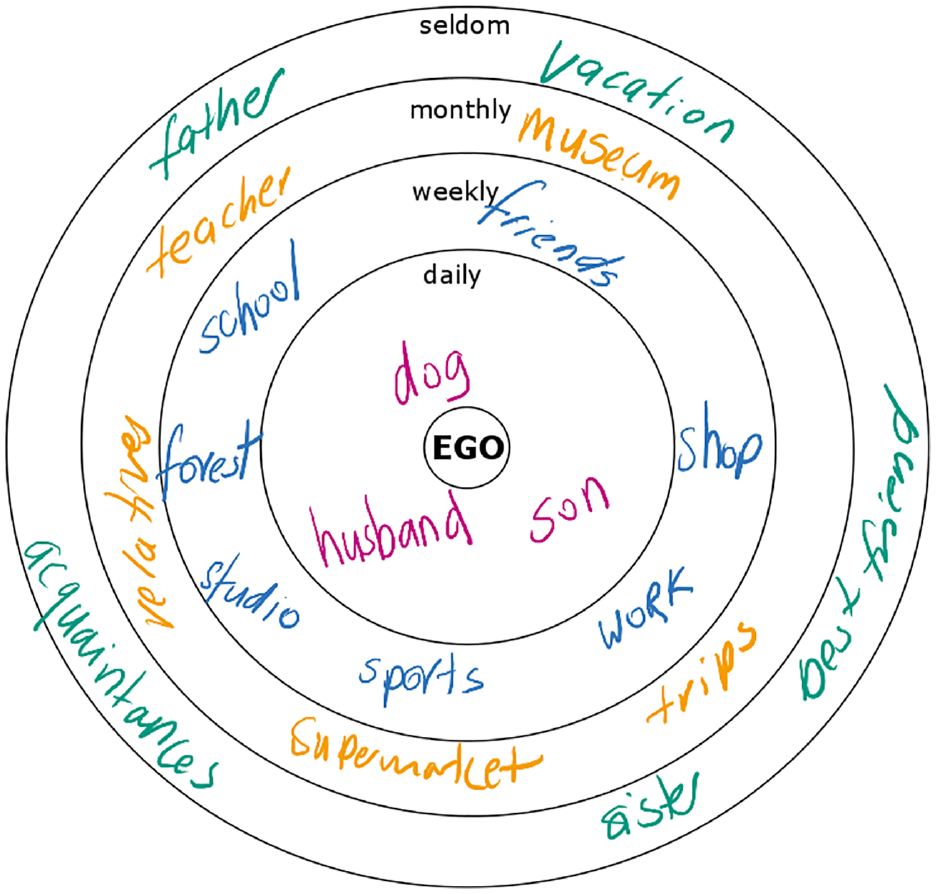
Example of social network plot.
Subsequently, participants filled out a travel diary over the period of one week. Activity diaries are a common source of data for the examination of travel behavior as they allow the collection of data on the context of travel ( 15 ). The diary used in this study captured information on the activity type, scheduling of trips, mode and destination choice, as well as presence of others during the activity. The reason for supplementing the qualitative data with a travel diary was to better understand the mobility related context of interactions, but also to reveal (more random) network partners that participants had forgotten to mention during the first interview.
A follow-up interview then explored mobility related aspects of the relations captured through the travel diary and the first interview. The reasons for using or not using different transport modes and destinations were discussed and whether there is a need for changes/improvements to the transport system. Questions focused on whether participants have the impression that they can do things differently and in what situations they do so.
The respondents were aged between 18 and 47. Some lived in single households, some in a flat-sharing community, some were single mothers, and others lived in dual-income households, thus the respondents provided a broad range of social realities. However, they have not been selected with statistical rigor and thus cannot be considered representative. Instead, interviewees were selected purposefully, so that they represent different sex, educational levels, and working status. The main selection criterion was whether interviewees lived in a household with or without young children. This criterion is based on the assumption that both groups differ in their freedom of choice and in respect to the social obligations imposed on them by others and the society as a whole. To be able to focus on social processes of mobility choices, spatial factors of the respondents’ living environments were kept similar. Therefore, all respondents live in the same inner urban district of Karlsruhe, characterized by social diversity and the co-existence of different lifestyles. The district provides good infrastructural connections offered by various tram stops and a diverse offer of service and product supply, such as restaurants, bars, supermarkets and playgrounds.
The Analytical Approach
The primary purpose of the analytical approach is to identify factors that explain the persistence of relationships or their potential for changes and to develop a usable typology of persistence and its impact on mobility. For our typology, four indicators are used:
Motivation: The first indicator relates to the degree to which people are motivated to establish and nourish distinct relationships. For example, some relationships are inherently satisfying and people are fully willing to keep this relationship alive, while others are rather perceived as a chore—and there are a lot of mixed motives in between these two ends. The theory of self-determination provides a valuable input for differentiating motivation along a continuum, ranging from pure intrinsic motivation to extrinsic motivation ( 16 ).
Reflectivity: What is important for our approach is not only the relationship itself, but also the mobility context of the relation. The second indicator is therefore applied to analyze the degree to which people reflect on their mode choice. The basic assumption of this dimension is that people act according to their practical knowledge of given situations. For example, for some relationships people do not reflect on the different alternatives that potentially exist. A typical example is the mode of travel to work. For other interactions, people reflect on a limited range of options (e.g., whether to take the bike or the car to pick up children). For still other interactions, people think of a range of possible alternatives and reflect on their mode choice consciously (e.g., visiting friends-at-distance).
Temporal flexibility: This indicator acknowledges that mobility related interactions come with different degrees of temporal flexibility. The authors agree with Schwanen et al. ( 17 ) that it appears too simple to think of activities as either fixed (e.g., work) or flexible (e.g., shopping) in a dichotomy. Rather the temporal flexibility can be considered as a scale in which different interactions range from high levels of flexibility to low levels of flexibility. Temporal flexibility is assessed by the rigidity of the time schedule and the degree to which it can be altered on an ad hoc basis.
Spatial flexibility: As with temporal flexibility, certain relationships are bound to a certain location, for example, a club site for performing team sports, while other relations allow for multiple destinations to perform an activity (e.g., individual sports). Spatial flexibility is measured by the actual number of locations used.
Motivation and reflectivity form a category to assess the substitutability of a relation. In doing so, it is assumed that relationships for which there is a high motivation to nourish them are not substitutable. Likewise, it is assumed that relationships that are associated with only one mode (low reflectivity) are subject to increased stability and substitution does therefore not appear very probable. Those relationships that are rather externally driven and where mode choice is reflected are supposed to be substitutable and that mode choice behavior can be adjusted (Figure 2).
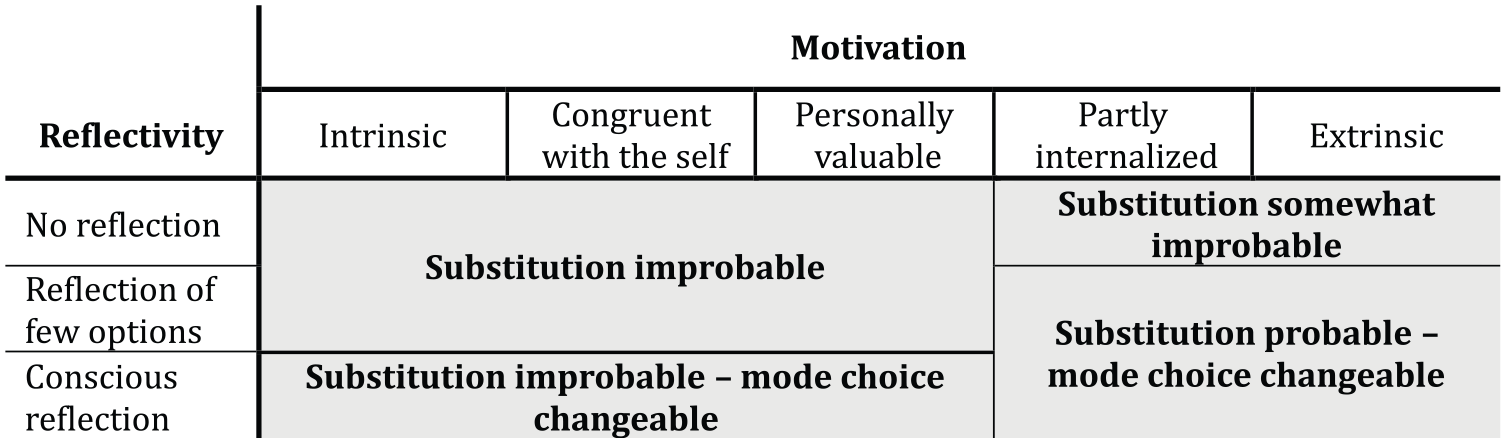
Substitutability of a relation assessed by motivation and reflectivity.
In order not only to assess the potential to substitute a relation, but also to modify its spatio-temporal setting, a spatio-temporal flexibility index is used. This indicates whether a relation is spatially flexible, temporally flexible, or both. From this, it can be deduced whether there is a certain probability if a certain relationship, for example, a certain sport, can be performed at a different location or at different times (Figure 3).
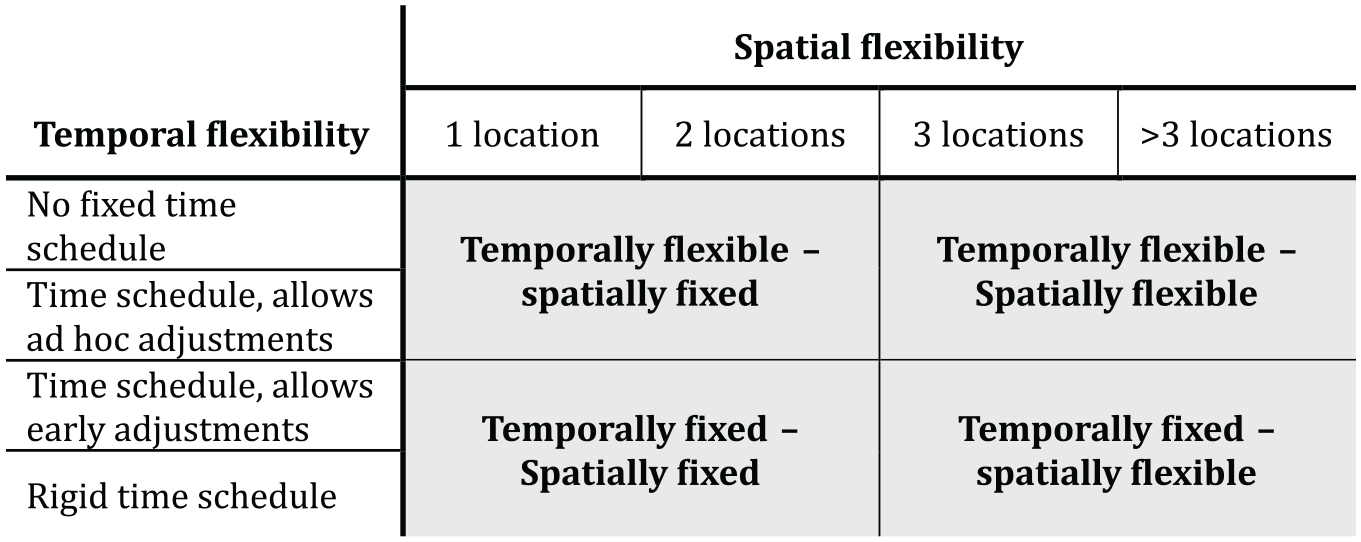
Spatio-temporal changeability assessed by spatial and temporal flexibility.
Taking this as a premise, interactions aggregated under the same transport purpose may imply subjectively different levels of persistence. For example, grocery shopping appears to be extremely flexible and a chore for some, while someone else perceives a very specific supermarket as a means to express social belonging ( 6 ). The willingness and competence to change behavior, to adapt to new circumstances or to substitute a relationship varies depending on the social and individual meaning of the relationship and the spatio-temporal flexibility that it allows. Based on these assumptions, this study differentiates three types of persistence and aims to outline the implications this may have for the adaptation to new services or restrictive interventions (Table 1).
Three Levels of Persistency
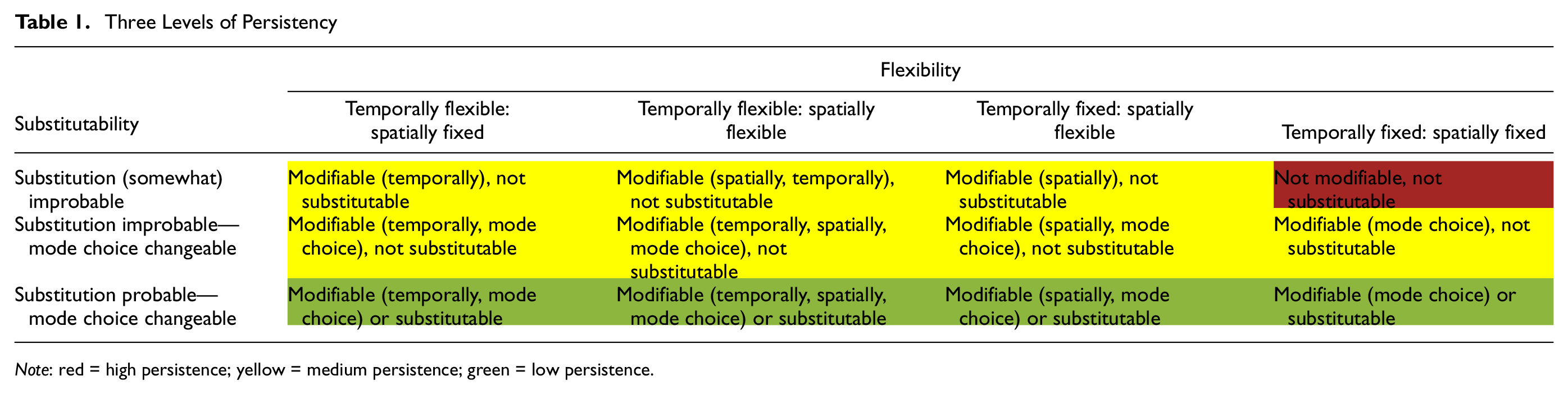
Note: red = high persistence; yellow = medium persistence; green = low persistence.
For relationships of high persistence (red columns), it can be assumed that interventions, new services, or both, do not lead to any significant changes in behavior. In contrast, interventions could trigger resistance and protest.
For relationships of medium persistence (yellow columns), it can be assumed that interventions, new services, or both, could lead to a reconfiguration in at least one dimension (temporally, spatially or mode choice). However, the relation is strong enough to remain part of the social network.
Relationships of low persistence (green columns), are principally assumed to be adaptive to new services or interventions, without triggering significant resistance. Relationships have not (yet) proved particularly meaning—or useful. The relationship could lead to a reconfiguration in one or several dimensions, or could be substituted by another relationship.
The different types of relationships classified in this manner can then be assessed according to their impact on travel. Frequency, regularity and distance are decisive for such an evaluation. To make this more explicit, this paper will present a detailed picture of the social network configurations and the respective mobility context of two interviewees.
Results
To substantiate the initial claims and underline the role of relationships for differences in mobility patterns, the authors decided to present two respondents in detail who are of similar socio-demographic characteristics. As such, the interviewees appear well suited to emphasize the benefit of a relational perspective in contrast to putting the focus on individual traits. They are both of similar age, of the same profession, they are both childless, and have a high educational qualification. From an attitudinal perspective, they both attach great importance to their physical and mental health, both are global thinkers and open persons who have traveled and experienced different parts of the world and they both care for their own future and that of the world in general. They represent typical young, well educated, inner city residents. Their mobility patterns differ substantially, however, and it will be shown that there are good reasons to assume that the stability and changeability of their mobility patterns also differs significantly. The authors aim to explain these differences by pointing to the interviewees’ distinct network configurations. The differences and similarities in their network configurations are exemplified in the following.
Case 1: Alexander
One of the respondents in Karlsruhe is a 35-year-old teacher. We will call him Alexander (Figure 4 gives an overview of his social network). Alexander works full-time around 50 km outside Karlsruhe; he draws appreciation from his work and likes what he is doing. As a teacher, he has a rigid time schedule, which largely follows external requirements. He is extremely familiar with his way to work; he reports that he even sees the same cars on the highway every morning. He has been living in the inner city of Karlsruhe for five years and enjoys living in the city center. However, Alexander grew up in one of the surrounding communities, where his parents still live today. Additionally, he has been engaged in a neighboring community association for more than 20 years, where he carries out several honorary activities, including being a member of the association board. For Alexander, daily life is configured around five long-lasting and highly persistent relationships. Apart from work, his partner, his volunteer engagement, his parents and a couple of strong friends are cornerstones in his everyday life. His relationships to the community association and to his parents and teenage friends have outlasted particular life events (such as relocation, change of job), even though his priorities have shifted toward work and partnership. He perceives these relationships as personally valuable. Alexander describes his motivation for the community association as follows: “To this day it is important to me. I have established many friendships over the past 20 years. It’s not just a hobby, it’s not a sport. I mean, you deal with people there. I can maintain many friendships only through this honorary commitment and that’s why I didn’t want to give it up, even if I live in the city center now.”
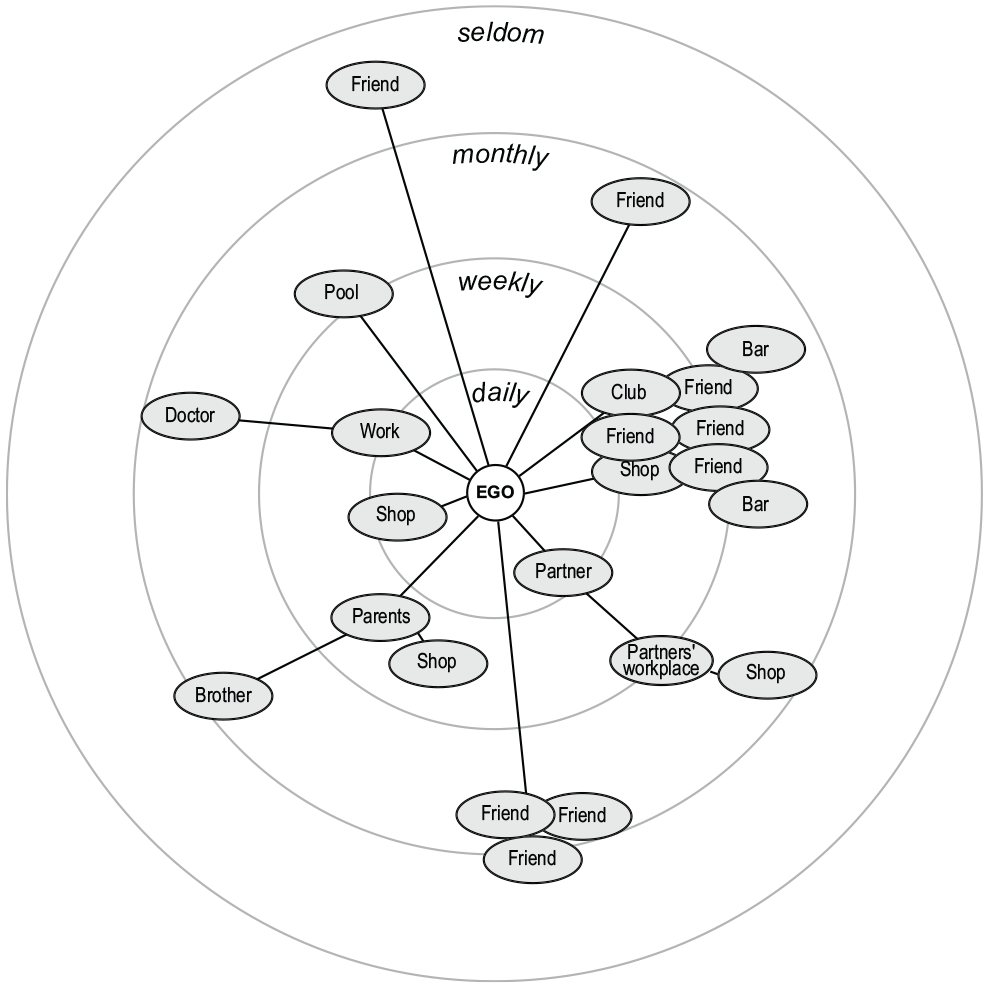
Overview of Alexander’s social network.
Alexander has a large network of strong and long-lasting friendships in and throughout the city. With most of his friends, he sets appointments about two to three weeks in advance. He has certain days which prove to be good for meeting friends and others for meeting his parents. He states: “Well, usually I try to visit them [parents] once or twice a week. Definitely once a week. That’s often on Sundays, to have lunch together or a cup of coffee. And sometimes also on Tuesdays.” Later during the interview, he continues: “I prefer to have these things fixed and to know: these dates are safe and then I have the flexibility to do the spontaneous things, to meet someone or to go out for a beer.” Often he visits friends at their homes, but sometimes they do things together, such as going to a bar. However, they do not have a particular bar, but a portfolio to choose from. Therefore, meeting friends is usually coordinated in advance and then set to a specific time. Doing sports (running and swimming) or meeting other friends is configured around these cornerstones.
Alexander perceives grocery shopping as a chore—he does not have a particular affinity to one store or another. He goes frequently to a supermarket in his neighborhood, but he is also familiar with several other stores, which are near to his workplace, his parents or the community association. He usually links grocery shopping to other appointments and states that he is not attached to a particular store. He states: “I try to handle this economically, both in terms of time and effort. I usually think where am I and what do I know on the way. For example, I don’t take the highway, but the country road. Or, if I come from my parents, I don’t drive directly into the city, but drive past the big supermarket. I try to do it on the way.” He used to do bulk purchases, but living in the city center taught him to walk over when he needs something. He still does a bulk purchase about once a month. For Alexander, grocery shopping is not bounded to a specific location nor does it follow a rigid time schedule. He is familiar with sufficient alternatives en route and does not have a particular relationship toward one store or another.
Alexander has owned a car since he was 18; he uses the car for commuting, but also for organizing his social life. For him, his car has always played a central role in daily life. He organizes his leisure network almost entirely by car. He is extremely familiar with trip chaining and parking situations and knows several alternative ways to organize the things he has to do (such as grocery shopping). However, for appointments in the city center, he usually walks or cycles: “Everything in the inner city, I do by foot or bike. I would never drive by car anywhere within the city center. […] To find a parking lot somewhere in the city, just to get something is terrible. However, I always take the car as soon as it goes out of the city, I don’t really think about it anymore. I can’t actually think of a situation where I did not take the car.”
Case 2: Julia
Another respondent is also in her mid-30s. We will call her Julia (Figure 5 gives an overview of her social network). She works at nearly the same distance and direction outside Karlsruhe as Alexander, and works as a teacher, too. Her working hours follow a rigid time schedule, even though she is rather flexible in where and when to do the preparation of her lessons. However, she prefers doing so at her workplace, to have a clear separation between work and home.
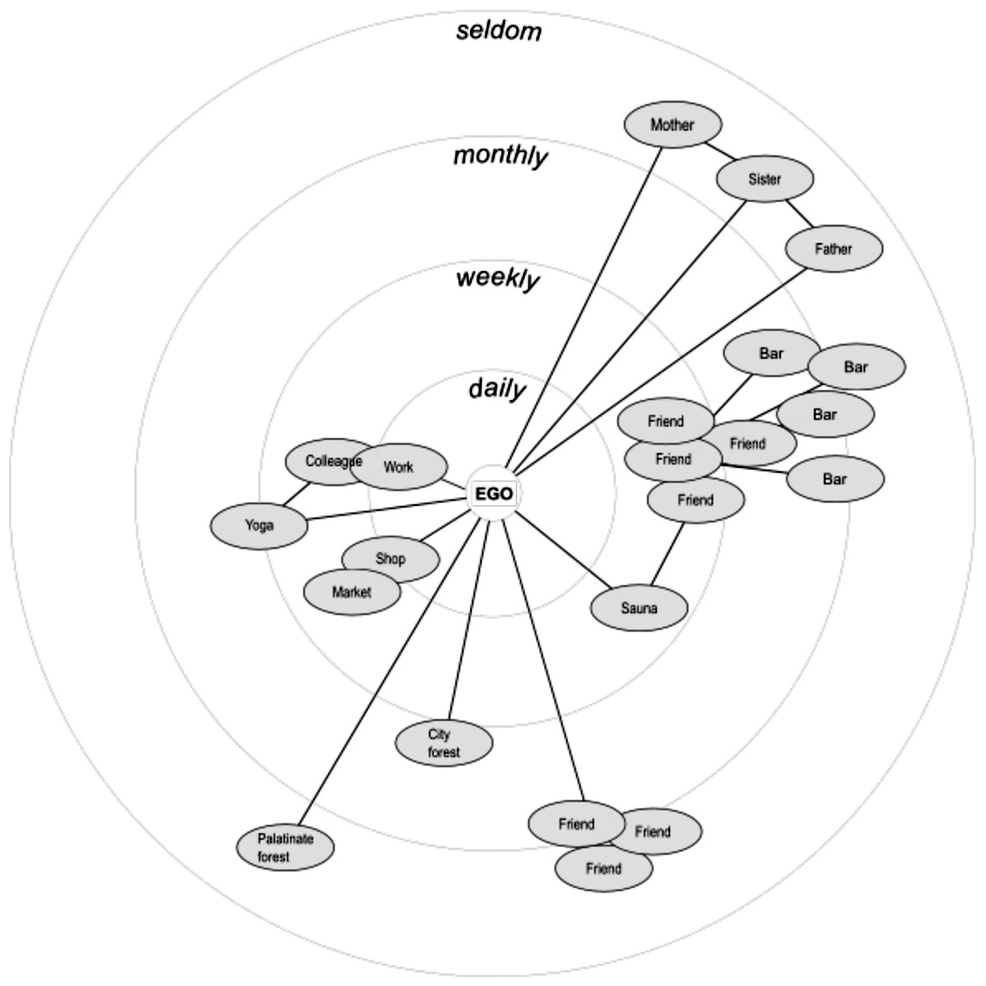
Overview of Julia’s social network.
Julia’s parents as well as her long-lasting friends live several hundred kilometers from Karlsruhe. It means a lot to her to keep these relationships alive, by periodic, though rare encounters, which are usually planned well in advance. She moved to Karlsruhe about five years ago after finishing university in another city. There are a few people in Karlsruhe she calls friends, some of whom are also her colleagues. She puts emphasis on her physical and mental well-being. In her spare time, Julia enjoys attending yoga lessons or going to the sauna. In relation to yoga classes, she states: “I never skip this.” She has spent several months abroad and has now resumed the course. She has also committed herself to go to the sauna once a week: “this is extremely important to me.” She prefers a specific sauna, even though there would be other options “because the other ones are horrible.” Other than for the yoga classes, she does not have a particular day for going. She inherently enjoys these activities. Julia does not have many long-lasting friendships in town—the sauna and her yoga class is an opportunity for her to meet other people. Additionally, she meets a group of friends and acquaintances every Sunday. For her, this date is fixed, while the meeting place is negotiated among the group. Out of this group, there are two friends she meets spontaneously every now and then for having a coffee together. For this purpose, a series of bars comes into question, all of them are no more than a means to an end; she would not go to them without her friends. Additionally she enjoys going to the forest. She usually goes to the city forest, which is close to her residence. Every now and then, if friends give her a lift, she goes to the Palatinate region, a famous hiking region, which she would like to do more often but it appears too complicated from a mobility perspective.
For grocery shopping, Julia prefers a specific, family-owned organic store and the open market in her district. She has internally set her “shopping day” on Saturdays: “I always go to the market on Saturday. And I get the rest from Holger [the organic store].” She does minor errands spontaneously after work in another supermarket, but states: “I think only because it is so close.” For her, grocery shopping is not necessarily characterized by joy, but by the goal to eat organic and fresh food. She willingly engages in these relationships because she sees an importance in it. That she finds both an organic store and the open market in her district is nice, but she would (and sometimes does) also undertake longer journeys to achieve this goal.
Julia’s relationships are either located in the city center or much further away. Unlike Alexander, Julia takes the train in combination with a folding bike for commuting. She does not own a car and is not a member of a car sharing association. Instead, she has a monthly train ticket and enjoys riding the bike. For her, everything in her daily life is accessible by bike. She is extremely familiar with most of the situations and usually does not think about which mode of transport to use, for her the bike is the most familiar. If a situation is novel to her, she usually looks up the bike route first. Just in cases when a journey is too far, she uses public transport. She is somewhat familiar with this transport system in Karlsruhe: “I always have to check which line to take and where to interchange, which is much more complicated [than riding the bike].”
Discussion
The aim of this study is to illustrate the social embeddedness of travel decisions, considering people’s relationships and their influence on people’s freedom of choice to do things differently. The detailed picture of the two respondents suggests that social network configurations can be very different, regardless of the individuals’ socio-demographic or spatial circumstances. Drawing attention to relations instead of individual characteristics adds further explanation to constraints and potential for change that usually remain under the radar of statistical surveys or model representations. People have different motives for traveling; focusing on relationships reveals these motives and points to different probabilities that these relationships will persist (Table 2). Alexander and Julia deliver useful representations for how differently relationships are experienced and what this means in relation to transport.
Alexander’s and Julia’s Relationships
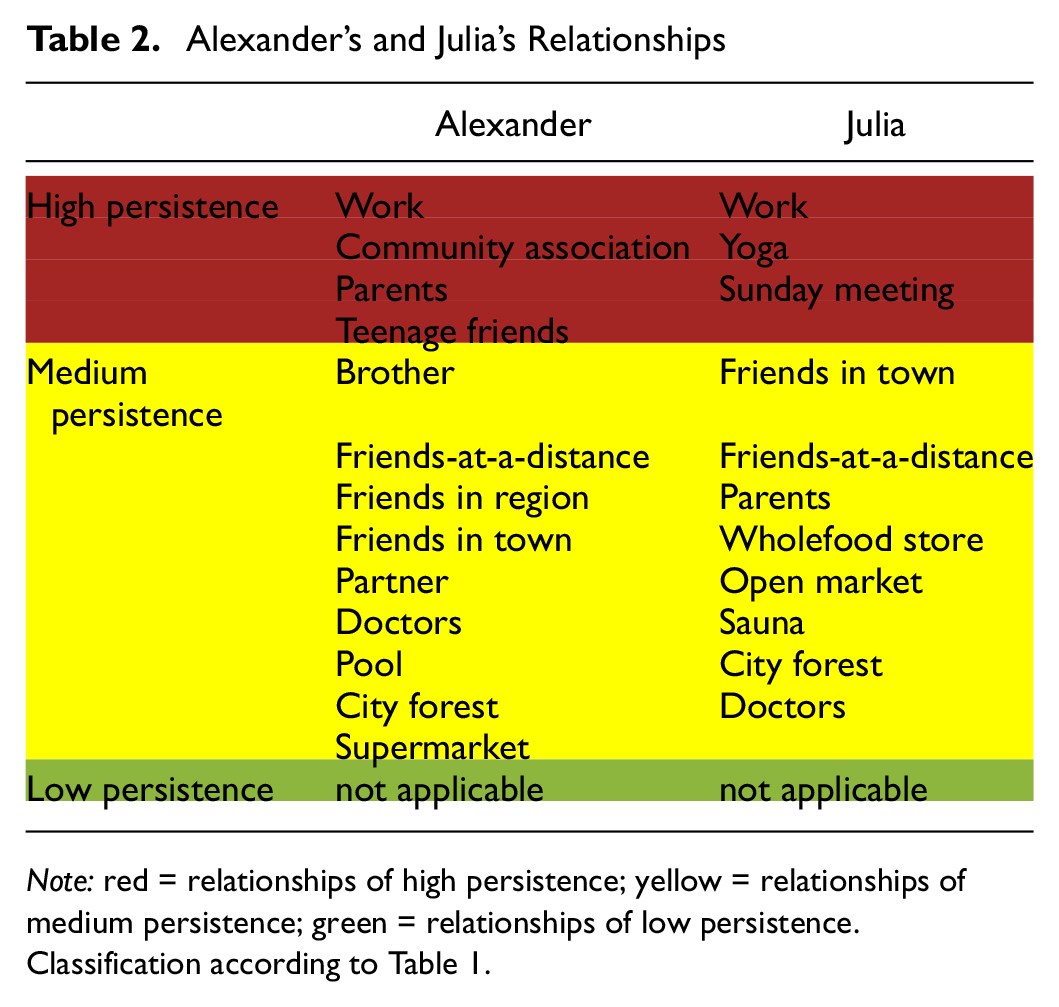
Note: red = relationships of high persistence; yellow = relationships of medium persistence; green = relationships of low persistence. Classification according to Table 1.
Alexander, for example, has a couple of highly persistent relationships, which are all located in a considerable distance outside the city center. There is no reason to assume that he is going to replace these relationships, even if other transport modes would be available that could transport him somewhere else faster and cheaper. For him, there is no alternative to these relationships. He is willing to maintain all his relations frequently and regularly. From a transport perspective, all of his highly persistent relationships are located between 20 and 50 km outside Karlsruhe, which makes the car the most convenient transport mode for him. The density and geographical dispersion of Alexander’s highly persistent relationships illustrates that focusing on individual travel purposes and their generalized costs of travel cannot entirely estimate probabilities of behavioral change. Even though very good public transport services are available for each of these relationships, Alexander does not take them into account, because of the variety of people and requirements he aims to meet in daily life. For Julia, her workplace, her yoga club and her weekly Sunday meeting are cornerstones of everyday life and a means to meet other people. Since her workplace is the only relationship in everyday life that is further away, she manages to go there by public transport. All other cornerstones are accessible by bike or on foot. In general, relationships of high persistency tend to be regulated by personal will, and not, or less, by external stimuli to minimize cost or travel time. It can be assumed that any interventions, new services, or both, do not lead to any significant changes in behavior. In contrast, interventions could trigger resistence and protest.
For relationships of medium persistence, it can be assumed that interventions, new services, or both, could lead to a modification of at least one dimension (e.g., spatial or temporal setting), but that the relationship will remain part of the existing social network. Looking at the changeability of Alexander’s and Julia’s relationships illustrates that, for both of them, most of their relationships are only changeable in temporal terms. Julia, for example, is very reluctant to go to another type of store; she is internally motivated to shop in exactly this store and the open market; likewise, she is not willing to go to another sauna. For Alexander this applies to his relationships to the public pool. He always goes to the same one, even though there are other options. For both, visiting friends or family members also appears temporally changeable, but not spatially, since they usually meet at their own homes. However, some relations are also changeable in spatial terms, for example, when they meet friends at a bar or restaurant. Both respondents are not attached to a specific bar or restaurant but are open to try out new things and places. However, these interactions are largely dependent on negotiations with others; estimating the changeability must therefore take these others (and their network configurations) into account. In relation to the changeability of their mode choice, we see that both respondents seem to be largely fixed to a certain mode of transport, without actively looking for alternatives. For Alexander it is clear to take the car for out of town activities and to walk or cycle for activities in town. For Julia it is the bike that takes her almost everywhere. Against the background of these relationships and their characteristics, the demands on new services or interventions appear very challenging.
As for the highly persistent relationships, focusing solely on generalized costs of transport tends to underestimate the stabilizing force inherent in certain relations. Most of the travel decisions of the participants presented here in detail are characterized with an extremely low level of reflectivity. This is particularly because of the focus of the paper on central aspects of daily life. However, over the course of the week in which the respondents filled out the travel diary, several relationships and activities were reported that were rather novel to the participants. It turned out that participants apply a kind of heuristic to different situations that influences their mode choice substantially. Certain relationships, which take place irregularly, such as going to the doctor, are then based on this heuristic and less on generalized costs of transport.
However, the low reflectivity as well as the observation that relationships can only be modified in very specific dimensions points to a significant stability in relation to their overall network configuration. Neither Julia nor Alexander report relationships that appear substitutable. It becomes obvious that a huge variety of new options would be needed to modify the bundle of Alexander’s car trips now needed to hold his social network together. From this point of view, it does not seem realistic that a transition can be triggered by digitalization alone, and if that would be more sustainable. For example, some of the relationships currently associated with joy but likewise with a high level of reflectivity, such as hiking in the Palatinate region for Julia, could become a more permanent part of her social network, if attractive new services were available.
Conclusions
The paper argues that social relationships are significant for understanding developments within the transport system and for assessing potential changes. It provides an approach to systematically analyze the meaning of social relationships and their spatio-temporal ordering in daily life. By relationships, we refer to relations between individuals, things and places. Instead of linking transport choices solely to the performance characteristics of distinct modes or attractivity levels of destinations, the authors propose taking the specific character of personal network configurations into account. This will help in assessing the transformative potential of new mobility offers and other interventions within the mobility system.
Against the background that developments in digitalization in general and the upcoming new mobility services in particular fuel discussions about the likeliness of travel behavior changes, this study presents an approach to operationalize social processes of travel behavior for the assessment of potential changes. Given that the meaning of relationships (or a respective activity) lies outside typical transport model boundaries, models are not capable of taking social settings as a stabilizing factor into account. Instead, they risk overestimating the impact of infrastructural or technological changes, because of the implicit assumption that such interventions are capable of reconfiguring personal social networks. However, the data suggest that external pressures may cause an adaptation for single relationships, but do not necessarily cause a reconfiguration of the network in general. In addition to usual choice indicators (time and cost), information on spatio-temporal flexibility and reflectivity could lead to a more profound understanding of the changeability of existing social network configurations. The use of data on relationships and measures on motivational aspects could be used as indicators of the (rather long-term) persistence of relationships and a more robust analysis of potential changes induced by infrastructural or policy interventions. Moreover, the indicators and the typology of persistence introduced here can also be used to assess institutional changes in different life domains (e.g., family life, working arrangements, leisure trends).
However, several challenges and open questions remain and point at promising directions for future research. First, one objective of this approach is to develop a modeling framework, in which relationships provide a meso level to enhance the assessment of behavior stability and variability. Second, for developing a robust modeling framework, results need to be quantified. So far, the qualitative design of the study provides valuable insight into the factors that lead to behavior stability, but does not enable us to make reliable assumptions on the extent to which socio-demographic characteristics have an effect on individuals’ propensity to value certain relationships in one way or the other. Third, the approach appears particularly suited to accommodate broader social dynamics and processes of institutional change in a modeling framework. For example, scenarios could be developed that systematically outline how future working or school environments, family life or leisure preferences will change and how that may affect personal network configurations and respective travel decisions.
Footnotes
Author Contributions
The authors confirm contribution to the paper as follows: study conception and design: Maike Puhe, Jens Schippl, Torsten Fleischer, Peter Vortisch; data collection: Maike Puhe; analysis and interpretation of results: Maike Puhe, Jens Schippl, Torsten Fleischer; draft manuscript preparation: Maike Puhe, Jens Schippl. All authors reviewed the results and approved the final version of the manuscript.
Declaration of Conflicting Interests
The author(s) declared no potential conflicts of interest with respect to the research, authorship, and/or publication of this article.
Funding
The author(s) received no financial support for the research, authorship, and/or publication of this article.