




Abstract
Given that older adults are prone to car cessation, they may also be at risk of food insecurity. Online shopping has the potential to become a key solution to this growing social issue. The objective of this study was to understand how mode use relates to food shopping patterns, and what specifically motivates older adults to choose certain travel modes for grocery shopping or to shop online. Sixty-one retired individuals were interviewed in Montreal, Canada. Participants were first asked to discuss their food shopping habits and the modes they used to purchase food. Then, participants were asked open-ended questions about beliefs from the theory of planned behavior. Participants listed advantages/disadvantages, people who approve/disapprove, and facilitating factors/barriers related to travel modes and online grocery shopping. Most participants never used online grocery shopping. Results revealed similarities in shopping styles between car drivers and online shoppers. Both were organized (prepared lists), shopped in bulk, and went on regularly timed shopping trips. Public transit (PT) and active mode users were spontaneous and irregular shoppers who viewed in-person shopping as physical and social activity opportunities. Grocery shopping using these modes could be made easier for some participants if shops offered home delivery after in-store purchases. Car drivers were more likely to adopt online services than PT or active mode users who preferred delivery after in-person shopping to reduce obstacles linked to these modes. In order for online grocery shopping to be integrated as part of one’s established habits, both travel habits and grocery shopping habits must be observed jointly.
Among the general population, older adults constitute the group that has the highest risk of food insecurity. This risk can result from factors such as socio-economic status or gender ( 1 ), or an individual’s living environment, such as the neighborhood where they reside ( 2 ). While individual and environmental food insecurity risk factors vary across cities and neighborhoods, the availability and use of travel modes undoubtedly accounts for large differences in access to healthy and fresh food ( 3 ).
Aging is a long-term process, which involves many phases. The difference between “old” and “young” people is determined by social and cultural constructs rather than by directly observable attributes. Accordingly, aging is not always clearly defined, and can be related to chronological age, retirement status, health status, or because one belongs to a social group composed of older people ( 4 ). In most countries across the world, these attributes co-occur around the chronological age of 60–65. While individuals are officially permitted to retire at age 65 in most developed countries, most lifestyle attributes consistent with aging—such as health and belonging to the social category of “older individuals”—appear earlier, at age 60. Travel modes used by an individual and food shopping habits are part of these lifestyle factors. For the purposes of this study, we shall apply the World Health Organization’s (WHO) definition of older individuals as those 60 years of age or older ( 4 ).
The need to travel for food shopping is an increasingly important social issue affecting older individuals ( 5 , 6 ) and is likely to remain a political preoccupation in the coming years. Given that older individuals are expected to cease driving and lose mobility ( 7 ), they are at high risk of food insecurity. Transportation planning for food access currently needs to prioritize social sustainability goals, while promoting subjective well-being, independence, and the social inclusion of older adults ( 8 ). Older adults, just as any other group within the population, are expected to reduce car driving and increase their use of alternative travel modes to address environmental sustainability goals. Many older people are forced to forego driving as their skills and reflexes decrease. This provides a great opportunity to foster this modal transition.
Online food shopping can improve food security in areas with limited access to retail food stores and among population segments with limited travel options. Despite this, the question of how online shopping fits with existing and long-term shopping practices and travel patterns has not been adequately addressed in older adults. The motivations for using online shopping instead of travel modes for grocery shopping are unknown. The objectives of this study were: 1) to examine how the use of travel modes relates to current food shopping patterns; 2) to understand how easy or difficult grocery shopping is for older adults, depending on used travel mode as well as online grocery shopping; and 3) to discuss the extent to which drivers, public transit (PT) users, or active mode users intend to include online grocery shopping as part of their habits in the future.
Literature Review
Context: Population Aging and Transportation Planning in Montreal
Montreal is one of the five largest metropolitan areas in Canada. On a yearly basis, it is exposed to at least six months of extremely cold temperatures, snowfall, and icy rain.
The proportion of adults over 65 years old in Quebec is 19.9% ( 9 ). This share is comparable to other developed and developing countries, and is expected to grow in the coming decades ( 8 , 10 , 11 ). Based on this anticipated increase, the city of Montreal has implemented various action plans aimed at older adults ( 12 , 13 ) and the provincial government is focused on fostering independence, well-being and social inclusion ( 14 ). Food shopping behavior is a significant contributing factor to the independence and health of older adults. Transportation option availability and the use of specific modes are decisive factors related to food insecurity in older individuals ( 15 ). A lack of transportation options can lead to food insecurity, regardless of food store proximity in given neighborhoods ( 3 , 16 ). The fact remains that older adults eventually lose mobility and cease driving, which ultimately increases their risk of food insecurity ( 7 ).
In Montreal, many older adults choose to live in private retirement homes, where they benefit from a variety of food and mobility plans. The living arrangements range from apartments with fully equipped kitchens, or studios equipped with a microwave and a small fridge. Residents can opt to consume 1–3 meals a day at the cafeteria, prepare food in their own apartments, or both. Along with housing and meals, retirement homes offer mobility options beyond general services like PT, paratransit, taxis, or ridesharing. These include the possibility of renting a parking, and the provision of shuttle services. As such, residents can either use paratransit services, which are funded by social welfare programs and are therefore free for disabled individuals, or shuttle services, which are available to all residents. On a weekly basis, shuttles drive the residents to the grocery store, the shopping mall, and leisure activities free of charge. By comparison, older adults who choose to live on their own are responsible for both their meals and travel.
Montreal encourages elderly to use alternative transportation to foster environmental sustainability ( 12 , 13 ). To encourage the use of PT, key transit agencies have implemented a variety of actions including increasing the number of elevators in subway stations, and improving connectivity of the PT network ( 12 , 13 ). Seniors also receive a 40% discount for monthly PT passes. Efforts are also being made to adapt sidewalk features and street crossing timing to slower moving populations with mobility restrictions ( 17 ).
Food Shopping and Mode Choice
In previous Montreal studies, no specific food deserts were identified per se ( 2 ). The research focused on food deserts using measures of supermarket density, which neglected important information, because they obscured the ability of individuals to choose and reach stores located farther away ( 18 , 19 ). Individual preferences and available travel modes are not assessed when using measures of store density or spatial accessibility. Furthermore, previous research has considered the implications for the general population, without specifically focusing on the elderly.
Given this, additional research on user strategies, preferences, and travel modes used by individuals for the purpose of shopping is clearly warranted ( 3 ). To account for the changing food retail market, including the growth in online grocery shopping options, it is also pertinent to investigate how older individuals react to online food shopping options compared with in-person store visits.
Current and Future Online Grocery Shopping Trends
Traveling for food shopping is increasingly becoming optional as a result of multiplying online grocery options. Customers generally opt for online food shopping because they have a wider range of options and can shop any time of day or night. Online grocery shopping can also contribute to healthier lifestyles since it limits impulse buying ( 20 ). At the same time, the delivery of goods purchased online arguably contributes to a similar environmental footprint as traditional shopping behavior since an increase in deliveries can lead to increased CO2 and greenhouse gas emissions ( 21 , 22 ).
Nevertheless, online shopping will likely continue to gain in popularity among the general population. Because of ongoing competition among stores, most are likely to adopt online selling as an option for customers. As a consequence, the number of physical shops will likely decrease over time ( 23 ). This means that older adults will possibly have to shop online for a portion or perhaps the entirety of their groceries because of decreasing physical access. However, older individuals are not yet a central target market for online groceries. According to available literature, target customers are typically young professionals and families with children ( 24 ) who buy groceries online to save time, purchase niche or high-quality products, or both ( 25 ).
The situation in Montreal is indeed reflective of these trends. Online food purchasing options have been expanding in recent years and now include meal kits ( 26 , 27 ), fruit and vegetable baskets delivered by local producers ( 28 ) and online supermarkets which, in 2019, were being offered by two major supermarket chains ( 29 , 30 ). In addition to in-store shopping, these supermarket chains offer three grocery shopping options: (a) online shopping; (b) online shopping with in-person pickup; and (c) in-person shopping with delivery. Online grocery shopping is done entirely online, after which the grocery order is delivered, thereby requiring no travel by the consumer. Online shopping with in-person pickup involves traveling to the store to pick up the goods selected online. In-person shopping with delivery involves traveling to the store and picking out and paying for individual goods before having them delivered. Officially communicated costs of online shopping were Can$4 for cart assembly and Can$3−8 for delivery ( 29 , 30 ). While these costs may be prohibitive to lower income groups of society, the revenue agency of Quebec allows tax deductions for cart assembly and delivery fees for seniors ( 14 ). The tax incentive suggests that the Quebec government favors online shopping for older adults as a way to support independent living and acknowledges its additional cost.
Using information and communication technologies is obviously required for online shopping. According to recent data for Quebec, most older adults own a computer/laptop (68%), a tablet (51%), a smartphone (46%), or any combination of these. Of older adults, 47% use these forms of technology on a daily basis to communicate with family and friends, search for information, and shop for (non-food) items ( 31 ). However, there is limited research on how online shopping could complement the established food shopping habits of the elderly. The impact of the tax-deductible delivery price and the extent to which other elements can enable online shopping in older individuals has also not yet been documented.
Understanding Mode Shift in Older Adults
Baby boomers are known to have entrenched car use habits and preferences ( 32 ). More recent studies, however, suggest that mode choice in older adults is more diversified, and usually depends on travel purposes. Moreover, older adults show more openness toward shifting modes than seniors from previous generations ( 33 , 34 ). Specific factors that influence travel mode use and travel mode shift for food shopping purposes include loss of mobility, weather conditions, and the need to carry packages.
With a view to achieving environmental sustainability, policy makers encourage increased alternative mode use and reduced car driving ( 12 , 13 ). In fact, individuals are even being highly encouraged to shift toward participating in activities that require no travel at all. For example, the Quebec government supports shopping without any need for travel by allowing tax deductions for food delivery costs. However, much of the scientific research suggests increasing travel is positive for older individuals, as travel and associated participation in social activities improve quality of life and independence, and may help prevent malnutrition ( 8 , 35 , 36 ). To date, little research has been conducted on relationships between travel modes and food shopping patterns and the readiness to adopt online food shopping. Studying how online food shopping fits in with existing shopping and mode use habits, and to what extent in-person grocery shopping could be substituted can help define future service provision policies and practices.
The objectives of this study were: 1) to identify grocery shopping patterns in relation to travel modes; 2) to identify the factors that make it easy or difficult to use different travel modes and online groceries; and 3) to explore whether online shopping fits within current shopping practices, and which particular mode users are more likely to successfully adopt online grocery shopping.
Intention Formation to Use Travel Modes or to Shop Online in the Theory of Planned Behavior
This study builds on the social-motivation framework of the theory of planned behavior (TPB), where individuals are viewed as intending or avoiding action ( 37 , 38 ). The intention to adopt (/avoid) a behavior builds on psychosocial constructs or “motives” that maximize the advantages and minimize the disadvantages for the individual.
The typical customer is thought to evaluate the subjective benefits from the consumption of goods and services ( 39 ). Subjective benefits are the “beliefs” components in the TPB. “Behavioral,”“normative,” and “control” beliefs refer respectively to the individual benefits, the perceived social pressure, and the individual’s ability to perform the behavior. Reasoning starts with the evaluation of behavioral beliefs, which are the expected advantages and disadvantages of the behavior ( 40 ). Favorable behavioral beliefs reflect advantages of the behavior, and lead to intentions to act. Individual decisions can also be guided by social surroundings, where individuals perceive that social referees have an influence or place pressure on the individual to perform the action. The more an individual perceives other people’s expectations to perform a certain behavior, the more he or she will consider the behavior as socially accepted, and the more he or she will intend to perform that behavior. The third component of intentions is control beliefs, which is composed of the individual’s perceived abilities as well as factors and situations that help or hinder action. The more a person believes that he or she can cope with the hindering situations, the more that person will perceive a strong control, and the more likely it is that he or she will intend to act. Intention to act is considered a building block for the actual adoption of a behavior of interest. In this case, we focus on in-person food shopping or a new behavior, online shopping.
While other psychosocial theories could prove useful to this topic, our specific interest in understanding actual choices, intention building for use and non-use, and the psychological aspects behind them made the TPB a preferred choice for this study.
Method
Procedure
Participants were recruited in retirement homes, leisure activity centers, and community centers in the Greater Montreal area.
The data collection protocol was approved by the University’s ethics committee. We sought to recruit participants over the age of 60, and aimed to achieve an even gender distribution, a diversified age distribution, and a variety of proximities to grocery stores. We selected retirement homes, community centers, and leisure activity centers with access to grocery stores located in the near vicinity (less than 10-minute walking distance), at a moderate proximity (10 to 20-minute walking distance), or far away (accessible only using a motorized mode of transportation). Retirement homes, community centers, and leisure activity centers were first contacted to request permission to collect data. Once we were granted permission, we were invited to present the study at an event or meeting and then conduct interviews with the individuals who agreed to participate.
Participants recruited at community centers mostly lived in their own homes or apartments. Because participants who visit community centers and leisure activity centers might live in a different district, with higher or lower supermarket density, candidates were asked to additionally indicate a street crossing representative of their living location. While many solicited individuals refused to participate, no volunteer participant was rejected. Authors recruited new participants as long as answers included new information on the discussed topics. A total of 61 participants were recruited, as saturation of the responses was reached (meaning no new concepts or ideas emerged).
Questionnaire
The interview was composed of three parts. The first part involved the participants openly describing their general food shopping habits, meal organization, and actual shopping trips. In the second part, each participant was randomly assigned one of the four following food shopping options: using a car; using public transit (PT); using active modes of transportation; or shopping for groceries online. Questions in this section were based on the TPB constructs and were formulated using the conditional form to assess beliefs in both users and non-users ( 41 ). The third part aimed at collecting data on the participants in relation to socio-demographics, availability, and use of travel modes as well as use of information and communication technologies. The semi-structured interview guide was designed as follows:
1) Assessment of current eating and shopping behaviors in relation to travel mode use or online grocery shopping. Open-ended questions asked about living arrangements, food shopping, meal preparation and eating habits, preferred food store types, and average grocery cost and size. All 61 participants answered this first set of questions. This first part allowed us to assess the extent to which living conditions and travel mode choice were associated with grocery shopping patterns.
2) Open-ended questions on the motives for using specific travel modes and shopping for groceries online were assessed using a TPB elicitation questionnaire. This questionnaire was inspired by public health belief elicitation studies ( 41 ). Participants were randomly assigned to list TPB beliefs either about car driving, PT use, active mode use, or online grocery shopping. Each participant was asked about the advantages/disadvantages (behavioral), the people who encourage/discourage (normative), and the factors/situations that help/hinder using either mode or online grocery shopping services (control beliefs). The belief elicitation was meant to establish why individuals did or did not use respective travel modes and online grocery shopping. Therefore, the TPB questions were assessed using conditional formulation in users and non-users. Participants who had never used a specific travel mode or shopped for groceries online explained why they avoided using this option (and vice versa). An example item for belief elicitation was: “If you had used PT the last time you went grocery shopping, what would have been the advantages (/disadvantages) of using PT for food shopping?” Subsamples were created with 15, 15, 16, and 15 respondents, respectively to discuss TPB beliefs about car driving, PT use, active modes, and online shopping.
When reading the results below, it is important to keep in mind that beliefs were assessed in users and non-users using self-declared statements in response to a question formulated in the conditional form. Self-reported opinions are limited to the elements participants perceive as items that make services useful for them or not. These elements can change once an individual has truly experienced using different travel modes and shopping online.
3) A questionnaire on socio-demographic characteristics completed the interview. Participants were also asked about the regular mode they use for food shopping (occurrence in the last month), the modes they would like to use, perceived physical activity limitations, and their use of information and communication technologies over the past month. Mode use and online shopping habits, as well as the desired mode for shopping trips were assessed. This assessment allowed us to identify gaps between real and desired use. Perceived difficulties in walking or climbing stairs were assessed by asking participants how often these difficulties had been encountered over the previous month. The ownership and use of information and communication technologies were assessed by asking participants if they owned a computer or laptop, tablet or smartphone, and by asking them how often they used these in a typical week. All 61 participants also responded to socio-demographic questions.
All of the interviews were recorded and transcribed. Verbatim data were classified in semantic item categories. Verbatim data are available on request.
Results
Sample Description
Between March and August 2019, 61 participants were interviewed (women = 67.2%, mean age 74.5, SD = 9.4). Data relative to the sample description are shown in Table 1. Over half of the sample participants were recruited in a retirement home where they lived in apartments or studios with fully or partly equipped kitchens (57.4%), and the remaining individuals were recruited in community and leisure activity centers and either owned homes/condominiums or rented apartments. The two most frequent highest educational attainment levels were high school and bachelor’s degree. The majority of the sample belonged to low and middle-class households (income ranging between 20k and 60k). Of the sample, 29.5% lived in areas where a grocery store was within 10-minute walking distance; 19.7% lived in neighborhoods where a grocery store was a 10 to 20-minute walk away; and 50.8% needed a motorized mode of transportation to get to the nearest grocery store. Most participants owned at least one form of information and communication technology: 55.8% owned a computer/laptop, a smartphone (54.1%), or both. Slightly less than half of the participants reported that they also owned a tablet (39.3%). Together, 67.2% of participants used their computer/laptop, smartphone, or tablet daily. Respectively, 1.6% and 3.3% used information and communication technologies 3–4 times a week or 1–2 times a week, and about a third of participants (27.9%) never used information and communication technologies.
Sample Description (n = 61; Mean Age: 74.5; 67.2% Women) a
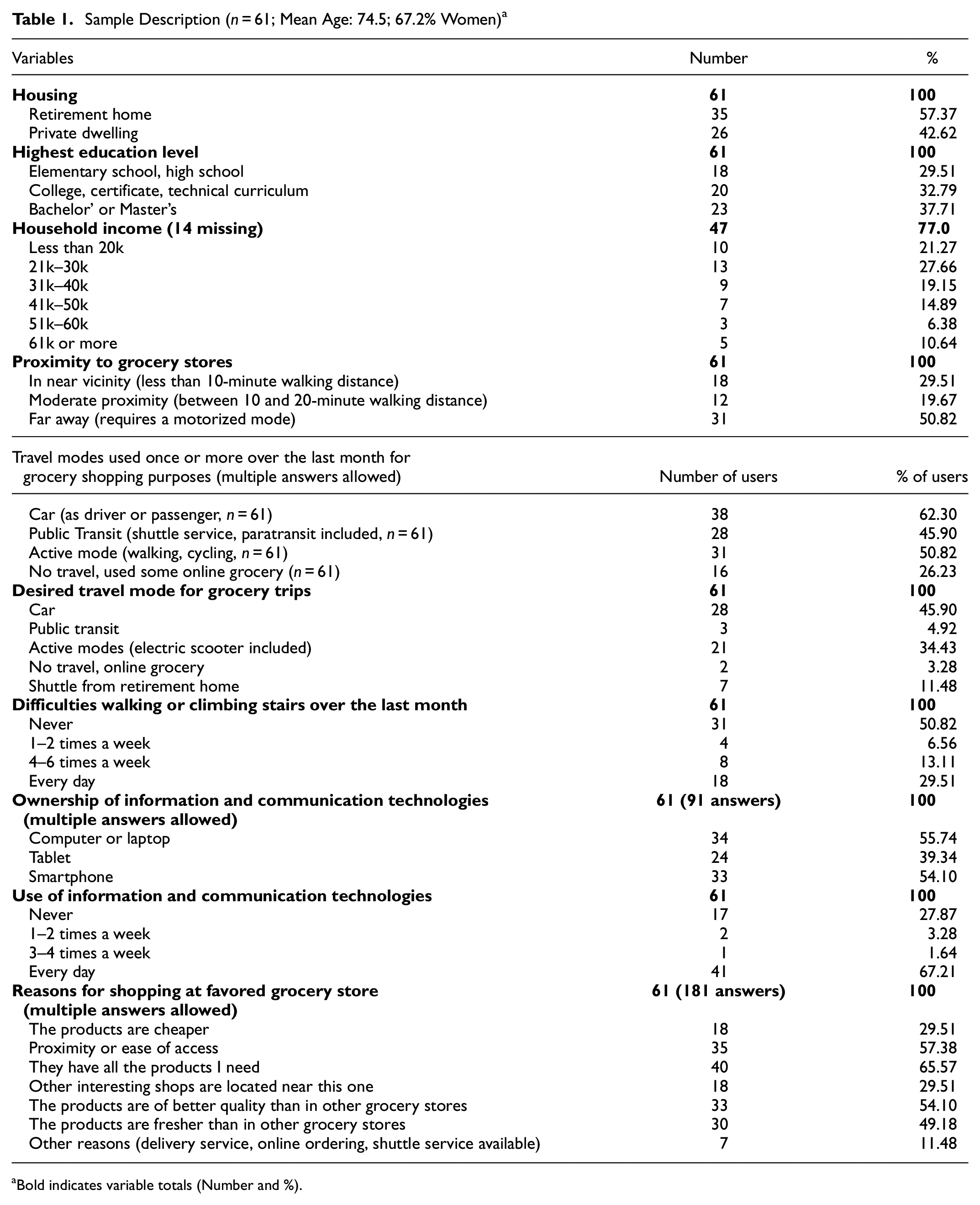
Bold indicates variable totals (Number and %).
Over the month preceding the interviews, the largest proportions of participants used a car at least once (62.3%), or PT once or more (45.9%) to go shopping. 50.8% of the sample used active modes of transportation and 26.2% had opted for online groceries at least once. The mode that was used was different from the desired mode. Nearly half of participants would have preferred to go to the grocery store by car (45.9%) while a little over a third would have preferred active modes (34.4%) and 11.5% would have opted for the shuttle. Very few participants would have preferred to use PT or online grocery shopping (4.9% and 3.3%).
Most participants had not perceived experiencing any difficulties walking or climbing stairs over the previous month (50.3%) whereas 6.6% and 13.1% had experienced respectively 1–2 or 4–6 episodes where they experienced such difficulties. One third of participants (29.5%) experienced these difficulties on a daily basis. On average, participants went grocery shopping outside of peak hours, generally around noon (mean = 12.08 p.m., earliest shopping activity at 7:30 a.m., and latest trip to a grocery store at 7:30 p.m.). The next section will discuss the associations between shopping patterns and the travel mode used in the sample, followed by a presentation of the underlying motives behind using specific travel modes or buying groceries online.
Travel Mode Choice Reflects Constraints for Food Shopping
This section presents the results related to the first objective: to identify current food shopping patterns and their associations with travel mode choice. Shopping patterns were associated with two important attributes: living arrangements and travel mode choice.
Living arrangements were understood through interviews as the housing, lifestyles, and diets followed, in relation to the shopping needs and patterns. Above all, participants’ living arrangements and lifestyle attributes reflected the need to shop for food or not. Health conditions such as low blood pressure or diabetes were crucial determinants in choosing specific ingredients at a grocery store. Available kitchen equipment and a certain level of cooking skill were, at the most basic level, related to the need to go grocery shopping. Participants who owned few kitchen appliances declared being unable to cook wholesome meals. These participants declared that they frequently ate at the cafeteria or bought frozen, convenience or deli-style meals on-site, in residences. The presence of a romantic partner was a trigger for the preparation of homemade meals on a regular basis, and the need to shop for food.
Living far from grocery stores was related to travel mode choice for car drivers, but less so for PT, shuttle service, and active mode users. Most car drivers declared not having any grocery stores within walking distance, and therefore drove to the grocery store on a regular basis. Certain participants had no other option but to walk or use PT or a shuttle. Participants who lived in retirement homes or in moderate proximity to a grocery store used the shuttle service or PT. Fewer of them walked to grocery stores.
Distance, however, is not always the most significant factor when it comes to mode choice since individual preferences and shopping attributes can be equally important. The attributes referred to in this case are household chore management, larger buying capacity when using cars or the additional physical activity that can be gained from walking to the grocery store. Some participants mentioned that the grocery store was accessible within a five-minute walk but preferred to use their car to increase carrying capacity. Car drivers typically perceived shopping as a household chore that needed to be scheduled while walkers deemed shopping to be a fun outing. Certain walkers opted for walking despite relatively long walking distances to and from the grocery store (>30 min or more). These participants chose walking because of the additional physical activity and fresh air they got to enjoy. Shuttle bus users preferred their chosen mode over any other mode since there were no additional fees for the service and it enabled travel for those with no other options. Participants preferred using shuttle busses over PT.
The relationship between travel mode choice and shopping patterns reveals the influence of buying capacity, the regularity of store visits, loyalty to specific stores, and the availability of money-saving options.
Travel mode choice was an important facilitator for regular store visits and buying capacity. Participants who had physical limitations went to the grocery store on an irregular and infrequent basis. They consumed most of their meals at the cafeteria of their retirement home and experienced a few sporadic food shopping episodes for which they personally did not go to the store. When meals were not consumed at the cafeteria, participants with physical limitations stated that they consumed deli-style or convenience meals. Deli-style meals, convenience meals, desserts, liquor, or snack items were reported as being optional extra items. Disabled participants purchased these extra items either online or through friends, neighbors (other retired residents), or family members. These statements confirm that a lack of mobility is related to restricted food options, lower quality meals and sporadic shopping episodes.
Individuals who drove a car declared that they went to the grocery store on a regular basis, often according to a set schedule, and purchased as many items as they wanted. Car drivers tended to be organized grocery customers, frequently using a shopping list, and buying larger quantities. Car drivers often declared preparing meals in advance and freezing them for later consumption. Planning meals, using a shopping list, and buying food in bulk was also mentioned by participants who had used online grocery shopping over the previous month.
Participants who used active modes or PT had regular and spontaneous visits to the grocery store, often combined with social activities. Those who walked, cycled or used PT said they had restricted buying capacities as a result of mode choice since they were forced to limit purchases to 1–2 shopping bags. PT and active mode users were generally not as organized as car drivers or online shoppers and left more room for spontaneous meals and impromptu shopping decisions. The option of buying heavy items was still considered available but required the use of a taxi or a delivery service on occasion. All in all, car driving and online grocery shopping were related to food purchase planning and bulk buying, whereas PT and active mode use reflected buying fewer items when going to the grocery store and making more spontaneous trips.
In our sample, travel mode options were associated with the frequency of grocery store visits and with loyalty to certain stores. Personal physical limitations sometimes led to online shopping and loyalty to the same store. Disabled individuals were not frequent shoppers and purchased only convenience foods and extra desserts and snacks, on an irregular basis, in the same stores. Although their shopping episodes were irregular, they consistently used the same online grocery stores. Participants who lived with a disabled life partner were regular and loyal customers of online grocery shopping. They remained loyal to the same online grocery stores because they found it more convenient than switching between grocery stores, where they would be required to familiarize themselves with a new interface. Individuals from retirement homes who had no disabilities found the shuttle bus service a great option for accessing a supermarket weekly, without any extra effort required to organize the trip. Some non-disabled residents, who ate all their meals at the cafeteria, reported sporadic shopping trips using the shuttle service, thereby constantly going back to the same store. Their choice to use the shuttle and shop at the same store every time was partly related to their own decisions, and partly related to a lack of options. While they could use PT and taxis, they preferred the shuttle. Not paying extra fees and having a predictable schedule were among the main reasons for using shuttle services.
Car driving is associated with loyalty, as participants returned to the same stores or combined shopping destinations more easily than other mode users. Walkers, on the other hand, were not loyal to the same grocery stores and generally took advantage of the abundance of options on commercial streets. Participants who walked to the grocery store declared choosing among various fruit and vegetable store options along their paths. Walkers and PT users also showed seemingly random and spontaneous shopping initiatives, especially when their visit to the grocery was combined with a social or leisure activity such as visiting the community or leisure activity center. Participants mentioned spontaneously buying groceries at a store located in proximity to the location of their social or leisure activity. Walkers and PT users also made use of specialized stores, butchers, and fishmongers more frequently. Overall, car users and online grocery shoppers were loyal customers, and PT and active mode users switched among various shops (see Table 2). Car driving and online grocery shopping were associated with organized and regular shopping activities whereas PT and active mode users were spontaneous shoppers.
Relationships between Shopping Mode and Shopping Habits
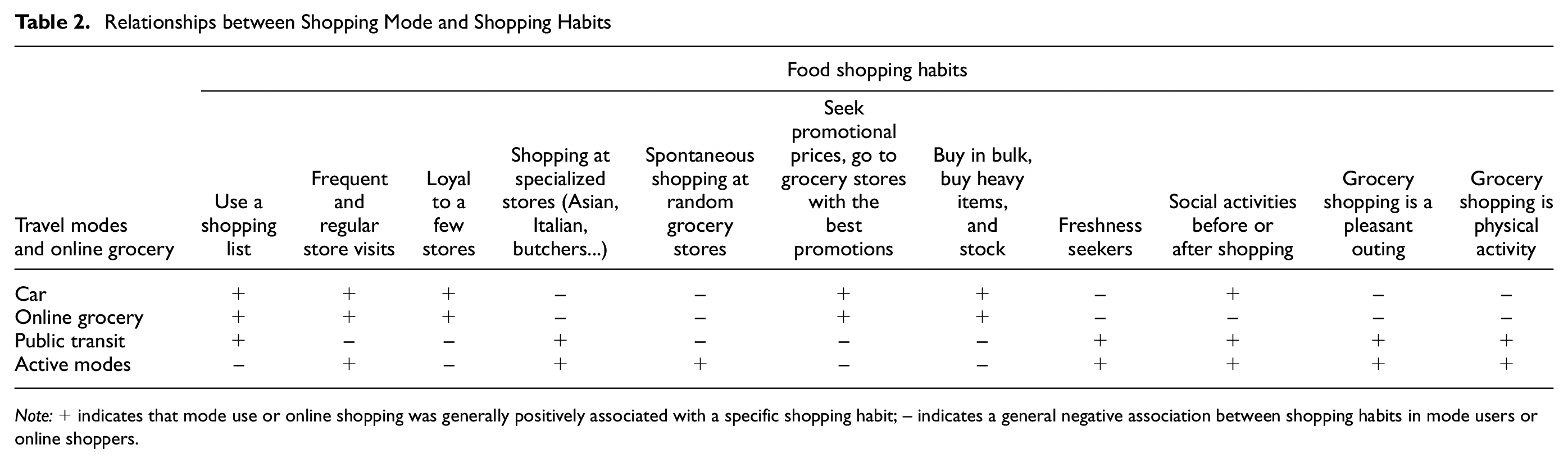
Note:+indicates that mode use or online shopping was generally positively associated with a specific shopping habit; – indicates a general negative association between shopping habits in mode users or online shoppers.
Mode choice was also associated with the ability to save money on groceries. Participants who used active modes or PT were not necessarily inclined to shop at the stores with the best deals, or the cheapest prices. Often, these participants instead purchased fresh ingredients for spontaneous meal ideas. Participants that did not make frequent use of online shopping mentioned that food items were more expensive in stores where online shopping or delivery services were offered. Food items in stores where shopping was only possible in-person were cheaper. Participants also expressed that any delivery service increased the overall shopping bill, topping bills with additional costs for cart assembly and tipping. However, despite these concerns, participants endorsed shopping at these locations to benefit from delivery services, and despite the extra costs for deliveries. To summarize, PT and active mode users were not seeking to save money but rather to buy fresh ingredients and have access to delivery options. Car drivers most frequently sought to shop for the best deals and the cheapest prices in our sample. All identified patterns associated with travel modes are summarized in Table 2. A plus sign indicates that mode use or online shopping was generally positively associated with a specific shopping habit. A minus sign indicates a general negative association between shopping habits in mode users or online shoppers. These assessments were identified as salient in the discourse of groups of respondents.
This section met the first objective of this study. Shopping patterns and travel mode choice are related, and participants can be classified into two groups of travel mode users and shoppers: 1) organized bulk buyers, who typically drive a car or opt for online groceries; and 2) spontaneous shoppers, who typically use PT and active modes to satisfy unplanned meal decisions and social activities. These two groups represent the current profiles of shoppers based on mode use. The next section will present the results relative to our study’s second objective, which was to better understand the underlying motives (i.e., service attributes) that enable or discourages mode use and online groceries.
Underlying Motives
The previous section demonstrated the relationship between travel modes used for shopping and food shopping habits: grocery planning, quantities bought, grocery stores choices, and desire to save money on groceries. This section addresses the second objective, pertaining to the underlying motives for the use or avoidance of different modes, to understand whether those motives are comparable to the ones that lead to online grocery shopping. The sections below present identified advantages/disadvantages, people approving/disapproving, and the factors and situations that help/hinder using travel modes and online grocery shopping as per the TPB. Subsamples, either users or non-users of the assigned mode, respectively reported why they would or would not use cars, PT, active modes, and online grocery stores to access food. We turn first to motives for car driving.
Motives for Car Driving (n = 15)
Of the entire sample, 62.3% had used their cars at least once over the previous month to go to the grocery store. For many participants, it was the most desired travel mode (45.9%). Car driving was the ideal mode for many reasons, including bulk shopping, thus enabling meal planning and advanced preparation (sometimes including freezing prepared meals). Participants mentioned that cars provided the flexibly to visit many different stores in a single shopping trip and made grocery shopping quick and efficient. Cars also enabled participants to save money and buy at grocery stores with the best deals.
The gap between real and desired use also shows why this mode was not fully ideal. It was associated with certain disadvantages for the elderly. Participants mentioned financial costs of ownership and maintenance efforts. While participants stressed car-related costs several times, they did not further discuss how those costs relate to money-saving strategies on food shopping. Participants rather found that cars were worth the money spent only when they traveled to many (non-grocery) destinations. Otherwise cars were found to be expensive.
Subjective norms, or perceived social pressure, were not strongly expressed by the participants. Most participants declared that they were not affected by any social influence in their decisions to access groceries or use travel modes. Friends, neighbors, and people of their generation were believed to support car driving for the same advantages as those cited by the participants.
However, despite the many practical advantages of cars, more barriers to car driving were identified than factors that made driving easy. Car driving was a stressful experience, with risks of injury or accidents. Risks included potential falls when getting in and out of the car. Long walking paths between the parked car and the store (or the home), feelings of insecurity, and the need to remove snow from the car and its surroundings during the winter were also cited barriers. The occurrence of risks of injury and accidents was perceived to be likelier to happen during the winter than during other seasons. Factors and situations that make car driving easy in older age were the ability to concentrate and be alert, to have a good sensory system, and to have available parking facilities at destinations. Beliefs identified in this section indicate that car drivers could potentially benefit from online grocery services that could reduce the disadvantages related to out-of-home travel (especially during the winter), and favor avoidance of risks of injury and accidents. Even with an important appreciation for the benefits of driving, shopping online has the potential to fulfill many of the perceived advantages of driving to buy groceries. It fits with drivers’ grocery shopping patterns and avoids some of the negative aspects of driving.
Motives for using PT (n = 15)
Similar to the motives encouraging car driving, intentions to use PT were motivated by individual advantages and control factors such as service attributes rather than by subjective norms and social influence.
Over the month preceding the interview, 45.9% of participants used PT once or more to go to the grocery store whereas respectively only 4.9% and 11.5% really wanted to use PT or the shuttle service for every shopping trip. PT use for grocery shopping was motivated by the relatively low cost of the service, the service’s regularity and predictability, as well as ease of use. Unlike car driving, PT use also did not require any mental effort. Using PT to go to the grocery store was considered a pleasant social activity that added to the grocery shopping experience. Participants would intend to use PT more frequently for grocery shopping if the service respected set timetables and if bus shelters were present at most stops they would need to use. Knowledge about how to integrate PT in their shopping trips would also favor its use. In other words, the elderly would benefit from knowing how to read bus timetables and knowing the location of bus shelters near their homes and grocery stores.
Despite its many positive aspects, PT has many disadvantageous service attributes that explain why most sample participants do not use or desire to use this mode. PT use is thought to limit shopping capacity (in relation to volume) and reduce the amount of available shopping destinations that can be accessed. While participants declared that the cost of PT was reasonable, it also required occasionally spending additional amounts of money for delivery (following an in-store purchase) or for a taxi when heavy shopping bags prevented them from returning home using PT. Specific service attributes that made it difficult to use PT (control beliefs) were the limited connectivity within the PT network, and service schedules not being followed. Participants reported feeling exhausted from walking between transfers and to and from PT stops. Participants would adopt PT more often if the drivers were more sensitive to their needs, if subway stations had elevators and if they could sit or were offered a seat by other passengers. These service attributes might be more easily fulfilled by shuttle bus services, which explains why 11.5% of participants perceive this mode as their ideal mode for accessing groceries (see Table 1).
Taken together, participants reported many complaints about the current PT service, but seemed to value the social and out-of-home activity that could be derived from shopping using PT, likely because it is combined with some walking. Online grocery shopping cannot fulfill this attribute. To reduce the disadvantages and factors that make PT use difficult for grocery shopping, supermarkets should increase the possibilities for delivery following in-person shopping.
Motives for Walking or Cycling (n = 16)
Active travel modes had been used once or more for grocery shopping by 50.8% of the sample participants over the previous month, whereas 34.4% reported that they really wanted to use this mode for each grocery trip (see Table 1). Walking or cycling to the grocery store was associated with many individual benefits such as feelings of satisfaction and autonomy, additional physical exercise gained from walking to stores and the pleasure of conducting a social activity outside the home. However, grocery shopping using active modes also limited shopping capacity to lightweight items and specific stores that were close to the home. This might explain the gap between used and desired modes. The sampled participants perceived strong social pressure to increase their use of active modes for grocery trips when compared with other modes assessed.
While participants expressed strong peer pressure to walk to the grocery store, they also reported many disadvantages to using this mode for grocery shopping. The lack of available grocery stores within walking distance from where they resided was a strong limitation to walking for groceries. Participants would additionally increase active mode use for grocery shopping if they were physically healthier and fitter, and if they had the option of having heavy shopping bags delivered to their homes after in-store purchase. Participants particularly preferred walking to the grocery store in sunny and warm weather. In the winter period, icy pathways and the risk of falling remain important factors that make it difficult to use active travel modes for grocery shopping.
Active mode users, similar to PT users, associated grocery shopping with additional social activities outside the home. Again, this attribute is not fulfilled by online shopping. Active mode users, like PT users, would benefit from in-person shopping with delivery options.
Motives for using Online Grocery Shopping (n = 15)
Of the sample, 26.2% had used online grocery shopping once or more to buy food in the previous month, whereas only 3.3% really wanted to use online grocery shopping to buy food. This section presents the elicited attributes that make online shopping difficult to use, and therefore reduce the willingness to use it.
The advantages to shopping online were of a practical nature, such as being able to avoid trips in cold weather, the absence of heavy items to carry back home and the advantage of a fast delivery (usually the next day). Participants also frequently cited the flexibility of online shopping since it can be done any time of the day, the ease of identifying weekly specials and specific items using built-in search engines and the feeling of independence associated with buying groceries for those dealing with physical mobility difficulties.
Older adults reported concerns about the expected quality of delivered products (freshness, smell) and experiencing difficulties in finding a substitute for an out-of-stock product. They also declared that online groceries require thorough meal planning using an organized shopping list, which leaves less room for spontaneous purchases. Many participants felt prone to forgetting items or committing errors when choosing between measurement units (e.g., pounds and kilos). Disadvantages in online shopping included the need to spend a minimum amount (around $50) to qualify for delivery and having to wait four hours or longer for the delivery. Online shopping was also associated with the stigma of being dependent and unable to conduct activities. It was also considered as isolating from social activities and as reducing opportunities for physical exercise.
Many factors and situations that could increase the participants’ intentions to use online services for food shopping were identified. Participants were skeptical about the quality of the products chosen by a third party, which led to a lack of trust in online grocery shopping. Product freshness and expiry dates need to be appropriately communicated, via the website or through phone communications. Moreover, the service was perceived as anonymous, and as lacking communication between the customer and the service provider.
Factors and situations that made it difficult to use online grocery shopping were previous unsatisfactory experiences with online food shopping and a limited availability of online grocery services (only two chain stores), where participants did not want to shop.
To summarize, beliefs about online grocery shopping were similar to beliefs about car driving. However, to attract car drivers, it would be pertinent to teach older individuals how to use online grocery shopping services and familiarize older individuals with online shopping options, strategies, and possible service providers. PT and active mode users do not seem to be a target group for online shopping because they highly value the social attributes of grocery shopping and because it gets them outside the home, which cannot be fulfilled by online grocery shopping.
Discussion and Conclusion
In this study, we proposed to examine the connections between modes used for purchasing groceries and individual preferences, shopping styles, and potential for grocery shopping online. Results suggest that car drivers can be a target group for online shopping, whereas PT and active mode users are more likely to maintain in-person shopping for its stated benefits. With declining ability to carry goods for active modes and transit users, deliveries after in-person shopping has more potential for adoption than a complete switch to online shopping. There is potential for car drivers to integrate online shopping into their habits given their shopping styles and the similarity of beliefs between shopping in-person (using their car) and shopping online.
Two main groups of grocery shoppers were identified in this study. The first group of shoppers was characterized by organized and regular bulk buying. Bulk buyers usually drove a car or shopped online. The motives supporting car driving and online food shopping were similar and included thorough organization and preparation of shopping lists. Online shopping can alleviate the disadvantages and hindering factors reported by car drivers without compromising on the perceived advantages and benefits of driving to grocery stores. However, most participants wanted to drive a car or walk to the grocery store and only a few participants wanted to use online services. Building on the TPB, several drawbacks to the use of online grocery shopping services were identified. To help make online grocery shopping part of the existing shopping habits of car drivers, stores offering online grocery services need to improve the current services as well as launch education, communication, and branding campaigns.
To make online grocery shopping more user-friendly for the elderly, grocery providers can use beliefs from this study to adapt their services and work on a branding strategy that enhances their reputation, especially with respect to freshness and customer service. The current drawbacks are lack of familiarity with the service, anonymity, and lack of habitual use. To attract new users, reducing anonymity between the service and the user seems to be of high importance to elderly populations. Grocery stores need to communicate product quality and freshness on their websites and guarantee that staff will assemble carts with care and sensitivity. Car drivers would also adopt online grocery shopping if they trusted the staff who take orders, assemble carts, and deliver products. Specific communication and education programs about online services should be implemented in retirement homes as well as in community and leisure centers to help the elderly adopt online shopping when desired. Topics should include familiarization with the service, usability of the services, and solutions for out-of-stock or forgotten items. An information campaign on the tax deduction of assembly and delivery costs could motivate the elderly to experiment with online shopping, especially when they express concerns about the cost of cart assembly and delivery.
It has been widely discussed that to win over new adherents for a service, promoters should focus on “word of mouth” strategies ( 42 , 43 ). However, building on the results from this study, “word of mouth” strategies are not likely to increase the use of online grocery services among the elderly since their peers are generally not interested in using them. More exposure to the opinions of peers and neighbors may actually decrease their intention to use such a service.
Participants also mentioned that the lack of online shopping services in less prominent stores limits the use of this shopping option to a few mainstream stores. Participants who enjoyed shopping in grocery stores with specialized ethnic products mentioned that they would use online grocery services if they were offered in their preferred stores.
While online services is increasingly becoming available in a wider range of stores, the issue of the environmental impact of deliveries remains to be addressed. It is important to consider that individuals who use sustainable travel modes but opt for deliveries or taxis for heavier items may in fact increase the environmental impact of grocery shopping. Future research should further investigate the environmental sustainability of online grocery shopping and deliveries after in-store purchases. Parcel locker systems where food deliveries can be stored for later pickups closer to a client’s residence ( 44 ) should be part of future research effort.
Participants who reported spontaneous meal plans and social activities characterized the second group of customers identified in this study. Most of them shopped using PT and active modes. The social attribute of food shopping was repeatedly mentioned as an important motive for using PT and active modes, and online shopping fails to fulfill this attribute. As such, PT and active mode users are a more likely target group for spontaneous in-person shopping with home delivery. Moreover, the social influence of peers was slightly more pronounced for active mode users and peers generally supported active mode use. To encourage individuals to adopt or continue walking to the grocery store, transport and public health officials should ensure they communicate the health and physical activity benefits of such trips to the elderly population. Providing information on the option of in-person shopping followed by (refundable) deliveries could reduce the burden of walking to food stores while also maintaining this option.
Importantly, cost and injury risks associated with weather and health conditions were identified as important concerns in the choice of travel mode for grocery shopping. These concerns might also reflect gaps between currently used and desired modes. Beliefs from the TPB allowed us to better understand the gaps between actual and desired mode use as well as actual and desired use of online grocery shopping services. While PT and active modes were found to be affordable, these modes required occasional use of taxis or delivery services, thereby increasing the total grocery bill. Moreover, PT and active modes were repeatedly associated with concerns about injury risks in the winter, thus creating potential conditions for online shopping in PT and active users. Costs related to cart assembly and deliveries were important factors in avoiding online grocery shopping despite online services allowing participants to minimize risk of injury and falling. These concerns were likely raised because most participants were not aware of the tax deduction for delivery of groceries available to seniors in the study region.
This study provides insight into the relationships between shopping patterns and travel mode choice and the possibility of online shopping. Food desert research can benefit from this qualitative study by integrating knowledge on how travel mode choice shapes organized or spontaneous shopping styles and habits. This study helps us understand the circumstances under which older individuals are more likely to become users of a non-travel shopping option. This is particularly important for the elderly who undergo mobility loss and driving cessation. One particular relevant study raises the knowledge gaps in food desert and geography research. The author argues that there is a lack of published studies on the relationships between access to food and everyday dynamics, lifestyles and socio-demographic factors ( 3 ). This study sought to contribute to reducing this gap. However, it is important to keep in mind that the findings reflect associations between mode choice, shopping constraints, and perceived facilitating factors and barriers to accessing groceries. Patterns and beliefs identified might not always arise from a choice, but also from limited options or abilities, which were not fully examined in this paper.
Our study presents a few limitations, which are worth mentioning. It is built around a qualitative framework, with self-reported attributes. The reported relationships interact in complex associations, and assessing causes and consequences proved to be difficult. Moreover, we did not capture the combined use of different modes for accessing stores. For example, some participants declared using cars for larger shopping trips and walking for smaller purchases. To avoid dealing with very complex travel patterns in a small sample size, the assessment applies to the most frequent shopping mode, without further integrating land use data. Future research would benefit from an investigation on a larger sample of older individuals, where results can be generalized. As suggested by Ajzen, the TPB items identified here can be transferred to a quantitative questionnaire to further verify hypotheses using a quantitative research design. Finally, in our sample, 27.9% of participants never used information and communication technologies, and 29.5% perceived difficulties walking or climbing stairs. This raises further questions about how disabilities and technical illiteracy should be addressed in online grocery shopping research.
Footnotes
Acknowledgements
The authors would like to acknowledge the editor and reviewers whose comments helped improve this paper. They also express their gratitude to Annie Booth for proofreading and improving the grammar, structure, and language used. In addition, the authors would like to thank the Fonds National de la Recherche, Luxembourg and the Social Sciences and Humanities Research Council of Canada for their financial support. All participating retirement homes and community centers, and the Fédération de l’Âge d’Or du Québec (FADOQ) were very helpful in enabling recruitment. Participants that took part in this research are also warmly acknowledged. Data collection for this project was guided by the ethics standards in research and was granted the ethics certificate from the University’s ethics committee (ref. #3180_e_2018).
Author Contributions
The authors confirm contribution to the paper as follows: study conception and design: Ana Bezirgani, Ugo Lachapelle; data collection: Ana Bezirgani; analysis and interpretation of results: Ana Bezirgani, Ugo Lachapelle; draft manuscript preparation: Ana Bezirgani, Ugo Lachapelle. All authors reviewed the results and approved the final version of the manuscript.
Declaration of Conflicting Interests
The author(s) declared no potential conflicts of interest with respect to the research, authorship, and/or publication of this article.
Funding
The author(s) disclosed receipt of the following financial support for the research, authorship, and/or publication of this article: Fonds National de la Recherche, Luxembourg (FNR, project reference 11245025) and Social Sciences and Humanities Research Council (SSHRC, project reference 1240613).