




Abstract
Protected bicycle lanes are held up as the end-all of bicycle infrastructure, with unprotected bicycle lanes being widely considered unsafe and inferior. This perspective is supported by existing research showing people’s preference for protected versus unprotected bicycle lanes. Scant research, however, has explored this topic area using an observational research method. If an observational method is used, the research is typically count-based and focused on a predetermined sets of variables identified before the observation period and this hinders the research from advancing findings beyond frequencies and the already known variables. Without a clearer understanding of how people are using and interacting on streets with either type of bicycle lane, it is difficult, if not impossible, to adequately assess whether, and which, facility type best accommodates safe bicycle mobility. This paper introduces a new qualitative-quantitative method for conducting observational research which takes a grounded theory approach to gain new insights into how people behave and interact while using street segments, intersections, and other public places. This method follows a four-step process which involves qualitatively identifying interactions recorded on video, using deductive and inductive logic to document independent variables associated with interactions, and concludes in a quantitative analysis of the qualitatively produced data. As a display of the applications of this method, a case study is presented here which uses the new method to investigate the interactions of bicyclists with other road users on a street segment with an unprotected bicycle lane in Munich, Germany.
In Munich, Germany, all bicycle lanes built on the vehicular roadway are delineated with solid or striped white painted lines, the width of which is sometimes painted red. These facilities are located between, and are physically unprotected from, the vehicular travel lane and parking lanes, if a parking lane is present. Without any barrier, the design of these bicycle lanes inherently allows encroachments into and out of the dedicated bicycle lane. Pedestrians can easily walk across the bicycle lane when crossing the street, drivers must cross the bicycle lane to access or egress from the parking lane, and bicyclists can flexibly move into and out of their dedicated travel lane to get around obstructions or access adjacent bicycle parking facilities. Owing to the permeable design of these facilities and this allowance for encroachment, it is likely that bicyclists experience interactions in the bicycle lane, not only with one another, but also with mode users crossing or traveling adjacent to the bicycle lane.
The most prominent bicycle advocacy organization in Germany, the Allgemeiner Deutscher Fahrrad Club e.V. (ADFC), is currently pushing for cities to build protected bicycle lanes to increase the safety and mobility of bicyclists ( 1 ). This policy position stems from the idea that protected bicycle lanes are held up as the pinnacle of good infrastructure design for urban streets and is supported by survey research findings that people feel safer and more comfortable bicycling in protected bicycle lanes ( 2 – 4 ). Unprotected bicycle lanes, on the other hand, are criticized for providing no physical protection and putting bicyclists in the “door zone”, yet such facilities have also been celebrated from the perspective that it is better to have some bicycle infrastructure on the ground than none ( 5 , 6 ). Existing research, unfortunately, provides only limited information on well unprotected versus protected bicycle lanes function to meet the needs of all people using the street, which hampers the ability to make informed decisions about the best type of design of bicycle facilities to build on urban streets.
To date, methods used to examine travel behavior have followed traditional engineering approaches that are count-based and deductively focus on traffic volumes, user gender, and expected behavioral variables, such as speed, lateral positioning, and passing distances. There is a call to move beyond quantitative logic and advance mixed-method approaches to enlighten our understanding of how infrastructure and public space design influences travel behavior ( 7 ). Furthermore, Clifton and Handy urge for the employment of qualitative methods, used in conjunction with quantitative methods, to more thoroughly “unravel the complexities of travel behavior to better assess the sources of the problems and predict the impact of future trends” ( 8 ). Responding to these calls, this paper presents a new qualitative-quantitative observational method designed to examine people’s street use. Drawing heavily on grounded theory, this method aims to contribute new insights into people’s behavior on transportation facilities by providing a framework for identifying typologies of interactions taking place between people while using given types of transportation facilities. Based on a quantitative analysis of the nature of the types of interactions observed, the performance of the transportation facility can be evaluated and mitigation measures for facility design or traffic regulations can be developed to avoid undesirable interactions.
This method was designed for investigation of the types of interactions experienced by bicyclists traveling on street segments with unprotected bicycle lanes in the City of Munich, given the infrastructure’s inherent allowance for encroachment. In the context of this research, an interaction event is broadly defined as a negotiation of movement involving a bicyclist and another person using any mode of transportation or a stationary object. This negotiation involves at least one person or object engaged in a legal, allowed, or illegal use of the roadway and at least one person reacting to the action or inaction of the person or object stimulating the interaction.
Although existing research results provide hints of the types of interactions occurring on bicycle facilities—see Aldred’s research on typologies of near-miss events experienced by bicyclists or Bernardi and Rupi’s study of bicyclists’ interactions with pedestrians on at-grade facilities—our understanding of the interactions people experience is limited by methods relying on people’s reported behavior and deductive assumptions about which variables influence the occurrence of interactions ( 9 – 11 ). In contrast, the method presented in this paper applies a grounded theory approach using induction to identify interaction typologies and code observed variables associated with those interactions. By using this qualitative approach to coding, the data collection process is unrestrained by assumptions and flexibly allows any type of interaction or behavior to be documented, expected or unexpected.
Following a discussion of the relevant existing research and background on the study of unprotected bicycle lanes below, the Methods section describes each step in a four-step coding procedure designed to qualitatively identify interactions and produce a quantitative dataset describing the behavioral, spatial, and circumstantial characteristics of identified interaction typologies. A proof of concept application of this method is then exhibited in the Case Study section, with results from a study of one street segment with unprotected bicycle lanes in Munich. This paper concludes in the Discussion section with an overview the method’s strengths and limitations, and a discussion of the potential future applications of the method in transportation research and policy evaluation.
Background
Grounded theory is a qualitative research methodology and method which aids “the discovery of theory from data systematically obtained from social research” ( 12 ). The method itself is typically described in the context of analyzing written texts ( 13 – 15 ). It is, therefore, not surprising that transport researchers employing grounded theory typically use transcripts from qualitative interviews as their data source. For example, Gardner and Abraham used interview transcripts in a grounded theory study aiming to identify people’s core motivations for sustaining their use of a personal motor vehicle ( 16 ). Füssl and Haupt likewise analyzed interview transcripts in their grounded theory-driven investigation of how people construct their identity as bicyclists ( 17 ). Beyond this traditional use of the method in the context of textual analyses, potential applications of grounded theory to analyze visual data have largely been left unexplored ( 18 ). Mey and Dietrich have argued that a sole reliance on textual analysis in grounded theory is unsatisfactory and Hicks has pressed for researchers to explore the application of grounded theory video-based analyses to assess whether or not, and in what ways, visual data sources can provide additional understandings of people’s daily practices ( 19 , 20 ).
A consideration for the use visual data is particularly relevant in the context of research on how people behave and interact along street segments, in intersections, or in plazas and other public spaces. Most research specifically investigating the use and safety of bicycle lanes usage surveys and travel diaries, data collected by instrumented bicycles, and historic traffic safety data to describe the advantages and disadvantages of these facilities ( 10 , 21 – 28 ). For example, Aldred identified typologies of near-miss events experienced by bicyclists (including near-misses caused by the bicycle path being blocked, drivers overtaking bicyclists too closely, and car doors being opened in bicyclists’ path of travel) using survey data and descriptions of near-miss events reported through travel diaries ( 10 ). Shackel and Parkin’s study using an instrumented bicycle found that, albeit statistically insignificant, drivers overtook the bicyclist at a closer proximity on streets in which a bicycle lane was present ( 25 ). In a study using hospital records of bicyclists involved in traffic incidents with drivers, Wall et al. observed both a decrease in total crashes and an increase in severe injuries, compared to mild or no injuries, on streets with painted bicycle lanes ( 29 ). However, this study used monthly pedestrian counts as a proxy for lacking bicycle count data to calculate exposure which may have biased the results. The insights into the nature of people’s interactions on streets with bicycle lanes provided by such existing research are valuable, but the methods and data used in these studies are unable to precisely describe the nuances of how these interactions and crashes took place.
To better understand how people behave on and adjacent to bicycle facilities, it is necessary to employ observational methods. Compared to research methods relying on reported behavior, it is known that “it is not unusual for persons to say they are doing one thing but in reality they are doing something else” and that “direct observation provides much more accurate results about behavior than do reports of behavior” ( 13 , 14 ). Studies investigating bicycle facilities with observational methods are typically quantitatively-driven and seek to collect and analyze a predetermined set of variables describing expected behavior and expected interactions ( 11 , 30 , 31 ). A drawback of this deductive approach is that the results are limited to an analysis of only expected variables, with no allowance to inductively include any unexpected variables observed as being associated with the behaviors or interactions under investigation. To advance our current empirical and analytical knowledge of the subtleties of people’s behavior on and the use of transportation facilities, a new observational methodology is needed.
Methods
This paper puts forward a mixed-method observational approach which uses a grounded theory-driven coding procedure to qualitatively document observations in a format allowing for a quantitative analysis of the qualitative observational data. Observations are made using video recordings, rather than collected in the field. A key benefit of recordings is that the film can be stopped or slowed down to thoroughly inspect the behaviors people engage in and “see things you otherwise would not” ( 32 , 33 ). This is particularly important if using grounded theory, as the researcher has the ability to view and re-view the observed behaviors and “decide at leisure how to code it” ( 14 ). As Whyte recommends when collecting visual data on people’s behavior in public spaces, the video camera should be installed in an inconspicuous location with a clear view of the subject facility, installed at an oblique angle to capture the largest portion of a space possible ( 33 ). Observations documented on film are then recorded manually using methods similar to those used in public life studies, including mapping the location of behavior, activities, and interactions, followed by an analysis of what connections the behavior has to the context and circumstances of the space ( 32 , 33 ).
The four-step coding procedure used to record and analyze observed interactions is guided by the grounded theory coding method advanced by Corbin and Strauss ( 13 ). First, the film is watched to identify instances of interactions occurring on the infrastructure that appear to be allowed, alleviated, or restricted by the design of the infrastructure. Second, inductive and deductive reasoning is used to identify the variables associated with the interactions describing the circumstantial, behavioral, and spatial characteristics of interactions. Variables describing the existing conditions are likewise coded, including lane widths, speed limit, and the location of sign posts, parking facilities or curb cuts. The created dataset is reviewed in the third coding step with the purpose of condensing the categories of variables describing the key components of the interaction and to create a dependent variable for the types of interactions observed. As a final step in this process, the dataset is quantitatively analyzed to further refine the dependent variable for interaction type and evaluate in what ways, and how significantly, independent variables are associated with the different types of observed interactions.
In this method, no hypotheses are developed before the first coding step as the main emphasis in grounded theory is “on the discovery rather than verification of theory” ( 15 ). Different from a traditional scientific approach focused on verifying or falsifying hypotheses developed in advance of data analysis, hypotheses for the types of interactions and variables associated with these interactions are developed during the coding and analysis processes. As stated by Corbin and Straus, when using grounded theory, hypotheses are “considered provisional until verified repeatedly against incoming data” ( 34 ). Any hypotheses not supported by the observational data are revised or dropped, rather than falsified, considering the emerging understanding of the relationships within data with the aim of establishing verifiable hypotheses describing the nature of observed interactions ( 34 , 35 ). Those hypotheses that can be verified by the data are then the foundation of the behavioral theory describing the types and nature of interactions discovered through this grounded theory-driven method.
Coding Procedure
The research tasks involved in each step of this qualitative-quantitative coding procedure are presented in Figure 1 and outlined in detail below. Each step in the coding process is described in the context of the case study in Munich. Nevertheless, the method was designed to be transferable and can be applied to investigate any type of event (interactions or other individual or group behaviors) occurring in the site-specific contexts of other transportation facilities or public spaces.
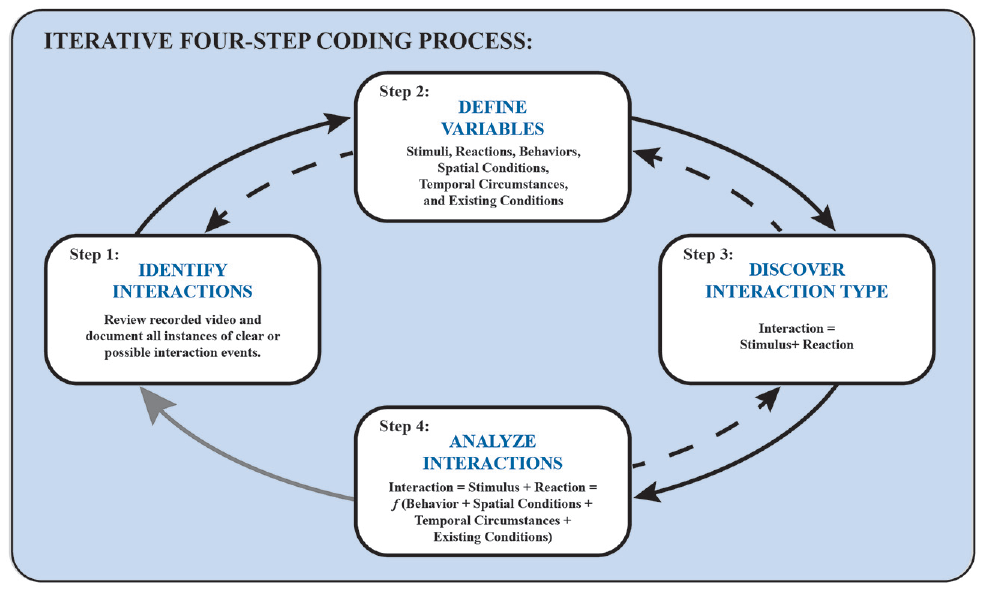
Grounded theory-driven coding procedure: an iterative four-step process.
Step 1: Identify Interactions
The first step in the coding procedure is to review video recordings of the subject infrastructure site to document occurrences of interactions. As is discussed in the introduction, at the beginning of the coding process an interaction is generally defined as involving at least one person or object stimulating the interaction and at least one person reacting, or not, to the stimulus participant’s (in)action. For example, if a vehicle driver temporarily parks in the bicycle lane and three separate bicyclists must exit or adjust their position in the bicycle lane to get around the parked vehicle, then three interactions occurred. However, if no bicyclists were using the bicycle lane while the driver occupied the facility, no interaction occurred, despite the occurrence of a potential stimulus to an interaction. Furthermore, it is not assumed that an interaction must involve an observed negative effect. If a bicyclist is observed encountering a vehicle partially obstructing the bicycle lane but does not adjust their position in the bicycle lane while passing the vehicle, this non-reaction to a potential stimulus is interpreted as indicating that there was no observable negative effect of the interaction.
Video recordings are reviewed to identify and log all observed instances of interactions. If interactions are observed which do not fit the initial definition of an interaction, but appear to be relevant to the study of the bicycle lane’s functionality, these interactions are also logged. To that point, a precise definition of unique interaction typologies is not produced through this coding step. Instead, the goals of this step are to identify clear and potential interactions occurring on the subject infrastructure site and to produce a catalog of observed interactions to be referred back to in the subsequent coding steps used to identify specific typologies of interactions.
Step 2: Define Variables
In the second coding step, the nature of each observed interaction is examined to identify variables associated with the given interaction. To begin this inductive documenting of the interaction characteristics, the researcher asks a series of questions to guide the coding process. These questions include: who or what is involved; who or what is the stimulus instigating the interaction; how do people respond to the stimulus; how does the stimulus participant respond, or not, to the interaction; what other behaviors are people engaged in; were any traffic rules broken; what are the spatial characteristics; and when did it occur? As these questions are answered, a qualitative dataset is assembled containing coded variables describing the behavioral, spatial, and circumstantial nature of the observed interactions, as well as the existing conditions of the site. The variables recorded during this coding step are then used to build a narrower definition of an interaction event (see below, with bolded items being the variables classified during the second coding step).

In the case study of a street segment with unprotected bicycle lanes in Munich, independent variables defined through this coding step include: (a) behavior—mode use, lane use, direction, lateral movements, as well as noting if a participant is crossing the street, parking, standing, or violating traffic a rule; (b) spatial context—location on the street segment, travel lane(s) on which the interaction took place, or the involvement of driveways or street furniture; (c) circumstances—time of day, number of people, by mode, and number of stationary objects involved; and (d) existing conditions—geometric design, speed limit, street signs, permanent and temporary street furniture. If this coding procedure is applied to studies of other types of infrastructure, the definition of an interaction and groupings of associated variables may differ based on the specific type of behavior or interaction under investigation.
Step 3: Discover Interaction Type
With the independent variable associated with interactions identified, the third coding step aims to define a dependent variable describing unique typologies of observed interactions. Following the definition of an interaction as a “mutual or reciprocal action or influence”, an interaction is defined as the combination of two variables: (a) stimulus—the (in)action of a person or object effecting another person’s undisturbed use of the roadway; and (b) reaction—a person’s observable reaction, or non-reaction, to their interaction with a stimulus ( 36 ).

A stimulus may be a vehicle parked or standing in the bicycle lane, a person entering or exiting a parked vehicle, a pedestrian crossing the street, or bicyclist traveling outside of the designated bicycle lane. A reaction may be a person slowing or stopping to avoid a conflict with the stimulus, a person adjusting their lateral position or moving to another travel lane to navigate the interaction, or a person having no reaction to the stimulus. Using these two nominal variables, a nominal dependent variable describing interaction typologies is constructed. The type of interaction is represented as a discrete value of the dependent variable, with each value describing each combination of observed stimuli and reactions. To refine the derived list of interaction types, each unique combination is then compared to the others and typologies are grouped based on deduced hypothetical relationships between the different types of interactions or when the difference between interaction typologies are adequately described by an independent variable. Concurrently, independent variables are likewise internally refined and restructured and new variables are added to aid the refinements to the dependent variable.
Step 4: Analyze Interactions
The final step in this coding process to inferentially analyze the independent variables to uncover the significance and direction of the relationship that each independent variable has with each type of interaction event.

First, exploratory cluster analyses are run using the stimulus, reaction, and independent variables to learn new information about the relationships between interaction types based on the statistically derived clustered groupings of interactions. These results are then used to inform further refinements to the discrete values of the dependent variable for interaction type. Using the refined dependent variable, logistic regression is performed to examine the relationship between the independent variables and each category of the dependent variable. A conditional interaction typology matrix may then be constructed to visually display the findings by highlighting the similarities and difference between the characteristics of interaction types and then used to identify the core variables describing the nature of interaction typologies, both in general and specific to each type of interaction. The purpose of this matrix is to organize the findings and to aid in developing a theory describing the nature and effect of the observed interactions ( 13 ). Moreover, the variables included in this matrix are used to inform future research by highlighting those variables found to be important for defining and describing the interactions observed.
Iterative Process
This four-step procedure is iteratively repeated using 5 to 10 h of video recordings at a time. The hours of film are limited to manage the workload and more quickly produce a dataset of variables and quantitative results, which are then used to deductively inform the on-going coding process. Each time the coding process repeats, newly observed interactions are documented within the dataset of variables created in the previous round(s) of coding. New variables, or discrete values of variables are flexibly added to the dataset as new types of interactions are observed, as well as new behaviors, spatial characteristic, and so forth, are observed in association with interactions.
The iterative process is complete when no new typologies of interactions or variables are discovered within the hours of video recordings planned for use in the observational study. This process can then be repeated in a validation study to confirm or further refine initial findings. Using the findings of these first studies as a framework, future observational studies can be more targeted and focus data collection only on those variables found to be important for the composition and occurrence of interactions.
Case Study
The grounded theory-driven coding procedure introduced in the previous section was applied to a case study analysis of interactions involving bicyclists on a street segment with unprotected bicycle lanes in the City of Munich. This case study examined a single block on Arcisstrasse, a street running north-south between Theresienstrasse and Gabelsbergerstrasse in the Maxvorstadt neighborhood (shown in Figure 2, below).
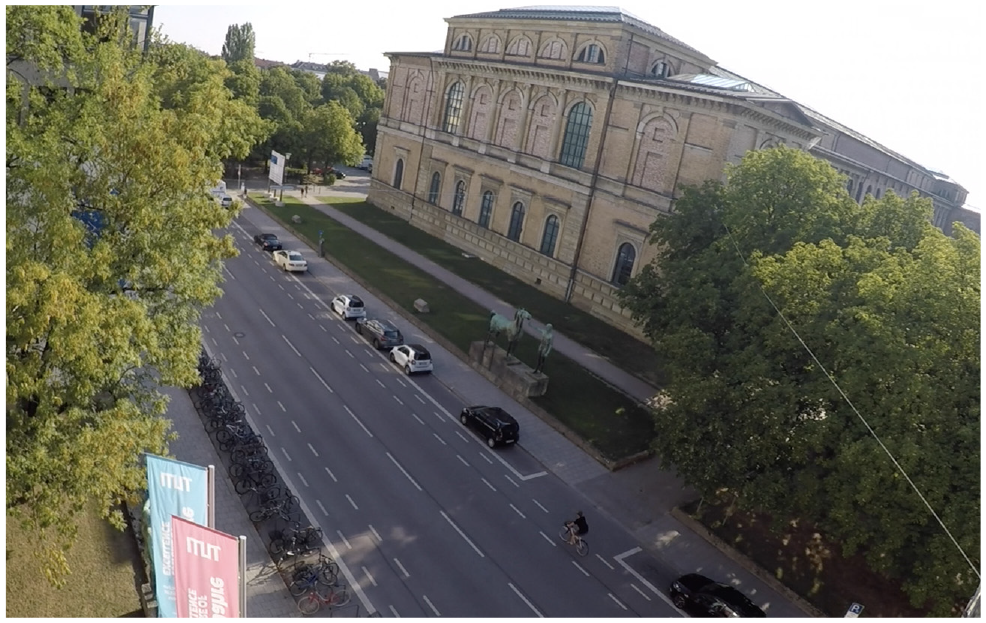
Screenshot from video recordings at the case study street segment.
Location Characteristics
The case study street segment on Arcisstrasse has one vehicular travel lane in each direction, 1.5-m wide unprotected bicycle lanes in both directions, and a 3-m wide sidewalk on the west side of the street and a 2-m wide sidewalk on the east side. The on-street parking lane on the east side of the street is used for vehicular parking and the parking lane on the west side of the street is used for bicycle parking. The two bicycle lanes are placed between the vehicular travel lane and the parking lanes, with a 0.5-m wide buffer between the bicycle lane and parking lanes. The main entrance to the city campus of the Technical University of Munich is on the west side of the street, with the campus building occupying the length of the block. An art museum is located across the street, with a small lawn between the side of the building and the sidewalk. A driveway used by all modes of transportation to access the museum and a park south of the museum is located on the east side of the street.
On this street, the bicycle lanes are demarcated by a striped painted line, which indicates that motor vehicle drivers may drive in the bicycle lane if the vehicular travel lane is too narrow for the vehicle ( 1 ). At the time of this study, these striped bicycle lanes also allowed drivers to temporarily stand in the bicycle lane for up to 3 min( 1 ). The allowances this type of bicycle lane gives to vehicle drivers decreases the protection provided to bicyclists traveling in these already unprotected facilities. Since this study, however, German traffic regulations have been updated and removed the allowance for motor vehicle drivers to park or stand in the bicycle lane with solid or dashed painted lines for any period of time ( 37 ).
Data Description
The case study of Arcisstrasse applied the four-step coding method to an analysis of 11 h of video recorded on Wednesday, August 22, 2018 between 08:30 and 19:30. The video recordings were made using a GoPro camera installed on a third-floor window in the university building on Arcisstrasse, angled facing north with a mostly unobstructed view of the unprotected bicycle lanes on both sides of the street.
The 11 h of film were analyzed through two iterations of the coding procedure described in the Methods section, first with 6 h of film then with 5 h. Through this process, 289 unique instances of interactions were identified. Interactions between two or more bicyclists represent 40% (n = 116) of the observed interactions, with 42% (n = 122) of interactions being between a bicyclist(s) and pedestrian(s) and only 16% (n = 47) of interactions being between a bicyclist(s) and a person(s) driving a vehicle, or a standing or parked vehicle (s).
A total of 694 people, standing vehicles, and one dog were observed participating in the documented interactions. Of these, 67% (n = 462) were bicyclists, 25% (n = 174) were pedestrians, 5% (n = 32) were drivers, and 3% (n = 23) were standing vehicles. Of the bicyclists observed participating in interactions, 62 bicyclists were involved in more than one interaction, as were 34 pedestrians, 4 drivers, and 6 standing vehicles. As these 106 participants were involved in numerous interactions, the actual number of unique participants by mode is lower than the total numbers of participants involved in interactions. Figure 3 (above) presents the actual totals alongside traffic volumes observed by mode during the observational period. Given the total traffic volume of bicyclists (n = 2,461) and the actual number of bicyclists involved in interactions (n = 400), 1 out of every 6 bicyclists traveling along this street section was involved in an interaction during the 11-H observational period.
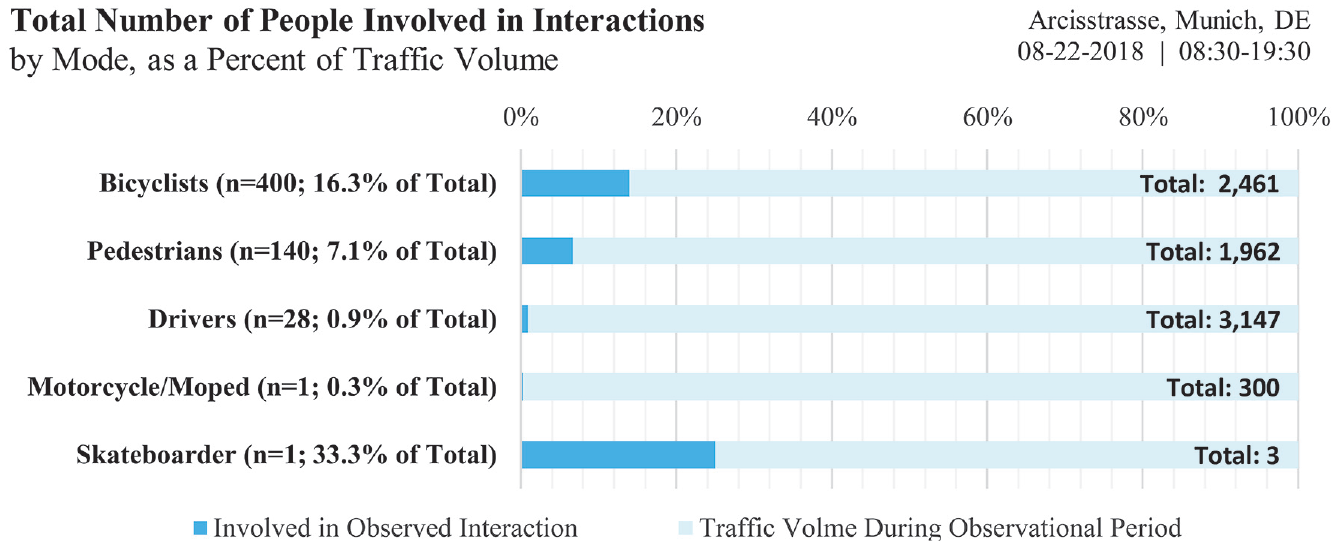
Percentage of people involved in observed interactions, by mode.
Interaction Characteristics
In the review of the 289 interactions performed in the second coding step, independent variable types were identified describing the nature and circumstances of observed interactions. Independent variables describing people’s observed behaviors include: the transportation mode used by participants; whether interaction participants were traveling alone or were with another person(s) involved in the interaction; the main actions of participants (normal use of the street section, accessing the driveway, egressing on-street parking, accessing a parked vehicle, crossing the street, etc.); and the participants’ reactions to one another during the interaction (adjusting lateral position, yielding behavior, glancing behavior, speed changes, no visible response, etc.). To document the spatial characteristics of the interaction, variables were created to describe the side of the street on which the interaction took place, the lane(s) each participant occupied, and whether each individual’s lane use, and use of the street in general, is legal. Circumstantial variables included variables describing the number of people participating in an interaction, and the time of day (exact time, 20-min intervals, 60-min intervals, and 3-h intervals). The existing conditions were coded into variables describing the geometric design of the street segment, the location and width of any driveways, and the presence of any permanent or temporary objects on the street during the observational period.
Interaction Typologies
As the independent variables were coded, variables were also created to describe the stimulus and reaction of each interaction. The stimulus variable was constructed through a review of documented variables describing the behaviors and spatial circumstances of the person or object stimulating the interaction. During this review, we constantly asked ourselves: What is the basic nature of this stimulus? Take, for example, the following observed interaction: a bicyclist adjusts their position in the bicycle lane to pass around another bicyclist who slows down in the bicycle lane, moves to the bicycle lane buffer and comes to a stop before parking their bicycle in the bicycle coral. The basic nature of the stimulus in this interaction is that the second bicyclist is ‘accessing bicycle parking, with the observed speed a reduction and lateral movements of this bicyclist being the independent behavioral variables associated with the stimulus action.
To construct the variable describing a person’s reaction to an interaction, we asked ourselves: What is the basic nature of the way the person reacted to their interaction with the stimulus? Further questions included: did the individual adjust their position on the roadway; did they move into a different travel lane while passing or crossing paths with the stimulus; did they yield to the stimulus? As an example: a pedestrian is walking on the sidewalk and glances behind their shoulder to see a bicyclist approaching on the sidewalk. The pedestrian then moves to the inside of the sidewalk to give way to the bicyclist. The reaction to this interaction is that the pedestrian ‘adjusts their lateral position’ to accommodate the presence of the bicyclist. Independent variables associated with this reaction to the interaction include that the pedestrian was the legal user of the sidewalk and that the pedestrian glanced toward the bicyclist before moving aside to yield.
At the beginning of the third coding step, the dataset included 39 and 30 types of unique stimulus (in)actions and (in)reactions, respectively. These discrete typologies were then grouped, first, according to their similarity, then uncommon types of stimuli and reactions were grouped into general categories. This led to a final list of nine types of stimulus actions and five types of reactions. These refined variables were then combined to reveal a total of 30 unique types of observed interactions. The seven most frequently observed interaction types (highlighted in bold in Table 1) represent 63.3% (n = 183) of all observed interactions, with each of the remaining 23 interaction types representing less than 5% of the observed interactions. Each interaction type is shown in Table 1 below, with interaction types grouped by the stimulus type and the frequency that the given stimulus resulted in each given reaction observed for that stimulus.
Stimulus-Reaction Interaction Summary
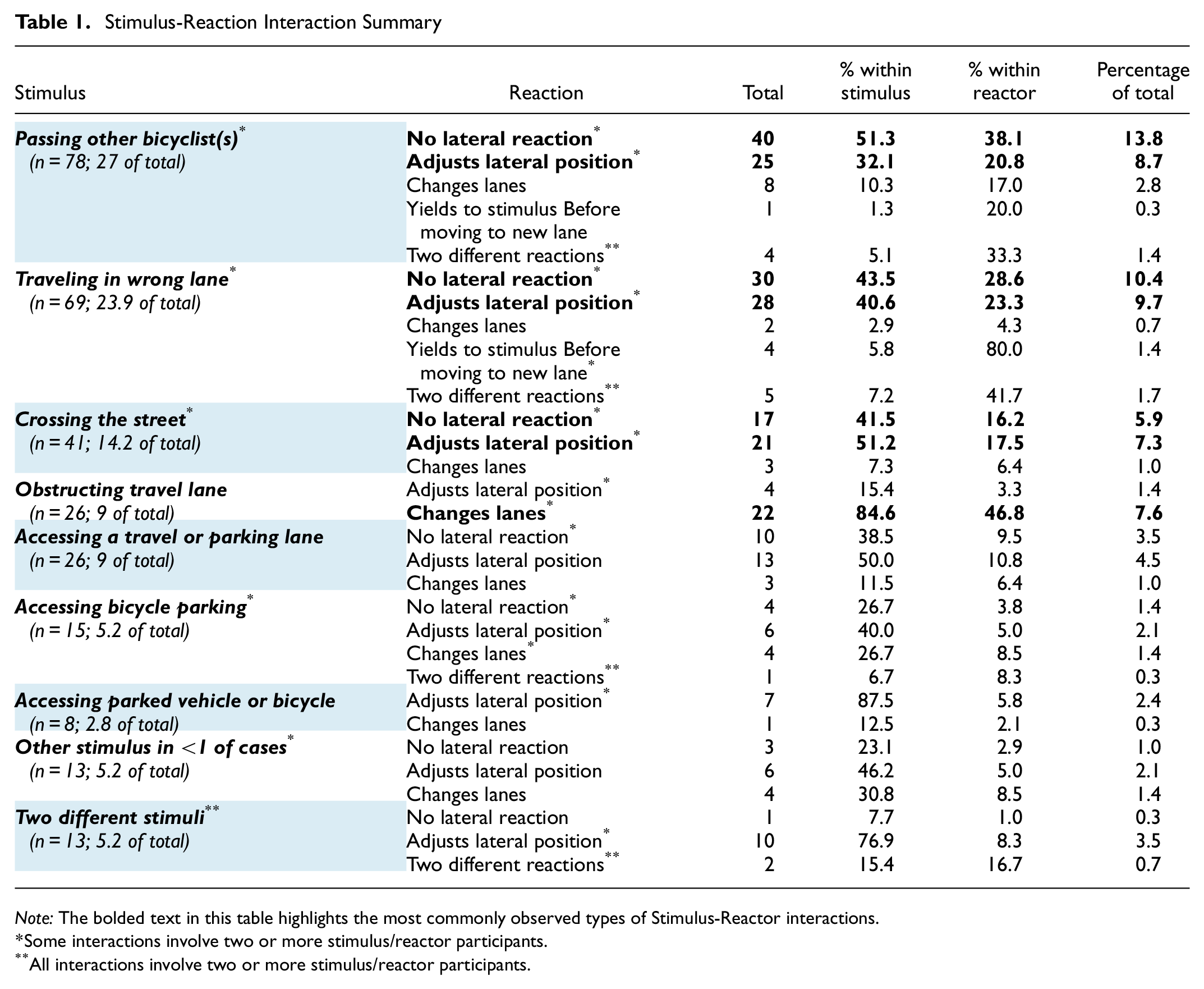
Note: The bolded text in this table highlights the most commonly observed types of Stimulus-Reactor interactions.
Some interactions involve two or more stimulus/reactor participants.
All interactions involve two or more stimulus/reactor participants.
The stimulus most frequently observed instigating interactions was a bicyclist passing another bicyclist(s) traveling in the bicycle lane, with two observed interactions involving two bicyclist passing another bicyclist(s). This stimulus initiated 27% (n = 78) of interactions in total and was the stimulus for the most common and the fourth most common types of interactions observed. The most common interaction, representing 13.8% (n = 40) of observations, involved the bicyclist(s) being passed having no reaction to the passing bicyclist. In 8.7% (n = 25) interactions, the person(s) being passed adjusts their position in the bicycle lane away from the passing bicyclist. In 86% of interactions involving this stimulus, the passing bicyclist moves into the vehicle lane and returns to the bicycle lane after passing the slower moving bicyclist.
The second and third most frequently observed interactions were initiated by one or more people traveling in the wrong travel lane. In 91% interactions involving this stimulus, a bicyclist was illegally traveling on the sidewalk and crossed paths with one or more pedestrians walking on the sidewalk. It was equally common for the pedestrians to have no apparent reaction to the passing bicyclists as it was for them to adjust their lateral position on the sidewalk away from the bicyclist. Other common interactions involved one or two people crossing the street mid-block and standing vehicles obstructing the bicycle lane. No driver was observed parking or standing in the bicycle lane and obstructing the lane for more than 3 min, meaning all vehicle drivers were legally obstructing the bicycle lane. The bicyclists, however, were required to illegally travel in the vehicular lane to pass around the vehicle disrupting their normal use of the bicycle lane.
Finding that the most prominent type of interaction involved a bicyclist exiting the bicycle lane to pass by a slower bicyclist suggests that the bicycle lane width may be inadequate. Similarly, 92% of interactions involving a vehicle legally standing in the bicycle lane or bicycle lane buffer, or both, required one or more bicyclists to move out of the bicycle lane. This finding provides evidence of the negative effect of allowing vehicle drivers to stand in the bicycle lane. With only 9% (n = 26) of bicyclists observed experiencing an interaction involving a travel lane obstructed by a vehicle and no observed risk to the bicyclists’ safety during the interactions, the negative effects of this stimulus may be interpreted as tolerable.
Limitations
The most difficult aspect of this method is determining what is, and what is not, an interaction, as well as what is a single interaction and what is a series of separate, but related, interactions. Some interactions are very clear, as when a vehicle is standing in the bicycle lane and a bicyclist moves to the vehicle lane to pass around the stationary object. Frequently, however, observed interactions were complex and required reviewing the footage multiple times to making coding determinations. Interactions instigated by multiple stimuli or involving multiple people reacting required creating variables describing the unique behaviors and characteristics of each participant, as well as developing variables to describe how each participant reacted to the behaviors of the others. In the case study, for example, variables were created to note if different participants were traveling together and other variables were built to identify a series of consecutive interactions that occurred involving the same stimulus. Although this was not the purpose of the case study, further analysis can be performed using these variables to explore how the behaviors of different participants of interactions or series of interactions influence one another in the context of different types of interactions.
To keep track of the decision-making with regards to how and what to code, a log was kept during the coding process to preserve the questions asked and the logic used to determine how, and if, observed interactions were coded. The need for this logging process highlights the greatest limitation of the method, which is that the coding is done by the researchers alone without the benefit of knowing how participants perceived their experience of the observed interaction. As Corbin and Strauss state: “A researcher may give meaning to a witnessed action-interaction, but unless that meaning is checked out with participants, the researcher’s interpretation may or may not be correct” ( 13 ). Therefore, it is recommended that the findings produced using this method be followed up by using a survey or interview methods to improve the validity of the findings and uncover more insights into the nature and effects of the observed interactions.
In addition to the rigor required to develop a coding structure using this method, the results from one case study can neither be assumed to be representative nor used to conclude if any particular design treatment helps to avoid undesirable interactions. To develop a generalizable typology of interactions, as well as to sufficiently understand how different design treatments are associated with different types of interaction, multiple studies at different case study sites with varying design characteristics should be carried out and validated. For example, the case study presented in this paper was conducted concurrently with an observational study of another street segment three blocks away with bicycle lanes installed at-grade with the sidewalk. The data collected through these two studies are to be analyzed together to compare the typologies and nature of the interactions occurring in these two different types of bicycle facilities. Results from this analysis will be validated in a follow-up study of other street segments with these two types of unprotected bicycle lanes. Results from these several studies can then be used to evaluate and infer which bicycle lane design and placement on the roadway is preferable given the safety risks presented by the types of interactions observed on the two types of bicycle lanes.
Discussion
Beyond the case study on unprotected bicycle lanes presented here, the observational approach can be applied to other studies of human behavior on transportation facilities and in other public spaces. For example, with the emergence and increasing use of new vehicles for low-speed transportation, researchers, policy-makers, and system designers are now facing real questions of how and where to accommodate the users of micromobility vehicles in the existing street network. According to Gössling’s media analysis of public opinion of barriers to e-scooters, one measure to support the use of this emerging vehicle is to require e-scooter users to travel in the bicycle lane ( 38 ). This policy has the benefit of protecting slower-moving pedestrians on the sidewalk from the faster-moving e-scooter users, however, it also has the potential to change the dynamics of the interactions bicyclists experience and may affect the functionality of the bicycle lane as a dedicated travel lane for bicyclists. As this observational method orients the researcher to focus on an inductive discovery of little known and little understood behaviors and interactions, it is particularly appropriate for identifying and evaluating the potential effects of such a policy by developing new data describing the otherwise unknown behaviors of e-scooter users and their interactions with other mode users.
The main challenge to investigating the functionality of bicycle facilities along street segments is that urban street are not only transportation facilities, they are public spaces. It is logical to assume that traditional behavioral variables such as speed or passing maneuvers play a role in how a segment of infrastructure functions. The full spectrum of behaviors and activities occurring on urban streets, however, extends beyond traditionally regulated and reported traffic behaviors. Streets operate as meeting spaces and are full of access points to workplaces, residences, and retail destinations. Traffic regulations are put in place to control people’s movements and the use of the streets, however, as Svarre and Gehl points out, “…it is not possible to pre-program the interaction between public life and space in detail, but targeted studies can provide a basic understanding of what works and what does not, and thus suggest qualified solutions” ( 32 ).
This grounded theory-driven observational method provides a new procedure for documenting the unexpected and unplanned uses of transportation facilities and public spaces with the purpose of revealing new insights into the ways that people truly behave and interact. Different from observational methods typically used in transport research, this method moves away from a count-based focus and uses a qualitative approach to dig more deeply into the observational data. This method does not restrict the researcher to document any specific variables, but rather requires inductive reasoning to be used in the production of data.
The four-step method is suitable for both individual case studies of given transportation scenarios as well as for a series of studies to iteratively evaluate what effects newly implemented designs or traffic regulations have on people’s behaviors and interactions. After initial studies of a facility using the complete method, following studies can benefit from the established coding framework and streamline observational studies to focus only on those behaviors previously found to be important predictors for interaction typologies. Using this method for observational studies, researchers can ensure that evaluations holistically account for the behaviors observed and the effect these behaviors have on the safety and functionality of given types of infrastructures. Thereby, the method can be used to support informed decision-making for transportation infrastructure design and policies based on empirical data of how people actually use and interact along street sections, in intersections, or other public spaces.
Footnotes
Acknowledgements
The video recordings used in this case study were collected using equipment from the Chair Traffic Engineering and Control at the Technical University of Munich, with the assistance of Dr. rer. nat. Andreas Keler.
Author Contributions
The authors confirm contribution to the paper as follows: study conception and design: C. Silva, R. Moeckel, K. Clifton; data collection: C. Silva; analysis and interpretation of results: C. Silva, R. Moeckel, K. Clifton; draft manuscript preparation: C. Silva. All authors reviewed the results and approved the final version of the manuscript.
Declaration of Conflicting Interests
The author(s) declared no potential conflicts of interest with respect to the research, authorship, and/or publication of this article.
Funding
The author(s) disclosed receipt of the following financial support for the research, authorship, and/or publication of this article: This research was supported by the Hans-Böckler-Stiftung.
Data Availability
Data can be made available on request to the corresponding author.