




Abstract
Over the last decade, platforms have emerged in numerous industries and often transformed them, posing new challenges for transportation research. Platform providers such as Uber, Uber Freight, Blackbuck, or Lyft mostly do not have immediate control over the physical resources needed to move people or goods. They often operate in a multi-sided market setting, where it is crucial to design clear incentives to motivate a third party to engage in collaboration. As a consequence, collaboration incentives become an integral part of decision support models for platform providers and they need to be developed at the operational level and applied dynamically. Naturally, this involves a trade-off between the interests of platform providers, shippers, and carriers. In this work, we investigate the real-world case of a platform provider operating as an intermediary between shippers and carriers in a less-than-truckload (LTL) business. We propose a new mixed-integer programming (MIP) formulation for the underlying collaborative pickup and delivery problem with time windows (PDPTW) that minimizes the price the platform pays to the carriers and enforces collaboration incentives for carriers through individual rationality constraints. This is facilitated by a dynamic pricing approach which ensures that carriers are better off collaborating than working on their own. The pricing is bounded by the costs and market conditions to keep the price range reasonable. We explore possible policies to be implemented by the platform and find that their business remains profitable when individual rationality is enforced and the platform could even guarantee increased profit margins to the carriers as incentives.
Platform companies like Uber, Uber Freight, Blackbuck, or Lyft have begun to disrupt the transportation industry by offering transportation services solely via software platforms that connect supply and demand in different branches of transportation—without providing any transportation hardware themselves. Moreover, they often provide directly the advanced decision support tools that allow them to outperform transportation incumbents. While general platform characteristics are increasingly well understood, this development poses various new challenges in transportation research. In contrast to conventional transportation companies, platform providers mostly do not have immediate control over the physical resources to move people or goods. Platforms operate in a multi-sided market setting, in which it is crucial to design clear incentives to motivate a third party to engage in an ad hoc kind of collaboration ( 1 ). In such a setting, collaboration incentives become an essential part of decision support models for platform providers, and they need to be developed at an operational planning level and applied dynamically. This inevitably involves a trade-off between the interests of the platform providers, the customers, and various transportation service providers. The term platform, in the way that it is used in this work, goes back to the work of the economists, Rochet and Tirole ( 1 ), and has more recently been discussed in the context of the rising platform economy ( 2 ) with famous examples such as Uber. Figure 1 illustrates the idea of platform-based cooperation in freight transport. In this setting, a platform acts as the intermediary between shippers and carriers. It generates collaborative plans and steers the collaboration providing both parties with information.
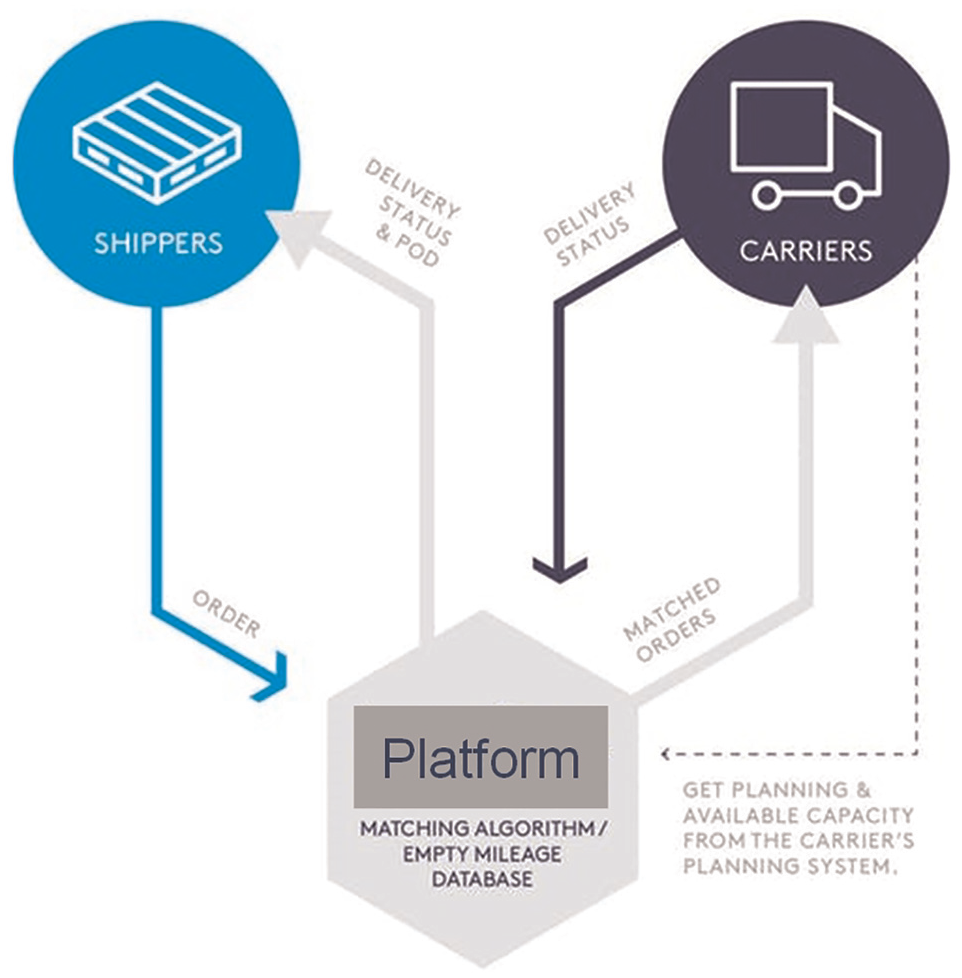
Information flows on a freight platform (adapted from Quicargo [ 3 ]).
Research on collaborative transportation has focused on routing ( 4 ), urban transportation problems ( 5 ), or allocation methods ( 6 ), and often demonstrated significant potential for improvement in relation to costs and sustainability objectives ( 7 ). Nonetheless, there is very limited research on operational planning approaches that explicitly incorporate the objectives of platform providers as well as transportation service providers. In this work, we address this gap by introducing a platform-based collaborative pickup and delivery problem with time windows (PDPTW) that balances platform and carrier interests. The platform interests are considered as the minimization of the price paid by the platform to the carriers. The carrier interests, on the other hand, are considered as the profit, that is, the difference between the price they get from the platform and their transportation costs. The balance between the two interests is addressed by modeling dynamic prices paid by the platform to the carriers as well as individual rationality constraints that ensure attractive profits for all carriers using the platform. We do this by studying the case of Quicargo, a freight platform less-than-truckload (LTL) business. Using real-world data from Quicargo, we find that the proposed collaborative PDPTW allows us to effectively balance the trade-off of platform and carrier interests when we minimize dynamic prices and model individual rationality constraints.
Related Work
Transportation platforms have been investigated seriously for about 10 years and have recently been receiving increased attention from academics. While early works have primarily focused on applications, conceptual models, and policies, recent research also considers platform characteristics for operational and tactical decision support for collaboration. Though this field seems still to be in its infancy, several studies have proposed platform-specific dynamic pricing and incentive creation approaches, sometimes considering allocation methods known in cooperative game theory. Moreover, there are several earlier works that consider some platform characteristics without explicitly referring to a transportation platform.
Early works on collaborative transportation platforms have predominantly focused on the analysis of requirements and drivers for collaboration as well as the development of conceptual models for platforms, often by investigating particular application cases. D’Amours and Rönnqvist ( 8 ) have surveyed previous contributions and derived information as well as technological requirements for platform-based collaboration. They stress the importance of clear cooperation incentives grounded in cooperative game theory, especially when cooperation of potential competitors is desired. Moreover, case study works, among others, have elaborated a conceptual model for transportation sharing in France ( 9 ) and an analysis of advantages for a platform enabling intermodal collaboration in Spain ( 10 ). As one of the first to model platform-based operations, ( 11 ) have developed a dynamic network simulation-assignment platform for intermodal freight transportation. The approach enabled non-collaborative and collaborative transportation to provide a flexible real-world solution. More recently, platform-based transportation research has increasingly focused on operational models and solutions approaches, for instance, enabling collaborative transportation service trading in B2B e-commerce logistics ( 12 ) or developing an agent-based modeling framework which considers the heterogeneity of urban freight agents and their interactions ( 13 ).
Quantitative models of platform-based collaboration have often focused on pricing, particularly on the development of equilibrium models for a taxi-hailing platform ( 14 ), ride-sourcing ( 15 ), or dynamic freight exchange ( 16 ). Choosing a different approach toward pricing, Al-Kanj et al. ( 17 ) propose an assignment problem for a ride-hailing platform in which prices are learned, and Kung and Zhong ( 18 ) analytically derive optimal prices in scenarios of membership-based pricing, transaction-based pricing, and cross-subsidization on a delivery platform. Behrend et al. ( 19 ), on the other hand, maximize the profit of a crowd-shipping platform taking into account different flexibility attitudes for shippers and carriers as well as a compensation rate reflecting excess travel times for the shippers. Moreover, there is a significant body of literature on horizontal collaborative transportation. Related research ( 20 – 24 ) often sets out to minimize costs or maximize profits for a group of collaborating carriers and develops allocation methods to define how the profits or costs are allocated among the individuals of the group. Using allocation schemes, these studies consider collaboration incentives but do not apply a dynamic pricing approach or consider a platform provider as part of the collaborative problem.
Table 1 provides an overview of available research related to platform-based collaborative transportation and positions our paper among them. Despite the increasing number of studies engaging with the topic, there is still a lack of operational planning approaches that explicitly incorporate the objectives of platform providers as well as transportation service providers. In this work, we address this gap by introducing a platform-based collaborative PDPTW that balances platform and carrier interests by modeling dynamic prices paid by the platform to the carriers along with individual rationality constraints for the profits of all carriers. The main contribution of our paper is the evaluation of a collaborative vehicle routing model for platform companies based on a real case study with two main model enhancements: (i) dynamic pricing within a PDPTW; and (ii) individual rationality for platform-based collaboration and, as such, modeling the conflicting interests a platform company has to address.
Analysis of Articles Published for Related Collaborative Transportation Problems
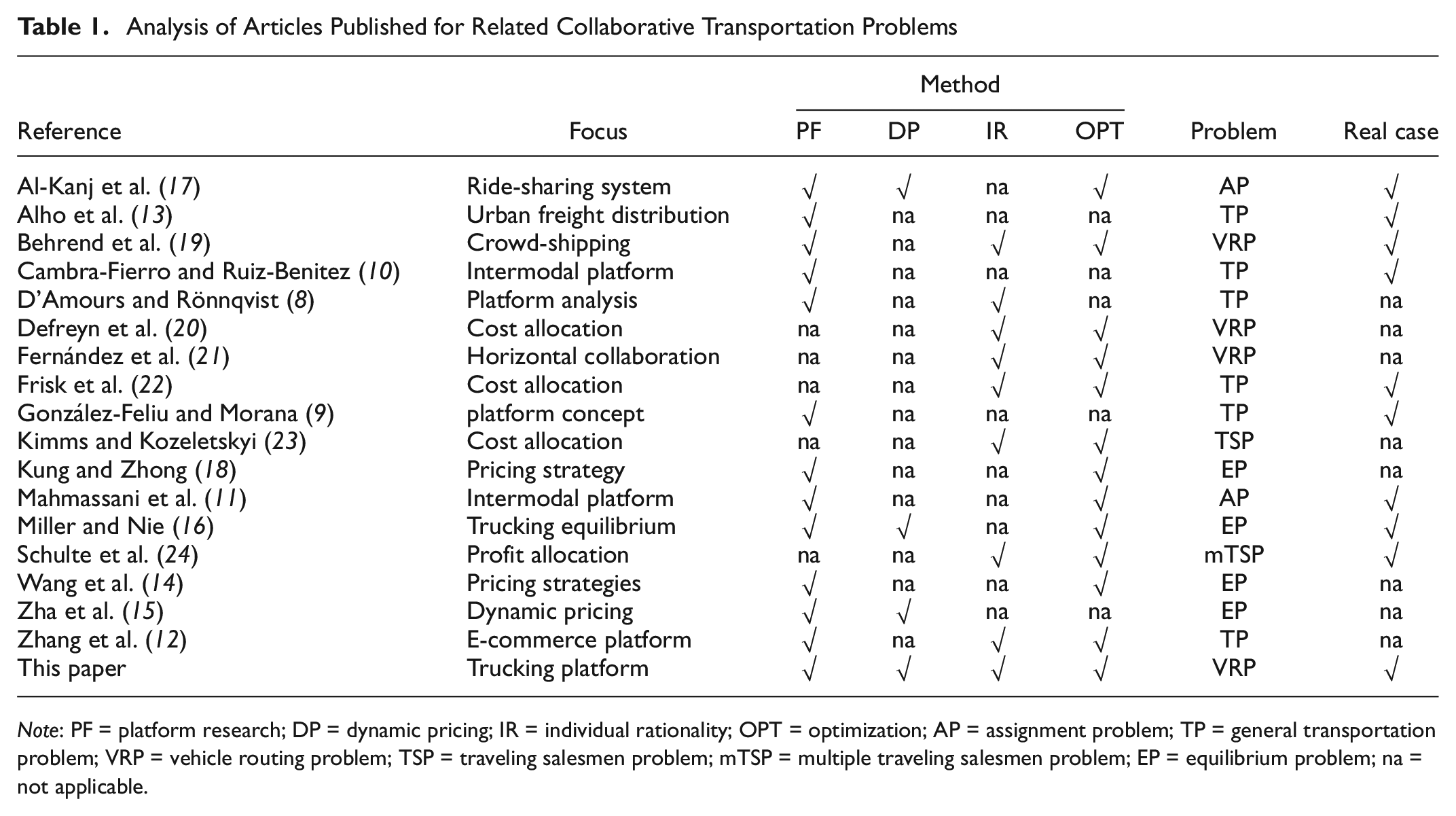
Note: PF = platform research; DP = dynamic pricing; IR = individual rationality; OPT = optimization; AP = assignment problem; TP = general transportation problem; VRP = vehicle routing problem; TSP = traveling salesmen problem; mTSP = multiple traveling salesmen problem; EP = equilibrium problem; na = not applicable.
A Platform-Based Collaborative Pickup and Delivery Problem
We formulate the PDPTW and dynamic pricing. Assume that there are
On top of this typical vehicle routing problem setting, we consider revenue related parameters and variables as we introduce dynamic pricing. First of all, we define the cost for each arc


Objective function (1) minimizes the total price paid by the platform to the carriers. Note that
Routing Constraints
Constraints 3 and 4 ensure that every node is visited exactly once and that the pickup node and the corresponding delivery node are visited by the same vehicle. Constraints 5 and 7 make sure that all routes start and end at the depot, respectively. Constraints 6 maintain the flow conservation.






Revenue and Pricing Related Constraints
Constraints 9 make sure that variables
We look at the problem from the perspective of the platform that connects shippers and carriers. This platform is assumed to provide the price to the carriers. We assume that each carrier owns a single truck. Therefore, each vehicle
As here we are assuming full collaboration, we need to take into account the profit of each carrier such that when the routes are optimized globally it does not lead to a lower profit for a given carrier as indicated by Constraints 13. Note that this
Furthermore, to make the price values realistic and reasonable we define a lower bound and an upper bound in Constraints 14 and15, respectively. The lower bound is the cost based on the origin-destination (OD) distance which is an estimate as the actual routing is not known before solving this model. The term









Time and Load Constraints
The consistency of the time variables is ensured by Constraints 18. Similarly, the consistency of the load variables is ensured by Constraints 19. Constraints 20 set the precedence constraints, meaning that a truck must visit the pickup node before it visits the delivery node, where





Constraints 18 and 19 are nonlinear and can be linearized as given in 23 to 25, where the constraints are binding only if







Policies and Experimental Results
We propose several polices for dynamic pricing of platform-based collaborative transportation and evaluate them in computational experiments using sampled real-world data from the LTL platform provider, Quicargo. The applied dataset contains all inputs required to solve the proposed collaborative PDPTW. Distances between locations are calculated based on the Google Maps Distance Matrix API, and the model was implemented in Python and solved with Gurobi 8.0.1 on a computer with a 2.8 GHz Intel Core i7 processor. Figure 2 contrasts a non-collaborative setting (a) and a setting using platform-based collaboration (b) in the real-world scenario considered in The Netherlands.
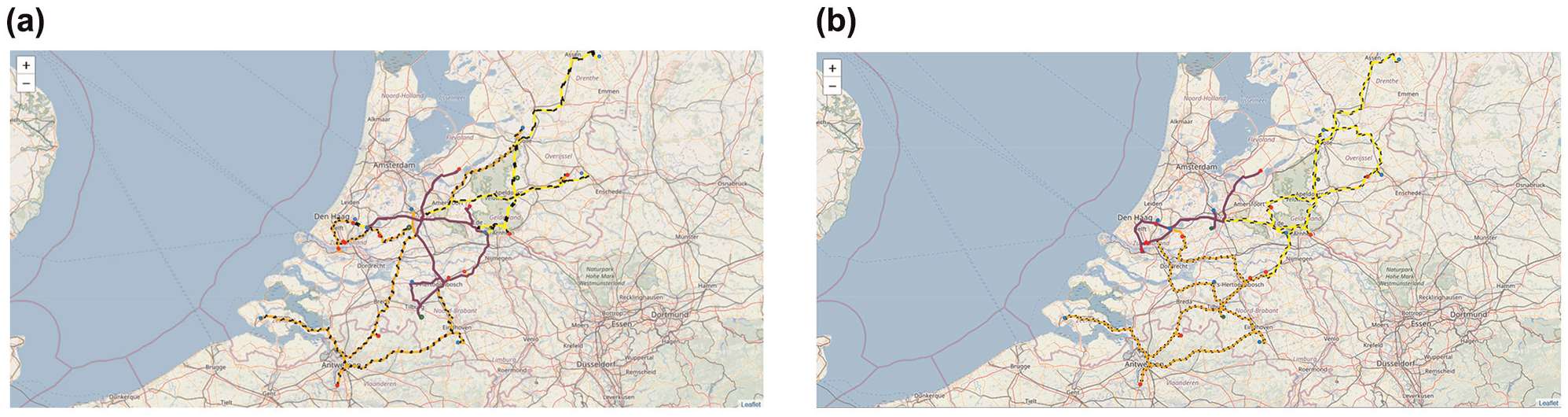
A comparison of individual and collaborative routes for an example of three carriers in The Netherlands (routes of Carrier 1 are marked as dotted, routes of 2 as dashed, routes of 3 as solid lines). A green node indicates a depot, a red node delivery, and blue node a pickup. (a) Individual pickups and deliveries. (b) Platform-based pickups and deliveries.
To establish a benchmark, we first consider a non-collaborative setting in which carriers do not exchange any information among themselves and only use their own trucks to service their own demand which they received without using the platform. In the second step, we examine a collaborative setting in which prices (paid by the platform to the carriers) remain static but the platform is assumed to have full control of all demands and all trucks to find an optimal solution for the collaborative PDPTW. Finally, we evaluate two policies for dynamic pricing in the collaborative PDPTW: (i) minimizing costs of the platform while maintaining individual carrier profits at the level of the collaborative setting; and (ii) minimizing costs of the platform while maintaining individual carrier profits at 5% and 10% above the non-collaborative setting.
For illustrative purposes, we subsequently introduce and compare the proposed policies using an example with three carriers and a given set of orders. The observed findings are confirmed by more extensive experiments with instances using a higher number of carriers and a different set of orders, as presented at the end of this section.
Individual Pickups and Deliveries by All Carriers—No Collaboration
As a benchmark for the collaborative policies, we first solve individual PDPTWs for all carriers where each carrier maximizes their own profit at their own prices. As a result, we obtain the profits that each carrier could generate without any kind of collaboration, that is,
Results for Individual Pickups and Deliveries by All Carriers
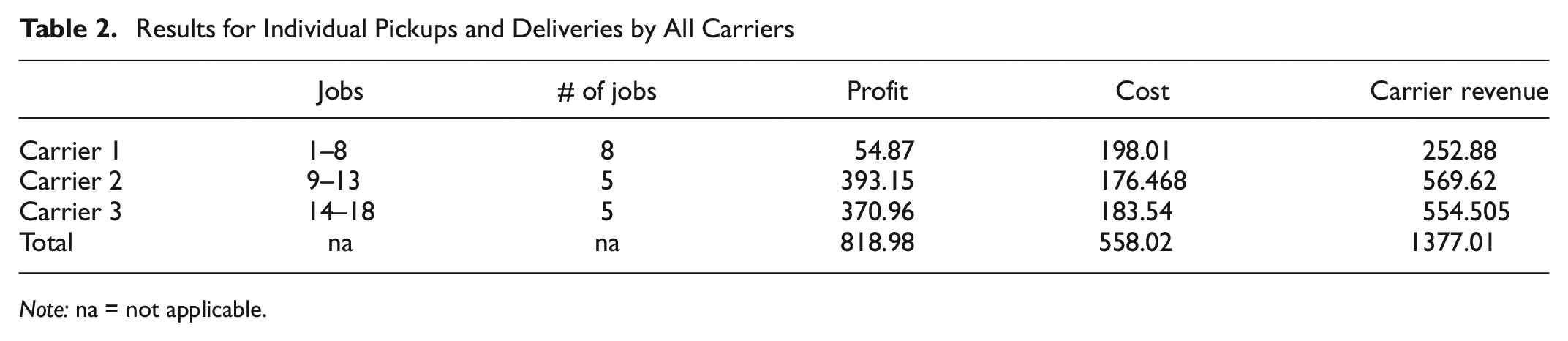
Note: na = not applicable.
Collaborative Pickup and Deliveries with Static Prices
As a first collaborative policy, we assume that the platform defines static prices (per km and loading meter) which are essentially the same prices carriers would use without using the platform. In this setting, the objective is minimizing transportation costs as given in objective function (
2
), and the prices are those that the carriers originally charged. Therefore, variables
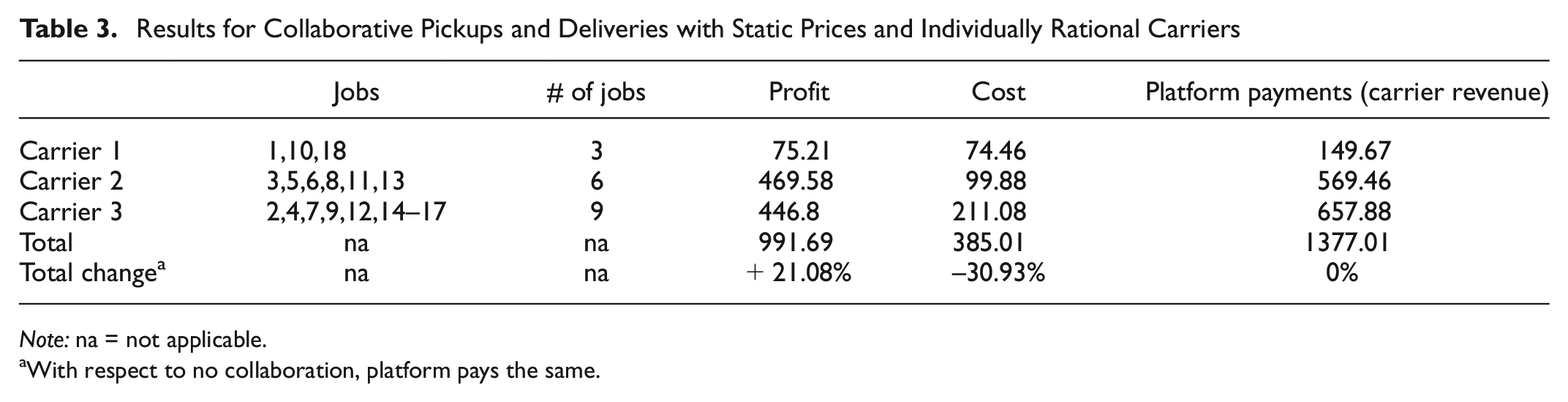
Results for Collaborative Pickups and Deliveries with Static Prices and Individually Rational Carriers
Note: na = not applicable.
With respect to no collaboration, platform pays the same.
Most notably, the results show that collaboration leads to significant cost savings and profit gains, even when considering relatively small instances. Nonetheless, following this policy, the benefit of the collaboration entirely goes to the carriers while the platform provider cannot generate any profit for their own business.
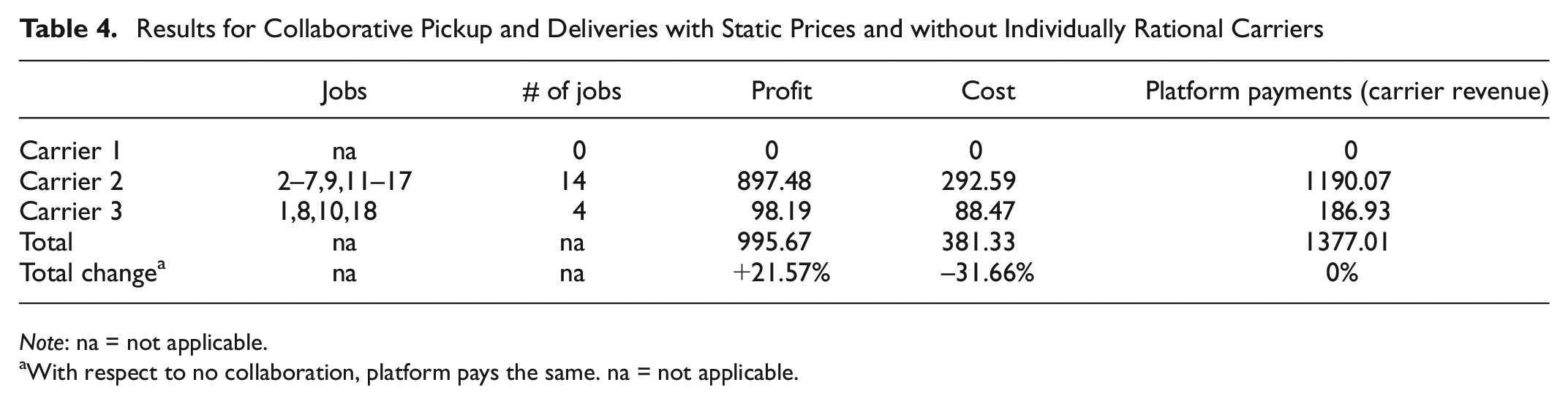
As a second collaborative policy, we assume again that the platform uses the static prices (per km and loading meter) and minimizes transportation costs as given in objective function ( 2 ). However, we relax the individual rationality Constraints 13 in the collaborative PDPTW, that is, we allow that the profit of any carrier may fall short in comparison to those in the non-collaborative setting. Table 4 displays the transportation orders (jobs), profits, platform payments (carriers), and costs for all carriers when they use the platform to collaborate and individual rationality is relaxed. As in the previous case, the platform payments are the revenues for the carriers in this setting.
Results for Collaborative Pickup and Deliveries with Static Prices and without Individually Rational Carriers
Note: na = not applicable.
With respect to no collaboration, platform pays the same. na = not applicable.
The results demonstrate that the individual rationality constraints do not affect total costs and profits significantly for the instance presented. This is something that could be expected since the model formulation pools together different jobs and has the flexibility to reassign them to carriers thanks to full collaboration. In the case of individual rationality, it needs to maintain each carrier’s profit specifically and can do so without increasing the prices significantly (compared with the case without individual rationality) as it can rearrange the job allocation. In practice, this means that a platform provider may be able to offer margins as collaboration incentives to the carriers without generating excessive costs on their own side. In the scenario considered without individual rationality, Carrier 1 ends up without any jobs or revenues. This is clearly a scenario that a platform provider wants to avoid because it may deter Carrier 1 from engaging in further use of the platform.
Collaborative Pickup and Deliveries with Dynamic Prices
We evaluate two policies for dynamic pricing in the collaborative PDPTW: (i) minimizing payments of the platform while maintaining individual carrier profits at the level of the collaborative setting; (ii) minimizing payments of the platform to the carriers while lifting individual carrier profits to 5% and 10% above the non-collaborative setting. In this case, we minimize the total price the platform pays to the carriers according to the objective function (1). For the first policy, we minimize the total prices and simply assume the individual rationality Constraints 13 in the collaborative PDPTW, ensuring that the profits of all carriers are maintained or exceeded in comparison to those in the non-collaborative setting.
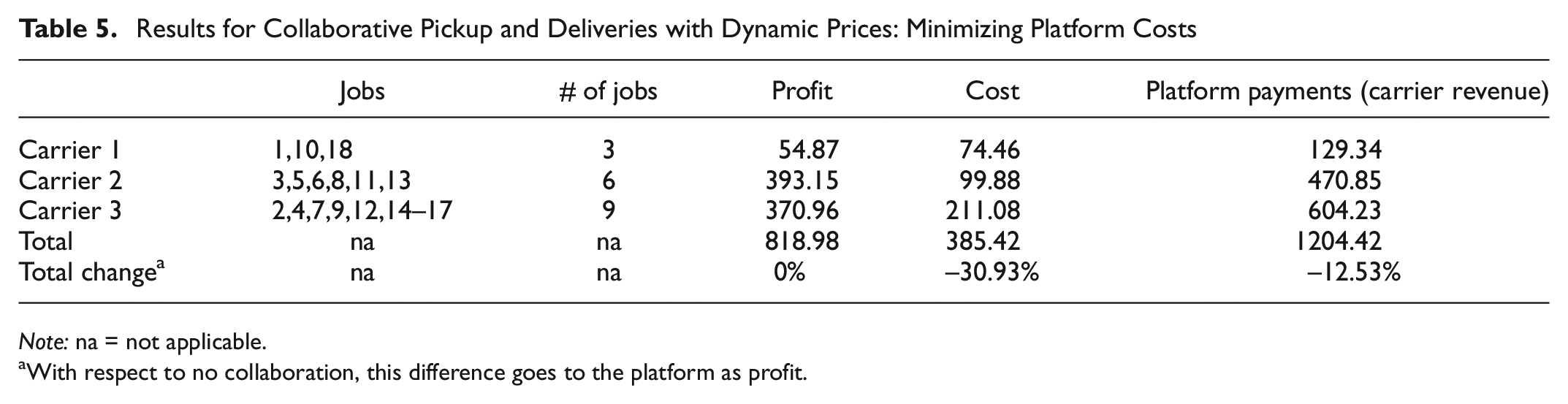
Table 5 shows the transportation orders (jobs), profits, platform payments (revenues of the carriers), and costs for all carriers when they use the platform to collaborate and individual rationality is maintained.
Results for Collaborative Pickup and Deliveries with Dynamic Prices: Minimizing Platform Costs
Note: na = not applicable.
With respect to no collaboration, this difference goes to the platform as profit.
Despite carrier profits being maintained by the individual rationality constraints, the results demonstrate that the platform payments can be significantly reduced (in comparison with the static prices paid in the earlier examples) in this setting. The carriers, on the other hand, maintain their profits. This shows that, even for a relatively small example with three carriers and a limited number of orders, the platform provider can generate a margin that can be used for their own operations or to create collaboration incentives for carriers and shippers.
To better understand how the platform provider could create collaboration incentives for carriers, we evaluate a second policy for dynamic pricing in which platform payments are still minimized but every carrier is guaranteed to gain 5% and 10%, respectively, in relation to the non-collaborative setting. Note that, depending on the parameter setting for
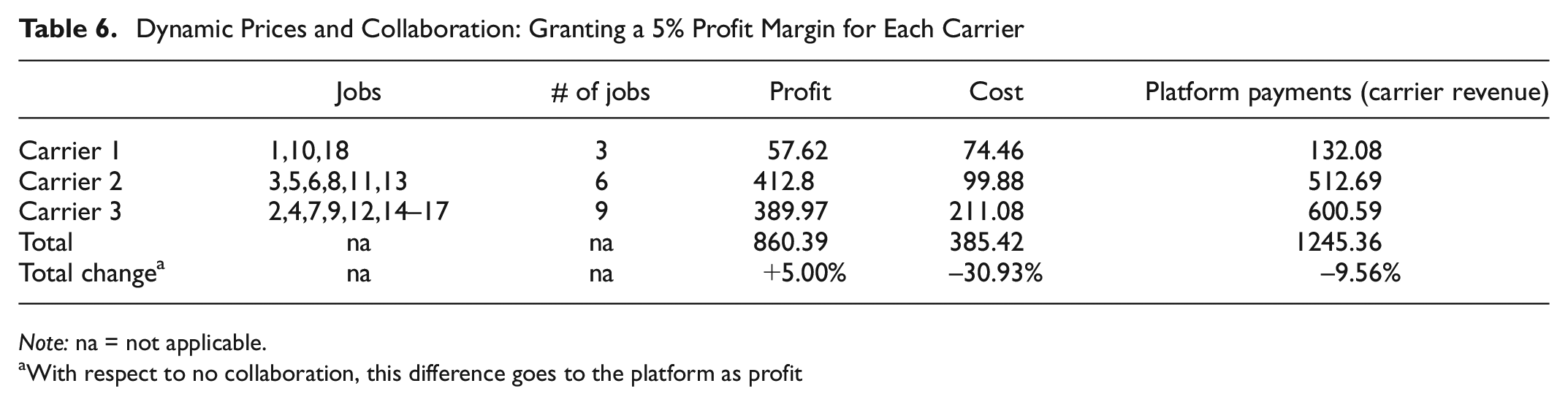
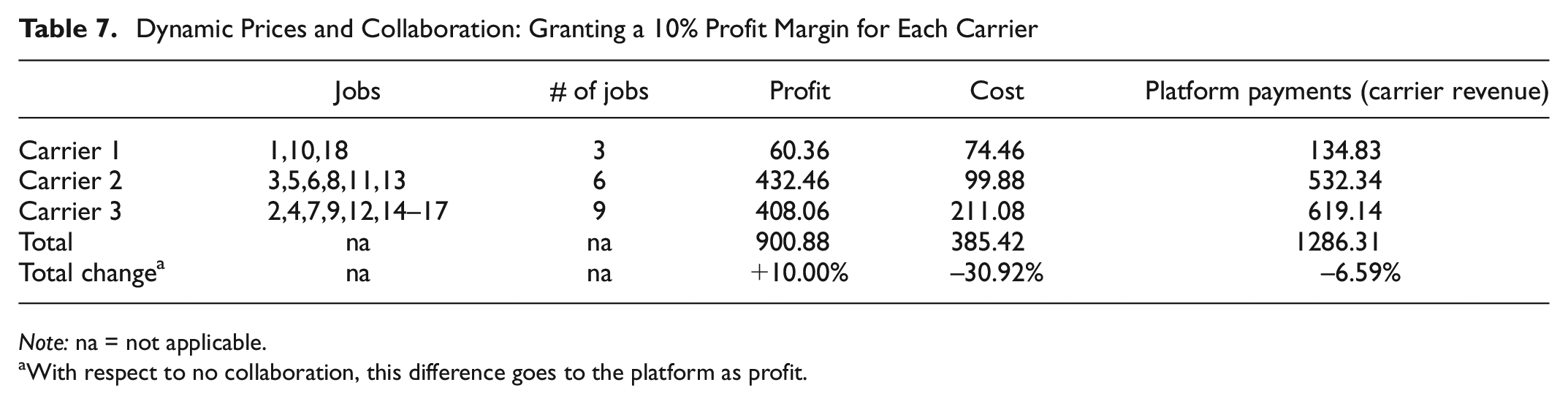
Tables 6 and 7 display the transportation orders (jobs), profits, platform payments (revenues of the carriers), and costs for all carriers when they use the platform to collaborate and individual rationality is maintained and the
Dynamic Prices and Collaboration: Granting a 5% Profit Margin for Each Carrier
Note: na = not applicable.
With respect to no collaboration, this difference goes to the platform as profit
Dynamic Prices and Collaboration: Granting a 10% Profit Margin for Each Carrier
Note: na = not applicable.
With respect to no collaboration, this difference goes to the platform as profit.
The results clearly show that the platform provider can even guarantee a 5%, or even 10%, as profit margins to the carriers and still maintain a significant share for itself. This implies that this policy effectively balances the interests of the major parties involved in the case of platform-based collaboration. The platform pays less to the carriers (in comparison with the standard setting with static prices) and the carriers can also gain significantly from using the platform for collaboration. Moreover, the results convey another message: platform providers could actually guarantee certain profit margins to their carriers and still maintain a healthy business, thanks to collaboration.
Experimental Results on Additional Instances
To confirm our findings and analyze the proposed policies for larger instances, we conducted more experiments with different sets of jobs and more carriers involved. The results actually confirm the earlier findings and indicate that the intuition that involving more players leads to larger gains may actually hold. Table 8 presents results for instances with five carriers. Here, we show the change in routing costs, platform payments, and carriers’ total profit in comparison with the non-collaborative case.
Results for Additional Instances with Five Carriers
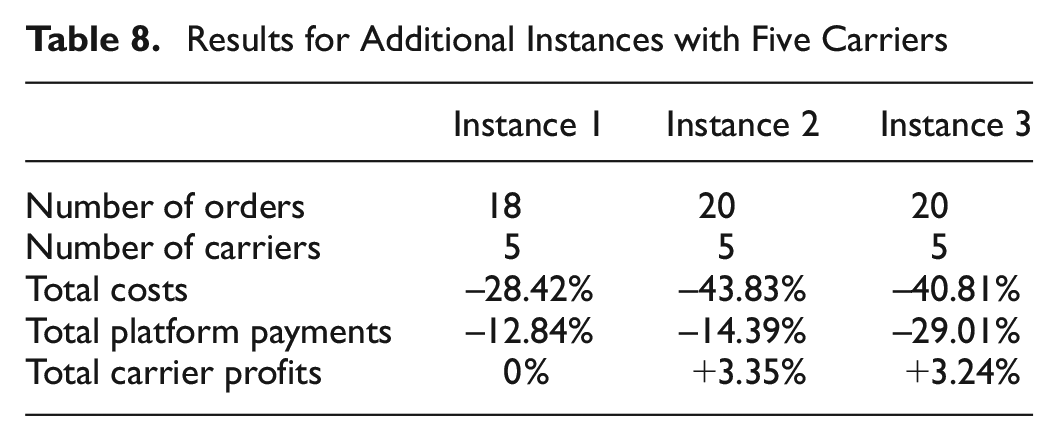
The first instance has the same set of orders (18 in total) as the previous section’s experiments. However, in this case they are distributed across five carriers. As a result, there is still a similar reduction in the total platform payments (slightly increased reduction). The routing cost in relation to the ‘no collaboration’ case is a bit lower, in this case with five carriers, since there are more potential job exchanges between carriers possible.
For the second and third instances, we work with two completely different sets of orders (20 in total) and again with five carriers. Note that, in these cases, some of the carriers are not profiting from the original assignment of the orders, that is, they are losing money without collaboration. In the case of instance 2, there are two such carriers and for the case of instance 3 there was only one. When we analyze the gains from the proposed collaborative PDPTW, we see that the routing cost reduction is even higher, and those carriers who have been losing money are now better off—that is why there is an increase in the total carrier profit. The overall strategy of the model is that, for those carriers who originally had higher profits, the model tries to assign more orders and optimize the routing in a way that they still make at least the original profit. On the other hand, for other carriers with lower original profits, it assigns only few orders, if any, so that the cost is not increased for them.
These additional instances show that under different settings we confirm the benefit of the proposed methodology. We are aware that the level of gains will very much depend on the set of orders at hand together with their attributes (origin, destination, delivery time windows, etc.). For cases where there really is little room for changing the routes, the gains will be smaller. In these instances, the gain from collaboration is considered to be mostly enjoyed by the platform. However, it is straightforward to tweak the model to guarantee a higher profit for the carriers and still keep a profitable business for the platform. For example, in the case with 20 orders, the gain of 14.39% in platform payments to the carriers can be split between carriers and the platform provider.
Conclusions and Future Research
Platforms have recently begun to transform the transportation industry. Transportation research, however, still lacks operational planning approaches that explicitly incorporate the objectives of platform providers as well as transportation service providers. In this work, we have introduced a new platform-based collaborative PDPTW that balances platform and carrier interests by modeling dynamic prices paid by the platform to the carriers as well as individual rationality constraints for the profits of all carriers. Using real-world data from the platform provider, Quicargo, we have found that the proposed collaborative PDPTW allows us to effectively balance the trade-off between platform and carrier interests when we minimize dynamic prices and model individual rationality constraints. To the best of our knowledge, this is the first case study of this kind for a freight platform. Combining methods from dynamic pricing, vehicle routing, and basic game theory, we provide a new way to model operations of transportation platforms. Moreover, the proposed policies add to research aimed at understanding dynamics on transportation platforms. For instance, our results indicate that platform providers could guarantee increases in carriers’ profit margins (of 5% or 10% in the examples provided) to create strong incentives for using the platform while still maintaining profitable operations on their side.
In this way, our findings may change the way transportation platforms are designed, used, and modeled in the future: platform providers could set new kinds of incentives, users may increasingly rely on platforms, and the modeling approach may be adopted for other new platforms. Nonetheless, our results indicate that larger instance sizes, in relation to carriers and orders, may lead to even more significant improvements for platform approaches. Future work will thus set a focus on the development of suitably exact and heuristic algorithms. Moreover, the adoption of approaches used in cooperative game theory, beyond individual rationality, will be investigated in the setting of transportation platforms. Furthermore, in practice, it is difficult to attain full collaboration. Different levels of information sharing and different levels of autonomy compromises by the carriers are, therefore, very promising future research directions.
Footnotes
Acknowledgements
The authors would like to thank the collaborators from Quicargo for making this work possible with the provided case study.
Author Contributions
The authors confirm contribution to the paper as follows: study conception and design: B. Atasoy, F. Schulte, A. Steenkamp; data collection: B. Atasoy, F. Schulte; analysis and interpretation of results: B. Atasoy, F. Schulte, A. Steenkamp; draft manuscript preparation: B. Atasoy, F. Schulte, A. Steenkamp. All authors reviewed the results and approved the final version of the manuscript.
Declaration of Conflicting Interests
The author(s) declared no potential conflicts of interest with respect to the research, authorship, and/or publication of this article.
Funding
The author(s) received no financial support for the research, authorship, and/or publication of this article.