




Abstract
This paper focuses on car drivers’ willingness to pay for design related attributes of parking garages. Car drivers’ willingness is retrieved from a stated choice experiment including three basic attributes (capacity of parking, parking tariff, and walking distance between parking and final destination) and 25 design related attributes. The design related attributes are included in the choice experiment following the principles of Hierarchical Information Integration that grouped the 25 attributes into five constructs: attributes related to the parking area, pedestrian environment, accessibility, service, and safety. Per construct, respondents were invited to choose two times between two parking facilities. The experiment was included in an online questionnaire that was completed by 315 respondents who evaluated in total 3,150 choice tasks. The respondents’ choices are evaluated using a standard multinomial logit model. The results show that the following design related attributes significantly contribute to the total utility of parking garages: the width of parking spaces, the width of road lanes, the type of pedestrians’ routes, the width of staircases, the types of elevator points, the presence of parking guidance systems, the available payment options, the presence of toilets, the level of lighting, the presence of ramps, and the level of cleanliness and maintenance. The respondents are willing to pay most for the available payment options (range €2.91) and the level of cleanliness and maintenance (range €2.69).
Parking companies aim to attract as many car drivers as possible to their parking facilities to increase the occupancy rates of their facilities and yield the maximum revenues ( 1 ). The companies pay a lot of attention to the demands of parking garage users ( 2 ). Over the years, car drivers have become more critical parking “consumers” with specific requirements regarding the facility where they park their cars ( 3 ). The parking companies recognize the importance of providing a high-quality product that meets the demands of car drivers (Figure 1). A parking garage may be equipped with a high-quality design, for example good lighting, luxurious materials, high-security equipment, and ultrasonic parking space sensors ( 4 , 5 ). These aspects, however, do not guarantee more visitors because of the applicable parking tariff. Car drivers may prefer a car park with a lower internal quality that is located closer to their final destination, has a lower parking tariff, or both ( 6 ). The same relationship is noticed when considering the competition between on-street and off-street parking ( 7 , 8 ). It also appeared that (un)fair parking tariffs affect the demand for parking in general but also the demand for parking in garages ( 4 , 9 , 10 ). The review of the existing literature reveals that there is a knowledge gap about the connection between parking tariffs and design related attributes ( 11 ).

Example of advertisement of parking company (www.q-park.co.uk).
The aim of this paper is to fill in this knowledge gap and provide more insight into car drivers’ willingness to pay (WTP) for design related attributes of parking garages. The paper focuses on the results of the model estimation process and the calculation of WTP. More detailed information about car drivers’ experiences with parking in garages can be found in Agarad ( 11 ). The remainder of this paper is organized as follows. First, a brief overview is given of design related attributes that are considered in several parking garage design documents including different parking garage evaluation lists. Next, the adopted research approach is outlined. The data collection and some details of the sample are presented in the following section. The results of the model estimation are presented in the subsequent section. The paper ends with the conclusions and some suggestions for future research.
Design Related Attributes
Design related attributes include all kind of attributes that give form to a parking garage both inside and outside the parking garage. When searching for design related attributes, various sources can be explored: handbooks, checklists, and previous studies of car drivers’ parking preferences. A variety of handbooks for parking garage design is available that pay attention to design related attributes (e.g., 12 – 17 ). Most handbooks give advice regarding individual attributes from a technical (size, height, slope, lux, etc.) and managerial (maintenance, safety, profit, etc.) perspective without paying detailed attention to the design aspects of the attribute or combination of attributes. The handbooks also pay less attention to car drivers’ preferences or WTP. They focus on the practical usage of all elements of parking garages like entrance and exits, parking roads and spaces, and pedestrian routes. Some examples of design related attributes are shown in Figure 2: wall painting, wall coverage (wood/glass), pavement (light/dark), and lighting (artificial/daylight).
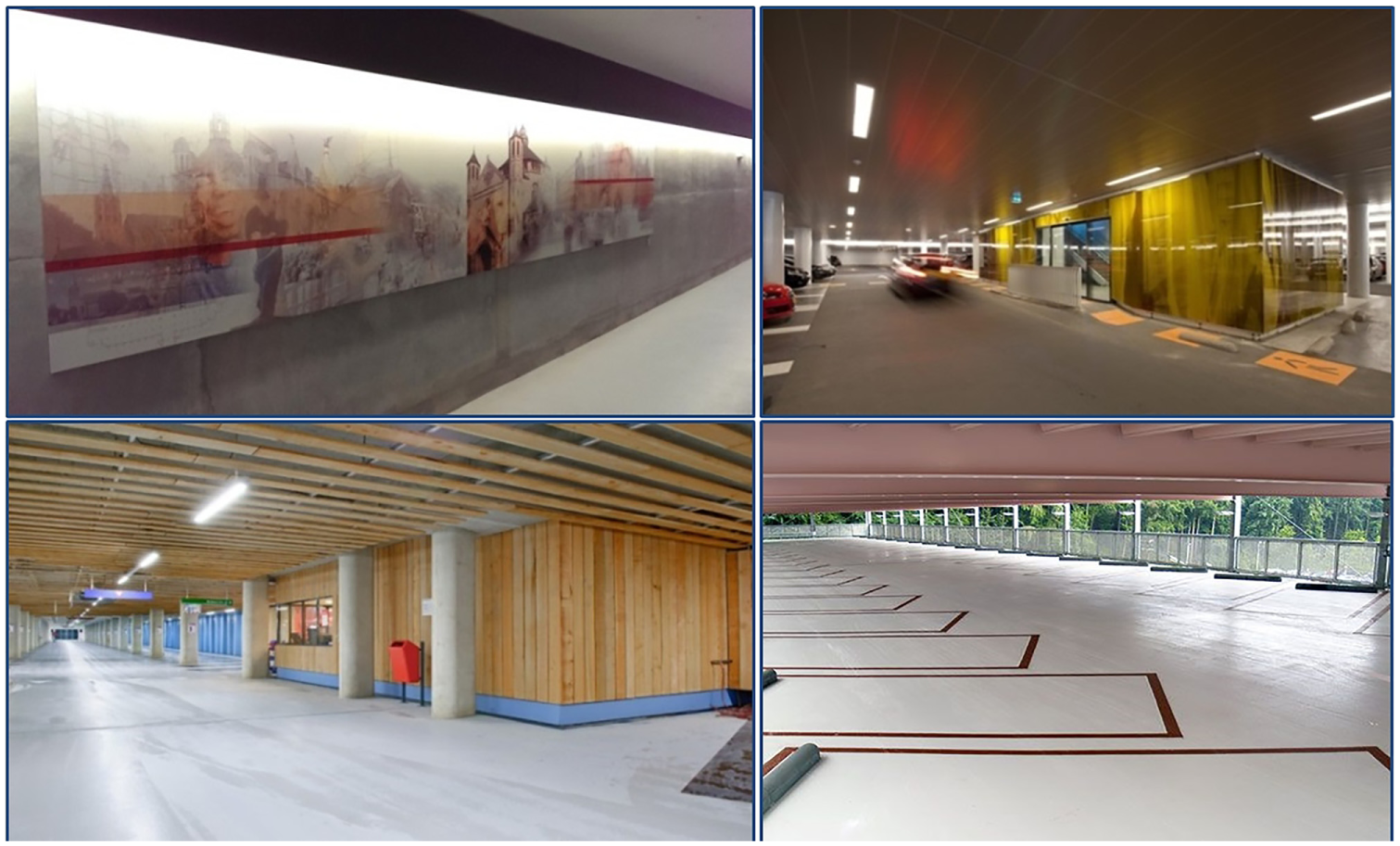
Examples of design related attributes (www.architectenweb.nl).
Another source of inspiration concerns various checklists that are used to evaluate parking garages. The European Parking Association developed an extensive checklist to evaluate parking garages for the European Standard Parking Award ( 14 , 18 ). The checklist includes 101 criteria to evaluate parking garages. The criteria are grouped into 11 categories: set of mandatory minimum requirements, lighting, car entry/exit, parking area, pedestrian route, elevators and stairwells, safety and security, outside of car park, comfort and miscellaneous, way finding, and energy and environment. In addition to the 101 criteria, the checklist evaluates aspects such as the presence of graffiti, presence of dirt, quality of paintwork, presence of poor quality/lack of maintenance, and evidence of bad smells. In addition, the check list pays attention to aspects such as extra provisions (lockers, bicycle rent, real-time traffic data), presence of customer service desk, and friendly staff. The checklist includes a very detailed scoring mechanism (in lux, meters, percentages, etc.) that is used by experts to evaluate parking garages. The Dutch organization of parking garage owners, Vexpan, has developed a checklist as well ( 14 ). The categories used in this checklist are more focused on the various activities that are connected to the use of parking garages: entering the garage, driving through the garage, moving as pedestrian to destination and back to the car, and leaving the garage. The checklist is filled out based on evaluations of both experts and users.
Research Approach
To investigate the relationship between car drivers’ WTP and design related attributes of parking garages, a stated choice experiment is designed. In this experiment sets of two hypothetical parking garages are presented to car drivers with the question which parking garage they liked most. The parking garages are described using three basic and 25 design related attributes. The selection of the design related attributes is based on the literature review as presented in the previous section. For this study, the basic attributes include parking tariff, walking distance between parking and final destination, and capacity. To make the choice task easier for the respondents, the design related attributes are categorized into five groups: attributes related to the parking area (e.g., parking space and road), pedestrian environment (e.g., routes and exits), accessibility (e.g., access control system and waiting time at entrance), service (e.g., parking guidance system and payment options), and safety (e.g., level of lighting and security).
The large number of possible influential attributes stimulated the decision to choose the Hierarchical Information Integration (HII) approach as presented by various researchers (e.g., 19 – 21 ). The approach includes the ability to handle a large number of attributes by combining attributes into smaller sets of decision constructs. HII structures complex decision problems by assuming that individuals categorize decision attributes into separate (high-order) decisions. It is assumed that individuals integrate information about attributes into constructs to form impressions of alternatives. The idea behind the HII method is to structure decision tasks to study and analyze each integration process separately and jointly. Oppewal et al. identified some problems and limitations related to previous use of HII and developed an approach of integrated HII choice experiments ( 19 ). This approach was used in the current study. The approach suggests that a choice alternative is described by the attributes of one construct and summary measures for the remaining constructs. In general, the following steps can be distinguished when setting up a stated choice experiment based on HII approach.
Step 1: Selecting interesting attributes
Step 2: Defining corresponding constructs
Step 3: Defining attribute levels for selected attributes
Step 4: Combining attribute and construct levels into choice alternatives
Step 5: Composing choice tasks
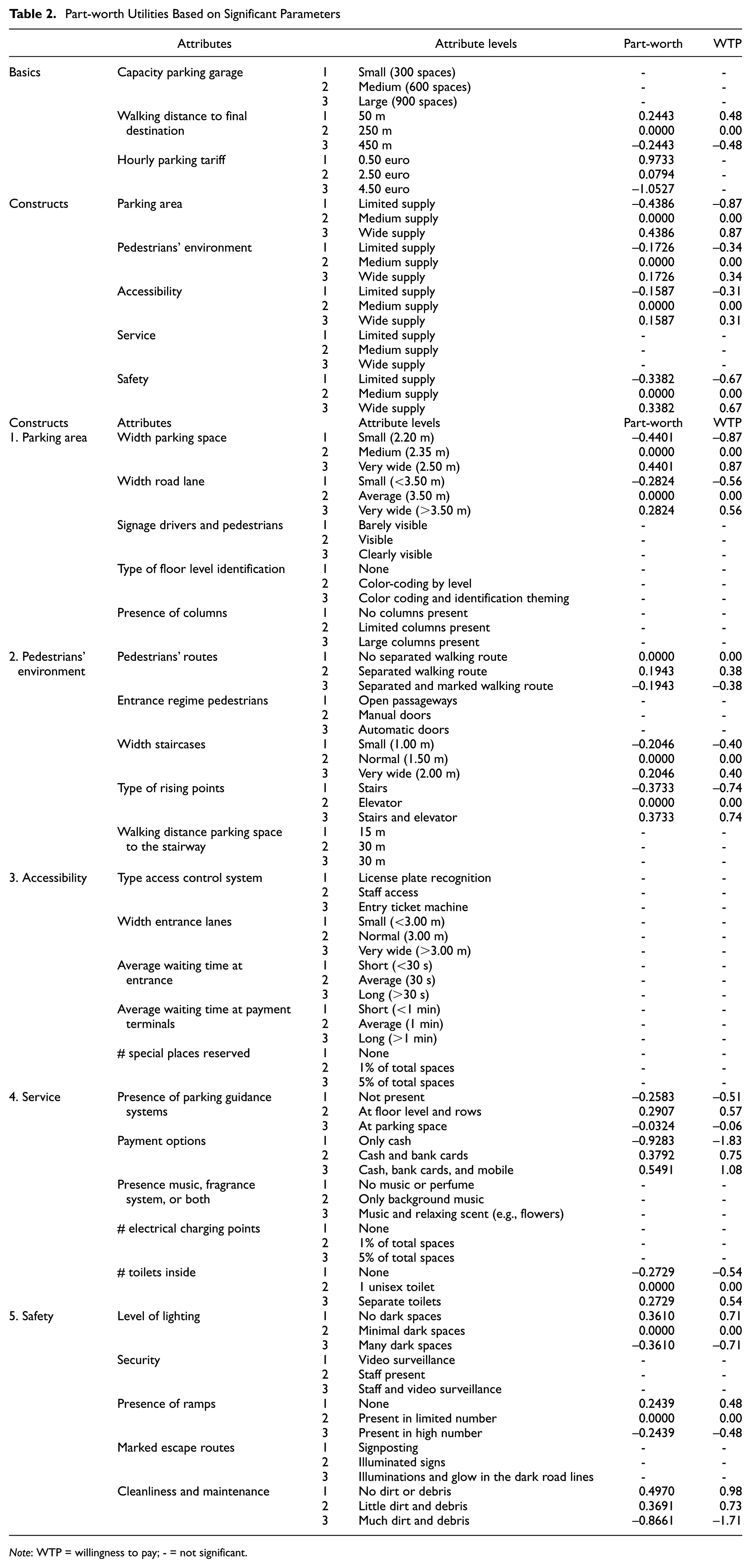
In total, each choice alternative is described by 12 attributes: three basic attributes, five attributes that detail one group, and four attributes that represent an overall score of the groups that are not detailed. A detailed specification of the attributes and corresponding levels is shown in Table 2. The overall scores of the groups range from wide supply (green bar) to limited supply (red bar). To express these scores, pictograms are used (see Figure 3). To define a parking garage, a fractional factorial design is used of 3^12 resulting in 54 different alternatives. The alternatives are randomly placed in choice sets each consisting of two alternatives. As shown in Figure 3, each parking garage was described by three basic attributes (capacity, walking distance to final destination, and tariff), five attributes describing one specific construct, and four attributes representing the global effect of the remainder constructs. After an introduction of the attributes and corresponding levels (with text and pictures), respondents were asked to select the parking garage they most prefer. Each respondent evaluated two choice tasks per construct. When evaluating the two parking garages, the car drivers had to assume that they were visiting an inner city area.
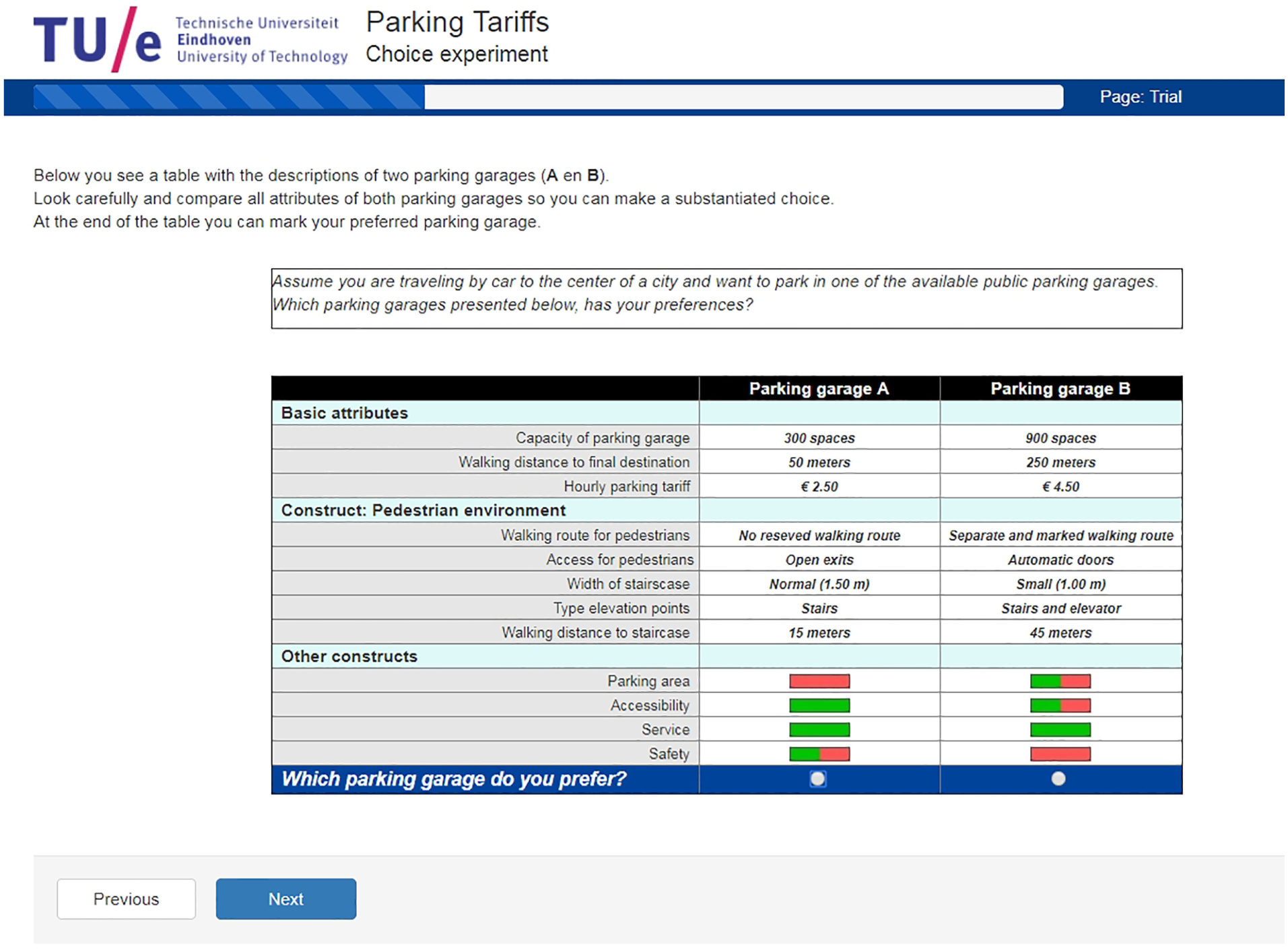
Example of a choice task construct “Pedestrian environment.”
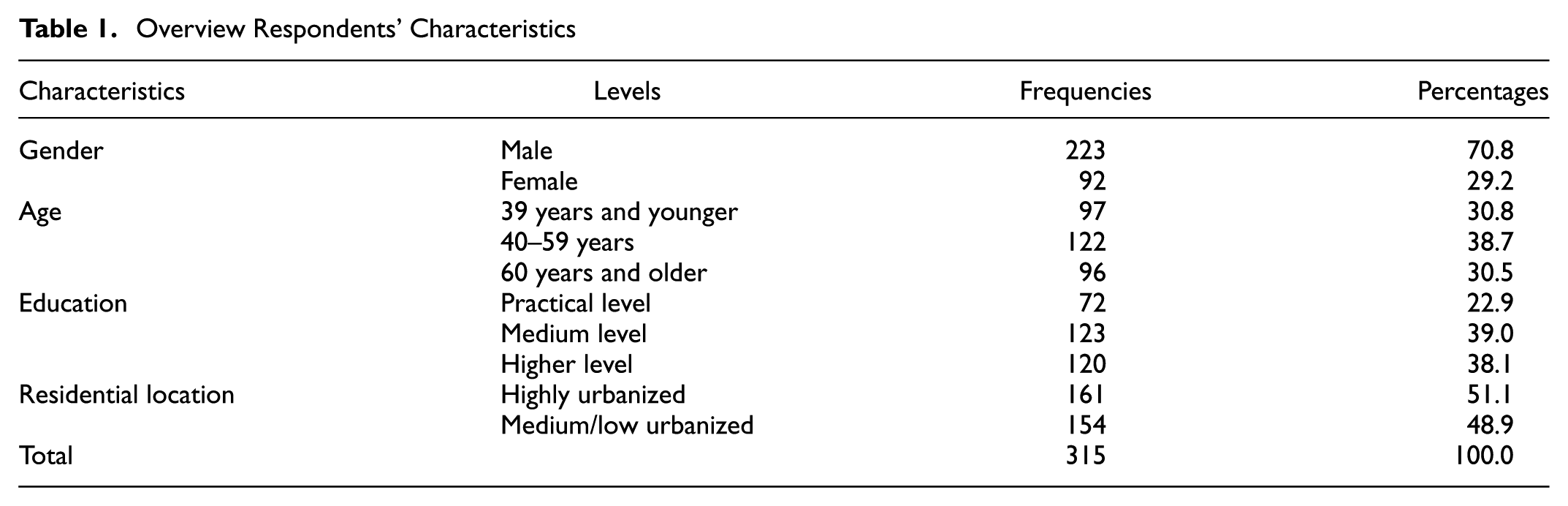
The experiment was included in an online questionnaire that was distributed among respondents who have a driving license and experiences with parking in a public parking garage. The questionnaire also includes questions regarding parking experiences (how often they visit a car park and how often they pay for parking) and personal characteristics (see Table 1).
Overview Respondents’ Characteristics
Data Collection
Invitations for the questionnaire were sent through different social and company networks and published on the website of the Dutch parking organization, Vexpan (vexpan.nl). In total, 315 respondents completed the questionnaire. Table 1 shows some details of the respondents. All respondents have a driver’s license and have experience (in relation to number of visits) with public parking garage use in city centers. Because of a lack of data, the sample could not be related to the population of parking garage users. With at least 72 respondents in each characteristics level, the distribution of the respondents across the levels is fair enough to continue the analyses. This means that all kind of respondents are well represented by the sample.
Model Analyses
The respondents evaluated 3,150 choice tasks in total. For each group of attributes and all individual attributes, the contribution to car drivers’ preferences is estimated using a standard multinomial logit model ( 22 ). This model is defined as follows (Equation 1).

where
Piq is the probability that individual q will choose alternative i;
Viq is systematic utility of alternative i and individual q.
The observed value of utility Viq can be defined as a function of K variables xiqk with parameter estimates βk as shown in equation below (Equation 2). A linear relation is assumed between the attributes and the systematic utility Viq with parameter estimates βk representing the weight of each variable k.

For the calculation of the total utility, a linear additive function is used where each parameter is a single fixed parameter ( 22 ). To represent the effects of the independent variables (x) on the dependent variable (V), effect-coding is applied in this research. Since there are three levels assigned to the eight attributes within the experiment, each attribute must be transformed into two effects. The three levels are coded respectively (1, 0), (0, 1), and (−1, −1). Note that such a coding scheme enables the estimation of both linear and non-linear effects. The model’s performance can be assessed by using McFadden’s Rho-Square. Rho-Square can take values between zero (no relation) and one (optimal relation). A descent model fit is already considered for a value of 0.3 ( 22 ).
The model is estimated using NLogit 5.0 ( 23 ). The model estimation process results in a log-likelihood value of −1553.6444 (with 66 parameters). A comparison with the log-likelihood of the null model (a model with all parameters equal to zero) shows that the estimated model outperforms the null model (LLnull = −2183.4136). This comparison is based on the Log-likelihood Ratio Statistic: −2[LLoptimal-LLnull] ( 22 ). The test-value for 66 degrees of freedom is equal to 85.965. The model has a Rho-Square value of 0.288 which shows that the model is able to predict the observed choices well.
Table 2 shows the part-worth utilities of the attribute levels based on significant parameters (confidence level of 90% or higher) multiplied with the effect coded value of the attribute levels.
Part-worth Utilities Based on Significant Parameters
Note: WTP = willingness to pay; - = not significant.
The results in Table 2 show that, of the basic attributes, walking distance and hourly parking tariff significantly contribute to the total utility of a parking garage. It appears that the longer the walking distance between parking garage and final destination, the lower the utility of the parking garage is. The part-worth utilities of the parking tariff show that the higher the tariff is, the lower the total utility will be. At the general level of the Constructs, all groups of amenities significantly contribute to the utility of a parking garage except for Service. For all significant constructs, the part-worth utilities indicate that the presence of a limited supply decreases the total utility of parking garages, while the presence of a wide supply increases the utility. The level of Service supply in general terms does not affect car drivers’ preferences. In addition, Table 2 shows for each construct the part-worth utilities of the individual attributes. Again, the part-worth utilities are calculated by combining significant parameters with the attribute values (based on effect coding). A negative part-worth utility indicates that the total utility of a parking garage decreases when the particular attribute level is offered. In the case of a positive part-worth utility, the total utility increases resulting in a higher probability of being chosen. At the detailed level of attributes no significant attribute was found for the construct “Accessibility.” This means that this construct does have an influence at the general (construct) level but not at the more specific level of attributes. Respondents do not focus on the detailed elements of accessibility that are included in the study. In contrast, significant attributes were found for the construct Service which as a construct was not significant (see before). Here respondents show a higher appreciation for the detailed elements that define the construct than for the general description at the construct level.
Almost all effects are as expected. The only exception concerns the effect of the attribute “Pedestrian routes,” where a separate walking route is preferred over a separate walkway with marking. It might be that car drivers feel too restricted in their movement as a pedestrian when marking is present. The absence of effects in the case of several attributes is not always as expected either. For example, unclear signage for drivers and pedestrians, the presence of columns, the absence of security, and the absence of marked escape routes are commonly mentioned issues in car drivers’ annoyances ( 3 ).
To find out how much car drivers are willing to pay for influential design attributes, the contributions of the attributes are related to the effect of parking tariff. The WTP is calculated as follows ( 22 ). First, the parameter range of parking tariff is calculated (2.0260). Next, this parameter range is related to the range of the attribute value (€4.00) which makes a part-worth utility score per euro of 0.5065 (2.0260/4). So, to get the price (in euros) car drivers are willing to pay for each attribute level, the part-worth utility score of the level is divided by 0.5065. The WTP results show that car drivers are willing to pay €0.48 extra per hour for a short walking distance between parking and final destination. In contrast, they want to have a reduction on the parking tariff of €0.48 per hour in the case the walking distance is equal to 450 m. As expected for all constructs it holds that car drivers want a reduced fee in case of a limited supply and want to pay more when the supply of construct related tools is wide. In the case of the separate attributes, the results show that the WTP is largest for the attributes “payment options,”“cleanliness of parking garages,” and “lighting levels in parking garages.”
Conclusion
The aim of this paper is to give more insight into car drivers’ WTP for design related attributes of parking garages. In total, 25 design related attributes are investigated in the study. Based on car drivers’ preferences retrieved from a stated choice experiment, part-worth utilities are calculated. The part-worth utilities are related to the effect of parking tariff on car drivers’ preferences. It appears that car drivers attach to one euro a utility of 0.5065. Figure 4 shows for each design related attribute the price range car drivers are prepared to pay. It is clear that the range for payment options is the largest, followed by the range of cleanliness. The first result is in line with a customer survey of the Dutch car drivers’ association ANWB that showed that car drivers overwhelmingly prefer freedom of choice when it concerns payment ( 3 ). For designers and managers of parking garages the results of this study clarify what design related attributes are interesting to take care of when trying to attract more car drivers to parking garages. The study also gives some insight into how much car drivers are willing to pay for the “interesting” attributes.
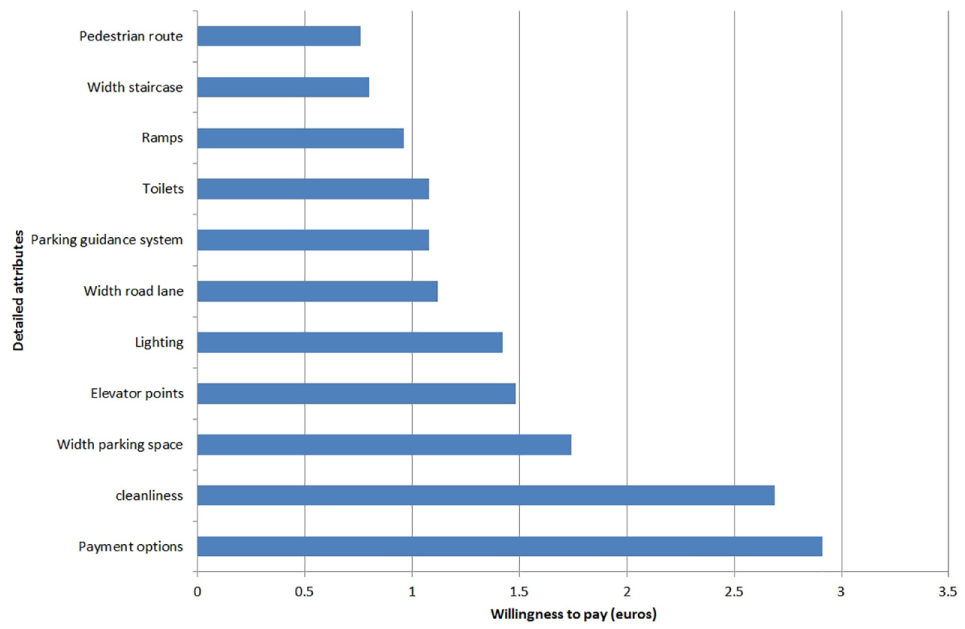
Willingness of payment for design related attributes.
Of course, the results of the study must be placed within some limitations related to the setup of the stated choice experiment and the data collection. Only a limited number of attributes are included in the stated choice experiment (25 out of a list of 74). To avoid an overload of information for respondents, the included attributes are defined with pictures or limited text only. In the same line, the choice task was limited to two choice alternatives without an option “None of these.” Leaving out this latter option forced respondents to make a choice which might give some unexpected results like in the case of “Payment options.” Another limitation concerns the composition of the sample that does not represent the Dutch population.
To deal with the identified limitations, the following issues could be considered in future research.
Replace non-significant attributes by new attributes such as length of parking spaces, separate entrance and exit points, and pavement and coloring of floors;
Specify non-significant attributes like quality of electric charging points instead of presence per total amount of spaces;
Define included attributes in more detail by using more text, visuals, or both;
Investigate the effect of an inclusion of a “none of these” choice option;
Increase the willingness of car drivers to participate by inviting them when they are actually using a parking garage.
Footnotes
Acknowledgements
The authors want to thank Martje Hoofs of Q-Park NV/Municipality of Amsterdam and Theo Arentze of Eindhoven University of Technology for their contribution to the research.
Author Contributions
The authors confirm contribution to the paper as follows—study conception and design: PvdW, SA; data collection: PvdW, SA; analysis and interpretation of results: PvdW, SA; draft manuscript preparation: PvdW. Both authors reviewed the results and approved the final version of the manuscript.
The Standing Committee on Transportation Demand Management (ABE50) peer-reviewed this paper (19-01135).