



Abstract
We integrate for the first time, to our knowledge, a dynamic transit assignment model into the tactical planning phase. The settings of service frequencies and vehicle capacities determine line capacity and have significant consequences for level-of-service and operational costs. The objective of this study is to determine frequency and vehicle capacity at the network level while accounting for the impact of service variations on users and operator costs. To this end, we propose a simulation-based optimization approach. The proposed model allows accounting for variations in service headways and crowding as well as their consequences for passenger flows distribution, all of which have not been accounted for in the tactical planning so far. Practical benefits of the model are demonstrated by an application to a bus network in the Amsterdam metropolitan area. This study contributes to the development of a new generation of methods that integrate reliability into the tactical planning phase to improve service quality.
Line capacity – that is, the number of passengers that can be transported within a certain time interval – is largely determined by the product of line frequency and the capacity of the vehicles assigned for operating it. The determination of frequencies and vehicle capacities is thus a crucial service design decision when planning public transport services. These decisions are considered both at the strategic and tactical levels. At the strategic level, frequency setting interacts with passengers’ route choices and the designated line capacity has consequences for the choice of public transport technology (e.g., metro, light rail, train, or bus). At the tactical level, both service frequencies and vehicle capacity (e.g., number of train cars, ordinary or articulated bus) can be altered on a seasonal basis and vary by time of day and day of the week. Service unreliability can severely affect line capacity by reducing the effective frequency. However, deviations from planning are only handled at the operational level by deploying real-time management strategies. In this study, we propose to integrate the impact of service reliability on both service provider and service users into the service dimensioning decisions.
Service providers can amend service frequency or vehicle capacity in response to service utilization levels, for example if passenger loads exceed the desired on-board occupancy. While both increased frequency and deploying larger vehicles inflict additional costs, the former requires the reallocation of drivers and rolling stock, whereas the latter requires changes in rolling stock composition. From the passengers’ perspective, higher frequency is preferred over larger vehicles. While they both solve the on-board crowding problem, higher frequency also yields shorter waiting times, leading to a lower generalized travel cost.
The consideration of consequences of service uncertainty for resource allocation requirements has so far been confined to vehicle and crew schedule, that is the operational planning phase, in the public transport planning literature. Desaulniers and Hickman ( 1 ) and Ibarra-Rojas et al. ( 2 ) provide exhaustive reviews of the considerable scientific efforts that have been devoted to solving the large range of public transport planning optimization problems. Frequency and vehicle size were typically either solved separately or jointly for a single line, neglecting their interplay when distributing a limited amount of resources under uncertainty across the service network. Service variability is inherent to (urban) public transport services and stems from the stochasticity of traffic conditions, operations and passenger demand and their interactions. Recently, Gkiotsalitis and Cats ( 3 ) integrated travel time, headway, and demand variability into an exact optimization of service headways where the expected passenger flows are assumed exogenous. In practice, authorities or operators typically use predefined service standards such as maximum vehicle occupancy rates along with local experience and expert judgment as the basis for setting frequencies and vehicle capacities.
Early studies formulated rule-based decision criteria for determining the service frequency on a line given passenger arrival rates, potential fleet size constraints and a desired maximum vehicle load factor (e.g., 4, 5). Starting from the 1990s, the problem was often solved in combination with assignment models that can forecast passengers’ behavior in response to a potential supply setting (6, 7). Public transport supply optimization is then solved using bi-level optimization models: a supply optimization model at the upper level and an assignment model at the lower level which computes passenger flows under equilibrium conditions which result from a certain supply given by the upper level model. More recent developments involve the consideration of additional decision variables and the use of metaheuristics (8–10). Several studies develop approaches for determining both frequencies and vehicle capacities simultaneously (11–13). These methods enable a more anticipatory planning and dimensioning of supply than if service was merely adjusted to prevailing demand distribution conditions.
All the methods developed hitherto have used static assignment models for distributing passenger demand on the service network, assuming perfectly reliable supply conditions. Travelers are thus assumed to make decisions based on average supply conditions. Performance indicators are, therefore, computed based on the given supply and passenger flows without taking into account the dynamic interaction between demand and supply. However, especially in the context of dense metropolitan systems, the dynamic and stochastic interaction between demand and supply may lead to significant reliability and crowding issues that are not accounted for in static assignment models.
The objective of this study is to determine frequency and vehicle capacity at the network level while accounting for the impact of service variations on users and operator costs. To this end, we propose a simulation-based optimization approach consisting of a metaheuristic technique which iteratively evaluates the consequences of selected solutions using an agent-based dynamic transit assignment model. The latter explicitly models passenger flow distributions which are dependent on the respective supply specifications. To the best of the authors’ knowledge, this is the first study to use a dynamic transit assignment in solving a tactical planning problem, allowing the capture of the impacts of stochastic variations in system supply and demand on the desired service dimensioning. The practical applicability and implications of the proposed model are demonstrated using data from a case study in Amsterdam, the Netherlands.
The paper is structured as follows: the next section provides a review and synthesis of the literature on headway and vehicle size determination. We then present a modeling framework along with a description of its formulation and implementation. The model is examined and verified using a test network and is thereafter applied for a real-world bus network, the set-up and results of which are detailed in the subsequent section. We conclude with the key findings and implications for public transport planning and point out directions for further research in the final section.
Methodology
The conceptual modeling framework is presented first and followed by the details of the three key modules.
Modeling Framework
The modeling framework for setting headways and vehicle size for each of the network services is depicted in Figure 1, including the sub-models, inputs and outputs parameters. The model consists of three sub-modules that are performed in an iterative process. The search process generates new solutions while enforcing fleet availability and operational budget limitations as well as upper and lower frequency bounds. In each iteration of the optimization algorithm, a potential supply setting in terms of line frequencies and vehicle capacities is generated and provided as an input to a dynamic transit assignment model. External inputs include the underlying network and demand-specific parameters such as the specification of the route choice model and an OD-matrix. Outputs produced by the assignment model related to passenger and vehicle costs are evaluated by another sub-model which evaluates the performance of the solution. The performance is measured based on the objective function specification for the supply condition under consideration. The search algorithm computes new solutions which are then provided again to the assignment model as an input. The algorithm proceeds by selecting a random neighbor using the relative performance of potential solutions and computing the objective function value using the output of the dynamic assignment model. The procedure is repeated until a user-specified stopping criterion (e.g., consistently negligible change in objective function value) that is checked in each iteration is fulfilled, obtaining the final solution. In the following sections we describe the search algorithm, dynamic assignment model and performance evaluation modules, respectively.
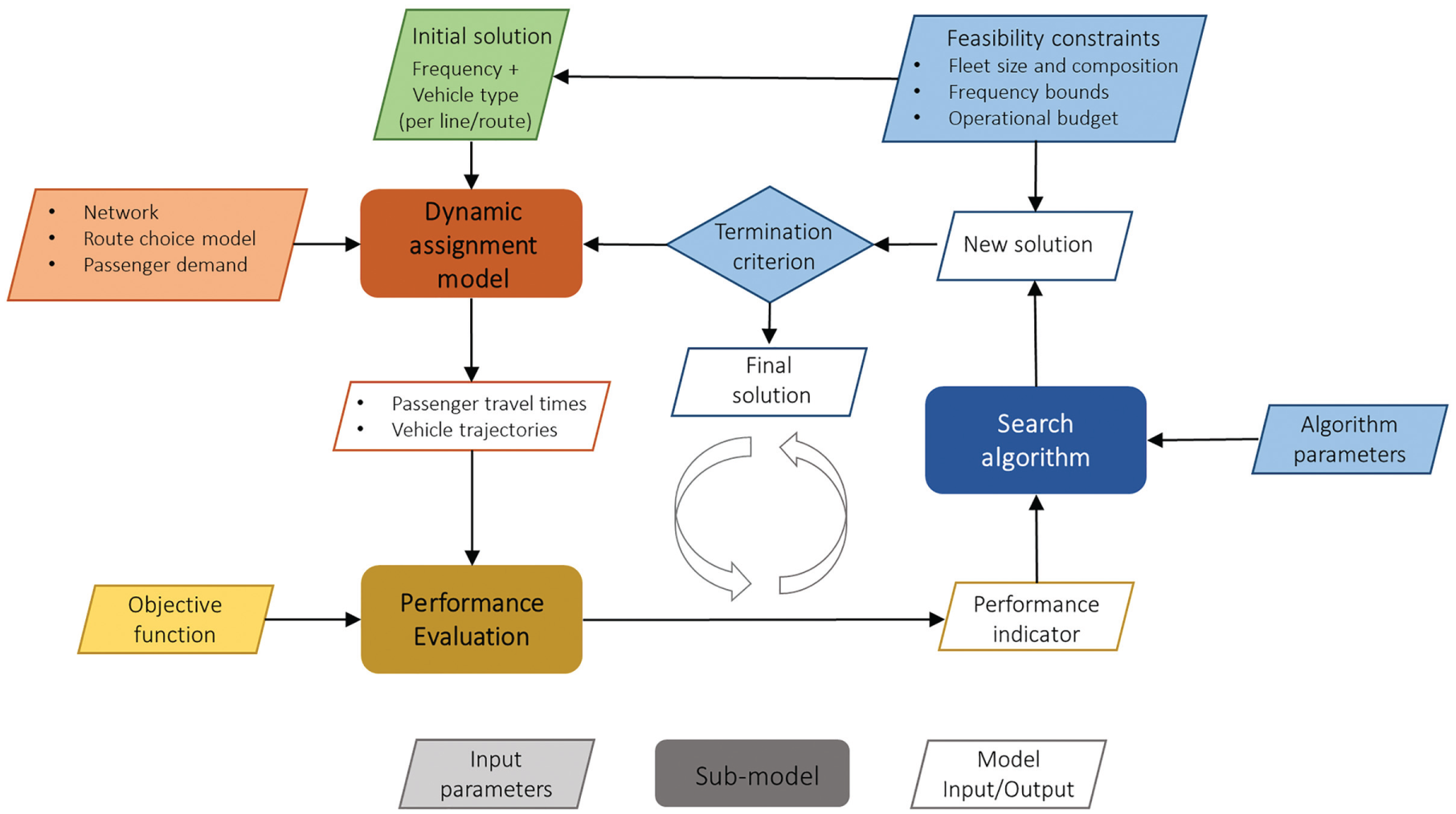
Basic framework of the headway and vehicle size determination model.
Search Algorithm
Solution Generation Process
Simulated Annealing (SA), a probabilistic metaheuristic for searching for the global optimum in large solution spaces, is employed as the search algorithm. The name and inspiration of SA pertains to the physical annealing of solids, which is the process of finding low energy states of a solid by initially melting the substance, and then lowering the temperature slowly and in a controlled way. Kirckpatrick et al. ( 14 ) and Cerny ( 15 ) showed that a stochastic Monte Carlo method for simulating the annealing of solids could be used for solving large combinatorial optimization problems such as the traveling salesman problem. The algorithm is designed to avoid local optima by occasionally accepting a solution positioned in another neighborhood of the solution space even though it is attributed with a higher cost function value. In the public transport context, it has been demonstrated that SA can efficiently search through a large solution space and that it outperforms genetic algorithms in solving the transit network design problem ( 16 ).
The SA is incorporated in the proposed headway and vehicle size determination model. The algorithm is initialized by a feasible initial solution that is generated either manually or at random. Subsequently, a Neighborhood Generator finds all feasible solutions that can be generated by altering a single decision variable value of one of the service lines by increasing or decreasing its value to the next possible integer. This is done by changing either the headway or the vehicle capacity of a selected line to the next smaller or larger values of the predefined discrete sets of allowed values, while keeping all other variables unchanged and satisfying the feasibility constraints. The algorithm proceeds by selecting at random a neighbor from the set of all feasible neighboring solutions. The solution is then specified and tested in the dynamic assignment model and thereafter evaluated. If the solution performs better than the current objective function value, then it is accepted as the new solution. Otherwise, it is accepted as the new solution using an acceptance function which computes the probability,

Equation 1 implies that the smaller the difference between the old (better) solution and the new (worse) solution is, the greater the likelihood that the new solution is accepted. The temperature is set at each iteration following an exponentially decreasing cooling function as follows:

where the decreasing factor
Feasibility Constraints
The feasibility of any solution generated by the search process needs to be checked. Each solution specifies the set of headways and vehicle sizes assigned to each line


Furthermore, a solution may not be feasible because it violates fleet availability or operational budget constraints. Upper bounds of fleet size availability per vehicle type are specified as follows:

where
Service providers may also wish to impose a constraint on the operational budget as follows:

where
When generating random initial or neighboring solutions, an immediate feasibility check is performed by applying Equations 3 to 6. Infeasible candidate solutions are excluded. Depending on the specification of
Dynamic Assignment Model
Solutions are specified as inputs to BusMezzo, a dynamic public transport operations and assignment model designed to support the analysis and evaluation of public transport planning, operation, and control. The reader is referred to previous studies for details on the supply side representation ( 18 ), model validation in relation to service reliability ( 19 ), within-day demand side phenomena ( 20 ) and day-to-day learning ( 21 ). Only a brief presentation of the most relevant model features is thus given here.
The model considers the interaction between demand and supply and its implications for service reliability and bus bunching in particular (18, 19). The mutual interactions of vehicles and passengers in BusMezzo are explicitly modeled using an agent-based simulation approach consisting of within-day and day-to-day dynamics. The latter is performed iteratively through passengers’ learning processes and adaptions until the assignment results converge in terms of the generalized passenger travel cost. This iterative network loading procedure yields network-wide steady-state conditions which can be seen as an equivalent to the congested user equilibrium in conventional static assignment models.
The model captures the three passenger congestion effects in public transport networks: (1) deteriorating comfort on board a crowded vehicle; (2) denied boarding in case of insufficient vehicle capacity; (3) service headway fluctuations resulting from flow-dependent dwell time variations. The dynamic and stochastic transit assignment simulation has been used in the past for simulating the evolution of network reliability and on-board crowding and quantifying passenger benefits as part of project investment appraisals ( 20 ).
Network supply and demand are given as inputs to the assignment model. The supply input includes network topology including information about the service layer such as line configuration, timetables, travel time distributions and dwell time functions. The planned headway and the vehicle type assigned to each line are specified based on the
Passenger demand is represented as an Origin-Destination matrix. The overall demand for public transport is assumed here to be inelastic, neglecting potential modal shift. However, travel demand levels are time-dependent and the number of travelers during the time interval may be stochastic to represent day-to-day variations. During the simulation, passengers are generated following a Poisson arrival process, assuming that services are frequent enough so that passengers do not coordinate their arrival with scheduled vehicle arrival times. An initial choice-set generation phase is followed by a dynamic path choice model consisting of a sequence of en-route travel decisions determining how passengers progress in the network ( 22 ). A day-to-day learning and adaption process iteratively updates the accumulated experience of each individual passenger with respect to waiting times, in-vehicle times, and on-board crowding ( 21 ). Model running time, critical for iterative evaluations, is for instance approximately 500 times faster than the simulated period for a network of ∼50,000 passengers and ∼250 transit vehicles.
Performance Evaluation
Alternative solutions are evaluated in terms of the total system cost, consisting of transport user costs,

The cost functions of users and operators,
Total costs to be borne by the set of service users,

where the the generalized travel cost per passenger
The operational costs,

First, fixed costs,

Second, distance-dependent costs,

Third, time-dependent costs,

The cost parameter per time unit,
Fourth, standing still costs,

where
Application
The model presented in the previous section is applied to a real-world case study network to investigate and demonstrate its practical applicability and performance. We first present the case study, followed by the scenario design.
Case Study
The case study bus network is located to the north of Amsterdam, the Netherlands. Figure 2 shows a geographical as well as a schematic representation of the case study network. The network consists of 5 high-frequency lines connecting central locations in the ‘Zaanstreek’ area surrounding the city of Zaandam with key locations and transfer hubs in Amsterdam.
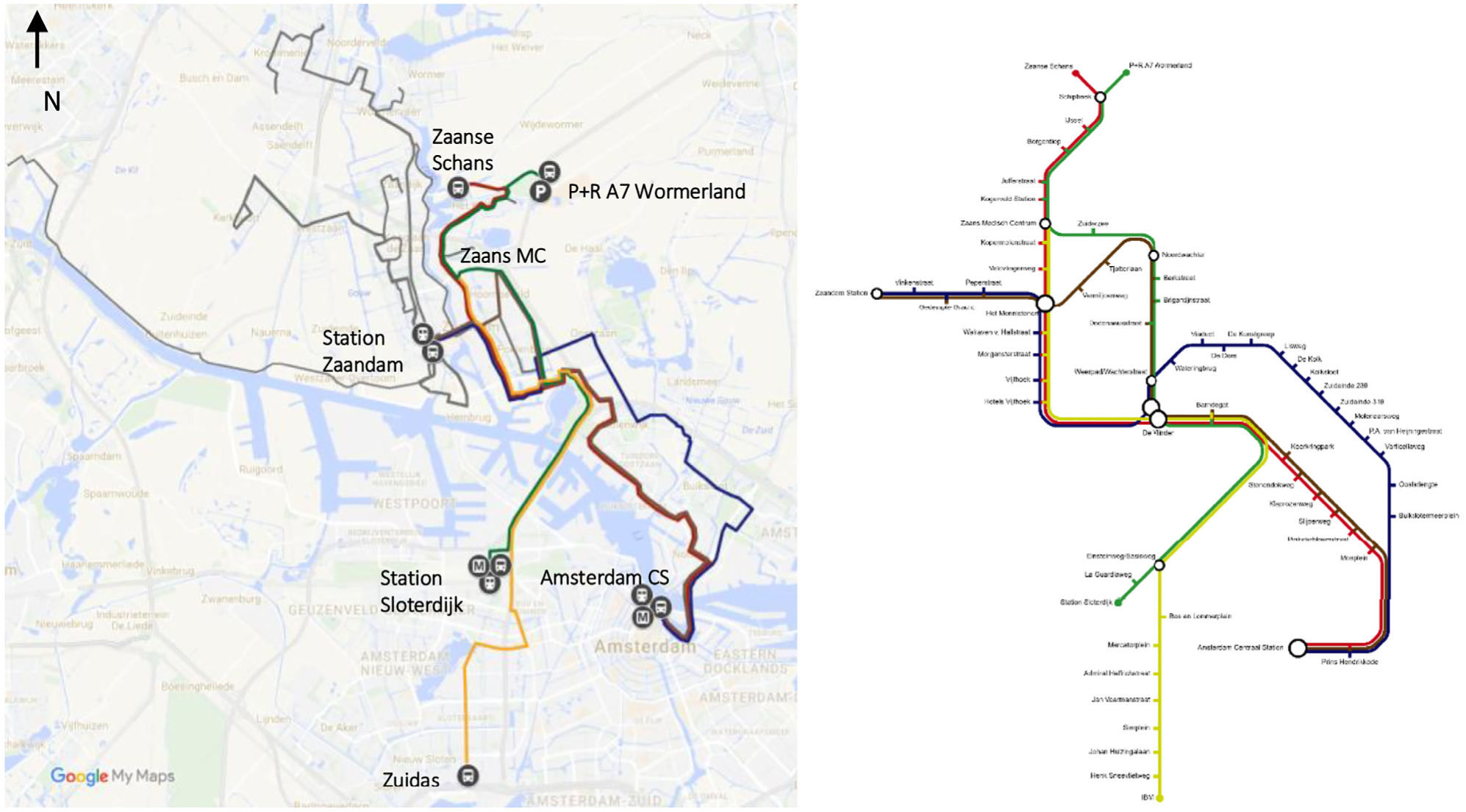
Geographical (left) and schematic representation (right) of the case study network.
The high-frequency lines – 391, 392, 394, 395 and 398 – serve 62 stops and are part of the R-net (or ‘Randstadnet’), which is a cooperation of local authorities and operators in the urban core of the Netherlands aiming at providing high-quality public transport services. Multiple travel alternatives are available for the majority of Origin-Destination pairs, allowing passengers to adjust their route choice in response to differences in service intensity, service reliability and passenger congestion.
Passenger demand is analyzed based on passenger smartcard transaction data from February 2017 consisting of more than 400,000 records. The two busiest hours during an average working day are 8 to 9 a.m. and 5 to 6 p.m. which are selected for further analysis (∼1,300 during each). OD-matrices and link running times are specified based on an empirical smartcard and vehicle positioning data.
During the morning peak, service frequencies are currently set to 4 vehicles per hour on all lines and route variants except for line 398, which has 3 departures per hour (only southbound direction). During the afternoon peak, the same supply setting is provided on most lines, whereas an asymmetric service frequency is offered on line 392 (the northbound direction is operated with an increased frequency of 8 vehicles per hour).
Scenario Design and Model Specification
The performance and implications of the proposed model are tested for various scenarios that differ in the degrees of freedom given in terms of vehicle fleet composition and frequency setting. The experimental design includes scenarios permitting (or not) for a heterogeneous fleet and allowing (or not) asymmetrical frequency setting. This design allows testing whether using small vehicles on lines with low demand can, for instance, save operational costs that can instead be used to increase capacity on highly-utilized lines. Furthermore, it also allows investigating whether asymmetric frequency settings can be advantageous given the asymmetric distribution of demand within the network. Moreover, two different objective functions are considered:
The minimization of total costs (TC) as formulated in Equation 7
The minimization of user costs (UC) costs (Equation 8) subject to a budget constraint as defined in Equation 6. This budget limit was set to 907 vehicle-kilometers which correspond to the current maximum supply offered during the analysis period. In this case, the goal is to find what is the fleet size required and therefore the fleet size constraint formulated in Equation 5 was relaxed, that is, on the assumption that a sufficiently large number of vehicles per type is available.
In addition, scenarios with either morning or afternoon peak demand is included, as summarized in Table 1. The corresponding current supply settings (denoted by a.m._base and p.m._base) were also simulated for benchmarking purposes.
Scenario Design by Formulation of the Objective Function, Passenger Demand Input and Assumptions on the Decision Variables Frequency and Vehicle Capacity
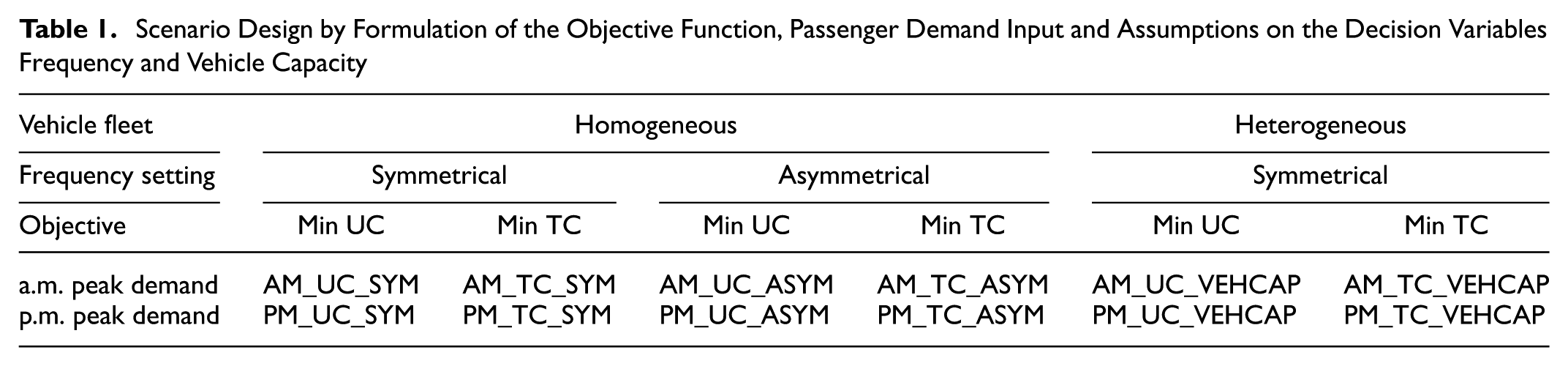
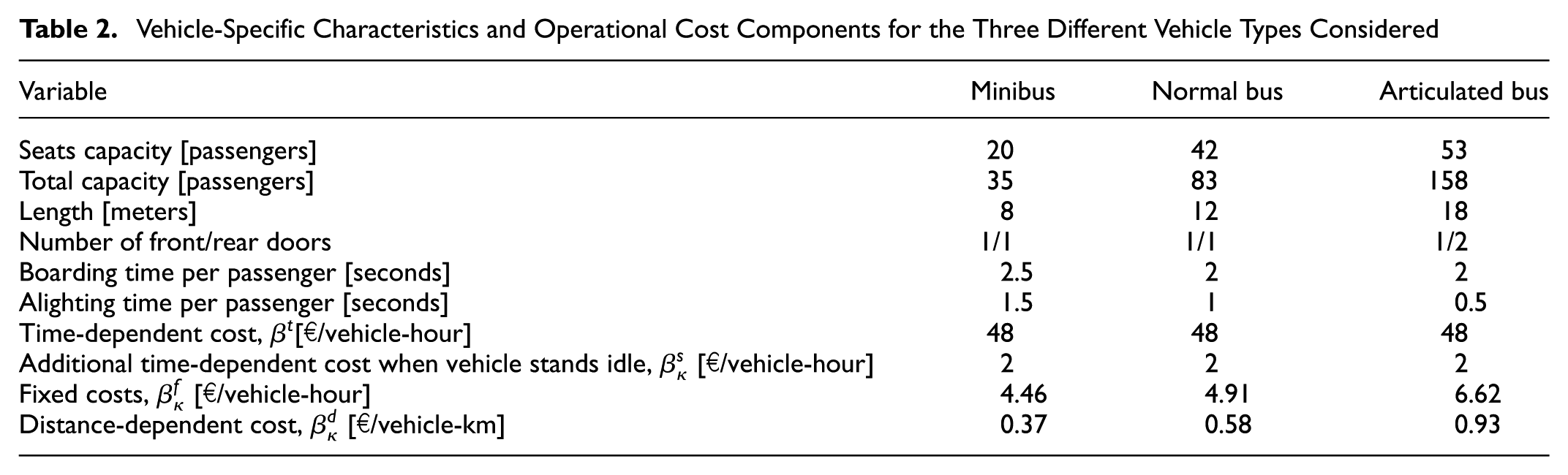
Table 2 reports the vehicle type-specific input parameter values used in the case study for three different vehicle types: mini, normal (currently the only bus deployed) and articulated buses. The operational unit cost values for the normal and the articulated bus are based on Swedish recommendations for cost-benefit analyses (
23
) and the values for minibuses are based on a German study into the determination of operational costs for bus services (
24
). Based on the existing headways, cyclic timetable considerations and the observed passenger loads, seven possible headways were specified for each line:
Vehicle-Specific Characteristics and Operational Cost Components for the Three Different Vehicle Types Considered
The weights in the generalized travel cost function (Equation 8) are specified as follows:
The total running time of the search algorithm depends on the number of day-to-day iterations to reach convergence, the number of assignment replications needed to obtain statistically robust results, the number of iterations of the SA algorithm and the runtime of one simulation instance in BusMezzo (<10 seconds). The number of replications for evaluating each solution was set to 10 (each of which including day-to-day learning), yielding a maximum allowable error of 1% of the average objective function value. Model running time amounted to a total of 40–240 minutes on a standard PC, depending on the scenario.
Results and Analysis
Figure 3 shows the utilization of each link in the network given the current service provision based on the BusMezzo assignment results. Average occupancy levels are visibly higher in the morning than in the afternoon peak with the southbound direction of line 392 reaching an average load factor of 1. While the load factor of individual vehicle trips varies and occasionally exceeds 1, vehicle capacity limitations (including standees) are never binding in the base case scenarios. A clear directionality in passenger volumes and supply utilization can be observed in Figure 3 with substantial discrepancies between the two directions of service segments within a given time period.
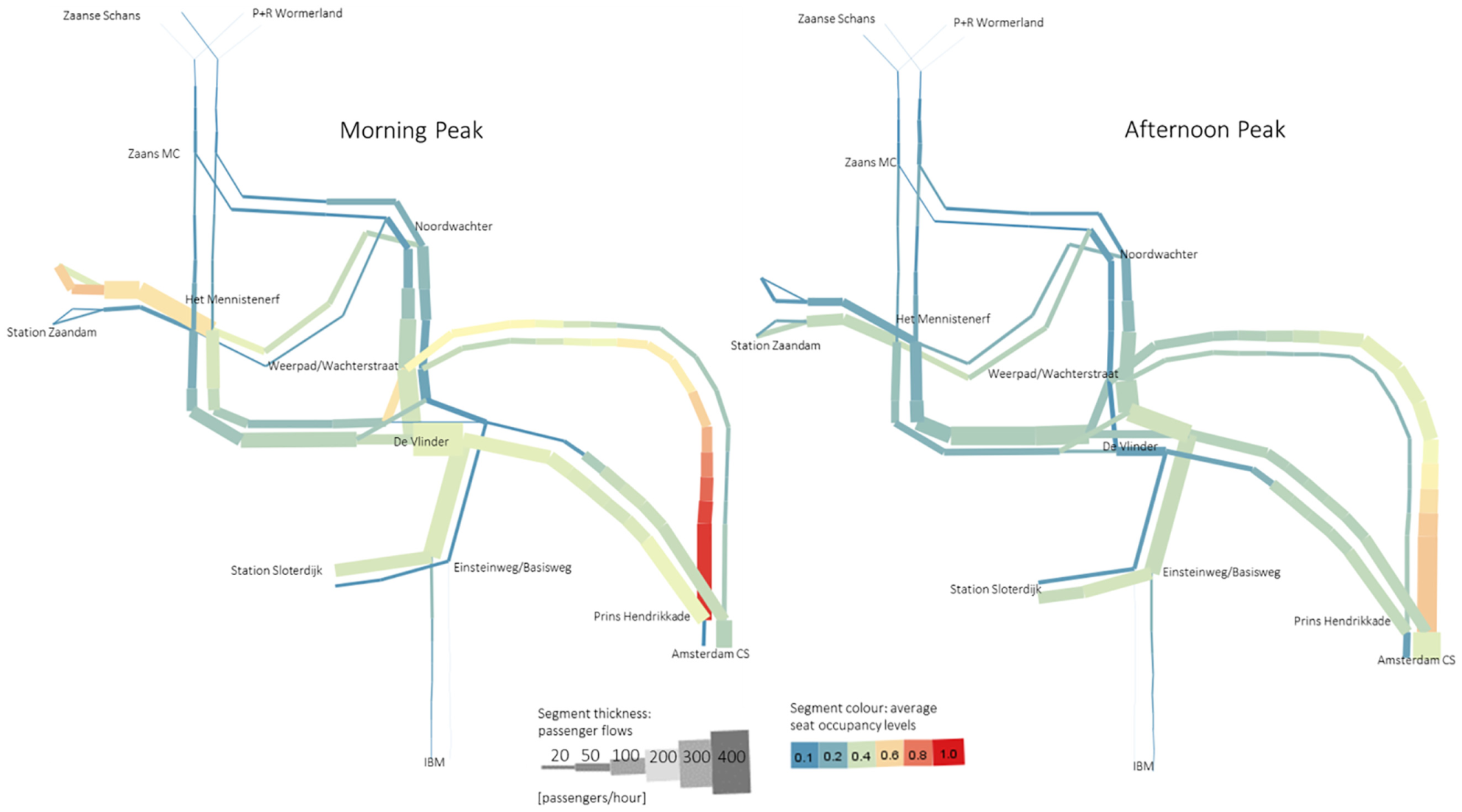
Passenger volumes and service utilization in the case study network.
Table 3 reports the decision variable values and the corresponding user and operator costs for each of the scenarios. Operator costs are shown also for scenarios that seek to minimize only user costs while fulfilling the fleet kilometers driven constraint. As expected, this value approaches the budget limit in all of the UC scenarios as the model attempts to minimize the user costs with the available resources, confining the problem to a resource allocation problem.
Model Solutions for all a.m. Peak (a) and p.m. Peak (b) Scenarios Including Decision Variables and Objective Function Components
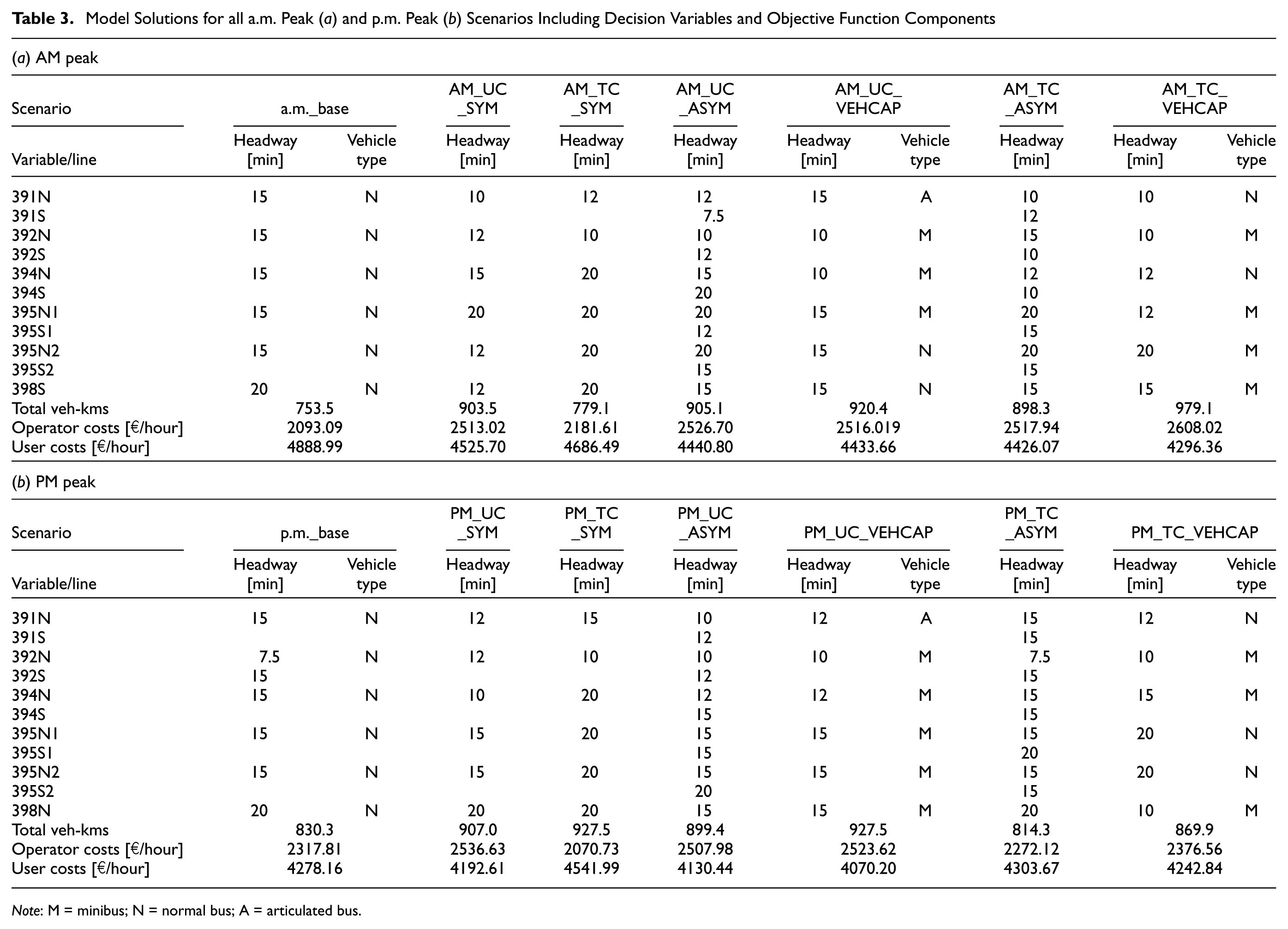
Note: M = minibus; N = normal bus; A = articulated bus.
The solutions in terms of frequency settings exhibit considerable differences between the two peak periods. Especially in the ASYM scenarios, resulting from the directionality in passenger flows. The results of the UC scenarios suggest that a redistribution of the existing service intensity can yield passenger travel time savings by attaining a more balanced allocation of resources in the morning peak. In addition, service frequency on the trunk lines 391, 392, and 394 should be increased in the afternoon peak.
When different vehicle types can be deployed, the final solution of the UC scenario is to allocate minibuses and articulated buses on certain lines, sometimes accompanied by a higher frequency (392 and 394). The passenger volume over capacity ratio can be either addressed by changing the service frequency or the vehicle capacity. Which of these tactical design decisions will yield lower costs depends on the dynamic interplay between supply and demand and its consequences for service reliability and crowding. Moreover, the passenger volume may change as well in response to changes in travel experience.
Interestingly, the results of the UC scenarios exhibit overall fewer discrepancies from the base case scenario than the TC scenarios. This suggests that the current supply provision is steered toward minimizing user costs, presumably due to the set-up of the procurement process and concession contracting conditions. The final solutions of the TC scenarios tend to deploy smaller vehicles than the corresponding UC scenarios. No systematic trend is observed for service headways.
To systematically analyze the performance of all the scenarios in terms of user and operator costs, their results are plotted in Figure 4. All points lying on the dashed line traversing one of the points marking the base scenarios (a.m._base and p.m._base) yield equal total costs (i.e., total system costs are currently higher in the morning than in the afternoon peak, mainly due to higher user costs).
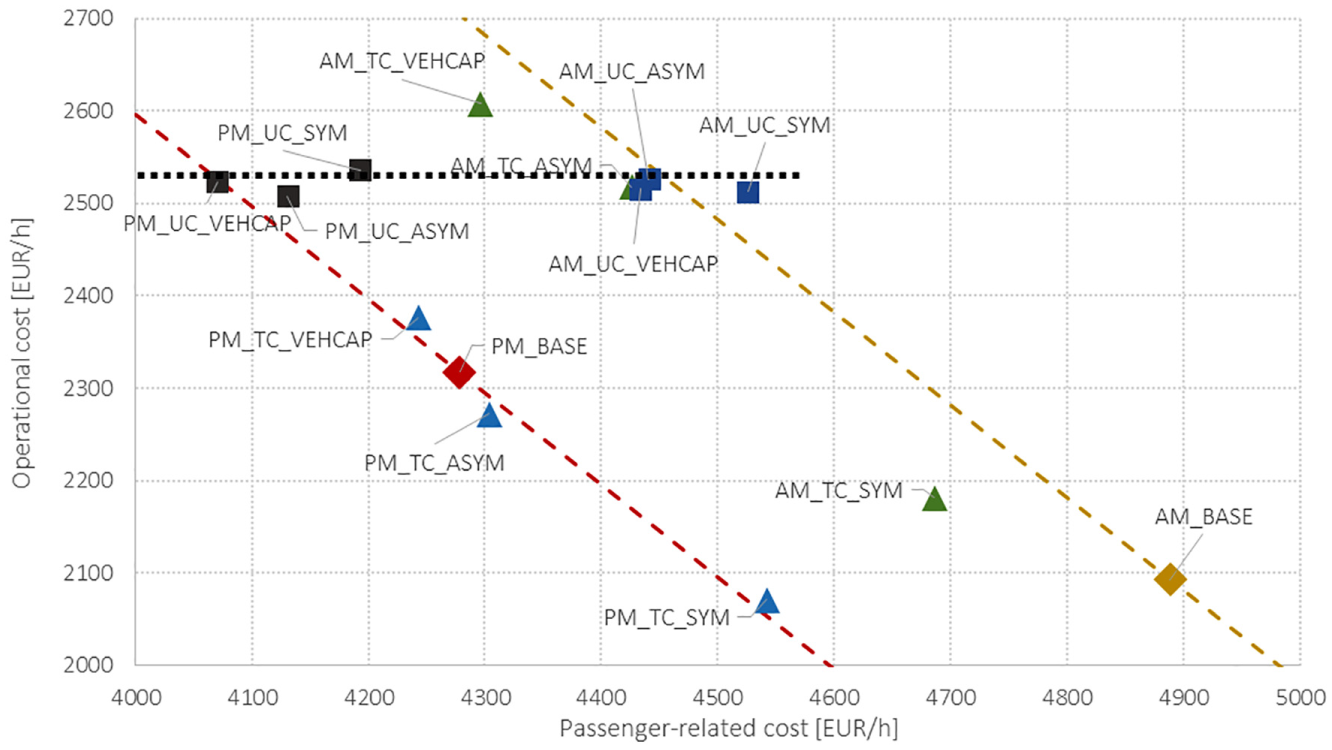
Overview of the performance of all solutions found for the different scenarios in terms of associated passenger-related and operational costs.
Overall, the performance of solutions obtained by the TC scenarios indicates that current supply level and allocation is close to system optimum conditions in the afternoon peak. Conversely, user as well as total costs can be reduced in the morning peak by increasing the supply offered. In both morning and afternoon peak periods, user cost savings can be attained in the UC scenarios by increasing the operational cost by about 20% and 9% in the morning and afternoon, respectively, utilizing the allowable budget limit (horizontal dashed line in Figure 4). As mentioned, the budget limit was set to
In both morning and afternoon peak periods, the VEHCAP solutions perform significantly better than all other corresponding scenarios with respect to user benefits based on t-tests with a confidence level of 95%. Since the deployment of smaller types of vehicles can decrease the average operational costs per bus compared with the current situation, a larger number of buses can be deployed while maintaining the same operational expenses and while reducing passenger waiting times.
The solutions obtained for the TC scenarios exhibit a significantly different trend for the two periods regarding their performances relative to the respective base cases. In the morning peak, service can better cater for the prevailing demand with user costs reductions of about 12% whereas in the afternoon peak no significant improvement is yielded. As in the UC scenarios, most of the savings in user costs can be attributed to reductions in waiting times, yet in-vehicle times can also be slightly reduced by up to 2.5% (morning peak). Note that the best performing solutions with respect to user costs are always obtained in the VEHCAP scenarios. A heterogeneous fleet composition yields a reduction in overall system costs, concurring with the results reported by Dell’Olio et al. ( 11 ). A statistically significant reduction in total costs is only attained in the morning peak for the VEHCAP scenario (1.1%). In contrast, in the afternoon, none of the solutions found can significantly reduce the total costs. Therefore, during this period, a change in supply provision cannot yield significant benefits in terms of total costs, yet, significant passenger cost savings can be attained by increasing supply up to the available budget limit.
Conclusion
The dimensioning of line capacity across the network is one of the most important decisions made by public transport planners. While the effective capacity, passenger waiting times and on-board crowding and fleet size requirements depend on service reliability, models for setting line frequencies and vehicle capacities were either confined to single-line operations or neglected the uncertainty inherent to service operations. We propose a method for addressing this gap in the literature by contributing to a new generation of models that integrate reliability into the tactical planning phase. The proposed method allows for the simultaneous determination of line frequencies and vehicle capacities based on the iterative assessment of candidate solutions using a dynamic and stochastic transit assignment model. This enables the consideration of the dynamic interaction between demand and a potential supply setting and the resulting consequences on overall system performance at the network level.
The application of the model demonstrates its practical applicability and yielded solutions that can improve upon the current situation. The results suggest a considerable improvement potential in the morning peak hour, where significant travel cost savings can be made, suggesting that overall supply provision should be increased. In contrast, in the afternoon peak, changing the current situation is not necessary from a total system cost point of view. This result confirms the adequacy of the current situation given the prevailing demand conditions. Furthermore, our findings clearly highlight the advantages of an asymmetric service provision during periods of directed passenger demand. Moreover, a simultaneous determination of vehicle capacities and line frequencies attests to the benefits of deploying a mixed vehicle fleet in the case study network.
The proposed model has several limitations which suggest avenues for future research. The consequences of line capacity decisions on subsequent planning decisions – namely, timetable design, vehicle and crew scheduling – can be assessed by accounting for drivers and rolling stock circulation constraints. The estimated fleet size required and the respective operational costs may need to be adjusted based on the exact vehicle scheduling. Future research may thus seek to integrate vehicle scheduling constraints into the frequency and vehicle capacity determination problem. Another potential development is demand elasticity to line capacity and in particular to service frequency. The societal value of ridership growth needs then to be incorporated in the objective function.
The supply setting problem is formulated in this study as a system cost minimization problem consisting of service users (generalized travel) costs and service providers (fixed and variable) costs. The objective function can also consider only user costs or only operator costs. The former was investigated in this study and requires the specification of operational constraints in terms of an available vehicle fleet or budget constraint so that the maximum quantity of supply provided is bounded. This exemplifies the potential value of adjustments in service frequencies and vehicle allocation for transit quality and level of service, even when assuring that no additional resources are required. In the latter case, where only operator costs are minimized, a constraint ensuring that demand is served satisfactorily needs to be introduced. This could for instance be the condition that a certain minimum level of service is provisioned and that the maximum vehicle occupancy rate should not be exceeded on any line segment. In other words, the capacity offered is always sufficient.
Potential applications of the proposed model extend beyond the tactical level and include strategic network design and supply setting during special events. The model can be used for network design by specifying all candidate lines (i.e., line pool) and those lines resulting in zero or very low frequencies could then be removed from the set of attractive lines. Running the model on a modified network or special demand configurations in case of special circumstances such as construction works or large-scale events can create valuable outputs which can be used as a tactical basis for predefined service plans. Finally, we intend to extend the model to investigate the breakeven point for deploying automated public transport services by testing it for a range of fixed and variable costs.
Footnotes
Acknowledgements
We thank Henk Post and Transdev NL for providing with the case study input data.
Author Contributions
The authors confirm contribution to the paper as follows: study conception and design: O. Cats; data collection: S. Glück; analysis and interpretation of results: O. Cats, S. Glück; draft manuscript preparation: O. Cats, S. Glück. All authors reviewed the results and approved the final version of the manuscript.