



Abstract
Fresh cut flower supply chains are aware of the need for reducing spoilage and increasing customer satisfaction. This paper focuses on a part of the cut rose supply chain, from auction house to several end customers. A new business mode is considered that would allow end customers to subscribe to florists and have a continuous supply of bouquets of roses. To make this business mode feasible, we propose to benefit from real-time information on roses’ remaining vase life. First, a quality-aware modeling technique is applied to describe supply chain events and quality change of cut roses among several supply chain players. Then, a distributed model predictive control strategy is used to make up-to-date decisions for supply chain players according to the latest logistics and quality information. This approach provides a tool for multiple stakeholders to collaboratively plan the logistics activities in a typical cut rose supply chain based on roses’ estimated vase life in real time. The proposed approach is compared with a currently used business mode in simulation experiments. Results illustrate that the new business mode and the planning approach could reduce unmet demand and spoilage in a cut rose supply chain.
Cut flowers and foliage are some of the most traded commodities in the world. In 2014 alone, the amount of these perishable goods imported to Europe from developing countries was worth almost 1.2 billion, according to the Centre for the Promotion of Imports from developing countries ( 1 ). The Netherlands is the biggest cut flower trader in Europe, with an annual total value of 2.9 billion exported to other countries.
A typical international cut flower supply chain consists of growers, forwarders, importers, retailers, and customers. In the Netherlands, Royal FloraHolland, the Dutch auction house, is the main hub for cut flower trades. In 2016, the turnover of cut roses, for instance, had a value of 746 million, making it the largest part of the cut flower trade in Royal FloraHolland ( 2 ).
Cut roses are highly perishable and vulnerable to high temperatures. Efficiencies of the supply chain are often affected by uncertainties from the weather-dependent perishable nature, as well as from the dynamics of supply and demand ( 3 ). The nature of this fragile product, the fast moving features of the supply chain, and the complexity of supply–demand interactions create the need for close coordination among different parties within the supply chain.
This paper focuses on the part of the supply chain after the auction house, including wholesalers, florists, and customers. In today’s business mode, a common practice of florists and wholesalers is to maintain a certain stock of roses. However, in this business mode, uncertainties of demand and degradation rate often leads to unmet demand or spoilage. To reduce the unmet demand and spoilage, this paper considers a business mode in which customers can subscribe to florists to have a continuous fresh rose supply. When a bouquet at a customer is no longer fresh, another fresh bouquet is supplied to them. Meanwhile, with the quality information of roses made available to suppliers by sensing and communication technologies, the demand from customers can be predicted.
To benefit from the information of demand and quality, the authors propose an approach to schedule logistics activities by combining quality-aware models and distributed model predictive control (DMPC). The quality-aware model is developed to represent the logistics activities and quality change that roses are going through during their life cycle. The DMPC strategy is applied to assist wholesalers and florists when making decisions on how many roses to purchase and which of the stocked roses to sell, with the consideration of quality changes due to possible disturbances from environmental factors.
The remainder of this paper is organized as follows. First, a literature review on perishable goods logistics is conducted. Then the specific objectives and contributions of this paper are highlighted. Then the problem statement adopting a system and control perspective is introduced, and the assumptions considered in this approach are explained. Then the quality-aware models to describe the considered part of the rose supply chain, using integer/mixed-integer linear programming formulations are presented. Then the DMPC strategy for achieving the coordination within the supply chain is discussed. Then the proposed modeling approach and control strategy are assessed in simulation experiments. The potential of the proposed business mode in comparison with the current mode of operation is discussed. Lastly, the study is concluded and directions are provided for future research.
Literature Review
The transport of cut roses is a race against time due to their perishable nature. Van Meeteren ( 4 ) points out that temperature is one of the most important factors in rose quality control, and modeling temperature and quality relations is beneficial for rose supply chains. Tromp et al. ( 5 ) have examined two different models for rose quality prediction, namely, a kinetics model and a time–temperature model. Through analysis of experiments, they prove that the time–temperature model has practical value in predicting the remaining vase life of roses during transport and storage. To implement this model in rose supply chain optimization and coordination, temperature is the key indicator that needs to be monitored with roses during transport. Since this information can be made available in real time by advancing sensor and communication technologies ( 6 ), this research focuses on how real-time quality information can be used to increase the effectiveness of supply chain activities and reduce cost and spoilage.
Limited research addresses logistics scheduling in a rose supply network with the consideration of the decreasing quality of fresh products. Verdouw et al. ( 7 ) made an initial step to address this topic by designing a conceptual framework for the Dutch horticultural supply chain virtualization. The paper proposed that by means of Internet-of-Things technology, a dynamic, connected, intelligent, and quality controlled supply chain can be realized. De Keizer et al. ( 8 ) performed a quantitative study by designing a network for flower distribution. The research applied a network flow model to represent the amount of flowers being transported from auctions to wholesalers and finally to retailers. Quality aspects were considered with an index of time–temperature summation attached to nodes (locations) and arcs (transportations) in the network model.
Beside De Keizer et al. ( 8 ), other research also combines flow models with quality degradation for perishable goods in general. Rong et al. ( 9 ) represent temperature differences using multiple nodes for the same location. Goods at the same location can then be distinguished by putting them to different nodes, resulting in different qualities. Yu and Nagurney ( 10 ) introduce arc multipliers to represent the change of environmental conditions and durations. De Keizer et al. ( 11 ) use fractions of a flow to represent goods with different quality categories in the same flow. Although flow models have been proved to be very useful in conventional transport systems ( 12 , 13 ), they are often not effective when including the change in product quality together with the decisions of allocating products. This is because these models usually need to attach quality attributes to network attributes. Nevertheless, the degradation of perishable goods does not only depend on the location of the goods but also on the environmental and products’ internal conditions. In other words, the products’ change of location and change of quality are two different series of events, and thus one should not be attached to the other.
Dabbene et al. ( 14 ) propose a hybrid model, combining event-driven logistics dynamics and time-driven quality dynamics. This approach separates the two characteristics of the product, namely logistics activities and product quality. The representation, however, limits the model application to a fixed supply chain without route choices, rather than a supply network.
In our previous research ( 15 ), a preliminary quality-aware model was developed to resolve the aforementioned problems. Instead of focusing on network flows, the proposed approach focused on a certain number of perishable goods using a state-space representation, consisting of a quality aspect and a logistics aspect. The two aspects can affect each other but are not dependent on each other. Moreover, the flexibility of the model allows different route options to be considered in the scheduling of logistics activities. In this paper the model is extended in order to describe several different players in a fast-moving supply chain.
Apart from a quality-aware modeling approach, the authors have proposed the application of a model predictive control (MPC) strategy ( 16 ), an online optimization-based control technique ( 17 ). MPC updates decision-making in response to real-time information over a given horizon. It has wide applicability in freight transportation systems (18–20). For perishable goods logistics, MPC also has great potential in handling the decision-making process, in which quality of goods and environmental factors (such as temperature) can change rapidly. Therefore, decisions obtained from the MPC approach in response to these changes could increase the efficiency of logistics activities and reduce the loss of perishable goods. This paper adopts this strategy to assist the decision-making process for several cut rose supply chain players as price and quality changes from time to time.
Objective and Contributions
The objective of this research is to develop a decision-making strategy for cut rose supply chain players with the consideration of rose quality. This strategy controls the supply chain in a coordinated way to reduce unmet demand and spoilage. By utilizing real time and predicted information on the vase life of roses, the strategy can assist supply chain players to make informed decisions on amounts and time of purchasing.
The contribution of this research is twofold. From the theoretical perspective, the quality-aware modeling approach is extended, so that it can effectively describe logistics activities, quality attributes, and decision-making in a cut rose supply chain. From the practical perspective, it is demonstrated that the quality-aware modeling approach and the DMPC technique are capable of handling decision-making processes for supply chain players in a changing environment.
Problem Statement and Assumptions
This paper considers a cut rose supply network from auction house to end customers. Several involved players are the auction house, a wholesaler, several florists, and customers (see Figure 1). The wholesaler purchases roses from the auction house, which are kept dry at a low temperature. The florists buy roses from the wholesaler and put them in water. Because roses are highly perishable and the demand is often not known in advance, it is difficult for both florists and the wholesaler to determine the number of roses in stock that would result in no loss of sales or spoilage of roses.
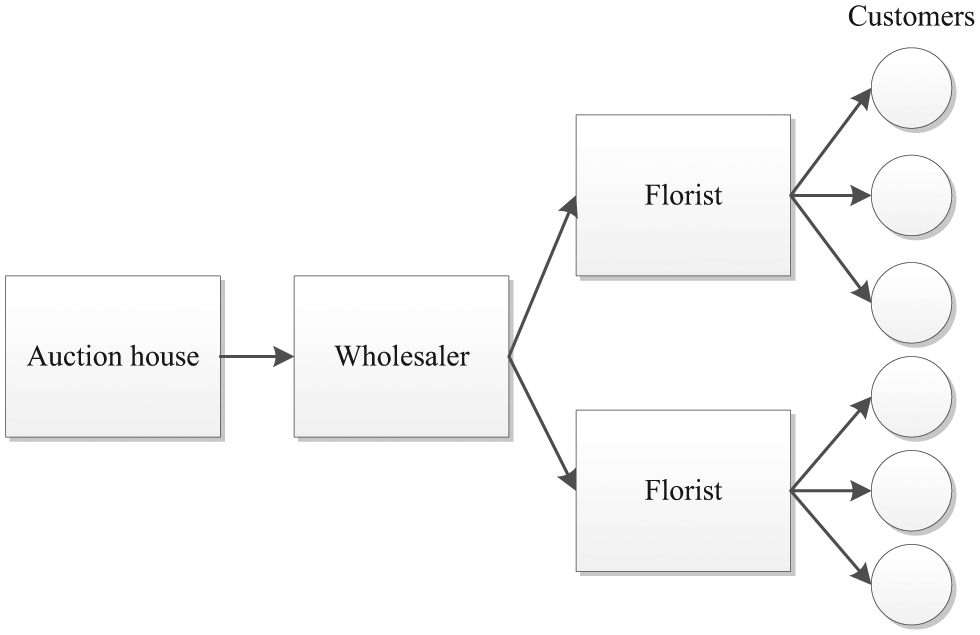
Supply network for cut roses considered in this study.
In this study the end customer is seen as a supply chain player if they prefer to have a continuous supply of rose bouquets. When their roses perish, they will soon need another bouquet. A future scenario is considered where supply chain players adopt sensing technology so that roses’ remaining vase life can be predicted. Customers can subscribe to a local florist who keeps their houses decorated with bouquets of roses. Thus the demand can be known to the florist by estimation of the vase life of roses.
Assumptions
The following assumptions are considered in this study:
Vase life of roses can be estimated and predicted by the wholesaler and florists;
An auction house has an unlimited amount of flowers that are available to the wholesaler at any time;
Wholesalers and florists discard roses with low quality according to their standards;
Wholesalers purchase roses in boxes, and florists purchase roses in bouquets. Each box contains several bouquets;
Wholesalers can always satisfy demands from florists, while florists only purchase on fixed days per week. A penalty is added to florists if they do not fulfill the demand from customers.
Quality-Aware Model for Cut Rose Supply Chains
This study focuses on the decisions and operations of the wholesaler and florists. Each supply chain player is described in a quality-aware modeling method, consisting of a logistics perspective and a quality perspective.
Logistics and Quality Evolution in a Quality-Aware Model
From the logistics perspective, roses are considered as units (boxes by the wholesaler, bouquets by the florists) that go through different stages of the supply chain, denoted by a directed graph
From the quality perspective, we consider the quality of a unit of rose
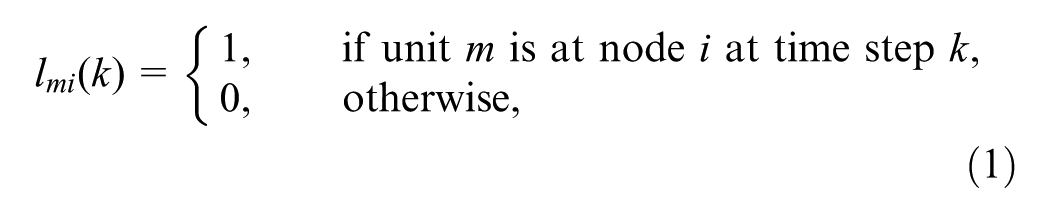





in which Equations 1–3 represent the evolution of logistics attributes (locations and movements) of unit
Equations 1–6 describe the two aspects of the dynamics (logistics and quality) of a unit of roses in a quality-aware model. Next, the model is developed specifically for the wholesaler and the florists in cut rose supply chains.
Quality-Aware Logistics Model for Florists
Each florist purchases roses from a wholesaler, stores them in water, and then supplies them to subscribed customers. The graphical representation (
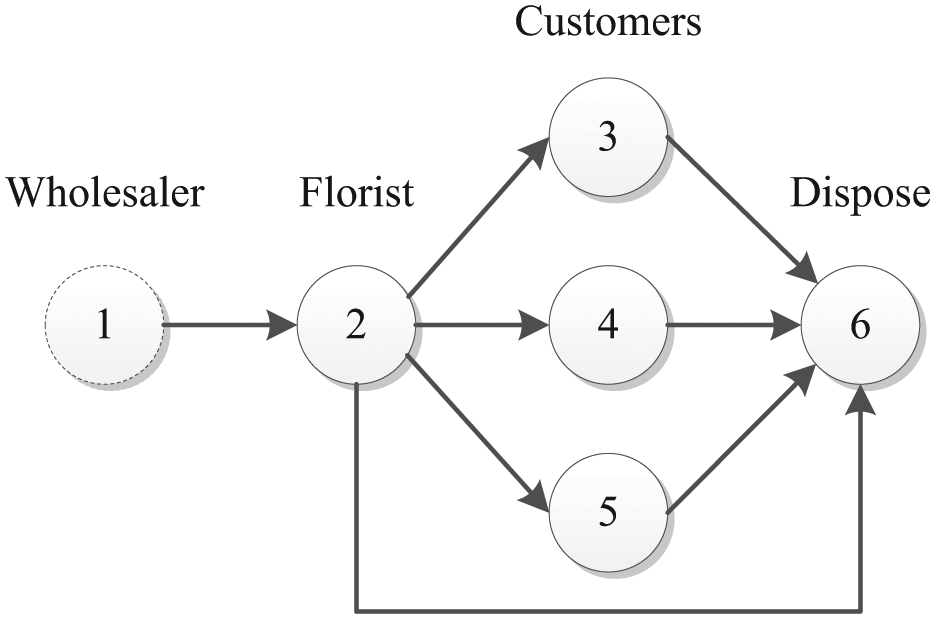
The graph
Now we consider the dynamics of each bouquet unit

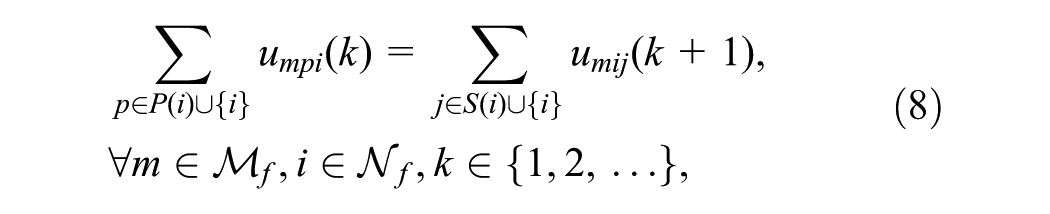


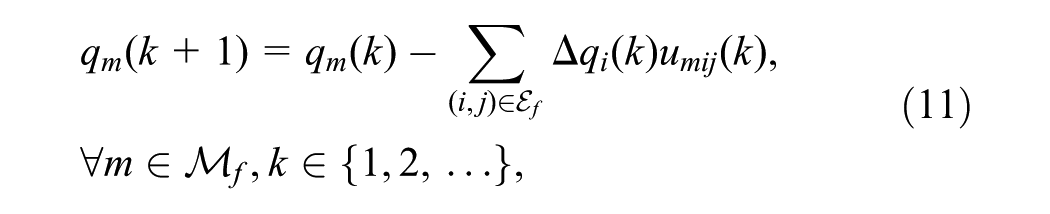



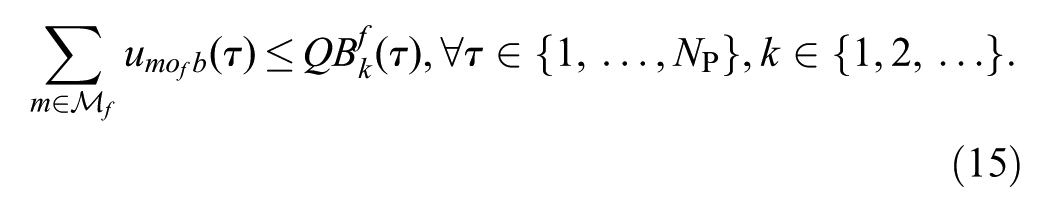






in which Equation 7 ensures that at any time step, the transition of locations of a unit/bouquet
Quality-Aware Logistics Model for the Wholesaler
The part of the logistics system for the wholesaler
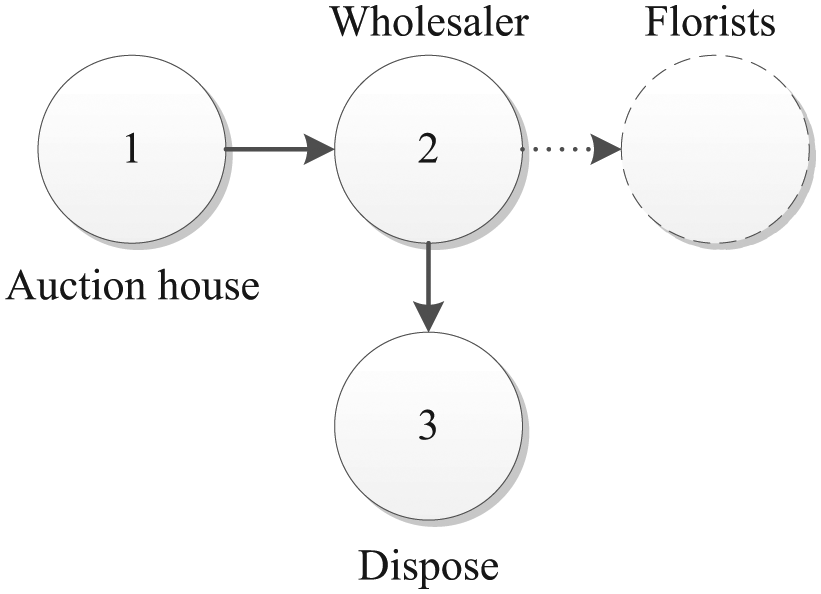
The graph
Note that the wholesaler buys roses in boxes but sells them to florists in bouquets. Therefore, a box of roses can be sold to different florists. We introduce a variable
We now discuss the dynamics of each box of roses

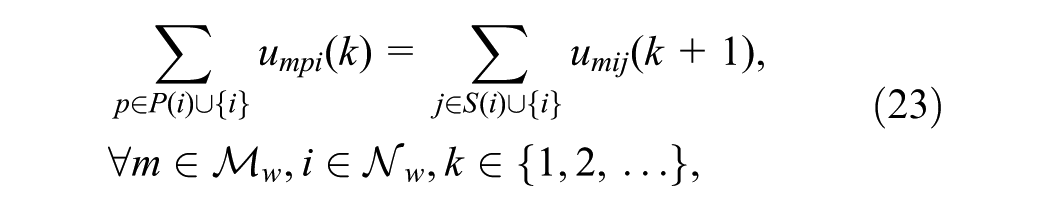







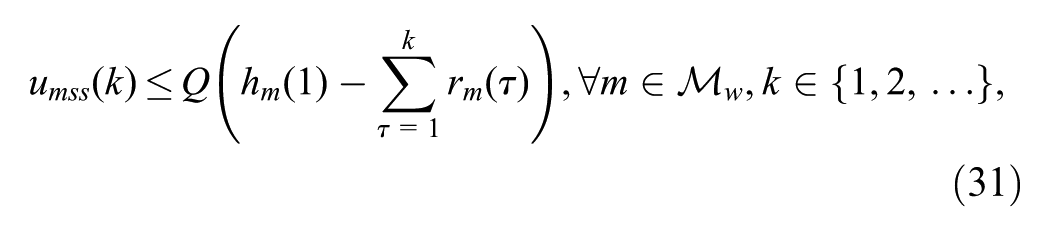









in which Equations 22 and 23 are the topology constraints that ensure units appear at one place at each time step and move along the directed arcs of the graph; Equation 24 ensures that the decisions for movements of the upcoming time step
Control Strategy for Real-Time Coordination
The previous section presents the quality-aware models for rose handling at the wholesaler and florists. This section introduces the control strategy for each supply chain player to make optimal decisions, and to coordinate with others in the supply chain. Firstly, the objective functions of controllers at the wholesaler and the florists are introduced. Subsequently, a rotating units method is introduced in order to cope with a fast-moving rose supply chain. Then, control algorithms for each controller and inter-controller communication are described.
Objectives of the Controllers
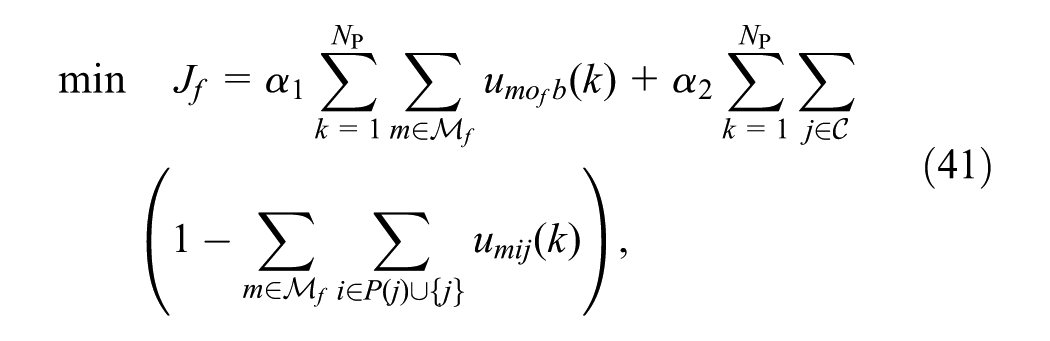
The controller at each florist

Rotating Unit Method and Communication between Controllers
In this modeling approach, the number of units in a system needs to be defined before optimization. However, roses are fast-moving goods as they come into and are consumed from the supply chain all the time. This feature requires controllers to be capable of introducing new units and disposing of consumed/spoiled units. A rotating unit method is applied: when a bouquet/box enters a supply chain player, it is registered to a unit with the new attributes (quality and location). When the bouquet/box is disposed of, it is unregistered and the unit moves to the beginning of the supply chain to register as a new bouquet/box of roses. Therefore, given a pre-determined number of units, these units can be “reused” over time, instead of trying to include every future unit in the model. Consider any unit
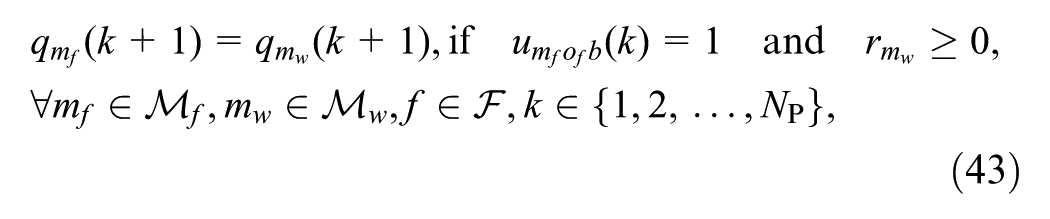



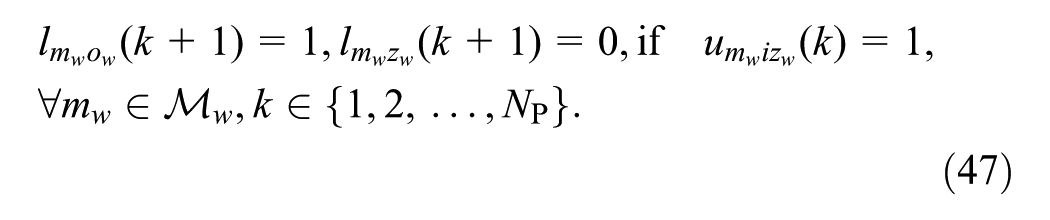

Equation 43 describes the communication of quality between the wholesaler and a florist when purchases happen: the quality of a new bouquet moving into a florist
Distributed Control Algorithms
We list the algorithms for the control strategies for the florists and the wholesaler as follows.
Algorithm for florist
Examine the current system state
Solve the binary integer linear programming problem with the objective function (Equation 41) and constraints (Equations 7–15). Compute the optimal solution over the horizon:
Send purchase plans
After receiving confirmation from the wholesaler, purchase roses from wholesaler with certain qualities, update qualities of newly purchased bouquets in
Execute the decisions
Algorithm for wholesaler
Examine the current system state
Receive the total demand from florists
Solve the mixed-integer linear programming problem with the objective function (Equation 42), constraints (Equations 22–31), and the daily update of the price
Sell roses to florists with certain qualities according to
Execute the decisions
In Figure 4, a flowchart is presented to illustrate how and when inter-controller communications are carried out within a control loop at time step
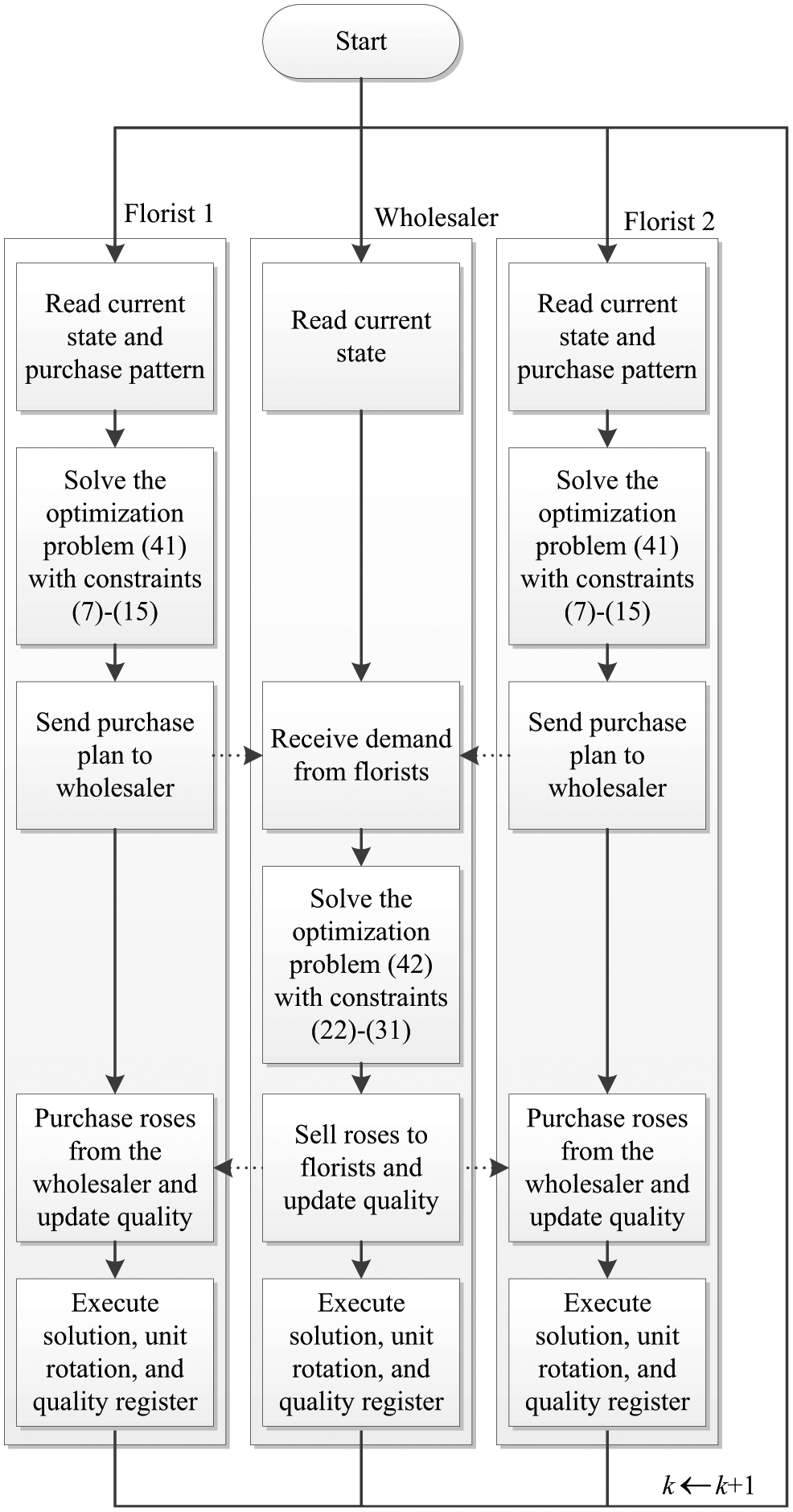
Flowchart of the coordinated control strategy at time step
Simulation Experiments
In this section, simulation experiments are carried out to compare the effectiveness of the current handling method and the proposed approach. Firstly, the current approach is explained and the parameters of the scenario are introduced. Then, results of simulations are presented and discussed.
To demonstrate the potential of the proposed approach in the business mode, its performance is compared with a simulation of a reference group without the proposed approach. The supply chain players in the reference group apply the strategy of maintaining their stocks at certain levels. This is commonly seen in today’s cut flower supply chains. In this paper it is assumed that florists 1 and 2 aim to maintains their stock at two and three bouquets, respectively; the wholesaler maintains the stock at no less than five bouquets.
Scenario Description
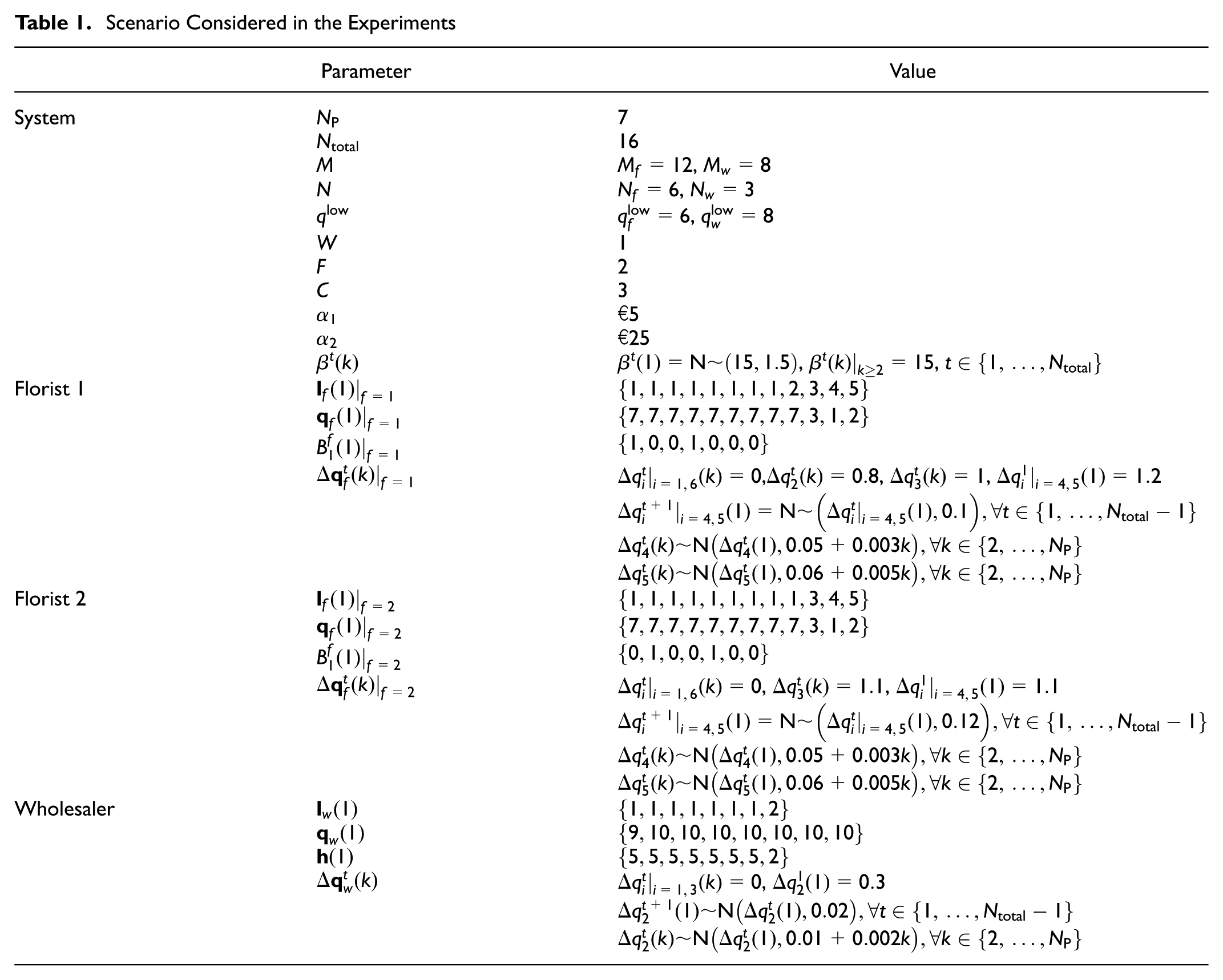
We consider the scenario of one wholesaler, two florists, and six customers (as shown in Figure 1). The parameters and initial system states are given in Table 1. In the scenario, we consider
Scenario Considered in the Experiments
The optimization problems are solved by Cplex v12.5.1 in a Matlab 2015b, Windows 7 64-bit environment, on a desktop with Intel Core 2 Q8400 2.66GHz and 4GB RAM. Running the whole program takes only 19 seconds.
Results and Discussion
The results from the current approach and the proposed approach are compared in Table 2. Performance indicators are unmet demand from florists, total cost of the wholesaler buying roses from an auction house, and total number of spoiled bouquets over the whole simulation.
Comparing Results from the Current Approach with the Proposed Approach and Sensitivity Analysis
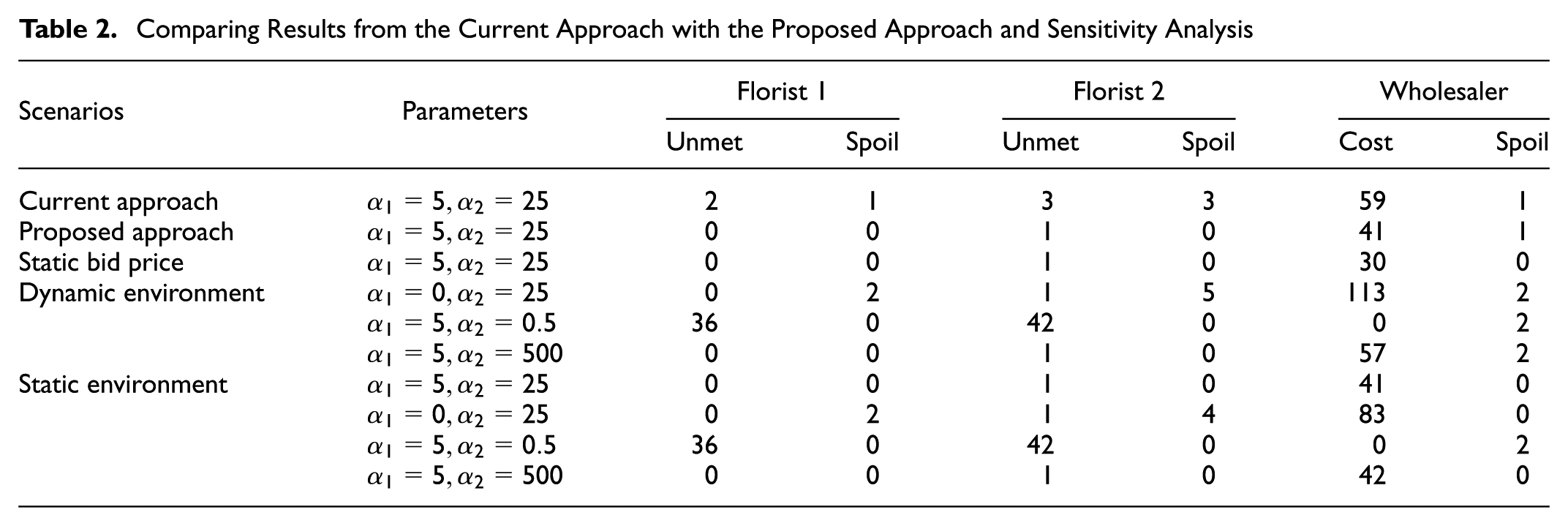
Compared with the current approach, florists in the proposed approach have the number of spoiled bouquets reduced to zero. Unmet demands from subscribed customers are also much lower. The wholesaler has one spoiled bouquet but has fewer costs making purchases from the auction house. Although the auction price per box of roses of the upcoming days is assumed unknown in advance, considering an average price of €15 (
Sensitivity Analysis
A sensitivity analysis was carried out regarding
When the price for a box of roses from the auction house is static and predictable, the wholesaler only buys roses when necessary, spending less in purchasing roses and resulting in less spoilage. While in reality, the wholesaler needs to compare the current auction price with the average value and buys roses in advance if the auction offers a good deal, which can result in increased buying frequency. In a dynamic environment, when the cost of each bouquet
In summary, the results illustrate that this approach of quality-aware modeling and control can largely benefit supply chain players. The application of the new business mode brings wholesalers, florists, and customers into closer coordination. In this way, purchased roses are better used, with reduced prices, unmet demand, and spoilage. A closer analysis shows that a higher penalty for unmet demand or lower price of bouquets may result in a higher flow volume, and more accurate prediction of vase life may help stakeholders make even better decisions in logistics operations.
Conclusions and Future Research
Cut roses are traded and transported in significant amounts across continents. Nevertheless, the highly perishable nature and complexity in supply–demand relations often brings challenges to supply chain players in reducing waste and loss of sales at the same time. The authors consider a business mode that brings end customers into the rose supply chain together with wholesalers and florists. In this mode, customers can subscribe to a florist to receive a continuous supply of fresh bouquets of roses. This business mode can be realized by sensor and communication technologies, which makes remaining vase life known to other players in the supply chain. In order to fully benefit from this business mode, the authors propose a decision-making strategy combining a quality-aware modeling method and a distributed control approach. This strategy is designed to coordinate several players in a fast-moving perishable goods supply chain with uncertainties. Simulation experiments illustrate that the realization of this business mode via the proposed approach could significantly reduce unmet demand and spoilage in a cut rose supply chain.
This paper focuses on a part of a cut rose supply chain from an auction house to the end customers. Future research may include modeling of larger scale supply networks, impacts on long-haul transport, investigation of more detailed and practical extensions in supply chain coordinations, and validation in real-world experiments with different types of horticultural products.
Footnotes
Acknowledgements
This research is supported by the China Scholarship Council under Grant 201406950004, entitled “Controlled cool logistics: Real-time coordination for fresher perishable products.”
Author Contributions
The authors confirm contributing to the paper as follows: study conception and design: Lin, Negenborn, Lodewijks; data collection: Lin; analysis and interpretation of results: Lin, Duinkerken, Negenborn; draft manuscript preparation: Lin, Negenborn, Duinkerken. All authors reviewed the results and approved the final version of the manuscript.
The Standing Committee on Freight Transportation Planning and Logistics (AT015) peer-reviewed this paper (18-06644).