




Abstract
Fully automated services allow for greater flexibility in operations and lower marginal operational costs. In this study we examined the strategic planning implications of a novel service concept – an automated rail demand responsive transit (DRT) system that offers a direct non-stop service. The objective of this study was to determine the capacity requirements of the envisaged service and discuss its prospects and feasibility. A cost minimization approach for determining the optimal track and station platform capacities for a rail-DRT system so that passenger, infrastructure, and operational costs are minimized is described. The macroscopic model allows for studying the underlying relations between technological, operational and demand parameters, optimal capacity settings, and the obtained cost components. The model was applied to a series of numerical experiments to test its implications for different network structures and demand distributions. The results of the numerical experiments indicate that – unlike conventional rail systems in which stations often are capacity bottlenecks – link capacity properties are more critical for the performance of automated rail-DRT systems than station capacity. A series of sensitivity analyses was performed to test the consequences of various cost and capacity specifications, as well as the characteristics of future automated rail-DRT systems.
The rapid advancements in the developments of fully-automated vehicles have led to an increasing interest in the concept of demand responsive transit (DRT) systems. Automated services will allow for greater flexibility in operations and lower marginal operational costs. The area of application has almost exclusively been limited to road-bound systems. Although automation on rail networks is not new, to the best of the authors’ knowledge, applying DRT as a substitute for current heavy rail services has not been considered in the literature or practice to date. This paper presents a first step into the relatively unknown area of rail DRT.
In this work, a DRT system that has been designed as a full replacement of scheduled heavy rail for a given (sub-)network is envisaged. The automated rail-bound vehicles offer a direct, non-stop service and are in the rail network, in response to passenger requests, with no predefined routes and schedules. Vehicles transport passengers that share the same origin and destination stations. Vehicles can be sized according to the operator’s preference, but they are considerably smaller than existing trains.
The objective of this study was to determine the capacity requirements of rail DRT. Unlike road-bound DRT services, which operate in rural areas or cater for special user groups, rail DRT is designed to serve a large geographical area with relatively high demand that could result in an operation constrained by congestion and capacity limitations. The strategic planning objective of this study constitutes a major difference from most of the earlier models such as Anderson ( 1 ) and Winter et al. ( 2 ), which considered microscopic operational models with a stochastic passenger arrival.
The development of technological and service concepts that will facilitate rail-DRT systems are still in their early stages. It is therefore not surprising that literature on rail DRT is limited. An early research identified the challenges of short vehicle headways and limited station capacity in the context of dense urban operations ( 3 ). The vehicle engineering RailCab project developed technical and mechanical solutions for small driverless rail-bound traffic ( 4 ). Vehicle design solutions for operating at short headways in an automated guideway transit system were studied by Choromanski and Kowara ( 5 ), whereas capacity in relation to station layout has been analyzed in more detail by Greenwood et al. ( 6 ). Although these studies provide preliminary insights into anticipated advanced in-vehicle technology, there is a lack of knowledge on the strategic planning aspects of such operations, such as the capacity requirements they inflict on railway network infrastructure and related system performance and level-of-service.
This paper presents an optimization approach for determining the optimal track and station platform capacities for a rail-DRT system so that passenger, infrastructure, and operational costs are minimized. The model is formulated as a cost minimization problem in which vehicle flow distribution attains system-optimum conditions. The model allows for studying the underlying relations between technological, operational and demand parameters, optimal capacity settings, and the obtained cost components. The model is applied to a series of numerical experiments to illustrate and explore the strategic planning aspects of possible rail-DRT network-wide implementations. The performance under various scenarios is assessed, the implications and feasibility of which are discussed.
Methodology
Modeling Approach
Current railway models with timetables as their cornerstone are unsuitable for rail-DRT applications. The main challenge in modeling network-wide long-term planning for rail DRT is that the model needs to capture flow distribution and capacity constraints without representing system dynamics in microscopic detail. Other rail-DRT challenges include the need to handle large numbers of hourly passenger requests, strict routing constraints due to the nature of rail infrastructure, and highly heterogeneous service characteristics compared with traditional rail systems. The approach taken in this study was to develop a novel macroscopic model by considering rail DRT as a special case of the network flow problem.
The deterministic and static optimization problem is solved for a given network topology and passenger demand distribution (DD), both are thus exogenous to the model. Other inputs to the model include vehicle size (homogenous fleet), cost units, and track and node flow-speed and -delay functions. Model outputs are the optimal infrastructure capacity per network element (i.e., rail segments and stations), vehicle flow distribution, and the value of passenger, infrastructure, and operational costs.
Network Transmission Cost Functions
This section describes how the link speed-density function and node delay-density function are defined. The speed-density function is assumed to follow a logistic function ( 7 ) albeit with an abrupt transition from free-flow to jam, which is more suitable for automated systems. Link travel times are then determined based on link length, free-flow speed, and a logistic term with the volume over capacity ratio.
Vehicle arrivals are assumed to follow the Poisson distribution, implying that service requests of all vehicles can be represented as a joint Poisson process. Vehicles either drive through or call at origin and destination stations. Considering each platform as a server, and assuming that all vehicles have the same mean service time with an exponential service time distribution and that all vehicles can use all platforms, the DRT station is characterized as a non-pre-emptive multi-server queuing model where servers are governed by a Poisson process and job service times are distributed exponentially denoted as a M/M/c system (similarly to metro stations in for example Xu et al. [ 8 ]). If the station has more than two platforms, it is assumed that through-going vehicles can overtake dwelling vehicles, otherwise the station is governed by non-prioritized M/M/c queues. The expected waiting time in the non-pre-emptive M/M/c queue depends on delay probability ( 9 ) with the corresponding expected delays in prioritized and non-prioritized queuing systems being determined according to the formulations provided in Wagner ( 10 ). This function assigns different values for through-going vehicles and dwelling vehicles at stations in which overtaking is possible, otherwise no distinction is made.
Cost Minimization Problem
Considering rail DRT as a special case of the network flow problem, the decision variables are link capacity, node capacity, and the share of vehicle flow routed via each route alternative per origin–destination (OD) pair. The objective is to minimize the cumulative value of infrastructure capacity costs, passenger travel time costs, and operational costs. The rail-DRT planning objective is to balance between the costs of adding infrastructure capacity and the costs of delay or detours caused by insufficient infrastructure capacity.
The cost minimization problem is then formulated as follows: (i) passenger travel times calculated over all links and stations; (ii) track capacity investment costs; (iii) station capacity investment costs; and (iv) variable operational costs. Each of the objective function components is associated with a weight that is the corresponding monetary cost.
Link travel times and the expected delay at stations are calculated as described in the previous section. Additional constraints include demand satisfaction, flow conservation, and non-negative decision variables. Decision variables include the capacity of each link and each station and the number of vehicles traversing each link that travel between a certain OD pair. Hence, the cost minimization problem entails the simultaneous solution of setting the capacity per rail-segment and station and obtaining the corresponding system-optimum solution of network flow distribution while minimizing user, investment, and operational costs.
Service frequency is specified in this study as approximately proportional to passenger demand for a given OD pair unless passenger demand is not sufficient to justify a predefined minimum service frequency. Hence, waiting times are determined in the initialization phase, independent of the decision variables, and can be left out of the analysis of alternative solutions.
Model Implementation and Specification
Model specification involves setting values for a series of technological and service parameters. In the following, base case values designed to reflect the prevalent conditions in the Netherlands – for which the authors have access to relevant information – are specified.
Objective function weights were set as follows: the Dutch value-of-time was €10/h. Based on estimates from the Dutch rail industry, investment costs were estimated to amount to €50 million per km of track and €123.5 million per station platform assuming a 38-m long platform required for the envisaged system operations. Both were assumed to have depreciated over a 30-year period. Operational cost per seat-km was estimated at €0.02.
The speed-density function involves specifying the free-flow speed and track vehicle capacity (VC). The former was set to 100 km/h based on current conditions in the dense Dutch network. Track capacity (TC) was set to 180 vph in line with operational people-mover systems, which operate at 20-s headways.
Station platform operation is governed by the queuing servers. Based on observations in an existing automated system (i.e., Rivium Parkshuttle), dwell time was set to 20 s. Mean service rate was set to 5 s for non-stop vehicles and 80 s for dwelling vehicles. The latter is based on an estimation of the time required for setting switches, pulling into the station, dwelling, and clearing the platform.
Finally, the base case VC was set to 24 passengers. Vehicles are designed so that all passengers are seated. Service frequency per OD pair was determined to satisfy the demand with a load factor of at least 0.7. OD-pairs for which demand does not justify at least one departure per hour (i.e., 17 passengers) remain unserved by the DRT service. The optimization problem was solved in MATLAB.
Numerical Experiments
The cost minimization model described in the previous section was applied to a series of numerical experiments to analyse the generic properties of rail-DRT systems, underlying relations between model variables, and the sensitivity of model outputs to variations in input parameters.
Experimental Set-up
The numerical experiments were performed using a graph composed of 17 nodes and 48 unidirectional links. Two distinct network structures were considered: a grid and a ring/radial structure, as illustrated in Figure 1. The base case passenger demand corresponds to 34,000 hourly requests distributed over the network based on a gravity model using the Euclidean distance between all origin and destination nodes (an average of 125 trips per OD pair). Each optimization problem was solved within 15 s on a standard PC.
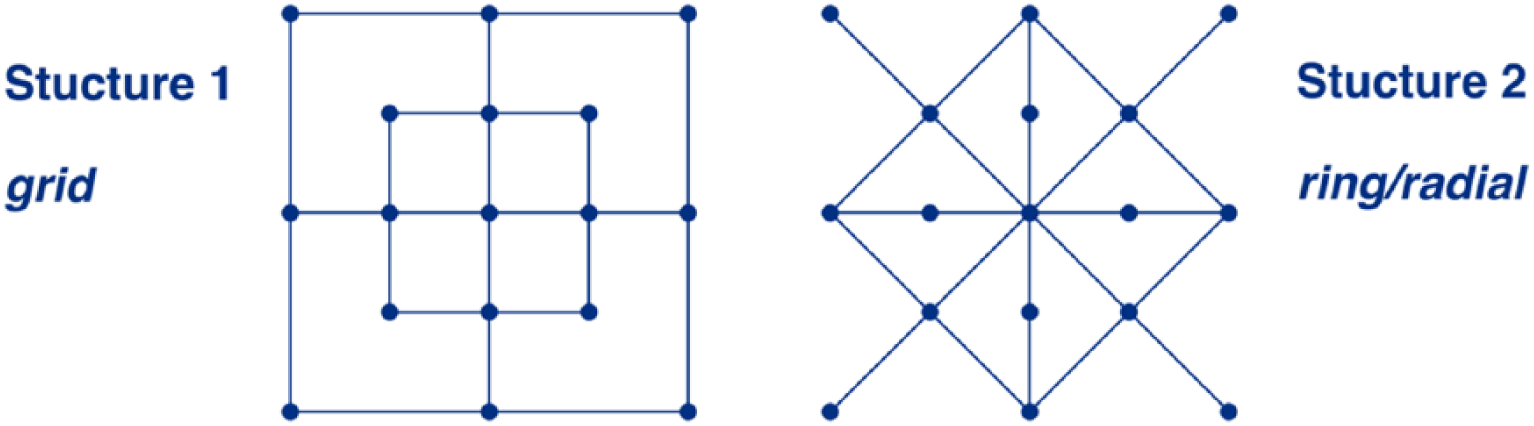
The two network structures considered in the numerical experiments: grid (left) and ring/radial (right). All lines represent bidirectional arcs.
A series of sensitivity analyses pertaining to service design, cost parameters, technological capabilities, and demand scenarios were performed. In the following, the results for variations in vehicle passenger capacity, TC, and DD pattern are reported and discussed. In the case of VC, it is also varied in conjunction with corresponding changes in operational costs and minimum service frequency threshold.
Results and Analysis
Table 1 summarizes the results of the base case scenario along with the key sensitivity analysis scenarios. The base case is set with the parameter values specified in the Model Implementation and Specification section – including a VC of 24 passengers and TC of 180 vph – and with the Euclidian gravity DD. The table reports results for other VC and TC scenarios noted with the corresponding value, as well as DD scenarios as detailed below. Table 1 includes the four cost components for the optimal solution expressed in hourly terms (columns 2–5), followed by two indicators of system resources – fleet size and total seat-km offered – and the resulting service speed.
Numerical Experiments Scenario Results for Grid; Ring/Radial Networks
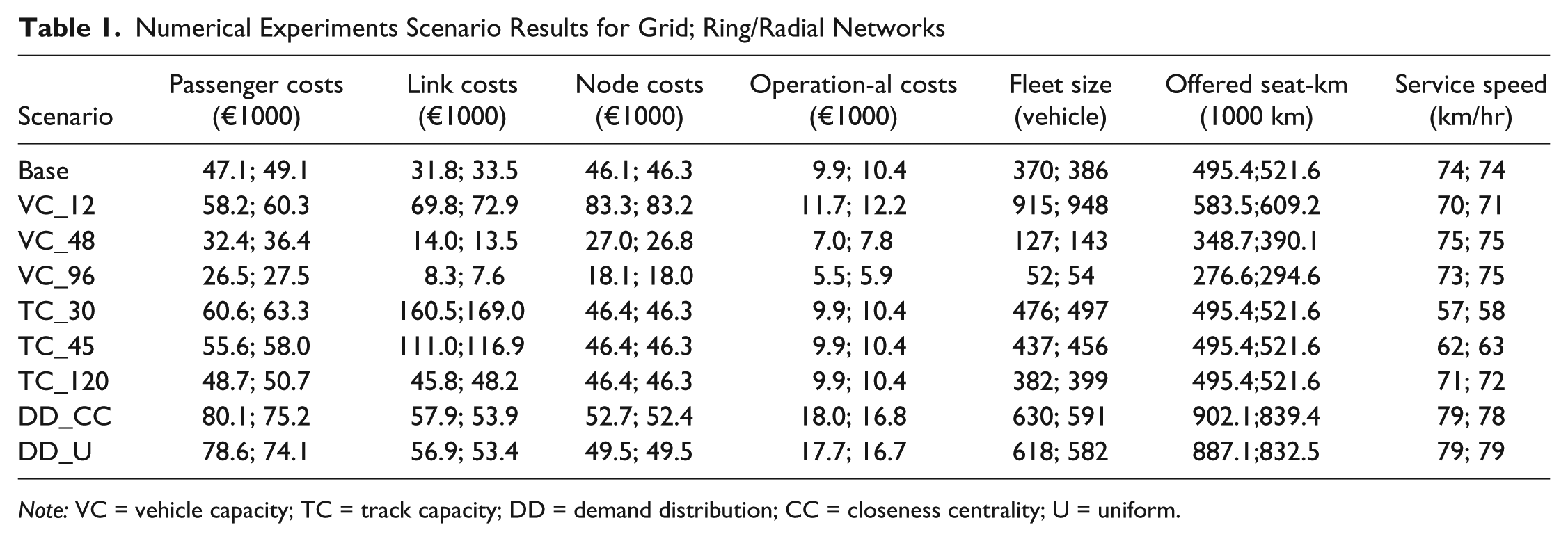
Note: VC = vehicle capacity; TC = track capacity; DD = demand distribution; CC = closeness centrality; U = uniform.
Overall, the grid network was found to outperform the ring/radial network, yielding lower values for all cost components in the optimal solution with the existing DD. Careful investigation revealed that this difference stemmed primarily from the fact that in the grid network flows can often be rerouted at constant mileage, whereas in the ring/radial network rerouting always comes at the price of increased travel distance. Consequently, flow rerouting was common in the grid network, whereas all vehicles took the shortest route in the ring/radial scenario.
Figure 2 presents the unrounded (left) and rounded (right) allocated infrastructure capacity and corresponding utilization in the grid network. All but four arcs that require a double track have a single track. Hourly arc capacity costs increase to €73,000 compared with €32,000 in the unrounded case. Hourly node capacity costs increase to €50,000 up from €46,000. Notably, arc costs are considerably more sensitive to the integer capacity criterion. The utilization level is close to 70% on most arcs and in excess of 80% for nodes. These values hold for the major part of the network. The cost minimization solution results with a low variability in capacity utilization across the network (67% to 72%).
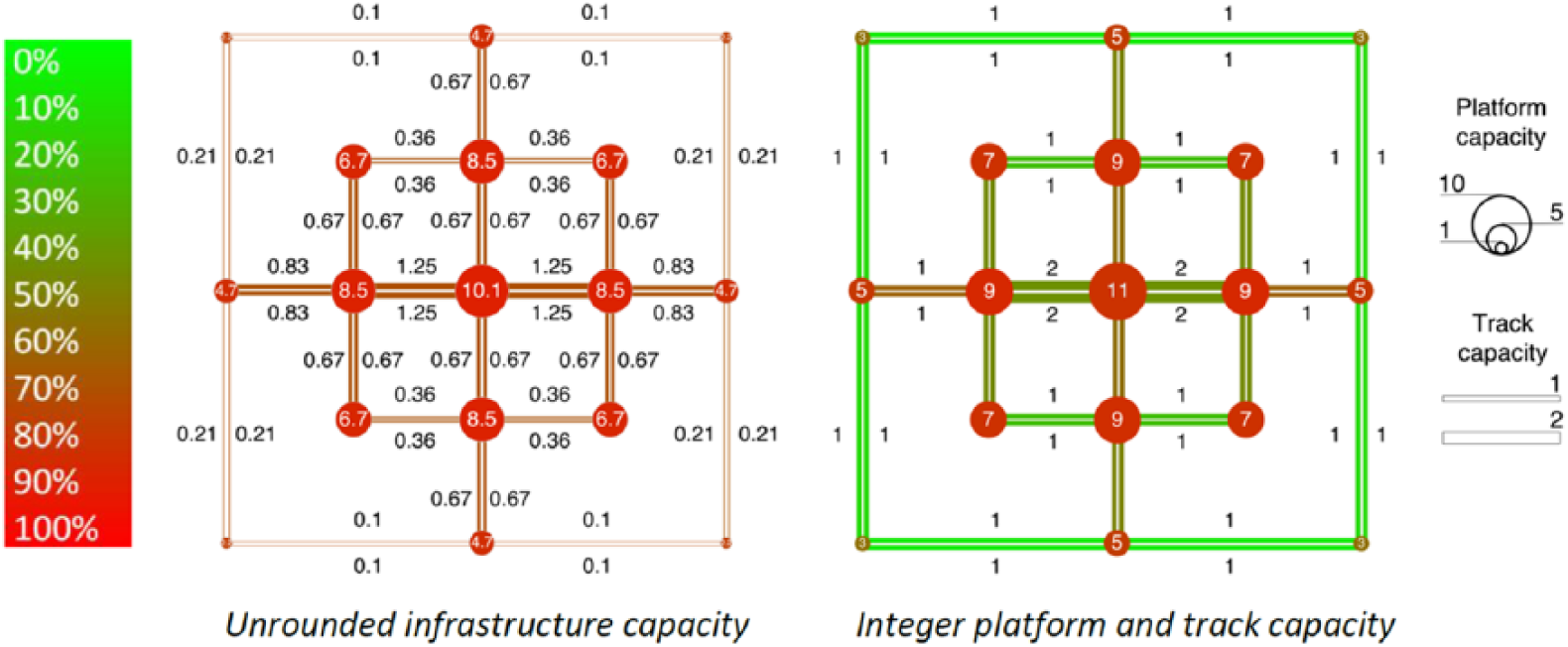
Allocated capacity (numbers) and corresponding utilization (indicated in color) in the grid network.
Solution sensitivity to VC was tested for the following values: 12, 24, 48, and 96. These capacities correspond to the number of seats in van, base case, bus, and intercity train car unit, respectively. Station capacity costs were adjusted to correspond to changing platform length requirements. A pronounced trend can be observed for both network structures in the results reported in Table 1 – the smaller the VC, the higher all cost components become. This is also clearly visible in Figure 3, which displays cost component per VC scenario for the grid network. Reducing VC from the base case value of 24 to 12 results in an increase of approximately 120% and 80% in link and node capacity costs, respectively. This increased capacity is required to handle a fleet size that is 2.5 times larger, but nevertheless results in a 25% rise in passenger costs. Part of this difference was attributed to the increasing number of passengers that were not offered a direct DRT service as vehicle size increased. This share increased dramatically from negligible levels to a sizable minority of passenger demand in the scenario with a capacity of 96. With the exception of the lowest capacity scenario, service speed remained at a relatively constant level.
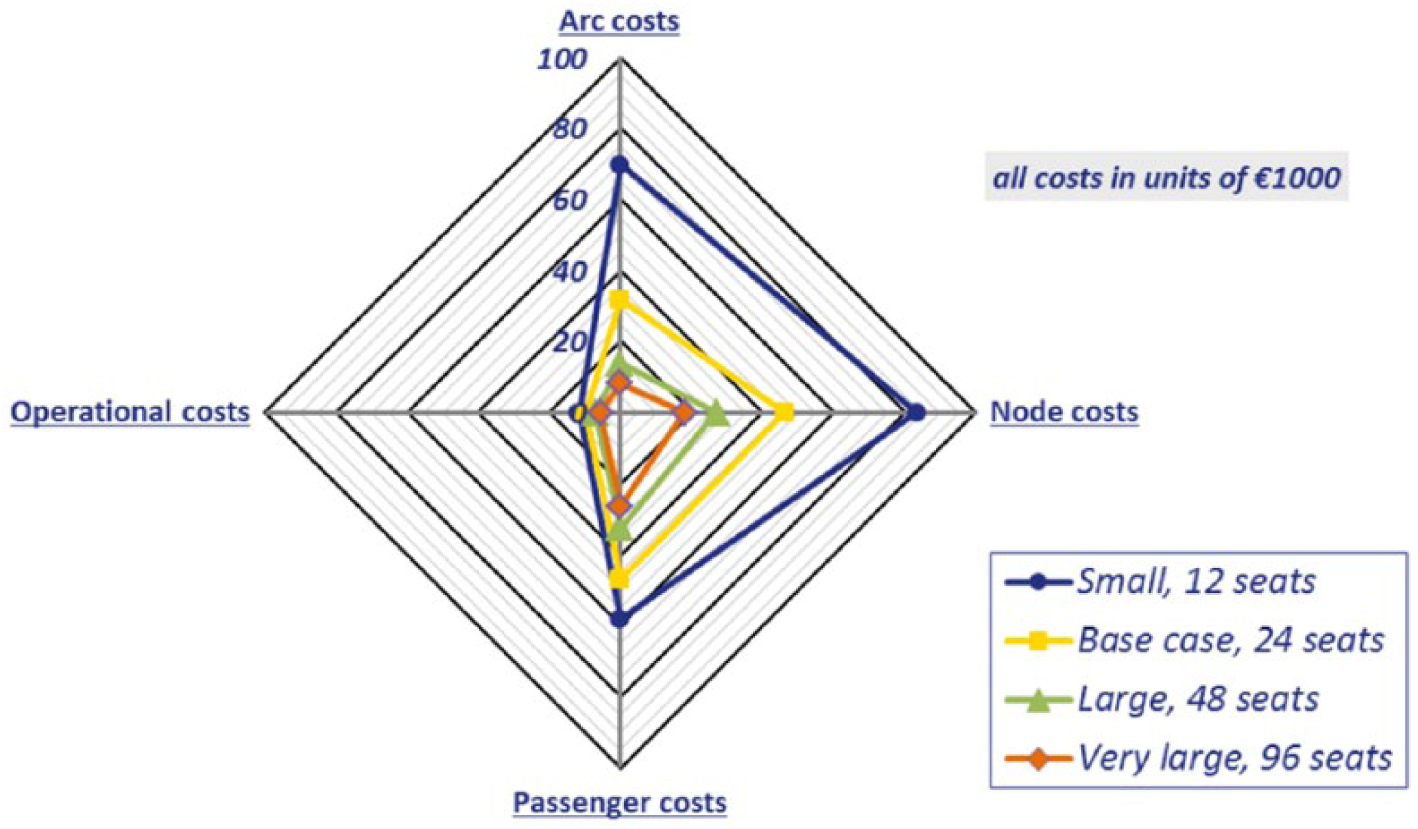
Cost component sensitivity to vehicle capacity in the grid network.
Smaller rail vehicles are associated with higher operational costs, because the seat-to-engine ratio is lower. It might therefore be argued that to ensure a fair comparison, a change in vehicle size needs to be accompanied with an opposite change in operational costs. The following scenarios are studied for the grid network: 12 seats at €0.08 per seat km, 24 seats at €0.02 per seat km (base case), 48 seats at €0.015 per seat km, and 96 seats at €0.0125 per seat km. As shown in Figure 4, the simultaneous change in seat km price and unit operational costs has most influence on the component of operational costs. Nevertheless, the results in Table 1 show that a change in unit operational costs has no major influence on the decision variables. Differences between the various vehicle size scenarios are in line with the results reported in Table 1.
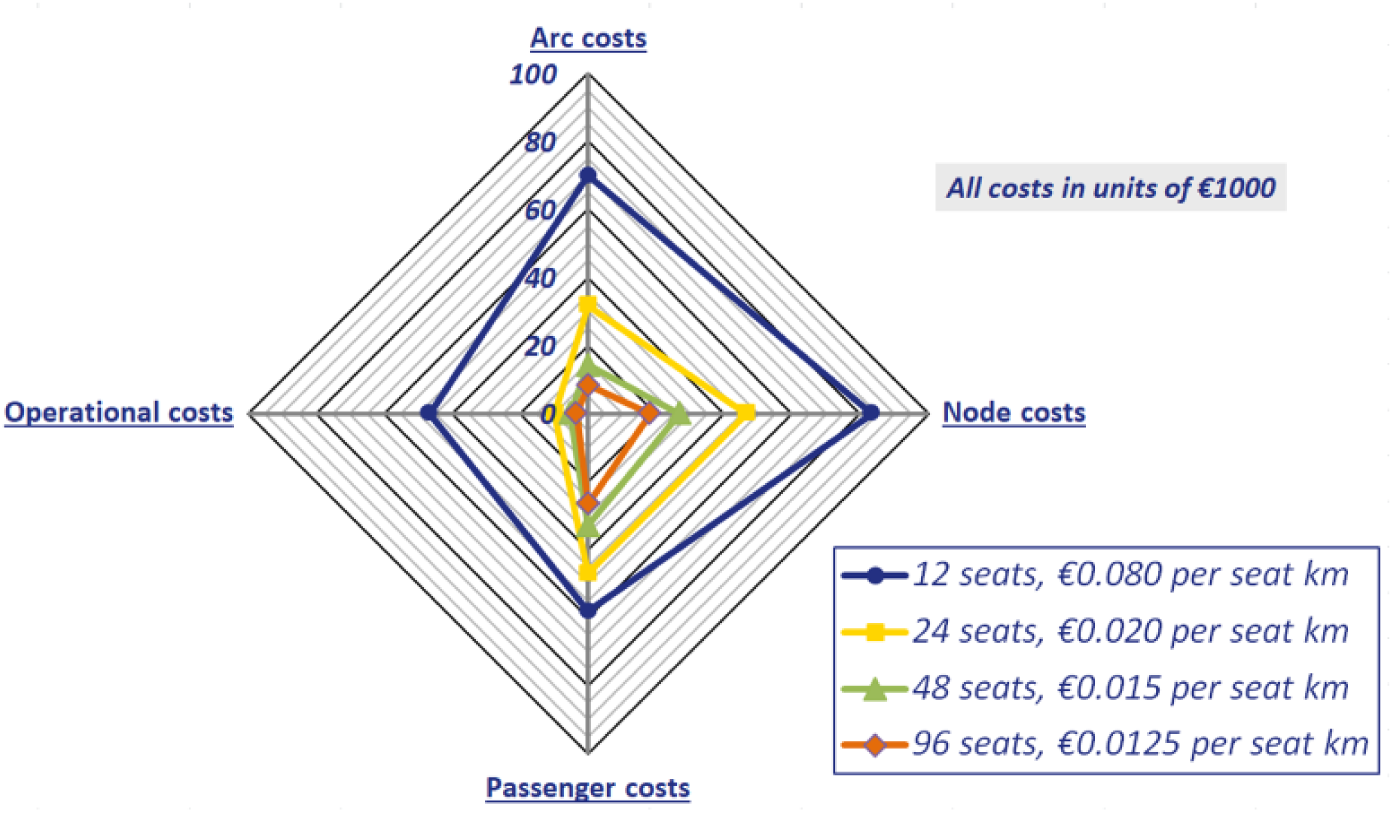
Cost component sensitivity to combined changes in vehicle capacity and unit operational costs in the grid network.
To overcome the deficiency of large shares of unserved demand when vehicle size increases, the second set of combinatorial scenarios studied a decrease of minimum service frequency at an increase in VC for the grid network. The largest vehicle was associated with a frequency threshold of one departure per hour. The threshold values for smaller vehicles were set such that the minimum capacity of 96 seats per hour was obtained in all scenarios: 12 seats and at least eight departures per hour; 24 seats and 4 hourly departures; 48 seats and 2 hourly departures; and 96 seats with at least one departure per hour. In this way, the share of unserved demand was fixed in all cases (12%). Though served demand was equal in all scenarios, passenger costs still decreased with increasing VC, albeit more modestly (i.e., 46,940 and 40,560 for 12 seats and 96 seats, respectively) than reported in Table 1. Link and node capacity costs were significantly higher in low VC scenarios with costs more than five and three times as high for link and node costs, respectively, when comparing 12-seat and 96-seat scenarios, yet resulting in a lower operational speed. Notwithstanding, smaller vehicles may still be preferred because they offer higher service frequency.
The automated rail TC assumed in the base case scenario to be 180 vph, is very high compared with existing heavy rail systems. To test the consequences of technological developments that result in lower values, the model was run with TC values of 30, 45, and 120 vph. The most conservative value corresponds to the maximum frequency in classical heavy rail with European Railway Traffic Management System (ERTMS signaling. A reference value of 45 is taken from automated metro systems. An intermediate value of 120 can be indicative of more limited technological advancements. The results of the sensitivity analysis are visualized in Figure 5. As might be expected, link costs are most affected by changes in TC as they exercise a linear relation. In the scenario of 30 vph/track, link costs increased by over 400% compared with the base case. In contrast, the impact of TC on passenger costs exhibited a logistic relation through the operational speed resulting in an increase of 29% when comparing the low capacity scenario of 30 vph with the base case scenario. Node costs and operational costs remained unaffected. Link costs dominated the cost function for low TC values and decreased to levels similar to station capacity and passenger costs for TC values of 120 vph and then were exceeded by the latter two for a capacity of 180 vph (i.e., base case).
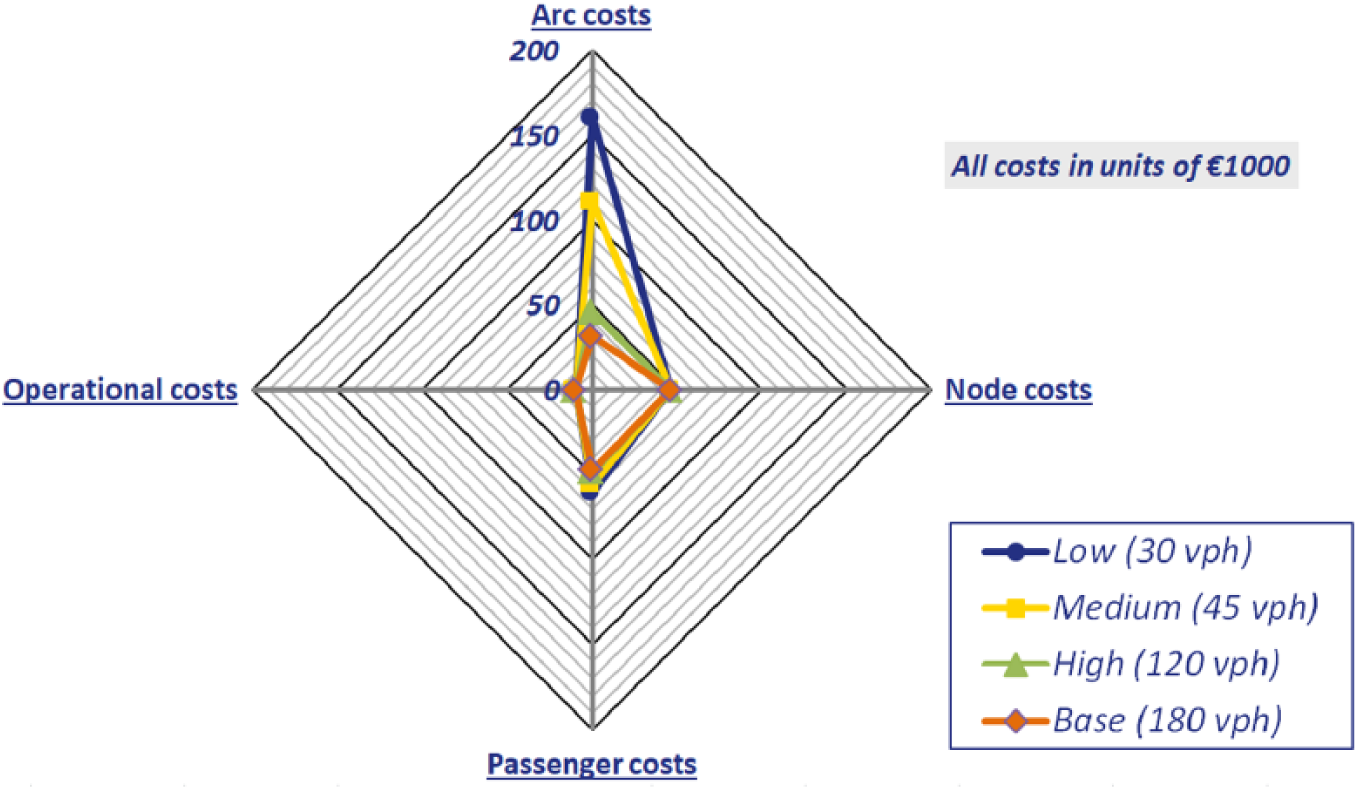
Cost component sensitivity to changes in track capacity in the grid network.
Finally, DD was expected to have profound effects on system performance. Two DD scenarios were considered in addition to the base case, which had demand oriented toward the network’s center of gravity: the opposite case of uniform demand distribution (DD_U) and an intermediate case where demand is proportional to the node closeness centrality (DD_CC) metric (i.e., average distance to all other nodes). Note that unlike the uniform and gravity distributions, DD in the latter scenario is not independent from network connectivity and hence results in a different OD-matrix for the two network structures. In contrast to the base case results, link costs in the optimal solutions for the two alternative DD scenarios surpassed station costs. A more uniformly distributed demand required a larger fleet and led to higher mileage and thus TC on more network links, albeit with lower congestion levels as reflected in the increase in average speed for both network structures. Operational costs were lower for the ring/radial network than for the grid network in the average closeness and uniform scenarios due to its better connectivity, whereas the grid network performed better when demand was concentrated at the center where it offered shorter routes.
Discussion and Conclusion
This study presents a network cost minimization model for determining the optimal infrastructure capacity and flow distribution of rail-DRT systems. The results of the numerical experiments indicate that – unlike conventional rail systems in which stations often are capacity bottlenecks – link capacity properties are more critical for the performance of automated rail-DRT systems than station capacity. Despite the highly heterogeneous service characteristics of rail DRT, it is concluded that only a limited number of stations need to offer overtaking capacity. Hence, DRT stations in general do not have to be positioned off the main line.
As this study is pioneering in the public transport system it envisaged, model specification required making a series of assumptions about plausible characteristics of future automated rail-DRT systems. A series of sensitivity analyses was performed to test the impacts of even extreme deviations from the assumed values on model outputs. Future developments are expected to allow finer specifications of technological and service features such as the link speed-density function, the station platforms queuing regime, and related assumptions.
The automated rail TC assumed in the base case scenario to be 180 vph, is very high compared with existing heavy rail systems. From the sensitivity analysis, it is concluded that link costs are most affected by changes in TC. Link costs dominated the cost function for the lowest TC values examined and decreased to levels similar to station capacity and passenger costs for TC values of 120 vph. From a conventional heavy rail point of view, rail-DRT TC characteristics are challenging and require vehicle switching on fixed rails, communications-based train control, and automated dispatching. In addition to the technological exploration of this study, there are station management aspects to offering rail-DRT services that need to be addressed in future research. These design and technical aspects include the coordination of passenger travel requests, and informing passengers and vehicles about the dwelling and loading positions within the station.
Under the base case parameter settings, the optimal link and station capacity allocation is comparable to those currently available in some heavy rail networks. Link infrastructure utilization is however higher, in the order of 70% to 85%, compared with approximately 65% with today’s system. The need to invest in link capacity strongly depends on vehicle characteristics of minimum headway and the speed-density relation. Trading-off link costs against passenger costs is possible in the form of either inducing longer travel time or reducing service frequency by increasing VC.
The sensitivity of the overall results to changes in unit operational costs is negligible within any reasonable range of unit operational cost values. Choices on infrastructure capacity and vehicle flow routing can therefore be made regardless of unit operational costs. This is an important conclusion with respect to the development of rail-DRT vehicles. Even in the unfortunate case when rail-DRT vehicles are more expensive to operate than anticipated, the strategic choices on available infrastructure are still valid.
The optimal solution corresponded to the system-optimum flow distribution. Even though model formulation allows for rerouting vehicles to attain global system-optimum conditions, only in extreme cases is a minority of the vehicle flow not assigned to the shortest route. The implications of competing DRT service providers can be studied by adjusting the objective function used in this study to guarantee user-equilibrium conditions.
Although certain network structures appeared to be better equipped in reducing the objective function value for certain DDs, the overall pattern is that the denser a network becomes, the lower the costs per passenger kilometer. This relation is particularly pronounced when the higher connectivity is offered in the area of highest demand. In practical terms, this implies that also in the context of rail DRT, stations should be higher in number and closer together in areas of high demand, such as urban regions. In low demand zones, such as rural areas, the number of stations should be more conservative.
This study examined the long-term planning consequences of offering a new transportation technology and service concept. To test its potential to substitute the existing rail service, current demand levels were tested in the application. Future research is needed to assess travelers’ perceptions and preferences toward such services and potential changes in demand patterns that may be caused by the introduction of rail-DRT services. For example, the service might have consequences for station attractiveness due to the increased correlation between service frequency and demand for specific connections. This may also have ramifications for network structure design and service availability, including equity considerations.
Footnotes
Acknowledgements
The authors thank Dennis Huisman for his suggestions and critical input. Dutch Railways (NS) kindly provided input on operational settings.
Author Contributions
The authors confirm contribution to the paper as follows: study conception and design: O.C.; data collection: J.H.; analysis and interpretation of results: J.H. and O.C.; draft manuscript preparation: O.C. and J.H. All authors reviewed the results and approved the final version of the manuscript.
The Standing Committee on Automated Transit Systems (AP040) peer-reviewed this paper (18-02339).