




Abstract
Background
Hemiplegic stroke survivors frequently exhibit reduced toe clearance during the swing phase of gait, increasing the risk of tripping and falls. Although various task-specific training (TST) interventions aim to address swing-phase biomechanical deficits, the magnitude and certainty of their effects on direct toe-clearance outcomes remain uncertain.
Objective
To systematically review and meta-analyze randomized controlled trials (RCTs) evaluating task-specific interventions targeting swing-phase mechanics to improve direct measures of minimum toe clearance (MTC) in adults with poststroke hemiplegia.
Methods
PubMed, EMBASE, Cochrane CENTRAL, CINAHL, and Web of Science were searched from inception to June 2025 for RCTs involving adults with hemiplegic stroke. Eligible studies assessed interventions explicitly targeting swing-phase mechanics and reported direct toe-clearance measures or biomechanically relevant proxy outcomes. Risk of bias was assessed using the Cochrane RoB 2 tool and the Physiotherapy Evidence Database (PEDro) scale. Data were pooled using random-effects meta-analysis. A priori subgroup analyses (intervention modality, stroke phase) and sensitivity analyses were performed. Certainty of evidence was evaluated using the Grading of Recommendations Assessment, Development and Evaluation (GRADE) framework.
Results
Eighteen RCTs (n = 972) were included, with 12 contributing to quantitative synthesis. TST interventions significantly improved MTC compared with control conditions [standardized mean difference (SMD) = 0.68, 95% CI (0.45, 0.91); p < 0.001), with moderate heterogeneity (I2 = 62%). Although biofeedback interventions demonstrated the largest point estimate (SMD = 0.85), followed by functional electrical stimulation (SMD = 0.62) and robotic-assisted gait training (SMD = 0.51), subgroup differences were not statistically significant (p = 0.12). No significant differences were observed between subacute and chronic stroke subgroups. Sensitivity analyses excluding high-risk-of-bias trials yielded similar results. Improvements were also observed in gait speed, functional mobility, and balance. Funnel plot asymmetry and Egger's test suggested possible publication bias. Using GRADE, the certainty of evidence was moderate for MTC and gait speed and low for timed up and go and fall outcomes.
Conclusions
Task-specific gait training improves toe clearance and related functional gait outcomes in individuals with hemiplegic stroke, with moderate-certainty evidence for direct toe-clearance improvements. These findings support the integration of TST approaches across the stroke recovery continuum, while underscoring the need for standardized outcome reporting and longer-term trials assessing falls and real-world mobility.
Gait abnormalities such as hip hiking, circumduction, and pelvic obliquity lead to reduced toe clearance and greater fall risk. Interventions involving biofeedback, FES, RAGT, and obstacle/adaptability training collectively improve mobility, balance, and safety outcomes.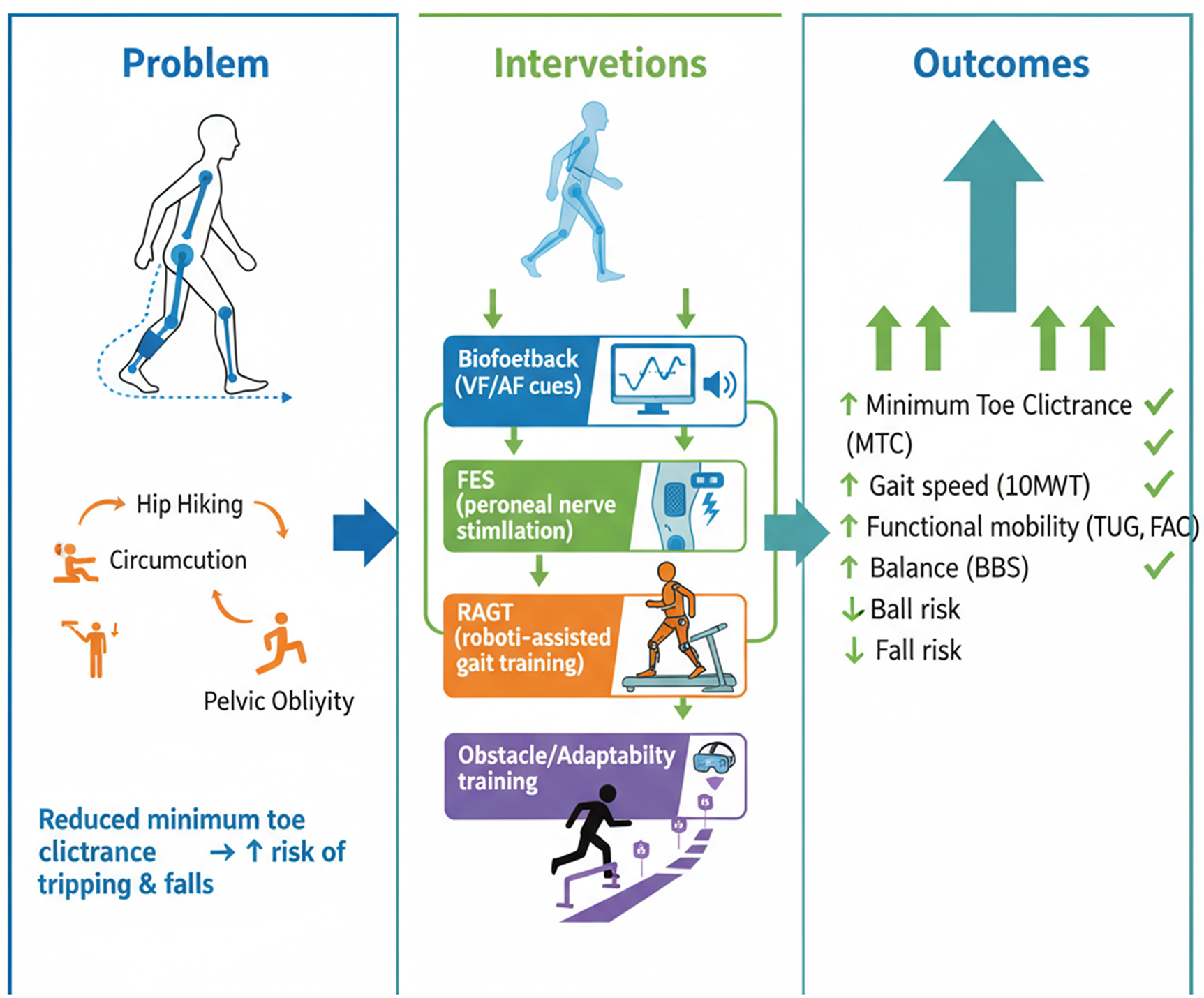
Keywords
Get full access to this article
View all access options for this article.