



Abstract
Case
A 30years old man 178cm in height and 72kg in weight with a BMI of 22.7 visited our clinic on May 2,2009 for desensitization therapy for asthma. Medical history Received treatment for bronchial asthma until sometime while he was in the 6th grade of elementary school.
Underwent surgery for inguinal hernia at the age of 8 years.
Had a relapse of asthma in August 2008. He had been treated at another hospital /clinic, but visited our clinic for basic treatment of the disease because of a relapse of symptoms that had developed on discontinuation of oral medication.
Stopped smoking, when he experienced a relapse of asthma.
Has been drinking more coffee (4to5cups/day) than before. Laboratory findings
IgERIST 271 lU/mL
IgERAST House dust Class3
Candida Class 1
Timothy Class 1
Cow’s milk and rice Class 0 Findings of the Bi-Digital O-Ring Test (BDORT,Omura. Y. 1977-2009)
Positive for house dust, Candida, timothy, cow’s milk, polished rice, coffee, chocolate, and rhinovirus. Pulmonary function tests
Vital capacity 4.54L (%PR: 105%)
FEV1.0% 81%
Modem medical technology does not detect any abnormal findings, while BDORT shows abnormality mainly in the lower lung field.
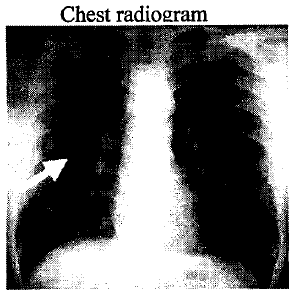
A diagnosis of “no abnormal findings” was made On the basis of this image by modem medical technology. A loss of the normal structure of the lung is shown (the arrow) at the site of the area found positive by the BDORT on the chest radiogram. On the BDORT, there was resonance with HHV-6 and HHV-7.
This area was positive for coffee and chocolate.
Discussion
Asthma, emphysema, and chronic bronchitis comprise COPD and may cause respiratory failure in elderly patients.
Approximately 40% of the 80,000 patients on home oxygen therapy receive it because of COPD. *1
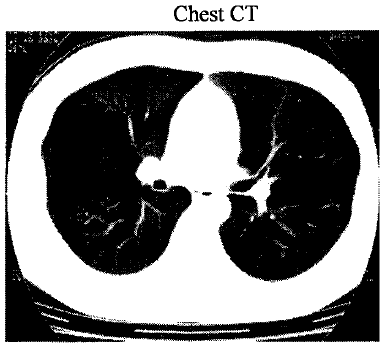
In this patient with asthma, the low-attenuation area (LAA) on a chest CT image was diagnosed as “no significant abnormal findings” by modem medical technology.
BDORT, however, provided a diagnosis of infection with HHV-6 and HHV-7, and also found coffee and chocolate to be aggravating factors.
ECG generally shows biphasic P waves in chest lead VI, and thus it is difficult to detect abnormalities on chest radiograms by modem medicinal technology, while BDORT can detect them.
Furthermore, BDORT allows early detection of COPD if the area of the hand representing the lungs is frequently examined. BDORT is thus useful for screening.
Conclusions
Review of a case of asthma suggests that the use of the BDORT allows prevention of respiratory failure due to COPD.
Chest radiography and chest CT used in combination with BDORT can detect COPD early.
Biphasic P waves in lead VI on ECG may be used as a sign of early COPD.
Early COPD can be detected by frequent screening of the area of the hand representing the lung. The cause of early COPD was found to be infection, food, pollen, and other substances by the BDORT. This knowledge may lead to prevention of respiratory failure.
Get full access to this article
View all access options for this article.