



Abstract
In dental treatment, various kinds of metals are used for dentistry. Metallic allergy can be seen in many patients after having these treatments. The metal allergy belongs to type 4 hypersensitivity, delayed type allergy, cased by cellular immunity. Trapping of the metal occurs when it is combined with a salivary carrier protein by dendritic cells such as Langerhans cells which cause sensitization against dental metals. Sensitized T cell and macrophages produce inflammatory cytokines such as interleukin 1(IL-1), TL-6 and tumor necrosis factor alpha (TNF a). In this study, we subjected two patients who suffered from dental metal allergy to Bi-Digital O-Ring Test (B-D-O-Ring Test, Y., 0mural977-2000).
Case I
A housewife aged 26 year-old, has a serious dermatitis on her back shoulder and back part of left thigh. She has many dental treatments of metal materials and orthodontic wire. By attitude BDORT (Bi-Digital O-Ring Test, OMURA, Y. 1977-2000) with Pd Alloy 1 g, 1-2 of examiner opened 1-4 of examinee to the -4 level.
We did the 16 kinds of metal patch tests. Pd, Zn, Sn, Cr was positive, especially Pd was very Strong response. Nonspecific IgE antibody titer was 50IU/ml. IgE titers were less than average (250).
So we doubted metal Allergy and began to remove metals from her previous dental work. There were 9 crowns and inlay. At first, we took out 4 pieces and changed into Au metal contained (Au 83.6%, Ag 6%, Cu 9%, Ishihuku). One of them was a precious metal porcelain crown. Becauseause it had no response to Pd, Sn, Cr, Zn, we didn’t remove it. Sometimes cement involves Zn. We used the cement without Zn. But the disease became worse. December 1999, all Pd Alloy were removed, and changed into Au without one crown. The dermatitis did not improved. At this point, the orthodontic wires that responded to Cr still remained.
We found Pd resonance in her body, but could not remove wires for the orthodontic treatment. The middle of January 2000, prescribed Chinese parsley 10 mg 3 times/day. 2 months later the response of CMV supplemented DHA/EPA did not improve. 14th March, Orthodontic treatment finished. Main wire were removed, but small wires for king responded to Cr. Chinese parsley had been kept to prescribe. 20 days later, the dermatitis has improved very much. We suggested to the orthodontic dentist that wires should be changed to another materials. During the treatment, we suspected the reason that the disease got worse was the two kinds of metal existence and wires inhibited the exhaust of Pd.
Case II
A 59-year-old female housewife, had PPP syndromes introduced by dermatologist in March 2000. Since 1989 for three years, she had PPP and she got a tonsillectomy. This disease disappeared. In June 2000, she had the dental treatment of full dentures made of metal. In December 2000 the PPP relapsed.
We examined her by 16 kinds of metal patch tests. Sn was only positive. But metal dentures and other oral crowns don’t contain Sn (tin).
Denture contains (Co 63%, Cr 28%, Molybdenum 5%, Silicon 1%, Mn 1%, Carbon 1%, Nitrogen 1%, Nickel 1%). We made the sample of Molybdenum.
Mo has negative and Denture itself was the same result by BDORT.
IgE antibody sera titer was 130(lower than average). HSV-IgE 77.5(higher than average), CMV-IgE 25.2(higher than average).
We are looking for another causes.
For patch tests, some samples aren’t permitted clinically, so B.D.O.R.T is a better method.
The conditions of ion are more effective than metal solid on B.D.O.R.T. We think the parts of liquid laminated would remain for half a year. We measured the weight of 5 drops each, and made samples of 1 drop on the average. Vaseline type samples have the weight multiplied by percent of themselves.
Examination on the hands, legs, neck and many places are better. Because sometimes metal buttons would inhibit B.D.O.R.T.
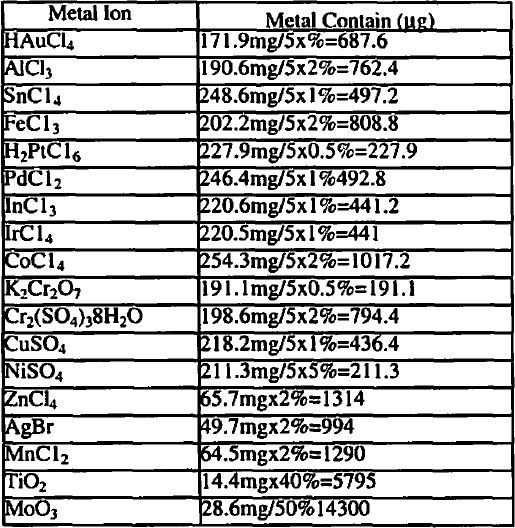
| Metal Ion | Metal Contain (μg) |
|---|---|
| HAuCl4 | 171.9mg/5×%=687.6 |
| AlCl3 | 190.6mg/5×2%=762.4 |
| SnCl4 | 248.6mg/5×1%=497.2 |
| FeCl3 | 202.2mg/5×2%=808.8 |
| H2PtCl6 | 227.9mg/5×0.5%=227.9 |
| PdCl2 | 246.4mg/5×1%492.8 |
| InCl3 | 220.6mg/5×1%=441.2 |
| IrCl4 | 220.5mg/5×1%=441 |
| CoCl4 | 254.3mg/5×2%=1017.2 |
| K2Cr2O7 | 191.1mg/5×0.5%=191.1 |
| Cr2(SO4)38H2O | 198.6mg/5×2%=794.4 |
| CuSO4 | 218.2mg/5×1%=436.4 |
| NiSO4 | 211.3mg/5×5%=211.3 |
| ZnCl4 | 65.7mg×2%=1314 |
| AgBr | 49.7mg×2%=994 |
| MnCl2 | 64.5mg×2%=1290 |
| TiO2 | 14.4mg×40%=5795 |
| MoO3 | 28.6mg/50% 14300 |
Get full access to this article
View all access options for this article.