




Abstract
Purpose
Y. Omura first reported in 1995 that Cilantro can remove abnormal metal deposits in human tissue. In this study scavenging effect of Chinese parsley on localized lead deposition was investigated in male ICR mice exposed to lead.
Materials and Methods
Seven weeks old ICR male mice were exposed to 1000 ppm lead in drinking water for 32 days. Administration of Chinese parsley to mice by gastric intubation was performed for 25 days from 7 days after beginning of lead exposure to the end of experiment. After 32 days, the mice were sacrificed for comparison of lead distribution. The localized lead in various organs was analyzed by atomic adsorption spectro-photometry and the content of d-aminolevulinic acid (ALA) excreted in urine was determined by high performance liquid chromatography.
Results
Most of lead reached the highest concentration in femur. Localized lead deposition in femur was decreased significantly by administration of Chinese parsley (Fig. 1). In addition, urinary excretion of ALA which is known to increase with lead intake was also significantly suppressed by administration of Chinese parsley (Fig. 2).
Conclusion
These results suggest that Chinese parsley have an activity to suppress lead deposition.
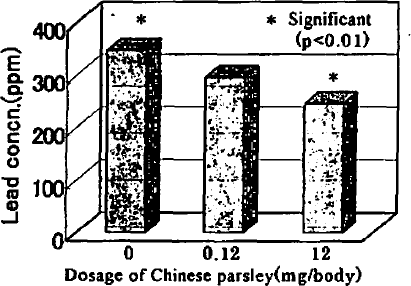
Scavenging effect of Chinese parsley against lead distribution to femur
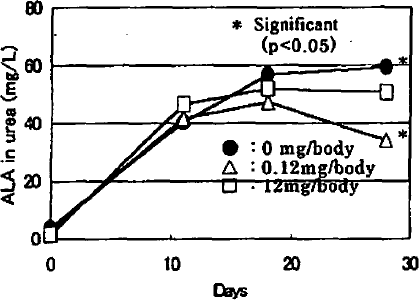
Levels of urinary excretion of ALA
Get full access to this article
View all access options for this article.