



Abstract
[Objective]
According to the traditional theory of acupuncture, if some meridian becomes pathologic, that is, if it becomes ‘deficient’ or ‘excessive’, some acupoints along that meridian serve as tonic points and others along the same meridian serve as sedating points (Table 1). At this Third International Symposium on Bi-Digital O-ring Test, I will present my recent clinical study, in which the association of these tonic and sedating points with various organs was analyzed, using the Bi-Digital O-ring test (BDORT) originally developed by Prof Omura, Y. ofNew York.
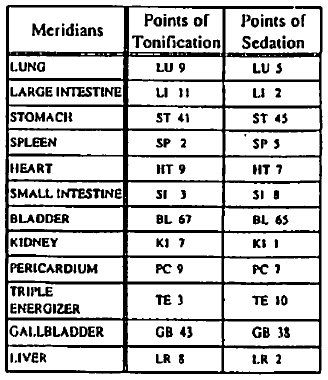
| Meridians | Points of Tonification | Points of Sedation |
|---|---|---|
| LUNG | LU 9 | LU 5 |
| LARGE INTESTINE | LI 11 | LI 2 |
| STOMACH | ST 41 | ST 45 |
| SPLEEN | SP 2 | SP 5 |
| HEART | HT 9 | HT 7 |
| SMALL INTESTINE | SI 3 | SI 8 |
| BLADDER | BL 67 | BL 65 |
| KIDNEY | KI 7 | KI 1 |
| PERICARDIUM | PC 9 | PC 7 |
| TRIPLE ENERGIZER | TE 3 | TE 10 |
| CALLBLADDER | GB 43 | GB 38 |
| LIVER | LR 8 | LR 2 |
[Methods]
1. Subjects:
Ten randomly selected patients (3 males and 7 females) were the subjects. In each subject, 24 acupoints, serving as tonic or sedating points, were tested in July or August 1997.
2. Procedure of BDORT
While the subjects held a specimen of a normal organ on their palm, the examiner compressed the skin above the acupoint, using an insulated bar, and pulled the finger to be tested. A map was made of those skin areas whose compression induced the test finger to open (areas showing the resonance phenomenon, i.e., areas associated with the specimen held) and areas whose compression did not induce the finger to open (areas not associated with the specimen held)[3]. This is called direct BDORT.
[Results and Discussion]
1. Compression of the perimeter of most acupoints resulted in positive responses when the subject held the specimen of the organ whose name is linked with the meridian to which the stimulated acupoint belongs. For example, compression of acupoints Taiyuan (L9) and Chihtse (L5), which belong to the lung meridian, yielded positive responses when the subject held a specimen of lung However, acupoints along the pericardial meridian were found to be associated with the adrenal gland instead of the pericardium, acupoints along the triple heater meridian were associated with the thyroid, parathyroid, pancreas and gonad, and acupoints along the bladder meridian were associated with the peritoneum.2. Positive responses to compression of the center of each acupoint were not related to holding one particular organ on the palm. That is, no particular correspondence was observed between positive responses to compression of the center of each acupoint and the organ specimen held in the hand. These results suggest that each acupoint is associated with two or more organs, rather than only one organ.
Get full access to this article
View all access options for this article.