




Abstract
Public academic libraries are among the many organisations concerned about using artificial intelligence (AI) technologies. The study adopted a mixed methods research (MMR) approach using a concurrent research design to examine the use of AI innovations in public academic libraries. Thematic and descriptive statistical data analysis was used to analyse the data gathered from questionnaires, interviews and document content analysis. The findings revealed that public academic libraries in South Africa did not have clear strategies for adopting AI innovations. Consequently, AI was not widely used. Library management systems can support AI, but some must be upgraded. Librarians had excellent computer literacy, although many had not received AI training to broaden their expertise and awareness of this innovation. Results suggested that public academic libraries should create comprehensive AI adoption strategies responsive to AI trends. This study highlights the need for strategies that ensure AI technologies are utilized ethically, equitably, and with accountability. It also contributes to the literature on the use of AI in academic libraries. The results of this study may encourage public academic librarians to begin planning the incorporation of AI technology into their strategies.
Keywords
Introduction and background
The fourth industrial revolution (4IR) has the potential to completely change everything thanks to artificial intelligence (AI) and a host of new technologies (Velarde, 2020). AI is a paradigm shift in technology that is revolutionising computing services and resources, including the provision of information in public academic libraries. AI is transforming society, and as technology advances, libraries must be prepared to modify their offerings to suit the ever-changing demands of society and technology. Libraries should incorporate new technologies, such as digital resources, e-books, online databases and advanced search tools, to meet the growing demand for digital information. AI has multiple functions in academic libraries and can transform library operations (Vijayakumar and Sheshadri, 2019). This is partly achieved by integrating intelligence into the technologies that enhance service quality and facilitate information accessibility for users.
Research has shown that AI can be used in libraries for a variety of functions, including reference, acquisition, cataloguing, indexing and classifying (Monyela, 2020); information literacy (Honghai, 2020; Vijayakumar and Sheshadri, 2019); and library marketing (Omehia and Mmejim, 2020). Intelligent library automation systems can also be used to provide staff and patrons with knowledge-based services (Omame and Alex-Nmecha, 2020). According to Hilt (2017), libraries can leverage AI technologies to support data processing, documentation and research. Romero (2018) asserts that AI has the potential to enhance library users’ ability to find and retrieve new media with greater efficiency and effectiveness, while also introducing them to non-traditional materials. Academic libraries’ information systems provide opportunities for improvement if AI is incorporated (Asemi et al., 2020).
Furthermore, AI's advantages for libraries are widely acknowledged (Wheatley and Hervieux, 2022). Cox et al. (2019) show how AI improves search and resource discovery by looking for metadata problems, analysing the indexing process and making sure the content is discoverable. Subaveerapandiyan et al. (2023) aver the benefits of employing AI applications for managing physical infrastructure, such as buildings, rooms and equipment, as well as for managing human resources and career development.
Implementing AI can also reduce human errors and inefficiencies and free up library staff members to focus on more challenging and valuable tasks, like assisting lecturers in creating reading lists, mentoring students on how to conduct better research, curating library collections and other related tasks (Faga and Yusuf, 2023; Omehia and Mmejim, 2020). That implies that libraries can improve library service quality and redesign their emphasis, focus and attention using AI applications (Whitehair, 2016). According to Echedom and Okuonghae (2021), AI holds great promise for enhancing the provision of information services in university libraries across Africa.
Conceptual framework
Several theories and concepts have been used to explain disruptive technologies in libraries. For instance, to enable librarians to think about AI as a technology that may support alternative innovative service delivery, Wheatley and Hervieux (2019) established the AI innovative library services conceptual framework (AI-LSICF). The diffusion of innovations (DOI) concept was utilised by Lund et al. (2020) to explain how academic library staff members felt about using AI. These studies set the precedent for how theories and concepts can be used to explain the adoption of AI in academic libraries. However, the present study used a conceptual framework as suggested by Bilal et al. (2023) and Ngulube and Mosha (2023) because no single theory was appropriate for the constructs used in this study and its context. To comprehend how AI technologies were applied in South African public academic libraries, the study integrated ideas from the literature with one of the four components of the DOI theory. More specifically, elements from the literature were blended with the innovation itself (Rogers, 2003). The study aimed to consider the innovation's availability, compatibility with South African library systems, its inclusion in libraries’ strategic plans and staff members’ capability to use it.
Literature review
Consistent with the conceptual framework, the review of literature focuses on AI technology inclusion in libraries’ strategic goals, the availability of the technology in academic libraries, library systems’ compatibility with AI technologies and staff members’ ability to apply the innovation. These elements highlight the application of AI in public academic libraries in South Africa.
Public academic libraries’ strategic goals
The implementation of AI technologies in South African academic libraries generally follows a structured approach. Stanke (2023) confirms that a key component of using AI efficiently is strategic planning. Integration with existing library management systems is a common strategy. For example, the University of Pretoria has successfully integrated AI tools with its existing digital library infrastructure, ensuring seamless operations and minimal disruptions (Moyo, 2022). User training and support are also crucial components of successful implementation (Barsha and Munshi, 2024; Okolo et al., 2023). Academic libraries will survive and grow if they incorporate AI into their strategic plans (Vassilakaki and Moniarou-Papaconstantinou, 2016).
However, South African libraries face challenges such as limited funding, infrastructure constraints and a skills gap in AI technologies (Zondi et al., 2024). The digital infrastructure in many South African libraries is insufficient and cannot effectively support AI implementation (The AI Blog, 2024). The substantial expenses in acquiring, implementing and sustaining AI systems create major obstacles that public academic libraries must overcome (Modiba and Chisita, 2023). For instance, the university libraries faces significant infrastructural challenges when it comes to integrating AI technologies into its operations (Rabatseta et al., 2024).
These constraints shape their libraries' strategic goals and implementation strategies. Libraries are focused on incremental AI integration to improve accessibility and operational efficiency (Ndou, 2021). The Organisation for Economic Co-operation and Development (OECD, 2019) posits that libraries in developed countries will benefit from more funding, advanced infrastructure and better expertise in AI, allowing them to pursue more ambitious strategic goals.
Availability of AI technologies in academic libraries
According to a 2019 survey conducted in Canada and the United States, not many institutions had participated in AI initiatives or created their own AI centres, and there was a dearth of knowledge about current AI trends (Wheatley and Hervieux, 2019). Harisanty et al. (2023) point out that the use of AI in libraries is still in its infancy, and the use of intelligent libraries to support services is presently superficial. Robotics technology is being used in libraries to free up space and provide customers with easy access to information resources (Murphy, 2015). Academic libraries in Nigeria use expert systems in reference services, acquisition, indexing, technical and natural language processing, pattern recognition and robotics in library activities (Adejo and Misau, 2020).
Academic libraries in South Africa have begun to integrate various AI technologies to enhance their services (Monyela and Tella, 2024; Zondi et al., 2024). Notably, chatbots and virtual assistants are becoming increasingly common. For instance, the Durban University of Technology has successfully integrated AI into its library operations to enhance service delivery (Zondi et al., 2024). This includes using predictive analytics for resource management, automated cataloguing systems and AI-driven chatbots that assist with user inquiries. These innovations have significantly improved both user satisfaction and operational efficiency. Similarly, Stellenbosch University has automated routine chores like inventory management and book sorting using AI-based solutions (Monyela and Tella, 2024; Stellenbosch University Library and Information Service, 2024). AI-driven technologies now enhance virtual reference services, improving the library's ability to assist patrons effectively and remotely. The University of Pretoria has implemented AI technology to improve the efficiency of several library services (University of Pretoria Department of Library Services, 2024; Zondi et al., 2024). This includes using AI-powered recommendation systems to customise user experiences and machine learning techniques to manage digital collections. These innovations have enhanced access to information and resulted in more effective use of resources.
Existing library systems’ compatibility with AI technologies
Several South African academic libraries utilise information library systems (ILS) such as Millennium and Koha. These systems handle various library functions, including cataloguing, circulation, acquisitions and user management. Millennium is a proprietary system from Innovative Interfaces, Inc, known for its robust features but less flexible in terms of customisation compared to open-source options (Moyo, 2022). These systems face challenges in AI integration due to their proprietary nature and limited application programming interface (API) support. Significant customisation and technical expertise are often required to enable AI functionalities (Murash and Neshcheret, 2024). Koha is an open-source ILS widely adopted due to its flexibility and cost-effectiveness. It supports customisation and integration with other systems through APIs (Bwalya and Akakandelwa, 2021). Moyo (2022) points out that Koha offers good compatibility with AI technologies due to its open-source nature and API support. Libraries using Koha have successfully integrated chatbots and recommendation systems. Younus (2021) indicates that South African academic libraries have adopted various ILS, but the integration of AI is still in its nascent stages. Financial constraints, lack of technical expertise and inadequate infrastructure are major barriers.
Contrarily, libraries in developed countries have made significant strides in integrating AI technologies. For example, North American and European libraries often benefit from better funding, advanced infrastructure and greater access to technical expertise, facilitating smoother AI integration (OECD, 2019). Integrating AI technologies into South African academic libraries will offer significant benefits, including improved user experiences and efficient resource management. However, challenges related to compatibility, financial constraints and skill gaps must be addressed.
Capability of employees to apply AI technologies
Librarians should have the essential skills and knowledge to utilise a technological innovation. Librarians may also need additional training to adapt to potential changes in their professional roles because AI requires new skills in automation, communication, innovativeness, productivity and digitalisation (Hervieux and Wheatley, 2021; Sima et al., 2020). However, studies highlight that while South African employees possess strong technical skills, there are gaps in critical thinking and creativity, partly due to the education system's focus on rote learning (van Zyl et al., 2017). In comparison, employees in countries with robust innovation ecosystems, such as the United States and Germany, tend to have higher proficiency in critical thinking and creativity, supported by comprehensive education and training systems (OECD, 2019). According to Cox et al. (2019), advancements in AI require the acquisition of new competencies and data literacy. The training will give librarians a positive outlook on the use of AI. Strong information and communication technology (ICT) skills among librarians would significantly improve the effective provision of library services in the 4IR period (Akparobore et al., 2020).
Problem statement
AI is improving user experiences, extending the power of librarians and converting libraries into dynamic centres of knowledge and information access. Many libraries recognise the potential of AI to enhance efficiency and user experiences (Hussain, 2023; Wheatley and Hervieux, 2022). However, the adoption of AI by public academic libraries in South Africa appears to be slow, which delays the enhancement and provision of quality services (University of Pretoria, 2020). A lacklustre utilisation of AI by public academic libraries will have a detrimental effect on academic library users’ information demands and behaviour. This study examined the use of AI in public academic libraries in South Africa. The objectives of the study were:
To determine the extent of the inclusion of AI in the strategic plans of public academic libraries in South Africa; To ascertain whether AI technologies are available in South African public academic libraries; To assess the compatibility of the current library systems in public academic libraries in South Africa with AI technologies; To measure whether employees are capable of utilising AI.
Research methodology
The study used pluralism and pragmatism as an ontological and epistemological perspective for the research paradigm (Creswell and Plano Clark, 2017; Poth, 2018). The study employed a mixed methods research (MMR) approach and a convergent design (Creswell and Plano Clark, 2017; Poth, 2018). This design is used when researchers want to compile the findings from qualitative and quantitative data analysis to contrast them. The study used qualitative data to explain, confirm and disconfirm quantitative results, leading to a more robust and insightful analysis. Parallel mixed methods sampling was used for the study (Ngulube, 2022; Onwuegbuzie and Collins, 2017). A parallel sample from a research population can be used to evaluate both quantitative generalisations and qualitative insights within a single study, adding to the richness of the context and inferences (Ngulube, 2022; Onwuegbuzie and Collins, 2017).
From a study population of 5287 in 26 public academic libraries in South Africa, 503 librarians were chosen for questionnaire data collection using proportional stratified random sampling. An actual sample size of 20% (503) was taken from the total number of librarians, and a proportion of
With the aid of the qualitative data analysis programme Atlas.ti (version 23.3.4), content analysis and qualitative data were examined using thematic data analysis (Braun and Clarke, 2022). IBM Statistical Package for the Social Sciences (SPSS) for Windows (version 29) was used to analyse quantitative data in a statistical descriptive manner. Following analysis, the two datasets were combined in accordance with the requirements of the convergent design (Creswell and Plano Clark, 2017; Richards et al., 2019).
Findings of the study
Qualitative data obtained through interviews with systems librarians and library managers as well as the content analysis of documents are presented first, followed by the quantitative data.
Qualitative findings
Library managers reported that strategic planning did not fully contemplate AI. They said that the goal was to deal with the ‘innovation’ in public academic libraries in the future. Some typical responses were as follows: Participant A= Participant I (Library manager); Participant A (I): “Even if we do not have AI in our strategic plans, we use words such as “innovative” “innovation” “client driven” and ”supporting teaching and learning" to refer to our strategy. The library procured two self-check machines in 2014 which was way ahead of other academic libraries” (Library Manager). Participant O= Participant II (Library manager); Participant O(II): “We have not included AI in the strategy, but the library has an e-strategy with AI as a critical component” (Library Manager). Participant B= Participant III (Library manager); Participant B (III): “The library's strategic plan does not outline fully a plan on the adoption of AI, but discussion on the innovation is prevalent” (Library Manager). Participant A= Participant IV (Systems Librarian); Participant A (IV): “We use LibChat from Springshare and the university uses Chatbots” (Systems Librarian). Participant L= Participant V (Systems Librarian); Participant L (V): “I think we are moving towards that direction. We have not fully implemented artificial intelligence” (Systems Librarian). Participant A= Participant IV (Systems Librarian); Participant A (IV): “Yes, the system has customised options which allow some AI tools to be embedded to the system” (Systems Librarian). Participant F= Participant VI (System Librarian); Participant F (VI): “Yes, I think the system does support AI tools because it has pattern recognition for advanced search” (Systems Librarian). Participant N= Participant VII (Systems Librarian); Participant N (VII): “Yes, the system is updated and aligned to AI operational level” (Systems Librarian).
Participants reported that the systems in public academic libraries were interoperable and allowed integration with AI tools. In agreement with others, one participant stated: Participant M= Participant XIII (Systems Librarian); Participant M (XIII): “Yes, the system allows in the library is compatible for AI because AI can be integrated with it” (Systems Librarian). Participant H= Participant VIII (System Librarian); Participant H (VIII): “To a greater extent but it will need to be integrated with other systems” (Systems Librarian).
Participant M=Participant XIII (Systems Librarian) Participant M (XIII): “It can, because we have a number of resources in the library which are not all in sync but are used by our students and staff members” (Systems Librarian). Participant Q= Participant XVII (System Librarian) Participant Q (XVII): “To a greater extent, because it supports some AI tools” (Systems Librarian). Participant A= Participant I (Library manager);
Participant A (I): “Currently, we do not have such training because AI has not been at the top of our priority as we always align what we do to the University's Vision, which in this case has been Vision 2022. We will, though, start some initiatives in 2023 as we have finalized the University's Vision 2030, which has Digital Transformation as one of the KPAs. AI initiatives therefore will be considered as the response to the University's Vision 2030 agenda” (Library Manager). Participant L= Participant XII (System Librarian)
Participant L (XII): “The library has not yet fully adopted AI, nor are its operations dependent on the requirement for its training” (Systems Librarian). Participant A= Participant I (Library Manager) Participant A (I): “Training is needed to ensure that we keep abreast with innovative technologies, to avoid becoming stagnant. Training will assist with skills development, learning and multiskilling enabling staff to work in various sections of the library as well as being equipped to apply for higher positions”(Library Manager). Participant E= Participant V (Library Manager) Participant E (V): “Training will be required to align the knowledge and skill sets of the library staff relative to 4IR technologies” (Library Manager). Participant B= Participant III (Library manager) Participant B (III): “Librarians do portray willingness towards the adoption of any form of technology that will advance our services and support to library users and make our work more efficient” (Library Manager).
Quantitative data from librarians
This section presents findings from the data collected from librarians through a questionnaire. A total of 301 out of a target sample of 503 librarians completed the questionnaires, for a response rate of 60%.
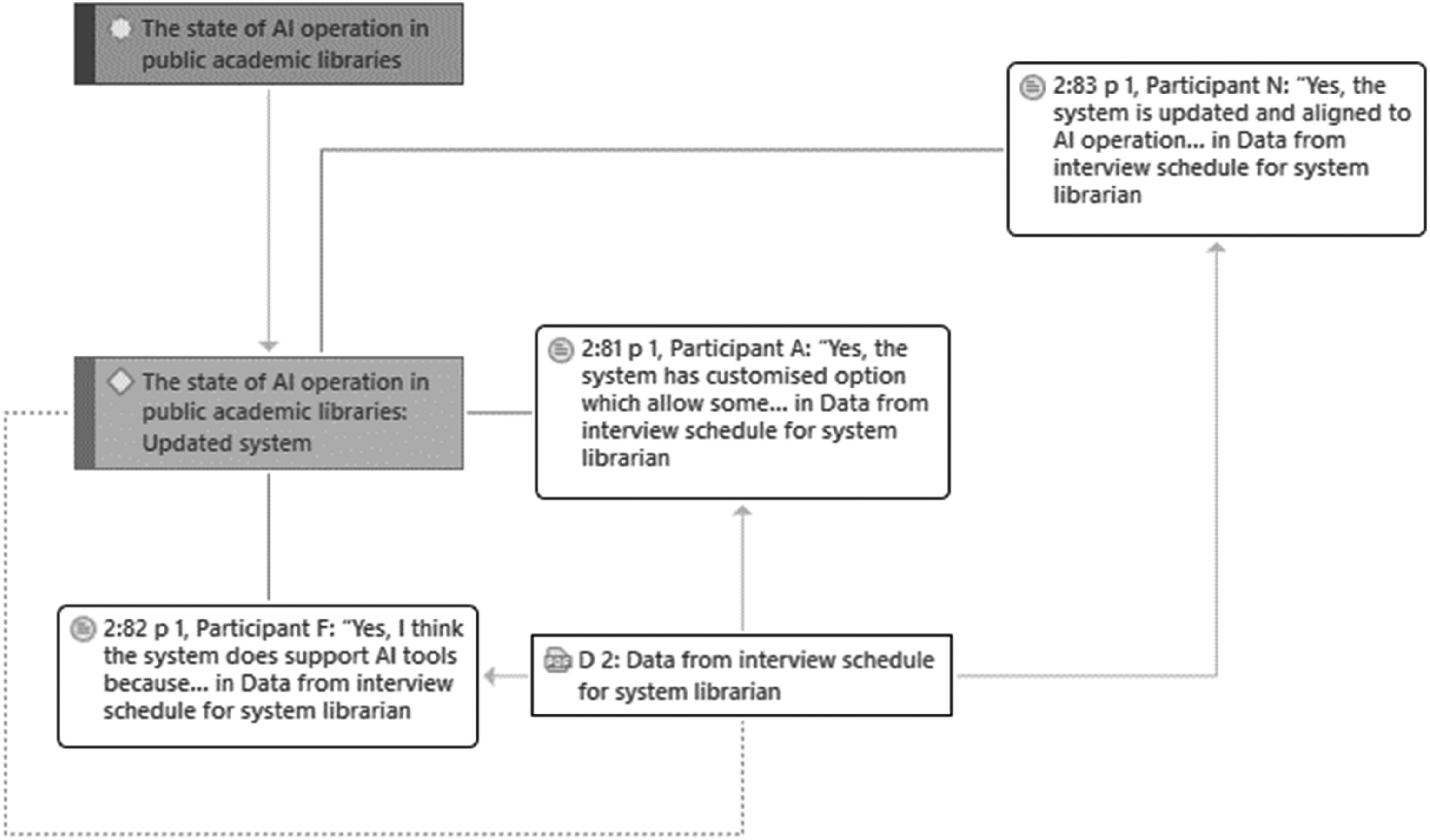
Support of systems for AI.
Strategic planning for public academic libraries.
Many (250; 83%) of the respondents reported that they were not aware if their library’s strategy planned for the use of AI technologies. A few (51; 16%) said that their library's strategic plan provided for the use of AI. Only three participants (1%) stated that their library’s strategy provided for ethical use of AI while enjoying its benefits; one of these three respondents stated that the strategy focused on privacy and transparency and gave priority to operations intended to use AI.
Availability of AI technologies in public academic libraries.
This finding of the study shows that public academic libraries in South Africa had automation systems in place that provided users and staff with knowledge-based services, with 298 (99%) respondents indicating so. A total of 16 (5%) respondents specified that the systems had visual and text recognition. When specifically asked about the availability of AI technologies, 151 (83%) respondents stated that their libraries had automatic speech recognition technology, 105 (35%) indicated that their libraries had chatbots, 19 (6%) reported the existence of pattern recognition systems and 14 (5%) indicated that robotics technology was used, as illustrated in Figure 2.
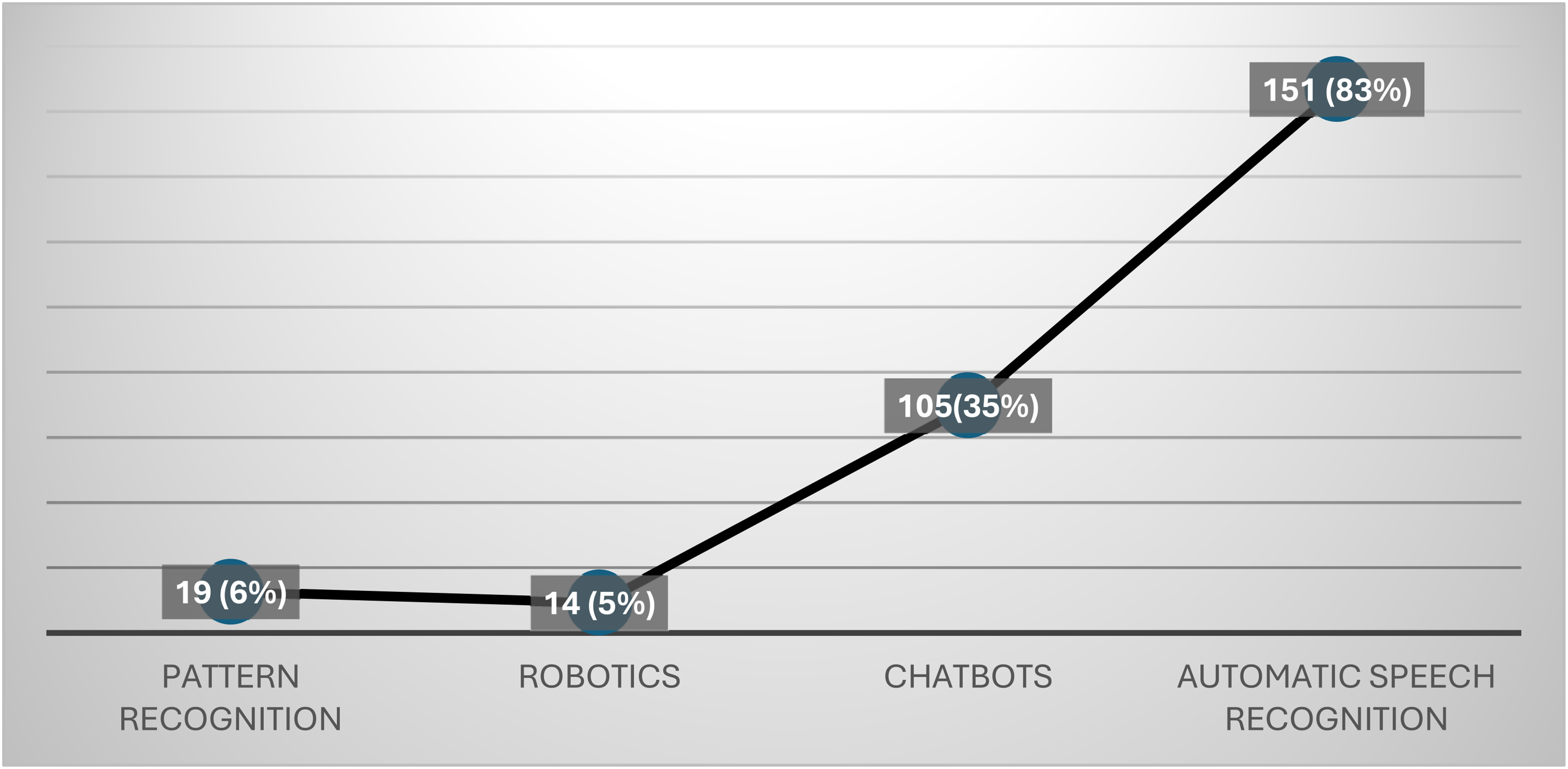
AI related technologies in the library.
Compatibility of current library systems with AI technologies.
These findings of the study show that 292 (97%) of the respondents indicated that their library systems were up to date and could accommodate many innovations. Results show that 256 (85%) respondents reported that their library systems were compatible with AI technologies. A total of 42 (14%) respondents reported that their library systems needed to be upgraded before integration with AI technologies, and three (1%) were not sure whether their systems were compatible with AI technologies.
Capability to utilise AI technologies.
Results indicate that 111 (37%) of the participants held a bachelor's degree, 66 (22%) had an honours degree, 62 (21%) had a master's degree, 35 (12%) had a PhD, 19 (3%) had a diploma and eight (3%) had certifications in library and information science. The study's findings indicated a high level of computer literacy among academic librarians working in public university libraries. Participants evaluated their skills on a scale from 1 to 5, with 5 being the highest score. A total of 159 (53%) evaluated their talents at 4, 101 (34%) rated at 3, 39 (13%) rated at 2, and 2 (0.66%) rated at one on a scale of 1 to 5, with five being the highest.
Many of the respondents (203; 67%) indicated that they had not received training in AI technologies in libraries, while 98 (33%) had received such training. In response to multiple-choice questions, many respondents (297; 99%) stated that they needed to be skilled in the use of digital infrastructures and facilities, and 186 (62%) said they wanted solid knowledge on the operation of AI technologies. Furthermore, many respondents (261; 87%) indicated that they wanted training to improve their level of awareness; 99 (33%) wanted to learn how to make good, safe and economical use of AI; 75 (25%) wanted to broaden their knowledge on the use of AI for library services; and nine (3%) wanted to enrich the necessary skills to work with AI.
Discussion and integration of the results
The discussion compares and integrates quantitative and qualitative data to establish corroboration or divergence in line with the MMR convergent design.
Strategic planning for AI in public academic libraries
Strategic planning has significant implications for public academic libraries. A crucial leadership responsibility is to match strategy with operations (Kiron et al., 2023). Some libraries appeared to be adopting AI without any strategic leadership, which suggests that management did not align their strategy with business operations. Data from library managers show that the strategic plans of South African public academic libraries do not include a comprehensive strategy for implementing AI. Many of the respondents reported that they were not aware if the library strategy planned for the use of AI technologies. South African public academic libraries may not be adequately prepared to leverage AI technologies, which could limit their ability to enhance services, streamline operations and improve user experiences.
This seemed to be the case since strategic planning was uncommon among the public academic libraries surveyed. Apparently, this was the case since strategic planning for AI was uncommon in public academic libraries in South Africa. A content analysis of strategic documents confirmed that the deployment of AI technologies was not adequately planned. The results are in line with a study revealing that only three academic libraries in the United Kingdom and 21 in China mentioned AI in their strategic plans (Huang, Cox and Cox, 2023). Developing awareness and a need to explore AI technologies may be reflected in the lack of a clear strategic plan. In fact, libraries have not yet reached the confirmation stage and are currently assessing the innovation (Harisanty et al., 2023).
One library used terms such as “innovation” and “innovative” in their strategic plan, which is in line with the findings of Wheatley and Hervieux (2019), which revealed that some university libraries included statements about digital innovation in their strategy. Anticipating the adoption of technological innovations signifies a focus on users’ needs and a desire to give them more effective and user-friendly ways to find, use and engage with library resources. Public academic libraries must put themselves in a position to offer cutting-edge services, guarantee the ethical application of AI, and promote transparency and justice in their contribution to the larger field of information and knowledge management by preparing to address these innovations by having strategic plans that accommodate AI innovations.
Availability of AI technologies in public academic libraries
The quantitative results showed that AI technologies available in public academic libraries include automatic speech recognition technology and chatbots, while pattern recognition and robotics were absent in some libraries. System librarians confirmed that their libraries had deployed chatbots and other AI technologies. In agreement with the qualitative findings, the quantitative results suggest that libraries are at varying stages of AI adoption. The availability of these technologies signals progress towards embracing cutting-edge tools to enhance user experiences and library services. The use of robotics, for instance, can free up space, make information resources more accessible and boost the performance of existing information systems (Asemi et al., 2020; Murphy, 2015).
AI technologies contribute to improving users’ experience by providing them with seamless access to information, personalised recommendations and 24/7 assistance through AI-driven chatbots. These tools help users locate resources quickly and efficiently, reducing waiting times and easing the workload on staff. AI's pattern recognition capabilities can also offer enhanced search functions, allowing users to retrieve more accurate and relevant results, further improving their research efficiency.
In addition to improving user interaction, AI can optimise internal processes. Automated indexing, acquisition and natural language processing (NLP) allow libraries to manage collections more effectively. AI-driven data analysis also offers insights into usage trends and performance metrics, helping libraries to adapt their services to better meet user needs.
As seen in other contexts like Nigeria, AI technologies such as expert systems, pattern recognition and robotics are already being used to expand library services beyond traditional models (Adejo and Misau, 2020). In contrast, South African public university libraries lag behind on the adoption of these technological advancements, a situation that may be attributed to insufficient strategic planning. However, by integrating AI more fully, libraries can create more efficient, inclusive and user-centred spaces that better serve the evolving needs of their communities. While AI can automate many processes, tasks that require subjective judgment, contextual awareness and human interaction will still benefit from human oversight.
Compatibility of current library systems with AI technologies
A need for academic libraries to adopt technologies that are compatible with both their users’ needs and existing technologies was underscored by Mafungwa (2017). Findings obtained from systems librarians’ answers revealed that library systems of many public academic libraries in South Africa were considered up to date, compatible and allowing the integration with AI tools. This was confirmed through questionnaire answers showing that 85% of the respondents reported that their library systems were compatible with AI technologies. A few libraries reported that their systems needed to be upgraded to be able to fully operate with AI technologies. These findings show the possibility of AI adoption by public academic libraries in South Africa. This is consistent with DOI theory, which states that the degree to which an innovation aligns with adopters’ needs, experiences and current values will determine how quickly it is adopted (Rogers, 2003).
Current technologies employed to execute library functions such as descriptive cataloguing, subject indexing, reference services, technical services, shelf reading, collection development and information retrieval can be integrated with AI (Ajani et al., 2022; Asemi et al., 2020). Libraries that can integrate AI tools into their systems are better positioned to stay up to date with technological advancements and provide state-of-the-art services. According to Schrettenbrunnner (2020), organisations that integrate new technologies quickly will prosper, but those that do not leverage AI to speed up the virtualisation of their processes and products will not last. The literature recommends and emphasises the adoption of AI through integration (Ajani et al., 2022; Mafungwa, 2017). The library and information systems in academic libraries in South Africa can be enhanced by incorporating AI technologies.
Capability to utilise AI
Investing in staff training is crucial for libraries to effectively harness the potential of advanced systems, as recognised by Hervieux and Wheatley (2021) and Sima et al. (2020). According to Yoon et al. (2022), the skills necessary for using digital facilities and a solid understanding of AI operations are essential resources for the adoption of AI within public academic libraries. Staff training ensures librarians are equipped to handle AI systems effectively. In South Africa, system librarians acknowledge that even librarians with good computer literacy skills need specific AI training. Upskilling is feasible, as data reveal that 97% of librarians have qualifications higher than a certificate. Quantitative data indicate that many librarians have not received training in AI technologies in libraries, with 99% of respondents expressing the need for training in using digital infrastructures and facilities, as well as in the safe and economical use of AI. Additionally, 62% of respondents desire solid knowledge of AI operations. These findings suggest that introducing AI technologies in libraries has been limited by insufficiently planned training programs.
Innovation, as an element of DOI theory, emphasises the importance of introducing new ideas, practices or technologies, and the necessary steps for their adoption. Training in AI represents a crucial innovation for librarians, empowering them to develop new skills and competencies necessary for navigating complex digital environments. The use of this innovation could include implementing AI-driven systems, interpreting AI-generated insights to improve library operations and using AI technologies in an ethical and accountable manner. Without adequate training, librarians may miss opportunities to leverage AI technologies effectively, potentially hindering the quality and efficiency of library services. Librarians equipped with AI knowledge can contribute more effectively to the evolving information landscape and assist library users in accessing and applying AI-powered tools and services, thereby enhancing the overall user experience.
These findings highlight that while AI technologies have been introduced in libraries, the innovation's full potential can only be realised through comprehensive and well-planned training programmes. This will ensure that librarians are not only competent at using AI technologies but are also innovators able to drive the successful diffusion of these technologies within the library ecosystem.
Conclusions and recommendations
The findings of this study exhibit a remarkable consistency with existing literature on the use of AI in libraries. They are also consistent with the conceptual framework underscoring that there are several factors that can contribute to the use of AI. It can be concluded that there was limited strategic planning for the use of AI technologies. Adoption of AI in public academic libraries in South Africa was partial. The technologies used in South African public libraries were up to date and compatible with AI technologies, although some libraries needed to upgrade their systems to accommodate customisation for AI tools. Qualitative and quantitative data also confirmed that investment in staff training necessary for South African public academic libraries to fully adopt AI was inadequate.
These findings imply that many public libraries were not ready to use AI. For public academic libraries to embrace AI technologies, they need:
To formulate strategic plans that include the use of AI technologies in supporting library services; To ensure that all library systems are up to date and compatible with AI technologies; To urgently and actively respond to AI trends by incorporating AI technology into library systems, including robotics; To invest in skill development programmes to ensure that staff members are equipped to utilise and manage AI technologies effectively.
This study has several limitations. It did not cover all the public academic libraries in South Africa. It also excluded private academic libraries. That limits the extent to which the results can be generalised to academic libraries in South Africa. Further research should be conducted in private academic libraries and in all the public academic libraries to find out if their infrastructure is ready for the use of AI technologies. This study did not fully investigate the infrastructure needed to use AI, which is one of the indicators of readiness for AI adoption. The use of other MMR designs can also lead to the generation of theory on the use of AI technology in context.
Footnotes
Declaration of conflicting interests
The authors declared no potential conflicts of interest with respect to the research, authorship, and/or publication of this article.
Funding
The authors received no financial support for the research, authorship, and/or publication of this article.
