




Abstract
In the era of digital innovation, the preservation of indigenous knowledge stands at a compelling intersection of heritage and technology. Librarians play a crucial role in navigating the complexities of technology while respecting cultural protocols. Through a comprehensive exploration of librarian practices, this study sought to unpack how indigenous knowledge can be ethically preserved in the digital landscape. A qualitative study was conducted with 20 librarians in Zimbabwe, who were purposively selected. Interviews and observation were used to collect data, which was analysed using thematic content analysis. The findings reveal that libraries preserved indigenous knowledge in the form of poetry, folklore, drama and artefacts; demonstrated traditional dances; and sometimes recorded live sessions and special collections. The major challenges being faced were the ethical issues in documenting indigenous knowledge. It is recommended that librarians actively work with indigenous communities in indigenous knowledge projects to avoid resistance from knowledge holders.
Keywords
Introduction
The IFLA (2010) recommends that libraries should preserve indigenous knowledge due to their importance in meeting most of the Sustainable Development Goals. In the digital era, the acquisition, preservation and dissemination of indigenous knowledge has undergone profound transformations. This evolution presents both challenges and opportunities for the safeguarding and promotion of indigenous knowledge, which holds immense cultural, historical and ecological significance for indigenous communities worldwide (Dlamini and Ocholla, 2018; Hovenga, 2022; Ngulube, 2002; Owiny et al., 2014). As gatekeepers of information and advocates of inclusive knowledge access, librarians play a pivotal role in facilitating the processes of acquiring, preserving and disseminating indigenous knowledge in the digital landscape (Afful-Arthur et al., 2022; Chigwada and Chiparausha, 2020; Chisita, 2011; Maina, 2012). Indigenous knowledge encompasses the accumulated wisdom, practices, beliefs and traditional know-how developed and passed down through generations within indigenous communities (Baporikar, 2022; Lodhi and Mikulecky, 2010). Rooted in intimate connections with nature, ancestral histories and cultural practices, indigenous knowledge forms the bedrock of their identities and social cohesion. However, this wealth of knowledge faces an array of threats in the face of globalization and the rapid advancement of digital technologies. Without proper attention to preservation and dissemination, irreplaceable indigenous knowledge systems may be at risk of erosion, dilution or even loss (Cámara-Leret and Bascompte, 2021; Lekhi, 2019; Reyes-García et al., 2013).
The digital era brings with it unprecedented opportunities for librarians to collaborate with indigenous communities in preserving and disseminating their cultural heritage. Digital repositories, online archives and innovative technologies can facilitate wider access to indigenous knowledge beyond geographical limitations (Hodder and Beckingham, 2022; Hunter, 2005; Stevens, 2008; Thumbadoo and Taylor, 2022). Nevertheless, this transformation also brings its share of challenges, and librarians must navigate these complexities with cultural sensitivity and ethical responsibility to ensure that indigenous knowledge is respected, protected and valued in the digital realm. As the role of librarians becomes increasingly multifaceted in the digital era, it becomes imperative to examine their contributions and limitations in the acquisition, preservation and dissemination of indigenous knowledge. Each indigenous community has its unique perspectives, needs and concerns, and the approach used in acquiring, preserving and disseminating indigenous knowledge must be adaptable and respectful of distinct cultural values and practices (UNESCO, 2010; United Nations, 2019, 2021a). The process should prioritize indigenous agency, self-determination and the long-term sustainability of the knowledge heritage.
The digital era has brought about some changes in the way indigenous knowledge is acquired, preserved and disseminated. The FAIR (findable, accessible, interoperable, reusable) guiding principles for scientific data management and stewardship were developed to facilitate the sharing of scientific data and support open access, as shown in Table 1 (Wilkinson et al., 2016). The FAIR principles deal with the reusability of data and enhancing the ability of machines to automatically find and use data (Carroll et al., 2021; Wilkinson et al., 2016). However, the movement towards open data did not fully consider indigenous peoples’ rights since the FAIR principles focus on facilitating increased data sharing (Global Indigenous Data Alliance, 2023). Indigenous communities were worried about how they could protect their rights and interests in indigenous data at the same time as supporting open data, machine learning, broad data sharing and big-data initiatives (Carroll et al., 2020). This created tension for indigenous peoples who were working towards greater control of the application and use of indigenous data for collective benefit, leading to the development of the CARE (collective benefit, authority to control, responsibility, ethics) principles for indigenous data governance. The CARE principles are people- and purpose-oriented, and describe how data should be treated to ensure that indigenous governance over data and its use are respected (Jennings et al., 2023). The CARE principles complement the FAIR principles in ensuring that data movements respect indigenous communities’ right to use data ethically (Carroll et al., 2020).
The FAIR and CARE principles.
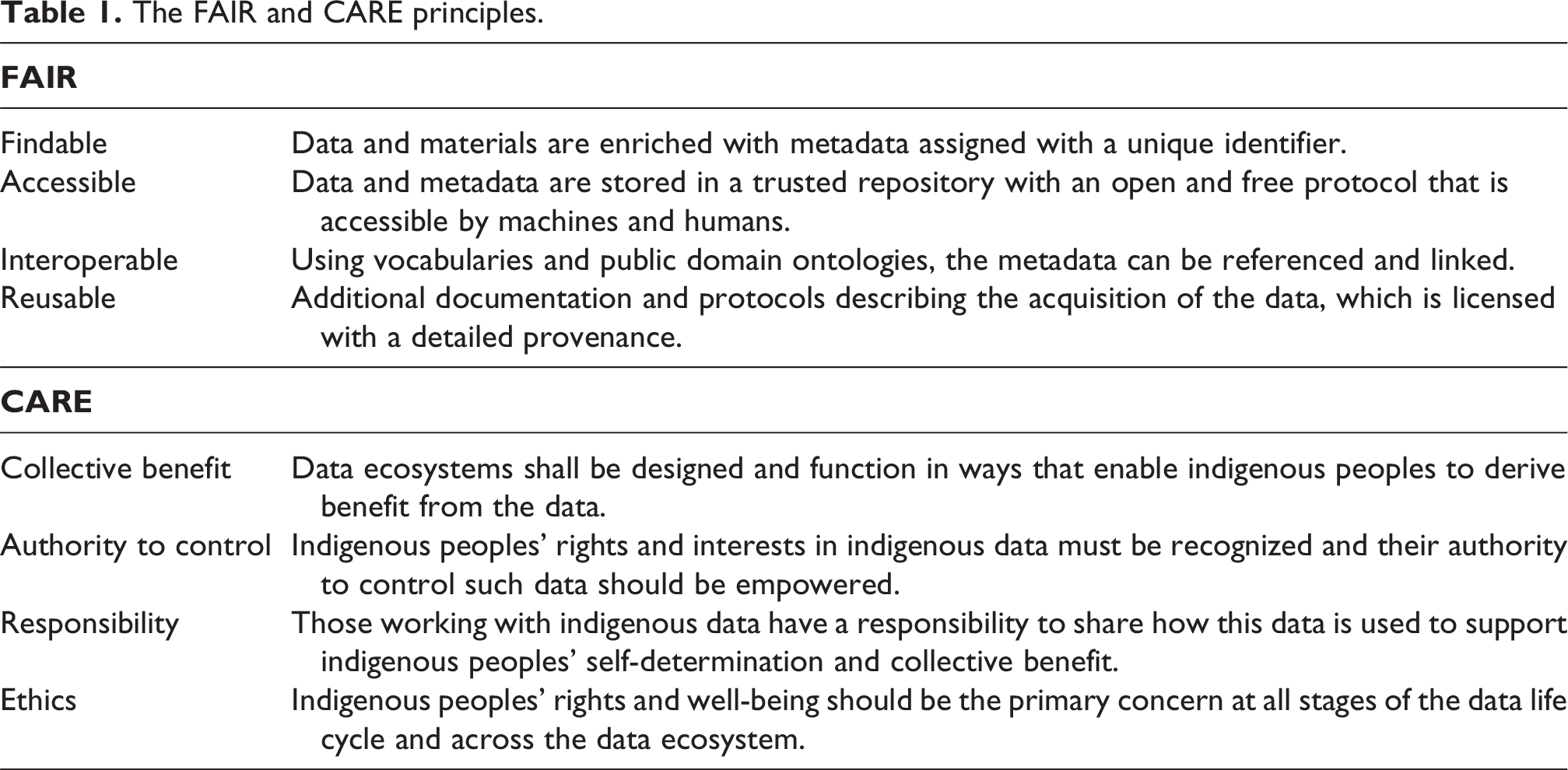
Librarians have been presented with the challenge of balancing the FAIR and CARE principles of data governance when working with indigenous knowledge in the digital era. The purpose of this study was to document the role of librarians in acquiring, preserving and disseminating indigenous knowledge in the digital era. It is against this background that the study sought to: Identify the format of indigenous knowledge in the digital era; Assess the role of libraries in the acquisition, preservation and dissemination of indigenous knowledge in the digital era in Zimbabwe; Discover how librarians are implementing the FAIR and CARE principles of indigenous data governance; Determine the challenges faced by libraries in the acquisition, preservation and dissemination of indigenous knowledge in the digital era in Zimbabwe.
Statement of the problem
Acquiring, preserving and disseminating indigenous knowledge in the digital era is a complex and sensitive process that requires collaboration, respect for indigenous communities’ rights and the use of appropriate technologies (Hunter, 2005; Mdhluli et al., 2021; Nakata et al., 2014; Stevens, 2008; United Nations, 2019). The preservation of indigenous knowledge must take into consideration emerging international trends, such as the open science movement, which led to the introduction of the FAIR and CARE principles of indigenous data governance. Therefore, the role of librarians in facilitating the acquisition, preservation and dissemination of indigenous knowledge is now more critical than before. However, the effectiveness of their involvement in indigenous knowledge preservation and the extent of their impact remain unclear, and the processes are presented with multifaceted challenges. Indigenous knowledge is also in danger of becoming extinct due to its oral nature (Maluleka and Ngoepe, 2018; Mdhluli et al., 2021; Ogar et al., 2020; Owolabi et al., 2022). Adeniyi and Subair (2013) note that African indigenous knowledge is poorly managed, and some of it disappears when the knowledge holders die. Therefore, this study aimed to unpack the overall role of librarians in promoting the preservation of indigenous knowledge and investigate the challenges faced by librarians in acquiring, preserving and disseminating indigenous knowledge in the digital era in Zimbabwe. Through a comprehensive examination of librarian practices and community engagement, this research sought to identify best practices, inform policy recommendations, and contribute to the advancement of inclusive and culturally sensitive information services in support of indigenous knowledge preservation and dissemination.
Formats of indigenous knowledge in the digital era
In the digital era, indigenous knowledge can be in various formats to ensure its preservation, accessibility and dissemination. The format chosen depends on the nature of the knowledge, the preferences of the indigenous communities and the resources available, and this has implications for open science. Indigenous knowledge can be in the form of digital texts, audio recordings, video recordings, photographs, digital artefacts and objects, interactive multimedia, digital maps, digital archives and repositories, and digital exhibitions and online collections (Abera, 2021; Dare, 2022; Masenya, 2022; Slade and Yoong, 2014). Indigenous knowledge can be documented in textual form, including traditional stories, myths, medicinal practices and historical accounts (Masango and Nyasse, 2015; Owusu-Ansah and Mji, 2013). Digitizing these texts preserves their cultural significance and allows for easy storage, search and retrieval. Oral traditions, songs, chants and storytelling can be audio-recorded to capture the nuances of spoken languages and preserve the richness of oral traditions. Video recordings can be used to capture cultural rituals, ceremonies, traditional performances and traditional knowledge transmission between generations. In that manner, photographs can document cultural practices, artefacts and the cultural landscape, providing a visual representation of indigenous knowledge and heritage (Marsden et al., 2010; Reitmaier et al., 2012; UNESCO, 2021). Artefacts and objects with cultural significance can be digitized to allow preservation and sharing with a broader audience, even if the physical objects are in specific museums or cultural centres. Interactive media applications such as virtual and augmented reality can be used to create immersive experiences that engage users with indigenous knowledge and cultural practices (Boboc et al., 2022; Giannini and Bowen, 2022; King et al., 2016; Nikonova and Biryukova, 2017; Skublewska-Paszkowska et al., 2022; UNESCO, 2020).
Libraries and cultural institutions create digital archives and repositories to store and organize various digital formats related to indigenous knowledge. Digital maps can also be used, where geospatial data and digital mapping technologies represent indigenous knowledge linked to specific locations such as sacred sites, hunting grounds and places of cultural significance (Cole and Hart, 2021; Olson et al., 2016; Thumbadoo and Taylor, 2022). Curating digital exhibitions and online collections helps showcase indigenous knowledge and cultural heritage to a global audience. Indigenous communities can also use social media platforms and online forums to share knowledge, connect with others, and raise awareness about their culture and issues (Borrero, 2016; Kamakaila, 2021; Mkhize, 2014; Owiny et al., 2014). Customized knowledge management systems can also be developed to organize and structure indigenous knowledge according to the community’s cultural values and traditional classification systems. Indigenous language technologies, such as text-to-speech and speech-recognition systems, can also support the representation and preservation of indigenous languages in digital form (Galla, 2016; Meighan, 2021). However, it is important to note that the representation of indigenous knowledge in digital formats must be done in a culturally sensitive and respectful manner, with the involvement and consent of the indigenous communities. Libraries, archives and cultural institutions play a significant role in collaborating with indigenous communities to determine the appropriate formats and technologies to use while considering issues of intellectual property rights, data sovereignty and the long-term sustainability of digital resources.
Role of libraries in acquiring, preserving and disseminating indigenous knowledge
Libraries play a vital role in acquiring, preserving and disseminating indigenous knowledge in the digital era (Isah et al., 2012; Mbilinyi and Mwabungulu, 2020; Tjiek, 2006). In the acquisition of indigenous knowledge, libraries work in close partnership with indigenous communities to understand their knowledge needs, cultural protocols and preferences for knowledge sharing (Afful-Arthur et al., 2022; Kaya and Seleti, 2013; Mdhluli et al., 2021; Nakata et al., 2005). During this process, librarians look at ethical collection development by prioritizing ethical considerations, including free, prior and informed consent, when acquiring indigenous knowledge to ensure respectful representation and protection of cultural heritage. Libraries also digitize indigenous materials from their collections and collaborate with indigenous knowledge holders to collect and preserve digital materials that hold cultural significance (Balogun, 2023b; Boamah and Liew, 2017; Mdhluli et al., 2021).
As a way of ensuring the accessibility of indigenous materials, libraries use appropriate metadata standards and organization systems to ensure efficient discovery and access to indigenous knowledge (Chisa and Hoskins, 2016; Chowdhury et al., 2021; Gilman, 2006; Ruckstuhl, 2022). Librarians deal with the issue of data security and ethics when they implement data security measures to protect sensitive cultural information and adhere to ethical guidelines when managing indigenous knowledge (De la Porte and Higgs, 2019). Libraries participate in digital preservation efforts to safeguard indigenous knowledge from technological obsolescence and data loss (Balogun and Kalusopa, 2021; Masenya and Ngulube, 2019, 2021). Special collections are maintained, including rare materials, manuscripts and historical documents, preserving cultural and historical knowledge for future generations (Nilson and Thorell, 2018). Libraries also employ conservation practices such as proper storage conditions, handling protocols and repair techniques to ensure the long-term preservation of physical indigenous materials, safeguarding them from damage or degradation (Balogun and Kalusopa, 2021; International Centre, 2021; Iyishu et al., 2013).
Libraries disseminate indigenous knowledge through various avenues such as online access, open access initiatives, cultural protocols, community engagement and educational initiatives (Balogun and Kalusopa, 2022; Mdhluli et al., 2021; Mhlongo, 2020). They also promote open access to indigenous knowledge, aligning with the principles of open science and open education by respecting and adhering to the cultural protocols set by indigenous communities regarding the dissemination of sacred or sensitive knowledge while taking into consideration the FAIR and CARE principles of indigenous data governance (Carroll et al., 2020, 2022; Hayward et al., 2021; Mdhluli et al., 2021). Libraries also develop educational programmes and resources that incorporate indigenous knowledge, fostering cultural awareness and appreciation among library users and the broader public (Mdhluli et al., 2021; Mhlongo and Ngulube, 2018; Rivera, 2013). Libraries also offer advocacy and support when they call for the repatriation of digitized indigenous materials held in external collections to their respective communities (Anderson and Christen, 2013; Bell et al., 2013; Christen, 2011). In the process, libraries are working towards bridging the digital divide by providing technology access and training to indigenous communities, empowering them to engage with and utilize digital resources effectively.
Libraries take collaborative initiatives when they partner with indigenous institutions. Libraries collaborate with indigenous organizations, cultural centres and institutions to jointly preserve and disseminate indigenous knowledge (Kaya and Seleti, 2013; Malmer et al., 2020; Mhlongo, 2020; Sarkhel, 2016). They also support the development of community-based archives, enabling indigenous communities to manage and control their digital knowledge repositories (Boamah and Liew, 2017). Moreover, libraries promote respect and understanding through cultural sensitivity among library staff and users to ensure that indigenous knowledge is treated with respect and appreciation (Mdhluli et al., 2021). Overall, libraries act as mediators between the digital world and indigenous communities, fostering equitable access to knowledge while respecting cultural values and ensuring that indigenous knowledge remains a living, relevant and cherished resource for present and future generations.
Implementation of the FAIR and CARE principles
The FAIR and CARE principles of indigenous data governance are essential frameworks for managing and sharing indigenous knowledge data (Carroll et al., 2020; Global Indigenous Data Alliance, 2023; Research Data Alliance, 2019). Librarians play a crucial role in ensuring that these principles are applied when acquiring, preserving and disseminating indigenous knowledge in the digital era. To make indigenous knowledge findable, librarians can ensure that the proper metadata is attached to indigenous data in order to assist indigenous communities and other researchers in identifying and retrieving relevant information (Balogun, 2023a; Farnel, 2020; Montenegro, 2019; Nakata et al., 2005). Indigenous knowledge should have a clear and accessible identifier that makes it easy to find and locate. Indigenous knowledge should also be accessible to both humans and machines as a way of promoting openness and transparency. Librarians can facilitate proper indigenous knowledge storage and sharing mechanisms which ensure that indigenous data remains accessible while respecting cultural protocols (Hayward et al., 2021; Mdhluli et al., 2021; Nakata et al., 2005; Stevens, 2008). In the digital era, indigenous data should also be structured in a way that allows for easy integration with other data sets to enhance usability. Librarians can assist in standardizing data formats and metadata to enable seamless data integration. Reusability documents the need for indigenous knowledge to be well documented and properly licensed, enabling its reuse by others without restrictions. Librarians can ensure that indigenous data is documented comprehensively and that licensing respects indigenous intellectual property rights and community protocols (Oguamanam, 2020). However, it should be noted that it is still difficult to implement the FAIR principles regarding indigenous knowledge acquisition, preservation and dissemination since indigenous knowledge is communally owned, and some indigenous knowledge holders are not willing to document their knowledge, preferring to pass it on orally to the next generation.
The CARE principles apply more to indigenous knowledge preservation and can be easily implemented in the open science and digital era (Carroll et al., 2021). ‘Collective benefit’ involves prioritizing the well-being and advancement of indigenous communities. Librarians can work with communities to ensure that indigenous knowledge usage aligns with collective interests and benefits since indigenous knowledge is communally owned (Mdhluli et al., 2021; Mhlongo, 2020). ‘Authority to control’ documents the need for indigenous communities to have control over their indigenous knowledge, including decisions on collection, storage, access and use. Librarians can act as advocates, ensuring that indigenous knowledge practices respect community decisions and consent (Mhlongo and Ngulube, 2018; Stevens, 2008). Librarians should also exercise ethical responsibility when handling indigenous knowledge and consider the potential impacts on communities and their cultural heritage. This involves transparency, informed consent and protecting sensitive information. Librarians should ensure that the collection, use and dissemination of indigenous knowledge aligns with ethical standards and community values (Chigwada and Ngulube, 2023; Mhlongo, 2020). They can facilitate conversations about the ethical implications of indigenous knowledge usage and assist in setting guidelines. Librarians, therefore, by virtue of their role as information professionals, are well positioned to uphold and promote the FAIR and CARE principles when dealing with indigenous knowledge, despite the challenges faced in the process (Mdhluli et al., 2021).
Challenges faced by libraries in acquiring, preserving and disseminating indigenous knowledge
Acquiring, preserving and disseminating indigenous knowledge in the digital era comes with various challenges for libraries. Addressing these challenges requires a collaborative and community-oriented approach, with a strong emphasis on building trust, respecting cultural protocols, and empowering indigenous communities to play an active role in the preservation and dissemination of their knowledge. The challenges include cultural sensitivity and respect, access to indigenous communities, intellectual property and ownership concerns, the digital divide, language barriers, ethical considerations, copyright, data privacy and security, sustainability and long-term preservation, lack of funding and resources, lack of expertise and the appropriateness of technologies (Chiwanza et al., 2013; Lwoga et al., 2011; McCarter et al., 2014; Mdhluli et al., 2021; Msuya, 2007; Ngulube, 2002; Okorafor, 2010; Owiny et al., 2014; Sithole, 2007). Libraries must approach indigenous knowledge with cultural sensitivity and respect for the beliefs, practices and protocols of indigenous communities. Failing to do so can lead to misunderstandings and conflicts that may hinder collaboration and knowledge sharing.
Gaining access to indigenous communities and knowledge holders can be challenging due to geographical isolation, language barriers and historical mistrust resulting from past exploitative practices (Luisetto, 2023; United Nations, 2021a). As a result, knowledge holders and community leaders may resist sharing their knowledge during the acquisition stage. Indigenous knowledge is often passed down through generations, and the concept of individual ownership may not align with the communal nature of this knowledge. Libraries may face challenges in determining who holds the right to share and disseminate certain information, and this requires clear communication and consent to deal with intellectual property and ownership concerns. Indigenous knowledge may not always fit neatly within conventional copyright frameworks (Okediji, 2018; Van Der Merwe, 2010). Libraries need to navigate copyright issues and seek permission to digitize and disseminate materials, which may involve complexities in understanding traditional knowledge systems. There is also the potential for misrepresentation and the risk of exploitation, since the digitization and dissemination of indigenous knowledge raises ethical questions regarding the appropriate use of such information (Christen, 2012; Scassa and Taylor, 2017; Torsen and Anderson, 2010; World Intellectual Property Organization, 2013).
There is also the issue of the digital divide, where many indigenous communities may lack access to reliable Internet connectivity and digital technologies, making it difficult to engage in digital preservation and access initiatives (Dutta, 2019; Mwanza, 2022; United Nations, 2021b). Language barriers can be a challenge since indigenous knowledge is often expressed in native languages that may not have standardized digital representations or character sets (Cosijn et al., 2002). As a result, libraries may face challenges in accurately representing and preserving indigenous languages in digital formats. Data privacy and security needs to be dealt with since preserving and disseminating indigenous knowledge digitally requires robust data privacy and security measures to protect sensitive cultural and sacred information from unauthorized access or misuse (Masenya, 2022; Mdhuli et al., 2021).
Libraries should work on the appropriateness of technologies when acquiring, preserving and disseminating indigenous knowledge. Libraries need to select technologies that align with the needs and values of the indigenous communities they work with (Mhlongo, 2020). Using inappropriate or intrusive technologies can undermine trust and collaboration. This goes hand in hand with the sustainability and long-term preservation of indigenous knowledge in the digital era. Libraries must ensure the long-term sustainability of digital repositories containing indigenous knowledge (Balogun, 2023a; Tjiek, 2006). This includes addressing challenges related to digital storage, data migration and technology obsolescence. However, some libraries may lack the expertise and cultural understanding required to curate and preserve indigenous knowledge appropriately. Collaboration with indigenous knowledge holders and experts becomes essential to bridging this gap. It has been noted that initiatives involving the acquisition, preservation and dissemination of indigenous knowledge require significant financial and human resources (Mdhluli et al., 2021). Libraries may struggle to secure adequate funding to support these initiatives effectively.
Research methodology
A qualitative study was carried out to investigate the role of libraries in the acquisition, preservation and dissemination of indigenous knowledge. Interviews and observation were employed as the data collection methods. A total of 20 librarians from special, public, school and academic libraries in Mashonaland West and Central were purposively sampled. The population consisted of 13 school libraries, four academic libraries, two special libraries and one public library. The special collections librarians in academic libraries were interviewed while those who managed the special libraries alone were the participants. School and teacher librarians were among the participants in the schools that had indigenous knowledge collections. Interviews were used as they enabled the researchers to follow up with questions as a way of seeking clarity from the participants. The interviews were recorded and then transcribed and coded according to the study objectives. Observation was then done to validate the results collected during the interview process. Visits to the libraries were carried out to assess how the librarians were acquiring, preserving and disseminating indigenous knowledge. The researchers looked at the indigenous knowledge collections in these libraries and how they were processed to enhance dissemination, and notes were taken during the observation. The data was analysed using thematic content analysis, where data was collected and analysed without preconceived categories or theories, and presented according to the objectives of the study.
Findings and discussion
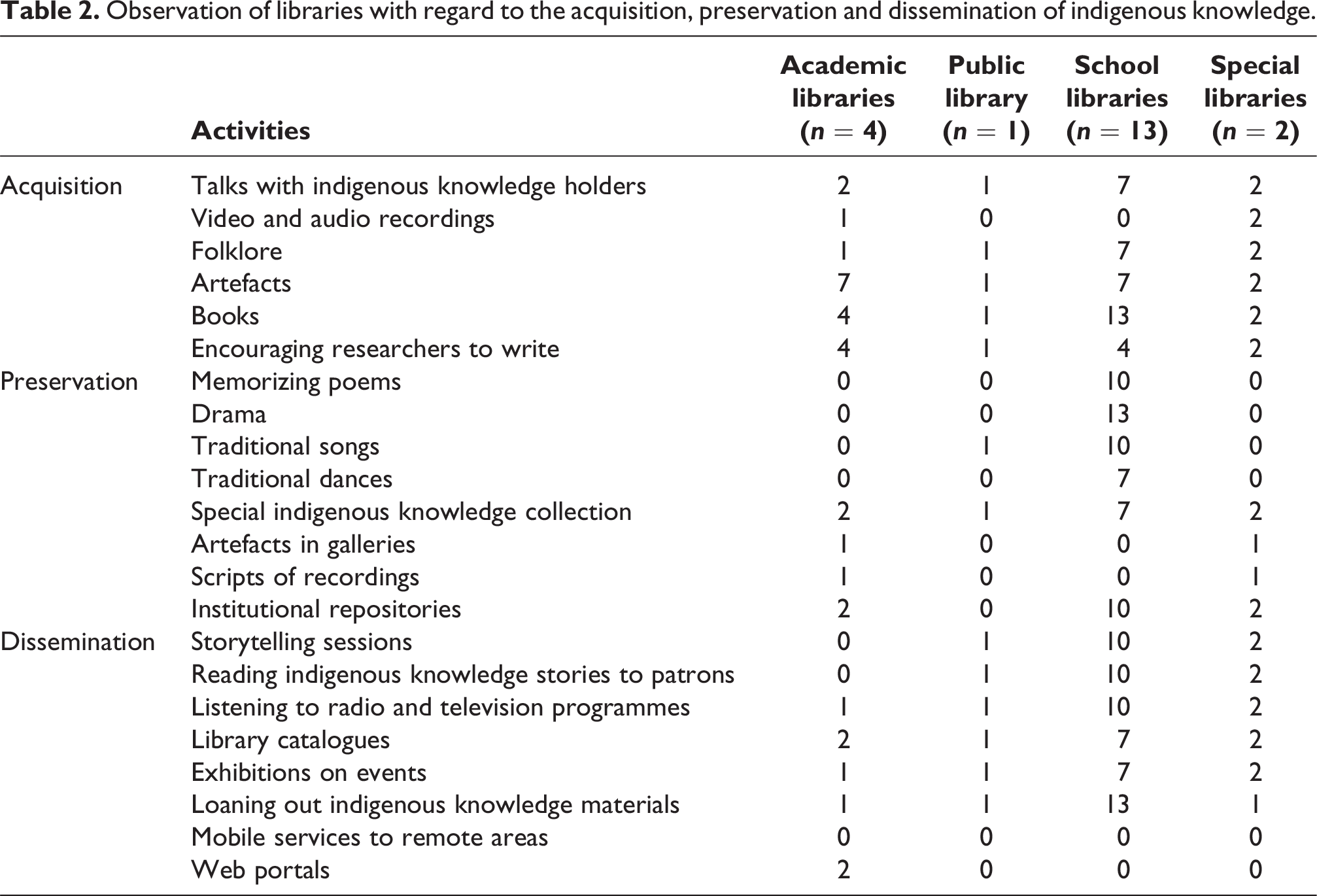
The results of the observation are shown in Table 2.
Observation of libraries with regard to the acquisition, preservation and dissemination of indigenous knowledge.
Format of indigenous knowledge in the digital era
It was noted that all the libraries were involved in the acquisition, preservation and dissemination of indigenous knowledge. The indigenous knowledge collections in these libraries were in both electronic and print formats. They were regarded as other library materials when processing them. Cultural protocols were taken into consideration during the acquisition process, and the librarians only acquired what indigenous peoples were willing to share with them. The findings reveal that school and public libraries were preserving indigenous knowledge in the form of poetry, folklore, traditional dance and drama; special libraries exhibited artefacts and demonstrated and recorded traditional dances and music; and academic libraries documented and preserved indigenous knowledge in special collections. This is in line with the studies by Abera (2021), Dare (2022), Marsden et al. (2010), Masenya (2022), Reitmaier et al. (2012) and UNESCO (2021a), which indicate that libraries are preserving and disseminating indigenous knowledge in the digital era. The special and academic libraries participated in audio and video recordings, where they visited indigenous knowledge holders after getting permission from the village headmen or chiefs to acquire the indigenous knowledge in line with the CARE principles. In academic libraries, those institutions that offered indigenous knowledge as part of the curriculum worked with researchers to acquire indigenous knowledge, which was then used as sources of information. The indigenous collections were in the form of scripts of the recordings made by researchers, and these librarians worked with other libraries to ensure that their researchers could access the indigenous knowledge materials needed.
In some cases, indigenous knowledge was acquired through purchases or donations in both print and electronic formats. The indigenous knowledge collections in all the libraries included poetry, proverbs, novels, artefacts, idioms and folklore, and the academic libraries subscribed to electronic resources on indigenous knowledge. This supports the sentiments of Afful-Arthur et al. (2022), who indicate that academic libraries make indigenous knowledge accessible for national development. A librarian from the school library supported what was observed in terms of how indigenous knowledge was being acquired and disseminated by stating: We invite elders to come and do storytelling sessions and folklore as a way of teaching the learners about indigenous knowledge within the community, and transfer the knowledge to the young ones so that they can teach the coming generations. Sometimes, during library time, we play recorded radio sessions that were done by the elders to showcase their indigenous knowledge.
Role of libraries
The findings of the study reveal that the role of libraries in the acquisition of indigenous knowledge involved holding talks with experts and elders, video and audio recordings, folklore, artefacts and books, and encouraging researchers to write about indigenous knowledge within their communities. This is supported by Balogun (2023b), Boamah and Liew (2017), and Mdhluli et al. (2021), who state that libraries collaborate with indigenous knowledge holders to preserve indigenous materials that are culturally significant. It was noted that libraries that acquired indigenous knowledge were involved in its preservation, where the librarians ensured that the collection was safe, just like any other collection in the library. One of the school librarians pointed out: ‘We encourage learners to memorize poems, dramas, and traditional songs as a way of preserving indigenous knowledge’ – and this was in line with what was observed during the study.
A librarian from a special library indicated that they had a special collection for indigenous materials that was easily accessible, and artefacts were preserved in the gallery where people could view them and learn about the indigenous knowledge within the community. This is in line with Nilson and Thorell’s (2018) study, which points out that indigenous knowledge special collections were maintained in libraries. The findings reveal that indigenous knowledge in school libraries was preserved through memorizing poems, performing dramas on the traditions of the community, singing traditional songs, doing traditional dances and having a special collection of indigenous materials for learning purposes. The academic libraries had repositories and digital collections on indigenous knowledge, scripts of recordings done by researchers and special collections on indigenous knowledge, and they used digital libraries (see also Balogun and Kalusopa, 2021; Masenya and Ngulube, 2021).
It was found that the school and public libraries conducted storytelling sessions by inviting indigenous knowledge holders from the community to share folklore and stories as a way of disseminating their knowledge. Indigenous knowledge was also shared in class, where indigenous stories were read and, in some instances, learners were sent to the library to read ngano (fairy tales) and then come back to recite the stories in class and point out the lessons learned. Indigenous knowledge in school libraries was also disseminated using live radio and television sessions. Supporting what was observed during the study, one school librarian commented: ‘We invite learners to listen to live radio sessions and watch television sessions when indigenous communities are performing as a way of educating the learners and passing on the indigenous knowledge to the next generation during this digital era’. It was noted that libraries also disseminated indigenous knowledge materials by organizing the information sources and making them accessible via online public access catalogues. These catalogues guide users when they are looking for sources of material on indigenous knowledge. This is supported by the research of Balogun and Kalusopa (2022), Mdhluli et al. (2021) and Mhlongo (2020), which notes that libraries were utilizing information technology to enhance the dissemination of indigenous knowledge. Special libraries facilitated exhibitions and displays of indigenous materials, and held live events that were recorded with the consent of the indigenous communities and those who were performing the shows, such as traditional dances, poems and traditional music. Therefore, the dissemination of indigenous knowledge in the digital era was done through storytelling sessions that were recorded, reading indigenous knowledge stories, listening to radio and television indigenous knowledge sessions, exhibitions at events, and library catalogues and websites. However, none of the libraries were working on advocacy towards the repatriation of indigenous collections to their own communities, contrary to what is pointed out by Anderson and Christen (2013), Bell et al. (2013) and Christen (2011).
Implementation of the FAIR and CARE principles
The findings reveal that all of the librarians were implementing the FAIR principles by ensuring that the indigenous knowledge collections they had in their libraries were accessible and findable through the classification and cataloguing processes that were undertaken after the acquisition process (see also Balogun, 2023a; Farnel, 2020; Montenegro, 2019; Nakata et al., 2005). In the academic and special libraries, indigenous knowledge materials were findable via catalogues and accessible through institutional repositories and web portals. In the school libraries, they concentrated more on preservation, where they encouraged learners to memorize indigenous knowledge practices and participate in traditional dances and music. The librarians stated that their main aim was to ensure that indigenous knowledge was accessible to learners and other researchers who were interested in the subject, which confirms the FAIR principles as pointed out by Carroll et al. (2021).
It was noted that the librarians who were involved in the acquisition of indigenous knowledge were collaborating closely with indigenous communities to ensure that indigenous knowledge was managed in a way that respected cultural sensitivity, preserved heritage and supported community aspirations (see Carroll et al., 2020; Global Indigenous Data Alliance, 2023; Research Data Alliance, 2019). The librarians were balancing technological advancements, ethical considerations and community engagement to ensure that the use of their indigenous collections was in line with ethical standards and guidelines (see Chigwada and Ngulube, 2023; Mdhluli et al., 2021; Mhlongo, 2020). They were working on providing guidance and expertise for the ethical preservation and sharing of indigenous knowledge in the digital era, taking into consideration the FAIR and CARE principles.
Challenges faced by libraries
The findings show that the libraries had been facing various challenges in the acquisition, preservation and dissemination of indigenous knowledge in the digital era. The major challenges faced by all the libraries included the issue of technology, which is ever changing, and the lack of resources needed to implement successful indigenous knowledge projects. As one of the academic librarians pointed out: because of technological obsolescence, it is difficult to manage indigenous knowledge collections, and this has affected the accessibility of some of the recorded sessions. However, efforts are always made to ensure that the content is migrated to new sources when there is an upgrade in hardware or software.
During the acquisition process, the librarians indicated that they faced resistance from some indigenous knowledge holders, who were not willing to share their indigenous knowledge, especially if they knew that it was being recorded. One academic librarian indicated: The knowledge holders were afraid of the abuse of their indigenous knowledge as well as losing their intellectual property rights during the acquisition process. As a result, we started by building trust with the indigenous communities and seeking their consent, especially when the recording was involved.
It can be noted that the library and information professionals were well versed in the ways of acquiring, preserving and disseminating indigenous knowledge in the digital era (see also Afful-Arthur et al., 2022; Mdhluli et al., 2021). The librarians showed that they had the capacity to engage with knowledge holders who were willing to make their indigenous knowledge accessible. However, it was noted that the biggest challenge hampering indigenous knowledge management in libraries was the unavailability of the resources that were needed to make this knowledge available. This is in line with the studies by Chiwanza et al. (2013), Lwoga et al. (2011), McCarter et al. (2014), Mdhluli et al. (2021), Msuya (2007), Okorafor (2010), Owiny et al. (2014) and Sithole (2007). It was also noted that there is a need to deal with intellectual property rights issues when working with indigenous knowledge in the digital era. If libraries have indigenous knowledge repositories, indigenous communities should be actively involved in the management of these repositories as a way of encouraging ownership among the knowledge holders. Therefore, the CARE principles are more applicable to the preservation of indigenous knowledge, and it is difficult to make use of the FAIR principles in their entirety since some indigenous communities are not willing to share their indigenous knowledge. However, the libraries that were part of this study were utilizing both sets of principles since they provided access to all the indigenous collections in their holdings. The reusability component of the principles was the only drawback, since the indigenous objects were unique to the indigenous communities.
Limitations of the study
This study documented the role of librarians in Zimbabwe, and it might be difficult to generalize the results to incorporate what is happening in other countries. Their roles might be country-specific, and it is therefore important to carry out other studies to document how libraries in other countries are contributing to the acquisition, preservation and dissemination of indigenous knowledge in the digital era.
Conclusion and recommendations
In conclusion, it can be noted that librarians play a critical role in the acquisition, preservation and dissemination of indigenous knowledge in the digital era through various formats and activities. Indigenous knowledge is being preserved in different formats, which mostly suit the location of the library and the resources available. The digital landscape has revolutionized the methods of knowledge preservation and dissemination, presenting both challenges and opportunities for safeguarding the cultural heritage of indigenous communities. Therefore, librarians act as bridge-builders between traditional knowledge systems and the digital world. Their collaboration with indigenous communities has been instrumental in understanding cultural protocols and the aspirations of knowledge holders. The FAIR and CARE principles are being adhered to by librarians who acquire, preserve and disseminate indigenous knowledge. However, in undertaking this process, librarians face technological challenges, which are ever changing, and they have to ensure that the digitized content is always accessible.
The authors recommend the need for collaboration between librarians and indigenous communities so that librarians work closely with knowledge holders from the start. Collaborative partnerships ensure that the process is inclusive and respectful, and that the knowledge is shared with the community’s consent and ownership. Librarians should also adhere to ethical guidelines, such as those provided by IFLA (2010) and the FAIR and CARE principles of indigenous data governance. This involves respecting the intellectual property rights of indigenous knowledge holders and ensuring that access to sensitive knowledge is controlled appropriately. Libraries should be actively involved in the digital preservation of indigenous knowledge through the capture of audio and video recordings, and the utilization of appropriate metadata standards for organization and discovery. However, librarians cannot do this alone; there is a need for a coordinated approach at the national level to include all stakeholders in indigenous knowledge management. Libraries should invest in capacity building for indigenous communities to enable them to manage their digital knowledge repositories effectively and sustainably. If libraries are providing access to indigenous knowledge, they must be sensitive to cultural protocols and restrictions on certain knowledge. Implementing access controls and community-specific guidelines can help protect sacred and restricted knowledge. Libraries should also collaborate with researchers, anthropologists and other experts to ensure the accurate representation and contextualization of indigenous knowledge in the digital era. Moreover, library schools should teach how technologies can be used to acquire, preserve and disseminate indigenous knowledge as a way of educating the librarians who will be responsible for indigenous knowledge management. Librarians should also work with the relevant ministry on the development and maintenance of a database that documents indigenous knowledge in Zimbabwe. The resuscitation revival of the Zimbabwe Resource Centre for Indigenous Knowledge or the establishment of a new organization to assist in the management of indigenous knowledge in Zimbabwe would be instrumental in the acquisition, preservation and dissemination of indigenous knowledge in the digital era.
Footnotes
Declaration of conflicting interests
The authors declared no potential conflicts of interest with respect to the research, authorship and/or publication of this article.
Funding
The authors received no financial support for the research, authorship and/or publication of this article.
