




Abstract
This exploratory case study delves into the views and perspectives of 17 US library experts involved in 21st-century library diplomacy practices. Using the template analysis, four main themes of library diplomacy are identified: (1) the actors showed implicit and explicit roles in diplomatic involvement; (2) the main objective of library diplomacy was to facilitate knowledge dialogue; (3) the strategies aimed to foster cultural humility; and (4) the actors viewed digitalization as a significant instrument in international library work. This research offers significant insights into the less explored topic of library diplomacy, particularly when 21st-century libraries are challenged concerning global issues relating to freedom of information; the values of equity, diversity, inclusion and accessibility; and sustainability efforts. Library diplomacy is more critical than ever to be at the forefront of establishing dialogue around the world. The study encourages further investigation of library diplomacy practices in a variety of geographical and international contexts.
Keywords
Introduction
Library diplomacy, though not a new concept, has witnessed growing interest and discussion among scholars studying the role of soft power and cultural diplomacy in the field of library and information science (LIS; Bell and Kennan, 2022; Mariano, 2022; Mariano and Vårheim, 2021). Library diplomacy is characterized by the role of library actors at individual, institutional, national and international levels in establishing international relations, influencing global policy decisions, and bridging understanding between and among various institutions and countries. This can be achieved by leveraging library resources and programmes as soft-power assets, cultural diplomacy instruments or cross-cultural mediators to bring together and connect diverse actors, institutions and communities in the international arena. Soft-power diplomacy is one of the mainstream diplomatic strategies of state and non-state actors in the 21st century. It shapes preferences and influences the international community by attracting the global public through culture, values and ideals, utilizing galleries, libraries, archives and museums (Bell, 2022; Mariano, 2021, 2022; Nye, 2004, 2021). In the USA, libraries have traditionally been used as instruments for government and non-governmental institutions to build relations and influence foreign public opinion (Barnhisel and Turner, 2010; Chambers, 2016; Laugesen, 2019; Snow and Cull, 2020; Witt, 2014b). Libraries have served as tools for furthering US foreign policies and disseminating American culture and liberal values such as peace and democratic ideals, particularly during the Second World War and Cold War periods, using resources such as reading rooms, books, magazines and cultural programmes (Becker, 2004; Cull, 2008; Laugesen, 2010; Maack, 2001; Prieto, 2013; Richards, 2001; Robbins, 2007). American librarians and professional library associations also spearheaded 20th-century library modernization initiatives (Laugesen, 2019; Richards, 2001) and established international library standards, international partnerships and networks to help improve libraries worldwide (Kraske, 1985; Lee and Bolt, 2016; Lor, 2019; Mattson and Hickok, 2018; Munson and Thompson, 2018; Witt, 2014a).
The early 21st century presents escalating global challenges like information warfare and related issues of disinformation (Jankowicz, 2020; Stengel, 2019), computational and digital propaganda (Oxford Internet Institute, 2023), and the influx of post-truth narratives and alternative facts, such as the COVID-19 infodemic crises (Walker, 2021). These information challenges pose significant disruptions to local and global public views of knowledge, information and factual realities in the digital sphere (Bjola et al., 2019; Manor, 2019). Science cooperation, the scientific diaspora and science diplomacy strategies are also facing challenges in fostering scientific knowledge in the 21st century. These global challenges stem from economic trade wars, disputes over intellectual property rights and threats to information security (Prieto and Scott, 2022; The Royal Society, 2010). These issues are not only confined to the USA, but are also prevalent worldwide, particularly given the significant involvement of other global and regional powers such as China and Russia (Blank, 2022; Vuletić and Stanojević, 2022).
Similarly, US libraries and the American Library Association’s core values of librarianship have also been challenged by recent incidents, 1 such as the banning of books and information censorship in US school libraries, coupled with the spread of disinformation, misinformation and mal-information within US digital communities (Harris and Alter, 2022). In response, the American Library Association (2023) has taken strategic actions by releasing practical resources, tool kits and data addressing the COVID-19 pandemic crisis, tools for combatting fake news and post-truth narratives, resources related to artificial intelligence, and guidelines for handling the censorship of library resources. US libraries and the library profession are not siloed from these international challenges, underlining the importance of library diplomacy today more than ever. In library diplomacy, it is crucial for libraries to create a strong presence in international policies, facilitate dialogue and devise solutions to these global challenges.
This study on the present understanding of library diplomacy and its connection to international and global engagement calls for an empirical analysis to examine the roles various actors play, including their goals, strategies and instruments, in the international sphere. The article aims to identify the key characteristics of library diplomacy practices in the USA and investigate how US library experts from government and non-governmental institutions engage and shape library diplomacy. The research also aims to develop the library diplomacy concept for further exploration.
The following research questions are addressed: How is library diplomacy being practised and used in the USA in the early 21st century? How do the actors’ practices from both government and non-governmental institutions shape the roles, goals, strategies and instruments of library diplomacy and international engagement? What are the key and emerging characteristics of US library diplomacy practices?
Libraries and diplomacy
Libraries and international relations have been comprehensively studied in the fields of LIS and political science. Libraries have been linked to concepts and theories of library internationalism (Laugesen, 2019: 167; Lor, 2019: 58), cultural internationalism (Lor, 2019: 526; Witt, 2014a: 506, 2014b: 276), cultural diplomacy and foreign cultural relations (Cummings, 2003: 1, 3; Melissen, 2005: 21–22), public diplomacy (Cull, 2008: 9, 11; Maack, 2001: 59), soft power (Bell, 2022: 1458; Bell and Kennan, 2022: 707), the internationalization of LIS education, and the discourses around international librarianship and international partnerships (Carroll et al., 2001; Lee and Bolt, 2016; Lor, 2008, 2019; Mattson and Hickok, 2018). Most of the research data and researchers’ interests have mainly focused on the US context in the 20th century, with a qualitative focus on historical and textual studies, and few quantitative and theoretical studies (Mariano and Vårheim, 2021: 657).
During the 20th century, the US government developed various diplomatic initiatives and foreign policies concerning the dissemination of US libraries, and information programmes for the sole purpose of shaping foreign public opinion towards the USA. These key US foreign policies were the Creel Committee of 1917–1919; the Office of the Coordinator of Inter-American Affairs in 1940; the Office of War Information in 1942; the Smith–Mundt Act of 1948; the United States Information Agency in 1953; and the Fulbright–Hays Act of 1961 (Cull, 2008; Elder, 1967; Maack, 2001; Melissen, 2005; Richards, 2001). The USA’s foreign policy goals were focused on fostering relationships by promoting liberal values and ideals like peace and democracy through different forms of media such as books, pamphlets, newspapers, films and radio broadcasting, and through reading and information programmes (Dalton, 2007; Laugesen, 2010; Maack, 2001; Makinen, 2001; Mokia, 1995; Morinaka, 2019; Prieto, 2013; Richards, 2001), cultural and aid programmes supporting English-language learning, and educational and facilitating library exchange activities (Glant, 2016; Guth, 2008; Richards, 2001; Robbins, 2007).
US non-governmental institutions like the Carnegie Endowment for International Peace and the American Library Association have similarly played significant roles in establishing book programmes and collections aimed at fostering global understanding through peace and cultural initiatives (Witt, 2014b). American representatives to UNESCO and individual library advocates championed the American model of librarianship, contributing to the world’s library modernization initiatives, such as bibliographic programmes and interlibrary loan activities to improve education globally (Kraske, 1985; Laugesen, 2019; (Price, 1982). The American Library Association’s American Library in Paris initiative – École des bibliothécaires – is one of the few examples of how the USA has influenced international LIS curricula (The American Library in Paris, 2020; Carroll et al., 2001; Chapuis, 2021; Maack, 2007; Witt, 2014a).
Most of the 20th-century literature describing the library diplomacy efforts of government and non-governmental actors has contributed to a one-way cultural relationship and monocultural influence towards other countries to shape foreign public opinion in favour of US national interests. These efforts were often associated with issues such as the Cold War information warfare, cultural propaganda and cultural imperialism (Chambers, 2016; Guth, 2008; Laugesen, 2010, 2019; Maack, 2001; Prieto, 2013; Richards, 2001; Witt, 2014b).
The end of the 20th century marked a significant change in US library diplomacy. The United States Information Agency was abolished and incorporated into the US Department of State through the Foreign Affairs Reform and Reconstructing Act of 1998. The decline in the US government’s support for cultural diplomacy programmes triggered a decrease in, and the closure of, most US libraries, reading rooms and cultural centres overseas. Only a few surviving libraries were rebranded as Information Resource Centers, located within US embassies and consulates. The rebranded centres replaced books with computers and prioritized digital resources such as e-books, e-journals and other virtual tools in a bid to join the Internet revolution that marks the information age of public diplomacy (Cain, 2010; Cull, 2012; Melissen, 2005; Simmons, 2005).
Libraries, knowledge and information continue to shape global communities and influence international discourses. However, the identities of the emerging actors and their goals, strategies and instruments in library diplomacy remain underexplored. In fact, library diplomacy has been less researched by LIS scholars interested in international and global librarianship than its other cultural institution counterparts, such as museum diplomacy and heritage diplomacy, particularly over the last decade (Mariano and Vårheim, 2021). Moreover, fields related to library diplomacy – including data diplomacy (Boyd et al., 2019), knowledge diplomacy (Knight, 2023), digital diplomacy (Bjola et al., 2019; Manor, 2019), and the theoretical dimensions and variations of international library partnerships – have also been understudied. These areas of research interest point to the need for further investigations to deepen understanding of the concept and practice of library diplomacy, particularly in the 21st century (Mariano, 2022; Mariano and Vårheim, 2021).
Methodology
This research utilized an exploratory case study as a qualitative research method to delve deeper into the practices of library experts from government and non-governmental institutions in the USA, specifically focusing on the concept of library diplomacy in the early 21st century. Yin (2018: 15) defines a case study as an ‘empirical inquiry to investigate a particular contemporary phenomenon within its real-life context’, specifically when the phenomenon and its context, including their interconnections, remain underexplored. Exploratory case studies commonly pose ‘how’ and ‘what’ questions to examine evidence derived from documents, observations and interviews. This type of case study can be melded together with different analytical research methods, including template and thematic analysis, and theoretical frameworks, such as practice theory, to capture a systematic and in-depth understanding of the phenomenon (Braun and Clarke, 2022; King and Brooks, 2017; Ritchie et al., 2013; Yin, 2018).
Practice theory, which is related to the constructivist theoretical approach, is a social theory emphasizing the fundamental role of ideas, norms and identities in shaping the social world (Wendt, 1992). Practice theory, in the field of international relations and diplomacy, highlights the importance of practices, norms and patterns in attributing meaning to practitioners’ actions (Adler and Pouliot, 2011). Pouliot and Cornut (2015) further describe that practice theory is used by international relations scholars as a theory–method package to empirically interpret practitioners’ actions within their social contexts. Several studies that have incorporated practice theory have used ‘how’ questions to illuminate practices and issues through the lens of the actors involved (Pouliot and Cornut, 2015: 305).
Procedure
This research employed interviews as the primary source of empirical data in order to gain an in-depth understanding of the actors’ involvement in library diplomacy and international library work in the early 21st century. The interview data was used to identify socially recognizable patterns in the real-world experiences of the library diplomacy experts (Pouliot and Cornut, 2015). The expert interviews were conducted with the aim of triangulating and cross-validating associated systematic reviews, theoretical papers and conceptual perspectives published on the concept of library diplomacy.
The individual semi-structured interviews were conducted online from 4 April 2022 to 2 March 2023. Initially, the research had scheduled in-person interviews with experts in the USA. However, due to the COVID-19 pandemic, the interviewees opted for online interviews. Given the logistical challenges and travel restrictions between the USA and Europe, the researcher obtained approval from the UiT The Arctic University of Norway's ethics committee and the Norwegian Centre for Research Data to conduct all of the interviews online. This was facilitated through the university’s approved software application (its Zoom account) and secure research data storage (its SharePoint account). The interview protocol and guide, which were used flexibly, covered the following topics: Understanding of and involvement in library diplomacy, international partnerships and international library engagement activities; Insights into and familiarity with current library practices concerning diplomacy and internationalization; Views on the concept of library diplomacy and its utilization in international library work and advocacy.
The study employed snowball or chain sampling, a form of purposive sampling, to gather rich and relevant data to address the research questions. This method involved identifying and recruiting expert interviewees in the field of international librarianship in the USA through a chain of referrals, starting with invited experts who met clear criteria and objectives (Ritchie et al., 2013). The initial pool of invited interviewees included 12 librarians and library advocates in the USA. They were selected based on their expertise and backgrounds with libraries in the context of diplomacy, international relations, international partnerships and global engagement. These experts were affiliated with government and non-governmental institutions in the USA. However, only eight confirmed their participation. Following the expert interview protocol, which allowed for the recommendation of additional experts in the field of study, five out of the initial eight interviewees identified 11 more experts for potential recruitment. Out of these 11, only nine confirmed their participation. The study comprises a total of 17 in-depth semi-structured interviews. In the transcription phase, the interviewees were assigned pseudonyms corresponding to the first names of US presidents to ensure anonymity.
Analysis
In order to thoroughly understand US library diplomacy practices, this study employed Adler and Pouliot’s (2011) practice theory and incorporated a thematic framework derived from the recent systematic review by Mariano and Vårheim (2021). The framework outlines the four a priori themes utilized for this study:
Actors: the individuals, organizations or countries involved in communication and interaction with domestic and foreign publics, and playing an important role in shaping international activities and policies;
Goals: the motives, objectives and causal ideas that drive actors to advance international understanding and dialogue;
Strategies: the mechanisms and methods – such as dialogue, exchanges and negotiations – employed to achieve international policy objectives;
Instruments: various programmes and activities – ranging from exchange programmes to digital campaigns – used to accomplish goals and implement strategies.
All of the data was transcribed, coded and analysed using ‘template analysis’ – a form of thematic analysis employed in qualitative research. The template analysis, coupled with a broad thematic analysis technique, utilized hierarchical coding to identify patterns and themes within the textual data. This analysis method was chosen and integrated due to its openness and flexibility, allowing adjustments at each coding stage to capture and compare codebook templates, and subsequent clustering into meaningful themes. This research highlights the use of template analysis for its systematic and structured approach to developing codebook templates, in contrast to broad thematic analysis, which exhibits less structural rigor (Braun and Clarke, 2022; Brooks et al., 2015; King and Brooks, 2017).
The key themes identified through the a priori themes were (1) actors, (2) goals, (3) strategies and (4) instruments. The empirical data was classified and clustered into various levels of themes, subthemes and in-vivo codes. The template analysis was executed in three stages of codebook templates to systematically capture the patterns and meanings using NVivo Mac version 1.7.1 (Nvivo version 1.7.1 Qualitative data analysis software, 2020). The first template was then compared with the second, and the second with the third, which produced the final template that identified key significant themes. As the principal investigator, the researcher solicited the aid of his supervisor to validate and critically review the codebook templates, thereby ensuring that the thematic structure accurately reflected the empirical data.
Findings
This section organizes the results of the expert interviews into four main sections based on the a priori themes: (1) actors, (2) goals, (3) strategies and (4) instruments. Within these a priori themes, several subthemes and four major themes emerged, which are described and substantiated with selected quotes from the data collected. From the 23 library experts invited to participate in the study, with specializations in international librarianship, international partnerships, diplomacy and global engagement within the US context, 17 contributed, offering valuable insights on the present scenario of library diplomacy. These experts were affiliated with diverse sectors, such as the federal and state governments, professional organizations, academic and research institutes, non-profit organizations, the corporate sector and public–private agencies, revealing their engagement at the individual, institutional, national and international levels. These experts reported interaction with a wide array of library users and collaborators, from college students, young professionals, librarians, entrepreneurs and diplomats to refugees, indigenous peoples and diaspora communities.
Actors
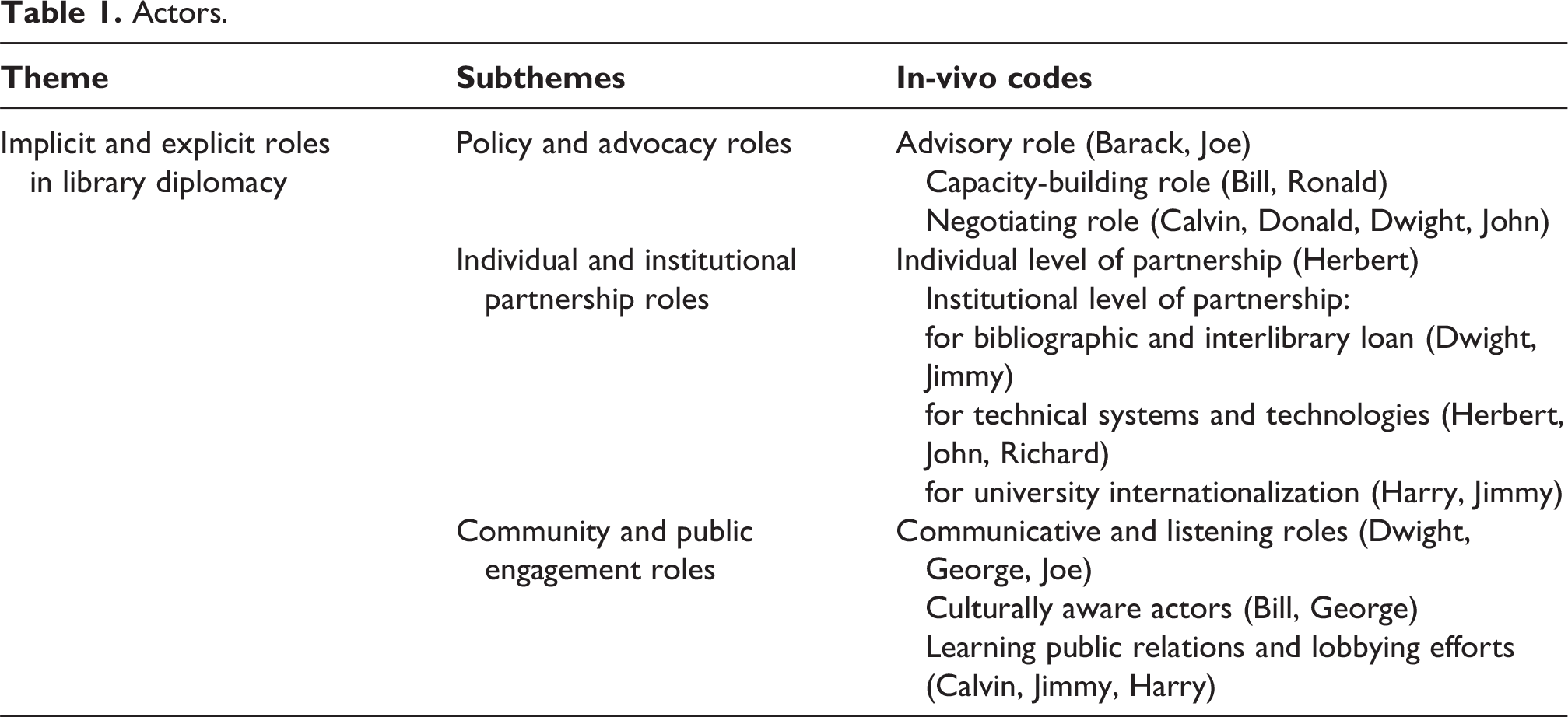
This section explores the various roles of individual, organizational and nation-state actors – namely, policy and advocacy roles, individual and institutional partnership roles, and community and public engagement roles (see Table 1).
Actors.
Policy and advocacy roles
This subtheme draws attention to the engagement of librarians, institutions and countries in international issues and processes shaping global policies. The interviewees emphasized their roles as policy consultants and advocates, with actors from government, academic and non-governmental institutions contributing to US foreign policies and international policy initiatives. Federal employees like Barack and Joe, who worked at American Spaces, described their advisory and consultant roles in implementing US foreign policies in library diplomacy programmes suited to their host countries or institutions.
2
These American Spaces, formerly known as the United States Information Agency, Information Resource Centers and American Corners, are currently the cultural diplomacy extension of the Department of State, with over 600 libraries established worldwide. Bill and Ronald underscored their capacity-building roles in empowering libraries to thrive in the changing information environment. Ronald pointed out the significance of fostering capacity development to have a level playing field, where everyone can contribute and work together for better libraries. Similar to capacity-building roles, Calvin articulated the view that ‘librarians who work as a diplomat are deeply connected to their communities’. They listen and build relationships, ensuring they have a supportive library network that is ready to empower and advocate when challenges arise. Non-governmental actors (e.g. academic librarians and professional library association leaders) underlined their instrumental role in addressing global issues relevant to libraries, such as technological changes, copyright issues and freedom of information. John recalled his policy negotiation experience, creating dialogue and lobbying efforts around copyright policies at the World Intellectual Property Organization as an American Library Association delegate. Similar sentiments were expressed by Donald and Dwight with regard to librarians playing a proactive role in driving policy action forward in local, national and international arenas: I think librarians can be diplomats. And then they can also help influence policy…I think that is a really important activity that librarians participate in [to] help drive how policy is formed at the local level, at the state level, and then at the national level. (Donald)
Individual and institutional partnership roles
This subtheme examines the various actors engaged in partnerships and cooperation at an individual and an institutional level. The interviewees described partnerships that typically occur around international library projects, such as the international standardization of bibliographic access and documentation, interlibrary loan partnerships, and library exchange programmes between countries and institutions. Herbert reflected on his experience contributing to an institutional library partnership through librarian-to-librarian engagement. He pointed out that individual efforts to connect and meet international librarians at meetings, conferences and network gatherings can lead to international collaboration. He also highlighted the importance of respecting cultural norms, standards and values when entering into foreign partnerships. Jimmy discussed the role of libraries in institutional partnerships at universities, public libraries and professional associations aimed at improving user and technical services, such as bibliographic and interlibrary loan cooperation: [The] library diplomacy of my employer, the place where I work, whether it’s the city that I work in and its public library, or the university I went to work at in its academic library, there’s an interest in building relationships with counterparts around the world. And I’ve had experience working with a number of projects and programmes that have embraced institutional relationships so there’s interlibrary loan.
Community and public engagement roles
This subtheme underscores the actors’ roles in community engagement, focusing on understanding audience needs. Public outreach and communication were seen to be key competencies among the librarians in both government and academic institutions. Government employees like Joe stressed the importance of their diplomacy and international communication backgrounds in engaging international communities with public outreach programmes. Academic librarians like Dwight highlighted their outreach skills, learned from their LIS education background, in offering their expertise to support the international needs of their community. Both Dwight and George underscored diplomatic listening skills for trust-building, and Dwight suggested that active listening and outreach skills enable librarians to extend their expertise to non-library collaborators, benefitting the institution they serve. Bill described the role of international library programmes in fostering shared cultural awareness, essential to understanding global societal concerns – for example, library programmes that promote the shared remembrance of genocide and collective memory initiatives to keep human rights alive. Bill and George described that by fostering cultural awareness, libraries facilitate knowledge exchange within library spaces, ensuring that library resources reach and empower the community: The goal of any library is very similar to the goal of public diplomacy – to create that connection with communities, that space for knowledge sharing for cultural awareness growing. So, informational, educational, cultural, it all is co-located into these spaces, whether they’re virtual spaces or physical spaces. (Bill)
Goals
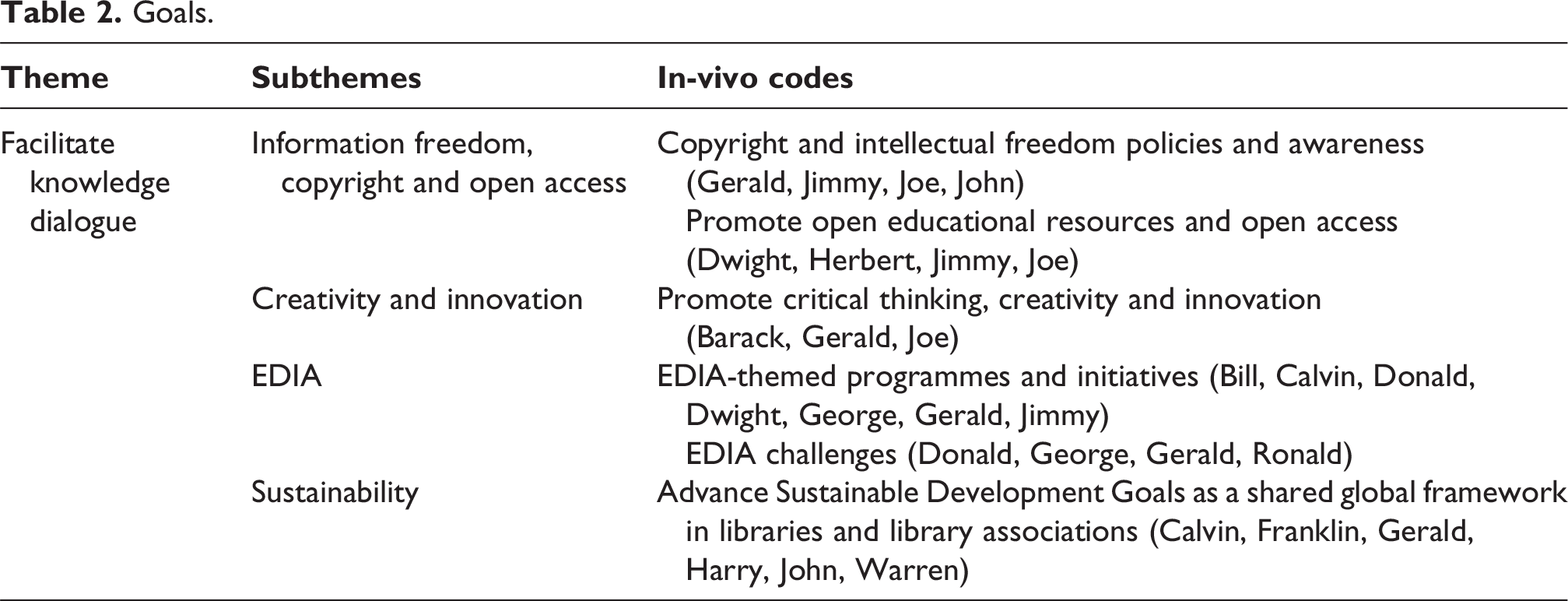
Library diplomacy involves the development of international objectives and motivations to foster understanding and build relationships. The interviewees emphasized four key subthemes to describe their library diplomacy objectives: information freedom, copyright and open access; creativity and innovation; equity, diversity, inclusion and accessibility (EDIA); and sustainability (see Table 2).
Goals.
Information freedom, copyright and open access
This subset of themes encompasses promoting policies related to information freedom, copyright, open-access initiatives, and the development of knowledge skills such as information literacy, creativity and critical thinking. Joe, Jimmy, Gerald and John highlighted library diplomacy’s role in international discussions surrounding the topic of copyright laws and intellectual freedom to safeguard both the interests of library users and the rights of knowledge creators. They underscored the librarian’s responsibility in navigating varying local copyright frameworks, striving to balance intellectual access and copyright compliance. Librarians are at the forefront of negotiating the library’s core information values to achieve mutual benefits for the library community: ‘Libraries need to be in those [international conference] discussions. They can’t just be discussing library to library. They need to be at the United Nations. They need to be at the World Intellectual Property’ (John).
Jimmy raised the importance of popularizing open-access initiatives within universities and research institutes. He emphasized the crucial role libraries play in managing and advocating for open educational resources and open-data research projects at the international level. Non-profit organizations such as the Scholarly Publishing and Academic Resources Coalition, an alliance advocating for open and equitable access to information, are actively working to dismantle academic siloes and connect library infrastructures in open knowledge creation and scholarship. Joe, Jimmy, Herbert and Dwight highlighted challenges to information access in the USA and abroad, pointing out instances of book banning in a few US schools and Internet-filtering incidents in several countries where American Spaces are hosted. Dwight noted that libraries and their core values are being challenged, particularly in upholding freedom of expression and democratic ideals: I think our core values have not changed. But in some ways, they are challenged. And one good example is all the things that are going on with book banning. And some of these are international information that people don’t necessarily want shared. I think information sharing, valid information, has always been one of our values. We stand firm on that value.
Creativity and innovation
This subtheme describes the motivation to advance creativity and innovation in libraries. Government library experts like Joe and Barack expressed libraries’ goals of enhancing critical thinking and innovation among their users through exchanges and capacity development. They also highlighted libraries’ strategic shift towards prioritizing STEM (science, technology, engineering, mathematics) literacies, entrepreneurial skills and hands-on learning to empower the communities they serve. These science, innovation and entrepreneurship initiatives are supported to foster knowledge creation and sharing by using libraries for diplomatic engagement. Gerald also noted that diplomacy enables libraries to be engaged in global library solutions: We facilitate librarians to identify a particular challenge, especially in knowing the other, you know, because we tend not to trust people who are different [from] the other. And so this particular process allowed us to share particular issues, invite librarians to find solutions, implement them in the engineering approach, then you evaluate, and you modify and improve.
EDIA
A key aspect of this subtheme revolves around fostering international understanding and broadening the world view of communities through libraries. These values address efforts to build dialogue with international students and diaspora and multiethnic communities in US local libraries, and engage with diverse advocacy groups such as women, LGBTQ+ (lesbian, gay, bisexual, transgender, queer, other) communities, non-governmental institutions, academia, researchers and think-tank policymakers in US libraries abroad. Librarians act as interlocutors in bridging EDIA objectives and shaping community and governmental perceptions about EDIA. Donald expressed the Department of State’s focus on aligning foreign policies with White House EDIA-themed programmes. Gerald, George, Jimmy and Dwight highlighted the American Library Association’s efforts to infuse EDIA objectives into US libraries, encouraging dialogue around EDIA values. Gerald recommended viewing library diplomacy beyond nation-state-level interactions, instead focusing on connections between libraries and communities – for instance, indigenous-to-indigenous based dialogue or women’s advocacy groups across borders through international library programmes. Gerald argued that the historical legacies of US colonialism, which contrasts with EDIA objectives, present limitations for contemporary US diplomatic engagement. Donald, George, and Ronald observed the role of English as a second language programmes in US libraries, locally and internationally, in connecting diverse groups such as new immigrants, refugees, young professionals and international students. They acknowledged that language barriers still exist, but expressed confidence in overcoming these through collaboration with English as a second language teachers and interpreters. Ronald believed that English-language learning still served as a soft-power tool and was an attractive asset of American Spaces programmes abroad, mainly in attracting young professionals and international students to study and live in the USA, but also as a means for new immigrants and refugees to share their cultural and knowledge backgrounds and be integrated into American society. However, George emphasized that utilizing English for advocacy abroad presents an EDIA challenge, as not everyone speaks the language. This can hinder the building of relationships and trust in multicultural and multilingual communities: Language, of course, remains another challenge – making sure that we’ve got adequate resources for good conversations, right, whether that is interpreters or, you know, just that we were conscious of this. And I think that this is something that is going to be, you know, a challenge. That it’s hard for Americans sometimes, who don’t have a lot of experience outside of the States to remember that not everyone speaks English. (George)
Sustainability
This subtheme focuses on the United Nations’ Sustainable Development Goals and the objective of libraries to drive economically, socially and environmentally sustainable societies using knowledge and information. Gerald and Calvin described Information Action Briefs, which are workshops that are designed to underscore libraries’ pivotal role in achieving the Sustainable Development Goals. The American Library Association has also initiated a task force committee to advance the Sustainable Development Goals at the domestic level within the USA: ‘They have formed a library sustainability group as part of the American Library Association’ (Calvin).
Calvin and Franklin voiced that the 16 Sustainable Development Goals serve as a unifying global framework, enabling librarians to connect and work together internationally. The Sustainable Development Goals also position libraries’ potential power to address economic, cultural, environmental and social issues. However, John and Warren identified a disconnect between librarians and Sustainable Development Goal policymakers, expressing concern that libraries are not fully part of Sustainable Development Goal discussions. For instance, libraries’ role in development is not included in the 248 Global Framework indicators and targets. Calvin highlighted the need for a diplomatic effort from international library networks and advocates to ensure the involvement of librarians in Sustainable Development Goal conversations, recognizing that knowledge and information are as essential as human rights. Warren also saw the need for more Sustainable Development Goal supporters within international library networks who can actively pursue the Sustainable Development Goals and incorporate them into library policies and programmes.
Strategies
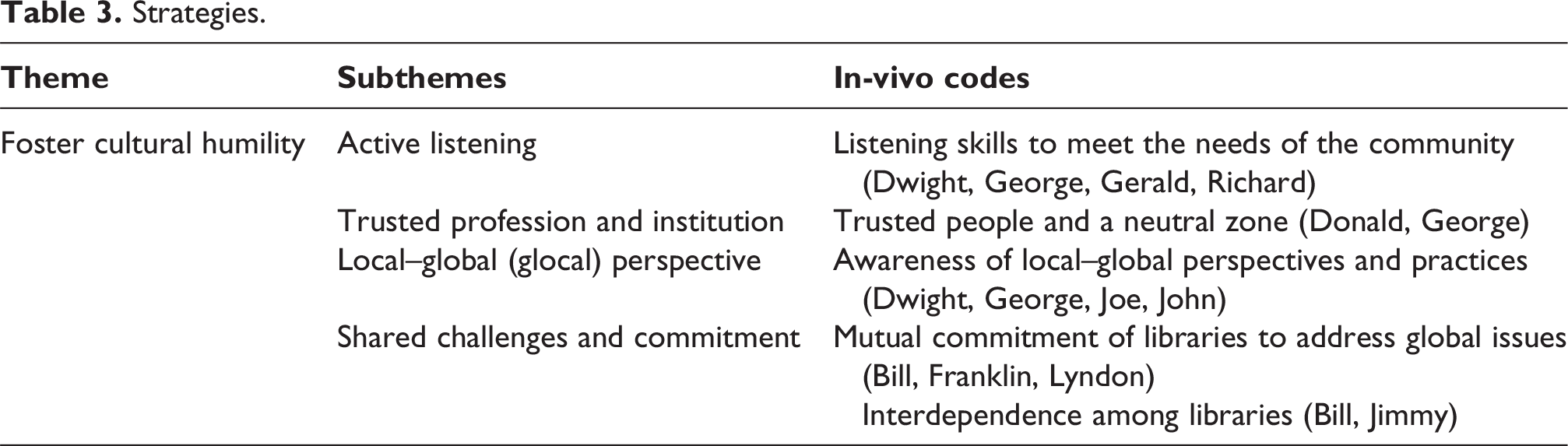
This section identifies international processes and strategies to fulfil international understanding, encompassing dialogue, exchanges and negotiation. Four subthemes emerged: active listening; trusted profession and institution; local–global (glocal) perspective; and shared challenges and commitment (see Table 3).
Strategies.
Active listening
This subtheme draws attention to the listening strategies employed by library actors to engage in mutual understanding and dialogue with diverse communities. Dwight’s, George’s, Gerald’s and Richard’s insights revealed the role of active listening in fostering a non-threatening learning environment that is conducive to partnership. George and Gerald contextualized listening strategies, highlighting the need to identify the audience’s information behaviour and needs – for instance, their information literacy levels and interaction in the digital world. Dwight and Richard stressed that listening is essential for cultivating self-awareness of one’s cultural identity, and they also noted that imposing one’s cultural beliefs, attitudes and biases on others creates an environment that hinders understanding and dialogue: Our priorities were never to tell people how to do things or what was best, but rather to listen, and exchange ideas, and learn from the people that we were working with. (Dwight) I think that good librarians listen…they try [to] meet and have one-on-one relationships, and good librarians have that within their communities. (Richard)
Trusted profession and institution
This subtheme acknowledges the long-standing trust in libraries, including their collections, staff and spaces. George and Donald expressed that librarians earn trust in their community due to their neutrality and openness. Donald added that libraries, being safe and neutral zones, help bring people’s ideas together, thereby recognizing diverse viewpoints in the community. According to George: ‘I also think, just from a diplomacy standpoint, that no matter where you go in the world, librarians are really trusted people in communities, and libraries are trusted places’.
Local–global (glocal) perspective
This subtheme examines the merging of local and global perspectives – also referred to as a glocal perspective – in building dialogue with diverse international communities. Dwight, George and Joe stated that the glocal approach is essential in building international library programmes that are appealing and relevant to both domestic and international audiences. They described that the multifaceted communities of the USA have prompted libraries to embrace local–global perspectives, catering either to those seeking access to internationally diverse collections at the library or to those wanting to engage with inclusive and diverse networks of indigenous and immigrant communities through library programmes. In the context of academic libraries, John expressed the significance of developing universities’ Area and Global Studies programmes, supporting the internationalization of universities. Joe added: I also think that in the United States, for example, we are very fortunate to have very large populations of immigrants and refugees…the diversity of the United States and those communities’ influences on us really help us to become more aware of the outside world and be better connected with communities.
Shared challenges and commitment
This subtheme highlights the vital role of libraries as interlocutors in fostering a shared commitment to promote knowledge dissemination. Lyndon, Bill, George and Franklin discussed the mutual commitment of libraries to international collaboration in order to address global issues and challenges. Jimmy and Bill underscored shared objectives and the common challenges that motivate libraries to be interdependent and work together for common goals and actions. According to Lyndon: [It is a matter of] how we can bring our expertise to bear on a certain situation. And we work together. And that creates a sense of community, a sense of collaboration. And also a sense that this is, you know, shared knowledge as well, so people don’t just stay in their silos.
Instruments
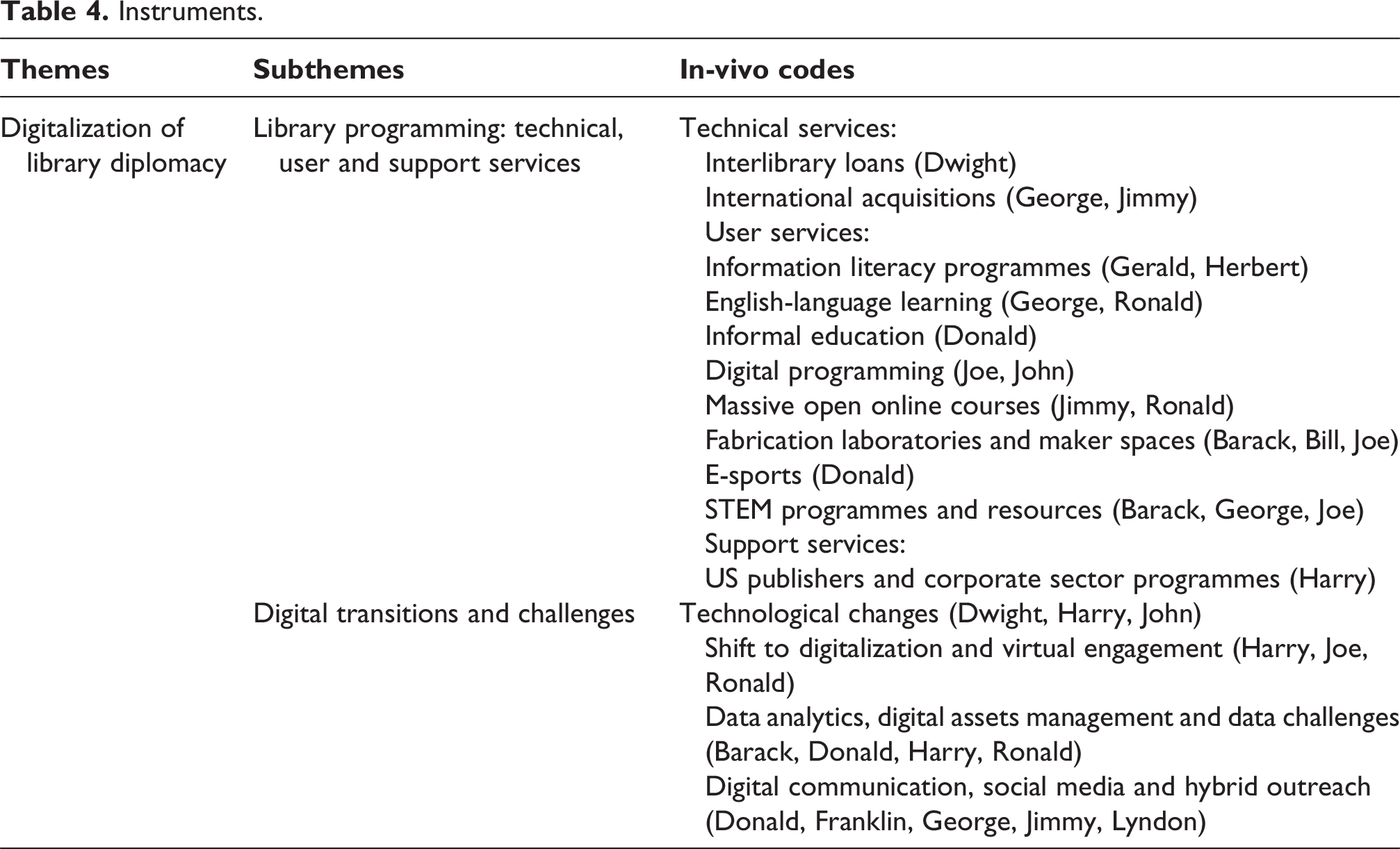
This section identifies the common tools, instruments and platforms used in diplomacy and international engagement – namely, library programming (encompassing libraries’ user, technical and support services) and transitions to digitalization (see Table 4).
Instruments.
Library programming
This subtheme revolves around the various types of library services and programmes utilized by the USA as tools to facilitate diplomatic and international engagement with partnering institutions and countries abroad. These library programmes span various types of libraries, including federal and state government libraries, public libraries, special libraries and academic libraries.
Different aspects of library programming, such as technical, user and support services, were revealed in the interview data. Dwight discussed the long-standing history of interlibrary loans, enabling resource collaboration across library institutions worldwide. Jimmy reflected on the growing need to engage with international publishers to meet the increasingly diverse demands of US public and school libraries aiming to serve multi-ethnic and multicultural communities.
George described the Library of Congress’s unique international acquisition practices through its field offices abroad, engaging foreign libraries in its collection development strategies and reciprocally helping these foreign libraries in their collection development needs, such as trainings and resource exchanges. Gerald and Herbert pointed out that libraries’ user services, like information literacy, have become popular means of engaging with international audiences. George and Ronald stressed the utilization of English-language programming, and John and Joe emphasized digital programming as crucial to the success of literacy programmes in international settings, with Donald commenting on the importance of fostering lifelong learning and informal education.
Various innovative library programmes were discussed by Ronald and Jimmy, including massive open online courses and open educational resources for lifelong learning and career development. Joe, Barack, Bill, Ronald and Jimmy highlighted the big shift to STEM programmes by libraries, using maker spaces and fabrication laboratories’ (fab labs’) physical and digital collaborative spaces: We saw a big shift towards STEM. And we started working with maker spaces, and doing more programmes around that topic, since it’s such an important subject, I guess, for youth to learn about and help inspire, you know, the next generation of scientists and engineers. (Barack)
Digital transitions and challenges
The changes from traditional to technology-driven services, particularly the digital transitions within libraries, emerged as a subtheme in this study. John, Harry and Dwight expressed that globalization and technological advancements enable libraries to connect and collaborate with both local and international communities. Such library collaboration and connectivity results in digitalization projects and the use of digital communication tools. Harry and Ronald emphasized the significance of virtual engagement, encompassing virtual meetings and webinars, as a significant aspect of libraries’ digital transition. Joe and George highlighted government priorities in investing in digital resources, such as the Department of State’s eLibraryUSA and the Library of Congress’s World Digital Library, aimed at making libraries’ digital assets available for both American and global audiences. Data analytics and management emerged as critical priorities for the Department of State, mainly when reporting to other branches of government, such as Congress. Donald underscored the importance of libraries’ data-reporting to demonstrate continued support for libraries in the Department of State’s diplomacy work: [It is important to have a] data management system that will facilitate reporting from the field to our office, that we can then share with stakeholders at the department and with Congress on how American spaces help promote United States foreign policy objectives.
The experts also identified some challenges with digital transition. According to Barack, there are several challenges associated with the changing preferences and priorities of top-level stakeholders, such as politicians, policymakers and administrators, in collaborating with data science experts rather than with librarians for international library engagement. Another challenge, stressed by Harry and Barack, is the complex digital ecosystem and varying policies and decentralized nature of the digital infrastructure of government and private and academic institutions, which hinders collaboration and management. Harry also argued that an inclination towards a technologically deterministic approach influences librarians’ work, particularly in managing and disseminating knowledge and information to the community: We started a data concierge study to look at what would the libraries need to do to collaborate in international partnerships, in scientific research. The institutions have very complex ecosystems around research, data management and laws…there’s certainly a technology side – our lives in some way determined by major [digital] corporations that control the infrastructure that we use to communicate, that we use to get our information, that we use to do our jobs.
Discussion
This research explored the library diplomacy practices of US library experts, encompassing their roles in implementing goals, strategies and instruments for diplomacy and international library work. The study identified four major themes regarding US library diplomacy in the 21st century: the implicit and explicit roles of the actors involved; an emphasis on knowledge dialogue and sharing as the overall goal of diplomacy; the strategic use of cultural humility in dialogue and understanding; and the vital role of digitalization in enhancing international library activities and library infrastructures.
Actors’ implicit and explicit roles
The research highlights the varied practices and roles among the diverse actors studied, which included diplomatic, library-based, policy-based, corporate and individual advocates in the US government and non-governmental institutions. The findings reveal a difference between implicit and explicit roles in library diplomacy. Explicit actors are characterized by their intentional and deliberate use of diplomatic terminology, goals and strategies. They also fully recognize their roles and label themselves as diplomats involved in international library practices. On the other hand, implicit actors are attributed as playing a subtle or indirect role in international engagement and diplomatic practices. These actors have a more nuanced and context-specific understanding of internationalization and international library work, which does not directly align with international relations and diplomatic concepts and processes.
The research reveals that the majority of the actors operate both implicitly and explicitly. For instance, the public and academic librarians, Library of Congress staff and other library advocates in the non-governmental-institution sector perceived their advocacy and community engagement roles as playing an indirect role in diplomacy, but their actions aligned with their institutions’ overt goals and strategies, akin to the approaches of akin to the approaches of US congress representatives, state politicians, non-governmental-institution policymakers and academic officials. The research further identifies specific examples of the explicit roles of diplomatic-based actors, including foreign service officers, American Spaces directors and coordinators within the Department of State, library-based and policy-based actors on the committee of the American Library Association’s International Relations Round Table, International Relations Committee officers, and executives at the Library of Congress and Smithsonian, as well as certain academic librarians. Their explicit roles are reflected in their specific job titles, such as regional public engagement specialist, international library initiative specialist, institutional partnership librarian, international outreach librarian, director for international library programmes, head of global engagement initiatives, and senior advisor for the Office of International Relations. As Herbert commented: ‘my title of international outreach librarian is also in institutional partnerships [interest of the university]’.
Gerald revealed that his academic institution had transformed from playing an implicit role to having an explicit mission to advance international library work worldwide: ‘In the past, it’s been more implicit. However, since I started in the position of directorship, then that has been more intentional’. Conversely, some library-based actors in federal and state libraries, as well as the private and corporate sectors, were found to be implicit in their roles and actions concerning library diplomacy.
The dimensions of implicitness and explicitness in the actors’ roles in this study resonate with similar recent findings on science diplomacy. Some scholars have noted that the actors involved in implementing science diplomacy projects, such as politicians, government administrators and scientists, may play either explicit or implicit roles in their international engagement (Young et al., 2020).
Knowledge dialogue
This research identifies that libraries emphasize knowledge dialogue as a primary objective of the actors involved in pursuing diplomacy and international engagement. Knowledge dialogue emphasizes the unique position libraries hold in acquiring and managing vast amounts of information and resources, harnessing learning and creativity skills over generations, and their commitment to making knowledge accessible to a broader community. The underlying goals related to knowledge dialogue include advocating for freedom of information, combating information censorship such as Internet filtering and book banning, supporting open-access initiatives and innovation, and advancing EDIA and sustainability values. Contemporary libraries and the practice of librarianship in the 21st century use diplomacy to create spaces for dialogue, the exchange of ideas, problem-solving and critical thinking. This is evident in the commitment of the Department of State’s American Spaces, Library of Congress and American Library Association’s International Relations Round Table to sharing knowledge of library practices between American librarians and their international counterparts worldwide. The findings of this study align with practices in health studies, where knowledge dialogue promotes a two-way mode of communication, intercultural exchange and consensus-building (Pan American Health Organization, 2022). This study also resonates with Knight’s (2023) concept of ‘knowledge diplomacy’ in international and higher education, research and innovation. This study identifies the unique role of libraries and information centres as agents and assets of academic and research institutions for the purpose of internationalization and diplomacy. This perspective adds a novel dimension that has not been previously addressed in the existing framework of knowledge diplomacy.
Cultural humility
This research identifies cultural humility as a central theme in describing the strategies employed by library actors to initiate library diplomacy programmes. This theme encompasses subthemes such as active listening, trust in the library profession and institution, a shared commitment to addressing challenges, and a glocal perspective. Cultural humility, as defined by LIS scholars such as Goodman and Nugent (2020) and Hurley et al. (2019), involves self-reflective recognition of one’s culture, customs, beliefs and values, and a willingness to learn from others’ experiences and practices. Cultural humility is commonly practised in public health and social work, but is also gaining traction in the LIS field.
These findings on cultural humility parallel existing research on cultural diplomacy highlighting cross-cultural dialogue, the recognition of power imbalances, and the promotion of mutually beneficial cultural exchanges in libraries and cultural centres (Andrews and Kim, 2017; Mariano and Vårheim, 2021; Melissen, 2005). One of the experts in this study said that acknowledging nuanced identities helps develop reflection on one’s own identities and world views by harnessing a multi-dialogue rather than monocultural approach: Now, I think moving from more of a mindset of cultural competency and moving towards cultural humility and understanding the complexities of cultural exchange, I don’t think anybody’s really looking to go back to, like, [the] monocultural mindset of diplomacy, but instead are approaching things in a much more nuanced way. (Harry)
Digitalization
This theme identifies the multifaceted digital transformation and technological changes in libraries in the 21st century. Digitalization emerges as a main theme due to the blurring of the boundaries between local and foreign publics, facilitated by the democratization of digital information – making it accessible to everyone. Twentieth-century practice, specifically through the United States Information Agency libraries under the Smith–Mundt Act, was exclusively aimed at foreign audiences. However, the current practice of library diplomacy has become more inclusive, adopting a glocal approach and encompassing digital audiences. For instance, the American Spaces programmes, exchanges and services extend to both American and international audiences by using social media and other digital engagement tools, further democratizing access to information. The increase in the number of Library of Congress webinar programmes and its 4 Corners of the World blog have promoted local and global interest in its special collections from both diaspora communities and international students in the USA.
Second, digitalization as a diplomatic tool highlights the shift towards digital resources, massive open online courses, maker spaces, gamification and digital literacy programmes to engage with so-called ‘digital natives’ and cater to the emerging digital society in the global sphere. Third, the digitalization of library diplomacy reveals enhanced practices to bolster international library work. The incorporation of data analytics, data visualization, digitally enhanced technology for interlibrary loans, cultural preservation, and virtual meetings and conferences increased rapidly during the COVID-19 pandemic and has been increasing significantly since. Like the international library modernization and technologies of the 20th century, digitalization plays a similar role in current practice, encouraging communities to work and collaborate on enhancing library services worldwide. This theme closely aligns with the research on digital diplomacy. Manor (2019), in his research on the digitalization of public diplomacy, describes the tangible impact of digital technologies on the diplomatic practices of ministries of foreign affairs worldwide, highlighting the merging of local and global publics into a digital public.
Limitations
This research study, which has delved into the insights, practices and conceptual understanding of library diplomacy among library experts in the USA, has certain limitations. The researcher recognizes that there is a dearth of literature at present, with the majority of the existing research focusing on 20th-century phenomena and only a few LIS scholars having explored this topic. Therefore, the research necessitated the inclusion of insights from closely related fields of study, such as history, international relations and social sciences, to enrich the understanding of library diplomacy. Second, the research data is contextualized in the USA, potentially limiting its applicability to global perspectives and an overall understanding of the concept of library diplomacy. However, this empirical research hopes to serve as a foundational reference and starting point for further exploration and a deeper understanding of library diplomacy practices globally.
Conclusion
In conclusion, this article has addressed the following research question: How is library diplomacy being practised and used in the USA in the early 21st century? It has looked at the actors’ roles, goals and strategies, and the instruments employed by US international library experts. Historically, the primary intent behind leveraging libraries as a vehicle for public diplomacy in the 20th century was to disseminate American culture, values and technologies, often associated with cultural hegemony and information propaganda strategies. This research, however, posits that early 21st-century library diplomacy practices are driven by diverse actors with implicit and explicit roles in policy, advocacy and public engagement. The main focus is on fostering knowledge dialogue and knowledge sharing; advocating for the core values of librarianship, such as freedom of information, open access, EDIA and sustainability values; and embracing cultural humility as a strategy to achieve cross-cultural and multi-dialogue understanding at the local and global levels. Parallel to the 20th-century digital revolution, digitalization continues to shape library diplomacy in the early 21st century, echoing various digital practices and mainly to engage the digital public. This study’s contribution is to encapsulate the uncharted area of library diplomacy practices in the 21st century. Its limitation, however, stems from its specific geographical context of the USA, which may restrict the findings’ applicability to a more comprehensive global understanding of the subject. Therefore, the researcher calls for a broader exploration across other global superpowers, such as China, the European Union, India and Russia, and including the global and regional contexts of the Global North and Global South. Such an extended research inquiry could enrich global understanding of library diplomacy’s multifaceted international policies and practices in knowledge, information, digital and data diplomacy.
Footnotes
Acknowledgements
The author extends his gratitude to his PhD thesis supervisors, Dr Andreas Vårheim and Dr Per Mangset, for reviewing the validity of the empirical data and providing guidance.
Declaration of conflicting interests
The author declared no potential conflicts of interest with respect to the research, authorship and/or publication of this article.
Funding
The author received no financial support for the research, authorship and/or publication of this article.