




Abstract
Transliteration involves skills, critical thinking and practices based on digital fluency in a changing context. This concept is based on the inquiry process of scientific research, but is currently not integrated into the STEAM (science, technology, engineering, art, mathematics) approach. In the first phase of the ‘TLIT4U – Improving Transliteracy Skills through Serious Games’ project, an attempt was made to clarify the STEAM framework towards an inquiry-based training model. The authors, belonging to different universities in Bulgaria, Finland and Italy, investigated the perception of the concept of digital fluency and the research-process awareness of students with different disciplinary backgrounds at their respective universities. Subsequently, the authors organized interviews and focus groups with teachers, librarians and scholars at partner universities to investigate their perceptions of transliteracy. The main findings and open questions highlighted by the TLIT4U comparative study are presented in this article.
Introduction
The acronym STEAM represents the starting point for a new way of learning and teaching in higher education. In a STEAM approach, the ‘S’ for science is the starting point and is used to identify and study the research problem, establish the cause and show students the solutions adopted so far. The ‘T’ of technology represents the set of tools necessary to implement the initial solution to a problem. The ‘E’ of engineering is the implementation method, as the effectiveness of a research design is based on the combination of ‘user expertise’ and ‘tool complexity’. From the ‘A’ of art, the STEAM approach takes creativity, an innovative and disruptive element in the STEAM alphabet. In fact, art serves to broaden horizons and to approach things in a completely different way. The ‘M’ of mathematics, in a STEAM activity, remembers that collecting feedback, applying it, modifying the project, returning to the original problem, searching for new questions, and trying and trying again are all important moments as they are representative of the research inquiry and experimentation process. The acronym STEM is often used because it is not considered the A of. The UNESCO International Bureau of Education affirms that: STEM competence covers both the ‘know-what’ (the knowledge, attitudes and values associated with the disciplines) and the ‘know-how’ (the skills to apply that knowledge, taking account of ethical attitudes and values in order to act appropriately and effectively in a given context). In the information age of the 4th Industrial Revolution, the ‘know-what’ and the ‘know-how’ of STEM encompasses the traditional components of knowledge, skills, values and attitudes and the all-important expansion of information, big data and technology. (UNESCO International Bureau of Education, 2019: 11)
A problem with the STEAM approach is that some teachers focus on technology as a new set of digital skills to be developed separately from the curriculum content, and not integrated into each subject’s research method (Livingstone, 2012). This is the reason why it is important to understand teachers’ beliefs and perceptions related to STEAM. Teachers, as important people in a student’s acquisition of skills, have prior experiences that will influence their STEAM education and learning.
The aim and objectives of the research were to explore the perceptions of students and teachers in relation to the problem, and to understand the context of the three partner universities of the TLIT4U project – the University of Library Studies and Information Technology (Bulgaria), University of Parma (Italy) and University of Lapland (Finland) – and one non-governmental organization – Fondazione Politecnico di Milano (Italy). The objectives were as follows: To explore students’ awareness of digital fluency terms; To assess students’ level of skills according to the updated European Digital Competence Framework for Citizens (DigComp 2.0); To study expert groups’ perceptions and attitudes in relation to the application of the STEAM approach in their teaching.
Literature review
Enrolment in STEAM disciplines at universities is increasing globally, which can be attributed to the greater life opportunities open to students as a result of a STEAM education. But while institutional access to STEAM programmes is widening, the retention and success of STEAM undergraduate students remains a challenge. Pedagogies that support student success are well known; what we know less about is how university teachers acquire pedagogical competence (Winberg et al., 2019). Calls to improve student learning and increase the number of STEM college and university graduates assert the need for the widespread adoption of evidence-based instructional practices in undergraduate STEAM courses. Faculty identify a variety of barriers to proposed changes in teaching practice; however, faculty also identify a variety of drivers that might help institutions change teaching and learning norms (Shadle et al., 2017).
The EU STEAM Coalition is a European network that is working to build better STEM education in Europe. 2 The main goal of STEM methods is to activate a consistent process of inquiry-based learning with a focus not only on competences, but also on the process itself. The way in which this inquiry is realized is much more important than the result. The teacher’s role is to monitor and assist in the various stages of task performance. Wherever and whenever necessary, the teacher intervenes and supports the inquiry process. The assessment of students is made taking into account the complex performance of the inquiry.
The inquiry process characterizes not only STEAM education but also the media and information literacy approach. From a policy point of view, UNESCO’s (2013) Media and Information Literacy: Policy and Strategy Guidelines constitutes a sort of manifesto for the UNESCO vision of media and information literacy. The text begins by explaining the relevance of media and information literacy policy and strategy in the digital age and continues by illustrating how media and information literacy is a composite concept. Designed in 2019 and launched in 2021, the ‘Global Standards for Media and Information Literacy Curricula Development Guidelines’ form a relevant basis to guide media and information literacy curricular development and implementation by stakeholders in countries around the world. Media and information literacy is a basis for enhancing access to information and knowledge, freedom of expression and quality education. It describes the skills and attitudes that are needed to value the functions of media and other information providers, including those on the Internet and in society, and to find, evaluate and produce information and media content; in other words, it covers the competences that are vital for people to be effectively engaged in all aspects of development.
Partially overlapping with media and information literacy, the concept of transliteracy highlights the many literacies that today make the inquiry process complicated (Ipri, 2010). The term ‘transliteracy’ was originally defined by Thomas et al. (2007) as ‘the ability to read, write and interact across a range of platforms, tools and media, from signature to oral through handwriting, print, TV, radio and film, to digital social networks’. Sukovic later defined transliteracy as a ‘fluidity’ of movement across a range of technologies, media and contexts: Transliteracy is an ability to use diverse analogue and digital technologies, techniques, modes and protocols:
to search for and work with a variety of resources to collaborate and participate in social networks to communicate meanings and new knowledge by using different tones, genres, modalities and media. (Sukovic, 2016: 21)
The concept of transliteracy has been combined with the concept of fluency. ‘Digital fluency’ is a relatively new term. Unlike ‘digital literacy’, which means understanding how to use technology and different tools, digital fluency is the ability to create something new with them (new information, a new product). Transliteracy consists of skills, knowledge, thinking and acting, which enable a ‘fluid’ movement across in a way that is defined by situational, social, cultural and technological contexts, including capabilities such as find, evaluate, select, manage, create and reflect. Bruce et al. (2012: 527) have developed similar concepts and argue that ‘experiences of informed learning’ include information awareness, sources, processes, control, knowledge construction, knowledge extension and wisdom.
The interconnection between multiple literacies and STEAM education is found in the inquiry process. The two most important frameworks for inquiry models are the Framework of Skills for Inquiry Learning (FOSIL) and Carol Kuhlthau’s Guided Inquiry Design. FOSIL is a model for the inquiry process that includes the following steps: connect to previous knowledge; develop questions; investigate; construct; express; reflect. 3 Inquiry is an approach to learning (not limited to information skills) and the model has been developed by Barbara Stripling (2021). These tools help educators to design and resource effective inquiries – often as a collaborative team involving teachers and librarians – and to support students engaged in inquiry. FOSIL is based on a continuum of skills and strategies that includes a new focus on multiple literacies, including visual and media literacy; the use of technology for learning, including digital literacy skills pre-kindergarten; the personalization of learning; the evaluation of multiple perspectives; digital citizenship and civic responsibility; design thinking, including innovation and creation; and student voice and agency.
Guided Inquiry Design is a research-based pedagogical framework that was developed by Kuhlthau for teaching information literacy skills. 4 The inquiry framework for designing and facilitating inquiry-based learning includes the following steps: open; immerse; explore; identify; gather; share; create; evaluate.
Theoretical framework
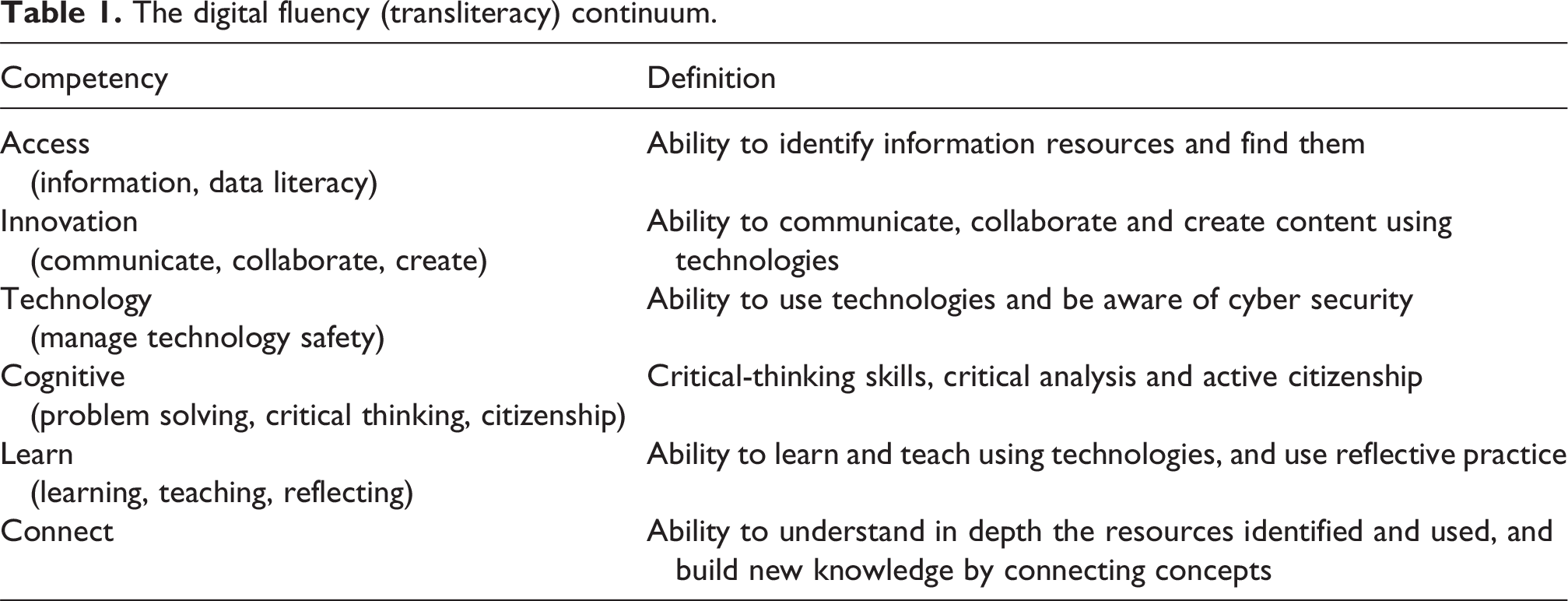
The theoretical framework guides the research of the project and determines how the project can compare the different contexts of the partners – Bulgaria, Finland and Italy. From the analysis of the literature, a general representation of the relationship between the concepts has been established. The framework focuses on existing and time-tested theories and definitions of transliteracy, and includes the state of the art and the results of various research. In the TLIT4U project, there are three contexts – technological, pedagogical and cognitive background – and the demands of different academic disciplines, including library and information science. Trying to combine the definitions and competences in the literature, the matrix in Table 1 can be used to define the theoretical framework of the TLIT4U project. The theoretical framework lists the different elements of the concepts of information, digital literacy and digital fluency.
The digital fluency (transliteracy) continuum.
Methodology
The current research examined students from three universities – the University of Library Studies and Information Technologies (Sofia, Bulgaria), the University of Parma (Parma, Italy) and the University of Lapland (Rovaniemi, Finland) – and university lecturers, teachers and library specialists (hereafter, experts) at the three partner universities and the Fondazione Politecnico di Milano.
The methodology for selecting the sample of students involved sending invitations to students from the three universities with the intention to obtain at least 80 respondents. The same method of invitation using the email lists of the three partner universities was applied to the second group of experts, with the aim of obtaining up to 20 respondents. The following research tools were used to collect the data: (1) an online questionnaire for the students translated into the three partner languages and (2) structured interviews with the experts, also in the three partner languages.
Target group: students
To investigate the students’ perceptions, the project team organized a digital fluency workshop with the aim of introducing the concepts of transliteracy, STEAM and digital fluency to the students. Professor Miltenoff Plamen was the expert speaker who illustrated the various topics, which were divided into nine micro-questionnaires for each topics covered. The workshop in Sofia was held face-to-face in March 2022, and that with the Finnish students and Italian students was held online in April 2022.
The questionnaire (see Appendix 1) was divided into three parts. The first aimed to understand the degree of awareness of key terms such as digital fluency, media and information literacy, soft skills, technology skills and so on, and the level of expertise for the research process. The second was a self-assessment of a set of five skills according to the European Digital Competence Framework for Citizens: information and data literacy, communication and collaboration, digital content creation, security and problem solving. The third part of the questionnaire aimed to explore the attitudes and awareness of the target groups in relation to terms such as Education 4.0, Industry 4.0, the Internet of Things, big data, artificial intelligence and digital humanities; these terms are part of everyone’s daily routine and are a prerequisite for innovation in all areas of life. Many of the questions were closed-ended but the question on the level of expertise in 21st-century research skills was open-ended.
Sixty-two Bulgarian students responded to the questionnaire (although 101 participated in the workshop), of which the majority (33%) were aged 37–47, followed by 27% in the younger 26–36 age group. In Finland, 57 students completed the questionnaire, the majority (63%) of whom were 21–25-year-olds, followed by 21% in the younger 18–20 age group. In Italy, 21 students answered the questionnaire (although there were 37 participants in the workshop), with half in the 21–25 age range, followed by 20% between the ages of 26 and 36.
The processing of the information was carried out through statistical data processing programmes, and the open-ended questions were coded and processed manually.
Target group: teachers, librarians and scholars
To investigate the teachers’ perceptions, the authors organized a series of interviews and focus groups with a sample of the experts. The interviews and focus groups used the same structure of the eigth questions in the TLIT4U project (see Appendix 2). The responses collected during the focus groups were transcribed semi-automatically (using YouTube subtitles) in an attempt to report the whole discussion.
The respondents were questioned along the following lines: What do teachers and instructors think of digital literacy? What do they think of digital fluency? In particular, what do teachers, librarians and scholars in the humanities and engineering think? Finally, what do they think generally about the use of technologies for teaching and learning? The responses were transcribed and coded. To encode the responses, they were analysed using the theoretical framework developed by the literature review.
Students’ perceptions
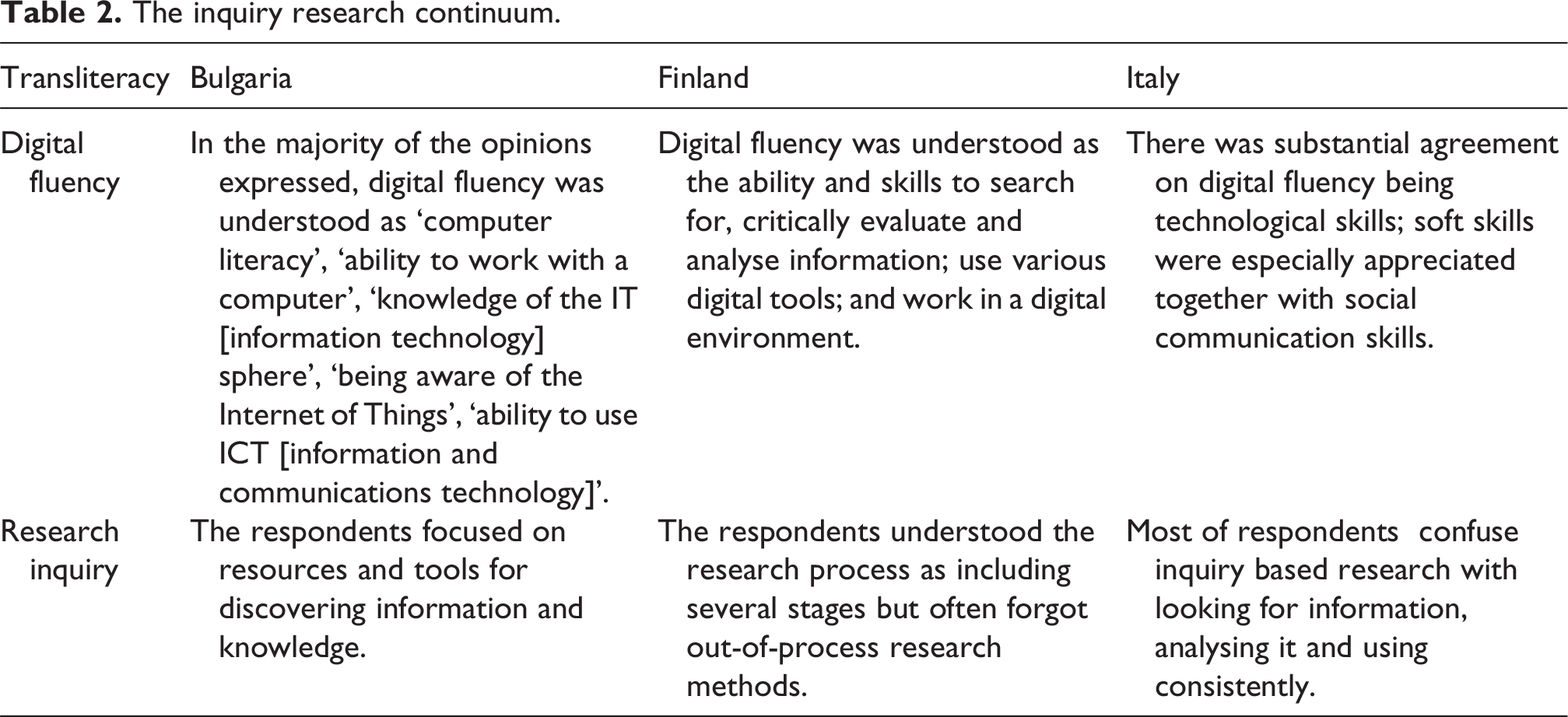
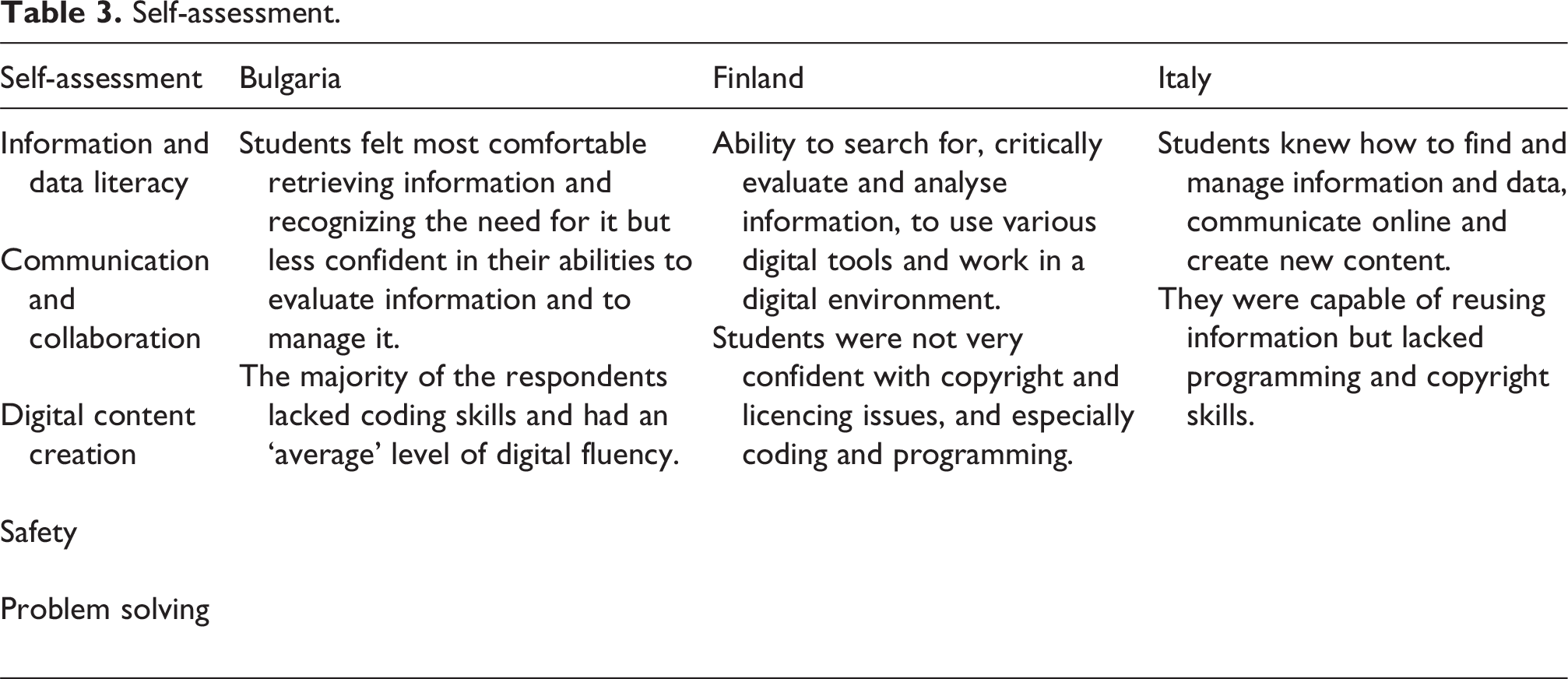
All of the respondents in the three countries (see Table 2 and 3) shared a positive approach towards innovation and the use of technologies for scientific research, and wished to improve their digital fluency. There were differences in their perceptions, however, as well as in their understanding of the scientific inquiry process and the priorities of digital fluency capabilities.
The inquiry research continuum.
Self-assessment.
The research continuum
In Bulgaria, the students recognized scientific research and skills in the digital world as ‘a rather important aspect in people’s lives today’. Media and information literacy in modern times was considered extremely insufficient to be adequate for and competitive in the labour market. In most of the judgments expressed, the students would have liked to have had practical training and skills in using technical tools. However, an understanding of the complexity of the investigation process was evident, as shown by the following responses: ‘collection of different data on the object of the research’; ‘facts and new knowledge or their collection and systematic analysis’; and ‘search, analysis and verification of data’. Some respondents used general formulations to express their thoughts on 21st-century research: ‘the application of scientific methods to the study of something’, ‘process’ and the like.
Since development and progress are defined and guided by the scientific approach of science and scientists, the students were asked about their vision of scientific research. Media literacy is an important topic in Finnish curricula, starting from early childhood education through to higher education. The terms used in teacher training are ‘media literacy’, ‘media education’ and ‘multiliteracy’, which may have confused the respondents, but otherwise the answers in relation to digital fluency and awareness were perfectly in line with their previous knowledge. The respondents, however, quite often forgot out-of-process research methods. Interestingly, some respondents also mentioned ‘sharing’ research results and data as part of the research process, even though this is not specifically highlighted in their curricula.
The Finnish students understood digital literacy as the ability and skills to search for, critically evaluate and analyse information, use various digital tools and work in a digital environment. Their answers included the following remarks: ‘digital reading skills are about understanding credible and non-credible information and the ability to differentiate’; ‘being able to read, perceive and analyse digital text, image, voice and sound’; ‘using digital tools, platforms and materials to create new things’; and ‘a capacity to critically interpret texts in a digital environment’.
The Finnish students understood the research process as an activity involving several stages, including: choosing a topic; formulating research questions; searching for information and its critical analysis; combining information; conducting research using certain research methods; and formulating conclusions, recommendations and/or guidelines. Interestingly, some of the respondents mentioned that sharing research results is an inevitable part of the research process: ‘I see the process as follows: extracting information, analysing information, creating new information and sharing new information’; ‘We ask research questions, determine methods for extracting information, analyse the information obtained using a certain method, formulate conclusions and evaluate the research process Finally, we publish the results’. There were other interesting opinions expressed by the Finnish students: the research process is about determining what we want to know and understand, how we will acquire the information we need, and what methods are best for the purpose. Also, an important aspect is how many people/researchers work on the same problem, as they generate more ideas and opinions and allow the issue to be considered from all sides. the process of research involves the study of a certain phenomenon in order to find new information about it. Research is a multidimensional process through which new information is created.
Self-assessment
In Bulgaria, most of the students assessed themselves in a positive way, remarking that they had a ‘good’ or ‘average’ level of fluency. However, in our opinion, caution should be exercised regarding those who answered ‘average fluency’, as this is a neutral response position where it is not possible to assess how well they were able to cope with challenges. The European Digital Competence Framework for Citizens also defines skills related to solving problems of a technical nature, as well as the use of technology to create and communicate new knowledge (Martzoukou et al., 2020).
Most of the respondents in Finland deemed that they were quite or extremely competent in browsing, searching and filtering data, information and digital content. In regard to evaluating data, information and digital content, they replied that they were only somewhat competent. Almost as many respondents replied that they were quite or somewhat competent in managing data, information and digital content, but some said they had poor data management skills. The respondents considered that they were quite good at communicating and sharing through digital technologies, but most found that, in engaging in citizenship through digital technologies, they were only somewhat competent. The self-assessment questionnaires revealed some important gaps in Finnish students’ education.
In Italy, most of the respondents were confident in knowing how to find and manage information and data, together with the ability to communicate online and create new content is widespread together with security, but they felt that they lacked programming and copyright skills. Not everyone was confident that they were capable of reusing information.
Experts’ perceptions
The experts from the three countries were asked about the importance of digital fluency in the field of education and scientific research. To collect data from the experts (teachers, librarians and scholars), a structured interview was used with eigth questions (see Appendix 2) on their perceptions of their attitudes and the place of next-generation technologies in their teaching.
In Bulgaria, 18 independent in-depth interviews were conducted. 5 This made it possible to reveal essential details and nuances related to the purpose of the research, and to search for the root of the problems recorded and possible ways to solve them. The individual interviews with the invited specialists (teachers, university professors, librarians and professionals from the Ministry of Education and Science) took place both face-to-face and online (via videoconference) in the period from March to May 2022.
In Finland, four focus groups were organized between 6 April 2022 and 26 April 2022. 6 The participants were librarians (one group with three participants), university teachers (two groups with four participants in each group), and teachers and media education experts (one group with four participants). A total of 15 people were interviewed. The interviews used the eight-question structure of the TLIT4U project. Only the order of the questions was changed slightly. The interviews were conducted in Finnish and the results were summarized in English. Three interviews were set up online with Microsoft Teams, and one interview was a face-to-face meeting. All of the interviews were recorded and lasted between 55 and 65 minutes.
In Italy, the focus group was organized virtually on 14 June 2022 and lasted 90 minutes. 7 The interviewees included two librarians, two engineering teachers and three humanities teachers, giving a total of seven interviewees. All of the staff belonged to the University of Parma and the Fondazione Politecnico di Milano, and had an interest in innovation in higher education. The focus group discussion was semi-automatically transcribed (using YouTube subtitles) in an attempt to record it in its entirety.
The main conclusion from the interviews in Bulgaria was the need for a comprehensive and unified policy to integrate and link information and digital skills – almost everything contained in the perception of the term ‘transliteracy’ – in the curricula studied in schools and universities, including approaches to using technology for creating and communicating new content. The experts pointed out that this need is important for all participants in the educational process (students and educators), since only people who are confident in their inquiry skills find successful professional career and strive for self-improvement. With regard to the relationship between the concepts of ‘information and digital literacy’, education and libraries, the experts most often expressed that ‘in the library, education and both types of literacy meet’. According to them, information literacy needs to continue to be part of curricula and training because ‘it is the basis of digital literacy – the ability to master ideas, to discuss problems, to create’. In the curricula of schools and at the university level, it is necessary to invest much more seriously and comprehensively in information and digital literacy training, which will help ‘people find a path to realization and improvement with ease and confidence’. According to the respondents, libraries in educational institutions (higher education institutions and, increasingly, school libraries) conduct targeted training for students in information and digital literacy but, unfortunately, in Bulgaria this is not particularly popular, probably due to an insufficient understanding of its importance. The Bulgarian experts believed that training in both schools and universities is still not encouraging and extensive enough in terms of students gaining confidence in using technology and different tools to create a new product. They proposed that libraries and universities need to create an environment for the development of digital literacy and digital confidence by carrying out research on the need for training for the development of digital literacy and digital fluency, and creating individualized curricula and syllabi according to the level of development of students’ digital literacy.
This opinion was shared by the Finnish experts, who thought that students should be expected to be able to search, analyse and interpret information, as well as communicate using various digital tools. They should be able to use different digital tools and create new knowledge in their own research (Bachelor’s and Master’s theses), and have knowledge of the principles of the ethical use of information. Multiliteracies and media literacy are important terms in Finnish primary education curricula, and university lecturers are expected to be aware of them. As a problem, the experts highlighted the fact that not all trainers have the necessary skills to integrate the concepts of multiliteracies and media literacy in their teaching. The concept of digital fluency is not implemented in the Finnish education system. The term ‘multiliteracies’ is taken as the basis for curricula. In Finland, digital technologies are part of everyday life: work, teaching, learning and research. According to the Finnish experts, teachers, students and librarians should know about and be able to use the available tools. They also emphasized that digital technologies promote accessibility for people with disabilities. As a challenge, they saw not only the learning of new technologies, but also the selection of correct and appropriate new technologies and tools.
The opinions of the Bulgarian experts supported what was shared by the Finnish and Italian experts, but also touched on several other aspects. First, in education, technologies provide an opportunity to present material in an interesting and memorable way to learners. Moreover, the realization of the idea of a knowledge-based economy (and, in particular, lifelong learning) is impossible without technologies in the fields of education and scientific research, and they added that innovations in science cannot be implemented without the use of modern information and communications technologies. The Italian respondents agreed that technology changes the way of teaching and stimulates curiosity, participation and active learning, but stated also that it is important that trainers (teachers, lecturers, librarians) are aware of the appropriate tools.
Regarding the relationship between the concepts of information and digital literacy, education and librarianship, the experts from Italy shared the opinion that learners must have the skills to identify, use and evaluate information resources, as well as communicate and create new resources using appropriate technologies. Also, they should possess the capabilities of working independently and critical thinking. When asked how they viewed the role of libraries, schools and universities in the formation of digital confidence among students, the experts from Italy believed that the creation of original content is not limited to knowledge of technology. According to them, it is necessary to emphasize the purpose and subject of the study/research, and not only master the appropriate technology for creating content. In Italy, digital fluency must be understood correctly: it cannot be confused with knowing how to apply technologies. Instead, it is necessary to know and be able to apply the inquiry process, starting with clear objectives and research questions. An important element of digital fluency is curiosity, which must be stimulated by teachers. Teachers themselves must learn new skills; in particular, they must know which technologies are useful for teaching. With regard to the priority of the necessary skills, it should be recognized that Italian students arrive with a wealth of knowledge and skills derived from previous learning and the family context. The problem is that they lack critical and analytical skills.
New technologies are the driving force behind the development of innovations in all spheres of everyday and professional life. They require the continuous acquisition of new skills to be applied at the theoretical and practical levels. Active participation in lifelong learning processes is the only guarantee that people continue to be adaptable and competitive in the face of constant change.
Conclusions
The TLIT4U project aims to introduce innovative practices in the field of higher education through the application of a game-based approach for teaching transliteracy and adapting the STEAM model. University educators lack a consistent understanding of STEAM education, therefore they need to innovate in their teaching by using the framework of STEAM education. The process of integrating science, technology, engineering, art and mathematics into an academic subject can be as complex as the global challenges that require a new generation of STEAM experts. Educational researchers have indicated that teachers struggle to make connections between the STEAM disciplines.
Based on the findings of this study, the TLIT4U team will design a draft conceptual framework on which to focus the game approach. The conceptual model will be based on an adapted STEAM model for inquiry-based learning after in-depth analysis of the different perceptions and training approaches related to transliteracy and STEAM in Bulgaria, Finland and Italy. The students and experts survey results will be used to develop an innovative game for teaching inquiry-based learning in higher education. The game will also be able to be adapted to the needs of other target groups of the project – for example, informal learning for adults.
If we want current and future students to cope confidently with new challenges in the world, it is necessary to change ways of teaching and acquiring knowledge and skills towards a focus on values and attitudes. To this end, it is necessary to move away from teaching that is limited to memorizing and reproducing information towards the use of interactive methods, engaging students in the educational process, personalization of learning content and orientation to results. The need for teachers and educators to be creative, innovative and inspiring is becoming increasingly clear.
Directly linking serious gaming with advancing digital fluency and transliteracy in various higher education curricula could engage young people in appying an inquiry-based learning approach.
Footnotes
Declaration of conflicting interests
The authors declared no potential conflicts of interest with respect to the research, authorship and/or publication of this article.
Funding
The authors received no financial support for the research, authorship and/or publication of this article.