




Abstract
This article combines social constructivist and transformative paradigms to propose a framework for communicating library training to first-year students. Although performance indicators for literacy are universal, there are explicit attempts to move away from a universal approach to information literacy, as exemplified in the Association of College and Research Libraries Framework for Information Literacy for Higher Education. This article addresses the fragmentation of teaching and learning practices in a single case study of University of the Free State libraries. Data were collected using two methods: an integrated literature review; and document analysis. Literature and documentary evidence were found to justify a call for developing an underpinning theory for planning purposes. Furthermore, it was found that synthesized concepts from models, ideas and frameworks can inform new pedagogical approaches. This article proposes the Authority Pedagogy Socialization framework for communicating library training to first-year students and concludes with several recommendations.
Introduction
Empowering students with skills and knowledge for navigating through the vast resource pool in academic libraries differs from country to country. Library instruction, bibliographic instruction, user education, library orientation and library training, consist of programmes that teach library users how to find and locate information (Reitz, 2004). Library training is known by different names across the world. Similarly, information literacy programmes in South African university libraries are “known by different titles/names” (Jiyane and Onyancha, 2010). Library training is different from information literacy. Library training equips users with skills to use information resources in a library. Information literacy focuses on the ability of individuals (e.g. library users) or groups of people (e.g. local communities) to identify information needs from an abundance of information sources at different times for different purposes (Zurkowski, 1974). The critical point here is that library training is often used as an approach and method to facilitate the training of users in information literacy programmes. However, being information literate is unrestricted to the academic library environment and can occur anywhere for different reasons. This article focuses on library training facilitated by library and information service professionals to emphasize the context of University of the Free State (UFS) libraries.
The origins of library training
Libraries, in general, and academic libraries, in particular, design programmes that support users’ learning, teaching and research activities. According to Renirie and Harper (2019: 339), “library instruction can include broad threshold concepts of the nature of research and the value of information, as well as the more practical skills of searching a library’s print and electronic resources”. Library instruction started in the United States between 1876 and 1910 and gained a stronghold in the early twentieth century (Grassian and Joan, 2010). Librarians take the role of teachers in library training programmes.
The librarian as a teacher
The librarian’s role as a teacher was redefined by Justin Winsor, president of the American Library Association, in 1880 (Robinson and Winsor, 1880). Lorenzen (2001) posits that the introduction of library instruction in the United States resulted in the founding of the Library Orientation Exchange. This non-profit initiative has hosted conferences and shared borrowing collections with more than 650 member states as members, including South Africa. Library instruction relates to information literacy because a programme empowers students to be “able to recognize when information is needed and the ability to locate, evaluate, and use the needed information effectively” (Association of College and Research Libraries, 2006). Based on these explanations, library training plays a significant role in teacher–librarian–student relationships in academic libraries.
The UFS library training context
The UFS libraries offer library training to first-year students in two (2) approaches; firstly, general library training for all first-year students. This is communicated by the librarians to the students using a blended learning approach (e.g. face-to-face and on Blackboard). The second approach is embedded library training, where the activity forms part of a module in a department/faculty. It is compulsory for all students registered for that module to attend these sessions since they come with an assessment. Compared to the first approach, this embedded library training is communicated to students by academic facilitators in partnership with librarians. As a result, attendance for the embedded library training programme is always characterized by good attendance compared to the general library training for first-year students. This article focuses on the general library training administered by librarians.
The significance of library training
While programmes vary from country to country, library training makes it easier for users to “access, identify, retrieve and effectively use information from the library shelves and catalog that will aid their learning, teaching, and research” (Omeluzor et al., 2017: 1). Rowe et al. (2021) conducted a study that sought to understand the impact of library training on undergraduate student success. The study found a correlation between students who attend library training programmes and student success. The study concluded that library training could effectively educate users and create awareness about resources in the library. The Association of College and Research Libraries (2015: 14) notes that academic libraries in the United States prioritize library training to “reach a high number of students and to establish a foundation of information literacy competencies for students as they progress through their academic careers…”. Aliyu (2011) asserts that although a considerable number of students at the Abubakar Tafawa Balewa University in Nigeria considered the library training course important, there was a need to review the programme to reflect changes in library operations.
Rapid changes in society require a reflection on library training programmes. Ellis-Barret (2014) notes that because the information literacy landscape in the twentieth century changes rapidly with technology, it is essential to keep up with the needs of the students and their different learning styles. Academic libraries in the Global South, particularly South Africa, have adapted somewhat to rapid technological changes affecting operations. As with UFS libraries, budgets focus on adopting specialized tools to create electronically driven systems, processes and procedures. For librarians in teaching and learning sections of universities, introducing new technologies poses challenges and opportunities for improvement in how they communicate library training to a diverse student population with different learning styles and needs. There is a need to develop new pedagogical approaches in library training.
The following sub-sections present the research gap and focus of the article. The methodology adopted for the paper follows with a view to discussing findings from an integrated literature review and documentary evidence from a library training programme at UFS libraries. The final part of the article discusses the results, presents the framework and concludes with recommendations.
Addressing the research gap and focus of the article
The critical role played by library training in information literacy programmes is vast in the literature, with most of the studies referring to the Association of College and Research Libraries (2016) Framework for Information Literacy for Higher Education. However, most studies present perspectives of library training from a universal point of view, specifically those of thought leaders and think tanks in developed economies (e.g. the United States). It is therefore not surprising that the Framework for Information Literacy for Higher Education (Association of College and Research Libraries, 2016) is communicated in language versions belonging to non-African countries, such as Chinese in Asia and various languages in Europe, which include German, Italian, Persian, Spanish and Swedish. In addition, there is also a focus on library training as it relates to the written word and information and communications technologies (ICTs). As the United Nations Educational, Scientific and Cultural Organization (2008: 22) puts it, “for UNESCO, the focus on IL should be as it relates to the written word and ICT”.
The overemphasis on the written word and ICTs needs to pay more attention to alternative performance indicators informed by epistemologies from preliterate oral cultures in developing countries. Several studies point to this epistemic neglect. Kay and Ahmadpour (2015) developed the 5Ps model to chart the way forward for assessing and understanding new directions for information literacy. Harden and Harden (2020) offer practical skills on how instructors in a political science course can teach information literacy with or without librarians. Carncross (2015) redeveloped an information literacy course for university students using the Framework for Information Literacy for Higher Education. To understand the perceptions of librarians, faculty and student’s perceptions of information literacy skills in academia, Yevelson-Shorsher and Bronstein (2018) shared three perspectives on information literacy. Fullard (2017) used the Framework for Information Literacy for Higher Education to foster partnerships between librarians and faculty members. While Fullard (2017) suggests that librarians and lecturers can use the Framework for Information Literacy for Higher Education to uncover processes and practices of knowledge creation never known before, there is also a need for transformative frameworks that guide such partnerships, especially in South African university libraries. Furthermore, indicators for determining adult literacy levels are based on international surveys that originated in developed countries, mostly in Western Europe and the United States. One example of a global survey guiding literacy levels is the International Adult Literacy Survey (United States Department of Education, 1994). While literacy and information literacy are two discrete fields of knowledge, they share a common ground in assisting individuals in making sense of the world and its natural and manufactured objects. The example of the Latin American Migration Project (LAMP) survey was included in this article to emphasize the thesis that both concepts originated in the developed world and were exported to developing countries (e.g. South Africa). Again, the five levels of proficiency identified in LAMP are strictly associated with literacy proficiency with written records and ICTs.
In summary, the authors of this article assert that although the concept of literacy is universal in nature, there are explicit attempts to move away from a universal approach to information literacy, as exemplified in the Framework for Information Literacy for Higher Education. Additionally, proficiency in information literacy is associated with written records and ICTs. The overemphasis on information literacy based on written documents and ICTs perpetuates the marginalization of oral indigenous African ways of knowing in library training programmes. The literature considers other types of literacies (e.g. media, audio and library) to focus more on specific skills, leading to information and digital literacy as general concepts based on knowledge, perceptions and attitudes (Bawden, 2001). To close this gap, the purpose of this article is to address the fragmentation of teaching and learning practices in a case study of UFS libraries. This article seeks to achieve the following objectives: To explain the librarian’s role towards self, and others, including objects. To encourage librarians to think as teachers for best practices in library training. To motivate librarians to model knowledge construction through socialization. To make recommendations for the implementation of the framework.
Methodology
The authors combined social constructivist and transformative paradigms to propose a framework for communicating library training to first-year students at UFS libraries. Social constructivism [the Vygosky version] emphasizes language and culture as essential cornerstones on which learners experience, share and comprehend reality (Mohammed and Kinyo, 2020). Transformative frameworks are based on the belief that knowledge production in society should benefit marginalized groups such as indigenous communities and other societies needing freedom from institutional and systematic marginalization. Transformative frameworks recognize that social knowledge is shaped by social and power relationships and, therefore, is not neutral. For qualitative researchers, adopting a transformative framework in research sets the agenda for reforms that can change people’s lives (Mertens, 2003).
Two methods were used in the article, namely: integrated literature review; and document analysis. The authors presented data from an integrated literature review (see Molepo and Blose, 2023). Document analysis is a qualitative data collection method used to analyse documentary evidence (Frey, 2018) systematically. Additional data were collected from official documents used by librarians to communicate library training in a single case study design of UFS libraries. Single case studies allow a deeper understanding of a situation or participants (Yin, 2009). Direct quotations from official documents were used to present the findings. The UFS General/Human Research Ethics Committee approved this study as ethically sound with an ethical clearance number UFS-HSD2021/1755/21. The authors believe that ethical clearance in research projects protects participants and researchers. It also shows that the article’s authors have adhered to the accepted moral standards of the affiliated institution. Figure 1 visualizes the methodology used in this article. The following sub-sections briefly explain the two data collection and analysis methods employed in the report.
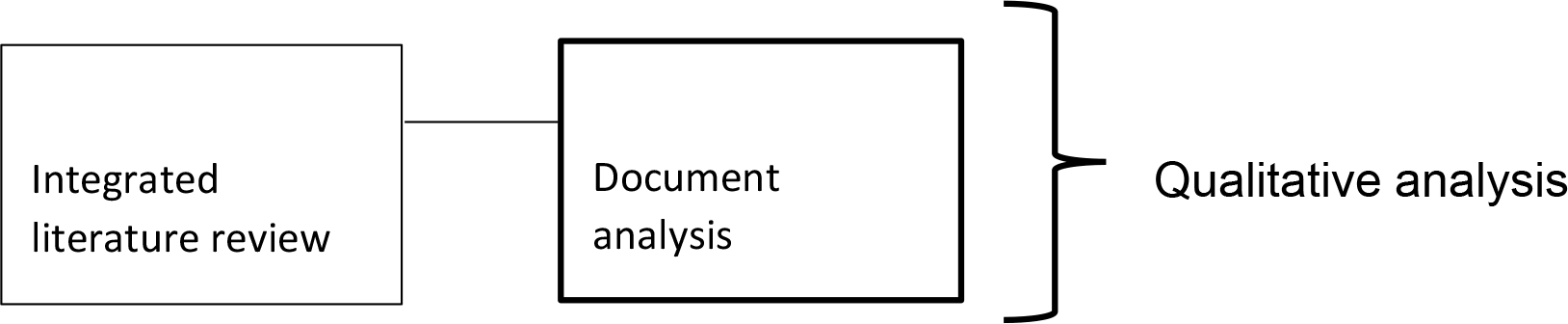
A visual representation of the methodology.
Integrated literature review
The article followed Torraco’s (2005) guidelines for conducting integrated literature reviews, namely: asking whether the topic investigated is mature or new; explaining why a literature review is the research method to address the problem earlier in the article; organizing the study with a conceptual structure of the article; describing how the review was conducted; critical analysis aligned with objectives; synthesizing new knowledge on the topic; considering the logic and conceptual reasoning; and using the review article as a catalyst for future research and a clear writing style. The guidelines assist researchers in analysing, commenting on and synthesizing available literature to develop a new theory or framework (see also Molepo and Blose, 2023).
Document analysis
The authors collected and analysed secondary data from email communication and library training ‘tutorials’ (e.g. word-processed documents) of the teaching and learning section of UFS libraries. Additionally, the authors categorized emerging data for relationships, patterns and examples using Creswell’s (2007) spiral approach. The spiral method consists of categorization or coding, classification and synthesis before the final presentation.
Results
This section presents and discusses data collected from an integrated literature review (see Molepo and Blose, 2023) and documentary evidence from library training activities at the UFS libraries.
Insights from the integrated literature review
Molepo and Blose’s (2023) integrated literature review identified concepts from models and theories. In addition to the concepts identified in the integrated literature review, this section briefly presents the first of six frames specified in the Framework for Information Literacy for Higher Education (Association of College and Research Libraries, 2016). The aim is to draw insight from the first of the six frames and its knowledge practices and dispositions to construct a valuable framework for communicating library training to first-year students at UFS libraries. As the Association of College and Research Libraries (2016: 25) puts it: “Librarians and teaching faculty need to understand that the framework is not designed to be implemented in a single information literacy session in a student’s academic career; it is intended to be developmentally and systematically integrated into the student’s academic program at a variety of levels.”
Framework for Information Literacy for Higher Education
This section discusses the first of the six frames of the Association of College and Research Libraries (2016) Framework for Information Literacy for Higher Education. The framework is the most recent, cited seminal work in information literacy. There are various models for information literacy training worldwide (see Odede (2020), for a comparative review). These models were discounted because they deal with specific ways of implementation. The authors understand that frameworks are practical as underpinning theory that shows the interrelatedness of concepts for planning purposes. At the same time, models build on frameworks to provide specific, practical solutions for implementation.
Like the preceding Information Literacy Competency Standards for Higher Education (Association of College and Research Libraries, 2000), libraries and educational institutions worldwide recognize and use the new framework for planning library training. According to Carncross (2015), aspects of the rescinded standards are still widely used even though the Framework has replaced them for Information Literacy for Higher Education. The author says that the standards will remain for some time because they were tightly woven into the information literacy course they teach. Removing the standards simultaneously requires revising the course, assignments and activities – a time-consuming and energy-consuming process. The new framework has six frames: Authority Is Constructed, and Contextual; Information Creation as a Process; Information Has Value; Research as Inquiry; Scholarship as Conversation; and Searching as Strategic Exploration.
Having established the six frames, this section focuses on the first frame (e.g. Authority Is Constructed and Contextual) of the Framework for Information Literacy for Higher Education. The reason is that the framework developed in this article focuses on library training for first first-year students in UFS libraries. The authors contend that librarians should play a significant role in planning to activate specific knowledge practices and dispositions in library training aimed at first first-year students. The framework can include other frames as students progress through their academic journey. The Association of College and Research Libraries (2016: 12:13) explains the first frame as follows: “Authority Is Constructed and Contextual Information resources reflect their creators’ expertise and credibility and are evaluated based on the information needed and the context in which the information will be used. Authority is constructed in that various communities may recognize different types of authority. It is contextual in that the information needed may help determine the authority level required. Experts understand that authority is a type of influence recognized or exerted within a community. Experts view authority with an attitude of informed skepticism and an openness to new perspectives, additional voices, and changes in schools of thought. Experts understand the need to determine the validity of the information created by different authorities and to acknowledge biases that privilege some sources of authority over others, especially in terms of others’ worldviews, gender, sexual orientation, and cultural orientations. Understanding this concept enables novice learners to examine all evidence critically—be it a short blog post or a peer-reviewed conference proceeding—and to ask relevant questions about origins, context, and suitability for the current information need. Thus, novice learners come to respect the expertise that authority represents while remaining skeptical of the systems that have elevated that authority and the information created by it. Experts know how to seek authoritative voices but also recognize that unlikely voices can be authoritative, depending on need. Novice learners may need to rely on basic indicators of authority, such as type of publication or author credentials, where experts recognize schools of thought or discipline-specific paradigms.”
Overall, we can deduce that there is a recognition that library training in higher education should continue. Library training programmes in institutions of higher learning could reap significant benefits from embracing new perspectives and world views related to information systems and sources.
Now that there is evidence of frames for improving library training programmes in university libraries, the following sub-section analyses data collected from documentary evidence at UFS libraries. The documentary evidence was analysed to gain deeper insights into the current practices of librarians at UFS libraries. Documentary evidence is crucial for understanding gaps in piloting new pedagogical approaches for communicating library training to first-year students. Data were analysed thematically with examples of direct verbatim from documents.
Documentary evidence
This sub-section analyses documents used in one-shot library training at UFS libraries. Direct verbatim from official documents (e.g. email correspondence and tutorial letters) used by librarians at UFS libraries were transcribed into categories and classifications using Creswell’s (2007) spiral approach. The categorization and classification of themes in the analyses draw from discussions about tutorial action’s significance in university education (see Guerrero-Ramirez et al., 2019). Since librarians in UFS libraries do not necessarily teach, tutorial actions can enhance the library’s support role in library training programmes. The analysis is limited to three themes: name of the library training programme and welcome message; learning outcomes; and activities. The following sub-sections present direct verbatim from one official document template for training students about various electronic resources database usage. The following results emerged from the document.
Name of the library training programme and welcome message
Having established the approach used in the analyses, this sub-section presents the results from the documents. While the paper used to communicate library training to students at UFS libraries is referred to as a ‘tutorial’, it is written in an unstructured format. Furthermore, the document does not clearly state the name of the library-training programme at the beginning. Only the terms of databases taught to students appeared at the beginning of the paper. The following blocks (refer to Figure 2) indicate the direct verbatim relating to the name of the library-training programme and welcome message.
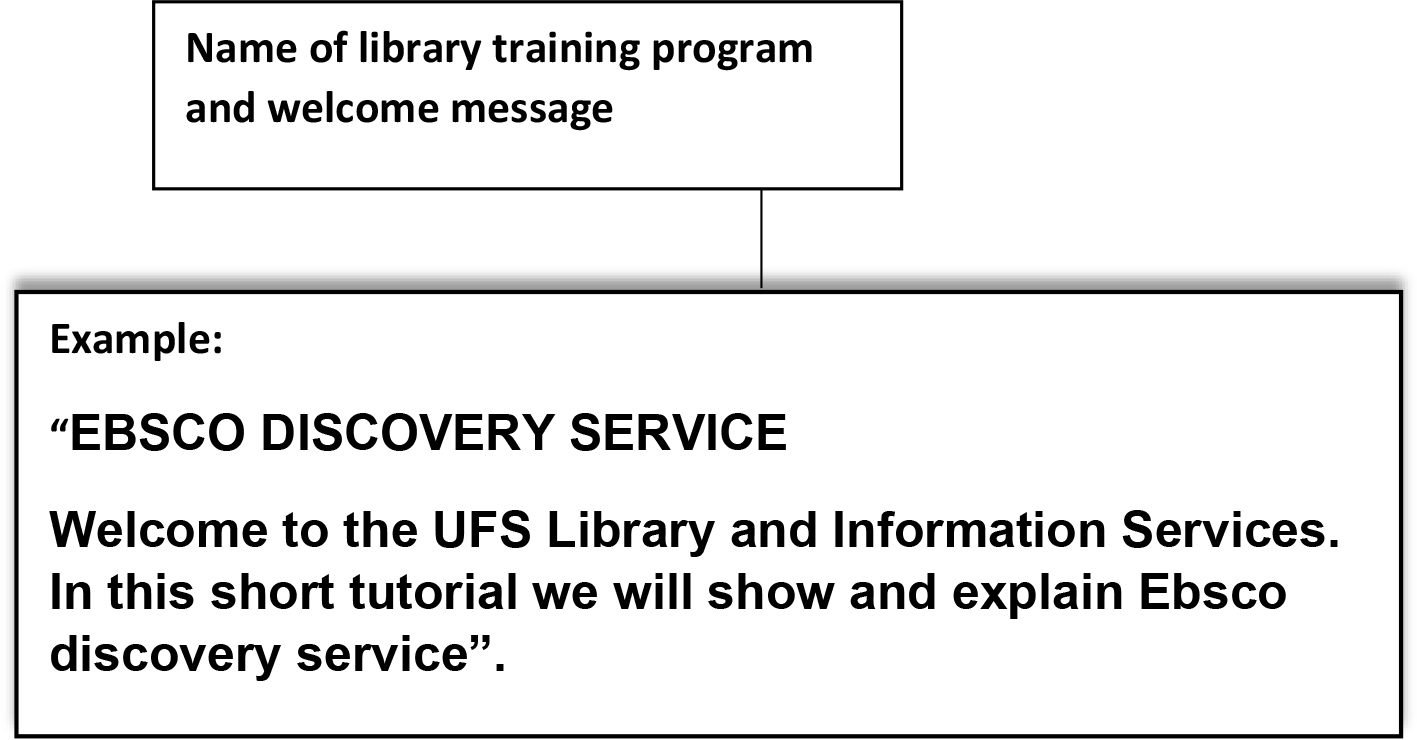
Direct verbatim showing the name of the library training programme and welcome message.
The first introductory sentence in the above document appears as a welcome message to the library training session. The following sentence describes a ‘tutorial’ for a subscription electronic resource database. The example clearly shows that the ‘tutorial’ does not adhere to standard tutorial design processes.
Learning outcomes
To understand the extent to which the official document used to communicate library training outlines learning outcomes, this sub-section focuses on the direct verbatim that follows the previous example. The analysed document does not indicate learning outcomes, as illustrated in Figure 3.
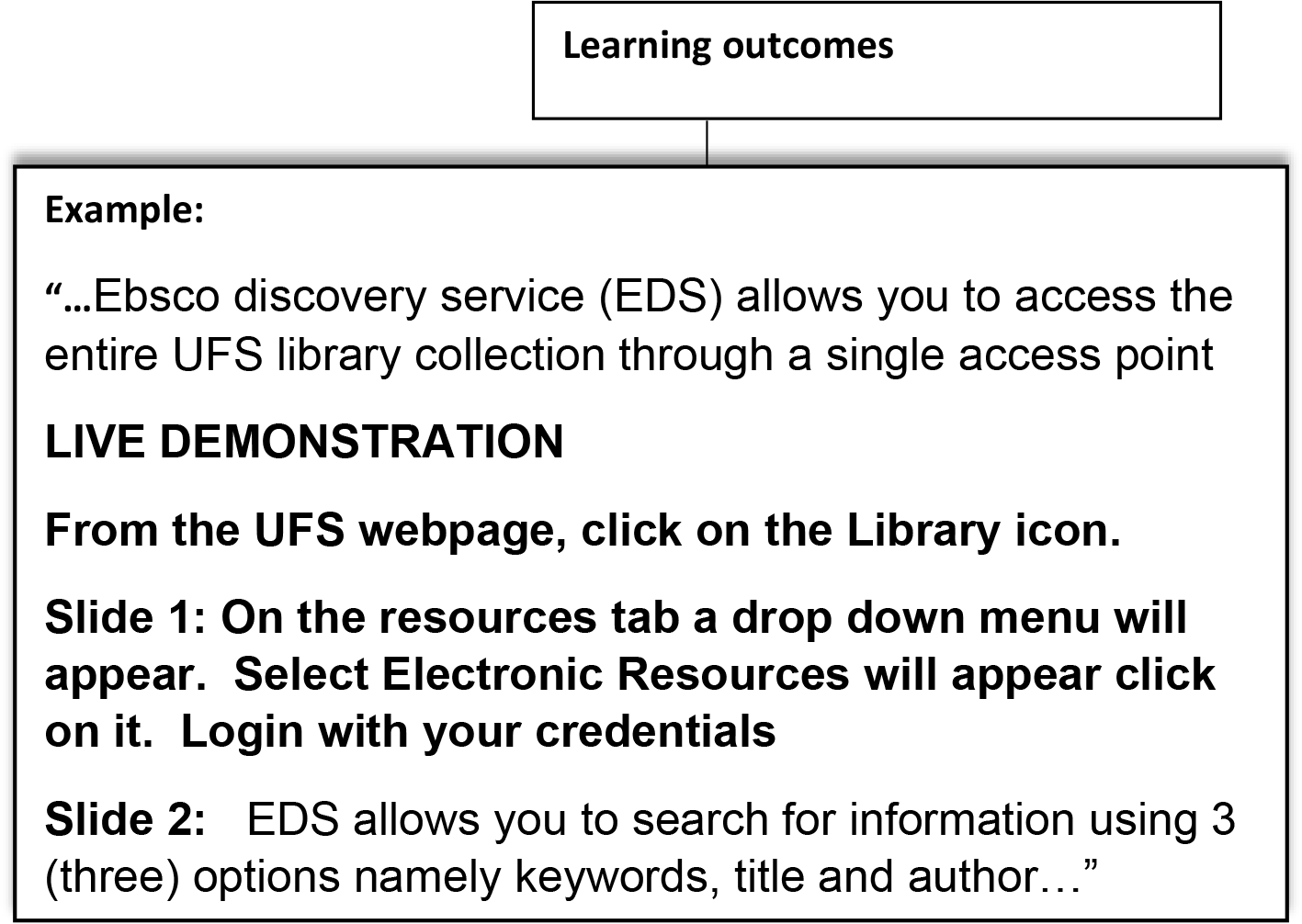
Verbatim from the document analysed shows no learning outcomes.
From the documentary evidence above, the authors deduce that there are no learning objectives to indicate the expected outcomes of the one-shot library training programme. According to the example above, the training activity moves from the welcome message to a live demonstration of the electronic resource database.
Activities
To the authors’ knowledge, the document analysed does not contain any synchronous or asynchronous activities for students. Following the ‘live demonstration’ of the electronic resource database, the training activity focuses on several numerical ‘slides’ until the end. The final part of the document ends with a thank you message and referral to the faculty librarian in case of further questions.
Recruitment message
A closer analysis of the email recruitment message for UFS library training programmes indicates that English is the primary language of instruction (refer to Figure 4). Whereas the recruitment message is distributed at least once a week, the authors have experienced low attendance rates in UFS library training programmes. Low attendance rates continue despite the blended learning approach to library training. These data imply two things: one, most students may not relate to the recruitment message because it needs to consider their diverse learning styles and linguistic, cultural and epistemological characteristics; and two, students do not relate to the message because it needs to indicate how much library training contributes to the required credits to progress their studies. Several studies share strategies for improving student library training attendance (see Galvin, 2005; Krysiewski and College, 2020; Martin et al., 2012).
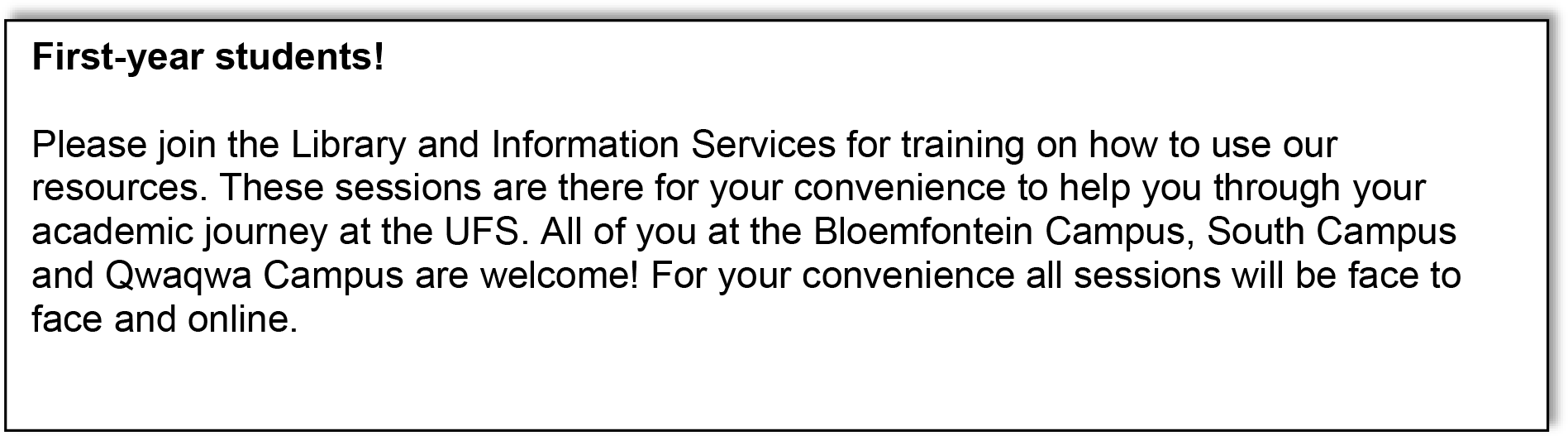
The first part of the recruitment message.
Based on the results of the integrated literature review (see Molepo and Blose, 2023) and analysis of documentary evidence, the following sub-sections will present a framework that could be useful for communicating library training to first-year students in UFS libraries.
Authority Pedagogy Socialization (APS) framework
This sub-section presents the APS framework. The APS framework (refer to Figure 5), works within transformative (Mertens, 2003) and social constructivist (Mohammed and Kinyo, 2020) frameworks to encourage new pedagogical approaches in library training at UFS libraries. The framework synthesizes selected concepts identified in the integrated literature review by Molepo and Blose (2023), namely: information source (Shannon and Weaver, 1964); three generations of pedagogy (Anderson and Dron, 2011); social learning (Bandura, 1977); and authority as constructed and contextual (Association of College and Research Libraries, 2016).
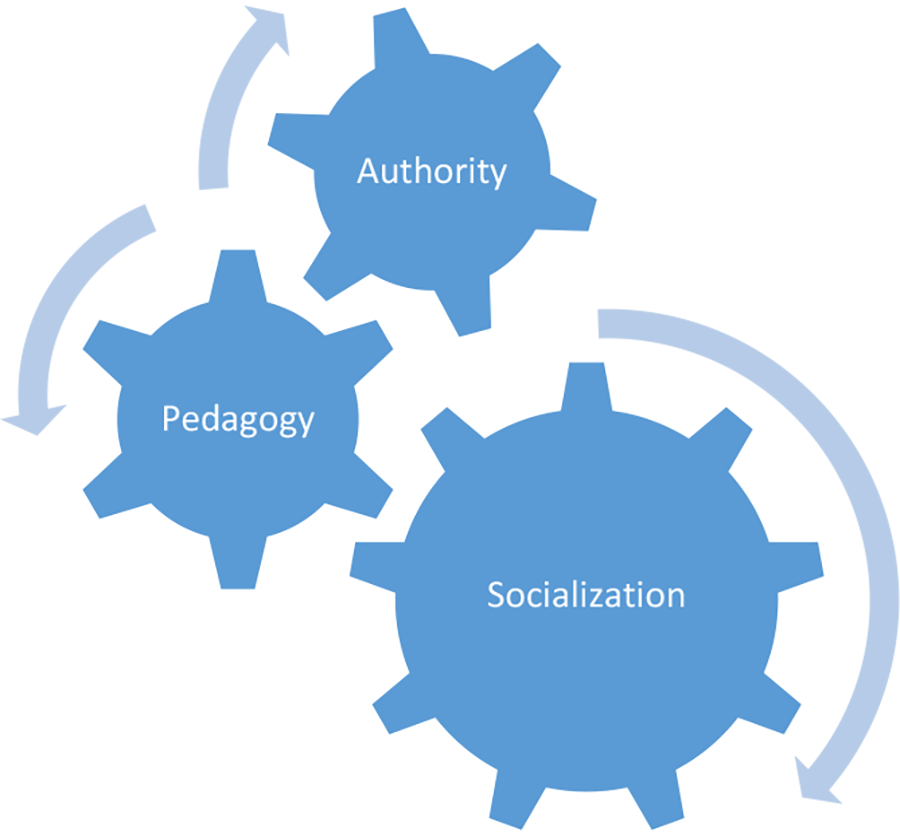
Authority Pedagogy Socialization framework.
The framework is born out of the belief that librarians can significantly encourage first-year students to think critically and embrace new perspectives and diverse ways of knowing in previously marginalized communities. Research shows that historically, library training went beyond teaching users how to use systems by including encouraging learners to think critically, participate actively in learning and learn new concepts (Grassian and Kaplowitz, 2010). Universities also recognize the need to transform teaching and learning methods to enable students to compete globally while focusing on local concerns. As the Revised Integrated Transformation Plan (University of the Free State, 2022: 6) puts it: Much of the curriculum traces back to isolation years or is stuck in a past that neither reflects contemporary global thinking nor shows sufficient respect for local understanding, experience, and problems. Students do not feel recognized in their human fullness and feel that their knowledge and the knowledge produced by their communities are not valued. At the same time, we need to be fully engaged in global conversations and disciplinary, multidisciplinary, and transdisciplinary debates. An achievement gap, particularly between black and white students, needs to be addressed.
The frames
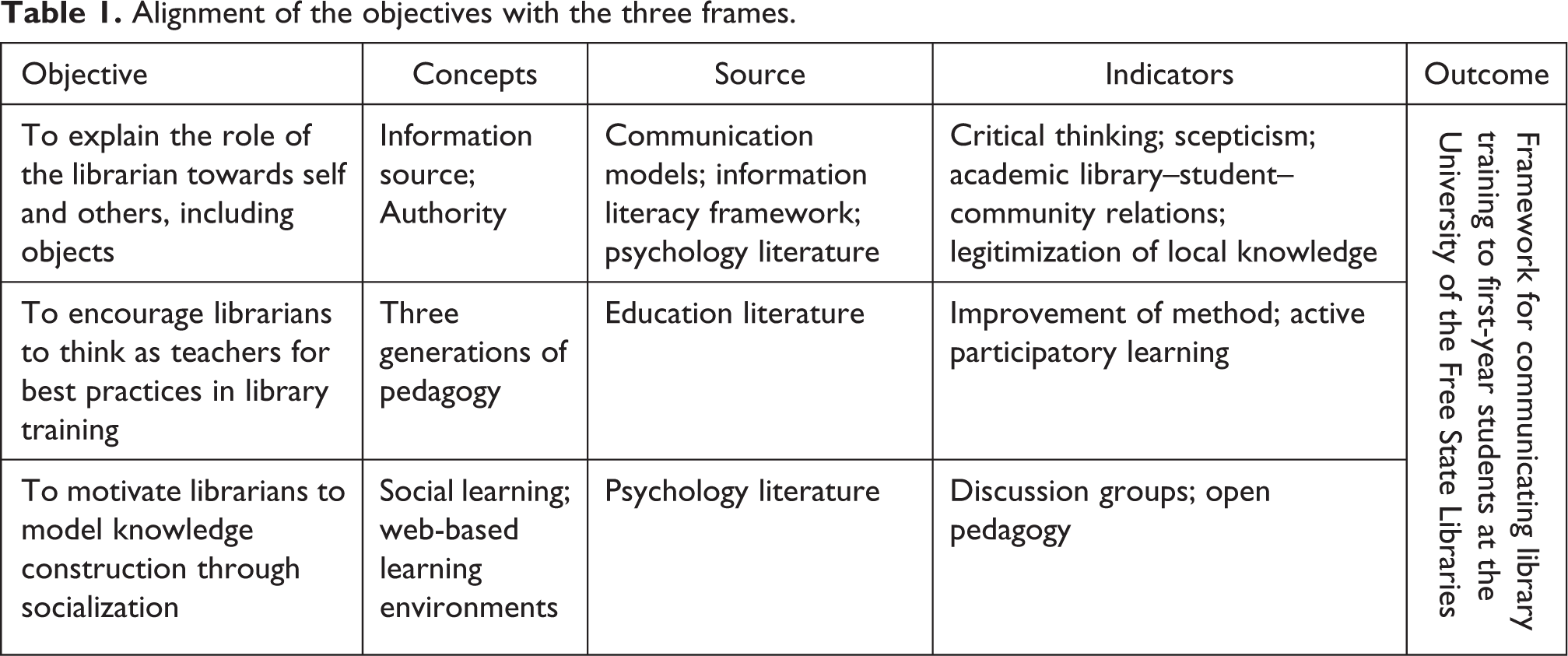
This sub-section presents the three core frames of the APS framework: authority; pedagogy; and socialization. Table 1 illustrates the alignment of the objectives with the three frames.
Alignment of the objectives with the three frames.
Authority
This sub-section addresses the first of the three frames of the proposed APS framework. Within the context of local communities, authority within the UFS libraries should be constructed through a partnership between students, librarians and domain experts. UFS is a multi-campus institution with diverse campuses in Bloemfontein (two) and one in QwaQwa (University of the Free State, 2022). These three campuses consist of a diverse student population represented by prevalent languages such as Sesotho, Afrikaans, English, IsiZulu and IsiXhosa. The QwaQwa campus is located in an area historically consisting of mainly black African ethnic groups such as Makholokoe, Bakoena and Batlokoa, united under the name QwaQwa (Raper, 2016). These communities consist of local paradigms and knowledge, also called indigenous knowledge systems. The United Nations Educational Scientific and Cultural Organization (2021) explains that “local and indigenous knowledge refers to the understandings, skills, and philosophies developed by societies with long histories of interaction with their natural surroundings. For rural and indigenous peoples, local knowledge informs decision-making about fundamental aspects of day-to-day life”.
Using the UFS QwaQwa campus as an example, librarians need to acknowledge that students do not only rely on the library’s information resources for their daily information problems. Their information needs are also driven by different problems encountered daily within their communities. Instead of focusing only on teaching students how to use the UFS library systems in one-shot library training sessions, librarians should construct authority through innovative approaches to library training programmes. Innovative approaches require self-reflection on the part of the librarian. Reflecting on the procedures for information seeking, searching and retrieval used in library training programmes can pave the way for new designs based on students’ subjective experiences. The librarian knows by situating the library training programme for redesigning processes in students’ experiences. Figure 6 illustrates a case in point.
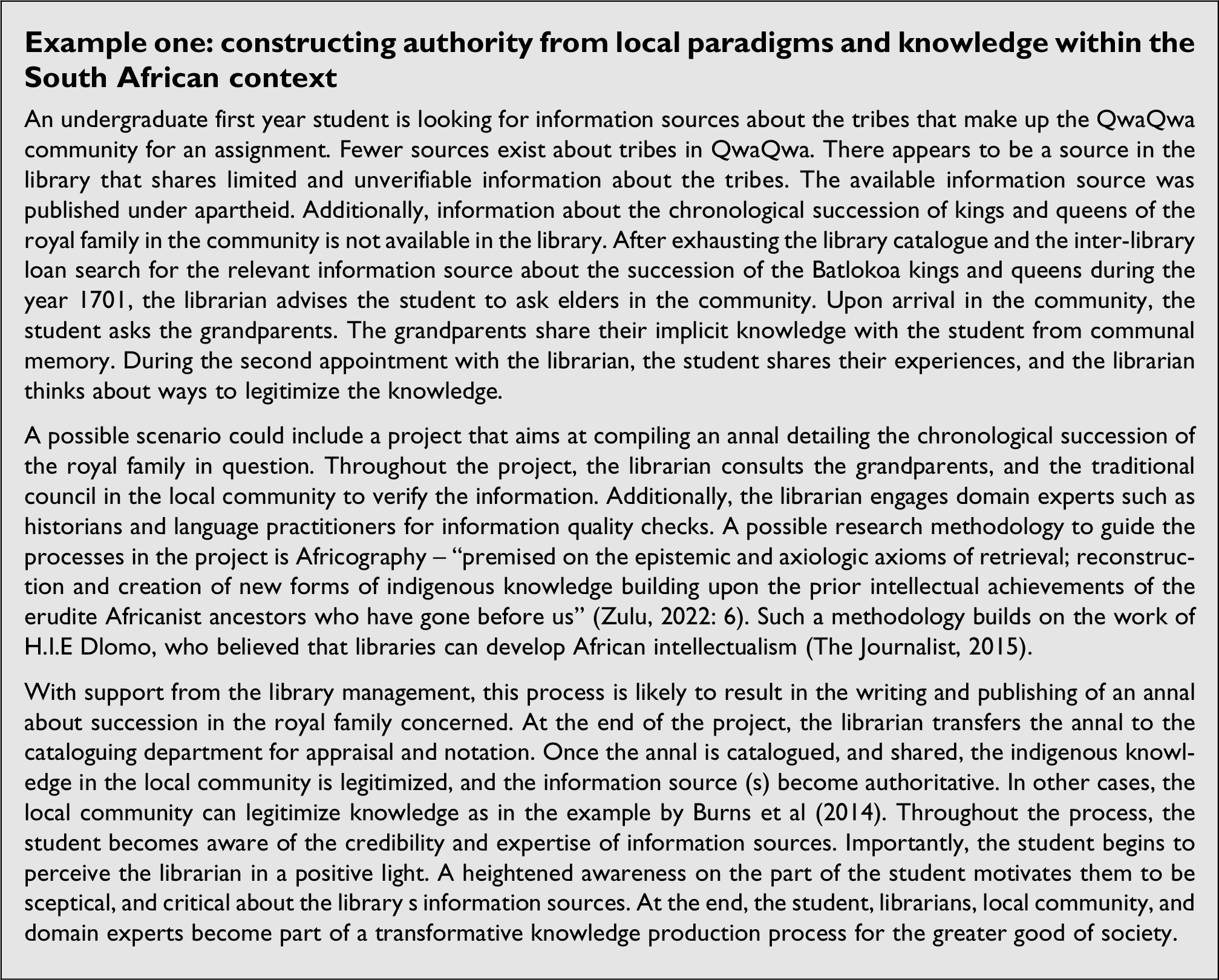
Constructing authority from local paradigms and knowledge.
A library training programme based on the students’ subjective experiences has the potential to motivate students to change their perceptions of the librarian. The librarian’s acknowledgement of diverse information resources places them in a better position to encourage students to be critical information seekers and users. Indicators should include critical thinking, scepticism, library–student–community relationships and legitimization of local knowledge. This will require innovation in the teaching and learning activities of the library training programme.
Pedagogy
This sub-section presents pedagogy as a second frame of the proposed APS framework. Noe (2013) asserts that a change of perception from librarians can bring benefits in examining one’s teaching style, developing and implementing improved pedagogies, class planning and awareness of how students learn. A pedagogically inclined academic library workforce is necessary for engaged scholarship.
Education pedagogies were constructed from various worldviews. There are widely used learning theories in education: cognitive behaviourism; social constructivism; and connectivism (Anderson and Dron, 2011). It has become customary for UFS librarians to take a top-down approach to library training, which implies an allegiance to the cognitive-behaviourist theory. A pedagogically inclined library workforce is likely to introduce acceptable universal design principles (Mcquire, 2011) that recognize the diversity of learners in instructional material (e.g. tutorials and study guides). Content can combine text, images, video and audio. Content could be structured as a module consisting of a welcome message, learning outcomes, learning units and a list of references consulted. Library training pedagogy in UFS libraries is necessary for face-to-face and web-based learning environments (e.g. Blackboard).
Lessons from the 2021 UFS Learning and Teaching Conference indicate a paradigm shift in teacher–learner relationships. For example, the conference name starts with the construct ‘learning’ instead of ‘teaching’. A similar approach was taken for the 2022 Learning and Teaching Conference (University of the Free State, 2021). Alignment with changes at the institutional level can assist UFS libraries in addressing fragmentation in library training programmes.
Librarians in UFS libraries may benefit from identifying different education classifications, namely education based on educational technology and technology teachers (Hansen, 1998; Stošić, 2015) and education based on learners’ experiences and the socialization of educators (Leal-Rodŕiguez and Albort-Morant, 2019; Hansen, 2000). As in the example in Figure 6, the librarian may centre their training on collaboration and two-way communication with the students for engaged scholarship. Indicators should include improvement of method and active participatory learning. One way of centring UFS library training programmes on student experiences is through socialization.
Socialization
This sub-section presents the third and final frame of the proposed APS framework. Librarians in UFS libraries may benefit from socialization that is two-pronged: socialization of self; and socialization of learners. According to Šaras and Perez-Felkner (2018: 1), socialization “is the multifaceted process through which individuals learn and internalize cultural norms, codes, and values. This process enables entry into and sustained membership in one or more social groups. Individuals develop social and cultural competencies through (1) interaction with other individuals and social institutions and (2) response to their macro- and micro-sociocultural contexts”. Librarians in UFS libraries already belong to a diverse environment of distinct cultures, languages, norms and values. Due to the history of apartheid, librarians and learners from mostly black African ethnic groups were socialized into Anglo-Saxon and Afrikaner culture, language, norms and values. Present-day South Africa is based on fairness, liberty, equality and inclusion, enshrined in the Constitution of the Republic of South Africa (Republic of South Africa, 1996). What better way to have social learning (Badura, 1977) between librarians, students, domain experts and local communities reciprocated between diverse cultures, languages, values and norms? Indicators should include discussion groups and open pedagogy, where librarians can explore the interface between open pedagogy and open educational resources on connected platforms.
Conclusion and recommendations
In conclusion, this article developed a framework for communicating library training to first-year students at UFS libraries. The framework is born out of the belief that UFS Librarians can significantly motivate first-year students to think critically and embrace new perspectives and diverse ways of knowing. Instead of focusing only on teaching students how to use the UFS library systems in one-shot library training sessions, librarians should construct authority through new pedagogical approaches to library training programmes. Since “academic librarians are not required to have educational or practical training in pedagogy, either through coursework or practicum experiences” (Hess, 2018: 8), it is in the best interest of the librarian in UFS libraries to seek innovative approaches to library training programmes. A decision must be made about the type(s) of literacies UFS librarians teach students. Onyancha (2020) identified 75 types of literacies in the literature. Diversifying the literacies taught to students and employing innovative approaches requires self-reflection on the part of the librarian. In other words, a return to the central unit of analysis in the core business of academic libraries – information. Without initiative, librarians in UFS libraries will find it challenging to adapt to a changing higher education landscape.
This article makes the following recommendations:
Strengthen the activity referred to as ‘library training’ with an information literacy programme(s) for undergraduate and postgraduate students.
Entrench the librarian as a facilitator of critical information literacy approaches (e.g. for teaching and learning purposes) and restore credibility.
Prioritize the student’s voices in library training programmes.
Conduct further research with students, librarians and academics in UFS libraries to ascertain their perceptions and understanding of information literacy programmes.
Socialization between UFS librarians and first-year students should occur in person or online through a learning management system such as Blackboard. In-person activities can include face-to-face focus groups discussing content presented during library programmes. Online discussion groups can be hosted on Blackboard’s discussion board, where threads can be organized around a particular information literacy topic.
Assume the new role of teacher–librarians.
Whereas academic librarians do not teach, they should adopt acceptable facilitation methods and be designing learning materials and tutorials to support first-year students’ learning and research activities.
Introduce library training using a five-stage framework for online activities (Salmon, 2002) and other learning strategies for improving library training.
Work within the social constructivist learning theory in addition to existing ones.
UFS librarians should be role models and set examples for a reciprocal socialization process.
Collaborate and train students using real-life scenarios and problem-solving techniques not far-fetched from the language and culture of the student.
Incorporate learning theories into the library training programme.
Reform library training for adherence to conventional curriculum and pedagogical practices. Renewal should focus on making information literacy programmes credit-bearing.
Embrace education pedagogies in the Teaching and Learning Section of UFS libraries.
Collaborate with learning designers for support departments.
Renew the relationship with the Centre for Teaching and Learning to address the fragmentation of teaching practices in UFS library training.
Support the reskilling of librarians on effective teaching and learning practices in collaboration with internal stakeholders. An example could be arranging a weeklong workshop where librarians are introduced to learning theories, curriculum development, facilitation, instructional design (e.g. tutorial development) and more. Kleinveldt et al. (2016) affirm that increased support from management is crucial for enhancing lecturer–librarian collaboration. Similarly, support from library management is vital for teacher–librarians.
Librarians in other South African university libraries should conduct further research to discover what holds in their contexts. Multi-case and comparative study designs can be helpful in this regard.
Footnotes
Declaration of conflicting interests
The authors declared no potential conflicts of interest with respect to the research, authorship, and/or publication of this article.
Funding
The authors disclosed receipt of the following financial support for the research, authorship, and/or publication of this article: This work was supported by the University of the Free State Libraries (grant numbers UFS09 and UFS10).
