




Abstract
The Saskatchewan Aboriginal Storytelling project is a month-long event in Saskatchewan, Canada, which celebrates the lives, histories, practices and cultures of First Nations, Métis, Inuit and non-Status peoples through storytelling. The Library Services for Saskatchewan Aboriginal Peoples committee oversees the project and employs a coordinator, who applies for grants, coordinates the project’s guidelines, and is the contact for site funding and event reporting. Since its launch in 2004, the Saskatchewan Aboriginal Storytelling project has grown significantly and has effectively promoted traditional storytelling, supported a network of Aboriginal storytellers, and helped to create stronger relationships between Aboriginal peoples and libraries. The Saskatchewan Aboriginal Storytelling project is a dynamic methodological and theoretical model for decolonizing library spaces, programmes and collections through celebrating Aboriginal oral traditions.
Introduction
In the Canadian library and information science field, Indigenous librarianship and library services are slowly gaining recognition as a unique branch of the library profession in that it emerged due to colonialism in civilizations where the dominant values of mainstream librarianship were imported by colonizing races and do not reflect the information management needs of the pre-existing culture. (Doerksen and Martin, 2015: 2)
Despite the recognition of Indigenous peoples as a unique service population, modern libraries, which developed from classical Mediterranean intellectual traditions, continue to serve as public institutions that promote and propagate the values of a settler colonial state. Although recently scholars have attempted to critically examine the history of libraries and library services, all too often the library is viewed as an egalitarian institution providing universal access to information for the general public. However, such idealized visions of a mythic benevolence tend to conveniently gloss over the library’s susceptibility in reproducing and perpetuating racist social structures found throughout the rest of society. (Honma, 2005: 2)
This article proceeds from the understanding that decolonizing libraries involves systemic change to policies, collections, spaces, services and attitudes (Callison, 2017; Edwards, 2019; Kelly, 2010; Lee, 2011). Library decolonization starts with becoming aware of and ‘acknowledging the structural biases and inadequacies in existing schemes of knowledge organization and information retrieval arising from colonialism’, as well as ‘review[ing] assumptions and paternalistic policies that have previously shaped approaches to service delivery and outreach’ (Callison, 2017: 28, 39). Consistent with the SAS project’s praxis, which is situated within applied librarianship, this article primarily focuses on describing and analysing the dynamic approach to decolonization taken by the SAS project.
This article presents the SAS project from an internal, Indigenous, perspective. The author of this article is an Indigenous librarian (holding a Master of Library and Information Science degree) who has been involved with the SAS project since 2007, first as the librarian at a host site for SAS events and now as an executive committee member of the parent organization, the Library Services for Saskatchewan Aboriginal Peoples (LSSAP) committee. This article was prepared in collaboration with the SAS coordinator and the LSSAP executive, and an effort has also been made to prioritize the writings of Indigenous peoples throughout the article. Additionally, the format of this article mirrors the SAS project development process – beginning with methodology (doing) and then moving into theory (thinking about why we do what we do).
Started in 2004, the SAS project is a province-wide annual event in Saskatchewan, Canada, which celebrates the lives, histories, practices and cultures of First Nations, Métis, Inuit and non-Status peoples through bringing traditional Aboriginal storytelling into libraries. The LSSAP committee oversees the SAS project and employs an SAS coordinator to handle the administrative details. Over the last 15 years, the SAS project has promoted traditional storytelling, supported a network of Aboriginal storytellers in Saskatchewan, and helped to create stronger relationships between Aboriginal peoples and libraries. The SAS project is continually creating and recreating itself based on changing environmental circumstances and user feedback/participation. This commitment to two-way communication and continuous adaptation is the hallmark of dynamic library service delivery (Ezeani and Igwesi, 2012). Despite challenges in recent years, the SAS project is a very successful dynamic applied model for decolonizing library spaces, programmes and collections.
General background
The LSSAP committee began in 1991 when Maureen Woods, Lynne Hunks and Wendy Sinclair ‘discussed establishing a committee on library services for Aboriginal people’ (Lee, 2016: 4). Situated within the wider Saskatchewan context, which strongly supports multi-type library cooperation (Shires, 2015), the committee quickly became a non-profit working group with Indigenous and non-Indigenous members representing public libraries, academic libraries, special libraries, other literacy organizations and the Saskatchewan Provincial Library. In 1992, LSSAP hosted a conference, ‘Empowering People Through Libraries’, which brought delegates together to discuss challenges and best practices in libraries (Lee, 2016). LSSAP’s work and the 1992 conference contributed to bringing the issues surrounding Indigenous library services to the attention of the wider Saskatchewan library community. At that time, the issues included financial and social barriers to service, low numbers of Indigenous library staff, and collections and programming that did not reflect Indigenous cultures.
As a result of LSSAP’s advocacy efforts, from 2000 to 2001, LSSAP committee members participated in the Minister’s Advisory Committee on Library Services for Aboriginal People, which was formed to address two specific areas of concern regarding Saskatchewan public library services for Aboriginal people: the barriers to public library services that existed for on-reserve First Nations members and the low numbers of off-reserve First Nations and Métis peoples using public libraries. The Minister’s Advisory Committee’s 2001 report, Information is for Everyone, contained 46 recommendations for improving public library services for Indigenous people and resulted in the provincial government allocating additional funding to the public library system to provide those services. Additionally, the report contained the recommendation ‘that an official Storytelling Week occur in February of each year, throughout the province to promote First Nations and Métis oral traditions and the use of public libraries’ (Minister’s Advisory Committee, 2001: 37). LSSAP acted on this recommendation by initiating the SAS project.
Description of the SAS project
The SAS project began in 2004 and is currently in its 17th consecutive year of operation. What began as a modest week-long project with 21 storytelling sessions hosted in 18 locations that attracted 2813 attendees has grown into a large-scale, month-long annual project that in 2018 was able to distribute CAN$76,586 to support 345 storytelling sessions hosted in 129 locations which attracted 21,344 attendees. When assessed using standard programming output statistical measures, it is clear that the SAS project has grown steadily and become very successful in the years since 2004 (Figures 1 and 2).
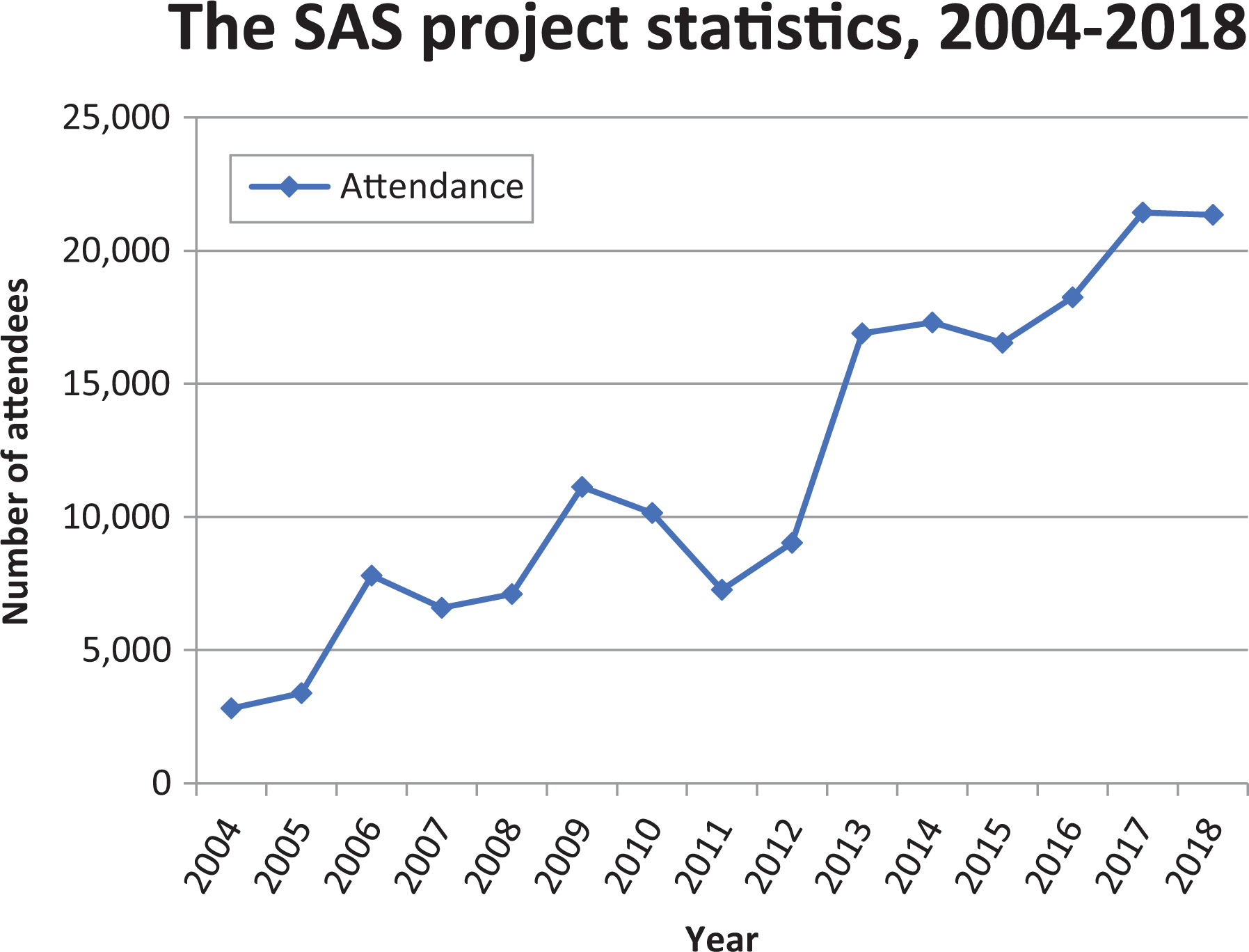
SAS project attendance statistics.
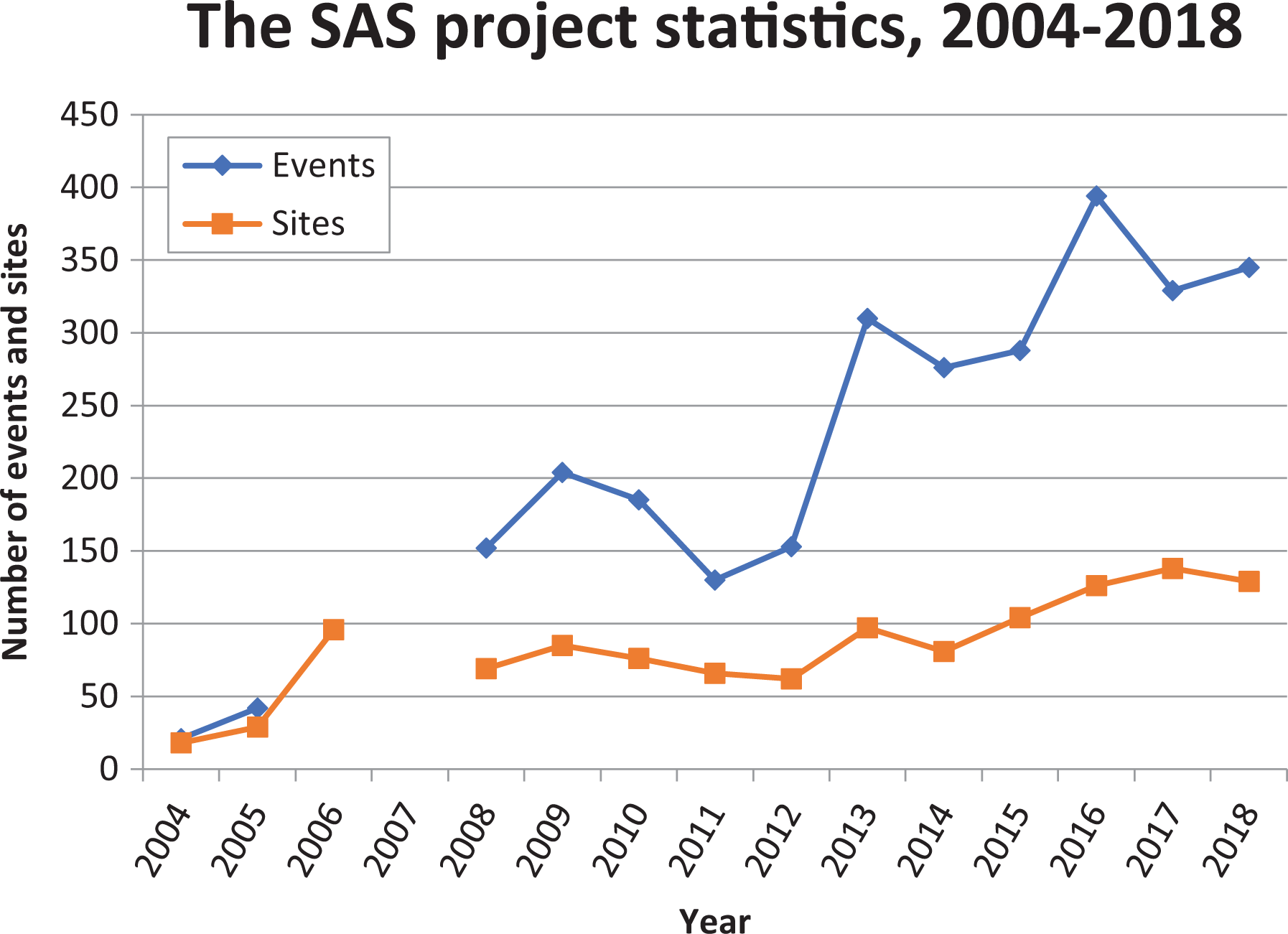
SAS project event and site statistics.
Indeed, the SAS project has grown to such a large size that LSSAP now contracts out administrative tasks to the SAS coordinator. The SAS coordinator works with the SAS committee and applies for grants and sponsorships on behalf of LSSAP. The coordinator promotes SAS to libraries and organizations, distributes SAS funding application packages and guidelines to host organizations, and receives and organizes the SAS funding applications for the SAS committee to review and approve. Once the SAS committee approves applications and decides on funding allocations, the coordinator notifies the event sites, distributes event packages and works with the host organizations to support their SAS events. The coordinator also receives SAS event reports from the host organizations; reviews event financial reports with the LSSAP treasurer in order to distribute funds to host organizations; maintains a database of storytellers; prepares all the grant and sponsorship reports on behalf of LSSAP; and presents an annual SAS report to the LSSAP committee. The SAS coordinator and the tasks they accomplish are an integral part of the success of the SAS project and have contributed to its long-term stability.
The LSSAP committee also assesses the success of the SAS project using impact and goal-achievement measures. LSSAP originally set four goals for the SAS project: to increase province-wide the cultural activity levels of Aboriginal peoples; to promote and enhance cross-cultural understanding; to demonstrate the cultural and historical value of storytelling; and to celebrate Aboriginal cultures by promoting, preserving and enjoying First Nations and Métis oral traditions. It is clear that the SAS project has had significant successes over the years in terms of meeting these four goals. In 2018, for example, the SAS project involved 63 Elders and storytellers, whose contact information, areas of specialization and travel preferences were included in a standing database of Indigenous storytellers that is made available to SAS grant applicants. This list includes traditional storytellers who speak in a variety of Indigenous languages, published Indigenous authors, Indigenous musicians and performance artists, children’s performers and Indigenous academics. The SAS project connects these storytellers, many of whom would otherwise be unavailable, with host locations, thereby increasing connections between Elders and youth, Indigenous and non-Indigenous peoples, and experienced and emerging Indigenous storytellers. Additionally, the SAS project continues to be assessed positively in the feedback that is received from session participants, who indicate that these events provide good to exceptional experiences for students, audiences, storytellers and the hosting locations.
Since 2004, the SAS project has grown to include a variety of storytelling formats. Storytellers can be Elders who tell traditional Indigenous stories in their own languages; professional puppeteers who tell Indigenous stories interactively to audiences; musicians who play traditional Indigenous instruments while sharing cultural information with listeners; Indigenous performance artists who first immerse audiences in a shared experience and then talk about their stories; or published Indigenous authors who share their stories, poems and histories. As technology changes, the SAS project has incorporated those changes. For example, in 2018, the SAS project provided funding for a community project where youth in two First Nations communities wrote songs about their collective stories, created music videos and posted the music videos on YouTube. As well, LSSAP currently maintains a website where information on all the SAS projects since 2013 is archived and accessible to the public (lssap.wordpress.com).
Challenges to the SAS project
In recent years, a number of challenges have emerged. LSSAP is a non-profit organization and the SAS project is dependent on government grants and organizational sponsorships. In the last few years, this has left the SAS project vulnerable to economic recessions and changing application criteria, and has affected the amount of funding the SAS coordinator is able to access successfully. As with many public service organizations, the SAS committee struggles to do more with less and has had to make some hard decisions about SAS project applications. A second challenge comes from the changing definitions and understandings of storytelling. Many host organizations have pushed the boundaries of traditional storytelling into new frontiers. Some of the changes have been exciting extensions of Aboriginal storytelling, while others have moved into the realms of professional development and experiential history lessons. In response, the SAS committee has had to create a number of guidelines that clearly lay out what the SAS project will not fund and define what types of events are not considered Aboriginal storytelling.
A third challenge has occurred because of the focus on standard programming output statistical measures – particularly, attendance and event numbers. In order to drive up attendance numbers, many libraries are partnering with schools and hosting the SAS project in school facilities. Although this does result in larger audiences and builds valuable partnerships between organizations, it has also resulted in deprioritizing the connection between the SAS project and library services for Aboriginal people. For instance, in 2018, the SAS event evaluations revealed that approximately 10% of the respondents felt that their event did not promote awareness and use of libraries, and did not help to create a stronger relationship between libraries and Aboriginal communities. This is a significant area of concern for the SAS committee and resulted in the prioritizing of in-library events for 2019 funding. Ultimately, the SAS committee has decided that reaching the impact goals of the SAS project is more important than achieving high statistical outputs, although this may have implications for future SAS project governmental grant and organizational sponsorship applications.
Discussion and analysis
Overall, the SAS project is intended to promote library services for Aboriginal people and decolonize library collections and spaces. It works to achieve the goals of the Calls to Action that were released in 2015 by the Truth and Reconciliation Commission of Canada and the 2017 recommendations of the Canadian Federation of Library Associations – Fédération canadienne des associations de bibliothèques (CFLA–FCAB). In response to the Calls to Action, the CFLA–FCAB established a Truth and Reconciliation Committee, which released a report containing overarching and granular recommendations that the CFLA–FCAB and all Canadian libraries could take in order to advance reconciliation and decolonize library collections, services and spaces. Some of the overarching recommendations included encouraging libraries to implement the 94 Calls to Action; ensuring accessibility of library materials and services; decolonizing access and classification in library cataloguing; decolonizing library spaces; and implementing Indigenous Knowledge Protection protocols and agreements to respect Indigenous concepts of copyright (Callison, 2017). The SAS project provides a practical applied method for implementing the Calls to Action by making library materials accessible in an oral format.
The SAS project contributes to decolonizing library collections and spaces by prioritizing an experiential and interactive engagement with the spoken word as it is expressed through Aboriginal oral storytelling. For Indigenous peoples, oral traditions and storytelling are much more than entertainment. Storytelling is ‘crucial to the cultural and political resurgence of Indigenous nations’ (Corntassel et al., 2009: 137). The act of storytelling expresses resistance to colonization and a commitment to resurgence, decolonization and Indigenous knowledge production for both the storyteller and the listeners (Sium and Ritskes, 2013; Wilcox et al., 2012). Consistent with an Indigenous understanding of the value and intent of storytelling, the SAS project embeds respect for Indigenous knowledge protection and Indigenous concepts of copyright in the event-hosting guidelines that hosting organizations must agree to in order to access SAS event funding.
Not only does the SAS project contribute to a methodology for decolonizing libraries, but it is also consistent with a theoretical understanding of decolonizing. Dian Million (2014: 35) has argued that Indigenous people embed theoretical concepts of how the world works in stories and narratives, and that ‘story is Indigenous theory’. Million’s body of work was developed within the canon of Indigenous feminisms and it exposes ‘colonialism as it is felt by those whose experience it is’ (Million, 2009: 58). She focuses on intellectual and academic decolonization as an active practice (Million, 2011: 317) and, throughout her body of literature, Million (2008: 268) continuously returns to and emphasizes ‘what can be achieved by felt action, actions informed by experience and analysis, by a felt theory’.
The SAS project is acting to decolonize libraries based on the felt experience of Aboriginal library staff and patrons. The SAS project removes the Euro-western-based conceptual boundaries between collection development and programming by creating an experiential traditional oral storytelling collection that can be accessed by Saskatchewan library staff and patrons annually during the month of February. The SAS project is acting to create a library experience based on holistic Aboriginal values – values that are felt and expressed by Aboriginal storytellers. The SAS project is also working to create an inclusive library experience that respects and reconciles Indigenous and non-Indigenous library staff with each other and with Indigenous and non-Indigenous library patrons.
Conclusion
The SAS project provides an important methodological and theoretical approach for positively and collectively addressing the issues of racism and white privilege inherent in Canadian libraries. With this project, the LSSAP committee has clearly created an important ethical space (Ermine, 2007) wherein Indigenous storytelling and Saskatchewan libraries can come together in order to shift the status quo of the colonial state. However, the future of the SAS project depends on continued engagement with multiple stakeholders and on successfully securing annual project funding, as well as making difficult decisions about how to assess the programme’s success.
LSSAP now calls to the wider library community to engage with Indigenous oral traditions within the context of print-based libraries. In this way, the decolonization of library collections, programmes and spaces truly becomes ‘reconciliation [as] a process and an ongoing relationship between non-Indigenous and Indigenous people’ (Blair and Wong, 2017: 4). Just as Canadian libraries have played a role in colonization, so they must play a role in decolonization and reconciliation, as institutions wherein everyday relationships occur between Indigenous peoples, settlers and new immigrants. In order to become decolonial spaces and places, libraries must approach and implement decolonization based on non-coercive, non-adversarial and non-antagonistic Indigenous values. Or, as Métis storyteller and activist Isaac Murdoch says: ‘it’s more effective to be for something, rather than against something’ (personal communication, 12 October 2018). As is clearly seen in this article, LSSAP and the SAS project are for something: decolonization and reconciliation within libraries.
Footnotes
Acknowledgements
Contributions to this article were made by Harriet Roy, chairperson of LSSAP, and Carol Vandale, a SAS coordinator. This article was prepared on behalf of the 2018–2019 LSSAP committee, and the committee would like to acknowledge all the current and past members of LSSAP, all the past SAS coordinators, all the SAS storytellers and all the many staff at the SAS host organizations for their contributions to this project.
Declaration of conflicting interests
The author declared no potential conflicts of interest with respect to the research, authorship and/or publication of this article.
Funding
The author disclosed receipt of the following financial support for the research, authorship, and/or publication of this article: The LSSAP committee acknowledges that the following agencies provided funding for LSSAP and the SAS project during the time that this article was being prepared for publication: the Community Initiatives Fund, SaskCulture Inc., the Saskatchewan Arts Board, the Saskatchewan Government’s Office of the Provincial Interlocutor, the Canadian Council for the Arts, SaskTel and other provincial corporations, and the Saskatchewan Indian Gaming Authority and other casino organizations.
