




Abstract
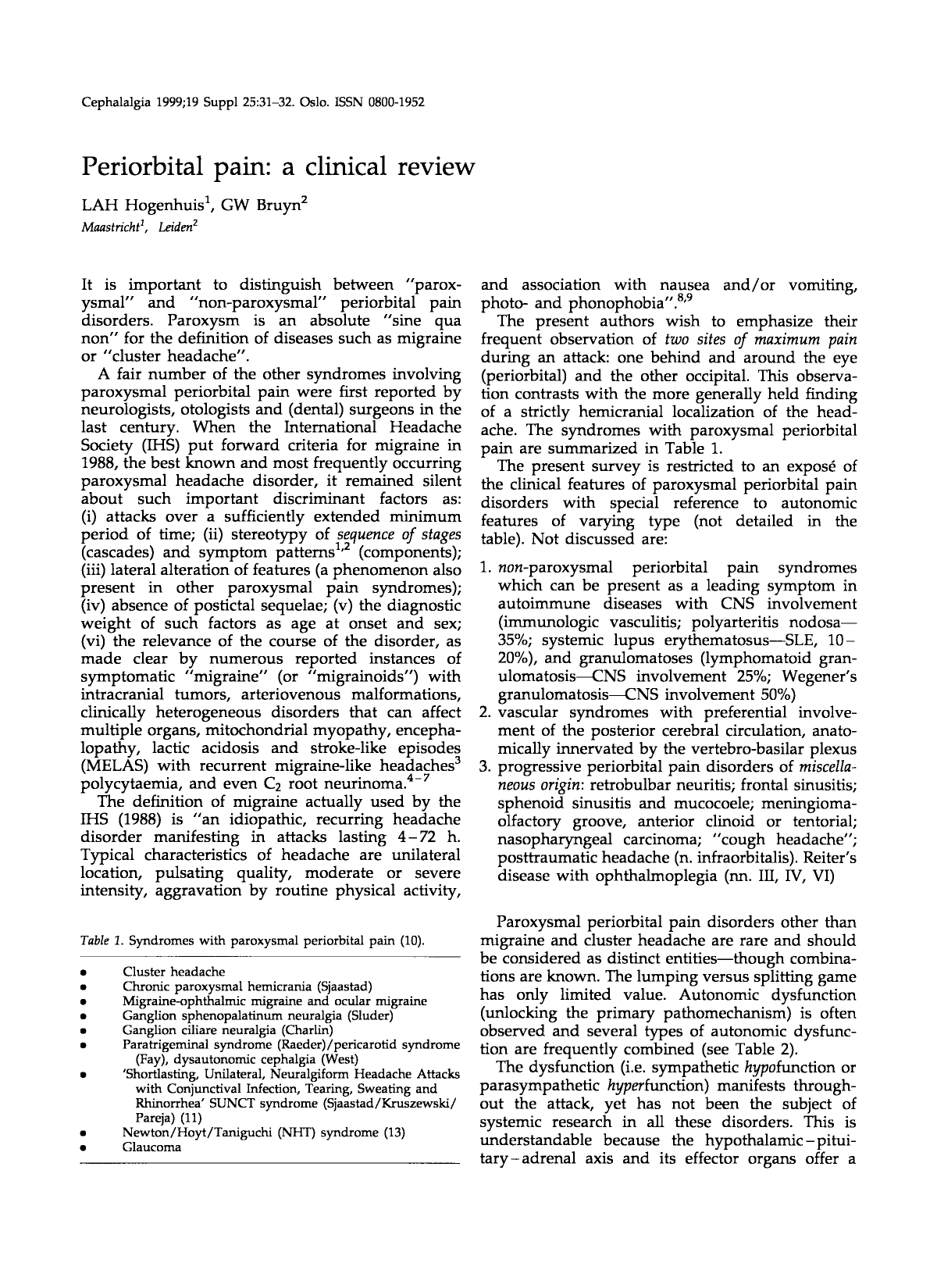
It is important to distinguish between “paroxysmal” and “non-paroxysmal” periorbital pain disorders. Paroxysm is an absolute “sine qua non” for the definition of diseases such as migraine or “cluster headache”.
A fair number of the other syndromes involving paroxysmal periorbital pain were first reported by neurologists, otologists and (dental) surgeons in the last century. When the International Headache Society (MS) put forward criteria for migraine in 1988, the best known and most frequently occurring paroxysmal headache disorder, it remained silent about such important discriminant factors as: (i) attacks over a sufficiently extended minimum period of time; (ii) stereotypy of sequence of stages (cascades) and symptom patterns 1, 2 (components); (iii) lateral alteration of features (a phenomenon also present in other paroxysmal pain syndromes); (iv) absence of postictal sequelae; (v) the diagnostic weight of such factors as age at onset and sex; (vi) the relevance of the course of the disorder, as made clear by numerous reported instances of symptomatic “migraine” (or “migrainoids”) with intracranial tumors, arteriovenous malformations, clinically heterogeneous disorders that can affect multiple organs, mitochondrial myopathy, encephalopathy, lactic acidosis and stroke-like episodes (MELAS) with recurrent migraine-like headaches 3 polycytaemia, and even C2 root neurinoma. 4–7
The definition of migraine actually used by the IHS (1988) is “an idiopathic, recurring headache disorder manifesting in attacks lasting 4–72 h. Typical characteristics of headache are unilateral location, pulsating quality, moderate or severe intensity, aggravation by routine physical activity, and association with nausea and/or vomiting, photo- and phonophobia”. 8, 9
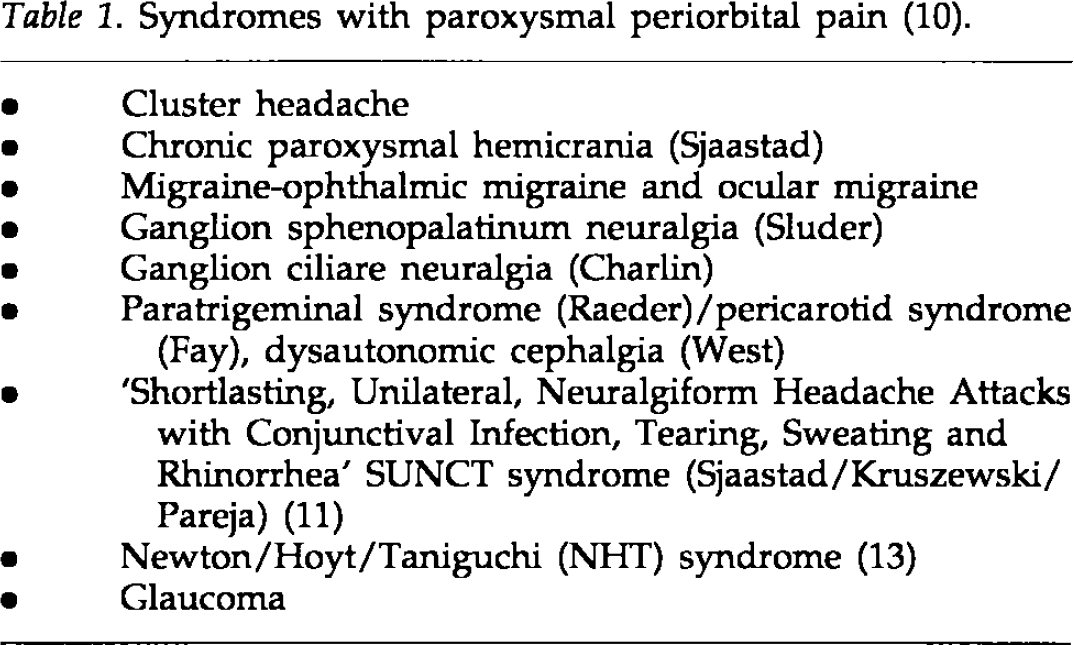
The present authors wish to emphasize their frequent observation of two sites of maximum pain during an attack: one behind and around the eye (periorbital) and the other occipital. This observation contrasts with the more generally held finding of a strictly hemicranial localization of the headache. The syndromes with paroxysmal periorbital pain are summarized in Table 1.
Syndromes with paroxysmal periorbital pain (10).
The present survey is restricted to an expose of the clinical features of paroxysmal periorbital pain disorders with special reference to autonomic features of varying type (not detailed in the table). Not discussed are:
non-paroxysmal periorbital pain syndromes which can be present as a leading symptom in autoimmune diseases with CNS involvement (immunologic vasculitis; polyarteritis nodosa—35%; systemic lupus erythematosus—SLE, 10–20%), and granulomatoses (lymphomatoid granulomatosis—CNS involvement 25%; Wegener's granulomatosis—CNS involvement 50%)
vascular syndromes with preferential involvement of the posterior cerebral circulation, anatomically innervated by the vertebro-basilar plexus
progressive periorbital pain disorders of miscellaneous origin: retrobulbar neuritis; frontal sinusitis; sphenoid sinusitis and mucocoele; meningiomaolfactory groove, anterior clinoid or tentorial; nasopharyngeal carcinoma; “cough headache”; posttraumatic headache (n. infraorbitalis). Reiter's disease with ophthalmoplegia (nn. III, IV, VI)
Paroxysmal periorbital pain disorders other than migraine and cluster headache are rare and should be considered as distinct entities—though combinations are known. The lumping versus splitting game has only limited value. Autonomic dysfunction (unlocking the primary pathomechanism) is often observed and several types of autonomic dysfunction are frequently combined (see Table 2).
Autonomic phenomena and paroxysmal periorbital pain.

+ positive findings; − negative findings.
The dysfunction (i.e. sympathetic hypofunction or parasympathetic hyperfunction) manifests throughout the attack, yet has not been the subject of systemic research in all these disorders. This is understandable because the hypothalamic-pituitary-adrenal axis and its effector organs offer a substantial range of neurotransmitters, neuromodulators, and peptides. Changes in all these functions throughout the attack sequence, one more marked than another (15), indicate that migraine and the other periorbital pain disorders involve the whole body and not merely the head. Moreover, these changes precede the constituents of the attack and thus seem to be more fundamental than secondary blood-flow changes, indicating also the importance of the peripheral triggering mechanisms.
Conclusions
(i) Migraine: two sites of maximum pain during attack: one periorbital (behind and around the eye) and the other occipital, (ii) Periorbital pain is suggested to be of neurogenic origin, due to a disordered interganglionic-“circuitry” interaction between sensory and sympathic/parasympathetic nerves at the ganglionic level, (iii) A combination of autonomic dysfunctions is frequently observed.
Footnotes
1
J. N. Blau 1985. Pathogenesis of migraine headache. J. Roy. Coll. Phys. (Lond), vol. 19, pp. 166–8. L. A. H. Hogenhuis and G. W. Bruyn 1993. Periorbital pain: a clinical review. Orbit, vol. 12, pp. 199–227.
2
Mitochondrial myopathy encephalopathy, lactic acidosis and stroke-like episodes; MELAS syndrome (Pavlakis et al., 1984).
3
Bruyn, 1984; Shimizu et al., 1993; Goldhammer, 1993; Kong et al., 1996.
4
J. W. Lance et al. 1988. Classification and Diagnostic Criteria for Headache Disorders, Cranial Neuralgias and Facial Pain. Headache Classification Committee of the International Headache Society. Cephalalgia (suppl 7), pp. 1–96. The attack criteria include 3–5 variables, each one of them comprising 1–4 subvariables (pp. 19–20), a collection giving ample room for misdiagnosis.
5
Combinations of paroxysmal periorbital pain syndromes. A number of syndromes can occur in combination in the same patient, e.g. the cluster-like headache disorders, of which the following are known (N. T. Mathew, 1992). Cluster headache, Neurology, vol. 42 (suppl. 2), pp. 22–31. (a) Cluster ‘tic douloureux’ syndrome, (b) Cluster-vertigo syndrome, (c) Cluster migraine, a not uncommon disorder, is diagnosed when one major distinguishing feature of cluster headache occurs in a patient with migraine or vice versa. For example, a patient may have a migraine attack with severe autonomic symptoms, or migraine attacks that are clustered in time. Conversely, a patient with cluster headache may experience a visual aura, (d) Cluster-like headache following head and facial trauma injuries occurring in the trigeminal territory, (e) Co-existing migraine and tension-type headache (comment in the IHS Classification “patients should be coded for migraine and for tension-type headache if they have both forms.”
6
O. Sjaastad, C. Saunte, R. Salvesen, T. A. Frederiksen, A. Seim, O. D. Røe, K. Fostad, O.-P. Løbben, Zhao, Jing-Ming 1989. Shortlasting, unilateral, neuralgiform headache attacks with conjunctival injection, tearing, sweating and rhinorrhea. Cephalalgia, vol. 9, pp. 147–56. P. Kruszewski 1993. Sunct syndrome with special reference to the autonomic nervous system. Comparisons with cluster headache. A collection of VII papers in the period 1991–1992. Trondheim: Tapir.
7
T. H. Newton and W. F. Hoyt 1970. Dural arteriovenous shunts in the region of the cavernosus sinus. Neuroradiology, vol. 1, pp. 71–81. R. M. Taniguchi, J. A. Goree and G. L. Odon 1971. Spontaneous carotid-cavernosus shunts presenting diagnostic problem. J. Neurosurg., vol. 35, pp. 384–91.
8
Parasympathetic neuropathy.
9
Vegetative autonomic components manifest throughout the migraine attack, prodromi in 20–40%, auras in 15–20%, in headache 90–95% (J. N. Blau in Monograph Migraine, 1989).