



Abstract
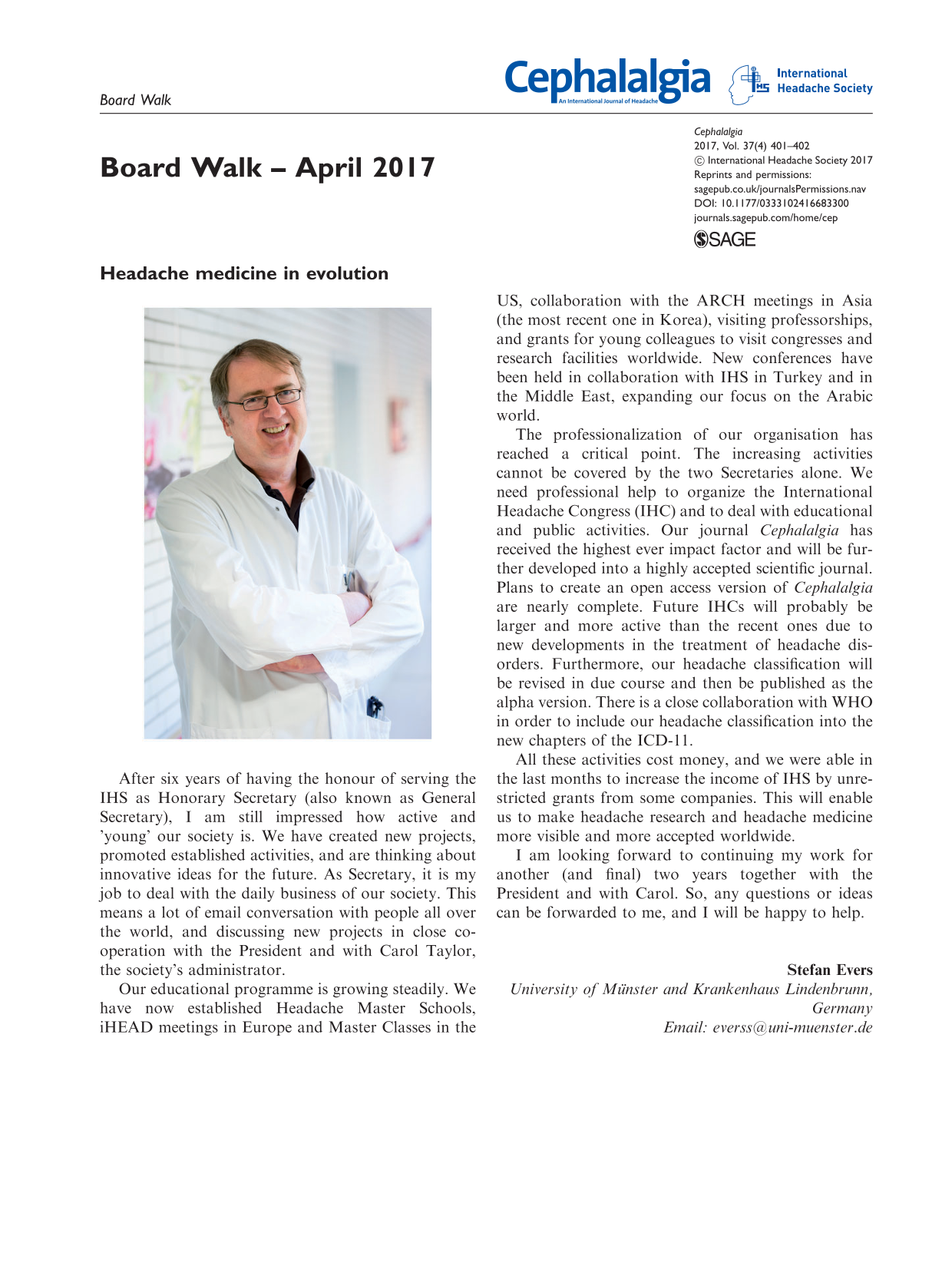
Headache medicine in evolution

After six years of having the honour of serving the IHS as Honorary Secretary (also known as General Secretary), I am still impressed how active and 'young' our society is. We have created new projects, promoted established activities, and are thinking about innovative ideas for the future. As Secretary, it is my job to deal with the daily business of our society. This means a lot of email conversation with people all over the world, and discussing new projects in close co-operation with the President and with Carol Taylor, the society’s administrator.
Our educational programme is growing steadily. We have now established Headache Master Schools, iHEAD meetings in Europe and Master Classes in the US, collaboration with the ARCH meetings in Asia (the most recent one in Korea), visiting professorships, and grants for young colleagues to visit congresses and research facilities worldwide. New conferences have been held in collaboration with IHS in Turkey and in the Middle East, expanding our focus on the Arabic world.
The professionalization of our organisation has reached a critical point. The increasing activities cannot be covered by the two Secretaries alone. We need professional help to organize the International Headache Congress (IHC) and to deal with educational and public activities. Our journal Cephalalgia has received the highest ever impact factor and will be further developed into a highly accepted scientific journal. Plans to create an open access version of Cephalalgia are nearly complete. Future IHCs will probably be larger and more active than the recent ones due to new developments in the treatment of headache disorders. Furthermore, our headache classification will be revised in due course and then be published as the alpha version. There is a close collaboration with WHO in order to include our headache classification into the new chapters of the ICD-11.
All these activities cost money, and we were able in the last months to increase the income of IHS by unrestricted grants from some companies. This will enable us to make headache research and headache medicine more visible and more accepted worldwide.
I am looking forward to continuing my work for another (and final) two years together with the President and with Carol. So, any questions or ideas can be forwarded to me, and I will be happy to help.
University of Münster and Krankenhaus Lindenbrunn, Germany. Email:
IHC 2017: New Horizons in Headache


For those of you who are interested in head, neck and orofacial pain, the biggest event in 2017 will be the 18th International Headache Congress (IHC), which is to be held in Vancouver from 7–10 September. As usual, the congress will serve as a platform to share recent advances in clinical and basic research, experience in the care of headache patients, and to co-ordinate international efforts in reducing the burden of headache worldwide. The congress will start with teaching courses:
Paediatric Episodic Syndromes That May Be Associated With Migraine Laboratory and Imaging Investigations in Primary Headaches Headache Research for Young Scientists Teaching Course for Nurses Refractory Headaches Cluster Headache Secondary Headache
In addition, what makes this congress so exciting and unique is we are entering a new era. After the “triptan boom” in the 1990s, we have experienced a relatively silent period in the pharmaceutical pipeline, except for the sporadic rise of topiramate, onabotulinumtoxinA, and gepants. The recent success of CGRP monoclonal antibodies gives rise to new hope in the treatment of migraine, and deserves global attention in the field of headache medicine. In addition, further highlights of this congress include:
Headache classification: ICHD-3-beta towards the final version Peripheral vs central mechanisms in migraine Vulnerability to migraine: genetics and epigenetics Trigeminal neuralgia – joint IHS-IASP session Placebo in headache: mechanisms and use What is new in post-traumatic headache? Neuromodulation in primary headaches Emerging targets for migraine treatment: endocannabinoids, P2X3, and kappa opioid receptors Cognitive control of pain Imaging and biochemical biomarkers of chronic migraine Challenges in clinical trials
We are certain that IHC 2017 will quench your thirst for knowing all aspects of headache and look forward to seeing you all in Vancouver.
IHC 2017 Scientific Programme Committee Co-Chairs Emails: