



Abstract
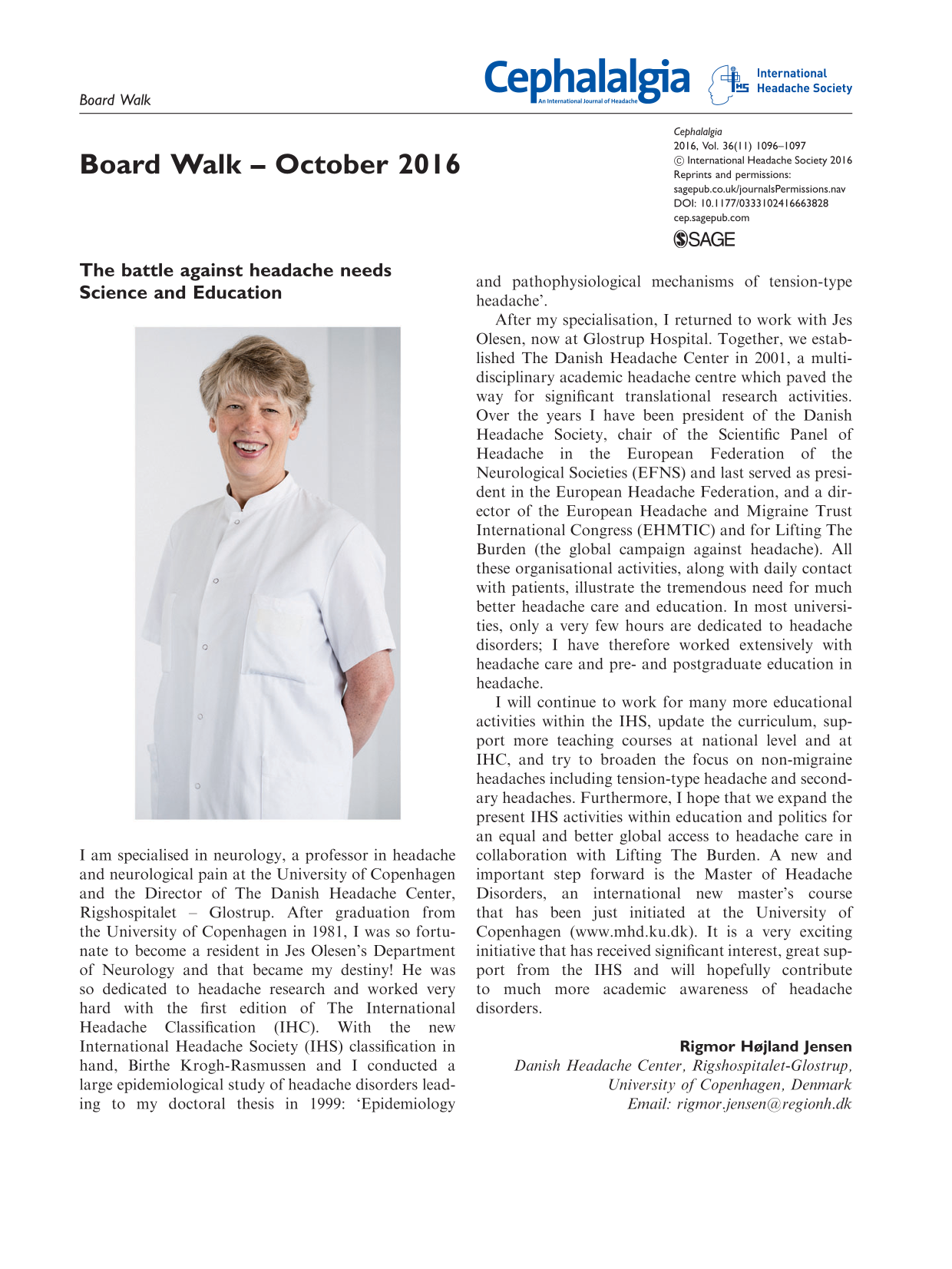
The battle against headache needs Science and Education

I am specialised in neurology, a professor in headache and neurological pain at the University of Copenhagen and the Director of The Danish Headache Center, Rigshospitalet – Glostrup. After graduation from the University of Copenhagen in 1981, I was so fortunate to become a resident in Jes Olesen’s Department of Neurology and that became my destiny! He was so dedicated to headache research and worked very hard with the first edition of The International Headache Classification (IHC). With the new International Headache Society (IHS) classification in hand, Birthe Krogh-Rasmussen and I conducted a large epidemiological study of headache disorders leading to my doctoral thesis in 1999: ‘Epidemiology and pathophysiological mechanisms of tension-type headache’.
After my specialisation, I returned to work with Jes Olesen, now at Glostrup Hospital. Together, we established The Danish Headache Center in 2001, a multidisciplinary academic headache centre which paved the way for significant translational research activities. Over the years I have been president of the Danish Headache Society, chair of the Scientific Panel of Headache in the European Federation of the Neurological Societies (EFNS) and last served as president in the European Headache Federation, and a director of the European Headache and Migraine Trust International Congress (EHMTIC) and for Lifting The Burden (the global campaign against headache). All these organisational activities, along with daily contact with patients, illustrate the tremendous need for much better headache care and education. In most universities, only a very few hours are dedicated to headache disorders; I have therefore worked extensively with headache care and pre- and postgraduate education in headache.
I will continue to work for many more educational activities within the IHS, update the curriculum, support more teaching courses at national level and at IHC, and try to broaden the focus on non-migraine headaches including tension-type headache and secondary headaches. Furthermore, I hope that we expand the present IHS activities within education and politics for an equal and better global access to headache care in collaboration with Lifting The Burden. A new and important step forward is the Master of Headache Disorders, an international new master’s course that has been just initiated at the University of Copenhagen (www.mhd.ku.dk). It is a very exciting initiative that has received significant interest, great support from the IHS and will hopefully contribute to much more academic awareness of headache disorders.
Danish Headache Center, Rigshospitalet-Glostrup, University of Copenhagen, Denmark
Email:
A life dedicated to a neglected malady

My interest in headache dates back to 1987, when I first examined a so-called recently described chronic paroxysmal hemicrania patient. After writing a monograph on this interesting headache in 1988, Professor Ottar Sjaastad invited me to join his group in Trondheim for a PhD thesis. The defence took place in Trondheim in September 1992, under the supervision of Professor Sjaastad and Linda White. The work, entitled ‘Vasoactive peptides in the ocular/forehead area: Association with headache’, involved basic research on the effects of various neurotransmitters, peptides and drugs on isolated vessels and various neuropeptide levels in a greater occipital nerve stimulation model I specifically developed in rats.
From the clinical perspective, headache patients were examined on a daily basis under the supervision of Professor Sjaastad. After returning to Brazil, the head of the Department of Neurology, Professor Sérgio Novis, Federal University of Rio de Janeiro, asked me to create, lead and develop the headache sector in our facilities. My professorship was obtained in 1995, allowing us to establish the master and doctoral programmes on headache. The first doctoral thesis was written by my colleague Professor Péricles Maranhão-Filho on the effects of sumatriptan on an isolated chick retina spreading depression model. Working at the same university where Leão developed his career, we were particularly proud to initiate the modern headache academic activities in this very area. Having replaced Professor Novis as the head of neurology, 12 theses were produced afterwards involving various aspects of headache, regular courses and seminars for residents and undergraduates were established, and a regular headache outpatient unit was developed. In 2006, I spent 4 months at Nouchine Hadjikhani Laboratory in Boston with a Fulbright scholarship, where we studied aspects related to aura and neuroimaging.
I am an active member of the Brazilian Headache Society and the Brazilian Academy of Neurology, where I have been involved with several educational initiatives. I have been a member of the IHS classification committee twice. In Brazil, a country with relatively poor social and health standards, a high-quality centre for research, education and specialised care in headache for thousands of patients represents a crucial achievement. I am deeply committed to the advance of headache education and science in my country and worldwide as well as to the promotion of this branch of medicine as one of the most relevant for the benefit of all untreated sufferers.
Federal University of Rio de Janeiro, Brazil
Email: