




Abstract
From 1945 and into the 1950s in Ireland's economic history has been described as post-war recovery and gloom and doom respectively, leading to the 1960s golden age. However, despite this gloomy outlook, with some delays attributed to the Emergency, a ‘quiet revolution’ kicked off in late 1946. That revolution was the Rural Electrification Scheme (RES) of the Electricity Supply Board of Ireland, a scheme designed to bring electric power to every village in Ireland. While some academic research has addressed the RES, detail on specific locations and effects is lacking, which is surprising given the effects the scheme had on life and economy in rural Ireland. Drawing on archival evidence, existing history texts, media and some oral histories, this paper explores the story of the first village to receive power under the RES, namely the village of Oldtown in County Dublin. This story is largely untold, and in particular, why this village was the first is explored. The benefits of electric power to rural homes and farms are also detailed. In the case of farming, early shoots of today's thriving tillage and horticultural activity typical of North County Dublin are apparent.
Introduction
At the time of writing this paper in 2024, it has been seventy-seven years since the Electricity Supply Board of Ireland (ESB) brought electric power to a village in north County Dublin. This village was Oldtown, and it was the first village to formally receive power under the Rural Electrification Scheme (RES) of the ESB. Although the RES has been written about, neither it nor the history of the ESB itself seems to have received much attention in Irish social, economic or business history literature. 1 This is somewhat surprising, as it was captured by the title of Michael Shiel's book as The Quiet Revolution that transformed rural society and rural economies. The RES was also one of the longest running infrastructure projects in the history of the Irish state, running from 1946 to 1976 and costing about €193 million and is regarded as a highly successful project. 2 The building of a hydro-electric power station at Ardnacrusha on the River Shannon in the late 1920s was the starting point, producing enough power at that time to light rural homes and farms. Of course, a power distribution network had to be built, and this was the role of the RES.
The Irish economy from partition to the Emergency could be described as poor. 3 Economic policies focusing on self-sufficiency and a trade war with the United Kingdom left the economy in a poor state into the 1930s, and then the outbreak of war brought many external forces acting on the Irish economy. However, during this period what is today one of the most profitable Irish semi-state companies was formed: the ESB. This company and the RES, despite their success and effects on rural life and business, have not received much detailed attention in Irish social and economic history research. For example, Ó’Gráda refers to more recent years when describing electricity and telecommunications in the Irish economy; Adelman refers to electrification in the context of food, through having the ability to heat water more conveniently. 4 There is some limited research on the ESB in the accounting literature, where early signs of New Public Management are noted. 5 In the context of the RES, a key topic of this paper, there are well-maintained ESB archival records of the 792 parishes that received electric power under the scheme. 6 In this paper, these records are drawn on to provide a detailed account of one village, Oldtown, which heretofore has not been mentioned more than it being the first village to receive power. An effort is made to establish how or why this village was the first, using archival records, parliamentary debate records and oral histories. The paper also draws on archival records and the print media to detail what rural electrification did for life in the village, and how it affected economic activity in the area – mainly in the form of agriculture. What happened in Oldtown in 1947 was replicated in 791 other areas over the next thirty years or so and it serves as a useful example of the effects of the RES on rural life.
Electricity Supply Board of Ireland
A brief outline of the formation of the ESB is useful to set the context for this paper. After the 1921 Anglo-Irish Treaty, the Irish state faced the mundane, but necessary, matters of detangling from British institutions and systems, including power and telecommunications networks. In 1870 telegraph companies were nationalised under the Telegraph Act 1868, making the transfer of these networks to the Irish Free State administratively simple. 7 Such consolidation was not present with power generation and networks. While electric power was present in Dublin, other Irish cities and many larger towns by the 1920s, each company was independently run. The ESB Annual Report for 1927–28 reveals Dublin County had fifteen different power suppliers and in excess of 150 nationwide. Over time, the ESB became a single provider of power and power networks until (retail) deregulation in 2010. 8
The building of a hydro-electric power station at Ardnacrusha (known as the ‘Shannon Scheme’) pre-dates the forming of the ESB, and it was to be a source of power to towns and villages beyond the numerous local supplies mentioned above. 9 According to the ESB Archives, in 1925 Thomas McLaughlin, an engineer and a key driver of electrification of the Irish Free State, presented a White Paper on the Shannon Scheme (together with Siemens and Patrick McGilligan TD, Minister for Industry and Commerce) which was accepted by the government and encapsulated in the Shannon Electricity Act 1925. 10 A budget of £5.1 million (c. €406 million in 2024 values) was allocated to the project, which was about 20 per cent of Ireland's national revenue at that time. 11 The Shannon Scheme was the nerve centre for the new national grid, which was being constructed in tandem and was to be a key infrastructure element of the RES.
The Shannon Scheme and the developing national power grid ultimately led to the establishment of the ESB on 11 August 1927, reflective of more emphasis in government policy on building an electricity network than a telephone network.
12
Dáil Éireann debates from March and April 1927 suggest two key issues were apparent as the ESB was being formed: 1) the powers to be granted to the ESB and 2) the acquiring of existing electricity undertakings. In short, the ESB was given extensive powers to generate and distribute electric power and government appeared to want an independent company with less political interference, Minister McGilligan citing the Swedish model of control. This model is well summarised by Major Bryan Ricco Cooper, a Cumann na nGaedheal representative for Dublin County: If this is to be a state enterprise, and if it is to be a monopoly - and I have reluctantly come to the conclusion it is inevitable that it must be - I much prefer the system of working by a board, and I am very glad to hear Deputy O’Connell say that too. He has fallen in line with the Socialism of Sweden and Belgium, the more moderate Continental Socialism, and has turned his back to the Soviets. I congratulate him.
13
On the first issue of a board, Manning and McDowell (1984) note how McGilligan did not wish the ESB to be controlled by a private company, by foreign investors or by a government department/civil servant. 14 The board should be independent, with technical expertise but with accountability for its activities and expenses to the government. On the second issue, the debates suggest there was fear of monopoly control by the ESB. Owners and staff of existing undertakings were compensated. 15 In fact, the ESB did have a monopoly in power generation and supply until deregulation in 2000 for industrial customers, and 2010 for retail customers.
Despite its almost 100-year history and the ESB's importance in Ireland economic development, it seems literature on the company and/or its effects is scarce. Books by Shiel, Bielenberg and Manning and McDowell provide useful general histories on the RES, Shannon Scheme and the company itself. 16 In addition, work by this author and Warren exploring ESB management during the RES period suggests the company was well run, exhibiting signs of what is today referred to as a New Public Management approach to the operation of state enterprises. 17 However, there is little literature that has specifically explored the RES in a more localised context as here.
Rural Electrification Scheme
Shiel highlights how bringing power to rural Ireland was a topic of debate as early as 1925 when Professor Boyle of University College Cork wrote about the use of electricity in agriculture. 18 In 1927, Seán McEntee (an engineer, and later Minister for Finance in the 1932 Fianna Fáil government) spoke to the Institution of Electrical Engineers Irish branch about rural electrification; in 1931 and 1938, members of the Institution of Electrical Engineers from Great Britain read papers to the Irish branch on rural electrification. 19 Internally, Thomas McLaughlin, a member of the ESB Board, raised the matter of rural electrification several times during the 1930s. In 1936, he requested that a list of supply charges should be drawn for villages with a population of 250 or less and for isolated dwellings. 20 A resulting schedule of charges included a fixed charge based on floor area, plus a charge per kWh of 1.25d. about 37 cent in 2024 prices. The charges were expected to be equal to or greater than the capital cost of connection over the first two years, known as the ‘2 to 1 ratio’. If the charges did not cover the capital cost, a contribution would be required from the householder. 21 In 1937, McLaughlin proposed the ratio be increased to 4 to 1. The ESB paused consideration of any proposals by McLaughlin until the question of government funding was addressed and ‘his constant raising of rural electrification at Board meetings was undoubtedly intended to stir the Board and ultimately the government to action’. 22
McLaughlin had an ally in the form of Seán Lemass, Minister for Industry and Commerce at the time. In May 1939, Lemass requested the ESB to draw up plans for rural electrification and to consider the amount of finance required. McLaughlin led this task, assisted by Patrick Dowling and Alphonsus McManus, both engineers and farmers’ sons. While progress was made, the outbreak of World War II (or The Emergency as it was termed) in September 1939 brought things to a pause.
23
When The Emergency ended, rural electrification came to the fore of the political agenda. In his 1944 Budget Speech, Seán T. O’Kelly referred to the curtailing of capital expenditure by the ESB during The Emergency and noted approval of the RES and its financing, noting: the Government have approved a comprehensive scheme for the extension of electrical services to the rural community, generally. Not only will electricity bring to rural dwellers the benefits of good lighting in homes and outbuildings and the amenities of domestic appliances, radio, etc., but it will also take much of the drudgery out of farm life.
24
The initial capital expenditure was estimated to be £20 million (c. €1.73 billion in 2024 values).The final full cost was in the order of £140 million spread over the period 1946–1975. Following the above May 1944 speech, the Electricity (Supply) (Amendment) Bill, 1944 was introduced to Dáil Éireann in November 1944, and became the Electricity (Supply)(Amendment) Act, 1945, giving a legal basis to the commencement of the RES. The 1945 Act capped government contributions for the RES at £12.5 million (c. €627 million in 2024 values) to ensure adequate progress and controls before any further monies were contributed by government. Organisationally, the Rural Electrification Office (REO) was formed within the ESB, led by William Francis Roe, with Patrick J. Dowling as his deputy. Both were electrical engineers and had worked for the ESB for many years.
Parliamentary debates from early 1945 provide some useful information about how the RES might affect rural Ireland. For example, Minister Seán Lemass noted that ‘out of a total population of 2,968,000 at the time of the 1936 Census, 1,742,000 are without a supply of electricity’.
25
The importance of cheap electric power to develop Ireland's agriculture was also noted, with the following being an example form James Hughes, Fine Gael, representing Carlow/Kilkenny: We have often wondered why the agricultural industry here is in a stagnant condition […] first we have not attempted to apply modern scientific technique to agriculture and that we lack suitable, modern equipment. One of the things that the average homestead in rural Ireland lacks is electrical equipment, cheap power and light on the farm. In these circumstances the cost of the preparation of winter feeding is excessive compared with the cost in other countries. [Thus] if we are to maintain our livestock in a proper condition, the provision of electrical equipment on the farm is absolutely vital.
26
Oldtown, the village of interest here, comprised just the type of rural homestead referred to by Hughes, but in addition as will be detailed later, benefitted from the RES as regards its tillage and horticultural farming.
Power to Rural No.1 and effects on social and economic life
As mentioned in the introduction, this paper attempts to establish how and why Oldtown village was the first in Ireland to be electrified. Drawing on oral histories undertaken by the present author in 2022 and archival sources, a definitive answer is unfortunately not forthcoming. 27 However a logical case can be presented based on these two data sources.
The REO structured its work around various ‘districts’ and ‘areas’. Each ‘area’ was typically based on the parish unit, which was normally an area of 25–30 square miles. 28 According to the ESB annual report for the year to 31 March 1947 (see Figure 1), seven areas were initially selected for supply, including Kilsallaghan, which includes the village of Oldtown.
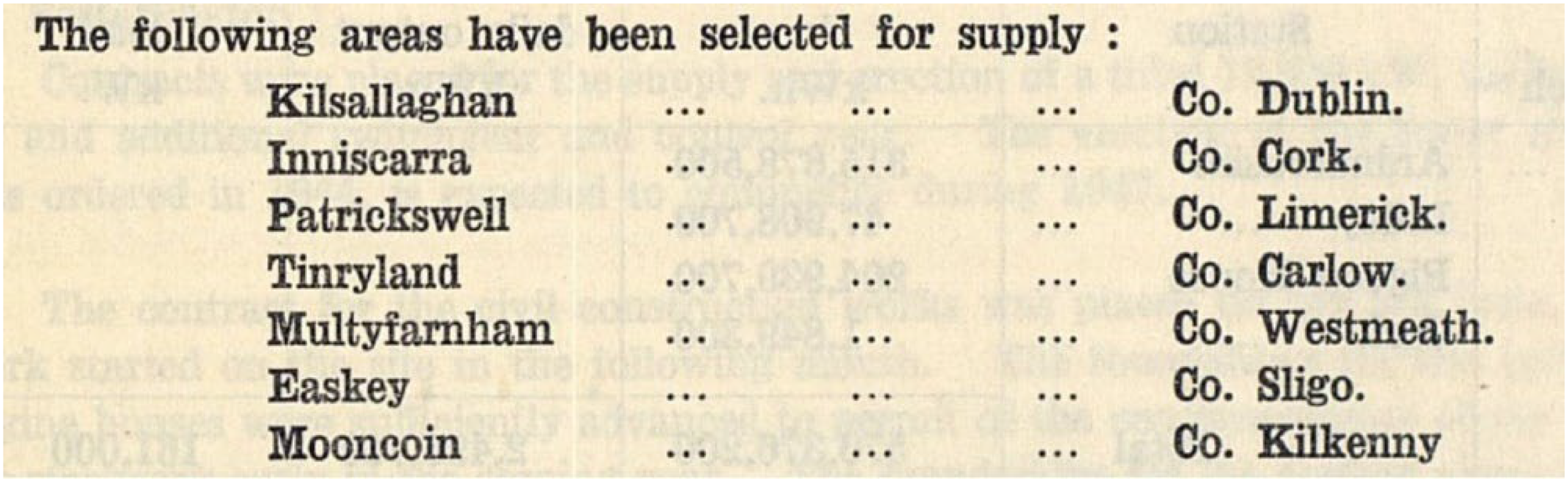
Areas selected for supply – source, ESB annual report 1946–47, courtesy of ESB archives. ESB; Electricity Supply Board.
Why was Oldtown the first village to get electric power under the RES? Archival evidence and geography/demographics allow for a plausible explanation. Kilsallaghan was the only parish (area) in Dublin, with Oldtown situated twelve miles from Dublin city, six miles from Swords and 3.5 miles from Ashbourne. ESB Archive records show a 10KV transmission line running from Swords passing less than 2.5 miles from Oldtown. 29 A 10KV line was something McLaughlin suggested as a requirement for the seven initial areas. 30 At an ESB board meeting of 26 February 1946, it was decided ‘to develop the St. Margaret's area if Mr Roe finds that it is suitable’. 31 A meeting of 5 March 1946, notes Finglas and Killossery as ‘approved’ as one of the trial areas. 32 Killossery is a civil parish area (dating from British rule) which includes Rolestown (but not Oldtown) adjacent to Kilsallaghan. Oldtown, in civil parish terms, is part of Clonmethan parish. 33 However, civil parishes are typically not the same as Catholic Church parishes, with the latter typically being larger. Thus, there seems to be some mixed use of civil and church parish areas in the cited ESB documents - although as noted by Manning and McDowell, the church parish was the unit of organisation. 34 The final agreed Rural Area No. 1 corresponded to the church parish area of Rolestown, Oldtown and Kilsallaghan.
REO staff canvassed on an area basis and priority was given to areas yielding a higher revenue in proportion to capital costs. 35 According to a document dated 16 October 1946, the total estimated capital cost of the Kilsallaghan area was £23,174 (c. €1.16 million in 2024 values) with an estimated annual revenue of £3,546 (c. €140,000 in 2024 values) i.e. the capital cost would be recouped in six to seven years. 36 Another document of the same date notes that the area had 525 houses, with 399 (or 76 per cent) agreeing to take a supply. Of these 399, twenty-seven are noted as being outside the ‘economic limit for connection and would incur a special charge’. 37 Work on the Kilsallaghan area began in November 1946 and the final cost was £22,946 (c. €857,000 in 2024 values). 38 According to archival records, 348 electricity meters were used, suggesting 66 per cent of houses were supplied - somewhat less than the canvassed number. Shiel noted the role of the church (normally the parish priest) in encouraging parishioners to connect to the electricity grid, and numerous photos at the ESB archives depict clergy in this role. 39 However, while the parish priest was present at the switch on ceremony at Oldtown (see below), there is no evidence of other involvement of the clergy. The good initial acceptance rate may be attributable to the advantages electricity brought to farmers, which is discussed in some detail later; or the fact, as detailed below, frequenters of the local pub already had experience of electric light.
The first premises to be ‘switched on’ was White's pub on or around 15 January 1947. National media at the time included a photograph of Tommy White, the local publican, putting away the oil lamp (see Figure 2). While perhaps not a deliberate marketing ploy on behalf of the ESB, the image in national media of a rural publican putting away an oil lamp to give way to electric light no doubt had some power in convincing people in other parishes to adopt electricity. So why was a pub the first premises? Based on oral histories from Tommy White's family and others in the village, there is a simple answer: the pub was already wired for electric light. Tommy White inherited the pub from his cousin Anne (Nan) Corway. Under her stewardship of the pub, another cousin, Terry White (brother of Tommy) installed a wind turbine to generate power. According to the oral histories recorded for this study, sometime in the early 1940s, Terry White with the assistance of another local man James Boyle, built a metal tower to the rear of the pub and installed a wind turbine. 40 As far as can be determined, the system did not have any battery storage and thus could only produce power when there was sufficient wind to turn the turbine. It is conceivable that a canvasser from the ESB called to White's pub to find it already (at least partially) wired for electric lighting. A canvasser would not doubt be delighted to find a premises already wired in one of the trial locations. A more formal switch on ceremony took place in the local village hall on 15 January 1947. Shiel noted the attendance of locals, the parish priest and senior ESB officials, with the switch on supervised by the Engineer-in-Charge, W. F. Roe. 41 The events were confirmed by the oral history recordings with the relatives of Tommy White. The Irish Independent reported on events at the local hall, commenting that a ‘demonstration on the uses of electricity in the home and farm’ was given. 42 With electric power now installed, changes to the social and economic life of villagers in Oldtown are now captured in a general sense, and some specific examples are offered drawing on the ESB archives.
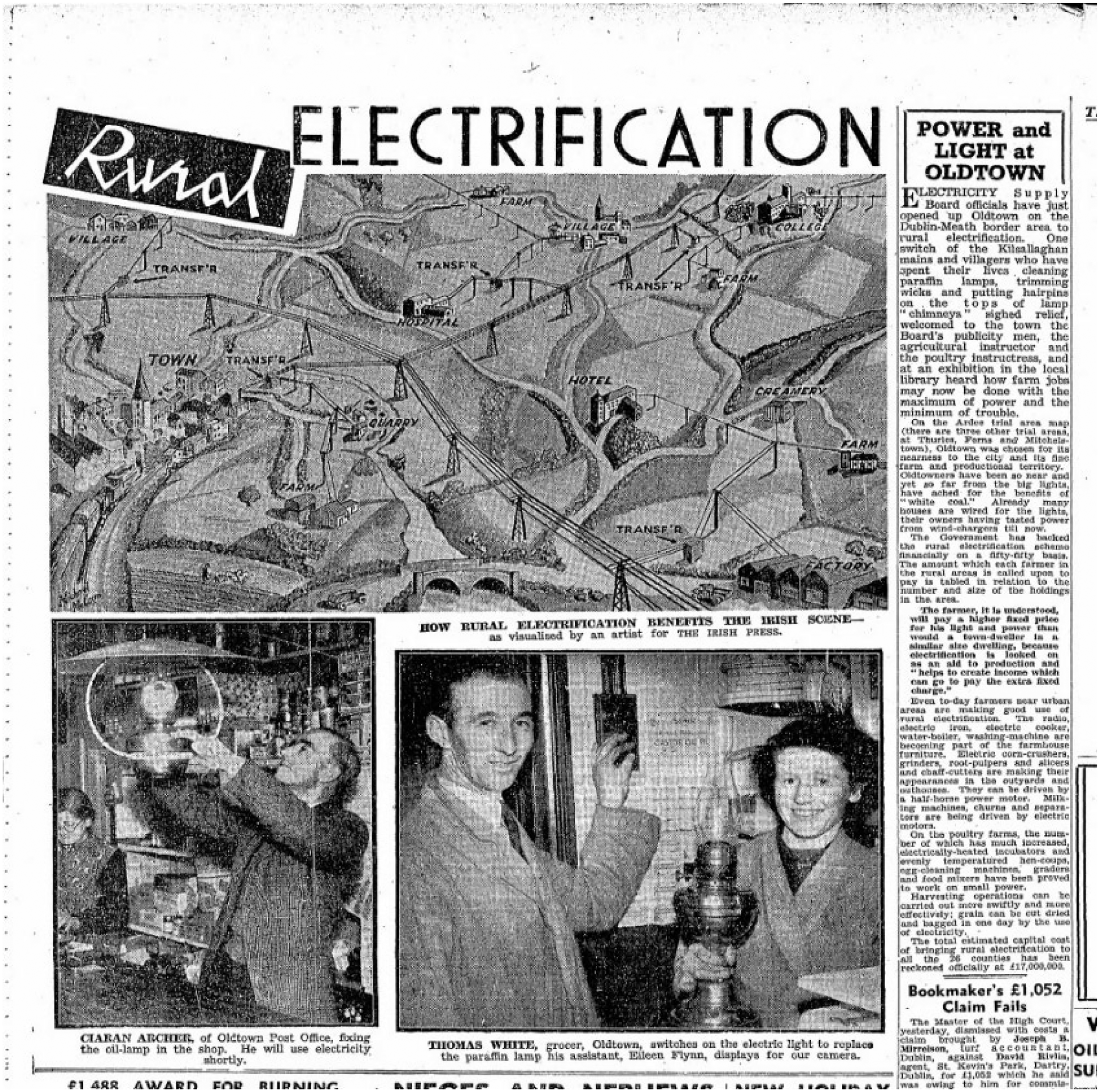
Tommy White, Eileen Flynn (right) and Ciaran Archer putting away the oil lamps. Irish Press, 18 January 1947, page 5. Source: Irish Newspaper Archives.
Effects on Home and Social Life
As mentioned, 66 per cent of the houses/premises canvassed in the Kilsallaghan took an initial supply of power under the RES. The initial scheme was completed by mid-February 1948. It is worth noting out that the number of lights and power outlets then was nothing like the present day. 43
Shiel also noted that even by 1964, the average number of power outlets was 2.5 per premises, although this increased to 5.5 per premises by the mid-1970s. 44 Thus, it is likely that each house in Oldtown had perhaps one or two light fittings and one or two power outlets. Of course, cost to each householder may have also been an issue, as Oldtown was a typical rural village and not considered affluent. To ascertain how affordable electric power may have been to a householder in Oldtown, we can estimate an average bill and compare it to incomes at the time. According to the ESB's annual report for the 1946/47 year, the rates of charge for a dwelling between 400 and 600 square feet consisted of a fixed charge of 8s 9d bi-monthly and 2.5d per KwH up to 80 KwH in a two monthly period, and 1d for the next 280 KwH. 45 The 1946/47 annual report also provides the units of electricity sold and the number of ESB customers. Calculating a simple average, the average consumption bi-monthly is 305 KwH. Using a lower number of say 200 units, the bi-monthly bill charge to a house in Oldtown under 600 square feet would be as shown in Figure 3. In decimal form, the cost would be £1.775 (about €89 in 2024 values), or about €11 per week. 46 The average industrial wage in 1947 was €187 per week, and while farming/rural incomes may have been lower, an electricity supply appeared affordable. 47
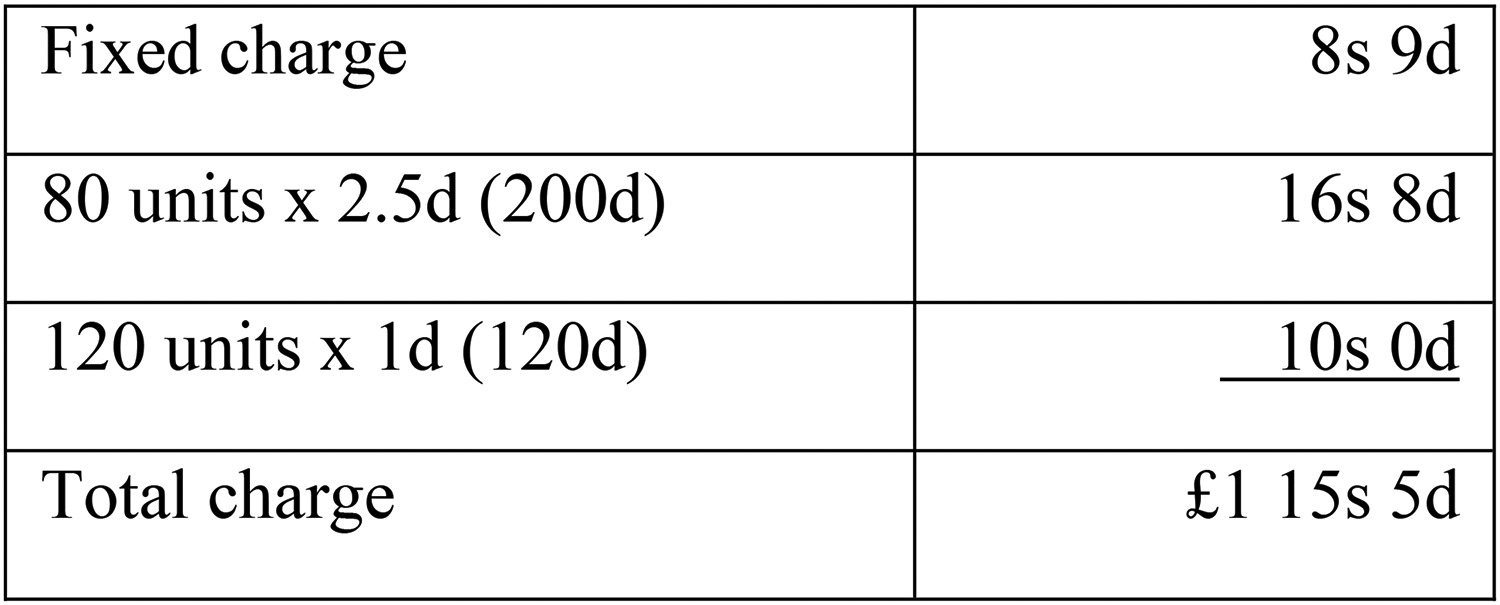
Estimated average household electricity bill in 1947.
Household work was made easier through the use of electric appliances such as washing machines and cookers.
48
ESB promotional pamphlets from the time give some insights into what a householder in Oldtown could expect from the RES. One early pamphlet noted (see Figure 4): Electricity will light your house, out-offices and yard. In the home, it will work a radio, iron, kettle, cooker, water-heater, vacuum cleaner, washing machine, etc.
49
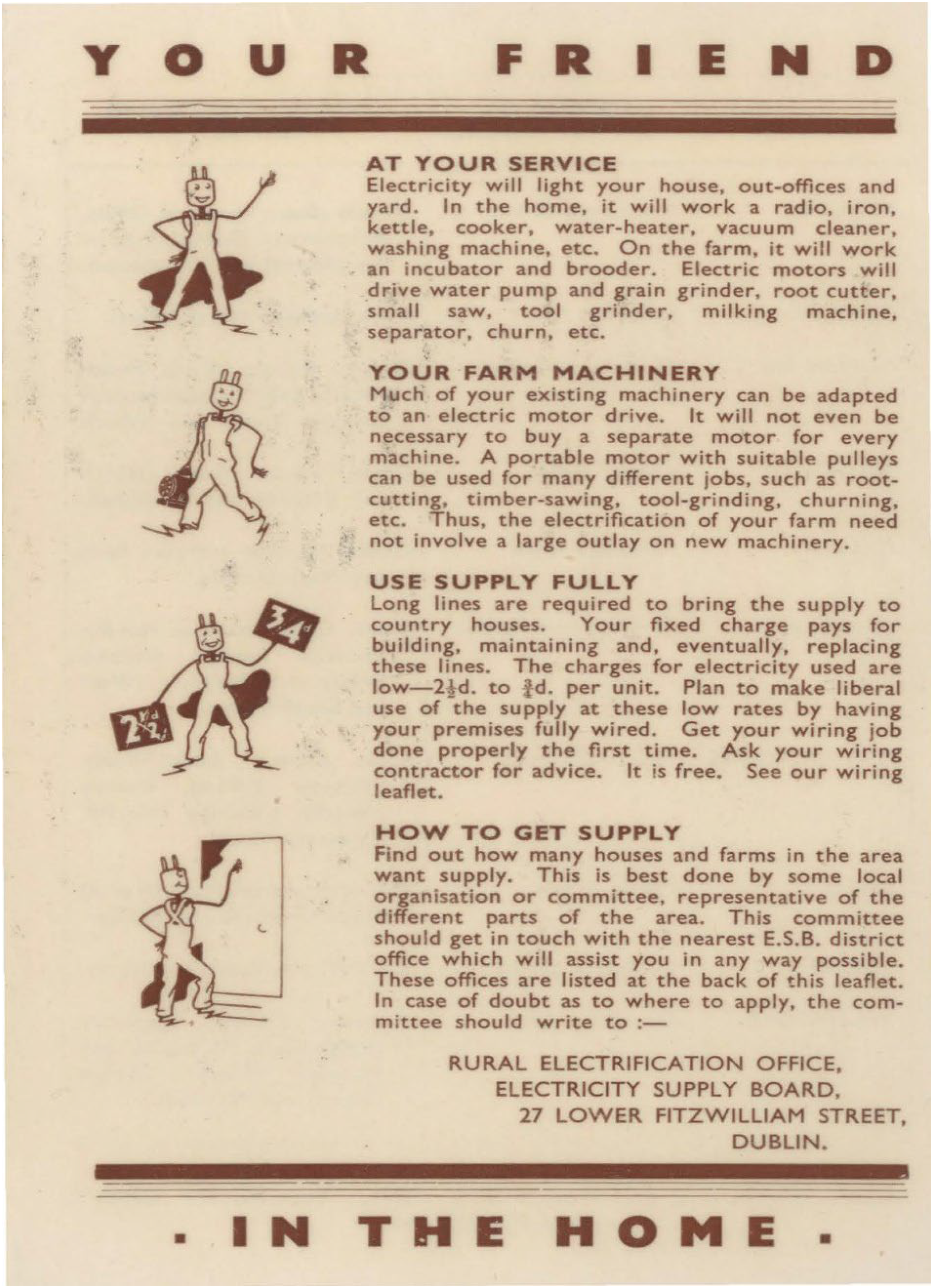
Extracts from an early RES pamphlet, courtesy of ESB archives. RES: Rural Electrification Scheme; ESB: Electricity Supply Board.
Not every house would have had such appliances immediately and having such appliances may have been much less appealing than having running water, which was now more readily available through electric water pumps. Such pumps were extremely beneficial in rural areas where water was often drawn from wells. Indeed, as noted by Daly, although the ESB's remit was not the provision of running water, the RES made it one of the best organisations to promote the use of running water. 50 By 1952 the Department of Agriculture offered a 50 per cent grant (to a maximum of £100) towards the installation of a kitchen sink and tap. 51 Over time, more such appliances were likely to have been used, and the use of electric power in the home increased. This in turn led to some supply problems, or delays with installation to some dwellings.
The archival records contain several examples of residents of Oldtown and the surrounding area writing letters to request supply or on matters related to supply. While it may be that householders wrote to the ESB and had no response, in the archives such letters generally seemed to come via an indirect route to the ESB. 52 This route typically involved writing a letter to a local politician. One letter from 1964 complained about the cost of the installation to his home. The letter made its way to the ESB, who duly investigated it. The local suggested that the ‘nearest pole was 100 yards’ from his house, and he could not afford the additional annual service charge quoted by the ESB. Ensuing correspondence notes the house was 700m from the nearest substation and 200m from the nearest pole. To connect this supply required some improvement works and it is noted that ‘his neighbour has been re-canvassed but is not interested in supply’. This example highlights some of the difficulties faced by the REO as it continued its roll-out in Oldtown and other villages around Ireland. The response from the ESB to this local resident highlights that the supply of power had to be economical in the longer term. Their response notes ‘I regret that no reduction can be made in the terms already quoted. The special service charge is necessary because the revenue from the normal fixed charge does not give a sufficient return’. A second example from late 1966 follows a similar pattern. In this example, the homeowner was initially quoted £16 to bring supply to the house (c. €320 in 2024 values), which he claimed he could not afford. This case was resolved quickly as the resident in question agreed to pay the £16, which was a once-off payment. An example from 1968 gives a different view, that of someone who seems to have been an early adopter of electricity. In this case, the person returned to their family home after selling another home. It seems the family home had been either unoccupied or did not have a supply of electricity. The letter written initially to a local politician complained of having to wait three months for supply. The outcome, at least according to the ESB reply, was a promise of a supply within six weeks.
The three examples convey differing views of how locals perceived electricity supply, affordability of supply to the householder in more remote areas, and difficulties faced by the ESB trying to recoup costs. 53 It is also worth noting at this point that the ESB, under government pressure, reduced its special service charge and reduced the minimum return on investment to 4.5 per cent. 54 As the 1970s arrived, the archives contain examples of complaints about the quality of supply. Complaints included mention of the effects of agricultural machinery on neighbouring households. One complaint noted how the television received interference when the neighbouring farm switched on certain machinery. This type of complaint suggests electric power was now embedded in home life and is similar to the ‘the Wi-Fi is bad’ complaint of today.
Another aspect of social life around this time was the importance of radio. Before the arrival of electricity, battery operated radios were commonplace. With the arrival of electricity, radios could now be more reliably run and as noted by O’Brien (2023), the electric radio in the rural kitchen now complemented kitchen essentials. 55 For radio to be broadcast over a wider area and in higher quality, a power infrastructure is needed. Archival records show a request for a power supply made by Radio Éireann dated December 1955, with authorisation for the work granted on 23 December 1955. The supply was needed for the erection and operation of a transmitter at Rolestown West to boost radio signals across north Dublin. 56 Such transmitters brought clearer radio signals to many areas across Ireland as the RES progressed, keeping the population informed of national and international events. Most were decommissioned in the 1970s as radio technologies improved and fewer transmission stations were needed.
Social life also includes education. The present-day Oldtown national school opened in 1946, after some delay. According to the Drogheda Independent tenders to build the school had been requested in March 1945.
57
There was a delay with the signing of a lease and commencement of work, but on completion in 1947, the new national school had electricity.
58
Electric light would have helped children to read and learn with a little more comfort and do homework in the evenings.
59
As mentioned, Tommy White's pub was the first place to receive electric power and the effect on education was captured well by the Irish Times in 1963.
60
The headline read ‘Kathleen never worked by paraffin’. Kathleen is Tommy White's daughter, born one month after the village received electricity. Being close to her due date is the reason why Margaret (Dolly) White, Tommy's wife, did not feature in the photo shown in Figure 2. The first paragraph of the Irish Times article is reproduced below: A family celebration will be held in a tavern at Oldtown, Co. Dublin, tonight, marking the 15th anniversary of the beginning of rural electrification - as well as the 15th birthday of Kathleen White. Mr. Thomas White, his wife and family of four will sit down in a room lighted by oil-lamps, for they have preserved these as mementoes. The wind charger from which they had pioneered their first light is long gone and has since become debris. But Kathleen, now finished with national school, had never to do homework by paraffin light.
Effects on Economic Life
In 1947, Ireland had little in the way of large industry and most economic activities centred around agriculture. Then, and to a large extent still today, economic activity in Irish rural villages was driven by small farm holdings. Most villages had one or a few shops, and a pub (or pubs). A post office may have existed within a typical village shop. Oldtown in 1947 fit this profile, with most economic activities centred on farming. As mentioned, electric light in households in 1947 may not have been what we would expect today. Despite this, it is not hard to imagine how electric light would be of benefit to work in farm outhouses. An immediate effect was that farm work time could be extended, especially in the darker winter months. Shiel devoted an entire chapter to ‘Electricity on the Farm’. 61 Drawing on this, as well as documents and pamphlets from the ESB Archives, this section captures uses of electricity brought to farms in Oldtown.
Farming in 1940s Ireland was not overly developed. ‘Irish farming at the end of World War II was not in a healthy state’ and by 1956 ‘46 per cent of British farms were over fifty acres, as against only 28 per cent in Ireland’. 62 That is, about 70 per cent of Irish farms were. Despite efforts made to raise farming standards, small farmers had ‘a serious lack of resources’. 63 In 1929, the Agricultural Credit Corporation (ACC) was formed, opening up a source of finance for farmers. However, at this time, with little rural electrification and hence power to run items such as grain elevators or infra-red lamps, loan capital which may have available from the ACC was of less use to rural farmers. This changed from 1947, as the RES arrived in Oldtown and spread across the rest of rural Ireland. The most promoted use of electricity on the farm was in the milling, elevating (see Figure 5) and drying of grain. 64
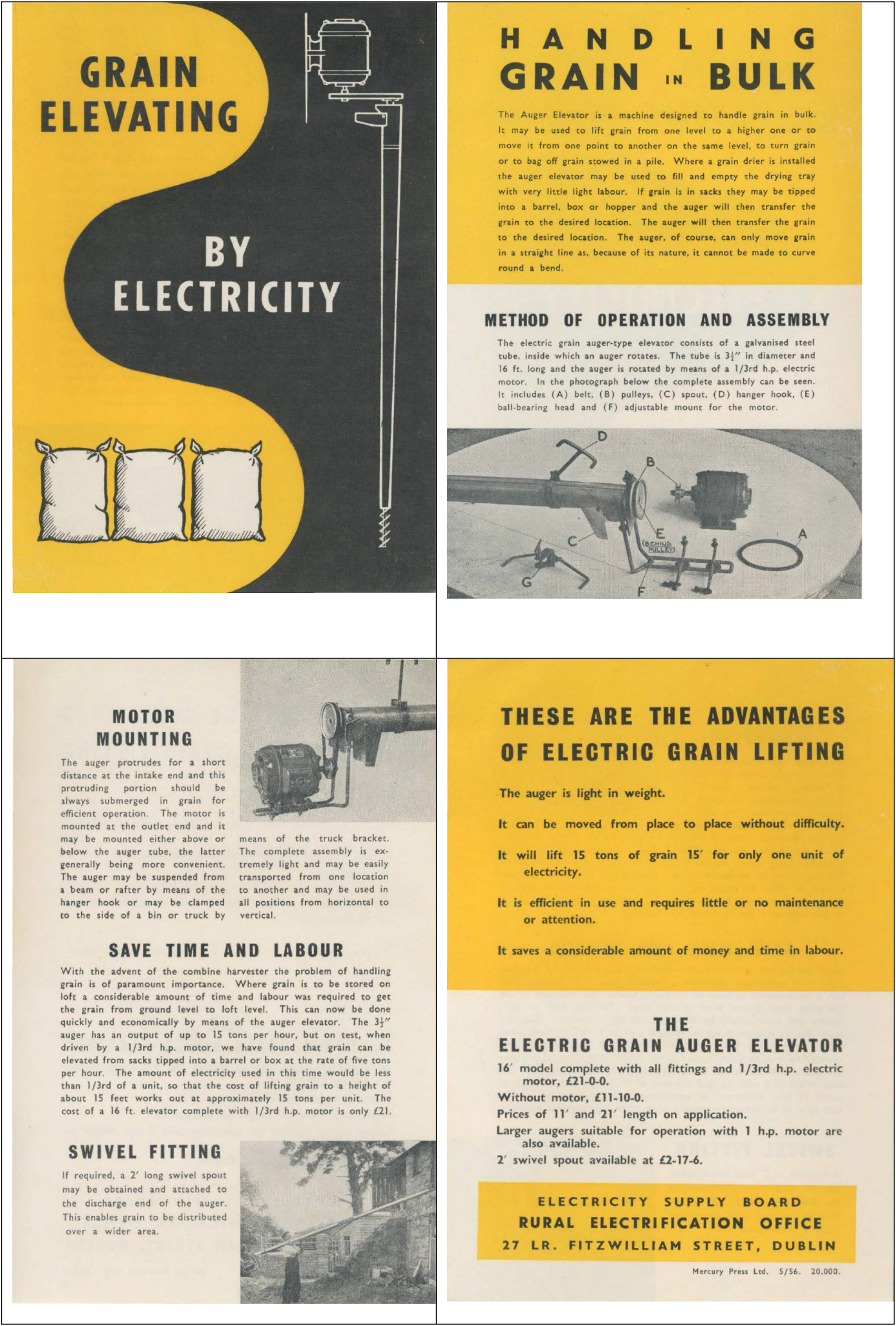
REO pamphlet on grain elevating from 1956, courtesy of ESB archives. ESB: Electricity Supply Board; REO: Rural Electrification Office.
In 2024 values, £45 in 1947 equates to approximately €2,200. A grain dryer could be added to the mill for another £40-£60, depending on the power of the fan. Handling of the grain could also be made easier using ‘a very simple screw or auger grain elevator’.
65
A similar example can be found in REO News from 1948¸ the regular pamphlet issued by the REO. An extract from the issue is reproduced below: A County Dublin farmer in the Kilsallaghan area has used one of these grinders during the last few months to coarse grind oats for cattle feeding, and also wheat for his home-made bread. In addition, the power take-off was used to drive a turnip chopper and a circular saw. A half-day's work with the saw provides him with firewood for a fortnight. He grinds about a barrel of oats and chops about one-quarter ton of turnips each day.
66
The other major area of farm life affected by the arrival of electricity was the ‘farm workshop’. 67 For example, Shiel refers to the usefulness of an electric grindstone to sharpen tools used on the farm. 68 Sharpening tools was not the only thing which electricity could help with in the workshop. Electric drills were quite popular, as were electric welders which cost about £50. 69 Farm outhouses and animal pens could also be lit, milking machines could also be installed in dairy farms and poultry could be reared under infra-red lamps (see Figure 6). 70
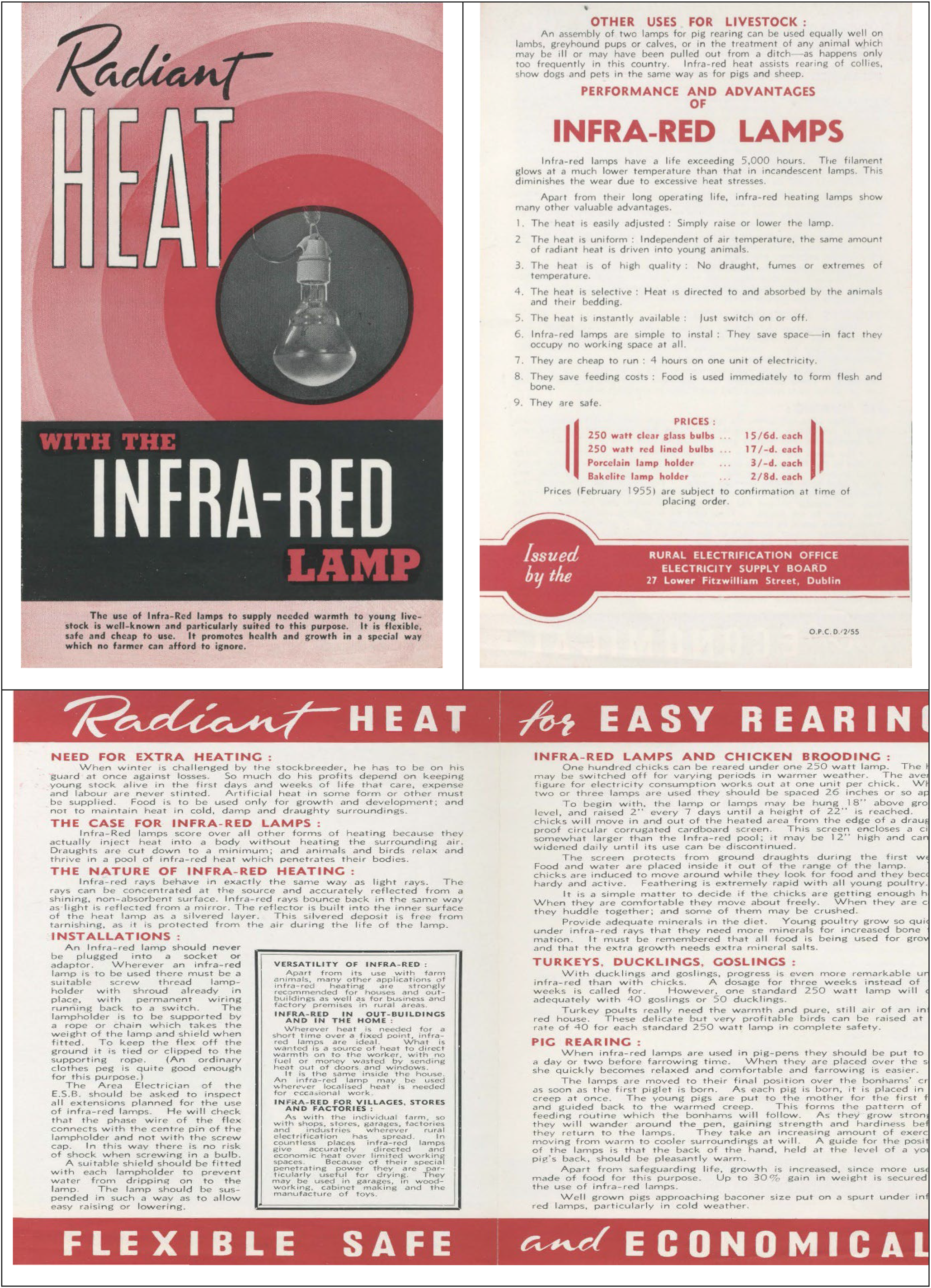
REO pamphlet on use of infra-red lamps from 1955, courtesy of ESB archives. ESB: Electricity Supply Board; REO: Rural Electrification Office.
Before giving some examples of farming uses of electricity from Oldtown found in the ESB archives, an explanation of the types of power supply is useful. 71 Households typically have single-phase supply (one live, one neutral wire) at a voltage of 230V. Farms and industrial premises typically have a three-phase supply (all three are phases, or live) and has a voltage of 415V. Three-phase supply is more useful for running heavy machinery. Under the RES, the provision of three-phase supply was chargeable to the business or farmer in the same way as domestic supply, thus implying special charges could be made if the farm supply was not deemed economical.
Some examples of how farmers in the Oldtown area were using electricity to make existing farming activities more efficient are now given. 72 It should be remembered that Oldtown is about twelve miles as the crow flies from Dublin city centre, giving farmers in the area close access to the markets within the city e.g. the Corporation fruit, flower and vegetable market off Mary's Lane. The first is from October 1952, and relates to a cereal farmer residing on the outskirts of the village area. The farmer requested a single-phase supply to operate a grain elevator and general farm use. 73 The request for a single-phase supply suggests no supply existed previously. Given the farm's distance from the nearest power line, 2km of power cable was needed. The archives show the work was completed on 29 October 1952, at a cost to the ESB of £294 (about €11,200 in 2024 values). As in the householder examples above, the ESB added a special annual charge to the normal fixed charge to recoup some of the costs. In this case, the special charge was 20 per cent on top of the normal standing charge of £15/15s.
A second example from May 1954 reveals a request for a three-phase supply by another farmer on the outskirts of the village, mainly involved in the rearing of cattle. 74 This request entailed the installation of a transformer and some additional wiring. Notes associated with the application reveal the farmer needed the supply to run a milling machine - to mill barley for animal feed - which had a 25HP electric motor. The cost of the installation is noted at £320 (c. €12,000 in 2024 values). A third example from 1956 refers to the installation of an electric pump in a field, presumably to pump water for animals. The cost mentioned is £275 (c. €10,300 in 2024 values). The pump could be run on a single-phase supply and the archival records indicate the farmer was charged an additional annual fixed charge for the supply.
Some further examples reflect how the arrival of electric power not only assisted farming, but also offered opportunities to offer new produce – such as the ability to use electric power to propagate plants in greenhouses. Three examples relating to greenhouses are now presented which capture the initial growth signs of what north County Dublin has become nationally (and indeed internationally) famous for, namely horticulture. Power could run pumps for irrigation systems and be used to heat greenhouses - the heating was typically by means of an oil-fired boiler, which needed electric power to run and to pump heated water through pipes to heat the greenhouses. Such examples are mainly from the 1960s. The first example was a three-phase supply request in 1960 by a grower from the broader Oldtown/Kilsallaghan area whose main produce was fruit such as apples and strawberries. The application for the supply noted it was needed ‘for milking machines and the operation of greenhouse boiler equipment’. 75 The total cost was £1,298 (c. €41,100 in 2024 values). A note on the files makes for interesting reading. It was noted that the greenhouses could not go without power for more than two hours, and the farmer had a backup generator. This shows the importance of electric power to the farmer at the time. The supply was also used to power motors to cool fruit in on-farm stores. A note on the files also mentions how the ability to store fruit for longer had increased the farmer's output and business. The increase in electricity consumption by the farmer noted on the files suggests the usage of power to store fruit had doubled, presumably meaning business had also increased substantially. Further documents from 1963 suggest the same farmer had expanded, acquiring additional greenhouses, and needing a further three-phase supply. This latter request was delayed until the 1964 growing season as the farmer faced considerable delays in acquiring a boiler from England. By 1966, the farmer was installing dedicated refrigerated stores – in which apples could be stored - and was requesting an increase in power supply. This was granted in July 1966, with an upgrade from a 50KV supply to a 100KV supply, completed in September 1966. The cost of this upgrade is noted at £529 (c. €13,200 in 2024 values). The ability to store produce such as apples in a refrigerated store prolonged their life, allowing the grower to sell produce over a longer time period and potentially at better prices. 76
A second example is another application for a three-phase supply from a farmer on the outskirts of Oldtown. In this case, the farmer is noted as already having three acres of greenhouses and was using a single-phase supply to run a heating boiler. 77 The files note the farmer was extending the greenhouse area. The application provides extensive detail on the type of equipment to be used, which implied a need for more power and hence a three-phase supply. The notes attached to the application by the ESB also provide detailed information on power consumption to date. Given a substantial consumption of power and closeness to existing supply, the notes attached propose ‘a three-phase 50KV supply can be extended without special conditions’. Thus, the farmer did not pay any additional supply costs, which according to the files was £2,105 (c. €41,000 in 2024 values). The files note that the farmer accepted that the annual cost of his electricity consumption would be in the region of £500 (c. €9,800 in 2024 values).
A third example comes from 1968, from a farmer on the outskirts of the village. Until this point, the farmer was mainly involved in tillage farming. It was again an application for a three-phase supply for ‘greenhouse heating purposes’. 78 The total cost of the supply was estimated by the ESB at £1,780 (c. €41,000 in 2024 values). In this example, a boiler was ordered from Denmark and work would proceed on its arrival. The supply was connected, with a special fixed charge of £15 per annum added to the normal charges.
As mentioned, over time, North County Dublin has become a notable horticultural area. Household brand names such as Keoghs (crisps) and Keelings (fruit) have their origins as family farms within the Kilsallaghan RES area.
79
These two names alone today employ over 2,000 staff between them, producing and supplying high-quality produce for the end consumer. Additionally, Keelings have over time acquired knowledge to such a degree they now sell it essentially, as captured in their website: Keelings Knowledge creates Enterprise Resource Planning (ERP) software specifically for the fresh produce industry. Our customers use our industry-tailored software across all sections of their operations, from procurement to sales to export, to drive quality and profitability within their businesses.
80
Neither of these two well-known names are likely to have become what they now are without their early entry into the production of agricultural produce in an efficient way. More generally, both then and now, tillage farming was predominant in North County Dublin. The examples presented earlier reflect how the RES allowed farmers to diversify their land use to include greenhouses and store produce for longer with refrigeration. Stories of improvements in farming are no doubt repeated across Ireland, however tillage farming in North County Dublin benefitted particularly from electrification. Dairy and other farming types of course benefitted from the RES in the Oldtown area. A comment from one oral history interview captures this well: ‘before electricity, they may have milked six or seven cows by hand. Once the power came, they could milk twenty or thirty and the extra money earned might have sent one of the kids to college or something’. 81 However, Oldtown and its environs did not develop a large dairy sector, instead improving tillage and horticulture as mentioned. In economic terms, this improved tillage and horticulture highlights indivisibilities and the long-term gains associated with the development of agriculture through the RES, such as maintaining or increasing local employment and exporting product.
Concluding Comments
Seventy-five years have passed since the lights were turned on for the first time in Oldtown, and this was the starting of about thirty years work to bring electricity to every home and farm in rural Ireland. As noted in the introduction, detailed and/or localised accounts of the effect of the RES are not common in Irish social, economic or business literature. It is hoped that this paper is a beginning, as there are a total of 791 other files in the REO records at the ESB archives. Based on file No.1 (Oldtown), these files not only contain details accounts of project progress and costings in each area, but also detailed indirect accounts of personal and business life in rural villages and surrounding areas. The latter, typically represented by handwritten letters to the ESB, may be useful to garner accounts of business development, or even family histories.
This paper has shown nuances in and around electricity supplies to homes and farms in just one parish. Having said that, it reveals some elements of conflict inherent in schemes such as the RES – for example, demands from householder and business versus the ESB's efforts to provide supplies at reasonable costs and gain a return on investment. It also shows how politics played a part in raising the complaints of locals regarding supply of power. To repeat, this paper is but one parish. A small number of other works on the RES in other parishes – such as those by O’Gorman and Waldron – have been mentioned, as well as the chapter on two parishes in Shiel's book. This still leaves a large volume of potential parishes to be research in a manner similar to here. Such research not only enhances of our knowledge of localised social and economic history, but may also allow for more macro-level or regional comparisons of issues faced. As mentioned earlier, Oldtown did not have much dairy farmers, whereas other areas would. Thus future work on the social and economic benefits to dairy farmers from the RES is to be welcomed.
The paper has also provided a reasoned, but not definitive, explanation as to why Oldtown was the first area to received electric power. The combination of closeness to an existing line and supplies, having a village centre with a population willing to install power and a ready-wired pub may have all been coincidence, but together help explain why Oldtown was first. The examples of how farmers in and round Oldtown use electric power given in the latter part of the paper show how these same farmers were in essence innovators. Without disclosing identities, all but one of the examples noted continue with farming/horticulture today, enjoying much success and maintaining employment in a rural area.
To conclude, it is hoped this paper will encourage further research on the effects of the RES on social and economic life in other parts of Ireland, providing a deeper an nuanced understanding of social life in rural Ireland during the thirty of so years of the RES. Indeed, even if the effects of the RES are not the direct subject of research, use of the ESB archives may provide context to more general studies of Irish rural life from the late 1940s to the mid-1970s.
Footnotes
Declaration of Conflicting Interests
The author declared no potential conflicts of interest with respect to the research, authorship, and/or publication of this article.
Funding
The author received no financial support for the research, authorship, and/or publication of this article.
