




Abstract
The 1930s was a period of profound crisis for Irish dry cattle farmers. Understandably, many blamed the then Fianna Fáil government, which instigated a trade dispute with Britain and harboured a deep aversion to the cattle trade. In this context, many viewed the government's decision to reduce the cattle herd in 1934 as part of a grand plan to upend largescale cattle farming. As this article demonstrates, the situation was far more complex. The government certainly sought to reform Irish agriculture but was unwilling to preside over the complete collapse of the cattle trade. The Irish government's intransigence played a part, but the worst years of the crisis also owed much to British protectionism. Yet, notwithstanding the conditions, farmers stubbornly stuck to cattle.
Introduction
Cattle, whether for beef or dairy production, have long been a central component in Irish agriculture. However, in recent years, environmental and food sustainability considerations have led to a growing reassessment of the centrality of cattle in Irish agriculture. The cattle herd is increasingly viewed as unsustainable, and some now argue it must be cut. Unsurprisingly, such viewpoints have been met with opposition from Irish farmers. However, this is not the first time a reduction in the Irish cattle herd has been posited. In March 1934, the then Minister for Agriculture, James Ryan, went before the Dáil and forthrightly declared that there were ‘too many cattle in this country’ and that they had to ‘try to cut down the numbers’ by ‘slaughtering up to 200,000 calves in the year’. In the eyes of the government's opponents, this was no less than a ‘calamity’. 1 It was, as Maurice Manning has observed, an issue that lived ‘on in the farming folk-memory for decades’. 2
The proposed reduction in the 1930s occurred in a period that, as noted by Cormac Ó Gráda, ‘marked the nadir of farmer welfare’ in the independent Irish state. 3 A trade war between Britain and Ireland and an increasing turn to economic protectionism in both Britain and Ireland combined to devastate the Irish cattle trade. In this context, the slaughtering of calves was interpreted as an attack on farmers’ livelihoods and the state's economic welfare. According to Joseph Johnston, a prominent senator and economist during this period, the scheme was part of the ‘ruthless war on our cattle industry’ that was being waged by the then government. 4
Yet, despite the controversy and the significance of this decision at the time, it is an issue that has received little more than a passing mention in the historiography. Indeed, in Mary Daly's history of the Department of Agriculture, it is erroneously contended that ‘the planned programme of calf slaughtering was never put into effect’. 5 Elsewhere, various scholars have assumed that the policy resulted from a predetermined intention to shift agricultural production from cattle to tillage. 6 However, such arguments are simplistic and fail to do justice to a policy dictated more by economic circumstances than political dogmatism. Although Daly overlooks key aspects of the issue, she is correct in describing the Fianna Fáil (FF) government's attitude towards the cattle trade as ‘ambivalent’. 7 This ambivalence underscores the intricacy of the political landscape at the time, where actions often diverged from rhetoric, and contradictions abounded. This article thus seeks to explain the ambivalence.
Three fundamental arguments underpin this article. Firstly, while it is true that many in FF deplored the Irish state's dependence on the cattle trade with Britain, the FF government did not set out to reduce the cattle herd from the outset. Second, the article contends that the 1934 decision to cut the herd was not a predetermined policy but a response to specific external factors. Finally, it demonstrates that, despite party rhetoric, the realities of Ireland's economic situation left the government with little choice but to continue relying on cattle exports to the British market. The circumstances prompting some to advocate for a fundamental transformation of Irish agriculture today are vastly different from those that prevailed in the 1930s. Nevertheless, an investigation of the government's management of the cattle sector during this period provides valuable insights into how attempts to transform the characteristics of an agricultural system are contentious, complicated and fraught with difficulty.
The Rise of the Cattle Economy
Irish agriculture underwent a significant transformation in the nineteenth century. Thanks largely to the economic dislocation caused by the Great Famine, in the middle decades of the century, there were ‘quite radical shifts in land occupancy from small to medium and extensive occupiers’ with graziers and ranchers, those who occupied holdings of at least 200 acres, becoming ‘a more numerous and expansive elite’. 8 Because it was less labour intensive, these large holdings focused on livestock production, especially dry cattle, but this trend towards increased livestock farming was evident across all classes of Irish farmers, spurred by rising demand in the British market. This resulted in a ‘radical change out of tillage production’, and by the early twentieth century, Irish agriculture ‘was emphatically based on livestock production’. 9
For many Irish nationalists, most notably Arthur Griffith, the concentration on cattle for export to Britain was deemed to be to the detriment of the Irish nation itself. Griffith, who championed a protectionist economic model, lamented how ‘agriculture in Ireland is resolving itself into the cattle trade’. This, he argued, left few who could find an adequate livelihood on the land and stunted Irish industrial development. 10 However, with the achievement of independence in 1922, Griffith's colleagues in the pro-Treaty Cumann na nGaedheal ‘showed scant respect for the teachings of the master’ during the first decade of the Irish Free State. 11
As the primary employer in the state, Cumann na nGaedheal viewed agriculture as the engine of the Irish economy. It was a point the Minister for Agriculture, Patrick Hogan, made clear when he stated that ‘national development, for our generation at least, is practically synonymous with agricultural development’. To this end, government agricultural policy aimed to improve the quality of exports, reduce production costs and maximise farmers’ profits. 12 Griffithite protectionism was not conducive to such an approach, and instead, free trade became a defining feature of government policy. The policy found particular favour among the large grass farmers dependent on the British market, who formed an influential support base for Cumann na nGaedheal. 13 Dry cattle production for the British market thus remained the dominant feature of Irish agriculture. By the 1920s, some cattle rearing was practised on almost all farms, Dairy producers and small farmers typically sold their young stock to the grass farmers of north Leinster, who fattened the animals on their expansive fertile pastures before most of the animals were mostly exported. 14 Most of these fattened cattle were then exported. Thus, whereas most of the country's crop requirements were imported, by 1930, as much as five-sixths of Irish livestock output was exported to Britain. 15
When FF emerged in 1926 under the leadership of Éamon de Valera, its approach to agricultural matters was, in many ways, the antithesis of Hogan's. Seán Lemass, one of the party's leading economic thinkers, spoke for many in the party when he condemned Hogan's pro-cattle exporting policies as ‘the root cause of all the economic evils that are hitting our people’ as it provided little for the country except a profit for the farmer. 16 FF was avowedly protectionist, viewing free trade as ‘a British dogma, devised for British purposes, implemented by British lackeys and inevitably resulting in an exploited, stunted, depopulated and poverty-stricken Irish economy’. 17 Additionally, the party viewed the large grazing ranches as a blight responsible for rural depopulation and economic underdevelopment. To establish ‘as many families as practicable on the land’, FF was committed to acquiring and dividing up such ranches among small farmers and agricultural labourers, who naturally showed appreciation at the ballot box. 18 Fundamentally, the party viewed the purpose of agriculture as supplying food for the home market and providing more employment on the land. This, the party argued, could be achieved by a greater emphasis on labour-intensive tillage. Ireland's days as ‘an out-garden for the British’, as de Valera told the Dáil in 1928, had to end. 19 With this change, he envisaged that the land would be made liveable for people, not just bullocks.
There was undoubtedly an element of economic archaicism to FF's agricultural policy. Many in the party viewed placing as many people on the land as an end in itself and showed scant regard for productivity, modernisation, or commercial viability. Indeed, the backbench FF TD Michael Kennedy called for a ‘movement to revert to savagery’ after he saw the party leadership promote labour-saving agricultural machinery. 20 At the same time, as Kenneth Shonk has observed, a current within the party sought to present a vision where ‘the nation could be modern while at the same time maintain its traditionalist connections to the land’. 21 In this regard, it is significant that FF's chief agricultural spokesperson, James Ryan, was not the product of smallholding stock in the west of Ireland but came from a sizeable mixed farm in ‘one of Ireland's most progressive farming districts’ in Wexford. 22 Ryan and those like him in the party did not strive for a primordial vision of agriculture; rather, a modern, prosperous country like Denmark, which cultivated more land and exported more livestock products than Ireland, offered the model. 23 FF's position was aimed at expanding agricultural output, and in doing this, as Tom Garvin has recognised, ‘there was no necessary contradiction between the plough and the cow’. 24
Economic War
That there was a change afoot for Irish agriculture was evident from Ryan's declaration soon after assuming office that the ‘Home market was the best market’. However, he followed this with the important proviso that the government also sought ‘to maintain the balance of trade by encouraging the export of all agricultural produce of which there is an exportable surplus’. 25 The government wanted farmers to alter their production in a way that met the needs of the Irish consumer, but there was no question of abandoning the British customer. Indeed, Ryan's first piece of legislation entailed subsidising butter exports. Falling butter prices were making dairy production unremunerative, which was deemed a particular concern, because dairy was, as Ryan told the Dáil, ‘the basic industry in agriculture’ under which the rest of agriculture depended. 26 Safeguarding the dairy herd was a priority. As Mícheál Ó Fathartaigh notes, ‘FF wished to rebuild agriculture around small farmers and the most sustainable type of farming for small farmers was dairy farming’. 27 With government policy committed to a large dairy herd, it also ensured an ample supply of calves for beef production.
The decision to subsidise butter exports is a reminder that FF came to power during global agricultural depression. As Seán Kenny notes, the impact of the Great Depression in Ireland was comparatively mild, with the economy only contracting by approximately 1.4 per cent between 1929 and 1932. While modest, this contraction was notably driven primarily by difficulties in the agricultural sector. 28 Although Irish agriculture was not in a state of crisis when FF assumed office, it was facing significant difficulties that farmers expected the new government to address. Indeed, globally, over-supply and declining demand led to a calamitous fall in agricultural prices. In such circumstances, governments everywhere adopted trade restrictions, internal regulations and price supports to help their farmers. 29 However, the situation in Ireland was further complicated by a protracted trade dispute with Britain.
The genesis of this dispute, known as the Economic War, lay in the government's default on the land annuities due to the British government. The British Treasury then utilised these funds to funds to service the principal and interest on bonds issued under the pre-independence land acts. Additionally, several other payments, primarily pensions, were also suspended. Totalling £5 million annually, these payments were not an insignificant burden on the Irish economy. 30 For FF, the non-payment was viewed as part of their wider campaign against the hated 1921 Treaty, and it was also popular among farmers who resented paying these annuities. 31 Many did not appreciate that the government still expected farmers to pay their annuities to Dublin.
Predictably, the British government resented the non-payment. While it was theoretically possible for Britain to default on the land bonds and attribute the blame to the Irish government, this approach was highly risky. The bonds were largely held by domestic British institutions, which would have suffered significant harm from such a default. 32 The British government needed to repay the bondholders and was determined that the funds be extracted from Ireland. There was some reticence about starting a trade war, but ultimately, ‘trade and employment considerations carried little weight beside the larger political questions’. Import duties were thus imposed on a range of Irish agricultural produce to recoup the money and hopefully bring de Valera to his senses. 33 These duties of 20 per cent, which soon rose to 40 per cent, represented a heavy blow to Irish agriculture. Ireland's leading agricultural newspaper, the Farmers’ Gazette, predicted that ‘in so far as the immediate future is concerned, the live stock traffic and the trade in agricultural commodities between the Free State and Great Britain is likely to end completely and abruptly’. 34
The potential downfall of the cattle trade was seemingly not a concern for many in the FF grassroots. One protectionist commentator succinctly expressed the widespread FF attitude when he wrote, ‘The cattle trade did not enrich this country: though it filled the emigrant ships it has brought about a crisis which in the end will make us prosperous and contented’. 35 Those whose livelihoods depended on the cattle trade were predictably not so exuberant. Cattle industry representatives quickly met Frank Aiken, who was deputising as Minister for Agriculture, to express their concerns, but Aiken bluntly dismissed their fears. He insisted there would be no need to export so many cattle once the government implemented its self-sufficiency policies. 36
Britain's potential to import ever larger amounts of high-quality chilled beef from its faraway Dominions opened the possibility, as many feared, that Ireland could lose its position in the British market permanently if it surrendered it now. 37 However, Ireland had a distinct advantage over its competitors as its proximity ensured it was the dominant exporter of live cattle to Britain. In opposition, FF argued that more employment could be created by having the ‘the meat packed here and not to have it sent off driven on its four legs’. 38 Yet, Ireland's position as an exporter of live cattle rather than dead meat gave it a competitive advantage. From the British perspective, Irish store cattle, that is, those that still had to be fattened before they were ready for slaughter, were an essential component of British farming, considered ‘the raw material of the livestock industry in Great Britain’. 39 The British government thus did not wish to make the duties so punitive as to decimate the cattle trade, not least because it was largely from duties on live cattle that the British hoped to recover the defaulted money. As such, the British government had some reason to worry about the collapse in Irish cattle exports that followed the imposition of the duties. 40 As it happened, the Irish government's response converged with British interests.
Despite the bellicose talk of some, the FF government had to take action to ensure the continuance of the cattle trade. With strong farmers holding off on selling their cattle for export, they were not restocking their land with the cattle they usually bought from smaller farmers who lacked the means to sustain themselves through a protracted fall in business. One penniless widow exemplified this difficulty when she wrote to the government in August, pleading for assistance because she could not sell her cattle, leaving her family on the ‘verge of starvation’. 41 She and others like her could not wait for the future utopia of self-sufficiency. Consequently, the government sought to revive the cattle trade by introducing an export bounty of 12.5 per cent for all cattle. As with the decision to subsidise butter exports, the government sought to alleviate the economic distress and maximise agricultural production. There was also the hope that the bounty could be used to modify Irish agriculture more to FF's liking. It was initially decided that the bounty would apply to fat cattle as fattening more cattle in Ireland would require more fodder crops and thus aid the government's tillage agenda. Moreover, fattening more cattle in Ireland provided an effective means of retaliation for, as de Valera correctly told a public meeting in September, ‘the British want our store cattle’. 42 However, it was quickly realised that it would be impractical to differentiate cattle, while the number of store cattle that could be finished in Ireland was limited. 43 It was an early indication of the Irish government's inability to alter the cattle economy.
The cattle bounty was intended as a temporary measure to get through the initial shock. Many in government hoped the bounty would end soon, not least because there was something incongruous in FF subsidising the cattle trade, which they so often depicted as damaging to the Irish economy. As one ‘small farmer’ observed in December, FF representatives were continuing to denounce ‘ranchers and grazers’ while at the same time, the government was providing them with a bounty ‘to feed John Bull’. 44 When the government decided to halve the land annuities in December, it appeared that this also offered an opportunity to end the embarrassment of the cattle bounty. However, the problem remained regarding how they could do this without harming small farmers and agricultural production. Ryan was not prepared to abandon those, mostly small farmers, who practised stall-feeding, a type of farming that complemented tillage production since it provided both an output for fodder crops and a source of manure. 45 If he wanted to retain the bounty for these stall-fed cattle, then practicalities meant he had to maintain the support for all cattle. Moreover, the Department of Agriculture officials warned that discontinuing the cattle bounty so long as the British duties continued would be detrimental to the wider farming economy. 46 Consequently, Ryan had few options but to persevere with the bounty, much to the frustration of many in his party.
After the introduction of the cattle bounty, export bounties were soon applied to almost all agricultural produce. Taken together, these constituted a large sum. Indeed, for a government committed to industrialisation and economic protectionism, the degree to which public funds were utilised to support agricultural exports was striking. Despite FF's pledge to reduce public expenditure while in opposition, they soon oversaw a spending increase of £6 million, over 40 per cent of which went to agricultural subsidies. 47 As Tom Feeney notes, the rise in spending on bounties, as well as on pensions and unemployment benefits, reflected FF's priority to ‘fulfil the promises of extensive social amelioration made in opposition’ – much to the displeasure of the Minister for Finance, Seán MacEntee. 48 Nevertheless, the cattle bounty was only a small consolation to Irish farmers. After alterations to the duty and bounty rate in 1933, fat cattle could only expect support of £1.75 against a penalty of £6. 49 In contrast, the bounties for dairy, pigs and eggs were far more generous. 50 It was naturally more politically expedient to support these commodities, given they were largely the preserve of small farmers. Nonetheless, the sums afforded to both cattle and dairy produce indicate that if the government was out to destroy the country's livestock industry, as their opponents so often alleged, they had a peculiar way of doing it (Figure 1).
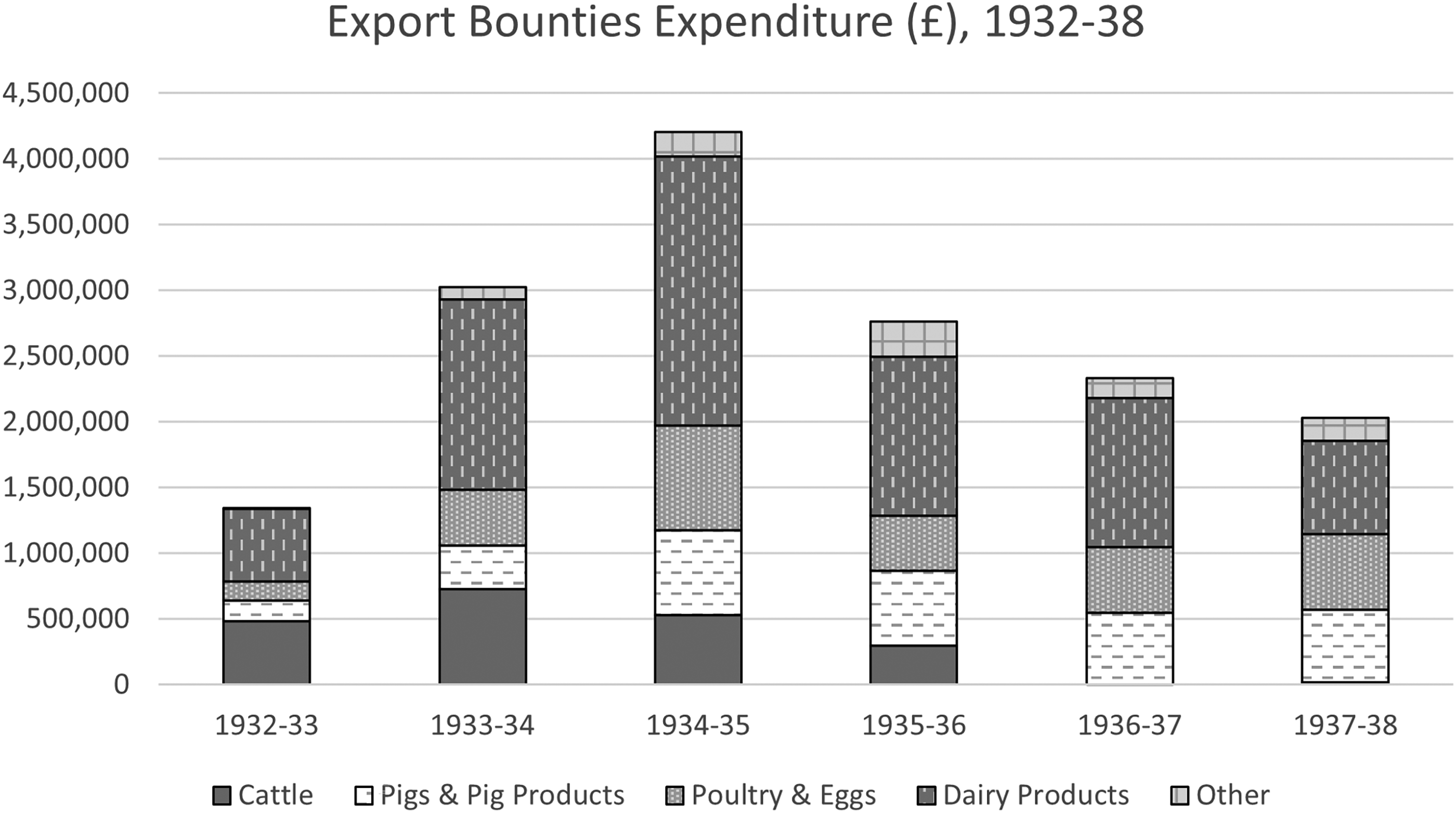
Export bounties as reported in the Annual Reports of the Minister for Agriculture.
Running concurrently with the efforts to keep the export trade alive was the campaign to remodel agriculture into a system that placed a much greater emphasis on tillage and the home market. Under the 1933 Cereals Act, wheat was subsidised, cereal imports restricted and animal-feed mixtures were mandated to include a proportion of home-grown grain. 51 The plan certainly had some merits, but in the circumstances of the Economic War, pro-tillage measures ‘tended to assume the character of a vendetta against cattle’. 52 It was a view that was only strengthened by Lemass' insistence that the legislation marked the point ‘at which the Irish people have made up their minds that men, women and children, in happy homesteads on the land of Ireland, are to take the place of cattle and byres’. 53
In contrast, Ryan, the main driver of the legislation, did not present it in such binary terms. He hoped the legislation would result in a substantial million and a half extra acres of tillage, but this meant putting only 15 per cent of grassland under the plough. He maintained that efficient use of manure would compensate for the slightly reduced grassland area. 54 Even if the government met its tillage targets, grass and cattle would still predominate. Ryan was not aiming to swap cattle for wheat. Instead, he sought to maximise agricultural production, which he believed provided the surest way of maintaining people on the land. Indeed, as he was keen to point out throughout this time, more tillage would lead to more cattle. 55 As such, at a farmers’ meeting in June 1933, Ryan derided anyone who believed they could promote tillage without at least maintaining their livestock numbers as ‘either a fool or a knave’. 56 He may well have had some of his party in mind.
The Cattle Surplus
Irish farmers were in an especially difficult situation throughout the 1930s, but their plight was not entirely unique. The onset of the Great Depression in 1929 led to a decline in consumer demand, which impacted farmers throughout Europe. Similar to Ireland, governments across the continent responded by implementing protective tariffs and quantitative controls as a means to shield their farmers from the economic crisis. 57 As an industrial country and the world's leading food importer, Britain had long been reluctant to embrace agricultural protection. For decades, British farmers, struggling against foreign competition, argued for tariff protections, but their pleas fell on deaf ears. However, the slump of the 1930s forced a shift in government policy. 58
Like in Ireland, a sense of despair marked British agriculture in the 1930s. In October 1932, the Daily Mail warned, ‘The livestock industry is rapidly nearing a collapse, which, if not stayed, will mark the final plunge to ruin of our agriculture.’ 59 Some even blamed the penal duties for increasing the costs of Irish store cattle, but others viewed the continued importation of Irish fat cattle as the problem. 60 No doubt to the surprise of Irish farmers, some of their British counterparts bemoaned the bounty for being too generous and thus allowing a flood of Irish fat cattle that are ‘wrecking our markets’. 61 Such farmers wanted more extensive restrictions on cattle imports, and they were fortunate that the British government was more open to considering their pleas for protectionism.
As John Martin details, the National Government that came to power in 1931 was less committed to free trade and soon placed tariffs and restrictions on several food imports. 62 Although it constituted a relatively small share of the British economy, the British Minister of Agriculture, Walter Elliott, was especially anxious to defend the interests of British agriculture, telling the Commons in November 1932 that ‘if you lose agriculture, you not only lose an industry; you lose your life’. 63 Elliot's efforts to save and expand British agriculture were reflected in the 1933 Agricultural Marketing Act, which allowed for the extensive regulation of agricultural imports. As he told the Commons upon introducing the legislation, ‘It is no longer the national policy to buy all over the world in the cheapest market’. 64
The need to placate its Dominions meant British protectionism was different from that practised by other states. This issue was discussed at the Imperial Economic Conference in the summer of 1932 in Ottawa, where it was agreed that the Dominions would be given a preferential position in the British market, although the principle of quantitative regulation of exports into Britain was also recognised. In effect, as observed by Paul Brassley, ‘the needs of the UK producer came first, those of Empire producers second, and others last’. 65 Although still a Dominion, Ireland failed to reach an agreement with Britain at Ottawa and did not obtain imperial preference, Britain was not yet prepared to treat Ireland as a foreign state. Instead, Ireland was regarded as ‘intermediate’ between the other Dominions and a foreign country. 66 Thus, when at the end of 1933 Elliot decided to reduce the number of fat cattle imported into Britain, it was decided that in the ‘present circumstances’, Ireland and not Canada, the other, albeit much less significant source of imported cattle, ‘should be called upon to bear the brunt of the cut’. 67 This reduction, announced in December 1933, amounted to a 50 per cent reduction in fat cattle imports from Ireland, with store cattle also open to regulation and beef and veal imports prohibited.
Elliot was clear that the move was solely prompted by ‘the crisis in the beef industry’. 68 However, this explanation mattered little to the Irish government's vociferous critics. The Irish Times reflected the view of many in maintaining that ‘Mr de Valera's hostility to England and his Economic War are the prime causes of this broadside from Britain’. 69 While this analysis has a veneer of truth, it is unfair. The fact was that Irish agriculture faced two parallel challenges in the form of Ireland's strained relations with Britain and the depression in British agriculture that was leading to the turn towards protectionism. The restrictions announced by Elliot represented a convergence of both problems, although it was easier to lump them both under the heading of ‘Economic War’. The Farmers’ Gazette, which had a fuller understanding of the global agricultural position than most, showed a greater appreciation of both these difficulties. The paper noted that while the blow to the cattle trade might have been lessened by a ‘more tactful handling of other important issues’, British policy and the ‘economic world situation’ likely made the blow, ‘irrespective of the Government in power in the Free State and our political relationships with our neighbour’, ‘inevitable’. 70
When the Meath farmer, Joe Ward, reflected on the Economic War in later years, he maintained that ‘whatever about the effect of the tariff – the quota was fatal altogether’. 71 The problem emanated from the fact that of the roughly million calves born every year, 750,000 were ultimately exported. With the quota, it was estimated that no more than 550,000 animals could now be exported. 72 There was little hope of sending the surplus cattle elsewhere as, since the beginning of the Economic War, ‘alternative markets’ were looked for, but mostly, this amounted to a fool's errand. Clandestine cattle smuggling into Northern Ireland, where farmers, notwithstanding falling prices, did not suffer under tariffs or quotas, predictably increased in 1934. 73 This likely helped reduce the burden, but it was not a cure for the problem. The government had few options except to reduce cattle supply, increase domestic beef consumption and stabilise cattle prices.
Among the initiatives quickly decided upon was a scheme for killing old and diseased cows. However, this scheme could not commence until 1935, when a meat-meal factory was established in Roscrea to dispose of the animals. Importantly, this did not imply a reduction in the dairy herd; rather, it would allow the cows to be replaced with young heifers that might otherwise go into beef production. To maintain agricultural employment and output, the government insisted that the dairy herd, the ultimate source of the surplus cattle, not be reduced. 74 Thus, if the government wanted to reduce the beef cattle supply, calves had to be disposed of. It was quickly recognised that greater veal consumption offered a solution, but this was no easy task given the meat's unpopularity. As such, it was decided to apply an export bounty of 10s. to calf skins in the hope that this would induce farmers to kill their calves and ‘cause the flesh to be available…at such a low price that the very poor who rarely obtain meat at any period of the year may be able to procure it’. 75
In announcing the new policy in March 1934, Ryan was adamant that killing some 200,000 calves was necessary if they were going to manage their cattle surplus problem. 76 In a country so accustomed to raising cattle, the announcement immediately caused outrage. In the local and national press, the scheme was denounced as the ‘most revolutionary and sensational proposal of a Ministry with a long list of breath-taking schemes behind it’, the ‘most badly considered’ of all the actions taken by the government. 77 Fine Gael's Patrick Belton viewed it as a sad indictment of Irish self-government and ‘the mess they have made of it.’ 78 Even the prominent FF senator, Maurice Moore, expressed reservations and advised farmers to disregard the bounty. 79 However, it quickly became apparent that farmers paid little heed to such calls. As Andrew Forrest, then growing up in Cork, remembered, ‘farmers had no hesitation in skinning every calf they could lay their hands on be they dead or alive, still-born or premature, they all suffered the same fate’. 80 The British press was only too happy to propagate lurid stories of ‘infuriated fiends in the midst of the slaughter’ who ‘smashed heads’ and stripped the calves of their hides as they were ‘still alive and groaning with pain’. 81 An element of imperviousness was apparent in such reporting, and as de Valera rightly recognised, they ‘attempt to represent us as uncivilised’. 82 Domestic opponents meanwhile saw something Biblical in the enterprise. It was decried as a modern-day ‘slaughter of the innocents’ in which Ryan, so declared the erratic Fine Fael leader, Eoin O’Duffy, had the role of ‘King Herod in all his glory’. 83
The calf slaughter came at a time of intense political polarisation in rural Ireland. The direction of agriculture played no small part in creating a ‘politics of hatred’ that, in the view of Maurice Manning, had perhaps never been seen before or since. 84 This was most plainly seen in the rise of O’Duffy's para-fascist Blueshirts, which, as noted by Mike Cronin, owed much of its rise as a political force to the Economic War. 85 For those who believed that FF was always intent on decimating the livestock sector, the calf skin bounty seemingly offered proof. As opined by the Irish Times, Ryan appeared to have decided that, ‘the cattle trade is a bad thing in itself – that there is something inherently patriotic in the growing of wheat and something inherently treacherous in the raising of a bullock’. 86 Language from senior figures like Frank Aiken, who threatened ‘drastic action’ against those who ‘worship the bullock’ exacerbated this perception. 87 Despite what this language implied, there was no compulsion to kill calves. Farmers were offered 10 s. for their calf skins, and many endorsed the policy by their actions, with 138,000 bounties ultimately paid out in 1934. The policy was contentious, but it was not, contrary to James Meenan's later claim, such a ‘shock to public opinion’ that it was quickly scrapped. 88 It continued for three more years, resulting in the killing of 221,000 in 1935, 162,000 in 1936 and 122,000 in 1937. 89 Yet, although the scheme succeeded in killing calves, Ryan had to admit by 1937 that ‘our hope of encouraging the consumption of veal was not realised’. 90 With the lack of domestic demand for veal, farmers would only continue to kill their calves if the bounty was deemed more lucrative than the potential benefit from rearing the animals. As higher cattle prices would naturally result from limiting the supply, it was not a sustainable long-term policy to limit cattle numbers.
That veal did not catch on undoubtedly had something to the government's contradictory aim of increasing beef consumption. In 1934, this was necessary to provide a stable market for those cattle that could not be exported. This was the purpose of the 1934 Slaughter of Cattle and Sheep Act, passed in September. As part of the legislation, the cattle supply was brought under strict government control by means of fixed prices and a branding system that determined when cattle could be slaughtered. State loans were also provided for domestic meat processing. Among the most notable features of the legislation was a free beef scheme, financed by a levy on domestically slaughtered cattle, for those on unemployment and home assistance, benefiting approximately 110,000 recipients, as well as their dependents. 91 Although declarations in the Dáil that no ‘Communist Government in the world could add a comma to this Bill’ were certainly inflated, there was no denying that this, along with the already existing licensing system used to control exports, constituted an unprecedented level of state intervention in cattle production. In the words of one ‘big cattleman’, Ryan had become the ‘bullock dictator’. 92
The troubles in the cattle sector at least allowed some consolation for the government as the establishment, with state support, of the aforementioned factory in Roscrea, as well as a meat canning factory in Waterford, fitted into the government's drive to industrialise the country. 93 The provision of free beef also offered a means for FF to cement its position as the champion of the impoverished. Unsurprisingly, the government's critics saw it as a cynical attempt at ‘political proselytism’. According to the Cork Examiner, it was no more than ‘a bit of propaganda for the Christian Socialism of FF’ and called for less of this ‘high-falutin’, ‘sloppy sentimentalism’. 94 Certainly, the provision of free beef fit the oft-repeated narrative that while the government was mishandling agriculture and dictating to farmers, they were overly generous to welfare recipients and urban dwellers. Yet, the plain fact was that these measures were introduced solely for the benefit of farmers.
When fat cattle prices had fallen by half since 1931, it was difficult for many farmers to appreciate that the government's actions were easing their burden. 95 Nonetheless, the collective consequence of the government's actions was that annual domestic consumption of cattle rose by 90,000 to 211,000, which ensured a market that otherwise did not exist and prevented prices from collapsing even further. 96 Perhaps what the farmers wanted, as the satirical Dublin Opinion supposed, was ‘a really good scientific process for turning beef into something else’. 97 Lacking such innovation, the government had to pursue these interventionist policies. As unprecedented as these measures were in the Irish context, they were not exceptional within the broader European framework. Agricultural exporting countries like the Netherlands and Denmark were also forced by economic conditions to take steps to reduce their cattle numbers by extensive culling programmes. 98 The Irish experience certainly had its peculiarities, but it was not wholly idiosyncratic (Figure 2).
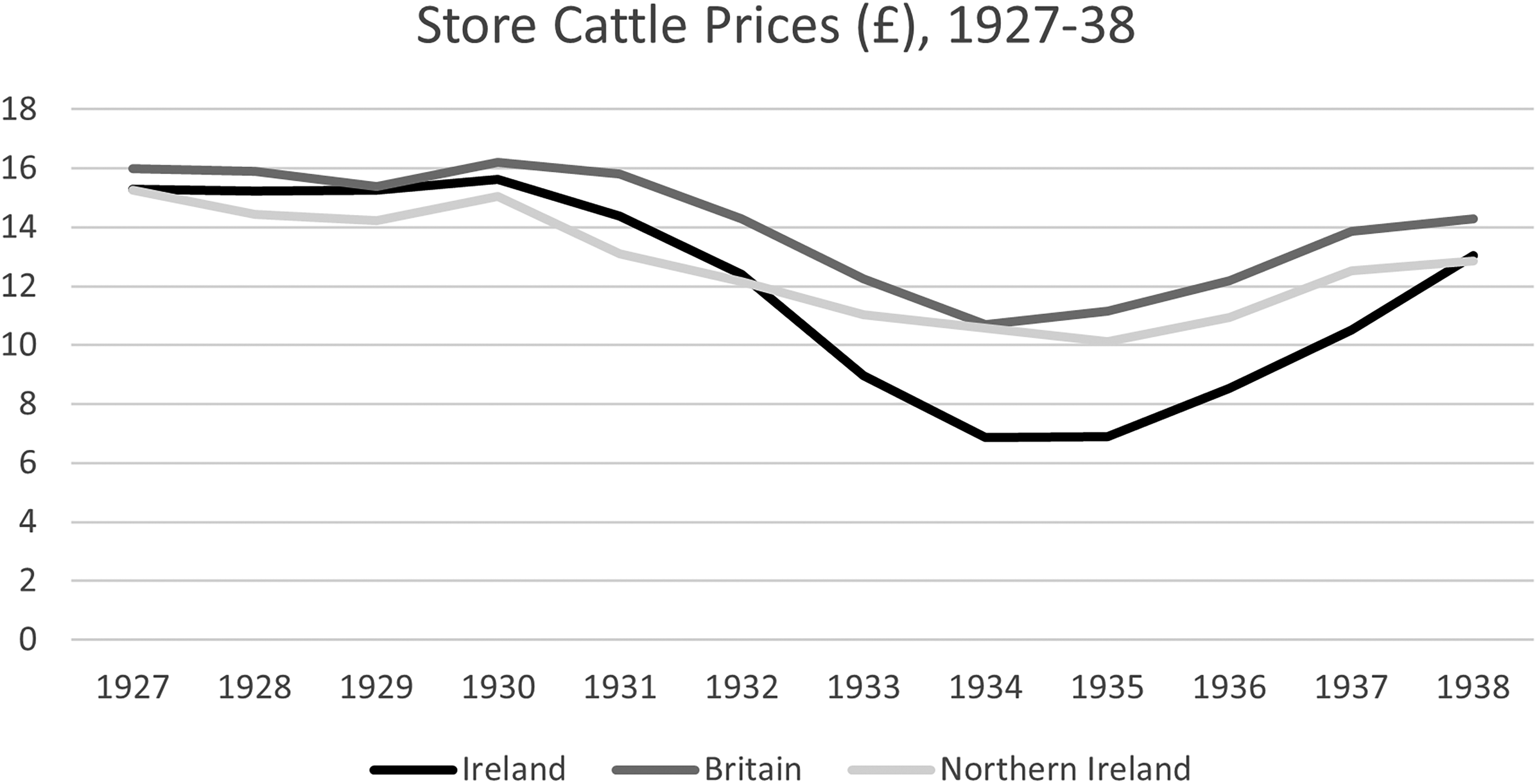
Store cattle prices as seen in P. J. Neary and C. Ó Gráda, ‘Protection, Economic War and Structural Change: The 1930s in Ireland’, Irish Historical Studies, 27:107 (1991), 260.
The Ending of the Crisis
In the view of the Farmers’ Gazette, the collapse of cattle markets in 1934 offered proof that an ‘economic revolution is in progress’, and farmers needed to adapt to the new dispensation. 99 However, 1935 began with a sign that the revolution might be stalled. A coal-cattle pact was agreed to in January between the British and Irish governments, which saw the cattle quota increased in exchange for Ireland purchasing the equivalent value of British coal. De Valera had reservations, but he reluctantly agreed to the deal. J.J. Lee has interpreted this as de Valera's recognition that ‘historical illusion must succumb to economic reality’. 100 However, Lee's analysis implies that de Valera's position on the Economic War had changed. This was not so. The land annuities remained withheld while his mission to assert Irish sovereignty continued. Nor had de Valera's fundamental conviction that the cattle trade hampered Irish economic development changed. Indeed, at the very time when the pact was being negotiated, de Valera told the Dáil that ‘the development of the cattle industry here in this country in the past, as a corollary of the English free trade system, was purchased at an immense cost to our people’. 101 That he nonetheless agreed to the pact reflected his government's position since 1932: the cattle trade was an unfortunate characteristic of Irish agriculture, but it was nevertheless a feature upon which Irish farmers depended.
It was not a Damascene conversion on the part of de Valera but rather rapid alterations in the British government's trade and agricultural policy that brought about the coal-cattle pact. It must be remembered that the sole reason for the cattle quota was to assist British agriculture. It was a policy that Elliot remained committed to as 1934 progressed, but among other elements of the government, there was growing disquiet with Elliot's position. Increasingly, it was pointed out that the agricultural expansion that Elliot desired would hamper British exports and worsen the employment position. Moreover, the existing quantitative restrictions proved ineffective. Only more extensive cuts to imports would improve the prices for British farmers, but such cuts were inconceivable for urban Britain. Ultimately, the government's free traders again gained ground, and the principle of quantitative restrictions fell out of favour. A subsidy on cattle sold for slaughter was instead adopted as the most efficient means to help British farmers. 102 Furthermore, there was also a desire to impede Ireland's growing trade relationship for fear that Britain would lose its position as Ireland's chief coal supplier. 103 Therefore, to paraphrase Lee, the coal-cattle pacts, in part, marked the point where the British government recognised that idealistic aspirations for British agriculture must succumb to the reality of Britain's position as a food-importing, export-orientated industrial nation.
The 1935 pact helped ease the problem of surplus cattle, but it was far from a panacea to the troubles in the cattle sector. Prices were still low, and uncertainty over future trade remained. In this context, gone were the days when Ryan could preach the message of more tillage leading to more cattle. A degree of pessimism took hold, and he was now definitive that cattle production could not be maintained at current levels. The ‘plough means stability’, he advised farmers at the start of the year, but ‘the bullock is still a gamble’. 104 Nevertheless, he continued to support those who took the risk. Moreover, such farmers also benefited from the larger dairy herd that resulted from the government's generous subsidisation of butter. More cows meant a surfeit of cheap calves for those who wanted to gamble on the bullock. 105 At the same time, the number of calves exceeded demand, meaning the calf slaughter continued. The calf skin bounty may have been seen as evidence of the government's deliberate destruction of the cattle trade, but few appreciated the role the government's pro-dairy policies played in its persistence (Figure 3).
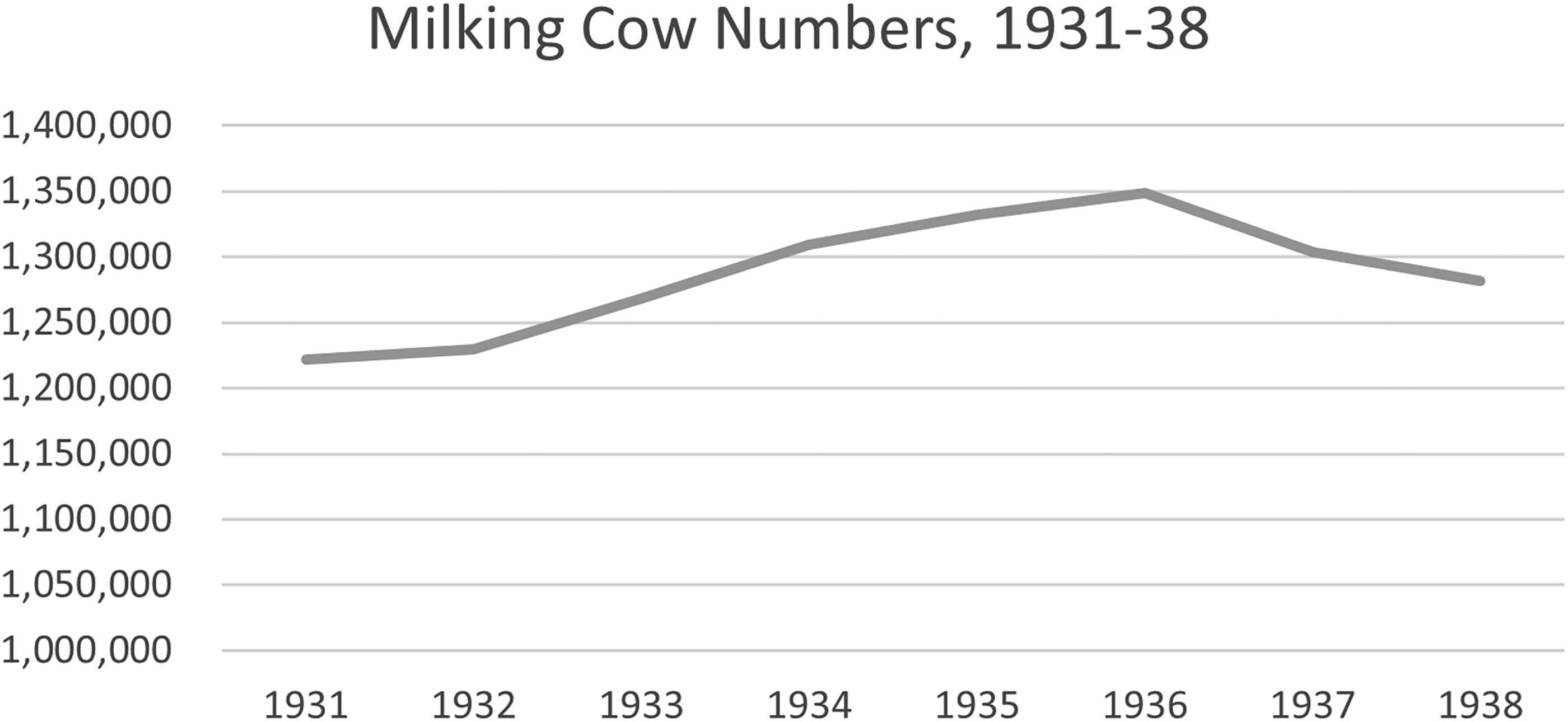
Milking cow numbers as seen in Central Statistics Office, Farming since the Famine: Irish Farm Statistics, 1847–1996 (Dublin, 1997), 283.
With the subsidised dairy herd producing an ample supply of animals that ultimately had to be disposed of or marketed at some government expense, there was some justification to the Minister for Finance Seán MacEntee's protest at the end of 1934 that the continued expenditure on export bounties was ‘having all the defects of a planned economy without any of its advantages, because it is essentially unplanned’. 106 MacEntee had never reconciled himself to the bounties, but similar to previous disagreements, Ryan had little time for ‘academic considerations’ and remained adamant that the money for bounties ‘must be found if agriculture is to survive at even its present standard’. 107 The Departments of Finance and Agriculture were locked in a constant struggle over the bounties, but as Ronan Fanning points out, Agriculture ‘was able in the abnormal circumstances of the time to wield an influence in areas which, throughout the twenties, had remained the exclusive preserve of Finance’. Much like on previous occasions, the cabinet sided with Ryan over MacEntee, and the bounties continued. 108
Nevertheless, with MacEntee determined to tighten the purse strings and with agricultural prices remaining unremunerative, Ryan's fatalism regarding farming's future metastasised. In July 1935, he submitted a memo to cabinet on ‘farm prices and the necessity for action’, proposing a new general import tax to fund the massive augmentation of agricultural prices to pre-depression levels. At the same time, he suggested that agricultural production be gradually reduced over five to ten years to meet home consumption only. 109 This was a remarkable proposition that entailed the fundamental restructuring of the entire Irish economy. Indeed, so unthinkable was this plan that Ryan's sincerity in suggesting it can be questioned. Perhaps it was not more than a cry for help from a minister in a seemingly impossible position. Nevertheless, on the foot of this, Ryan was requested to examine the practical implications of substantially reducing total cattle numbers, including the prized dairy herd.
When Ryan reported back to cabinet in November, he presented a memorandum from his Director of Agriculture, J.M. Adams, on what this cattle reduction would entail. The memo presented a scenario that was so bleak that it was hardly surprising that Ryan retreated from his former position. Adams explained that if cattle numbers were reduced to meet only domestic requirements for dairy and beef, the consequences for Irish farming were almost apocalyptic. With the diminished numbers, over a third of all agricultural land would require an alternative use. It was deemed unlikely that tillage could replace the livestock because, as was noted, any limitation on cattle numbers ‘is likely to prove the most serious obstacle to an expansion in corn growing and may, in fact, bring about a reduction in the area of cropped land in the Saorstát’. The cut to the dairy herd would amount to about a third, but as this would be mostly confined to the dairy heartlands of Munster, it would result in the ‘complete collapse’ of the creamery industry. Many poorer farms would also fall into dereliction, and there would have to be ‘afforestation on an immense scale’ for the vast area of disused land. A less resistive scenario was also presented, which allowed for just enough exports deemed financially viable, but even this entailed ruin. 110
Perhaps, Adams contemplated, the predicted widespread displacement could be avoided if farmers adopted an autarkic lifestyle that relied little on purchased goods or the production of surplus commodities. After all, this was in keeping with the idealistic vision championed by de Valera of a self-sufficient peasantry. However, the idea that farmers would replace their uneconomic cattle for the sacred cow of frugalism was dismissed by Adams as ‘at best a counsel of despair’. 111 The picture painted in the memo was a striking rebuff to those who advocated the extinction of the cattle export trade. After years of debate, it had perhaps never been put in such stark terms what the practical consequences of a radical reduction in the cattle herd would be. As was asserted, nothing would do more to destroy the idyllic rural landscape cherished by FF than the destruction of Ireland's trading relationship with Britain and the diminution of the Irish cattle herd.
Adams’ memo undoubtedly helped stall the momentum towards even more drastic measures to reduce cattle numbers, but more significant was the gradual improvement in prices in 1936. Thanks to a desire within the British government to ameliorate economic and political relations with Ireland, a new coal-cattle pact was agreed to in February that increased the Irish cattle quota and reduced the duties. 112 Seizing upon this opportunity, the government immediately ended the cattle bounty. Nevertheless, the Irish cattle trade could now cope without it. A falloff in British cattle breeding meant Irish store cattle were in demand. 113 Additionally, the British subsidy on slaughtered cattle, payable to Irish cattle so long as they were domiciled in Britain for 3 months, ensured a brisk trade. Indeed, it was estimated that of the total British subsidy of £5 million in 1936, £500,000 accrued to Irish farmers. 114
Following the conclusion of the 1936 pact, Ryan confidently told the Dáil how the larger cattle quota, increased domestic consumption, and the small export trade with Germany ensured that the market for cattle was larger than ‘during the ten years when there were unrestricted exports’. 115 Given the circumstances over the preceding years, this was somewhat remarkable. The free beef scheme, which had since evolved into a cheap beef scheme, was no longer required and formally ended in 1937. 116 Ryan could also take some solace in the fact that there were by now 200,000 extra acres of tillage compared to 1932. 117 However, this proved to be the peak of the tillage campaign's success. Some farmers were willing to turn to subsidised wheat and beet when cattle prices were at their worst, but once they improved, the incentive was gone. The advance made by both tillage and dairy ended as farmers again seized upon the opportunity presented by the British market. What's more, the natural consequence of this subsidy was that, inverse to FF's preference, a much greater proportion of exported cattle were stores. This had, as Johnston argued, ‘an injurious effect on our economy as a whole’, as it did not incentivise farmers to fatten their cattle through the winter. 118 Stall-feeding, the type of cattle raising most conducive to tillage production, went into decline, thus hindering hopes of putting more land under the plough. It was further proof that the direction of a key component of the Irish economy had as much, if not more, to do with the whims of Westminster than any diktat from Dublin (Figure 4).
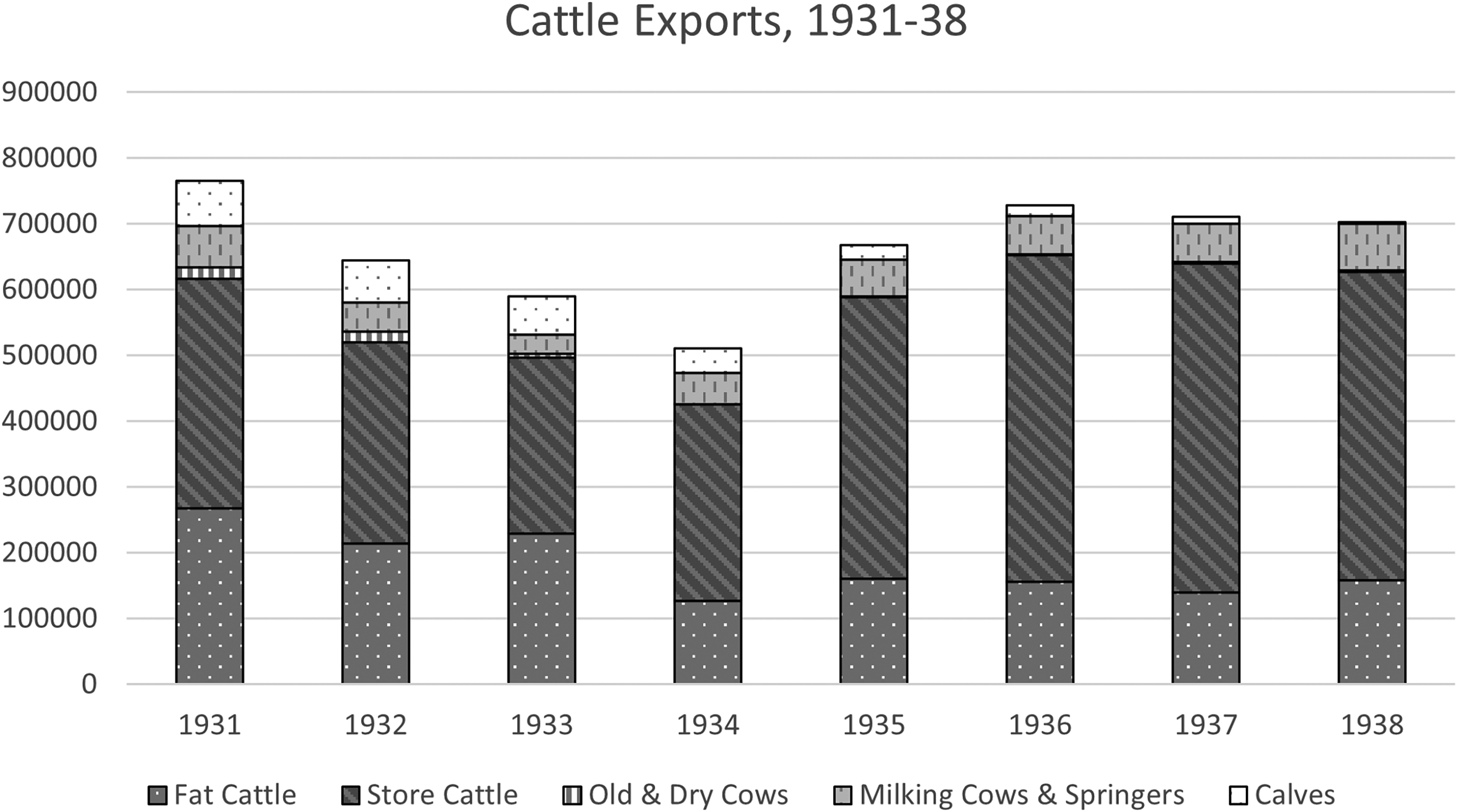
Cattle exports as reported in the Annual Reports of the Minister for Agriculture.
Therefore, while many farmers were relieved to see the prospects of cattle improve, Ryan remained convinced that concentrating on a form of agriculture dependent on a foreign market was fraught with risk. It was a concern he expressed in the 1937 edition of the Capuchin Annual in an article aptly titled ‘Our Cattle Problem’. According to Ryan, unpredictable world prices and changes in British food consumption, partly due to ‘that horrible craze for slimming’, had the potential to undermine the cattle trade. He remained convinced that a switch to veal consumption could ensure a more ‘balanced economy’ that would alleviate this risk. Still, he accepted, with regret, that they could not overcome the ‘deep prejudice against veal’. With this, he ruefully conceded that they relied on the British market. It went against the instincts of many in FF, but the practical realities of government ensured that it was a fact that had to be accepted. As Ryan admitted in a comment that succinctly summed up this government's approach to the ‘cattle problem’, they had to ‘take conditions as they are, try to improve them if we are able, and meet each difficulty that presents itself as best we can’. 119 It was a comment that reflected FF's thoroughly pragmatic approach to this issue and was indicative of their wider approach to governance.
Accepting as he did that the dream of a self-sufficient utopia was not within reach, de Valera was anxious to improve their position in the British market and reach a permanent settlement. Likewise, in a worsening geopolitical climate, the British sought to end the dispute with its nearest neighbour. 120 This culminated in agreements in 1938 in which Britain surrendered its naval bases in Ireland while the remaining annuity debt was generously written off in exchange for a lump sum payment of £10 million. Most significantly for Irish agriculture, especially cattle, the retaliatory duties, which had, contrary to British hopes, failed to break de Valera's resolve, were removed. 121 Daly has commented that with the 1938 agreement, ‘the dominance of cattle farming was restored’. 122 In truth, it never lost its central position in Irish agriculture, instead, the agreement reflected the realisation that cattle was and remained the cornerstone of Irish agriculture.
Conclusion
When, in 1961, a debate in the Seanad descended into a heated argument on the distant past, the exasperated chair could not help but note that ‘this discussion always ends up with the Economic War and the Blueshirts’. 123 Much has been made about the prevalence of Civil War politics, but Economic War politics also showed remarkable perseverance. When Andrew Forrest reflected on the FF government's actions in later life, he found it ‘hard to believe that people were capable of such madness’. However, Forrest's perception is clouded by a fundamental misunderstanding of the government's actions. The killing of the calves was not, as Forrest believed, part of a devious plan to starve the British. 124 Similarly, another man's lasting resentment stemmed from his belief that his boyhood pet calf was forcibly liquidated after he was informed on by a ‘blind follower of de Valera’. 125 The veracity of such tales is doubtful, but what cannot be questioned is that many remembered the Economic War with extreme bitterness.
Much like the Civil War, the Economic War was remembered in a manner that was often simplistic or downright fabricated. When James Ryan became Minister for Agriculture in 1932, he aimed to reshape Irish agriculture to better serve the domestic market and reduce its dependence on exports to Britain. Yet, at the same time, and despite the bellicose rhetoric of many in FF against the cattle trade, he was also initially emphatic that the cattle herd had to be maintained, even as Irish cattle were burdened with the weight of punitive tariffs as a result of the Economic War.
It was only when the British government decided to impose quota restrictions in 1934 that Ryan and his government had to face the prospect of reducing the cattle herd. Notably, the British decision to impose a quota was prompted by domestic concern for British farmers and a growing sympathy towards protectionism rather than the ongoing dispute with Ireland. Even when Ryan accepted that the cattle herd needed to be cut, he had to face the reality that doing so would undermine the very fabric of the Irish agricultural economy. The party's pragmatic impulses ensured it took a path that was cognisant of the interdependencies of Irish agriculture. If it sought to end the cattle trade, it would have to deal with the consequences of that decision on its small farm supporters. The actions of the FF government, although seeking to sway farmers towards a more diverse agricultural system that would have less reliance on the British market, were attuned to the fact that Irish farmers relied on exports for their livelihoods.
The developments in 1934 forced the government to take actions that it previously would not have considered. Ryan's assertion that ‘there are too many cattle’ was not a remonstrance dictated towards Irish farmers, but rather, it was a statement of fact in the face of the British quota. The measures adopted were extensive, but in the circumstances, it was obvious that some drastic actions were required. Many farmers struggled to see any value in the government's actions, which was understandable given their depressed economic condition. The government would have benefited from giving more consideration to a 1933 lecture by John Maynard Keynes in Dublin, where he noted that ‘Agricultural processes have deep roots, work themselves out slowly, are resistant to change and disobedient to administrative order’. 126 This observation was true in the 1930s and still holds relevance today.
Talk of reducing cattle numbers in the 1930s appeared to farmers as no less than a direct attack on their way of life. Today, though the reasons for such discussions have changed, the prospect still evokes deep unease among many farmers. It is well to recall that despite the dire economic position for Irish dry cattle during much of the 1930s and notwithstanding the incentives provided for tillage, ‘farmers clung to live-stock’. 127 This serves as a salutary lesson for modern policymakers when considering efforts to transition farmers into alternative forms of production. History has shown that farming communities, deeply rooted in long-standing traditions and economic structures, do not easily adapt to sudden or enforced changes, even when faced with compelling economic pressures.
Footnotes
Declaration of Conflicting Interests
The author declared no potential conflicts of interest with respect to the research, authorship, and/or publication of this article.
Funding
The author disclosed receipt of the following financial support for the research, authorship, and/or publication of this article: This work was supported by the Irish Research Council, Universities Ireland (grant number GOIPG/2023/5022, N/A).
