




Abstract
This article reviews the publication trends in Irish Economic and Social History over its first 50 years.
As Irish Economic and Social History celebrates its golden anniversary, we (two former editors and one current editor) have taken stock of high-level trends in publications in the journal over the past 50 years. We focus primarily on specific publishing trends including chronological categorisation and some bibliometric analysis of patterns in the journal over its entire history, as well as trends since the turn of the millennium. In doing so, we follow on from two reviews focusing on publications in the journal. 1 Clarkson's first review, published in 1980, pertained solely to Irish economic history, while the second, published in 2001, considered Irish social history but was an overlap of the two fields. In his 2001 review, Clarkson reflected on the disciplinary definitions of, and the relationship between, economic and social history: social history, he claimed, was capacious and ‘like the elephant, the subject is more easily recognised than defined’. He suggested, however, that economic and social historians both explored the problem of ‘scarcity and choice… as it presented itself in the past’. For Clarkson, the question of ‘scarcity and choice’ had four dimensions: ‘economic change; economic welfare; the distribution of wealth; and the interaction of the individual and the institutions of power’. These dimensions are addressed, explicitly and implicitly, in many of the articles published in the journal, some of which are discussed below. Reflecting the zeitgeist of his time, Clarkson was also concerned with specific methodological innovations, noting the increased interest in quantitative techniques and tools from the social sciences as key for studying the past.
We start by presenting a periodisation of the articles published in the journal over the past 50 years (see Figure 1). The periodisation follows an earlier index of publications in the journal. 2 The overwhelming majority of articles published in the journal, one in every two, were classified as pertaining to ‘Modern History I (1750–1922)’. Relatively speaking, there were fewer articles published in ‘Medieval History’ (4 percent), an area that seems ripe for further exploration. This tendency for historians to focus their attention on the modern period has been noted by Clarkson in his review of writing of Irish economic history from 1968 to 1980, 3 when he noted a tendency to focus on the period between 1600 and 1900.
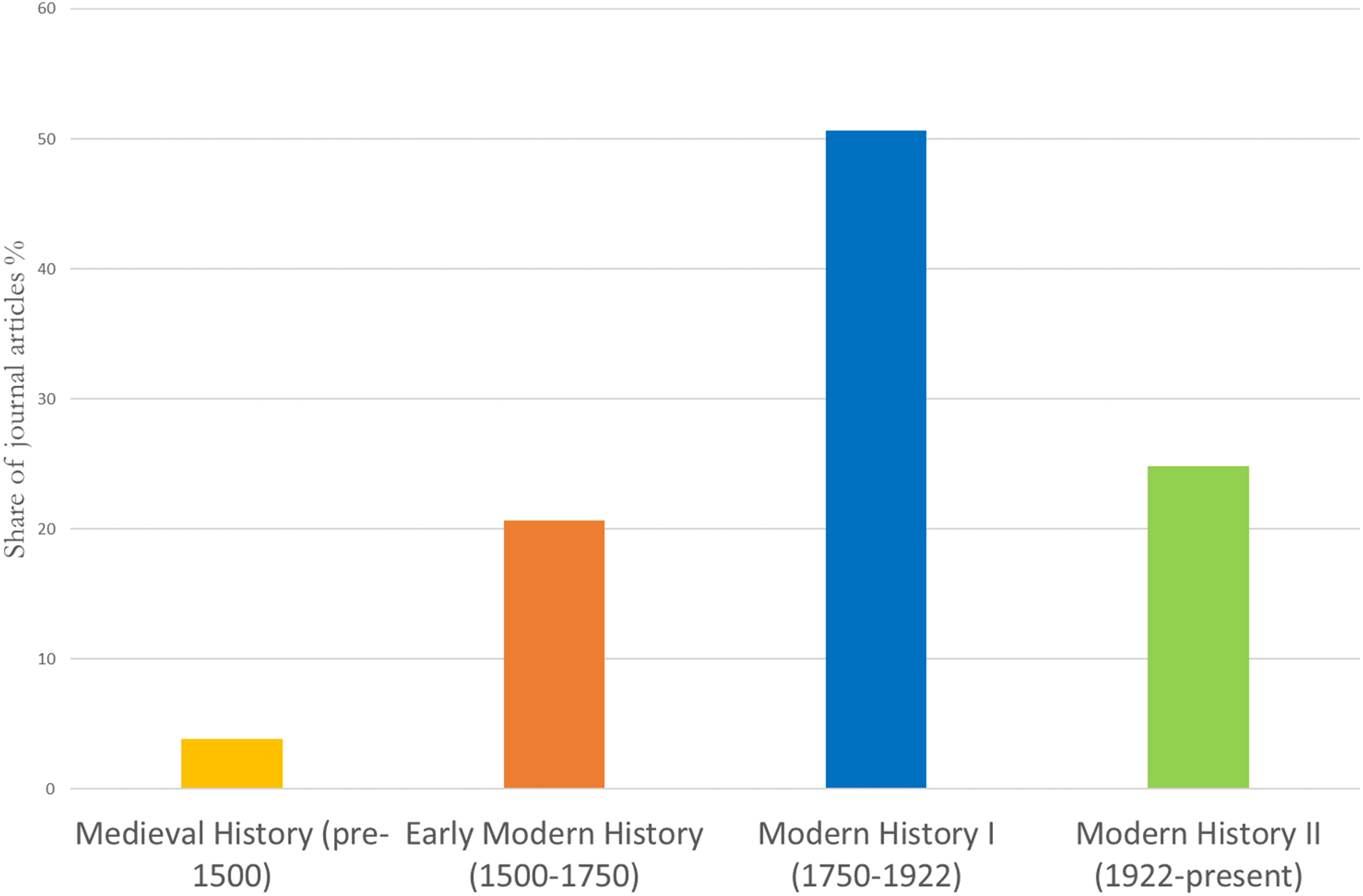
Periodisation of articles published in the journal, 1974–2023.
Figure 2 presents a periodisation of articles published before and after 2000, since the last review of articles published by Clarkson in 2001, which looked at publications from 1974 to 2000. 4 While ‘Modern History I’ has kept its allure, the big shift in the historical gaze has been the increased study of the modern period (1922–present), this has come at the expense of the study of ‘Medieval’ and ‘Early Modern’ history. The increased interest in contemporary history has brought more diverse methodological approaches, including articles drawing on oral history. 5 Given the information in Figures 1 and 2, it would seem that future scholars could possibly find greater scope for novel contributions in the study of Irish economic and social history pre-1750.
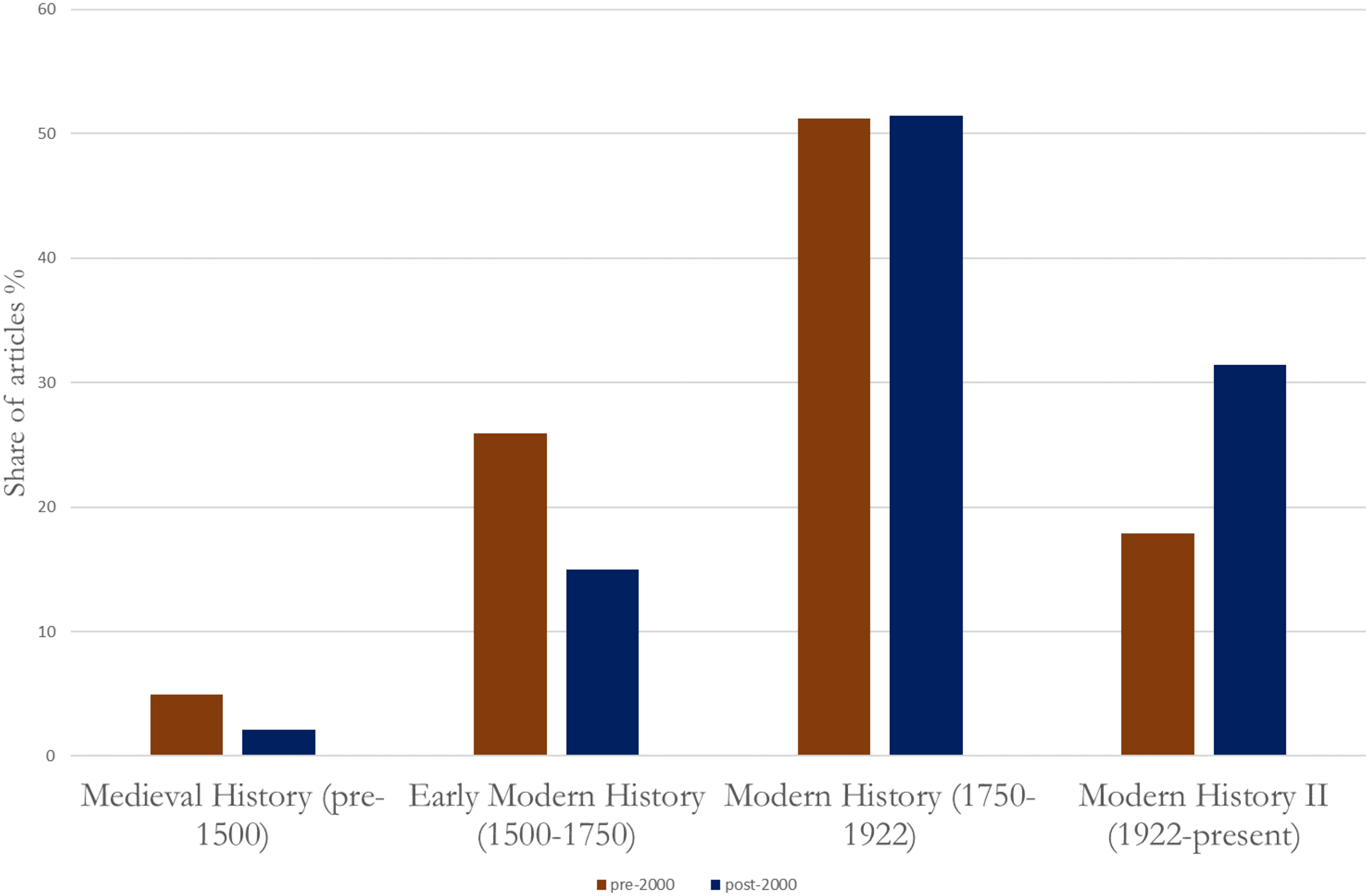
Periodisation of articles published in the journal, pre- and post-2000.
In 1980, Clarkson had lamented that ‘current Irish [economic history] writing looks a trifle old-fashioned, with the bewitching voices of the social sciences muted and statistical wizardry missing’. 6 This is no longer the case, with an increased use of methodologies from across the social sciences. Indeed, the energy behind the quantitative approach to social history, upon which Clarkson placed such emphasis, has passed and dissipated somewhat, as social history now is more often preoccupied with drawing on qualitative sources to uncover the experiential and emotional aspects of ‘scarcity and choice’, especially as these pertain to ‘ordinary’ people. In his review of Irish social history, Clarkson noted the lack of women's history as ‘copy has not been submitted’ to the journal but instead had been submitted to British or American journals. To quote Clarkson, ‘a lot of good economic and social history is not coming our way’, this appears to still be the case. Referring specifically to the debates of the early 1990s on the place of women's history in journal, Clarkson noted in 2001 that the ‘subject … has been shy of showing itself to this Journal’. Arguably this is still true today, with relatively few articles in this area submitted for publication since 2000. It would seem authors are more likely to place them in dedicated journals such as Women's History Review and perhaps the journal has not fully shaken off earlier criticisms of being unreceptive to the theme. Many articles dealing with women's history address questions of sexuality, rights, and health which speak to the enduring influence of K. H. Connell's work on sexuality and reproduction. 7
Clarkson was concerned with a top-down view of the varieties of Irish economic and social history and his pertinent remarks related to the overall literature. A few observations can be made when we drill down to consider the citations for specific papers. In Table 1, we list the ten most cited articles in the journal between 1974 and 2023. As we can see, at least three major figures in global cliometric history – such as Joel Mokyr, Jeff Williamson and Nick Crafts – feature in this citation ‘hit parade.’ As citations are sometimes interpreted as a proxy for academic influence, an implication of Table 1 is that the Irish economic history literature has since the 1970s been incorporated into the wider cliometric research agenda.
The Ten Most Cited Articles in IESH, 1974–2023.
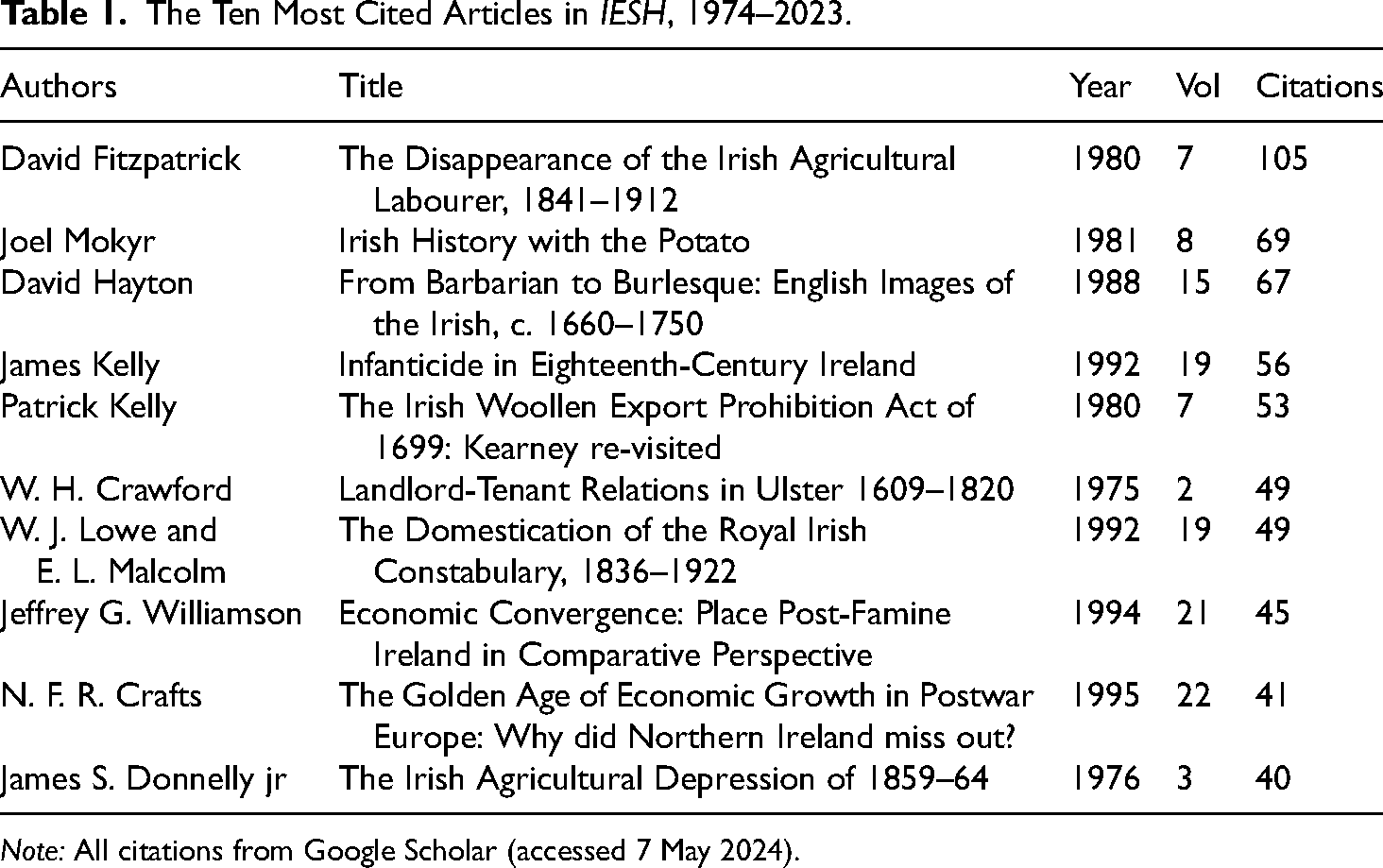
Note: All citations from Google Scholar (accessed 7 May 2024).
Irish economic history has often been framed in a comparative way by scholars outside of Ireland, and so papers in Irish Economic and Social History that have been framed through a comparative lens have had a good chance of being cited. Table 1 additionally reflects the way papers concerned with pre-Famine economic backwardness and/or post-Famine economic adjustment as well as the Famine itself has been widely cited within the comparative cliometric literature. The papers by Fitzpatrick, on the disappearance of the agricultural labourer, Mokyr on the role of the potato, Williamson on post-famine convergence, and Donnelly on the 1859–1864 agricultural crisis, can all to some extent be categorised in this way. Furthermore, Table 1 indicates that social history is also well represented in this top ten. The papers by Hayton, Kelly and Lowe and Malcom can be categorised as contributions to social history. Throughout its 50-year history, there has been a thematic richness to the social history covered in the journal which spans the early modern to the modern period, with strengths in the history of crime, infanticide, sport, emigration, childhood, medicine and science, and the co-operative movements. Again, it is notable that only one article, Crafts's 1995 paper, corresponds to the “Modern History II” category discussed above. It is also noteworthy that Crafts takes a comparative approach to analysing Northern Ireland's lacklustre economic record during the Golden Age with other industrialised national and regional economies.
In Table 2 the citation of articles published during 2000–2023 are presented. As in Table 1, cliometric work of a comparative flavour is well represented. The papers by O’Rourke, Gerlach and Stuart, and Kelly and Ó Gráda can all be placed in the category of cliometric work that places the Irish economic record in an explicitly comparative setting. The paper by Kelly and Ó Gráda furthermore illustrates the ongoing citation of cliometric papers concerning the Famine. Again, as with the citation patterns illustrated in Table 1, social history is also well represented. Articles by Earner-Byrne, Tait, and Sneddon can all be placed in the category of Irish social history. Furthermore, themes of the social aspects of diaspora and emigration can be viewed in the papers by Delaney, Earner-Byrne and MacRaild. One of the gaps highlighted by Clarkson, was there was ‘practically no business history’. 8 One notable change between Tables 1 and 2 is that two papers authored or co-authored by Barry concerning business and investment in independent Ireland feature. To the extent that both these papers represent the emergence of an Irish business history literature, in parallel to the more well established cliometric-comparative literature, they represent a belated counterpoint to Clarkson's comments concerning the paucity of Irish business history within the overall literature. Another contrast between the citation pattern in Tables 1 and 2 is that whereas Table 1 was male dominated, Table 2 features four female authors. The male dominance of the journal is also reflected in the fact that of the 210 articles published over the entire lifetime of the journal, only 49 were written by women. This has improved significantly though since the turn of the millennium, with 36 of the 105 articles written by women. Another feature of Table 2 is the increasing prevalence of co-authored papers, where three of the ten papers were co-authored compared with one of the ten in Table 1. This reflects practices in wider social sciences where co-authorship has become commonplace, for example in economics solo authored papers were the norm in the 1940s but there has been a gradual increase in coauthored papers. 9 Co-authorship is less common in the humanities, where the lone scholar model prevails, however, a growing number of scholars are co-authoring journal articles and in some instances, books.
The Ten Most Cited Articles in IESH, 2000–2023.
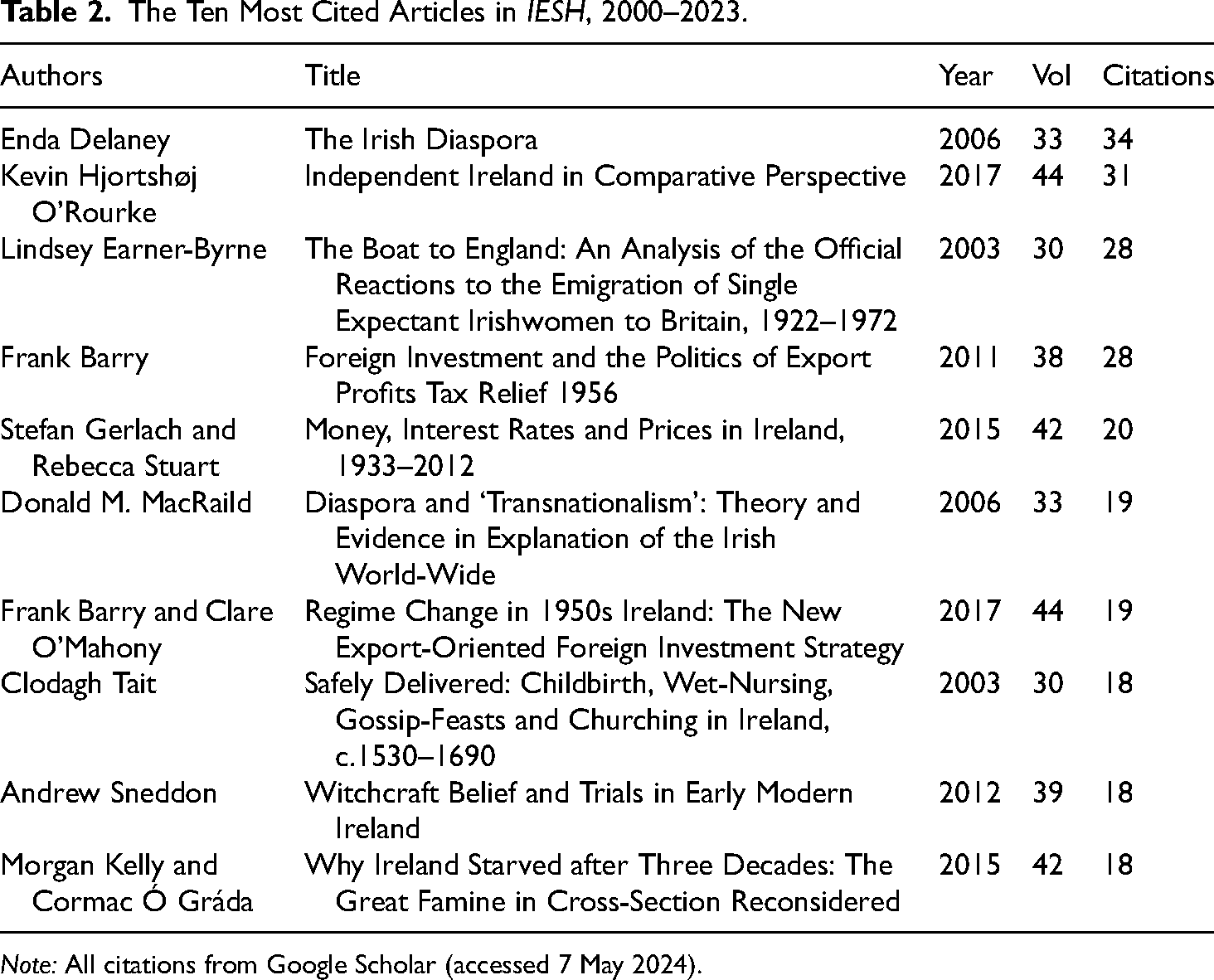
Note: All citations from Google Scholar (accessed 7 May 2024).
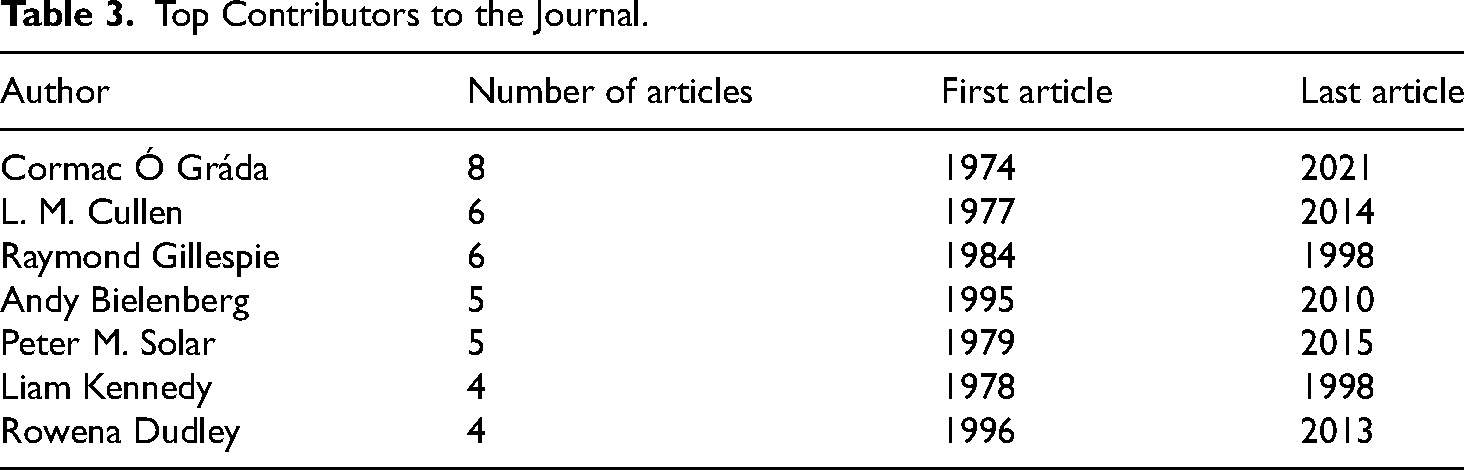
Reviewing the authors of articles, the journal brought to its readership the ‘first’, or very early publications of numerous well-established social or economic historians. Table 3 presents evidence on the most common contributors to the journal. Given their international profiles as well vital roles in reigniting Irish economic history as a research topic it should come as no surprise that Ó Gráda and Cullen take the top two spots for economic historians. Both continued to publish in the journal: Ó Gráda's most recent publication was in 2021. Furthermore, Gillespie's voluminous publication record edges him into the top spot for a social historian.
Top Contributors to the Journal.
Future Directions
Articles using new data science and digital humanities techniques have been relatedly slow to appear in the journal, with a few exceptions. 10 The comparative lack of articles using digital humanities techniques is somewhat surprising, especially given the richness of digitised collections such as the Military Service Pensions, as well as large transnational digitised projects relevant to Irish history. Social historians today are increasingly preoccupied with uncovering voices and experiences of ‘ordinary people’, through the use of letters, memoirs, etc., a notoriously difficult task. Nonetheless, the challenging task of giving voice to the silenced and the marginalised has reinvigorated reflections on the methodologies of social history. Such reflections often address concerns that these histories can be dismissed as ‘small history’, especially after the ‘global turn’. As Julia Laite has observed, the tension between the quest to restore agency and understand the experiences of individuals and groups, and the desire to understand larger historical processes and structures continues to be difficult to reconcile. 11 Such reflective practice by social historians can also produce an enhanced and more nuanced awareness of the ‘archivally unknown’. Not just those groups who are absent from archival collections because they did not produce a written record, but those too who are absent, hidden or explicitly silenced because of historic archival practices which replicated broader societal power structures, and left on the ‘margins a multiplicity of perspectives’. 12
On the whole, the future remains bright for the journal. As Ireland continues to undergo substantial economic and social changes, we look forward to our successors reflecting on the next silver and golden anniversaries of the journal.
Footnotes
Declaration of Conflicting Interests
The authors declared no potential conflicts of interest with respect to the research, authorship, and/or publication of this article.
Funding
The authors received no financial support for the research, authorship, and/or publication of this article.
