




Abstract
In the late 1970s, a criminal-based youth subculture known as the Bugsy Malones emerged in inner-city Dublin. Through the use of oral history interviews, this article avails of ‘proximate voices’ to shed light on the Bugsy Malones’ socio-economic background, their individual and group characteristics, and the rise of a subcultural mythology because of the involvement of Gerry ‘The Monk’ Hutch (a well-known Irish figure linked to organised crime) with the subculture. These proximate voices comprise n = 10 individuals who encountered the Bugsy Malones in a personal or professional capacity and shared lived experiences, physical spaces and/or interests with them. By capturing such voices, the article transcends caricatured press coverage and generates enhanced insight into this largely forgotten subculture.
Introduction
The study of youth subcultures in the Republic of Ireland constitutes a fruitful if relatively underdeveloped dimension of historical research. 1 One of the earliest academic analyses of a youth subculture was provided by barrister James O’Connor in 1963 in relation to the Teddy Boys. The Teddy Boys emerged in Britain in the early 1950s and wore Edwardian-style clothing, listened to rock ‘n’ roll music and were associated with juvenile delinquency. 2 O’Connor drew upon the writings of Donald Ford and T.R. Fyvel to portray the Teddy Boys as socially insecure, possessing low self-esteem, and having tendencies towards violence and destruction. 3 Neary and Kearns expanded this discussion of the Teddy Boys within their respective biographies of Garda James ‘Lugs’ Branigan who was tasked with policing the subculture in 1950s Dublin. 4 O’Leary and Holohan respectively introduced a social history analysis of the Teddy Boys and both have argued that the Irish manifestation of the subculture was ‘more style than substance’ compared to its English counterpart. 5
A number of studies have addressed the Mod subculture in Ireland. The Mods (or Modernists) emerged in the early 1960s, embraced a neat style which included Fred Perry polo shirts and Levi jeans, often rode Italian scooters in the form of Vespas or Lambrettas, and were associated with drug-taking in the form of amphetamines. 6 O’Halloran provided an in-depth analysis of the 1960s Mod subculture, drawing on interview data with owners of underground Mod venues known as ‘beat clubs’ and the musicians who played in them. 7 Likewise, McAllister and Cooper drew upon interviews carried out with Mods in 1970s and 1980s Ireland during the revivalist era of the subculture. 8 Murphy has examined subcultural meaning and identity in an Irish context in relation to the Punks, while O’Neill's book Where Were You? provided a photographic account of youth subcultures and offered a useful visual basis for exploring the vibrancy of the Irish subcultural landscape. 9
The aforementioned subcultures (Teddy Boys, Mods and Punks) had Anglo-American origins and may be regarded as cultural imports. Studies of homegrown subcultures, which originated in Ireland rather than being imported from abroad, are relatively rare. 10 However, Fallon's research on the Animal Gangs in the 1930s, Keohane's Foucauldian analysis of the corner boys in Ireland between 1922 and 1970, and Ilan's ethnographic work on ‘The Crew’ in inner city Dublin in the mid-2000s have made significant contributions to the study of indigenous youth subcultures. 11 Similar to the Animal Gangs, corner boys and The Crew, the Bugsy Malone subculture was an indigenous one consisting of young males in an urban setting (even though the term ‘Bugsy Malone’ derived from a film produced by British companies; see below). 12
To date, the Bugsy Malones have occupied a fragmentary status within the existing historiography. They received an ambiguous mention in Ferriter's study of 1970s Ireland and comprised three pages of Williams’ engaging if sensationalised biography of Gerry Hutch. 13 Their activities such as handbag snatching and jump-overs were alluded to in a memoir written by Jesuit priest Peter McVerry, while their incarceration in Loughan House was discussed by its former Assistant Director John Lonergan. 14 The Bugsy Malones also received brief discussion on popular history blogs such as Come Here To Me, ensuring that their memory in Dublin folklore remains strong. 15 Apart from these sources, however, the story of the Bugsy Malones has been largely forgotten.
This article aims to contribute to an enhanced understanding of the lives of marginalised young men growing up in 1970s and 1980s Dublin and the trajectories that some of their lives later took. The story of the Bugsy Malones further offers insight into how changing social and economic conditions in Dublin's inner city in the 1970s and 1980s – such as the rise of standardised shipping containers and subsequent decline of dock labour – shaped the lives of those most impacted by these changes (see ‘Socio-Economic Background’). In this way, youth subcultures such as the Bugsy Malones serve as a conduit through which Irish social history can be examined. Furthermore, this episode holds contemporary relevance given the recent trial (and acquittal) of a former member of the Bugsy Malones, Gerry ‘The Monk’ Hutch.
The article proceeds as follows. It first discusses the emergence of the Bugsy Malones and the simultaneous glorification and dehumanisation of the subculture by the contemporary press. It proceeds to delineate the research methodology used, namely oral history interviews carried out with n = 10 participants. It then presents the findings of these oral history interviews, focusing on the socio-economic background of the Bugsy Malones, their individual and group characteristics and the subcultural mythology which surrounds the subculture because of its association with Gerry ‘The Monk’ Hutch. The article concludes by delineating the key contributions the Bugsy Malone episode makes to Irish social history and by examining the methodological limitations associated with proximate voices.
‘Junior Al Capones’
The term ‘Bugsy Malone’ derived from a 1976 film directed by Alan Parker, starring Jodi Foster, John Cassisi and Scott Baio. The film was a ‘gangster drama of the Capone era’ featuring a cast of child actors. 16 It sanitised violence by featuring splurge machine guns which hit victims with whipped cream. 17 It was first screened in Irish cinemas in December 1976, and the Evening Herald criticised the movie as ‘both inconsiderate and ill advised’ as it provided the temptation for children to ‘create reality out of fantasy, however harmlessly’. 18 Inspired by this movie, Evening Herald journalist Liam Ryan reported in January 1977 that a Bugsy Malone gang comprising young people aged between eleven and fifteen years of age was operating in Dublin's north inner city. 19 This so-called Bugsy Malone gang was associated with criminal activities such as jump-overs (a robbery of a bank or business) and handbag snatching.
The inaugural jump-over of the Bugsy Malones took place in January 1977. £1,400 (approximately €10,102 in today's currency) was stolen from Northern Bank on O’Connell Street by three youths aged between eleven and fifteen years. 20 Two days later, the thirteen-year-old leader of the Bugsy Malone gang, dubbed ‘the Godfather’ (after the eponymous 1972 crime film directed by Francis Ford Coppola), was arrested by Gardaí, while the two other ‘child mobsters’ in the gang were still evading apprehension. 21 Such Mafioso discourse was commonly used by the Herald in relation to the Bugsy Malones – for instance, members of the subculture were described as ‘junior Al Capones’ (after the 1975 crime film Capone directed by Steve Carver) which had the effect of glorifying their activities. 22 This may have incentivised the Bugsy Malones to further engage in criminality (though it is unclear whether members of the subculture were even aware of how the papers were describing them). Eddie, a participant interviewed for a study conducted by Farrelly in 1989, recalled, regarding the subculture, that, ‘If the media hadn’t of interfered I think things would probably have slackened off much quicker. But with the media hype every night in the papers everyone began thinking that they were heroes and that they could do anything’. 23 Playful descriptions such as the ‘counter-high raiders’ and ‘tiny tot gang’ were further applied to the Bugsy Malones which undermined any sense of gravity surrounding their activities. 24
Concern soon emerged over the perceived organised criminality of the subculture. For instance, a RTÉ Radio programme in September 1978 claimed that the Bugsy Malones were engaging in ‘selective and organised robberies and burglaries’. 25 Although a senior detective asserted that the perceived organised nature of the Bugsy Malones was ‘sheer fantasy’ and the gang operated on a purely opportunistic basis, this perception of organised crime continued. 26 Granted, there was a small degree of organisation to the activities of the Bugsy Malones in relation to their handbag snatching scheme. The subculture developed this scheme at the intersection of Summerhill and Gardiner Street (otherwise known as ‘Handbag Junction’). One member of the subculture would stand on a rooftop to spot cars containing female drivers who had their handbags on the front seat. A signal would be sent to another member of the subculture waiting at the traffic lights, who would press the button at the pedestrian crossing to stop the oncoming car. A third Bugsy Malone would then smash the window of the car, grab the handbag and escape into the nearby flats. The members of the subculture would later reconvene to ‘divide the spoils’. 27 While this (rather elaborate) scheme did involve a degree of planning, collaboration and forethought, it remains too minor to be classified as ‘organised crime’ which suggests that this element of concern over the Bugsy Malones was misplaced.
In November 1977, Fianna Fáil Minister for Justice Gerry Collins announced that an open prison for males aged sixteen to twenty-one located in Blacklion, Co. Cavan, known as Loughan House, was to be converted to a place of detention for young male offenders aged between twelve and sixteen years. 28 While Loughan House would cater for the detention of any juvenile delinquents within this age bracket between 1978 and 1983 (whereby it was replaced by Trinity House located in Lusk, Co. Dublin), it was contemporaneously associated by the press with the Bugsy Malones. 29 The controversy which surrounded the opening of Loughan House has been addressed in a separate article. 30
It is worth noting that as the opening of Loughan House drew nearer, press coverage surrounding the Bugsy Malones grew darker. The Bugsy Malones were portrayed on occasions in a manner that rendered them less than human, with an animalistic discourse used to achieve this. According to a senior detective, quoted in the Evening Herald: These young thugs are like rats preying on the public. They come out from their holes only in haphazard fashion to steal whatever is available.
31
The animalistic simile comparing the Bugsy Malones to rats attributed a cunning intelligence to them but simultaneously dismissed them as unwanted rodents. Adjectival descriptions of them ‘ravaging’ 32 and ‘terrorising’ 33 Dublin city reinforced their wild and ferocious reputation. It is important to note that the Bugsy Malones were not always depicted as monstrous creatures – for instance, Independent TD Tony Gregory called for sympathy for these ‘most deprived of children’. 34 Despite such a counter-narrative, press coverage of the Bugsy Malones remained largely negative.
In September 1978 the Irish Independent coined the term ‘Bugsy Malone syndrome’ to characterise the actions of juvenile delinquents who were supposedly influenced by the original subculture. 35 The use of this term suggested that the Bugsy Malones had become pathologised as an abnormal medical disorder which was affecting other young people throughout society. This dehumanising press rhetoric, coupled with the lack of academic attention paid to the Bugsy Malones, means that current historical representations of the subculture exist mainly in caricature. This paper aims to generate a more accurate portrait of the Bugsy Malones by drawing on proximate voices.
Methodology
The data upon which this article is based derives mainly from oral history interviews conducted with n = 10 participants. These interviews were carried out between April 2019 and September 2021 as part of a wider project examining youth subcultures in mid to late twentieth-century Ireland. In order to identify and recruit interview participants, snowball sampling was used whereby ‘the researcher makes initial contact with a small group of people who are relevant to the research topic and then uses these to establish contacts with others’. 36 While there are limitations to snowball sampling – for instance, lack of representativeness due to in-network selection – nevertheless this approach was deemed suitable given the dearth of existing research surrounding the Bugsy Malones. 37
Regrettably, despite all efforts, no former Bugsy Malones were interviewed for this project. Instead, proximate voices comprising individuals who encountered the subculture in a personal or professional capacity and shared lived experiences, physical spaces and/or interests with the Bugsy Malones were captured. These included criminal justice practitioners, youth workers, inner-city residents, politicians, priests and journalists (see Figure 1). All participants signed a consent form prior to the interview and their identities have been anonymised for ethical reasons.
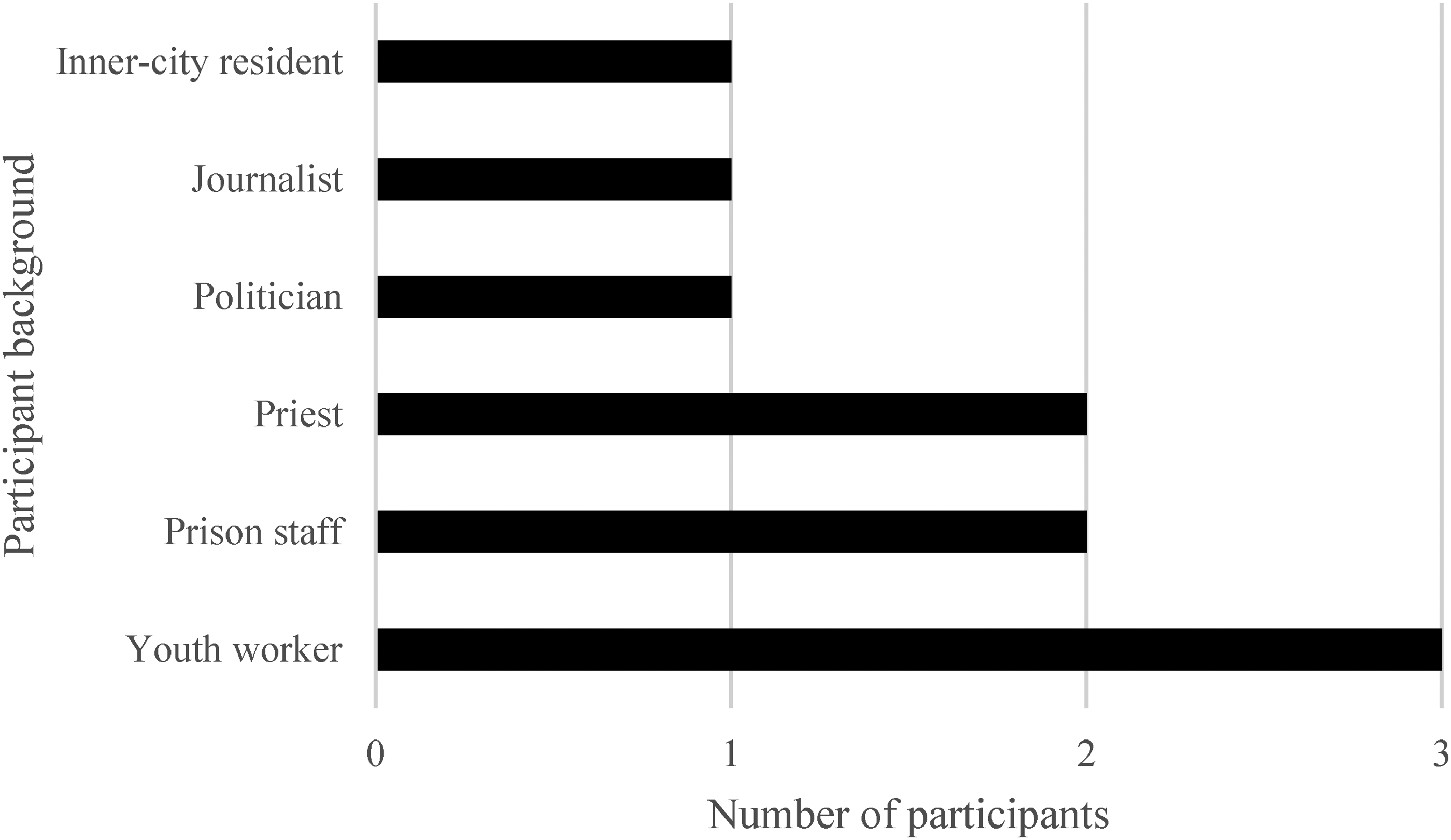
Backgrounds of interview participants (n = 10).
Similar to contemporary press coverage, these proximate voices offer third-party perspectives of the Bugsy Malones. The recollections they provide do not capture the lived experiences of the subculture, nor can they be construed as unbiased accounts (see ‘Conclusion’). However, the proximity of these interview participants to the Bugsy Malones means that they offer a unique and alternative vantage point from which to examine the origins, nature and legacy of the subculture.
This proximity took the form of shared lived experiences, physical spaces and interests. In terms of shared lived experiences, Tom (1/7-10; 2/34-40) was an inner-city resident and a contemporary of the Bugsy Malones. In terms of shared physical spaces, priests Max (9/232-234; 4/99-100) and Gareth (1/9-16; 2/31-33) encountered the Bugsy Malones in the local community through their pastoral work; youth workers Hector (4/111-117; 16/445-451), Colm (8-9/235-244) and Jack (16/424-432; 24/652-656) encountered the Bugsy Malones while running local youth clubs; while criminal justice practitioners Larry (28/789-795) and Shane (6/157-163) came into contact with members of the subculture through their work in Loughan House and Trinity House, respectively. In terms of shared interests, the criminal activities of the Bugsy Malones such as jump-overs and handbag snatching were of professional interest to Aidan (3/82-87), a crime journalist whose articles focused on Dublin's inner-city, and to Nick (5/130-133), a senior politician involved in the decision to open Loughan House.
It is important to note that the proximity of these interview participants to the Bugsy Malones varied in terms of hierarchy and engagement. Regarding the former, while criminal justice practitioners such as Larry was a staff member of Loughan House and so had a hierarchical relationship with the Bugsy Malones as a figure of authority, Tom was a contemporary of the Bugsy Malones and his relationship with members of the subculture lacked this power differential. Regarding the latter, while youth workers such as Hector came into direct contact with the Bugsy Malones in youth club venues, Nick indirectly engaged with them through his involvement in the opening of Loughan House. While hierarchy and engagement varied, all proximate voices were male. The absence of female voices constitutes a key limitation of this study.
The interview participants made valuable contributions on both individual and collective levels. On an individual level, the variation in hierarchy and engagement means that each participant occupied a unique vantage point regarding the subculture. This facilitated nuanced and context-specific insights. Collectively, the interview participants interacted with the Bugsy Malones in their local, structural and institutional contexts. Participants were therefore optimally positioned in 1970s and 1980s Dublin to witness the rise, impact and decline of the Bugsy Malones, and their combined perspectives expand our understanding of this largely forgotten youth subculture. The following sections present the findings of these interviews.
Socio-Economic Background
The proximate voices concurred that the Bugsy Malones came from a deprived socio-economic background. Nick, a senior politician during the 1970s, recalled that in the inner city there were ‘poor people, bad housing, bad conditions, bad prospects for the future of the children’ (Nick 1/6-7). Tom grew up in the inner city and was a contemporary of the Bugsy Malones. He described how ‘everywhere there was a block of flats, basically there was poverty […] there was four tenants living in one bedroom in a house, there was four rooms, you know, and you got washing in the sink, you know, there was no privacy going to the toilet’ (Tom 2/46-50). As of April 1979, 43.1 per cent of persons in Mountjoy A Ward (comprising parts of Seán McDermott Street, Railway Street, Rutland Street, Corporation Street and Buckingham Street) lived in households of more than seven persons, compared to 29.4 per cent in the wider Dublin County Borough. 38 This indicates the level of overcrowding in inner-city accommodation.
As a result of these poor housing conditions, Dublin Corporation introduced ‘a policy of de-tenanting the inner city’, whereby the state sought to move residents to new housing complexes on the outskirts of the city in locations such as Ballymun, Ballyfermot and Darndale (Colm 6/177-179). A survey carried out in 1979 by the National Economic and Social Council found that inner-city residents spent an average of 17.7 years in a dwelling and an average of 27.4 years in the area itself. Moreover, 40.3 per cent of those surveyed had relatives in the inner city, which indicated strong family ties and attachment to the locality. 39 The policy of de-tenanting the inner city disrupted these community ties; as Flynn and Yeates wrote: ‘if someone had deliberately set out to destabilise society in the city they couldn’t have come up with a better plan’. 40 The dislocation of longstanding residents from the area suggests that the inner city was suffering from social disorganisation during the 1970s.
The familial environments from which the Bugsy Malones emerged were often dysfunctional according to these proximate voices. Tom outlined that ‘looking back in the north inner city, there was a lot of people who had serious traumas. There was so much abuse, rampant abuse, that a lot of these young fellas grew up with no identity’ (Tom 1/17-21). On a personal level, Tom recalled being ‘brutalised’ by his father (Tom 1/13), and believed that ‘most of the parents, especially the fathers, were rejecting their boys […] it was an inheritance of dysfunction’ (Tom 1/26-28). However, according to Shane, an employee of Trinity House, ‘we always knew, if a kid was going back to – no matter how bad their family is, how abusive their family is, that's where they wanted to go. And that's where they would run to’ (Shane 14/632-365). This cycle of dysfunction proved difficult to escape from in the eyes of the interview participants.
The Bugsy Malones also grew up in an environment where little value was placed on educational attainment. The local primary school, Rutland Street School, was nicknamed ‘the Redbrick Slaughterhouse’ because of the extreme levels of violence that took place there (Max 2/54). One teacher in Rutland Street School was nicknamed ‘King Kong’ because ‘he was over six foot tall’ and was ‘absolutely vicious […] he used to beat us to a pulp’ (Colm 3/70-76). Colm, an inner-city resident, claimed the same teacher was responsible for the education of the Bugsy Malones; ‘he used to beat the shit out of them’ (13/372-373), and such beatings ‘drove a lot of us to stay away from school’ (Colm 2/50-51). Use of corporal punishment was not officially outlawed in schools until 1982. 41 A study by Morrissey and Murphy in 1978 found that 77.8 per cent of young people in the north inner-city aged fifteen to eighteen had left school, which suggests low levels of educational attainment. 42
Strongly correlated with these low levels of educational attainment was the lack of employment opportunities for denizens of the inner city. Manual work on the docks was a common employment avenue, and according to Colm ‘a lot of those Bugsy Malones, their fathers were dockers’ (Colm 5/141-142). However various developments introduced from the 1960s onwards, such as the introduction of standardised containers and mechanical grabs, reduced the need for dock labour. 43 As a result between 1967 and 1979, the number of cross channel dockers fell from 1,200 to 200. 44 According to Jack (4/98-99; a youth worker in the inner city), because of this decline of dock labour, ‘a generation grew up with parents unemployed…so there was no incentive for work, for any kind of achievement’.
Few opportunities were available in industrial employment either. During the 1970s, many factories such as T&C Martins and Brooks Thomas either closed or relocated elsewhere. From 1975 onwards, in the manufacturing industry alone the Industrial Development Agency estimated that approximately 2,000 jobs per year in the inner city were lost. 45 As of April 1979, the unemployment rate in the Mountjoy A Ward (16.2 per cent) was almost three times higher than in Dublin County Borough (5.4 per cent). 46
Because of the paucity of legitimate employment opportunities, Hector (6/154; a youth worker) outlined that there was an ‘economic imperative’ for the Bugsy Malones to become involved in criminality. By engaging in crime, they saw ‘how quickly they could get money, and how hard it was to get them, to convict them. So some of the more entrepreneurial as we’d say to use a positive term […] took full advantage of that’ (Hector 5/127-129). The presence of opportunities for committing crime – having bank counters to jump over and handbags to steal – also facilitated the criminal activities of the subculture.
Overall, these factors such as poor housing, social disorganisation, familial dysfunction, lack of educational attainment and high unemployment rates ‘gradually mushroomed into total chaos in young people's lives’ (Jack 5/134-135). As Aidan (a crime journalist) recalled, ‘you could tell even at six or seven often, which kids were going to end up in Mountjoy, or in Loughan House’ (Aidan 3/83-84). Gareth (a local priest) commented that given this deprived socio-economic background, ‘we should probably be surprised that there weren’t more gangs back then like the Bugsy Malones’ (Gareth 11/272-274).
Not all Bugsy Malones, however, were predestined to embark on a career of criminality. In January 1979, journalist Ingra Saffon wrote of a seventeen-year-old youth, Noel, who was a former member of the Bugsy Malones and had already spent a year in a reformatory school. A local priest, Father Paul Lavelle, helped Noel to secure employment ‘painting over graffiti on Mary's Mansions and Liberty House for £30 a week’. Noel was ‘determined to stick with his job’ and ‘does not speak with bravado about his Bugsie [sic] Malone days’. 47 Though the remainder of Noel's life story is unknown, deprivation is not always destiny.
Individual and Group Characteristics
With the socio-economic background of the Bugsy Malones in mind, this section examines their individual and group characteristics. The gathering place of the Bugsy Malones was an entrance to St. Mary's Mansions flat complex known as ‘The Gate’ (Jack 10/254-271). Jack recalled regarding identification of the Bugsy Malones that ‘only if you’d passed Mary's Mansions Gate, it's the only time you’d have been able to […] pick them out’ (Jack 28/739-740). They were not stylistically distinctive according to Jack, and there was an apparent purist and periphery divide within the subculture as ‘you had a core group who were there, and the others were just seen to be there’ (Jack 12/312-313). Gareth asserted that the Bugsy Malones ‘weren’t a gang in the way gangs are today. You know it was sort of a bit fluid’ (Gareth 2/52-53). When outside of their local environment, the Bugsy Malones experienced adjustment problems. Hector outlined how ‘they couldn’t cope outside of a very local neighbourhood environment. They’d be like a fish out of water, they just couldn’t breathe’ (Hector 18/493-495). Such adjustment problems heightened the unsuitability of Blacklion, Co. Cavan as a location for the detention of the Bugsy Malones.
Participants associated various positive traits with the Bugsy Malones, such as loyalty, kindness and intelligence. For instance, Jack encountered the subculture in his capacity as a youth worker and was seemingly well-respected by the group. Jack recalled that ‘one of the jobs I had, I worked in a business on the southside. And they had hit all of the other similar businesses in the area and I remember talking to them a couple of years after, some of the lads, saying “how come you never hit where I worked?”’. The Bugsy Malones responded, ‘because you worked there’ (Jack 24/652-656). They were also empathetic towards the plight of other young people in similar circumstances to their own. Tom expounded that: some of the Bugsy Malones would have known me from living in the area, and they knew, they knew what you were going through […] they never mocked people though, for going through difficult times. They sort of [had] empathy [for] them, because somewhere they could identify at an early age what was going on in that person's life […] there was no bullying, they wouldn’t be bullies. (Tom 2/34-40)
Moreover according to Larry (a Loughan House employee), despite their lack of formal educational attainment, the Bugsy Malones were ‘Witty like, couldn’t write their names, but brilliant minds like […] Sharp as anything like, off the cuff’ (Larry 27-28/762-765). These traits of loyalty, kindness and intelligence are elements of the Bugsy Malone story that contemporary press coverage largely failed to capture. There was a strong degree of sentimentality surrounding these recollections of the Bugsy Malones, which merits a sceptical gaze. Nevertheless, such memories help to humanise members of the subculture.
At the same time, while seemingly possessing positive characteristics as outlined above, the Bugsy Malones were also characterised by destructive and violent tendencies. Max described how the Bugsy Malones were ‘out of control’ (Max 11/289-291), and journalist Mark Brennock outlined how soon after arriving in Loughan House, ‘the kids went wild. They tore down the curtains, ripped up clothes and destroyed any piece of furniture or gym equipment that they could lay their hands on. They threw stones at the staff, abused them and bit them’. 48 Similarly, Shane recalled how when they were transferred from Loughan House to Trinity House, they ‘tore the place apart’, recalling that ‘there was one room that had this, it was a kind of like a lino, they actually took it off the floor, rolled it, and used it to pry the ceiling. You put somebody in a room, and then you come back and there's nobody there’ (Shane 11/280-288).
Violence was also sometimes used by the Bugsy Malones, though participants such as Gareth regarded such violence as a performance of masculinity. Gareth outlined how he had ‘a run-in’ with a Bugsy Malone over ‘admission to a youth club’, and the youth ‘broke a bottle, and he put it up to me’. Gareth, however, outlined that: ‘I wasn’t afraid […] I had no belief that he was going to use it at all’. He described the Bugsy Malones as: sort of – macho but harm- (laughs) I won’t say harmless, but now if someone put a bottle up to you eh with the drugs scene you’d very likely might use it. Eh but again I had no fear at all and I was absolutely certain this was just macho and they weren’t going to [use it] […] they were sort of innocent, hard criminals, if you can, that's not a contradiction in terms. (Gareth 10-11/259-266)
The paradoxical description of the Bugsy Malones as ‘innocent, hard criminals’ seemed to allude to their performative use of violent tactics as an expression of machismo rather than an expression of injurious intent. (However, their smashing of car windows at Handbag Junction implies a deliberate form of violence against property if not necessarily against the person).
Shane outlined that the Bugsy Malones preferred Loughan House to Trinity House because the former was regarded as a prison under the control of the Department of Justice whereas the latter was run by the Department of Education. They saw the move to Trinity House as: kind of babying it down, kind of, you know. They were, they had been part of the prison service, the big boys, kind of. Suddenly they were in this place that was for, children, kind of, really. And they didn’t class themselves as children […] didn’t want to be recognised as that. (Shane 11/289-295)
When they approached the age of sixteen, ‘a lot of them […] committed more offences just to get into Pat's [St. Patrick's Institution was a place of detention for young male offenders aged between sixteen and twenty-one], because they didn’t want to be in the children's detention, they wanted to be in with the big boys’ (Shane 11/296-299). The perceived desire of the Bugsy Malones to be incarcerated with ‘the big boys’ suggests that criminality may have been an (misplaced) expression of masculinity.
The Bugsy Malones were simultaneously precocious and immature. On the one hand, Larry recalled how ‘in some ways they were a hundred years ahead of their peers in normal society’, outlining that they were all sexually active from about twelve or thirteen (Larry 13-14/356-358). On the other hand, in terms of ‘being able to manage money, education’, they were ‘totally immature. They hadn’t a clue like’ (Larry 14/362-366). There was a star system introduced in Loughan House whereby those with good behaviour earned privileges such as staying up late to watch a movie or being brought for a day trip to Sligo (Larry 9-10/244-252). According to Larry, ‘what I used to notice is that you’d see this little flicker with the Bugsys, a little flicker of light in their eyes. A word of praise, and they sort of say – what? Or when they get four stars, or five stars, and they’d be so thrilled with themselves’ (Larry 31/876-879). Within places of detention such as Loughan House and Trinity House, members of the subculture ‘became children. You know, they were actually able to be what they should have been at that age’ (Shane 8/200-203). Detention, it seems, allowed the Bugsy Malones to (temporarily) experience the innocence associated with childhood. It is important to emphasise, however, that Larry and Shane, as employees of Loughan and Trinity House respectively, had a vested interest in recollecting the positive effects of their benevolent interventions. If first-person accounts by the Bugsy Malones themselves were available, a different picture might emerge.
Various participants alluded to the phenomenology of crime, namely the desire of the Bugsy Malones for excitement. According to Larry, while in Loughan House the Bugsy Malones engaged in risk-taking behaviours. For instance, they climbed up on the roof of the institution: ‘they used to run along that when they were up on it same as [if] they were birds. If you went down along it, you’d be dead in a minute’ (Larry 9/236-238). One of the youths involved would lead a rooftop protest in Mountjoy Prison a few years later (Max 4/90-92). 49 Similarly in Trinity House, Shane recalled that a lot of time was spent trying to replace the need of the Bugsy Malones for a ‘buzz’ with recreational activities; ‘we’d spend hours in the gym, playing football, basketball, badminton, everything, every sport you could, you know’ (Shane 8/193-194). This desire for risk-taking behaviour aligns with Lyng's research on edgework, suggesting that ‘the thrill of transgression’ (or simply the desire to alleviate boredom) may have catalysed the delinquent activities of the subculture. 50
The Monk and Subcultural Mythology
There was one name mentioned frequently by interview participants in relation to the Bugsy Malones, namely Gerry Hutch. Hector outlined that Hutch was ‘seen as the main guy’ within the subculture (Hector 8/211), while Jack described him as the ‘public persona’ associated with the gang (Jack 11/285). Max recalled that: I remember him when he was twelve. He was in the [local] school. There was a wonderful teacher, she went in one day, and she said ‘now boys, page twenty-five’. This kid at the front turned around to the class [mimed shaking his head], and they didn’t. Gerry Hutch […] he had that influence, at that age, extraordinary gift, you know. (Max 3/75-81)
It is almost impossible to verify the accuracy of Max's story, but it serves as an example of the mythology surrounding Hutch as a cool, collected and charismatic criminal, even at the age of twelve. As journalist Veronica Guerin wrote, ‘Even though The Monk was then only a child, older, more experienced and notorious criminals sought out his company. He has always had an authoritative air, and a charisma that makes him different to other criminals’. 51
As an adult, Hutch became renowned for the ‘meticulous planning and ruthless efficiency of his celebrated heists’. 52 In January 1987, Hutch allegedly participated in the robbery of a Securicor van at Marino Mart in Dublin in which IR£1.4 million (€2.9 million in today's money) was stolen. Eight years later, he was deemed as ‘the mastermind behind the country's biggest ever cash robbery’ in relation to the robbery of IR£2.8 million (€4.6 million in today's money) from Brink's Allied Depot in Coolock in January 1995. Journalist Liz Allen outlined how: ‘This man is just thirty-one years old, but he has the brilliant mind of a wizard who has been around for many more years. Not bad for the young boy who started out as a member of the Bugsy Malones…only Bugsy Malone went on to become Al Capone’. 53 Hutch was never convicted of the Marino Mart or Allied Brinks robberies, though he was forced to make a settlement of £1.2 million with the Criminal Assets Bureau on account of his alleged involvement in these heists. 54
His fame (or infamy) was heightened due to the ‘unusual nickname’ he was bestowed with, namely ‘The Monk’. He was known by this nickname due to ‘the disciplined, ascetic lifestyle’ he led; for instance, he drove a modest Toyota Corolla and sometimes a Nissan Micra as opposed to flaunting his affluence. 55 He was also regarded as an ‘ethical villain’ because of the moral code which he lived by. 56 He outlined this code as follows: ‘No betrayal. That means you don't talk about others, you don’t grass and you never let people down’. 57 Hutch appears to be the only member of the Bugsy Malones who has confirmed, on record, that he was a former member of the subculture. During an interview with journalist Veronica Guerin in March 1996, Hutch recalled regarding the Bugsy Malones that: ‘we were kids then, doing jump-overs (jumping over bank counters to steal cash), shoplifting, robberies, burglaries, anything that was going, we did it. That was normal for any inner-city kid then’. 58
There is a degree of mythology that Gerry Hutch's name has bestowed on the Bugsy Malones, despite the fact that Hutch appeared to be an atypical member of the subculture. Two alleged former members of the Bugsy Malones, Eamon Byrne and Thomas O’Driscoll, were killed during armed robberies of the B + I Ferry terminal in Dublin Port in November 1982, and of the North Cumberland Street Labour Exchange in September 1987 respectively. 59 Another alleged former member, Tommy Byrne, was killed by a gunman in O’Neill's Pub in Summerhill Parade in April 2000. 60 Moreover, according to journalists such as Paul Williams, many of Hutch's Bugsy Malone counterparts ‘succumbed to the heroin scourge’ of the early 1980s. 61 Heroin became available in Dublin around 1979, and by 1982 approximately 9 per cent of youths aged between fifteen and twenty-four in the north inner city were using this drug. 62 Jack confirmed that as a result of this crisis, ‘the Bugsys disintegrated’ (Jack 20/528-529) and according to Colm some ended up dying because of their drug addictions (Colm 10/284-291). In contrast, Hutch commented to journalist Veronica Guerin that ‘I’ve nothing to do with drugs and I never have. Naming me as public enemy number one is linking me to drugs. I don’t do them, sell them, finance them, nothing – I hate drugs’. 63
In September 2015, a feud erupted between the Hutch and Kinahan criminal organisations following the murder of Gary Hutch (Gerry Hutch's nephew) in the Costa del Sol in Spain. In retaliation, in February 2016, David Byrne, a member of the Kinahan organisation, was shot dead in the Regency Hotel in Dublin. 64 Between September 2015 and May 2017, there were twelve people murdered as a result of this feud (though some were killed in cases of mistaken identity). 65 Max described Hutch as a ‘dead man walking’ (Max 4/86-87), and in August 2021 Gerry Hutch was arrested on a European Arrest Warrant by Spanish police for his role in the murder of David Byrne. 66 He was put on trial in the Special Criminal Court but was acquitted in April 2023. The history of the Bugsy Malone subculture is interwoven with the criminal career of Gerry Hutch, but the mythology surrounding the latter overshadows accurate portrayal of the former.
Conclusion
The foregoing analysis of the Bugsy Malone episode makes a number of significant contributions to Irish social history. First, this paper has contributed to the relatively underdeveloped literature on indigenous youth subcultures in Ireland. While the emergence of Anglo-American subcultures such as Teds, Mods and Punks can easily be blamed on external forces, the emergence of indigenous subcultures (particularly vilified ones like the Bugsy Malones) may force society to engage in greater introspection around its own values, attitudes to young people and socio-economic structures. Future research could engage in a comparative analysis of how indigenous and international youth subcultures are portrayed in an Irish context.
Second, the article also highlighted the powerful role of the press in distorting narratives surrounding youth deviance. It has emphasised the importance of looking beyond convenient press narratives to search for greater depth, complexity and nuance when trying to understand the origins and nature of youth subcultures. In a world where ‘fake news’ proliferates, this pursuit is becoming even more essential. 67
Third, this article has contributed to an enhanced understanding of life on the margins in Dublin in the 1970s and 1980s. Seismic changes such as the de-tenanting of the inner city and decline of dock labour disrupted traditional norms, and the formation of a youth subculture premised on criminality may have offered the Bugsy Malones a form of resistance to these broader socio-economic changes. In the long run, however, it did not offer them much else, as a number of the Bugsy Malones’ lives were cut short as a result of the heroin epidemic or due to involvement in serious crime.
68
Writing in Magill magazine in March 1985, journalist Mark Brennock reflected on what had happened to the Bugsy Malones. He wrote that: All of the first twenty inmates of Loughan House served further prison sentences. Several are addicted to heroin. One was shot dead by a detective during an attempted armed raid on the B&I terminal on North Wall. One was killed crashing a stolen car. The two passengers in the car were injured. Both had been in Loughan House.
69
From Brennock's piece, it seems that the Bugsy Malone subculture was largely decimated by the mid-1980s. Today, few members of the original subculture survive (and even fewer are accessible to researchers) which renders it difficult to fully capture their voices. Proximate voices offer an alternative (and more accessible) way of capturing marginalised subcultures such as the Bugsy Malones.
Like all historical sources, however, there are limitations associated with these proximate voices. The interview participants held various biases and agendas which coloured their memories of the Bugsy Malones. For instance, Hector (5/136-143) articulated that institutional solutions such as Loughan House were ineffective and emphasised the need instead to ‘change the economic and social conditions’ where young people grew up and ensure ‘better social services intervention for families’. He noted that ‘we have to have more sophisticated and research-led approaches. That's why I’m talking to you’ (21/587-588), which highlights his professional motivations in partaking of the research project. Similarly, Nick took part in the interview for professional reasons, namely to defend and justify a controversial political decision in the late 1970s to open Loughan House. He argued that Loughan House ‘was successful and fulfilled the needs of the day’ (3/67-68) and that ‘it wasn’t a place where we vacuum-cleaned (laughs) loads of youngsters out of Dublin […] no no, it was just the worst offending ones that we were asked by the courts to look after’ (6/159-161). His political background shaped his vision of the Bugsy Malones as juvenile delinquents whose detention in Loughan House was necessary (as opposed to Hector who viewed them as deprived youngsters whose detention was futile given the lack of wider socio-economic change and familial supports).
These biases and agendas emphasise the need to approach proximate voices with caution. Despite this, these voices have generated rich recollections which contribute to a more three-dimensional image of the Bugsy Malones. As Fogerty has written, within many archival collections ‘the inarticulate, the uneducated, and those burdened with work beyond their strength are virtually unrepresented; and their stories are lost’. 70 The Bugsy Malones constitute one group who are ‘virtually unrepresented’ in the archives, but the proximate voices captured by this article have ensured that their stories are not completely forgotten.
Footnotes
Acknowledgements
This research was undertaken while a doctoral candidate at the Sutherland School of Law, University College Dublin. The author would like to sincerely thank Professor Ian O’Donnell who supervised this research.
Data Availability Statement
The data that support the findings of this study are available on request from the corresponding author. The data are not publicly available due to privacy or ethical restrictions.
Declaration of Conflicting Interests
The author declared no potential conflicts of interest with respect to the research, authorship, and/or publication of this article.
Funding
The author disclosed receipt of the following financial support for the research, authorship, and/or publication of this article: This work was supported by the Irish Research Council, (grant number GOIPG/2019/2366).
Ethics Approval Statement
This study was approved by University College Dublin's Human Research Ethics Committee (approval no. HS-19-26).
