



Abstract
We investigate the utility of knowledge sources (employees, top management, external sources) for organizational adaptation in contexts of varying environmental turbulence. To successfully adapt, firms require knowledge on what and how to change. Building on the knowledge-based view, we argue that knowledge sources vary in their ability to update knowledge that fits the focal firm’s knowledge requirements. We propose that the source’s focus of attention and recency of interaction with focal firm specificities influence the source’s knowledge-updating ability. Survey data from 438 firms in four transition economies indicate that as turbulence increases employees have higher utility regarding what to change, while top management demonstrates higher utility regarding how to implement changes. Our work provides theoretical insight on the contingent effect of environmental turbulence on knowledge-source utility.
Keywords
1. Introduction
Organizational adaptation is essential for firm success, particularly in turbulent conditions such as caused by political instability, regional conflicts, and major disruptions like the COVID-19 pandemic and climate change (Cooper et al., 2023; Grant and Phene, 2022). Adapting in such environments often requires firms to draw on diverse knowledge sources. However, the utility (value) of these sources is difficult to determine in advance. Relying on low-utility knowledge sources is problematic as this can lead to wasted resources, missed opportunities, higher costs, and reduced competitive advantage (e.g. Chatterji et al., 2019; Levine et al., 2022; Wright et al., 2018). Despite the importance of this issue, existing research offers limited theoretical insight into the utility of different knowledge sources that may be critically important in turbulent environments.
Substantial literature investigates knowledge in relation to organizational adaptation and performance (Bergh et al., 2025; Fawad Sharif et al., 2022; Foss et al., 2013; Grant, 1996a; Karim and Kaul, 2015; Kogut and Zander, 1992; Kraatz, 1998; Steensma and Lyles, 2000), including the knowledge-based view (KBV) of organizations (Grant, 1996a; Grant and Phene, 2022; Kogut and Zander, 1992). In this organizational adaptation context, knowledge is defined as the (information) solution to a problem (firm’s need or requirement) (Nickerson and Zenger, 2004; Von Hippel and Von Krogh, 2016). While much of this research focuses on the properties of knowledge, less attention is given to its sources, such as customers, suppliers, and other organizational units (Haas and Hansen, 2007; Piezunka and Dahlander, 2015; Steensma et al., 2005). And although the literature generally indicates the benefits of more knowledge, some research notes its drawbacks, including costs, limited usefulness, and potential reduced knowledge value under certain conditions (e.g. Chanda and Ray, 2023; Haas and Hansen, 2005; Levine and Prietula, 2012; Posen and Levinthal, 2012). Notwithstanding these valuable insights from prior research, the utility of different knowledge sources across contexts remains poorly understood.
As a next step in building theoretical understanding of the utility of different knowledge sources, we examine how knowledge-source utilization influences a focal firm’s adaptation success under varying levels of turbulence. Our conceptual framework links sources of knowledge—employees, top management, and external sources because they are anticipated to offer unique knowledge (Audretsch and Belitski, 2023; Chang et al., 2024)—with distinct types of knowledge. Specifically, we differentiate between two types of knowledge: knowledge on what to change and knowledge on how to change, which are recognized in the literature as distinct yet complementary (Grant, 1996a; Kogut and Zander, 1992). We theorize that knowledge-source utility in turbulent environments varies because sources vary in their capacity to update knowledge—creating timely, relevant knowledge for focal firm adaptation. This updating capacity, we argue, is shaped by a source’s focus of attention (Ocasio, 1997) and the recency of its interaction with firm specificities (Kok et al., 2019; Nickerson and Zenger, 2004; Nonaka, 1994; Sheremata, 2000). Our framework culminates in six hypotheses that examine how the interplay between knowledge sources and knowledge types supports firm adaptation, contingent on environmental turbulence.
We test our hypotheses in a natural experimental setting for environmental turbulence, a transition economy context where knowledge-seeking is crucial (e.g. Newman, 2000; Peng and Heath, 1996). The 438 firms surveyed were still adapting to new and drastically evolving environmental conditions in Lithuania, Bulgaria, Ukraine, or Belarus at a unique window in time, seeking knowledge on cost reduction, sales growth, satisfying customer requirements, and improving competitive position, product/service quality, and productivity (Makhija, 2003; Peng and Heath, 1996; Svejnar, 2002). Our findings provide robust evidence for the positive moderating effects of environmental turbulence regarding the utilization of knowledge from employees about what to change and from top management about how to change on successful organization adaptation.
Our research contributes to the literature in several ways. First, our research complements and extends theory on knowledge sources (e.g. Andersson et al., 2015; Garg and Zhao, 2018; Grigoriou and Rothaermel, 2017; Monteiro and Birkinshaw, 2017) and organizational adaptation (Sarta et al., 2021) by offering new theoretical insights into why and how environmental turbulence affects the benefit of different knowledge sources for various types of knowledge on successful organizational adaptation, supported by empirical evidence. Interestingly, our finding that external sources’ knowledge on how to change is less beneficial in turbulent environments contrasts with previous KBV studies that suggest the high value of external knowledge (e.g. Almodóvar and Nguyen, 2022; Day and Schoemaker, 2016; Foss et al., 2013).
Second, our work enhances the understanding of knowledge fit—aligning or matching source’s knowledge with knowledge requirements (Argote et al., 2003; Chanda and Ray, 2023; Van Wijk et al., 2008)—and subsequent utility by explicating two mechanisms for a source’s knowledge-updating ability: focus of attention and recency of interaction, which affect in-depth and real-time understanding of the emerging knowledge requirements and potential solutions. We contend that the latter, relatively unexplored mechanism (Nerkar, 2003; Schulz and Zhu, 2022) is particularly critical for timely and context-relevant knowledge in turbulent conditions as knowledge is essentially developed in an active process. Overall, our work contributes new insights into knowledge-source value in turbulence (e.g. Levine and Prietula, 2012; Posen and Levinthal, 2012) and thereby extends research on the KBV (Bergh et al., 2025; Grant, 1996a; Grant and Phene, 2022; Kogut and Zander, 1992) to more comprehensively encompass environmental turbulence as a contingency.
2. Theory background
We investigate how utilization of different knowledge sources affects firms’ successful adaptation contingent on environmental turbulence, as shown in Figure 1. We theorize that firms use knowledge from multiple sources simultaneously, often lacking clear and accurate insight into the value of the source’s knowledge, especially in higher turbulence. Since the utility of knowledge delivered varies across sources (Haas and Hansen, 2005), we distinguish the utility of different knowledge sources in use (see, for example, Levinthal and Marino, 2015).
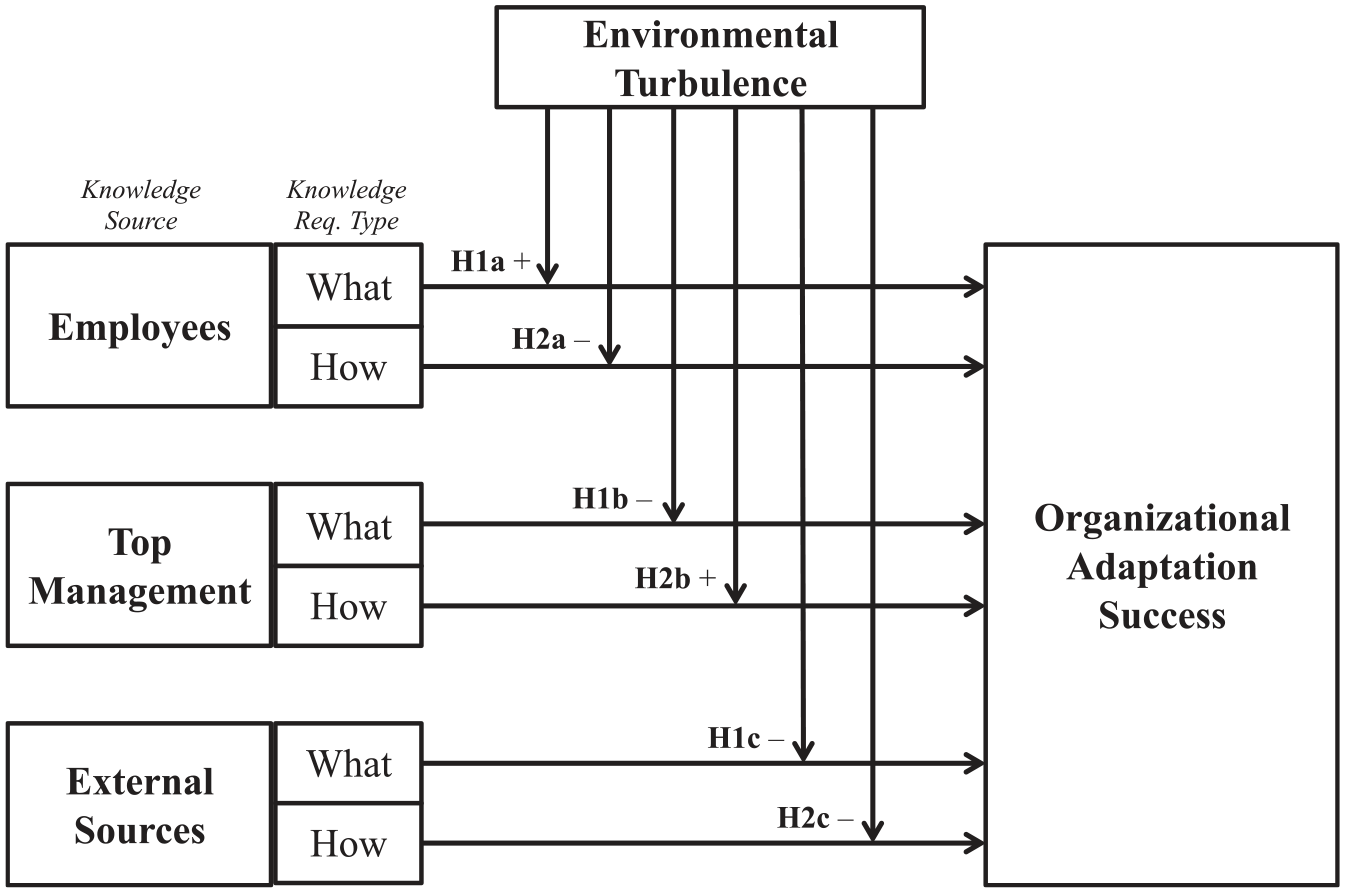
Model of the hypothesized contingent influence of environmental turbulence on the knowledge source-knowledge requirement type relationship on adaptation success.
2.1. Organizational adaptation success
The degree of success in adaptation (hereafter called adaptation success) is conceptualized as an ongoing process of organizational change where the focal firm seeks and varyingly attains congruence with the environment at both the firm’s strategic and operational levels (cf. Nadkarni and Narayanan, 2007; Sarta et al., 2021). Organizational adaptation is a core reason for firms to seek knowledge in turbulent (changing) environments (e.g. Kriauciunas and Kale, 2006; Srikanth and Ungureanu, 2025). Scholars have long been interested in the antecedents of organizational adaptation, examining, for example, resources and capabilities (Vergne and Depeyre, 2016; Zhou et al., 2006), knowledge and learning (Asmussen et al., 2016), and governance institutions (Frank, 2014). For example, the use of product development is considered as a vehicle for developing knowledge (Furr and Snow, 2015). Overall, firms require and use knowledge (solutions) to adapt, but we know little about the effectiveness of different knowledge sources in the course of this organizational adaptation.
2.2. Knowledge requirement types, sources, and value
Drawing from the KBV literature (Grant, 1996a; Kogut and Zander, 1992), we distinguish a firm’s knowledge requirements into two fundamental knowledge types: information and know-how (also, see: Huber, 1991). Information involves “knowing
Aligned with the KBV literature, we examine a parsimonious set of knowledge sources both internal and external to the firm (Arend et al., 2014; Audretsch and Belitski, 2023; Grant, 1996a; Steensma et al., 2005; Stephan et al., 2019; Van Wijk et al., 2008). Internal organization members are of two distinct categories in the literature (Felin and Hesterly, 2007; Hedlund, 1994; Nonaka, 1988), even a third category is sometimes noted: middle managers (Ren and Guo, 2011). Maintaining a sharp theoretical distinction, our examination focuses on top management and employees because top managers possess different knowledge compared to employees, owing to a manager’s broader view, organization-level responsibility, and experience integrating both external and internal perspectives to determine the approach for action (Hillman and Dalziel, 2003; Maksimov et al., 2017; Smith and Tushman, 2005). External sources consist of business partners and social network constituents, including consultants that may have different knowledge than that of internal sources (Arend et al., 2014; Chang et al., 2024; Foss et al., 2013; Nonaka, 1994).
Knowledge sources develop and update knowledge in an active process through both creation and search, often including the recombination of prior knowledge fragments (see, for example, Fawad Sharif et al., 2022; Nonaka and Von Krogh, 2009; Schulz and Zhu, 2022). The literature suggests various reasons for differences in the capacity of sources to develop knowledge, including motivational differences (Joshi and Sharma, 2004), knowledge exchange or interaction (Arikan, 2009), and social practices (Cook and Brown, 1999). Importantly, knowledge value arises when knowledge is relevant for what the focal firm needs, thus, using knowledge that matches knowledge requirements (knowledge fit).
2.3. Environmental turbulence and knowledge
Environmental turbulence refers to instability or “disorder” in the environment, while unpredictability and uncertainty refer to “the lack of pattern that disorder implies” (Davis et al., 2009: 423). Capturing the notion of irregular, nonsystematic change (Miller et al., 2006; Srikanth and Ungureanu, 2025) that may come from different sources, we define environmental turbulence as the degree to which the environment exhibits high-magnitude and unpredictable change, making it more uncertain. Environmental turbulence has different drivers, ranging from disruptive new technologies to major economic transitions (Grigoriou and Rothaermel, 2017; Hoskisson et al., 2000; Peng, 2003; Svejnar, 2002).
Turbulence generally reduces the value of existing knowledge and jeopardizes the value of newly generated knowledge (Levine and Prietula, 2012; Posen and Levinthal, 2012). So, past knowledge will be less useful in the changed or changing situation. Moreover, the required knowledge may not be available or exist, or it may be tentative and therefore difficult to assess in highly turbulent environments. In these environments, and in the short term, knowledge may instead develop through fast trial-and-error, experiential learning (e.g. Katila, 2002; Levine and Prietula, 2012; Nerkar, 2003).
Overall, we build on three foundational theoretical perspectives: (1) the value of knowledge varies and is relative to its context of use (Haas and Hansen, 2005); (2) the value of a source’s knowledge tends to erode (reduce) with increasing turbulence (Chanda and Ray, 2023; Posen and Levinthal, 2012); and (3) knowledge sources likely differ in their ability to match their knowledge to a focal firm’s knowledge requirements (Reus et al., 2009). Despite the accepted importance of turbulence, there is little understanding of how turbulence affects knowledge-source utility for organizational adaptation.
3. Hypothesis development
Contingency theory aids our theorizing on how turbulence influences knowledge-source utility through the concept of knowledge fit (matching source’s knowledge with knowledge requirements). We argue it is crucial that sources understand focal firm knowledge requirements and maintain knowledge in line with these requirements for relevance and subsequent utility.
In more stable conditions, a source’s knowledge and the focal firm’s knowledge requirements are more well-defined and evolve more incrementally. In this situation, past knowledge maintains greater utility. Most knowledge sources can provide relevant knowledge as incremental knowledge updates to better fit such requirements are likely similarly feasible, ceteris paribus, assuming a reasonable degree of fit of prior knowledge and incremental learning. Knowledge in a perfectly stable environment could theoretically be one hundred percent relevant as requirements are largely durable.
In contrast, in more turbulent environments, there is increased probability that a focal firm’s knowledge requirements shift in unpredictable, radical ways (Rodan and Galunic, 2004) because adaptation is ongoing (Sarta et al., 2021). Requirements can only be imperfectly and ambiguously defined (Von Hippel and Von Krogh, 2016) because firms are less able to predict future situations, knowledge needs and solutions, or the outcomes of current actions under these conditions (cf. Afuah and Tucci, 2012). This means that neither the focal firm’s knowledge requirement nor the solution may be precisely definable ex ante (cf. Morris et al., 2023). Knowledge value erodes; knowledge increasingly moves out of high fit, which is thus temporary. This is because sources’ knowledge become less relevant as turbulence increases and a focal firm’s knowledge requirements shift with “fit-destroying change” (Siggelkow, 2001). Although past knowledge likely retains some relevance (Cohen and Levinthal, 1990; De Massis et al., 2016) and since knowledge sources draw on what they know historically for knowledge development, continuous knowledge updates are required to realign knowledge with adjusted requirements for a better fit (cf. Donaldson, 2001). Still, an imperfect knowledge fit may be high enough to add value for the focal firm (Donaldson, 2001; Pérez-Nordtvedt et al., 2008; Van de Ven et al., 2012).
We therefore contend that in more turbulent environments, the time dimension increases in relative salience to achieve knowledge fit (Chanda and Ray, 2023; Siggelkow and Rivkin, 2005). Knowledge sources more attuned to the focal firm’s shifting requirements, once they temporarily become more known, albeit imperfectly, can more quickly update knowledge according to the specific requirements through, for example, quick feedback from experiential learning. 1 This expedited knowledge-updating perspective is consistent with research generally emphasizing speed for higher performance under turbulence (Eisenhardt, 1989; Schoemaker and Day, 2021; Siggelkow and Rivkin, 2005). Thus, the overarching proposition for our hypotheses is that sources that are better able to update knowledge toward shifted or shifting requirements will possess timely knowledge with a higher degree of fit, thus offering greater utility.
We focus on two mechanisms for knowledge fit that align with notions of knowledge familiarity and distance (Capaldo et al., 2017; Piezunka and Dahlander, 2015). First, a knowledge source’s focus of attention (Ocasio, 1997) affects in-depth understanding of the focal firm’s specificities, even as specificities may shift due to unpredictable change. This focus of attention influences the source’s experience and ability to update knowledge in the direction of the focal firm’s knowledge requirements, impacting the relevance of updated knowledge and its subsequent utility. Subject-matter expertise (Afuah and Tucci, 2012; Grant, 1996a; Joseph and Ocasio, 2012) and high levels of attention (Ocasio, 1997) improve in-depth understanding, which increases the fit of new knowledge and particularly the fit of knowledge updates in changing environments.
Second, a knowledge source’s recency of interaction with focal firm specificities affects real-time understanding that impacts knowledge updates to align with shifting requirements. This active interaction with the organizational system embedded in the environment provides a high level of access to, and real-time direct engagement with, focal firm specificities such as operations, entrenched routines, or technologies well-suited to solving the problem of adaptation. Direct or indirect experience, such as trial-and-error learning and enabling actors to learn from one another, is known to facilitate opportunities for knowledge creation (Argote et al., 2003; Park and Puranam, 2023). Despite contrary views that suggest too much recency of interaction can have negative effects in specific circumstances (Heeley and Jacobson, 2008; Katila, 2002), most research finds that recency allows for access to currently available knowledge “in use” and that it facilitates finding “best” solutions in the creation of new knowledge (Kok et al., 2019; Nerkar, 2003). More recent interaction thus enhances the knowledge source’s ability to update knowledge in the direction of shifting knowledge requirements (Atuahene-Gima, 2003; Sheremata, 2000), making them more useful (relevant) (e.g. Piezunka and Dahlander, 2015; Schulz and Zhu, 2022), and thus of greater utility.
We now turn to our hypotheses focusing on contingency effects, while building on the general expectation of a positive relationship between knowledge-source utilization and organizational adaptation success (direct relationships are not formally hypothesized but are tested).
3.1. Knowledge sources for what to change
3.1.1 Employees
Employees are an accepted source of knowledge and contributor of ideas, such as regarding innovation and incremental improvement (e.g. Gray and Meister, 2004; Lei et al., 1996; O’Dell and Grayson, 1998; Penrose, 1959). As a source, employees thus tend to have a positive effect on adaptation, although cognitive entrenchment or core rigidities can lead to exceptions of this effect (Almandoz and Tilcsik, 2015; Leonard-Barton, 1992). In general, it is therefore expected that firms that exhibit greater utilization of employees for knowledge on what to change, controlling for the use of other sources, will perform better than those that utilize this source less.
With increasing turbulence, we posit that there is an increasingly positive relationship between a focal firm’s utilization of employee knowledge on what to change and adaptation success. First, job responsibilities guide the employee focus of attention toward tasks and activities (Riege and Zulpo, 2007; Simon, 1947). This active and direct involvement in organizational activity places this source, as a whole (employees as a combined group), close to the problems at hand (Atuahene-Gima, 2003). Since there are many employees embedded in the organization, fulfilling different roles with varied foci of attention, employees collectively attend to the diverse but individually specific activities across the firm (Grant and Phene, 2022; Sheremata, 2000). Because employees focus on the task at hand, the in-depth collective understanding of employees regarding specific adaptation problems is, therefore, high. This understanding is associated with the search for more relevant knowledge and appropriate solutions (i.e. what needs adjustment) (Nickerson and Zenger, 2004). Thus, these aspects of attention foci provide in-depth understanding of what requirements, which enable this source to better update knowledge that better fits the focal firm’s requirements.
Second, the source’s recency of interaction, due to active engagement and organizational embeddedness, provides high levels of access and real-time direct interpretations of firm specificities within employees’ local areas of task activity. This recency enhances real-time understanding of the knowledge requirements and provides the ability to update knowledge in a timely fashion to better fit the focal firm’s knowledge requirements regarding what to change (Nerkar, 2003; Schulz and Zhu, 2022). Moreover, embeddedness and learning by doing are important regarding tacit knowledge (Afuah and Tucci, 2012; Park and Puranam, 2023; Riege and Zulpo, 2007; Simonin, 1999). As a collective group, employees have broad, multi-point involvement in an array of firm activities and aspects that enable this source to better update knowledge and thereby achieve a better fit.
In sum, the more turbulent the environment, the less well current knowledge from any source tends to fit, because the focal firm’s knowledge requirements continue to shift. However, the firm’s employees as a collective group are likely to update knowledge that better fits shifting requirements regarding what to change, through their focus of attention and recency of interaction that are associated with higher levels of in-depth and real-time understanding of the focal firm’s knowledge requirements (problems) and solution opportunities. Therefore, the relationship between the focal firm’s utilization of employee knowledge about what to change and adaptation success, controlling for the use of other sources, 2 will strengthen with increasing environmental turbulence:
3.1.2 Top management
Top management is an accepted source of organizational knowledge (e.g. King and Zeithaml, 2003; Nonaka, 2007). Firms with greater utilization of top management knowledge regarding what to change are expected to perform better than those that utilize this source less—although there are exceptions due to, for example, cognitive limitations, cognitive inertia, and threat rigidity (Hodgkinson and Healey, 2011; Liang, 2023).
However, we posit that the utility of top management knowledge about what to change for adaptation success decreases with increasing turbulence. This is due to this source’s limited ability 3 to update knowledge that highly fits what-requirements in a timely manner. First, top managers’ accountability for organizational outcomes and processes (Kreutzer et al., 2014; Simons, 1991) guides this source’s focus of attention toward the organization as a whole. As a decision-maker’s attention focus is shaped by “structured interests and identities” (Ocasio, 1997: 201), we argue that interests arising from task remit (scope of role and decision rights) are inherently stable drivers of focus of attention (Cho and Hambrick, 2006). In the capacity of their work responsibilities and tasks, top managers are theorized to heavily focus their attention on coordinating and integrating resources (Michel and Hambrick, 1992; Shepherd et al., 2017). This management focus constrains the level of continuous, detailed attention available on the array of specific problems and solutions regarding organizational aspects that need adjustment (cf. Atuahene-Gima, 2003). The limited available attention on detailed organizational activity hinders in-depth understanding and the ability to update knowledge that better fits the shifting what-requirements.
Second, top management interaction with detailed organizational activities is of limited recency, due to both the task focus of top management and an asymmetric relationship involving limited actors and many factors. Given there are few top managers, they are less likely to have comprehensive interaction with the multitude of firm specificities, particularly regarding what to change. Moreover, interaction is likely of a more indirect or limited nature, due to the many factors that are changing, thereby potentially decreasing the quality of understanding. Top managers will thus have limited active engagement and real-time relevant interaction with these specificities. This limited recency hinders real-time understanding of what-requirements as well as the ability to update knowledge accordingly in a timely manner (Nerkar, 2003), especially as trial-and-error learning is frequently important in turbulent environments (Levine and Prietula, 2012).
We contend that these constraints decrease the source’s ability to update knowledge about what to change to gain a better fit with the focal firm’s shifting requirements. Consequently, the relationship between utilization of top management’s knowledge about what to change and adaptation success will weaken as environmental turbulence increases:
3.1.3 External sources
A firm’s critical knowledge may lie outside the boundary of the firm, within its network of relationships. Research has documented performance benefits due to relationships, agreements, and networks that the firm can utilize without ownership (Granovetter, 1985; Gulati, 1998; Peng and Luo, 2017; Uzzi, 1997). A firm’s network may include suppliers, customers, partners, and consultants. Such external sources are important because, with their experience, they can provide diverse external information on problems and solutions (Hagedoorn and Duysters, 2002; Ozdemir et al., 2023; Zahra and Nielsen, 2002), as greater knowledge diversity increases the likelihood of solution discovery (Rodan and Galunic, 2004). Overall, the literature largely indicates that knowledge from external sources provides performance advantages (e.g. Anand et al., 2002; Fawad Sharif et al., 2022).
However, we posit that the utility of external sources’ knowledge about what to change for the focal firm’s adaptation success decreases with increasing turbulence due to the source’s limited ability to update knowledge in pursuit of better fit. First, the focus of attention among external sources is likely diverse, distributed across varied tasks and activities, and this attention is likely not allocated exclusively to the focal firm, even if an external source’s domain of expertise is the focal firm’s area of activity (cf. Ozdemir et al., 2023). Because requirements are shifting, we generally anticipate low levels of in-depth understanding of firm-specifics by external sources, as they are frequently remote to the firm (Sheremata, 2000). This decreases the probability of accurately identifying the focal firm’s shifting knowledge requirements to formulate appropriate solutions with respect to those organizational aspects in need of adjustment. Prior research supports this expectation, as positive effects from external knowledge sources are hampered when the knowledge need is tacit, complex, or nonmodular (Afuah and Tucci, 2012)—conditions matching the what-requirements in the context of turbulence. External sources’ limited focus of attention on the specifics of the focal firm thus constrains in-depth understanding and hinders the ability to update knowledge for better fit.
Second, given their location outside the firm’s boundary, external sources also have limited recency of interaction with the firm’s specific activities, constraining their timely exposure to emergent problems and opportunities (Atuahene-Gima, 2003; Koçak et al., 2023). The ensuing limited, real-time understanding decreases the source’s ability to update knowledge to match the focal firm’s shifting requirements in a timely fashion. Thus, the probability that external sources’ knowledge about what to change has a high degree of fit decreases with increasing turbulence, yielding less utility, weakening the relationship between utilizing this source’s what-knowledge and the focal firm’s successful adaptation:
3.2. Knowledge sources for how to change
3.2.1 Employees
Employees can also provide ideas on how to change, particularly involving aspects related to their task activity (e.g. Kogut and Zander, 1992; Ramus, 2001). However, with increasing turbulence, we expect decreasing utility of employee know-how for adaptation success. First, the focus of attention and expertise domain of this source are mostly related to the task at hand, which is a beneficial focus for the problem of what to change but hinders the level of in-depth understanding regarding how to implement that change, particularly when requirements shift. Instead, a broader organizational focus of attention and integrative knowledge are more beneficial for this how-knowledge requirement (Grant, 1996a, 1996b). The aspects of employees’ attention focus (i.e. more isolated knowledge) therefore hinder in-depth understanding of how to change, which requires more knowledge combination, coordination and alignment of interdependent elements (cf. Chen et al., 2021). Second, the limited recency of interaction with the entire problem of how to change reduces real-time understanding. While employees actively engage with organizational activities, their narrower scope of task activity limits their ability to engage in timely, full observations of the organizational process and structure frequently needed for how-requirements (cf. Koçak et al., 2023). A limited in-depth and real-time understanding hinders the updating of knowledge to better fit the shifting knowledge requirements, thereby weakening the relationship between utilization of this source’s knowledge regarding how to change as turbulence increases:
3.2.2 Top management
Top management is an accepted source of organizational knowledge regarding how to change, largely due to its experience in defining direction and process procedures once a problem or its solution are identified (e.g. Marginson, 2002; Simons, 1991). With increasing turbulence, we posit the utility of top management knowledge regarding how to change for adaptation success increases due to the source’s greater ability to update knowledge that better fits requirements. This source’s focus of attention and recency of interaction with firm-specific problems and opportunities promotes in-depth and real-time understanding of knowledge requirements on how to change. First, top management is the generally responsible source, having decision rights for organizational processes and procedures and coordinating resources (Marginson, 2002). Top managers are tasked with achieving the firm’s desired performance outcomes, including developing and directing process procedures intended to assure those performance outcomes are achieved (e.g. Marginson, 2002; Simons, 1991). For example, top managers are directly involved in resource allocation and strategy implementation (e.g. Simons, 1991), designing organizational characteristics and structure (Olson et al., 2005; Slater et al., 2006) and defining organizational control measures (Kreutzer et al., 2014). Importantly, top management guides the intended organization-level processes and outcomes that typically involve multiple, interdependent activities, job functions, and employees (Kreutzer et al., 2014). How-requirements can be well understood with these aspects of top management’s attention focus. Second, the source’s recency of interaction with the subject matter also provides high levels of real-time direct understanding of firm specificities that are necessary to solve tacit, nonmodular, interdependent problems (Afuah and Tucci, 2012; Koçak et al., 2023)—aspects that are critical for this knowledge requirement type in more turbulent environments. Together, top management’s in-depth and real-time understanding increases the probability for knowledge updating to better fit the shifting knowledge requirements regarding how to change. Therefore, the relationship between the focal firm’s utilization of how-knowledge from this source and adaptation success will strengthen with increasing environmental turbulence:
3.2.3 External sources
The literature strongly supports the notion that knowledge from external sources, such as consultants, provides a performance advantage because these sources can provide diverse information from other relevant experiences (e.g. Simonin, 1997) that may be particularly beneficial in the case of complex tasks (Rodan and Galunic, 2004). However, with increasing turbulence, we suggest the utility of external sources’ know-how for adaptation success decreases due to the sources’ limited ability to update knowledge toward better fit. First, while the domain of expertise of some external sources, such as specialized consultants, might be related to the problem of implementing change, it is unlikely that an external source’s focus of attention is entirely on the focal firm’s shifting requirements. Such expertise is likely based on a more generalizable type of experience-based knowledge that can be applied to similar problems across settings (see e.g. Gary et al., 2012). However, knowledge of how to implement change frequently necessitates in-depth understanding of organizational specifics based on experience and learning in a particular setting (Atuahene-Gima, 2003; Reus et al., 2009). This is due to the tacit, complex, and nonmodular nature of how-knowledge (Afuah and Tucci, 2012), especially as specifics shift in turbulent environments. As a result, we contend that the focus of attention of external sources constrains in-depth understanding of the focal firm’s how-requirements. Second, external sources also have low recency of interaction with focal firm-specifics, limiting their real-time understanding of problems and opportunities as they emerge (cf. Ozdemir et al., 2023). This constrained real-time understanding decreases their ability to develop timely knowledge that more substantively matches the focal firm’s shifting knowledge requirements. Collectively, as environments increase in turbulence, in-depth and real-time understanding decreases. As a result, efforts from external sources to update how-knowledge in a way that better fits the shifting knowledge requirements are increasingly frustrated. Therefore, we hypothesize a weakening relationship between utilization of the source’s (how to change) knowledge and the focal firm’s successful adaptation as environmental turbulence increases:
4. Data and methods
Our empirical analysis leverages a natural experimental setting for the phenomenon of exogenous, environmental turbulence by investigating a transition economy context. Specifically, the study period (1999–2002) is a highly relevant timeframe, as Lithuania, Bulgaria, Ukraine, and Belarus were then progressing differently from centrally controlled to free-market-oriented economies (beginning in 1990). These countries exhibited substantial differences in economic and political development and stability. Transition processes impacted property rights, strategic factor markets, and competition from domestic, foreign, and entrepreneurial firms (Hoskisson et al., 2000; Peng, 2003; Peng and Heath, 1996). Dissimilar reform approaches, movements toward free markets, and political systems (Makhija, 2003; Svejnar, 2002) resulted in substantial differences in levels of turbulence (unpredictability and uncertainty) in these countries’ economic-exchange (business) environments. Our survey data provide valuable original information from inside the firms in these turbulent conditions on issues otherwise difficult to obtain, such as knowledge sources used and firm adaptation objectives (Sarta et al., 2021). This makes this unique data appropriate and relevant for our research (Ketchen et al., 2023). One of the authors prior work in this region facilitated firm access.
We identified a representative sample of 1662 firms (512 from Lithuania, 500 from Bulgaria, 350 from Ukraine, and 300 from Belarus) from the Amadeus database developed by Bureau van Dijk, supplemented with local sources such as business-press rankings and client lists. The English survey, translated into local languages and back into English, indicated no language issues. The survey examines four functions of the firm (technology, marketing, quality assurance, and human resource management) with same questions because they cover the main common functional areas firms need to be successful (or to minimally exist) in a free-market economy, regardless of industry or firm size. In pre-survey interviews with company managers in Lithuania, Ukraine, and Bulgaria, in 2001, and Belarus, in early 2002, we validated these as critical functions to examine regarding firm-level adaptation toward free markets.
Our survey was sent by mail in Bulgaria and Lithuania, but conducted through structured face-to-face interviews in Belarus and Ukraine (more unstable environments) because in-person contact was deemed necessary for participation (Hoskisson et al., 2000). Both methods included the same survey questions and called on the firm’s senior director to identify the individual best suited to provide responses pertaining to each function (top functional manager). Supplement A presents relevant survey items. On average, two respondents per firm participated (in small firms, managers were often cross-functional), avoiding single-respondent bias by using multiple key informants. To address the possibility that high-performing firms in Lithuania and Bulgaria would be more likely than others to respond to the survey, we compared GDP growth between 1999 and 2001 in each country with firm employment growth for the same period. We found that firms in the sample did not perform better than the overall economy, thus minimizing concerns about non-response bias. The response rate was 18.6% for Lithuania, 15.8% for Bulgaria, 68.9% for Ukraine, and 81% for Belarus, with an overall response rate of 39.5%. Regression weighting in our analysis addresses the variation in response rates—owing to different survey methods between countries. Our dataset includes 656 firms; after eliminating firms with missing data and small entrepreneurial firms (fewer than 5 employees), our analysis is based on 438 firms in 12 industries (65 in Lithuania, 24 in Bulgaria, 157 in Ukraine, and 192 in Belarus).
4.1. Measures
4.1.1 Adaptation success of firms
Survey respondents indicated the success of implemented changes in their function from January 1999 to December 2001. Given multiple responses per firm, we averaged the scores to calculate a firm’s adaptation success. Cronbach’s alpha for the four items is 0.83 thus acceptable (Nunnally, 1978). In emerging economies, self-assessment is often more reliable than publicly reported data (e.g. Hoskisson et al., 2000) and is commonly used in management research (e.g. DeSarbo et al., 2005).
Adaptation success criteria were relative to important firm adaptation goals identified in pre-survey interviews with company managers, including reduced costs, increased sales (mainly domestic sales), satisfaction of customer requirements, and improvements in competitive position, in product/service quality, and in productivity. These goals provide a reference for the knowledge sought and serve as an operationalization of the focal firm’s knowledge requirements. High adaptation success indicates better knowledge fit if the source was highly important in providing knowledge for each knowledge requirement type, ceteris paribus, generally consistent with the “fit” concept treatment in prior work (Donaldson, 2001; Venkatraman, 1989).
4.1.2 Knowledge sources for what to change
Senior functional management received information (knowledge) on what to change and how to implement that change from each knowledge source, with both knowledge types measured similarly across sources. What-knowledge relates to information on those firm-specific organizational aspects and activities needing adjustment. Our survey measured Employees—What, Management—What, and External Sources—What. Respondents rated the importance of knowledge sources, on a seven-point Likert-type scale, as a source of ideas on what to change for their function (January 1999 to December 2001). Specifically, respondents directly reported the category Employees, while for Management, our measure is the maximum reported rating for two survey items (top management and owners) (Grabisch et al., 1998). For External Sources, our measure is the maximum reported rating for any of eight sources in the survey, such as consultants and foreign business partners, because we are interested in how much the firm utilized any source in a category. We view within-category choices as substitutes—although multiple sources may be utilized simultaneously. We averaged responses across the four functional areas, with Cronbach’s alpha exceeding 0.70 (Nunnally, 1978) for each aggregation.
4.1.3 Knowledge sources for how to change
How-knowledge relates to information on methods for implementing firm-specific change and making necessary organizational adjustments happen. Our survey measured Employees—How, Management—How, and External Sources—How. Respondents evaluated, from rarely to frequently on a seven-point Likert-type scale, how they received information to implement changes (by implementors, in writing, and through discussions) from what source: management, departments within the firm (employees), or sources outside the firm. The average response across the four functional areas represents the organizational use of how-knowledge. Cronbach’s alpha for the three source-item aggregations exceeded 0.70 (Nunnally, 1978).
4.1.4 Environmental turbulence
Government instability is a critical source of turbulence since governments establish the regulations and policies regarding economic exchange. We selected the World Bank’s exogenous country-level indicator “political stability and absence of violence” as a proxy for Environmental turbulence, capturing the likelihood of government destabilization (Kaufmann et al., 2008)—presenting uncertainty and unpredictability. We inverted the scale to indicate turbulence rather than stability. We averaged scores for 1998 and 2000 (−0.527 for Bulgaria, −0.486 for Lithuania, 0.128 for Belarus, and 0.297 for Ukraine), with higher positive numbers indicating greater turbulence. Our sample exhibits meaningful variation in turbulence given this indicator’s range from −3 to 3, with zero as the mean.
4.1.5 Control variables
Our control variables address alternative explanations for adaptation success and capture proxies for extant knowledge (e.g. R&D density) and knowledge processes within the firm (e.g. Foreign Ownership). We used 1999–2001 survey values (averaging across the four functional areas) unless otherwise noted. Also included were Private ownership, Export experience, Privatized (whether the firm was formerly state-owned), Firm size (natural log of the number of employees), Firm age (natural log of the firm age), Industry diversity (Herfindahl-type index capturing the number of industry segments and the importance of each segment; higher numbers indicate less diversity, where 1.0 represents a single business firm), GDP growth (1998–2001 average per country, www.ebrd.com), firm’s Strategy-cost and Strategy-differentiation (Thornhill and White, 2007), and industry fixed effects. Our empirical model controls for the typical variables used to study inertia and imprinting in transitioning-economy firms (i.e. size, age, and privatization).
4.2. Empirical analysis and results
We used a weighted ordinary least squares (OLS) regression analysis to test our hypotheses, using country weights to correct for response rate variation across countries and potential sample imbalance. Variables were mean-centered for better interpretation of our results. Variance inflation factors (VIF) on the model coefficients are below 10, reducing multicollinearity concerns (Cohen et al., 2003). Our analytical approach follows the model of Figure 1 in a stepwise manner: (1) control variables and environmental turbulence, (2) adding knowledge sources for each type of knowledge separately, (3) adding environmental turbulence interaction terms on these separate models, and (4) full models with all variables and interactions.
Descriptive statistics are in Table 1, and hypotheses tests are in Table 2. Model 1 indicates reduced adaptation success when environments are more turbulent (−0.144, p = 0.004), as expected. Models 6 and 7 are particularly revealing because utilization of each knowledge source may be considered an alternative explanation for adaptation success and because knowledge sources can be accessed simultaneously. In Model 6, the knowledge-source variables, except Employees—What and External Sources—What, positively relate to adaptation success. This generally supports the non-hypothesized expectation that greater utilization of a knowledge source, while controlling for other sources, is associated with increased success in adaptation.
Descriptive statistics.

Bold font indicates significance p < 0.05.
Regression model results for adaptation success (438 firms).
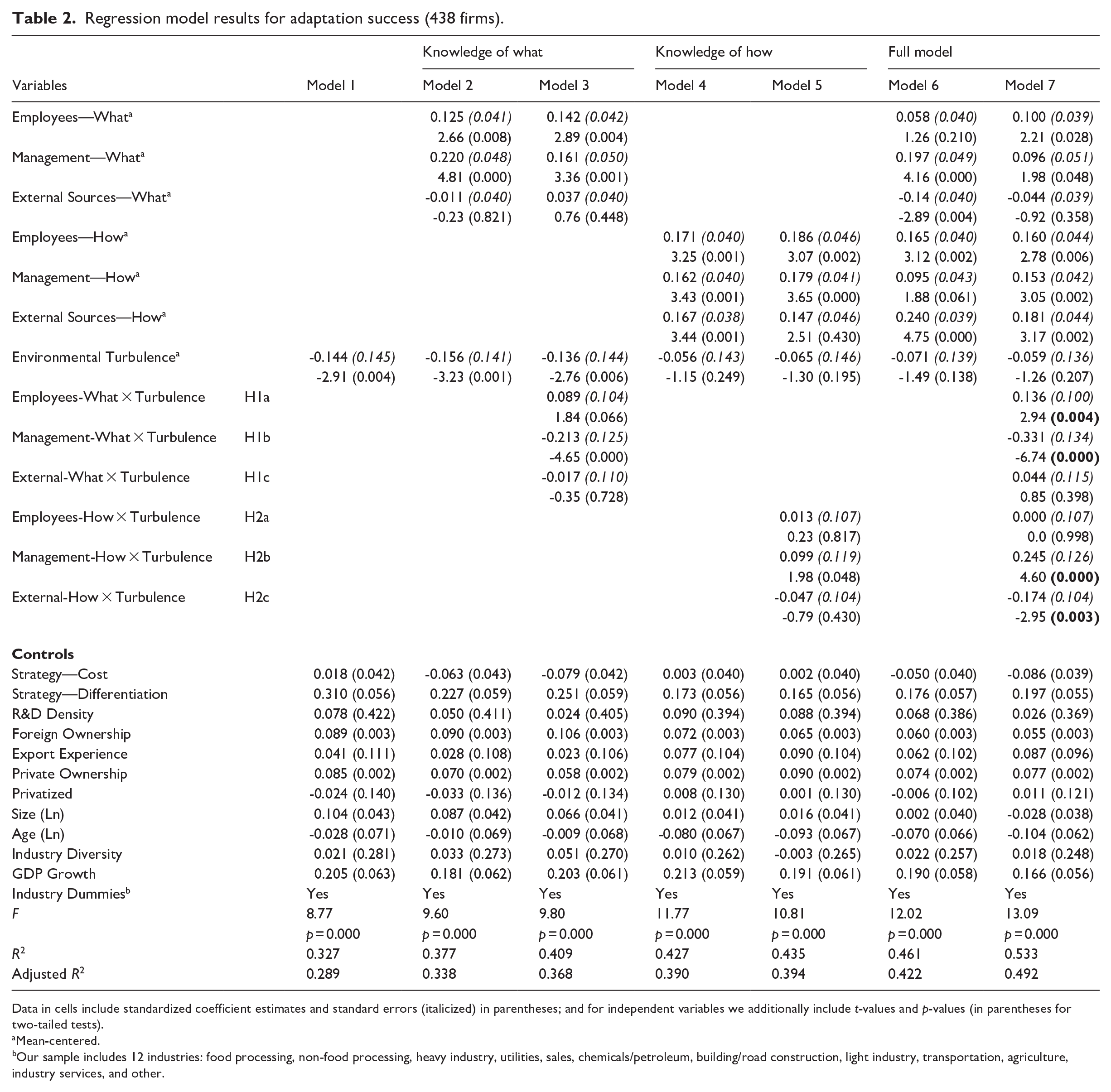
Data in cells include standardized coefficient estimates and standard errors (italicized) in parentheses; and for independent variables we additionally include t-values and p-values (in parentheses for two-tailed tests).
Mean-centered.
Our sample includes 12 industries: food processing, non-food processing, heavy industry, utilities, sales, chemicals/petroleum, building/road construction, light industry, transportation, agriculture, industry services, and other.
We evaluate our hypotheses in Model 7. A positive coefficient on the interaction with environmental turbulence supports Hypotheses 1a and 2b, while a negative coefficient supports the remaining four hypotheses. Interaction graphs are in Figure 2. Support for Hypothesis 1a is demonstrated by the coefficient 0.136 (p = 0.004) in Table 2, indicating that the relationship between utilization of employees, as a source of what to change, and adaptation success (controlling for other sources) strengthens as the environment becomes more turbulent. Hypothesis 1b (−0.331, p = 0.000) is also supported, with greater utilization of top managers, as a source of what to change, weakening adaptation success as environmental turbulence increases. We do not find support for Hypothesis 1c. Greater utilization of external sources for ideas on what to change is associated with decreasing adaptation success, and this relationship does not significantly change with the level of environmental turbulence. Regarding how to change, we do not find support for Hypothesis 2a, regarding employees as a source. Greater utilization of employees, as sources for ideas on how to change, is associated with increasing adaptation success, and this relationship does not significantly change with the level of environmental turbulence. We find support for Hypothesis 2b (0.245, p = 0.000) that the relationship between utilization of top managers as a source of how to change and adaptation success strengthens as the environment becomes more turbulent. Support for Hypothesis 2c (−0.174, p = 0.003) indicates that greater utilization of external sources for ideas on how to change is positively associated with adaptation success; such utilization becomes less beneficial as environmental turbulence increases.
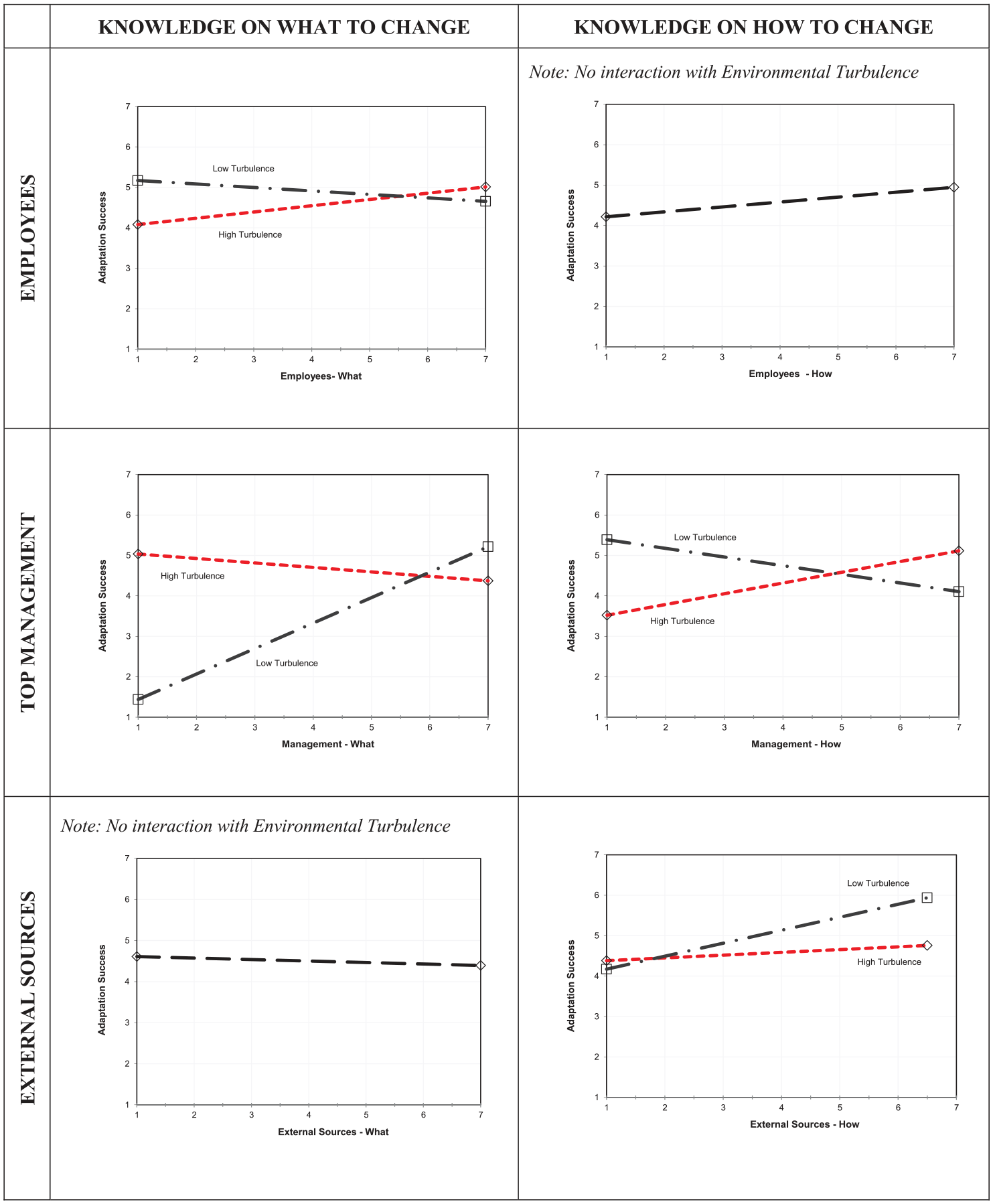
Predicted adaptation success at high and low levels of environmental turbulence.
The adjusted R2 values in Table 2 show that the effect size is meaningful. From Model 1 to Model 7, the change in R2 values is 0.203, indicating a substantial amount of the variance in adaptation success is associated with knowledge-source utilization and environmental turbulence. From Model 6 to Model 7, the change in R2 values is 0.070. This difference is also meaningful (Cohen, 1992), indicating the substantial influence of environmental turbulence. Figure 2 further illustrates the influence of environmental turbulence, where the difference between low and high turbulence conditions (low and high values of our data) is significant in relation to the standard deviation of adaptation success (1.08 on our seven-point scale).
We performed numerous sensitivity analyses to evaluate the robustness of our results, including examining knowledge transfer as an alternative explanation, evaluating endogeneity arising from reverse causality and lack of variable independence, and evaluating a censored Tobit analysis, curvilinear relationships, and common method bias. Details of these evaluations are in Supplements B and C. These analyses increase confidence in our results.
5. Discussion
We sought to contribute to the KBV of the firm (Grant, 1996a; Grant and Phene, 2022; Kogut and Zander, 1992) by more thoroughly understanding the contingent effect of environmental turbulence on knowledge-source utilization for organizational adaptation success. We hypothesized that the effectiveness of utilizing knowledge sources varies with environmental turbulence due to source’s varying ability to update knowledge to fit the focal firm’s shifting knowledge requirements (distinguishing between knowledge on what and how to change). As Table 2 and Figure 2 show, we found support for four hypotheses, especially for Employees—What and Management—How. Interestingly, greater utilization of Management—What was found detrimental with increasing turbulence. These findings align with arguments and findings where using a bottom-up approach is beneficial to enhance organizational adaptation in high-changing environments (e.g. Yang and DiBenigno, 2025) and complements research on (non-) hierarchy and adaptation (e.g. Koçak et al., 2023). These results are also consistent with our argument that in-depth and real-time understanding allows for knowledge updates that better fit with shifting knowledge requirements regarding organizational adaptation. Accordingly, we contribute to a more forward-looking theory of knowledge-source utility. Fundamentally, with increasing environmental turbulence, knowledge-source utility for the focal firm is a function of a source’s capacity to update knowledge based on its focus of attention and recency of interaction with firm specificities. While our empirical data are from transition economy contexts, we believe our insights on knowledge-source utility in turbulent contexts have broader relevance.
Interestingly, we found that environmental turbulence does not moderate the relationship between Employee—How and adaptation success, finding positive utility across environments. Employee knowledge on how to change may contribute to adaptation in general given their immediate work context. We find support that top management (Management—How) has improved fit and greater utility as turbulence increases. However, we found no support that environmental turbulence moderates the relationship between External Sources—What and adaptation success, while the direct relationship was negative. This indicates external sources struggle to achieve better knowledge fit in a general transition economy context, not only in more turbulent environments hypothesized. We offer two possible explanations: (1) firms turn to external sources for difficult problems, which are harder to solve, and (2) internal people may facilitate adaptation by helping overcome resistance and inertia. Grigoriou and Rothaermel (2017) also found that the effectiveness of external knowledge sources is contingent on internal knowledge sources. A secondary evaluation of direct, independent effects of eight external sources generally further confirmed our findings (mostly negative and insignificant, see Supplement B).
We constrain our claims to the transition economy context 4 because our findings may partly reflect these economies’ unique nature and challenges. First, turbulence in transition economies may differ from turbulence in traditionally studied environments such as arising from competitive intensity in developed economies, that is, the former may be more pervasive and severe. Second, the focus of attention for knowledge sources may vary in transition economies. Although our general arguments were validated through interviews prior to the survey, qualified top management talent was scarce in our study’s period and countries (Xia et al., 2009), and managerial attention prioritized implementation (know-how), getting things done in a scarcity economy (Zhou et al., 2006). Therefore, top management as a knowledge source may differ in other contexts. In addition, in such environments of unpredictable high-magnitude change, sources’ knowledge may be more fungible (out of necessity), thus enhancing the propensity for updating. Nonetheless, we believe our novel insights regarding knowledge-source utility and updating in turbulence contribute to the literature. We encourage further studies to explore the generalizability of our findings in other turbulent contexts. 5
Our work contributes to the knowledge literature, particularly the KBV (Grant, 1996a; Grant and Phene, 2022; Kogut and Zander, 1992), by highlighting that knowledge sources differ in their ability to update relevant knowledge and revealing the contingent importance of environmental turbulence. First, we clarify how and why knowledge-source utility varies contingent on environmental turbulence, offering new perspectives on the mechanisms that influence knowledge source utility for successful firm adaptation. This addresses a recent call to “illuminate theoretical mechanisms for how this resource [knowledge] impacts competitive advantage and performance” (Bergh et al., 2025: 13). Empirically, we show that turbulence affects knowledge-source utility when pursuing organizational adaptation in transition economy contexts, adding insights into the types of knowledge required. Our findings may help explain inconsistent results in prior research that did not distinguish between what and how knowledge (e.g. Kraatz, 1998; Levine and Prietula, 2012). We also add to theoretical and simulation-based research with in-situ real-world insights and knowledge in use, shedding light on contingencies of knowledge-source utility when firms face necessary adaptation. This research thereby addresses gaps in the literature about where effective knowledge comes from during high-magnitude environmental turbulence, particularly when knowledge requirements are shifting (cf. Sarta et al., 2021). For instance, our argument and finding that external sources’ utility of knowledge regarding how to change decreases with increasing turbulence contrasts with substantial work emphasizing external knowledge benefits (e.g. Anand et al., 2002; Fawad Sharif et al., 2022). Yet, our results resonate with research showing the advantages of internal knowledge sources for solving innovation problems in emerging economies (Morris et al., 2023).
Second, we contribute to knowledge management theory (see, for example, Argote et al., 2003; Cooper et al., 2023) by shifting the focus to knowledge fit in turbulent environments, specifically through the driver of knowledge updating. We explicate two key mechanisms for updating knowledge—focus of attention (Ocasio, 1997) and recency of interaction with firm specificities (Kok et al., 2019; Nickerson and Zenger, 2004; Nonaka, 1994; Sheremata, 2000)—that enhance in-depth and real-time understanding of problems and solutions. Our work extends existing perspectives on knowledge value (e.g. Capaldo et al., 2017) by emphasizing knowledge fit and updating as crucial for utility in turbulent environments; to substantively improve the degree of knowledge fit—relative to knowledge requirements vis-à-vis turbulence. We thus identify knowledge updating toward the focal firm’s knowledge requirements as a critical ex ante determinant of knowledge-source utility.
We also add to research on transition economies (e.g. Peng, 2003; Peng and Luo, 2017) by exploring the benefit of internal versus external knowledge sources for successful firm adaption. Our finding that utilization of internal sources is more beneficial than external sources provides new insight into performance improvement for firms in transition economies. Our work complements research that finds benefit of upgrading management knowledge with external knowledge for firm innovation (Maksimov et al., 2017). Finally, we contribute to the discussion on knowledge-value erosion in turbulent environments (Chanda and Ray, 2023), arguing that fast experience-learning-knowledge-updating cycles, even though imperfect, are necessary to maintain utility as knowledge loses relevance quickly. In contrast to prior research, 6 we suggest that the durability of knowledge utility under turbulence depends on both the lifespan of knowledge requirements and how effectively and timely knowledge is updated to meet shifting requirements. Our research paves the way for further exploration into knowledge-value decay (erosion) and useful knowledge updating in turbulent settings.
Our investigation also provides managerial insights, as firms make strategic decisions regarding knowledge sources that affect company performance and survival. In turbulent environments, especially transition economies, managers can benefit from utilizing Employee—What and Management—How knowledge, and to a lesser extent, Employee—How. Managers can also actively guide a knowledge source’s focus of attention and recency of interaction with firm specificities to enhance real-time in-depth understanding and increase the relevance of knowledge for shifting requirements. Furthermore, managers can select knowledge sources based on the anticipated direction of shifting knowledge requirement (if possible) and the sources’ ability to update knowledge given the foci of attention and opportunity potential for real-time interaction with firm specificities. Overall, our work explains why knowledge-source effectiveness varies under turbulence, contributing to the KBV of the firm (Grant, 1996a; Grant and Phene, 2022; Kogut and Zander, 1992).
5.1. Limitations and future research
Our study has limitations that offer opportunities for future research. First, investigating different contexts, including industry comparisons with quantifiable variance in environmental turbulence, could provide additional insights and evaluate the generalizability of our findings. Second, while our data are cross-sectional and provide in situ inside perspective of knowledge sourcing and its value for organizational adaptation, our theorizing has a dynamic underpinning. Future research using longitudinal data could offer a deeper understanding of knowledge sourcing over time (see, for example, research on external knowledge sourcing in multinational corporations in a 7-year study: Monteiro and Birkinshaw, 2017). Third, testing mechanisms directly with field data is challenging, so we encourage future research to empirically test our arguments, especially regarding knowledge updating. Fourth, adding firm-specific factors like prior commitments, routines, extant knowledge, cognitive frames, culture, leadership, and absorptive capacity could further refine studies on knowledge-source utility.
Overall, this research provides insights into knowledge-source utility in turbulent transition economy environments. This setting calls into question the relevance of existing knowledge relative to the capacity for updating knowledge to achieve organizational outcomes. We hope to pave the way for further research on knowledge fit, knowledge-value erosion, and knowledge updating in turbulent settings. We believe this is an important area for understanding how firms adapt in uncertain environments.
Key Practical and Research Implications
Supplemental Material
sj-pdf-1-aum-10.1177_03128962251319725 – Supplemental material for How knowledge-source utilization influences adaptation success in turbulent environments: Evidence from transition economies
Supplemental material, sj-pdf-1-aum-10.1177_03128962251319725 for How knowledge-source utilization influences adaptation success in turbulent environments: Evidence from transition economies by Mirjam Goudsmit, George A Shinkle and Aldas P Kriauciunas in Australian Journal of Management
Footnotes
Acknowledgements
We gratefully acknowledge the invaluable contributions of Greg Hundley (Purdue University), who participated in the conceptualization and early development of this research but sadly passed away before the manuscript’s submission. We gratefully acknowledge the constructive comments and suggestions on earlier versions of this paper from Zur Shapira, Glenn Hoetker, Will Felps, Chris Jackson, and Tom Roehl, as well as seminar participants at the University of New South Wales as well as participants of the Academy of Management Annual Meeting. We appreciate the support of the Michigan Ross School of Business, the William Davidson Institute, CASE-Ukraine, Central Securities Depository of Lithuania, Institute for Market Economics, Institute for Privatization and Management, and Kaunas Technological University.
Final transcript accepted 29 December 2024 by Miles Yang (AE Strategy).
Funding
The author(s) disclosed receipt of the following financial support for the research, authorship, and/or publication of this article: The first-named author’s contribution to this work was funded through the support of the Australian Government Research Training Program Scholarship and the Ryoichi Sasakawa Young Leaders Fellowship Fund (Sylff). The second-named author’s contribution to this work was funded through the support of the Australian Research Council (award DE130100840).

Notes
References
Supplementary Material
Please find the following supplemental material available below.
For Open Access articles published under a Creative Commons License, all supplemental material carries the same license as the article it is associated with.
For non-Open Access articles published, all supplemental material carries a non-exclusive license, and permission requests for re-use of supplemental material or any part of supplemental material shall be sent directly to the copyright owner as specified in the copyright notice associated with the article.
