



Abstract
1. Introduction to the special issue
We start this special issue with an acknowledgement of the Traditional Owners of the Land on which we, the four co-editors, live and write: the Wiradjuri people of the southern Wiradjuri Nation lands, the Wurundjeri people of the Kulin Nation and the Kombumerri people of the Yugambeh language region. Sovereignty was never ceded.
We are stuck. Let’s face it. Stuck inside the belly of the colonial project (i.e. powerful ethno-nations’ practices of dispossession of land, settling of their people on the conquered territory and domination of the original custodians of the land through violent, structural and normative means). Even now, especially now, the aims of the colonial project reverberate across our society, our institutions and our organisations and shape our lives. Those aims were brought to these shores with the purpose of extinguishing what already existed. The wholesale denial of First National sovereignty, cultures, languages, livelihoods and humanity lay a veneer over colonised countries. This false foundation is the canvas on which the business model of the colonial project has taken root (O’Sullivan, 2021), with its business strategies settler colonialism, extractive colonialism, missionary colonialism (Shoemaker, 2015), making money and setting the pace for what success looks like in the colonised nations.
These colonial strategies are strengthened by racial classification that maintains the domination of colonial power, colonial values and colonial people. Racism is tightly interwoven into the operating principles of the colonial project. The threads of domination weave with the strands of capitalism, adhering to the principles of the racial hierarchy, separating people between property and property owners (Harris, 1993), manufacturing rights for the use of First Nations people as unpaid workers or slaves, as bodies to be picked up and moved at the will and business requirements of colonisers.
In current day Australia, organisations continue to operationalise colonial logics. Organisations reproduce themselves, proffering solutions, creating markets, economically growing while maintaining the racist status quo. Racism is continually cast away as ‘forever elsewhere’ and ‘never us’. Structural and institutional racism permeates our organising, filtered through a racial hierarchy that maintains whiteness as supreme, promoting western capitalist values, such as individual pursuit of happiness as normalised, and the systems that go alongside these values, such as ‘closing the gap’ to be about addressing equity while reinforcing the deficiency of First Nations people against a white norm.
This exercise in denial can also be seen in the rise of diversity, equality and inclusion (DEI) policies that have largely focused on superficial, visible measures of organisational diversity. Under the banner of DEI, colonial organisations can engage in performative anti-racism while often usurping and dismantling the explicitly reparational policies of affirmative action that came before it. In DEI exercises, virtue can be commodified, bestowed and acquired through various self-congratulatory exercises of allyship, mentorship, unconscious bias and cultural competency training, and diversity accreditation. Organisational members can then busy themselves with a slate of annual events and award ceremonies, all while upholding the structures and ideologies of colonialism. Cynically, powerful organisational members can leverage DEI to fashion themselves as white saviours. A large extent of the performative anti-racism operationalised via DEI replaces meaningful, systemic change. Replaces any genuine reckoning with the structures and ideologies that see and treat non-White people as subhuman.
The colonial system continues to organise our institutions, our policies and our practices. They are invisible and normalised; they are business as usual. Despite over a century of anti-racist theorising and practice (Muzanenhamo and Chowdhury, 2023; Paluck and Green, 2008), it seems we are collectively stuck inside the belly of coloniality. These issues cannot simply be dismissed as foreign. Racial injustice prevails on the home front as well where First Nations people remain the most incarcerated people per capita in the world (Anthony, 2017). Similarly, recognition of First Nations people in the constitution continues to be unresolved centuries on from invasion of these sovereign First Nations lands. We are in the epistemic wars between Western and Indigenous knowledges where even Acknowledgement of Country is vilified and weaponised (e.g. Morse, 2022) as a political act. Racism remains a major cemented organising principle of our societies across Australia, New Zealand, the Pacific and the world. All these efforts push against us all as we work to create a fair and just world. Anti-racism principles matter more than ever, both in the material and in the epistemic.
Releasing our Call for Papers in 2020 amid a global pandemic, we acknowledged that racism was difficult to ignore within our organisations and our organising efforts. This was a time where access to events across our nation and the world loomed larger because we were stuck at home. One resonant global moment where we all watched in horror was the televised murder of Mr Floyd on 25 May 2020. We cried and raged in despair about how this could happen in 2020, during a pandemic no less. In our collective anger and energy to insist on racial justice, we felt as though the world was ready to face a racial reckoning, where Black Lives Matter. At the same time, there were so many flash points of police brutality (Schwartz, 2020), issues with unequal access to care during the pandemic (Khazanchi et al., 2020), the rise of right-wing nationalism (Magnus, 2022) and anti-Asian racism in full display in the Global North (Sojo and Bapuji, 2020), against the ever present critical challenge of climate justice.
The Call for this Special Issue was a provocation to scholars to share their work that raises ‘uncomfortable questions around race, racism and racial inequality by contextualising racial discrimination pertaining to Black, Indigenous, People of Colour (BIPOC) experiences in organisations, organising and organisational practises in Australia, New Zealand and across the Pacific’. Importantly, we have actively encouraged Indigenous scholars, early career scholars and scholars whose work is multidisciplinary in nature. As a team of editors, we come from various disciplines and methodological backgrounds and together our sometimes discordant voices jarred but moved us all forward. Together, we have worked with the authors on this Special Issue to activate space for a new generation of voices.
Anti-racism as an organising principle requires us to produce a way of working together that ‘reduces power differentials through advantaging subordinate racial groups and/or disadvantaging dominant racial groups’ (Paradies, 2005: 3). With this at the critical centre of our work, the voices you have in this Special Issue produce articles that signal where organisational and organising discourses are at right now. While we as editors wished to spark uncomfortable radical responses, we note those voices are not loud or the space for them to be heard are neither safe nor vast enough, yet. This further anchored the need for this Special Issue as a platform for a newer generation of voices.
The authors who have braved the Call for Papers and the review process, and are now published, some for the first time, go some way to claiming space in a powerful forum, such as the Australian Journal of Management. We thank you for being a part of this Special Issue and for trusting our vision for creating space here.
2. Papers in the special issue
The collection of papers in this special issue richly covers numerous theoretical lenses, methodological approaches, organisational settings and practical perspectives. Each in their own way contributes to advancing uncomfortable theoretical, societal and practical conversations on anti-racism.
The first paper in the special issue, Elias et al.’s (2023) study ‘Re-imagining anti-racism as a core organisational value’, presents a critical conceptual position arguing that ‘engaging in anti-racism within organisations takes more than a recognition of diversity’ (p. 3). They offer a foundational critique of thinking and practice of anti-racism in organisations. Through a multidisciplinary lens, including Critical Race Theory, postcolonialism and decolonialism perspectives, they explain how and why racism endures in organisations. The authors raise a call for anti-racism as a core organisational value, instead of a tokenistic afterthought. The study offers a timely critique on limitations of several conventional anti-racism practices, despite the fact that contemporary organisations remain inherently racialised entities that legitimate and perpetuate inequities, power, resources and privileges. Ultimately, going beyond superficial calls for ‘non-racism’, the authors advocate for a deliberate anti-racism approach actively aimed at dismantling, reversing or remedying the root causes of racial inequality in organisations.
The quantitative study by Wright et al. (2023) titled ‘The whiteboard: Decoupling of ethnic and gender diversity reporting and practice in corporate Australia’ provides a firm-level account of trends in Australian for-profit corporate leadership. The authors investigate the decoupling between what companies say they do (in terms of gender and ethnic representation), and what they actually do. Drawing on data from Australia’s largest firms from 2005–2021, they uncover a mismatch between public rhetoric about diversity and actual appointment of non-White corporate leaders. The authors find that despite public commitment to diversity, at 2021, only 7% of board or executive seats in Australia were held by non-White leaders – and none by Aboriginal or Torres Strait Islander People. The study provides a robust analysis on corporate Australia, highlighting how corporate narratives struggle to go beyond generalised notions of diversity, to truly tackle anti-racism.
Khatibi et al. (2023) situate their study in a setting where racism has been particularly visible over the last years – professional sporting organisations. Their study, ‘Discrimination by avoidance: The underrepresentation of Indigenous Australians in leadership positions within the Australian Football League’, highlights the underrepresentation of Indigenous Australians in leadership and management positions within a national sport. They raise the question as to why there are so few Indigenous Australians in leadership positions (e.g. coaches, managers, executives), despite their visible presence in the player ranks. Through a purposeful sampling approach and a qualitative research design, they conducted 16 semi-structured interviews with respondents from nine Australian Football League (AFL) clubs and three AFL state organisations across Australia. They uncover an underexamined angle through which racism is reinforced in organisations, via avoidance of underrepresentation issues and enforcing discriminatory practices. Notably, organisations (1) claim equality and assume that the organisation is inclusive, (2) use diversity management practices that improve the outward image of the organisations without substantively instilling internal change and (3) may actively silence vocal minorities. The authors conclude by introducing the notion of ‘discrimination by avoidance’ to the literature.
Trenerry et al. (2023) advance a multi-level organisational change framework in their study titled ‘Productive disruptions: Supporting diversity and anti-racism in the workplace through multi-level organisational strategies’. They acknowledge that racism manifests concurrently at multiple levels; and the multi-level complexity of racism in organisations needs to be tackled holistically for anti-racism interventions to be effective. A notable strength of their approach lies in developing a versatile framework that can help navigate manifestations of racism in different organisational settings, with concrete anti-racism prescriptions and interventions to help drive the required changes. They showcase the framework on a qualitative examination of a 4-year public health programme and evaluation aimed at supporting diversity and reduction of racial discrimination across different settings in two local municipalities in Victoria, Australia. Together, they show that the collection of strategies at the micro-level (e.g. training), meso-level (e.g. organisational structures, practices, policies) and macro-level (legislation) is situated in interpersonal and institutional enablers and barriers to their effectiveness.
Finally, Jones et al. (2023) ask: ‘Why isn’t my professor Aboriginal?’ Through an autoethnographic inquiry, the article provides an intimate account of the lived experience of a Karajarri Yawuru, First Peoples’ doctoral candidate and his interactions with the profession. The article offers a scathing, yet timely, critique of universities’ exclusion of First Peoples in the Academy. They articulate this premise through vignettes that highlight three forms of racism in the Academy: (1) questioning of First Peoples’ academic legitimacy, (2) dismissal and devalues of First Nations’ lived experience and (3) instrumentalisation of First Peoples’ academics. The authors raise a pressing call for reflection by scholars and academic leaders alike, paired with an active call for challenging Institutional Whiteness in the Academy.
Together, the collection of articles included in this special issue provides a timely reference point for scholars, policymakers and practitioners alike to understand racism and anti-racism in and around organisations, topics we, the co-editors of the Special Issue, address next.
3. What even is racism?
‘Racism’ is a contentious term. With the exception of far-right extremist groups, few people in Australia would concede to being ‘racist’. Indeed, the label can feel so threatening that some people think being called a ‘racist’ is worse than racism itself (Lentin, 2018). Others believe even acknowledging race exists is racist, that we ought to somehow pretend to be colourblind instead, insisting that humans of all shades should move on from the past and just get along (see Bonilla-Silva, 2014).
Unsurprisingly, the denial and silence surrounding racism upholds racism (Elias, 2023). In this country, there is a severe lack of racial literacy around how the very fabric of Australian society and culture has been shaped by the colonial encounter (Bargallie et al., 2023). Like many Western countries, Australia demonstrates a strong economic, social and political preference for Whiteness (Liu, 2021). The racial hierarchy persists despite its deniers and can be reflected in the racialised rates of recruitment, promotion, pay and retrenchment in organisations and education, housing, wealth, health and well-being, incarceration, and death in society more broadly.
Race is not an epidermal quality but a system of power (Liu, 2022). We are all inculcated in racist ideology, irrespective of our ethnic identifications. Yet, the dominant assumption of racism as an individual moral failing has met virulent backlash, often (ironically) by racist White people who revile being challenged by those they believe they are entitled to oppress (DiAngelo, 2018; Lentin, 2018; Yancy, 2018). This assumption has also led to racism being defined solely in its most extreme expressions of violence and thus allowing people to absolve themselves of the responsibility to redress its ongoing practices (Bargallie et al., 2023).
In our original Call for Papers, we clarify that racism is not just confined to visible ‘acts of intent’ but comprises the ‘casual, unreflective, taken for granted, everyday acceptance of the status quo’ (Coram, 2011: 182). It may include interpersonal acts of aggression and prejudice, but more often operate in subtle ways so it is not always clear to the target, bystanders, organisations or institutions whether it really was an act of racism (Bonilla-Silva, 2014).
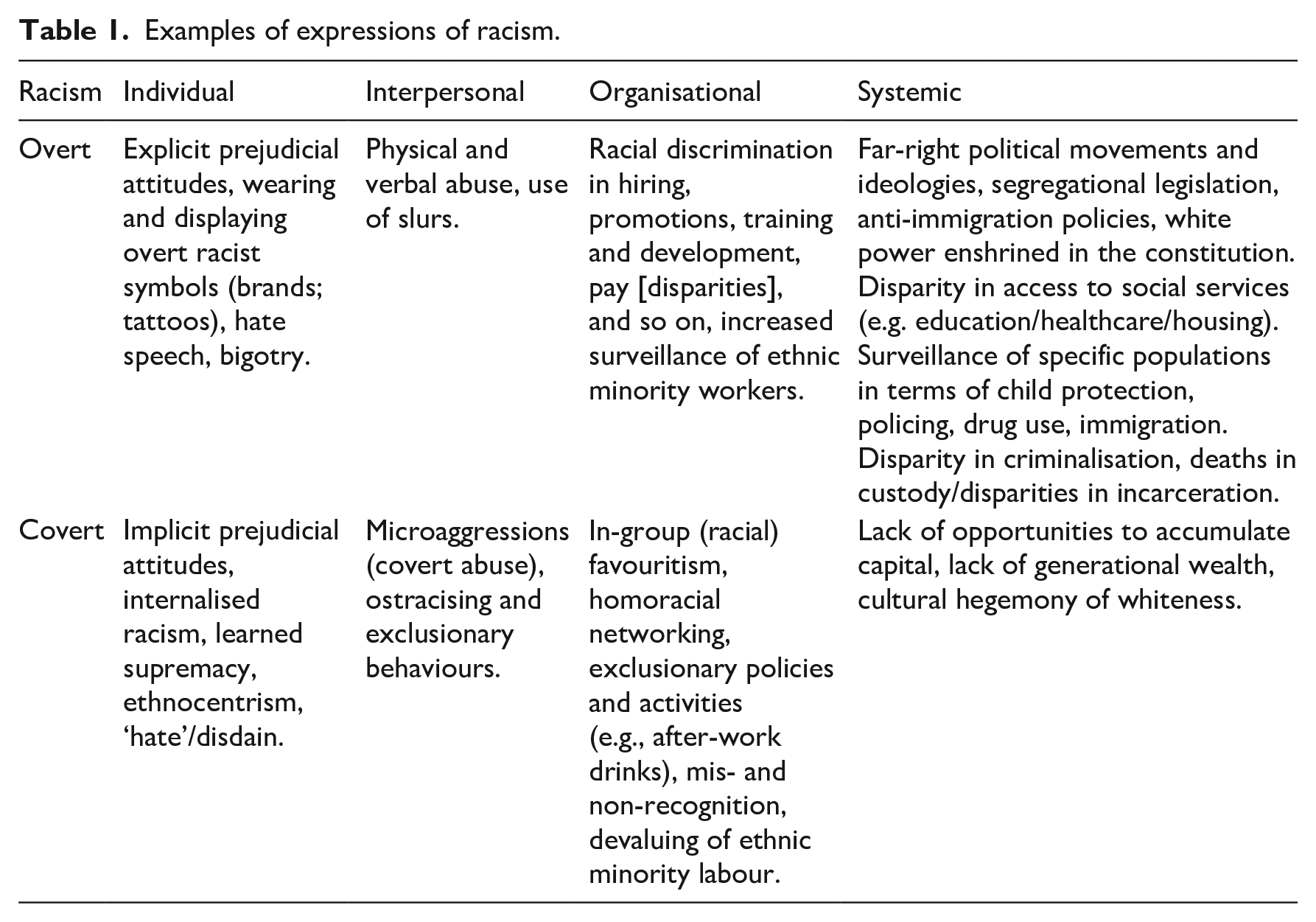
Racism is a multi-level system of oppression developed and used to preserve racial hierarchies. In Table 1, we map multi-levelled practices that maintain the racial hierarchy and uphold racism across its various expressions. We distinguish between expressions of racism that are more overt but also reveal the more covert expressions of racism that are often exercised with impunity. In addition to these two forms of racist expression, we recognise the ways racism can varyingly operate on the individual, interpersonal, organisational and systemic levels. Of course, distinctions are rarely clearcut in everyday life and our examples are not designed to be definitive. For instance, we recognise that what may seem hidden and covert for White people could seem more overt to Black, Indigenous and other ethnic minority people who recognise broader patterns in racist behaviour. We hope that the table shows racism extends beyond common understandings of it as purely overt and interpersonal, but can encompass other more wily, insidious forms across organisational and social life.
Examples of expressions of racism.
The impacts of this racist system of oppression also manifest at multiple levels. Racism has a pervasive and insidious impact on the general well-being of targeted groups and the communities they are part of (Ferdinand et al., 2015). Racism impacts individuals’ mental and physical health, sense of belonging, workplace retention and performance and capacity to thrive at work and in the broader community. In multicultural environments, racism impacts the whole community by instigating distrust and intergroup conflict. Importantly, racism can hinder the capacity of the whole community to cooperate and thrive (Dovidio et al., 2002), creating a range of missed opportunities.
4. What is anti-racism?
We wish to make plain what we see as the kind of organising principles we need to bring about real, meaningful change. Anti-racism encompasses the range of approaches used by individuals, groups and institutions to purportedly eliminate racism. We are able to recognise three distinct enough logics underpinning how anti-racism is exercised in and around organisations, with examples summarised in Table 2:
Anti-racism logics and examples of their multi-level manifestations.
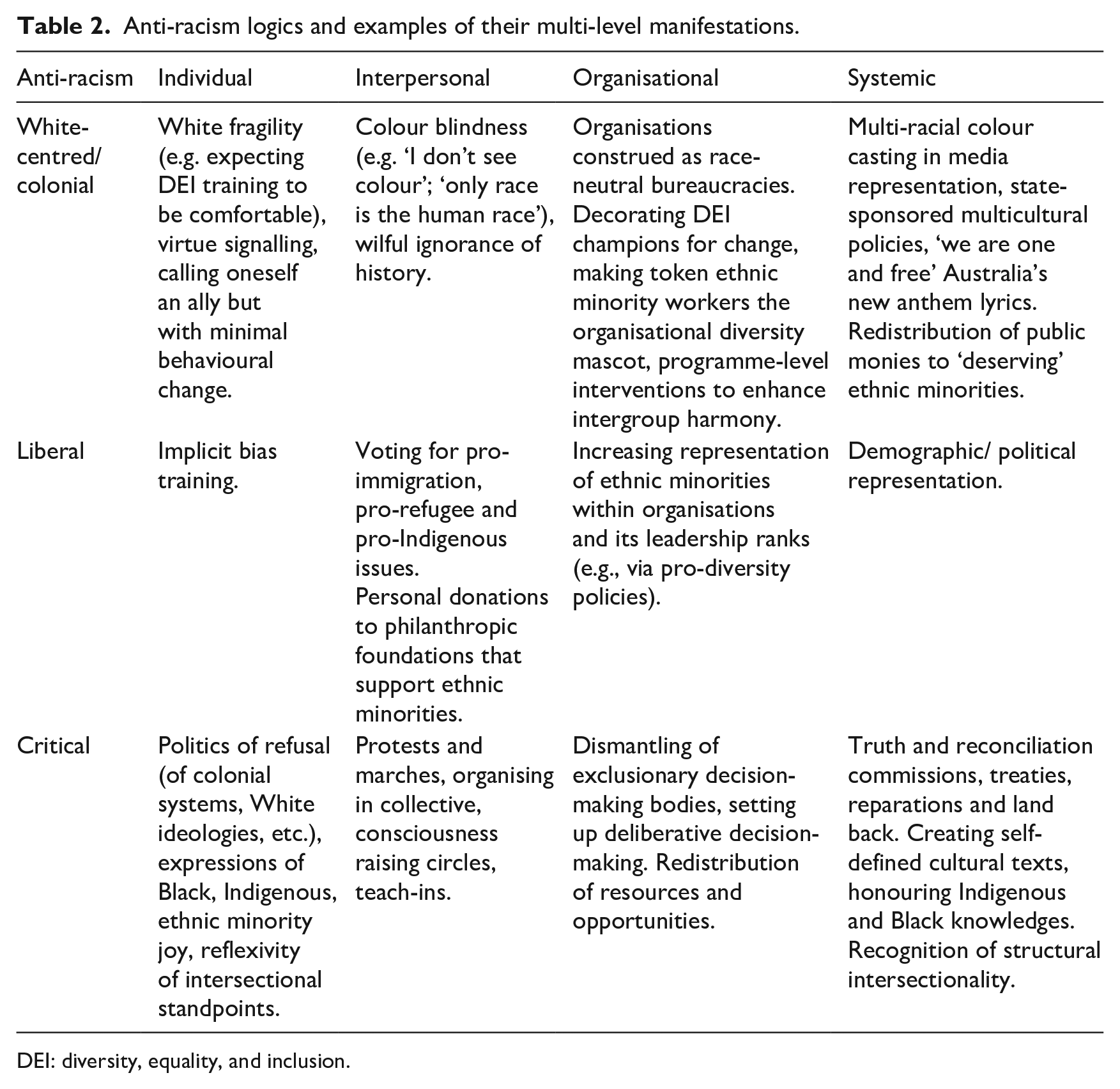
DEI: diversity, equality, and inclusion.
- The White-centre/Colonial approach considers racism to be the natural order of things in the world, created and sustained by biological differences between ethnic groups. From this perspective, anti-racism should be an endeavour put in place to simulate action and change, while actively or neglectfully allowing for the racist status quo to be preserved. These anti-racist efforts centre white values and interests as the measure of what should be done to address racism. Therefore, anti-racist actions can only be performed if they do not create discomfort among the dominant group, let alone losing any form of status or power. These efforts tend to focus on eradicating perceived differences between groups and enhancing feelings of harmony, both of these actions have the ultimate objective of preserving the racial hierarchy in place.
- The Liberal approach to anti-racism largely considers racism to be a problem of the mind. From this perspective, racism is a set of negative attitudes that some humans hold against other groups, either implicitly or explicitly. These attitudes are considered to be what drive discrimination against ethnic minorities in existing institutions. The liberal solutions to racism require training to understand our own prejudices, personal support for causes that are perceived to be fair towards ethnic minority groups (e.g. allyship), with solutions operating within the current social and organisational systems, such as using philanthropy to address disadvantages or increase the representation of demographic minorities within existing governing bodies, without necessarily changing the fundamental aspects of the institutional practices that have facilitated the creation of structural racism in the first place.
- The Critical anti-racism approach considers racism to be a problem of overt or covert distribution of resource-based, processual and symbolic power along racial lines within institutions (e.g. legal instruments, workplaces, universities, schools, churches, homes). This disparity in power is reinforced by formal and informal institutional practices set up to preserve the racist hierarchy (e.g. processes to obtain a loan, set up a business, get a job) that favour dominant groups and by a range of symbolic instruments (e.g. ideals of individual fairness, respect and civility that curtail anti-racist collective action). From this perspective, anti-racism requires an effort at the institutional level to redress racial injustices and reform or recreate institutions to redistribute power and to create a new set of symbolic tools that reinforce liberation and just relations between racial groups. At the organisational level, anti-racism will require redistribution of resources and opportunities and changes towards more deliberative decision-making practices. Interpersonally, this form of anti-racism requires collective organising and action, to find power in numbers and use collective decision-making to agree on the areas of focus and ways of achieving racial justice. At the individual level, this form of anti-racism requires a reflexive practice of our own position in the world, fundamentally refusing oppressive systems and, finally, rejecting shame and expressing joy in our own existence as racialised individuals.
While we are able to articulate these logics in a stylised and discrete way, in everyday life, they are operating in parallel and crossing over. This process of intertwined logics functioning at once offers an opportunity for individuals and collectives to reflect on their contributions to racism and anti-racism from different perspectives. However, because the contestation of ideas about racism and anti-racism is taking place in a racially asymmetric field in terms of power, it is no surprise that White-centre/colonial and Liberal logics are pervasive, making it harder to introduce a more critical approach to anti-racism in all spaces. Given this situation, we must ask ourselves, what can management and organisational scholars do to advance a critical approach to anti-racism?
5. Anti-racist management and organisational scholarship
A critical anti-racism approach in management and organisational scholarship requires focus on our three main tasks of research, education and leadership.
5.1. Research
Critical anti-racist research needs to engage in reflexivity about the topics we investigate, the methods we use and our position as investigators in this contested and difficult area (Cunliffe, 2003, 2004). We must ask ourselves: what kind of assumptions about human nature, institutions and the causes and consequences of racism do we hold, and how are these assumptions impacting the research questions we are pursuing and the methods we are using?
Anti-racist management and organisational research requires more and better studies about the multi-level nature of racism in and around organisations, how these layers of oppression are generated, and how they interact to create precarious and intractable conditions for ethnic minority groups and other negative effects for organisations and societies. Knowing the sources/drivers and operations of racist practices within organisations is an essential first step to devise ways to dismantle racism.
A critical analysis of anti-racism interventions is also required. We must identify the logics, intentions and implications behind anti-racism efforts in organisations. While we have decades of research about anti-racism interventions, the fact that racism continues to be a problem, and that its manifestations keep changing, means we need to continue to explore ways to eliminate racism. Here, again, we need to understand what assumptions we have about racism and organisations. We need to move from exclusively studying anti-racism interventions that conceptualise racism as a problem of attitudes and prejudice (Paluck and Green, 2008), into interventions that consider racism as a social problem embedded in institutional practices set out to preserve power disparities between ethnic groups (Ray, 2019). Importantly, we need to make sure we think about the design, implementation and evaluation of whole-of-organisation changes to organising practices, norms and symbols to be able to tackle the multi-level nature of this problem and the short- and long-term intended and unintended effects of the proposed changes (Leslie, 2019; Nishii et al., 2018).
The production of research about racism and anti-racism can also benefit from more theoretical, methodological and disciplinarity plurality (Sojo and Wheeler, 2023). While most of the organisation and management theorising is done by White men (Cunliffe, 2022; Muzanenhamo and Chowdhury, 2023), seemingly to explain and reify their world, theorising about racism requires centring the perspectives of Black and Brown scholars who are uniquely positioned to understand and explain the nature of the experience of racism. Of course, this research can only be made meaningful and impactful when it is done in cooperation with actors who have lived experience of racism and of attempts to engage in anti-racist practices in organisations. Finally, because racism operates at individual, interpersonal and institutional levels, this area of research might benefit from multidisciplinary scholars who are able to bring a more comprehensive but also cohesive perspective to what racism and anti-racism are. The kind of research endeavour described here will require long-term partnerships between academics across disciplines and the communities we are part of and are trying to understand, as opposed to applying the default extractive models of academic research (Gaudry, 2011).
Having Black and Brown academics ready to work on anti-racism is not going to be enough. In the process of creating management and organisational research that is anti-racist in its topics and approaches, we will need White academics to do their part (Muzanenhamo and Chowdhury, 2023). If you understand that racism is fundamentally unjust and detrimental to the sustainability of organisations, then join your Black and Brown peers in the goal of developing academic institutions that are not racist and that work actively in dismantling racism everywhere. Think about your own position of power as a White person in academia and how you can use it to create more and better opportunities for academics from all backgrounds. You can start by co-supervising non-White higher-degree-by-research students and opening up your networks and other resources to them.
Management and organisational studies research is imbued with epistemic injustice (Fricker, 2010; Liu, 2022; Muzanenhamo and Chowdhury, 2023). The lack of representation of Black and Brown scholars in academic institutions and journals, the over-representation of White scholars as editors and reviewers, and the construal of Black and Brown scholarship as activist, motivated, and therefore less objective and subpart outsiders are just some examples of how racism is institutionalised in mainstream management and organisational research. Editors and reviewers play a particularly important role as gatekeepers. Making calls for management research from the Global South seems to be the extent most journals are willing to go to remedy this injustice. However, we need them to give due consideration to the diverse range of innovative theories and approaches used by scholars outside the Global North, to explain situations that are rarely manifested in mainstream management and organisational studies journals. The fact is that most of ‘what we know’ in management and organisational research is about the ways of organising in a very specific set of contexts. There is enormous potential to enrich our theories if we look outside Global North contexts and if we allow a diverse range of scholars to develop, refine and promote new theories to capture and explain other ways of organising.
5.2. Education
While workplace diversity-related topics and entire subjects are now commonplace in management education, anti-racism remains conspicuously absent from discussions on how to educate the next generation of managers or management and organisational studies scholars. Anti-racist management education requires efforts to engage students in reflexive practices about racism in its full complexity (e.g. not just as a problem of negative attitudes). There is research, including the insights presented above and in this special issue, that can be used to guide these conversations. Importantly, we should be in a position to discuss the negative impacts of racism and approaches to eradicate it from institutions. Subjects about strategy and organisational change can benefit greatly from reflections about ways to transform organisations operations and symbols as ways to address structural racism. Our industry teaching in particular is fertile ground to introduce the very complex problems presented by racism in organisations as case studies for analysis.
Whether in industry or at universities, the discussion of racism and anti-racism can generate heated debate. Educators need to prepare themselves and their students for such conversations. Start by explaining to your class that it is ok to have conversations where different people might hold different opinions, as long as everybody is clear that people’s humanity and dignity are not up for debate and should be respected. While it is often talked about the need for people to ‘acknowledge their privilege’ (Jourdan, 2021; Ma et al., 2022), we think it is more important that students do not deny disparities in opportunities and power in society and understand why and how these disparities are not accidental but the product of mechanisms put in place to preserve racial hierarchies.
5.3. Leadership
The most powerful tool we each have as individuals is our capacity to model the behaviours we want to see in others and lead by example. Our students, colleagues, research partners and the community more broadly are able to see topics and groups we engage with, the realities we acknowledge or deny, and the methods we use to do our research. This presents an enormous opportunity to reshape academic research, education and service in a way that helps eradicate racism. Human dignity, equity, respect, liberation and justice should be at the centre of all academic endeavours. These are values that can help create spaces where racism is less likely to fester. In an increasingly polarised world, where culture wars are present everywhere, we must focus on the respect of basic human rights (e.g. the right to a life free from violence, the right to fair conditions at work), not as a way to be neutral about injustice, but as a prompt to act to remedy it.
Crucially, those in roles with structural power are in a better position to lead change within organisations. Putting in place initiatives to understand how standard processes within academic institutions (e.g. recruitment, selection, promotion, performance and grant assessment) that are construed as part of a neutral bureaucracy in fact end up disadvantaging people of colour is the minimum academic leaders need to do. We must engage in a more active or positive effort to create partnerships with the First Nations in the jurisdictions where universities are located, acknowledging we might be operating on land stolen from First Nations and engaging in programmatic activities to remedy that injustice, starting with providing real educational and employment and growth opportunities. Elevating the voices of First Nations and other groups of colour to leadership positions is an essential step towards furthering their self-determination, echoing ‘nothing about us without us’.
6. Final considerations
Management and organisational studies are organised, referenced and built on received knowledges that require our persistent examination as a core scholarly obligation. Standard approaches, both scholarly and practice-based, will not cut it if we stand up to the challenge racism provides us all. We need bold ideas and open minds to explore and develop new ways of organising and advance through discomfort towards anti-racist organising principles. We know that the disparities that structure our society and our knowledges are not accidental, that is the challenge we collectively rise to by working indefatigably, through strategy formulation, trial and error, towards root and branch reform.
To achieve this, we commend this group of original contributions that present multi-level analysis, intertwine disciplinary logics and bring forward new and multidisciplinary scholarly voices. Elias et al. (2023) activate anti-racism practices through learning by doing, demonstrating a central anti-racism organising principle of reflexivity in our practice as scholars and as professionals. Wright et al. (2023) and Khatibi et al. (2023) highlight the insufficiency of performative anti-racism and how these undemanding strategies avoid the critical exacting work that requires our attention. Trenerry et al. (2023) exemplify an anti-racism organising principle of the value of embodied lived experience arguing why diversity strategies are just the map for organising, the activation as always belongs firmly in the hands of individuals and leaders. Finally, Jones et al. (2023) demonstrate how racism has sunk its teeth into institutions, creating and replicating spaces and systems and processes that rub off on all that inhabit them causing so much harm. Leaving the last words to Jones et al. (2023):
Despite such, I am less inclined to accept that . . . universities can’t do better and live up to their commitments to First Peoples. I put forth a call to White allies to join me going forward, our First Peoples numbers are few, but we are strong. It is only collectively that we can shape a different future. (p. 13)
We hope to trigger much-needed uncomfortable conversation, research and action around anti-racism with this special issue.
