




Abstract
While interest in nonprofit-business collaboration (NBC) has grown rapidly in the past decades, literature has underexposed the peculiarities of nonprofit organizations (NPOs), compared to the ample attention on the perspective of the firm and the implications for society. In specific, we lack clarity on how NPOs can deliberately seek collaboration with the business sector to foster their organizational viability and economic interests, in addition to their traditional focus on delivering social value and meaningfulness. This active approach has become imperative given the growing uncertainty of government funding and budgetary constraints. However, the proactive involvement in NBC is complex and risky. In this study, we address this dilemma by investigating several NPOs that are active in NBC. Based on the analysis and findings, we developed an empirical-based framework that explains the essence of NPOs’ proactive engagement with the business sector. More specifically, we offer subtle theoretical and empirical investigations of various internal and external contingencies that explain the effectiveness of NPOs in establishing collaboration with firms for value creation. Moreover, we advance the current debate concerning the need to establish a clear distinction between value creation for society (conceived as the sum of benevolent benefits obtained from the collaboration) and for the partners. As such, we showed that the active-in-collaboration NPOs distinguish between different NBC values that include economic benefits (for survival), institutional development (for organizational effectiveness), and transformational for changing business practice (for the fulfillment of mission). Therefore, we shift the focus from the predominating perspectives of society and business to consider NPOs as an active component of this relationship. Together, these findings offer a robust nonprofit-centric foundation that is necessary for NBC practice and theory development.
Keywords
1. Introduction
Modern societies encounter socioeconomic problems that have become increasingly complex and exceed the capacity of a single sector (i.e. government, public, and nonprofit) to resolve independently (Al-Tabbaa et al., 2021; Bryson et al., 2006; Yaziji and Doh, 2009). Accordingly, the collaboration between sectors has grown in popularity. In particular, nonprofit-business collaboration (NBC) has become a prominent example, whereby a considerable amount of research investigates how NBC can address challenges in society and create public value (Coupet et al., 2020; Salignac et al., 2017). This includes studies that examine the motivations and boundary conditions that determine the effectiveness of NBC (e.g. Arenas et al., 2013; Bryson et al., 2006; Lin, 2012). At the same time, a different research stream has emerged, which focuses on how NBC can deliver organizational benefits to the involved actors (Mirońska and Zaborek, 2018). While firms can use NBC to drive their social performance and thus reinforce reputation and legitimacy (Holmes and Smart, 2009), nonprofit organizations (NPOs) can obtain tangible and intangible assets and resources from their participation in NBC (Berger et al., 2004).
Accordingly, the existing literature has highlighted the critical importance of considering both business and nonprofit perspectives for successful collaborative relationships (Baur and Schmitz, 2012; Mirońska and Zaborek, 2018). However, the research focusing on the perspective of NPOs remains underdeveloped (Al-Tabbaa et al., 2019; Bauer et al., 2022; Fu and Cooper, 2021; Lodsgård and Aagaard, 2017). Specifically, the literature lacks clarity on how NPOs can proactively engage in collaborations with the business sector to effectively capture value for their relational engagement (Arslan et al., 2021; Harris, 2012; Herlin, 2015). This is consistent with the study of Harris (2012) who contends that “we know little about why NPOs choose to embark on such relationships, what organizational challenges the relationships pose for NPOs and how the challenges are responded to” (p. 9).
Addressing this research gap is crucial for three reasons. First, NPOs need to explore new and non-traditional approaches to maintain their viability and continue pursuing their social mission (Besel et al., 2011; Weerawardena et al., 2010). Operating in a critical environment, NPOs face challenges in terms of economic viability and growth due to increased competition within the nonprofit sector (Eikenberry and Kluver, 2004), the expanding role of for-profit businesses in social service provision (Eikenberry and Kluver, 2004), uncertainty surrounding government funding (Bingham and Walters, 2013), and a decline in traditional philanthropic income sources (McAlexander and Koenig, 2012). These threats have encouraged the nonprofit sector to become more entrepreneurial by considering new approaches for diversifying income streams (Gras and Mendoza-Abarca, 2014; Osborne, 2012). Given the potential flow of resources from the business partner (Clarke and Fuller, 2011; Simo and Bies, 2007), seeking NBC can become one of these approaches. Second, businesses are actively seeking new ways to optimize their philanthropic practices (Austin, 2000; Selsky and Parker, 2005), including identifying the most suitable NPOs for collaboration to maximize their return on investment. Together, these justifications highlight the need for a comprehensive exploration of NPOs’ engagement strategies and their implications for value creation in collaborative endeavors. Finally, and from a more general perspective, by focusing on this, the NPOs’ side, we complement our understanding of the NBC process, as the effectiveness and stability of any collaboration across sectors demand creating collective value (i.e. for society), as well as addressing the individual interests of the involved partners (Austin and Seitanidi, 2012a; Bryson et al., 2006; Sofaer and Firminger, 2005). Such individual interests would create expectations regarding what the collaboration should yield. Accordingly, failing to achieve these expectations can result in perceptions of injustice (e.g. Austin, 2000; Rondinelli and London, 2003), undermining the chance of developing an effective long-term partnership (Bryson et al., 2006; Huxham and Vangen, 2005).
However, proactive involvement in NBC (i.e. when NPOs actively seek to collaborate with the business sector to derive organizational value) is complex and risky. The risk of detrimentally affecting NPOs’ value-based organizational culture (Lindenberg, 2001); stakeholder sensitivity and their diverse reactions to organizational pairing (Baur and Schmitz, 2012); and the difficulty of justifying collaboration cost due to the complexity of quantifying NBC long-term impact on society (Dahan et al., 2010) require comprehensive consideration through a structured approach (Austin, 2000). The aim of this article, therefore, is to explore how NPOs can proactively and safely establish and engage in deliberate collaboration activity. What value is created from this engagement? Such deliberate engagement can help NPOs to develop forward-thinking regarding NBC, changing their mindset from being reactive (waiting for marginal business donation) to proactive (embracing NBC as a mean that significantly fosters their organizational viability and development), while considering the protection of their image, value systems, and stakeholders.
To answer this question, we draw on a conceptual framework that proposes several factors to underpin the NBC strategy (Al-Tabbaa et al., 2014), to collect and analyze data from 26 UK-based active-in collaboration NPOs. The framework is based on Pettigrew’s work (Pettigrew, 1987; Pettigrew and Whipp, 1991), which asserts that the combined effect of three elements (context, content, and process) determines the realized shape of a strategy (Miller et al., 1988; Sminia and De Rond, 2012) and predicts its effectiveness (Ketchen et al., 1996).
Overall, the study provides several implications for theory and practice; first, by developing an empirical-based framework that explains the essence of NPOs’ proactive engagement with the business sector. More specifically, we offer subtle theoretical and empirical investigations of various critical aspects that are likely to explain the effectiveness of NPOs in establishing collaboration with firms for value creation. As such, we advance our understanding of the pre-collaboration stage (Austin and Seitanidi, 2012b), which is vital for collaboration alignment and success (Bryson et al., 2006). While the literature on the pre-collaboration stage focuses on problem-setting (Gray, 1989), preconditions of collaboration (Bryson et al., 2006), and partner selection (Rondinelli and London, 2003), we unpack the approach that NPOs deploy to secure collaboration opportunities that foster their organizational viability and economic interests, in addition to a focus on creating social value and increasing meaningfulness (Al-Tabbaa et al., 2022; Arslan et al., 2021). More specifically, our study offers a comprehensive framework that integrates the contextual, content, and process aspects of proactive engagement in NBC. This framework provides a deeper understanding of NPOs’ perspective in establishing collaborative activities with the business sector. The framework highlights the contextual factors that influence NPOs’ proactive engagement, including stakeholder pressure, nonprofit competition, and barriers to organizational change. These contextual aspects shape the “where” of NPOs’ proactive engagement by creating facilitators or barriers within the external and internal settings. Moreover, the framework identifies the content of NPOs’ proactive engagement, encompassing positioning approaches and differentiation between collaboration levels. This aspect addresses the strategic choices and directions NPOs need to consider in order to achieve their predetermined targets through collaboration with the business sector. In addition, the framework explores the process of proactive engagement, emphasizing the impact of individuals and groups on strategy development. It sheds light on how NPOs formulate and implement their adopted strategies, considering factors such as power imbalance, feedback channels (FCs), and transaction costs. Finally, the framework recognizes the value captured by NPOs through their proactive approach in collaboration with the business sector. This includes economic benefits for survival, institutional development for effectiveness, and transformational outcomes that contribute to changing business practices and fulfilling the NPOs’ mission. By integrating these themes within a comprehensive framework, our research contributes to a better understanding of NPOs’ perspective in proactive engagement with the business sector, providing insights into the “where,” “what,” and “how” of their collaborative efforts, and how these aspects can be connected with NBC value. Together, these findings advance and provide new insights to the extant literature on the NBC nature and underpinning dynamics (e.g. Austin, 2000; Austin and Seitanidi, 2012b; Berger et al., 2004)
Second, the developed framework can serve as a starting point for managers in the nonprofit sector when considering NBC as a strategic choice. As such, the framework recognizes the critical factors necessary for the development of an effective NBC strategy, taking into account the sustainability-related difficulties faced by NPOs (Chetkovich and Frumkin, 2003; Chew and Osborne, 2009). These difficulties have prompted NPOs to adopt new strategic and operational measures, including the diversification of funding streams (Besel et al., 2011) and the utilization of unconventional approaches within the nonprofit sector. By leveraging the developed framework, decision-makers can systematically predict and pre-empt problems and risks associated with NBC. This framework acts as a checklist, aiding in the strategic decision-making process by guiding power-holders within organizations in their course of action. The strength of the framework lies in its recognition of the critical factors that contribute to the success of any NBC strategy. It enables decision-makers to navigate the complexities of NBC, ensuring a more comprehensive approach and mitigating potential challenges.
Finally, the article adds to the current debate concerning the need to establish a clear distinction between value creation for society (conceived as the sum of benevolent benefits obtained from the collaboration) and for the partners (Cabral et al., 2019; Kivleniece and Quelin, 2012; York et al., 2013). The overarching objective of this debate is to reconcile the potentially contradictory self-interests of each partner and the overall NBC agenda (Utting and Zammit, 2009). Ignoring such issues is likely to complicate NBC design and implementation and, crucially, to generate tensions and opportunistic claims following the establishment of the relationship (Lax and Sebenius, 1987; Wood and Gray, 1991). Therefore, our focus on the NPOs’ perspective in NBC, where we developed a specific approach that embraces NPOs’ interests and concerns, offers a novel and complementary perspective to this debate. In other words, this article provides a more robust nonprofit-centric foundation that is necessary for NBC practice and theory development. Therefore, we shift the focus from the predominating perspectives of society and business to consider NPOs as an active component of this relationship.
2. NBC: a critical review
NBC can be defined as a discretionary agreement between an NPO and a business aiming to create value by addressing social and/or environmental issues by combining their resources and idiosyncratic knowledge (Austin, 2000; Yaziji and Doh, 2009). However, researchers have recently recognized that the typical normative view as to how value can be created in NBC (and cross-sector collaboration more generally) is not sufficient because it “bypasses the heterogeneity of individual interests and objectives . . . hence, needs to be enlarged with an instrumental perspective to accommodate a variety of self-interested value claims” (Kivleniece and Quelin, 2012: 276). Accordingly, calls have been made to distinguish between value creation for society and value attained by partners when studying these collaborations (Quélin et al., 2017).
For business, in recent years, there has been a shift in societal norms regarding NBC, with communities starting to accept self-interest motives alongside altruistic ones as legitimate drivers for businesses engaging in social collaboration (Porter and Kramer, 2011). This institutional transformation has prompted firms to reconsider their traditional philanthropic activities and find ways to extract economic value while benefiting society (McDonald and Young, 2012). This has created a research stream that focuses on the business perspective, which examines how NBC can help companies enhance their legitimacy, attract and retain staff, access market knowledge, and enhance innovation capacity (Austin and Seitanidi, 2012a; Yaziji, 2004). For example, this shift is reflected in empirical findings that highlight the significance of NBC as an element of corporate social responsibility (CSR) strategies (Jamali and Keshishian, 2009).
For NPOs, on the other hand, a few studies have examined NBC as an opportunity for NPOs to attain various benefits, including increased visibility and public awareness of social issues, access to financial resources, organizational learning and capability development, and a broader volunteer pool (Herlin, 2015). Arguably, Andreasen (1996) was the first to posit the notion of “finding a corporate partner,” focusing primarily on cause-related marketing and sponsorship. Since then, more insight emerged, yet without solid research streams. For example, some studies discussed how the nonprofit sector began to appreciate the advantages they hold (e.g. social legitimacy, credibility), which can be transferrable to business partners when collaborating (Herlin, 2015). In other words, NPOs started to regard NBC as a two-way win-win relationship rather than as a one-way model of business philanthropy or financial donation (Rumsey and White, 2009). Nevertheless, Schiller and Almog-Bar (2013) questioned the ability of NBC to deliver sufficient value to NPOs that can justify its considerable cost (Hudson, 2005: 101). This is mainly due to a potential set of issues such as power imbalance and cultural discrepancies between the two partners (Schiller and Almog-Bar, 2013), which typically require extended resources and time to be managed. Importantly, research on NPOs’ perspective has also focused on the potential downside of NBC. Herlin (2015) found that strategic alliances might bring real challenges to the legitimacy of NPOs as it can lead to the NPO becoming an appendage of the business and losing their special character and social value (Young, 2002). Moreover, evidence was found that NPOs that engage in NBC might face a decline in individuals’ willingness to support them because their contributions might be perceived as marginal (Bennett, 2012). Krishna (2011) reported the same risk, although it was caused by the altruistic driver. Specifically, individuals might refrain from supporting NPOs through cause-related marketing since they might consider this to be selfish behavior, in comparison to direct charitable giving.
This, in turn, indicates the need for careful and systematic consideration of proactive engagement because “[NBC] brings together actors from two different societal sectors . . . [where] these sectors present contesting institutional demands, since they are guided by different core logics [e.g. economic versus social rationale]” (Van Huijstee et al., 2011: 44). We aim to address this need by developing and validating a conceptual framework that explains the essence of NPOs’ proactive engagement and captures its enabling factors as discussed further.
3. Method
3.1. Research approach
We chose to investigate NBC strategy from the nonprofit sector perspective through a qualitative study. In general, this form of qualitative research is useful to gain in-depth understanding of decision-markers’ and senior staff’s experiences and perceptions regarding how strategy is enacted (Balogun et al., 2014; Sminia and De Rond, 2012; Wit and Meyer, 2010). In terms of theory advancement, this approach is particularly relevant to “generate, elaborate, or test management theories” (Bluhm et al., 2011: 1870). Through the use of a qualitative inquiry, findings are allowed to emerge naturally from the richness of the raw data (Lee, 1999), thus being powerful to develop theory in under-researched areas (Eisenhardt and Graebner, 2007; Miles and Huberman, 2008), as in this study: NBC from NPOs’ perspective.
3.2. Selection of NPOs and interviewees
NPOs that were actively engaged in NBC were targeted. To begin with, we narrowed our search to the Yorkshire region because of our “local” knowledge of the area. Using the England Charity Commission database, 414 NPOs were identified. To determine if these NPOs were “active,” their websites were examined for evidence of success stories about involvement in NBC or details of current business partners. Surprisingly, this screening process resulted in a potential sample of just 34 NPOs (we acknowledge though that not all NPOs might decide to publicize NBC activity via their website). Of these NPOs, only eight agreed to participate in the study. Therefore, we used a snowballing technique (Bryman and Bell, 2003) to increase the research sample: Informants from the eight cases were asked to recommend other NPOs that were active in collaboration but not included within our initial sample boundary. This technique was successful in securing the final sample of 26 NPOs, which were categorized according to their annual income (Foster and Meinhard, 2002), see Table 1. This categorization was necessary for comparison purposes; that is, dissimilar NPOs according to their income might have different field operations, organizational structures, access to resources, and profile (e.g. brand awareness), all of which might influence the NBC strategy (Stone et al., 1999). From this sample of NPOs, 38 individuals who were connected with NBC at a decision-making level agreed to be interviewed, see Table 1.
NPOs and interviewees.
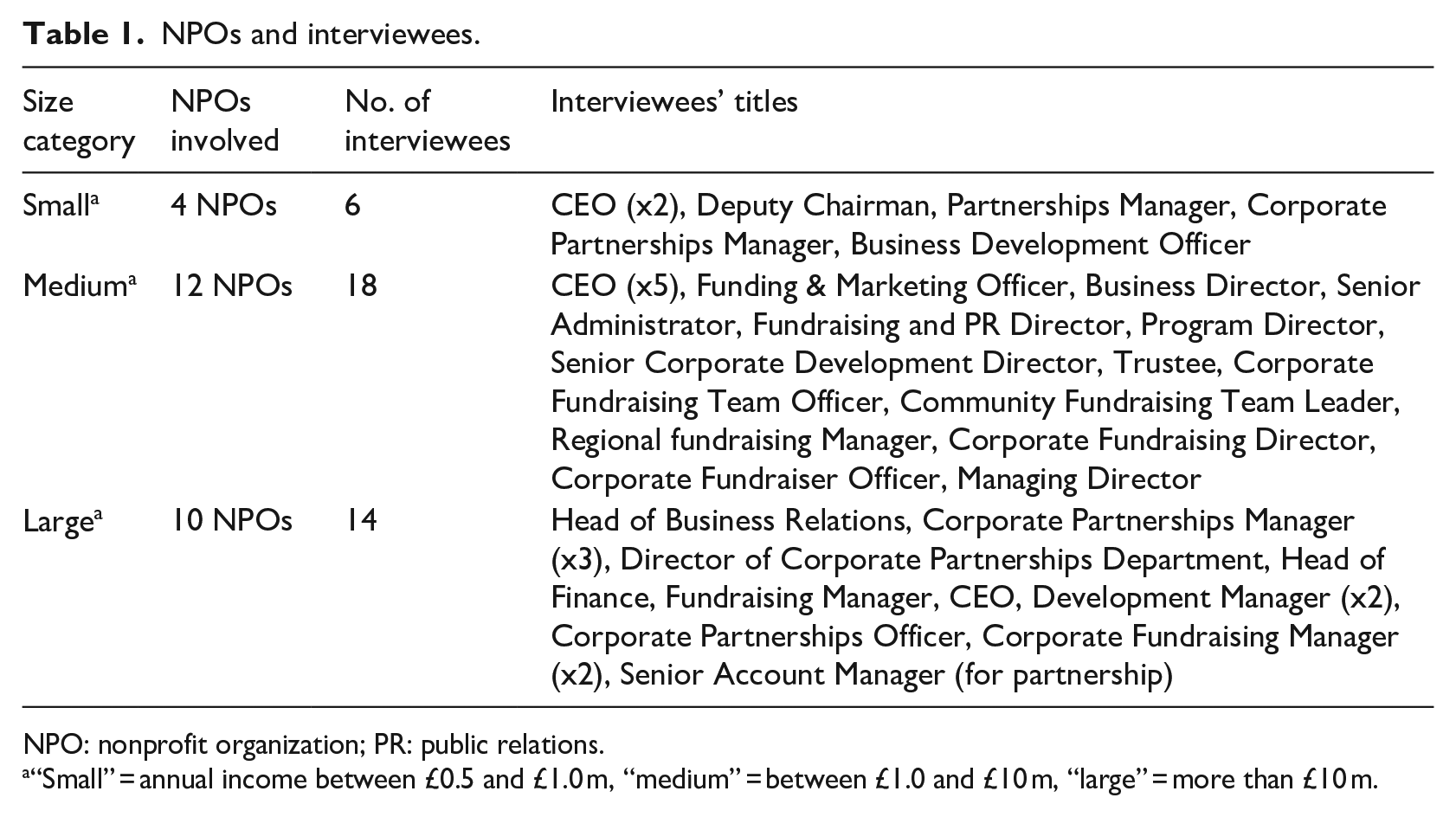
NPO: nonprofit organization; PR: public relations.
“Small” = annual income between £0.5 and £1.0 m, “medium” = between £1.0 and £10 m, “large” = more than £10 m.
3.3. Semi-structured interviews
All interviews were recorded and transcribed verbatim. The interviews on average took 55 minutes to complete. The opening questions focused on the informants’ background, including the responsibilities undertaken. Using the framework of Al-Tabbaa et al. (2014) as a guide, the next series of questions concerned the interviewees’ experience of NBC. Example questions are shown in Table 2. The questions were piloted to ensure their relevance and understandability (Prescott and Soeken, 1989), which involved two staff (personal contacts) from two NPOs that were not included in the main sample. Using NVIVO, transcribing started after the first interview. We added thoughts, ideas, and observations to the scripts using the annotation tool while transcribing.
Selected examples of interview questions.
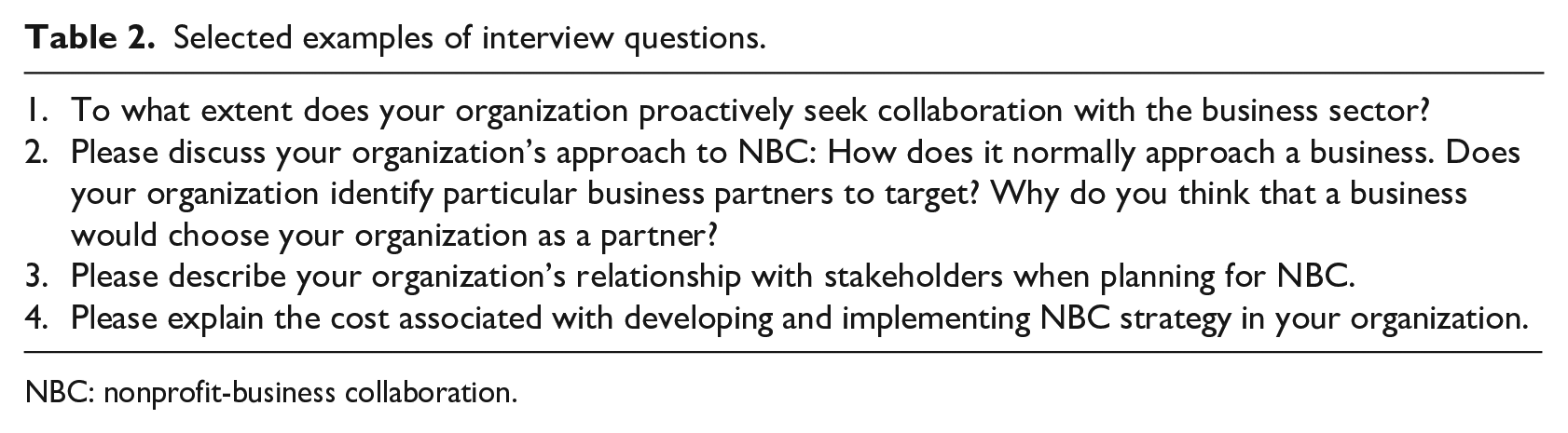
NBC: nonprofit-business collaboration.
3.4. Interview analysis
We analyzed the data using the principles of template analysis (King, 2012a). The advantage of this technique stems from its middle-ground position between two opposite approaches: inductive and deductive (King, 2012b: 426). In other words, this “abductive” logic allows the use of existing theoretical constructs to define prior codes to inform the initial categorization yet is sufficiently flexible to permit iterative adaptation of these codes and emergent themes (Lindebaum and Fielden, 2011). Moreover, and to organize our coding process and presentation, we followed the approach of Gioia et al. (2013) to structure our findings and identify the theoretical concepts and themes as they emerged from the analysis. Next, we discuss the steps (three steps) of analysis in detail.
First, using Nvivo 8, we employed the nine factors identified in Al-Tabbaa et al.’s (2014) theoretical model as a prior coding scheme (i.e. initial templates); see Table 3 for a description of these factors. All interview scripts were scrutinized to identify any information that was relevant to any of these initial codes. Such information included specific descriptions and critical incidents that supported or explained the codes. Therefore, the factors in Table 3 were used as a skeleton for the open coding process, where the factors were used as the first-order categories, see Table 4. Second, information that appeared to be related to any of the factors was grouped to form a series of “provisional” categories. Similarities and differences between these categories were identified and used to collapse the categories into a set of second-order themes, see Table 4. For example, within the “positioning approaches” factor, we identified different ways through which the NPOs position themselves in the market as competent partners for the business sector, which we clustered into four themes: value, collaboration contribution, role of trustees, and nonprofit co-opetition, as in Table 4 (we provide a description of all these themes in the findings section). Subsequently, each theme was compared across the size categories, seeking to establish a cross-case comparison (Yin, 2013), so that the impact of “size” on concepts and themes can be realized. Finally, and as the third step, these themes were distilled further into aggregated dimensions, by identifying relationships between them. This has resulted in several overarching dimensions of NPOs’ proactive engagement in collaboration. These include the “where” (the external and internal environments of the NPO that may facilitate or prohibit consideration of NBC); the “what” (the deliberate strategic choices and directions made by the NPOs to achieve their objectives from NBC); the “how” (addresses the impact of individuals and groups on how the collaboration strategy is developed, and how the adopted strategy will be formulated and implemented within an organization); and NBC value creation.
Prior coding scheme (initial templates): description of the theoretical factors. a
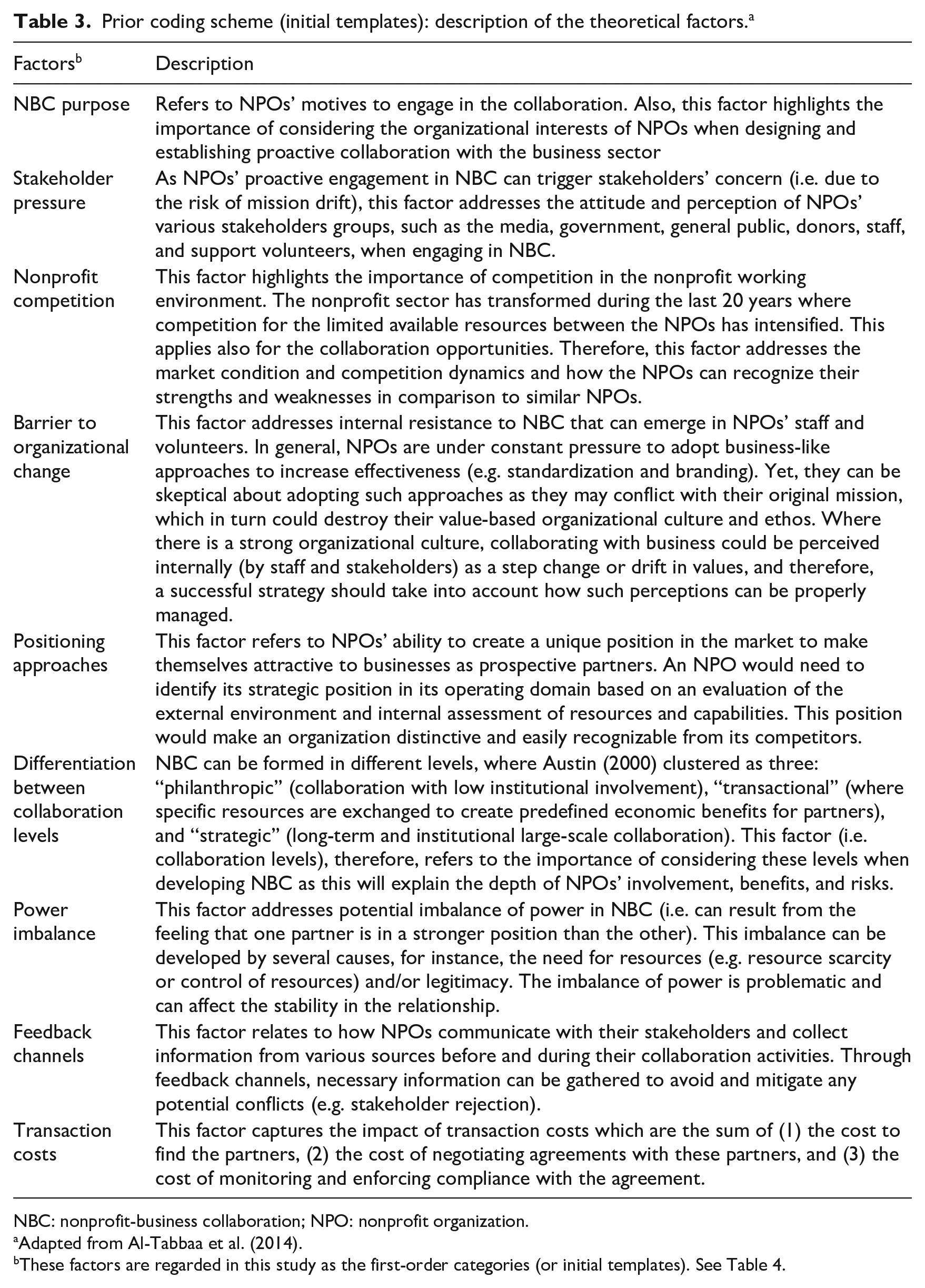
NBC: nonprofit-business collaboration; NPO: nonprofit organization.
Adapted from Al-Tabbaa et al. (2014).
These factors are regarded in this study as the first-order categories (or initial templates). See Table 4.
Data structure.
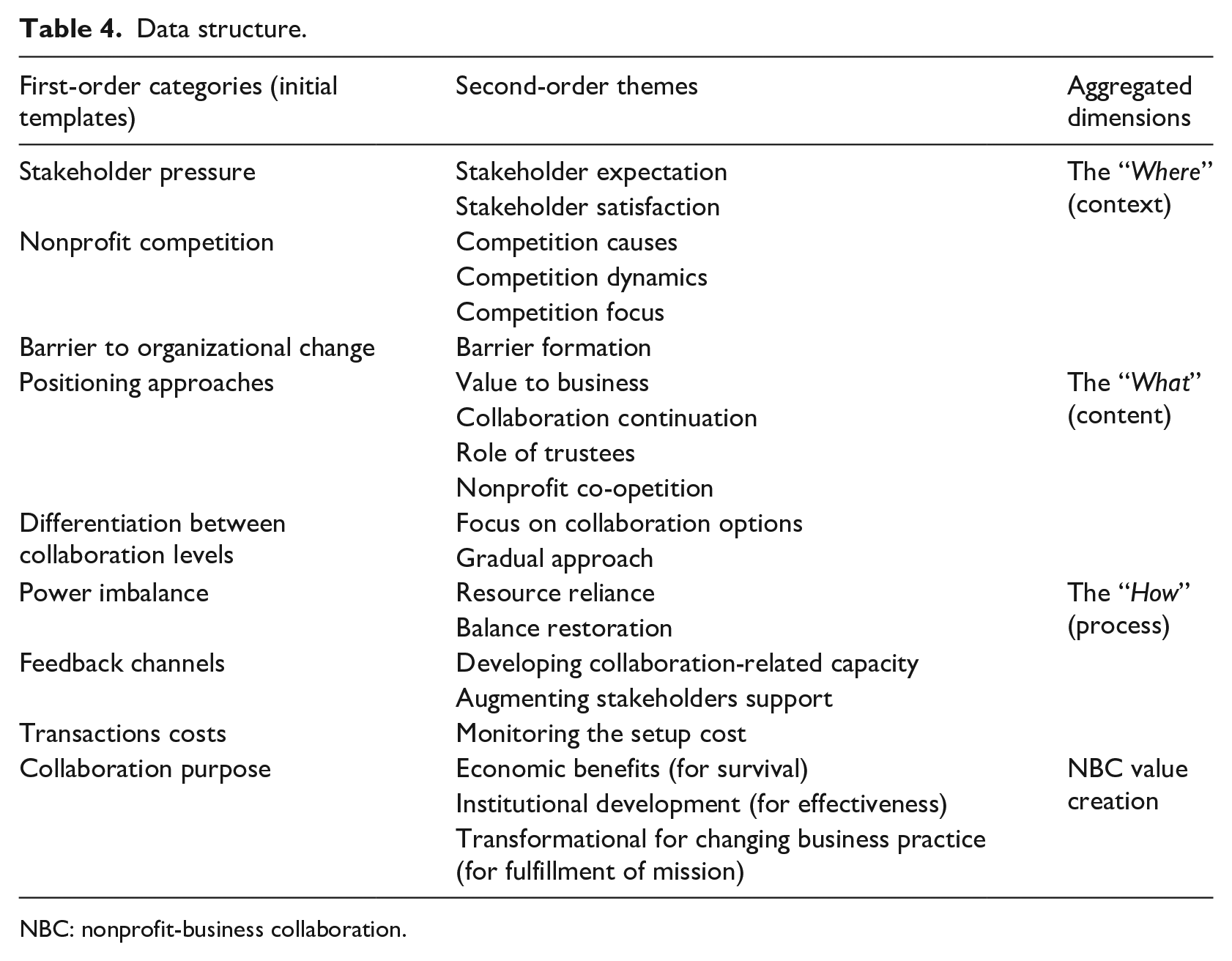
NBC: nonprofit-business collaboration.
Information on NBC was also collected from the NPOs’ websites and documents (e.g. annual reports, business plans, advice and consultancy reports). Via these means, NPOs were found to communicate NBC achievements to internal (e.g. staff, volunteers) and external (e.g. donors) stakeholders. Such information was used to verify (where possible) the interview-derived themes.
4. Results
In this section, we report the study findings focusing on the different themes as emerged from the analysis, explaining their role as the underpinning foundation for NPOs’ proactive collaboration with the business sector. We also present the analysis of the NBC values as informed by the respondents.
4.1. The context of proactive engagement: the “where”
The context reflects the external and internal settings that can facilitate or hinder NPOs’ proactive engagement in establishing collaboration activity with the business sector. From the analysis, three contextual aspects (and their underpinning themes) emerged as critical: stakeholder pressure; nonprofit competition; and barrier to organizational change.
4.1.1. Stakeholder pressure
Two themes emerged regarding stakeholder pressure. The first concerns stakeholder expectations. Interviewees (30/38) commented that their NPO was under close stakeholder scrutiny to deliver maximum value and to ensure no violation of its mission or values from engagement in NBC.
I think when we consider a partnership, it has to be right . . . we seriously consider if somebody is promoting something that we did not think was right or ethically right . . . [our stakeholder] want to know everything in black and white now. [Medium—Regional Fundraising Manager]
The second theme relates to stakeholder satisfaction with NBC. Interviewees (28/38) indicated that stakeholder satisfaction was typically fragile, being easily eroded should NBC be perceived as incompatible with any of their expectations. Comparing NPOs in terms of size (income), this theme was more evident for larger NPOs due to media attention.
Any charity can quickly become under the spotlight. They are praised when everything went right, but trashed when something is going wrong. So we are careful about who we are collaborating with . . . we are most conscious of our support base. [Medium—Senior Administrator]
4.1.2. Nonprofit competition
Three themes capture the comments that relate to this factor: competition causes, dynamics, and focus. In connection with the first theme, interviewees (30/38) indicated that competition within the nonprofit sector had become intense because of the reduction in government funding and greater business selectivity regarding their social investments (e.g. CSR programs).
There are less and less available funding pots and more and more charities applying for them. It is a very difficult time . . . I think also that big companies have their own charities where they focus their funds. Also, many of the available opportunities are designed to suit more national charities. [Medium—CEO]
The second theme, competition dynamics, concerns how the intensity of competition varies depending on the level of collaboration. Interviewees (21/38) indicated that competition is stronger in connection with “gifts in kind” or philanthropic contributions than, for instance, strategic partnerships. This variation is due to the availability of organizational resources (e.g. dedicated management staff) that not all NPOs possess: Strategic partnerships require greater resources to establish than philanthropic contributions.
There is no competition to collaborate [at an international level]. There are only a few large NGOs who operate in this space, so whilst there are 170,000 registered charities in the UK, there are only very few credible trusted global NGOs. [Large—Corporate Partnerships Director] [Competition] is definitely massive, particularly for the “charity of the year” partnerships that can potentially raise a lot of money with the major retailers and banks. That’s every charity’s dream: to be selected. [Large—CEO]
The third theme, competition focus, relates to how NPOs define their competitors. Interviewees (17/38) mentioned that, naturally, their NPO was in direct competition with others of similar capabilities and operational scope.
4.1.3. Barrier to organizational change
A single theme emerged from the comments that relate to this factor: barrier formation. Interviewees (8/38) explained that resistance to NBC often occurs when staff holds a prejudice that prevents the adoption of a proactive mindset toward NBC. Comments indicate that this resistance has two principal causes. The first concerns the belief that a proactive approach conflicts with the traditional passive approach to funding, such as stable income from a government department.
There is a culture within our charity that would resist that [NBC] and make us reluctant to engage in such things. There are many concerns, which—I think—are properly well-founded within the charity. I think one of the reasons why we are so slow to change is that some people are less enthusiastic about these sources of relationships and resist change . . . It is new; it is not how we operated before. [Large—Development Manager]
The second cause relates to an NPO’s mission. Interviewees (3/38) commented that some staff perceived their NPO’s mission as unattractive to businesses, thereby undermining the drive to engage in NBC.
[A reason for resistance] is the assumption that our mission [helping ex-offenders and homeless] will never attract the kind of levels of sympathy that charities dealing with animals or children receive. . .but we are going to drop our old prejudice. [Large—CEO]
Given the frequency of comments it can be argued that, for the active-in-collaboration NPOs in the present study, cultural issues regarding NBC were not widespread (i.e. “barrier to organizational change” factor is less important than other factors for NBC strategy development). One plausible interpretation is that these NPOs had recognized the current challenges in their external environment and thus adapted their established norms and beliefs to accept NBC, for example: We have already thought seriously about the private sector . . . it made us think more about how we align ourselves with that sector. Over the last 12 months, we have changed our focus quite significantly. We have used the European framework for quality management to do that . . . We have certainly looked at the possibility of relying less and less on grants and the fact that we have to work more with corporates in order for this charity to survive. [Medium—Managing Director]
4.2. The content of proactive engagement; the “what”
In general, the content of strategy addresses “what” strategy to follow (Jemison, 1981). Therefore, it defines the deliberate strategic choices and directions that the NPOs need to take to achieve predetermined targets from their collaboration. When analyzing the data, we identified two fundamental aspects that constitute the content of NPOs’ proactive engagement in NBC: positioning approaches and differentiating between collaboration levels.
4.2.1. Positioning approaches
Four themes were identified in relation to how NPOs build their strategic position: value, collaboration continuation (CC), role of trustees, and nonprofit co-opetition. The first theme concerns the attractiveness of an NPO based on what it could potentially “offer” to a prospective business partner. Two types of value were identified: social impact and economic impact.
Interviewees (33/38) indicated that their appeal to prospective businesses relates to their NPO’s capacity to create value to society. In other words, businesses are attracted to such NPOs because of their specific expertise and track record in realizing social/environmental change.
We provide education and accommodation, and medical support for extremely vulnerable people who have complex disabilities with associated learning difficulties . . . We think that there is no other organization in the country that offers what we offer. [Large-Head of Finance]
Concerning economic impact, interviewees (28/38) explained that their NPO’s ability to generate financial returns is an important factor in attracting a business partner. They mentioned that this impact typically concerns their NPO’s role in achieving CSR objectives, thereby potentially enhancing a business’s customer loyalty, reducing staff turnover, and/or improving its brand.
We have a big brand name in the UK, so when we ring people up to talk with them about collaboration they usually open the doors and talk to us . . . Sometimes they just come to us because we have a strong brand. [Large—Head of Business Relations]
According to interviewee comments, small NPOs appear to rely more on social impact than economic impact because of their limited ability to generate the latter (e.g. small NPOs are typically locally based). Large NPOs, by contrast, seem primarily dependent on their economic impact to attract businesses.
The second theme relates to CC. In addition to targeting new partners, interviewees (24/38) stressed the importance of extending current collaborations as a part of their strategy.
[Extending an existing collaboration is] very much a priority for us because it is much more cost-effective to develop and expand on the partnerships that we have and, in a way, easier than going out and trying to secure new business, so that is a really important part of what we do. [Large—Corporate Partnerships Officer]
To enable CC, interviewees (22/38) emphasized the importance of managing the collaboration professionally to avoid conflict (e.g. allocating resources and setting realistic objectives).
We have a very strong account management team . . . [partners] get a dedicated account manager . . . We work with them to make sure that we deliver the partnership as best as possible . . . We are going above and beyond wherever possible to make sure that companies stay after the official partnership comes to an end. [Large—Business Development Manager]
Furthermore, interviewees (20/38) mentioned the role of trust in extending a collaboration: [NBC] starts very small and then we work on that partnership over a considerable amount of time. It is all about building trust and whether they are investing their money and resources into a trustworthy charity. [Medium—Fundraising and PR Director]
As our third theme, the analysis also showed that the trustees have an important role in strengthening the position of the NPOs. As such, interviewees (26/38) commented that their NPO’s trustees (typically retired or senior businessmen) played a pivotal role in strengthening their position (in front of the business sector) and facilitating the implementation of their proactive strategy.
[The trustees] can come along to a networking event to be seen and add weight to the event. They are good in supporting us . . . and can introduce us to other people and businesses. They are active in the corporate market; they always provide advice to us. [Medium—Regional fundraising Manager]
Finally, the analysis showed that some of the NPOs (interviewees 14/38), mainly the smaller NPOs, have used sought to reduce the intensity of competition by cooperating with other NPOs (rather than competing) when approaching a business.
We sometimes work with some similar charities to develop a group or a consortium and then we approach a company, which puts us in a better position and is much more effective than competing. [Small—Partnerships Manager]
Interviewees (11/38) mentioned that through co-opetition, NPOs could share ideas and best practices. Moreover, they commented that by combining resources and competencies (e.g. staff, networks, public support base, and geographical presence), the group would become more attractive to prospective business partners (e.g. greater social impact) than any individual NPO.
We work with other charities . . . two are stronger than one. Also, I think this will be more acceptable to funders as it is more sustainable because three [organizations] of people are working together and not against each other. [Medium—CEO]
However, interviewees (10/38) commented that the decision to work with other NPOs should be carefully evaluated. NPOs should consider their brand, which could be weakened through co-opetition, and their share of the return from NBC, which might be less than the investment effort.
“There is a positive side in [co-opetition] . . . but at the same time it’s important to think . . . whether you are spreading yourself too thinly . . . also it’s really important to think about the [return] . . . because if you do collaborate with other charities then that does impact on the amount of money that you’ll be raising from the activity. [Large—Head of Business Relations]
4.2.2. Differentiating between collaboration levels
For the second content theme, differentiating between collaboration levels, the analysis revealed that almost all the interviewees (34/38) had a specific level of collaboration in mind as part of their proactive engagement. In addition, all participating NPOs had experience with more than one level of collaboration, from philanthropic to transactional and strategic, with none having been dominant in the interview sample. Importantly, almost all interviewees (especially from small- and medium-size categories) emphasized a strategy of not targeting prospective business partners by offering long-term collaboration (e.g. strategic alliances) from the outset, but rather following a gradual approach. This was seen as important to build trust and facilitate their penetration of the business sector boundaries by convincing the partner of their capacity to deliver value to society and to firms.
Initially, when you are working together, you do not necessarily know the ins and outs of each other . . . You need to really understand and get under the skin in order to come up with the right kind of [collaboration] ideas and mechanics. [Describing a collaboration example] A lot of the first year is about getting that infrastructure in place, understanding each other’s business, understanding how you can best work together, getting charity champions to help with the activities that you are doing and that takes time to do, but once you have that all in place, you have a very strong foundation to build on. [Large—CPM]
Concurrently, it was clear that the NPOs have specific targets in their NBC strategy, even while recognizing the gradual nature and being in general open to investigating and assessing the feasibility of any level of collaboration offered. Around half of the interviewees were keen to develop high-level partnerships as they perceived this to be the best option due to the long-term relationship that would enable them to plan better for the future and allow interactions between the two partners to take place at various organizational levels. This level is normally expected to result in creating value that could exceed the agreed benefits of the collaboration agreement (mainly by discovering new ways that the partners can work jointly in a more effective way).
Regarding the influence of size, all informants in the sample appeared to appreciate the different values and consequences of each of the collaboration levels. Nonetheless, findings suggest that some NPOs from the small- and medium-size categories prefer the first level, that is, philanthropic NBC—while still very difficult to get these days—as it provides relatively simple and less time-consuming relationships. By contrast, large NPOs strategically target the highest level of collaboration as they expect the larger involvement between the partners to deliver a more sustainable impact.
4.3. The process of proactive engagement; the “how”
In general, much of the strategy literature on process addresses the impact of individuals and groups on how strategy is developed (Ketchen et al., 1996). It explains how the adopted strategy will be formulated and implemented within an organization and describes activities that support strategic choice and decision-making. As such, we identified three process-related aspects for NPOs’ proactive engagement: power imbalance, FCs, transaction costs.
4.3.1. Power imbalance
Two themes were identified in relation to this factor: resource reliance and balance restoration. Regarding the first theme, interviewees (35/38) commented that power reflects their NPO’s ability to reject or amend a collaboration agreement. They indicated, understandably, that such power depends on the extent to which their NPO is reliant on the business partner: greater reliance, less power.
If you are desperate as a charity you go along with things sometimes just to get what you want to get. You may allow them to do what they want a little bit because there is a need for that [Medium—CEO]. We have never been in a position where somebody dictates what we do. We are not heavily dependent on fundraising [e.g., income from the business sector] [Large—Head of Finance]
In regard to the second theme, balance restoration, interviewees (24/38) explained that power balance could be restored and maintained when both parties perceive the relationship as mutualistic. They mentioned that this collaborative state might arise should the realized “social power” of an NPO (e.g. social experience, legitimacy) lessen the “economic power” of a business (i.e. transfer of resources).
They are giving us funding and their expertise and their time, but in return, we are giving them our expertise and we are giving them great PR. We are giving them staff engagement opportunities, team building, all those sorts of things, and they are getting that halo effect of being associated with our charity . . . We are also really good at our jobs, and they are incredibly lucky to work with us. [Large—Corporate Fundraising Manager]
4.3.2. Feedback channels
FCs refer to the system of sending and receiving information between an NPO and its stakeholders. Two main themes were identified: developing capacity and augmenting support. In regard to the first theme, interviewees (26/38) indicated that their NPO deliberately used FCs to develop their capacity in designing future NBCs.
We always measure the [collaboration] impact and reflect on it. Much more important is simply that this is a continuing process of developing our strategy and our plans . . . So we do have a structure which entirely recognizes fundraiser deals with companies and programs where people deal with companies . . . and we have a coordinating group that reviews our work and, therefore, they can develop our planning and our strategizing. [Large—Head of Business Relations]
The second theme, augmenting support, concerns the use of FCs to generate stakeholder support for NBC. Interviewees (22/38) mentioned that FCs were used to update stakeholders about how existing collaborations were progressing and delivering value.
If we have new activities, we first contact all our staff and volunteers telling them about the new event coming up . . . we try to generate the interest of all our staff in that new thing, so people see the collaboration as an important thing for the charity and themselves. [Medium—Funding & Marketing Officer]
4.3.3. Transaction costs
A single theme emerged under this factor: setup costs. Interviewees (26/38) commented that the process of finding business collaborators was expensive due to (1) market research to improve understanding of a business’s CSR agenda and commercial activities to facilitate the design of customized collaboration packages; (2) screening to identify appropriate businesses; and (3) building general links with the business sector (e.g. presentations, organizing networking events, etc.).
Finding an appropriate partner costs a lot . . . we look at their mission and their core values. If one of their core values is education, well then, let’s look at linking up together on an education project . . .. If they are a bank and they talk about financial literacy, well then, potentially a micro-finance project might be of interest to them. So it is a kind of looking through the DNA of the company. [Large—Corporate Fundraising Manager]
Irrespective of NPO size, interviewees naturally emphasized the importance of monitoring such costs: One of the things [to consider] is how much time you spend with company A when company B might be a better prospect. In a busy day, we need to prioritize our activities and effort to create the maximum value from it. [Small—CEO] We are looking to minimize costs and using resources as effectively as possible . . . we have a cost to income ratio . . . so we have a benchmark to evaluate . . . we have to self-check ourselves and make sure that we’re not over-servicing . . . we are investing our time and focus where there is more potential. [Large—Corporate Fundraising Manager]
Importantly, interviewees (17/38) commented that setup costs could prevent engagement in NBC: One of the things that we were planning to have, but was suspended due to the cuts, was somebody dedicated to public relations and marketing . . . It is an irony that we are saying we want to expand this area and to have more business links, but actually we cannot manage the resources to develop that at the present. [Large—CEO]
4.4. NBC value
The analysis also showed that the NPOs were able to capture different forms of value as a result of their proactive approach. In specific, three themes were identified: economic benefits (for survival), institutional development (for effectiveness), and transformational for changing business practice (for the fulfillment of mission). The economic theme concerns the tangible and intangible resources, and interviewees (35 out of 38) commented that the acquisition of such resources was the main reason for NBC engagement. Underlying these comments was a recognition that economic and political changes (e.g. the decline in voluntary donations, review of public spending policies) were a threat to organizational sustainability.
When charities start losing contracts, many of them become interested in what we are doing [i.e. collaborating with the business sector]. I think charities are going back to the old days when they were independent of contracts and they had to fundraise . . .. I think we are lucky as we were able to develop these links already, whereas some charities are now beginning to say “we should build up these links with the corporate sector.” [Medium—Senior Administrator]
The institutional theme relates to organizational development. Interviewees (30/38) explained that NBC was instrumental in improving the efficiency and effectiveness of their organizations as they were able to learn business-related skills such as marketing and cost-cutting techniques.
We use experts from the industry to help us in developing our work. They helped us to develop our plan in information management . . . we had a relationship with [a bank] . . . they helped us in producing our annual report and some marketing activities, IT support and training, data protection which was important for us in how we give our help. [Small—Corporate Partnerships Manager]
Finally, the data reveal that some NPOs (21/38) were able to utilize their collaboration to deliver deeper positive change to society, which can be described as transformational. These NPOs have moved their strategic thinking beyond the economic (tangible benefits) and institutional (intangible benefits) values, to reach a status in which they can engage businesses with their mission. NPOs with this vision believe in their ability to achieve large-scale impact on society (i.e. macro impact) by influencing business mission and attitude on one hand and reforming CSR agendas by helping the business sector to better understand its social responsibility on the other.
We think influencing businesses and working with them can have very substantial development effects . . .. For example, we have the [name of an environmental initiative] which is absolutely not about companies donating to us . . . it is to generally improve the transparency of companies’ impact on developing countries [and] to assist in changing activities of a particular company involved. [Large—Head of Business Relations]
5. Discussion and implications
This study aimed to investigate NPOs’ proactive engagement in NBC, a topic of inquiry that has been widely overlooked in the NBC literature (Al-Tabbaa et al., 2021; Spitz et al., 2021). In specific, we sought to unpack how NPOs deliberately establish and engage in collaboration activity with firms and what forms of value are delivered. Drawing on our analysis and findings, this study makes several theoretical and practical implications.
5.1. Theoretical contributions
Overall, the study offers two key contributions to theory. First, we contributed to the NBC literature by developing an empirical-based framework (that comprises several emerging themes and sub-themes) that provides a detailed account of the proactive engagement logic in NBC as illustrated in Figure 1. By looking at the various themes (and their interplay) that emerged from the analysis, we contend that the NPOs in our study have become proactive (i.e. enact and take deliberate actions) regarding their relationship with the business sector (as captured in Figure 1). This finding challenges the view that NPOs are more reactive actors in such relationships (Harris, 2012; Schiller and Almog-Bar, 2013), sometimes even merely in a role as “sub-contractor” for corporate social investment (Dahan et al., 2010; Porter and Kramer, 2002). Fundamentally, this proactive mindset reflects a strategy for NBC, the features of which were evident in the identified themes. Our argument is supported by the details revealed about the necessity to consider the inner and outer contexts (Pettigrew, 1987) in terms of stakeholders and competitors, the decisions NPOs need to make in advance based on the appraisal of their capabilities (e.g. which collaboration level to target, whether or not to engage in co-opetition), and the mechanisms which NPOs used to safely and effectively implement their collaboration plans (e.g. restoration of power, capacity-building). In principle, the proactive thinking toward NBC is typically driven by a range of macro conditions that drive the NPOs to consider systematically new approaches for creating value. Moreover, and drawing on the findings, we argue that NPOs’ proactive mindset regarding NBC comprises planned decisions (i.e. choices to be made, e.g. how to position themselves) and emerged actions (i.e. manage stakeholders), which indicates that these NPOs have developed a proactive engagement in NBC as a “realized strategy” for NBC. Adopting such approach would deliver a range of organization-specific value (i.e. economic and institutional) and society-centric (i.e. transformational) values as depicted in Figure 1.
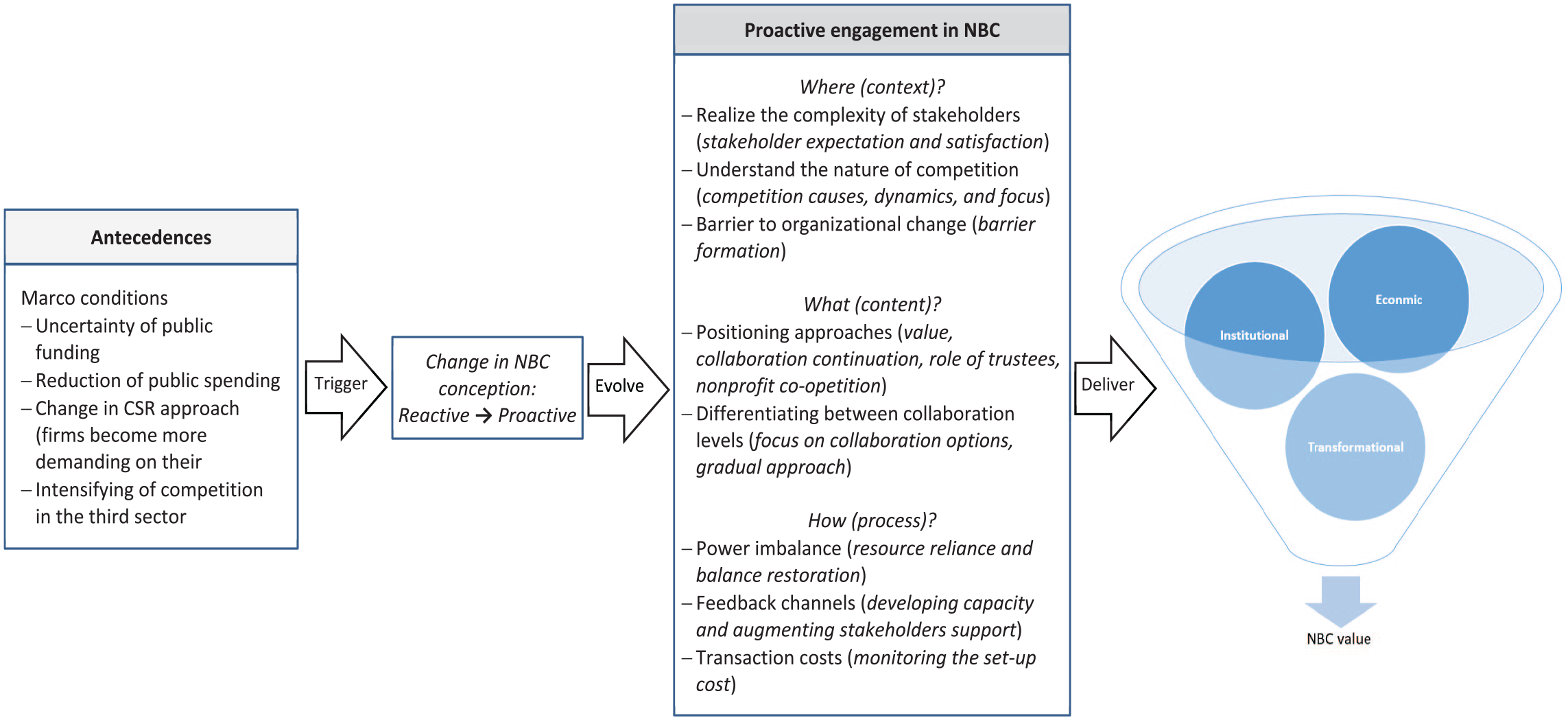
An empirical-based framework for nonprofits’ proactive engagement in NBC.
Interestingly, the findings also showed relatively low support for the “barrier to organizational change” factor; only 8 out of 38 interviewees highlighted this issue. We interpret this result as NPOs’ staff have recognized the challenges in their external environment and thus became more willing to adapt. The literature provides some support for this interpretation. Traditionally, NPOs have held negative views regarding the values, norms, and approaches embedded in the business sector. While NPOs are perceived as socially driven, participative, and co-operative, businesses are typically described as profit-driven, hierarchical, and competitive (Berger et al., 2004; Parker and Selsky, 2004). However, most NPOs are aware that their main income sources are deteriorating (Chew and Osborne, 2009; Weerawardena et al., 2010). Therefore, this situation has affected NPO’s assumptions and views (Chew and Osborne, 2009) and missions (Barczak et al., 2006) that have driven them to consider untraditional approaches and working models borrowed from the business domain to survive (Osborne, 2012). Accordingly, the “barrier to organizational change” became less important because the NPOs had already faced and successfully conquered any traditional/culture-related barriers that can cause internal resistance to adopt a strategy for NBC.
Moreover, the analysis revealed two important issues. The first concerns the role of trustees. The findings suggest that trustees have two key functions in relation to the NBC strategy: building links with potential business partners and safeguarding the NPO’s mission. This finding is partially consistent with the literature, which refers to the trustees in the nonprofit context as responsible, in addition to the managerial staff, for monitoring organizational performance (Chadwick-Coule, 2011). They also play a key role in establishing and sustaining the linkages with different funding streams (Besel et al., 2011). This was supported in our data as they helped in strengthening the position of their NPOs. In this regard, Handy (1995: 293) claimed that the NPOs would typically “invite people with appropriate attributes such as reputation and wealth to endorse the organization [i.e. the NPOs] by lending their names to it.” Accordingly, these trustees can be influential in bridging the gap between the NPO and the potential business partners by employing their reputation and status in building trust between the two parties, which is essential when embarking on any NBC (Milne et al., 1996).
On the other hand, the effect of nonprofit co-petition was highlighted by many interviewees. In general, the term co-opetition describes a situation where a set of rivals has recognized a chance to achieve superior, long-term performance by cooperating rather than competing (Gnyawali et al., 2006). Guo and Acar (2005) suggest the typical cooperation between NPOs (in general but not for NBC) can take either the shape of informal (e.g. information sharing and client referrals) or formal collaboration (e.g. joint program, joint venture, and merger). Interestingly, the authors reported that cooperation between NPOs is more common among large organizations (in terms of annual budget), typically because of the scale of their resource and capabilities to be shared together (Foster and Meinhard, 2002). In addition, these large NPOs are less likely to lose their autonomy when formally cooperating as they have established organizational bodies and reputation. To some extent, this contradicts the findings revealed in our study where the small- and medium-sized NPOs were more inclined to cooperate. One possible reconciliation for this contradiction might be made using the form of cooperation (i.e. formal vs informal). Formal cooperation is prevalent in large-size NPOs (Guo and Acar, 2005), where this study found that small- and medium-sized NPOs are more interested in informal forms of cooperation that include sharing of knowledge and experience and also serve to increase their visibility and stakeholder base through, for example, collective campaigns. In addition, the small and medium NPOs might have this preference since there is less chance to lose their autonomy and organizational identity due to the informal type of cooperation. Our previous interpretation is supported by Arya and Lin (2007) who found that the status difference, in terms of the organization’s reputation and legitimacy (Li and Berta, 2002), between the NPOs would typically result in a negative outcome when these NPOs cooperate.
Finally, by reflecting upon the overall findings, it can be realized that the issue of stakeholder management is a central issue that cuts across the NBC phenomenon. By connecting the findings reported under the themes (stakeholder pressure, barrier to organizational change, differentiation between collaboration levels, power imbalance, FCs, and transaction costs), a better understanding of this issue can be reached. As a starting point, NPOs need to proactively identify their stakeholders and understand their concerns (Pajunen, 2006). This involves conducting stakeholder analyses to identify key related internal/external individuals, groups, or organizations. By sensing their concerns and priorities early on, NPOs can better address their needs and preferences regarding the collaboration with the business sector (Bryson, 2004). Active-in collaboration NPOs need also to establish open and reciprocal communication channels with stakeholders. This communication should aim to generate stakeholders’ interest and create a sense of achievement (Mason and Doherty, 2016). As such, regular and transparent communication (Pajunen, 2006) can help stakeholders understand the potential value of the NBC strategy and enable them to realize the benefits of supporting the organization. At the same time, the NPOs should actively engage with different stakeholder groups throughout the planning and implementation stages of the NBC project (via the FC). This includes not only direct stakeholders but also indirect stakeholders such as business staff and supply chain partners. Engaging a wide range of stakeholders helps broaden the base of supporter stakeholders and opens up future opportunities for collaboration (Berger et al., 2004).
As our second contribution, we advanced the literature by shifting the level of analysis from the predominating perspectives of society (i.e. effectiveness of the relationship) and business (i.e. economic rent) to consider NPOs as a distinct component in this interaction. Importantly, the separation between society and NPOs, as examined in this study, contributes to the current debate regarding the need to differentiate between value creation by society and value appropriation by collaborators (Kivleniece and Quelin, 2012). The identified themes provide evidence of the existence of such a distinction between organizations and society’s interests. In particular, the differentiation between NBC values (economic, institutional, and transformational), as outputs from the NPOs’ proactive engagement, substantiates the importance of this view. However, the results challenge existing literature that suggests all collaborators have both internal (i.e. organizational) and external (i.e. society) value-creation perspectives in the relationship (Austin and Seitanidi, 2012a; Koschmann et al., 2012). In particular, we found that not all NPOs considered NBC to deliver transformational value, which indicates that some NPOs might be considering NBC as a direct funding stream, rather than an explicit approach for creating value to society. This may be one explanation for the relatively high failure rate in NBC collaboration (Bryson et al., 2006; Yaziji and Doh, 2009), as NPOs might be focusing on attaining organizational benefits rather than the collective good of the partnership.
5.2. Implications for practice
In addition to theory, the study offers implications for nonprofit managers. NPOs are facing sustainability-related challenges that have necessitated the adoption of new strategic and operational measures to sustain their mission. One such measure is the diversification of funding streams via the exploration of unconventional approaches within the nonprofit sector, such as NBC. The framework developed and assessed in this study can serve as a valuable starting point and guide for managers in the nonprofit sector when considering NBC as a strategic choice. The strength of the framework lies in its recognition of the critical factors necessary for the development of an effective NBC strategy. The framework acts as a checklist, enabling decision-makers to systematically predict and pre-empt problems and risks commonly associated with NBC. Through the examination of the framework’s factors, this study has identified sources of risk, providing insights that can encourage NPOs to move beyond traditional thinking and become more open and less skeptical when considering collaborative ventures.
5.3. Limitations and future research
Drawing on the methodology, we identify three potential research directions. First, given that this study investigated a relatively small number of cases (N = 26), the findings suffer from limited generalizability (Eisenhardt, 1989), as the purpose of the qualitative approach is not to extend the results obtained from a small sample to the general population, but rather to develop an in-depth understanding of the phenomenon under investigation (Creswell and Clark, 2011). Therefore, there is a need to extend the findings of this study to test the statistical generalizability of the framework. More specifically, this might include the use of a questionnaire across a representative sample of the NPOs’ population. Importantly, such a study can use the themes identified in this study to develop specific measurable constructs and testable hypotheses. Second, future research can examine further the outcomes of the proactive engagement in NBC, specifically: What are the measures (or indicators) that can be used to assess the performance of the collaboration strategy? To what extent the general measures used to evaluate any collaboration project (Austin and Seitanidi, 2012a) can be used to assess the effectiveness of the collaboration strategy? For example, can the criteria used to evaluate a developed strategy in general, including “suitability,” “acceptability,” and “feasibility” (Johnson et al., 2011: 361) be appropriately used in this context? Providing answers to these questions would be necessary in order to gain a comprehensive understanding of NBC as a value-creation tool for the nonprofit sector. One possible way to do such research is to conduct a longitudinal study that explores causal paths between the framework factors. Third, despite considering the impact of NPOs’ size, there are other classifying dimensions worth investigating. These include, for example, “autonomy,” where NPOs have independent regional offices, versus “central control,” or when an NPO’s head office controls the regional offices (Berger et al., 2004), “service” vs “advocacy” NPOs (Yaziji and Doh, 2009: 5) and “local” vs “international” NPOs. Such comparisons, along with size, would enrich our understanding by proving information about the impact of NPOs’ various forms and structures on NBC strategy.
Moreover, the framework has been developed on the premise of how a single NPO might plan strategically to attract one or more business partners. Yet, it is expected that the framework can also assist a group of NPOs to develop collectively a strategy for NBC. In support of this assumption, and as emerged from the analysis, some NPOs do consider the “co-optition” route when approaching potential business partners. Therefore, it is worth examining the extent to which the framework is relevant to intra-sector alliances, or how multiple NPOs can work together to secure collaboration with businesses. In particular, there is a need to understand how such cooperation would strengthen the “strategic position” of the nonprofit group and to investigate potential risk. Despite the expected advantages of an alliance between NPOs, it has its drawbacks. The alliance might create challenges with regard to the coordination of efforts/resources to harmonize the relationships between the NPOs, and the nonprofit cooperation might create the risk of free-riders, where some cooperated NPOs might unfairly benefit more than others (Peloza and Falkenberg, 2009; Saadatyar et al., 2020).
Footnotes
Acknowledgements
The author wishes to extend heartfelt appreciation to the editor and the anonymous reviewers for their invaluable comments, which significantly enhanced the quality of this study. However, it is important to note that the content and any remaining shortcomings are solely the responsibility of the author.
Final transcript accepted 29 August 2023 by Weiting Zheng (AE International Business).
Declaration of Conflicting Interests
The author(s) declared no potential conflicts of interest with respect to the research, authorship, and/or publication of this article.
Funding
The author(s) received no financial support for the research, authorship, and/or publication of this article.
