



Abstract
In higher education, gender imbalances continue to persist, particularly at senior academic levels and in university leadership. To explore practical ways to address this disparity, a grassroots initiative was established at an Australian University in 2015 and has grown into an ecosystem of mentoring and support for career advancement of academic women. Challenges and successes of the initiative from 8 years of operation are presented through a teaching case accompanied by teaching notes, including different benefits of grassroots initiatives for gender equity to both organisation and individuals.
Keywords
1. Introduction
The story begins in 2012 at a university in Melbourne, Australia, with a chance encounter of like-minded academic women. Hailing from different disciplines, the three women had advanced to the penultimate academic level, Associate Professor or Level D and were separately considering their chances of success for promotion to the most senior academic level: Full Professor or Level E. What began as a chance encounter would evolve into a collaboration and friendship that would set the university on a path towards change to improve the experiences of academic women at Swinburne University of Technology. This teaching case study is designed to first outline a pervasive problem in higher education institutions: the lack of gender equity and inclusion in academia and underrepresentation of women in senior levels. Second, the teaching notes (see Supplemental material) will aid facilitators and encourage students to work through the challenges associated with the development, implementation and continuous improvement of organisational change initiatives, such as the one outlined in this case, which aimed to improve the representation of women at higher academic levels.
2. Plotting and planning
Swinburne was born as a technical college more than a century prior but is a young university, having celebrated its 30th year as a university in 2022. Still, as with most Australian universities (Johnson et al., 2015; Winchester and Browning, 2015), Swinburne has a slightly higher percentage of women than men employed at the lower academic levels (Levels A and B) and considerably fewer women at the professorial levels (Levels D and E). In 2014, women comprised 44.4% of academics in Australian universities, but only 25.1% were Level E (Universities Australia, 2015). At Swinburne, 34.2% of academics were women, with just 22.1% of Level Es being women. This underrepresentation highlights that women’s careers tend to stall at the lower ranks.
Swinburne was an inaugural Athena SWAN Institutional Bronze Award recipient in 2018 and launched a 2022–2025 Gender Equality Action Plan (which included a gender audit and strategies for achieving gender equality), but there remains work to be done. Driven by the glaring underrepresentation of women in academia, particularly at senior levels, the three women discovered a shared passion for supporting and mentoring peers and junior women academics.
Having served on academic promotion panels, the trio of associate professors had observed firsthand that more men tended to apply for promotion. One proclaimed, ‘We’ve got a lot of knowledge – we should do something!’ Together, they decided to take action to support the advancement of academic women at Swinburne, agreeing that a mentoring program would be an impactful place to start. They strategised about how such a program might be structured and drafted an email to the executive leader responsible for overseeing promotions. They laboured over the wording, knowing they had to get ‘the ask’ right to secure support to enliven their vision. With a dash of trepidation and fear of rejection, they sent the email in November 2014. If the executive leader did not favour the proposal, would they abandon their plans?
The email highlighted the trio’s involvement as elected members on the last three annual academic promotions panels and their desire to use their combined experiences to better support women academics to pursue career advancement. It proposed that they would organise a series of mentoring sessions for academic women who were considering applying for promotion. They detailed plans to work with colleagues and to cultivate a peer-mentoring network that would involve women providing feedback on other women’s promotion applications. Mentoring was targeted over other initiatives, such as mandatory diversity training. Positive impacts of such endeavours have been observed for mentees and mentors in efforts to increase diversity (Dobbin and Kalev, 2016).
Recognising that women face numerous barriers within (e.g. higher service loads) and external (e.g. disproportionate caring responsibilities) to the academy (e.g. Guarino and Borden, 2017), including unpaid domestic labour (e.g. Ferrant et al., 2014), the aims would be to increase the number of women academics who were being promoted. They planned to offer pragmatic support to strengthen the calibre of women’s applications and to increase the number of women applicants by encouraging colleagues who had reached the top step 1 of their current academic level (i.e. those at the top step of their academic level must apply for promotion to continue their career progression) or who were high-performing but reticent to apply.
Awaiting a reply more than 2 months later, the trio began plotting how they would bring their vision to fruition in the absence of executive support. In late January 2015, however, a response arrived. They had the initial endorsement they needed to get the mentoring program off the ground! However, the verbal support lacked mention of material resources to establish the program, such as workload allocation. This grassroots initiative would require personal time above and beyond their allocated workload. Undeterred, it was time to get to work. The trio leveraged the verbal support to catalyse relationships with key stakeholders in the promotion process, including the People and Culture (i.e. human resources) team.
In 2014, anecdotal evidence had indicated that many women academics at Swinburne were not aware that they could apply for promotion, had not received encouragement from their line manager to apply, or opted not to apply if they had been previously unsuccessful and subsequently discouraged from reapplying. This anecdotal evidence echoed research showing that women tend to apply for jobs when they meet close to 100% of job selection criteria, whereas men tend to apply when they meet only 60% (e.g. Mohr, 2014). Therefore, in February 2015, the trio sent out a call for women mentees who were at the top step of their academic level, or just below, to gauge their readiness for and interest in applying for promotion and participating in the mentoring sessions.
They expected a few women would put up their hands and that the three of them would serve as mentors. But they did not receive just a few expressions of interest; they received 60 requests to join the program. Acknowledging the impossible task of three women mentoring 60, they began inviting women who had recently been promoted to Levels D and E and those already in the professoriate to mentor aspiring colleagues who were craving support to advance their careers. Twenty-five mentors were enlisted, and the Swinburne Women’s Academic Network 2 (SWAN) took flight.
2.1. The evolution of SWAN
Now that SWAN was established and mentors and mentees were ready to engage, the trio faced important questions concerning how to swiftly develop a program for a larger-than-anticipated number of women. There were just over 6 months to the annual promotion applications deadline. The trio anchored their planning around a short- and a long-term goal. The short-term goal was to demystify academic promotion through peer support, especially for women who were overdue or ready for promotion but reluctant to proceed. The long-term goal was to facilitate career development opportunities for academic women at all levels.
The trio scoured the literature for best practice guidelines for establishing a program to support academic women and searched for similar university programs as inspiration. They were met with underwhelming results. There was a dearth of literature on which to build SWAN’s foundation. In the spirit of due diligence, they organised a co-creation session and asked academic women what they wanted and needed to prepare them to apply for promotion, what they hoped for as they strived to grow their careers and what obstacles had been holding them back. From the data they collected and their own knowledge of the components of the promotion application and process, they developed a series of informational workshops and group mentoring sessions tailored for each academic level.
The program consisted of two parts: making the process transparent and building capacity through formal professional development sessions and facilitated peer support. The professional development sessions were standardised over time and include an overview of the promotion process, a detailed look at each of the portfolios (research, teaching and service/leadership), the curriculum vitae and the summary statement.
Mentoring was adapted over time based on program numbers and mentees’ needs. For example, in 2015, mentees were allocated into groups applying for the same academic level. Groups of 10 to 12 mentees were allocated a set of more-senior mentors; a lead mentor (Level E) was responsible for each group of mentees and mentors. Groups met monthly to share their draft promotion applications and to receive feedback from mentors and fellow mentees. In 2018, a mentor was assigned three to five mentees from different levels. The small mentoring group met monthly to discuss draft applications and to answer questions. As the submission date neared, mentees shared a full draft of their application and received detailed mentor feedback. After the 2015 promotion round, wherein only one out of six applications to Level E were successful, it became clear that Level E applicants needed additional support. Therefore, in 2016, additional professional development sessions were organised for this group.
The Peer Promotions Program described above was only the beginning for SWAN. In 2016, executive leadership approved workload time for academic women to run SWAN programs and established an annual operational budget. Budget has been sustained each year since, with a key justification being the cost is far less than if the University funded women to attend externally run equivalent professional development.
Since its inception in 2015, SWAN has evolved to include five different programs.
Collectively, these comprise the SWAN Ecosystem of support (see Figure 1): Peer Promotions Program (established 2015); Career Development (established 2017); Academic Carer’s Financial Assistance Program (ACFA; established 2017); Women ATTaining LEadership (WATTLE; a national program established 2018); and Grant It (i.e. grant-writing support; established 2019).
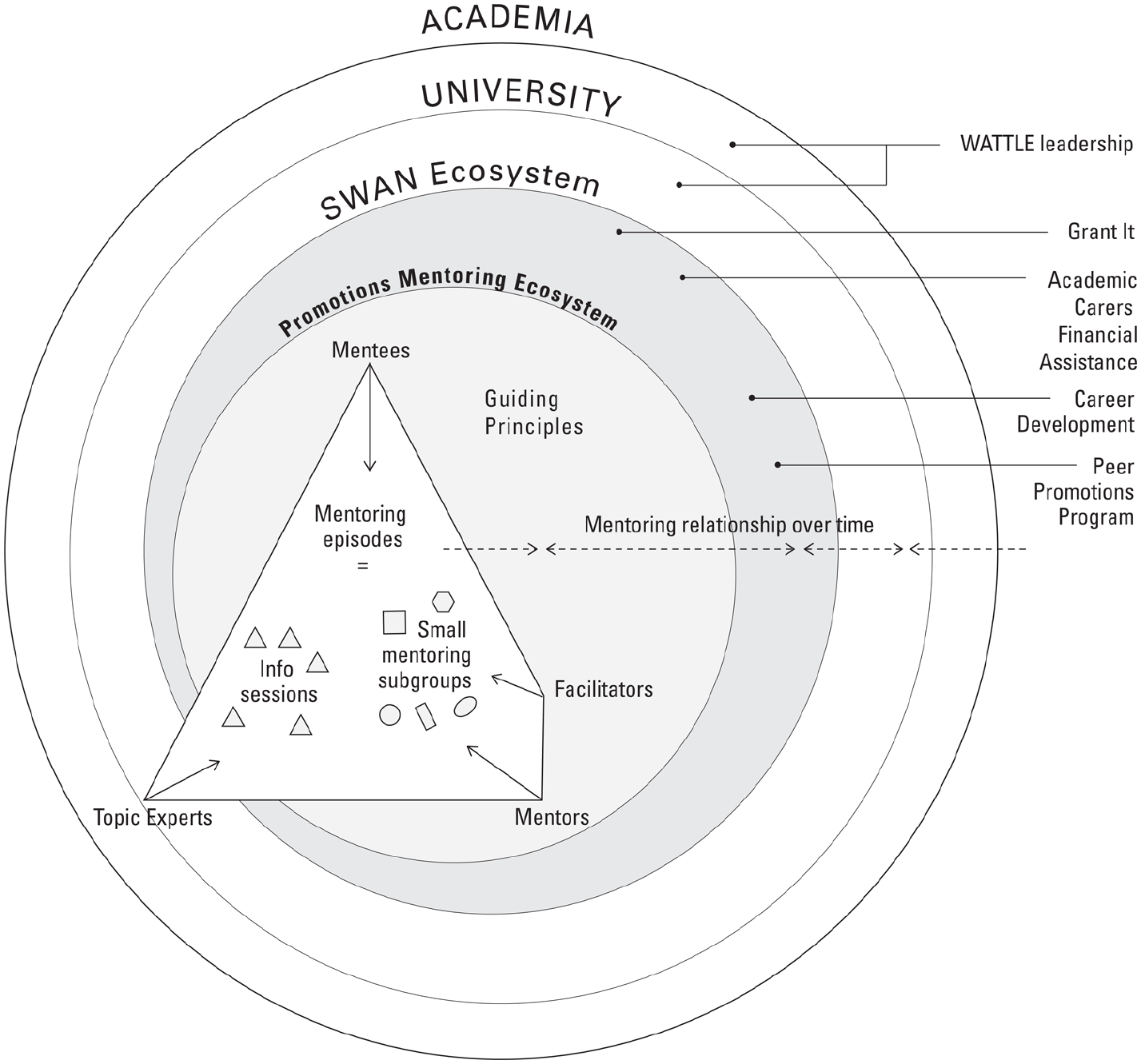
SWAN Ecosystem of Support, adapted from Lunsford (2016).
3. An ecosystem of support
SWAN needed a set of principles to ensure alignment, cohesion and collaboration across programs. As with many grassroots initiatives, the founders laid out a set of aims and objectives, which eventually developed into guiding principles. Each SWAN program (1) has a grassroots foundation of women supporting women; (2) aims to provide a safe space to share vulnerabilities; (3) is outcome-oriented and uses a holistic lens, considering the various roles women fulfil; (4) is social, structured and celebratory of academic women and (5) is designed to build enduring cross-disciplinary networks. These five principles crystalised over time as part of reflective practice and ongoing feedback from participants in the various SWAN programs. While present in practice from the outset, these principles were not formally articulated until 2018, when interest from other Australian universities who were keen to establish similar programs necessitated that we communicate our point of difference from other women-centric professional development resources.
As with the challenge of deciding what to include in such a program, the trio found little guidance in the way of successfully conceived past programs. McCormack and West (2006) in an Australian context propose key competencies for developing academic women as Knowing Why, Knowing How and Knowing Who, that can be achieved through group mentoring. Inspired by McCormack and West (2006), and by Lunsford’s (2016) work in mentoring ecosystems, a series of programs were crafted. Like Lunsford’s (2016) ecosystem, which features mentoring episodes that bring together mentees, mentors and specific contexts, SWAN’s Peer Promotions Program has a similar conceptual structure (Figure 1). Lunsford (2016) argues that micro-mentoring episodes happen over time. Likewise, SWAN evolved to offer a range of developmental activities to facilitate benefits akin to micro-mentoring episodes.
Figure 1 shows how the majority of the SWAN programs operate within the level of the SWAN Ecosystem. For the Peer Promotions Program, Mentees interact with Facilitators and Mentors in Information sessions and Small mentoring subgroups within the Promotions Mentoring Ecosystem and with Topic Experts at the University level. Opportunities for formal and informal mentoring episodes strengthen the mentoring relationship over time from within the Promotions Mentoring Ecosystem, and then throughout the University Ecosystem and beyond. Other SWAN programs including the Career Development, Academic Carers Financial Assistance and Grant It, were developed based on the Guiding Principles set out by the SWAN founders, the trio mentioned in the case, and operate within the SWAN ecosystem. WATTLE Leadership operates at the level of the University (and Academia more broadly), as it is made up of 15 participating universities to date.
3.1. Peer promotions program
SWAN launched the Peer Promotions Program in 2015. The program runs annually over 6 months in the lead-up to the September deadline for academic promotions applications. The program is led by a team of academic women leaders and aims to actively encourage women academics to apply for promotion, to make the promotions process transparent through formal professional development sessions and to facilitate peer support within a mentee-mentor network.
Five monthly professional development sessions address the key components of the promotion application. Importantly, sessions are provided by key people within the University, who speak to both the expectations of applicants and to the promotions process. Program participants are also given access to successful promotion applications from prior years. Professional development sessions cover:
Five professional development sessions are complemented by mentoring, which is coordinated by leaders of the Peer Promotions Program. Mentors are briefed on expectations of mentors and mentees. Peer support is facilitated as mentees discuss their applications and how they are working to demonstrate impact across the various portfolios. Mentees share application drafts with one another and with mentors for feedback. Mentors provide guidance on mentees’ application narrative, help mentees to self-reflect and to see their achievements more clearly and provide encouragement. Each group decided how often to meet and how to communicate with members.
Survey feedback (anonymous and online) to assess the impact of the Peer Promotions Program and to inform its refinement is invited from women after they participate in the program. Feedback on the content, format, value received, benefits and challenges is solicited. Between 2015 and 2019, 80 surveys (5 to 23 annually) were completed. Of those, 20 were mentors, 51 were mentees and 9 were both a mentor and mentee in a given year. Thirty-three program participants (55.0%) reported that they applied for promotion the year they completed the survey, while others strategised in preparation to apply in a subsequent year, demonstrating that many women engaged with SWAN for the purposes of planning for future career advancement.
Using conventional content analysis (Hsieh and Shannon, 2005), two researchers inductively coded open-text participant responses. After familiarisation with the data, they independently applied descriptive codes. They subsequently collaborated to compare, consolidate and organise the data into categories. Four core categories were generated: the value of information and resources, richer connections, emotional nourishment and professional growth. Illustrative quotes that showcase the value an ecosystem of support offers academic women are presented in Table 1.
Content analysis of participants’ open-ended survey responses.
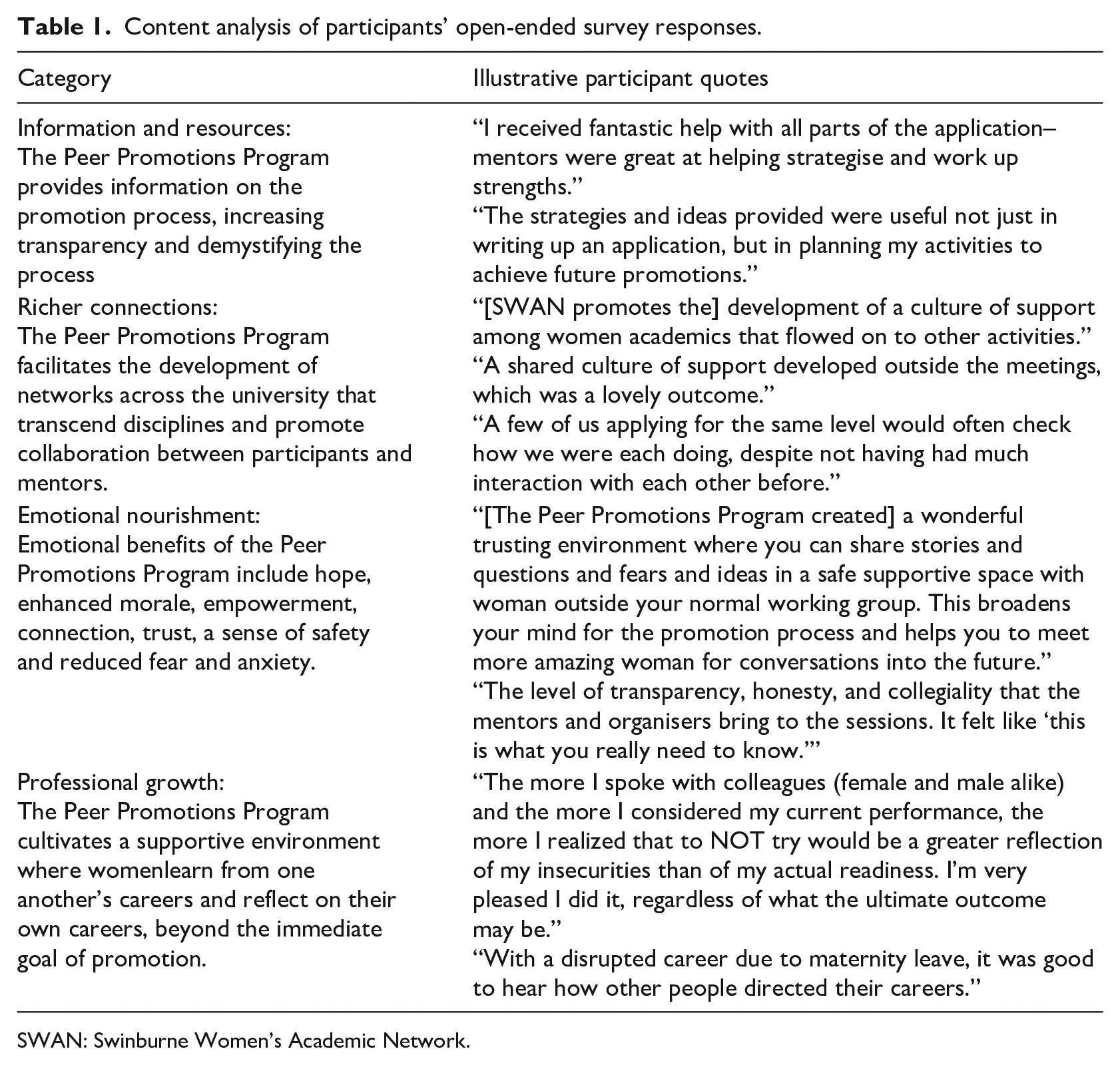
SWAN: Swinburne Women’s Academic Network.
3.2. Career development program
It became apparent that the Peer Promotions Program provided valuable support for women who intended to apply for promotion. However, women in between promotions and those not interested in promotion desired further support for career development to maximise micro-mentoring episodes described by Lunsford (2016). In 2017, the Career Development Program was established. This program builds opportunities to support the development of various aspects of women’s academic careers. The Career Development Program was co-created through in-person focus groups and online surveys that explored potential program topics, content and delivery formats. All academic women at Swinburne, including permanent, contract, sessional and Higher Degree Research (HDR) students were invited to participate and were represented in both methods (23 focus group participants, 20 survey respondents). Using affinity diagramming to conduct thematic analysis, responses were sorted into themes by Program Leaders. A range of programming topics (e.g. developing personal brand and informal networking) and delivery formats were expressed. The content and delivery format have been evaluated and updated each year based on participant survey feedback and Program Leader observations, to meet academic women’s shifting needs, especially since the onset of the COVID-19 pandemic, which disrupted the ways people work. Career Development expanded support to women at the earliest stages of their academic career by including HDR students and sessional staff who did not have access to support mechanisms previously, as they are not eligible for academic promotion.
3.3. Academic carers financial assistance
Initiated in 2017, ACFA was designed to support academics who are primary carers of children, individuals with disabilities, older adult family members and others. In contrast to other SWAN programs, academics of all genders can apply for funding, which can be used to overcome obstacles to research productivity that have been exacerbated by caregiving responsibilities. This gender-neutral program recognises and encourages applications from academics who have non-traditional caring roles and responsibilities. ACFA (up to AU$3,000) is awarded through a formal process in which applicants must be a primary carer and research active and must articulate how funding will advance their research. The funds can be used to cover the cost of travel companions (e.g. children and/or childcare support) to enable academic carers to maintain care responsibilities, while attending and presenting at conferences, which is critical to growing professional networks and to researchers’ national and international visibility.
3.4. WATTLE
As SWAN continued to grow and evolve, a national program was developed to support senior women university staff to build their networks and confidence to take up leadership roles and to succeed in them. The first WATTLE program ran in 2018 with participants from six universities and continues annually. WATTLE offers two programs, one for academic women and one for professional women. At the time of writing, there were 15 participating universities across Australia. The lifeblood and future of WATTLE is driven by volunteers. WATTLE alumnae, after receiving promotions and accepting new positions, have gone on to become deans, department chairs, heads of divisions and to serve as a professional network for past and future WATTLE participants.
Grant It, an annual grant-writing support program launched in 2019. This program takes a similar developmental approach as the Peer Promotions Program but focuses specifically on developing grant applications. The Grant It Program provides a series of scaffolded grant-writing sessions that demystify the process of applying for Australian Research Council (ARC) grants. The sessions present key information and introduce a novel framework for constructing grant applications to make the process of writing grants less daunting and more accessible. Grant It has increased the number of women applying for ARC grants at an institutional level, with five women from the program submitting applications in its first year. The 2019 SWAN Annual report documented that this was the first time that more Swinburne women than men applied for ARC Future Fellow grants.
4. Institutional- and policy-level impacts
The steady expansion of SWAN has enabled the needs of a larger number of academic women to be catered and has led to the creation of new university-level leadership positions for academic women. These positions are beneficial to the career progression of Level C and D academics and increase women’s visibility within the institution. The labour of leading SWAN programs has also been recognised within the academic workload model. Collectively, the SWAN Ecosystem contributed strongly towards Swinburne’s successful application for a Science in Australia Gender Equity (SAGE) 2018 Athena SWAN Institutional Bronze Award, as mentioned above.
SWAN has impacted the whole institution by influencing policy change in the academic promotion process. In particular, SWAN was instrumental in the 2017 introduction of an optional statement of relevant personal circumstances in promotion applications. Inclusion of the relative-to-opportunity statement normalises discussion of circumstances, including career interruptions, caring responsibilities or illness, or period of part-time work that may yield gaps in productivity or influence career trajectories and must be considered in the evaluation of promotions applications. This initiative benefits academics of any gender whose career trajectory has been atypical or nonlinear, which is an important step towards equity in performance measurement in Swinburne’s academic promotion process. The SWAN Peer Promotions Program has also contributed to increased quality of applications for promotion, as well as a higher rate of successful applications among women applicants, as documented by an institution-wide email that announced the outcome of academic promotions in 2019. The proportion of women level E academics at Swinburne has risen from 22.1% in 2014 to 33.3% in 2019 (Universities Australia, 2015), demonstrating how actions within the institution have led to an increase in the proportion of women at the full Professor level.
5. Challenges within the University context
Developing a relationship with the People and Culture team was not straightforward. The trio encountered degrees of resistance and, in some cases, push back from People and Culture around releasing data, despite support from the executive leader for promotions. To inform program development and to track outcomes, the trio needed to first understand current trends, success rates and gender distribution of recent promotion application rounds. People and Culture’s reluctance to share data stemmed from ethical considerations that pit transparency and diverse stakeholder inclusion against employees’ right to privacy (see Tursunbayeva et al., 2022, for a review).
Sustained effort into building this relationship over time, such as by including People and Culture in aspects of program planning through informal meetings and by inviting them to contribute to information sessions for the Peer Promotions Program, helped to establish trust. The relationship strengthened over time and facilitated a bi-directional sharing of information, where program leaders continue to provide feedback to People and Culture on women’s experiences throughout the promotion process (including the challenges and benefits of disclosing their personal circumstances relative to their opportunities) and where the People and Culture team provide early notice of upcoming changes to the annual promotion process.
As SWAN developed and as the benefits became evident, there was some pressure from university leadership to open SWAN programs to all academics, not just women. The SWAN founders held fast to program principles, as SWAN was created to redress historical and systemic biases that have perpetuated ongoing gender disparities in academia, especially at senior levels (see Cardel et al., 2020, for a review). Cardel and colleagues highlight the discrepancy in the representation of women at different levels, with women receiving over 50% of all PhDs in the United States and accounting for over 50% of early career academics, but representing only 32% of all Professors. This disparity is exacerbated for specific groups of academic women. For example, Black and Hispanic women make up less than 5% of tenured academics. Calls for more inclusive programs that recognise the compounding barriers of intersectionality, including those faced by gender-diverse academics, have been embraced. SWAN leaders are working towards further improving inclusivity for marginalised groups.
Although SWAN is an established and accepted part of the university, the work related to the different programs significantly burdens the women running the program. In the first year of SWAN, everyone leading and facilitating programs did so as a labour of love. From year 2 onwards, the university has acknowledged the importance of SWAN by providing funding and recognition of work hours as part of service and leadership roles and responsibilities. However, women taking on leadership positions must regularly justify their SWAN role to their direct line manager to actually receive the allocated workload. The workload is, in many cases, only given when the direct line manager is made aware that this is an initiative endorsed by the university’s leadership. Even though the workload acknowledges the work that is required to run a program such as this, it is a small token compared to the real effort required to keep the program operating.
The program can be perceived to heavily emphasise ‘fixing women’ (Ryan, 2023) and not really changing the system to be more inclusive of women. Those running SWAN can see small changes in the system procedures (e.g. changes in promotion process discussed), and the evolution of the SWAN programs signals expansion in resources dedicated to supporting opportunities for women collectively, even if individual benefits experienced vary. However, more work is needed to create a more equal environment for gender-diverse academics, as we still have disparity in diversity in upper-level leadership positions, and diversity challenges, such as intersectionality, to further address.
6. Conclusion
SWAN has evolved over time to function as an ecosystem of support for women academics that offers mentoring for academic promotion, career development, research funding for carers and grant-writing support. Sustained by the tenacity of its founders and subsequent leaders, SWAN has remained a steadfast feature of University culture for more than half a decade, despite changes in University executive leadership and the effects of the COVID-19 pandemic. Its longevity and future success are dependent upon devising strong solutions to a variety of challenges:
How can SWAN continue to grow when it is difficult to capture objective metrics that demonstrate value to the organisation and to individuals? Anecdotal evidence and testimonials can only go so far to confirm that objective value continues to be delivered.
How can gender equity programs like SWAN become more inclusive of gender-diverse individuals, address intersectional challenges and engage more people without becoming diluted or spread too thin in laudable attempts to support everyone to do everything?
How can programs of support demonstrate their effectiveness when other strategic initiatives (e.g. target hires where academics with stellar profiles (often white, men Professors) are head hunted for senior positions) continue to exacerbate women’s underrepresentation at senior levels?
These questions and others highlight the challenges and complexity of enacting organisational change and remind us of the importance of monitoring outcomes and responding to the evolving needs of program participants in an effort to optimise the success of such initiatives.
Supplemental Material
sj-docx-1-aum-10.1177_03128962231188453 – Supplemental material for A tale of three associate professors: A grassroots approach to supporting women in higher education
Supplemental material, sj-docx-1-aum-10.1177_03128962231188453 for A tale of three associate professors: A grassroots approach to supporting women in higher education by Christine Thong, Melissa A Wheeler, Jessica L Mackelprang, Mahnaz Shafiei, Helana Scheepers and Virginia Kilborn in Australian Journal of Management
Footnotes
Acknowledgements
The SWAN ecosystem features a network with many different contributors. SWAN is only possible due to each of them, and we thank many of them here. Our gratitude to Jenelle Kyd for providing inspiration to aim high. We thank our former SWAN champions, Duncan Bentley and Bronwyn Fox. We appreciate that you share our vision of SWAN.
Thanks to previous leaders, Birgit Loch, Rosemary Stockdale, Jennifer Beaudry, Chrystal Zhang and Georgina Willetts who are taking the SWAN spirit to other universities around Australia. We also recognise three former leaders, Kay Cook, Narelle Lemon and Zhenwei Cao, who continue to do great things at Swinburne.
Thanks to our other current leaders of various SWAN programs: Carolyn Beasley, Christine Agius, Flavia Marcello, Simone Taffe, Jennifer Turner, Catherine Orr and Faith Kwa. We also recognise the hard work of our partners from Science in Australia Gender Equity and Swinburne Research: Sarah Russell, Angela Ndalianis, Katia Wilson, Lucy Weaver, and Lachlan Doughney.
Thanks to our “leaders of the future”: Georgia Keam, Humera Amin, Esther Wilding, Caroline Tjung, Ashlea Gleeson, and Ann Tran who provided the crucial administrative and research support needed for SWAN’s success. In particular, we thank Ashlea Gleeson and Ann Tran who provided research assistance for the preparation of this paper.
Final transcript accepted 17 May 2023 by Victor Sojo Monzon (Guest Editor-in-Chief Special Issue).
Funding
The author(s) disclosed receipt of the following financial support for the research, authorship, and/or publication of this article: This research was funded by Swinburne University of Technology.

Supplemental material
Supplemental material for this article is available online.
1.
In Australia, academic levels A, B, C and D include ‘steps’ through which academics progress each year. Each step increase is associated with a pay increase. The most senior academic level, Level E, does not include steps.
2.
Not to be confused with the Athena SWAN Charter that led to the Science in Australia Gender Equity (SAGE) initiative in Australia (also piloted in 2015). The coincident launch signalled the work described in this case was topical to national challenges faced in STEMM and Higher Education sectors. The SWAN program was introduced in the 2 years preceding SAGE’s adoption in Australia and featured significantly in Swinburne’s SAGE Bronze award application.
References
Supplementary Material
Please find the following supplemental material available below.
For Open Access articles published under a Creative Commons License, all supplemental material carries the same license as the article it is associated with.
For non-Open Access articles published, all supplemental material carries a non-exclusive license, and permission requests for re-use of supplemental material or any part of supplemental material shall be sent directly to the copyright owner as specified in the copyright notice associated with the article.
