



Abstract
Diversity of company leadership is an important governance issue for corporations globally, yet the uneven treatment of diversity priorities remains a major challenge. We explore the extent and change over time of both gender and ethnic diversity in leadership and disclosure for Australia’s largest firms from 2005 to 2021. Using institutional theory, we compare the isomorphisms driving change, and examine the extent to which there is rhetorical decoupling between diversity disclosure and practice. Our analysis reveals a significant improvement in gender diversity over time but very little progress in the ethnic diversity of corporate leaders. We find a connection between diversity reporting and the appointment of female corporate leaders. However, there is a disconnection between public commitment to diversity and the appointment of non-white corporate leaders. A lack of regulation for diversity reporting contributes to this imbalance with different outcomes for gender and ethnic diversity as the result of different institutional isomorphisms. Our findings can inform policymakers and corporations, highlighting the importance of a range of institutional pressures that encourage the disclosure and practice of ethnic diversity in corporate leadership.
1. Introduction
Australia is a multicultural triumph. It’s time we start seeing more cultural diversity in the leadership of our organisations. There’s a challenge to get board diversity right – and not just on gender
(Tim Soutphommasane, Australian Human Rights Commission, 2018)
Diversity of company directors and executives is one of the most important governance issues currently faced by corporations around the globe, with the United Nations Sustainable Development Goals (goal 10) urging all countries to ‘empower and promote the social, economic and political inclusion of all, irrespective of age, sex, disability, race, ethnicity, origin, religion or economic or other status’. Diversity of company leaders is argued to improve monitoring and decision-making (Cox, 1993; Upadhyay and Zeng, 2014), enhance organisational efficiency (van der Walt and Ingley, 2003), governance (Kiel and Nicholson, 2006), reputation (Dadanlar and Abebe, 2020) and performance (Ospina and Foldy, 2009).
Given these advantages, diversity has gained significant attention from regulators and professional bodies. Several western jurisdictions have mandated rules for corporations to improve diversity disclosure and appointment practices, including the United States, European Union and United Kingdom. In Australia, the Australian Stock Exchange (ASX) Corporate Governance Principles and Recommendations in 2010, effective on or after 1 January 2011, recommended that all listed companies establish and disclose a diversity policy, particularly regarding gender. The Australian Institute of Company Directors (AICD) called on all boards, particularly the ASX200, to appoint at least 30% of women directors by the end of 2018 (Australian Institute of Company Directors, 2015). In 2019, the AICD reported that the 30% target was achieved and by 2021, there were no ASX200 boards without any women (Australian Institute of Company Directors, 2019, 2021). However, a recent study commissioned by the AICD reports that culturally diverse individuals are underrepresented at leadership levels in both the private and public sectors, despite almost half of Australia’s population being born overseas or having at least one parent born overseas (Groutsis et al., 2018). Despite the clear motive to improve diversity across multiple domains – including ethnicity, class, experience, sexuality and age – industry and regulatory action has largely focussed on gender.
Similarly, academic attention has largely highlighted matters of gender diversity. Very few studies have explored diversity from the perspective of ethnicity, predominantly focusing on non-Australian contexts such as Canada, the United States and the United Kingdom (Abebe and Dadanlar, 2021; Brammer et al., 2007; Carter et al., 2010; Fredette and Sessler Bernstein, 2019). In Australia, there are very few academic studies of the extent, cause and impact of ethnic diversity in corporate Australia, with some finding little presence of Aboriginal or Torres Strait Islanders in the leadership of large companies (Australian Human Rights Commission, 2016; Groutsis et al., 2018; Kaur and Qian, 2021). Although there is recognition of the persistent challenge of ethnic diversity in corporate leadership, there is very little understanding of how this form of diversity has changed over time.
Annual reports and corporate disclosure have been studied as a complementary indicator of the company’s commitment to equality, sustainability, ethical practice and corporate governance (Baalouch et al., 2019; Chan et al., 2014; de Silva et al., 2020; Du, 2018; Dumay and Hossain, 2019; Lu et al., 2015; Shayuti et al., 2018). Diversity disclosure – the company’s progress and strategy towards equal employment and promotion of a range of minority groups – has received relatively little attention within the literature. Those that do, generally examine the extent of diversity reporting with the number of women in leadership (Ahern and Clarke, 2013; Ghauri et al., 2021). There is not, to our knowledge, any research that examines diversity reporting and both gender and ethnic diversity in large Australian firms.
We contribute to this literature by systematically exploring the extent of gender and ethnic diversity practices, and diversity statements in annual reports of large Australian companies from 2005 to 2021. We adopt a mixed-method analysis, tracking the extent of diversity disclosure and practice (quantitative) and analysing the content of company diversity statements (qualitative). The longitudinal, cohort data used in this article prompt conceptualising annual reports and leadership appointments as collective organisational forms, rather than only the result of individual- and firm-level motivations. As such, we interpret our findings with institutional theory, comparing the institutional isomorphisms driving change in each organisational form, and examining the extent to which there is rhetorical decoupling between them.
The remainder of the article is structured as follows: in section 2, we review the literature relating to academic research on diversity in leadership and annual report disclosures. In section 3, we outline our theoretical framework and in section 4, discuss the mixed-method approach. In section 5, we discuss the empirical results, concluding that there has been close alignment between diversity reporting and the number of women in leadership. When it comes to matters of racial and ethnic diversity, there is a disconnect between general public commitment to diversity, and the practice of appointing non-white corporate leaders. The unregulated nature of diversity reporting has contributed to decoupling between disclosure and practice, with different outcomes between gender and ethnic diversity, the result of institutional isomorphisms. These findings are relevant to policymakers and corporations, highlighting the importance of a range of institutional pressures for encouraging both disclosure and practice for much-needed ethnic diversity in corporate leadership.
2. Literature review
The last four decades have witnessed a significant increase in public, government and media interest in the composition of corporate boards (Armour, 2020; Fairfax, 2005; Groutsis et al., 2018). Academic research has examined board members of top corporations to appointment processes, compliance with diversity objectives and the impact of board composition on profit and governance (Agrawal and Knoeber, 2001; Frijns et al., 2016; Griffin et al., 2019; Kagzi and Guha, 2018; Post and Byron, 2015; Rao and Tilt, 2016). The majority of research has so far focussed on matters of gender diversity, with relatively few studies exploring ethnic diversity (Adams and Ferreira, 2009; Ahmed and Ali, 2017; Ahmed et al., 2018; Ali, 2016; Griffin et al., 2019; Harjoto et al., 2015; Hillman et al., 2002; Saeed et al., 2016; Strydom et al., 2017). Representation of those from diverse ethnic or cultural backgrounds has been found to be far less than gender diversity, with Abebe and Dadanlar, (2021) finding that, for the United States, although most companies had women directors, only 10% of firms had non-white directors (see also the studies by Brammer et al., 2007; Carter et al., 2010; Fredette and Sessler Bernstein, 2019; Guest, 2019; Rose and Bielby, 2011). The literature has discussed some of the reasons for poor ethnic diversity in corporate leadership, including internal firm factors, industry effects or external structural factors such as the composition of the labour market (Glass and Cook, 2018; Pirzada et al., 2017; Singh, 2007). While there is acknowledgement of the relative presence of women and non-white directors on corporate boards, there is no research that compares the external institutional factors that have contributed to this disparity.
Research has acknowledged the importance of external institutional pressures for the appointment of women and non-white leaders. In some contexts, the introduction of formal legislation, comply or explain procedures or corporate governance principles have obliged firms to improve the gender, ethnic and cultural diversity of corporate boards (Post and Byron, 2015; Rose and Bielby, 2011). In others, pressure has been applied through professional associations or public activism (Deloitte, 2021; Rose and Bielby, 2011). In other research, the ‘business case’ has been effective, with the now widely accepted principle that diversity is good for profit, innovation and monitoring prompting companies to appoint members of minority groups to their leadership suite (Brammer et al., 2007; Ginalski, 2022; Post and Byron, 2015; Rose and Bielby, 2011; Singh, 2007; Vinnicombe et al., 2008). However, these various motivations have been constrained by the ‘pipeline’, with inequalities in corporate work contributing to constrained career prospects for women and non-white workers, thereby reducing the ‘pool’ of candidates appropriately experienced for executive and board roles (Groutsis et al., 2018; Wright, 2021). Others have identified the potential for tokenism and decoupling (see below), with corporations making public commitments to equality, yet only appointing members of minority groups at the minimum level necessary to placate stakeholders (Farrell and Hersch, 2005).
Similar to research internationally, Australian diversity research has generally examined gender, with far less work ethnic diversity in leadership (Ahmed and Ali, 2017; Ahmed et al., 2018; Gray and Nowland, 2017; Strydom et al., 2017; Yarram and Adapa, 2020). Australia offers a unique context as board quotas are not mandated, with board composition principle-based rather than rule-based (Yarram and Adapa, 2020). Work has identified the ‘glacial at best’ progress of women appointed to Australian company boards since the 1990s, the importance of professional and regulatory changes for their appointment and their impact on governance and profit (Australian Institute of Company Directors, 2021; Cermak et al., 2018; Du Plessis et al., 2014; Handley et al., 2018; Klettner et al., 2021; Ross-Smith and Bridge, 2008). Research has also tested the appointment of women leaders against various firm-specific drivers such as size, existing leadership diversity, governance quality, shareholder concentration and so on (Ahmed et al., 2018). Despite the wealth of research on Australian women in corporate leadership, the relationship between this and other public commitments to equality – namely annual reports – has not yet been analysed critically (Ahern and Clarke, 2013 and Ghauri et al., 2021 do so for the United Kingdom and New Zealand, respectively).
There is very little Australian research on the extent, antecedents and impacts of ethnic diversity in corporate Australia, with recent industry reports finding that board members and executives are overwhelmingly of Anglo-Celtic and European ethnicity (Australian Human Rights Commission, 2016; Groutsis et al., 2018). Indigenous representation is particularly low, with no top board members or executives of Aboriginal or Torres Strait Islander heritage, and very little evidence of their involvement in leadership roles elsewhere in large companies (Australian Human Rights Commission, 2016; Groutsis et al., 2018; Kaur and Qian, 2021). The corporate sector is particularly homogeneous, with better outcomes for ethnic diversity in political leadership, or on the boards of cultural institutions and not-for-profits (Azmat and Rentschler, 2017). Although this limited Australian evidence has indicated the present and ongoing challenge of ethnic diversity in corporate leadership, there is a gap in understanding changes in ethnic diversity over time, and in relation to both gender diversity and company disclosure practices.
Very similar to the appointment of women and non-white leaders, annual reports have been studied as an indicator of firms’ commitment to equality. Scholars have examined compliance with regulated or compulsory financial disclosure (Abraham and Shrives, 2014; Cortese and Andrew, 2020). Others have examined non-regulated or voluntary disclosure in annual report narrative sections such as the chief executive’s letter, summaries of operations, environmental and sustainability reports and equity and diversity statements. Most research on voluntary disclosure has focussed on corporate social responsibility (CSR) reporting, finding that disclosure practices vary based on firm size, profitability, industry and country of origin (Chan et al., 2014; Lu et al., 2015; Rao and Tilt, 2016; Shayuti et al., 2018). More recently, interest has shifted from exploring CSR as a whole to examining the increase in specific areas of disclosure such as corporate governance, risk, environmental management and human rights (Baalouch et al., 2019; Beck et al., 2010; Collett and Hrasky, 2005; de Silva et al., 2020; Du, 2018; Gerged, 2021; Gibson and O’Donovan, 2007). Disclosure of diversity disclosure has received relatively little attention within the literature. A handful of studies have focussed on gender, finding that gender diversity disclosure is generally lower than other voluntary disclosures (Ahern and Clarke, 2013; Ben-Amar et al., 2021; Bernardi et al., 2002; Chatterjee and Zaman Mir, 2008; Ghauri et al., 2021; Holton, 2005; Rao and Tilt, 2016) 1 . In Australia and New Zealand, there has been limited research on diversity disclosures, with studies finding that although the incidence and specificity of diversity policies increased from around 2010, most content focusses on gender (Ahern and Clarke, 2013; Ghauri et al., 2021). Both studies compare the extent of diversity reporting with the increased representation of women in management and director roles in the United Kingdom and New Zealand. Although there is clearly recognition that diversity encompasses more than gender, there is not, to our knowledge, any research that compares diversity reporting and both gender and ethnic diversity within the leadership suite of Australian firms.
3. Theoretical framework
Company leadership and annual reports are organisational forms subject to a range of individual, firm and institutional factors. Corporate leaders are appointed based, in part, on knowledge and skills that allow them to align the interests of managers and shareholders (agency theory) and to guide company’s operations (resource dependence theory; Bendickson et al., 2016; Berle and Means, 1932; Kaczmarek et al., 2014). Recruitment may also respond to team dynamics, with members of a similar background more likely to make decisions efficiently, while a diverse board – although often plagued with conflict – increasing innovation and encouraging more responsible practices (Ali and Ayoko, 2020; Brass, 1995; Kamalnath, 2017; Post and Byron, 2015). The appointment of executives and directors also serves a symbolic role as part of the company’s public face, with leaders expected to appear knowledgeable, ethical and community-minded (Barnes, 2013; Beji et al., 2021; Bice, 2017; Hung, 2011; Redmond, 2012; Shabana et al., 2017; Wright and Forsyth, 2021).
Annual reports are a key mechanism through which a company discharges its accountabilities to shareholders and other key stakeholders, with modern annual reports part statutory audited financial statements, and part symbolic ‘mediascapes and ideoscapes’ that provoke ‘interpretive and emotional reactions’ from readers (David, 2001: 195). Non-compulsory ‘narrative sections’ such as the executive’s letter, summaries of operations, environmental and sustainability reports and equity and diversity statements respond to a range of firm-specific motivations, addressing issues important to company stakeholders (stakeholder theory), meeting public expectations (legitimacy theory) and constructing belief systems that affect how readers view the company, the industry or corporations more generally (impression management; Ali et al., 2017; Da Silva Monteiro and Aibar -Guzmán, 2010; Deegan and Blomquist, 2006; Michelon and Parbonetti, 2012).
Although these individual- and firm-level motivations are important, examining a longitudinal, cohort-level data set of large Australian companies prompts conceptualising leadership appointments and annual reports as collective organisational forms. Institutions are the ‘cognitive, normative, and regulative structures’ (Scott, 1995: 33) that provide the ‘rules of the game’ for social thought and action (Bachrach and Baratz, 1970: 43; Irvine, 2002: 2; Jepperson, 1991). These norms become ‘infused with value’ over time as they gain acceptance among organisational members (Selznick, 1957: 19). Critically, these established procedures often carry no clear duty to comply, nor are there mechanisms for enforcement. Instead, this ‘soft regulation’ relies on the development and acceptance of norms, the reputation and influence of the users of the rules, and, eventually, the legitimacy that is ascribed to the institutional practices (Kingsford-Smith, 2012: 378). Di Maggio and Powell studied the dynamic evolution of organisations – including boards of directors – arguing that they tend to become more similar to one another over time. This tendency is the result of institutionalised behaviours, which reflect a non-binding but strongly held commitment to social mechanisms that softly regulate institutional relations (Jacobsson, 2004).
Institutional isomorphisms (coercive, mimetic and normative pressure) encourage organisations to conform, not necessarily due to efficiency, but for the purpose of establishing power and legitimacy in their field. Coercive isomorphism encompasses factors determined by the external environment, including pressure from regulators, legal requirements and cultural and societal expectations. Mimetic pressure involves firms imitating others or modelling past successful performance. Normative pressure stems from organisations conforming to ‘best practice’ established or legitimised through professional structures and industry associations. Institutions are also historically contingent, with changes in institutional pillars influencing the system in which companies, workers and leaders operate, and the practices, norms and obligations that take on a ‘rule like status’ (Jacobsson, 2004; Kingsford-Smith, 2012; Meyer and Rowan, 1977; Scott, 1995; Selznick, 1957).
In our case, leadership appointments for large organisations are an institution governed by coercive pressure in the form of regulation and activism, as well as the gender and race regimes within Australian society that externally dictate those able to be appointed to the leadership suite (Connell and Connell, 2002; Glass and Cook, 2018; Kenny, 2007; Sheridan et al., 2021). Leadership appointments have also been subject to mimetic pressure through the actions of large or market leading firms, and normative pressure in the form of industry and professional recommendations. Company annual reports are subject to a similar range of institutional pressures, with coercive pressure from regulators and activism, mimetic pressure in the form of disclosure practices of large firms and normative pressure from established ‘best practice’ influencing the shared disclosure practices of large Australian corporations.
Although there are similar institutional forces that act on leadership appointments and annual reports, there may be a disconnect between these two organisational forms. Decoupling argues that firms undertake two distinct forms of action – internal and external – to respond to institutional isomorphic pressures (Hawn and Ioannou, 2016). Internal actions, or the inward-looking real practices of the company, are geared towards meeting the needs of internal stakeholders, whereas external actions generally focus on portrayal and legitimacy in the eyes of public stakeholders (Cho et al., 2015; García-Sánchez et al., 2021; Tashman et al., 2019). Research in Australia and overseas has found evidence of decoupling with regards to CSR; environmental standards; bribery; human rights; and work, health and safety disclosures, in a range of locations (Cho et al., 2015; García-Sánchez et al., 2021; Hawn and Ioannou, 2016; Islam et al., 2021, 2022; Tashman et al., 2019). In our case, although there is public, industry and stakeholder expectations regarding diversity in corporate leadership, decoupling involves these expectations being met through public communication in the form of the annual report, rather than actual hiring and promotion practices.
Rather than the binary of coupled/decoupled actions, the literature identifies several intermediate practices of decoupling. Full decoupling involves the ‘malignant separation’ and complete non-disclosure of regulated activity; slight decoupling involves the ‘symbolic adoption’ and ceremonial disclosure of regulated activities; and no decoupling involves the complete implementation and compliance with the regulated activity (Buhr, 2001; Holder-Webb and Cohen, 2012; Islam et al., 2021; Jamali, 2010; Sandholtz, 2012). This framework largely applies to instances of regulated disclosure, where there are concrete penalties for non-compliance. In our case, we propose rhetorical decoupling to account for disclosure practices that occur with voluntary disclosure (similar to the study by Sandholtz, 2012). Sandholtz (2012), examining International Organization for Standardization (ISO) certification, noted that firm compliance with these ‘soft regulations’ was necessary for the firm to achieve legitimacy, but then became ceremonial and was decoupled from the technical work of the organisation (see also the study by Kingsford-Smith, 2012). Islam et al. (2021) has similarly noted the importance of regulation to minimise decoupling, with the lack of regulation for diversity disclosure potentially increasing the extent and scope of decoupling.
In light of the institutionalisation and potential decoupling of both of diversity practices and company diversity statements, we track the appointment of company leaders and content of annual reports to determine:
The extent and change over time of gender and ethnic diversity in Australian corporate leadership,
The extent and change over time of diversity disclosure in Australian company annual reports, and
The extent to which there is rhetorical decoupling between diversity disclosure and practice.
4. Empirical data and methods
We adopted a mixed-methods approach to examine diversity of leadership appointments, and diversity disclosure, of the ASX100 companies in 2021 as well as tracking the same group of companies over several longitudinal benchmarks (2015, 2010 and 2005). Each historical sample had some attrition from the original 100 companies, with the smallest sample size of 62 firms for 2005. We linked each company to their predominant industry group (which we assume is relatively stable over this time horizon), based on the Global Industry Classification Standard (GICS) taxonomy. We measured firm size based on market capitalisation, collecting separate market capitalisation data for each benchmark year using the Morningstar DatAnalysis database.
Board diversity and disclosure information was based on publicly available annual reports accessed through company websites or the DatAnalysis database. Reports are released at the end of each financial year, between July and October for 2020, 2015, 2010 and 2005. Board diversity was coded by examining the personal profiles of board members and senior management team for each company. Although a simplification, we have coded gender as either male or female. Regarding ethnicity, we make the distinction between white (Anglo-Celtic, Caucasian and European directors), and those from non-white backgrounds. The small number of non-white directors and executives means we make no further distinction of ethnicity in the data, though in the empirical section, we discuss the backgrounds that are commonly represented. We detail the number of seats held by men and women, and white and non-white directors, acknowledging that corporate leaders may hold multiple board seats in a single year. Examining the number of board and executive seats also allows the comparison of diversity outcomes based on firm size and industry, and between firms with different-sized boards. To this end, we use simple T-tests to compare market capitalisation, determining statistically significant differences in the size of firms with one or more women, three or more women and one or more non-white leaders.
Diversity disclosure data were based on content analysis of annual reports. Content analysis is frequently used by accounting and management researchers to study corporate disclosure (Beck et al., 2010; Cortese and Andrew, 2020; Merkl et al., 2011). It is a way of ‘systematising the normal, everyday understanding of texts’, or applying ‘scientific method to documentary evidence’ (Groeben and Rustemeyer, 1994: 310; Holsti, 1969: 5). Content analysis can be classified into two broad approaches: mechanistic (volumetric or frequency capture of routine words and references) or interpretive (disaggregating the narrative into constituent parts and understanding what is communicated and how; Beck et al., 2010). Studies that rely on a mechanistic approach often use a dichotomous categorical index to analyse contents published publicly through various company reports or websites, with results then compared to specific compliance guidelines (Abraham and Shrives, 2014; Chan et al., 2014; Cortese and Andrew, 2020; Lu et al., 2015; Rao and Tilt, 2016; Shayuti et al., 2018). Extant literature on corporate diversity reporting often applies a mechanistic approach (Ahern and Clarke, 2013; Du, 2018; Ghauri et al., 2021).
Our data record the incidence of diversity reporting in company annual reports. As the form and content of annual reports changes over time and between firms in different industries, we considered diversity reporting ‘present’ in our dichotomous construction regardless of whether it was a long section with definitive targets or a short paragraph. In each case, the discretionary nature of narrative sections means that different forms of diversity statements constitute a choice on the part of the company that is proxy to their rhetorical, public commitment to the issue. As with the personnel data, we include descriptive statistics regarding diversity reporting based on firm size and industry, and use T-tests to determine differences in the size of firms that include these disclosures.
5. Results and discussion
5.1. Decoupling of diversity statements and leadership appointments
The number of women in Australian corporate leadership has increased markedly over time. The proportion of firms with at least one woman increased from 77% in 2005 to 100% in 2021, with the overall number of seats held by women increasing four-fold from 101 (11%) to 481 (35%; Table 1, Figure 1). There was an acceleration in the proportion of board seats held by women from 2010, from an increase of 2% between 2005 and 2010, to 9% from 2010 to 2015 and 13% from 2015 to 2021. Diversity statements in annual reports also increased consistently across the benchmarks. Sixteen companies (26% of the sample) included some form of diversity statement in 2005, increasing to 78 firms (82%) in 2021. The incidence of diversity reporting was lower than the proportion of firms with at least one female board member in each benchmark, though was roughly equal to the proportion of firms that had a critical mass of women (three or more) on their board (82% compared to 88%, respectively). Diversity reports were thus not necessary for women’s board or executive representation, though closely tracked alongside deepening commitments to gender equality.
Diversity practices and diversity reporting.
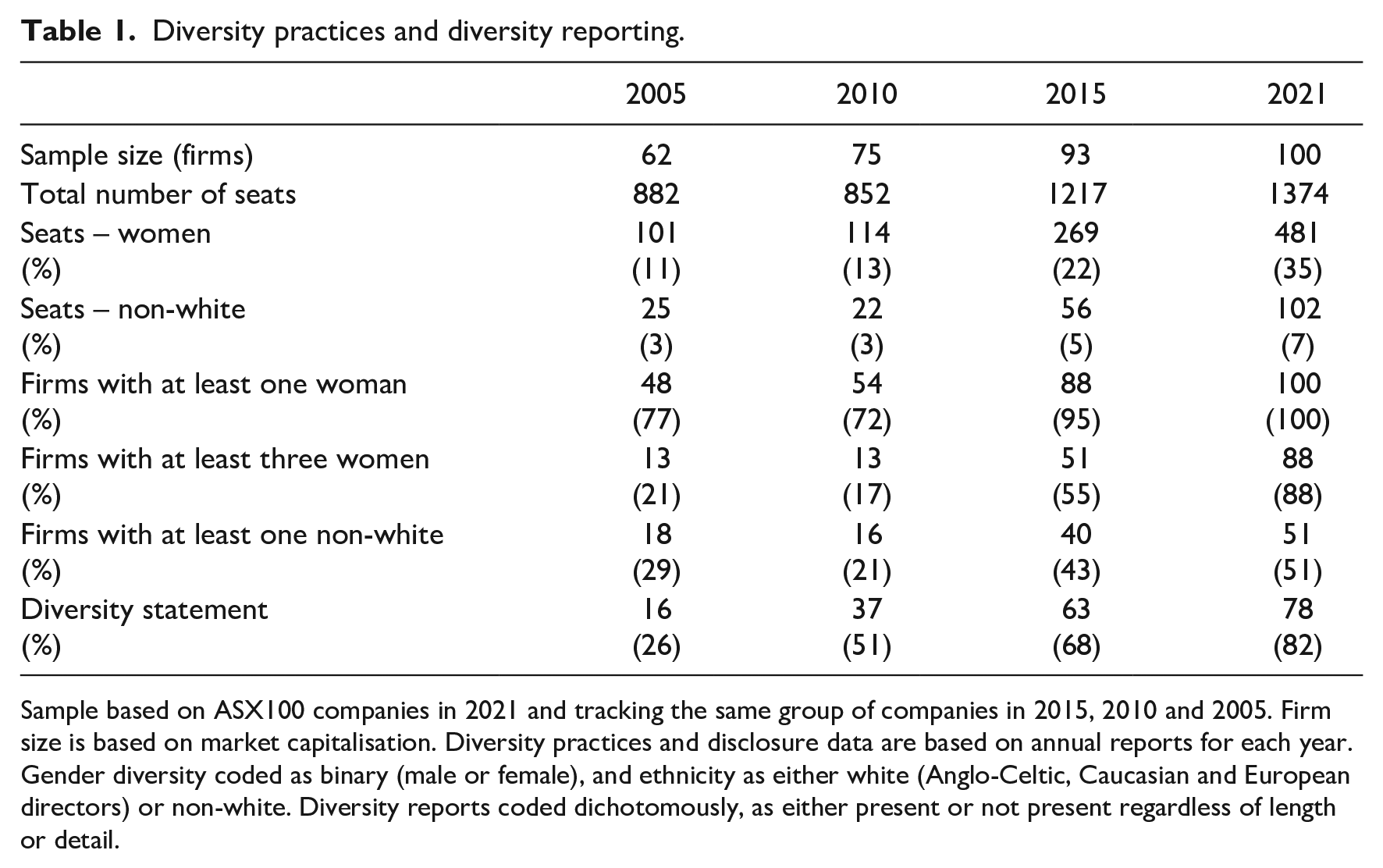
Sample based on ASX100 companies in 2021 and tracking the same group of companies in 2015, 2010 and 2005. Firm size is based on market capitalisation. Diversity practices and disclosure data are based on annual reports for each year. Gender diversity coded as binary (male or female), and ethnicity as either white (Anglo-Celtic, Caucasian and European directors) or non-white. Diversity reports coded dichotomously, as either present or not present regardless of length or detail.
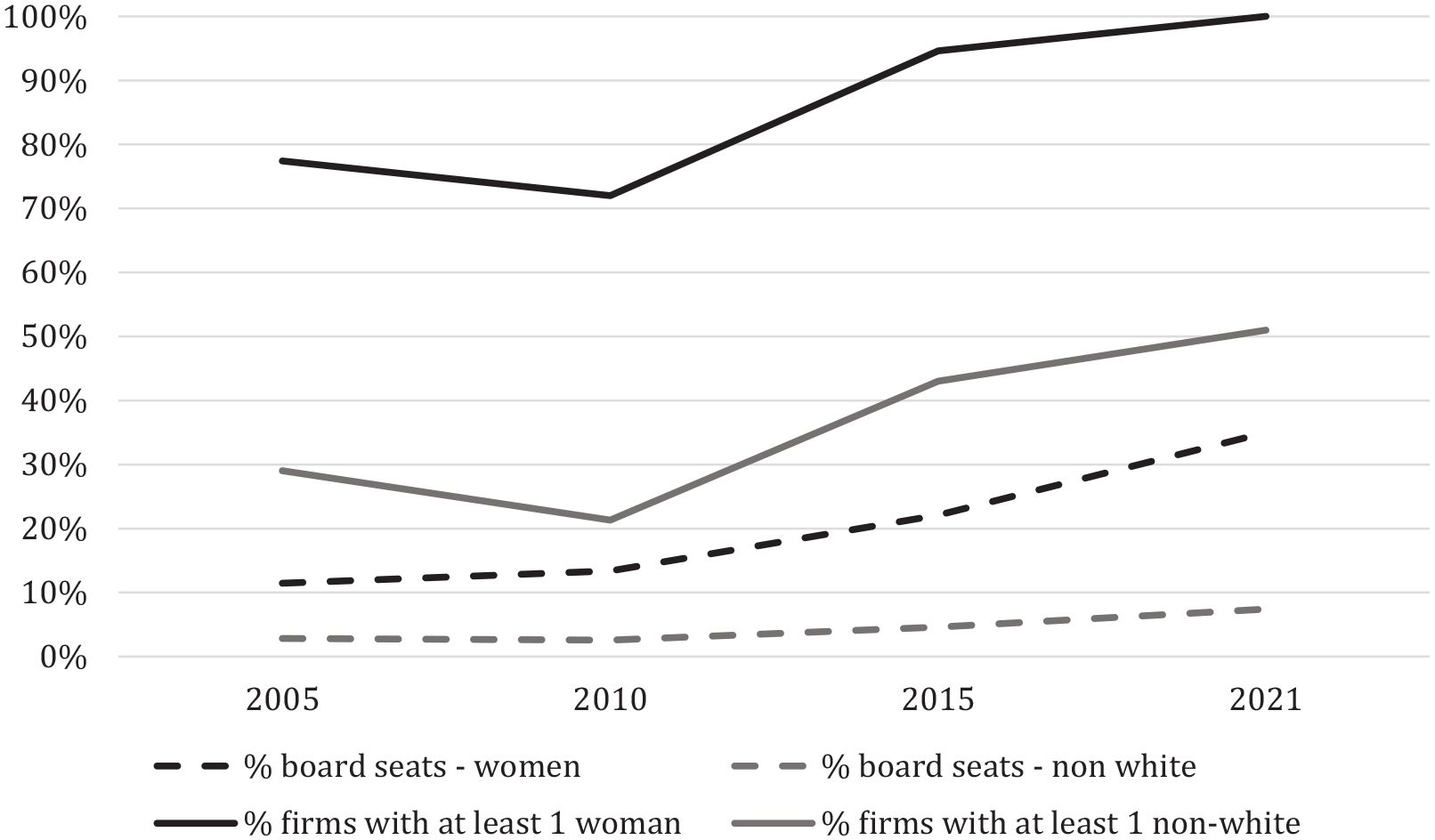
The growth of women and non-white corporate leaders.
Content analysis reveals that top company diversity reports have generally focussed on gender equality. Diversity statements have been recommended (though not required) by the regulator, and have varied in length, detail and form over time. In 2005, diversity reports were brief and vague, with most addressing either the inclusion of women in work and middle management (particularly through the Equal Employment Opportunity (EEO) framework), or vague statements on ‘diversity of personal background’ that did not specify the type of diversity targeted. For example, the 2005 ANZ annual report stated that they ‘made diversity a real priority, with a particular focus on women’ (ANZ, 2005: 35), and ASX Ltd commented that the firm was ‘commended by the Equal Opportunity for Women in the Workplace Agency for our commitment to equal opportunity’ (ANZ, 2005: 20).
By 2020, an interstice opened between the scope of workforce diversity reporting, and disclosures regarding the leadership team. In most cases, there was distinction made between diversity objectives in the workforce and those for executive and director roles, with GPT Group identifying action towards gender, Indigenous and LGBTQIA+ inclusion in work; and gender diversity in leadership. Information Technology firm, Xero, disclosed strategy and progress regarding gender, cultural background, sexuality, and disability diversity in work, but women in leadership. Evolution Mining, similarly, stated that ‘we continued to improve diversity by increased participation for all people that may face more barriers than others including Indigenous peoples, females and the LGBTI + community’ (Evolution Mining, 2020: 10), but with regards to the leadership suite reported that ‘female Board representation was increased to 25%’ (Evolution Mining, 2020: 26). Although companies now often disclose progress and strategy towards achieving gender equality in leadership, these disclosures tend to neglect other forms of diversity.
On the surface, there is evidence of rhetorical decoupling with regards to diversity policies. We define ‘white’ in our sample as those of Anglo-Celtic, Caucasian and European directors, with non-white directors most commonly of Asian heritage, with smaller numbers of South Asian or Middle Eastern descent. Although the number of firms with at least one non-white executive or director roughly doubled (from 29% in 2005 to 51% in 2021), there were disappointing improvements in the overall number of board seats, from 3% in 2005, to only 7% in 2021 (Table 1, Figure 1). To compare, the incidence of diversity reporting began at a similar level in the earliest benchmark (26% in 2005), but became far more common than firms with at least one non-white leader (82% in 2020). There was a significant proportion of companies that included a diversity statement alongside an entirely white leadership suite, from 81% of companies with a diversity statement in 2005, 78% in 2010; 62% in 2015; to 41% in 2020. For example, in 2010, Stockland argued that they recognised ‘the importance of cultural and ethical values, and the benefits of diversity’ (Stockland, 2010: 10), though only appointed Anglo-Celtic or Caucasian directors.
Examining top company appointment practices and the content of diversity statements highlights the progress still to be made regarding ethnic diversity in leadership. Although companies have acknowledged the importance of non-white Australians for their workforce, they have addressed women in leadership rather than promising or developing a strategy for improving the pipeline of non-white directors to the leadership suite. Increased disclosure of gender diversity in leadership tracked closely with the appointment of women directors and executives over time, and the absence of such reporting has occurred alongside disappointing outcomes regarding ethnic diversity. The unregulated nature of diversity reporting has thus contributed to close coupling regarding gender diversity in leadership, but rhetorical decoupling between the public commitment to diversity and the appointment of leaders from diverse ethnic backgrounds. Companies have acknowledged, in a largely external, ceremonial way, the importance of ethnic diversity in work, but have failed to either disclose or act on ethnic diversity in leadership.
5.2. Institutional isomorphisms and diversity procedures
As diversity reporting is principle-based rather than rule-based, the coupling and decoupling we observe regarding gender and ethnic diversity in leadership is largely due to institutional isomorphisms that have acted as ‘soft regulation’ (Jacobsson, 2004; Kingsford-Smith, 2012; Meyer and Rowan, 1977: 341; Scott, 1995: 13).
5.2.1. Gender diversity
As with other countries around the world, the relative success of women in corporate leadership has been the result of a comprehensive suite of interventions (Deloitte, 2021; Rose and Bielby, 2011; Wright, 2021). The broader labour market – including changes in the pool of suitably qualified and experienced directors – has operated as an external force, dictating the appointment of company leaders and thereby resembling coercive pressure. Although women in leadership have become commonplace across every industry, their presence in tertiary service firms – where women have consistently experienced better labour market outcomes – generally outperformed the average. In 2005, women held 11% of board seats across the sample (Table 1), though held 19% of seats in financial firms, 18% in utilities, and 16% in consumer staples (Table 2). Similarly, in 2021, with an average in the sample of 35%, women constituted 44% of seats in information technology (IT), 39% in consumer staples and 37% in real estate. On the contrary, women were less likely to be an executive or director of materials, energy and industrial firms, reflecting gender imbalance in the entry level workforce in these industries, and masculine corporate cultures that structurally disadvantage women (Birch and Preston, 2020; Summers, 2013).
Industry distribution of diversity practices and disclosures.
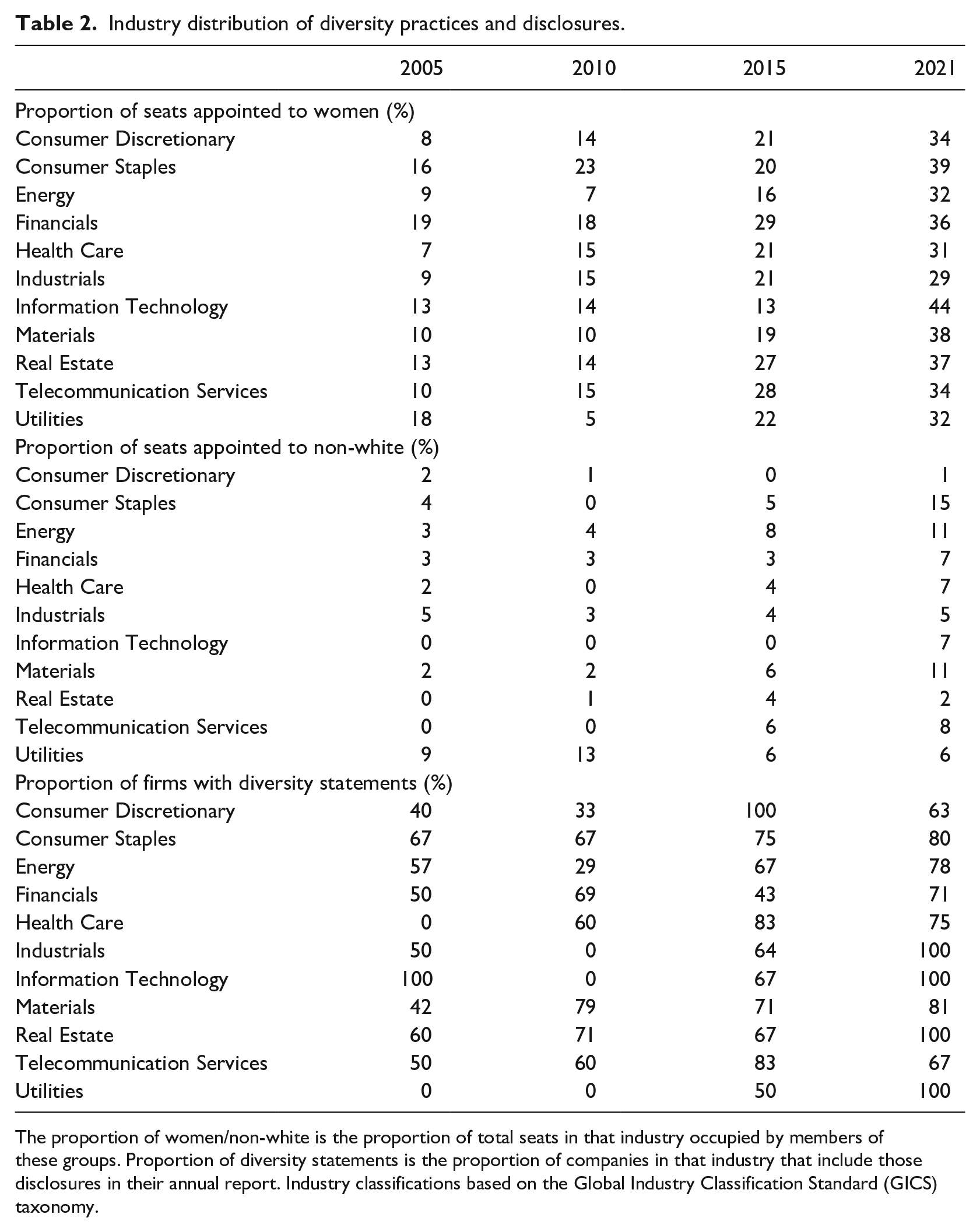
The proportion of women/non-white is the proportion of total seats in that industry occupied by members of these groups. Proportion of diversity statements is the proportion of companies in that industry that include those disclosures in their annual report. Industry classifications based on the Global Industry Classification Standard (GICS) taxonomy.
External coercive isomorphism in the form of public and regulatory pressure has been successful at improving both the disclosure and appointment of women in corporate leadership. Since the 2000s, building on earlier feminist movements that addressed workplace participation and equal pay and promotion of women in corporate professions, public, government and NGO attention has centred on improving the number of women in corporate leadership (Du Plessis et al., 2014; Summers, 2016). In 2012, the Federal government implemented the Workplace Gender Equality Act, requiring firms with more than 500 employees to implement a strategy to address either workplace gender composition, the gender-pay gap, flexible work arrangements, or sex-based harassment and discrimination.
Normative pressure – encouraging firms to confirm with ‘best practice’ established through professional structures and industry associations – has been established through partnership between the ASX and a range of professional bodies such as the AICD, Women on Boards (established(est.) 2001), Chief Executive Women (est. 1985) and Male Champions of Change (est. 2010). The ASX stopped short of requiring firms to appoint women board members, but revised its Corporate Governance Principles and Recommendations in 2010 to encourage firms to monitor and establish policies to improve the number of women in leadership at the executive and board level. In the 2014 amendment, they specifically argued that: A listed entity should have and disclose a diversity policy, and through its Board or a committee of the Board, set measurable objectives for achieving gender diversity in the composition of its Board, senior executive and workforce generally (Australian Stock Exchange, 2014: recommendation 1.5).
Similarly, the AICD has tracked gender diversity on top company boards, and set highly publicised voluntary targets for the sector. This created expectations for firms’ conduct regarding both the appointment of women and the disclosure of their gender diversity progress, with companies that failed to meet the targets of these professional bodies seen as archaic and unprofessional (Du Plessis et al., 2014; Ross-Smith and Bridge, 2008; Sheridan et al., 2014, 2021).
Mimetic pressure has followed, with the actions of large firms pressuring others to conform. T-tests performed on market capitalisation reveals women were consistently appointed to the boards of larger firms. Firms with at least one woman were consistently, and statistically, around three- to four-times larger than those without (average market capitalisation of $10.7 billion, compared to $2.8 billion in 2005; $14 billion compared to $4.4 billion in 2010; and $14.7 billion compared to $3.3 billion in 2015; Table 3). As the 2010s progressed and coercive and normative interventions became more insistent, market leadership extended to the appointment of a greater number of corporate women, with firms with three or more women statistically larger ($21 billion compared to $6 billion in 2015; $16.4 billion compared to $7 billion in 2021). Diversity disclosures – the bulk of which addressed gender diversity – were also the purview of statistically larger firms in 2005 and 2010. In 2015 and 2021, as diversity reporting became more common, the market leadership effect disappeared due to ubiquitousness. The combination of pressure from external stakeholders, industry groups and large firms themselves has normalised and created stringent expectations regarding the appointment and disclosure of Australian women in corporate leadership.
T-test results.
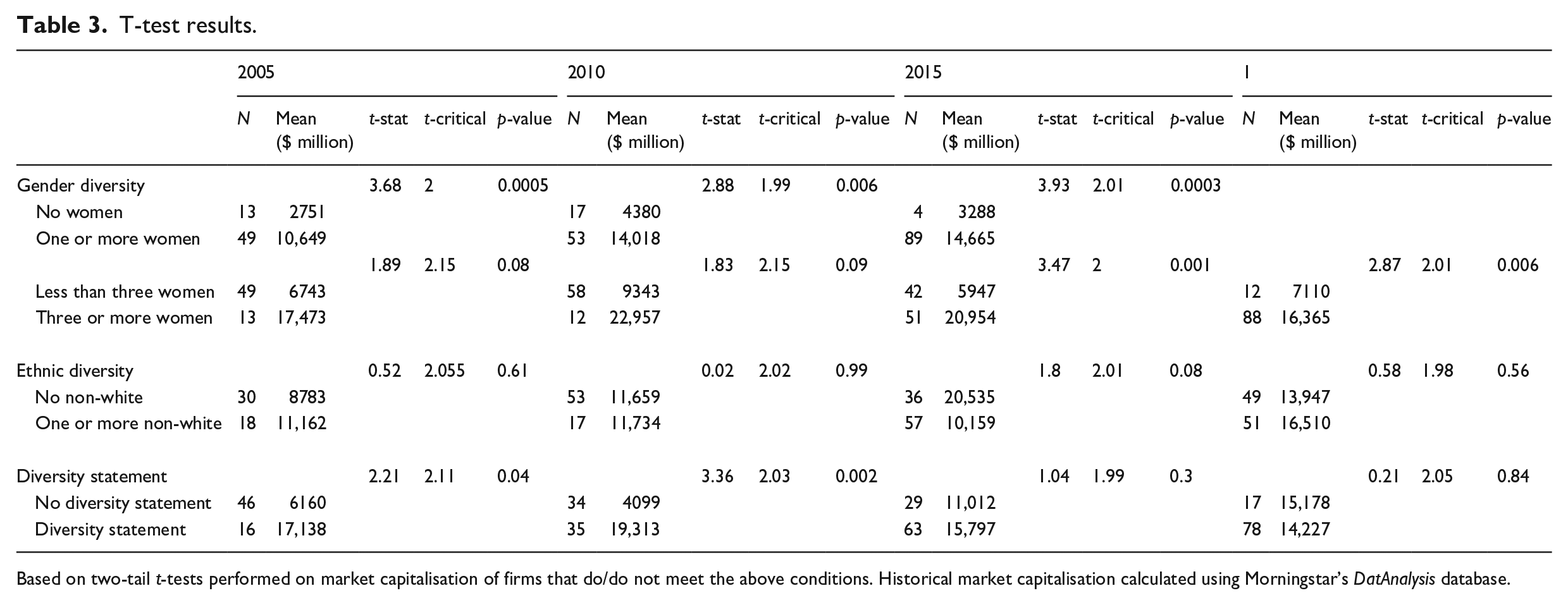
Based on two-tail t-tests performed on market capitalisation of firms that do/do not meet the above conditions. Historical market capitalisation calculated using Morningstar’s DatAnalysis database.
5.2.2. Ethnic diversity
The lack of ethnic diversity in Australian corporate leadership has been primarily due to career path inequalities, with corporations less likely to hire or promote those from non-white backgrounds (Colic- Peisker and Tilbury, 2007; James and Otsuka, 2009; Loosemore and Chau, 2002). For example, Asian-Australians have entered relevant professions such as accountancy at similar rates as Caucasian people, and yet have been promoted far less than their white counterparts. Despite similar levels of qualification and experience, the key barrier to ethnic diversity in corporate leadership has been racism in corporate management and promotion that has limited the numbers of those able to move through the career pipeline (Groutsis et al., 2018). Indigenous Australians face even greater barriers to training, employment and promotion, particularly in professional work that is often a prerequisite for executive and board roles (Altman and Biddle, 2015; Biddle et al., 2013). The composition of the corporate labour market – particularly the marginalisation of non-white folks in the pool of experienced directors – resembles a coercive isomorphism, as an external force that has, in part, determined the composition of the leadership suite.
At the same time as the corporate labour market has institutionalised the status quo, companies are under little obligation to disclose or address ethnic diversity in leadership. As with international research that has emphasised various firm-specific drivers, Australian companies with greater than average ethnic diversity reflect micro-institutional pressures specific to their company or industry (Pirzada et al., 2017; Rose and Bielby, 2011; Singh, 2007). For example, The Star’s 2021 diversity and inclusion strategy disclosed ‘multicultural diversity’ as one of its key pillars, setting a target of 20% Asian representation in leadership levels by 2023 (The Star Entertainment Group, 2021a: 34). This reflects their business strategy of integrating with the Asian gaming and tourism market (The Star Entertainment Group, 2021b). Mining company Oil Search had the most ethnically diverse leadership team in the sample, with 9 (41%) non-white executives and directors in 2021. This was the result of the firm’s operations, which are largely located in Papua New Guinea (PNG), and their specific external coercive pressures to engage with the local community. The Oil Search diversity statement aligned with their appointment procedures, noting their commitment to ‘localisation and diversity’ through 88% representation of local PNG workers and 77% of local operational leadership roles filled by PNG leaders (Oil Search, 2020: 5).
Within the sample more broadly, there is a lack of mimetic pressure for ethnic diversity, with no statistically significant market leadership effect for the appointment of non-white directors (Table 3). Regarding normative pressure, the 2010 Corporate Governance Principles recommended considering diversity of ‘gender, age, ethnicity and cultural background’ (recommendation 3.2), though the document placed far more emphasis on the appointment of women (recommendations 3.3 and 3.4; Australian Stock Exchange, 2010). In 2019, the fourth edition of the Principles recommended that companies ‘consider other facets of diversity [. . ..] having directors of different ages, ethnicities and backgrounds’ (Australian Stock Exchange, 2014: 34), but fell short of specific expectations on the matter. The primary industry body, the AICD, has begun to assert normative pressure for the disclosure and appointment of non-white directors (Groutsis et al., 2018). The AICD has also addressed the representation of Indigenous leaders, releasing their Reconciliation Action Plan in 2019, and in 2021 recommending boards foster ‘genuine, ongoing connections with First Peoples’ (Southward, 2021). While these normative pressures are welcome, it is likely to take some time to translate changes in expectations to changes in reporting and appointment practices.
6. Conclusion
By examining leadership diversity practices and the nature of diversity reporting for the ASX100, our analysis found that although the number of female directors and executives has increased significantly between 2005 and 2021, corporations have largely ignored ethnic diversity. In 2021, 35% of board or executive seats were occupied by women, only 7% were held by non-white leaders, and none were assigned to Aboriginal or Torres Strait Islander people. Despite this, there have been significant increases in public communication regarding diversity goals. Voluntary diversity disclosures have a social and symbolic role, and have been used to respond to stakeholders, create legitimacy and embed cultural beliefs regarding the success or future prospects for the firm. Australian corporations have demonstrated external commitment to some matters of ethnic diversity but appointment practices have excluded non-white leaders from executive or board roles.
A closer look at the content of diversity statements revealed that there is a dichotomy between types of diversity disclosure and, as a result, the nature of decoupling. To satisfy public and industry expectations, companies have acknowledged the importance of non-white and Indigenous Australians for their workforce and have addressed women in leadership, but have not yet promised or developed strategies to improve the pipeline of non-white directors to leadership roles. There is thus evidence of coupling regarding women in leadership and diversity reporting, but decoupling between diversity disclosures and the practice of appointing non-white leaders.
The principle-based (rather than rule-based) nature of diversity reporting has contributed to this uneven disclosure and practice, with differences between gender and ethnic diversity the result of different institutional isomorphisms. The disclosure and appointment of women in corporate leadership has been subject to a comprehensive suite of coercive, mimetic and normative interventions, including specific recommendations from the regulator and industry bodies, media and government attention and path-setting from market leaders. To compare, institutional isomorphisms regarding ethnic diversity have been very limited, but have increased in recent years. Our findings highlight the strategies that have been meaningful for aligning corporate disclosure and practice for women in corporate leadership, but there is work still to be done regarding ethnic diversity. Looking to the future, we recommend more stringent coercive, mimetic and normative pressures for diversity in corporate leadership, which incorporates a broad cross-section of gender, ethnic, age, experience, sexuality and disability diversities.
Footnotes
Acknowledgements
The authors would like to gratefully acknowledge the research assistance of Amanda Stevin. We thank Associate Professor Mariano (Pitosh) Heyden for helpful comments on earlier versions of this work. This project was supported by a grant received from the Accounting and Finance Association of Australia and New Zealand (AFAANZ).
Final transcript accepted 22 March 2023 by Victor Sojo Monzon (AE Special Issue).
Funding
The author(s) received no financial support for the research, authorship, and/or publication of this article.
