




Abstract
Although the practice of downsizing is prevalent, its effects on organisational outcomes remain poorly understood. This article examines how and when downsizing affects organisational innovation. Using a unique data set of UK firms over a period of 22 years, we test the effect of downsizing on innovation outputs by considering the moderating role of resource slack and constraints. We argue and empirically demonstrate that downsizing has a dual effect on innovation, contingent on the firm’s level of resources. Our results reveal that downsizing affects innovation outputs positively in firms experiencing resource slack and negatively in firms experiencing resource constraints. We also show that the effect is more immediate in resource-constrained firms. Theoretical and managerial implications of these results are discussed.
JEL Classification:
1. Introduction
The question of whether and how organisational slack affects innovation has been a pertinent topic in management studies. The debate is dominated by the argument put forward by Nohria and Gulati (1996) that neither too little slack nor too much of it is good for organisational innovation. Nohria and Gulati’s U-shaped thesis has been examined and confirmed by an extensive body of research drawing primarily on agency and organisation studies theories (Acar et al., 2019; Love and Nohria, 2005; Mellahi and Wilkinson, 2010a; Tan and Peng, 2003). However, two key questions remain inadequately addressed: (1) what is the role of resource slack and constraints, and (2) when does downsizing affect innovation? As a result, it is not yet clear whether and when change in organisational slack, through downsizing, improves, stifles or has no significant effect on innovation (Amabile and Conti, 1999; Dougherty and Bowman, 1995; Mellahi and Wilkinson, 2010a). In addition to revising Nohria and Gulati’s core thesis, we seek to advance the debate on the association between downsizing and innovation by examining the role of slack resources and constraints. The past studies that sought to examine the impact of a change in slack on innovation suffer from a major shortcoming by failing to account for the initial level of human resources (HR) prior to downsizing. Using a unique data set, we address this shortcoming by re-examining the effect of downsizing on innovation by considering the moderating role of resource slack and constraints.
In addition to the theoretical contribution, research examining the link between downsizing and innovation has important practical implications. Organisations are continuously seeking to increase efficiency and productivity. One of the low hanging fruit option is to opt for cost cutting strategies through downsizing. Indeed, downsizing has become prevalent under decline and non-decline conditions (McKinley et al., 2000). Consistent with institutional theory, downsizing has become a legitimate way to restructure the firm in order to enhance shareholder value (Goesaert et al., 2015; Jung, 2015; McKinley et al., 2000). Thus, both poorly performing firms and firms that do well are expected to downsize. As put by Trevor and Nyberg (2008): ‘Downsizing is commonplace today, with deployment of the strategy constrained by neither company financial health nor employee type’ (p. 259). As a result, downsizing has become an accepted way of reconfiguring human capital and organisational routines (Brauer and Laamanen, 2014; McKinley et al., 2000). In parallel, innovation is a key driver for firm survival and competitiveness (Hogan and Coote, 2014). Organisations are under pressure to become more innovative in an increasingly competitive environment. Han et al. (1998) argued that innovation is becoming increasingly critical ‘as a means of survival, not just growth’ (p. 30). Therefore, it is crucial to understand how firms can downsize without stifling their innovation.
Our study is of particular significance in that it moves the debate from whether slack affects innovation to whether resource slack and constraints play a role in determining the effect of downsizing on innovation. Previous studies on the impact of slack on innovation provide inconsistent evidence (Acar et al., 2019). Using reduction of slack as a proxy for downsizing, scholars stand divided on whether the reduction of slack is good or bad for innovation. Much of the literature on the association between downsizing and innovation focuses on slack reduction (Guthrie and Datta, 2008; Love and Nohria, 2005; Mellahi and Wilkinson, 2010a). This overlooks the effect of downsizing on innovation in companies already experiencing resource constraints, that is, the level of slack is below the industry average. Past research has perhaps overlooked resource constraints because of the assumption that only organisations that possess excess slack tend to downsize. Our study extends current research by considering the timing and magnitude of downsizing (Brauer and Zimmermann, 2019; Desai, 2019). Incorporating resource constraints may explain the contradictory findings on the effect of downsizing on organisational innovation (Dolmans et al., 2014). Some scholars advocate that despite experiencing resource scarcity, firms tend to leverage their resources more efficiently, thus fostering innovation (Fernández-Menéndez et al., 2020; Hoegl et al., 2008; Moreau and Dahl, 2005). Others argue that resource constraints hinder innovation (Becchetti and Trovato, 2002; Musso and Schiavo, 2008) because employees need to cope with having to do more with less (Taylor, 2020). Employees in firms with limited resources lack the time to focus on critical tasks such as identifying and exploiting new opportunities and are under constant pressure to focus on daily routines and forgo innovative projects. Another contribution of this article relates to the length of time it takes for downsizing to have an effect on organisational innovation. We advocate that the length of time may vary depending on the level of HR prior to downsizing.
2. Literature review and hypothesis development
2.1. What is the role of resource slack and constraints?
Scholars draw on agency and organisation studies theories to explain the effect of slack on organisational innovation. The two theories have contradictory assumptions that are somewhat incompatible. Drawing on organisation studies theory, advocates of slack typically argue that slack stimulates innovation because excess resources act as a buffer from environmental turbulence, promote experimenting with new ideas, taking risks and making proactive strategic choices (Bourgeois, 1981; Cyert and March, 1963; Singh, 1986). On the contrary, drawing largely on agency theory, opponents of slack posit that there are costs associated with large levels of slack including breeding inefficiency, reducing experimentation and limiting risk taking, thereby inhibiting innovation (Jensen, 1986; Jensen and Meckling, 1979; Leibenstein, 1969). Scholars offer two reasons as to why excess slack stifles innovation. First, in its role as a buffer against external shocks, slack can have a negative effect on innovation because firms can lose fit with the external environment (Love and Nohria, 2005). Slack resources make firms believe they can respond effectively to external threats, but they are also less motivated to do so (Debruyne et al., 2010; Suzuki, 2018). Firms, as a result, could miss-interpret the magnitude of the potential threat and do not resort to experimental projects looking for solutions. Second, managers tend to be self-serving and wasteful (Jensen and Meckling, 1979; Marlin and Geiger, 2015). Thus, management behaviour often leads to firms investing in projects that should not have been funded, and terminating projects that should have been continued (Nohria and Gulati, 1996). Mousa et al. (2017) found that given the chance, managers are often inclined to allocate resources to projects other than innovation. Thus, downsizing acts as a disciplining instrument that helps reduce innovation-related agency problems.
To reconcile the two opposed views, scholars argue that the relationship between slack and innovation is curvilinear – ‘too little slack is as bad for innovation as too much slack’ (Nohria and Gulati, 1996: 1246). Beyond a certain level of slack, innovation diminishes as slack increases due to complacency and lack of discipline within the firm. This middle ground has become the conventional wisdom (Acar et al., 2019). However, research has not yet explored the role of resource slack and constraints in the downsizing-innovation relationship.
A number of scholars argue that downsizing helps reduce cost and creates leaner and more efficient firms (Fisher and White, 2000; Freeman and Cameron, 1993; Mishra and Mishra, 1994). Downsizing also shifts employee role from routine tasks to multi-dimensional work, empowering employees rather than controlling them (Hammer and Champy, 1993), thereby enhancing their innovativeness. Those who support this line of thought affirm that downsizing is an effective strategy to improve performance including innovation (De Meuse and Dai, 2013; Mellahi and Wilkinson, 2010a). On the contrary, some scholars oppose this view, asserting that downsizing can negatively impact employee morale and increase stress, and subsequently stifles creativity (Fisher and White, 2000; Probst et al., 2007; Rusaw, 2004). Downsizing is also associated with the firm’s ‘deskilling’ or ‘deknowledging’ through the loss of skills and knowledge within the firm, which could have a detrimental effect on innovation (Littler and Innes, 2003; Worrall et al., 2000). However, we contend that this is more likely to be the case in organisation suffering from resource constraints rather than organisations possessing excess levels of slack.
For firms experiencing resource slack, the reduction of slack as a result of downsizing can enhance creativity through two complementary mechanisms. First, the fear of losing their jobs in possible future rounds of downsizing makes employees compete with one another resulting in outperformance and improved innovation. Second, having downsized, firms tend to restructure, change processes and routines and form new teams. These new interactions could be a fertile ground for innovation by bringing together experiences from different parts of the organisation. Following the above reasoning, we argue that downsizing is likely to improve innovation in firms experiencing excessive slack. Therefore, we propose the following baseline hypothesis:
Hypothesis 1a. Downsizing has a positive effect on innovation outputs in firms experiencing resource slack.
A growing body of research suggests that resource constraints have a positive impact on innovation (Acar et al., 2019) claiming that necessity is the mother of invention (Berrone et al., 2013; Hanlon, 2015; Weiss et al., 2011). However, the overwhelming evidence from the resource constraints literature suggests the opposite. Resource constraints are typically an inhibitor of organisational learning and innovation (Desai, 2019; Gibbert et al., 2014). Firms that lack resources may not be able to afford experimenting with new ideas and develop new technologies (De Carolis et al., 2009; Voss et al., 2008), or take risks on innovative projects (Cyert and March, 1963; Nohria and Gulati, 1996). Overall, because of the unavailability of resources, managers are less likely to champion experimental projects that allow firms to develop patents or introduce new products (Bourgeois, 1981; Rao and Drazin, 2002; Thompson, 1969). Moreover, firms with resource constraints behave differently. First, because the staffing level is below normal, any current downsizing increases employee expectation of lay-off in future rounds of downsizing. This acts as a demoralising factor, and employees are less likely to get motivated and compete against each other. Second, resource constraints mean that the firm has little resources left to successfully use internal restructuring to improve innovation. It is more likely that having recognised the negative impact on the surviving staff, the management will pursue a damage limitation strategy by keeping the status quo. Thus, downsizing in organisations already facing resource constraints will trim their resources to the bones and leave little room for what is already minimum innovation-oriented activities. Following this line of argument, we expect that downsizing is likely to stifle innovation in firms experiencing resource constraints. Based on the above, we propose the following hypothesis:
Hypothesis 1b. Downsizing has a negative effect on innovation outputs in firms experiencing resource constraints.
2.2. When does downsizing affect innovation outputs?
One of the intriguing questions about the association between downsizing and innovation is how long it takes for the effect of downsizing to occur. Although a few scholars have specifically investigated the time it takes for the effect of downsizing to show (Amabile and Conti, 1999; Mellahi and Wilkinson, 2010a), evidence suggests that the level of slack prior to downsizing influences the length of time it takes for the impact of downsizing to occur. Mellahi and Wilkinson (2010a) noted that ‘the change in impact of downsizing over time is often ignored or, at best, obscured’ (p. 488). They argue that the downsizing effect on innovation occurs 2 years after the initiation of downsizing, during which innovation slightly improved after moderate downsizing, and considerably stifled after substantial downsizing. Their study focused on the level of downsizing and did not pay attention to the role of resource slack and constraints prior to downsizing. We contend that the timing of the effect of downsizing on innovation is contingent on the firm’s level of resource slack or constraints. The effect will be much quicker in firms suffering from resource constraints due to severe deterioration in the work environment (Amabile and Conti, 1999), where employees quickly abandon innovative projects and only focus on essential tasks. However, in slack-rich firms, the effect of downsizing on innovation is expected to be slower due to the buffering nature of remaining slack. Overall, one expects that the timing of the effect of downsizing on innovation outputs is contingent on the firm’s level of resource slack or constraints. In particular, the effect of downsizing is more immediate in resource-constrained firms compared to slack-rich firms. Thus, we posit the following hypothesis:
Hypothesis 2. The timing of the effect of downsizing on innovation outputs is contingent on the firm’s level of resource slack or constraints. Particularly, the effect of downsizing is more immediate in resource-constrained firms compared to slack-rich firms.
3. Method
3.1. Data
We use hand-collected panel data comprising 122 UK firms with 22 years of downsizing and patent data from 1995 to 2016. The data set offers a good setting to study whether and when downsizing is good or bad for organisational innovation. It will enable us to study the effect of downsizing on innovation by considering the role of resource slack and constraints, and examine the length of time it takes for downsizing effect to occur. The sampling frame includes all UK medium and large firms that meet four criteria. First, only firms that have 250 employees or more were selected (Curran and Blackburn, 2001). The main reason for this choice is that smaller firms are more sensitive to business downturns and may not have the financial resources to control fluctuations in the number of their employees. Second, firms must be single businesses located in the United Kingdom. This condition rules out firms that relocate their activities overseas as well as firms that downsize in one business line and either expand or remain the same in other business lines. For example, an observed significant reduction in the number of employees can be the result of either layoffs (downsizing) or divestiture of organisational divisions (downscoping) (Zyglidopoulos, 2005). Excluding diversified firms helps us capture downsizing through layoffs rather than downscoping. Our third criterion includes firms that have downsized by at least 5% in any given year during the observed period. Most researchers agree that a 5% reduction in employees is a significant corporate event that points to downsizing (e.g. Ahmadjian and Robinson, 2001; Brauer and Zimmermann, 2019). Fourth, firms must have at least 10 granted patents in total during the observed period because businesses that produce less than one patent every 2 years on average are not considered to be focused on producing this type of innovation.
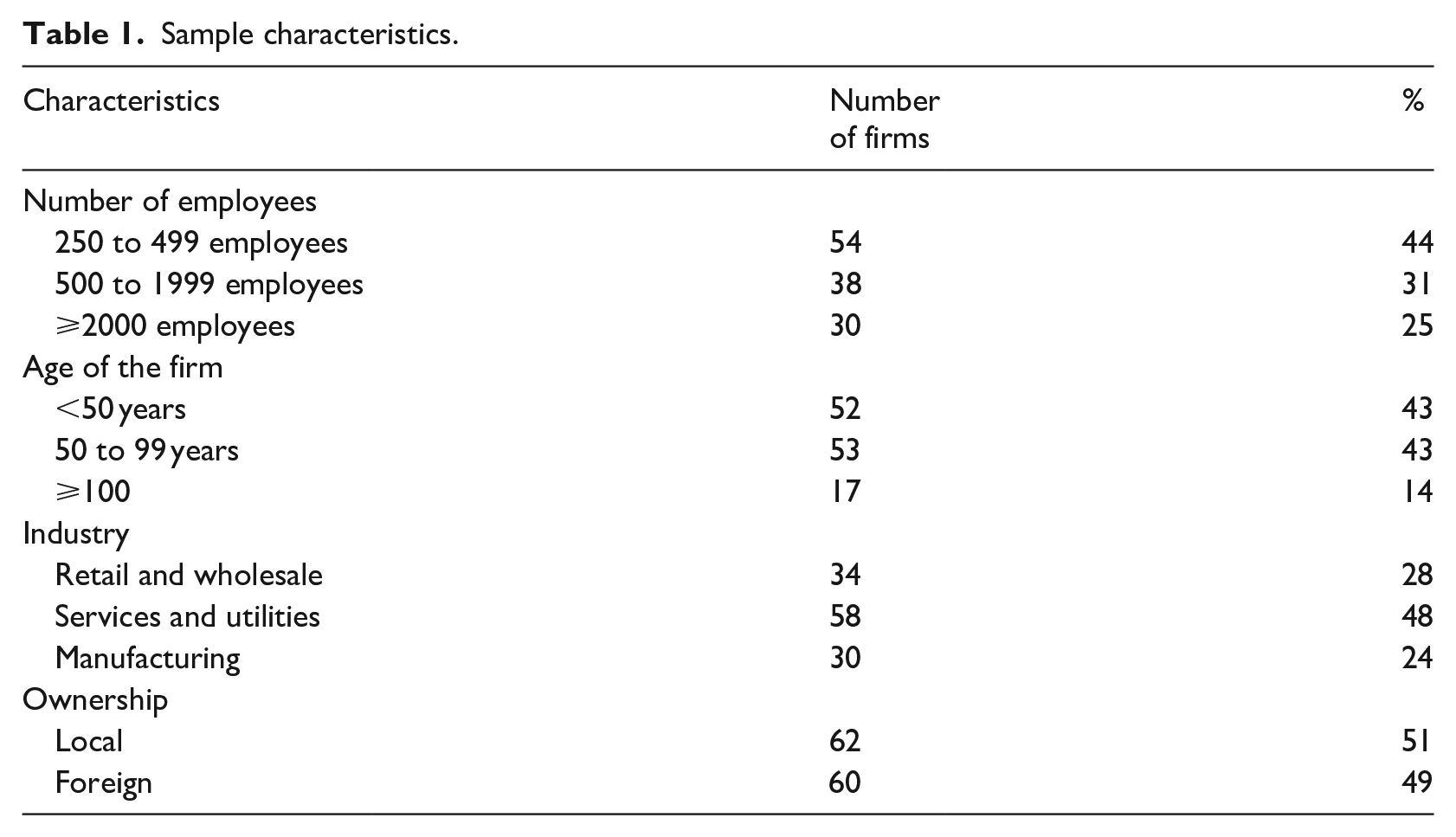
Table 1 highlights our sample characteristics. The sample is slightly dominated by smaller firms (less than 500 employees) with 44%. Nevertheless, the medium (500 to 1999 employees) and large (more than 2000 employees) firms also have a high representation with 31% and 25%, respectively. Not unexpectedly, 86% of the firms in our sample are less than 99 years old. About half of the sample are firms from the services and utilities industry, while the remaining half is roughly equally split between manufacturing and retail and wholesale. Finally, 51% of the sample represents local firms.
Sample characteristics.
Our panel data consist of the count of successful patents, firm-level data and industry data. It was hand-collected from three major databases. The count of successful patents was retrieved from the European Patent Office database. Firm-level data were drawn from Financial Analysis Made Easy (FAME) database, which provides data on yearly number of employees, ownership and research and development (R&D) expenditure. The industry data, such as market share, were obtained from the Office of National Statistics Annual Business Inquiry and is measured at the three digit UK Standard Industrial Classification level.
3.2. Variables
Following previous studies, we use patent count as our dependent variable to measure innovation outputs (Leyva-de la Hiz et al., 2019). Patents are by far the most used proxy for innovation although it can be measured by other outputs such as intellectual property rights, new products and new processes (Hagedoorn and Cloodt, 2003). While these are indeed interesting, our focus is mainly on patents because patent data are publicly available, while the other measures are difficult if not impossible to acquire. For our sample, we were unable to obtain data on measures such as licences or new processes, but we recognise that having multiple outputs of organisational innovation would indeed be interesting.
The independent variables are a combination of downsizing and slack. Downsizing is an indicator of whether the decline in the number of employees reached some threshold, to be detailed below. Welbourne et al. (1999) claim that HR slack is reflected in the number of employees relative to sales. We therefore use average sales per employee as a proxy for the level of slack. Specifically, we measure slack as sales per employee ratio compared with the average in the industry

where
Although preferable, a direct measure of HR slack is difficult if not impossible (Mishina et al., 2004). A measure of relative slack, on the other hand, is quite feasible because it does not require a direct measure of organisational efficiency and is therefore not sensitive to the size of the firm. In addition, we have used HR slack as opposed to other types of excess resources, such as financial slack because the knowledge inherent in human capital is one of the most important resources used in organisational innovation. For example, Lecuona and Reitzig (2014) show that employees holding knowledge that is specific to firms may benefit the firm’s performance.
We control for three variables. Our first control is lagged values of the dependent variable, the number of patents. Because patents are persistent, lagged patents are expected to be important control variables as they are able to capture most of the time persistent firm characteristics, such as market share and other time-invariant characteristics such as age, the type of ownership and export orientation. These variables would have been essential in a cross-sectional analysis, but with the availability of longitudinal data of 22 years, the autoregression on past patent values makes these variables redundant. The second control variable is firm size, which is proxied by the total number of employees. Existing research indicates that firm size has a positive and significant impact on a firm’s ability to innovate (Bound et al., 1984). In their study of 2582 US firms, Bound et al. (1984) showed that large firms were more likely to produce patents compared to their smaller counterparts. The third control variable is R&D expenditure. Research has shown that the role of R&D in the production function of patents is both significant and positive (Bound et al., 1984; Pakes and Griliches, 1984). However, R&D expenditure and slack data were not available for all firms and all years. We therefore employ an unbalanced panel approach in which only non-missing observations are used.
3.3. Empirical model
Let

where
Because patents are sticky, we include a lagged term to allow for the dynamic impact of past firm innovation performance. Lagged dependent variables also help incorporate feedback and other unobserved past characteristics.
Estimating the above model is not straightforward. The firm-specific effect,

This model is estimated by the generalised method of moments (GMM) using instruments based on lags of the dependent variable as well as the exogenous variables

where
Given the past history of a particular firm, current expected patents are dictated by

Therefore, we gauge the effect of downsizing via the examination of

Following Mellahi and Wilkinson’s (2010a) suggestion, we use up to 2 years lag because it may take more than a year for the effect of the change in the number of employees to materialise. The intercept,
Downsizing,
The interaction with slack captures the effect of slack on the relationship between downsizing and patents. We use
Our sample spans at least three major shocks, the 1997 Asian financial crisis, the 2000 dotcom bust, and the 2007 credit crunch. Besides, there are potentially many industry-related shocks, which we are unable to observe. Thus, to mitigate the effect of these shocks on innovation outputs, we conduct a quasi-natural experiment which contrasts the pre- and post-downsizing firm performance while controlling for non-downsizing firms. We use a difference-in-differences regression contrasting the treatment group (downsizers) and the control group (non-downsizers). 1 This approach has been recently employed by Nguyen (2018) to compare the financial performance of polluters and non-polluters, and by Ho et al. (2020) to test the effect of liquidity change on the speed of adjustment of corporate leverage.
In this article, we adapt the standard difference-in-differences approach to our setting. In the standard application of this approach, the sample is divided into two groups (treatment and control) and two periods (pre- and post-event observations). The groups are represented by a treatment dummy, whereas the event is represented by a before/after dummy. Because there is a single event, the before/after dummy is time varying but does not vary in the cross-section. For the same reason, the treatment dummy varies in the cross-section but is not time varying since a firm belongs to one group or the other for the whole period of study.
In our setting, however, we have many events. Since firms have many opportunities to downsize, a firm can be a treatment firm in some years but not so in other years. Consequently, both the treatment and the before/after dummies vary in time and in the cross-section. Finally, as we explain below, successive event windows must be non-overlapping in order to avoid accidentally removing pre-event information in case a firm downsizes during two or more consecutive years.
We use a panel model of the form

where
(a) Set
(b) If no firms downsized that year, then set
(c) Set
(d) Set
(e) Set
The scheme outlined above avoids overlapping of events. If an event occurs at
4. Empirical results
We assess the relationship between downsizing and innovation outputs using the GMM approach of Arellano and Bond (1991) with Newey-West heteroskedasticity and autocorrelation consistent (HAC) standard errors. We use 2-year lags for the variables of interest (downsizing and slack) as well as for the control variables. These lags are necessary because of the time needed between the application and the granting of patents and because it takes time for a change in the number of employees to affect a firm’s production of patents (Hall et al., 1986, 2001; Mellahi and Wilkinson, 2010a; Pakes and Griliches, 1984).
Table 2 provides some descriptive statistics for the main variables used in the estimation. The first column shows the number of valid firm-years. Patents and firm size show the lowest number of missing observations, with 2383 valid observations out of the maximum 2806. R&D expenditure shows the lowest number of valid observations (1764). The average patents granted per year is 9.20 patents, with the standard error of 27.26 indicating substantial dispersion within the sample. Indeed, the most productive year for the most productive firm is 399 patents. The average slack is 0.189%, ranging between –4.7% and 4.1%. The average R&D expenditure is relatively high at £67.809 million per year. This figure is high because our R&D sample is dominated by large firms, while smaller private firms either did not have an R&D account or did not disclose their R&D figures. We treated these unobserved R&D figures as missing which may have overstated our R&D statistics. As the maximum R&D figure shows, larger firms dedicate substantial resources to R&D. Moreover, the standard error of more than £219 million suggests a substantial variability with many firms having no R&D expenditure at all throughout the sample period.
Summary statistics.
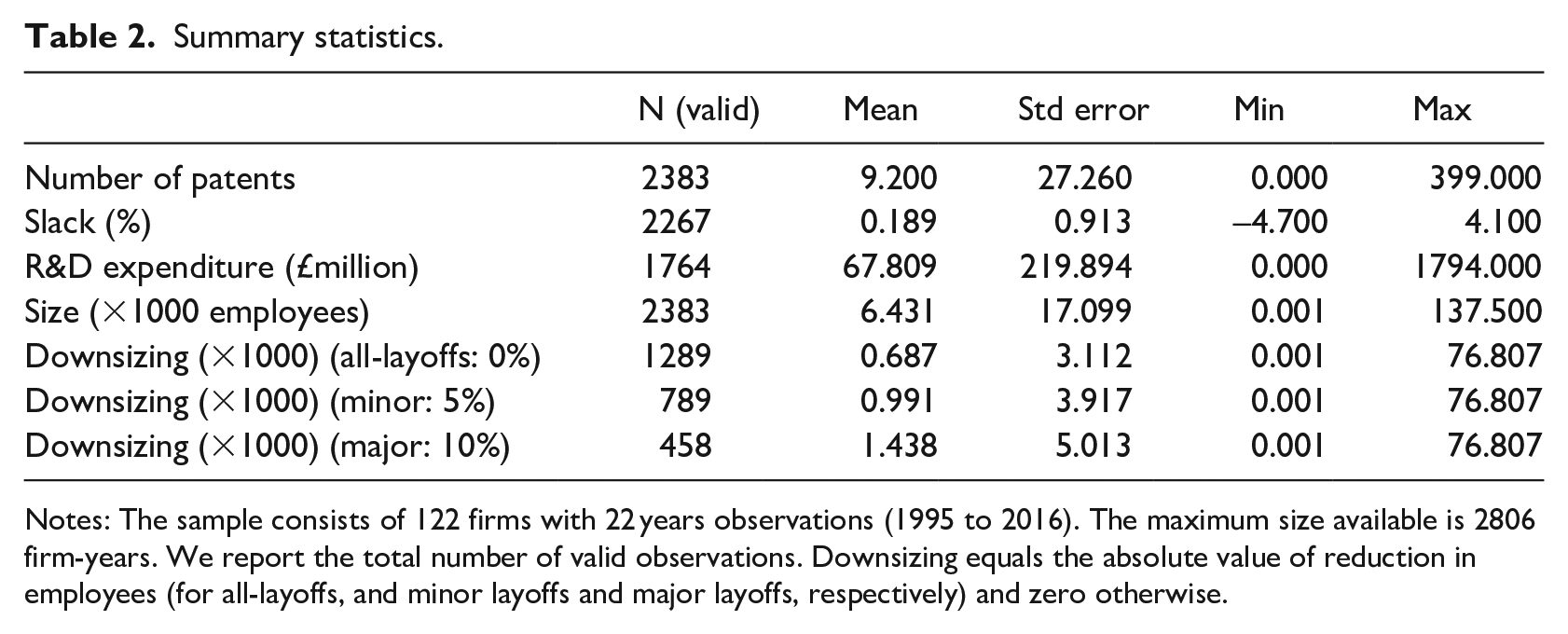
Notes: The sample consists of 122 firms with 22 years observations (1995 to 2016). The maximum size available is 2806 firm-years. We report the total number of valid observations. Downsizing equals the absolute value of reduction in employees (for all-layoffs, and minor layoffs and major layoffs, respectively) and zero otherwise.
There are 2383 observed size statistics. Firm-years for undisclosed size figures were treated as missing. The average size per year is 6431 employees, with a maximum of 137,500 employees. There are 1289 occurrences of layoffs of any size, 789 firm-years downsized by more than 5%, and 458 downsized by more than 10%. The average layoffs were 687, 991 and 1438, respectively.
Table 3 provides pairwise correlations between the main variables used in this study. Although most correlations are significant, they are mostly small in absolute value. Therefore, collinearity is unlikely to be a problem. Patents are positively and significantly correlated with all independent variables. The strong correlation between patents and R&D is expected, since internal research capabilities are key to enabling a firm to generate patents (Artz et al., 2010; Löfsten, 2014). Moreover, the strong correlation between patents and firm size is expected, given that larger firms tend to possess scale advantages and have access to complementary assets and capabilities. Also, downsizing and slack are positively correlated with patents, although slack is only significant at the 5% level. Interestingly, the correlation between downsizing and slack is insignificant and small. This suggests that firms experiencing high or low levels of resource constraints will not necessarily have high or low levels of downsizing. More importantly, this suggests that slack should not be used as a proxy for downsizing and might explain the inconsistent results found in the extant literature. Another large and significant correlation among the explanatory variables is between R&D and firm size. This is not unexpected because larger firms tend to have more assets and hence higher R&D expenditures. Nevertheless, the correlation of 0.327 is not near perfect correlation enough to warrant exclusion of one of the two variables from our model.
Correlations.
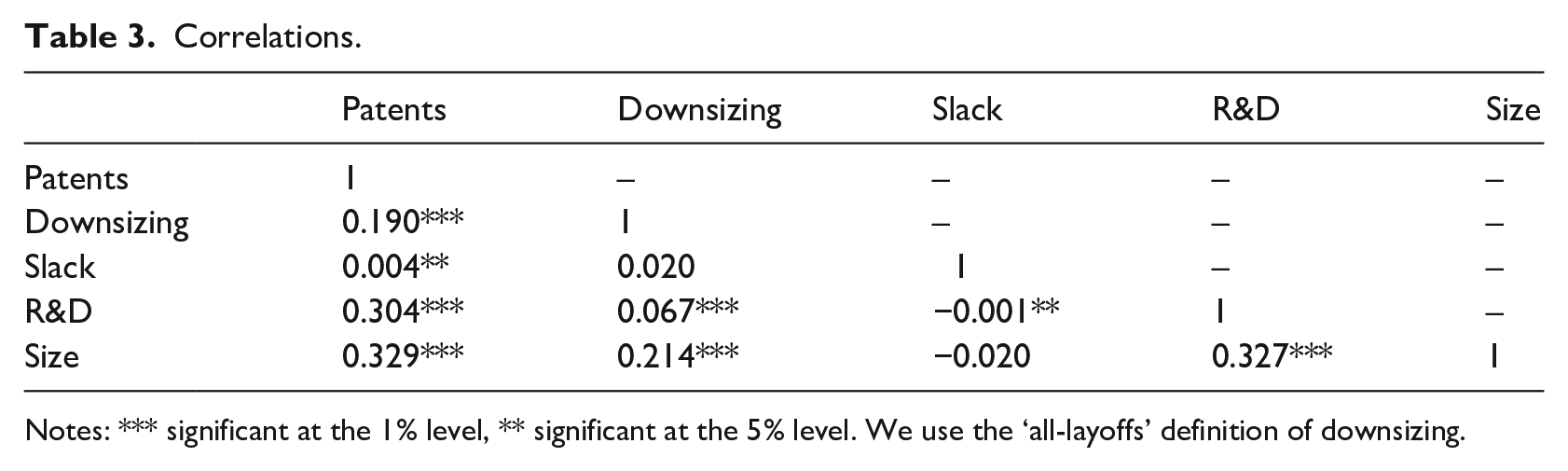
Notes: *** significant at the 1% level, ** significant at the 5% level. We use the ‘all-layoffs’ definition of downsizing.
The Arellano and Bond (1991) GMM estimation results are given in Table 4. The table summarises the estimation results for two definitions of downsizing. The first model defines downsizing as a reduction of more than 5% in the workforce. We call this minor downsizing. The second model considers downsizing to occur if the reduction in the workforce is more than 10%. We call this major downsizing. The 5% and 10% definitions are more consistent with organisational downsizing as an intentional proactive strategy (Freeman and Cameron, 1993). Definitions using layoffs of less than 5% are less appropriate as a measure of downsizing since they include small workforce changes that may not necessarily represent a downsizing decision. Small changes are more consistent with organisational decline, which occurs involuntarily as a result of environmental and organisational pressure (Freeman and Cameron, 1993).
Dynamic panel estimation results.
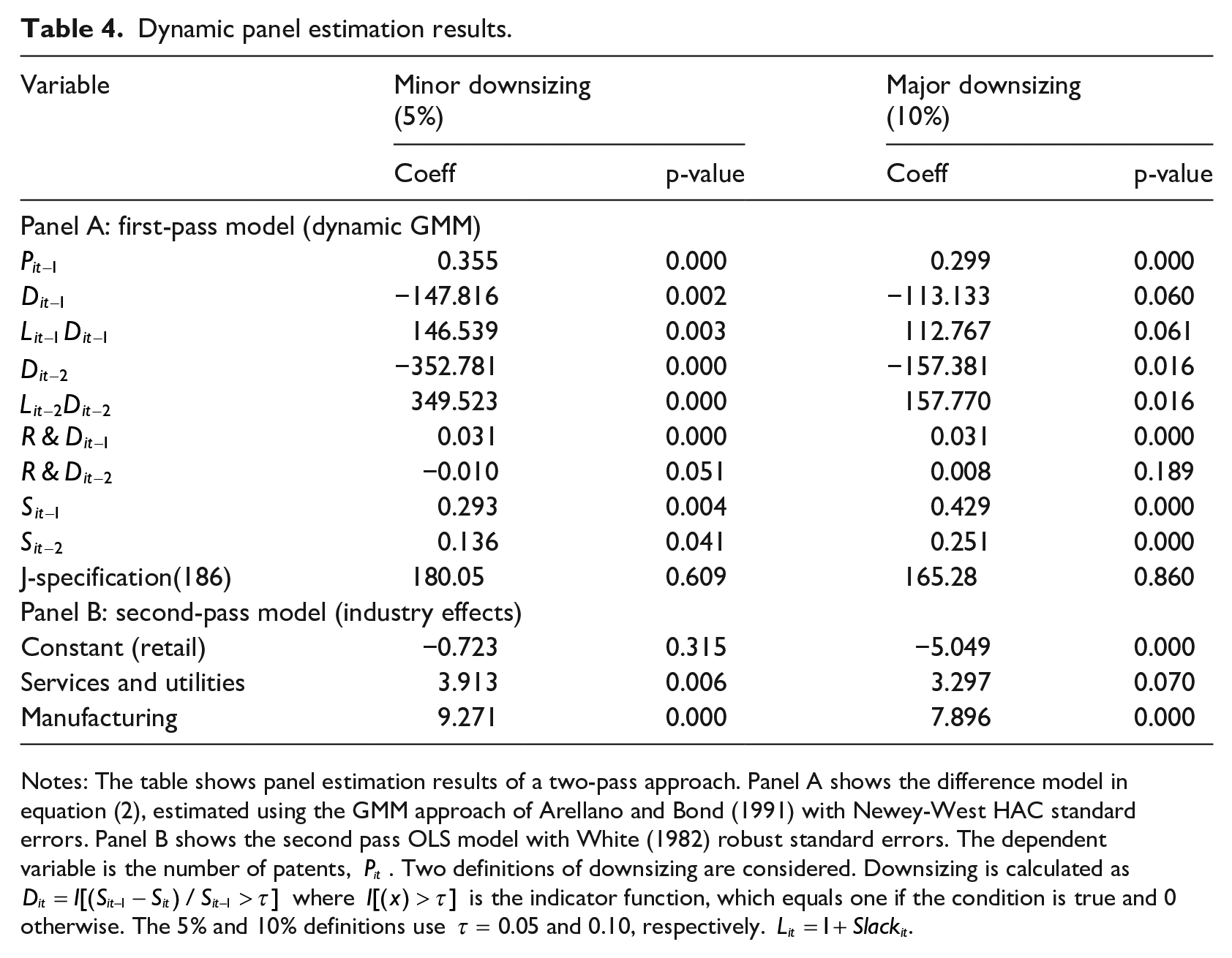
Notes: The table shows panel estimation results of a two-pass approach. Panel A shows the difference model in equation (2), estimated using the GMM approach of Arellano and Bond (1991) with Newey-West HAC standard errors. Panel B shows the second pass OLS model with White (1982) robust standard errors. The dependent variable is the number of patents,
To test hypotheses 1a and 1b, we estimated the panel model (equations (2)–(4)). The results are shown in Table 4. The first pass is shown in Panel A of the table, while the second pass is shown in Panel B. Both models are accepted by Hansen’s J-statistic, with p-values greater than 60%. This implies that the set of instruments is appropriate for these data.
For the industry effect, we first estimated the second-pass model via GMM with market share and ownership dummy as additional instruments. The set of instruments was rejected by Hansen’s J-statistics in all three cases. We therefore adopted OLS with robust standard errors.
As Panel A of Table 4 shows, the lagged patent coefficient is around 30% and highly significant for both models. Patents are clearly persistent, suggesting that high patent firms tend to continue their previous performances. Specifically, about 30% of current year patents is explained by last year’s patents, which justifies the inclusion of lagged patents
The 1-year lag R&D is positive and significant throughout, while the 2-year lag is insignificant at the 5% level. The Size coefficients, on the contrary, are positive and highly significant for both lag years.
Both minor and major downsizing models suggest that the effect of downsizing takes place over 2 years, although the 1-year lag of downsizing and interaction terms are only significant at the 10% level in major downsizing. The individual coefficients suggest that downsizing has a negative impact, but the full impact of downsizing needs to be taken in conjunction with resource slack and constraints. As Figure 1 shows, the effect of downsizing can be positive or negative, depending on the firm’s level of resource slack or constraints prior to downsizing. The effect of downsizing on innovation outputs is contingent on whether the firm is experiencing resource slack or constraints.
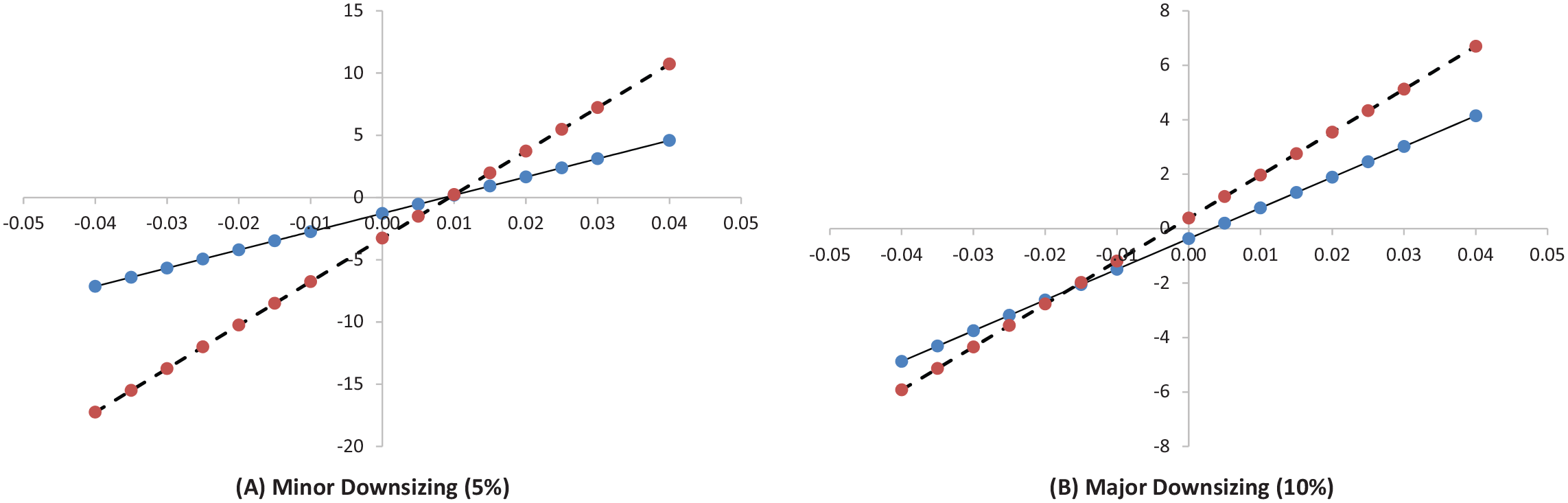
The impact of downsizing on innovation outputs.
As can be seen from Table 4, all interaction terms are positive. This suggests a positive impact for high slack firms and negative impact for negative slack firms, as expected. Moreover, the 2-year lag impact of downsizing is greater than that of 1-year lag impact. This difference is particularly acute in minor downsizing, where the 2-year impact is more than twice as big as the 1-year impact in absolute value. This can be clearly seen from Table 5, which shows the expected change in patents following downsizing. For example, for minor downsizing and a slack of –1%, the 1-year lag impact is –2.74 patents, whereas the 2-year lag impact is –6.75. Thus, less than a third of patent change takes place in the first year post-downsizing. The same pattern goes for most values of slack, except for slack near 1%, which is the crossing point as can be seen from Figure 1.
Changes in patents following downsizing.
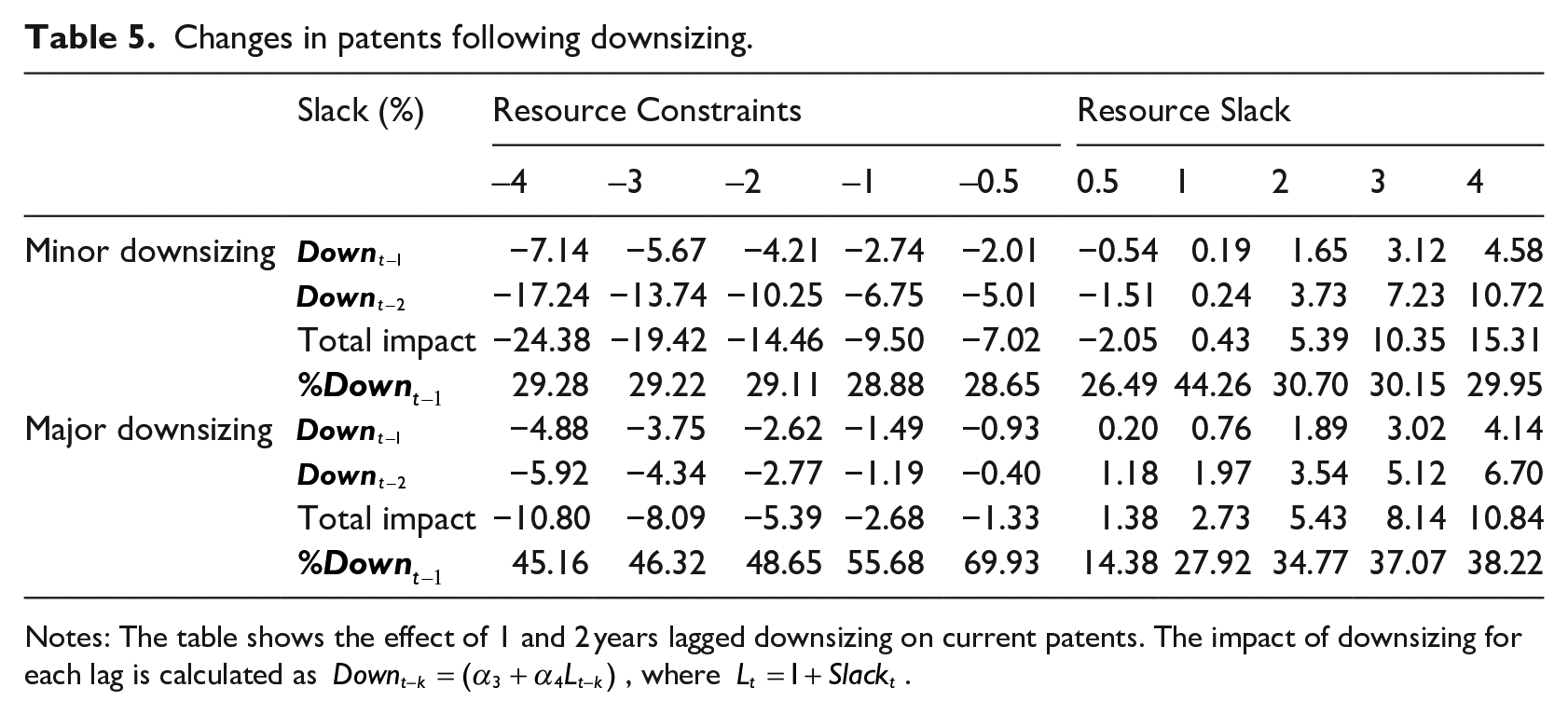
Notes: The table shows the effect of 1 and 2 years lagged downsizing on current patents. The impact of downsizing for each lag is calculated as
For the major downsizing model, the impact is not as clear-cut, as the 2-year lag coefficient of downsizing is smaller in absolute value than the 2-year lag interaction term. Moreover, both 1-year lag downsizing and interaction coefficients are insignificant at the 5% level. Nevertheless, as the table shows, for most values of slack, the 2-year lag impact is greater than the 1-year lag impact. The exceptions occur near the –1% slack, which is the crossing point for this definition of downsizing (see Figure 1).
Overall, both minor and major downsizing models provide qualitatively similar results, suggesting that the general pattern of our results are robust to the definitions of downsizing. Nevertheless, there is a notable difference in the scale of impact. In the minor downsizing model, the coefficients associated with downsizing are greater in magnitude than the coefficients associated with the interaction term. The opposite is true for the major downsizing model. The difference between the two definitions is shown in Figure 1. Both models indicate the positive (negative) impact of downsizing for resource slack (resource-constrained) firms. However, from Table 5, the minor downsizing model suggests that firms typically require between 0.5% and 1% slack before benefitting from downsizing. The major downsizing model suggests between 0% and 0.5% slack before benefitting from downsizing. Another important difference is the scale of the total impact suggested by the two models. While the minor downsizing model suggests total impacts between –24.38 and +15.31 patents, the major downsizing model suggests –10.80 and +10.84 patents for the two extreme slacks, respectively.
The industry dummies in Panel B of Table 4 show a clear heterogeneity across industries. For minor downsizing, the retail sector dummy is insignificant, suggesting that a ‘typical’ retail firm with the independent variables set to zero has no patents on average. The services and utilities dummy is about 3.91 patents and highly significant, suggesting that a ‘typical’ service and utilities firm has 3.91 more than a ‘typical’ retail firm. The highest patent output is found within the manufacturing industry. The coefficient is more than nine patents and highly significant. The major downsizing model suggests the same ranking by different levels, with the negative retail patent (around –5 patent), negative services and utilities patent (around –2 patents). Only the manufacturing sector has above average typical patents at around 2.8 patents.
Our hypotheses 1a and 1b are thus confirmed – resource slack (resource-constrained) firms are expected to be positively (negatively) affected by downsizing. However, these contrasting effects might not have the same timing and magnitude.
To test hypothesis 2 we compared the proportion of Year 1 contribution to total downsizing impact. This is shown in Table 5 as
For minor downsizing, we constructed two series on the proportion of Year 1 contribution to total impact. The first series calculates the proportion for negative slack, varying from –4% to –0.2% with increments of 0.2%. This gives us 20 observations for hypothetical resource-constrained firms. We also calculate 20 observations for slack-rich firms with slack values between 0.2% and 4% with increments of 0.2%. For our second hypothesis, if the effect of downsizing is more immediate for resource-constrained firms, we should expect that the contribution for negative slack to be greater than the contribution for positive slack. In Table 5, we produce the Year 1 contributions,
The Year 1 contribution for the major downsizing model is far greater for the resource-constrained firm. For example, Table 5 shows that the Year 1 contribution is almost 70% for a firm with –0.5% slack but only 14.38% for a firm with 0.5% slack. We repeated the same exercise for major downsizing. The mean difference is substantial at 18.98% and is highly significant (p-value < 0.001). The major downsizing model therefore suggests that indeed the impact of downsizing is quicker for resource-constrained firms.
Table 6 presents the difference-in-difference results for equation (5). The downsizing impact after controlling for potential exogenous shocks is given by
Difference-in-difference results.
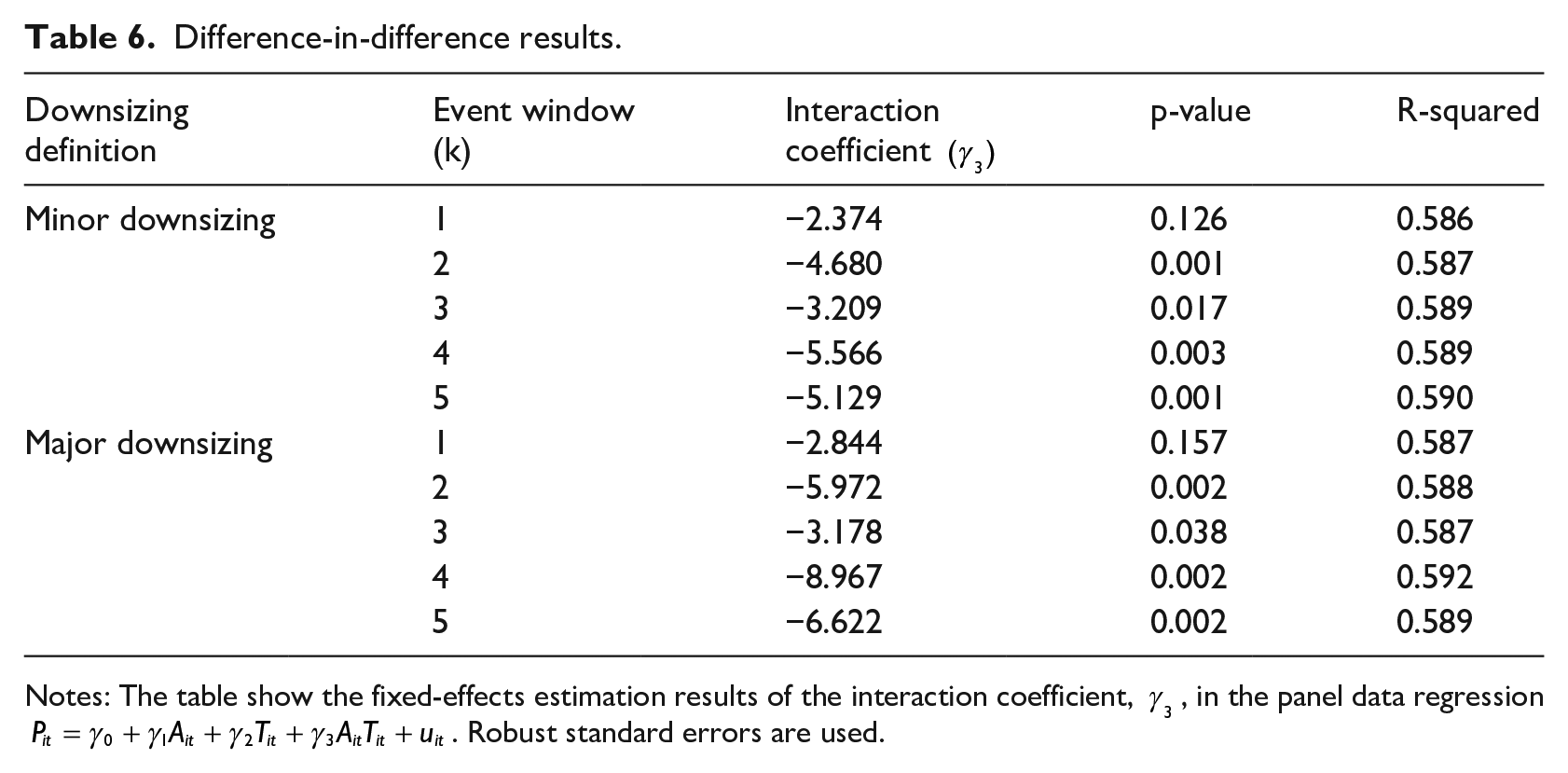
Notes: The table show the fixed-effects estimation results of the interaction coefficient,
5. Discussion
This study attempts to address the inconclusive evidence on whether downsizing improves, stifles or has no significant effect on innovation. We re-examine the effect of downsizing on innovation outputs by highlighting the contingent role of resource slack and constraints. Our empirical analysis shows that downsizing has a dual effect on innovation, contingent on the firm’s level of resources. Specifically, our results reveal that the effect of downsizing on innovation outputs is positive in firms experiencing resource slack and negative in resource-constrained firms.
This study advances prior research on the effect of downsizing on organisational innovation (Mellahi and Wilkinson, 2010a; Nohria and Gulati, 1996; Tan and Peng, 2003) in two important ways. By re-examining the effect of downsizing on innovation and incorporating the role of resource slack and constraints, the impact on organisational innovation cannot be specified without taking account of a firm’s resources prior to implementing downsizing. This is a major departure from previous studies, which looked at the effect of downsizing and ignored resource endowment prior to the event or only focused on the level of slack reduction. In line with our expectations, the results clearly show that downsizing improves innovation in firms experiencing slack resources and stifles innovation in resource-constrained firms. Overall, our study provides a more nuanced and comprehensive understanding of downsizing–innovation relationship. In particular, we provide evidence that a one-dimensional question such as ‘Are such organisations leaner and fitter or understaffed and anorexic?’ (Mellahi and Wilkinson, 2010b: 2299) needs unpacking because an organisation can be either, depending on its resource situation prior to downsizing. Using this metaphor, downsizing ‘fat’ firms does indeed lead to leaner and fitter firms, whereas downsizing anorexic firms leads to more anorexia.
Second, our study contributes to prior research on the time it takes for the effect of downsizing to occur (Amabile and Conti, 1999; Mellahi and Wilkinson, 2010a). Our results suggest that, while it takes 2 years for the full effect of downsizing to occur, the impact on innovation outputs takes less time in resource-constrained firms. Typically, within 1 year, the negative impact in resource-constrained firms accounts for a total contribution between about 45% and 70%, while the positive impact in slack-rich firms accounts for between 14% and 38%, depending on the level of slack resources. These results are consistent with Mellahi and Wilkinson’s (2010a) findings suggesting that it takes time for innovation outputs to be affected by downsizing. In addition, post-downsizing initiatives may explain the delayed effect of downsizing on innovation outputs in firms experiencing resource slack. These firms take a number of initiatives to manage the aftermath of downsizing (Fernández-Menéndez et al., 2020). This is also consistent with Amabile and Conti’s (1999) finding that organisations improve their work environment post-downsizing by rebuilding their innovative capabilities. However, the full impact of downsizing on innovation outputs is more immediate in resource-constrained firms. This could be due to the limited resources, which prevent firms from investing in post-downsizing initiatives and as a result forgo innovative projects.
The effect of downsizing on innovation in firms experiencing resource slack or constraints carries substantive managerial implications. First, before undertaking any downsizing, managers need to be aware of their existing resource situation. If the firm is experiencing resource slack, then managers should be confident that downsizing can be properly managed, and that it is likely to be beneficial for the firm because this action would increase their future innovation output. However, managers are cautioned against undertaking downsizing when their firms experience resource constraints. In this case, implementing downsizing would be detrimental to their organisational innovation. However, because more than half of the total effect will only take 1 year to show, managers may choose to mitigate this effect by putting in place initiatives to rebuild their innovation capabilities within a relatively short time span.
Finally, our findings have implications for scholars interested in uncovering the benefits and drawbacks of downsizing slack-rich organisations. We have demonstrated in this study that downsizing firms with low slack has limited potential benefits, whereas downsizing in firms with excessive slack has evident benefits in terms of innovation outputs. Thus, we call for future research to assess the validity of these findings and whether downsizing can benefit and/or hinder other areas of business performance.
6. Conclusion
This article has sought to study the effect of downsizing on innovation by incorporating the role of resource slack and constraints. Our key findings relate to the direction of the effect of downsizing on innovation outputs and the timing of this effect. For the former, our findings suggest that both the sign and the scale of the effect of downsizing is conditional on whether the firm experiences resource slack or constraints prior to downsizing. The negative impact of downsizing in resource-constrained firms increases monotonically with the level of resource constraints. This is perhaps expected, but our contribution is to quantify this loss of innovation which varies between around 7 and 24 patents, depending on the level of resource constraints. A less-obvious result is that of downsizing firms experiencing resource slack. While the effect of downsizing is positive overall, it is limited for moderate slack, but important for excessive slack. Within our sample, the most extreme case can benefit by an increase of over 15 patents. We also find that the effect of downsizing on innovation outputs is more immediate in resource-constrained firms compared to slack-rich firms. While most of the negative impact is realised within a year in resource-constrained firms, most of the benefits of downsizing is realised 2 years post-downsizing for slack-rich firms.
This study has several limitations that may, in turn, stimulate future research. First, this study has examined the effect of downsizing on innovation by focusing on one type of excessive resources (i.e. HR). However, this does not provide the full picture of the effect of downsizing in relation to other types of resources such as financial, operational, and customer-related resources (Suzuki, 2018; Symeou et al., 2019). Future research could examine the downsizing–innovation link in relation to other resources. Since firms may combine constraints in one type of resource and slack in other type of resources, it is also worth investigating which distinct bundle of resources (Paeleman and Vanacker, 2015) alters the downsizing–innovation relationship. Second, our measure of resource slack does not account for the different types of jobs being downsized. Using a different measure of resource slack that pinpoints the downsizing that targets innovation activities such as R&D employees would be a worthwhile avenue for further enquiry. Third, our measure of innovation outputs focuses on the production of patents and does not take into account other measures such as new product development. Also, our study did not consider the economic value of patents. Prior research has demonstrated that patents in themselves could be relatively unimportant as they vary in their economic value (Hall et al., 2001). Thus, future research could examine the innovation effectiveness or the ability of firms to capitalise on patents as dependent variables to verify the results of this study. Moreover, while the use of additional measures of innovations such as copyrights, licences and product development is desirable, it will only be possible if the data on these measures becomes publicly available. Fourth, this study is based on data collected from a single country. To further establish the generalisability of our results, future research could replicate this study in other industries and/or other institutional contexts (Ritter-Hayashi et al., 2020; Vanacker et al., 2017). Moreover, future research should examine the effect of downsizing on other organisational outcomes such as firm survival and performance (Bentley and Kehoe, 2020). Finally, this study adopts an output perspective of innovation. Future research should complement our study with an input perspective of innovation.
Footnotes
Final transcript accepted 11 October 2020 by Martina Linnenluecke (AE Strategy)
Funding
The author(s) received no financial support for the research, authorship and/or publication of this article.
1.
We thank an anonymous reviewer for suggesting this approach.