



Abstract

Source: National Cancer Institute Visuals Online AV-7805-3733.
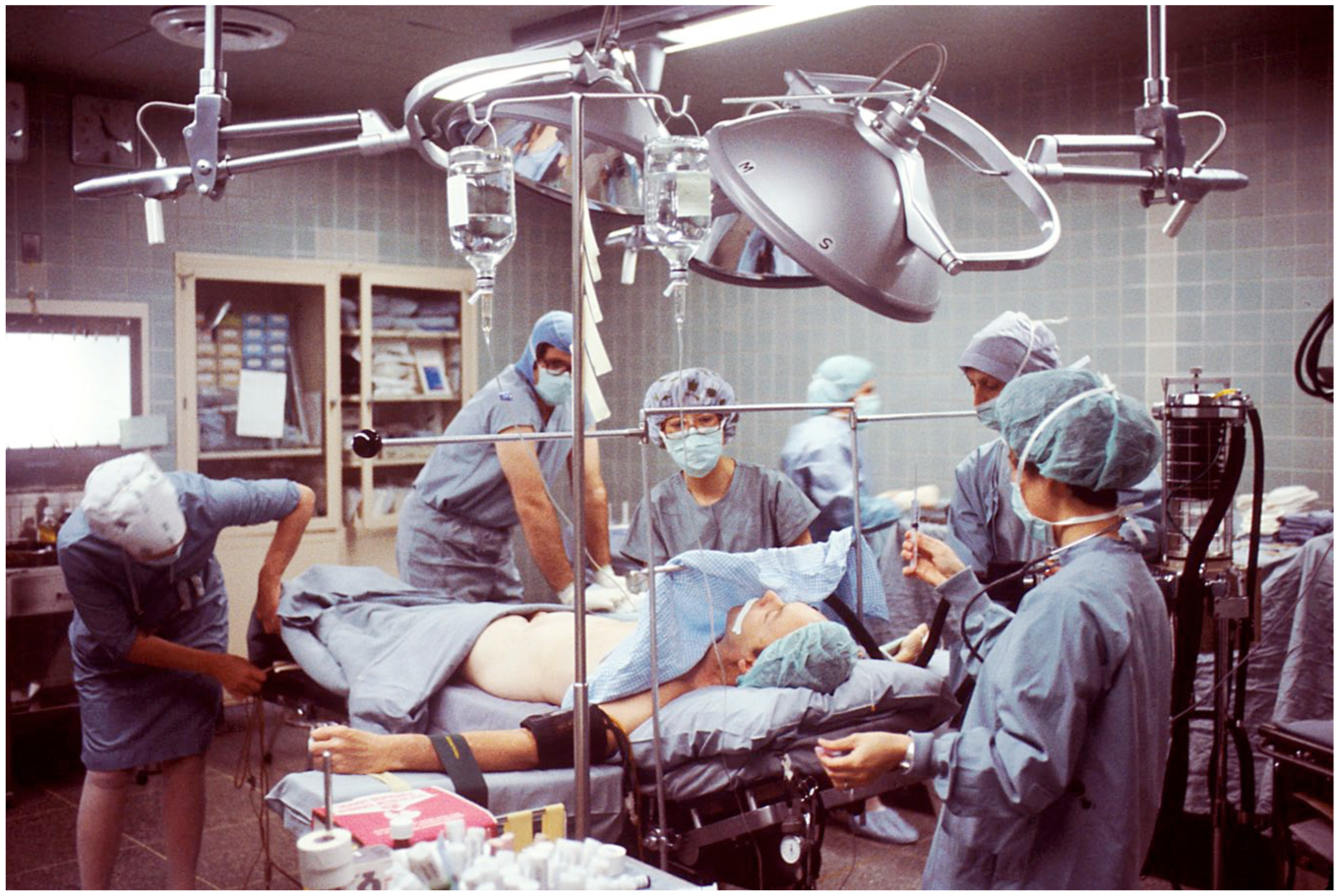
The living body of personnel in an operating room is by far the most important source of pathogenic organisms.
John Charnley, 1972.
1
In January 1963, a severe outbreak of postoperative Staphylococcus aureus wound infections at St Albans City Hospital, Hertfordshire was traced to an unusual source: an anaesthetist. Swabs taken from the anterior nares, dorsum of each hand, and forehead of the anaesthetist all yielded a heavy growth of the bacterium, which possessed the same antibiotic sensitivity pattern and phage type as the affected patients. Furthermore, blood-agar plates placed on the floor of a room in which he removed his clothes and dressed again were grossly contaminated with the organism. Previously identified as a nasal carrier of Staphylococcus aureus, the anaesthetist had been hospitalised 1 month before the outbreak with a flare of psoriasis, necessitating both local and systemic treatment. While this acute exacerbation settled rapidly and he was able to return to work on 7 January 1963, he did so with several large patches of desquamating but not overtly infected skin. It was postulated however, that these areas of desquamation were colonised with Staphylococci, transforming him ‘from a relatively harmless nasal carrier into a highly dangerous Staphylococcal disseminator’. 2
Prior research by microbiologists at the University of Edinburgh had demonstrated that ‘very large numbers of bacteria-carrying dust particles’ 3 were liberated from the skin of theatre staff during normal activities, and some of these particles could ‘remain airborne for a time more than sufficient to allow their drifting to the operating table from all parts of the theatre’. In tests conducted in a specially constructed chamber from which air was withdrawn for bacteriological analysis, the wearing of a sterile gown of the ‘usual surgical pattern’ (light cotton cloth, reaching to below the knees and tied at the back with tapes), sterile gloves, disinfected rubber boots and a ‘standard surgical cap and mask’ decreased the number of bacteria-carrying particles shed during ‘vigorous activity’ (which included ‘marking time at walking pace, raising the feet, and swinging the arms’) by just 41%—a reduction that was considered ‘practically valueless’. 3
Other investigators had also begun to question the ‘false faith in the surgeon’s gown’, which had been ‘more or less taken for granted’ since its widespread adoption in the early 20th century.4,5 Studies demonstrated that pathogenic microorganisms could be ‘sweated’ through the loosely woven sleeves, 6 and once wet with blood or irrigation fluid, the material acted as a ‘sieve to the passage of bacteria’. 4 Thus by the early 1960s, there was considerable interest in the creation of theatre attire that would reduce bacterial shedding, as well as the development of gowns that would provide an effective barrier to blood and aqueous fluid.
In 1965, a team including Robert Blowers, Director of the Public Health Laboratory, Middlesborough, and Edgar Pask, Professor of Anaesthetics, University of Newcastle-upon-Tyne, commenced a series of experiments using operating suits fashioned from ventile fabric.7,8 This closely woven cotton material possessed an average pore size of 9 µm, and had been developed during World War II for the immersion suits worn by pilots of the Royal Air Force Merchant Ship Fighter Unit, who accompanied convoys in the North Atlantic. When wet, the warp and weft yarns swelled to obliterate the inter-fibre pores, and this inherent water resistance was reinforced by a chemical treatment that remained effective for 30 launderings. 8
Initial tests conducted with a one-piece ventile scrub suit, which enclosed all the limbs, including the hands and feet, and the trunk up to the neck, demonstrated a significant reduction in the aerial dispersal of skin bacteria when compared with a similar outfit constructed from standard cotton. The suit was subsequently divided at the waist to create a two-piece design, which incorporated a loose and comfortable neck opening, short sleeves, and open trouser legs. Only this final modification allowed bacteria to escape in significant numbers, and this could be reduced by placing Velcro ties around the ankles. Donning a sterile ventile gown did not further decrease the liberation of bacteria into the air, but being waterproof, it reduced the ‘risk of direct contamination from the skin of the surgeon to the wound, if the surgeon’s sleeve became wet’. 8
Five years later, orthopaedic surgeon John Charnley introduced a ‘body exhaust system’ for use during total hip replacement procedures at Wrightington Hospital, Lancashire.1,9 This comprised a hooded ventile gown that hung from the vertex of the wearer’s head, and enveloped the whole body. Having no constrictions at the neck or waist, it encouraged warm air from the body to rise into the spaces between the shoulders and sides of the head, from where it was evacuated by suction hoses incorporated in a lightweight plastic headpiece, which included a transparent plastic window. Suction could be varied from 15 to 35 ft 3 per min. At higher settings this generated a noise similar to that ‘experienced in a private airplane’. Nevertheless, Charnley stated that ‘little or no conversation’ was required during routine, well-rehearsed surgery. In addition to believing that whole-body exhaust-ventilated suits would reduce the incidence of deep infection after total joint-replacement (a finding that was corroborated in a multicentre randomised study published in 1982, 10 but refuted by more recent data from the New Zealand Joint Registry 11 ), Charnley also felt that the system had beneficial effects on the physical and mental well-being of the surgeon, making operating ‘almost . . . akin to activity in the open air’, and improving concentration during prolonged procedures. 9
Despite its advantages, ventile fabric was expensive, and scrub suits proved uncomfortably warm when worn for long periods.12,13 While a host of disposable, non-woven fabrics were developed, 14 researchers began to question whether simpler types of theatre clothing could be designed if more were known about the sites from which contaminated skin scales were shed. 12
In 1974, aware of the risks posed by ‘heavy dispersers’ of Staphylococcus aureus, and evidence that this was ‘particularly associated with carriage of the organism in the skin of the perineal area’,12,15 two groups assessed the efficacy of ‘bacteria-proof . . . ventile underpants’ worn beneath a conventional cotton theatre suit. Although the results were conflicting, both studies agreed that approximately 10% of men, but only 1% of women were Staphylococcal disseminators.12,16 However, when it subsequently emerged that the wearing of scrub dresses increased bacterial shedding by females, calls were made for trouser suits to ‘be used by every person in the operating room’. 17
In recent years, debate over theatre attire has led many to question the clinical impact of recommendations made in the 1960s and 1970s based on bacteriological air sampling studies. 18 Yet this body of work continues to influence our practice today.
Footnotes
Declaration of conflicting interests
The author declared no potential conflicts of interest with respect to the research, authorship, and/or publication of this article.
Funding
The author received no financial support for the research, authorship, and/or publication of this article.
